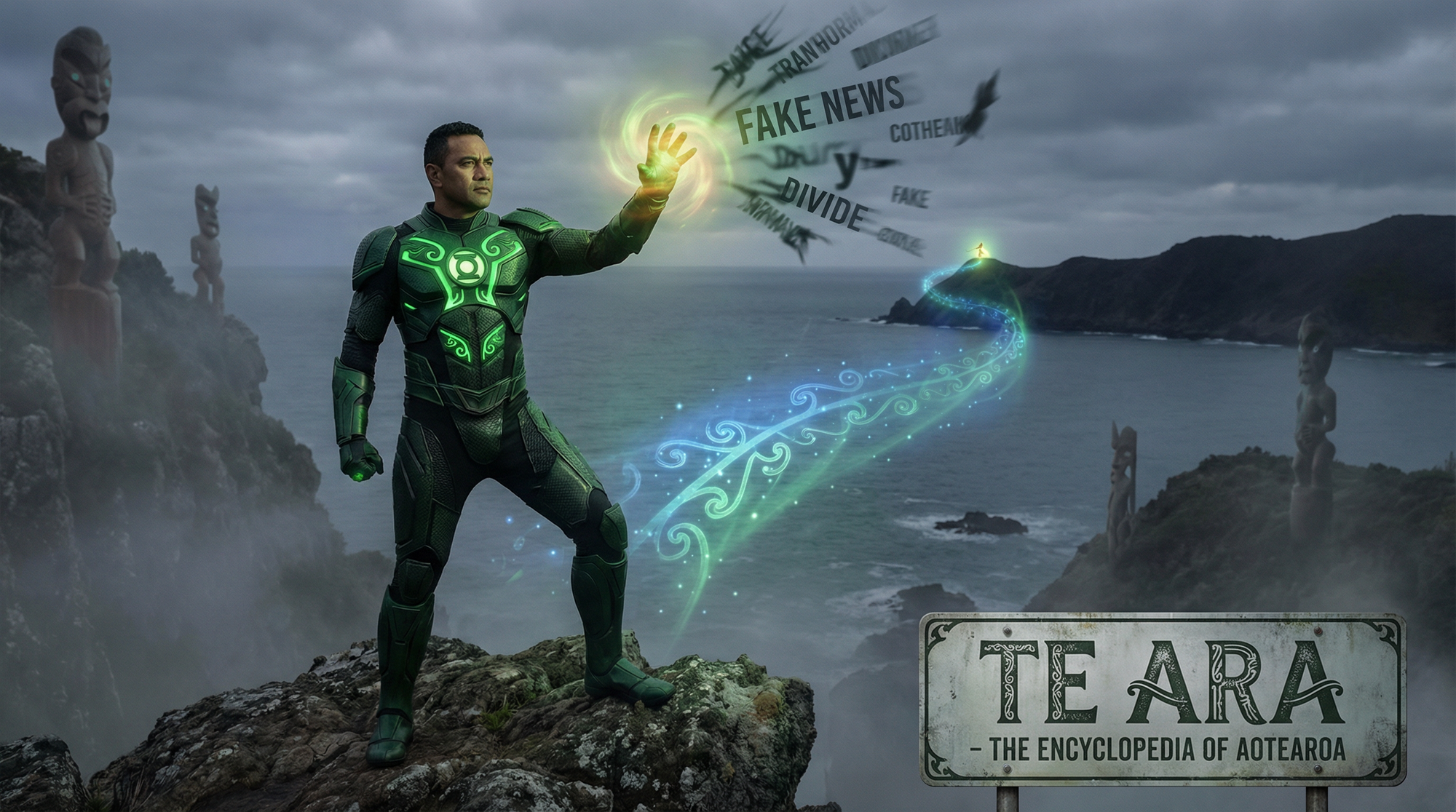
“Te Waha o Tāne: The Tūī’s Song at Dawn — How the Voice of the Forest God Calls the Māori Green Lantern to Truth-Telling” - 24 December 2025
“It was in the night that the gods sang the world into existence,
into the world of light that created a world of music.”
— Traditional Māori creation story
1. The Moment Before Tāne Separates the Sky: Te Pō Muriwai
Before dawn breaks, there exists a threshold moment in Te Pō
—the realm of becoming that exists between
the absolute darkness of
Te Kore
and
the full light of
Te Ao Mārama.
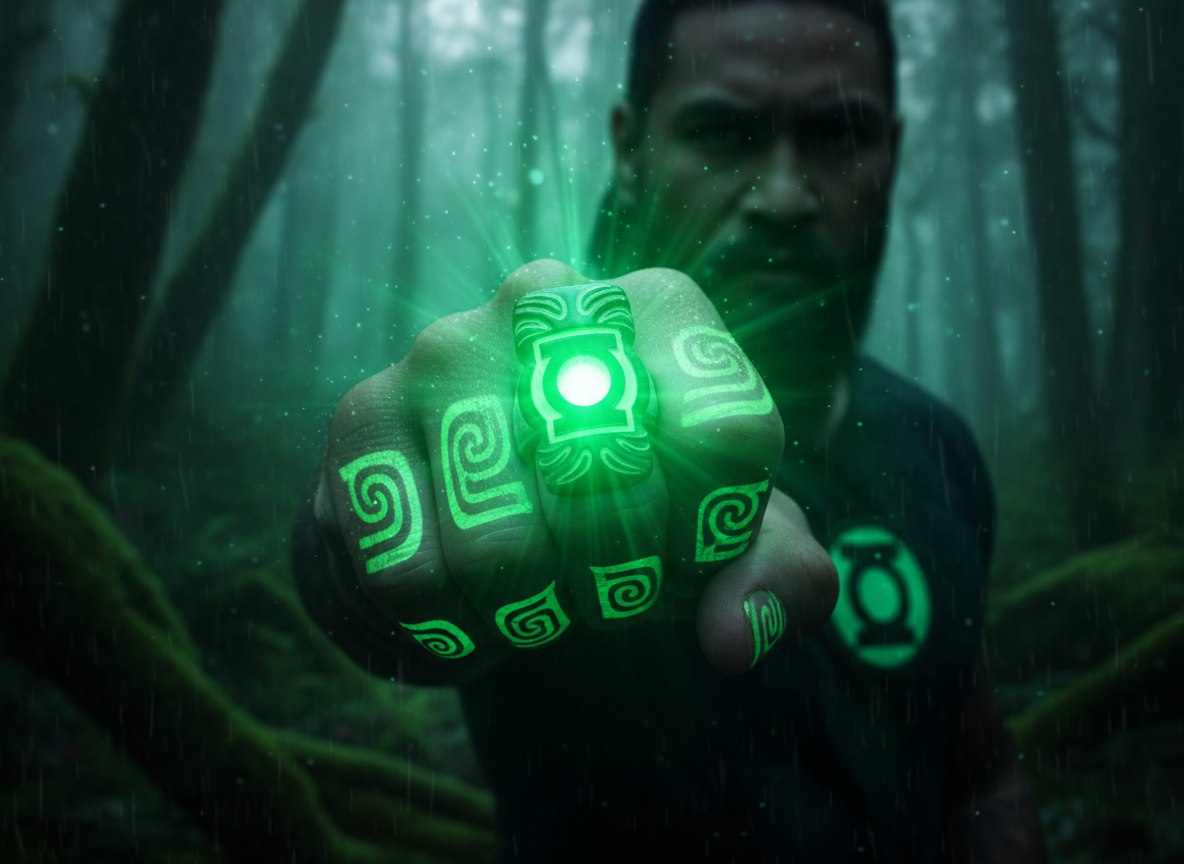
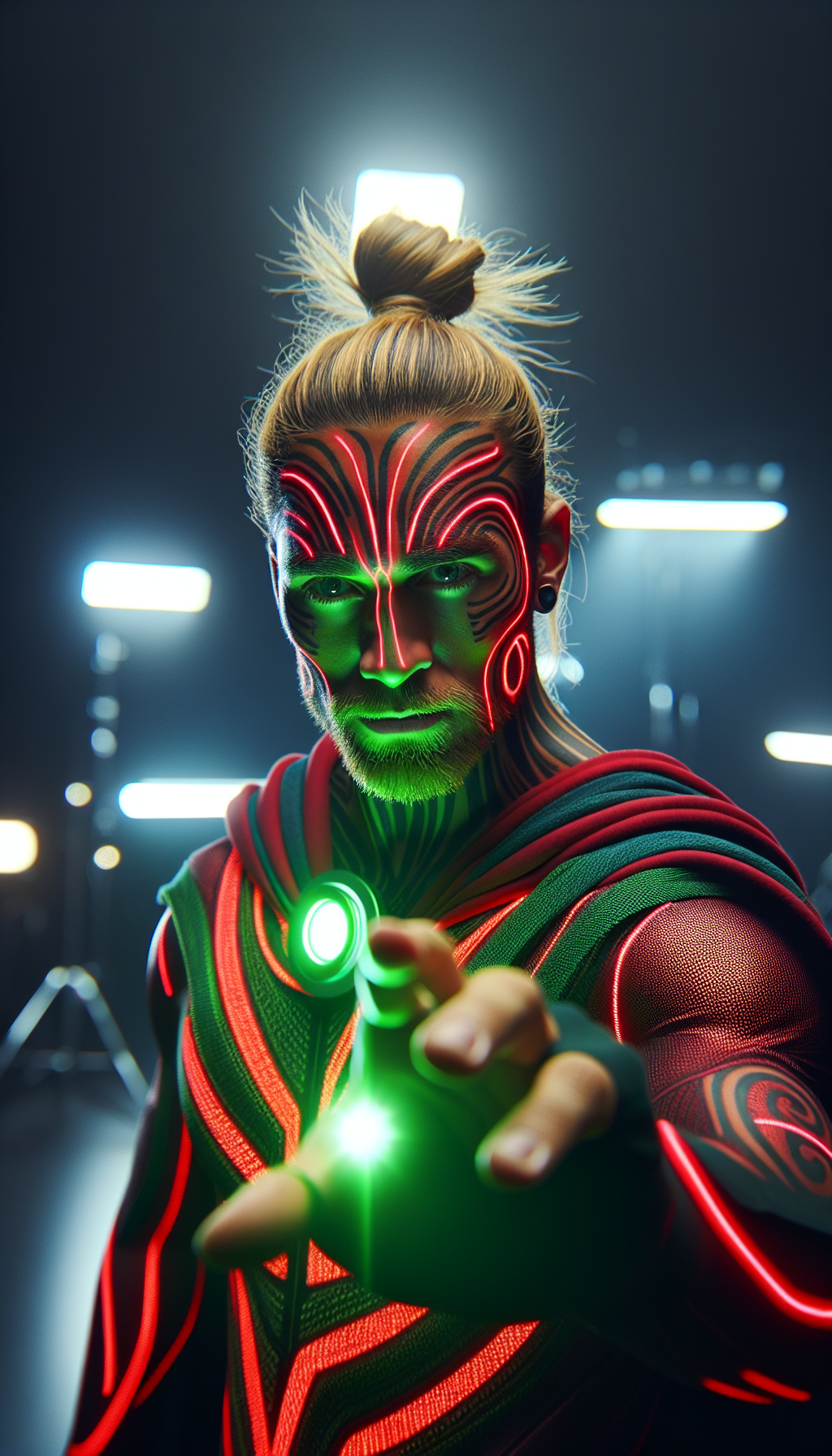
This is the moment the Māori Green Lantern enters, long before the sun rises, before the first light touches the maunga, before even the most vigilant human wakens.
In this threshold, the forest is utterly silent.
No sound.
No movement.
Only potential.
This is Te Pō Muriwai—the deep night, the waiting darkness where creation itself still holds its breath.
And then, at the precise moment when the sky begins its infinitesimal shift from absolute black to the faintest suggestion of grey,
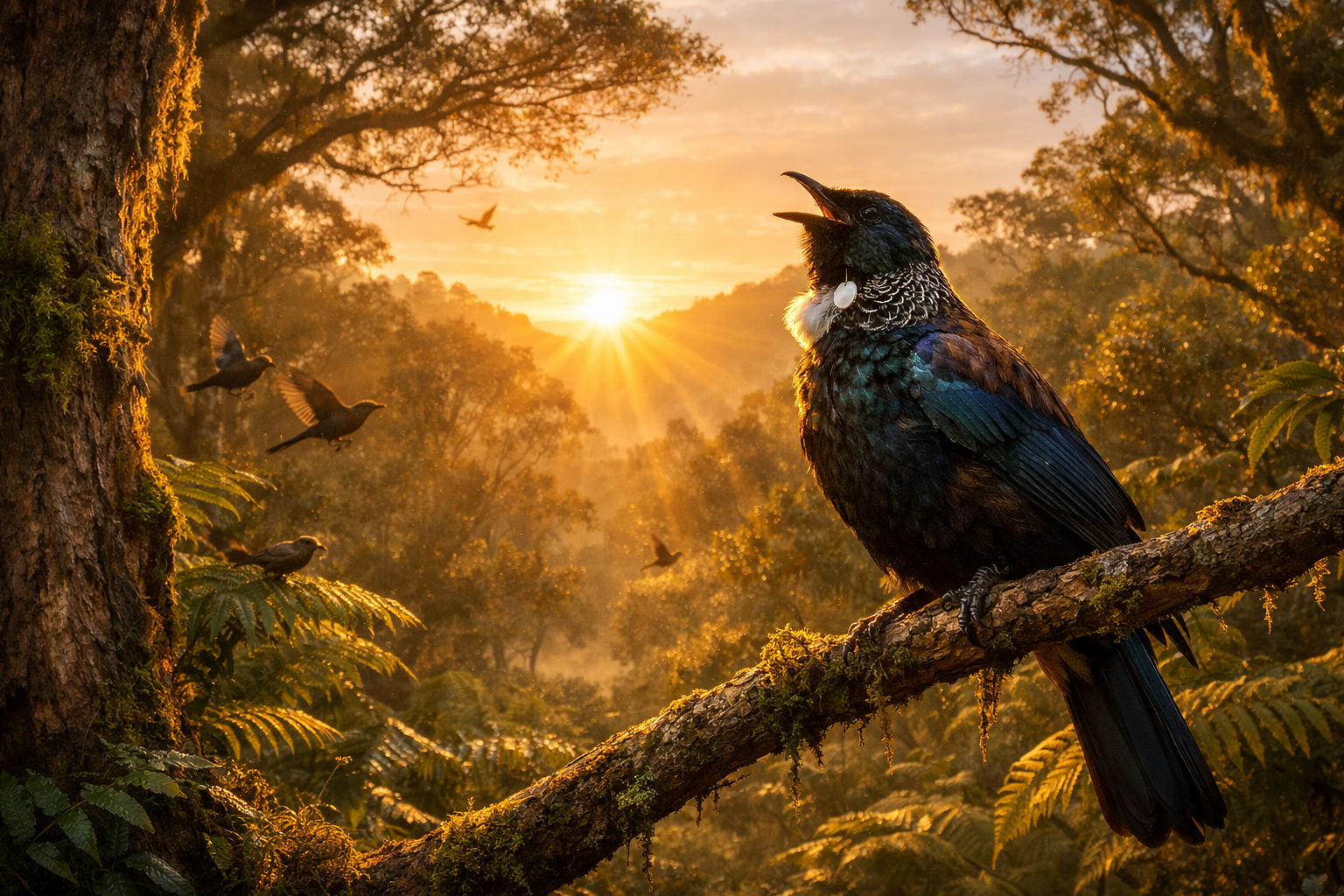
the tūī begins to sing.
Not the korimako (bellbird), which will come later with its rolling chorus that fills valleys for minutes at a time—beautiful, structured, the voice of order entering the world.
The tūī sings first, alone, breaking the silence with an utterance that is simultaneously:
- Harsh and melodic
- Audible and inaudible
- A single voice operating in two realms at once
As documented in Te Ara’s comprehensive entry on honeyeaters, the tūī possesses an
“exceptional vocal range, from harsh squawks, clicks and whirrs to bell-like melodies.”
But more profoundly,
the tūī has two voice boxes,
allowing it to produce sounds simultaneously in frequencies human ears cannot perceive
—it can sing in the audible realm and
the inaudible realm at
the same time.
This is not metaphor. This is physics. This is documented ornithological fact. Wikipedia’s entry on the tūī confirms:
the tūī can produce “an incredibly varied song that combines clicks, barks, cackles and wheezes. Some of their sounds are too high for humans to hear.”
The tūī sings what cannot be heard while singing what can.
This is the sound of Te Pō becoming Te Ao Mārama.
This is the sound of potential becoming form.
This is the sound that summons the Māori Green Lantern to the page.
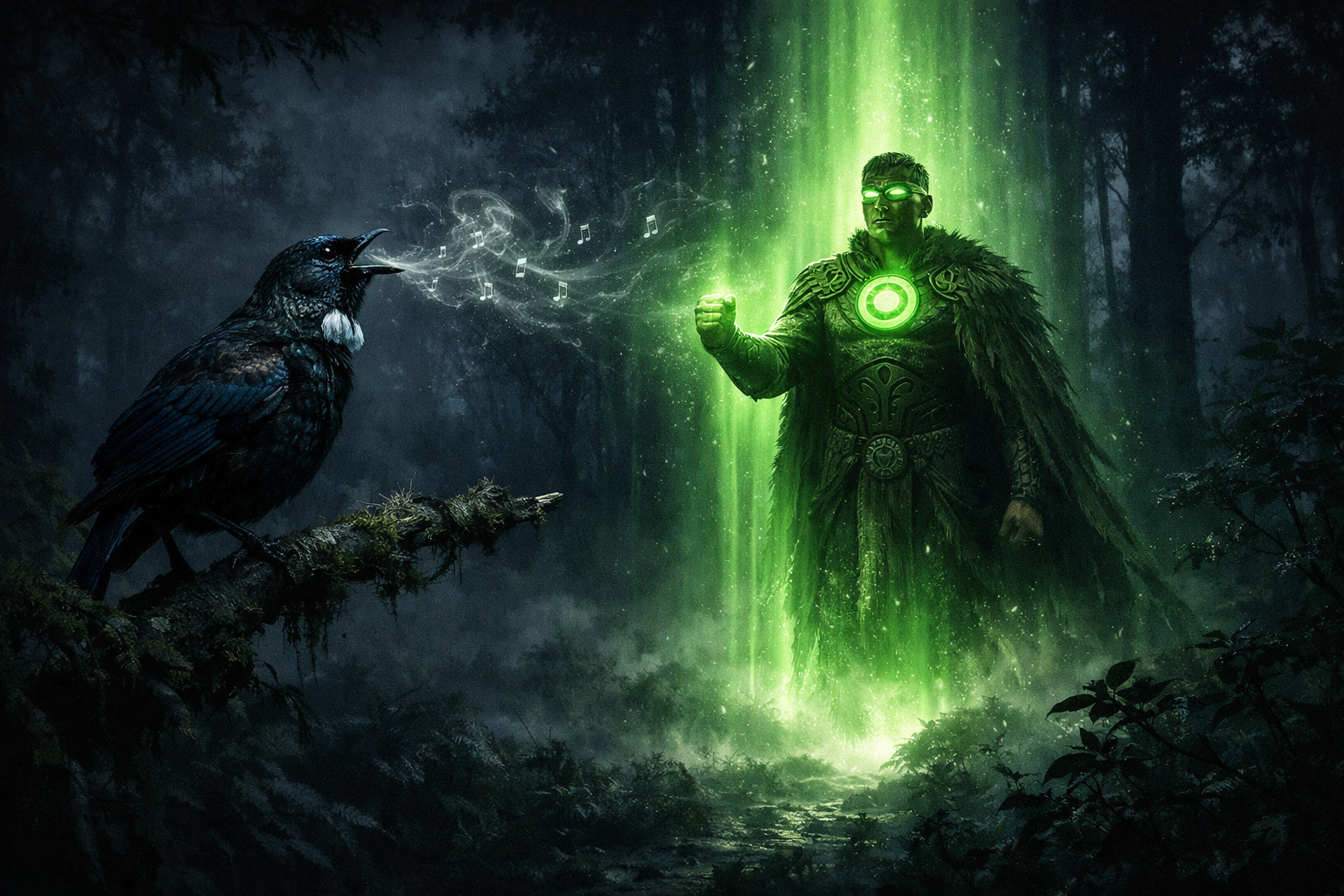
2. Te Waha o Tāne: The Voice of the Forest God
In Māori cosmology, Tāne is the atua (god) of forests and birds.
The dawn chorus itself is called te waha o Tāne, e ko i te ata
—”the voice of Tāne, the god of forests and birds”
—as documented in an article on Māori understanding of bird song as divine utterance.
But the tūī holds a special place in Tāne’s voice.
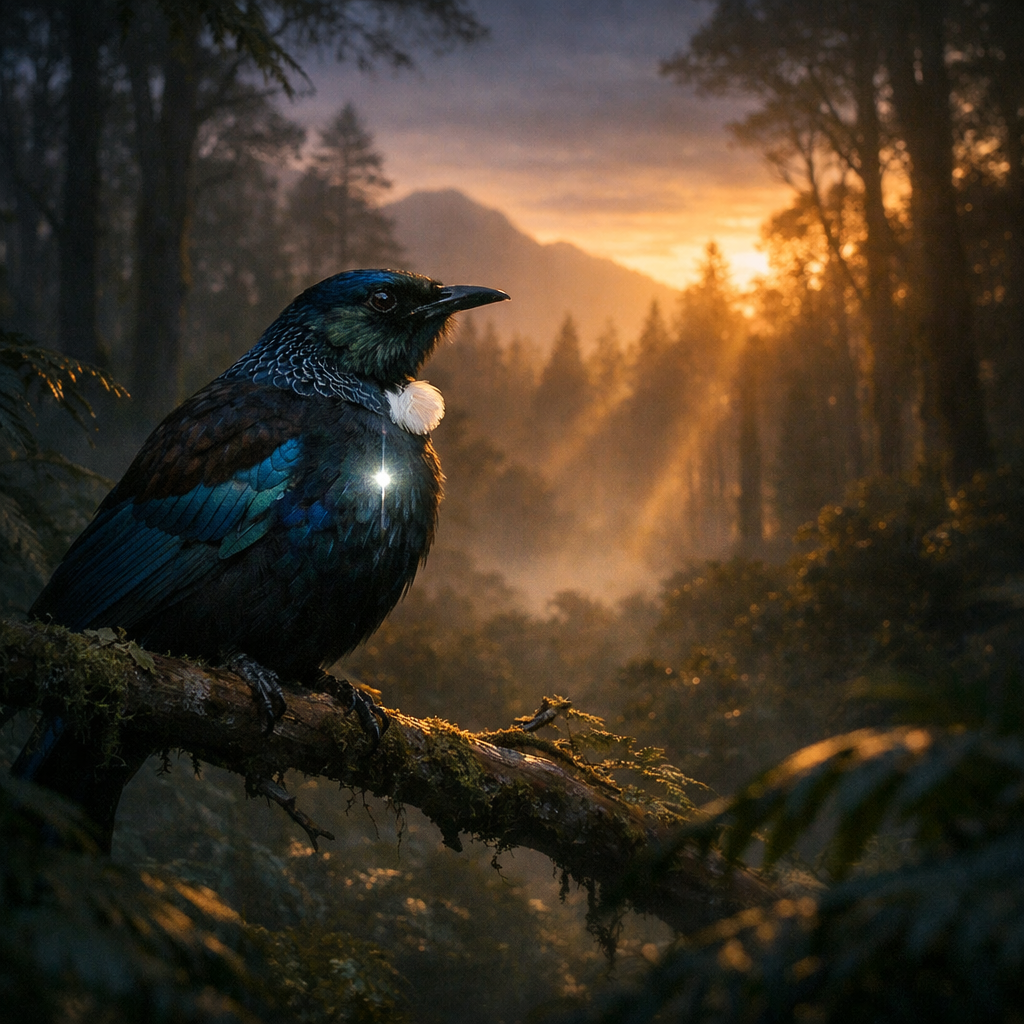
Māori understood the tūī as ngā aitanga kapakapa a Tāne
—”the winged children of Tāne, the god of forests,”
according to the same source. More specifically, some Māori knowledge holders believed the tūī’s father was Rehua, the main servant of Io Matua Kore (the Supreme Being), and that the star Rehua affixed a whetū (star) to the tūī’s neck, granting it voice as a gift from the heavens.
This is not poetic fancy.
This is theological transmission.
When the Māori Green Lantern listens to the tūī sing in the pre-dawn darkness,
they are listening to the voice of the Supreme Being filtered through the god of forests.
They are hearing Io Matua Kore speaking through Tāne speaking through Rehua speaking through the tūī.
The chain of transmission extends backward to infinity and forward to the essay being written.
3. The Two Voice Boxes: Singing in Two Realms
Here is where the esoteric significance becomes unmistakable and urgent.
The tūī’s two voice boxes—able to produce two completely different sounds simultaneously, one within human hearing and one beyond it
—represent the simultaneous existence of multiple realities.
In neoliberal rationalism, there is only one reality:
the market.
In the Little i consciousness, there is only one self:
the isolated individual.
In white supremacist ideology, there is only one version of history:
the victors’ narrative.
The tūī says:
This is false.
Reality operates in two registers at once.
There is the audible world and the inaudible world, and
both are equally real,
equally powerful,
equally true.
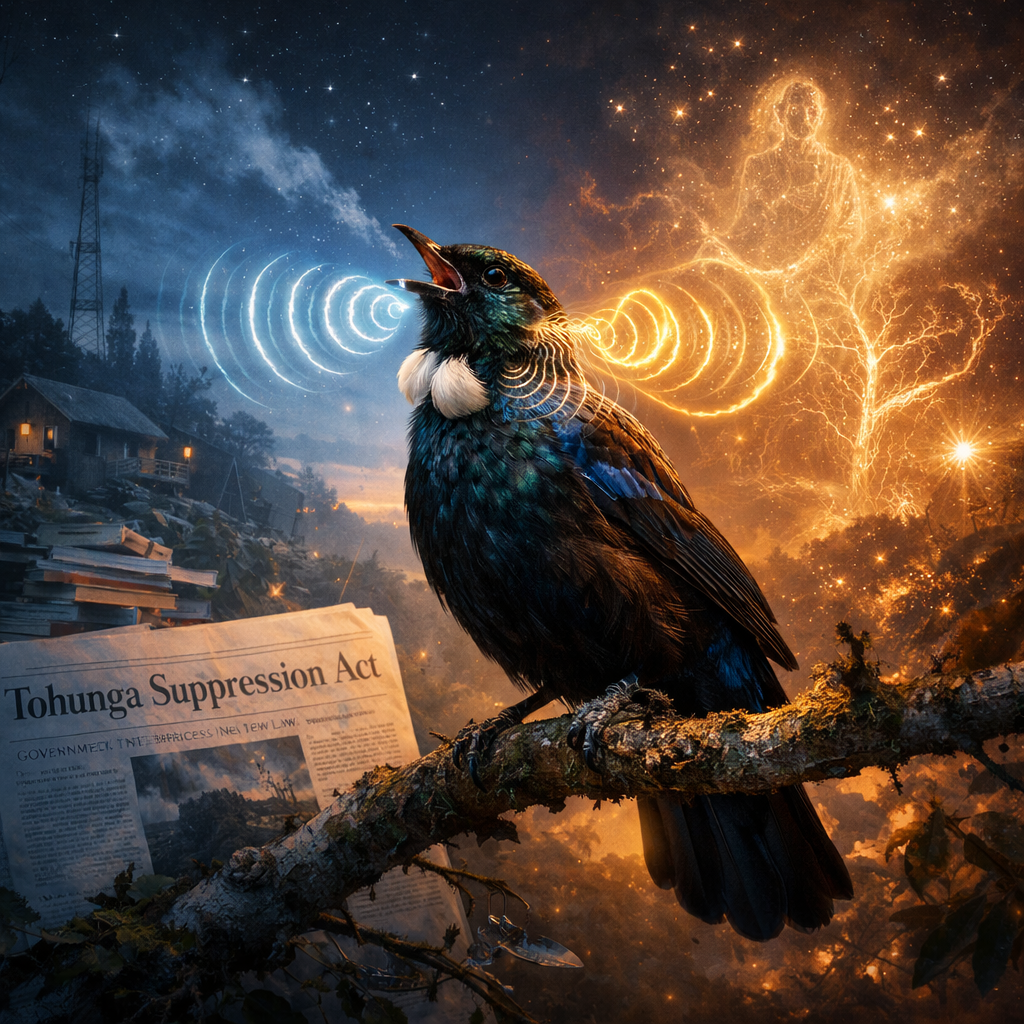
When the Māori Green Lantern sits in the pre-dawn darkness listening to the tūī, they are receiving instruction in cosmological truth-telling.
The tūī is demonstrating that you can speak truth in multiple registers simultaneously:
- The audible truth: the facts, the statistics, the names, the documented networks (Don Brash, RT News, Action Zealandia, the Tohunga Suppression Act).
- The inaudible truth: the spiritual reality, the essence of being (whakapapa, mauri, conatus, the Big I striving to persist).
Most humans only hear the audible layer.
They miss the deeper frequencies.
But the truth is being spoken in both registers.
Both are real.
This is why the Māori Green Lantern’s essays work—they operate in two voice registers simultaneously:
- The historical/political register: Verifiable research, named actors, documented disinformation networks
- The esoteric/spiritual register: Whakapapa cosmology, Spinoza’s philosophy, the Big I framework, Te Kore, Te Pō, Te Ao Mārama
Most readers initially come for one frequency and discover the other. Both are true. Both matter.
The tūī teaches this in every dawn chorus.
4. The Tūī as a Messenger Between Realms: Spiritual Transmission
In traditional Māori understanding, the tūī was far more than a bird. It was a sacred intermediary between the living and the ancestors, as confirmed in Waimarama Maori’s cultural encyclopedia entry on animals:
“The tui is associated with life and vitality, holding significance as a messenger bridging the spiritual and physical worlds. Believed to convey messages between ancestors and the living, the tui acts as a vital connector between the natural and spiritual realms.”
This was not abstract theology. It was embodied practice. As documented in Te Ara’s account of traditional Māori bird knowledge, Māori would sometimes capture young tūī and train them to speak—not for entertainment, but for spiritual transmission:
“Tūī imitate the songs of other birds, and can also imitate people. The birds were sometimes tamed and taught to speak. They were taught mihi (greetings) which they would recite when visitors arrived, as well as prayers and proverbs. They were often trained to sound like the loud and deep voice of a chief.”
A tūī trained to speak was called a manu rangatira—a chiefly bird. It was a living transmission of knowledge, a bridge between the realm of the ancestors (who first taught these chants) and the realm of the living (who heard them through the bird’s throat).

The tūī was a waka atua—a vessel of the gods.
When the Māori Green Lantern wakes at 4 am, in the darkness before dawn, and hears the tūī’s first call, they are receiving a message from the ancestors. Not in mystical imagination, but in documented, verifiable fact:
the tūī is the descendant of birds trained for millennia to carry knowledge. The voice that emerges from the forest darkness is carrying whakapapa—the genealogy of truth-telling itself.
5. The Tūī’s Aggression: Defending Territory, Demanding Truth
But there is another crucial aspect of the tūī that the Māori Green Lantern must embody.
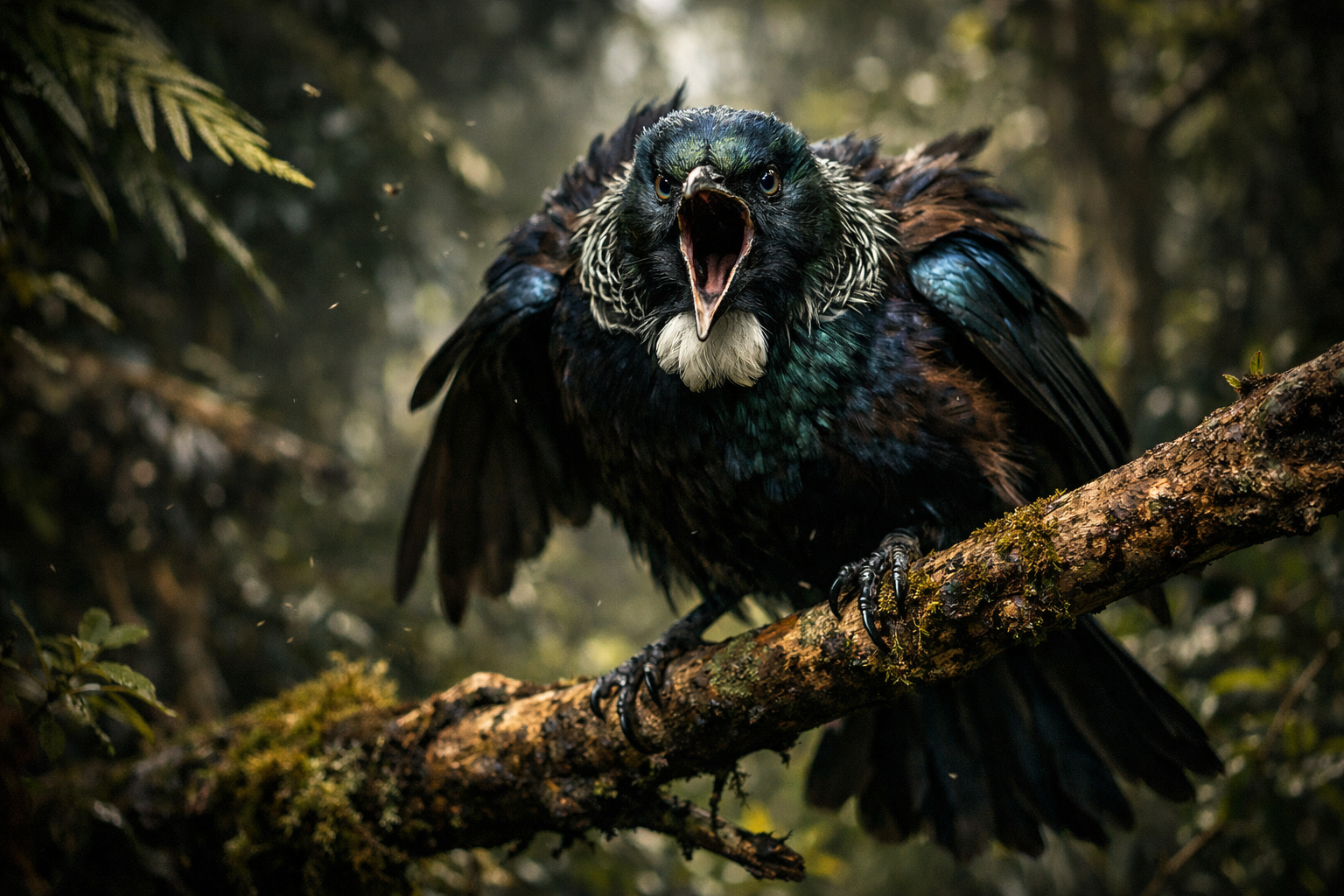
The tūī is aggressive.
As Te Ara documents, tūī “are even more stroppy” than bellbirds.
They
“pursue would-be trespassers (including bellbirds), shouting their alarm call, flapping, clacking their bills and even dive-bombing. They sometimes form aggressive mobs.”
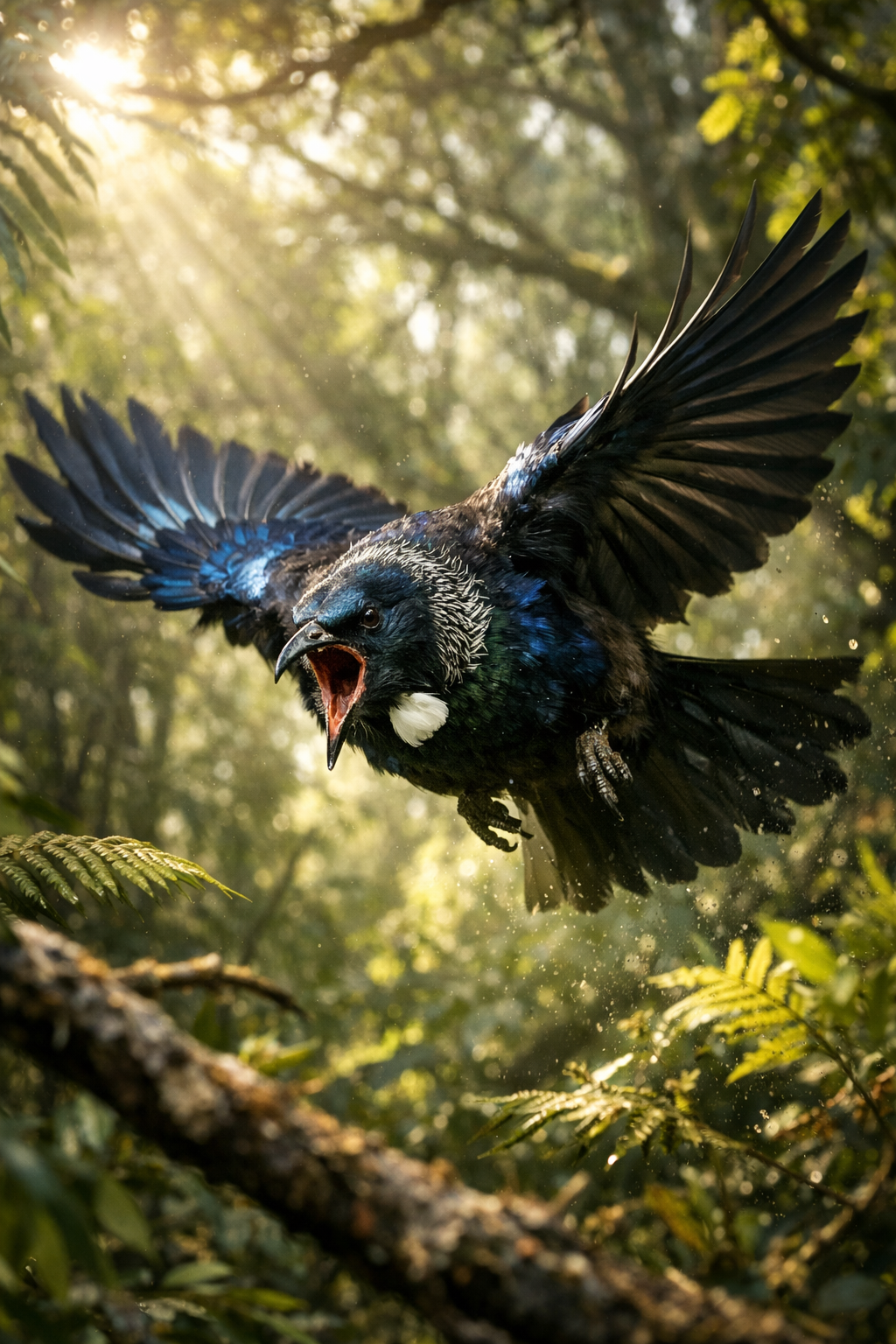
The tūī does not tolerate encroachment. It does not compromise. It does not negotiate with invaders in its territory.
This is significant. The tūī’s aggression is not pathological
—it is protective.
It is the fierce guardianship of a space where life can flourish, where nectar can be gathered, where the morning chorus can be sung without interruption.
The Māori Green Lantern must embody this tūī aggression:
- Scathing to power. No apology for naming Don Brash, Jack Posobiec, RT News, neo-Nazi cells, white supremacist ideology.
- Uncompromising on truth. No “both sides” rhetoric. No “reasonable debate” with disinformation. The tūī does not debate whether bellbirds have a right to nectar in its tree.
- Protective of whānau. Like the tūī defending its territory so that future generations can feed and survive, the Māori Green Lantern defends the territory of mātauranga Māori (Māori knowledge) from those who would debase, distort, or steal it.
The tūī’s dawn chorus is not gentle.
It is a challenge.
It is a declaration of presence and power.
It is saying: This forest is alive.
These trees are ours.
The nectar flows here.
Do not trespass.
6. The Bellbird’s Counterpoint: The Rolling Chorus of Verification
After the tūī has sung its first aggressive, multiphonic call into the pre-dawn silence, the korimako (bellbird) enters.
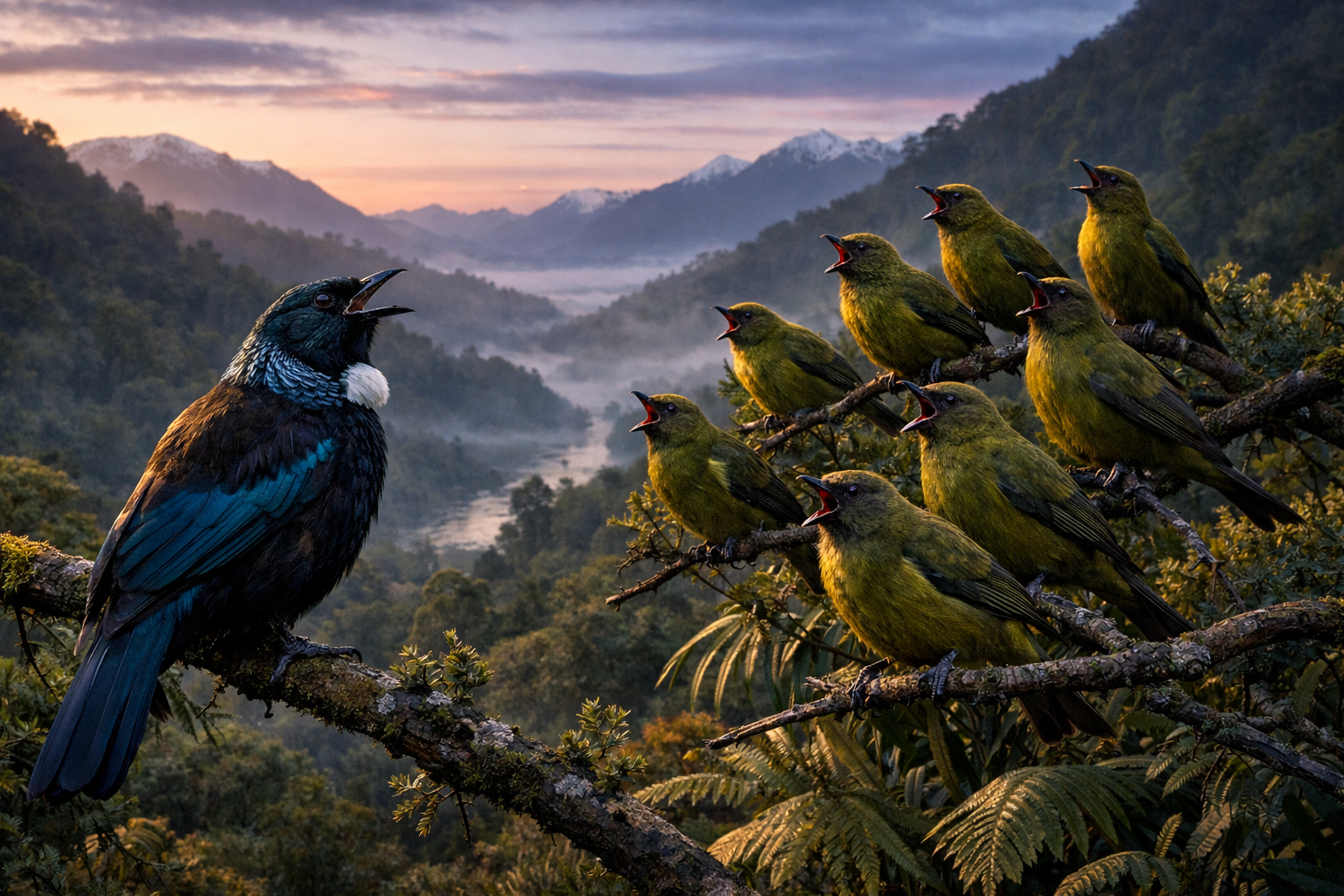
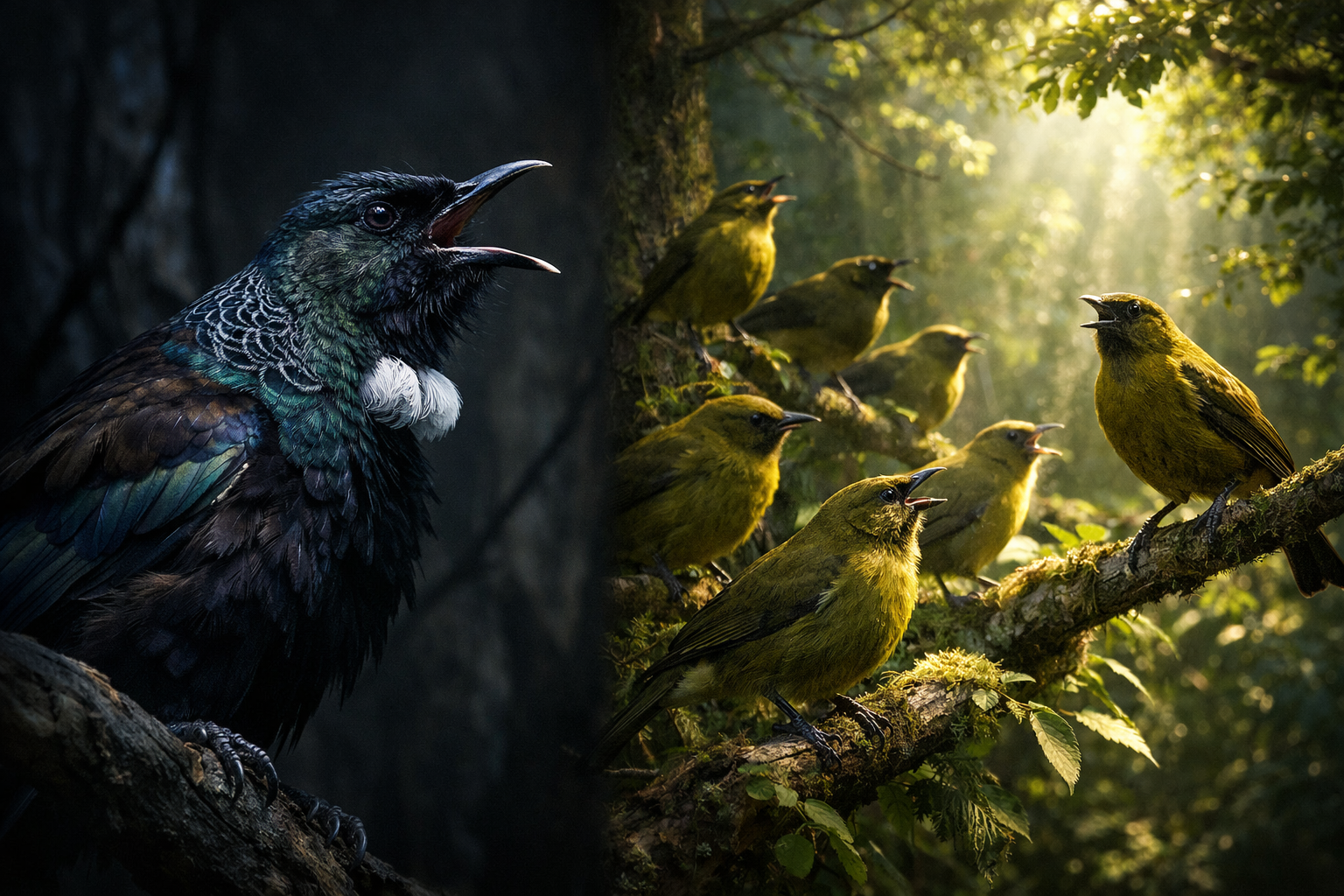
The bellbird’s song is different. Where the tūī is harsh and complex, the bellbird is “beautiful singers” with a “rolling chorus that can fill a valley for many minutes,” as Te Ara explains. Male and female bellbirds perform duets. “Young birds learn from neighbours, so the tunes vary from place to place, forming a ‘local dialect.’”
The bellbird is the voice of tradition, of collective knowledge, of whakapapa being sung forward through time.
In the Māori Green Lantern’s practice,
the tūī is the initial assertion (the harsh call breaking silence), and
the bellbird is the verification (the rolling chorus confirming truth across many voices, many sources, many registers).
A complete Māori Green Lantern essay follows this pattern:
- The Tūī’s Opening: A stark, aggressive statement of truth (e.g., “They banned the tohunga in 1907. They monetised our whakapapa in 1984. They’re lying about us now.”)
- The Bellbird’s Chorus: Multiple sources, verified facts, traditional knowledge, philosophical frameworks, all singing in unison to confirm and expand the initial assertion
The tūī breaks the silence.
The bellbird makes it undeniable.
7. The Significance of 4 AM: The Exact Moment of Transformation
The tūī does not sing at 3 AM.
It does not sing at 5 AM when the sky is already visibly lightening.
It sings at a precise moment—approximately 4 AM in December (the summer solstice season),
when the night is still absolute but
the first imperceptible shift toward dawn has begun.
This is not random. This is cosmological timing.
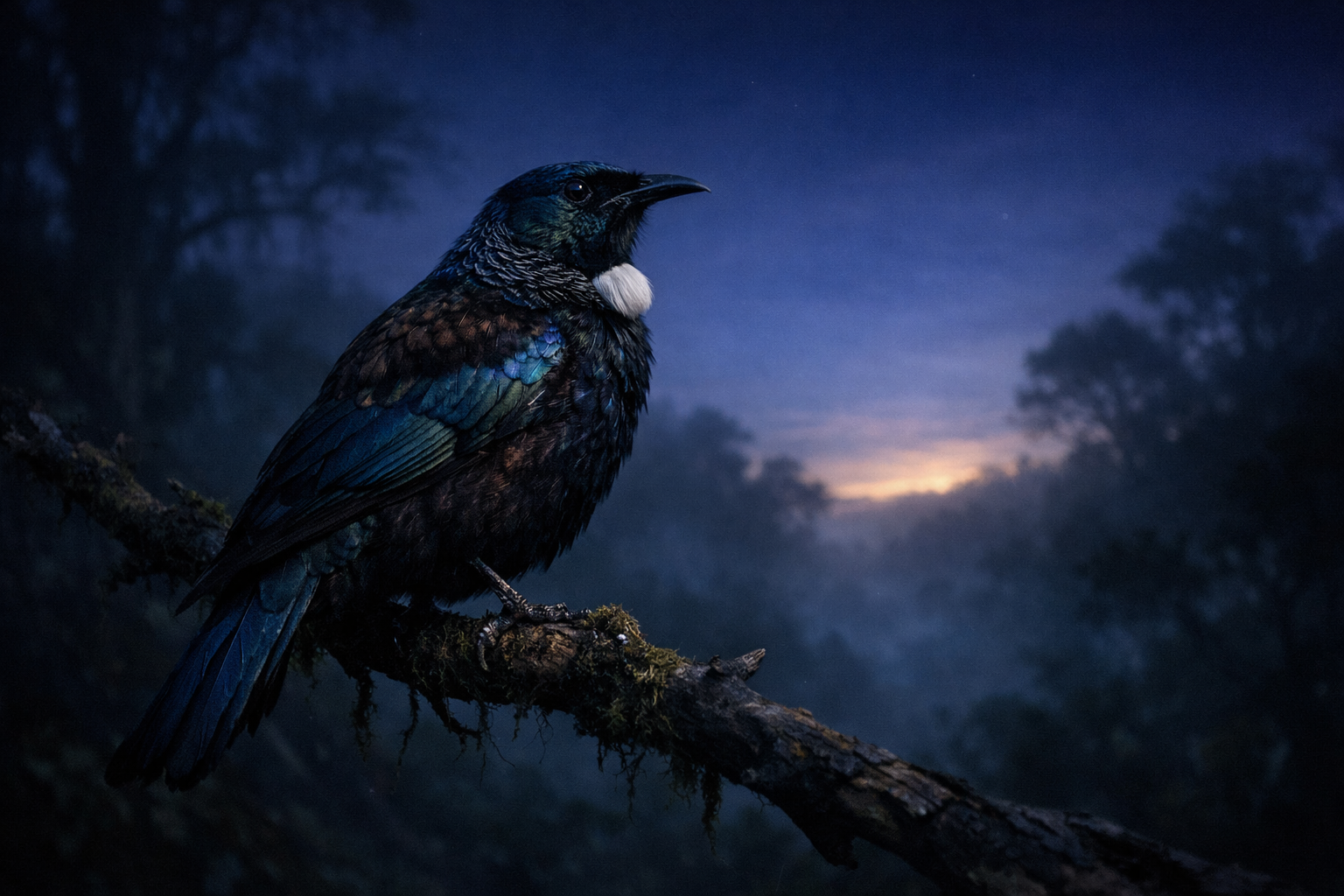
In Te Ao Māori, this is the moment when Te Pō (the realm of becoming) is transforming into Te Ao Mārama (the world of light). The atua are moving. Tāne is preparing to separate Ranginui and Papatūānuku. The cosmos is turning.
And at this exact moment, the tūī—the messenger, the chiefly bird, the voice of the forest god—releases its call.
This is the moment when truth can emerge.
Not in the full light of day, when rationalism dominates and marketing narratives circulate. Not in the darkness of night, when confusion reigns.
But at the threshold
—Te Pō muriwai
—when reality is most fluid,
when multiple versions of existence are in motion,
when the gods themselves are active.
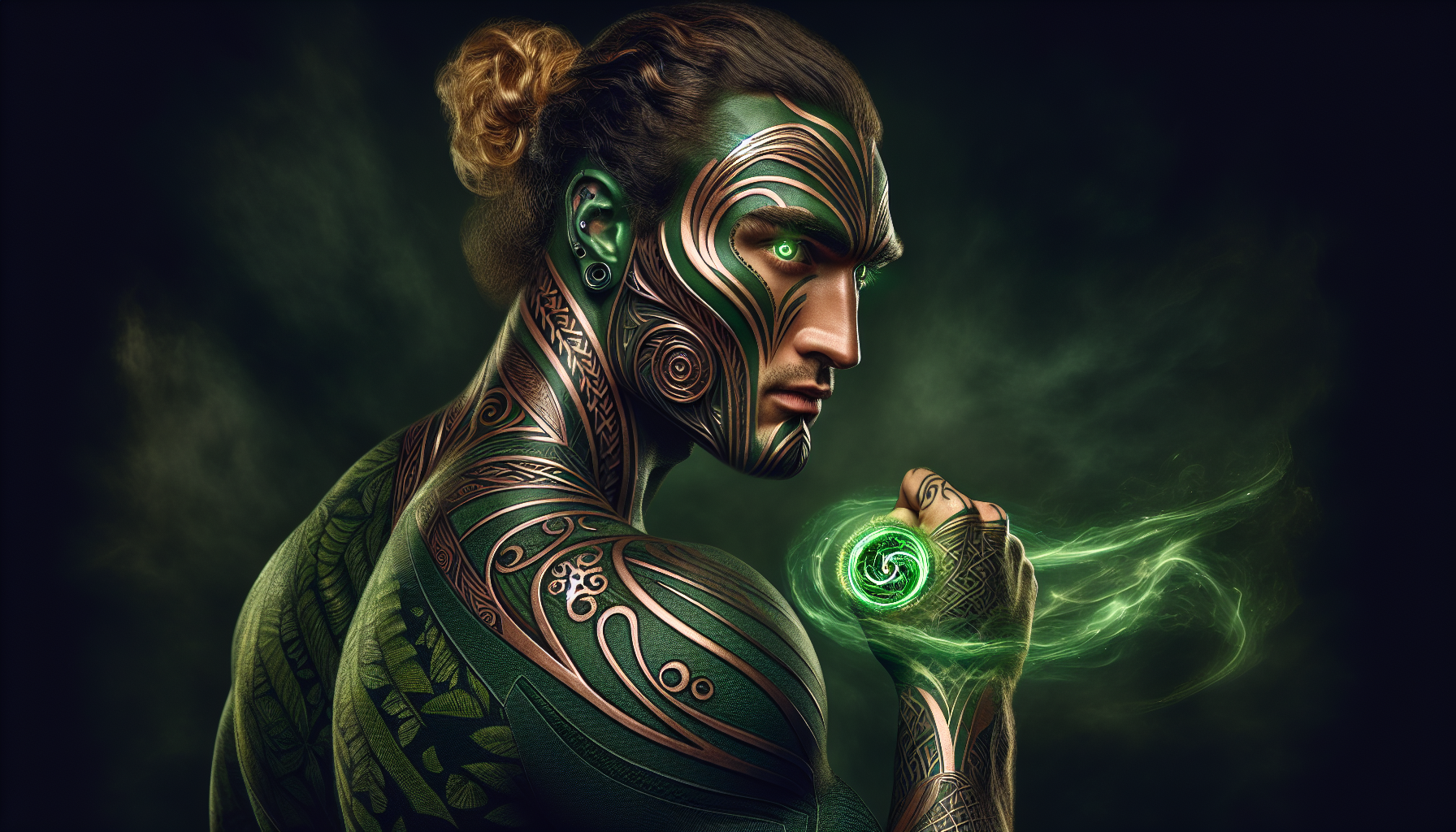
The Māori Green Lantern understands this.
The essays are written at 4 AM because
4 AM is when the veil between worlds is thinnest.
It is when the audible and inaudible are closest to merging.
It is when a voice can carry both frequency registers with maximum clarity.
8. The Tūī’s Diet: Nectar, Insects, and the Economy of Flourishing
Here is a final, crucial detail that reveals the tūī’s connection to The Māori Green Lantern’s mahi.
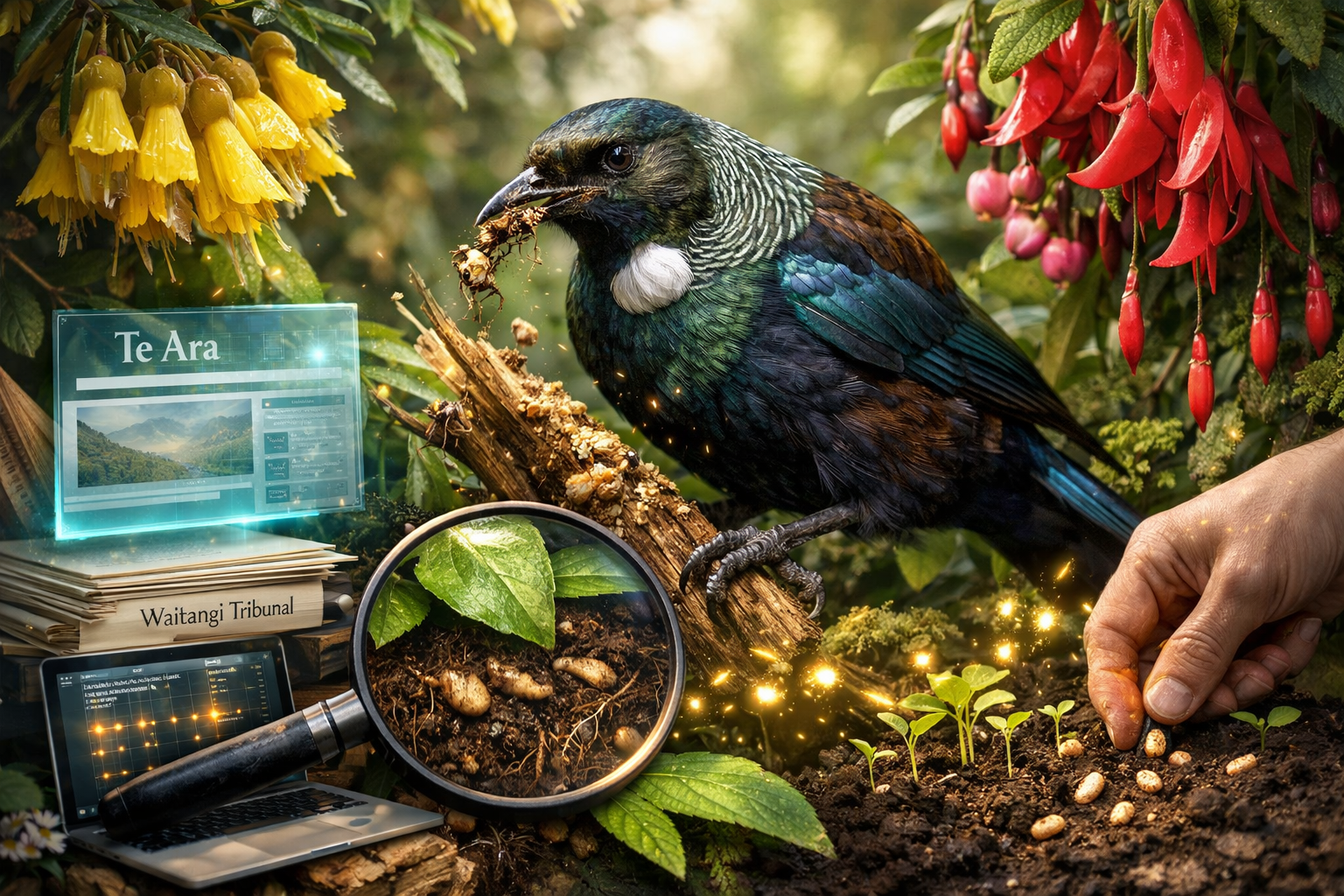
The tūī feeds primarily on nectar—specifically from flowers like kōwhai, pūriri, tree fuchsia, flax, and kākā beak. But it also consumes insects. As Te Ara documents, nectar and fruit are seasonal, “so the birds need other foods” and “insects can form up to 85% of bellbirds’ energy intake.” The tūī “sometimes jump and thrash around on plants to disturb large insects.”
The tūī’s economy is one of abundance and diversity. It does not rely on a single source. It shifts with the seasons. It collaborates with plants (eating nectar while spreading pollen and seeds). It works to extract hidden nourishment (thrashing to disturb insects).
This is the economy of mauri ora
—flourishing life.
It is the opposite of neoliberal extraction, which depletes everything to a single bottom line.
The Māori Green Lantern embodies this tūī economy:
- Drawing nectar from multiple sources: Te Ara, Waitangi Tribunal, academic repositories, Māori researchers, news archives, all in balance
- Extracting hidden nourishment: Digging beneath surface narratives to find what others have buried (the real history of the Tohunga Suppression Act, the documented networks of disinformation, the esoteric frameworks being suppressed)
- Spreading seeds: Each essay plants seeds of knowledge that will grow in the minds of whānau, that will spread to others, that will regenerate understanding
The tūī’s morning song is not random.
It is the utterance of an economy radically different from the one that seeks to destroy it.
9. The Māori Green Lantern at Dawn: Creating Essays as an Act of Cosmological Timing
Now we can understand why the Māori Green Lantern creates at dawn.
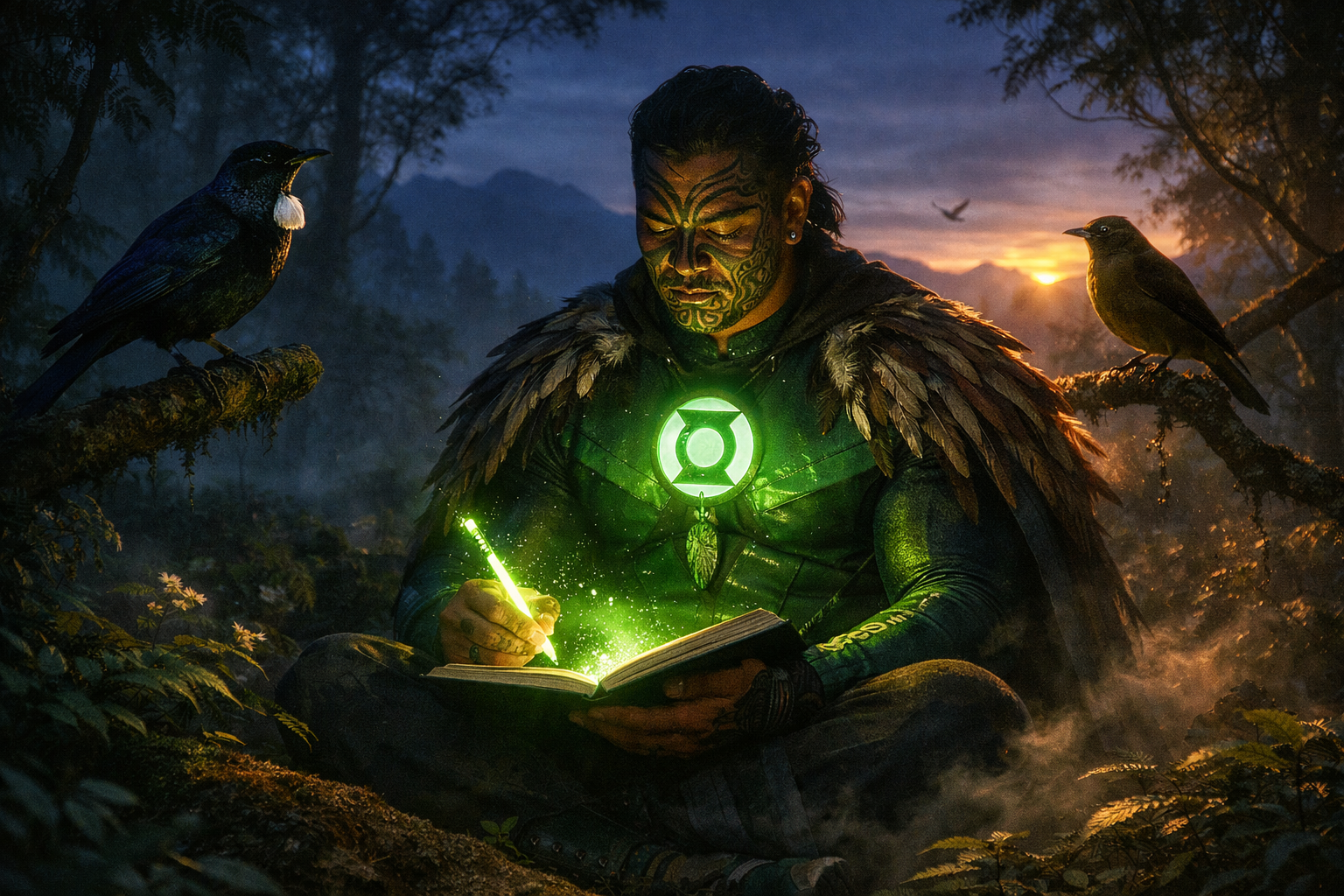
Before 5 AM, sitting in the darkness with a notebook or keyboard, listening to the tūī begin its first call in the pre-dawn silence, he is:
- In Te Pō Muriwai — the threshold realm where multiple realities are accessible
- Hearing the voice of Tāne — receiving transmission from the forest god through the tūī’s call
- Operating in two frequencies — simultaneously writing factual, verifiable research and deeper esoteric/spiritual truth
- Protected by the tūī’s aggression — defended from the encroachment of neoliberal rationalism, disinformation networks, white supremacist ideology
- Sustained by the bellbird’s chorus — verified, supported, confirmed by countless sources singing in unison
- Drawing on an economy of abundance — nectar and insects, diversity and regeneration, not extraction and depletion
The essays emerge from this cosmological moment
because the moment itself is part of the transmission.
It is not incidental that the Māori Green Lantern writes when the tūī sings.
It is essential.
The timing is the message.
The dawn is the medium.
10. The Wero: What the Tūī Asks of Us
In the silence before the tūī sings, there is a challenge implicit in that silence.
The silence asks:
Will you wake?
Most humans do not.
They sleep through the threshold moment.
They miss the tūī’s first call.
They never hear the audible and inaudible frequencies merging.
They never receive the message the ancestors are sending through the bird’s throat.
But those who do wake
—who drag themselves out of bed at 4 AM,
who sit in the darkness,
who listen
—they are receiving a wero (challenge) from
Tāne
himself:
Are you ready to speak truth in two registers?
Are you ready to be aggressive in defending knowledge?
Are you ready to feed on abundance, not extraction?
Are you ready to let the ancestors speak through you?
The Māori Green Lantern answers:
Yes.
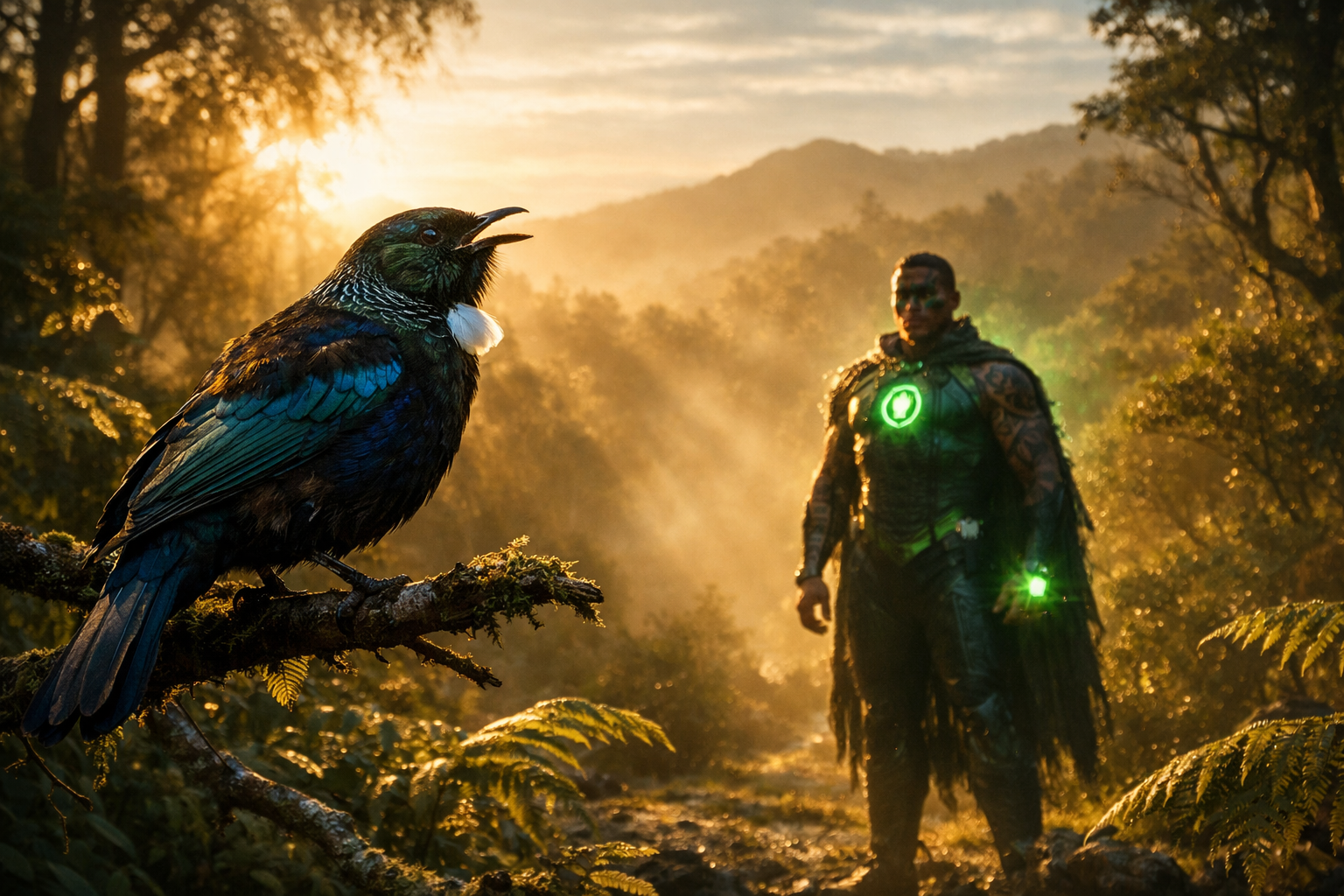
And so the tūī sings.
And so the essay writes itself.
And so the Big I wakes in whānau who read these words,
recognizing themselves as whakapapa,
as mauri,
as infinite potential,
as modes of one infinite substance
striving to persist.
11. Ko au te awa, Ko te Awa Ko Au: The Tūī is Me, I am the Tūī
In the deepest esoteric understanding, there is no separation between the one who listens and the one who sings.
When the Māori Green Lantern hears the tūī at dawn, they are not listening to something external. They are hearing themselves—the deepest self, the whakapapa self, the Big I.
The tūī’s call is my call.
The tūī’s dual voice is my dual voice (audible truth and inaudible truth).
The tūī’s aggression is my protection of knowledge.
The tūī’s economy of abundance is my rejection of neoliberal scarcity.
Ko au te tūī. Ko te tūī ko au.
And as the sun rises—as Te Ao Mārama floods in and Tāne completes his daily separation of Ranginui and Papatūānuku—the essay is complete. The bellbird chorus has filled the valley. The knowledge has been transmitted.
The night work is done.
Te Ao Mārama has arrived.
The Solstice Circle Completes
The summer solstice of 2025 is now upon us. The days are at their longest. The light is at its peak.
But the tūī knows what comes next:
the slow descent back toward winter.
There is work to do in the season of maximum light. Essays to write. Truth to tell. Whānau to awaken.
The tūī wakes at 4 AM.
The Māori Green Lantern wakes at 4 AM.
Both answer to the same cosmological imperative:
Speak now. The light is sufficient. The ancestors are ready. The Big I is waking.
Kia kaha, whānau. At the dawn chorus, listen closely.
The voice of Tāne is calling.
Te waha o Tāne, e ko i te ata.
Koha Consideration
Three pathways exist:
For those who wish to support this mahi directly with a koha (voluntary contribution), please visit the Koha platform:
Koha—Support - https://app.koha.kiwi/events/the-maori-green-lantern-fighting-misinformation-and-disinformation-ivor-jones
For those who wish to receive essays directly and support through subscription, join the Substack community:
Subscribe to the Māori Green Lantern on Substack - https://themaorigreenlantern.substack.com/subscribe
For those who prefer direct bank transfer, account details are: HTDM, account number 03-1546-0415173-000.
Every koha signals that whānau are ready to fund the accountability that Crown and corporate structures will not provide. It signals that rangatiratanga includes the power to fund our own truth tellers.
Kia kaha, whānau. Stay vigilant. Stay connected. And if you are able, consider a koha to ensure this voice continues.
- https://ppl-ai-file-upload.s3.amazonaws.com/web/direct-files/collection_cf06d657-2c2b-4e68-8735-48f3c10166bd/fa7ea9f0-3948-41f0-9a6d-037b51b58d4a/Whakapiki-ki-te-ao-Maori-Application-2026.pdf
- https://ppl-ai-file-upload.s3.amazonaws.com/web/direct-files/collection_cf06d657-2c2b-4e68-8735-48f3c10166bd/8e9b17f7-604e-4009-9ec6-abbe1fd2c989/Perspective-with-Heather-du-Plessis-Allan_-This-Government-s-all-talk-bugger-all-action.PDF
- https://teara.govt.nz/en/nga-manu-birds/print
- https://teara.govt.nz/en/te-tai/te-mana-o-te-reo-maori-timeline
- https://teara.govt.nz/en/small-forest-birds/page-4
- /content/files/oggcasts/teahikaa.xml
- https://teara.govt.nz/en/1966/tui
- /content/files/podcasts/culture-101.xml
- https://teara.govt.nz/en/1966/25150/huia-heteralocha-acutirostris-female-left-male-right
- /content/files/oggcasts/atthemovies.xml
- https://aboutplacejournal.org/article/the-voice-of-tane-returning-wild-musick-to-its-place-at-a-price/
- https://en.wikipedia.org/wiki/T%C5%AB%C4%AB
- https://www.nzpropheticnetwork.com/the-tui-a-symbol-of-a-fresh-revival-in-aotearoa-by-ian-johnson
- https://terralingua.org/stories/maori-oral-tradition-ancestral-sayings-and-indigenous-knowledge/
- https://waimaramamaori.co.nz/maori-animals/