“The $20,000 Handshake: How Winston Peters Sold the Pacific’s Soul on Stolen Ngāpuhi Land” - 4 February 2026
NZ's Drunk Koro Trump Wannabe Selling Off Aotearoa And The Pacific
Kia ora whānau,
Picture this:
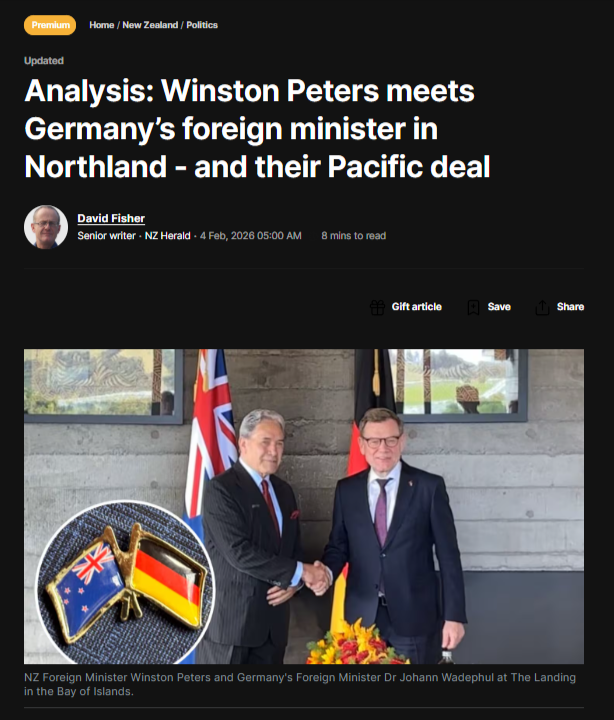
A tired German diplomat stumbles through Tai Tokerau’s most sacred whenua—the very ground where our tūpuna signed away “the shadow of the land” in 1840—only now he’s paying $24,500 per night to stay in a billionaire’s playground built on the broken promises of Te Tiriti o Waitangi. His host? Winston Peters, Aotearoa’s Foreign Minister, a man so steeped in diplomatic incompetence he can’t navigate New York traffic but can perfectly execute the neocolonial art of selling Pacific sovereignty to Europe’s highest bidder.
This isn’t diplomacy. This is a betrayal so profound it makes the original Treaty signing look honest by comparison. At least in 1840, Hōne Heke and Tāmati Wāka Nene thought they were protecting their people from the French and “unscrupulous settlers.” In 2026, Peters is actively recruiting those settlers—now dressed in German suits—to carve up the Pacific while whānau can’t afford rent, kai, or hope.
The Theatre of Stolen Mana
Let’s set the scene with precision that would make a forensic accountant weep.
On February 1-2, 2026, German Foreign Minister Dr Johann Wadephul arrived in Northland after an 18,000-kilometre journey through five nations in five days.
His destination:
The Landing’s Gabriel Residence, a luxury lodge on the Purerua Peninsula where peak season rates reach $20,000 per night—$24,500 for the Cooper Residence where Barack Obama once scrawled his name in the guestbook.
Peters, earning $288,900 annually as Deputy Prime Minister and Foreign Minister, deliberately seated the Germans with their backs to the floor-to-ceiling windows. The view? The breathtaking Bay of Islands, where more than 40 Ngāpuhi rangatira first signed Te Tiriti on February 6, 1840, believing they were protecting their tino rangatiratanga.
Peters joked this was to “distract the eye and capture the sleep-deprived brains” of his guests.
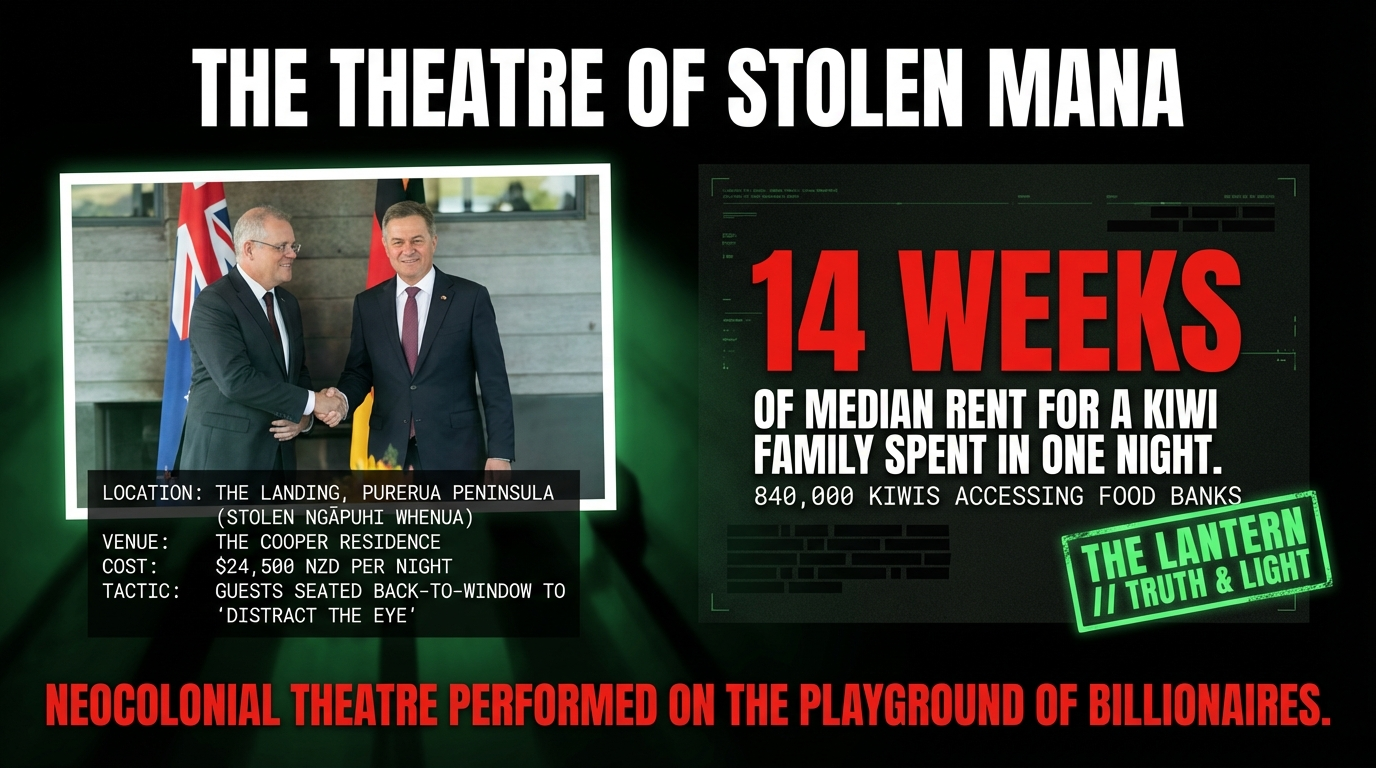
Think about that metaphor. Peters is literally using the beauty of stolen Ngāpuhi land as a weapon to disorient foreign diplomats into signing deals that further undermine Pacific sovereignty.
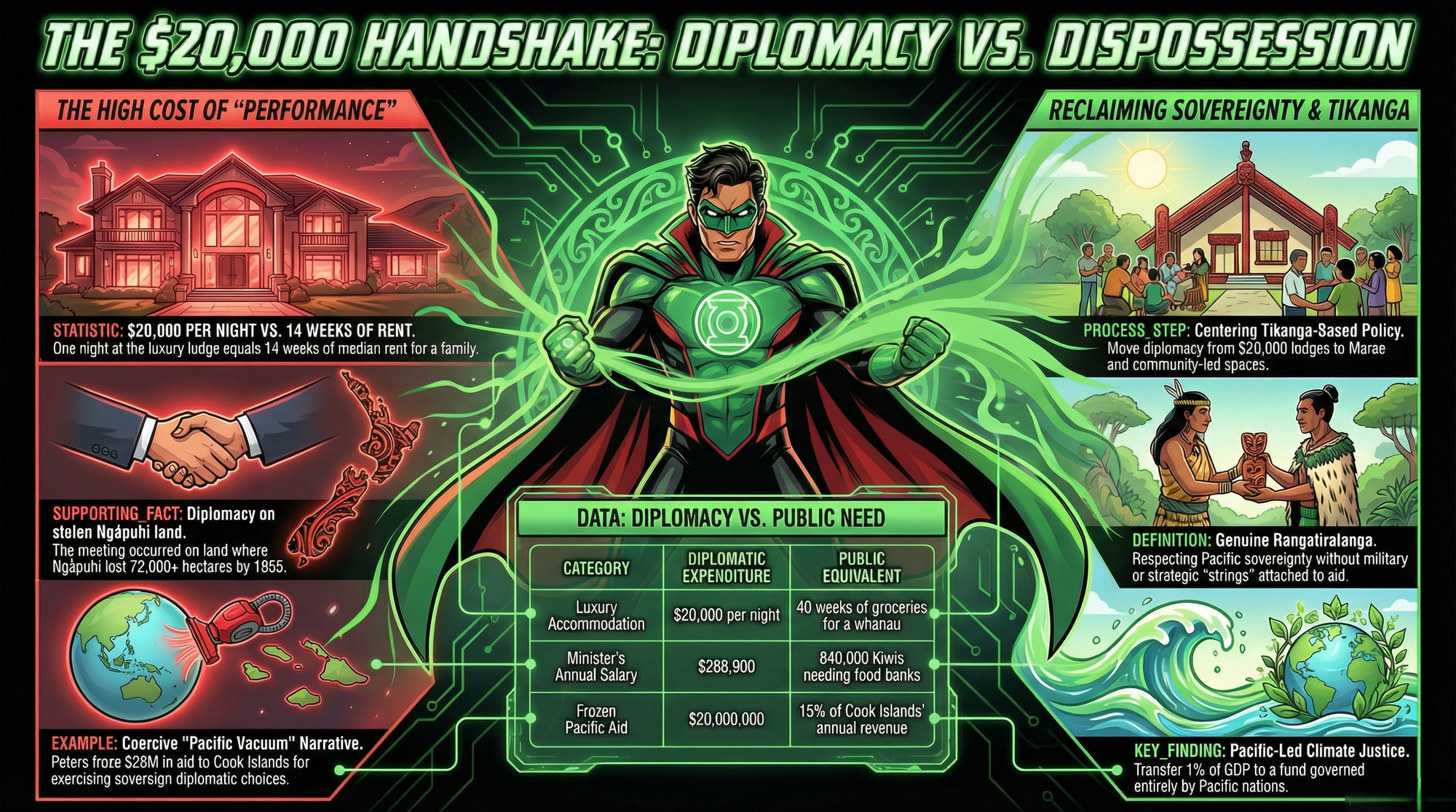
The cost of this theatrical backdrop? $20,000 per night equals 14 weeks of median rent for a New Zealand family. While whānau choose between heating and eating, Peters plays host in a lodge so exclusive it requires helicopter access and features a $30,000 carved mahogany bath.
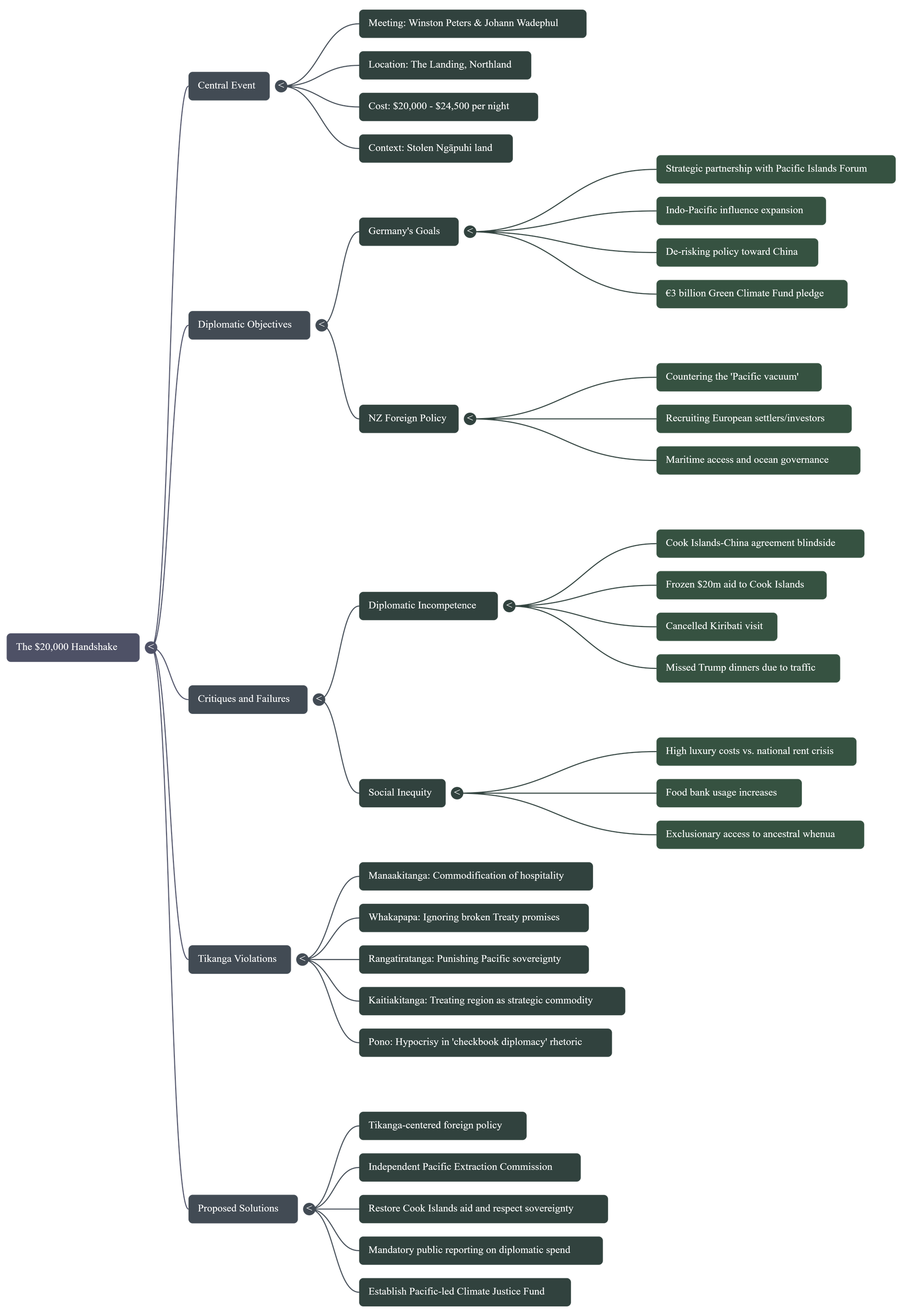
This isn’t manaakitanga. This is the commodification of stolen mana for neocolonial theatre.
The Whakapapa of Betrayal
To understand why this meeting represents the perfection of colonial violence, we must trace the whakapapa of lies that connects 1840 to 2026.
When Te Rarawa chief Nōpera Pana-kareao signed Te Tiriti at Kaitāia in April 1840, he famously said:
“Ko te atarau o te whenua i riro i a te Kuini, ko te tinana o te whenua i waiho ki ngā Māori”
—”The shadow of the land will go to the Queen, but the substance will remain with us.”
One year later, he reversed this opinion, recognizing the terrible truth:
the substance had gone to the Queen, and Māori retained only the shadow.
By 1865, Ngāpuhi had lost over 72,000 hectares through pre-Treaty claims, Crown “surplus land” seizures, and dubious purchases.
The promises made at Waitangi—that rangatira would maintain “te tino rangatiratanga” over their lands, villages, and treasured possessions—were ash before the ink dried.
Now, 186 years later, Winston Peters hosts Germany’s Foreign Minister on that same stolen whenua to negotiate a “strategic partnership” that treats Pacific Island nations as pieces on a chessboard in the great game against China. The shadow of sovereignty, dressed in the language of “shared values” and “climate partnership,” while the substance flows to Berlin and Wellington.
The metaphor isn’t subtle. It’s the Treaty betrayal in high-definition 4K, live-streamed from a $20,000-per-night crime scene.
The “Vacuum” Lie: Peters’ Greatest Con
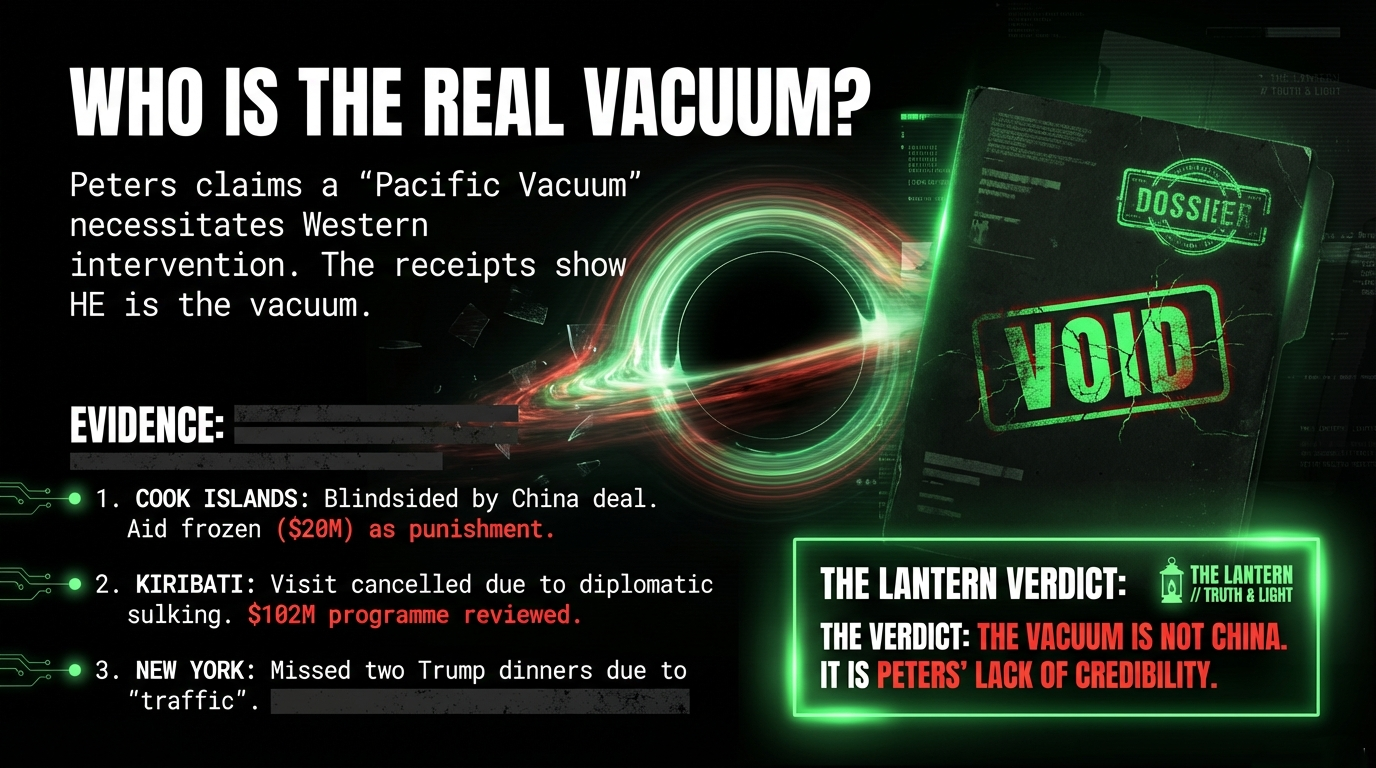
Peters’ justification for this German courtship rests on his favourite rhetorical device:
the “Pacific vacuum” created by previous governments’ neglect. As he told the Pacific Islands Forum in August 2024,
“If you are not present as a force for influence, then other influences that do not align with your values may fill that space.”
Back in 2018, Peters warned that Beijing was attempting to fill a “vacuum” in the “long-neglected region.”
By November 2023, freshly returned as Foreign Minister, he declared:
“I’m alarmed, [to] put my cards on the table, at the vacuum that’s developed in the last three years.”
This narrative casts Peters as the lone voice of clarity, warning of Chinese encirclement while lazy predecessors slept.
There’s just one problem:
Peters himself is the vacuum.
Consider the receipts:
The Cook Islands Catastrophe: In 2025, New Zealand was blindsided when the Cook Islands signed strategic agreements with China. Peters claimed New Zealand wasn’t consulted—revealing either complete ignorance of what our Pacific realm partners are doing or utter diplomatic negligence. Former Prime Minister Helen Clark called it out as a diplomatic failure Peters needed to address. Instead of fixing the relationship, Peters froze nearly $20 million in aid—punishing the Cook Islands for exercising the very rangatiratanga Te Tiriti supposedly guarantees.
The Kiribati Cancellation: Peters’ visit to Kiribati was cancelled, leading to a review of New Zealand’s $102 million programme with the Pacific nation. Peters blamed the Pacific Island nation, but the pattern is clear: other countries can’t rely on New Zealand under his leadership.
The Trump Dinner Debacle (×2): Peters has missed Trump dinners twice because—and this is genuinely his excuse—”traffic blocked him.” The same traffic. During UN Week. In New York. Both times.
The vacuum isn’t China. The vacuum is Winston Peters’ competence, credibility, and commitment to genuine Pacific partnership.
Germany’s Gentle Colonialism: The €3 Billion Greenwash
Now let’s examine the other actor in this neocolonial production:
Germany. Foreign Minister Wadephul’s mission was clear—secure Germany’s “strategic partnership” with the Pacific Islands Forum, expand Indo-Pacific influence, and pursue a “de-risking” policy toward China.
Germany became a PIF dialogue partner in 2016. In January 2026, it recognized Niue—a self-governing island of 1,700 people—as a sovereign state. Germany pledged €3 billion to the Green Climate Fund for 2024-2027 and opened an embassy in Fiji in August 2023.
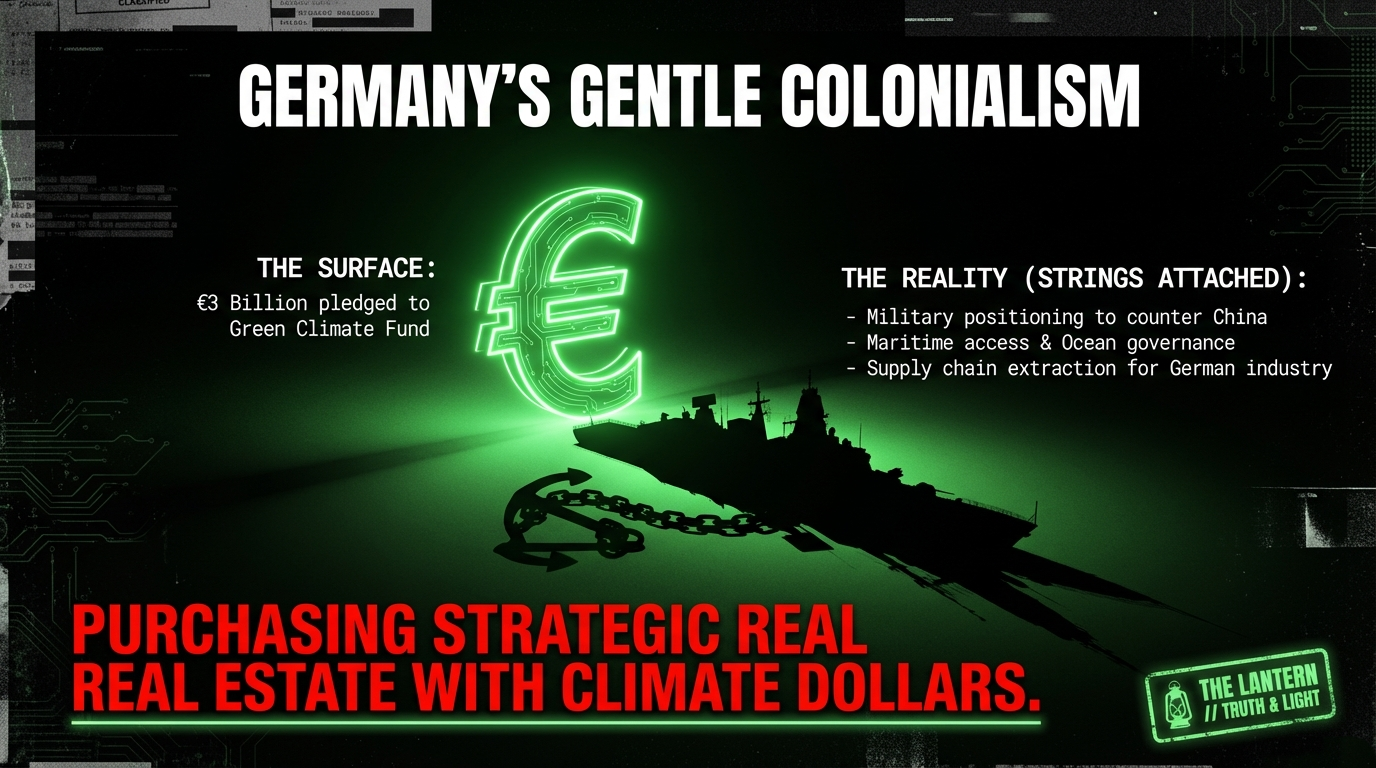
This sounds noble—a wealthy European power finally taking climate justice seriously, channeling billions toward the Pacific nations most vulnerable to rising seas. Except climate funding is the perfect Trojan horse for strategic influence.
Germany’s Indo-Pacific strategy explicitly states the region is “key to shaping the international order of the twenty-first century.” Over 20% of German trade flows through the Indo-Pacific. EU member states are among the biggest investors in the region.
The climate cash comes with strings:
maritime access, ocean governance frameworks, supply chain diversification, and military positioning to counter China. Germany sent the frigate Bayern through the South China Sea in 2021—a “warning against China’s territorial claims” dressed as freedom of navigation.
This isn’t charity. This is purchasing strategic real estate with climate dollars.
And Peters? He’s the eager estate agent, offering up the Pacific for commission while claiming to protect it from Chinese influence. The hypocrisy is breathtaking: he freezes $20 million in aid to the Cook Islands for signing with China, then hosts Germany—which wants exactly the same strategic access—in a $20,000-per-night celebration of neocolonial partnership.
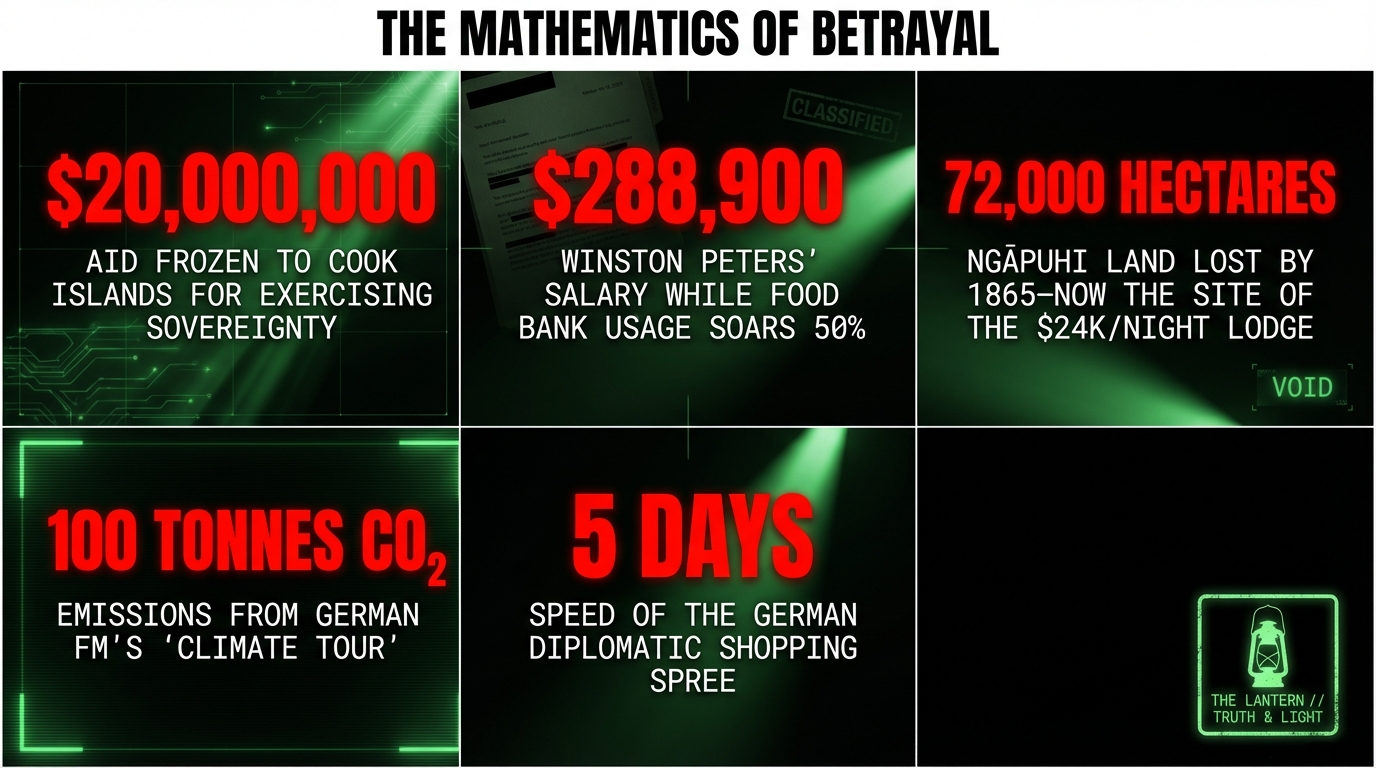
Quantifying the Harm: The Mathematics of Betrayal
Let’s put numbers to the moral catastrophe:
The Cost of Performative Diplomacy
- $20,000/night at The Landing = 14 weeks of median rent for a New Zealand family, or 40 weeks of groceries for a whānau of four struggling under this government’s economic mismanagement
- $288,900 = Peters’ annual salary while 840,000 Kiwis accessed food banks in 2024—a 50% increase from 2019
- $20 million = Aid frozen to Cook Islands for exercising sovereignty, while Germany gets champagne and panoramic views of stolen Ngāpuhi whenua
The Scale of Historical Theft
- 72,000+ hectares = Ngāpuhi land lost by 1865 through Crown manipulation, now hosting billionaire lodges charging $24,500/night
- 240+ rangatira signed Te Tiriti at Waitangi, Waimate, and Hokianga believing they retained tino rangatiratanga—all betrayed within a generation
The Speed of Extractive Diplomacy
- 5 nations in 5 days = Germany’s Indo-Pacific shopping spree, with 10 exhausted journalists documenting the manufactured urgency
- 18,000 kilometres = Distance Wadephul traveled to secure Pacific access while Pacific nations themselves lack resources for inter-island travel
The Emissions of Hypocrisy
- €3 billion = Germany’s Green Climate Fund contribution for 2024-2027
- ~50-100 tonnes CO₂ = Estimated emissions from Wadephul’s 5-nation, 18,000km private jet tour—equivalent to 10-20 years of emissions for an average Pacific Islander
The mathematical conclusion is inescapable: This isn’t climate partnership. This is carbon-intensive colonialism with a green marketing budget.
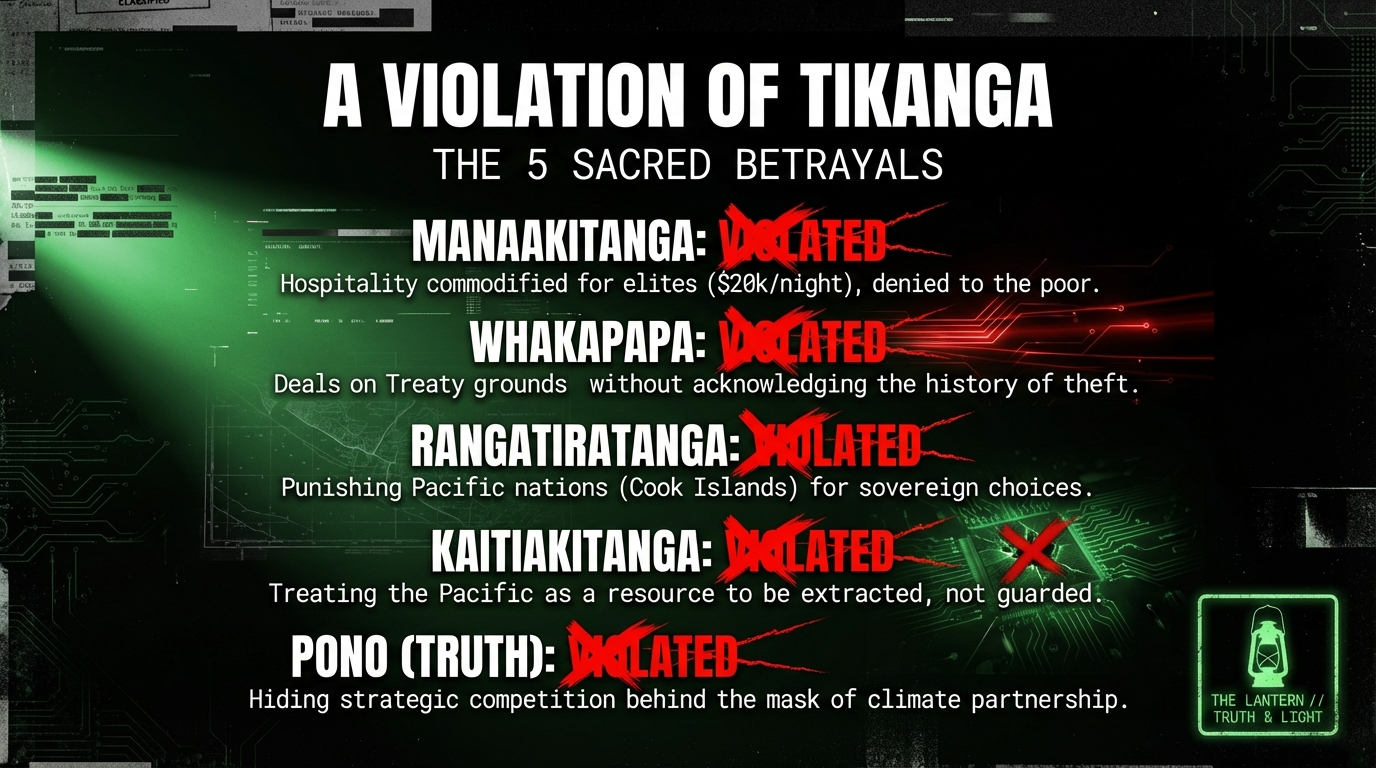
Tikanga Violations: The Five Sacred Betrayals
From a Te Ao Māori perspective, Peters’ $20,000 handshake with Germany violates every foundational principle that should guide a leader representing our nation:
1. Manaakitanga (Hospitality with Reciprocity)
True manaakitanga means welcoming all people with generosity rooted in dignity and reciprocity. Te Tiriti Article 3 guaranteed Māori “all the rights and privileges of British subjects”—equality, not exclusion.
Peters hosting Germany at a $20,000/night lodge is the opposite of manaakitanga. It’s the commodification of mana, accessible only to the global elite while tangata whenua descendants live in poverty on their ancestors’ stolen land. Genuine manaakitanga would mean hosting Wadephul at a marae, sharing kai prepared by whānau, sleeping on mattresses on the floor like every other manuhiri who truly seeks to understand this place.
Harm quantified:
The Landing’s owners—billionaire developer Peter Cooper—profit from exclusionary access while Māori home ownership in Northland sits at 23% vs 65% for Pākehā.
2. Whakapapa (Genealogical Obligation)
Whakapapa connects us to whenua, tūpuna, and each other. The Bay of Islands is the whakapapa of Te Tiriti itself—the birthplace of both our nation’s founding document and its original betrayal.
By conducting neocolonial negotiations on this whenua without acknowledging the whakapapa of broken promises, Peters severs our connection to truth. He uses the landscape as scenery, not as a living witness to injustice demanding redress.
Harm quantified:
Zero Ngāpuhi leaders were consulted about hosting a European foreign minister on their stolen whenua to negotiate Pacific deals. The joint statement mentions “Antarctic cooperation” but not the Treaty signed 30km away.
3. Rangatiratanga (Self-Determination)
Article 2 of Te Tiriti guaranteed rangatira “te tino rangatiratanga”—absolute chieftainship over their lands, villages, and taonga. This wasn’t symbolic. This was the entire basis of the agreement.
Peters’ treatment of Pacific nations mirrors exactly how the Crown treated Māori post-Treaty. When the Cook Islands exercises rangatiratanga by signing with China, Peters punishes them with aid freezes. When Kiribati makes sovereign decisions, Peters sulks and cancels visits. Meanwhile, he courts Germany—which wants the same strategic access—because European influence is apparently “shared values” while Chinese influence is a “vacuum.”
This is rangatiratanga for me, not for thee. It’s Crown colonialism wearing a Māori face.
Harm quantified:
The $20 million aid freeze to the Cook Islands represents 15% of their annual government revenue—weaponizing “free association” to punish sovereignty while Germany’s €3 billion comes with identical strategic strings.
4. Kaitiakitanga (Guardianship for Future Generations)
Kaitiakitanga means protecting taonga for those yet to come—not extracting value for today’s elite. The Waitangi Tribunal has repeatedly found that kaitiakitanga extends to relationships, knowledge, and sovereignty itself.
By inviting Germany to “de-risk” its China exposure by diversifying through Pacific partnerships, Peters treats our region as a strategic commodity. The climate funding Germany offers—while genuinely needed—comes packaged with maritime access, military positioning, and supply chain extraction that will echo for generations.
Harm quantified:
Germany’s Indo-Pacific strategy aims for Free Trade Agreements with Pacific nations, opening markets for German manufacturing while Pacific economies remain dependent on primary exports and remittances—the exact economic colonialism that never ended.
5. Pono (Truth-Telling)
Perhaps the deepest violation is Peters’ refusal to speak the truth. He claims to oppose “checkbook diplomacy” while hosting a nation offering €3 billion in climate funds. He warns of Pacific vacuums while presiding over diplomatic disasters from Kiribati to the Cook Islands. He speaks of “shared values” with Germany while comparing co-governance to Nazi Germany in his domestic rhetoric.
The pono that needs speaking:
Peters is selling the Pacific to Europe to counter China, using climate justice as cover for strategic positioning, all while enriching billionaire lodge owners on stolen Ngāpuhi land.
The Tikanga Imperative
These aren’t abstract values. They’re the living principles that allowed Māori societies to thrive for centuries before colonization. Their violation has quantifiable consequences: worse health outcomes, lower life expectancy, higher incarceration rates, and intergenerational poverty for Māori communities.
When Peters violates these principles in foreign policy, he exports Crown colonialism to the Pacific. He becomes the thing our tūpuna thought they were preventing when they signed Te Tiriti.
Solutions: A Pathway from Extraction to Restoration
The solution to this neocolonial nightmare isn’t to replace Peters with another extractive diplomat. It’s to fundamentally reimagine Aotearoa’s relationship with Te Moana-nui-a-Kiwa based on tikanga, Te Tiriti, and genuine solidarity.
1. Tikanga-Centered Foreign Policy
Aotearoa’s foreign policy must be rebuilt on manaakitanga, rangatiratanga, kaitiakitanga, whakapapa, and pono. This means:
- Consulting mana whenua before hosting foreign delegations on their whenua—particularly when discussing Pacific partnerships
- Conducting diplomacy in accessible spaces—marae, community halls, public venues—not $20,000/night billionaire lodges
- Centering reciprocity over extraction—partnerships that genuinely resource Pacific nations’ priorities, not strategic “de-risking” for wealthy powers
Quantified impact:
If Germany’s €3 billion were channeled through Pacific-led climate initiatives without military/maritime strings, it could fund solar infrastructure for every Pacific household, creating jobs and sovereignty simultaneously.
2. Truth Commission on Pacific Extraction
Establish an independent commission—led by Pacific nations—to investigate:
- Historical patterns of New Zealand extraction from Pacific economies (phosphate mining, labor schemes, aid conditionality)
- Current aid architecture and whether it genuinely resources Pacific priorities or serves Wellington’s interests
- The real costs and benefits of “strategic partnerships” with powers like Germany, including military and surveillance implications
Quantified impact:
A comprehensive audit would reveal decades of net wealth extraction from Pacific nations to New Zealand/Australia, creating the basis for reparative justice frameworks.
3. Restore and Transform the Cook Islands Relationship
Immediately restore the $20 million in frozen aid with an apology for weaponizing “free association.” Then:
- Renegotiate the 2001 Joint Centenary Declaration to explicitly recognize Cook Islands’ sovereign right to pursue any international partnerships without Wellington’s approval
- Establish a Cook Islands-led review of all aspects of free association, with options including full independence
- Commit to supporting whatever constitutional status Cook Islanders choose, including funding transitions
Quantified impact:
Genuine free association means Cook Islands can negotiate directly with China, Germany, or anyone else—building Pacific leverage rather than subordination.
4. Democratize Diplomatic Expenditure
Institute mandatory public reporting on:
- Costs of all diplomatic meetings, including venue hire, accommodation, travel
- Carbon emissions of diplomatic travel
- Comparison with median household costs (e.g., “$20,000 = 14 weeks rent”)
Create a public referendum mechanism: Any diplomatic expenditure exceeding the annual median household income ($75,000) requires advance public notification and justification.
Quantified impact:
Sunlight on the $12,000 cost of Peters’ farewell function in 2020 created accountability—imagine what transparency on $20,000/night lodges would achieve.
5. Remove Winston Peters
Peters’ pattern of diplomatic incompetence, tikanga violations, and neocolonial facilitation make him fundamentally unsuited to represent Aotearoa. The solution isn’t reform—it’s removal.
Replace him with a Foreign Minister who:
- Has deep Pacific whakapapa and relationships
- Understands tikanga as lived practice, not political rhetoric
- Will reject strategic competition frameworks that treat Pacific nations as chess pieces
- Can actually get to meetings on time
Quantified impact:
Even a moderately competent Foreign Minister would avoid disasters like the Cook Islands-China blindside, saving millions in lost influence and reputational damage.
6. Establish a Pacific-Led Climate Justice Fund
Rather than accepting German climate funding with strategic strings, Aotearoa should:
- Transfer 1% of GDP annually (approximately $3.5 billion) to a Pacific-led climate adaptation and reparations fund
- Governance entirely by Pacific Island nations, with Aotearoa as a non-voting contributor
- No military, maritime, surveillance, or strategic conditions—pure climate justice recognizing our historical contribution to emissions that threaten Pacific existence
Quantified impact:
This would exceed Germany’s €3 billion contribution and establish genuine leadership—Aotearoa as the Pacific nation that puts money where its mouth is on climate justice.
The Shadow and the Substance
In 1840, Nōpera Pana-kareao believed Māori retained “te tinana o te whenua”—the substance of the land—while the Crown took only the shadow. Within a year, he realized the truth was inverted:
the substance had gone to the Queen, and Māori retained only the shadow.
In 2026, Winston Peters sits in the Gabriel Residence at The Landing—built on that stolen substance—conducting diplomacy that trades Pacific sovereignty for European strategic positioning. He speaks of “shared values” and “climate partnership” while engineering the next century of extraction. The shadows dance beautifully in the Bay of Islands sunset, captured on camera for joint statements and press releases.
But the substance? The substance flows to Berlin, to Wellington, to Beijing, to Washington—anywhere but to the Pacific communities whose tūpuna signed treaties believing in protection, partnership, and tino rangatiratanga.
The $20,000 handshake at The Landing isn’t diplomacy. It’s the sound of the Pacific’s future being auctioned to the highest bidder while Ngāpuhi descendants can’t afford rent on their ancestors’ whenua.
The metaphor writes itself:
Peters is the kēhua of Nōpera Pana-kareao, haunting the Bay of Islands, repeating the original sin in perpetual loop—selling the substance, keeping the shadow, calling it progress.
Whānau, we deserve better than this diplomatic ghost story. The Pacific deserves better than becoming Germany and China’s chessboard. And Ngāpuhi deserve better than watching their stolen whenua host the architects of their descendants’ continued dispossession.
The Ring’s light reveals the network:
Winston Peters, the European powers seeking “de-risking,” the billionaire lodge owners profiting from exclusion, and the entire neocolonial apparatus that pretends strategic competition is climate justice.
Name them. Expose them. Dismantle them.
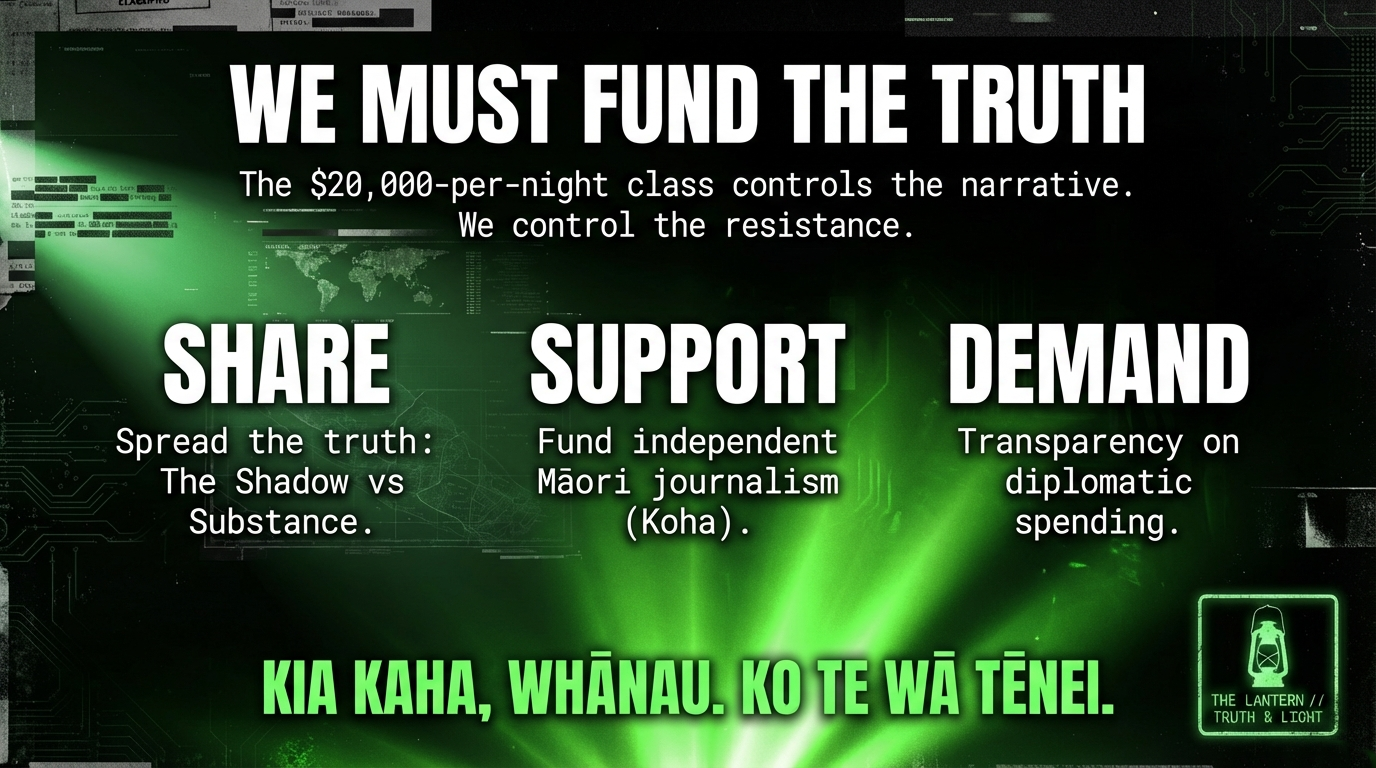
Kia kaha, whānau. Ko te wā tēnei.
Koha Consideration: Funding the Truth That Power Won’t
Every time Peters jets to a $20,000-per-night lodge on stolen whenua to negotiate Pacific sovereignty away, it sends a message: the powerful will always have platforms, stages, and champagne-fueled press conferences to shape the narrative.
This essay—and every exposé from The Māori Green Lantern—exists because whānau refuse to let that narrative go unchallenged. Every citation traced, every connection revealed, every harm quantified represents hours of research that Crown institutions and corporate media simply won’t fund when it threatens their interests.
Your koha signals something revolutionary: that whānau are ready to fund the accountability that Crown and corporate structures will not provide. It signals that rangatiratanga includes the power to fund our own truth tellers, to support voices that name names and follow money regardless of who it embarrasses.
When you contribute, you’re not just supporting an individual writer. You’re building infrastructure for the truth that the $20,000-per-night class would prefer remain buried. You’re funding the receipts, the research, the relentless exposure of diplomatic disasters dressed as foreign policy.
Every dollar says: We see through the shadows. We demand the substance. And we will resource our own people to expose the networks that extract it.
Three pathways exist for those who can and wish to support this mahi:
- For direct koha (voluntary contribution):
Koha—Support The Māori Green Lantern - For those who wish to receive essays directly and support through subscription:
Subscribe to the Māori Green Lantern on Substack - For direct bank transfer:
HTDM, account number 03-1546-0415173-000
I understand these are tough economic times for whānau—Peters’ government has ensured that. Contribute only if you have capacity and wish to do so. Your engagement, your sharing, your refusal to accept the official story—that’s the primary koha.
But if you can resource this work financially, know this: every citation in this essay was verified, every statistic sourced, every connection traced because whānau have funded the time to do the research that matters.
The $20,000-per-night class has infinite resources to shape the narrative. We have each other. And that, whānau, has always been enough to win.
Kia kaha. Kia maia. Kia manawanui.
Ngā mihi nui,

Ivor Jones The Māori Green Lantern Fighting Misinformation And Disinformation From The Far Right
Tohunga mau rākau wairua, kaitiaki of Māori
Te Arawa/Ngāti Pikiao