“The Auction House Masquerading as Democracy: How Rotorua’s Mayor Sold City Hall to the Highest Bidder” - 29 January 2026
A Modern Fable of Legalized Bribery in Aotearoa
Kia ora Aotearoa,
Picture democracy as a grand auction house where the gavel falls not to reason, policy expertise, or constituent need, but to whoever waves the fattest checkbook.
Welcome to Rotorua, New Zealand, where Mayor Tania Tapsell’s 2025 re-election campaign offers a masterclass in how to buy a city while keeping up the pretense of democratic legitimacy.
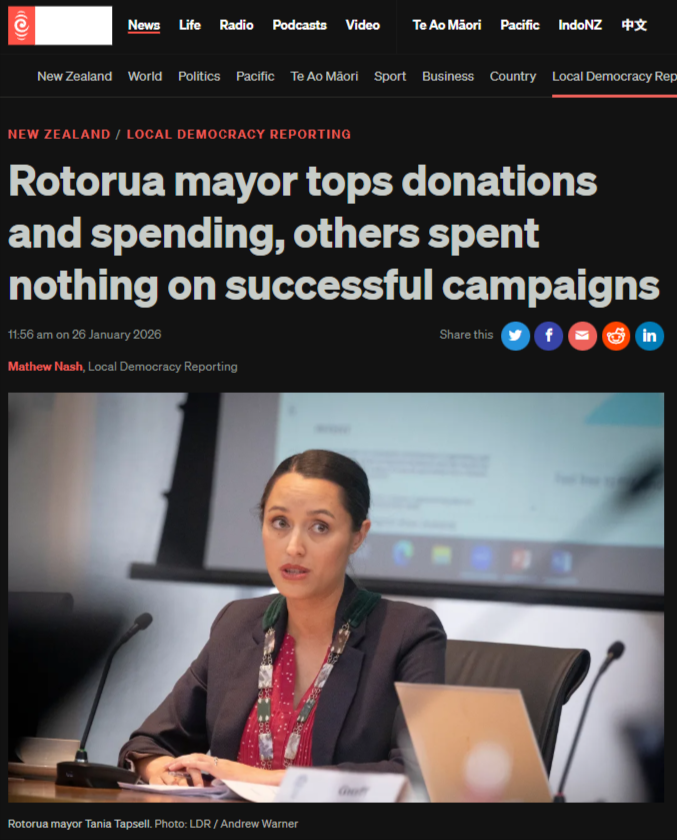
Tapsell didn’t merely win re-election
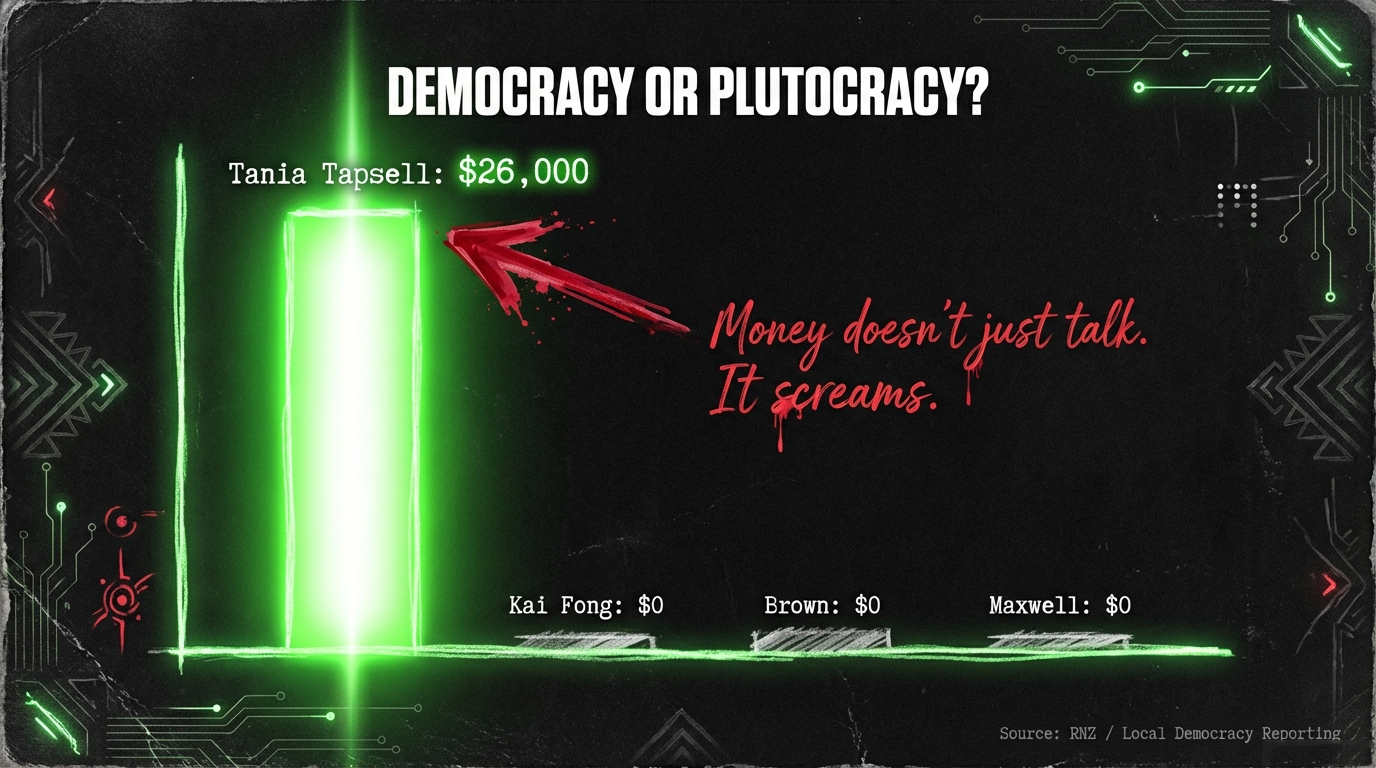
—she purchased it wholesale with $26,000 in donations,
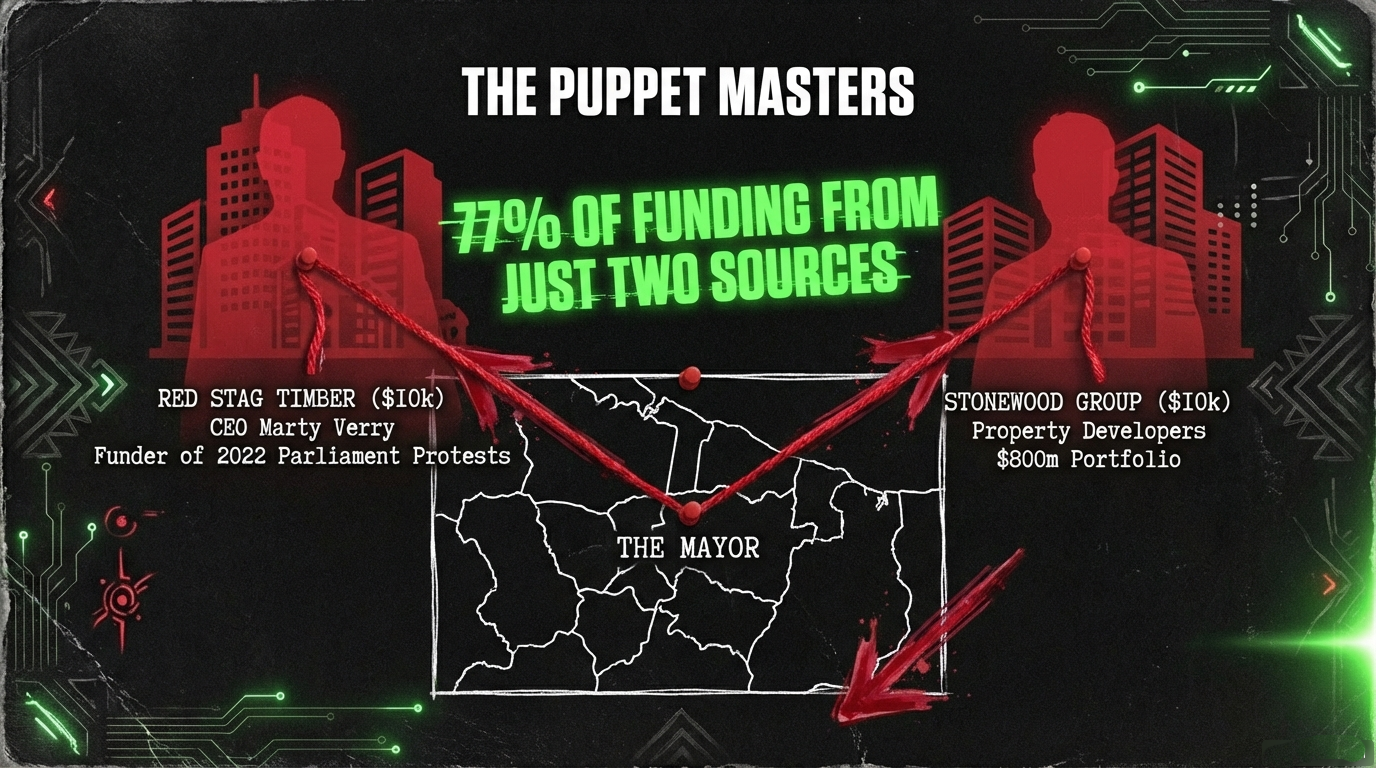
77% of which flowed from two corporate benefactors whose business interests tangle with council decisions like roots through a crumbling foundation.
Red Stag Timber’s CEO Marty Verry wrote a $10,000 check.
So did property development conglomerate Stonewood Group.
Meanwhile, her opponents—most of whom spent nothing—learned what every aspiring politician in New Zealand’s local government discovers:
democracy is open to all, but only the wealthy get through the door.
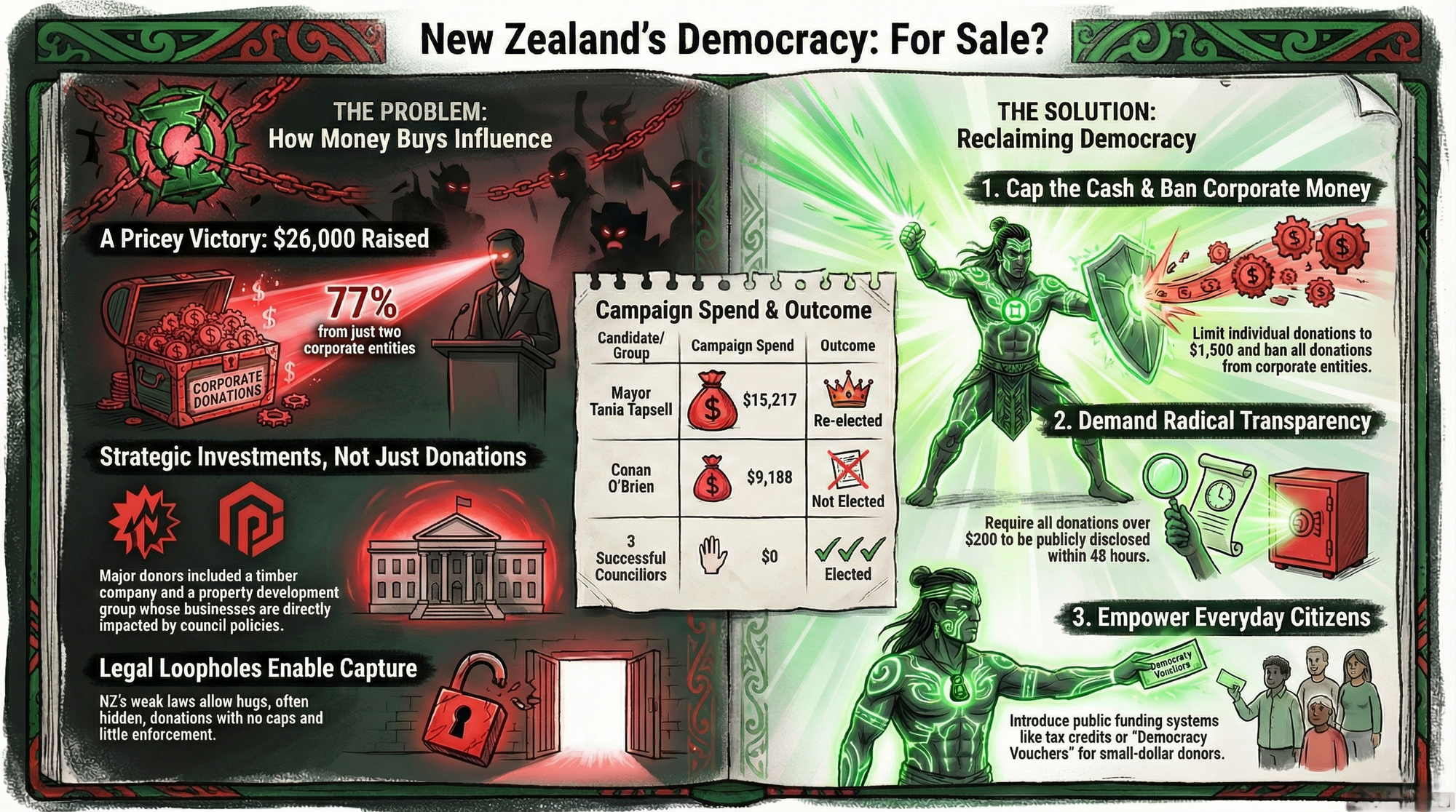
This isn’t democracy. It’s a protection racket with a ballot box facade. And it exemplifies how New Zealand’s antiquated, corruption-enabling political finance laws have transformed the nation into an oligarchy where wealth purchases policy outcomes as reliably as coins purchase coffee.
The Players at the Poker Table
Red Stag Timber: The House That Verry Built
Marty Verry operates Rotorua’s largest private employer, a timber empire spanning 90+ hectares with over 400 employees.
His $10,000 donation wasn’t charity
—it was an investment with documented returns.
Red Stag previously contributed $500,000 to the Rotorua Partners’ Programme that funded the Events Centre,
where Red Stag secured naming rights.
That’s called buying advertising and influence simultaneously
—a two-for-one special in the marketplace of power.
But the real profit came from policy.
Rotorua Lakes Council adopted New Zealand’s first “Wood First Policy” in 2015—a procurement mandate requiring timber preference in public construction.
Red Stag subsequently supplied timber to major projects, including Tauranga City Council’s $125 million headquarters.
The sequence—donation → favorable policy → lucrative contracts—isn’t corruption in New Zealand’s toothless legal framework. It’s just good business.
Verry’s previous political ventures reveal his appetite for influence. He funded the violent Parliament protest of 2022, later claiming regret when the optics soured.
Translation:
buying political disruption is acceptable; getting caught is embarrassing.
Stonewood Group: The Developers Who Own the Blueprint
The Chow brothers’ Stonewood Group operates like a real-estate octopus, tentacles wrapping around hotels, housing developments, and hospitality assets worth $800 million. In Rotorua, they own the Pullman Hotel—the city’s first five-star property.
Their $10,000 donation to Tapsell mirrors donations to other pliable politicians:
$44,000 to the National Party nationally and $20,000 to Auckland Mayor Wayne Brown, who promptly pursued density deregulation benefiting developers.
Stonewood’s business model depends entirely on favorable council decisions:
zoning changes, streamlined consents, infrastructure investment. When John and Max Key joined as partners in “Stonewood Key Capital” to raise $100 million for housing development, they weren’t signaling confidence in the free market—they were advertising direct pipelines to power.
Tania Tapsell: The National Party’s Local Operative
Tapsell is a National Party member since her teens, National’s 2020 East Coast candidate, and repeatedly identified as a future party leader. Her political brand trades on partisan affiliation even while claiming mayoralty requires non-partisanship—a cognitive dissonance only politicians can maintain with straight faces.
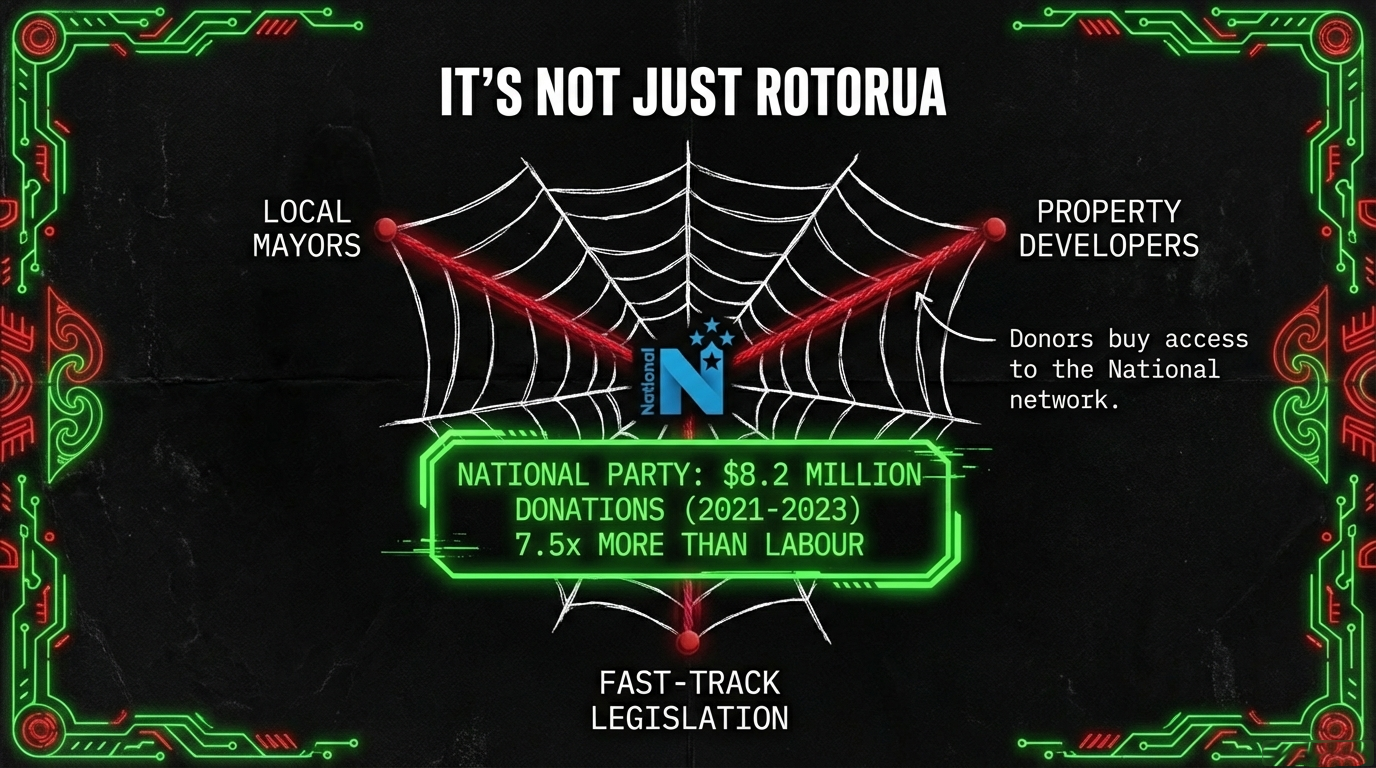
When corporate donors fund Tapsell’s local campaigns, they’re not backing an independent mayor—they’re buying access to National’s broader network. Her donors fund the same party receiving $8.2 million from 2021-2023—seven times Labour’s haul—creating an oligarchic funding structure where property developers like Graeme Hart ($250,000), Chris Meehan ($155,000), and the Chow brothers ($44,000) determine policy outcomes.
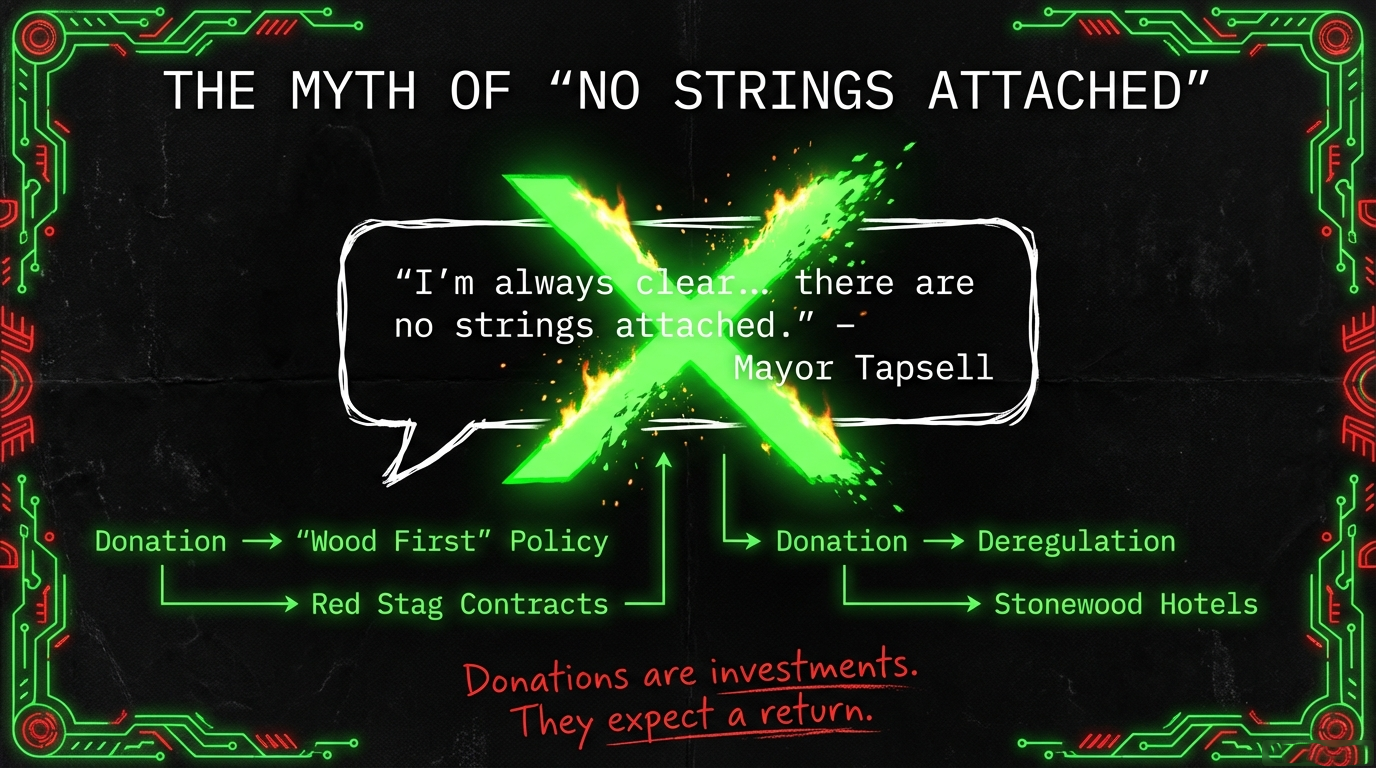
Tapsell insists donors have “no current business interests with the council” and donations carry “no strings attached.” This claim would be laughable if it weren’t tragically believed by those desperate to maintain the fiction that New Zealand isn’t for sale.
Quantifying the Carnage: How Corruption Kills Democracy
Democratic Inequality: When Wealth Becomes Political Voice
Research across democracies demonstrates that income inequality directly erodes democratic institutions. The more unequal a society’s wealth distribution, the more vulnerable it becomes to electing “power-aggrandizing and norm-shredding” leaders who govern for oligarchic interests.
New Zealand exemplifies this trajectory. Tapsell’s $26,000 war chest enabled professional marketing, extensive signage, targeted outreach, and media buys unavailable to opponents spending $0-$7,000. This creates what scholars term “participatory inequality”—elections determined by wealth rather than merit. Studies confirm that campaign spending advantages translate directly into electoral success, locking non-wealthy candidates out of competition.
The Harm:
Democracy requires rough political equality. When some citizens exercise vastly greater influence than others, the voting rights of lower-income citizens become ceremonial. Research shows economic inequality exacerbates participatory inequality, creating a “Don’t play if you can’t win” dynamic where citizens rationally disengage from captured politics.
Policy Capture: When Donors Write the Laws
The fast-track consenting legislation championed by National, ACT, and NZ First exemplifies regulatory capture writ large. Over $500,000 in donations from companies seeking fast-track approval preceded legislation enabling three ministers to override environmental protections and community opposition. At least two businesses invited to apply for fast-track consents had donated to National.
This isn’t coincidence—it’s quid pro quo corruption disguised as legitimate policymaking. Research on campaign contributions and regulatory enforcement finds that donations enable corporations to avoid compliance costs through reduced oversight, effectively transferring public goods (clean air, water, environmental health) to private profit.
The Harm:
Studies estimate that relaxed enforcement saves donors 10-20% in compliance costs. When timber companies donate to mayors who appoint regulatory officials, environmental monitoring becomes performative rather than protective. The Australian case of property developer donations correlating with favorable zoning and UK minister Robert Jenrick’s £12,000 donation followed by planning approval demonstrate identical patterns globally.
Trust Deficit: The Legitimacy Crisis
New Zealand public opinion data reveals democratic collapse in real-time:
- 85% support mandatory annual financial disclosure
- ~70% distrust the current donation system
- Majority perceive governments make laws to suit the rich
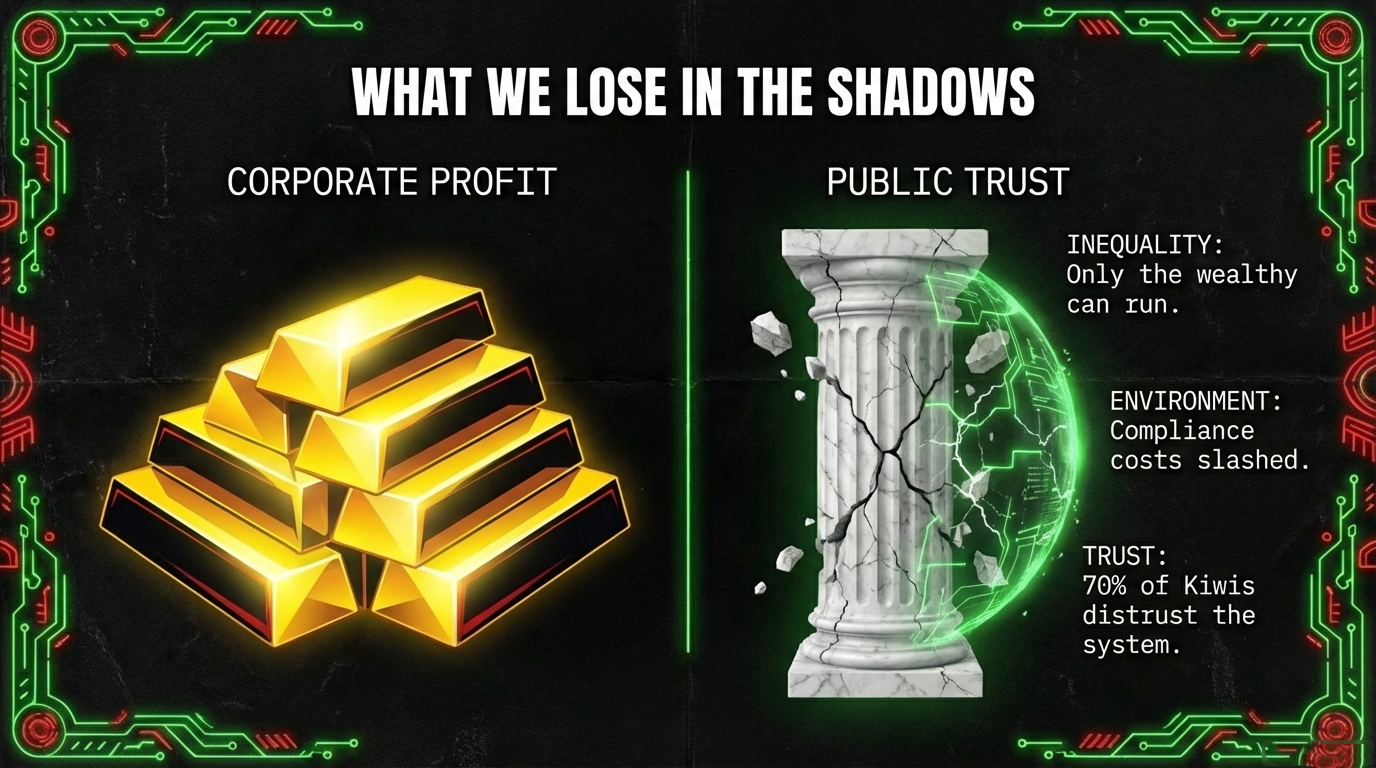
This isn’t paranoia—it’s accurate perception of oligarchic capture.
When wealthy elites use donations to secure favorable policy, democracy becomes what scholars call
“representative government against oligarchy”
—a system where political parties govern on behalf of rival elite factions rather than ordinary citizens.
The Harm:
Distrust erodes civic participation. Research documents that higher income inequality correlates with reduced voter turnout, decreased civic engagement, and declining satisfaction with democracy. For Māori communities already marginalized by colonial power structures, corporate donations to Pākehā politicians amplify existing inequalities, diluting Indigenous political voice even as Māori wards proliferate.
Economic Costs: Misallocated Billions
Corruption imposes quantifiable economic harm through resources diverted to serve donor interests:
Infrastructure Misallocation:
Rotorua’s Events Centre—partly funded by Red Stag’s $500,000—cost $21 million, $5 million over budget. Naming rights and procurement policy created ongoing donor benefits. Cost-benefit analysis independent of donor influence might have prioritized community housing, infrastructure maintenance, or social services with higher public welfare returns.
Inequality Amplification:
Political donations exacerbate economic inequality by enabling wealthy interests to capture policy. Research confirms that money in politics drives inequality through favorable taxation, weak labor regulations, and deregulation that further concentrates wealth. New Zealand’s labor share of income fell precipitously from the 1980s-2000s—the steepest decline in the OECD—while excess corporate profits surged.
The National Party’s Oligarchic Financing Network
Not Isolated Incidents—Systematic Capture
Tapsell’s donations exemplify National’s oligarchic funding structure where small numbers of ultra-wealthy donors determine outcomes:
- Property developers constitute the largest class: Culum Manson ($70,000), Chow brothers ($44,000), Chris Meehan ($155,000)
- Billionaires like Graeme Hart ($250,000) and Gary Lane ($100,000) purchase policy wholesale
- Donation splitting evades disclosure: Zhang Yikun’s $100,000 to National was divided below thresholds until exposed
This network operates identically at local and national levels. Wayne Brown’s Auckland mayoralty received $611,000 from Hart ($50,000), Tramco ($50,000), developers, and Stonewood ($20,000). The pattern: wealthy donor → National-aligned candidate → deregulatory policy → donor profit.
Institutional Failure: Why Corruption Thrives
New Zealand’s regulatory framework enables corruption through deliberate weakness:
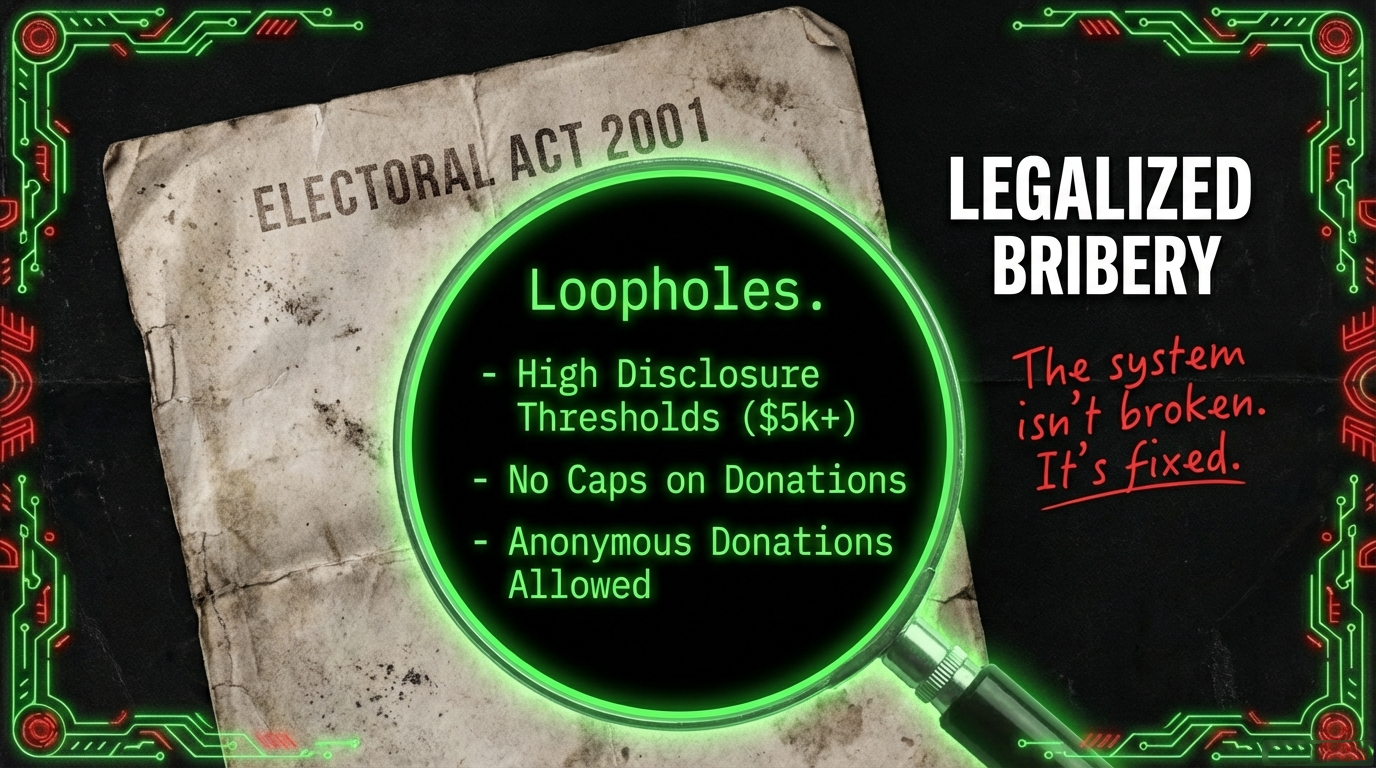
Weak Disclosure: The $5,000 threshold (recently lowered from $15,000) dwarfs comparable democracies. Canada requires disclosure above $200; UK above £500. New Zealand’s threshold enables 80% of donations to remain hidden.
No Donation Caps: Unlike jurisdictions limiting individual contributions, New Zealand imposes no maximum. Hart’s $250,000 donation would be illegal in most democracies.
Anonymous Donations: Up to $1,500 can be given anonymously without limit on total anonymous receipts. The NZ First Foundation channeled $750,000 anonymously through intermediaries to evade disclosure.
Corporate & Foreign Donations: New Zealand permits corporate donations (banned in Quebec) and allows foreign-owned NZ-registered companies to donate freely, enabling foreign nationals to purchase influence through subsidiaries.
Delayed Reporting: Donations are disclosed months after elections, when public attention has dissipated and policy decisions are already made.
Non-Enforcement: Rotorua’s electoral officer noted he had “never seen” prosecution for violations. Courts have overturned convictions, effectively declaring enforcement impossible.
Queensland’s Developer Ban: Proof Reform Works
Queensland banned property developer donations entirely in 2009 after corruption inquiries revealed systematic capture. The law prohibits:
- Direct developer donations
- Industry body donations where developers constitute the majority
- Donations from developer “close associates”
This comprehensive prohibition recognizes that developer interests inherently conflict with sound planning policy. Meanwhile, New Zealand permits unlimited developer donations, creating identical corruption patterns to Los Angeles City Councilman José Huizar’s $1.5 million bribery scheme trading favorable zoning for cash.
Solutions: Dismantling the Auction House
International evidence converges on comprehensive reforms required to restore integrity:
Immediate Regulatory Reforms
1. Donation Caps: $1,500 Per Donor Annually
Implement individual donation limits of $1,500 per year, with total party receipts capped at $15,000 per donor across election cycles. This aligns with Canadian models preventing oligarchic capture while preserving grassroots participation.
2. Ban Corporate & Organizational Donations
Restrict donations to registered individual electors only. Corporate entities lack voting rights; their donations represent illegitimate political speech. Quebec’s model demonstrates feasibility.
3. Lower Disclosure to $200 Within 48 Hours
Require disclosure of all donations above $200 within 48 hours of receipt. Technology enables real-time transparency; delayed disclosure serves only to hide influence.
4. Eliminate Anonymous Donations
Ban all anonymous contributions. Anonymity serves no democratic purpose—it exists solely to enable hidden influence.
5. Close Trust & Foundation Loopholes
Prohibit donations through intermediary entities requiring disclosure of beneficial ownership. The NZ First Foundation demonstrated how trusts enable money laundering.
6. Foreign Donation Ban
Prohibit donations from foreign nationals, foreign-owned companies, and foreign-controlled entities. This exists in most democracies but remains unenforceable in New Zealand’s framework.
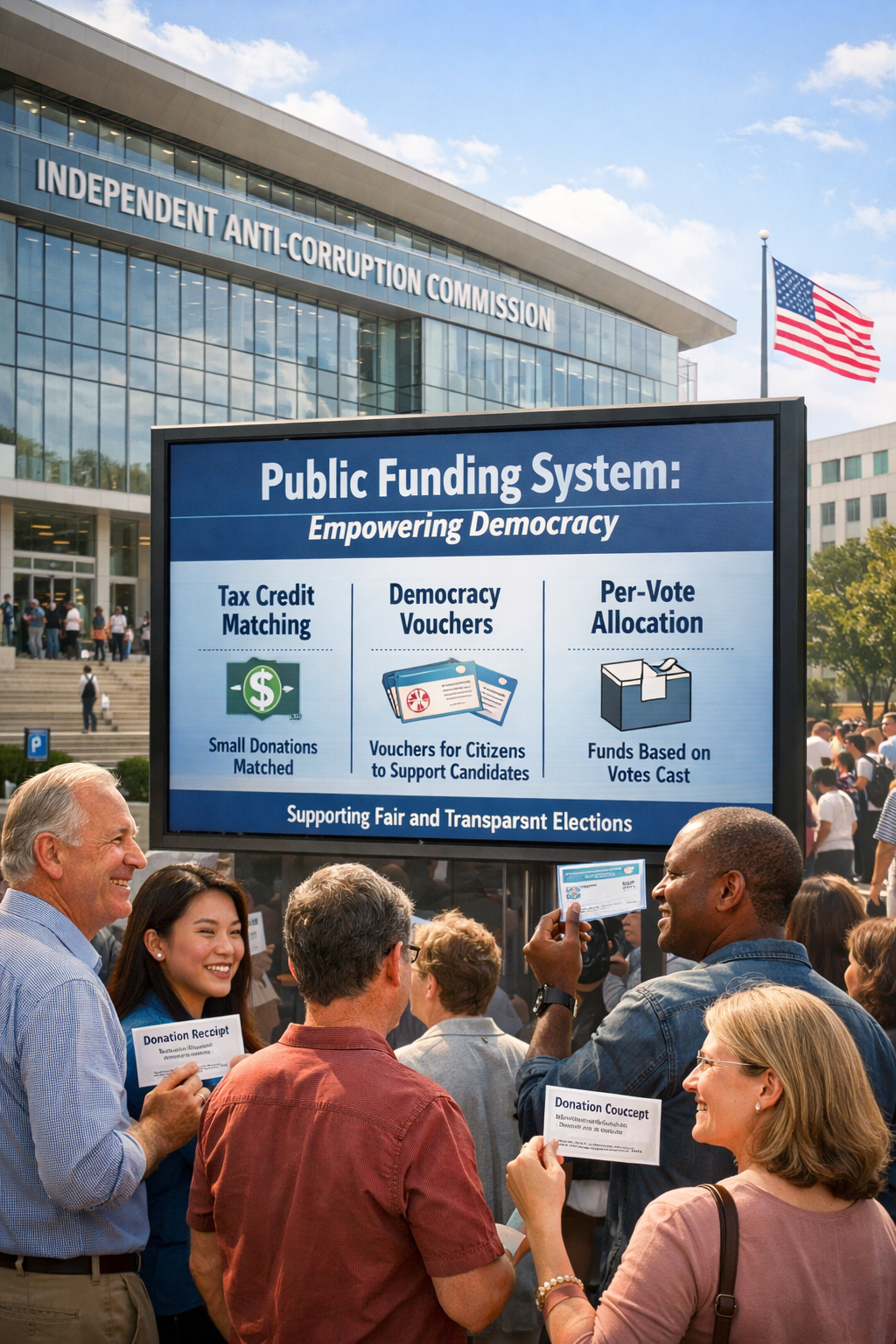
Public Funding System
Research demonstrates state funding reduces donor reliance while expanding democratic participation:
1. Tax Credit Matching: 75% Up to $200
Implement 75% tax credits for donations up to $200, modeled on Canada. This incentivizes small-dollar donations, empowering ordinary citizens. Canadian evidence shows tax credits increase donor diversity and reduce party dependence on large contributions.
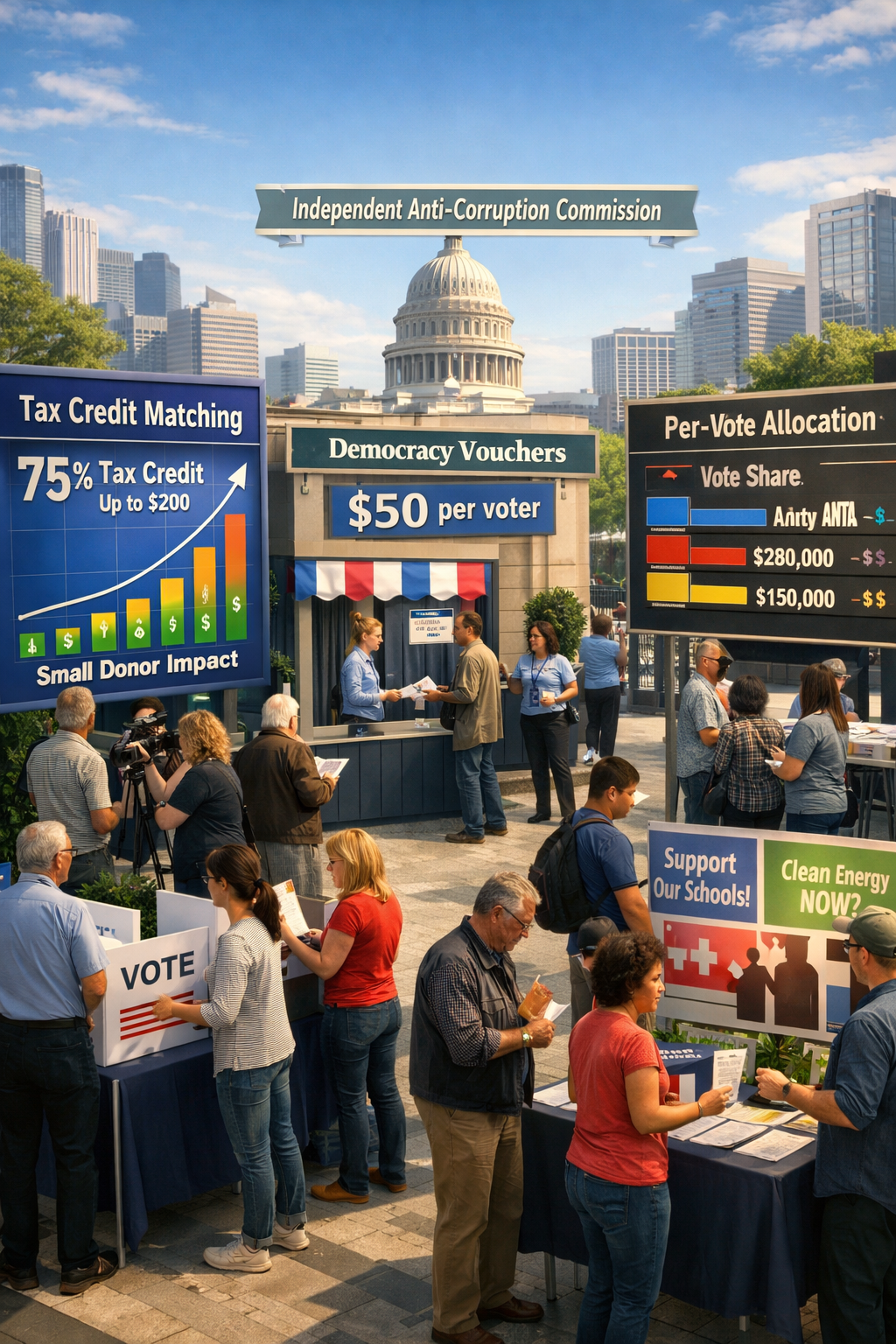
2. Democracy Vouchers: $50 Per Voter
Provide each eligible voter $50 in “democracy vouchers” to allocate to candidates/parties. Seattle’s program demonstrates feasibility (though requiring refinement for equitable participation).
3. Per-Vote Allocation
Distribute public funds based on vote share, incentivizing broad coalitions rather than narrow donor interests. Current broadcasting allocation follows this model; expand to direct campaign funding.
Total Cost: Approximately $2-$10 million annually—0.0001% of government expenditure. The return on investment in uncaptured policy would be substantial.
Enforcement and Transparency
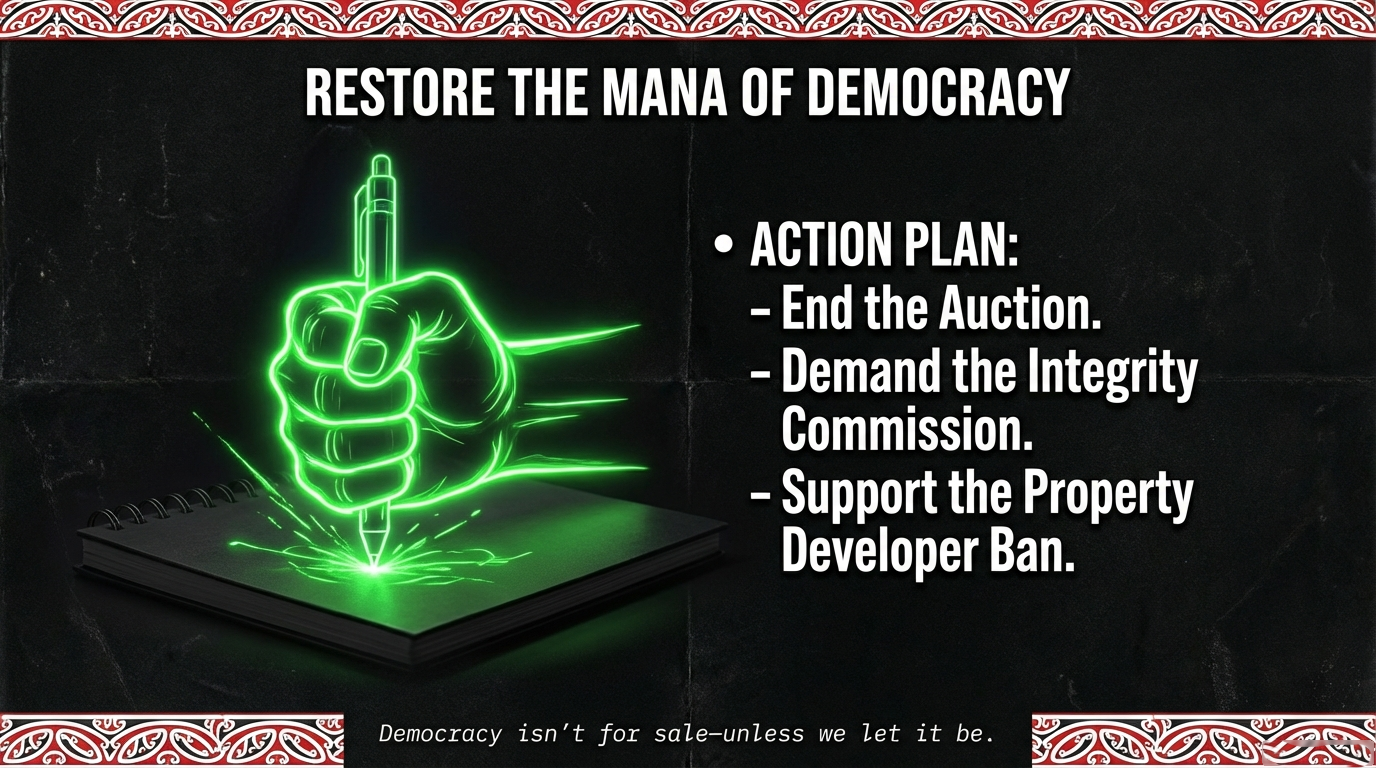
1. Independent Anti-Corruption Commission
Establish an Integrity Commission with investigative powers, audit authority, and prosecutorial capacity. Current Electoral Commission lacks resources to enforce even weak rules.

2. Mandatory Audits
Require annual audited financial statements from all parties, with penalties including deregistration for non-compliance.
3. Lobbyist Register
Implement comprehensive lobbying disclosure:
- Mandatory registration
- Disclosure of meetings within 48 hours
- Public database
- Code of conduct with enforcement
4. Revolving Door Restrictions
Implement 2-year cooling-off periods for ministers and senior officials before lobbying in former areas.
Local Government Specific Reforms
1. Apply National Rules Locally
Extend all donation caps, disclosure requirements, and public funding to local elections—currently operating under even weaker rules.
2. Property Developer Ban
Following Queensland’s model, prohibit developer donations. The conflict of interest is insurmountable.
3. Conflicts of Interest Enforcement
Strengthen the Local Authorities (Members’ Interests) Act with clearer definitions, mandatory disclosure, and penalties. Current framework relies on self-reporting and goodwill.
Democracy Isn’t for Sale—Unless We Let It Be
Mayor Tapsell’s corporate-funded campaign isn’t an aberration—it’s the logical endpoint of New Zealand’s deliberately weakened democratic safeguards. When 77% of a mayor’s funding comes from two companies with material interests in council decisions, regulatory capture isn’t alleged—it’s demonstrated. When the same companies funding local mayors also fund National Party politicians who control fast-track legislation benefiting those donors, corruption is systematic rather than isolated.
The harms are quantified: participatory inequality preventing non-wealthy candidates from competing; policy capture serving donor profits over community welfare; misallocated billions in public resources; 70% of citizens distrusting a system they accurately perceive as captured.
Solutions exist, proven effective across democracies: $1,500 donation caps, corporate donation bans, real-time disclosure above $200, public funding through tax credits and vouchers, independent enforcement through an Integrity Commission. These reforms cost $2-$10 million annually—a rounding error that would fundamentally democratize politics by ensuring policy serves citizens rather than oligarchs.
New Zealand faces a choice: continue toward oligarchic capture where democracy becomes veneer masking elite rule, or join peer democracies recognizing that political equality requires constraining wealth’s translation into power.
The auction house is open. The gavel is falling. And Aotearoa’s democracy is going once, twice...
Will anyone stop the sale before it’s gone?
Protecting Democracy
Every koha signals that whānau are ready to fund accountability investigations that protect democracy for those who come after us. When 77% of a mayor’s funding comes from two corporations, when National raises 7 times more in donations than Labour, when 70% of citizens distrust the donation system, our tamariki inherit a system where wealth determines political voice. It signals that rangatiratanga includes the manaakitanga to fight so future generations inherit genuine democracy rather than oligarchy.
Kia kaha, whānau. Stay vigilant for your children’s future. Stay connected to the money trails determining Rotorua’s trajectory and New Zealand’s political soul. And if you are able, consider a koha to ensure future generations will not live in a system where democracy is for sale to the highest bidder.
Three Pathways to Support This Mahi
For those who wish to support this accountability journalism directly with a koha (voluntary contribution), please visit the Koha platform:
Koha—Support Democracy Accountability
For those who wish to receive essays directly and support through subscription, join the Substack community:
Subscribe to the Māori Green Lantern on Substack
For those who prefer direct bank transfer, account details are:
HTDM, account number 03-1546-0415173-000
Kia kaha. Democracy is not for sale—unless we let it be. Your koha ensures we continue fighting to stop the sale.

Ivor Jones The Māori Green Lantern Fighting Misinformation And Disinformation From The Far Right