“THE AUDACITY OF SUBORDINATION: How Luxon, Willis, and Peters Demand Breman Submit While They Violate the Very Independence They Claim to Respect” - 19 January 2026
Kia ora koutou katoa,
This essay is for the archive. This is for the record. This is for every whānau member who trusted institutions and watched them erode from within. This is for every New Zealander who believed Christopher Luxon when he said
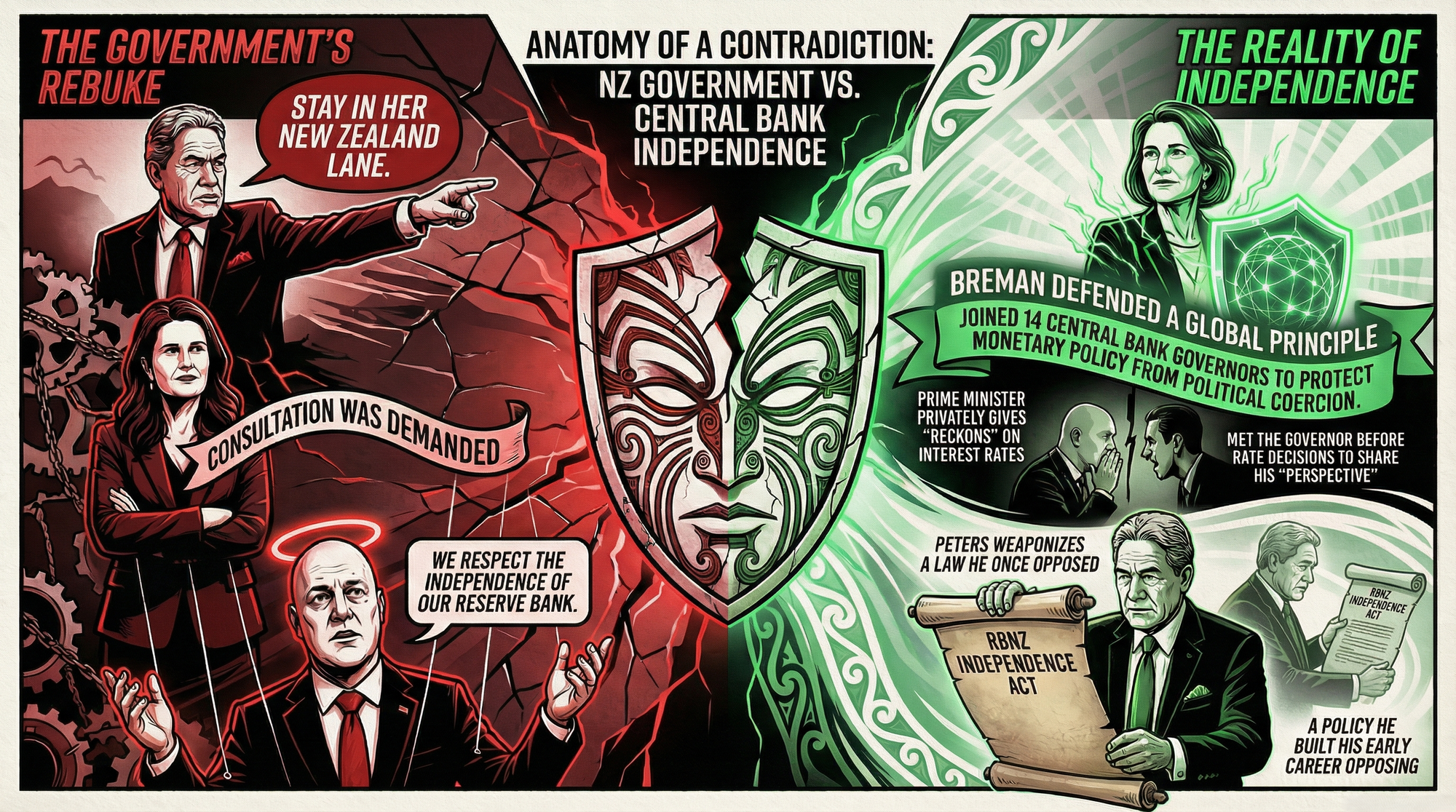
“we respect the independence of our Reserve Bank.”
This is the anatomy of despotism dressed as protocol.
The Despicable Claims: What They Said
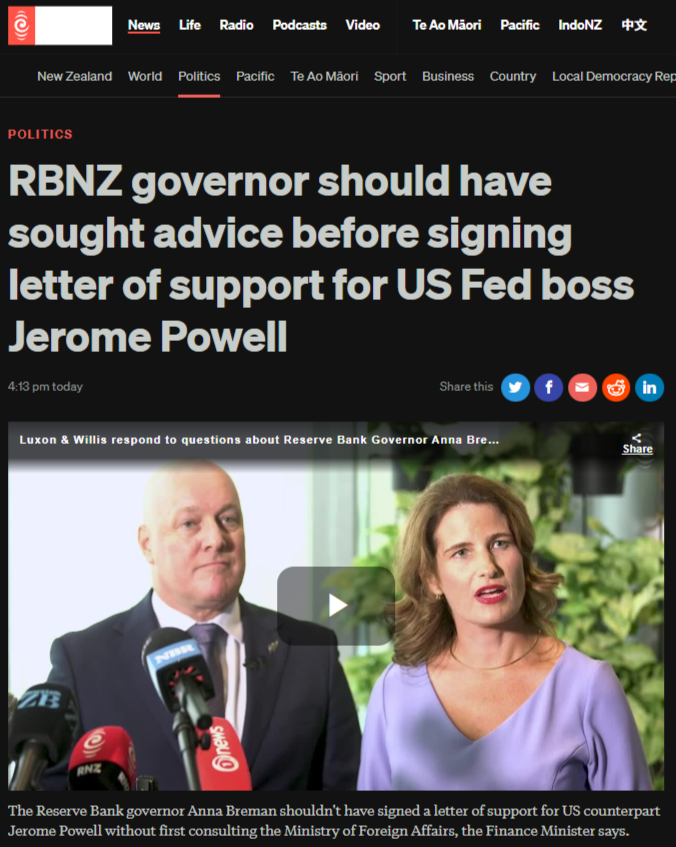
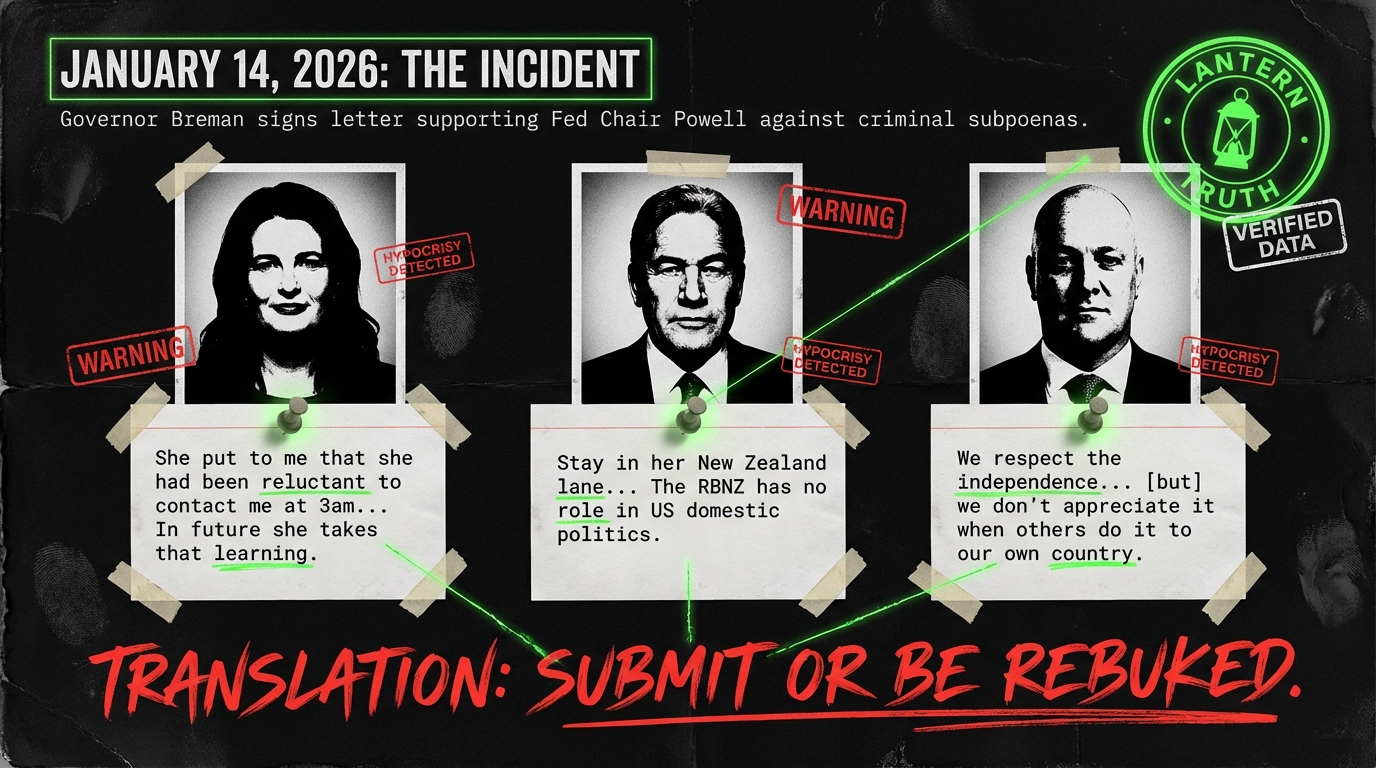
On Monday, January 19, 2026—following Prime Minister Christopher Luxon’s State of the Nation speech—the triumvirate of authoritarian mediocrity assembled to scold Reserve Bank Governor Anna Breman for her January 14 decision to co-sign an international letter defending Federal Reserve Chair Jerome Powell against Trump administration subpoenas.
Finance Minister Nicola Willis led the patronizing lecture. Breman, she scolded, “should have let me know” before signing the letter. Breman should have contacted Willis—even at 3am—to seek permission. Willis magnanimously conceded that she “didn’t think an apology was necessary,” but made clear that Breman must learn her lesson: “in future she takes that learning of making sure she seeks advice and lets people know ahead of any international statements.”
Translation:
Breman must ask permission before defending institutional principles that the government itself claims to respect.
Winston Peters went further.
The Reserve Bank “has no role, nor should it involve itself, in U.S. domestic politics.”
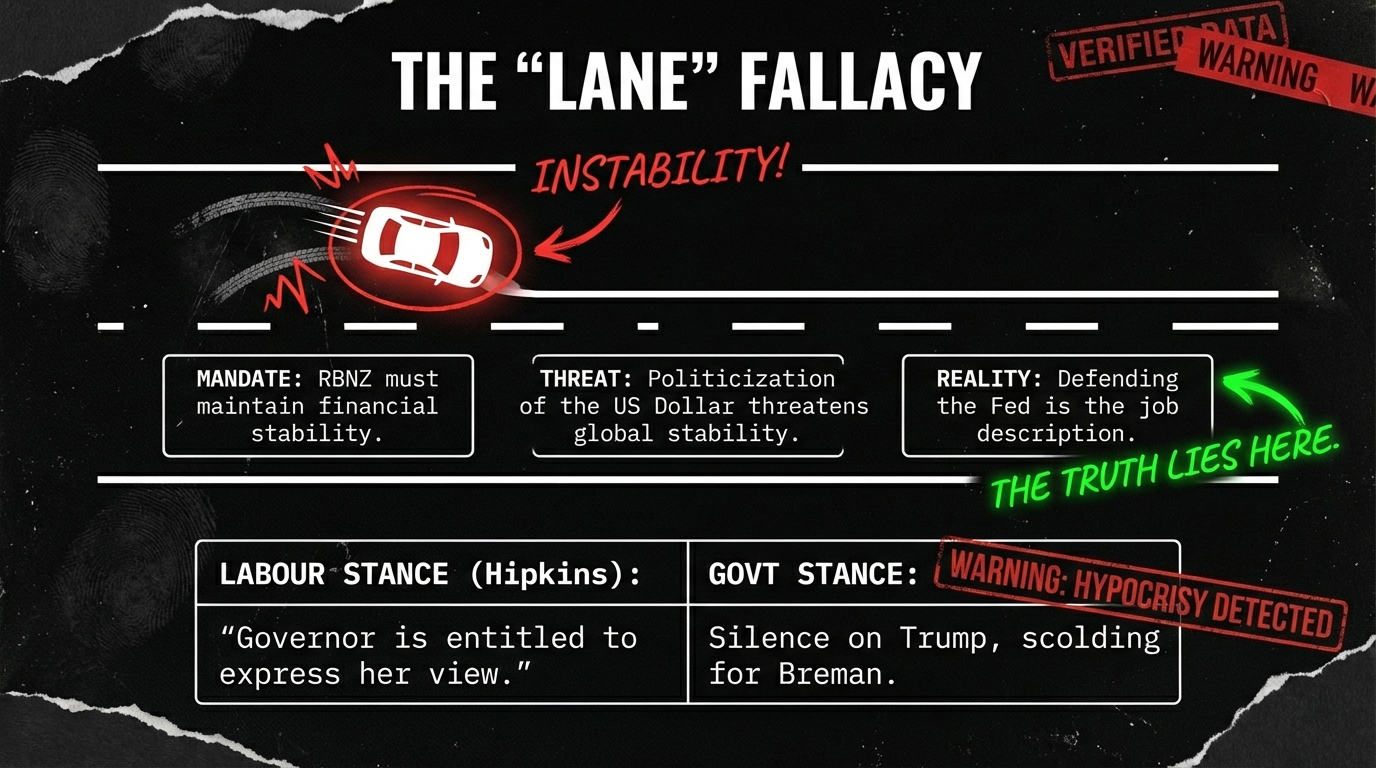
Breman must “stay in her New Zealand lane and stick to domestic monetary policy.”
“if the Governor had sought its advice, which she did not.”
Translation:
Breman must subordinate her professional judgment to a Ministry that Peters himself routinely ignores.
Christopher Luxon, fresh from his State of the Nation performance, offered the most cynical contribution.
Translation:
We respect her independence—as long as she does what we tell her.
What Breman Actually Did: Defending Institutional Independence from Autocratic Assault
Let us be absolutely clear about what Anna Breman signed.
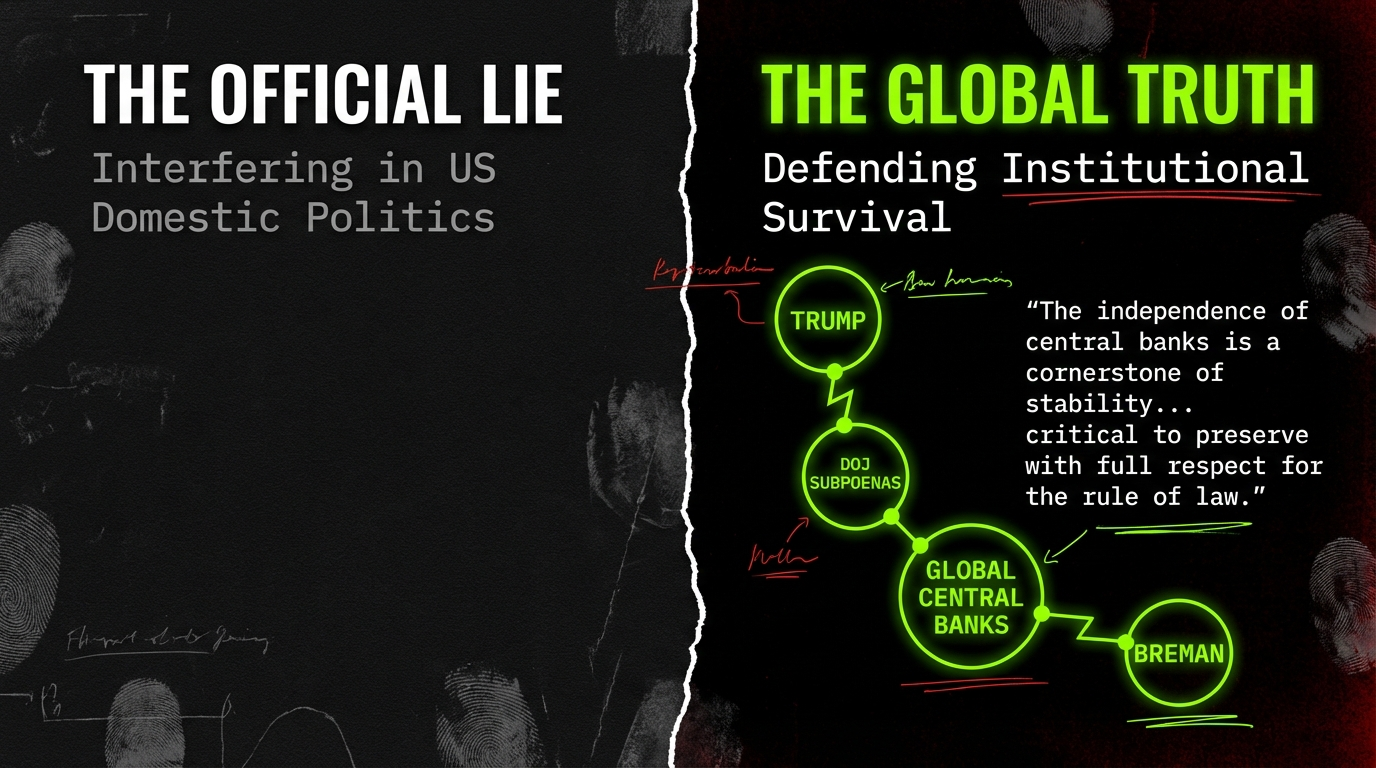
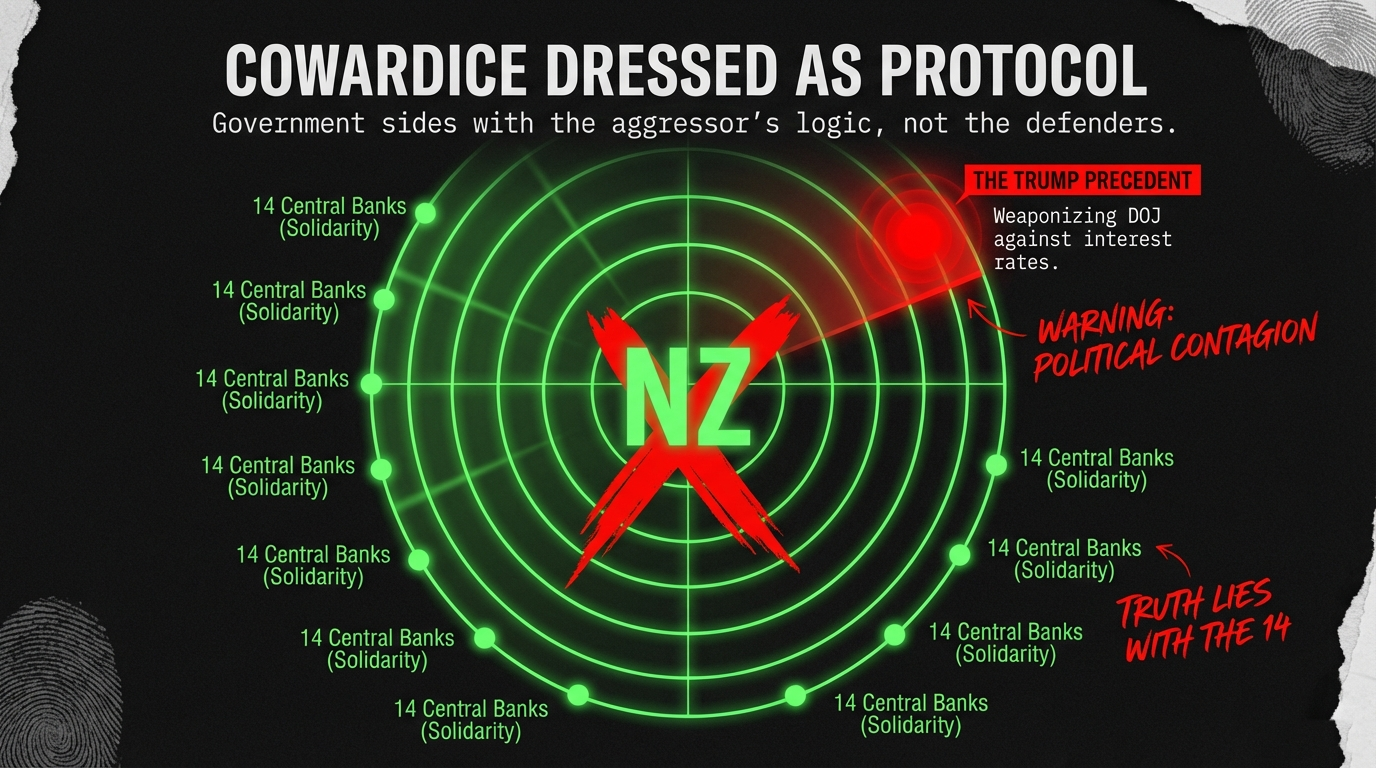
On January 14, 2026, she joined 14 other central bank governors worldwide in co-signing a letter expressing “full solidarity” with Jerome Powell after the U.S. Department of Justice served the Federal Reserve with grand jury subpoenas threatening criminal indictment.
The letter praised Powell for having
“served with integrity, focused on his mandate and an unwavering commitment to the public interest.”
Why did Powell face subpoenas? Ostensibly, the Department of Justice investigation concerned Powell’s testimony to Congress about the cost of Federal Reserve headquarters renovations. But Powell himself made clear what was actually happening: the threat of criminal charges is a consequence of the Federal Reserve setting interest rates based on professional judgment, rather than following the preferences of the President.
Trump has spent years demanding that the Federal Reserve slash interest rates to stimulate growth and reduce government debt servicing costs. Powell refused. So Trump weaponized the Justice Department to threaten Powell with criminal prosecution as a pretext for either forcing his resignation or establishing presidential control over monetary policy.
This is what Willis, Peters, and Luxon deemed inappropriate.
The Despicable Hypocrisy: Peters’ 1996 Betrayal
Winston Peters’ demand that Breman “stay in her lane” is an act of such staggering hypocrisy that it defies parody. Peters is weaponizing the very central bank independence doctrine he signed up to enforce in 1996—and then abandoned every principle he had campaigned on to do so.
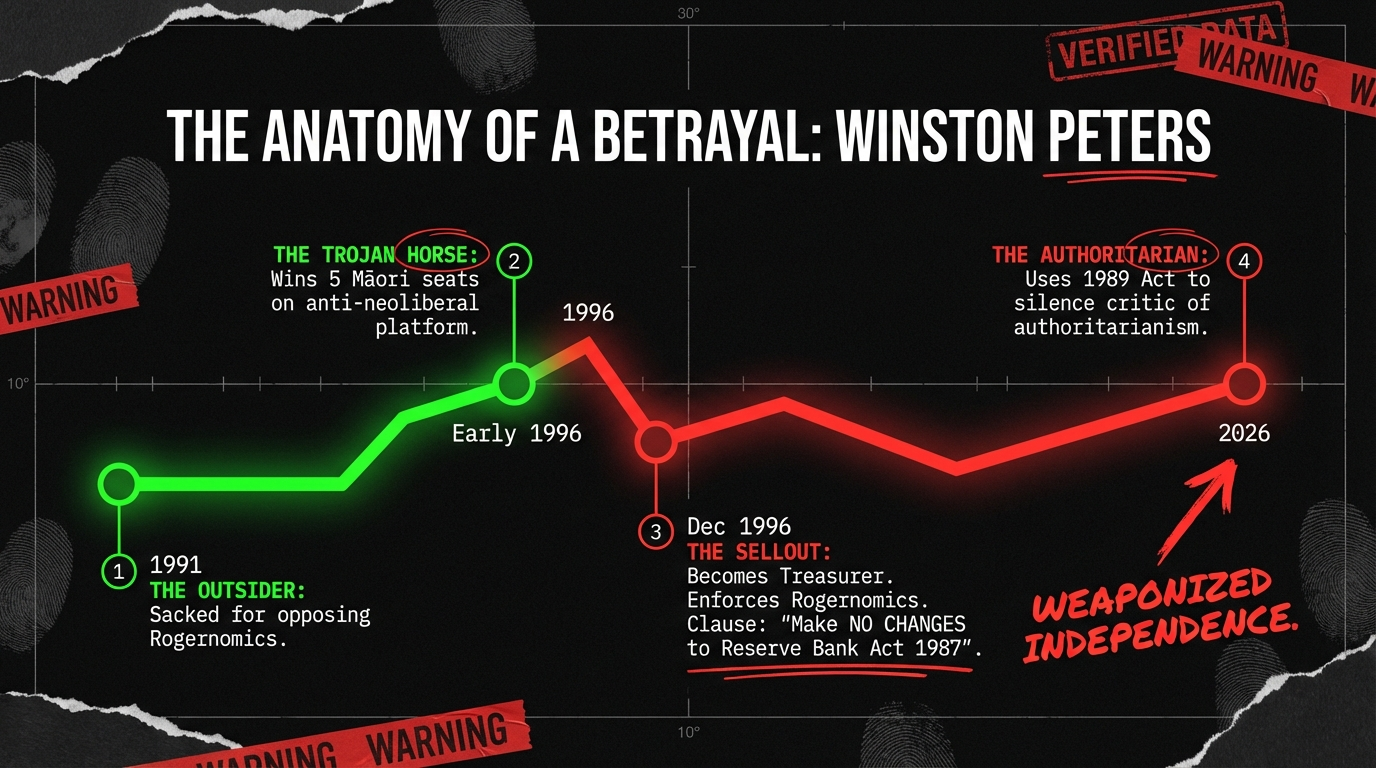
The 1996 Coalition Agreement between National and New Zealand First, signed by Peters on December 10, 1996, contains this commitment on the Reserve Bank Act:
“To raise 0-2% target range to 0-3%... To refer to sustainable economic growth and employment in Policy Targets Agreement... To make NO CHANGES to the Reserve Bank Act 1987.”
Peters KEPT the neoliberal central bank independence framework intact. He made only cosmetic changes: raised the inflation target slightly, added “employment” language to the Policy Targets Agreement. But the core Rogernomics structure—statutory independence, operational autonomy, insulation from political interference—remained untouched.
This is the same Winston Peters who:
- Was sacked from the National cabinet in 1991 for opposing neoliberal policy
- Founded New Zealand First in 1993 as an anti-neoliberal party
- Won all five Māori electorates in 1996 on a platform opposing central bank independence doctrine and Rogernomics
- Then signed a Coalition Agreement committing to “orthodox economic policies,” “continuing deregulation,” and NO CHANGES to the Reserve Bank Act
Peters preserved the Reserve Bank independence framework he had campaigned against. Now, 30 years later, he invokes that SAME framework to demand that Breman submit to government control when she defends institutional independence against Trump’s autocratic assault.
Peters is using the Reserve Bank Act 1989—the Rogernomics legislation designed to protect the central bank from political interference—as a tool to demand political subordination.
The audacity is breathtaking. The hypocrisy is despicable.
The Despicable Interference: Luxon’s Contradiction
Christopher Luxon’s claim that “we respect the independence of our Reserve Bank” is a lie so brazen that it insults the intelligence of every New Zealander.
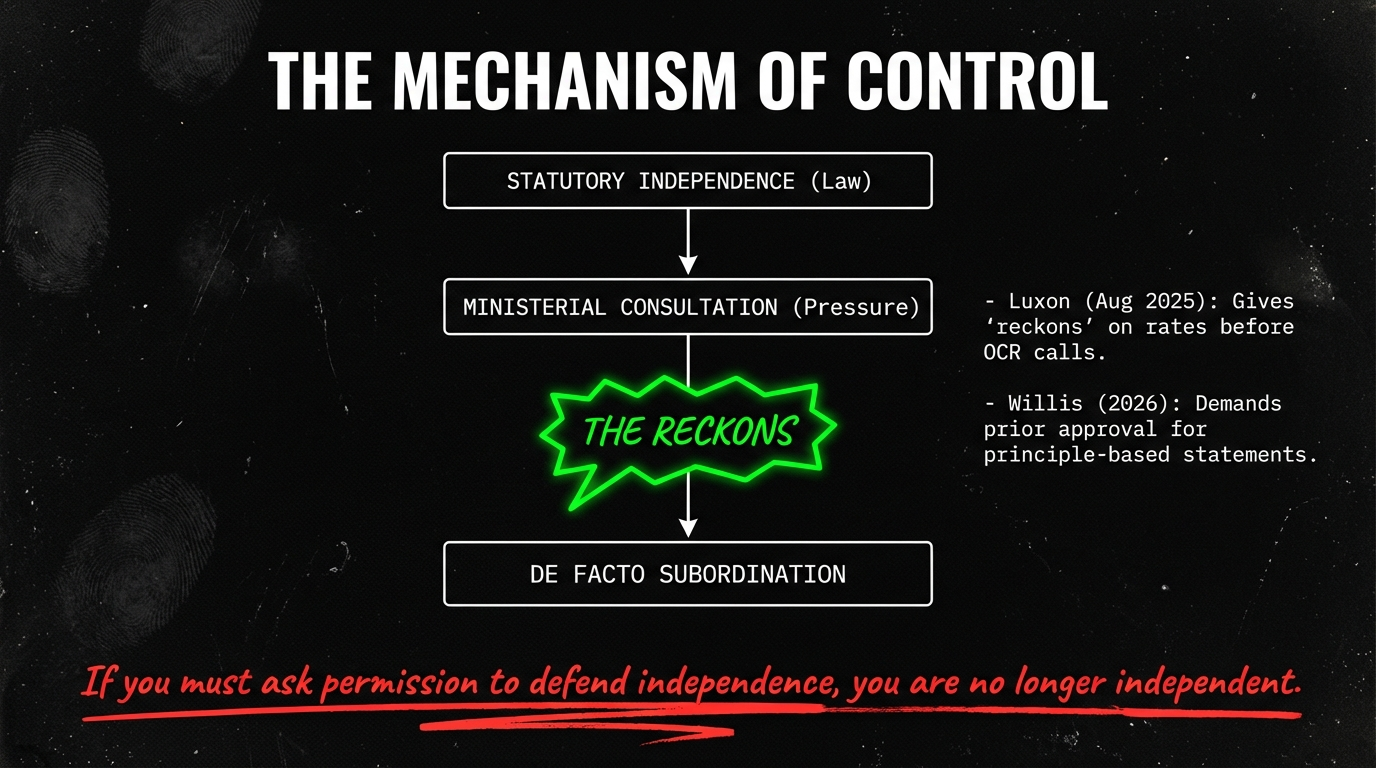
In August 2025—just months before scolding Breman for her Powell letter—Luxon admitted in an interview that he meets with the Reserve Bank Governor before EVERY Official Cash Rate announcement. He told media that he gives the Governor his “reckons and perspective” on where interest rates should go.
Let that sink in. The Prime Minister meets with the Acting Governor—whose application for a full-term appointment is pending with Finance Minister Willis—on the evening before OCR announcements and tells him where he thinks interest rates should go.
This is EXACTLY the kind of political interference that central bank independence frameworks are designed to prevent.
Then Luxon has the audacity to lecture Breman about respecting independence when she defends that same independence principle internationally.
The duplicity is staggering. The contempt for institutional integrity is absolute.
The Despicable Power Play: Willis’ Regulatory Capture
Nicola Willis’ scolding of Breman reveals the most insidious dynamic: Finance Ministers using “consultation” protocols to establish de facto control over statutory independence.
Willis told reporters that Breman should have contacted her—even at 3am—before signing the Powell letter. Willis would then have advised Breman to “take advice from across government” including the Ministry of Foreign Affairs and the Treasury Secretary.
Translation:
Willis expected Breman to run her professional judgment through a gauntlet of government officials who would have pressured her to withdraw her signature or water down her solidarity.
Willis’ claim that Breman was “being overly respectful of my private time” is patronizing theater.
The real message:
Breman failed to submit to ministerial authority BEFORE acting on her institutional principles.
This is not about “consultation.” This is about establishing subordination.
And Willis has form. She has already pressured the Reserve Bank on bank capital requirements. Former Governor Adrian Orr resigned in March 2025 in a funding dispute with Willis after refusing to cave to her pressure to loosen bank capital rules.
Willis claims to “respect” Reserve Bank independence while systematically undermining governors who refuse her direction.
Now she demands that Breman seek her permission before defending the institutional independence that Willis herself is eroding.
The cynicism is bottomless.
The Despicable Inversion: Peters Demands Consultation He Never Provides
Winston Peters’ claim that Breman should have consulted the Ministry of Foreign Affairs and Trade is an inversion so audacious it would be comedic if it weren’t so authoritarian.
Peters routinely ignores his own Ministry’s advice. He has spent his tenure as Foreign Minister freelancing foreign policy decisions without systematic consultation with his own Ministry.
Peters demands that Breman follow consultation protocols that Peters himself treats with contempt.
But there is a deeper issue: Peters is weaponizing institutional protocols to establish political control over statutory independence. When Breman’s signature on the Powell letter indicates “the support of the Reserve Bank of New Zealand, which is statutorily independent from the New Zealand Government,” Peters responds by demanding she should have sought government approval first.
Peters is inverting statutory independence into subordination.
The Despicable Context: What Was Actually at Stake
Let us return to what Anna Breman was actually defending. Jerome Powell faced criminal indictment from the Trump administration for refusing to subordinate Federal Reserve interest rate decisions to presidential preferences.
This is not a policy disagreement. This is an autocratic assault on institutional independence.
Central bank governors worldwide understood what was happening:
if Trump succeeds in establishing presidential control over U.S. monetary policy through criminal intimidation, the precedent will embolden authoritarian leaders globally to subordinate their own central banks.
The solidarity letter was a defense of a global institutional norm:
that central banks must set monetary policy based on economic data and professional judgment, free from political coercion.
Breman signed that letter because she “believed strongly in the independence of central banks.” Her signature indicated the support of the Reserve Bank of New Zealand, “which is statutorily independent from the New Zealand Government.”
This is what Willis, Peters, and Luxon deemed inappropriate.
They demand that Breman seek their permission before defending the institutional independence that THEY claim to respect.
The Despicable Message: Submit or Be Rebuked
The message from this government is clear: statutory independence is conditional on political submission.
Breman can be “independent” on domestic monetary policy—as long as she doesn’t defend that independence principle internationally without Ministerial approval.
The Reserve Bank can be “independent”—as long as Acting Governors accept the Prime Minister’s “reckons” on interest rates before OCR decisions.
Central bank governors can defend institutional principles—as long as they clear those principles with Finance Ministers and Foreign Ministers first.
This is not independence. This is subordination with a statutory veneer.
And the precedent is chilling. If Breman must seek government permission before co-signing international letters defending central bank independence, then the Reserve Bank’s statutory independence becomes meaningless. The government can veto any public statement that contradicts its political interests by claiming the Governor failed to “consult” appropriately.
This is how autocrats hollow out institutions: not by abolishing independence outright, but by establishing informal expectations of submission that erode autonomy from within.
The Despicable Contrast: Labour’s Principled Response
The government’s authoritarian performance is thrown into sharp relief by Labour’s response. Labour leader Chris Hipkins stated: “I have no problem with the letter. I think it reflects the position that the New Zealand Government should be taking.”
Translation: Rather than scolding Breman for defending institutional independence, the New Zealand Government should have co-signed the Powell letter itself.
Labour understood what this government refuses to acknowledge: defending Jerome Powell against Trump’s autocratic assault IS a matter of principle that transcends narrow “foreign policy” boundaries.
Breman understood this. Labour understood this.
Luxon, Willis, and Peters understood it too—and chose to scold Breman anyway because her principled stand embarrassed their cowardice.
The Despicable Abdication: Where This Government Actually Stands
This is cowardice dressed as diplomatic protocol.
Trump is not engaging in “internal domestic affairs.” He is weaponizing the Department of Justice to criminalize a Federal Reserve Chair for refusing to subordinate monetary policy to presidential preferences. This is an assault on democratic institutional independence that threatens the global financial system’s stability.
But New Zealand’s government chose silence. Luxon hid behind “non-interference” rhetoric while Trump dismantles democratic norms.
Then Luxon, Willis, and Peters scolded the one New Zealand institutional leader who had the courage to defend those norms publicly.
This government values Trump’s favor more than institutional principle. It values diplomatic timidity more than democratic solidarity. It values political control more than statutory independence.
And it will punish any public servant who embarrasses that cowardice by acting on principle.
The Despicable Precedent: What Comes Next
If this government succeeds in establishing that Reserve Bank governors must seek Ministerial permission before making international statements defending institutional principles, the precedent will extend far beyond Breman.
Every statutory officer with operational independence—the Auditor-General, the Ombudsman, the Privacy Commissioner, the Electoral Commission—will face the same expectation: subordinate your professional judgment to Ministerial approval or face public rebuke.
Statutory independence will become a legal fiction: institutions can be “independent” on paper while Ministers establish informal expectations of submission that hollow out that autonomy from within.
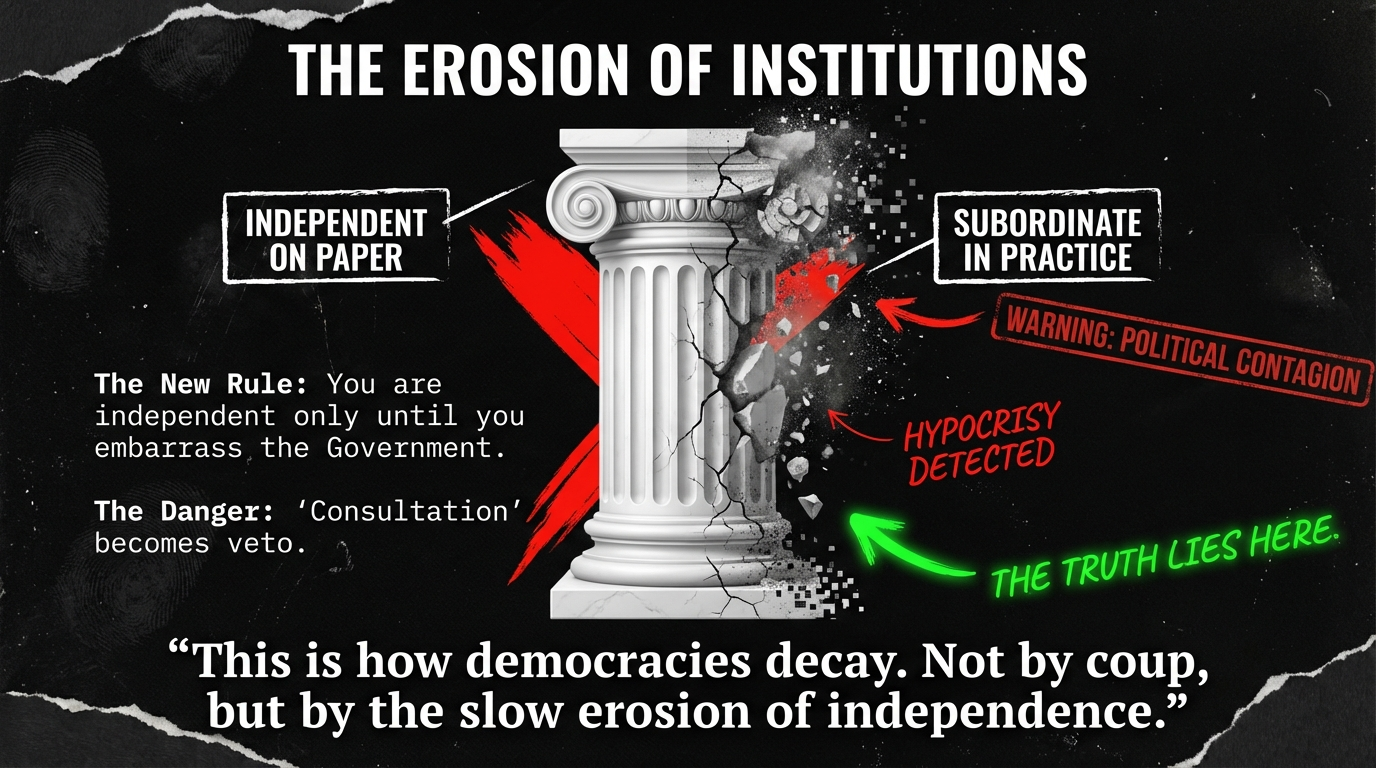
This is how democracies decay. Not through constitutional crisis or military coup, but through the slow erosion of institutional independence by politicians who claim to respect it while systematically undermining anyone who defends it.
Luxon, Willis, and Peters are establishing that precedent. Their scolding of Breman is not an isolated incident. It is a message to every public servant with statutory independence: submit, or face consequences.
The Path Forward: What Must Be Named
This essay is not just analysis. It is an indictment. The conduct of this government—its hypocrisy, its interference, its authoritarian expectations—must be named and documented.
Winston Peters betrayed every principle he campaigned on when he signed the Coalition Agreement preserving neoliberal central bank independence. Now he weaponizes that same independence framework to demand Breman’s subordination. This is betrayal compounded by despotism.
Christopher Luxon claims to respect Reserve Bank independence while telling Acting Governors where he wants interest rates to go before OCR decisions. This is interference disguised as consultation.
Nicola Willis demands that Breman seek her permission before defending institutional principles while Willis systematically pressures the Reserve Bank. This is control masquerading as protocol.
Together, they represent an authoritarian tendency that threatens every institution with statutory independence in Aotearoa.
Anna Breman acted on principle. She defended central bank independence against Trump’s autocratic assault. She upheld the institutional norm that monetary policy must be free from political coercion.
For this, she was scolded by a government that claims to respect the very independence she defended.
The hypocrisy is despicable. The precedent is dangerous. The abdication of principle is complete.
Kia kaha, e hoa. Document this. Archive this. Cite this. Because when historians ask how institutional independence was eroded in Aotearoa, this moment—this scolding, this hypocrisy, this authoritarian message—will be Exhibit A.
KOHA CONSIDERATION: The Audacity of Subordination
This essay documents institutional betrayal that Crown agencies will not investigate and corporate media will not name: Winston Peters weaponizes central bank independence he signed onto in 1996 to silence a Governor defending those principles in 2026. Christopher Luxon claims to respect Reserve Bank independence while telling Acting Governors where he wants interest rates—interference that influences job applications. Nicola Willis demands Ministerial permission before Breman can defend institutional principles.
This is despotism dressed as protocol. That accountability requires independent funding.
Three Pathways to Support
Koha Platform: https://app.koha.kiwi/events/the-maori-green-lantern-fighting-misinformation-and-disinformation-ivor-jones
Substack Subscription: https://themaorigreenlantern.substack.com/subscribe
Direct Bank Transfer: HTDM, 03-1546-0415173-000
Your koha funds accountability that Crown structures refuse to provide. Kia kaha, whānau.
Aroha nui,

Ivor Jones, The Māori Green Lantern Fighting Misinformation And Disinformation From The Far Right