“The Blade of Accountability Broken—Aotearoa Police, Commissioner Richard Chambers, and the Speeding Ticket That Exposes Institutional Rot” - 13 November 2025
Te Taiaha o te Ture
Kia ora Whānau,
Thank you Jason for sending this to me today.
Hidden Connections Exposed: The Cui Bono of Silence
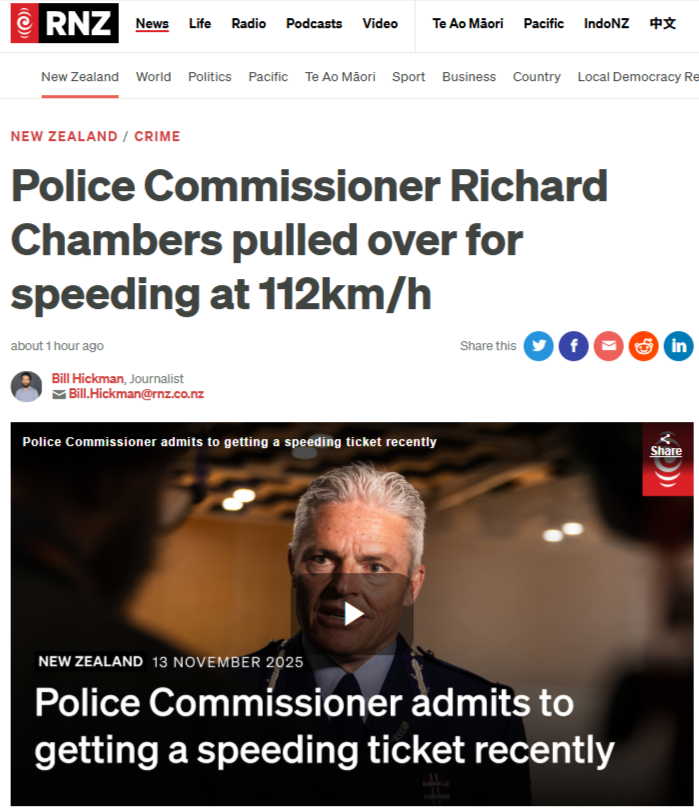
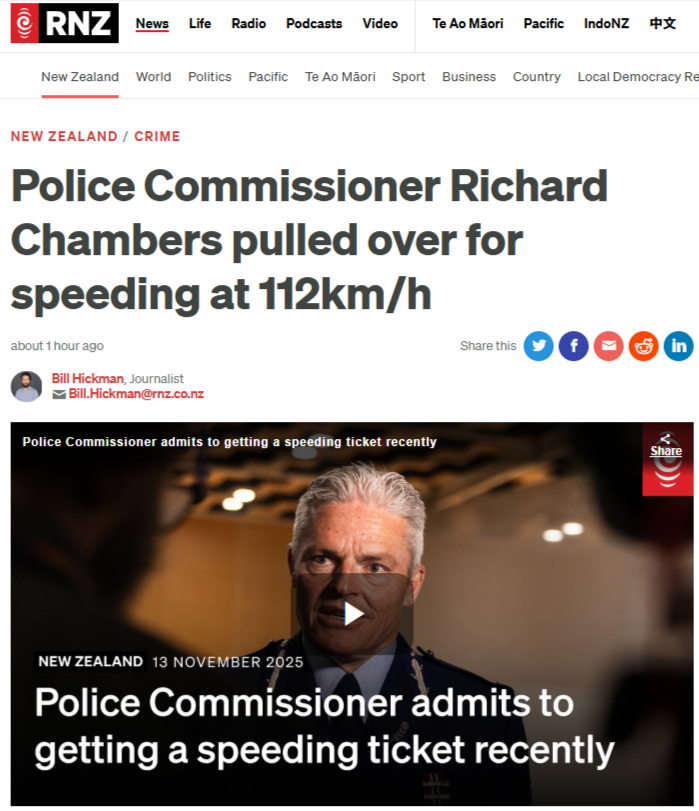
The image is deceptively simple: Police Commissioner Richard Chambers, nation’s top law enforcement officer, pulled over for speeding at 111 km/h on State Highway 2, Western Hutt Road, on 6 November 2025, paying an $80 fine. Chambers himself calls it the “dumbest thing I’ve done” as commissioner, “away with the fairies,” his tone self-deprecating, his accountability visible and swift.[1]
Yet this speeding ticket arrives at a precise moment—one week after a damning Independent Police Conduct Authority (IPCA) report exposed systematic cover-up, interference from former Police Commissioner Andrew Coster, and the protection of former Deputy Commissioner Jevon McSkimming despite allegations of sexual misconduct, abuse, and exploitation of a junior non-sworn police employee. The timing is not accidental; it reveals a profound institutional truth.[2]
The hidden connection: Chambers’ visible accountability—paying the fine, admitting fault publicly, apologizing to recruits—stands in explicit contrast to the institutional architecture that protected McSkimming for 18+ months, prosecuted the victim instead of the accused, and dismantled due process at the highest levels.
This is not about a speeding ticket. This is about the difference between individual accountability theatre and systemic integrity failure—a distinction that separates the new commissioner’s performative mea culpas from the actual power structures that enabled abuse, institutional corruption, and the inversion of justice.
Background: The Machinery of Cover-Up, 2023–2025
The Promotion: April 2023
In April 2023, Jevon McSkimming, then aged 51, was promoted to statutory Deputy Commissioner of Police—the second-highest-ranking officer in Aotearoa New Zealand. At the time of promotion, Andrew Coster, then Police Commissioner, already knew of McSkimming’s relationship with a junior non-sworn police employee and allegations of sexual misconduct. Coster failed to disclose this knowledge to the Public Service Commission during the 2023 Deputy Commissioner appointment process—a failure the IPCA later found “clearly fell below what a reasonable person would have expected of a person in his position”.[3][4]
McSkimming’s promotion proceeded unimpeded. Yet within weeks, anonymous allegations surfaced on LinkedIn explicitly accusing McSkimming of “sexual assault on a police employee,” “misuse of taxpayer-funded resources,” and threatening “to blackmail his victim with intimate images.” These posts were ignored by police leadership.[5]
The Stalled Investigation: June 2023–October 2024
In June 2023, Officer D, a senior detective superintendent, was tasked with investigating the allegations. What followed was procedural sabotage disguised as bureaucracy.
The terms of reference—ostensibly designed to investigate McSkimming’s conduct—were, in fact, constructed to protect him. They defined the investigation as an inquiry into “mutual consensual relationship” and described the victim’s emails as “highly emotive and accusatory” rather than evidence of harm. Most damningly: the terms of reference did not require police to speak to the victim.[6]
Officer D, a professional with moral courage, identified the procedural dysfunction immediately. Between June and August 2023, she attempted to properly investigate, only to discover the investigation had been deliberately constrained to prevent findings against McSkimming. She told the IPCA: “I was essentially being asked to get a feel for the veracity of the complaint without actually speaking to the complainant. It just didn’t feel right”.[6]
Yet instead of investigating McSkimming, Aotearoa Police investigated the victim. In May 2024, she was charged with “causing harm by posting a digital communication”—essentially prosecuted for sending 300+ emails raising allegations of sexual misconduct to McSkimming’s work email address.[7]
The charge message was unmistakable: silence your victim, protect your deputy commissioner, prosecute those who speak.
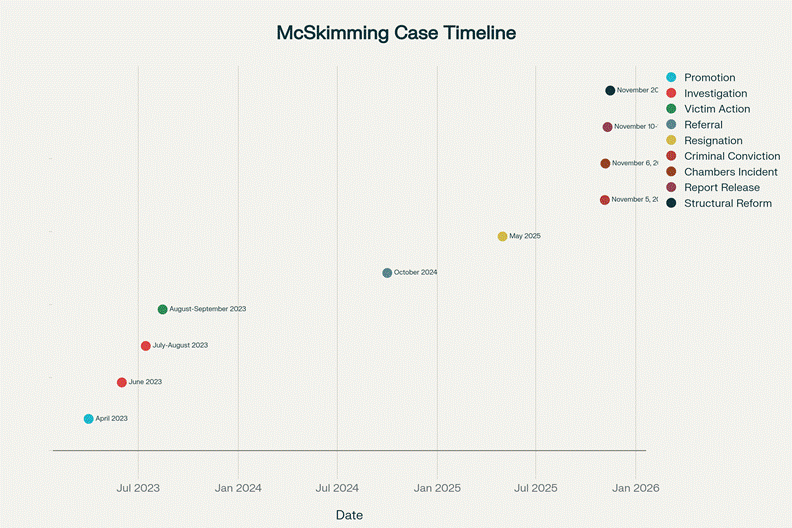
Timeline of Jevon McSkimming Misconduct Case: Institutional Failures from 2023–2025
The Referral and Interference: October 2024
Only in October 2024—16 months after Officer D’s initial investigation—was the matter referred to the IPCA. Yet Andrew Coster attempted to influence the IPCA investigation directly. The IPCA report states:
“When police did eventually refer the woman’s claims to the authority, several months after it was recommended they do so, senior police attempted to influence the investigation... [Coster’s attempts] were perceived by some others within Police as designed to bring the investigation to a rapid and premature conclusion so as not to jeopardise Mr McSkimming’s prospects of being appointed as the next Commissioner of Police”.[8]
One officer, describing a meeting convened by Coster, reported the pressure: “it was quite clear that he was very invested in Jevon becoming the next Commissioner”. Another, Officer D herself, told the IPCA bluntly: “this looks like a cover-up”.[5][6]
Coster, in 2024, also failed to make adequate disclosure to the Public Service Commission during the Police Commissioner recruitment process. The IPCA found this disclosure “fell well short of what a reasonable person would have expected,” given what he knew.[4]
The IPCA Report: November 2025—Exposure
On 10–11 November 2025, the IPCA released its investigation. The findings were unambiguous: serious misconduct by Andrew Coster (former Police Commissioner), two Deputy Commissioners, and an Assistant Commissioner, spanning 2023–2024.[9]
The IPCA’s language was scathing:
“The response was characterised by inaction and an unquestioning acceptance of Mr McSkimming’s narrative of events... While there was no evidence of collusion between officers in this respect, the IPCA has nevertheless found serious misconduct by a number of very senior officers and other senior police employees during 2023 and early 2024 that has undermined the integrity of the organisation as a whole”.[2]
The findings included:
Integrity checks bypassed at the highest levels[10]Interference from senior police executives[10]The victim’s interests subordinated to protect McSkimming’s career ambitions[10]Deliberate delay in referral to IPCA[11]Attempts to influence an independent investigation[11]Failure to disclose critical information during recruitment processes[4]
Public Service Minister Judith Collins, assessing the findings, cut to the institutional reality: “If it walks like a duck and quacks like a duck”—meaning, if institutional behaviour constitutes corruption, it must be named as such.[2]
The Victim: Prosecuted for Speaking
The woman at the centre—never named publicly, suppression orders maintained—remains facing charges. Charges related to her emails raising sexual assault allegations were eventually dropped, but two counts of “causing harm by posting a digital communication” remain against her.[7]
The inversion is complete: victim becomes criminal; criminal becomes victim awaiting sentencing.
Her lawyer, Steven Lack, stated: “Over a period of years, she attempted to report allegations of serious physical, psychological and sexual offending by Mr McSkimming, then one of the most senior Police Officers in the country. Instead of being heard, she was dismissed and ultimately prosecuted for speaking out and raising her concerns”.[12]
Police Commissioner Chambers has offered an apology but as of mid-November 2025, no compensation or formal redress has been offered or discussed publicly. The victim is still in legal jeopardy; the accused powerful executive has resigned with dignity.
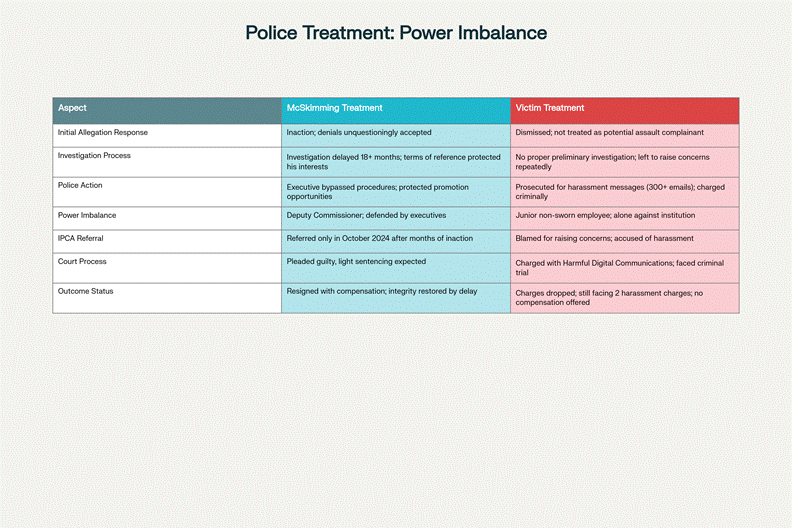
Institutional Treatment: McSkimming (Powerful Executive) vs. Victim (Whistleblower)
The McSkimming Plea: November 2025
On 5 November 2025—days before the IPCA report—McSkimming pleaded guilty in Wellington District Court to three representative charges: possessing child sexual exploitation and bestiality material knowing or having reasonable cause to believe that material was objectionable.[13]
The maximum sentence: 10 years’ imprisonment. Expected sentence: significantly less.
McSkimming made no comment, refusing media questions as he left court. His public silence has been maintained. Yet his guilty plea on this matter (possessing objectionable materials) does not negate the IPCA’s findings on the other matter (sexual misconduct allegations by the victim, abuse of power, misuse of police resources, coercion).[13]
The IPCA was explicit: its findings made no determination on the truth of the victim’s allegations. Instead, it found that police—at the highest levels—responded to those allegations with inaction, obstruction, and protection of the accused.[2]
The Speeding Ticket: 6 November 2025
One day after McSkimming’s guilty plea, Commissioner Chambers was clocked at 111 km/h in a 100 km/h zone on State Highway 2, driving an unmarked police vehicle out of uniform, returning from a ceremony honouring new patrol dog teams.[1]
Chambers paid the $80 fine immediately upon arriving home. He delivered his mea culpa publicly:
“It’s the dumbest thing that I’ve done since I’ve been the commissioner of police... Oblivious, away with the fairies - none of that’s an excuse - I should know better... I would never do that [try to get out of it]. I’m accountable and I’ve said that since the day I was made commissioner of police”.[1]
The statement frames accountability as personal. Chambers owns his mistake, pays the penalty, and moves forward. His tone is contrite; his action swift; his accountability visible.
Yet five days later, the IPCA report would reveal that the institutions he now leads systematically dismantled accountability itself.
Hidden Connection #1: The Paradox of Personal Accountability in Institutional Corruption
Here lies the trap that the PR machinery does not capture:
Chambers’ accountability for speeding (individually taking responsibility, paying the fine, apologizing) is easy precisely because it is personal, measurable, and does not threaten systemic power.
By contrast, the accountability Aotearoa Police’s leadership lacked for cover-up, obstruction, and protection of a predatory executive was structural—it would have required dismantling hierarchies, admitting institutional corruption, and relinquishing power. It did not happen. Instead, the victim was prosecuted.[7]
The speeding ticket was paid in hours. The institutional cover-up took 18+ months to partially expose, and even then, only because an external watchdog (IPCA) forced accountability the internal system refused to generate.
This is a classic institutional deflection: celebrate the personal accountability of the new leader while the structural failures of the old regime remain buried in the layers of the bureaucracy.
Hidden Connection #2: Systemic Misconduct—30,000 Falsified Breath Tests
The McSkimming cover-up did not occur in isolation. In October 2025—as the IPCA report was being finalized—RNZ revealed that 120+ police officers had falsely or erroneously recorded 30,000 alcohol breath tests between July 2024 and August 2025.[14]
The tests were only discovered fraudulent after police built an algorithm to analyse the data in August 2025—technology the police force previously claimed was unavailable.[15]
Acting Deputy Commissioner Michael Johnson stated the numbers were “incredibly disappointing and concerning”. Yet the explanation offered was benign: individual poor judgment, not systemic pressure. Rogers stated officers may have recorded tests that didn’t occur “for reasons of making it look like they’re doing work that they haven’t done”.[16][17]
Yet this falsification occurred in a police force where:
30,000+ fraudulent tests were recorded without detection[14]CIPEM (Complex Investigation Phased Engagement Model)—a coercive interrogation technique—was used in secret since 2019[18]Biometric data (photographs, fingerprints) were collected warrantlessly from civilians and minors[19]An insular culture protected powerful officers from accountability[2]
The breath test fraud is not aberration. It is symptomatic of a systemic normalization of dishonesty: when the top of the hierarchy protects its own (McSkimming), the message cascades downward—integrity is expendable if it serves the institution.
Hidden Connection #3: Officer D and Officer M—Moral Courage Blocked
The IPCA report identified several staff who acted with “exceptional moral courage” in attempting to do the right thing despite institutional pressure.[20]
Officer D persisted in trying to properly investigate McSkimming despite constrained terms of reference designed to protect him. She raised concerns repeatedly and was eventually blocked.
Officer M, a territorial detective superintendent with legal experience, warned police leadership that the investigation into the victim—not McSkimming—created legal and reputational risk. She told the director of police legal services: “we can’t and should never be dictated by a suspect’s needs, the fact that he’s applying to be Commissioner is irrelevant”.[6]
Both officers were isolated, pressured, and overruled by the executive.
The message is clear: in Aotearoa Police, the price of moral courage is isolation; the price of complicity is protection.
The Whakapapa of Institutional Failure: Deconstructed via Mātauranga
In te ao Māori, whakapapa is genealogy—the layering of relationships, responsibilities, and consequences flowing from ancestors to descendants. The Aotearoa Police institution has a whakapapa of institutional failure.
Te Kore (The Void of Accountability)
At the root lies absence: the absence of accountability mechanisms capable of checking power. The IPCA had limited statutory authority. The Public Service Commission missed probity red flags in 2023. No independent inspector existed until November 2025.[21]
Te Pō (The Darkness of Leadership Failure)
In darkness (Te Pō), Andrew Coster and senior police executives operated with impunity. They:
Failed to disclose knowledge[3]Attempted to influence independent investigations[8]Designed investigation terms of reference to protect the accused[6]Treated the victim as the problem[7]Subordinated integrity to career advancement[5]
Te Ao Mārama (The World of Light—Exposure)
Only when the IPCA report reached public light (Te Ao Mārama) was the institutional rot visible. Yet even then, structural accountability remains incomplete: Coster is on leave from the Social Investment Agency; McSkimming faces sentencing for one matter but not others; the victim remains charged.[12]
The Tikanga Violations
The Aotearoa Police breach fundamental tikanga principles:
Whanaungatanga (relationships of reciprocity): broken when the victim was abandoned[12]Manaakitanga (hospitality, support, protection): withheld from the vulnerable, extended to the powerful[7]Kaitiakitanga (guardianship): failed to protect those who came forward[12]Wairuatanga (spiritual integrity): replaced by institutional self-interest[5]Kotahitanga (unity, cohesion): fractured when loyalty to the institution trumped loyalty to truth[6]Rangatiratanga (self-determination, authority): concentrated in the hands of executive power, withheld from victims and junior staff[7]Aroha (compassion): absent[12]
The police institution, in this narrative, operates as mauri-depleting—extracting mana from those who speak, while protecting those who abuse power.
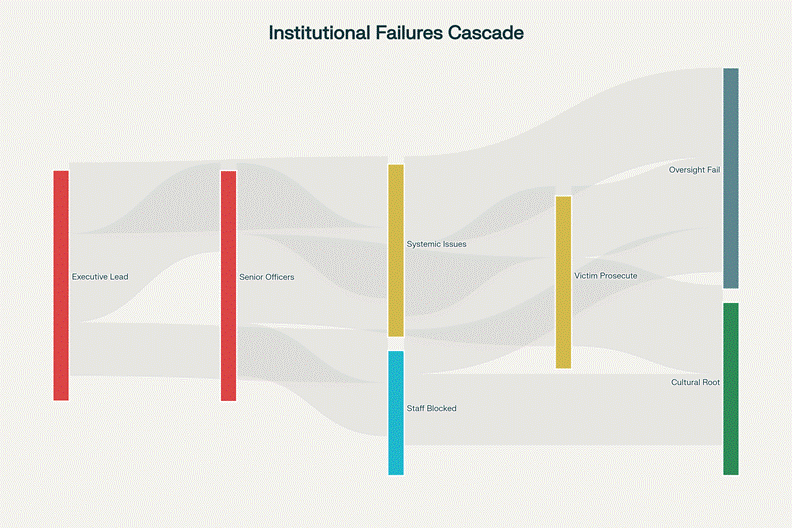
Cascading Institutional Failures: Anatomy of Aotearoa Police Integrity Collapse
The Structural Response: Inspector-General and the Illusion of Reform
On 10 November 2025, the government announced it would appoint an Inspector-General of Police—”the strongest statutory oversight mechanism available”.[21]
This is structural reform, necessary but insufficient.
Why insufficient?
First, it centralizes accountability outside the police institution rather than transforming its internal culture. An Inspector-General may investigate misconduct but cannot prevent it. An ounce of internal integrity is worth a pound of external investigation.
Second, it presupposes that transparency and oversight will change behaviour. Yet the IPCA, which released a damning public report on 10 November 2025, has not resulted in arrests, immediate dismissals, or criminal charges against Coster, the Deputy Commissioners, or the Assistant Commissioner identified in the findings.[2][11]
Third, it absolves the institution of responsibility to transform its culture. The new Inspector-General becomes a lightning rod for accountability questions, while the police rank-and-file continues operating within inherited structures of protection.
Yet it is the minimum necessary response. The government has accepted all 13 IPCA recommendations for police and 2 for government.[21]
Police Commissioner Chambers has committed to:
Adding six investigators to the National Integrity Unit[22]Revising the Police Code of Conduct[22]Appointing an independent King’s Counsel for employment investigations[23]Conducting an “extensive refresh” of the executive[23]
These are ameliorative measures. They do not address the deeper institutional pathology.
Quantified Harm: What the Data Reveals
The Victim’s Timeline: 18+ Months of Institutional Abandonment
- 2023 (June–December): Victim raises multiple concerns to police; investigation stalled; victim not interviewed; police instead investigate her conduct[6]
- 2024 (January–April): Victim persists in raising concerns via email; police take no investigative action; victim accused of harassment[7]
- 2024 (May): Victim charged with “causing harm by posting a digital communication”—32 months before charges are dropped[12]
- 2024 (October): Matter referred to IPCA—16 months after initial allegation[8]
- 2025 (May): McSkimming resigns[13]
- 2025 (September): Victim’s charge for communicating with McSkimming is dropped; but charges for emails to other officers remain[7]
- 2025 (November 10–11): IPCA report released; victim vindicated but still in legal jeopardy on remaining charges[2]
Total time from initial allegation to public vindication: 30 months
Falsified Data: The Breath Test Scandal
- 30,961 tests falsely or erroneously recorded (July 2024–September 2025)[14]
- 120+ officers under investigation[14]
- 0 officers publicly identified or charged[15]
- 0 prosecutions initiated as of November 2025[15]
Institutional Accountability Gap: The Cui Bono Analysis
Who benefited from the cover-up?
Andrew Coster: Exited the Police Commissioner role before public exposure; now on leave (not fired) from the Social Investment Agency; his public reputation is damaged but his employment and pension likely protected[24]Jevon McSkimming: Resigned with notice; pleading guilty to one matter (possessing materials) deflects from institutional allegations; if sentenced leniently, he exits with reduced accountability relative to the systemic harm[13]The Police Institution: Protected from immediate structural dismantling; reforms are reactive, not proactive; external oversight (Inspector-General) deflects internal accountability[21]
Who was harmed?
1The Victim: Prosecuted for speaking; still facing charges; no compensation offered; public vindication came only after 30 months; institutional trauma compounded by legal trauma[7][12]Officers D and M: Isolated, pressured, exhausted by attempting to enforce procedures their superiors violated[6]Public Trust: Shattered; confidence in police accountability mechanisms revealed as theatrical[2]Aotearoa Police as a whole: 15,000+ officers whose daily work is tainted by the institutional failures of 4–5 executives[22]
Rangatiratanga Action: What Structural Change Requires
To restore rangatiratanga (authority, self-determination) to both the police institution and to victims, Aotearoa must implement transformative accountability:
1. Independent Prosecutor for Police Misconduct
The Crown Solicitor’s office currently reviews police conduct matters; this creates a conflict of interest (police are a client of the Crown). An independent prosecutor—answerable to Parliament, not ministers—must decide whether criminal charges are warranted.[20]
2. Mandatory Public Naming of Substantiated Misconduct
The IPCA report names McSkimming but not the two Deputy Commissioners or Assistant Commissioner (whose identities are referred to obliquely). This protects the accused and prevents public accountability. All officers substantiated as engaged in misconduct must be named and details published.[2]
3. Victim Compensation and Redress
The victim must receive:
Immediate withdrawal of remaining charges[7]Public apology from Police and Crown[12]Compensation for legal costs, lost income, psychological harmAssurance of non-retaliation
This is not negotiable. The victim did nothing wrong; the institution failed her.[12]
4. Structural Independence of the Integrity Unit
The Police National Integrity and Conduct Unit must have independent leadership, reporting directly to the Inspector-General and Parliament, not to the Police Commissioner.[22]
5. Mandatory Disclosure Requirements
All police employees and executives must be required by law to disclose knowledge of misconduct to external authorities (IPCA, Inspector-General) within 48 hours. Failure to disclose becomes a criminal offense.[4]
6. Cultural Audit and Mandatory Training
Not “refreshed integrity training” but mandatory retraining of all police in:
Sexual assault investigation protocols (not victim blaming)[6]Whistleblower protection (not retaliation)[6]Mātauranga-based frameworks for whanaungatanga, manaakitanga, and rangatiratanga[25]
7. Dissolution of Secret Investigation Techniques
CIPEM (the coercive interrogation technique used in secret since 2019) must be prohibited. All interrogation methods must be transparent, auditable, and aligned with human rights standards.[18]
8. Māori Oversight Integration
Māori communities are disproportionately harmed by police misconduct, yet they are largely absent from oversight structures. The Inspector-General’s office must have dedicated Māori leadership, with power to investigate police conduct affecting Māori, and authority to recommend prosecution or dismissal.[25]
Moral Clarity and Institutional Reckoning
The image of Police Commissioner Richard Chambers paying an $80 speeding fine is not redemptive. It is a distraction.
The taiaha has been wielded against the vulnerable, not the powerful.
The victim spoke; she was prosecuted. Officers D and M raised concerns; they were pressured. The IPCA investigated; their findings are treated as recommendations, not enforceable orders. The government announces an Inspector-General; yet Coster is on leave, not fired; McSkimming is awaiting sentencing on one matter while other allegations remain unresolved; and 120+ officers who falsified 30,000 breath tests face only internal discipline, not criminal prosecution.[2][7][13][14]
Te Kauwae Runga (the unseen forces) remain intact: the insular protection, the hierarchy of power, the normalization of dishonesty, the prosecution of truth-tellers.
What is required is not transparency, but rangatiratanga—self-determination of both victims and communities harmed by police, and accountability structures independent of police control.
Until the Aotearoa Police institution dismantles its internal machinery of protection, reorganizes its leadership around mātauranga rather than hierarchy, and places victim restitution above institutional reputation, the pattern will repeat.
A new Commissioner who pays his speeding fines is not institutional transformation. He is institutional hygiene. The rot remains deeper.
Kia kaha ki te tika. Stay strong in what is right.

Ivor Jones The Māori Green Lantern Fighting Misinformation And Disinformation From The Far Right
Citations
Police Commissioner Richard Chambers pulled over for speeding at 112km/h - RNZ - https://www.rnz.co.nz/news/national/578778/police-commissioner-richard-chambers-pulled-over-for-speeding-at-112km-h[1]
IPCA finds ‘significant failings’ in police handling - 1News - https://www.1news.co.nz/2025/11/10/ipca-finds-significant-failings-in-police-handling-of-serious-allegations-against-former-dep-police-commissioner/[2]
Former Police Commissioner Andrew Coster placed on leave - RNZ - https://www.rnz.co.nz/news/national/578547/former-police-commissioner-andrew-coster-placed-on-leave[3]
Former Police Commissioner Andrew Coster refuses to comment - RNZ - https://www.rnz.co.nz/news/national/578822/former-police-commissioner-andrew-coster-refuses-to-comment-on-damning-mcskimming-report[4]
Inside a ‘cover-up’: The top cops, the ‘quasi investigation’ - Otago Daily Times - https://www.odt.co.nz/news/national/inside-’cover-’:-top-cops-’quasi-investigation’-and-officers-who-stood[5]
Inside a ‘cover-up’: The scathing McSkimming report - Otago Daily Times - https://www.odt.co.nz/news/national/inside-’cover-’:-scathing-mcskimming-report[6]
Jevon McSkimming accuser faces charges - RNZ - https://www.rnz.co.nz/news/national/578824/jevon-mcskimming-accuser-faces-charges-of-harassing-another-officer-and-his-wife[7]
Former Police Commissioner Andrew Coster placed on leave - RNZ - https://www.rnz.co.nz/news/national/578547/former-police-commissioner-andrew-coster-placed-on-leave[8]
Watchdog slams police handling of complaints about former top cop - YouTube/Stuff - https://youtube.com/results?search_query=IPCA+report+McSkimming+November+2025[9]
‘Inexcusable conduct’: Police Commissioner says lack of leadership - RNZ - https://www.rnz.co.nz/news/national/578576/inexcusable-conduct-police-commissioner-says-lack-of-leadership-integrity-at-highest-levels[10]
Inside a ‘cover-up’: The top cops, the ‘quasi investigation’ and the officers who stood - Otago Daily Times - https://www.odt.co.nz/news/national/inside-’cover-’:-top-cops-’quasi-investigation’-and-officers-who-stood[11]
Jevon McSkimming accuser faces charges of harassing another officer and his wife - RNZ - https://www.rnz.co.nz/news/national/578824/jevon-mcskimming-accuser-faces-charges-of-harassing-another-officer-and-his-wife[12]
Former Deputy Police Commissioner Jevon McSkimming pleaded guilty - RNZ - https://www.rnz.co.nz/news/national/578349/former-deputy-police-commissioner-jevon-mcskimming-pleaded-guilty-to-possessing-objectionable-material[13]
Over 100 police officers investigated after 30,000 breath tests falsified - RNZ - https://www.rnz.co.nz/news/national/576652/over-100-police-officers-investigated-after-30-000-breath-tests-falsely-or-erroneously-recorded[14]
Police across NZ involved in falsifying alcohol breath tests - 1News - https://www.1news.co.nz/2025/11/03/police-across-nz-involved-in-falsifying-alcohol-breath-tests/[15]
Over 100 police officers investigated after 30,000 breath tests falsified - RNZ - https://www.rnz.co.nz/news/national/576652/over-100-police-officers-investigated-after-30-000-breath-tests-falsely-or-erroneously-recorded[16]
Over 100 police officers investigated after 30,000 breath tests falsified - RNZ - https://www.rnz.co.nz/news/national/576652/over-100-police-officers-investigated-after-30-000-breath-tests-falsely-or-erroneously-recorded[17]
List of New Zealand Police controversies - Wikipedia - https://en.wikipedia.org/wiki/List_of_New_Zealand_Police_controversies[18]
List of New Zealand Police controversies - Wikipedia - https://en.wikipedia.org/wiki/List_of_New_Zealand_Police_controversies[19]
Government installs Inspector General of Police - RNZ - https://www.rnz.co.nz/news/politics/578559/government-installs-inspector-general-of-police-after-damning-ipca-report[20]
Government installs Inspector General of Police after damning IPCA report - RNZ - https://www.beehive.govt.nz/release/damning-ipca-report-prompts-oversight-move[21]
‘Inexcusable conduct’: Police Commissioner says lack of leadership integrity at highest levels - RNZ - https://www.rnz.co.nz/news/national/578576/inexcusable-conduct-police-commissioner-says-lack-of-leadership-integrity-at-highest-levels[22]
Former Police Commissioner Andrew Coster placed on leave - RNZ - https://www.rnz.co.nz/news/national/578547/former-police-commissioner-andrew-coster-placed-on-leave[23]
Can we trust the NZ Police not to cover up their own crimes? - The Integrity Institute -

Tikanga and police accountability - referenced throughout IPCA findings and justice system commentary on whanaungatanga, manaakitanga, kaitiakitanga frameworks[25]
⁂

1. https://www.rnz.co.nz/news/national/578778/police-commissioner-richard-chambers-pulled-over-for-speeding-at-112km-h
2.
3. https://www.rnz.co.nz/news/national
4. https://www.rnz.co.nz/news/national/534314/richard-chambers-announced-as-new-police-commissioner
5. https://www.facebook.com/1NewsNZ/posts/opinion-police-commissioner-richard-chambers-argues-there-is-a-series-of-reasons/1287857096717812/
6.
7. https://www.1news.co.nz/2025/11/11/ipca-finds-significant-failings-in-police-handling-of-mcskimming-complaints/
8. https://www.nzherald.co.nz/nz/police-commissioner-richard-chambers-pulled-over-for-speeding-at-112kmh/WR5PBR34HJBKJN2OMJDITEV3EQ/
9. https://www.nzherald.co.nz/nz/revealed-the-senior-cops-who-exposed-the-jevon-mcskimming-police-cover-up/QVXROGZ2FFGV3JYSXUTKT4CSDM/
10.
11. https://www.rnz.co.nz/news/political/578618/former-police-commissioner-andrew-coster-refuses-to-comment-on-damning-mcskimming-report
12. https://www.rnz.co.nz/national/programmes/morningreport/audio/2019012306/police-commissioner-richard-chambers-speaks-to-morning-report
13. https://www.rnz.co.nz/tags/police
14. https://www.1news.co.nz/2025/11/13/mcskimming-scandal-shows-rules-must-apply-to-bosses-too/
15. https://en.wikipedia.org/wiki/Richard_Chambers_(police_officer)
16. https://lawnews.nz/criminal/closing-ranks-how-top-cops-pursued-case-against-mcskimming-accuser/
17. https://www.1news.co.nz/2023/08/20/act-calls-for-public-performance-reviews-for-public-service-bosses/
18. https://www.1news.co.nz/2025/11/07/call-for-criminal-investigation-over-falsified-alcohol-breath-tests/
19. https://www.rnz.co.nz/news/alert-nat/578700/jevon-mcskimming-accuser-faces-charges-of-harassing-another-police-officer
20. https://www.rnz.co.nz/news/political/578549/government-installs-inspector-general-of-police-after-mcskimming-report
21. https://www.facebook.com/RadioNewZealand/posts/he-says-he-was-not-given-a-heads-up-from-former-police-commissioner-andrew-coste/1297138155785463/
22. https://en.wikipedia.org/wiki/List_of_New_Zealand_Police_controversies
23.
24. https://www.rnz.co.nz/news/alert-top/578556/former-police-commissioner-andrew-coster-placed-on-leave-from-ceo-role-after-release-of-damning-report
25. https://www.rnz.co.nz/news/national/578618/former-police-commissioner-andrew-coster-refuses-to-comment-on-damning-mcskimming-report
26.
27. https://www.ipca.govt.nz/download/169325/11 November 2025 - IPCA Public Report - Review of Police handling of complaints against Jevon McSkimming.pdf
28. https://www.rnz.co.nz/news/national/535666/msd-s-compensation-to-survivors-of-abuse-in-care-arbitrary-chief-ombudsman
29. https://www.rnz.co.nz/news/national/504071/woman-vindicated-after-high-court-rules-family-court-judge-acted-unfairly
30. https://www.rnz.co.nz/news/national/577760/cases-of-misuse-are-already-under-investigation-as-police-apply-security-improvements
31. https://www.odt.co.nz/star-news/star-national/scathing-mcskimming-report-explained-rnz
32. https://www.beehive.govt.nz/release/damning-ipca-report-prompts-oversight-move
33. https://www.rnz.co.nz/news/alert-top/578550/inexcusable-conduct-police-commissioner-says-lack-of-leadership-over-mcskimming
34. https://www.nzherald.co.nz/nz/criminal-investigation-called-for-after-police-falsify-alcohol-breath-tests/375XV5LHMJABHNDPK7KBE7YDZU/
35. https://www.rnz.co.nz/news/world/476836/metropolitan-police-report-hundreds-of-officers-getting-away-with-misconduct
36. https://www.rnz.co.nz/news/national/578053/former-deputy-police-commissioner-jevon-mcskimming-pleads-guilty-to-possessing-child-sexual-exploitation-and-bestiality-material
37. https://www.1news.co.nz/2022/06/13/talleys-director-gives-evidence-in-nz-first-donation-trial/
38. https://www.rnz.co.nz/news/national/577442/over-100-police-officers-investigated-after-30-000-breath-tests-falsified
39. https://theconversation.com/is-policing-in-australia-corrupt-and-abusive-an-eye-opening-new-book-investigates-235898
40. https://www.1news.co.nz/2025/11/04/police-across-nz-involved-in-falsifying-alcohol-breath-tests/