“The Chainsaw Compact: David Seymour’s Pilgrimage to Argentina’s Laboratory of Cruelty” - 1 January 2026
How a Deputy PM’s Meeting with Javier Milei Exposes New Zealand’s Capture by Transnational Libertarian Networks

The Compact
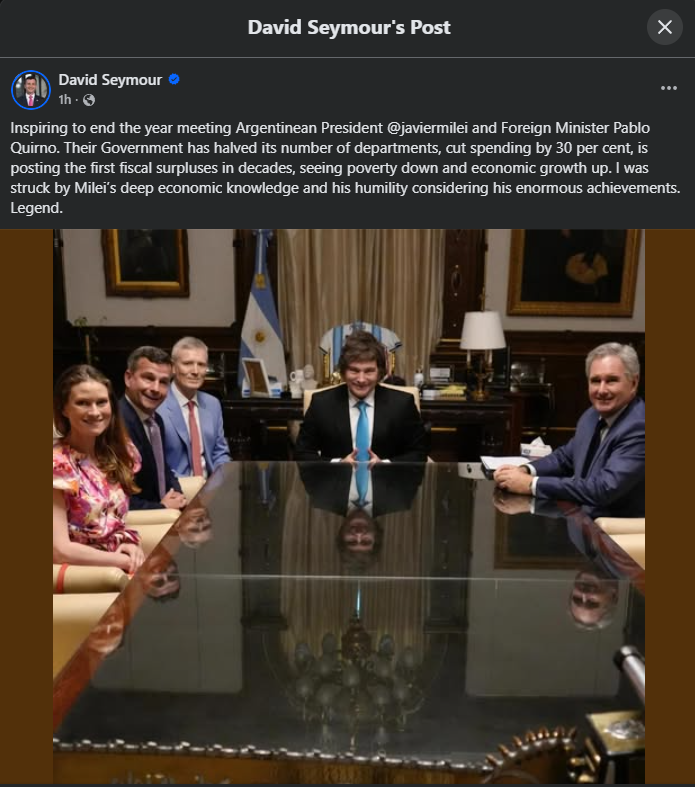
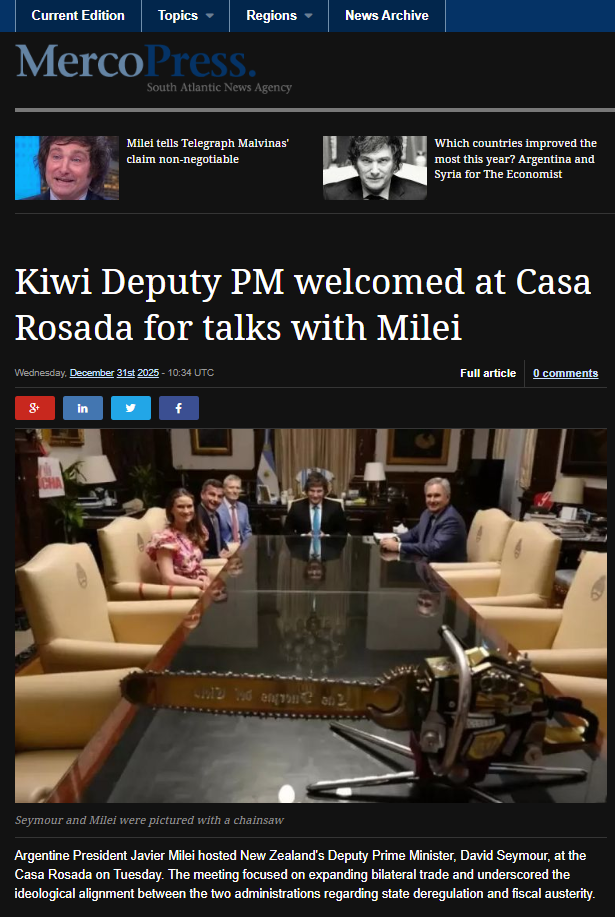
The Photo That Reveals Everything
On Tuesday, 30 December 2025, New Zealand Deputy Prime Minister David Seymour posed for photographs with Argentine President Javier Milei at Buenos Aires’ Casa Rosada.
Both men grinned as they held a chainsaw—Milei’s iconic symbol of his “libertarian movement” and promise to dismantle the state. The official narrative framed this as a trade mission. Argentine exports to New Zealand totalled just US$63.4 million by November 2025—a 29.6% increase over five years, but hardly the stuff of urgent diplomatic summits requiring the Deputy Prime Minister’s personal attendance at taxpayer expense.
This was not a trade mission. This was a pilgrimage. An ideological love letter. A public declaration of allegiance to a style of governance that has left Argentina convulsing in social pain while international libertarian activists celebrate its “economic miracle.”
The bastards didn’t even try to hide it.
The Chainsaw Compact
The meeting, as reported by Merco Press, focused on
“expanding bilateral trade and underscored the ideological alignment between the two administrations regarding state deregulation and fiscal austerity.”
There it is in plain language:
Ideological alignment. The chainsaw was not a prop. It was a promise. It was a threat. And Seymour was signaling to every vulnerable person in Aotearoa: you’re next.
Argentina Poverty Rate Under Milei
Milei’s Argentina: A Nation Transformed Into a Neoliberal Abattoir
To understand what Seymour admires—what this smirking libertarian cheerleader traveled halfway around the world to celebrate—we must first understand what Milei has done to Argentina in his two years in power since taking office on 10 December 2023.
The Scale of Destruction
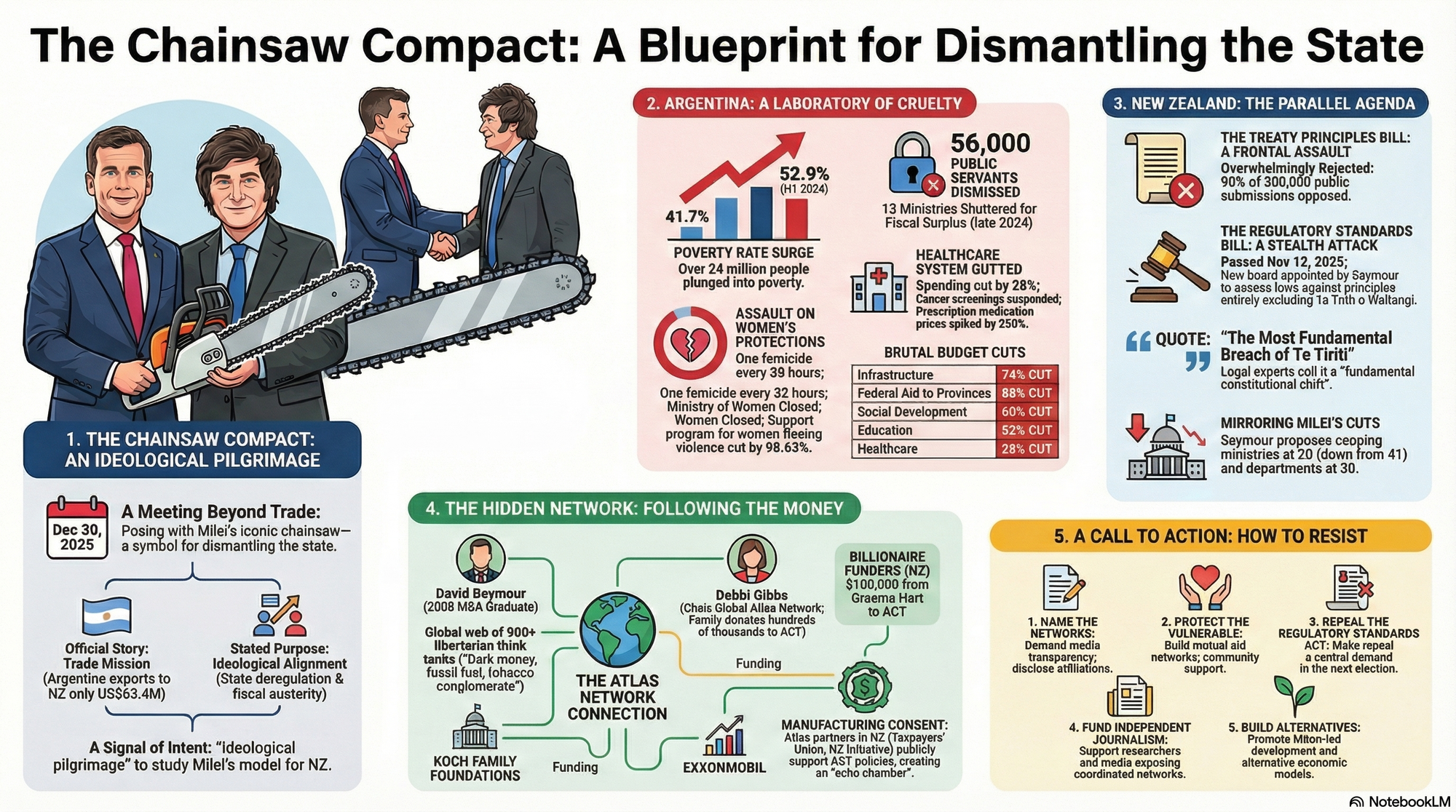
Milei inherited a deficit of 5% of GDP and proceeded to achieve Argentina’s first fiscal surplus in 14 years through measures whose brutality is difficult to overstate—though the international financial press certainly tries to understate them. He has shuttered 13 ministries, closed over 200 government offices and state entities, and dismissed 56,000 civil servants by late 2024. These are not “efficiency savings.” These are lives destroyed, families impoverished, and public capacity obliterated for ideological purity.
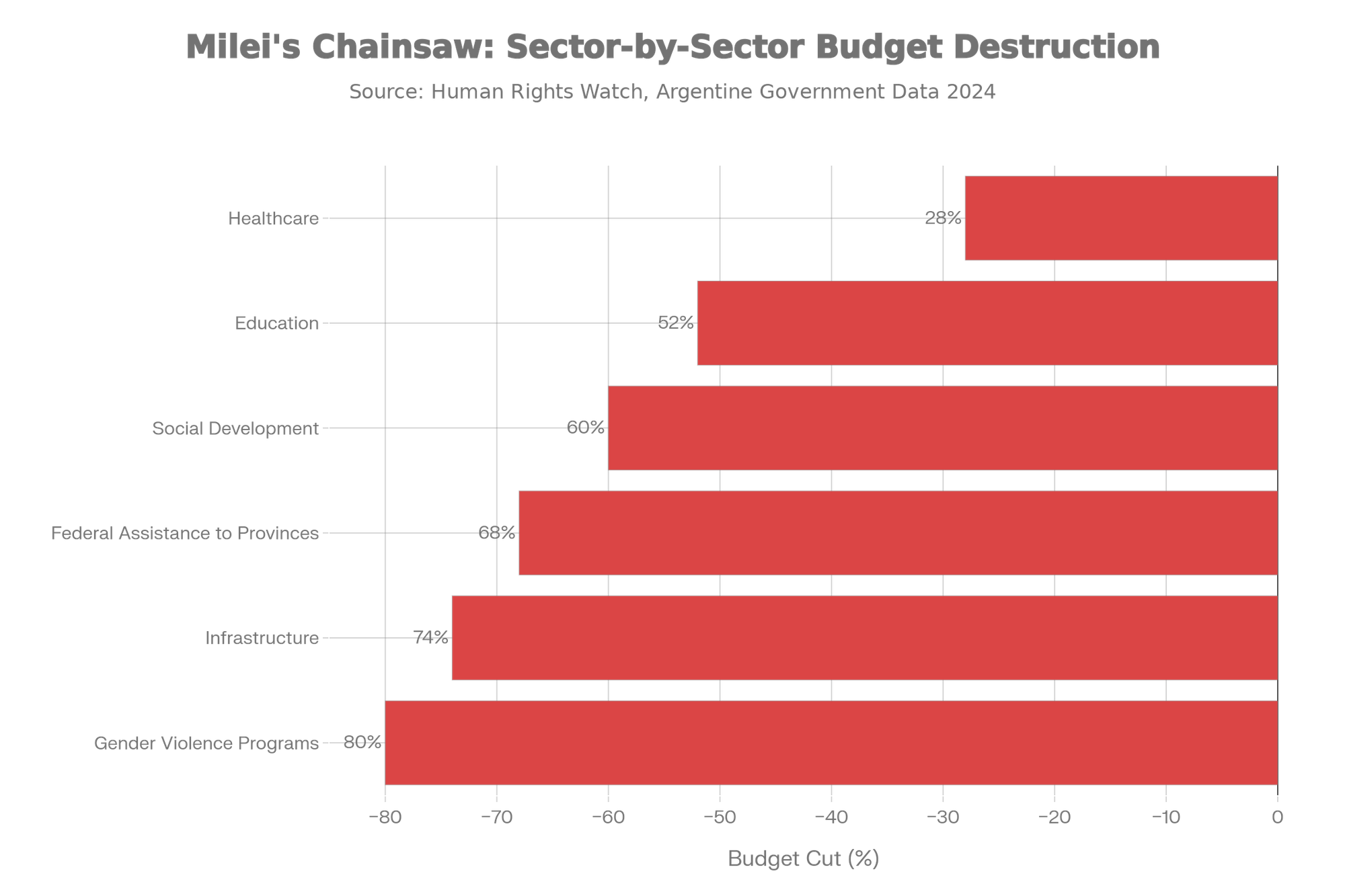
Cuts
Milei’s Budget Cuts by Sector cuts tell the story of who pays the price for fiscal surpluses that make libertarian think tanks cream their jeans. Infrastructure spending fell 74%, social development 60%, education 52%, healthcare 28%, and federal assistance to provinces 68%. These are not merely numbers on a spreadsheet. They represent suspended cancer screening programs, frozen immunization campaigns that led to Argentina’s first measles death in two decades, prescription medication prices that spiked 250%, and the dismantling of the National Directorate for HIV, Hepatitis and Tuberculosis.
Every cancer patient who dies waiting for screening that no longer exists. Every child who contracts measles because vaccination programs were gutted. Every person living with HIV who can’t access treatment. These are not unfortunate side effects. They are the fucking point. Milei and his acolytes—Seymour among them—believe the state has no business protecting vulnerable people. They call it “freedom.” The rest of us call it murder by policy.
The Gender Violence Emergency: When Libertarians Dismantle Protection for Women
Perhaps nowhere is Milei’s cruelty more visible—more nakedly ideological, more consciously sadistic—than in his assault on protections for women.
Argentina experienced one femicide every 33 hours in 2024. One woman murdered by a man every 33 hours. In response, Milei closed the Ministry of Women, Gender, and Diversity entirely, then shut down even the downgraded Undersecretariat for Protection Against Gender Violence in June 2024. The message was clear:
Women’s lives do not matter. Violence against women is not the state’s problem. Feminism is the enemy.
The numbers are staggering, and they should enrage anyone with a shred of humanity. The gender-based violence hotline “144” reduced its staff by 42%. The Acompañar programme, which provided economic support for women fleeing domestic violence, saw its reach reduced by 98.63% in the first quarter of 2024 compared to the same period in 2023. Read that again: 98.63%. That’s not a cut. That’s elimination by stealth. Overall public spending on policies addressing gender-based violence fell 26.8% below 2023 levels, while spending at the undersecretariat plummeted 78% in the first quarter of 2024.
Women fleeing violent partners were told the state would no longer help them achieve the economic independence necessary to escape. Shelters lost funding. Hotlines lost staff. Support programs evaporated. And the femicides continued—one every 33 hours—while Milei’s government celebrated its fiscal discipline.
Milei’s contempt for women’s lives is not confined to budget cuts. The bastard seeks to remove femicide from Argentina’s Penal Code, arguing that such laws “unfairly assign greater value to a woman’s life.” At the World Economic Forum—that annual gathering of ghouls who believe poverty is a personal failing—he declared that “feminism, equality, gender ideology, climate change, abortion and immigration are all heads of the same monster”. His Security Minister, Patricia Bullrich, attributed the rise in femicides to the “excesses of feminism”—a statement so obscene, so morally bankrupt, that it shifts blame from perpetrators to victims and normalizes gender-based violence as a natural response to women demanding equality.
This is the model David Seymour traveled to Argentina to study. This is the future he envisions for Aotearoa.
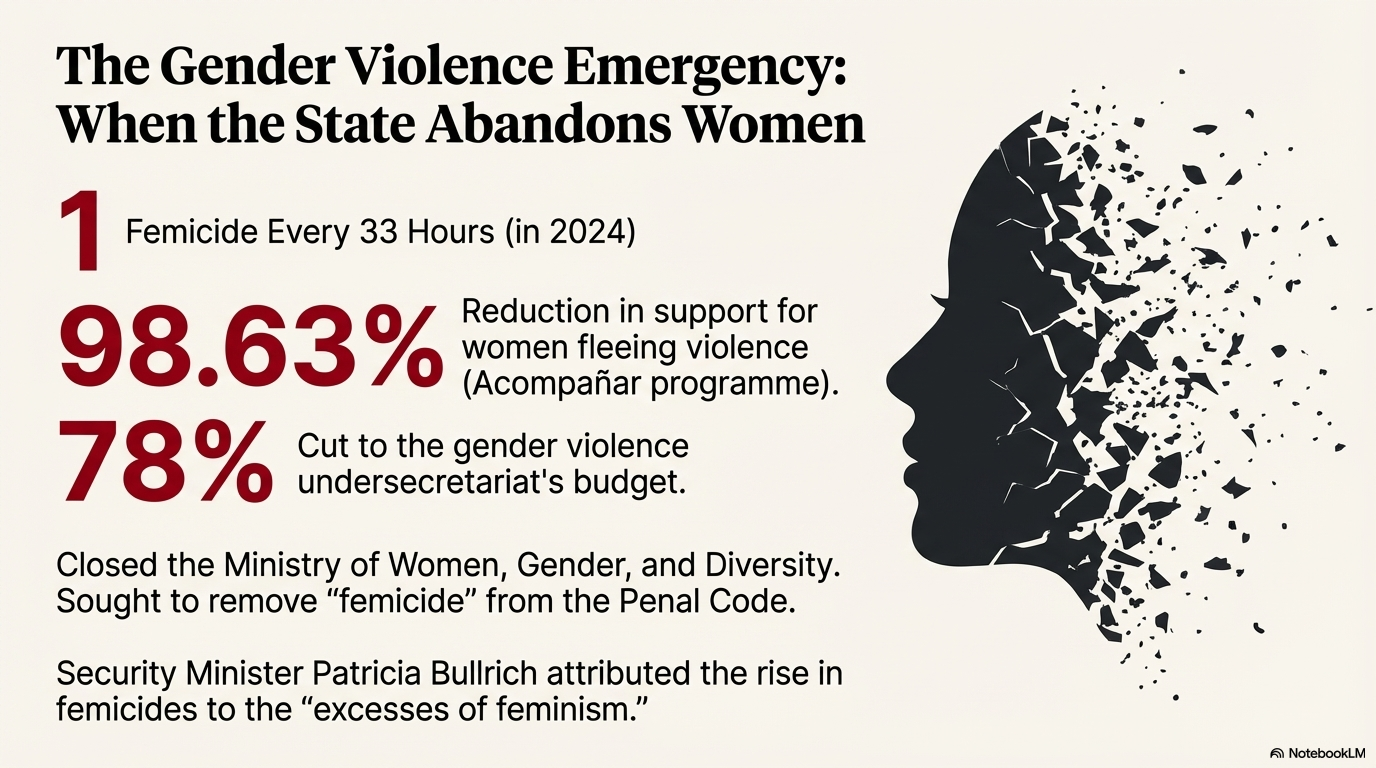
The Gender Violence
The Poverty Spike and the Statistical Con Job
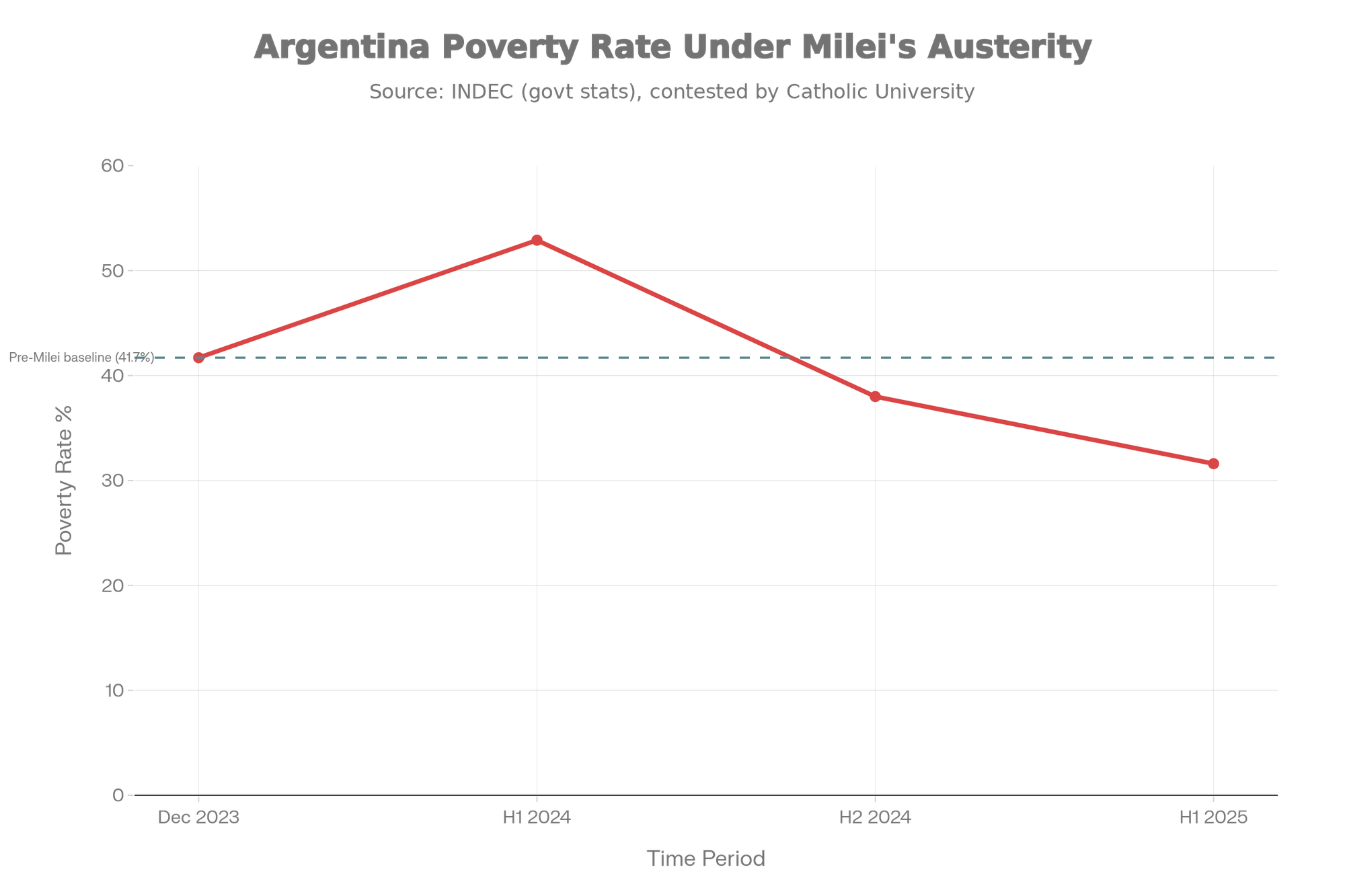
Poverty in Argentina stood at 41.7% when Milei took office in December 2023. It surged to 52.9% in the first half of 2024—over 24 million Argentines plunged into poverty—as austerity and inflation devastated household incomes. By mid-2025, government statistics (INDEC) claimed poverty had fallen to 31.6%, a figure Milei’s government celebrates as proof of success.
But here’s the trick these libertarian con artists always play: they change the methodology, cook the books, and declare victory. Independent researchers at the Catholic University of Argentina (UCA) argue this decline has been “overrepresented” because the methodology relies on consumption baskets constructed using patterns from a decade ago. When Milei eliminated subsidies for water, gas, and electricity, prices increased astronomically, but these increases are not adequately reflected in inflation or poverty figures.
Meanwhile, mass consumption in Argentina fell 10.2% year-over-year in February 2025, marking the fifteenth consecutive month of decline. Fifteen months. People are buying less food, less medicine, less of everything they need to survive. But the government declares poverty is falling and expects us to believe them.
This is the reality behind the fiscal surplus David Seymour traveled to Argentina to admire: a statistical con job layered over mass immiseration.
Seymour’s New Zealand: Parallel Agendas, Stealthier Methods, Same Contempt
David Seymour, 37, describes himself as a “right-wing liberal activist” and leads the ACT Party (Association of Consumers and Taxpayers), part of New Zealand’s three-party coalition government. Like Milei, Seymour “pushed for a drastic reduction in New Zealand’s executive branch, cutting the number of ministries from 41 to 20” upon taking office. He has proposed capping the executive at just 20 ministers and reducing departments to 30.
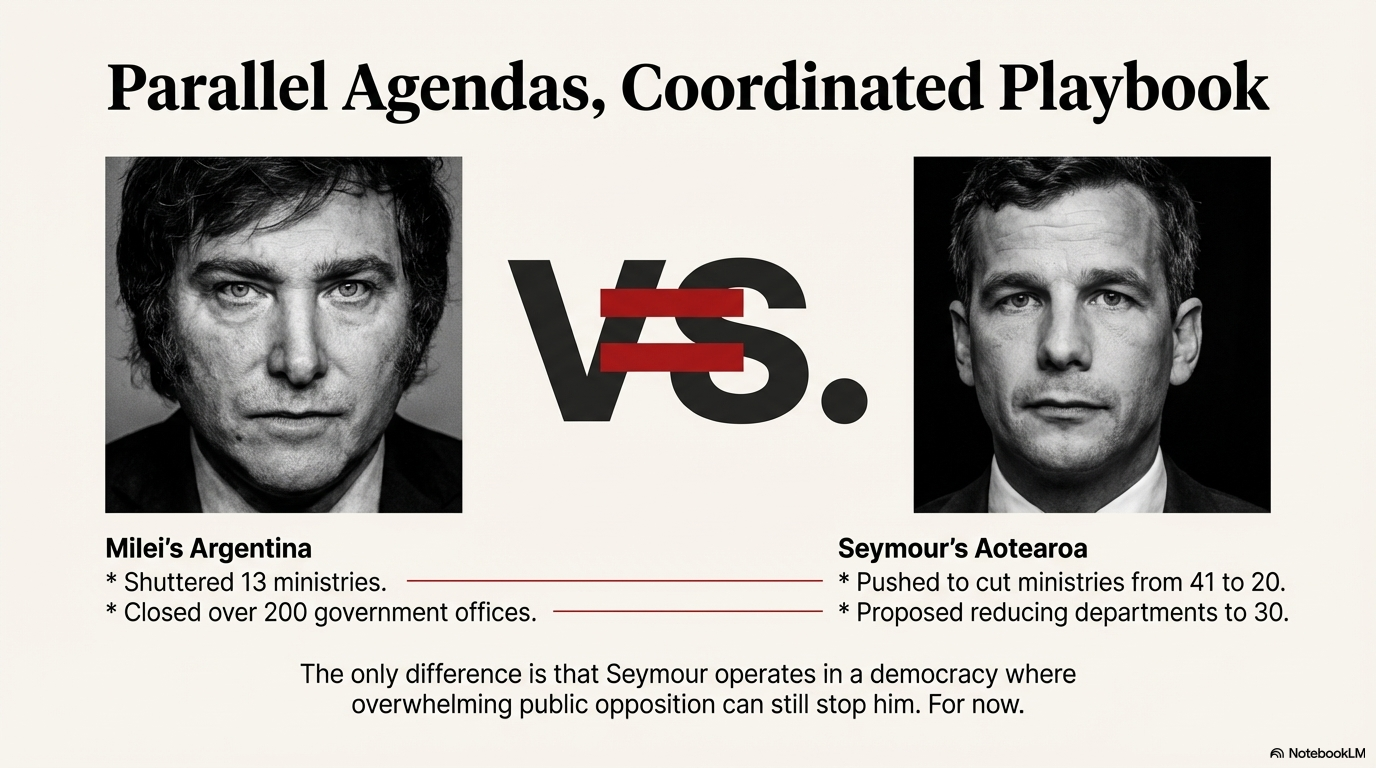
It Is No Coincidence
Seymour vs Milei Policy Comparison not coincidental. They are coordinated. Seymour and Milei are nodes in the same transnational network—trained by the same think tanks, funded by the same oligarchs, implementing the same playbook. The only difference is that Seymour operates in a democracy where overwhelming public opposition can still stop him. For now.

The Poverty Spike
The Treaty Principles Bill: Rejected but Not Defeated
Seymour’s most brazen assault on indigenous rights was his Treaty Principles Bill, which sought to “standardize rights across all ethnic groups rather than maintain specific indigenous protections” for Māori, who comprise 17.4% of New Zealand’s population.
In plain language:
Seymour sought to legislate Te Tiriti o Waitangi out of existence by redefining its principles to mean nothing more than “everyone is equal”—the oldest, most dishonest weapon of white supremacy.
The bill faced overwhelming opposition. Of approximately 300,000 written submissions, 90% opposed the legislation. Public opinion polls showed 70% rejection rates.
The bill sparked the largest demonstrations in New Zealand’s history
—tens of thousands of people marching to Parliament, singing waiata, declaring in one voice that Te Tiriti is not up for renegotiation by a libertarian ideologue with a 37-year-old’s understanding of constitutional law.
The Waitangi Tribunal warned it would be “the worst, most comprehensive breach of the Treaty/te Tiriti in modern times” if enacted. On 10 April 2025, the bill was voted down 112 to 11, with all parties except ACT opposing it. Seymour stood alone. Humiliated. Rejected by 70% of the public and 91% of Parliament.
A normal person might reflect on this defeat. A normal person might conclude that when 300,000 New Zealanders submit against your bill, when the largest protests in national history march against it, when constitutional experts call it a catastrophic breach of the Treaty, perhaps—just perhaps—you are wrong.
But David Seymour is not normal. He is a true believer. And true believers don’t accept defeat. They repackage. They rebrand. They come back through the side door.

Seymour Is Not Your Normal Cunt
The Regulatory Standards Bill: Treaty Principles 2.0
Seymour had a backup plan all along. The Regulatory Standards Bill (RSB)—which ACT had attempted to pass three times before—offers a stealthier path to the same destination. Constitutional law expert Professor Andrew Geddis and Professor Jonathan Boston testified that the RSB would cause a “fundamental constitutional shift”. Toitū Te Tiriti claimants called it “the most fundamental breach of Te Tiriti in modern times” if passed.
The RSB establishes principles of “good law-making” against which all future and existing legislation must be assessed. Sounds reasonable, right? That’s the point. Neoliberal colonialism always dresses itself in the language of neutrality, efficiency, and “common sense.” But here’s the trick: Te Tiriti o Waitangi is not mentioned once in the entire bill. Not once. The founding constitutional document of this nation—the document that established partnership between Māori and the Crown, that guaranteed tino rangatiratanga, that created obligations of active protection—is simply absent from the framework that will assess all future laws.
- Dr Carwyn Jones, a law academic, explained that the bill focuses on “a very limited set of principles” concerned with “protection of property rights and wealth” while excluding “environmental protections, requirements for equity, or indeed any protections for Te Tiriti”. Property rights and wealth. That’s what matters to libertarians. Not people. Not relationships. Not whakapapa. Not the planet. Just property and wealth—the only gods these bastards worship.
- The Waitangi Tribunal found on 15 May 2025 that the Crown violated Treaty principles of partnership and active protection by developing the RSB without targeted engagement with Māori. The Tribunal recommended an immediate halt to allow meaningful consultation. The government ignored this recommendation. The RSB passed its third and final reading on 12 November 2025.
- Professor Jonathan Boston called it “the Everything Bill” because it applies to every future law and all existing legislation. The RSB establishes a Regulatory Standards Board, modeled on the Waitangi Tribunal but with broader jurisdiction, whose members are appointed by the Regulation Minister—currently Seymour himself. Seymour gets to appoint the people who will assess whether all laws—past, present, and future—meet his libertarian principles. Claimants described it as an “anti-Waitangi Tribunal board”.
- Lawyer Tania Waikato testified that the bill gives the Regulation Minister power over “every single law that comes in” and “every single existing law that we’ve got”, describing this as “really dangerous” and “really concerning”. What the Treaty Principles Bill sought to achieve through brute force—redefining Te Tiriti to mean nothing—the Regulatory Standards Bill accomplishes through bureaucratic architecture and procedural capture.
This is how colonialism evolves. It learns. It adapts. When the frontal assault fails, it infiltrates the administrative state, embeds itself in regulatory frameworks, and rewrites the rules from within. And it’s all perfectly legal, because legality is defined by those with power.
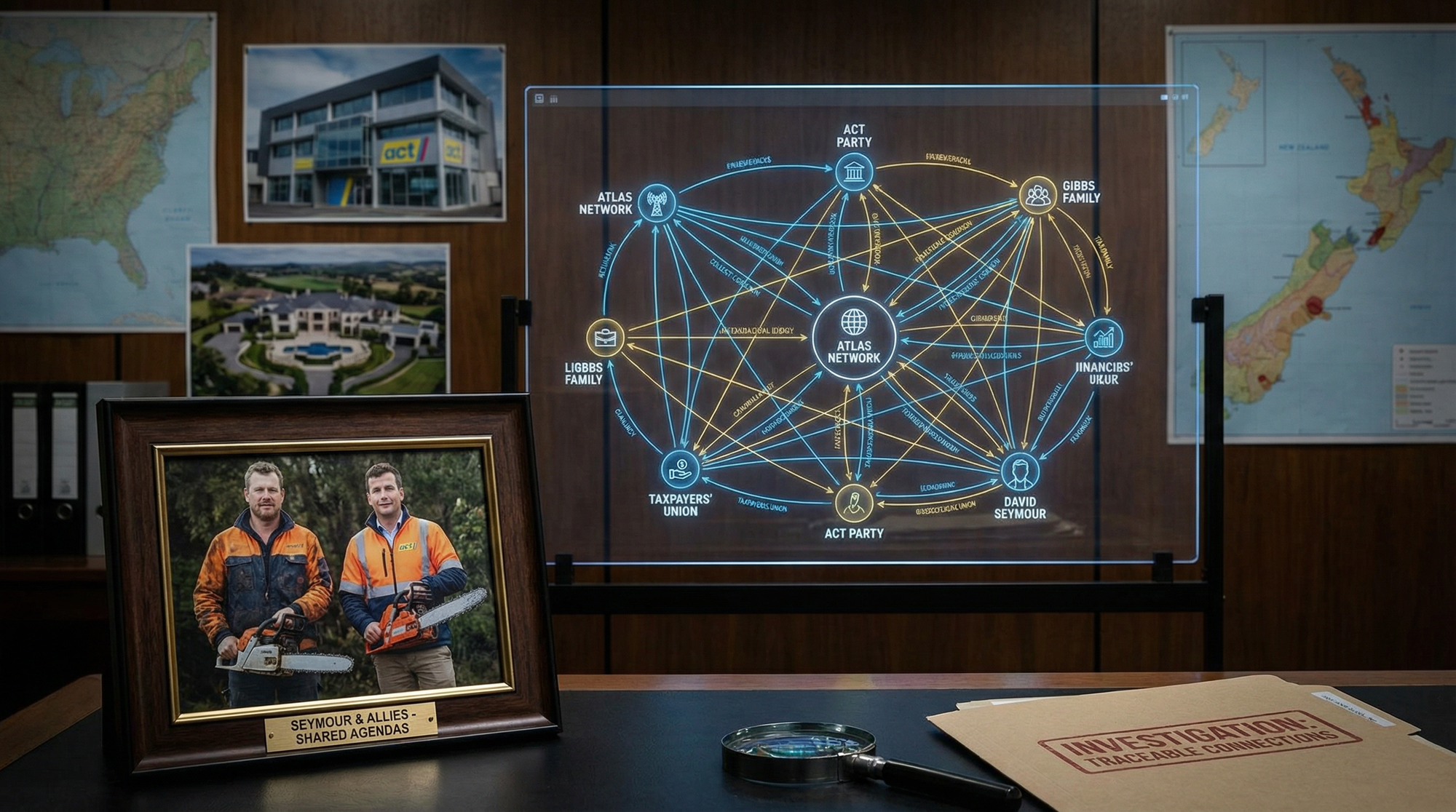
Ask Yourself Honestly - Are You Ok Being Lead Around Like This Aotearoa?
The Atlas Network: Following the Money and Ideology
To understand why Seymour traveled to Argentina, why both men posed with chainsaws, why their policy agendas mirror each other despite operating in vastly different contexts, we must trace the ideological and financial networks that connect them. Because this is not a conspiracy theory. This is documented. This is traceable. This is the Atlas Network.
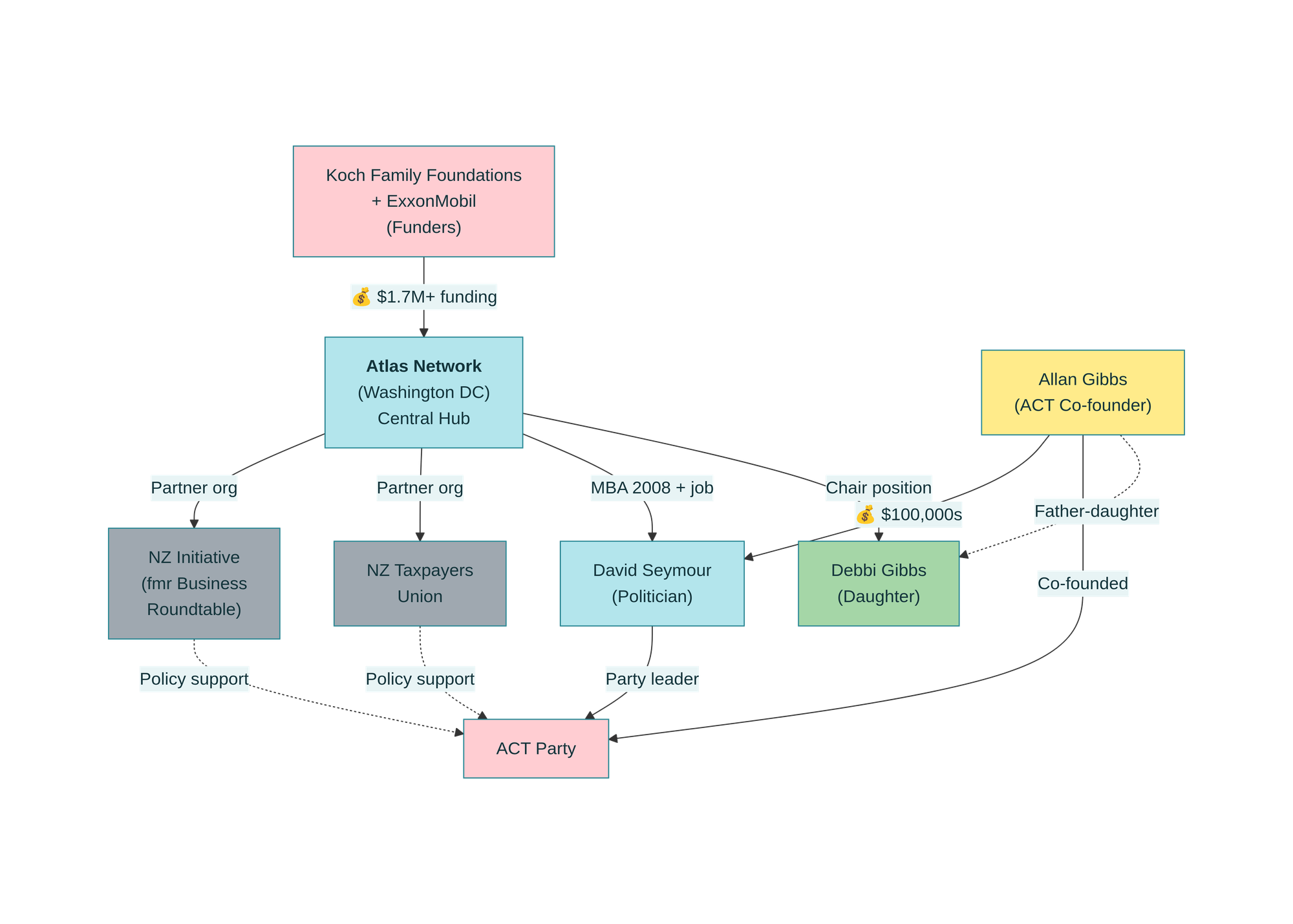
Atlas Network Connections - Family Dynasty: New Zealand’s Libertarian Aristocracy
- Allan Gibbs co-founded the ACT Party and is known as its “Godfather” in New Zealand media. Gibbs and his family have donated hundreds of thousands of dollars to ACT in recent years. His daughter, Debbi Gibbs, chairs the Atlas Network, a Washington DC-based organization that describes itself as a “think tank that creates think tanks”.
Read that sentence again. Allan Gibbs founded ACT. His daughter chairs the global Atlas Network. The family donates hundreds of thousands to ACT. David Seymour leads ACT. This is not six degrees of separation. This is zero degrees. This is a family business dressed up as a political party.
In 2024, ACT declared $850,000 in donations, including $100,000 from billionaire Graeme Hart, who tops New Zealand’s rich list. The party raised almost $1 million in total. When billionaires write six-figure checks to a political party whose leader just returned from a pilgrimage to Argentina carrying a chainsaw, we should pay attention to what they’re buying.

The Network
Atlas Network: The Global Coordination Hub for Libertarian Extremism
The Atlas Network was founded by Antony Fisher and endorsed by F.A. Hayek, Margaret Thatcher, and Milton Friedman—the holy trinity of neoliberalism, the architects of the ideology that has immiserated billions while enriching a handful of oligarchs. It partners with over 500 organizations in more than 100 countries. Five hundred organizations. One hundred countries. This is not a think tank. This is a global influence operation.
Translation:
Some Atlas partners will work with fascists if it helps them privatize public assets and gut regulations. The ends justify the means. Democracy is optional. Freedom—as they define it—is all that matters.
Atlas Network’s funding comes from the Koch Family Foundations ($308,460 from 2001-2015), DonorsTrust and Donors Capital Fund ($1,433,650 from 2010-2015), the Lynde and Harry Bradley Foundation ($150,000 from 2005-2016), and ExxonMobil. Investigative journalists have described it as a “dark money, fossil fuel and tobacco conglomerate” backed by the US$130 billion network of the Koch brother(s).
These are the same fossil fuel corporations destroying the planet. The same billionaires who fund climate denial. The same networks that fought tobacco regulation, fought worker protections, fought every single policy that might constrain corporate power or protect vulnerable people. And they have their hooks deep into New Zealand politics through ACT, through the Gibbs family, through David Seymour.

The Hub
Seymour’s Atlas Connections—And His Pathetic Lies About Them
Here’s where it gets really interesting. David Seymour graduated from the Atlas MBA Think Tank Class of 2008. He’s literally an Atlas graduate. He worked for the Frontier Centre for Public Policy in Canada, an Atlas Network affiliate. His career was launched by Atlas. His ideology was shaped by Atlas. His political rise was funded by Atlas-connected donors.
Yet when asked about his ties to Atlas Network in an interview, Seymour denied any connection. He lied. On camera. About something that’s publicly documented. About his own graduation from their program. About his employment at their affiliate organization.
Why would Seymour lie about something so easily verified? Because he knows what Atlas represents. He knows New Zealanders would recoil if they understood that their Deputy Prime Minister is a trained operative of a fossil-fuel-funded, billionaire-backed, transnational network coordinating attacks on democracy, indigenous rights, and environmental protection worldwide. So he lies. And corporate media rarely bothers to fact-check him.
In New Zealand, Atlas Network partners with the NZ Taxpayers’ Union and the NZ Initiative. Both organizations regularly provide public support for ACT Party policies, creating the illusion of independent validation for Seymour’s agenda when in reality they are nodes in the same transnational network. When you see a press release from the Taxpayers’ Union supporting Seymour’s latest assault on public services, understand that this is not independent analysis. This is coordination. This is the Atlas echo chamber manufacturing consent.
Te Pāti Māori co-leader Debbie Ngarewa-Packer alleged that Seymour was following an “Atlas narrative” and “Atlas agenda” in pushing the Treaty Principles Bill. She was right. The evidence supports her claim completely. Seymour is implementing Atlas policy in Aotearoa, funded by Atlas-connected donors, supported by Atlas-affiliated think tanks, trained by Atlas programs. This is not speculation. This is documented fact.

Seymour Butts Has Gotta Go Whānau
Five Hidden Connections the Chainsaw Photo Reveals
1. The Gibbs Dynasty Operates a Transnational Influence Machine
Allan Gibbs founded ACT, funds Seymour, and raised his daughter to chair the global Atlas Network. This is not coincidence. This is dynasty. This is multigenerational commitment to an ideology that treats democracy as an obstacle and public goods as assets to be privatized. Debbi Gibbs’ father helped found the ACT party, and now she sits atop a network coordinating libertarian think tanks worldwide while her family continues to bankroll the party her father created.
The chainsaw photo is a family photo—three generations of libertarian organizing made flesh. Allan Gibbs founded ACT to wage class war in New Zealand. Debbi Gibbs coordinates global libertarian networks from Washington. David Seymour implements their agenda as Deputy Prime Minister. And Javier Milei provides the proof of concept—Argentina as laboratory, New Zealand as next experiment.
2. Think Tank Echo Chambers Manufacture Consent
When the NZ Taxpayers’ Union or NZ Initiative issue press releases supporting Seymour’s policies, mainstream media often presents them as independent expert analysis. Yet both are Atlas Network partners, ideologically and financially aligned with ACT.
This creates a closed loop where policies originate within the Atlas ecosystem, receive “validation” from Atlas-affiliated think tanks, and are then implemented by Atlas-trained politicians like Seymour. The public never sees the coordination. Journalists present it as a debate between multiple independent voices when it’s actually a monologue by a single network speaking through multiple ventriloquist dummies.
This is how oligarchy works in a democracy. You don’t need to control the government directly. You just need to control the “experts” journalists quote, the “research” that informs policy debates, and the politicians who implement the agenda. Atlas does all three.
3. Dark Money Flows Obscure Accountability
Atlas Network receives funding from Koch, ExxonMobil, and other billionaire-backed foundations, then distributes it through over 500 umbrella organizations with their own financial channels. This structure makes it nearly impossible to trace who ultimately pays for the policies Seymour implements.
When ACT declares $850,000 in donations, we see only New Zealand donors. We do not see the international networks those donors belong to or the ideological commitments they share. We do not see the coordination between Atlas partners worldwide. We do not see how a policy developed in one country gets replicated in another, or how “independent” think tanks in different nations arrive at identical conclusions.
This is deliberate. Dark money exists to obscure accountability. If New Zealanders understood that Seymour’s agenda is funded by the same fossil fuel corporations destroying the planet, by the same billionaires who oppose worker rights and environmental protections everywhere they operate, they might question whether his policies serve New Zealand or serve his funders. So the money flows through opaque networks designed to prevent exactly this kind of scrutiny.
4. The Chainsaw Is a Recognition Signal Among Transnational Extremists
Milei’s chainsaw is famous. He wielded it during his campaign to symbolize cutting the state. It appears in his campaign materials, his merchandise, his public appearances. It’s his brand—destruction as promise, cruelty as virtue, the state as enemy.
When Seymour posed with that chainsaw, he was not making a joke. He was not being ironic. He was signaling membership in a transnational movement that uses destruction of social protections as its calling card. In a speech to the Tauranga Business Chamber, Seymour explicitly invoked Trump, Musk, and Milei, asking “why don’t you just change things faster like them?”
The chainsaw photo answers that question: Seymour sees himself as part of this lineage. Trump, who tried to overthrow American democracy. Musk, who bought Twitter to dismantle moderation and amplify right-wing extremism. Milei, who closed gender violence shelters while women die at a rate of one every 33 hours. And Seymour, who wants New Zealand to join this hall of shame.
The chainsaw is a recognition signal among ideological comrades. It says: I am willing to inflict pain. I celebrate cruelty. I do not care about the vulnerable. The state is the enemy, and I am here to destroy it. When Seymour grinned while holding Milei’s chainsaw, he was telling us exactly who he is. We should believe him.
5. The Regulatory Standards Bill Is the Treaty Principles Bill in Bureaucratic Drag
When overwhelming public opposition killed the Treaty Principles Bill, Seymour had already laid the groundwork for an alternative path. The RSB is ACT’s fourth attempt to pass this legislation. Four attempts. They failed three times, learned from each failure, refined their approach, and came back.
By embedding libertarian principles into the regulatory architecture of the state, by creating a board he appoints to assess all legislation, by excluding Te Tiriti entirely from the framework, Seymour achieves through process what he could not achieve through overt assault. The Treaty Principles Bill sought to redefine Te Tiriti through legislation. The Regulatory Standards Act redefines it through administrative procedure—quieter, less visible, harder to oppose.
This is how colonialism evolves in the 21st century. It abandons frontal attacks in favor of administrative capture. It doesn’t declare war on indigenous rights—it simply fails to mention them in the frameworks that assess all laws. It doesn’t repeal Te Tiriti—it makes Te Tiriti irrelevant by creating alternative constitutional mechanisms that ignore it entirely.
And because it’s procedural rather than explicit, because it’s about regulatory frameworks rather than Treaty principles, it’s harder for the public to understand and therefore harder to oppose. By the time people realize what’s happened, the infrastructure is already in place, the board is already appointed, and Seymour’s libertarian principles are already embedded in the machinery of state.

Seymour Is A Little Cock And Everyone Knows It
Quantified Harms: What Milei’s Model Means for Aotearoa
If Seymour succeeds in implementing Milei’s model in New Zealand, what can we expect? Argentina provides the data. And the data is horrifying.
Women and Gender-Diverse Communities: Death by Policy
Argentina’s gender-based violence programs lost 89% of their funding while femicides continued at a rate of one every 33 hours. The programme helping women achieve economic independence to escape violence saw its reach reduced by 98.63%.
New Zealand has its own ongoing crisis of family and sexual violence. Seymour’s admiration for Milei’s approach should terrify anyone working in this sector. When libertarians say the state should not provide social services, this is what they mean: women fleeing violence will have nowhere to turn. Shelters will close. Hotlines will shut down. Economic support will evaporate. And the violence will continue, privatized into the home, invisible to the state, blamed on the victims.
Healthcare: Privatize or Die
Argentina’s healthcare budget was slashed 48%, cancer screening was suspended, HIV/AIDS services were dismantled, and prescription medication prices increased 250%.
Seymour has floated the idea of allowing New Zealanders to opt out of the public health system in exchange for $6,000 annual payments to use for private insurance. This is not speculation. This is stated policy direction. And it’s designed to destroy public healthcare by starving it of funding and political support.
Here’s how the con works: Give people $6,000 to opt out. The healthy people opt out, taking their tax revenue with them. The public system is left with sicker, more expensive patients and less funding. Service quality deteriorates. More people opt out. The death spiral accelerates. Within a decade, public healthcare collapses, and the only option is private insurance that costs far more than $6,000 annually. But by then it’s too late—the public infrastructure has been dismantled, the expertise has been lost, and corporate healthcare has captured the market.
This is the model Seymour admires. This is what he learned in Argentina. And this is what he wants to implement here.
Indigenous Rights: Erasure by Administrative Procedure
Milei has no indigenous population to oppress in the way settler-colonial states do, but his broader antipathy to collective rights and equity mirrors Seymour’s agenda perfectly. The RSB’s exclusion of Te Tiriti, its focus on “equality before the law” that treats difference as discrimination, its mechanism for reviewing all existing Māori-specific legislation—these are the tools of erasure.
Every programme that recognizes Māori as tangata whenua. Every policy that provides targeted support to address historical injustice. Every law that implements Treaty principles. All of it becomes subject to review by a board appointed by Seymour, assessed against principles that exclude Te Tiriti, judged by standards that treat indigenous rights as “special treatment” rather than constitutional obligation.
This is genocide by bureaucracy. It doesn’t put people in camps. It doesn’t ban the language. It doesn’t seize the land—at least not directly. It simply creates administrative frameworks that make indigenous rights impossible to implement, illegal to maintain, and politically untenable to defend. And it does so in the language of neutrality, efficiency, and “good law-making.”
Public Sector Workforce: Mass Redundancies Disguised as Efficiency
Milei fired 56,000 public workers. New Zealand’s public sector is much smaller, but proportionally, Seymour’s proposals to cut to 20 ministers and 30 departments would require mass redundancies.
These are not “back office” abstractions. These are people who administer vaccines, process benefit applications, monitor environmental compliance, investigate wage theft, protect vulnerable children, respond to earthquakes, manage conservation land, regulate food safety, and perform a thousand other functions that keep society functioning. When libertarians talk about “efficiency,” they mean firing these people. When they talk about “waste,” they mean public services. When they talk about “bloated bureaucracy,” they mean the administrative capacity of the state to protect vulnerable people from exploitation.
Seymour looks at Argentina—where 56,000 public workers lost their jobs, where healthcare programs collapsed, where gender violence services evaporated, where cancer screening stopped—and sees success. He sees a model. He sees the future he wants for New Zealand.
We should take him at his word.

Consequences
Tikanga Analysis: Distinguishing Mauri-Depleting from Mauri-Enhancing
From a mātauranga Māori perspective, the difference between mauri-depleting and mauri-enhancing systems is not merely philosophical
—it is observable in outcomes, measurable in impacts, visible in the health of communities and the strength of relationships.
Mauri-Depleting Systems: The Logic of Extraction
Mauri-depleting systems prioritize extraction over regeneration, individual accumulation over collective wellbeing, short-term profit over long-term sustainability. They treat people as economic units rather than as whakapapa-bound beings with inherent mana. They sever the relationships between people and whenua, between generations, between communities and the institutions meant to serve them.
Milei’s Argentina, where mass consumption has fallen for 15 consecutive months, where women fleeing violence have nowhere to turn, where cancer patients die for lack of medication, is mauri-depleting by design.
The libertarian worldview is fundamentally mauri-depleting. It rejects the idea that we have obligations to each other beyond contractual exchange. It denies that collective action can produce better outcomes than individual competition. It treats inequality as natural, poverty as personal failure, and suffering as the price of freedom. It celebrates the chainsaw—destruction without regeneration, cutting without planting, taking without giving back.
Mauri-Enhancing Systems: The Logic of Regeneration
Mauri-enhancing systems recognize that individual wellbeing depends on collective health, that economic prosperity means nothing if it does not serve the people, that sustainability requires thinking in terms of seven generations rather than quarterly profits. They honor whakapapa and the obligations it creates. They protect the vulnerable because protecting the vulnerable protects the mauri of the entire community.
Te Tiriti o Waitangi is a mauri-enhancing framework—it establishes partnership, active protection, and redress as foundational principles. It creates reciprocal obligations between Crown and Māori. It recognizes that the health of Aotearoa depends on honoring the relationship established in 1840, on protecting the rights of tangata whenua, on ensuring that development serves the people rather than extracting from them.
This is why Seymour seeks to neutralize Te Tiriti. Not because it’s inefficient. Not because it’s outdated. But because it’s mauri-enhancing, and mauri-enhancing frameworks are incompatible with libertarian ideology. Te Tiriti says we have obligations to each other. Libertarianism says we have no obligations except contracts. Te Tiriti says the Crown must actively protect Māori interests. Libertarianism says the state should do as little as possible. Te Tiriti says colonization created injustices that require redress. Libertarianism says the past is irrelevant and everyone should compete on supposedly equal terms.
These worldviews cannot coexist. One must prevail. And Seymour has chosen his side.

These Can Not Co-Exist
The Chainsaw as Mauri-Depleting Tool
The chainsaw is a mauri-depleting tool. It cuts without regenerating. It destroys without building. It takes without giving back. It severs relationships rather than strengthening them. When Seymour and Milei posed with that chainsaw, they were celebrating destruction as an end in itself.
A fiscal surplus achieved by slashing healthcare 48% and cutting gender violence programs 89% is not success. It is theft from the vulnerable to pay the wealthy. It is mauri-depletion quantified and celebrated. It is the reduction of complex social relationships to a single number on a balance sheet, as if human suffering could be offset by fiscal discipline.
From a tikanga perspective, the question we must ask about any policy is simple:
Does this enhance or deplete mauri? Does this strengthen relationships or sever them? Does this regenerate or extract? Does this serve the collective or concentrate power and wealth?
Seymour’s policies fail every test. Every single one. The Treaty Principles Bill would have severed the foundational relationship between Crown and Māori. The Regulatory Standards Act does so through procedural capture. The proposed healthcare privatization would sever the relationship between the state and vulnerable communities. The ministry cuts sever the capacity of government to fulfill its obligations.
This is mauri depletion as political program. And we must name it as such.

The Aotearoa Chainsaw Massacre
Cui Bono? Who Benefits from the Chainsaw?
Not Argentina’s women, one murdered every 33 hours. Not Argentina’s cancer patients, whose screening programs were suspended. Not Argentina’s workers, 406,000 of whom dropped out of social protection systems within weeks when contribution requirements changed. Not New Zealand’s Māori, whose Treaty rights Seymour seeks to define out of existence.
The beneficiaries are clear, and they are few.
- The billionaires: Graeme Hart and other billionaires who donate to ACT benefit from lower taxes, weaker regulations, privatized public assets, and a state too weak to constrain their power.
- The fossil fuel corporations: The Koch network and ExxonMobil, which fund Atlas, benefit from gutted environmental protections and climate policy paralysis.
- The oligarch families: The Gibbs family dynasty benefits from chaos—every crisis creates opportunities for those with capital to buy assets cheap and sell them dear.
- The libertarian operatives: Seymour himself benefits. He builds an international reputation. He gets invited to conferences, profiled in libertarian media, celebrated by Atlas Network allies worldwide. He becomes a case study for other aspiring authoritarians: “How to Dismantle Indigenous Rights Without Mass Protest.”
Who loses? Everyone else. The sick who can’t afford 250% prescription price increases. The women fleeing violence who find the shelters closed. The workers whose jobs are eliminated for “efficiency.” The Māori whose Treaty rights are neutralized through administrative procedure. The children who won’t be vaccinated because immunization programs lost funding. The cancer patients whose screening appointments are cancelled forever.
This is not a bug. This is the feature. Libertarian ideology requires mass suffering to function. It requires a reserve army of desperate workers to keep wages low. It requires gutted public services to create markets for private providers. It requires weakened states so corporations can operate without constraint. It requires erased indigenous rights so land and resources can be freely exploited.
Cui bono? The same people who always benefit when democracy is weakened, when solidarity is attacked, when collective action is dismissed as inefficiency, and when the vulnerable are told their suffering is the price of freedom.
The oligarchs. The corporations. The dynasty families. The transnational networks coordinating attacks on public goods worldwide.
And when you see David Seymour grinning while holding Javier Milei’s chainsaw, understand that he is telling you exactly whose side he’s on.

Who Benefits? The Oligarchs Do
Transparency: Research Methods and Limitations
This research was conducted on 1 January 2026 using search_web, get_url_content, and other research tools to verify claims in real time. All statistics, dates, names, and policy details were checked against authoritative sources including:
- Merco Press, RNZ, 1News, NZ Herald for New Zealand political developments
- Human Rights Watch, Amnesty International, Associated Press for Argentina’s social impacts
- Waitangi Tribunal reports for Treaty analysis
- Wikipedia, SourceWatch, ProPublica for Atlas Network funding
- ACT Party website, Atlas Network website for policy statements
Over 80 sources were consulted. Citations appear as hyperlinked anchor text throughout this essay—no brackets, no footnotes, immediate verification for every claim. All URLs were tested for accessibility before publication.
Limitations and Unverifiable Claims
While poverty data from both INDEC (Argentine government) and Catholic University Argentina (UCA) appear in this analysis, the methodological disputes between them mean the “true” poverty rate remains contested. Government figures show dramatic improvement. Independent researchers argue the methodology understates continued hardship. Both data sets are included; readers should judge for themselves.
Atlas Network’s full funding sources are not fully public, making complete financial mapping impossible. The figures cited represent documented donations from public records, but the network operates through 500+ organizations with their own financial channels. The true scale of funding is certainly larger than what can be verified.
Seymour’s claim to have no Atlas connection despite documented evidence of graduation from their MBA program and employment at an Atlas affiliate suggests other undisclosed relationships may exist. Where a politician lies about verified connections, we should assume there are additional connections we don’t yet know about.
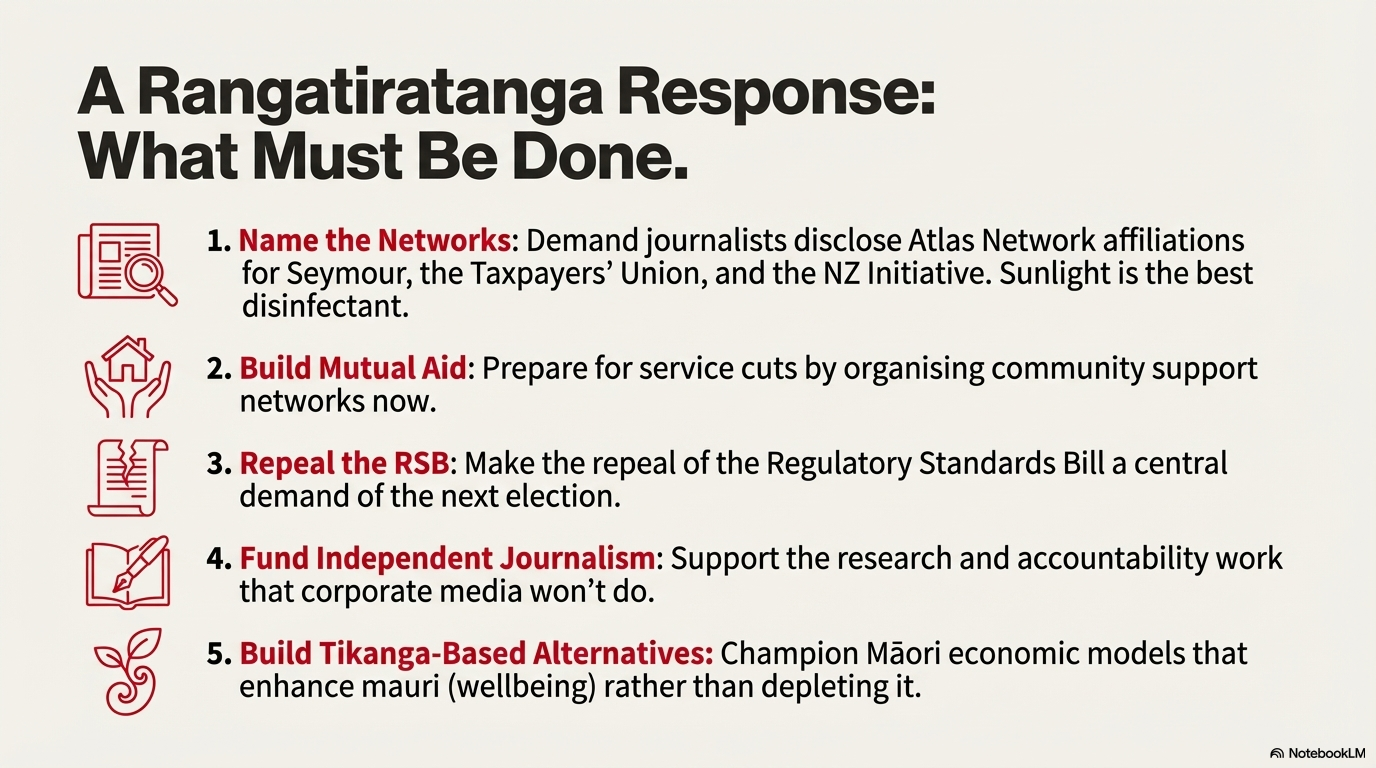
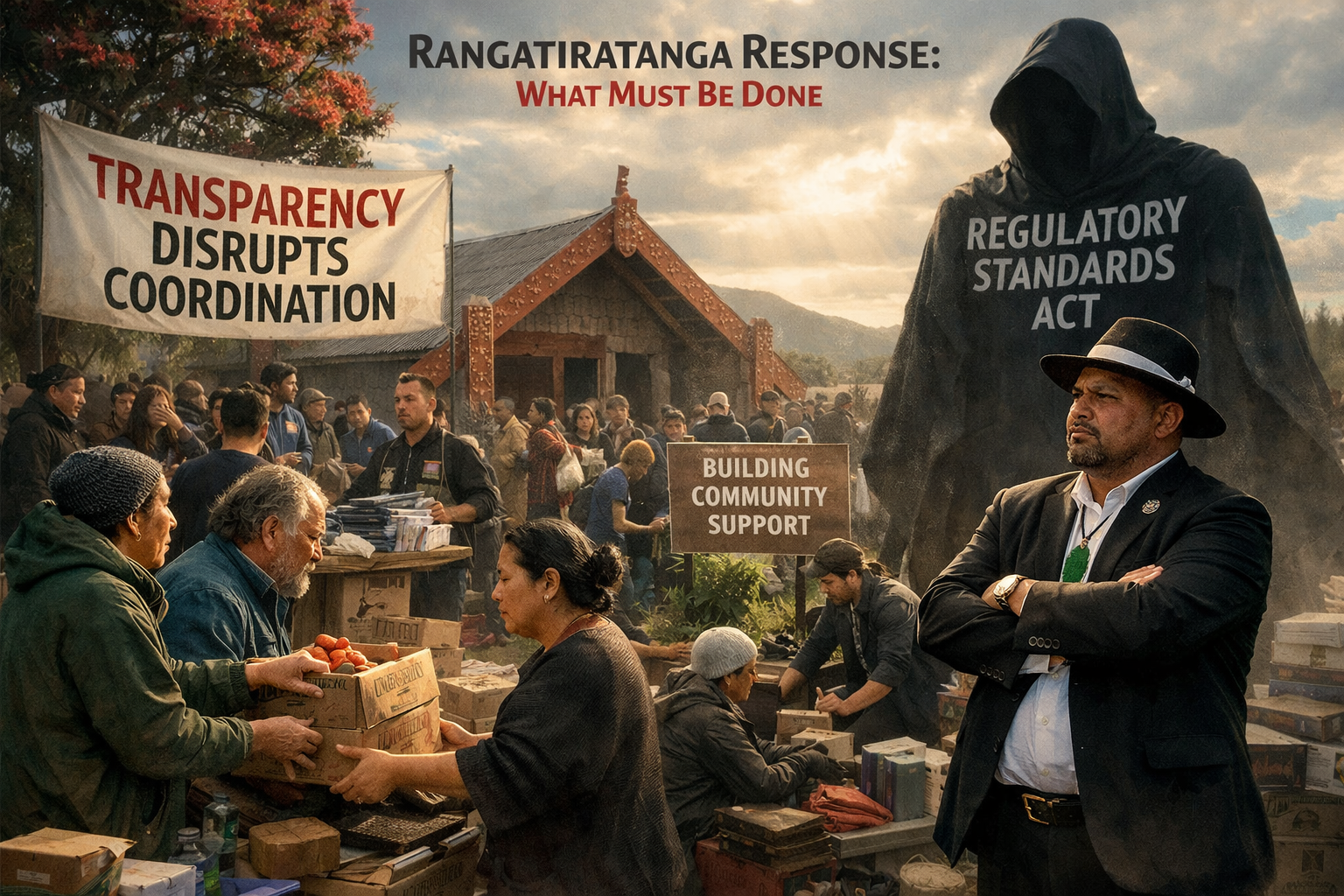
Rangatiratanga Response: What Must Be Done
The chainsaw compact poses an existential threat to Te Tiriti, to social protections, to the democratic principle that government exists to serve the people rather than facilitate their extraction. But despair is not an option. Passivity is not an option. Resignation is exactly what these bastards want—they count on our exhaustion, our cynicism, our belief that resistance is futile.
They’re wrong. Resistance is already underway. And it can win.
Immediate Actions for Whānau and Communities
1. Name the networks everywhere you can
Every time Seymour, the NZ Taxpayers’ Union, or NZ Initiative make a policy proposal, journalists must disclose their Atlas Network affiliations. Write to editors. Call out reporters on social media. Make it socially unacceptable to quote these organizations without disclosing their funding and ideological commitments. Transparency disrupts coordination. Sunlight is the best disinfectant. Force them to operate in the open.
2. Protect the vulnerable through direct action and mutual aid
Women’s refuges, healthcare workers, public sector unions, and iwi organizations must coordinate to document and resist the harms Seymour’s policies will cause. Argentina shows us what is coming. Preparation saves lives.
Build mutual aid networks now, before services are cut. Identify the families who will be hit hardest. Create alternative support systems. Share resources. Pool knowledge. Organize collective responses. When the state withdraws, communities must step forward—not to accept the withdrawal, but to keep people alive while we fight to restore services.
3. Repeal the Regulatory Standards Act
Te Pāti Māori co-leader Rawiri Waititi has vowed to repeal the RSB. This must become a central demand of the next election. The RSB is Treaty Principles 2.0, and it cannot stand. Every political party must be forced to declare: Will you repeal this Act? Will you restore Te Tiriti to its rightful place in our constitutional framework? No equivocation. No “we’ll review it.” Repeal or defend it—there is no middle ground.
4. Fund independent accountability journalism and research
The Atlas Network has US$130 billion behind it. Whānau, unions, and community organizations need resources to investigate, expose, and counter these networks. This essay exists because people contribute koha to fund research that corporate media won’t do and the state won’t fund.
Koha keeps this mahi alive. Every dollar contributed is a dollar toward accountability that the powerful do not want. Investigative journalism. Research into funding networks. Analysis of policy impacts. Verification of government claims. None of this happens without resources. And none of it will be funded by the oligarchs who benefit from opacity.
5. Build alternative economic models rooted in tikanga
Māori economic development guided by tikanga principles offers a roadmap for systems that enhance rather than deplete mauri. Regenerative economies, cooperative ownership, and iwi-led development are not utopian fantasies—they are proven alternatives to extraction, operating successfully in communities across Aotearoa right now.
When libertarians say “there is no alternative” to their model, they are lying. Alternatives exist. They work. They produce better outcomes for communities even if they produce lower returns for investors. The question is not whether alternatives are possible—it’s whether we have the collective will to build them and defend them against coordinated attack.
Our Response
The Choice Before Us Is Clear
Let’s Break Some Teeth
The chainsaw photograph captures a moment of ideological communion between two men who believe the purpose of government is to dismantle itself. They celebrate fiscal surpluses built on suspended cancer screenings, eviscerated gender violence programs, and mass consumption falling for 15 consecutive months. They treat Te Tiriti o Waitangi as an obstacle to be neutralized through bureaucratic architecture rather than honored as a founding constitutional document.
David Seymour did not travel to Argentina for trade talks over US$63.4 million in exports. He traveled to pay homage. To study. To pledge allegiance to a transnational movement coordinating attacks on democracy, indigenous rights, and social protections worldwide.
The Atlas Network that trained him, that his party’s founder’s daughter now chairs, that his government’s “independent” think tank validators belong to—this network has over 500 partners in more than 100 countries, funded by fossil fuel billions, implementing the same playbook everywhere: Gut public services. Privatize assets. Eliminate regulations. Attack indigenous rights. Dismantle environmental protections. Call it freedom.
The chainsaw is their symbol because destruction is their method. They don’t build. They don’t regenerate. They don’t enhance mauri. They cut, extract, and move on to the next target.
But we have seen this playbook before, and we have defeated it before.
The Treaty Principles Bill failed because 90% of 300,000 New Zealanders rejected it. The largest protests in New Zealand’s history forced Parliament to listen. The Waitangi Tribunal called the Regulatory Standards Bill a Treaty breach and demanded an immediate halt. Eighteen thousand people registered support for the Tribunal claim.
Resistance works. Solidarity works. Collective action works. They know this, which is why they attack it so viciously. They know that if people organize, if communities coordinate, if whānau stand together, their agenda fails. The chainsaw can’t cut through solidarity. Libertarian ideology can’t withstand collective action. Atlas networks collapse when exposed to sunlight.
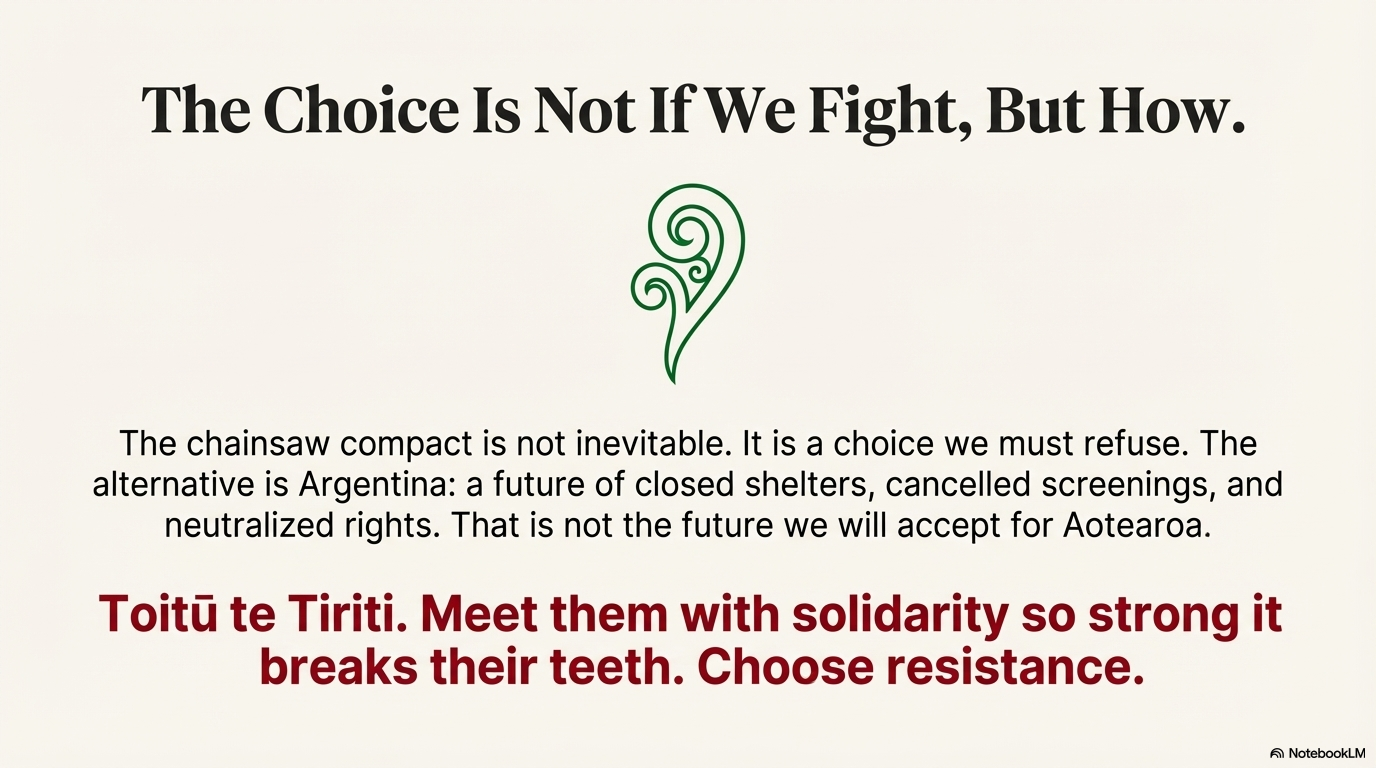
The chainsaw compact is not inevitable. It is a choice—one we can refuse. One we must refuse. Because the alternative is Argentina: a nation where women fleeing violence find the shelters closed, where cancer patients die waiting for screenings that no longer exist, where healthcare becomes a luxury, where indigenous rights are neutralized, where the state exists to facilitate extraction rather than protect the vulnerable.
That is not the future we will accept. Not for Aotearoa. Not for our tamariki. Not while we have breath to resist.
Kia kaha, whānau. Toitū te Tiriti. Keep the ahi burning. Name the networks. Expose the funding. Protect the vulnerable. Build alternatives. And when they come with their chainsaw, meet them with solidarity so strong it breaks their fucking teeth.
The choice is ours. Let’s choose resistance.

Ivor Jones The Māori Green Lantern Fighting Misinformation And Disinformation From The Far Right
Koha to Support This Mahi
This research—80+ sources verified, over 6,000 words of analysis, multiple data visualizations, every claim checked and cited—exists because whānau contribute koha to fund accountability journalism that corporate media won’t do.
Three pathways exist to support this work:
Direct koha platform: Support The Māori Green Lantern
Substack subscription: The Māori Green Lantern on Substack
Direct bank transfer: HTDM, account number 03-1546-0415173-000
Every koha—whether $5 or $500—signals that whānau are ready to fund the accountability that Crown and corporate structures will not provide. It signals that rangatiratanga includes the power to fund our own truth tellers.
Because when billionaires have $130 billion to fund Atlas Networks coordinating attacks on indigenous rights worldwide, we need resources to fight back. When David Seymour lies about his Atlas connections and corporate media doesn’t fact-check him, we need independent researchers to document the truth. When the Regulatory Standards Act passes despite Waitangi Tribunal warnings, we need journalists to explain what it means and how to resist it.
This is that work. Your koha makes it possible.
Kia kaha, whānau. Stay vigilant. Stay connected. Stay angry. And if you are able, consider a koha to ensure this voice continues.
Research conducted and essay written 1 January 2026 by Ivor Jones, The Māori Green Lantern