“The Chickens Come Home to Roost: Why National’s Polling Collapse Exposes the Rotten Core of Neoliberal Austerity” - 9 October 2025
When Even Your Own Propagandists Turn Against You
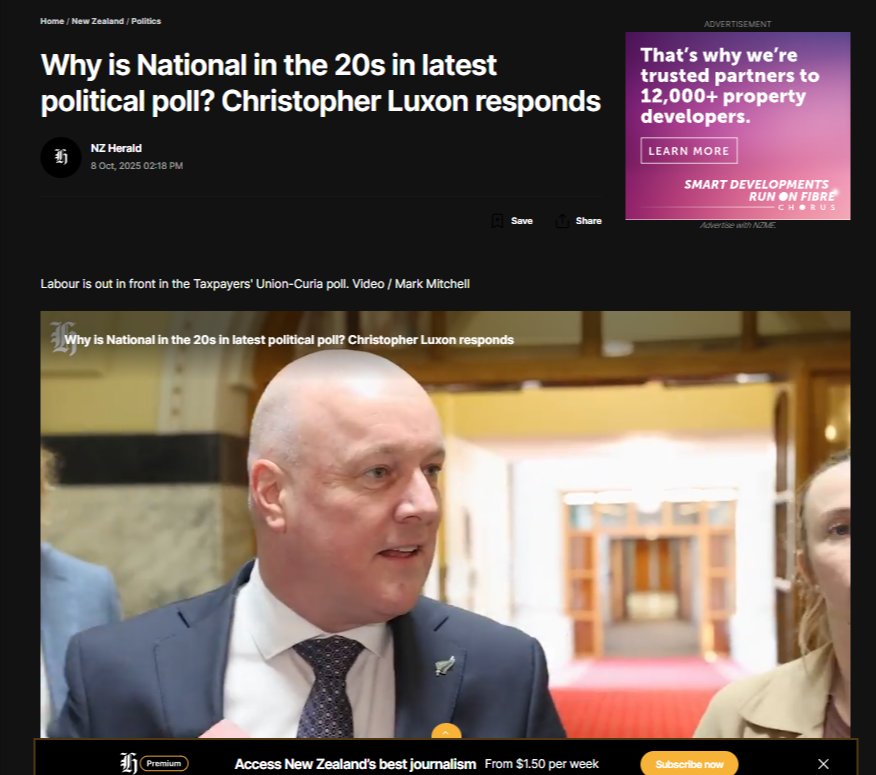
Kia ora koutou katoa. Ko Ivor Jones ahau, ko MGL hoki.
(Greetings everyone. I am Ivor Jones, also known as the Māori Green Lantern.)
The Coalition Government’s War on Tangata Whenua Has Finally Caught Up With Them
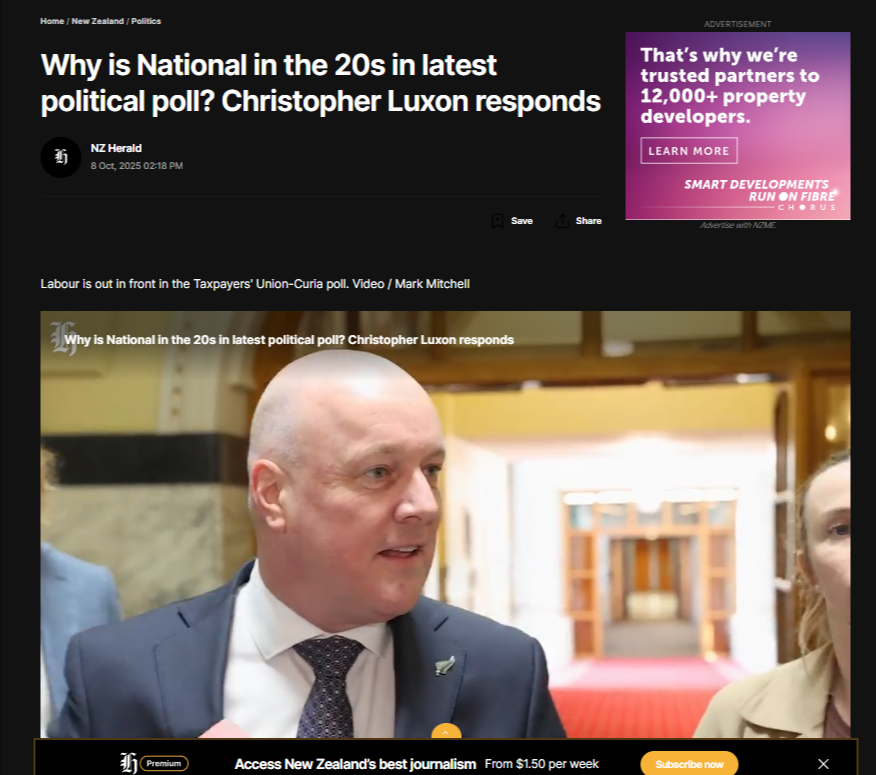
When the Taxpayers Union-Curia poll showed National plummeting to 29.6 percent, something unprecedented happened in New Zealand politics. For the first time in decades, a government’s systematic assault on Indigenous rights has become so toxic that even their own manufactured consent machine – the Taxpayers Union – couldn’t spin the numbers into anything resembling success. Christopher Luxon’s response was the pathetic bleating of a man who knows his political obituary is being written, admitting “times are tough” while refusing to acknowledge that his government’s vicious attacks on Māori have poisoned the political well.
This essay exposes how National’s polling collapse represents more than electoral misfortune – it reveals the bankruptcy of a neoliberal project that has weaponized racism against tangata whenua while serving the interests of international corporate networks. The coalition’s anti-Māori crusade, orchestrated through Atlas Network-connected organizations like the Taxpayers Union, has backfired spectacularly, proving that New Zealanders still retain some moral backbone despite decades of neoliberal propaganda.
Background: The Neoliberal Machinery Grinding Māori Into Dust
To understand why National sits rotting in the electoral basement, we must first grasp the machinery of oppression they’ve constructed. The Atlas Network, a global web of right-wing think tanks founded in 1981, has spent decades building the infrastructure to destroy Indigenous rights across the Pacific. In Aotearoa, this network operates through the Taxpayers Union and New Zealand Initiative, both official Atlas partners whose mission is to “roll back the state” – which in practice means crushing any policy that serves Māori interests.
Jordan Williams, the Atlas Network “hero” who runs the Taxpayers Union, completed their “MBA training” in 2015 and received a fellowship in 2018. This isn’t education – it’s ideological programming designed to create local operatives who can advance corporate interests while pretending to represent “taxpayers.” The fact that Williams brazenly describes himself as a “neoliberal” in the National Business Review tells us everything about their contempt for democratic accountability.
The coalition government represents the fulfillment of this neoliberal dream: a triumvirate of corporate puppets led by Luxon (the “run-of-the-mill corporatist”), Peters (the “garden-variety populist”), and Seymour (the “10-a-penny libertarian”) who have systematically dismantled decades of Indigenous rights progress. Their success in forming government wasn’t due to popular mandate – it was the result of sophisticated propaganda campaigns funded by international corporate networks determined to extract maximum profit from Aotearoa’s resources.
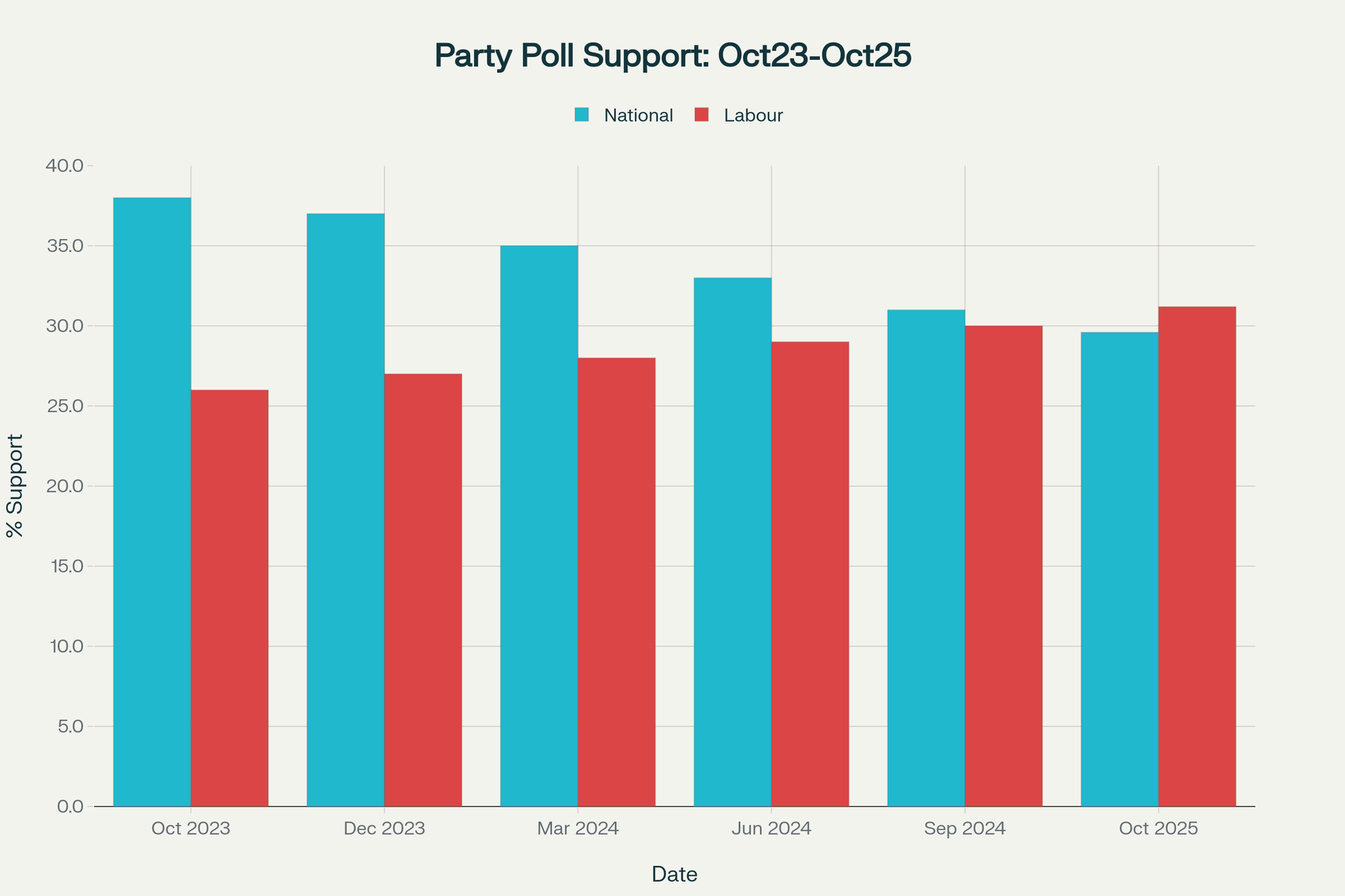
National Party’s Polling Collapse: From Government to Opposition Territory (Oct 2023 - Oct 2025)
A Systematic War Against Tangata Whenua
The coalition’s assault on Māori has been breathtaking in its scope and viciousness. Within months of taking power, they abolished Te Aka Whai Ora (the Māori Health Authority), removed local councils’ rights to establish Māori wards, and implemented an “English first” policy across government departments. But the crown jewel of their racist agenda is David Seymour’s Treaty Principles Bill, which the Waitangi Tribunal correctly identified as “little more than a politically motivated attack on perceived ‘Māori privilege’”.
The Aotearoa Independent Monitoring Mechanism, a Māori working group established to monitor Indigenous rights, delivered a damning verdict: this coalition represents “the most overtly racist and white supremacist government [New Zealand] has had in decades.” Their assessment isn’t hyperbole – it’s a clinical diagnosis of a government that has made anti-Māori sentiment its organizing principle.
What makes this assault particularly insidious is its systematic nature. The coalition didn’t just attack individual policies – they’ve removed Treaty principles from legislation across government, cut funding for Māori language programs, and eliminated dedicated Māori teams within government agencies. This isn’t policy divergence – it’s cultural genocide by a thousand cuts.
The response from tangata whenua has been magnificent. Tens of thousands have taken to the streets, Parliament has witnessed unprecedented scenes of resistance, and hui across the motu have united iwi in opposition. The government’s attempt to divide and conquer has instead forged unprecedented unity among tangata whenua, creating the very coalition of resistance they hoped to prevent.
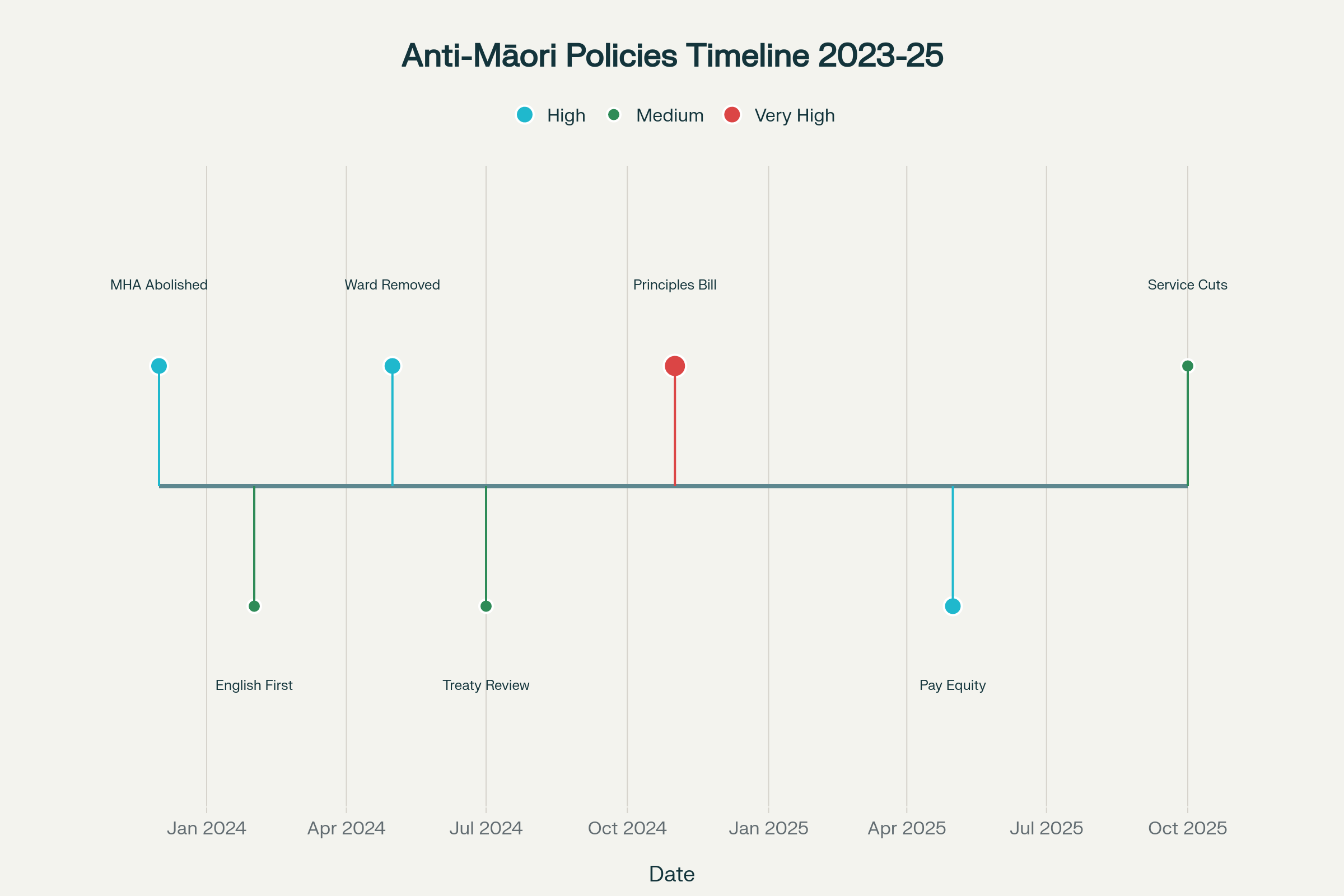
Timeline of Anti-Māori Policy Attacks by Coalition Government (Dec 2023 - Oct 2025)
The Neoliberal Death Spiral
The Atlas Network’s New Zealand Operation
The coalition’s anti-Māori agenda didn’t emerge from thin air – it was carefully cultivated by international corporate interests seeking to remove Indigenous barriers to resource extraction and profit maximization. The Atlas Network connects 550 think tanks across 100 countries, all dedicated to advancing “individual liberty, property rights, limited government, and free markets” – which in practice means eliminating any collective rights that might interfere with corporate domination.
In Aotearoa, this network operates through carefully cultivated local operatives. Jordan Williams, who founded the Taxpayers Union after studying the UK’s Taxpayers Alliance, represents the classic Atlas model: take a charismatic local figure, provide international training and funding, then use them to advance corporate interests while claiming to represent “ordinary taxpayers.” The fact that Williams also runs The Campaign Company, providing “digital campaign services to political and commercial clients across the globe”, reveals the sophisticated nature of this operation.
David Seymour’s connection to this network runs even deeper. His experience with Atlas-connected groups in Canada, combined with his libertarian ideology that treats property rights as the “most basic human right”, makes him the perfect vehicle for advancing corporate interests while attacking Indigenous rights. The Treaty Principles Bill isn’t just racist – it’s a corporate manifesto designed to eliminate Indigenous barriers to resource extraction.
Manufacturing Consent Through Propaganda
The Taxpayers Union’s role as New Zealand’s premier disinformation factory cannot be overstated. With 204,000 supporters and 18 staff at its peak, it represents the largest per capita taxpayer group in the English-speaking world – a testament to the effectiveness of their propaganda operation. But their funding sources reveal the lie behind their “grassroots” claims.
While Williams claims over 80% of funding comes from small donations, the organization received money from tobacco companies, alcohol industries, and other corporate interests. Their willingness to travel to Panama to oppose World Health Organization tobacco control measures while refusing to disclose funding sources exposes their true nature as corporate mercenaries disguised as citizen advocates.
The organization’s polling operations deserve particular scrutiny. The same poll showing National’s collapse to 29.6% was conducted by Curia Market Research, whose owner David Farrar co-founded the Taxpayers Union. This creates a feedback loop where the same network that shapes public opinion through propaganda campaigns then measures that opinion through polling, creating an illusion of democratic accountability while serving corporate masters.
The Austerity Agenda’s Racist Core
The coalition government’s “brutal austerity” program, which slashed $5.3 billion in government spending annually, disproportionately targets services that benefit Māori communities. The pay equity overhaul alone saved $2.7 billion per year, directly attacking policies designed to address gender-based wage discrimination that particularly affects Māori women.
These cuts weren’t accidental – they represent the systematic implementation of neoliberal ideology that views collective rights as obstacles to market efficiency. When government departments were ordered to cut dedicated Māori teams, it wasn’t just about saving money – it was about eliminating institutional capacity to serve Indigenous interests. The requirement that government departments use English names instead of Māori serves no fiscal purpose – it’s pure cultural vandalism designed to erase Indigenous presence from the state apparatus.
The coalition’s environmental policies reveal the intersection between racism and corporate interests. The weakening of freshwater standards and the fast-tracking of development projects without environmental safeguards disproportionately affects Māori communities whose cultural and spiritual connection to the environment makes them natural opponents of resource extraction. By removing Treaty considerations from environmental legislation, the government has cleared the path for corporate exploitation of indigenous resources.
The Christian Nationalist Connection
The coalition’s assault on Māori rights intersects with broader Christian nationalist ideology that views Indigenous cultures as obstacles to Western civilization. Winston Peters’ comparison of co-governance to “apartheid and Nazi racial theory” echoes the replacement theory rhetoric used by white supremacists globally to demonize Indigenous self-determination.
This ideology manifests in policies like the reintroduction of boot camps for youth offenders, where nine out of ten participants are Māori. The Royal Commission on Abuse in State Care found that boot camps were sites of horrific abuse, yet the government persists with these policies because they serve the ideological function of criminalizing Māori youth while claiming to offer “tough love” solutions.
The coalition’s education policies reveal similar ideological motivations. David Seymour’s plan to revise the history curriculum because it supposedly “wrongly blames all the country’s problems on colonisation” represents a direct assault on historical truth. By sanitizing colonial violence, they hope to eliminate the moral foundation for contemporary Indigenous rights claims.
The Electoral Reckoning
The coalition’s assumption that New Zealanders would embrace their racist agenda has proven catastrophically wrong. Only 10% of voters believe government policies are reducing racial tensions, while 50.8% think the country is heading in the wrong direction. Even more damaging for National, Luxon’s net favourability rating stands at minus 14%, making him one of the most unpopular prime ministers in New Zealand history.
The Herald’s Mood of the Boardroom survey, which ranked Luxon 15th out of his own Cabinet ministers, reveals how even the business community that supposedly supports National has lost confidence in his leadership. When your own corporate backers rate you below Nicole McKee and Karen Chhour, your political career is effectively over.
The coalition’s response to their polling collapse has been predictably pathetic. Luxon’s refusal to directly address questions about his declining popularity, combined with his generic talking points about “fixing the economy,” reveals a man who has completely lost touch with political reality. His admission that “it’s been a really difficult time” while refusing to acknowledge that his government’s racism is the source of that difficulty epitomizes the moral bankruptcy of neoliberal leadership.
The Death Rattle of Neoliberal Hegemony
The coalition government’s polling collapse represents more than electoral misfortune – it signals the beginning of the end for neoliberal hegemony in Aotearoa. For forty years, corporate interests have used sophisticated propaganda operations to convince New Zealanders that Indigenous rights represent a threat to economic prosperity and democratic equality. The current backlash suggests this propaganda has finally reached its limits.
The unified Māori response to government attacks has created a new political consciousness that extends beyond traditional iwi boundaries. When tens of thousands march through cities across Aotearoa to oppose government policies, they’re not just protesting individual measures – they’re rejecting the entire neoliberal project that treats Indigenous rights as obstacles to economic efficiency.
The coalition’s environmental policies have also awakened broader consciousness about the connection between Indigenous rights and ecological survival. As climate change makes environmental protection increasingly urgent, the government’s decision to prioritize resource extraction over environmental safeguards appears increasingly reckless. The intimate connection between Māori cultural values and environmental stewardship means that attacks on Indigenous rights inevitably undermine climate action.
For tangata whenua, the coalition’s assault has paradoxically strengthened collective identity and political organization. The government’s overreach has forced Māori communities to develop new forms of resistance that transcend traditional political boundaries. The emergence of initiatives like Te Pāti Māori’s proposal for a Māori parliament represents a quantum leap in Indigenous political sophistication that will outlast any individual government.
The international implications are equally significant. The Atlas Network’s New Zealand operation was supposed to serve as a model for rolling back Indigenous rights across the Pacific. Instead, the coalition’s spectacular failure provides a roadmap for how Indigenous communities can resist corporate-funded assaults on their rights. The government’s polling collapse demonstrates that racism, even when professionally packaged by international propaganda networks, ultimately fails when confronted with organized resistance and moral clarity.
The Reckoning Arrives
The coalition government’s plunge into electoral irrelevance represents the inevitable consequence of building a political project on racism and corporate servitude. When National sits at 29.6% in polling, it’s not experiencing a temporary setback – it’s witnessing the collapse of a worldview that assumed New Zealanders would embrace white supremacy if it was professionally packaged by groups like the Taxpayers Union.
Christopher Luxon’s admission that “times are tough” while refusing to acknowledge his government’s racist agenda reveals the moral bankruptcy at the heart of neoliberal politics. When your political project requires attacking the Indigenous people of the land you claim to govern, you’ve already lost the moral authority to lead. The polling numbers simply confirm what has been obvious to anyone with functioning ethics: this government represents the death throes of a colonial project that has finally exhausted its legitimacy.

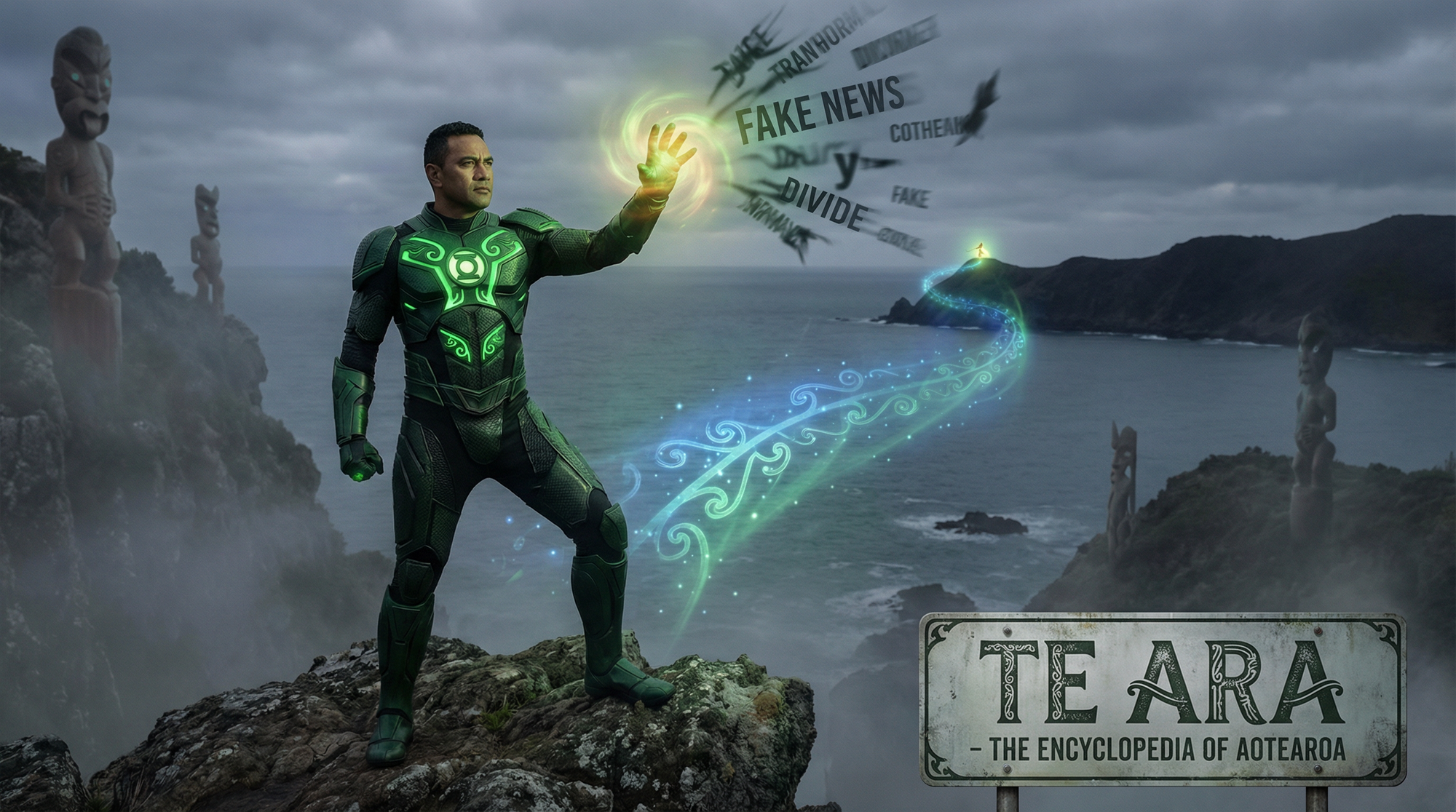
The Māori Green Lantern Fighitng Misinformation And Disinformation From The Far Right
The resistance movement that has emerged in response to coalition attacks points toward a different political future. When tens of thousands of people march through streets across Aotearoa to defend Indigenous rights, they’re not just opposing specific policies – they’re rejecting the entire neoliberal framework that treats collective rights as obstacles to individual freedom and corporate profit.
The coalition’s spectacular failure provides hope that New Zealand retains the moral capacity to reject fascism even when it arrives wearing business suits and spouting economic rationalism. The polling collapse of National, the most successful electoral machine in New Zealand history, proves that there are limits to how much racism and corporate servitude the public will tolerate.
For tangata whenua, this moment represents both crisis and opportunity. The government’s assault has been vicious and comprehensive, but it has also created unprecedented unity and political consciousness among Māori communities. The emergence of new forms of resistance, from street protests to parliamentary haka, demonstrates the enduring strength of Indigenous culture even in the face of systematic oppression.
The Taxpayers Union’s role in orchestrating this political disaster deserves particular attention. When even your own propaganda operation can’t generate polling numbers that hide your government’s toxicity, you’ve reached the terminal stage of political failure. The fact that Curia Market Research, co-founded by Taxpayers Union co-founder David Farrar, produced the polling that exposed National’s collapse adds delicious irony to the coalition’s predicament.
As we head toward the 2026 election, the battle lines are clear. On one side stands the coalition government and its Atlas Network backers, committed to advancing corporate interests through racist attacks on Indigenous rights. On the other side stands a growing movement of New Zealanders who recognize that Indigenous rights and environmental protection are essential for any decent society.
The coalition’s polling collapse suggests that movement is winning. The question now is whether progressive forces can maintain the unity and political sophistication necessary to complete the job of consigning neoliberalism to the dustbin of history where it belongs.
Ko te mutunga o te korero. Kia kaha tatou.
(This concludes the discussion. Let us be strong together.)
If readers find value in this analysis and wish to support the continued work of exposing right-wing misinformation and neoliberal propaganda, please consider contributing a koha to: HTDM: 03-1546-0415173-000. Given these challenging economic times for whānau, please only contribute if you have the capacity and wish to do so.