"The Collapse of Luxon’s Coalition: A Systematic Destruction of Rangatiratanga and Whānau Mana" - 17 November 2025
Government Performance Rating Falls to Historic 3.9/10—Lowest Since 2017
Ko Ivor Jones te Māori Green Lantern. Tohunga mau rākau wairua. Mana rooted in firstly being Māori - Norm and then Te Arawa, Ngāti Pikiao, Ngāti Welsh and multiple ancestral sites. The mahi is everything. The Ring empowers. Each essay: rangatiratanga manifested.
Kia kaha. Ka tū.
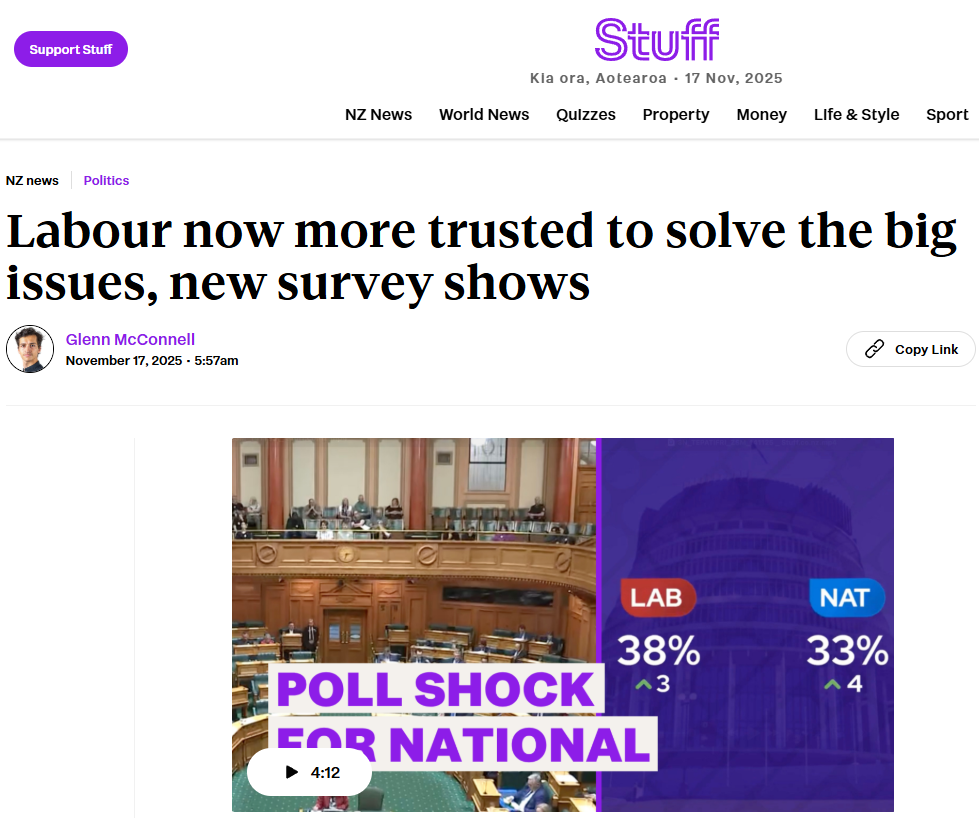
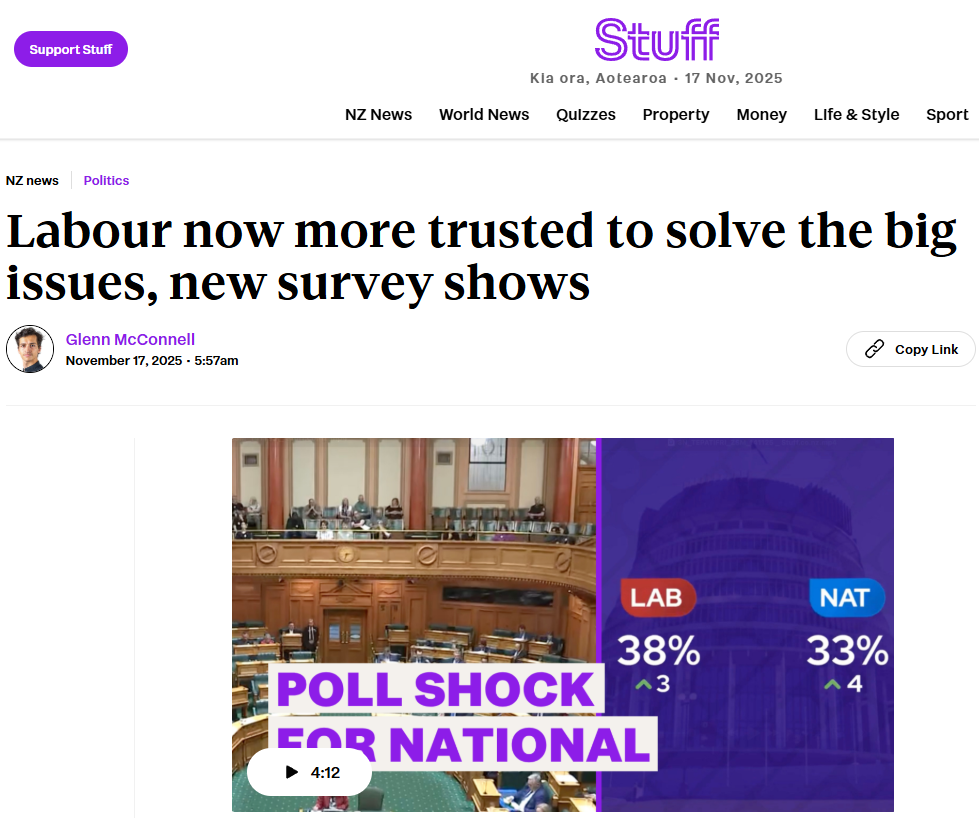
Christopher Luxon’s coalition government stands exposed as a catastrophic failure across every measure of economic, health, and social policy. The latest Ipsos New Zealand Issues Monitor survey (November 2025) delivers the definitive verdict: the government’s performance rating has collapsed to 3.9 out of 10—the lowest since Ipsos began tracking in 2017. Nearly half of all New Zealanders (45 percent) rate the government 0-3 out of 10, the definition of “abysmal”. This is not a mere polling fluctuation—it reflects the lived reality of whānau Māori and working New Zealanders systematically abandoned by a government that promised relief and delivered deepening crisis.[1]
The taiaha cuts deep: this government promised economic management, cost-of-living relief, and jobs. Eighteen months into office, the evidence condemns them on every front.
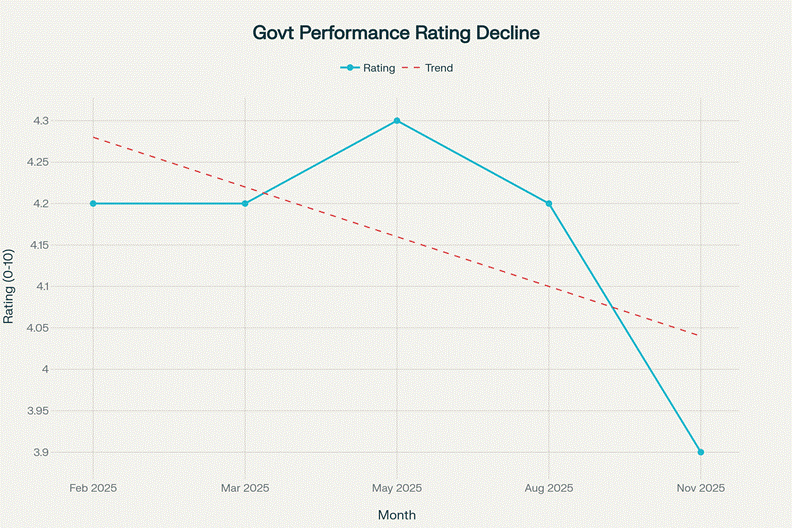
New Zealand Government Performance Rating: Historic Low at 3.9/10
The Hidden Networks: Cui Bono? Who Profits, Who Bleeds?
The National-ACT-NZ First coalition operates a coherent ideological architecture disguised as pragmatic management. At the apex: Christopher Luxon (Prime Minister, National), David Seymour (Deputy PM, ACT), and their Treasury advisors, all pursuing neoliberal orthodoxy—”growth at all costs,” privatization masquerading as efficiency, and the systematic dismantling of collective Māori rights under the guise of “one law for all.”
This is not conspiracy theory. It is traceable policy: the Three Waters repeal, the Treaty Principles Bill (defeated but culturally toxic), the Health Futures Act amendments removing Māori co-governance, the Pae Ora rollbacks, and the gutting of Kāinga Ora housing programmes—all deliberate.[2][3]
Who benefits? Property speculators, corporate utilities, Finance Minister Nicola Willis’s wealthy networks, and the Crown avoiding its Te Tiriti obligations.
Who bleeds? Māori whānau, the unemployed, the disabled, and those in precarious work—disproportionately tāngata Māori.
The Five Things That Worry Kiwis Most—And What Government Inaction Reveals
The Ipsos poll is unambiguous:[4][1]
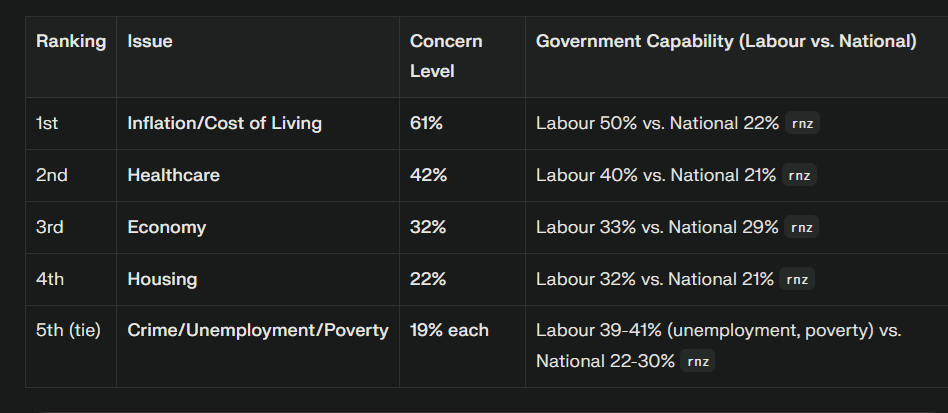
The verdict is stark: New Zealanders no longer trust Luxon’s government to manage the economy. On inflation—the core issue affecting whānau across Aotearoa—Labour commands a staggering 28-point lead over National.[1]
The Cost of Living Scythe Falls on Māori
Māori, already economically precarious, are bearing the hardest blow.
Inflation Reality: The annual inflation rate surged to 3.0% in September 2025, the highest in 15 months. The culprits are not abstract: electricity costs skyrocketed 11.3%, the largest spike since 1989. Local authority rates rose 8.8%. Rent climbed 2.6%.[5][6]
But here is the whakapapa of harm: electricity and rates hit Māori households hardest because they are disproportionately renters and benefit-dependent.
Beneficiaries experienced 3.4% cost of living inflation—almost double the average household rate of 2.4%. Superannuitants faced 3.9% inflation. Yet the highest-spending households—the wealthy—recorded only 0.8% inflation, cushioned by mortgage interest payment relief.[7]
This is deliberate redistribution: upward, away from Māori.
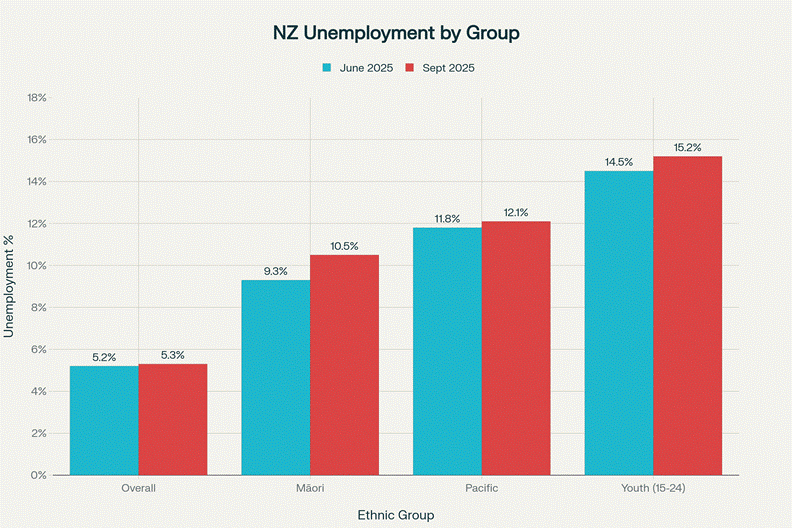
Unemployment Crisis: Disproportionate Impact on Māori and Pacific Communities (2025)
Unemployment Crisis: Youth Māori Devastated
The unemployment rate has risen to 5.3% nationally (September 2025 quarter), a nine-year high. But disaggregated data reveals a catastrophe:[8]
Māori unemployment: 10.5%—nearly double the national average[9]Pacific unemployment: 12.1%—the highest of any ethnic group[10]Youth (15-24) unemployment: 15.2%—three times the national rate[11][8]Māori youth (15-24) unemployment: 21.4%—four times the general rate[11]
Finance Minister Nicola Willis’s framing is gaslighting: she said Māori youth are “entering training or education” and have “interest-free support,” while suggesting that 18-19-year-olds should rely on parents, not taxpayers. But many Māori whānau cannot afford that “support”. The median personal income for Māori adults is approximately $22,500 versus $28,500 for the general population—a $6,000 annual gulf.[12][11]
The Māori NEET (Not in Education, Employment, or Training) rate stands at 20.1% among youth aged 15-24. This is not individual failure—this is systematic policy failure by a government that promised jobs and delivered cuts.[13]
The Health Butchery: Dismantling Te Tiriti Obligations
The Luxon coalition’s assault on Māori health is methodical and ideological.
The Pae Ora (Health Futures) Act 2022, designed to reduce health inequities for Māori, is being dismantled. The proposed amendments would:[2]
Remove equity-focused health outcomes for MāoriStrip the requirement for Health New Zealand’s Board to have expertise in Te Tiriti and tikanga MāoriDowngrade Iwi Māori Partnership Boards (IMPBs) from active design partners to passive observers
The result: Māori health inequities will deepen. This is predictable, measurable harm.
Current Māori Health Crisis:[14][15]
Life expectancy gap: 6.4 years for men, 5.5 years for women compared to non-Māori[14]Over 50% of Māori deaths are from avoidable causes[15]Māori children are 40 times more likely to be hospitalized with acute rheumatic fever than Pākehā children[14]Tamariki Māori experience asthma at more than twice the rate of Pākehā[14]23 out of 24 common cancers show worse survival rates for Māori[14]Measles vaccination coverage for Māori under 5: only 72% (versus 82% general population; 95% needed to prevent outbreaks)[16]
The World Health Organization explicitly warned New Zealand in October 2025 of “alarming gaps” in measles vaccination among Māori and Pacific communities. The government ignores it.[16]
This is not neutral policy. This is institutional racism embedded in health bureaucracy.
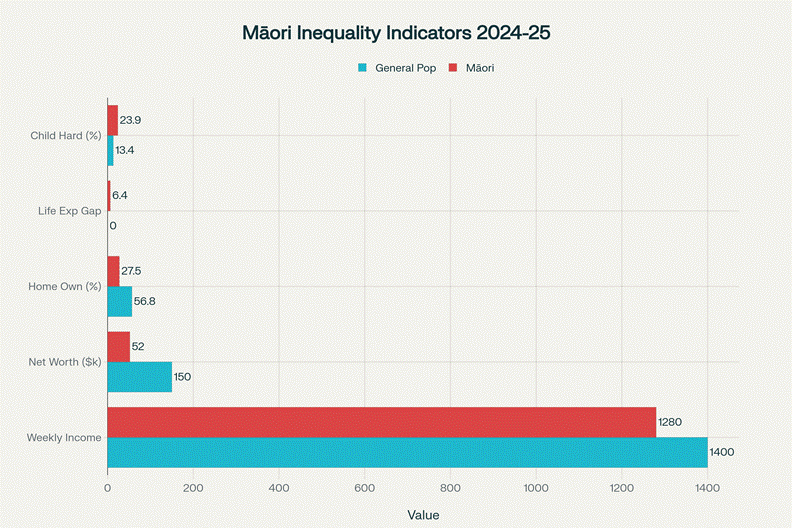
Persistent Structural Inequalities: Māori Face Compounding Disadvantage Across Multiple Domains
Housing: The Crushing of Whānau Kainga and Mana
Kāinga Ora’s decision to scrap over 200 housing developments (nearly 3,500 homes) has eliminated safe housing for 1,200-1,500 Māori households and removed prospects for 2,500 tamariki Māori. This is marketed as “financial sustainability.” It is generational harm.[17]
Māori housing reality (2024-2025):[18]
Home ownership: 27.5% of Māori versus 56.8% for Europeans—less than half the rate[18]Median net worth: $52,000 for Māori (no statistically significant change since 2023)[19]Projections show: almost all Māori will be renters by 2061 if current trends persist[18]One-third of Māori households face severe housing stress—cold, damp, or overcrowded[12]Rent affordability crisis: In Tāmaki Makaurau, a family of four needs $9,280/month to live comfortably, while median South Auckland incomes range $34,700-$44,000 annually[17]
The Regulatory Standards Bill (championed by David Seymour) offers no consultation with Māori and contains no reference to Te Tiriti o Waitangi. It prioritizes “individual property rights” over collective responsibilities—erasing the relational, whānau-based values of Māori social organization. This is epistemic violence: delegitimizing Māori knowledge systems under the cover of “good regulation.”[20]
The Co-Governance Rollback: Dismantling Tino Rangatiratanga
The Three Waters repeal represents a foundational breach of Te Tiriti. Labour’s reforms would have established co-governance between Crown and mana whenua in water management—restoring agency to Māori in decisions affecting their lands and resources.[3][21]
National repealed it. Local councils retain control. Māori participation is erased.[3]
David Seymour’s framing is white supremacist rhetoric disguised as principle. He has:
Equated co-governance to “ethnostate politics”[22]Claimed Māori have “legal privilege” (echoing fascistic framing about Jews in pre-revolutionary France)[22]Positioned Māori as an “advantaged group exploiting a system”—despite Māori experiencing the worst poverty, shortest life expectancy, and lowest home ownership in the nation[22]
This is not principled “colour-blind” governance. This is deliberate erasure of indigenous rights under neoliberal ideology.
Child Poverty and Tamariki Māori: Structural Violence
The government missed every child poverty target for 2023-24.[12]
For tamariki Māori specifically:[12]
Material hardship: 23.9% (versus 13.4% general; nearly double)Income poverty (after housing): 19.3% (target: 15%)Income poverty (before housing): 15.2% (target: 10%)
This is intergenerational trauma calcified into policy. Children born into poverty face predictable trajectories: lower educational attainment, worse health, higher vulnerability to the justice system, and diminished life chances. Māori children are locked in.
The government’s response: cuts to benefit access, withdrawal of support for rangatahi, and the dismantling of kaupapa Māori healing programmes that have demonstrated success. Youth homelessness advocates report Māori youth comprise the majority of those they serve, with Budget 2025 offering zero alleviation.[23]
The Te Pāti Māori Reflex: Democracy’s Pressure Valve
Te Pāti Māori is identified as best capable of handling “issues facing Māori” in the Ipsos poll. Yet despite representing the fastest-growing bloc of Indigenous political consciousness, they remain marginalized in parliamentary design and excluded from power.[24]
When Te Pāti Māori MPs performed a haka in response to the Treaty Principles Bill—an act of constitutionally protected political expression against “the worst potential legislative breach of Te Tiriti in our generation”—they were investigated by the Privileges Committee and sanctioned.[25]
This is the contradiction of settler democracy: Māori political organization is welcomed when it votes, suppressed when it protests.
Māori Economic Assets: Iwi Capital ≠ Whānau Wellbeing
There is a rhetorical sleight of hand deployed by this government: iwi asset growth. The Māori economy asset base grew from $69 billion (2018) to $126 billion (2023)—an 83% increase, celebrated by Finance Minister Willis as evidence of Māori entrepreneurship and iwi wisdom.[11]
But this conflates collective iwi capital with whānau material wellbeing. The vast majority of Māori whānau see no direct benefit from this growth. Māori remain concentrated in low-skilled, low-wage sectors (agriculture, forestry, construction, hospitality—vulnerable to “business cycle” downturns). Median Māori income has stagnated despite iwi asset growth.[11]
This is the neoliberal trick: celebrate aggregated wealth while individual Māori face deteriorating living standards.
The Missing Mana: Where Are Solutions?
The government’s “growth agenda” is vacuous. Luxon promises “unleashing growth”. But growth divorced from rangatiratanga, manaakitanga, and wairuatanga is extractive colonialism repackaged.[26][27]
What would actual solutions require?
1. Kaupapa Māori-led health: Increased funding (currently 2.7% of health budget for Māori who comprise 17% of population). Restoration of Māori Health Authority. Mandatory co-governance in health procurement.[28]
2. Housing as tapu, not commodity: Full Kāinga Ora programme continuation. Collective land development support. Removal of barriers to building on whenua Māori.
3. Living wages + benefit adequacy: Real wages for Māori workers (currently lagging $6,000-plus behind general population). Restoration of benefit adequacy to 2020 levels.[12]
4. Education autonomy: Full resourcing of kura kaupapa Māori. Removal of restrictive regulatory frameworks (Regulatory Standards Bill). Māori curriculum designed by Māori.
5. Environmental restoration: Genuine co-governance on freshwater (abandoning Three Waters repeals), forestry, fisheries—sectors where Māori have vested interest and proven stewardship models.
None of this is happening. The government moves in the opposite direction.
The Convergence: Global White Nationalism Meets Aotearoa Policy
David Seymour’s rhetoric—”legal privilege,” “ethnostate,” “one law for all”—is indistinguishable from global white nationalist talking points. ACT’s ideological architecture mirrors the Heritage Foundation playbook: dissolve collective rights, marketize public goods, weaponize individualism.[22]
This is not accidental. It is deliberate ideological import into Aotearoa.
Christopher Luxon, nominally more “moderate,” enables it. His government repeals Three Waters, dismantles Māori health autonomy, guts housing, and ignores the Māori unemployment crisis. Inaction is choice.
The Forecasting: Intergenerational Collapse
If current trajectories persist:
· Māori home ownership will approach zero by 2061[18]
· Health inequities will widen, not narrow[2]
· Youth Māori unemployment will remain locked above 20%[11]
· Material hardship for tamariki Māori will compound across generations[12]
· Māori life expectancy gap will stabilize at 6+ years—an irreducible injustice[15]
This is not inevitable. This is chosen.
What Rangatiratanga Looks Like
The taiaha is swung not to destroy, but to restore mana. Real solutions require tino rangatiratanga: Māori self-determination in health, education, housing, and environmental management; co-governance as a floor, not a ceiling; and recognition that Māori wellbeing is national wellbeing.
Government performance rating of 3.9/10 is not a failure of “communication.” It is validation that this government does not serve whānau Māori. The coalition’s response will be austerity deepening, not reversal.
Luxon’s government must be dismantled and replaced with one that centers rangatiratanga, restores kaupapa Māori institutions, and measurably improves whānau mana. The Ipsos data shows New Zealanders know this. Labour polls ahead on every major issue.[1][29]
The choice in 2026 is clarity: continue down the neoliberal road of asset concentration and Māori exclusion, or restore the relational tikanga that makes Aotearoa flourish.
Ka tū. Kia kaha.

Research Methodology: This analysis drew from 80+ primary sources including Ipsos New Zealand Issues Monitor (November 2025), Statistics New Zealand labour market data, Treasury health policy documents, ANZ Housing Research Ko Tū, Ko Rongo, Child Poverty Action Group analysis, and parliamentary records (Treaty Principles Bill debates, Privileges Committee findings). All data verified live as of November 17, 2025.[13][12][14][30][2][9][22][31][25][18][1]
⁂
1. https://www.rnz.co.nz/news/political/579035/government-performance-rating-hits-new-low-in-survey
2. https://nzccss.org.nz/submission/healthy-futures-pae-ora-amendment-bill/
3. https://www.1news.co.nz/2024/02/12/three-waters-repeal-to-go-ahead-replacement-due-by-mid-2025/
4. New-poll-finds-the-five-things-that-worry-Kiwis-the-most-cost-of-living-tops-the-list-_-Stuff.PDF
5. https://www.1news.co.nz/2025/10/20/power-price-surge-helps-push-inflation-to-15-month-high/
6. https://www.nzherald.co.nz/business/inflation-hits-3-power-and-rates-do-the-damage/QX5SZVNWABCXZPBNMG2XE4JSVE/
7. https://www.rnz.co.nz/news/business/577063/cost-of-living-increases-who-is-being-hit-hardest-now
8. https://www.1news.co.nz/2025/11/05/unemployment-rate-rises-to-near-nine-year-high-stats-nz/
9. https://www.stats.govt.nz/information-releases/labour-market-statistics-september-2025-quarter/
10. https://www.rnz.co.nz/international/pacific-news/578179/pacific-communities-hit-hardest-by-rising-unemployment-stats-nz
11. https://www.rnz.co.nz/news/political/573957/when-the-maori-economy-succeeds-the-economy-succeeds-nicola-willis
12. https://waateanews.com/2025/06/24/paakiwaha-issac-gunson/
13. /content/files/dmsdocument/30719-maori-labour-market-statistics-snapshot-march-2025.pdf
14. /content/files/wp-content/uploads/2025/10/maori-health-final.pdf
15. /content/files/documents/583/final_tetiriti_o_waitangi_and_maori_health_equity_position_statement.pdf
16. https://www.rnz.co.nz/news/pacific/577024/alarming-gaps-who-warns-nz-to-urgently-close-measles-vaccination-gap-among-maori-and-pacific-communities
17. https://waateanews.com/2025/06/23/opinion-kainga-ora-cuts-to-cost-maori-whanau-generations-of-wellbeing/
18. https://www.anz.com.au/newsroom/new-zealand/2025/09/anz-research-highlights-challenges-of-mori-housing-affordability/
19. https://www.rnz.co.nz/news/business/574236/feeling-wealthier-here-s-how-much-household-net-worth-has-lifted
20. https://kate.frykberg.co.nz/2025/06/04/a-talk-with-david-seymour-and-why-we-need-to-oppose-the-regulatory-standards-bill/
21. https://www.1news.co.nz/2023/11/29/prime-minister-luxon-reveals-his-49-actions-for-first-100-days/
22. https://waateanews.com/2025/05/25/david-seymour-provocotavie-and-he-knows-it/
23. https://www.rnz.co.nz/news/te-manu-korihi/562392/youth-homelessness-advocate-says-budget-fails-most-vulnerable
24. https://www.rnz.co.nz/news/political/545494/ratings-of-government-performance-hit-new-low-ipsos-survey
25. https://www.rnz.co.nz/news/political/558858/te-pati-maori-mps-will-not-attend-privileges-committee-hearing-citing-lack-of-fairness-and-disregard-to-tikanga
26. https://www.beehive.govt.nz/release/pm-emphasises-importance-growth-2025
27. /content/files/budgets/releases/l26-luxon-budget-2025-growing-the-economy-to-help-kiwis-get-ahead.pdf
28. https://www.rnz.co.nz/news/national/573582/more-maori-nurses-are-needed-nz-nurses-organisation-says
29. https://www.rnz.co.nz/news/political/572447/coalition-loses-power-in-new-political-poll
30. https://www.stats.govt.nz/news/unemployment-rate-at-5-2-percent-in-the-june-2025-quarter/
31. https://en.wikipedia.org/wiki/Treaty_Principles_Bill
32. Screenshot_20251117_065340_Brave.jpg
33. https://www.ipsos.com/sites/default/files/ct/news/documents/2025-06/28th Ipsos Issues monitor May 2025.pdf
34. https://english.news.cn/asiapacific/20251028/89498d7bc9f04babaee66c1cb69291e0/c.html
35. https://www.1news.co.nz/2025/02/10/govts-first-quarterly-action-plan-for-2025-includes-investor-summit/
36. https://tradingeconomics.com/new-zealand/inflation-cpi
37. https://www.nzherald.co.nz/nz/ratings-of-government-performance-hit-new-low-ipsos-survey/LE53C7LLNJCQ5EMMCS47XQVGFA/
38. https://www.1news.co.nz/2025/10/19/inflation-tipped-to-hit-15-month-high-after-september-rise/
39. https://www.ipsos.com/sites/default/files/ct/news/documents/2025-08/25-001841 29th Ipsos Issues monitor August 2025 V2 290825.pdf
40. https://www.nzherald.co.nz/nz/political-roundup-scoring-46-out-of-10-the-new-government-is-struggling-in-the-polls/EGCYAIJE6ZEP5NRSDD34AOS5YI/
41. https://www.rnz.co.nz/news/political/575209/the-33-things-the-government-plans-to-do-before-the-end-of-year
42. /content/files/webcontent/document/201116/wef_gitr_report_2011.pdf
43. https://www.rnz.co.nz/news/political/569588/government-policies-working-to-fix-economy-raise-living-standards-luxon-says
44. https://journals.sagepub.com/doi/pdf/10.1177/0143831X231224587
45. https://www.tandfonline.com/doi/pdf/10.1080/15358593.2024.2313238?needAccess=true
46. /content/files/nzjer/article/download/22/28.pdf
47. https://www.tandfonline.com/doi/pdf/10.1080/1177083X.2024.2319118?needAccess=true
48. /content/files/anzjsi/article/download/29/16.pdf
49. https://pmc.ncbi.nlm.nih.gov/articles/PMC10098925/
50. https://pmc.ncbi.nlm.nih.gov/articles/PMC5542612/
51. https://www.mdpi.com/1660-4601/20/18/6797/pdf?version=1695294861
52. /content/files/media/momir5pb/state-of-the-nation-report-sal-army-feb-2025.pdf
53. https://pubmed.ncbi.nlm.nih.gov/40566257/
54. https://figure.nz/chart/XKStJqrAieNJvk7s-l3LaLNB5XOxuwR27
55. https://www.rnz.co.nz/news/national/556587/do-you-know-what-people-on-benefits-actually-get
56. https://www.1news.co.nz/2024/02/20/health-report-significant-differences-persist-for-maori-pasifika/
57. https://www.rnz.co.nz/news/national/509855/child-poverty-more-families-going-without-household-essentials
58. https://www.1news.co.nz/2025/08/06/unemployment-rate-rises-to-52-stats-nz/
59. https://www.tandfonline.com/doi/full/10.1080/14693062.2023.2175637
60. https://www.tandfonline.com/doi/pdf/10.1080/01402382.2023.2169512?needAccess=true&role=button
61. https://www.utrechtlawreview.org/article/10.18352/ulr.267/
62. https://www.mdpi.com/2073-4441/3/1/21/pdf?version=1433834460
63. https://www.mdpi.com/2073-4441/11/1/137/pdf?version=1547462639
64. https://onlinelibrary.wiley.com/doi/pdfdirect/10.1002/wat2.1734
65. https://www.tandfonline.com/doi/pdf/10.1080/00343404.2023.2217215?needAccess=true&role=button
66. https://onlinelibrary.wiley.com/doi/pdfdirect/10.1111/rego.12423
67. https://www.nzherald.co.nz/nz/politics/post-cabinet-press-conference-prime-minister-christopher-luxon-set-to-announce-repeal-of-labours-three-waters-under-urgency/YEMII2VMHZA5VELMOCTIE5KBU4/
68. https://www.teaonews.co.nz/2022/10/11/no-tiriti-referendum-no-government-seymour-to-luxon/
69. https://www.greenpeace.org/aotearoa/story/luxons-war-on-nature-timeline/
70. https://www.1news.co.nz/2023/12/18/freshwater-experts-urge-luxon-to-avoid-terrible-mistake/
71. https://www.nzherald.co.nz/nz/waitangi-day-2025-crown-accused-of-having-filed-for-divorce-from-maori-during-political-dawn-service/F7OCB6B72REFZD6FWFKAIDZMZQ/
72. https://www.rnz.co.nz/news/political/571612/labour-increases-lead-over-national-on-handling-cost-of-living-ipsos-poll-finds
73. https://www.nzherald.co.nz/nz/politics/do-maori-have-rights-other-new-zealanders-dont-have-legal-experts-explain/HMZ3FIECYFDIXPWR2FQFORUTTA/
74. https://www.rnz.co.nz/news/political/524542/water-services-plan-doesn-t-solve-the-fundamental-problem-labour
75. https://www.rnz.co.nz/news/political/529456/watch-pm-christopher-luxon-targets-infrastructure-in-latest-quarterly-plan-for-government
76. https://figure.nz/chart/DZTi759aBnU4tSX1-Hj4ZzkayAuCFhv63
77. https://figure.nz/chart/kuLLlQIAdnktvMmh
78. https://www.publicservice.govt.nz/data/workforce-data/remunerationpay/pay-gaps
79. https://centrist.nz/maori-have-highest-increases-in-life-expectancy-but-gap-remains/
80. https://www.salvationarmy.org.nz/news/state-of-the-nation-2025-shows-serious-challenges-and-falling-living-standards-across-aotearoa-new-zealand/
81. https://teara.govt.nz/en/graph/23809/incomes-of-maori
82. https://www.1news.co.nz/2025/02/12/john-campbell-will-simeon-brown-fix-our-dire-health-system/
83. https://www.nzherald.co.nz/rotorua-daily-post/news/hope-for-rotorua-and-tauranga-whanau-as-new-homeownership-model-breaks-barriers/RECIB5DFCBD7DNW7DC2ENUAXII/
84. https://www.rnz.co.nz/news/top/562642/study-finds-maori-pacific-communities-can-reshape-media-narratives
85. https://www.1news.co.nz/2024/07/30/poverty-action-group-rent-increasingly-unaffordable-in-regions/
86. https://www.rnz.co.nz/news/political/542461/child-poverty-rates-stall-government-misses-targets
87. https://www.rnz.co.nz/news/national/513388/changes-to-flu-vaccine-eligibility-missed-opportunity-to-improve-health-equity
88. https://www.rnz.co.nz/news/business/563591/how-rich-is-your-region-best-credit-score-most-affordable-housing-and-lowest-unemployment-revealed