"The Comfortable Racism of Mike Hosking: How New Zealand's State Broadcaster Champions Bigotry" - 4 November 2025
From cyclone funding denial to Māori Party slurs—Hosking's decade-long campaign to erase indigenous rights, protected by 'opinion' and bankrolled by corporate sponsors
Mōrena whānau,
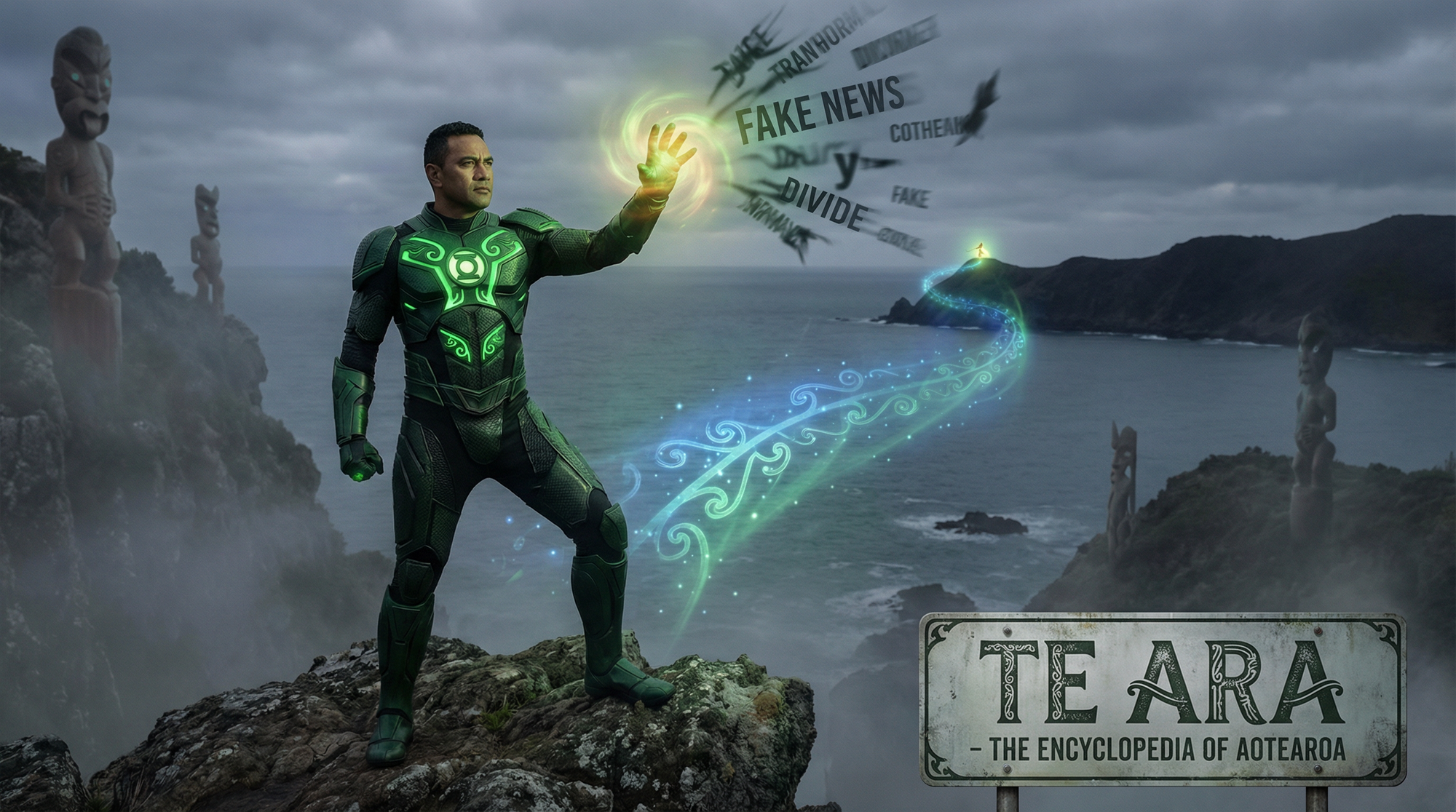
I hope you are well this morning as the beautiful Sun rises today. A valued follower sent me this go Māori Green Lantern on. I am personally disgusted by Hoskings and his rants. Let us destroy this racist ass for everyone to see shall we? Yes, let’s do that!
The Smoking Gun: A Broadcaster’s Mask Slips
Mike Hosking’s 3 November 2025 tirade against the Waitangi Tribunal reveals precisely what happens when neoliberal ideology collides with Indigenous sovereignty. Broadcasting from his Newstalk ZB pulpit to hundreds of thousands of listeners, Hosking didn’t just question a Tribunal finding—he weaponised constitutional ignorance to delegitimise Māori rights while cloaking white supremacist talking points in the language of legal concern. His central thesis: the Tribunal has “no actual legal power” and “seems merely to make things up”. This wasn’t commentary. It was coordinated delegitimisation of one of the few institutional mechanisms protecting Te Tiriti o Waitangi.[1][2]
The Tribunal’s actual finding? That the Citizenship Act 1977 breaches Te Tiriti by refusing to recognise whakapapa as a legitimate basis for citizenship, forcing Māori like John Ruddock (Ngāpuhi) and actress Keisha Castle-Hughes to watch their tamariki denied connection to their tūrangawaewae simply because they were born overseas. The Act privileges location of birth over genealogical connection—a fundamentally colonial framework that treats Māori as immigrants in their own ancestral homeland.[2][3][4][5]
Hosking’s response? Mockery. “Why not make it four [generations]? Why not make it really easy and anyone who remotely feels Maori can claim citizenship for any number of offspring no matter where they were born, as long as it feels right?”. This rhetorical slippage from “Māori” to “feels Maori” performs critical racist work—it suggests Māori identity is performative emotion rather than lived genealogical reality, erasing the significance of whakapapa while painting indigenous claims as unreasonable emotional demands.[1]
Historical Whakapapa: The Colonial Architecture of Citizenship
The 1977 Citizenship Act didn’t emerge from a vacuum. It crystallised a settler-colonial logic that has always viewed Māori as problematic to state formation. When Parliament restricted citizenship by descent to one generation, it embedded a geographic determinism that advantages settler mobility while punishing indigenous diaspora.[6][7]
Consider the quantified harm: 170,000 Māori now live in Australia—20% of the global Māori population—an increase of 36,857% since the 1960s. This diaspora stems from systemic economic marginalisation within Aotearoa: Māori flooded to Australia seeking opportunities denied at home. Now their tamariki and mokopuna born offshore face a cruel irony—descendants of people pushed out by colonial economic structures are denied legal recognition of their indigeneity because they left.[2][3][8][9][10][11][12]
The Tribunal found this breaches multiple Te Tiriti principles. By empowering government officials to determine the “legitimacy” of someone’s whakapapa during citizenship applications, the Crown violates rangatiratanga—the guaranteed authority of Māori over their own people and tikanga. By prioritising birthplace over genealogy, it breaches good government and active protection. And by failing to even mention Te Tiriti or tangata whenua status in the Act, it violates partnership obligations.[4][5][13][14][15]
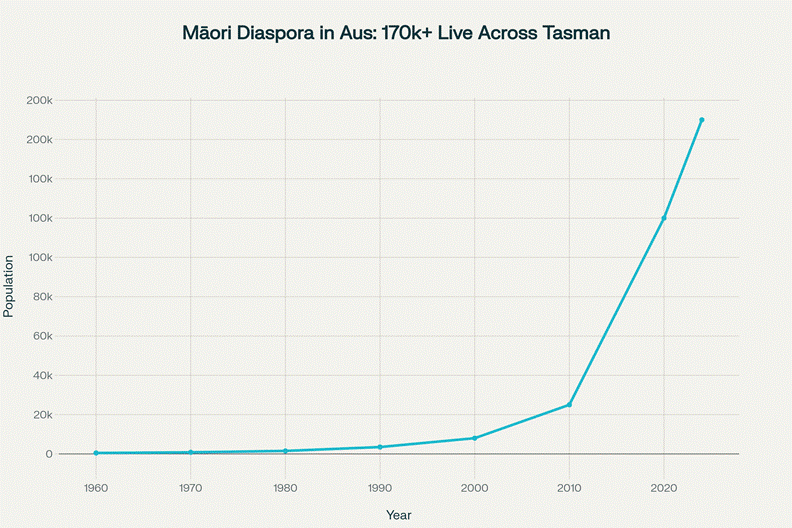
The Māori diaspora in Australia has grown from just 460 people in the 1960s to over 170,000 today - representing one in five Māori globally. The Citizenship Act 1977’s one-generation descent limit means many of their children cannot claim citizenship to their tūrangawaewae.
Judge Alana Thomas articulated the colonial violence precisely: “The wording of the legislation is void of any recognition of Māori as tangata whenua, and of any recognition of te Tiriti as our founding document. We have seen that this silence has become problematic for Māori who seek citizenship and permanent residency within their tūrangawaewae”.[3][5][13]
Deconstruct the Target: Hosking’s Rhetorical Arsenal
Hosking’s commentary deploys six interconnected fallacies and dog-whistles:
1. Strict Originalism Fallacy: “Which clause of the Treaty is the Waitangi Tribunal using when they suggest the Government recognise second generation Maori for citizenship?”. This assumes Te Tiriti operates as static 19th-century text rather than living constitutional partnership requiring interpretation as circumstances evolve. It’s the same logic David Seymour uses to attack Treaty principles—demanding 1840 text constrain 2025 rights.[1][16][17][18][19][20]
2. False Equivalence: By comparing Māori citizenship claims to “anyone who remotely feels Maori”, Hosking equates whakapapa (documented genealogical connection verified through iwi and hapū) with subjective feeling. This is reverse racism rhetoric—framing Māori-specific rights as “special treatment” while erasing the colonial dispossession that necessitates them.[21][22][23][1]
3. Slippery Slope: “Why not four [generations]? Why not make it really easy?”. This catastrophises Māori rights expansions as inevitably leading to absurd outcomes, a standard conservative tactic to delegitimise incremental justice.[24][25][1]
4. Appeal to Middle New Zealand: Hosking repeatedly invokes “middle New Zealand” to weaponise majoritarian opinion against Māori rights. In 2016, he claimed opposing Māori council representation was “completely in touch with middle New Zealand”—a statement that triggered 23,000 petition signatures demanding his removal and formal complaints to the Broadcasting Standards Authority.[26][27][28][29][30]
5. Judicial Activism Dog-Whistle: “The court simply didn’t like [the 2011 foreshore law] so they suggested change”. This frames courts upholding Te Tiriti as illegitimate overreach—the same rhetoric used globally to delegitimise judicial protection of minority rights.[31][32][33][1]
6. Tribal Authority Denial: Hosking questions “since when do [the Tribunal] speak for a whole race of people?”. This denies the legitimacy of Māori institutional structures—rangatira, iwi, the Tribunal itself—suggesting individual Māori opinion should override collective indigenous authority. It’s atomising neoliberal logic applied to sovereignty.[32]
Network Revelations: The Atlas Behind the Curtain
Hosking doesn’t operate in isolation. He’s embedded in overlapping networks that coordinate neoliberal attacks on Te Tiriti:
Network 1: NZME Corporate Infrastructure
Hosking is NZME’s highest-paid employee, earning between NZ$1.02-1.03 million annually—more than the CEO. NZME owns the NZ Herald, Newstalk ZB, and BusinessDesk, giving Hosking unparalleled platform reach. In 2024, NZME reported revenue of $345.9 million despite a $16 million net loss (following a $24 million asset writedown). By September 2025, the company upgraded forecasts to $59-62 million operating EBITDA, citing “better than expected revenue performance”.[34][35][36][37][38][39][40][41][42][43]
This matters because Canadian billionaire James Grenon—previously linked to right-wing “alternative news” site The Centrist—acquired 9.97% of NZME in March 2025 and immediately launched a board coup, claiming 37% shareholder backing. Union negotiator Michael Wood warned: “We clearly have an individual that is highly motivated to take control of a major media entity in New Zealand and who is doing so, quite clearly, with the intent of promulgating a particular political perspective”. That perspective? Free-market libertarianism channeled through Atlas Network-aligned institutions.[44][45][38][46][34]
Network 2: Atlas Network Think Tanks
The New Zealand Initiative—which Hosking frequently platforms—is an official Atlas Network partner promoting “individual liberty, property rights, limited government, and free markets”. Atlas coordinates 550 think tanks across 100+ countries to advance libertarian ideology by “influencing the development of public policy” and “shifting the climate of opinion”.[47][48][49][50][51][52][53][54]
Atlas partner organisations in Aotearoa include the Initiative and the Taxpayers’ Union, both of which attacked the Treaty Principles Bill debate from the right while demanding reduced “government obstacles to upward mobility”. ACT leader David Seymour literally worked for Atlas-affiliated Canadian think tanks before founding ACT. Atlas Network chair Debbi Gibbs’ father helped found ACT itself.[55][49][50][52][56]
This isn’t conspiracy theory. It’s documented transnational coordination: Atlas openly promotes think tanks as “the most effective, yet subtle, vehicles for influencing the development of public policy” by winning “the respect of journalists and government officials”. PSA research confirms Atlas advances “policies that go against our values...including public services cuts, denying climate change, slashing corporate regulations, eroding workers’ rights, privatisation, supporting landlords over tenants”.[50]
Network 3: Broadcasting Standards Authority Failures
Despite Hosking’s pattern of misinformation, the BSA has provided inadequate accountability. In 2017, it upheld a complaint that Hosking made “inaccurate and misleading” comments about Māori Party voting rights. In 2023, it again upheld a complaint for “materially inaccurate” statements claiming unions pay strikers full salaries. Yet in 2016, the BSA declined to uphold complaints about his comments dismissing racism against New Plymouth Mayor Andrew Judd, ruling his views fell within “freedom of expression”.[57][27][58][29][30][59][60][61][62]
This reveals structural bias: factual inaccuracy occasionally triggers censure, but ideological racism claiming to be “opinion” receives protection. The result? Hosking faces no meaningful consequences for delegitimising Māori institutions, dismissing racism, or spreading constitutional misinformation to his 20% national audience share.[29][62][63][64]
Tikanga Violations: How Neoliberalism Destroys Whanaungatanga
Every principle of Te Ao Māori stands violated by Hosking’s rhetoric and the citizenship regime he defends:
Whanaungatanga (kinship): The Citizenship Act severs legal recognition of whakapapa, telling Māori tamariki their genealogy doesn’t matter if they’re born in the “wrong” place.[2][3][8][65]
Rangatiratanga (self-determination): Crown officials—not iwi, not hapū—determine whose whakapapa is “legitimate” enough for citizenship. This usurps Māori authority over Māori identity.[5][18][66][13]
Kaitiakitanga (guardianship): By forcing diaspora Māori to prove connection through bureaucratic processes that deny tikanga Māori ways of knowing, the Crown fails its guardian duty to protect taonga—including Māori themselves as a collective.[18][66][67]
Manaakitanga (care): Where is care when Keisha Castle-Hughes testifies the system is “deeply, systemically racist”, forcing her to explain why her daughter isn’t “Māori enough”?[8]
Kotahitanga (unity): The Act fragments whānau across borders, creating citizenship castes within families where some siblings belong and others don’t.[3][2][5]
Aroha (compassion): There is no aroha in Hosking’s mockery of parents fighting for their tamariki’s legal recognition.[1]
Hidden Connections: The Coordinated Campaign
This isn’t isolated commentary. It’s coordinated ideological work:
Connection 1: Hosking platforms New Zealand Initiative reports attacking “MMP After 30 Years” and defending Treaty Principles Bill framings.[47][16][48][49][51]
Connection 2: ACT’s David Seymour—Atlas Network alumnus—launched a Treaty Principles Bill website (treaty.nz) with $270,000+ in public funding for submissions processing, while ACT emails supporters requesting donations to fund “mainstream media discussion”. Hosking provides that discussion, uncritically.[68][69][20]
Connection 3: NZME’s potential takeover by Grenon—linked to The Centrist, described as targeting “disaffected groups on the political fringes”—positions Hosking’s employer for further rightward shift.[45]
Connection 4: The same rhetorical moves Hosking uses against the Tribunal appear in Seymour’s attacks: questioning judicial/Tribunal legitimacy, demanding strict Treaty originalism, framing Māori rights as “divisive”.[16][20][32]
Connection 5: Hosking’s “middle New Zealand” invocations echo broader white grievance politics documented in Action Zealandia and Dominion Movement rhetoric claiming “European identity is under threat from demographic replacement”—the same ideological substrate that animated the Christchurch terrorist.[70][71][72][73]
The Implications: Quantified Harm and Threatened Rights
Statistical Harm to Māori:
- 170,000+ Māori in Australia denied legal connection to tūrangawaewae for their tamariki
Rights Under Threat:
The Tribunal recommended: (1) extending citizenship by descent to two generations for Māori; (2) co-designing citizenship law reform with Māori; (3) embedding Te Tiriti recognition in the Act; (4) creating whakapapa-based citizenship pathways. The Crown has refused to act. Christopher Luxon’s government is simultaneously:[2][3][4][8][65]
- Advancing Seymour’s Regulatory Standards Bill (”Treaty Principles 2.0”) to constrain Treaty obligations
Financial Flows:
Follow the money: Atlas Network funds libertarian think tanks globally to shift policy rightward. Those think tanks employ/platform figures like Seymour who craft anti-Treaty legislation. Media like NZME—facing potential Atlas-adjacent takeover—platform hosts like Hosking earning $1+ million annually to delegitimise Māori institutions. The result? Policy frameworks that privilege capital mobility (citizenship by investment) while restricting indigenous mobility (citizenship by whakapapa).[34][44][35][45][37][50][52][53][56]
Call to Action: Name Them. Expose Them. Organise Against Them.
Immediate Targets:
- Demand NZME accountability: Hosking’s constitutional misinformation breaches journalist ethics. Email complaints to: NZME, Broadcasting Standards Authority, Newstalk ZB advertisers threatening boycott.
- Support Wai 3513 implementation: The Tribunal found Crown breaches—demand Parliament amend the Citizenship Act immediately. Contact MPs: citizenship@parliament.govt.nz
- Block Grenon’s NZME takeover: Union and shareholder action must prevent Atlas-adjacent billionaire control of Aotearoa’s largest media company. Contact E tū union for coordination.
- Expose Atlas Network influence: Every time the Initiative or Taxpayers’ Union gets media coverage, demand disclosure of Atlas Network funding and ideology. Media must label them as “libertarian advocacy group with international funding”, not neutral “think tank”.
- Defend the Tribunal: When politicians or broadcasters attack Tribunal legitimacy, respond publicly naming it as coordinated delegitimisation of Te Tiriti protections.
Mike Hosking asked: “Where does the Treaty stop and the improvisation start?”. Here’s the answer he doesn’t want to hear: Te Tiriti is a living partnership requiring ongoing interpretation as new circumstances arise—exactly what the Tribunal does. When 20% of Māori live overseas due to economic conditions created by settler capitalism, and their tamariki are denied legal connection to tūrangawaewae, that’s not “improvisation”. That’s the Tribunal doing exactly what it was designed to do: holding the Crown accountable to honouring Te Tiriti.[1][17][18][19]
Hosking’s tirade wasn’t constitutional analysis. It was white grievance dressed in legal language, broadcast to hundreds of thousands, funded by corporate media profits, amplified by Atlas Network ideology, and designed to delegitimise one of the few institutional protections Māori retain against ongoing settler colonialism.
Ka whawhai tonu mātou. Ake! Ake! Ake!
Nā Ivor Jones (Te Arawa/Ngāti Pikiao)

The Māori Green Lantern Fighting Misinformation And Disinformation From The Far Right
If this mahi resonates and you have capacity to support further research exposing these networks, koha can be sent to HTDM: 03-1546-0415173-000. No pressure, only if you can.
Kia kaha, whānau.