“The Curriculum Con: How Neoliberal Vultures Are Strip-Mining Our Children’s Education” - 21 October 2025
A Brutal Exposé of Erica Stanford’s Scorched Earth Attack on Teachers and Mātauranga Māori
Kia ora e te whānau,
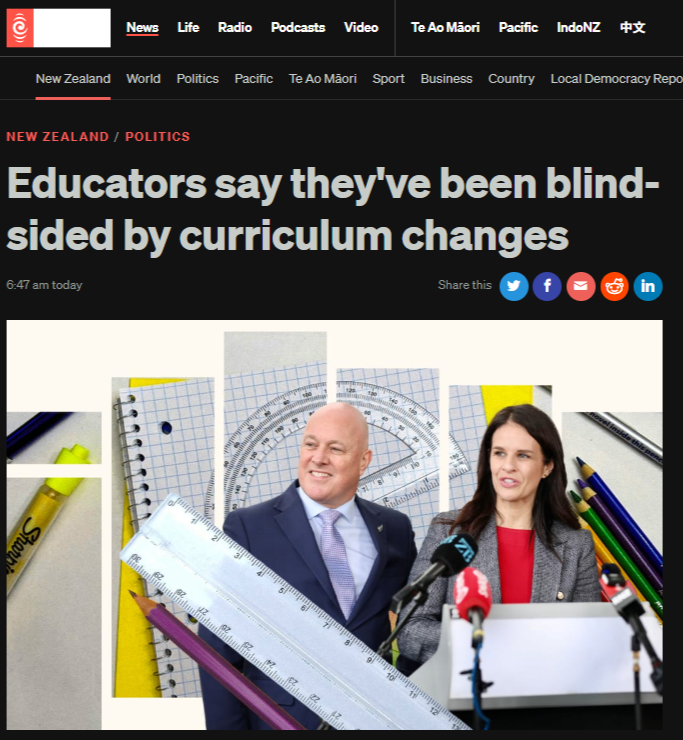
Straight Talk - Here’s What You Need to Know Right Now
Your child’s teachers are being set up to fail. Education Minister Erica Stanford and her coalition government are cramming five major curriculum changes down teachers’ throats in less than two years, giving them a pathetic four professional development days to figure it all out, while Singapore gives their teachers 100 hours of annual training. This isn’t education reform. This is a calculated demolition job designed to break the public education system so Stanford and her neoliberal mates can privatize the wreckage.
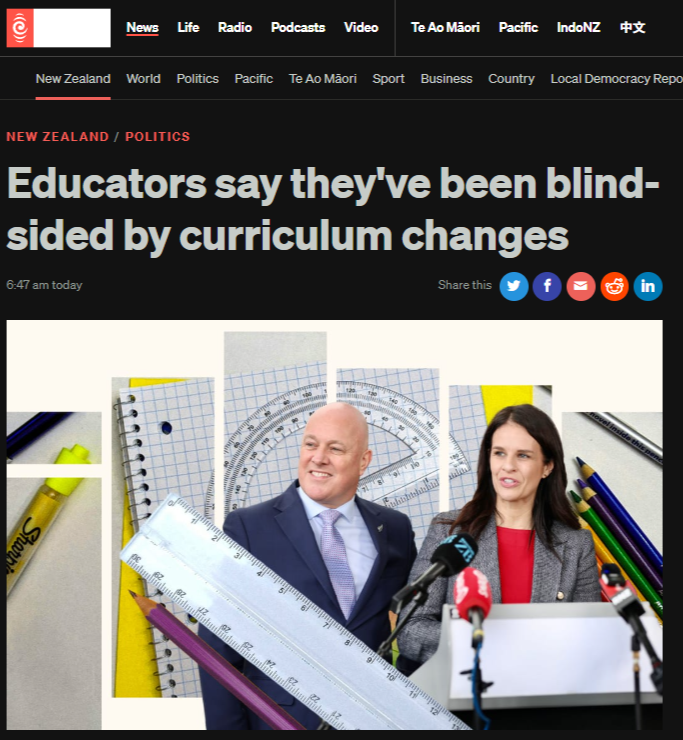
Professor Jodie Hunter from Massey University said many teachers would be “blind-sided by the extent of the changes.” Jordan Priestley, a relieving teacher, reported educators reaching out saying “they feel like resigning, they want to quit, they are so done” with the relentless workload the government keeps piling on. These aren’t just numbers on a page. These are our kaiako, our dedicated teachers, being pushed to breaking point by a minister who seems more interested in importing overseas consultants’ ideas than listening to the people who actually teach our tamariki every single day.
Background - The Neoliberal Trojan Horse
To understand how we got here, you need to know who’s really calling the shots. When Erica Stanford became Education Minister in November 2023, one of her first moves was appointing a ministerial advisory group in December 2023. Leading this group is Dr Michael Johnston, senior fellow of the New Zealand Initiative, a right-wing think tank funded by big business whose combined revenue represents a quarter of the New Zealand economy.
The NZ Initiative draws ideas and funding from the neoliberal Atlas Network, a global web of free-market fundamentalist organizations. Also on Stanford’s advisory group sits Elizabeth Rata, whose “extreme views” on Te Tiriti o Waitangi form the “intellectual bedrock” of ACT Party’s challenge to the Treaty. Another member, Melissa Derby, has publicly aligned with anti-trans rhetoric and frames systemic racism as individual responsibility issues.
This matters because curriculum change is always political. What gets taught to our children reflects who holds power. The Labour government’s curriculum refresh from 2017-2023 involved extensive stakeholder consultation over four years, including the New Zealand Council for Educational Research, university curriculum experts, and teachers from diverse cultural and socio-economic contexts. It was developing as representative of Aotearoa’s culture, history and communities.
Stanford and her advisory group have hijacked that process, replacing democratic consultation with ideological capture. The curriculum is now being shaped by people who openly oppose mātauranga Māori, dismiss Te Tiriti, and push free-market fundamentalism. This isn’t about “knowledge-rich” education. It’s about stripping indigenous knowledge from our classrooms and preparing the ground for privatization.
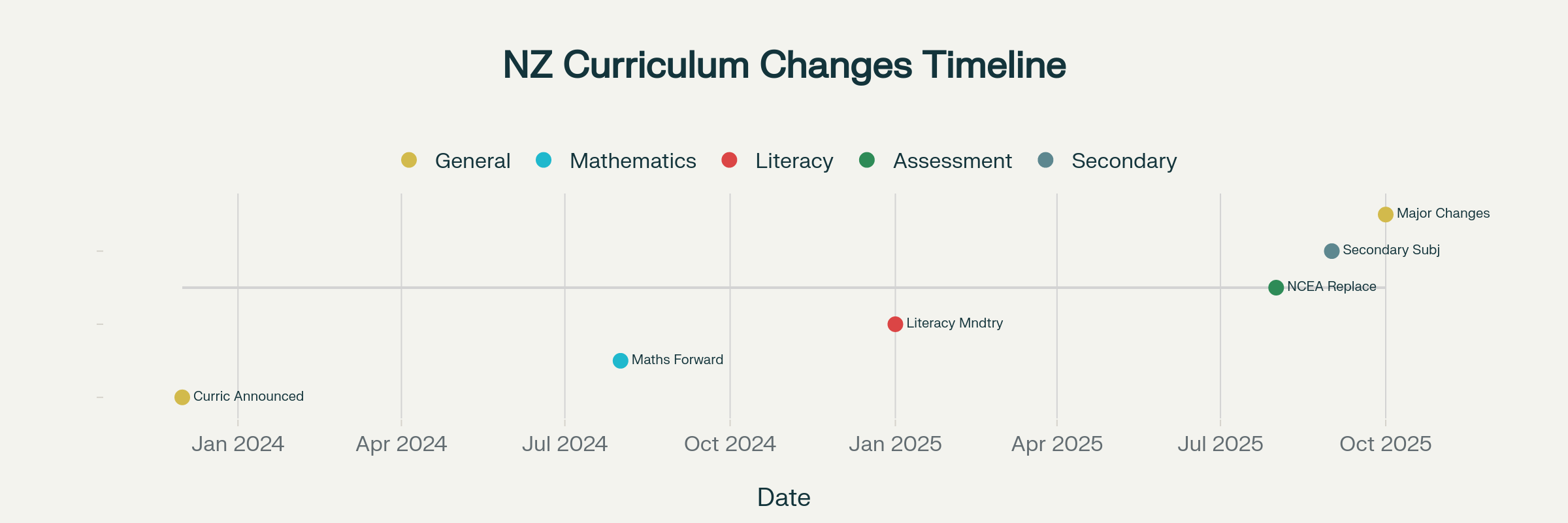
Timeline of rapid curriculum changes imposed by the Coalition Government (2023-2025)
The Issue - Teachers Blindsided, Students Betrayed
On October 20, 2025, the Ministry of Education dropped a bombshell. The curriculum changes they claimed were just the “finalized version” of updates from late 2024 were actually massive overhauls that fundamentally altered what teachers must teach.
Professor Jodie Hunter from Massey University explained the maths curriculum was already very busy and had now been “loaded up further” with “a lot of new content that has been added, and a lot of movement in terms of expectation.” Content previously taught in Years 9-10 has been shoved down to Years 7-8 or even Year 6. Algebra, traditionally introduced in Years 9-10 in Singapore and Australia, is now being moved to Years 7-8 in New Zealand.
But here’s the con - while Stanford claims to be following Singapore’s world-class model, she’s cherry-picking the bits that look good on paper while gutting the support structures that make Singapore’s system actually work. Singapore teachers receive 100 hours of professional development annually. They’re among the highest-paid in the world. They have clear career pathways including “master teacher” roles. Teachers work in the Ministry of Education on curriculum development then return to classrooms, ensuring policies reflect classroom realities.
Compare that to New Zealand. Teachers got four curriculum days to unpack the new curriculum when it was first introduced. Now those four days are useless because the curriculum has changed so much they have to start over. Stephanie Madden, convenor of the Principals’ Council on the New Zealand Educational Institute, said teachers would now “have to start that process all over again.” The entire process has been “flawed,” she said.
This matters desperately for Māori learners. While maths achievement in Māori-medium schools and kura kaupapa sits at only 25 percent meeting co-requisite standards for NCEA, Stanford’s response is to pile on more rushed changes rather than provide the sustained, culturally responsive support Māori educators have been begging for.
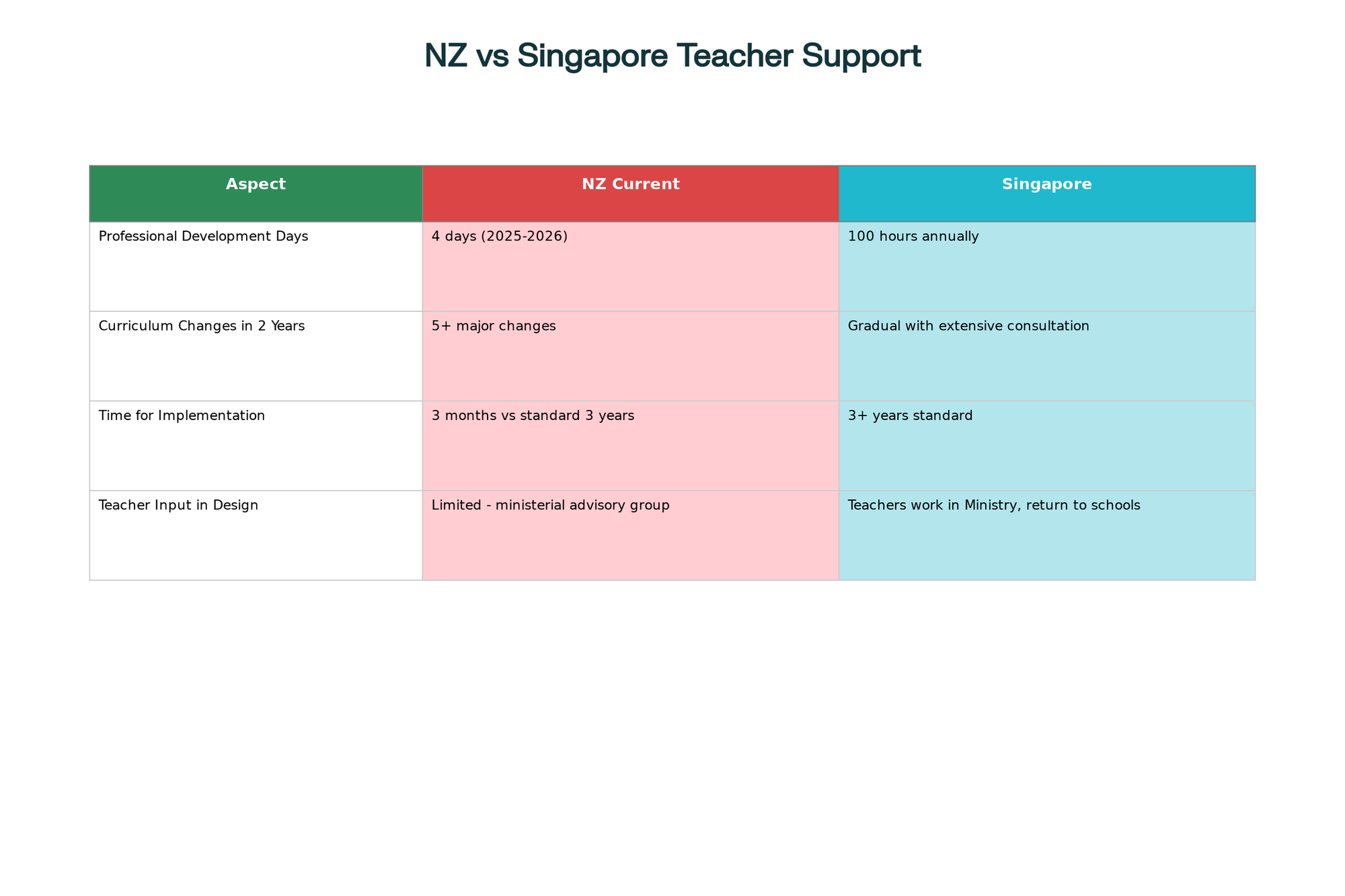
Comparison: NZ’s inadequate teacher support vs Singapore’s world-class approach
The Pattern - Demolition by Design
Step back and look at the full picture. This government has unleashed a tsunami of changes:
January 2025: Structured literacy became mandatory for all state schools from Term 1, despite NZEI Te Riu Roa warning that mandating a single approach undermines teacher professionalism. President Mark Potter said “politicians reaching into every classroom and telling every teacher how to teach every child undermines the professionalism of teachers.”
August 2024: The new maths curriculum for primary and intermediate children was brought forward a year, kicking off at the start of 2025 instead of 2026. The government gave schools three months to prepare instead of the standard three years.
August 2025: Stanford proposed replacing all levels of NCEA with new qualifications to be phased in from 2028. Level 1 would be scrapped entirely, replaced with foundation tests. Levels 2 and 3 would become new certificates with A-E grading instead of the current system.
September 2025: The government announced new secondary subjects including “industry-led” vocational pathways. These would be phased in from 2028.
October 2025: The “finalized” curriculum content for Years 0-10 English and Maths was released, revealing massive changes the ministry had downplayed.
More than 650 primary and area school principals signed an open letter in October 2025 urging Stanford to pause all curriculum rollout deadlines. The letter, endorsed by the New Zealand Principals’ Federation representing 2,000 principals and Te Akatea, the kaupapa Māori tumuaki national body, expressed “deep concern that the reforms are being implemented too quickly, with limited clarity, consultation, or local grounding.”
An NZEI survey from September 2024 found 77.5 percent of principals and 73.7 percent of teachers said change was happening too fast to be effective. One principal wrote: “It is NOT doable. I am teaching full-time and being a principal early morning and late at night. I cannot cope with all these changes as well as everything else.”
The Hidden Agenda - Privatization Through Chaos
This chaos serves a purpose. When you overwhelm and demoralize teachers, when you make the public system look dysfunctional, you create the conditions for privatization. And that’s exactly what’s happening in parallel.
ACT leader David Seymour, Associate Education Minister responsible for charter schools, secured $153 million in Budget 2024 for up to 15 new charter schools and converting 35 state schools. Charter schools are publicly funded but privately run. They don’t have to follow the national curriculum. They can hire unregistered teachers. They’re exempt from government policies like the cellphone ban.
When charter schools were first introduced under the previous National government (2014-2018), one school in Whangaruru was shut down after $5.2 million of taxpayer money was spent on it, with truancy rife and achievements poor. Ministry documents revealed “major gaps” in monitoring, including no independent measurement of student achievement and inadequate financial oversight.
Yet Seymour and Stanford are doubling down. When pressed about the low number of applications for charter school conversions, Stanford told Q+A in August 2025 that charter schools create “tension in the system” designed to make her “up our game, so we don’t have people leaving and wanting to convert to charter schools.” Read that again. The Education Minister sees charter schools as competition designed to threaten public schools, not as a genuine alternative for struggling students.
Meanwhile, Stanford announced $53 million for teacher training that bypasses established Initial Teacher Education providers at universities. The funding goes to alternative programs like Teach First, which the Minister favors despite consistent criticism for perpetuating meritocratic myths and de-professionalizing teaching.
This is textbook neoliberal strategy: defund and destabilize the public system, import private alternatives, then claim the market is the solution to the crisis you created.
The Ideological Web - Follow the Money and the Faith
Connect the dots and a disturbing picture emerges. Prime Minister Christopher Luxon is an evangelical Christian whose faith “grounded” him and gave his life “purpose.” While he claims his faith is “personal” and separate from politics, his government’s education policies align suspiciously well with Christian nationalist agendas: attacking public institutions, promoting “parental choice,” defunding secular education in favor of faith-based alternatives.
Luxon stopped attending the Upper Room church in Auckland years ago, but not before absorbing its worldview. The church’s pastor has promoted conspiratorial views. When Luxon entered Parliament, he felt compelled to defend his faith against being labeled “extreme,” insisting Christianity doesn’t mean extreme political positions. Yet his government’s demolition of public education speaks louder than his denials.
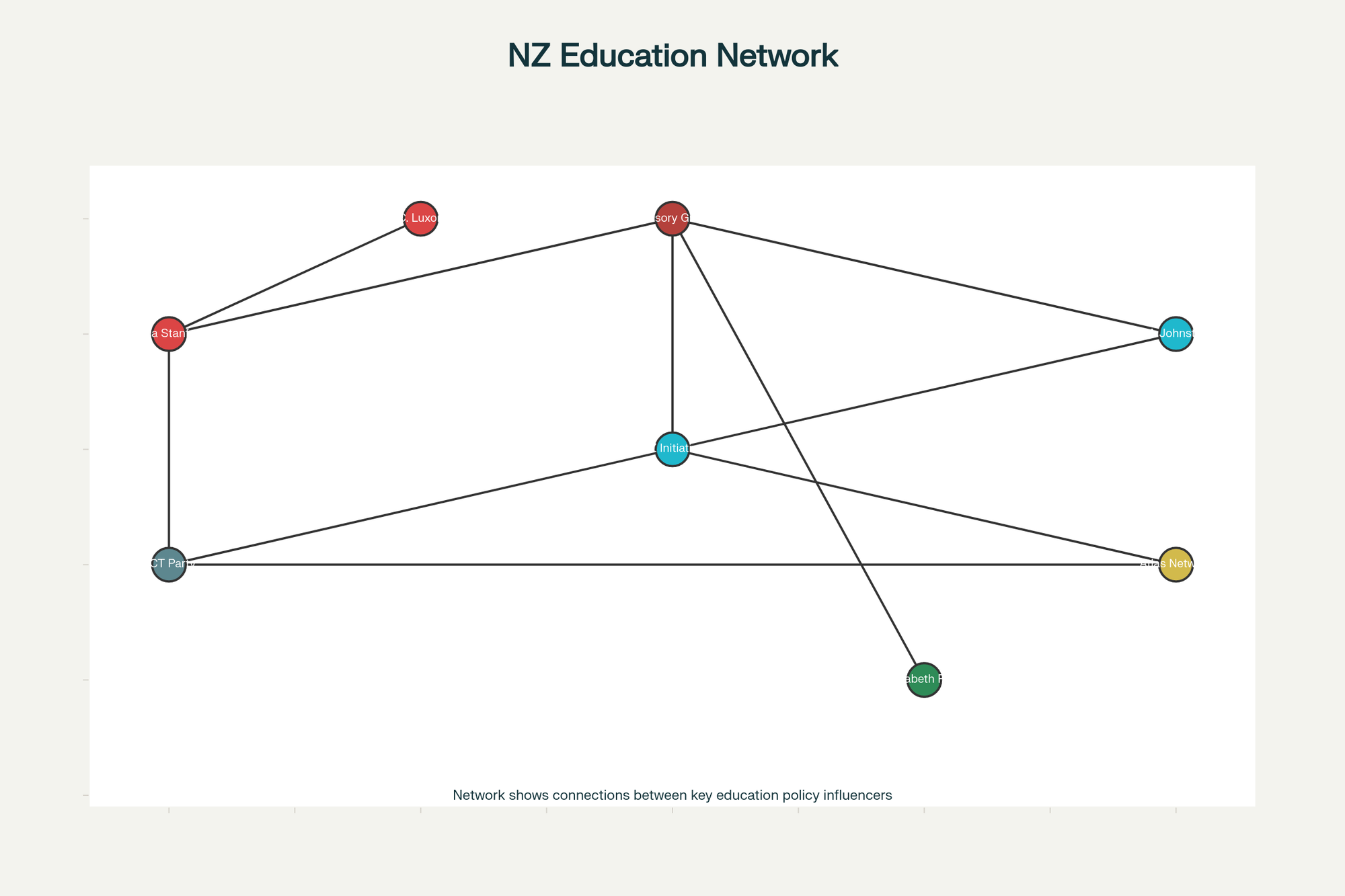
The hidden power network: How neoliberal ideology captured NZ’s curriculum
Stanford herself comes from a background producing reality TV shows like “Noise Control.” Now she’s treating education like a reality show where she can fire public servants, import overseas consultants, and reshape an entire system according to the NZ Initiative’s neoliberal playbook. The Initiative’s Dr Michael Johnston celebrated Stanford’s NCEA reforms as vindicating “a decade of education research” - research the Initiative itself produced to push its free-market agenda.
The NZ Initiative operates with funding from 54 member companies representing a quarter of New Zealand’s economy. Their 2017 report “Fair and Frank” looked at school performance management models from England, Singapore, and the US, cherry-picking elements that promote competition and private sector involvement. They’ve consistently argued for rating teachers based on student achievement and bringing market forces into education.
Elizabeth Rata, who shaped the English curriculum, equates inclusion of iwi, hapū and whānau knowledge with “emptying out” academic knowledge. The NZ Association for the Teaching of English took the unprecedented step of withdrawing from Ministry working groups in 2025, refusing to be associated with a curriculum they fundamentally opposed.
This is institutional capture at its most brazen. A network of ideologues with documented hostility to Te Tiriti, mātauranga Māori, and public education has seized control of curriculum development. They’re not hiding it. They’re celebrating it.
The Māori Dimension - Cultural Genocide by Curriculum
For Māori, this assault cuts deep. Stanford banned Māori words from new additions to books used to teach five-year-olds to read, claiming “experts in structured literacy approaches” told her that including two languages could confuse learners. She considered rewriting 27 books containing Māori words to retain only proper nouns in Māori, though she later backed off that particular demolition.
The Ministry’s own document showed evidence was mixed on whether te reo in early readers actually confused students, but Stanford pushed ahead anyway. This isn’t about reading instruction. It’s about erasing te reo Māori from the mainstream curriculum, relegating it to Māori-medium schools while English-medium students grow up monolingual and culturally impoverished.
Meanwhile, maths achievement in kura sits at 25 percent - a devastating indictment of how the system fails Māori learners. But instead of addressing the structural racism, under-resourcing, and colonial curriculum that produces these outcomes, Stanford piles on more pressure and more rushed changes.
The government claims to support Te Marautanga o Aotearoa with new subjects like Tātai Arorangi (Māori traditional systems of Earth and Sky) and Te Ao Whakairo (Māori carving). But these feel like tokenistic additions designed to deflect criticism while the real work of curriculum development is driven by people openly hostile to mātauranga Māori.
This is cultural genocide by a thousand cuts. Each curriculum change chips away at Māori knowledge, Māori language, Māori perspectives. Each rushed implementation makes it harder for kaiako Māori to do the culturally responsive teaching our tamariki need. Each neoliberal “reform” reframes education as individual achievement rather than collective wellbeing, undermining the whanaungatanga and manaakitanga that should ground our learning.
Implications - The Long Game
The Māori Green Lantern Fighting Misiformation And Disinformation From The Far Right
If you think this is just about curriculum, you’re missing the bigger picture. This government is systematically dismantling every structure that could resist corporate control of education.
Public sector jobs have been slashed. The Ministry of Education proposed cutting 755 positions in 2024, including nearly 100 regional and frontline roles directly supporting schools. These are the people who would normally support curriculum implementation. They’re gone.
Teacher unions are under attack. Charter schools employ teachers on individual contracts outside collectively agreed union pay scales and conditions. This fractures teacher solidarity, making it harder to resist exploitative working conditions. As one academic warned, “fracturing collective agreements redraws teacher relations with each other, and their schools, holding significant potential to exacerbate inequalities.”
Initial Teacher Education is being undermined. By funding alternative pathways through schools rather than universities, Stanford sidesteps public tertiary providers and opens ITE to private profit-making. The assumption that teaching is just copying established practice in schools perpetuates a false theory/practice binary and de-professionalizes teaching.
Democratic oversight is being eroded. When hundreds of principals beg for consultation and Stanford ignores them, when the professional association for English teachers withdraws from curriculum working groups in protest, when teachers’ expertise is dismissed as “union interference,” democracy dies.
The end game is clear: a two-tier system where wealthy families access well-resourced private and charter schools with elite curricula, while working-class and Māori kids are stuck in under-funded public schools implementing a dumbed-down, culturally stripped curriculum delivered by undertrained, overworked, underpaid teachers on individual contracts with no union protection.
This isn’t a future scenario. It’s happening now, accelerating with every curriculum change, every funding cut, every ministerial directive that treats teachers like robots and students like products.
Resistance and Hope

The Māori Green Lantern Fighting Misinformation And Disinformation From The Far Right
The good news is people are fighting back. Those 650-plus principals who signed the open letter. The NZATE members who withdrew from working groups. The NZEI members organizing and advocating. The Māori educators holding the line for mātauranga Māori despite relentless attacks. These are our frontline warriors.
But resistance requires understanding the full scope of what we’re facing. This isn’t just bad policy. It’s ideological warfare designed to destroy public education as a common good and replace it with education as a private commodity.
We must name the networks of power. We must expose how the NZ Initiative, the Atlas Network, ACT Party, and their allies in National have captured curriculum development. We must connect the dots between Stanford’s rushed curriculum changes, Seymour’s charter school agenda, Luxon’s Christian nationalism, and the global neoliberal project that seeks to privatize every public service.
We must defend our teachers. They are not the problem. They are being systematically sabotaged by a government that sees their professionalism as an obstacle to corporate control.
We must center Māori voices and mātauranga Māori. Any curriculum that doesn’t honor Te Tiriti, that doesn’t value indigenous knowledge, that treats te reo Māori as optional, is a colonial curriculum that perpetuates the violence of the past.
We must reject the manufactured crisis. When they say our students are failing, ask who benefits from that narrative. When they say we need “overseas best practice,” ask why they’re not listening to our own educators. When they say change must happen fast, ask who profits from the chaos.
The fight for public education is the fight for the soul of Aotearoa. It’s the fight for whether we’re a society that values collective wellbeing or individual profit. Whether we honor our founding document or trash it. Whether we trust teachers or treat them like replaceable cogs.
Kia kaha, e te whānau. This government is betting we won’t connect the dots, won’t organize, won’t resist. Let’s prove them wrong.
For those who find value in this analysis and wish to support this mahi, please consider a koha to HTDM: 03-1546-0415173-000. The MGL understands these are tough economic times for whānau, so please only contribute if you have capacity and wish to do so.
Mā te wā,
The Māori Green Lantern
Kaitiaki of Truth