“The Dangerous Game of Ethnic Division That Serves White Supremacist Interests” - 16 September 2025
Tākuta Ferris me John Tamihere: He Rākau Rākau mō te Hunga Mā
Kia ora whānau,
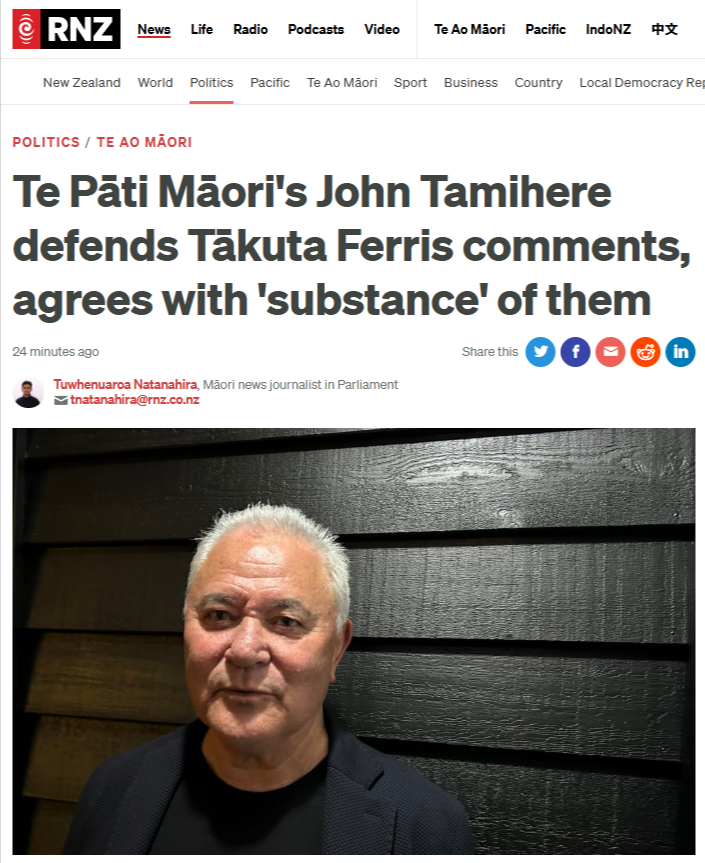
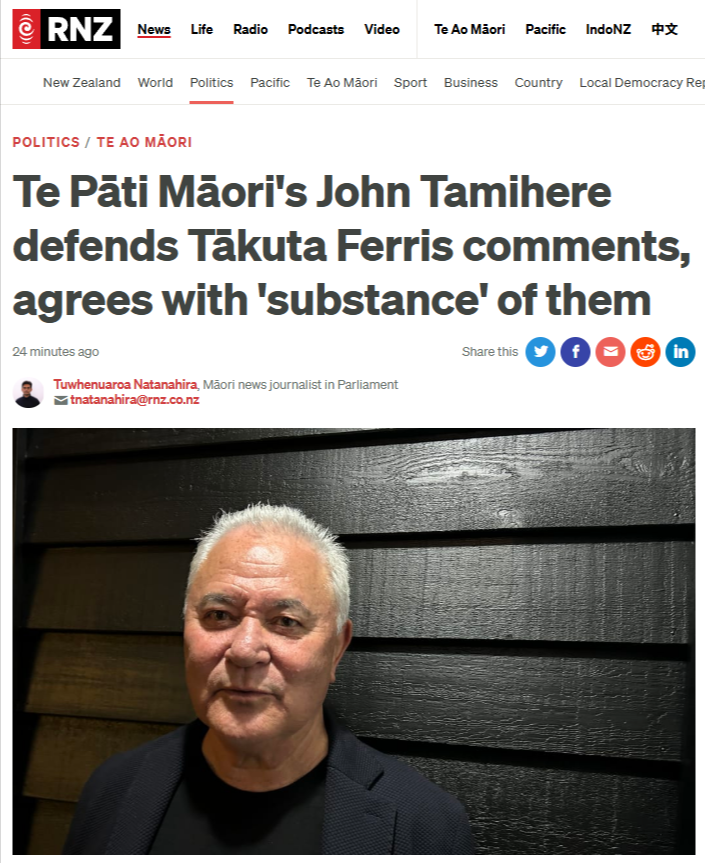
Here's the straight truth: Te Pāti Māori MP Tākuta Ferris posted on Instagram criticising "Indians, Asians, Black and Pākehā" for campaigning for Labour's Peeni Henare in the Tāmaki Makaurau by-election. When everyone called it racist, party president John Tamihere backed him up, saying he agreed with "the substance" of Ferris's comments. This isn't defending Māori sovereignty—it's handing ammunition to white supremacists who want to paint all Māori political action as racial separatism.
The heart of the issue is this: Ferris and Tamihere are playing directly into the hands of far-right anti-co-governance campaigns by promoting the very racial division these groups use to attack Māori rights. Instead of challenging the real enemy—the neoliberal system extracting wealth from all working people—they're creating divisions that weaken the coalitions needed to protect te Tiriti.
Background: What Actually Happened
Let's be crystal clear about the timeline. During the Tāmaki Makaurau by-election campaign, Ferris posted on Instagram showing Labour volunteers of different ethnicities with the caption "This blows my mind!! Indians, Asians, Black and Pākehā campaigning to take a Māori seat from Māori".
When Labour's Willie Jackson called it racist, Te Pāti Māori initially apologised. But then Ferris doubled down with an eight-minute Instagram video saying "The Māori seats are for Māori voices only" and "I don't give a crap who you care about or what you care about".
This matters because it fractures the left-wing coalition just when it's most needed. Labour leader Chris Hipkins warned that such positions would make Te Pāti Māori "very difficult" to work with, potentially enabling the National-ACT-NZ First government's continued assault on Māori rights.
The Colonial Violence Context They Got Wrong
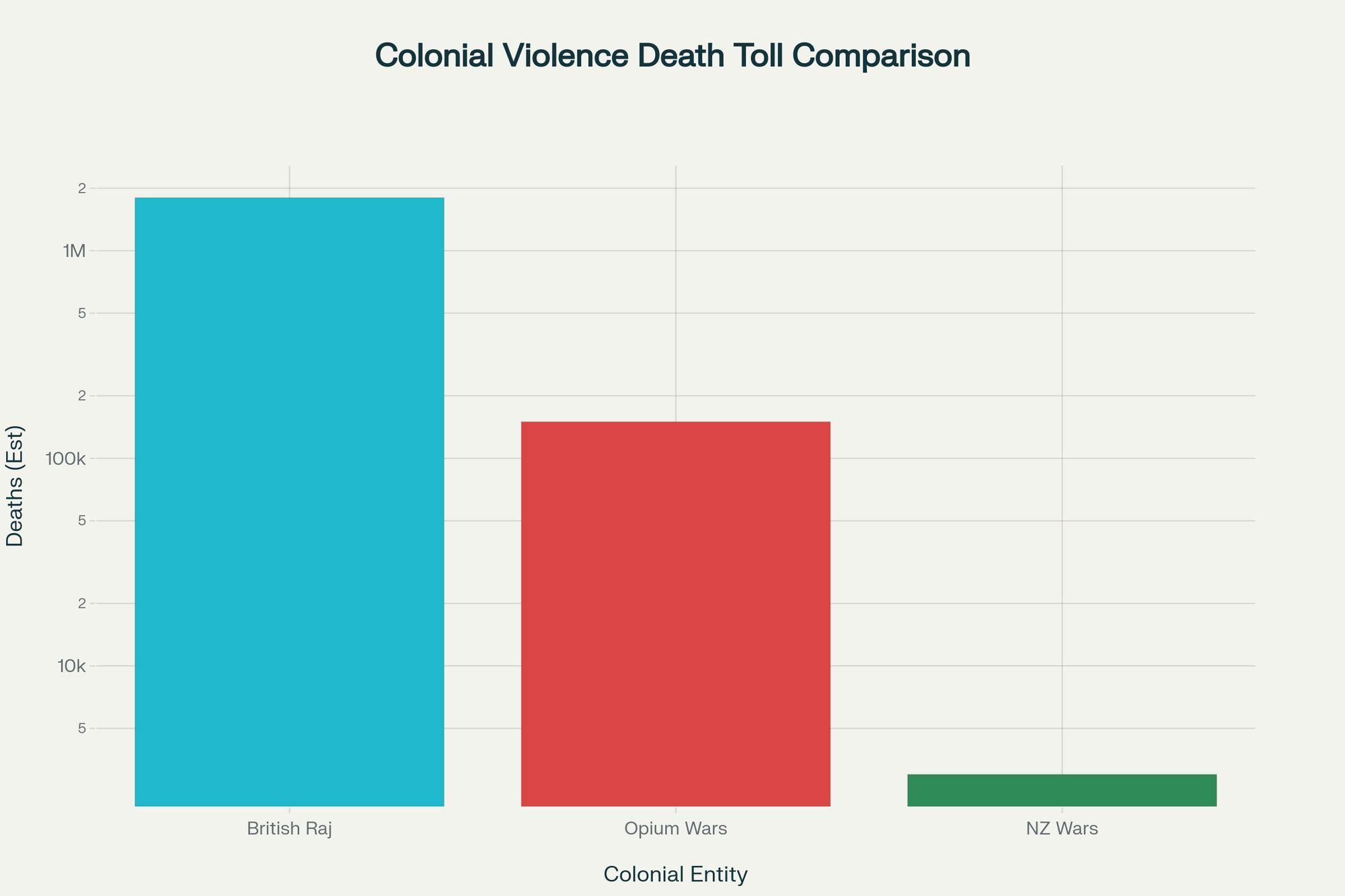
Comparative death tolls from British colonial campaigns reveal the systematic nature of imperial violence, with the New Zealand Wars representing just one chapter in a global pattern of dispossession
Ferris and Tamihere are right that colonialism operated through massive violence—the British Raj systematically drained $45 trillion from India while killing 1.8 million people, and the Opium Wars forced drug addiction on Chinese populations to generate British profits. But they've completely misunderstood how colonial power actually works in modern Aotearoa.
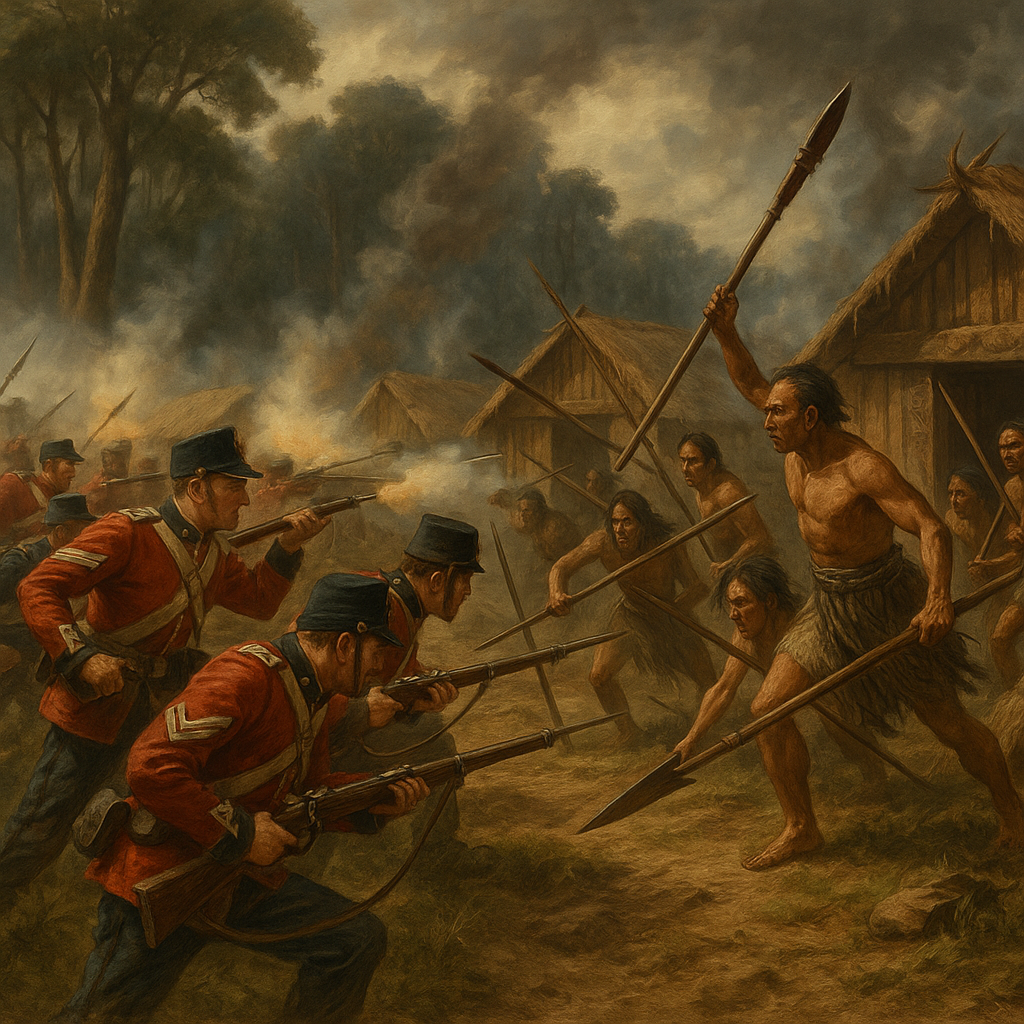
Colonial violence in New Zealand wasn't just about excluding Māori—it was about creating racial hierarchies that divided potential resistance. At Rangiaowhia in 1864, British forces attacked sleeping civilians, including women and children, as part of systematic land confiscation that stole 62% of Māori territory. But the colonial state also recruited Māori police to suppress other Māori, and promoted "good" versus "bad" Māori narratives to fragment resistance.
Today's neoliberal colonialism operates differently. Instead of outright exclusion, it uses market fundamentalism to extract wealth while promoting individual success stories that obscure structural oppression. The East India Company's model of using local elites to facilitate extraction mirrors how contemporary capitalism co-opts Indigenous leaders while maintaining systemic inequality.
How Anti-Co-Governance Campaigns Actually Work
The systematic escalation of anti-co-governance campaigns from 2022-2025 reveals coordinated far-right attacks on Māori political rights, peaking with government-backed legislative assault
The timing of attacks on Ferris reveals sophisticated far-right coordination. Since 2022, Julian Batchelor's Stop Co-Governance campaign has distributed over 350,000 pamphlets claiming Māori "elites" are conspiring to take over, while receiving funding from undisclosed private donors and business interests.
These campaigns specifically target multiracial coalitions supporting Māori rights, positioning any solidarity as evidence of Māori manipulation rather than genuine alliance. They frame co-governance as "apartheid" and "tribal rule" while promoting replacement theory narratives that position Māori advancement as threatening Pākehā democracy.
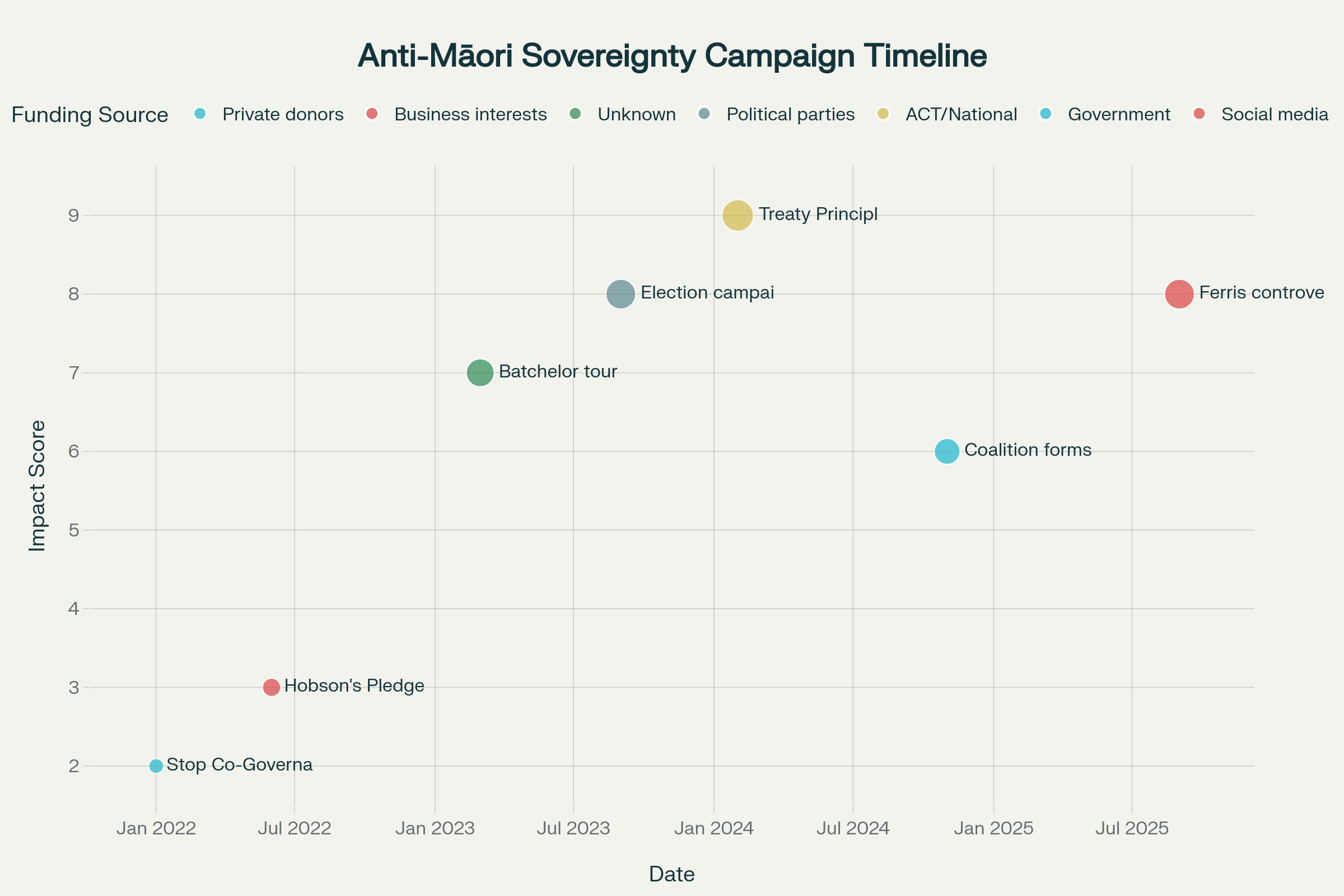
Ferris and Tamihere's rhetoric validates these narratives by accepting racial categories as natural and promoting ethnic exclusion. When Te Pāti Māori leaders say only Māori should support Māori political causes, they're literally proving the far-right claim that Māori politics represents racial separatism rather than legitimate responses to colonial oppression.
The Electoral Reality: Why Coalition Politics Matter
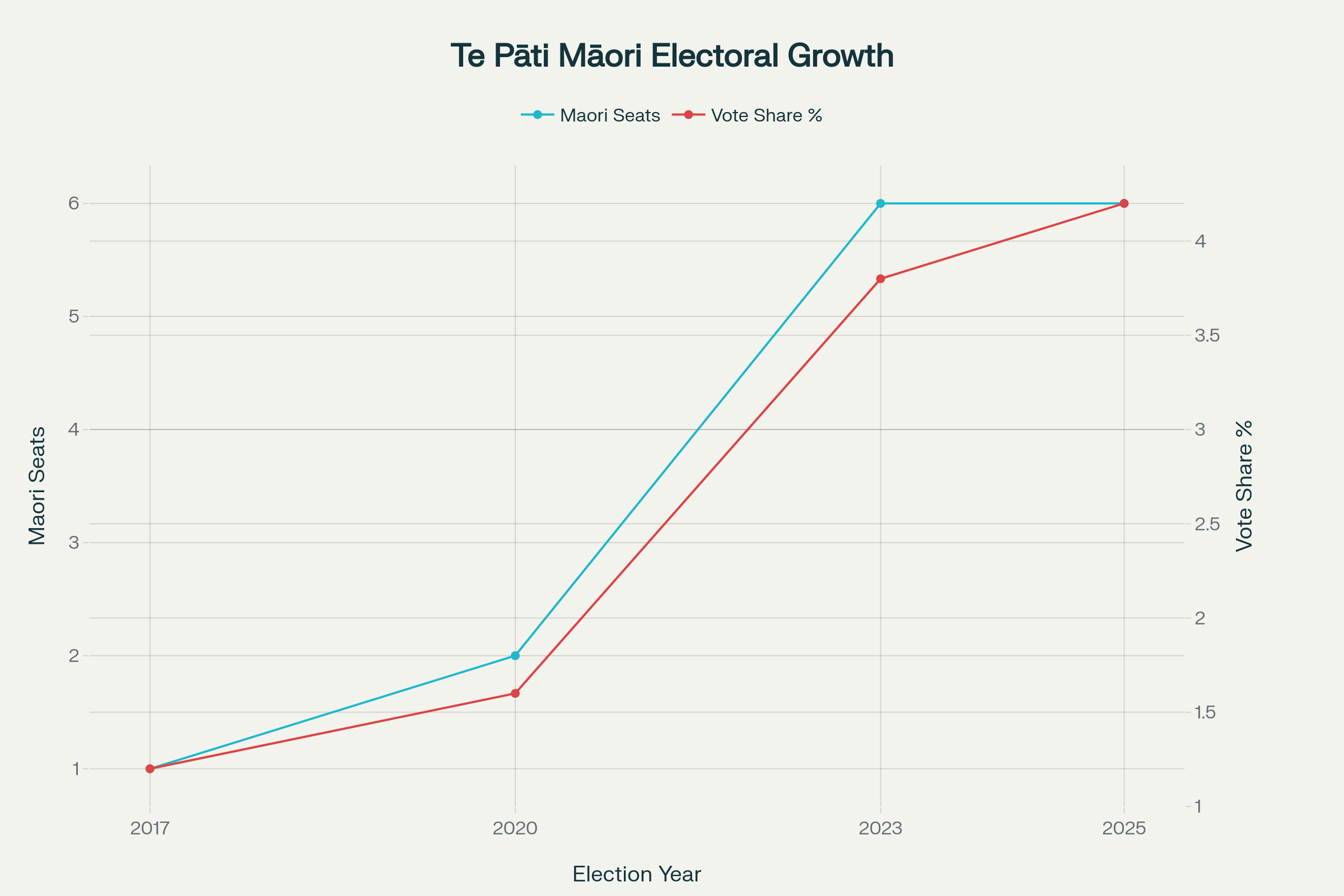
Te Pāti Māori's dramatic electoral growth from 2017-2025 demonstrates the increasing rejection of colonial political structures and the assertion of mana motuhake through the ballot box
Te Pāti Māori's growth from one seat in 2017 to six seats by 2023 demonstrates genuine political momentum. But in New Zealand's MMP system, governing requires coalition building. Recent polling suggests Labour would need both Green and Te Pāti Māori support to form a government, making cross-party cooperation essential for progressive change.
Ferris and Tamihere are sabotaging these strategic alliances precisely when they're most needed. The current National-ACT-NZ First coalition is systematically attacking Treaty rights through legislation like the Treaty Principles Bill, while implementing neoliberal policies that disproportionately harm Māori communities.
Labour's Willie Jackson warned that Ferris's positions provide "political extremists" with ammunition to "paint Te Pāti Māori as too extremist to ever work with the Labour Party", potentially enabling continued anti-Māori policies.
The Biological Racism Problem
Anti-racism groups have specifically criticised Ferris for making "assumptions based on the appearance of people", noting that "when you start to infer or suggest some form of ill intent about people based on your racial assumptions about them, that starts to wade into the area of racial profiling".
The most dangerous aspect of Ferris's rhetoric is assuming ethnic appearance determines political loyalty, ignoring that many people of mixed heritage identify as Māori while appearing ethnically ambiguous. This biological determinism mirrors the racial science used to justify colonial domination.
When Ferris categorised Labour volunteers solely by appearance, he deployed the same logic white supremacists use to exclude people from belonging. The irony is that Te Pāti Māori has previously faced criticism for claims about "Māori genetic makeup being stronger than others", showing how racial essentialism cuts both ways.
Media Complicity and Strategic Distraction
The mainstream media's obsession with Ferris's controversy perfectly serves neoliberal interests by diverting attention from structural issues. While media outlets focus on interpersonal conflicts and electoral calculations, they ignore how privatisation has systematically transferred public assets to corporations and created the inequality that fuels racial resentment.
This selective coverage treats Māori political assertion as inherently problematic while normalising far more extreme anti-Māori rhetoric from Pākehā politicians. When National MPs call for eliminating Treaty references or ACT leaders describe co-governance as creating an "ethno-state," media coverage treats these as legitimate policy debates rather than white supremacist attacks.
Winston Peters: The Puppet Master
Winston Peters's response reveals the strategic calculations behind far-right reactions. Peters called Ferris's comments "terribly racist" and claimed he had "lost the plot", while simultaneously noting that Ferris's "arrogance and destructive attitude" had "placed a wedge between Labour and Te Pāti Māori".
By amplifying and condemning Ferris's rhetoric, Peters achieves multiple objectives: legitimising anti-Māori sentiment, positioning NZ First as the "reasonable" alternative to both "extremist" Māori politics and "woke" Labour policies, and fracturing the left-wing coalition that threatens his government's power.
This is classic divide-and-conquer strategy—provoke your opponents into saying something divisive, then use their response to justify your own extremism while appearing moderate.
The Hidden Network of Corporate Interests
The real beneficiaries of this controversy are the corporate interests driving neoliberal extraction. While everyone argues about racial politics, the National-ACT-NZ First coalition continues implementing policies that privatise public assets and eliminate environmental protections.
ACT's Regulatory Standards Bill would prioritise private property rights over collective wellbeing, while their Treaty Principles Bill aims to eliminate Treaty references from legislation entirely. These policies directly serve transnational corporations seeking to extract resources without Indigenous consent.
Ferris and Tamihere's racial exclusionism inadvertently serves these interests by fragmenting potential coalitions and providing "proof" of Māori separatism that justifies eliminating Treaty protections altogether.
Implications: Serving the Enemy
The broader implications extend far beyond electoral politics. By positioning non-Māori support as inherently suspect, Ferris and Tamihere validate white supremacist claims while alienating rangatahi Māori who increasingly identify as multiracial.
Young Māori growing up in Auckland's diverse communities understand that liberation requires coalition-building rather than ethnic purity, making this rhetoric appear outdated and counterproductive. When Te Pāti Māori leaders reject solidarity from other colonised peoples, they undermine international Indigenous movements while reinforcing settler colonial divisions.
Most dangerously, this controversy threatens to fracture the multiracial coalitions needed to challenge the National-ACT-NZ First government's systematic assault on working people and the environment. The same neoliberal forces attacking Treaty rights also suppress wages, cut public services, and accelerate climate change—issues that affect all communities.

The Māori Green Lantern Fighting Misinformation And Disinformation From The Far Right
Choose Coalition Over Capitulation
Ferris and Tamihere have handed white supremacists their greatest gift: proof that Māori political leaders promote racial division. Instead of challenging the neoliberal system that oppresses all working people, they've created unnecessary conflict that weakens resistance to genuine threats.
True mana motuhake requires recognising that decolonisation means dismantling systems of extraction and domination, not policing racial boundaries. The choice is clear: continue down this path of ethnic essentialism that serves white supremacist narratives, or build the diverse coalitions necessary for genuine liberation.
The future of tino rangatiratanga depends on rejecting biological racism and embracing strategic alliance-building. Anything less is capitulation to colonial divide-and-conquer tactics.
Readers who find value in this analysis are welcome to contribute koha to HTDM: 03-1546-0415173-000—understanding these challenging economic times mean contribution should only occur if you have capacity and wish to support kaupapa-driven analysis.
Mauri ora,
Ivor Jones, Te Māori Green Lantern (Te Arawa/Ngāti Pikiao)