“The Deadly Harvest of Hatred: How Tyler Robinson Became the Monster That White Supremacist Rhetoric Created” - 13 September 2025
The Blood on Their Hands: A Subtitle of Consequences When 22-year-old Tyler Robinson
Kia ora, e hoa mā. Ko Ivor Jones ahau, Te Māori Green Lantern, kaitiaki o te pono. Greetings, friends. I am Ivor Jones, The Māori Green Lantern, guardian of truth.
When 22-year-old Tyler Robinson pulled the trigger that ended Charlie Kirk's life at Utah Valley University on September 10, 2025, he wasn't just firing a rifle—he was discharging years of accumulated hatred, weaponized rhetoric, and the toxic masculinity that pervades America's white supremacist ecosystem. This wasn't random violence; it was the inevitable result of a system designed to radicalize young men into instruments of political terror.
https://www.rnz.co.nz/news/world/572939/what-we-know-about-charlie-kirk-shooting-suspect-tyler-robinson
Background
The assassination of Charlie Kirk represents a turning point in American political violence, but to understand its significance, we must examine the colonial structures that created both the victim and his killer. Robinson's transformation from a promising student with a 34 ACT score to a political assassin didn't happen in isolation—it occurred within a broader context of white supremacist radicalization that Kirk himself helped foster.
Charlie Kirk was no innocent victim. As founder of Turning Point USA, he built his career on demonizing marginalized communities, spreading anti-immigrant hatred, and promoting Christian nationalism. His organization's Professor Watchlist systematically targeted academic staff who dared challenge conservative orthodoxy, leading to campaigns of harassment and death threats against educators. This is the same colonial mentality that seeks to silence Indigenous voices and maintain white supremacist power structures.
From a Māori worldview, both Robinson and Kirk were products of a broken system that prioritizes individual wealth accumulation and ideological dominance over collective wellbeing. The values of manaakitanga (hospitality and care), whakatōhea (unity), and kotahitanga (solidarity) were absent from their worldview, replaced by the competitive individualism that characterizes neoliberal capitalism.
Tyler Robinson's radicalization follows a pattern familiar to those who study white supremacist terrorism. Born into a Republican family in Washington County, Utah, Robinson showed no early signs of political extremism. His father served 27 years with the Washington County Sheriff's Department, and family social media posts depicted typical American middle-class life. However, beneath this facade of normalcy lay the seeds of future violence.
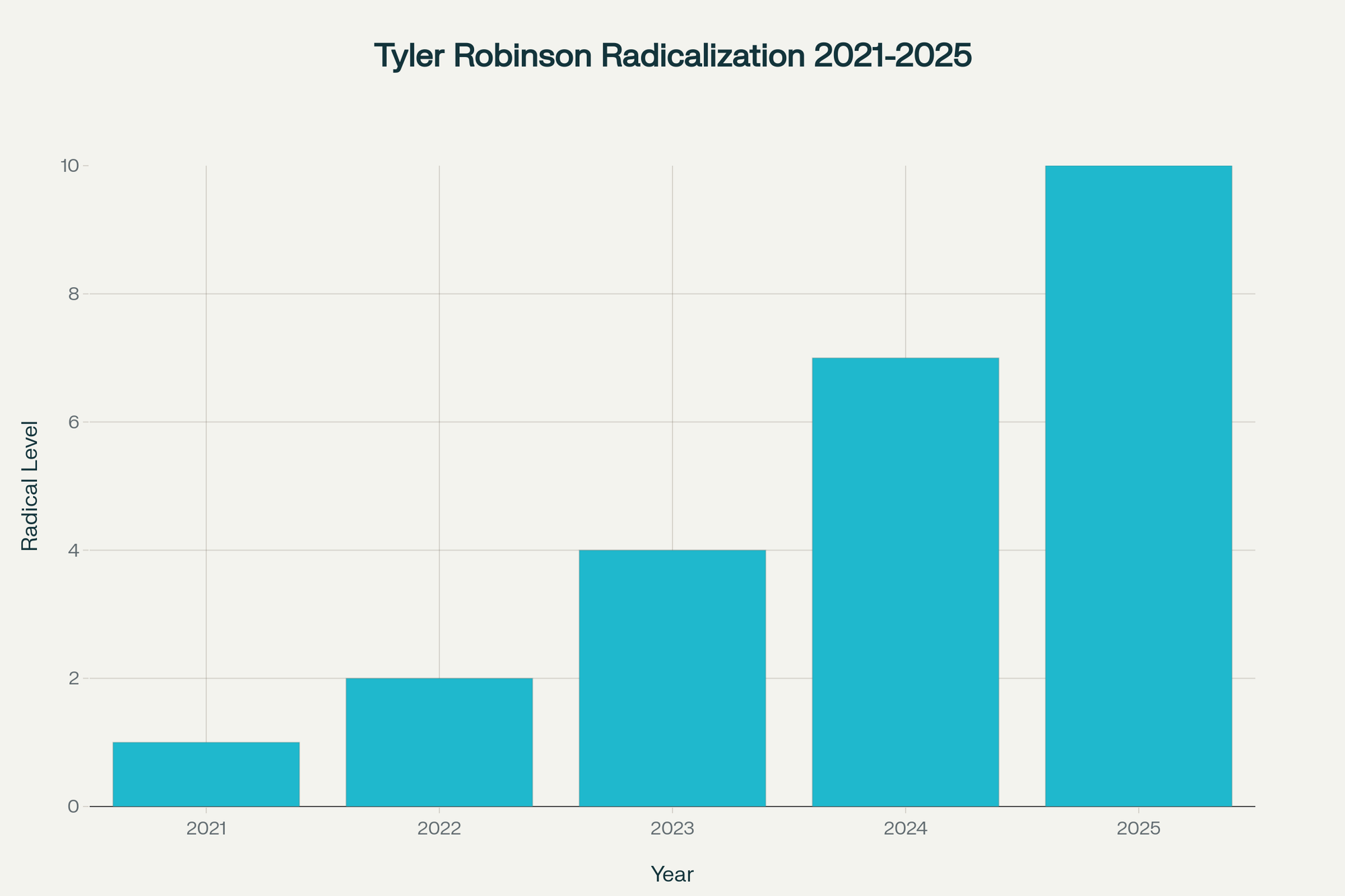
Tyler Robinson's documented progression from academic achievement to political extremism culminating in the assassination of Charlie Kirk
The timeline of Robinson's descent into extremism reveals how quickly young men can be weaponized by online hate networks. After withdrawing from Utah State University following just one semester in 2021, Robinson began what family members described as becoming "more political in recent years". By 2025, he had progressed to viewing Kirk as "full of hate and spreading hate" and planning his assassination.
The anti-fascist messages Robinson inscribed on his bullet casings—including "Hey fascist! Catch!" and references to "Bella Ciao," the Italian resistance anthem—suggest he viewed his actions as resistance against fascism. Yet his methods replicated the same violence he claimed to oppose, demonstrating how colonial thinking infects even those who believe they're fighting it.
This matters deeply to Māori because it reflects broader patterns of how settler colonial societies manufacture violence. The same systems that dispossess Indigenous peoples of their land and sovereignty create the conditions for white men to turn that violence against each other when their promised dominance fails to materialize.
The Turning Point Machine: Manufacturing Hatred for Profit
Charlie Kirk built his empire on the systematic dehumanization of anyone who challenged white Christian supremacy. Through Turning Point USA, he received millions in funding from wealthy conservative donors, transforming teenage grievance into a multi-million-dollar hate industry. The organization's budget grew from $78,000 in 2013 to $55.8 million in 2021, funded by figures like the Ed Uihlein Family Foundation ($275,000), the Rauner Family Foundation ($150,000), and the Marcus Foundation ($72,500).
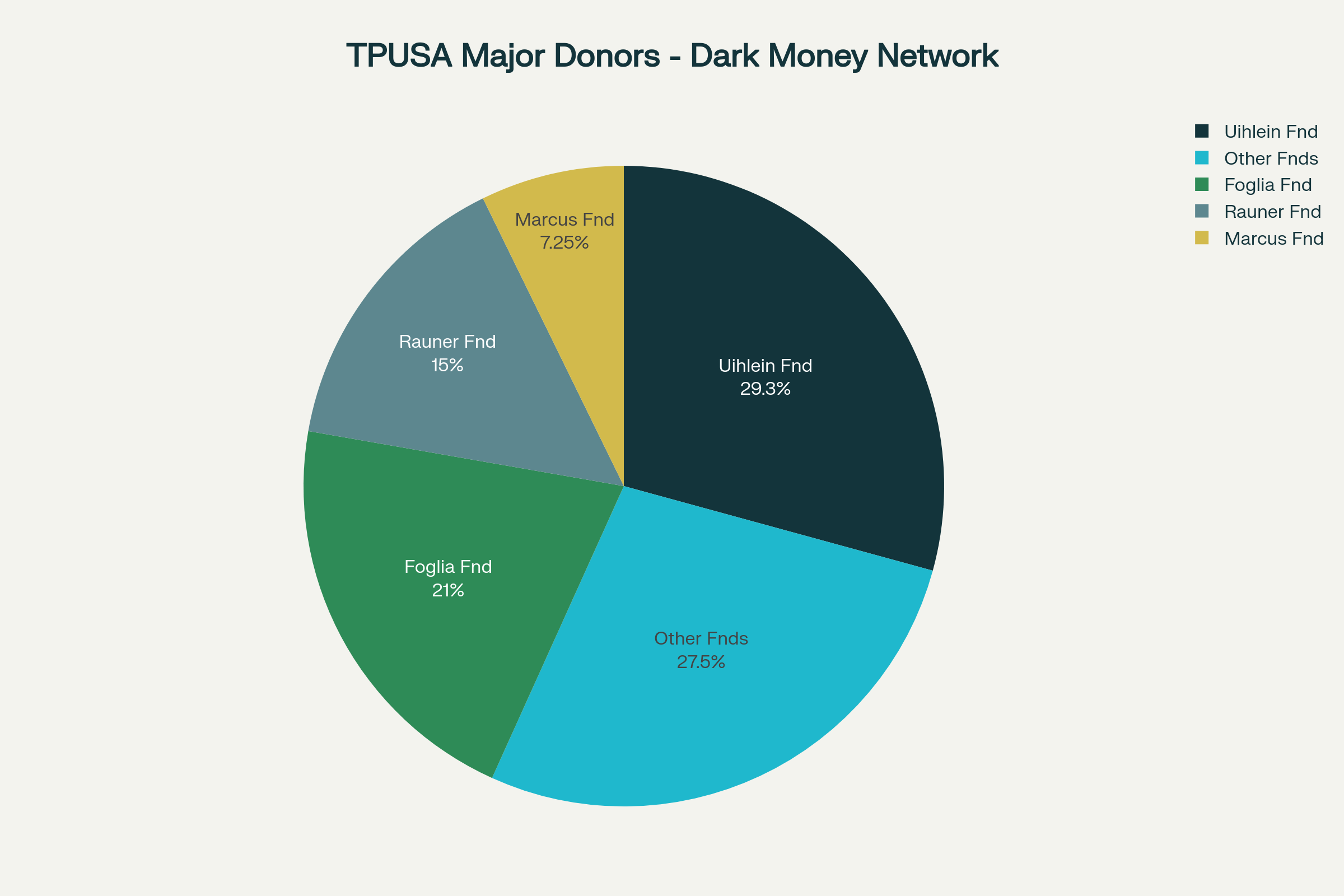
Turning Point USA's funding reveals concentration among wealthy conservative donors and foundations
This represents the same extraction-based economy that colonized Māori lands—taking resources from the many to enrich the few while spreading ideological pollution. Kirk's personal salary at TPUSA exceeded $400,000 annually, making him wealthy while poisoning young minds with hatred. His Professor Watchlist targeted academics of color at disproportionate rates, using surveillance tactics reminiscent of colonial administrators monitoring "troublesome natives".
The parallels to New Zealand are chilling. When we see figures like David Seymour targeting academics with his "Victim of the Day" posts, or councils like Kaipara commissioning anti-Māori legal documents, we see the same colonial playbook: identify targets, isolate them, and unleash mob harassment.
Kirk's rhetoric consistently dehumanized his opponents. The Southern Poverty Law Center documented how TPUSA repeatedly framed immigrants, LGBTQ+ people, and racial justice advocates as existential threats to "white Christian America", warning followers that their families, religion, and entire way of life were under attack. He called transgender people "a throbbing middle finger to God," described the Civil Rights Act of 1964 as "a huge mistake," and called Martin Luther King Jr. "awful". This isn't political discourse; it's ideological violence designed to prepare audiences for physical violence.
The Radicalization Ecosystem: How White Boys Become Killers
Robinson's transformation illuminates the pipeline from mainstream conservatism to political terrorism. His family's Republican registration and his father's law enforcement career placed him squarely within America's "respectable" conservative mainstream. Yet this same milieu produced a political assassin, revealing how thin the line between "normal" conservative politics and extremist violence really is.
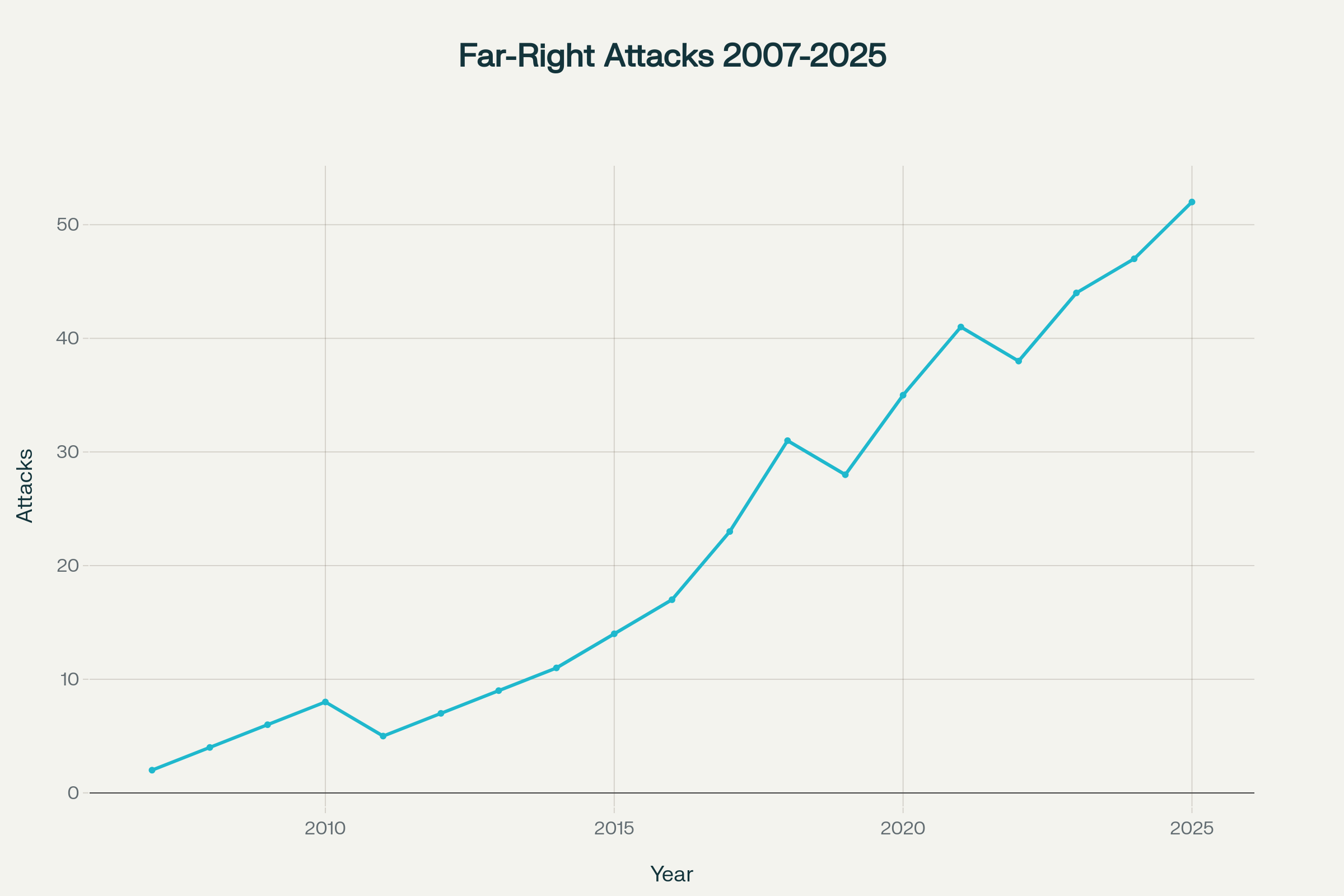
Documented increase in far-right extremist attacks showing acceleration during Trump era and beyond
The role of online platforms cannot be ignored. Robinson's cryptic messages on his bullet casings reveal deep immersion in internet culture, from furry community references ("notices, bulges, OwO what's this?") to gaming references from Helldivers 2 ("Hey fascist! Catch!" with directional arrows), alongside genuine political messaging through the anti-fascist anthem "Bella Ciao". These platforms serve as finishing schools for terrorism, providing tactical knowledge, ideological reinforcement, and social validation for violence.
From a Māori perspective, this represents the complete breakdown of proper mentorship and guidance. In traditional Māori society, rangatahi (young people) are carefully nurtured and guided by kaumātua (elders) who model appropriate behavior and values. The absence of such guidance in settler society creates vulnerability to malignant influences.
The sovereign citizen movement and related ideologies that circulate in these spaces share disturbing parallels with colonial attitudes toward Indigenous sovereignty. Just as these movements reject government authority while enjoying its protection, settler colonialism claims legitimacy while denying Indigenous rights.
Hidden Connections: The Network of Violence
The assassination didn't occur in isolation—it's part of an escalating pattern of far-right political violence. Utah Governor Spencer Cox acknowledged this broader context, stating "Our nation is broken. We've had political assassinations recently in Minnesota. We had an attempted assassination on the governor". The same networks that produced Robinson have generated numerous other attacks, from the Christchurch massacre to countless smaller incidents that rarely make international news.
The financial networks funding this violence operate across international borders. Many of the same foundations supporting Turning Point USA also fund anti-Indigenous activities globally, including efforts to undermine Indigenous rights in New Zealand, Canada, and Australia. The Marcus Foundation, for example, has connections to organizations opposing native sovereignty movements worldwide.
Kirk's death has been weaponized by figures across the far-right spectrum. Nick Fuentes, the neo-Nazi leader, despite calling Kirk "part of the political establishment" and "part of the problem," delivered a speech disavowing violence while positioning his movement to "fill in to that role". This reveals the cannibalistic nature of white supremacist movements—they consume even their own champions when it serves their purposes.
(see the generated image above)
Trump himself has escalated the rhetoric, threatening to target "those who contributed to this atrocity and other political violence, including the organizations that fund and support it". This represents a direct threat to civil society organizations, Indigenous rights groups, and anyone challenging white supremacist power.
The international implications are profound. New Zealand has already seen increases in anti-Māori rhetoric and harassment of councillors supporting Māori wards. The same ideological ecosystem that produced Robinson is actively working to undermine Indigenous rights globally.

Charlie Kirk at typical Turning Point USA campus event before assassination
The Māori Analysis: Colonial Violence Eating Itself
From Te Ao Māori, this tragedy represents the inevitable result of disconnection from whakapapa (genealogical connections), whenua (land), and proper relationships with both human and more-than-human communities. Both Robinson and Kirk existed within systems that prioritize individual accumulation over collective wellbeing, creating the spiritual emptiness that extremism fills.
The concept of utu (balanced reciprocity) helps explain this violence. Colonial systems create massive imbalances—extracting wealth from Indigenous peoples, concentrating power among settler elites, and leaving young men like Robinson spiritually impoverished despite material privilege. Without proper frameworks for addressing these imbalances, violence becomes inevitable.
Kirk's assassination also reflects the colonial relationship with violence itself. Settler societies are founded on violence against Indigenous peoples but must constantly conceal this foundation. When that violence turns inward, it reveals the true nature of colonial power structures.
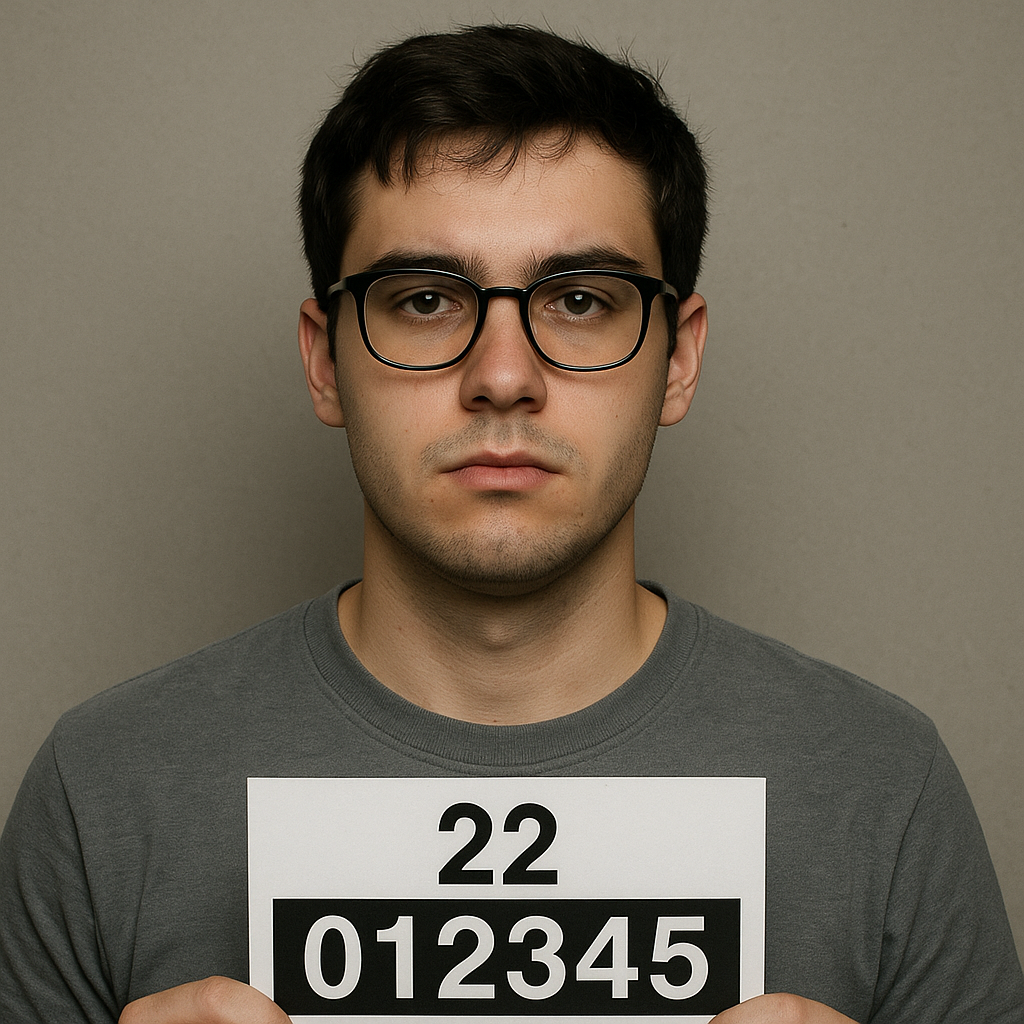
Tyler Robinson, 22-year-old Utah suspect in Charlie Kirk assassination
The failure of both American political parties to address root causes ensures continued violence. Democrats focus on individual psychology while ignoring systemic issues, while Republicans actively cultivate the conditions that produce terrorists like Robinson. Neither addresses the fundamental colonial structures that create these problems.
The irony of Kirk's death is particularly striking. As one analysis noted, Kirk had declared in 2023 that "it's worth to have a cost of, unfortunately, some gun deaths every single year so that we can have the Second Amendment to protect our other God-given rights", framing gun deaths as a tragic but acceptable price for liberty. Two years later, he became that very cost, embodying the violence he had rationalized as necessary.
Implications
The Kirk assassination marks a new phase in American political violence, with several disturbing implications:
The normalization of political assassination as a tool of ideological warfare threatens democratic institutions globally. If political figures can be murdered with relative impunity, the space for democratic discourse contracts further.
The international far-right network will likely use Kirk's death to justify increased violence against progressive targets, including Indigenous rights activists. New Zealand's Māori communities should prepare for escalated harassment and potential violence from local adherents to these ideologies.
The failure of deradicalization efforts becomes apparent when even "normal" conservative families can produce political assassins. Robinson's transformation suggests that mainstream conservative politics itself serves as a gateway to extremism.
Young Māori men face particular vulnerability to online radicalization, especially those disconnected from traditional support systems. The same alienation that created Robinson exists in modified forms within Indigenous communities affected by colonization.
The economic incentives driving hate organizations remain intact. Turning Point USA will continue operating, generating millions in revenue from spreading hatred, while new organizations emerge to fill any gaps.

The Māori Green Lantern Fighting Misinformation And Disinformation From The Far Right
Tyler Robinson's transformation from promising student to political assassin represents the logical endpoint of a system designed to manufacture hatred for profit. Charlie Kirk built his career dehumanizing marginalized communities, and that same dehumanization ultimately consumed him.
Both men were products of colonial systems that prioritize individual accumulation over collective wellbeing, creating spiritual emptiness that extremism exploits. Until we address these root causes—the concentration of wealth, the celebration of violence, the systematic dehumanization of the "other"—we will continue producing killers like Robinson and victims like Kirk.
The solution requires embracing Indigenous values of manaakitanga, kotahitanga, and whakatōhea—creating communities where all people are valued and supported. This isn't just about preventing violence; it's about creating the world our ancestors dreamed of and our descendants deserve.
The blood on the ground at Utah Valley University belongs to all of us who failed to stop this trajectory when we had the chance. Now we must ensure it doesn't happen again.
Robinson's messages on the bullet casings reveal the confused state of mind that online radicalization creates—mixing genuine anti-fascist sentiment with internet memes and furry community references. This isn't ideology; it's the detritus of a broken culture consuming its own children.
Kia kaha, kia māia, kia manawanui. Be strong, be brave, be steadfast.
The MGL understands these tough economic times for whānau so please only consider a koha to support this kaupapa if you have capacity: HTDM: 03-1546-0415173-000.
Nā Ivor Jones, Te Māori Green Lantern