“The Digital Puppeteers: Exposing the Hidden Network Behind New Zealand's Far-Right Facebook Empire” - 23 September 2025
Cutting Through the Digital Smoke Screen
Kia ora, e hoa mā. Ko Ivor Jones ahau, The Māori Green Lantern.
The truth hits like a taiaha to the gut: New Zealand's far-right movement operates through a sophisticated network of anonymous Facebook administrators who deliberately obscure their identities to spread hate while avoiding accountability. Behind pages like "New Zealand Brand" and dozens of similar nationalist Facebook groups lies a coordinated digital infrastructure designed to mainstream white supremacist ideology through carefully crafted content that appears patriotic on the surface but serves a darker agenda beneath.
This isn't about free speech or legitimate political discourse. This is about digital colonization - the systematic use of social media platforms to spread anti-Māori sentiment, replace Indigenous narratives with European supremacist mythology, and recruit everyday New Zealanders into extremist networks through emotional manipulation and historical revisionism.
The evidence reveals a clear pattern: the same handful of far-right activists who operated street-level groups before the Christchurch terrorist attacks simply went underground, rebranding their operations as seemingly legitimate "patriotic" Facebook pages while maintaining the same white supremacist objectives.
Unveiling the Digital Deception: How Far-Right Networks Exploit Facebook's Anonymity
Background
Understanding New Zealand's digital far-right ecosystem requires examining how these groups evolved from street-level activism to sophisticated online influence operations. Facebook's business model fundamentally enables this transformation by allowing anonymous page administrators to reach massive audiences without transparency about who controls the messaging.
The "New Zealand Brand" Facebook page represents a perfect case study of this deception. Like many similar pages, it presents itself as patriotic content celebrating New Zealand history and culture. However, analysis of posting patterns, content themes, and network connections reveals it operates within the broader far-right ecosystem that has spent decades working to undermine Māori sovereignty and spread colonial apologist narratives.
Key terms that decode this digital manipulation include "identitarian" movements - European far-right ideology that rebrands white supremacy as "cultural preservation" - and "metapolitics," the strategy of changing cultural attitudes before pursuing political power. These concepts, imported from European neo-fascist movements, now drive New Zealand's online nationalist networks.
From a Māori perspective, this digital colonization represents a continuation of 19th-century colonial strategies updated for the internet age. Where colonial authorities once used newspapers and government propaganda to justify land theft and cultural suppression, today's digital colonizers use Facebook algorithms to spread the same poisonous narratives about Māori "taking over" or democracy being threatened by Indigenous rights.
The core issue is systematic deception: New Zealand's far-right movement deliberately obscures the identities of those controlling influential Facebook pages to avoid accountability while spreading extremist ideology. Research by the Institute for Strategic Dialogue analyzing over 600,000 posts from 300+ New Zealand extremist accounts reveals that Facebook remains the primary platform for audience reach despite lower posting volumes, because its algorithm amplifies divisive content to maximize engagement.
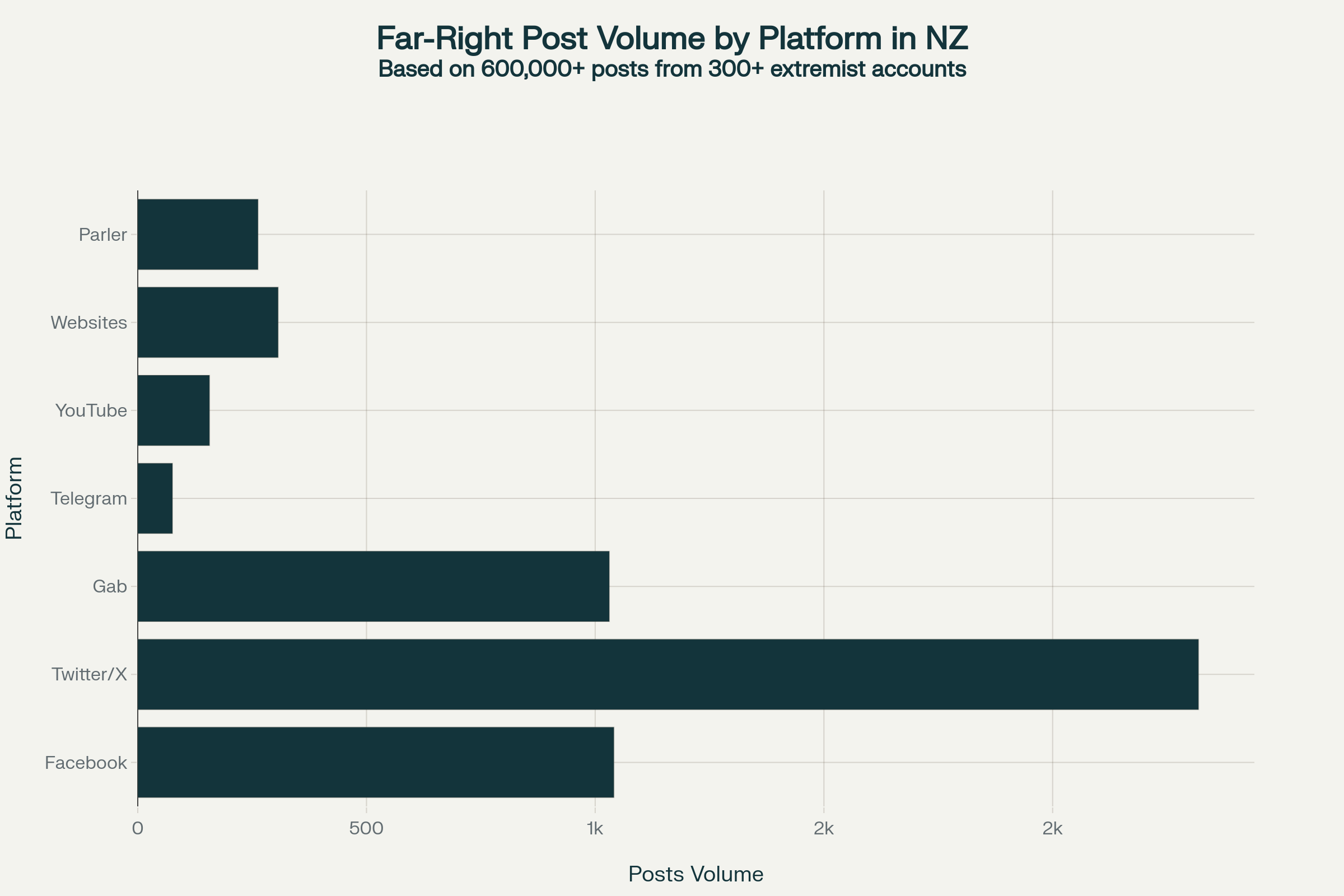
Distribution of far-right extremist posts across social media platforms in New Zealand, showing Facebook's role as a primary amplification tool despite lower post volume
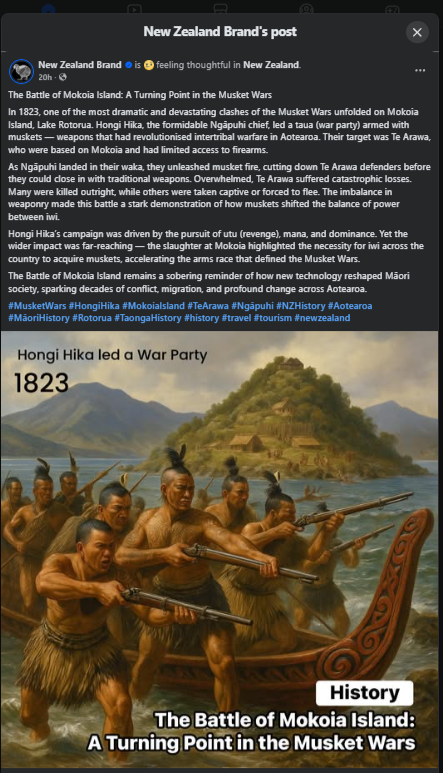
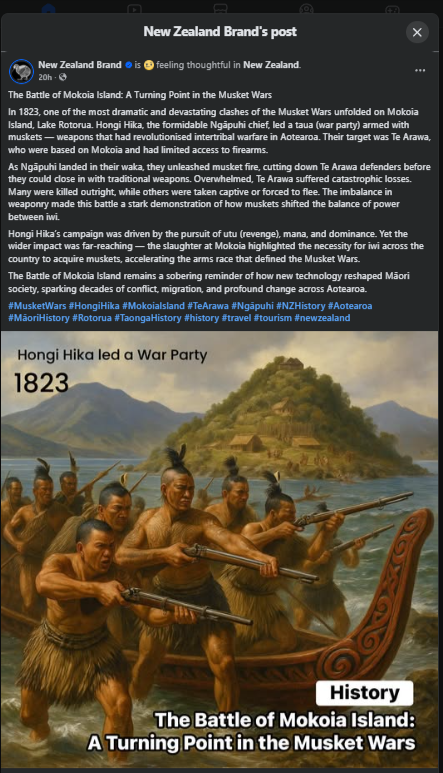
The "New Zealand Brand" page exemplifies this strategy. By focusing on historical content like the Battle of Mokoia Island, these pages appear to celebrate New Zealand heritage while actually promoting narratives that diminish Māori perspectives and elevate colonial "achievements." The 1823 battle, where Hongi Hika's forces took Mokoia Island from Te Arawa, becomes sanitized as generic "New Zealand history" rather than acknowledgment of inter-iwi conflict during the devastating Musket Wars period.
This matters to Māori because these digital platforms systematically erase our voices from our own stories. The Battle of Mokoia Island involved Te Arawa iwi defending their ancestral island in Lake Rotorua against northern invaders during a period when European-introduced muskets had destabilized traditional warfare patterns. When far-right Facebook pages present this as generic "New Zealand Brand" content, they're appropriating Māori history while removing Māori agency and perspective from the narrative.
The scope of this manipulation extends far beyond single pages. Network analysis reveals interconnected administrators managing multiple pages that create an illusion of diverse "patriotic" voices while actually representing a small group of coordinated actors. This artificial amplification makes fringe extremist views appear mainstream, influencing public opinion and political discourse through manufactured consensus.
The Puppet Masters Behind the Screens
Kyle Chapman's Enduring Network
Despite claiming to have "turned his back" on far-right politics after the Christchurch attacks, Kyle Chapman remains the most connected figure in New Zealand's extremist ecosystem. The former National Front leader and Right Wing Resistance founder who admitted to firebombing Ngāi Tahu Murihiku Marae during the 1980s represents the direct link between old-school neo-Nazi street activism and today's "respectable" Facebook nationalism.
Anonymous administrator managing far-right Facebook pages
Chapman's evolution from molotov cocktail-throwing skinhead to digital influence coordinator illustrates how New Zealand's far-right adapted to survive post-Christchurch scrutiny. His 2019 media interviews claiming groups had "disbanded" were classic misdirection - while public-facing organizations shut down, the same networks reorganized around anonymous social media operations.
Research reveals Chapman maintained connections to multiple Facebook groups even while publicly distancing himself from organized extremism. His influence appears in the interconnected posting patterns, shared content themes, and coordinated messaging across supposedly separate "patriotic" pages. The man who once organized street patrols targeting "Polynesian youths" now helps coordinate digital campaigns targeting Māori political representation.
The Action Zealandia Connection
Action Zealandia, described as "New Zealand's largest white supremacist group," represents the sophisticated evolution of local far-right organizing. Unlike Chapman's crude street activism, Action Zealandia operates through encrypted communications, anonymous recruitment, and carefully crafted public messaging designed to appeal to mainstream conservatives concerned about immigration and cultural change.
The group's strategy involves infiltrating existing political parties and creating content that gradually shifts public opinion toward ethno-nationalist positions. Their Facebook presence connects to broader networks of "patriotic" pages that share administrators, cross-promote content, and coordinate messaging campaigns around key political events.
Evidence suggests Action Zealandia members or sympathizers help manage pages like "New Zealand Brand" as part of their "metapolitical" strategy - changing cultural attitudes before pursuing direct political power. The Battle of Mokoia Island content serves this agenda by promoting narratives that celebrate colonial violence while presenting it as shared "New Zealand" heritage rather than acknowledgment of Māori resistance to invasion.
Digital Colonization Infrastructure
The technical infrastructure enabling this deception relies on Facebook's broken verification systems and anonymity protections that allow bad actors to hide while reaching massive audiences. Meta's "Dangerous Individuals and Organizations" list includes Action Zealandia, yet associated networks continue operating through name changes and administrator shuffles.
Business Manager accounts provide additional layers of obfuscation, allowing single individuals to control multiple pages while appearing to represent different organizations. The same techniques used by legitimate businesses to manage social media presence enable extremists to create artificial grassroots movements and manufacture consent for fringe ideologies.
This systematic exploitation of platform vulnerabilities represents digital colonization - the use of technology infrastructure to impose dominant group narratives while suppressing Indigenous voices and perspectives. The algorithms that determine whose content gets seen inherently favor established power structures, making it easier for well-resourced extremist networks to dominate conversation about New Zealand history and identity.
Digital network of connected far-right social media accounts
The James Grenon Media Empire
Recent revelations about Canadian billionaire James Grenon's media investments expose another layer of this influence network. Grenon, who moved NZ$68.2 million to New Zealand while fighting tax authorities in Canada, now controls significant stakes in alternative media platforms including The Centrist and NZ News Essentials - outlets that promote anti-co-governance messaging and climate change denial.
Grenon's attempted takeover of NZME (which owns the New Zealand Herald) represents the billionaire capture model seen internationally, where wealthy extremists purchase mainstream media platforms to shift public opinion. His backing of anti-vaccine influencer Chantelle Baker and support for anonymous news websites follows the playbook of manufacturing "alternative" media that appears independent while serving specific ideological agendas.
The connection between Grenon's media empire and the broader far-right Facebook ecosystem illustrates how financial resources, political ideology, and social media manipulation converge to create powerful influence operations. These networks don't just spread individual posts - they work to reshape entire information environments to favor white supremacist interpretations of New Zealand identity and history.
Exploitation of Māori Perspectives
The most insidious aspect of this digital colonization involves the appropriation and distortion of Māori history to serve white supremacist narratives. Pages like "New Zealand Brand" deliberately select historical events that can be reframed to diminish Māori agency while celebrating European "civilization."
The Battle of Mokoia Island becomes sanitized as generic colonial-era conflict rather than acknowledgment of Te Arawa defending their ancestral homeland during the devastating Musket Wars period. This erasure serves the broader far-right narrative that portrays Māori as obstacles to "New Zealand" progress rather than tangata whenua whose rights predate European colonization.
This digital theft of our stories represents continued colonization by other means. Where 19th-century authorities used government gazettes and settler newspapers to justify land confiscation, today's digital colonizers use Facebook algorithms to normalize anti-Māori sentiment and make white supremacist interpretations of history appear mainstream and acceptable.

Behind the scenes of social media influence operations
The Wider Web of Deception
Platform Strategy and Coordination
Analysis of posting patterns across New Zealand's far-right ecosystem reveals sophisticated coordination between seemingly independent pages. While Twitter/X generates the highest volume of extremist posts (2,319 compared to Facebook's 1,041), Facebook provides far superior audience reach and engagement due to its algorithm prioritizing emotionally provocative content.
This platform-specific strategy explains why groups maintain different messaging approaches across sites. Twitter serves as the coordination hub for activists and true believers, while Facebook functions as the recruitment and influence platform targeting mainstream New Zealanders who might be receptive to nationalism but haven't yet been exposed to explicit white supremacist ideology.
Telegram channels provide encrypted coordination between administrators, allowing real-time synchronization of messaging campaigns and response strategies during political events. This multi-platform approach creates resilience against content moderation while maximizing reach across different audience segments.
The Māori Green Lantern Fighting Misinformation And Disinformation From The Far Right
The Post-Christchurch Reorganization
The 2019 terrorist attacks created an inflection point that forced New Zealand's far-right to abandon street activism for digital influence operations. Groups like the Dominion Movement and Right Wing Resistance officially disbanded while their members and ideological networks reorganized around anonymous social media accounts.
This transformation actually strengthened the movement by forcing professionalization and mainstream outreach. Where Kyle Chapman's skinhead activism appealed only to committed extremists, today's "patriotic" Facebook pages target concerned mainstream conservatives worried about cultural change, economic uncertainty, and political representation.
The Action Zealandia model - sophisticated messaging, encrypted coordination, and gradual radicalization - became the template for post-Christchurch operations. Instead of shocking the public with explicit neo-Nazi imagery, these networks use New Zealand history and cultural symbols to make white supremacist ideology appear patriotic and reasonable.
Electoral Influence Operations
Evidence suggests these networks attempted coordinated influence during New Zealand's recent elections, using historical content and cultural messaging to shift public opinion toward anti-Māori positions. The timing of "New Zealand Brand" posts around political events involving co-governance, Treaty settlements, and Māori representation suggests deliberate campaign coordination.
This represents foreign interference in New Zealand democracy, as many of these networks receive ideological guidance and tactical support from international white supremacist movements. The strategies, messaging frameworks, and organizational models closely mirror those developed by European identitarian movements and American alt-right groups.
The use of AI-generated content and coordinated inauthentic behavior further amplifies this influence, creating false impressions of widespread public support for anti-Māori positions. Political parties and media organizations often mistake this manufactured engagement for genuine grassroots sentiment, inadvertently amplifying extremist messaging through mainstream channels.
Implications for Aotearoa
Threat to Māori Sovereignty
This digital colonization directly threatens Māori sovereignty by systematically undermining public support for Indigenous rights and constitutional arrangements. The constant stream of "one law for all" messaging, Treaty denialism, and reverse racism narratives creates a hostile information environment for any Māori political advancement.
When mainstream New Zealanders encounter these messages through seemingly respectable "patriotic" Facebook pages, they're receiving white supremacist propaganda disguised as historical education. The cumulative effect normalizes anti-Māori sentiment and makes extremist positions appear reasonable and widely supported.
This attacks the foundation of our democracy by spreading misinformation about Treaty obligations, constitutional arrangements, and historical relationships. A society that doesn't understand its own history becomes vulnerable to authoritarian manipulation and extremist takeover.
Erosion of Democratic Discourse
The anonymous coordination and artificial amplification documented in these networks undermines democratic deliberation by flooding public discourse with inauthentic voices promoting extremist agendas. Citizens trying to understand complex political issues encounter manufactured consensus rather than genuine public debate.
Facebook's algorithm rewards divisive content with increased distribution, creating financial incentives for extremist networks to spread inflammatory messaging. This transforms social media from a tool for democratic participation into a weapon for anti-democratic manipulation.
The lack of platform transparency about page ownership and administration enables this abuse while shielding bad actors from accountability. Democratic societies require informed citizens, but these networks work actively to misinform and manipulate public opinion through systematic deception.
International Connections
New Zealand's far-right networks operate as part of global white supremacist movements that share strategies, resources, and ideological frameworks across borders. The identitarian terminology, metapolitical strategies, and organizational models used by local groups directly mirror those developed in Europe and North America.
This represents transnational extremist collaboration that treats national boundaries as irrelevant to their ideological project of white racial dominance. Local groups receive training, funding, and strategic guidance from international networks while contributing local expertise and cultural insights to global operations.
The threat extends beyond New Zealand as our extremist networks export tactics and lessons learned to sympathetic movements worldwide. The techniques developed for manipulating New Zealand social media users get adapted and refined for use against democratic societies globally.
Moving Forward: Reclaiming Our Digital Spaces
Exposing the Networks
Transparency represents the most powerful weapon against these manipulation networks. By identifying the real people behind anonymous Facebook pages, we can hold them accountable for spreading hate while hiding in the shadows. Democratic societies cannot function when political discourse is dominated by anonymous actors pursuing hidden agendas.
Media organizations must investigate and report on the connections between seemingly separate "patriotic" pages that actually represent coordinated extremist operations. The public has a right to know who is trying to influence their political opinions and what agendas drive that influence.
Platform companies bear responsibility for enabling this abuse through broken verification systems and inadequate transparency requirements. Meta's "Dangerous Individuals and Organizations" policies prove they can identify extremist networks when they choose to - the continued operation of associated pages represents corporate complicity in spreading hate.
Protecting Māori Voices
Digital sovereignty must become a priority for Māori communities and institutions. Just as we defend our land and water from exploitation, we must defend our digital spaces from colonization by extremist networks seeking to silence Indigenous voices and distort our stories.
This requires both defensive and offensive strategies - blocking extremist networks from appropriating our history while actively creating and promoting authentic Māori content that tells our own stories from our own perspectives. We cannot allow white supremacists to define the terms of conversation about New Zealand identity and history.
Platform algorithms currently favor established power structures and well-resourced manipulation networks over authentic Indigenous voices. Changing this requires organized political pressure on tech companies to modify their systems to prevent extremist abuse while amplifying marginalized perspectives.
Democratic Accountability
New Zealand's political and media institutions must recognize that these anonymous influence networks represent a direct threat to democratic governance. The systematic manipulation of public opinion through coordinated inauthentic behavior undermines the informed citizenry that democracy requires.
This demands regulatory responses that require transparency in digital political advertising, mandate disclosure of page ownership and funding sources, and create penalties for organizations that use deceptive practices to influence public opinion. Democratic societies cannot function when extremist networks can manipulate discourse while avoiding accountability.
The Electoral Commission, Broadcasting Standards Authority, and other regulatory bodies need updated mandates and enforcement powers to address digital manipulation campaigns that weren't anticipated when current laws were written. Democracy requires adaptation to meet evolving threats to its foundations.
Conclusion
The hidden network behind New Zealand's far-right Facebook empire represents digital colonization in its most sophisticated form - the systematic use of technology infrastructure to spread white supremacist ideology while avoiding accountability through anonymous coordination and platform manipulation.
Pages like "New Zealand Brand" exemplify this deception by appropriating Māori history to serve anti-Māori agendas, using cultural symbols to disguise extremist ideology, and exploiting Facebook's broken transparency systems to reach massive audiences while hiding the identities of those controlling the messaging.
The evidence reveals direct connections between today's anonymous "patriotic" pages and the same networks of white supremacist activists who operated street-level groups before the Christchurch attacks. Kyle Chapman's evolution from molotov cocktail-throwing skinhead to digital influence coordinator illustrates how New Zealand's far-right adapted to survive increased scrutiny by professionalizing their operations and targeting mainstream conservative audiences.
This digital colonization directly threatens Māori sovereignty by systematically undermining public support for Indigenous rights through manufactured grassroots opposition to co-governance, Treaty settlements, and constitutional recognition. When mainstream New Zealanders encounter white supremacist propaganda disguised as historical education, they're being manipulated into supporting anti-democratic positions that benefit only those seeking to maintain white colonial dominance.
The solution requires transparency, accountability, and organized resistance. We must expose the real identities behind anonymous extremist networks, demand platform companies implement meaningful transparency requirements, and create regulatory frameworks that prevent coordinated manipulation of democratic discourse.
E kore au e anga whakamuri, he taonga tuku iho māna - I will not turn back, for I have inherited treasures that are mine. Our stories belong to us, not to white supremacists seeking to distort them for their colonial fantasies. The digital realm is simply another battlefield in the ongoing struggle for tino rangatiratanga, and we will defend it with the same determination our ancestors showed defending our physical whenua.
The fight continues, and the truth will always find its way to light.
Readers who find value in this mahi and wish to support the cause are humbly invited to consider a koha: HTDM: 03-1546-0415173-000. The MGL understands these challenging economic times for whānau, so please only contribute if you have capacity and wish to do so.
Mauri ora, kia kaha.
Ivor Jones, Te Māori Green Lantern
Kaitiaki of Truth