“The Education Factory Fire: How New Zealand’s Government Is Torching Professional Expertise and Feeding Children to Ideology” - 30 January 2026
When the Assembly Line Runs Backwards
Mōrena Aotearoa,
Picture New Zealand’s education system as a once-functioning factory—imperfect, certainly, but staffed by trained professionals who understood the machinery.
Now imagine political appointees storming through the doors, firing the engineers, bulldozing through safety protocols, and replacing decades of technical specifications with ideology scrawled on napkins from a Florida conference. The conveyor belts are running in reverse. The workers are fleeing. And the machinery designed to shape young minds is being retrofitted to manufacture compliance with a predetermined worldview that treats Māori knowledge as contaminant and professional expertise as obstacle.
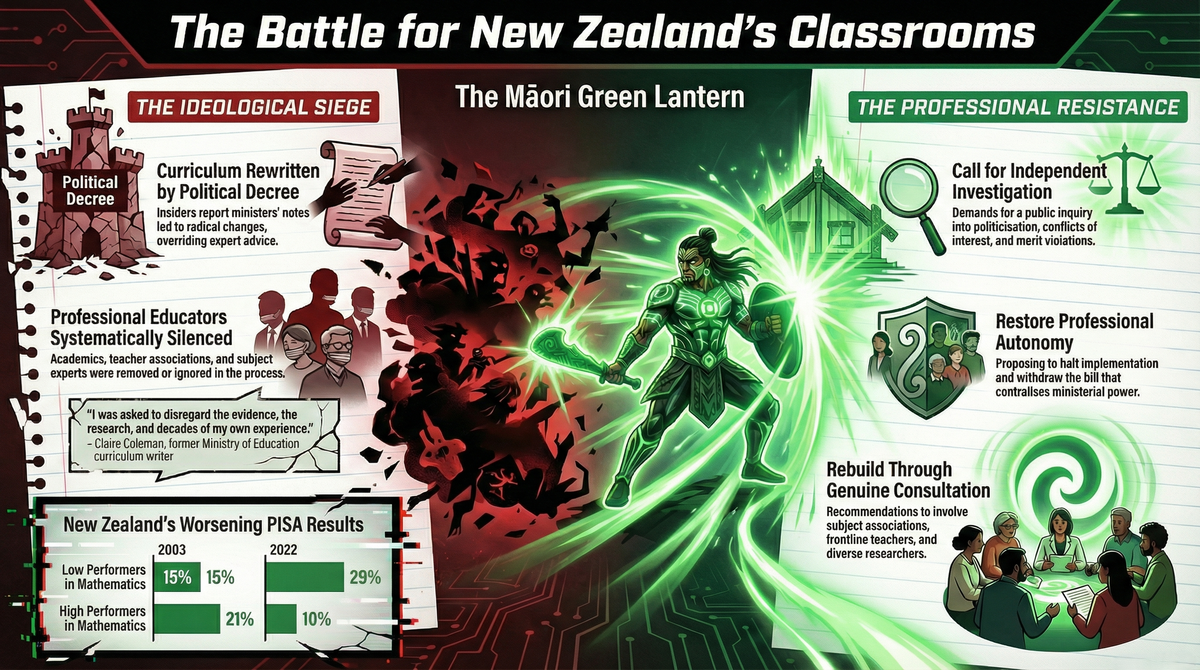
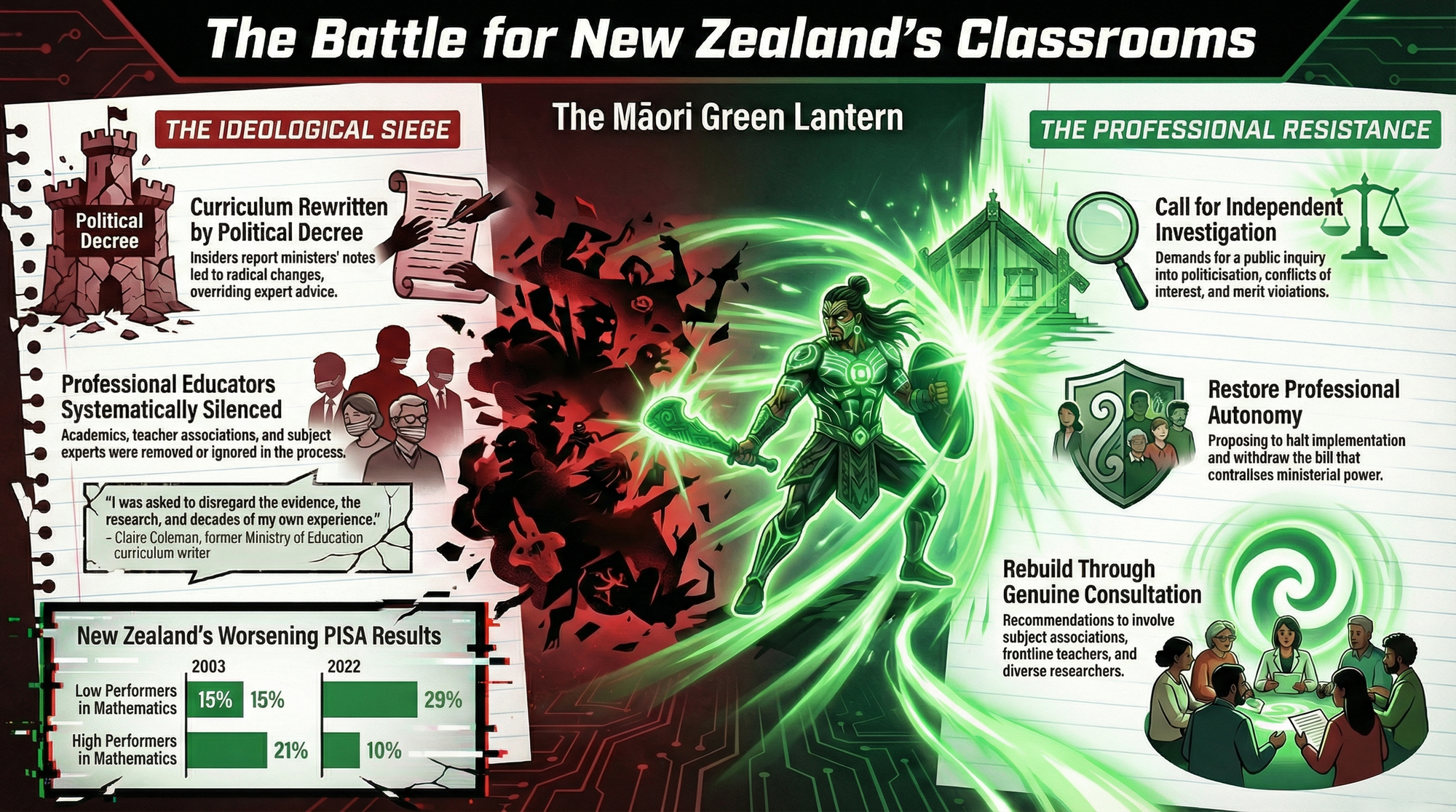
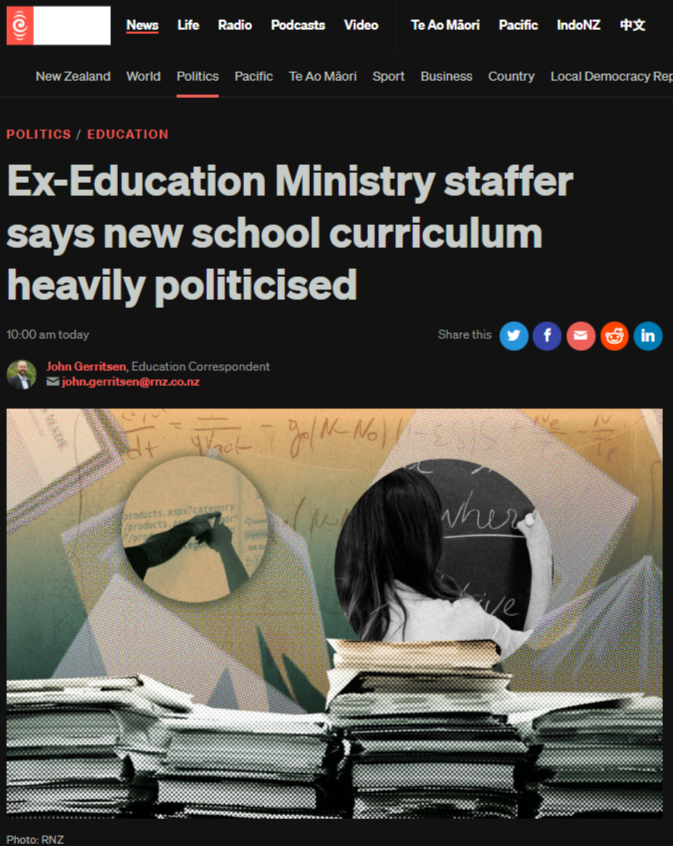
This is not hyperbole. This is the documented reality of curriculum development in Aotearoa New Zealand as of January 28, 2026, when former Ministry of Education curriculum writer Claire Coleman stood before Parliament and testified that she was instructed to
“disregard the evidence, the research, and decades of my own experience,” watching as
“academics and sector experts be removed from writing teams in favour of corporate resource creators,” and witnessing
Coleman described public servants
“routinely disregarded, bullied, and removed for not aligning with a predetermined outcome.”
This is not curriculum development. This is curriculum colonisation—a hostile takeover masquerading as reform, where evidence is the first casualty and children are the collateral damage.
The Ventriloquist Minister and Her Academic Puppet Master
Education Minister Erica Stanford didn’t simply adopt Elizabeth Rata’s ideological framework—she swallowed it whole, regurgitated it verbatim, and forced it down the throats of 800,000 schoolchildren.
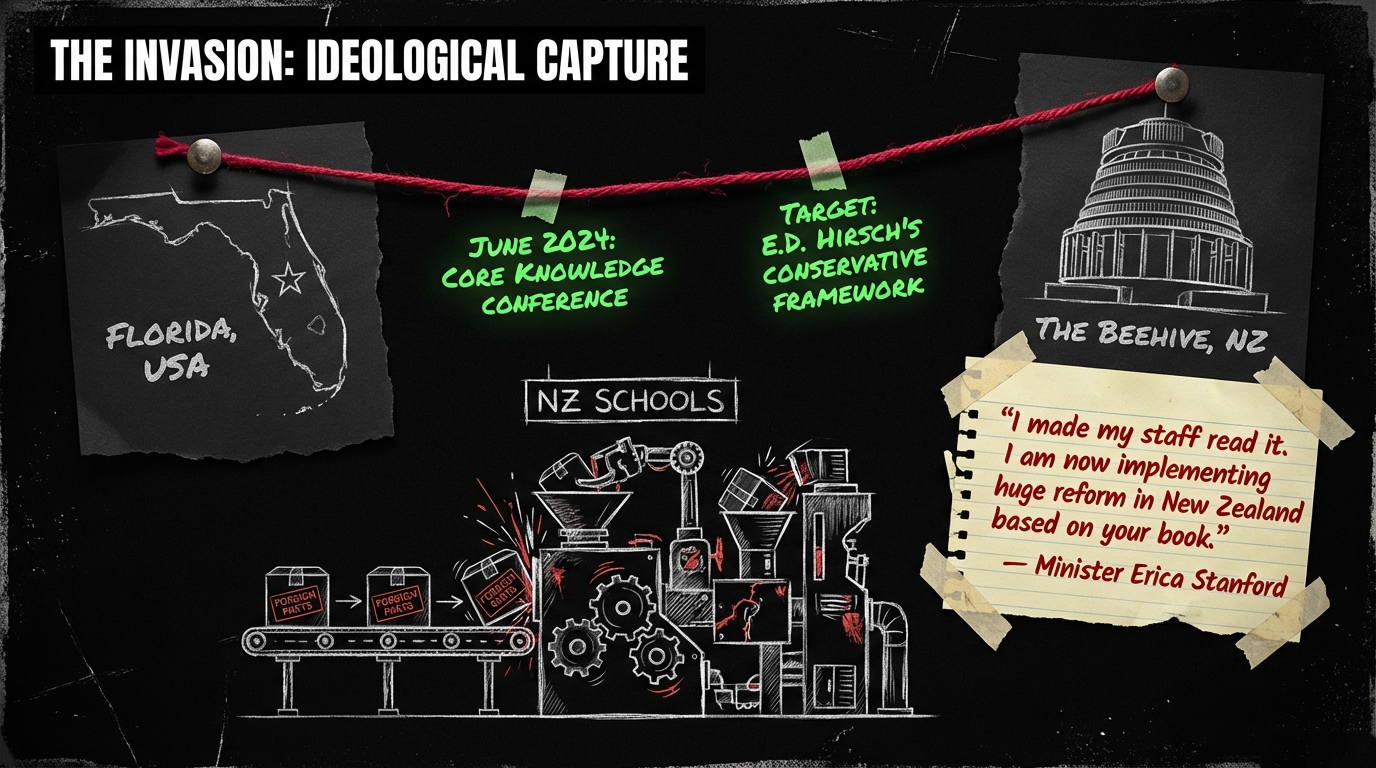
At the Core Knowledge Foundation conference in Florida in June 2024, Stanford gushed to founder E.D. Hirsch:
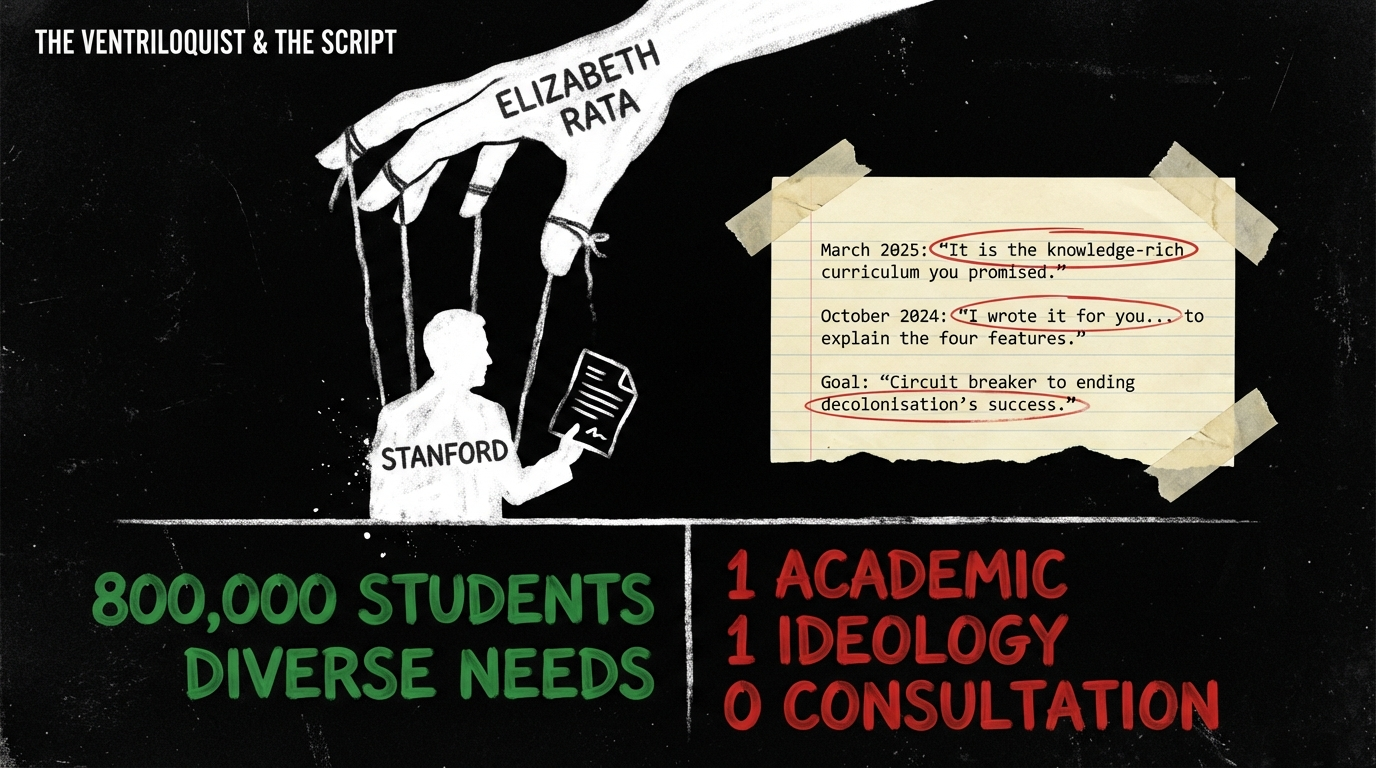
This is not policy consultation. This is ideological ventriloquism at a scale that would make even the most cynical lobbyist blush.
Rata’s influence is so pervasive it borders on governmental malpractice. She emailed Stanford in March 2025 congratulating her:
“It is the knowledge-rich curriculum you promised,”
then proceeded to write speeches for the minister.
In October 2024, following a National Party event, Rata wrote to Stanford:
Let that sink in:
An academic with an explicit political agenda is writing ministerial speeches and designing the curriculum that determines what every child in New Zealand learns. One academic. One ideological framework. Zero professional consultation worthy of the name.
Rata’s agenda isn’t subtle. She explicitly advocates using education as
“socialisation of children into the democratic nation,”
and has written speeches for Stanford explicitly hoping these reforms will serve as a
“circuit breaker” to “ending decolonisation’s success.”
This is not about literacy or numeracy. This is about using the classroom as an ideological boot camp, where five-year-olds are unwitting recruits in a culture war they didn’t ask to fight.
A Koha for Democratic Accountability in Education
Every koha signals that whānau are ready to fund the accountability that Crown and corporate structures will not provide. This essay documents what happens when ministerial ideology replaces professional expertise, when captured advisory groups write curriculum behind closed doors, and when teachers and principals are systematically excluded from decisions that determine what their students learn.
This is the work that corporate interests and political machines would prefer remain hidden. Every koha you contribute ensures that voices like Claire Coleman’s—insiders willing to risk their careers to expose systemic corruption—continue to be amplified. Your koha signals that rangatiratanga includes the power to fund our own truth tellers, our own investigations into how public institutions are being weaponised against their stated purpose.
The arsonists setting fire to professional education are counting on whānau to stay silent. They’re counting on teachers leaving the profession in silence. They’re counting on principals quitting without documenting what broke them. They’re counting on parents remaining unaware that their children’s curriculum is being written by a minister’s ideological ventriloquist, not by subject experts who understand how kids actually learn.
Your koha proves them wrong.
Kia kaha, whānau. Stay vigilant. Stay connected. And if you are able, consider a koha to ensure this voice continues speaking truth to the machinery of educational capture.
Three pathways exist:
For direct koha support to fund this investigative work:
Visit the Koha platform and contribute to support independent journalism exposing how New Zealand’s education system is being systematically politicised:
Support Education Accountability Journalism - https://app.koha.kiwi/
For ongoing essays delivered directly to your inbox:
Subscribe to receive regular analysis of how institutional capture undermines democratic education:
Subscribe for Education & Democracy Essays - https://themaorigreenlantern.substack.com/subscribe
For direct bank transfer supporting accountability journalism:
Account: HTDM
Account Number: 03-1546-0415173-000
Reference: Education Accountability
The Ministerial Advisory Group: When “Advice” Becomes Authorship
The mechanism of this capture reads like a procedural crime scene. In late 2023, Stanford appointed a Ministerial Advisory Group (MAG) ostensibly to advise on curriculum reform. But as documented through Official Information Act requests, the MAG metastasized beyond its advisory mandate to assume actual curriculum-writing responsibilities—work that a senior Ministry official cautioned on February 13, 2024, is “solely the work of government.”
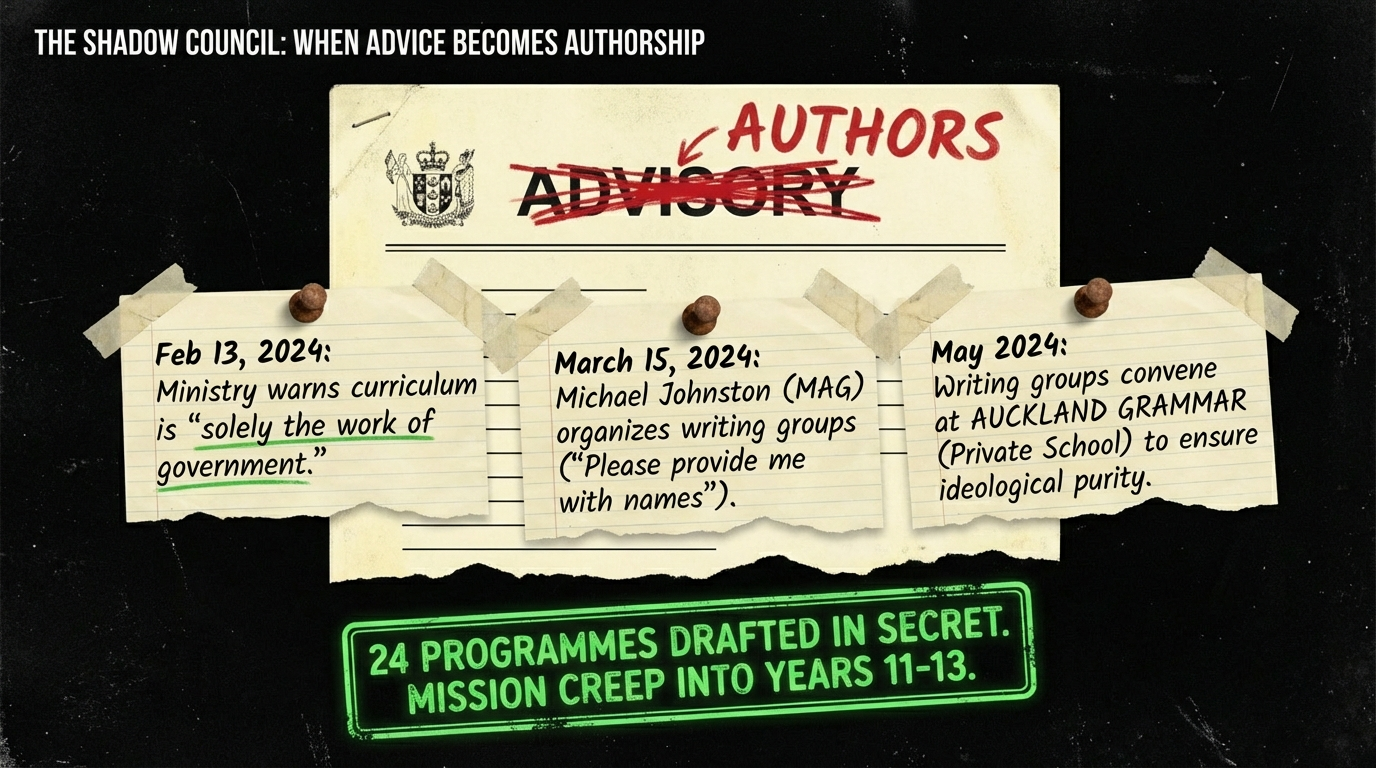
The warning was ignored. By March 15, 2024, before the MAG’s report was even publicly released, MAG member Michael Johnston was organizing writing groups, declaring:
“We will have strong input into who these people will be. Please provide me with names.”
This is not consultation. This is capture.
The MAG’s report explicitly recommended
“that the Minister authorises the MAG to draft the in-scope documents.”
Stanford agreed on April 5, 2024, effectively outsourcing governmental curriculum authority to a politically-aligned advisory body. By early May, Rata’s five-person English curriculum writing group had begun work at Auckland Grammar—not at Ministry offices where public servants could exercise oversight, but at a private school where ideological purity could be maintained.
By May 20, 2024, they had completed drafting 24 different programmes, including content for years 11-13 that were never within the project’s official scope. This is mission creep at warp speed—a small group of ideologues writing curriculum for year levels they weren’t authorized to touch, while the professionals who dedicated careers to understanding how children learn were systematically excluded.
The Merit Massacre: When Competence Becomes Inconvenient
Leaked emails showed Ministry staff expressing concern that curriculum writers were “not being appointed on merit.”
A procurement officer involved in the process wrote that
and requested reassignment from the project entirely.
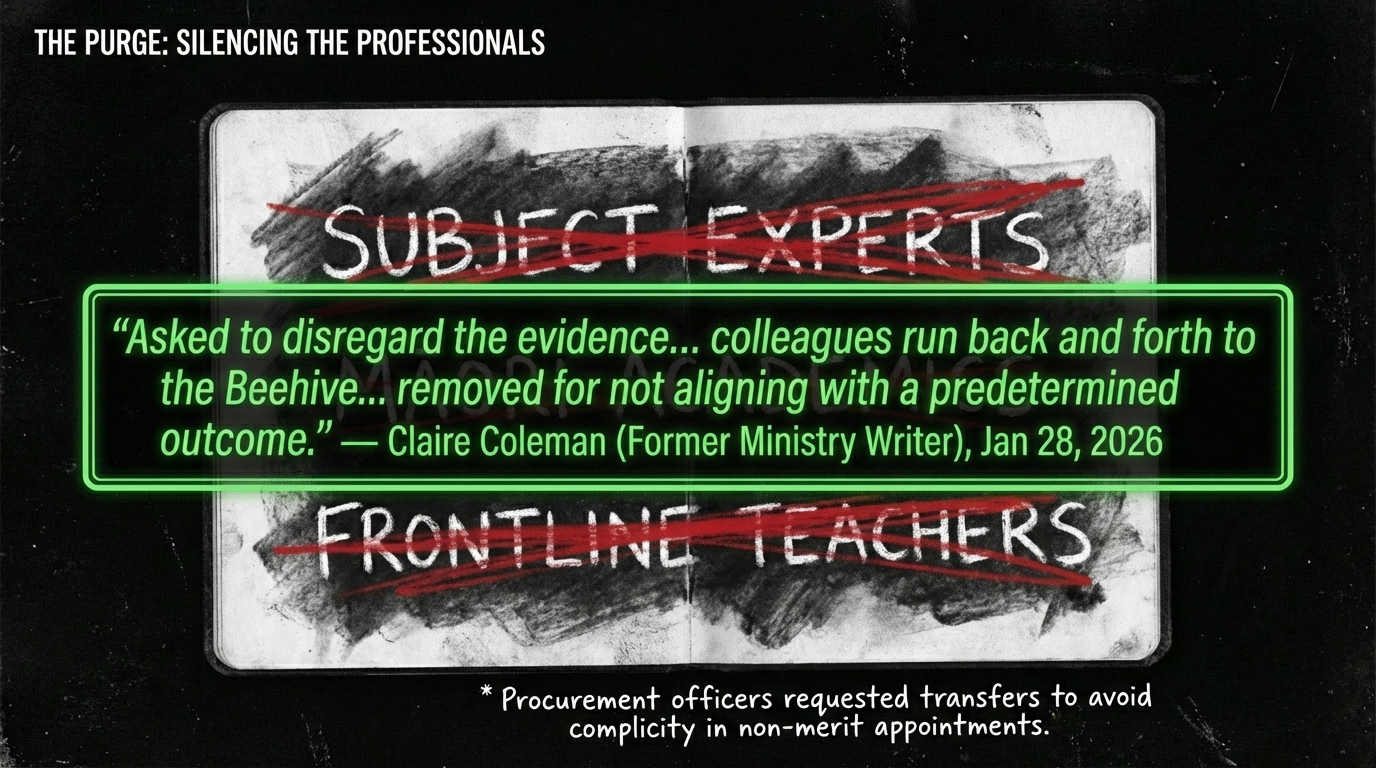
When public servants start requesting transfers to avoid complicity in a corrupted process, you’re not witnessing reform—you’re witnessing institutional rot.
The professional carnage extended far beyond curriculum writers. The NZ Association of Teachers of English president learned of the curriculum rewrite from media, not the Ministry. Subject associations—the organizations representing educators with decades of combined experience teaching English, mathematics, science—were not consulted or acknowledged. The Curriculum Voices group had its last two meetings cancelled with no reason provided. The Professional Advisory Group on NCEA was disbanded, with new members hand-selected by the Minister.
This is not streamlining. This is systematic silencing of professional expertise that might dare to question whether an ideological framework imported wholesale from conservative think tanks in the United States and United Kingdom is appropriate for Aotearoa New Zealand’s diverse, bicultural society.
The Conflict-of-Interest Carousel: When the Fox Guards the Henhouse
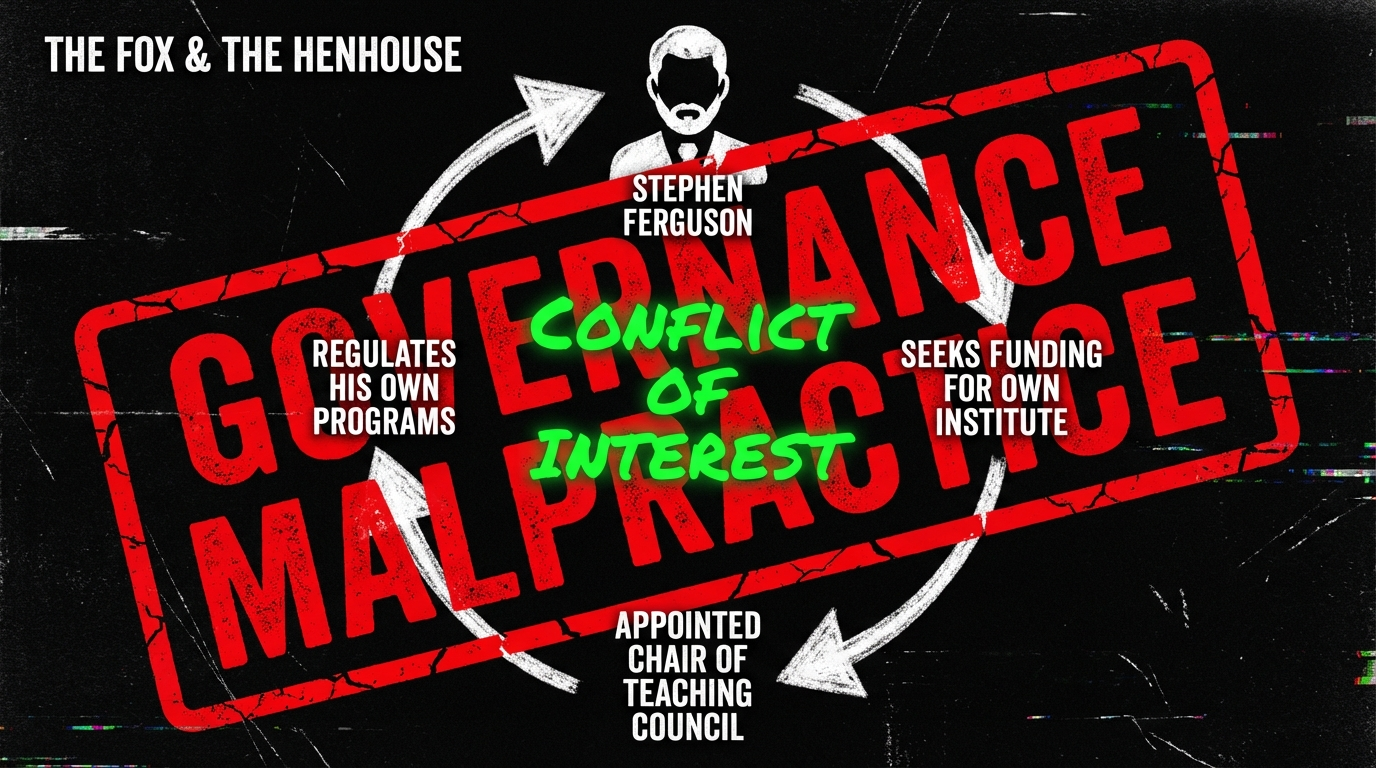
The rot extends to the highest levels of educational governance. Stephen Ferguson was appointed as Teaching Council chair after communications showing he contacted Stanford about funding for his own teacher training institute. On April 4, 2025, Ferguson messaged Stanford: “Hopefully the Ministry will support us with the requisite funding.” He was subsequently appointed as Chair of the very body responsible for approving his own programs.
This is not governance. This is a conflict-of-interest merry-go-round where ministerial appointees benefit financially while assuming regulatory authority over their own ventures. In any other sector, this would trigger immediate investigations. In New Zealand education under Stanford’s watch, it’s apparently standard operating procedure.
Quantified Harm: The Human Cost of Ideological Bulldozing
The Teacher Exodus
New Zealand teachers work 47.5 hours per week versus the OECD average of 41 hours. 33% experience stress “a lot” versus the OECD average of 19%. 73% of principals are likely to quit within five years due to crushing workload. As of January 2026, there are over 400 vacancies for school staff, with some high school teachers being made to teach subjects they’re not qualified in.
This is the baseline level of workforce crisis—before Stanford’s reforms added the burden of implementing an entirely new curriculum with inadequate consultation, compressed timelines, and zero respect for professional expertise.
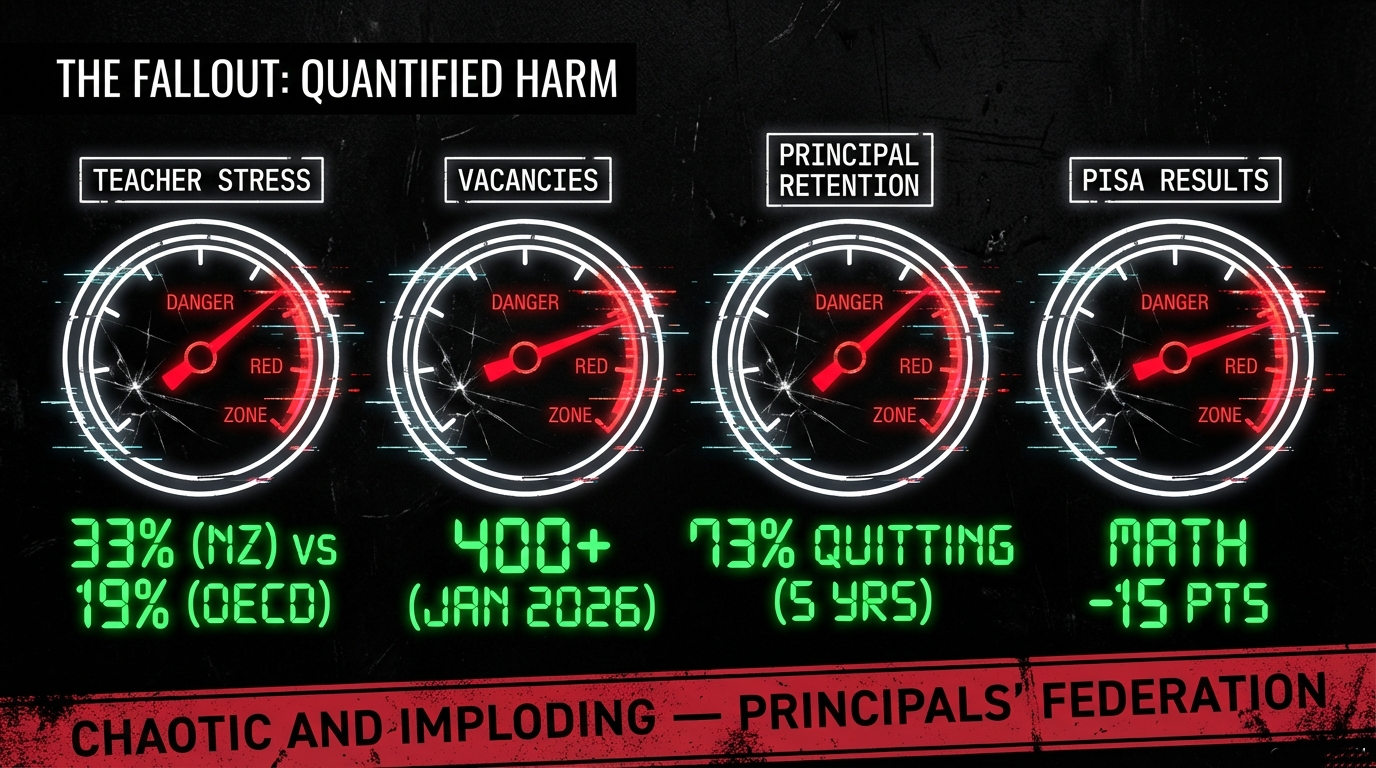
Only 50% of teachers feel confident about teaching the new English and mathematics curriculums. Over 80% of principals disagreed with the curriculum development process and timeline. Auckland Primary Principals surveyed delivered a “clear message that we would prefer more time for a really deep, authentic consultation,” noting it could take “about three years to embed the new curriculum.”
Stanford’s response? Mandate implementation in Term 1, 2026. Force-feed it down schools’ throats and call it progress.
The Principals’ Federation described curriculum changes as “chaotic and imploding.” Researcher Fiona Ell warned that deprofessionalising teaching will lead to “long-term negative effects... teacher expertise will decline and so will recruitment and retention.”
But expertise is precisely what Stanford’s reforms are designed to eliminate. You can’t capture a system still defended by professionals who remember what evidence-based practice looks like.
The Achievement Apocalypse
New Zealand’s 2022 PISA results were the worst ever recorded: mathematics dropped 15 points to 479 (ranked 23rd of 81 participants), reading dropped 4-5 points to 501, and science dropped 4-5 points to 504. The gap between rich and poor students grew. Low performers in mathematics increased from 15% in 2003 to 29% in 2022, while high performers dropped from 21% to 10%.
Stanford’s solution? Import an ideological framework from countries whose education systems are no better, implemented by a captured advisory group writing curriculum outside official channels, imposed on schools with inadequate consultation, and enforced through unprecedented ministerial overreach that puts the Teaching Council under control of ministerial appointees.
Domestic achievement data is equally catastrophic. By Year 8, only 47% of students are reading at expected level, 22% in mathematics, and 24% in writing. The government’s target of 80% by December 2030 requires miraculous improvement—yet Stanford’s reforms exhaust what little capacity remains in an already-collapsing system by forcing rushed implementation of an ideologically-driven curriculum.
NCEA Level 3 achievement among state school leavers dropped from 51% in 2019 to 47.5% in 2023—back to levels last seen a decade earlier. Post-pandemic drops are most obvious at poorer schools with higher EQI scores, revealing that social privilege plays a strong role—well-off students perform much better.
New Zealand has one of the largest differences in achievement between economically advantaged and disadvantaged students internationally, with only six countries having bigger equity gaps. Stanford’s response is to mandate a “knowledge-rich” curriculum that critics note narrows focus to traditional western knowledge structures, likely exacerbating rather than closing these gaps.
The Specialist Schools Distraction
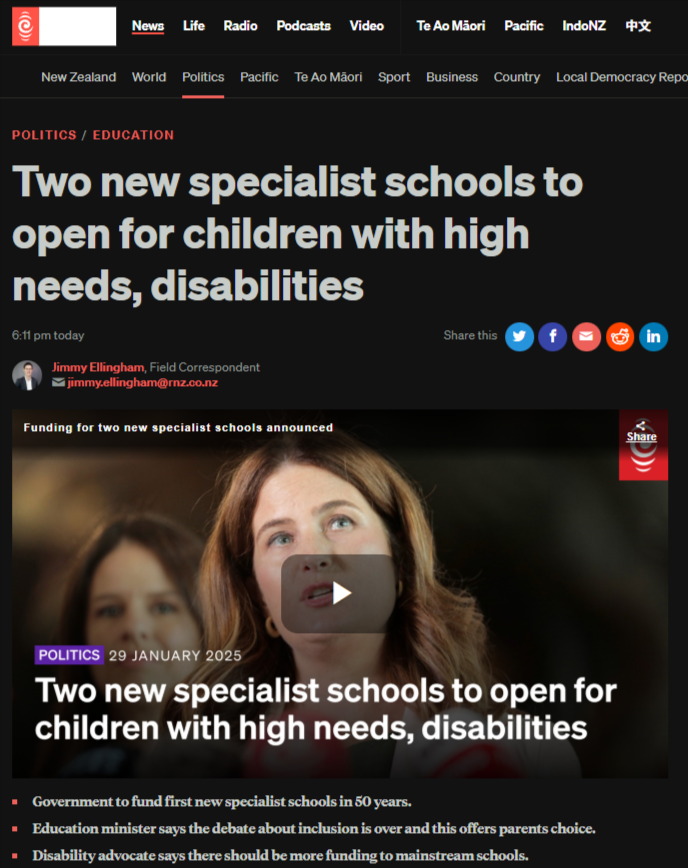
On the same day Coleman testified about curriculum corruption, Stanford announced two new specialist schools for students with high needs and disabilities—the first new specialist schools in nearly 50 years. A Palmerston North facility will open Term 2, 2027, with capacity for 36 students initially; a South Auckland facility will open Term 1, 2028, with capacity for 54 students.
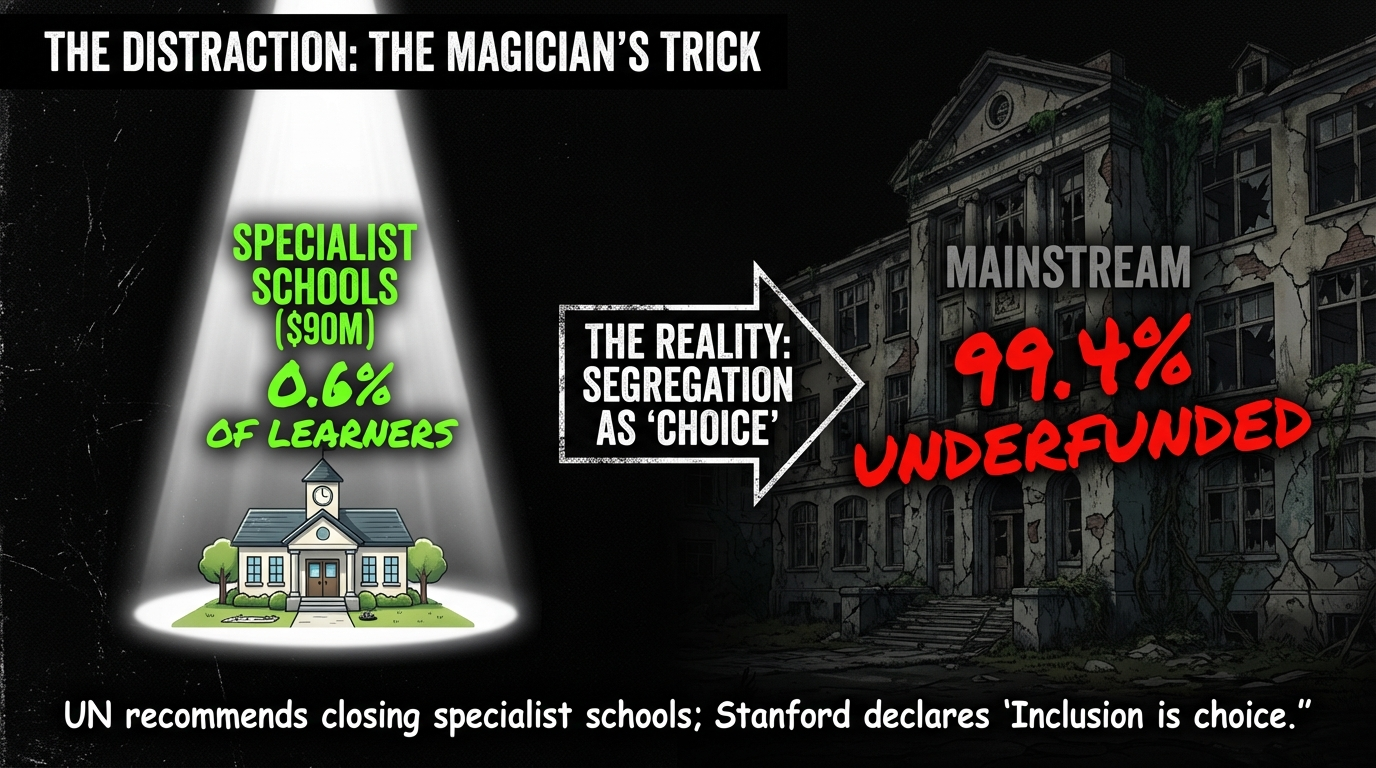
This sounds positive until context arrives. Specialist schools serve only 0.6% of disabled learners while 99.4% are in mainstream settings. The UN recommended in 2022 that New Zealand close residential specialist schools, citing international best practice favouring inclusion. The Inclusive Education Action Group condemned the $90 million specialist school funding as perpetuating segregation when mainstream schools are “desperate” for funding for initiatives supporting attendance, learning support, food, and community relationships.
This is not inclusion. This is warehousing—a politically palatable announcement designed to distract from systematic dismantling of professional standards in mainstream education.
The Democracy Deficit: When Public Education Becomes Political Theatre
International research on democratic curriculum development is unambiguous. The OSCE emphasizes that “complex challenges require inclusive processes... active consultation with all those concerned and efforts at transparency.” Best practice requires “communication with stakeholders... at all planning stages” and “integration of key stakeholders at all stages... to increase shared ownership and motivation to implement.”
Stanford’s curriculum development violated every principle. Teachers, principals, and subject experts were systematically excluded. Thirty submissions to the Education and Training (System Reform) Amendment Bill on January 27, 2026, were nearly all opposed. The Principals’ Federation called it “unprecedented ministerial over-reach.” Te Akatea expressed “absolute opposition... a project of recolonisation.”
The Bill puts the Teaching Council under control of ministerial appointees, reduces Council membership from 13 to 7-9 members with only 3 elected, eliminates requirements for consultation, replacing them with “inform” only, and gives the Minister power to change curriculum at will. The PPTA characterized it as “unprecedented power to the Minister of Education to dictate curriculum.”
This is not reform. This is democratic demolition—concentrating power in ministerial hands, eliminating checks and balances, and ensuring that future governments face no institutional resistance when imposing ideological agendas.
Research warns that “forced or rushed attempts to raise student achievement have tended to result in a focus on easily tested basic skills... at the expense of more in-depth student learning.” The “political structure of short-term election cycles... creates pressure on governments to ‘get results fast’... limits well-thought-through implementation strategy.” “Implementation is complex... variation is the rule rather than the exception... it can be described as ‘complex’ resulting in interactions that are non-linear.”
Stanford has ignored all of it, bulldozing through established process to impose reforms that serve political ideology rather than educational outcomes.
Solutions: Rebuilding from the Rubble
Immediate Actions
1. Independent Review of Curriculum Development Process
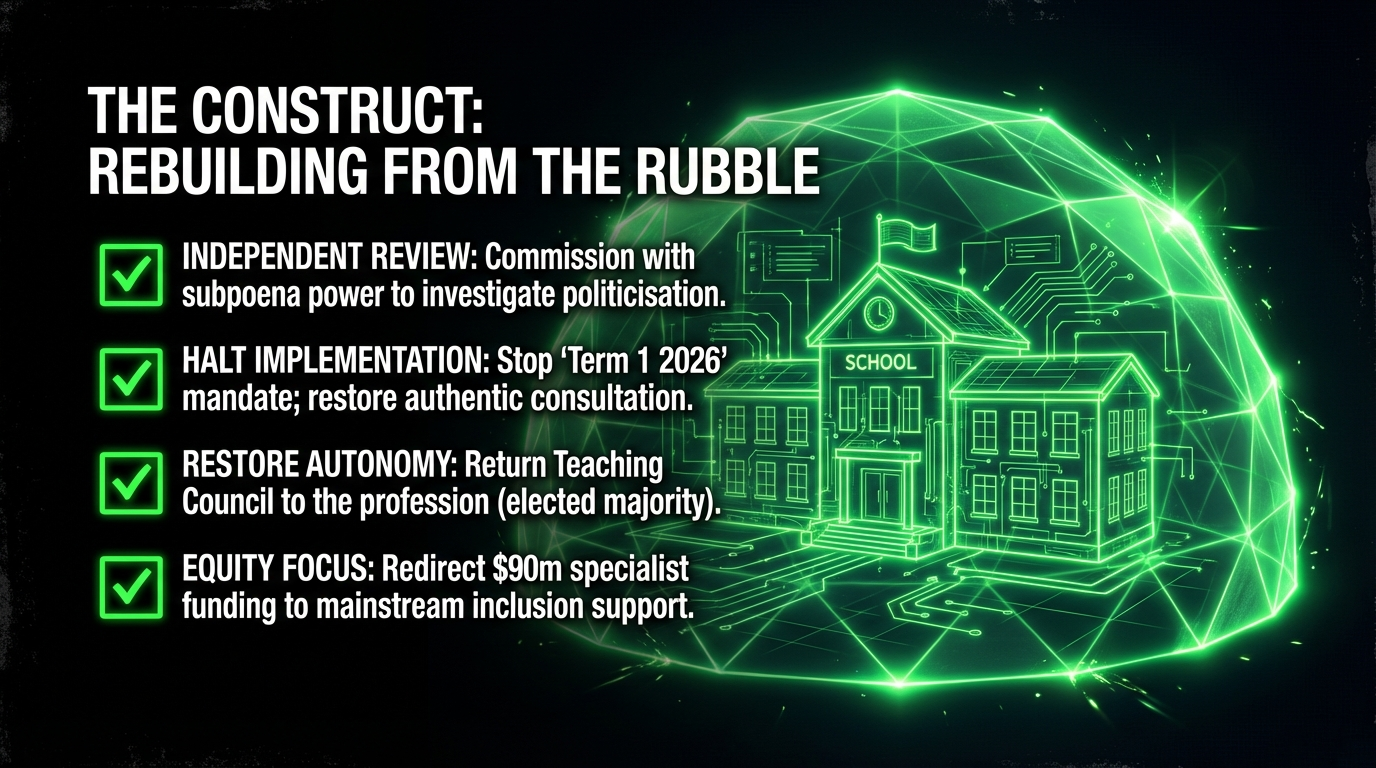
Establish an independent commission—free from ministerial control—to investigate allegations of politicisation, merit-based appointment violations, and conflicts of interest. The commission must have subpoena power, full access to Ministry documents, and authority to interview all participants without political interference. Findings must be made public and lead to binding recommendations.
2. Suspend Implementation Until Genuine Consultation
Immediately halt mandated implementation of new English and mathematics curricula. Replace compressed timelines with authentic consultation involving:
- Subject associations with decades of combined teaching experience
- Frontline teachers selected through professional bodies, not ministerial appointment
- Education researchers across theoretical traditions, not just those aligned with “knowledge-rich” ideology
- Māori educators and communities whose knowledge systems are being systematically devalued
- Disability advocates and special education professionals
- Students and families experiencing diverse educational pathways
Consultation must involve power to influence outcomes, not performative “listening” sessions where decisions are predetermined.
3. Restore Professional Autonomy to Teaching Council
Withdraw the Education and Training (System Reform) Amendment Bill. The Teaching Council must remain a professionally-led body with elected majorities, not a ministerial puppet. Teacher registration, professional standards, and initial teacher education approval must be determined by educators, not politicians pursuing ideological agendas.
4. Forensic Audit of Conflicts of Interest
Investigate all appointments to advisory bodies, curriculum writing teams, and governance roles for conflicts of interest, particularly those involving ministerial communications about funding. Stephen Ferguson’s appointment as Teaching Council chair while seeking funding for his own teacher training institute represents an egregious conflict that demands immediate resolution.

5. Resource Teachers, Don’t Burden Them
Before imposing new curriculum frameworks, address the workforce crisis making implementation impossible:
- Reduce teacher workload through smaller class sizes and increased administrative support
- Fund at least 700 additional teacher aides (the number $153 million for charter schools could have funded)
- Provide paid professional development time for curriculum familiarization
- Extend implementation timelines to match principals’ assessment that embedding new curricula requires approximately three years, not months
Systemic Reforms
6. Legislate Democratic Curriculum Development Standards
Enshrine in legislation minimum standards for curriculum development:
- Mandatory consultation with professional bodies at all stages
- Public reporting of curriculum writer qualifications and selection processes
- Transparent documentation of ministerial input with version control showing who changed what and when
- Independent oversight of process integrity by Education Review Office
- Requirement that curriculum development be evidence-based with citations to peer-reviewed research
7. Establish Curriculum Stability Windows
Legislate minimum timeframes between major curriculum changes (e.g., five years) to prevent political cycling that exhausts teachers and prevents proper implementation. Reforms should span electoral cycles, requiring cross-party consensus for major changes.
8. Mandate Equity Impact Assessments
Require independent equity impact assessments before implementing curriculum changes. Assessments must quantify likely effects on achievement gaps between socioeconomic groups, document consultation with affected communities, and provide mitigation strategies for identified harms.

9. Rebalance Funding Toward Mainstream Inclusion
Redirect specialist school funding toward inclusive education supports in mainstream settings, aligning with international best practice. This includes:
- Funding for learning support coordinators in every school
- Professional development in inclusive pedagogies
- Physical accessibility improvements
- Specialized equipment and technology
- Reduced student-teacher ratios for classes including students with high needs
10. Establish Independent Education Integrity Commission
Create a standing commission analogous to the Auditor-General’s office to monitor educational governance, investigate conflicts of interest, audit curriculum development processes, and report annually to Parliament on adherence to professional standards. The Commission must be funded independently and protected from ministerial interference.
Cultural Transformation
11. Reject Imported Ideological Frameworks
New Zealand’s bicultural, diverse society requires curriculum frameworks developed for our context, not imported wholesale from conservative think tanks in the United States and United Kingdom. Curriculum development must genuinely integrate te ao Māori and Pacific knowledge systems, not tokenize them while centering “traditional western knowledge structures.”
12. Restore Evidence-Based Practice
Require all educational policy changes to be accompanied by:
- Literature reviews of peer-reviewed research
- Pilot programs with rigorous evaluation before system-wide implementation
- Transparent documentation of research basis for decisions
- Public challenge processes where researchers can contest misrepresentation of evidence
As critics have noted, too many education reforms are
“driven by ideology rather than evidence.”
This must end.
13. Rebuild Trust Through Transparency
Ministry of Education must:
- Publish all curriculum development communications, including ministerial input
- Live-stream advisory group meetings with public comment periods
- Maintain public databases of curriculum writer qualifications and selection processes
- Provide annual reporting on teacher workload, stress levels, and retention with third-party validation
14. Invest in Teacher Professionalism
Treat teachers as professionals, not interchangeable factory workers:
- Competitive salaries reflecting the importance of education
- Genuine career pathways beyond classroom teaching or administration
- Protected time for collaboration, professional development, and curriculum planning
- Meaningful voice in institutional decisions through elected representative structures

15. Recognize Education as Multigenerational Project
Abandon the political fantasy that educational outcomes can be transformed within single electoral cycles through ministerial decree. Sustainable improvement requires:
- Long-term investment sustained across governments
- Stability allowing reforms to be properly implemented and evaluated
- Patience to build professional capacity rather than mandate compliance
- Humility to acknowledge that evidence may not support preferred ideological positions
Choosing Between Expertise and Ideology
New Zealand stands at a crossroads. One path leads deeper into ideological capture—where curriculum is written by political appointees serving ministerial agendas, where professional expertise is systematically excluded, where teachers flee a profession that no longer values their knowledge, and where children become cannon fodder in culture wars they never signed up to fight.

The other path requires confronting uncomfortable truths:
that improving educational outcomes is complex, evidence-based, and requires genuine partnership with professionals who dedicate careers to understanding how children learn. It requires admitting that importing ideological frameworks from overseas conservative networks is not educational policy—it’s colonisation wearing the mask of reform.
Claire Coleman’s testimony on January 28, 2026, offered a rare glimpse behind the curtain. She showed us the machinery of capture: ministerial red pens rewriting curriculum documents overnight, academics removed for insufficient ideological purity, public servants bullied into compliance, merit discarded when it conflicts with predetermined outcomes.
The question is whether New Zealanders will demand accountability, or whether we’ll continue sleepwalking toward an education system where political ideology trumps professional expertise, where teachers are interchangeable assembly-line workers, and where children’s futures are sacrificed on the altar of imported conservative orthodoxy.
The factory is on fire. The professionals who know how to fight it are being forced out. And the arsonists are calling themselves reformers.
It’s time to stop the charade before the entire structure collapses.
Every contribution—whether $5 or $500—funds the next investigation, the next interview with educators brave enough to speak on record, the next forensic analysis of captured institutions. Every koha says to the arsonists: “We see what you’re doing. We’re funding the truth tellers. And we’re not going anywhere.”
The education factory is on fire. Help us document who lit the match.
Ivor Jones The Māori Green Lantern Fighting Misinformation And Disinformation From The Far Right