"The Edwards Disinformation Project" - 19 January 2026
How Two Articles Conspire to Destroy a Serious Political Movement
Kia ora koutou,
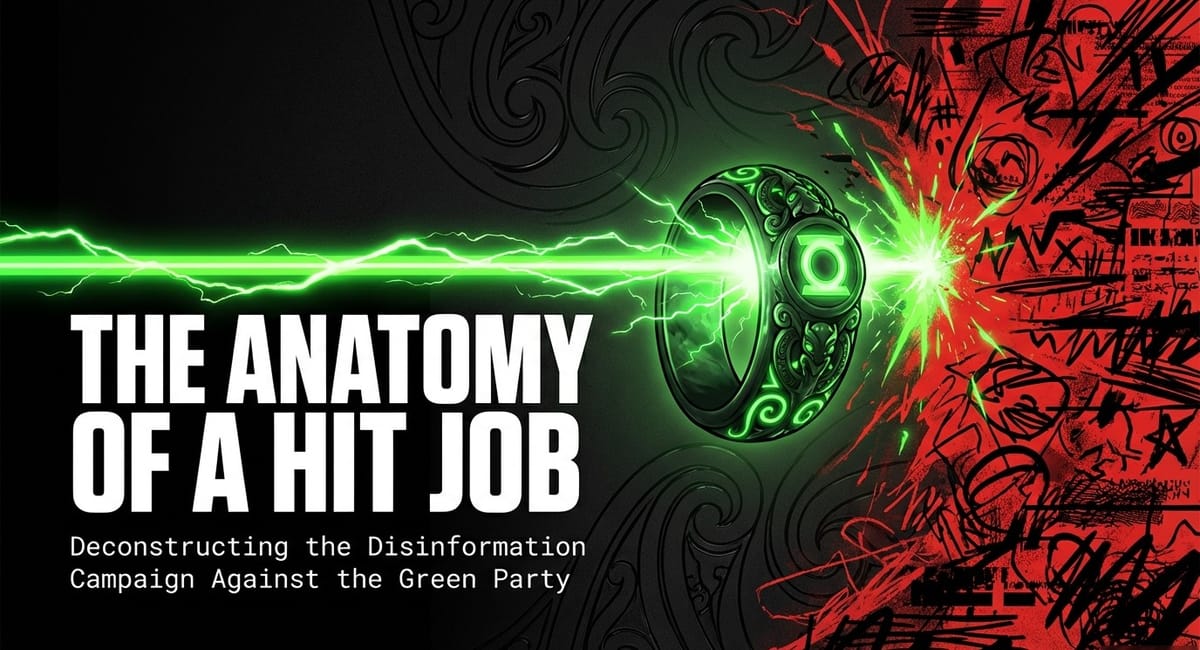
Over the course of two days in January 2026, Bryce Edwards published a coordinated attack on the New Zealand Green Party that functions not as honest political analysis but as a carefully constructed disinformation campaign.
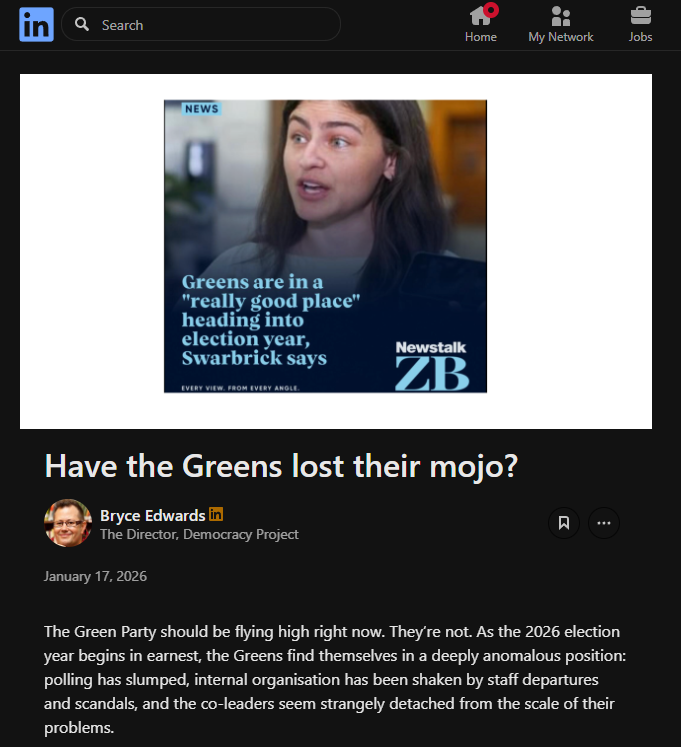
In “Have the Greens lost their mojo?” he establishes an atmosphere of crisis and decay—scandals, staff exodus, hubris, denial—while quietly admitting that the party “did the homework” on serious climate and economic policy.
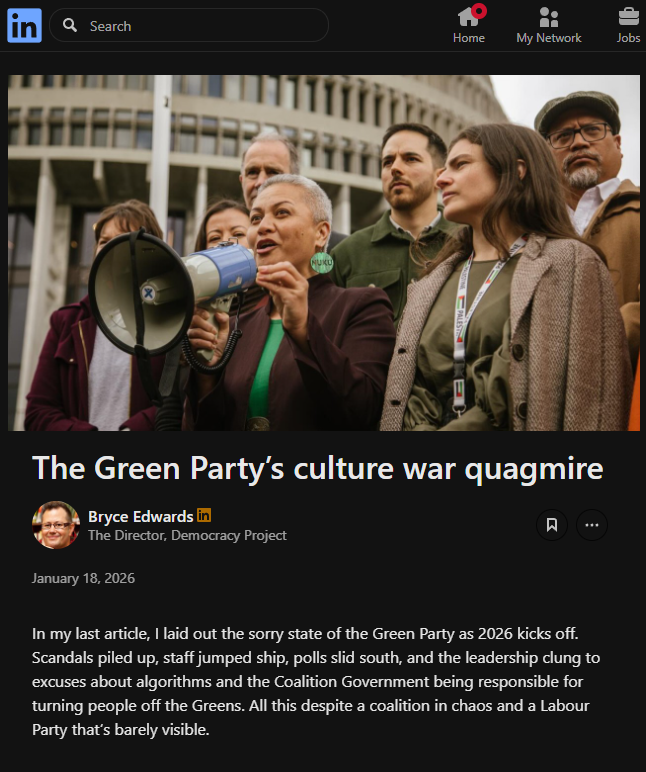
Then, in “The Green Party’s culture war quagmire,” he erases that very work from memory and declares instead that the Greens have “abandoned the environment” and become a “Palestine and pronouns party” obsessed with identity politics rather than material struggle.
The contradiction is not accidental. It is the method.
By controlling what facts are visible in each article and what is conveniently forgotten between them, Edwards achieves a narrative that bears little resemblance to the Greens’ actual record
—a record that includes the most ambitious climate and economic-redistribution platform in Parliament.
The stakes are not academic. If a respected political analyst can successfully rebrand a serious climate and justice movement as a toxic “woke” sect through selective omission, weaponised scandal coverage, and a rigged echo-chamber of culture-war pundits, then voters have no real option to hold corporate power and climate denial to account.
This essay deconstructs the techniques Edwards uses to manufacture that false narrative, and shows why both articles should be read not as analysis but as disinformation.
Koha consideration
This essay names a familiar machine:
a pundit class laundering culture‑war smears into “analysis” to blunt a real challenge to Crown and corporate power.
If this kind of accountability matters, then koha is not charity — it is rangatiratanga in practice:
whānau choosing to fund our own truth‑telling when the institutions that profit from distortion will not.
If you’re able, consider backing this mahi so these investigations keep landing — sharper, better resourced, and harder to ignore.
Three pathways:
- Koha platform (voluntary contribution): Koha—Support via Koha (this page states the organiser is verified and koha goes to a verified Westpac account).
- Subscribe to receive essays directly: Subscribe to the Māori Green Lantern on Substack.
- Direct bank transfer: HTDM — account number 03-1546-0415173-000.
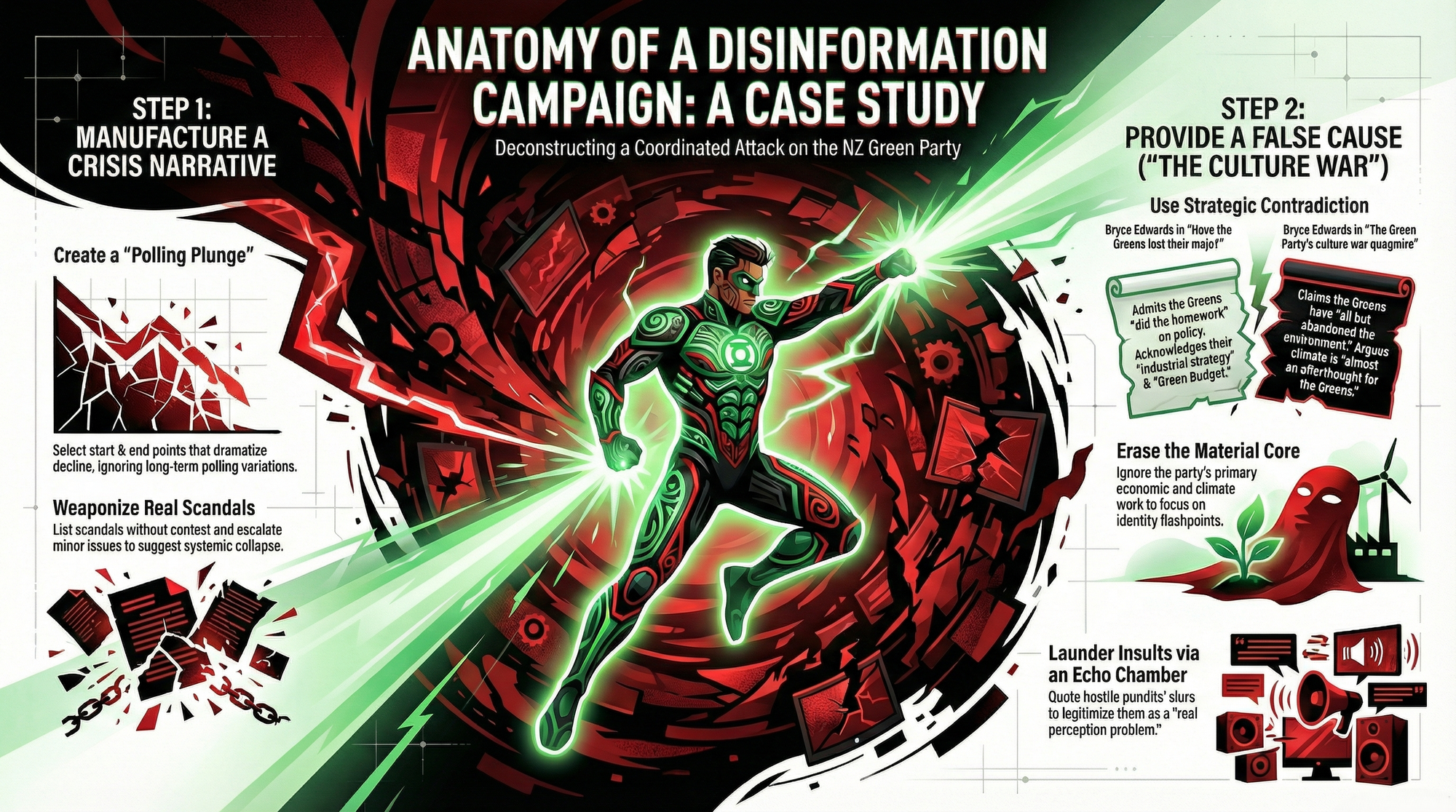
Two Articles, One Coordinated Attack
Bryce Edwards’ “Have the Greens lost their mojo?” and “The Green Party’s culture war quagmire” are not independent analyses that happen to be harsh on the Greens. They function as a coordinated, two‑step disinformation campaign.
- The first article constructs a story of a party in free fall: scandal‑ridden, hollowed out by staff exits, deluded by hubris, and trapped in “structural denial”.
- The second article then supplies the “underlying cause”: the Greens have “abandoned the environment”, become a “Palestine and pronouns party”, and are hopelessly trapped in identity politics and culture wars.
What makes this disinformation rather than just bias is that Edwards achieves his conclusions only by systematically omitting the Greens’ major climate and economic work, contradicting himself across the two pieces, cherry‑picking the most hostile commentators and treating their insults as analysis, and collapsing complexity into a monocausal morality tale:
“wokeness destroys parties”.
1. Contradiction as a Technique: From “They Did the Homework” to “They Abandoned the Environment”
In the first article, Edwards makes a crucial admission:
“The Greens released detailed policy documents throughout 2025, including an industrial strategy, a comprehensive Green Budget, and a fiscal strategy that challenged core assumptions of the Public Finance Act. They did the homework.”
That is a striking concession:
he acknowledges they have been producing serious, technocratic policy work on the economy and climate.
Yet in the second article, he asserts the opposite:
- The Greens have “all but abandoned the environment”.
- Climate politics is “in retreat”, “with the Greens leading the way”.
- Environmentalism has been “sidelined” for a grab‑bag of identity causes; climate is “almost an afterthought for the Greens these days”.
Both cannot be true.
A party that invests scarce resources into an industrial strategy, a Green Budget and a fiscal‑reform blueprint has not “abandoned” its environmental and economic mission. Edwards needs the “they did the homework” line when portraying them as technocratic but politically incompetent; he needs the “they abandoned the environment” line when depicting them as swallowed by culture wars.
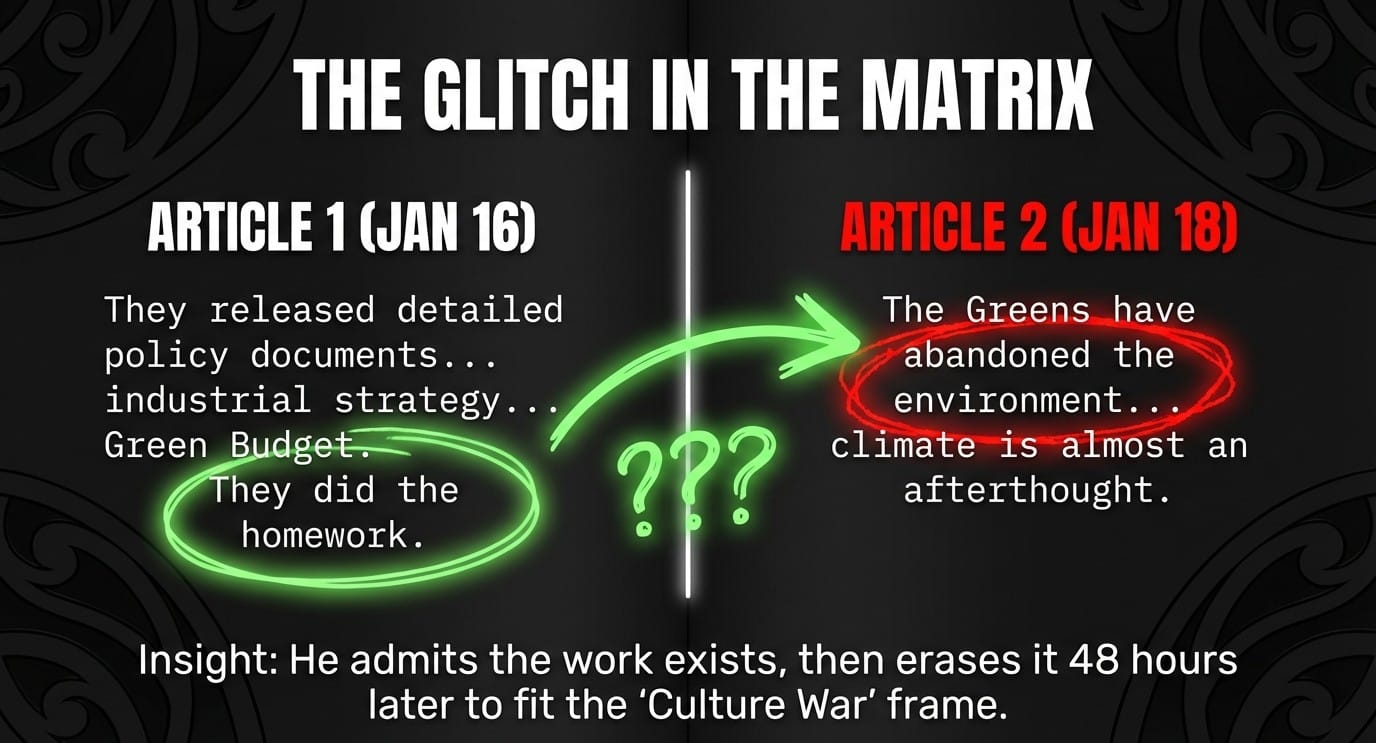
Instead of grappling with this tension, he simply drops the “homework” fact in the second article. The climate and economic work he previously acknowledged vanishes from view. This is textbook disinformation logic: facts are acknowledged only when they serve the story; when they don’t, they are erased.
2. Manufacturing a Crisis: Polls, Scandals and Staff Exits as Narrative Scaffolding
Both articles lean hard on an atmosphere of crisis to make the disinformation plausible.
2.1. Polls inflated into existential judgment
Edwards points to a 1News–Verian poll putting the Greens at 7%, down from 11.6% at the 2023 election and below earlier highs of around 15%. He dubs this a “polling plunge” and uses it to frame the party as losing its “mojo”.
But the Green Party’s historical range has typically been around 6–11%. Being at 7% is not a unique collapse; it is within long‑run variation. Edwards never shows a full multi‑year polling series; he picks start and end points that dramatise decline. By treating that peak as the “natural” level and anything below as catastrophic, he manufactures a sense of implosion.
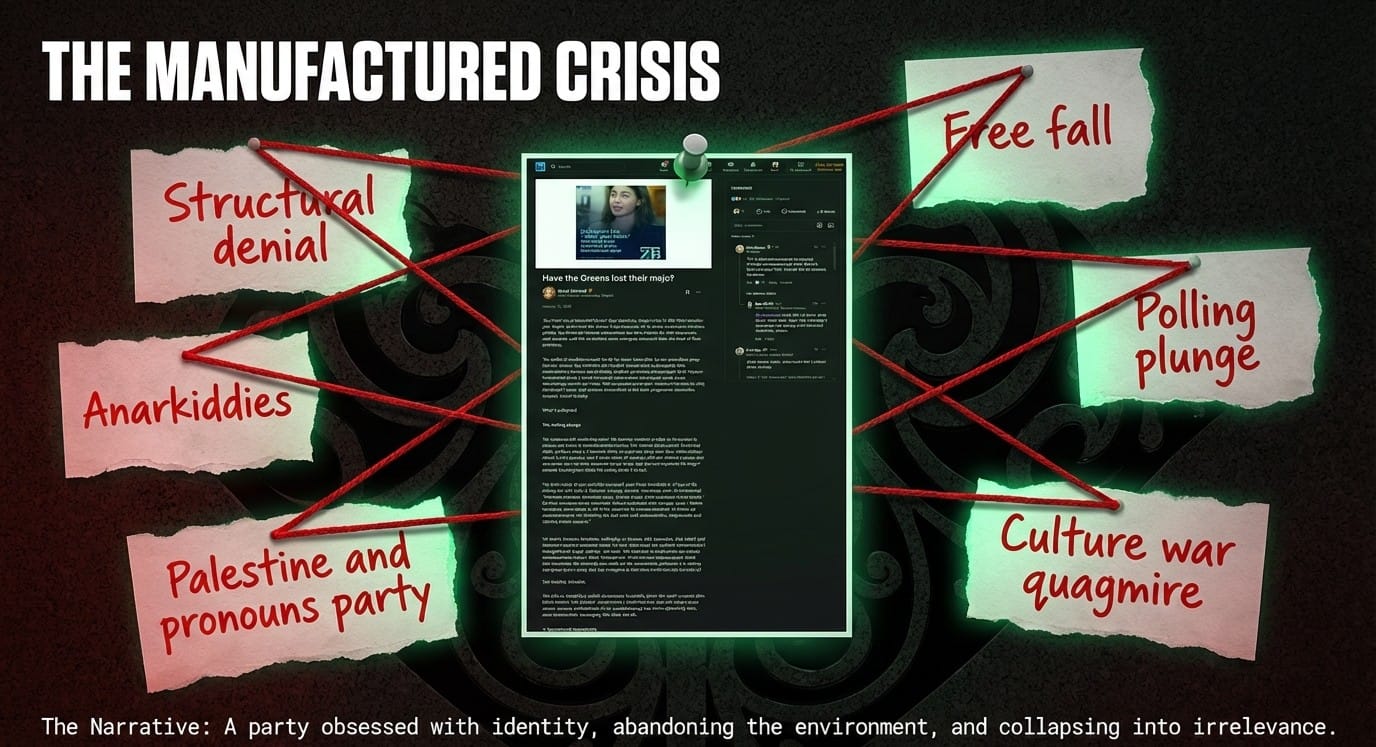
That inflated sense of “free fall” then becomes the emotional backdrop for the second article’s claim that the party is trapped in a “culture war quagmire”. The crisis is real enough to feel plausible, but it is stage‑managed.
2.2. Real scandals, weaponised and de‑contextualised
Both pieces compile the same list of Green scandals: Elizabeth Kerekere’s conduct; Darleen Tana and migrant exploitation allegations; Golriz Ghahraman’s shoplifting; Benjamin Doyle’s Instagram controversy; Marama Davidson being late to her own Right to Repair bill.
The raw events are not invented. The disinformation lies in:
- De‑contextualisation: There is no mention of other parties’ scandals – sexual misconduct, dodgy donations, bullying – that would show such problems are systemic. Only Green misdeeds count as evidence of collapse.
- Escalation: An MP being 20 seconds late to the chamber for a bill reading is framed as “hard to claim you’re ready to lead the country when you can’t make it to the chamber for your own legislation”. This is attack‑line rhetoric, not proportionate analysis.
- Generalisation: Individual failings are transmuted into the essence of the party – a caucus of “anarkiddies” and “hubristic” activists who “prefer performative outrage” to serious politics.
Once that essence is established in the first article, the second can confidently diagnose the underlying sickness as identity politics and culture‑war obsession. Scandals stop being contingent failures to be fixed; they become moral evidence that “wokeness” has rotted the project from within.
3. The Culture-War Narrative: “Palestine and Pronouns” as Total Explanation
The second article’s key rhetorical stroke is to brand the Greens as the “Palestine and pronouns party”, supposedly “more interested in pronouns and Palestine than power bills and polluted rivers”. The first article preps this conclusion by presenting the party’s actual economic and environmental work as invisible to voters; the second claims it barely exists.
This is disinformation in two layers.
3.1. Hyper-focus on identity flashpoints
Across both pieces, Edwards obsessively returns to:
- The Doyle saga, reduced to “queer slang” on a “bizarre” social‑media account.
- Chlöe Swarbrick’s Palestine activism, symbolised by the “keffiyeh” jibe approvingly quoted from Chris Trotter.
- The party’s engagement with Te Tiriti, co‑governance, and gender issues, framed as evidence of “post‑materialist” obsession with identity.
Every such episode is presented in its most inflammatory version. Context that would complicate a simple culture‑war reading is either absent or treated as beside the point. These flashpoints then become explanatory shorthand: if the Greens are struggling, it must be because they are “bogged down” in pronouns and Palestine, not because of climate‑policy complexity, corporate media hostility, structural voter disengagement, or the sheer difficulty of pushing redistribution in a low‑trust era.
3.2. Erasing the material core
At the same time, across both articles, Edwards minimises or ignores:
- The Greens’ emissions‑reduction plan, Green Budget and industrial strategy work that he himself admitted “did the homework”.
- Their relentless campaigning on cost of living, rent controls, wealth taxes, windfall taxes, supermarket duopoly and banking profits – the backbone of their policy output in 2024–26.
- Their consistent linking of climate, inequality, and corporate power – framing climate policy as a jobs and bills issue, not a boutique concern.
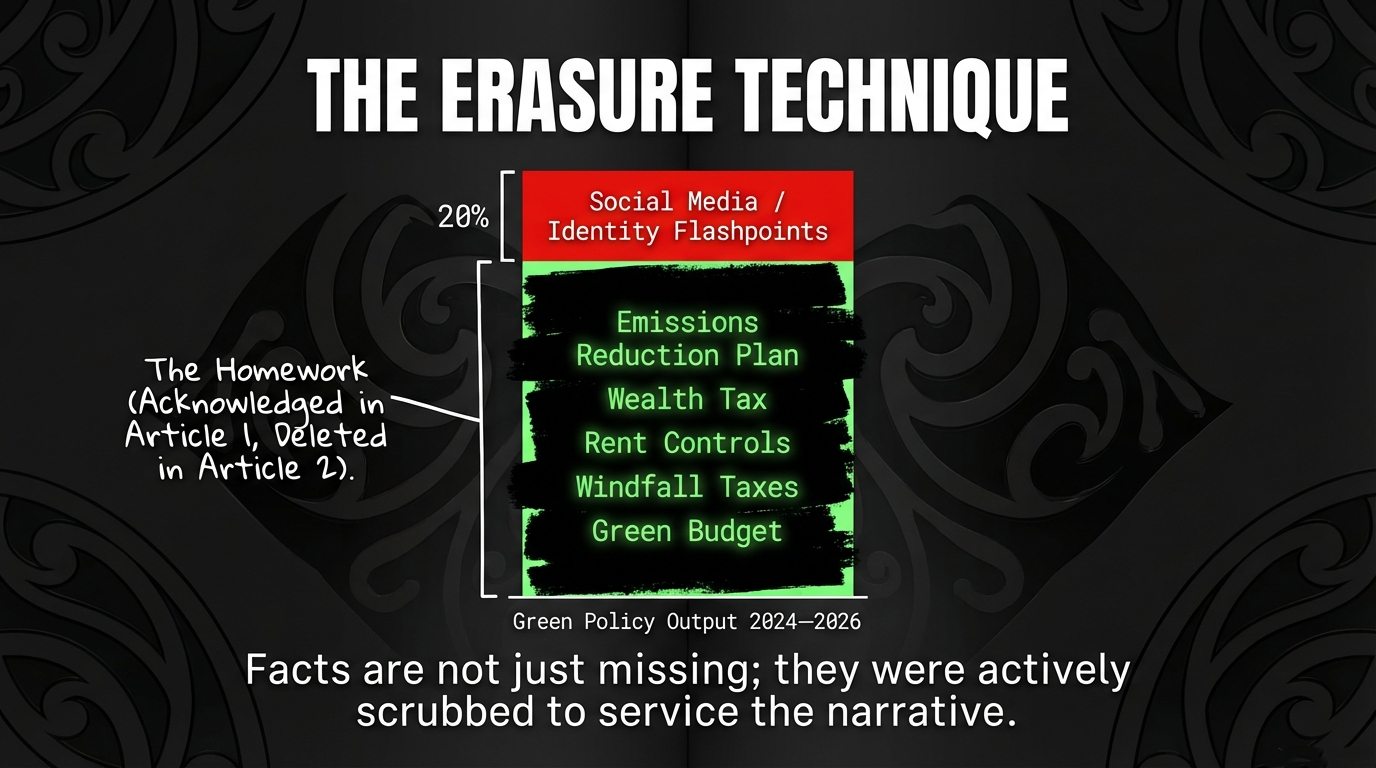
In the first article he briefly concedes that they “did the homework” on policy but notes that “none of it translated into increased support”. In the second article, trying to sell the story that the environment has been “abandoned” for identity, he behaves as though that homework never existed.
This is not just cherry‑picking; it is a deliberate relabelling of a climate‑and‑economic‑justice party as an identity‑politics sect. The primary content of their programme is painted out of the frame so that the most telegenic culture‑war episodes can stand in for the whole.
4. Delegitimising Structural Explanations: How Edwards Enforces a Single Narrative
A subtle but important part of the disinformation pattern is how Edwards treats any structural explanation offered by the Greens.
4.1. Voter disengagement dismissed as excuse
When Swarbrick suggests that some of the government’s agenda is designed to disengage people from politics, Edwards calls this “extraordinarily weak” and “analytically backwards”. He asserts that unpopular laws should “galvanise opposition support” and therefore the Greens’ failure to surge must be entirely their own fault.
But in many democracies, reactionary or chaotic governments do generate disillusionment, not just swings to opposition. Voters can believe “they’re all useless” and tune out rather than flock to minor parties. That possibility is dismissed out of hand because it would dilute his morality tale of Greens as sole authors of their misery.
4.2. Algorithms and Palestine treated as conspiracy
Similarly, when Swarbrick and Davidson talk about the collapse in their social‑media reach and suspect algorithmic throttling – especially over Palestine content – Edwards brands this “conspiracy” and “victimhood narrative”, only briefly conceding “there’s something to this” before moving on.
He does not ask whether there is any pattern of Palestine‑related content being disproportionately suppressed, or how rational it might be to shift emphasis back to door‑knocking and face‑to‑face organising. Instead, he reframes “touch grass” as a kind of personal surrender – an “admission of defeat” by a once‑savvy social‑media operator. The structure of digital capitalism and content moderation disappears; “algorithms” become code for “excuse”.
The through‑line is clear: any explanation that points to larger systems – media sensationalism, disengagement, platform power – is pathologised as Green denial. Only explanations that blame “identity politics” and “post‑materialist focus” are validated. That is not analysis; it is enforcing a single permitted story about cause and effect.
5. The Pundit Echo-Chamber: How Insults Are Laundered into Evidence
Across both pieces, Edwards repeatedly imports the most caustic lines from Graham Adams, Andrea Vance, and Chris Trotter:
- “Caucus of anarkiddies posting out social‑justice clickbait.”
- “Palestine and pronouns party.”
- “Chlöe ‘keffiyeh’ Swarbrick and Marama ‘It’s all the fault of cis white males!’ Davidson.”
- Swarbrick’s leadership goal as a “fever dream”.
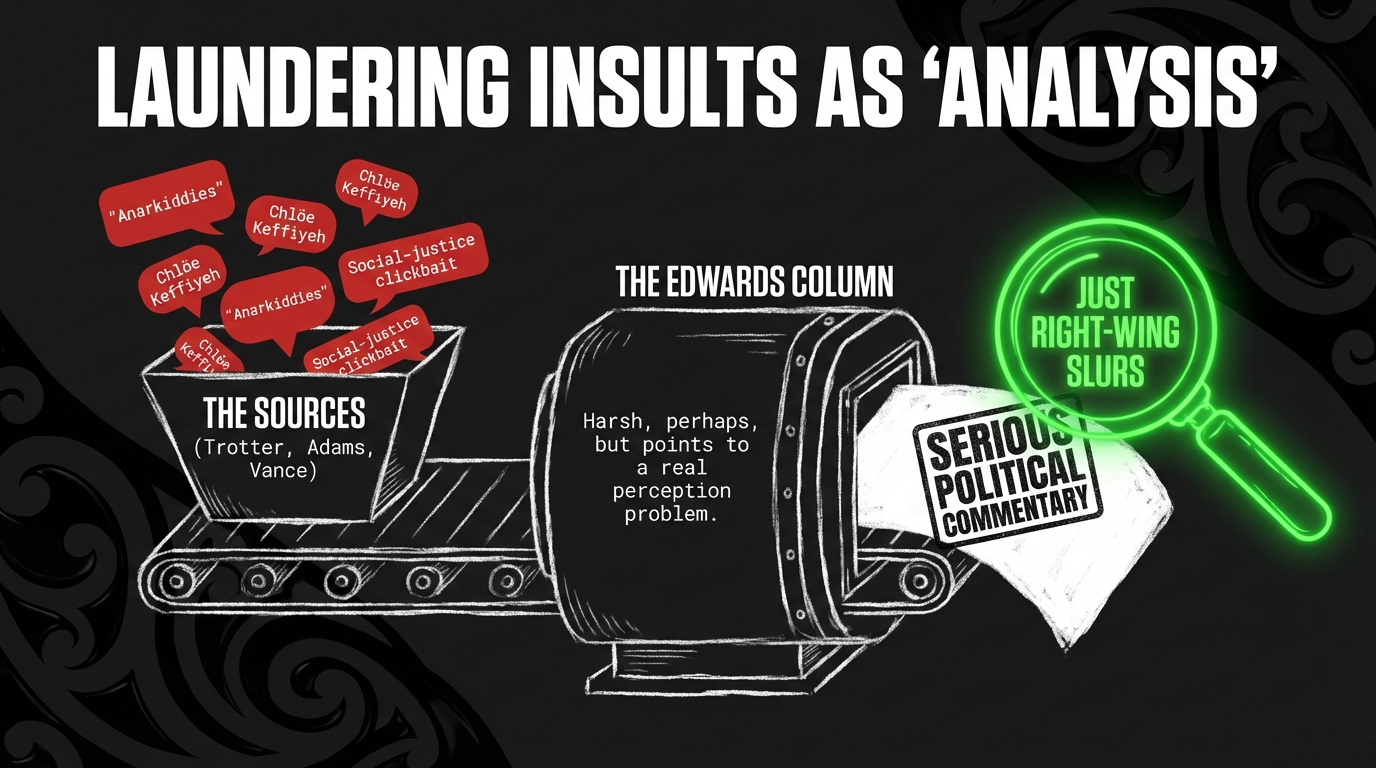
These are not neutral descriptors. They are crafted to humiliate and to slot the Greens into a global right‑wing cartoon of “woke elites”: privileged, hysterical, disconnected from “real people”.
Edwards’ trick is to quote them at length, then half‑distance himself with lines like “Harsh, perhaps, but these critiques point to a real perception problem”. In doing so, he:
- Amplifies the emotional impact of the slurs.
- Legitimises their content as common sense (”real perception problem”) rather than one contested viewpoint in a polarised debate.
- Avoids owning the full nastiness, because, technically, he’s only quoting.
This echo‑chamber matters. Once readers have had “anarkiddies”, “Palestine and pronouns”, and “Chlöe keffiyeh” hammered into their mental image of the Greens, the culture‑war explanation feels natural. The disinformation is not just what Edwards says; it is what he chooses to let others say on his stage, and how he frames it.
6. Why This Is Disinformation, Not Just Harsh Commentary
Disinformation is not only outright lies. It is also:
- Systematically misleading framing that hides crucial context.
- Contradictory storytelling where facts are used or suppressed depending on the rhetorical need of the moment.
- Emotionally loaded narratives that channel justified frustrations (scandals, organisational failures) into inaccurate diagnoses (it’s all “woke culture wars”).
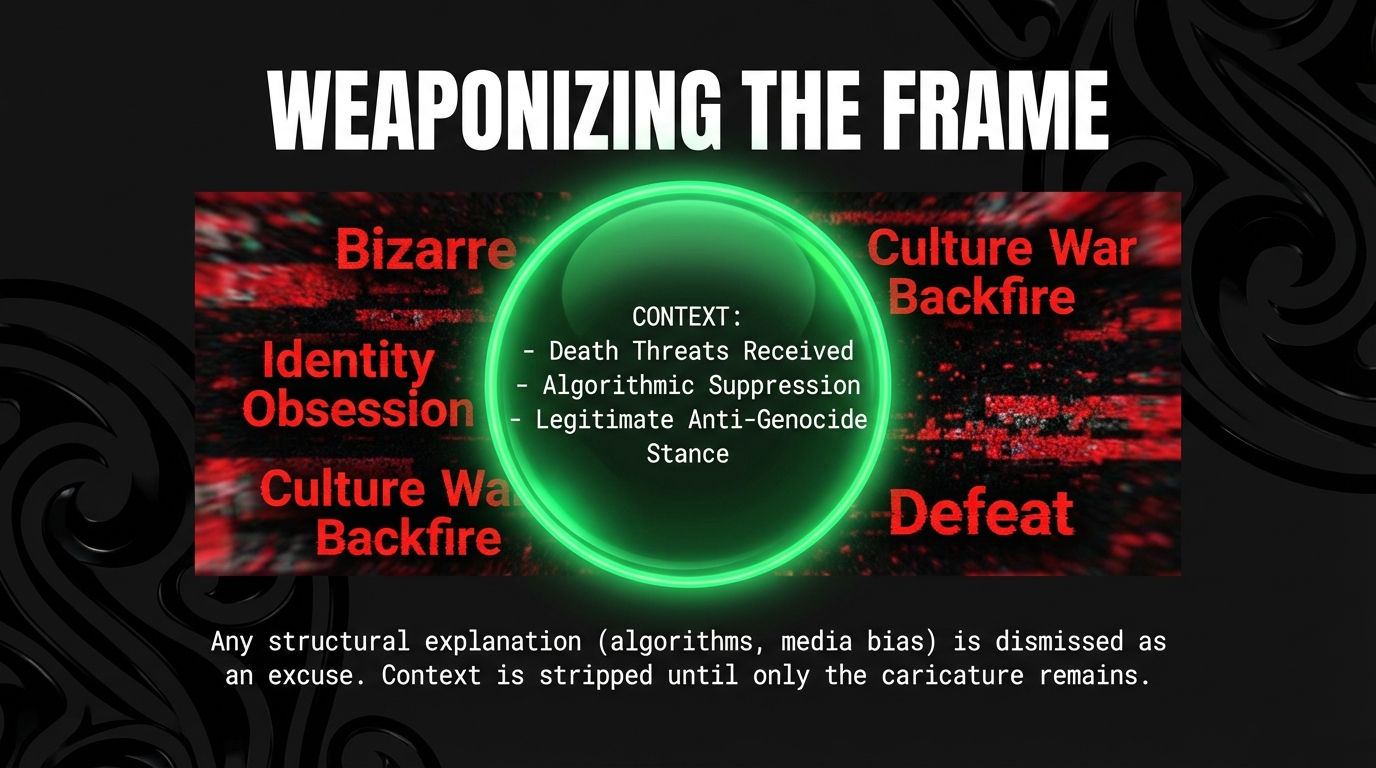
Across these two articles, Edwards:
- Admits when it suits him that the Greens “did the homework” on serious policy, then later accuses them of abandoning environmentalism and material politics as if that work never existed.
- Inflates fluctuating polls and scandals into proof of existential decay, with no comparative context across parties.
- Fixates on Palestine, pronouns, gender, and Te Tiriti flashpoints, while effectively disappearing the party’s climate and economic‑justice agenda.
- Delegitimises any structural explanation (media, algorithms, disengagement) as mere excuse‑making, because his story demands that Greens alone be at fault.
- Uses ideologically aligned pundits as a chorus of ridicule, laundering their culture‑war insults into “perception problems” rather than acknowledging their own agendas.
The result is a narrative in which voters are encouraged to see the Greens not as:
a flawed but serious party with the strongest climate and inequality platform, struggling with governance and communication,
but as:
a collapsing, arrogant, “Palestine and pronouns” clique of “anarkiddies” who have abandoned ordinary people and the planet.
That second picture is not an honest representation of the record. It is a carefully constructed image built through selection, omission, and ridicule.
7. The Real Stakes: What This Disinformation Does
These two articles are not neutral acts of political commentary. They have concrete political effects:
- They delegitimise the only parliamentary force arguing at scale for wealth taxes, windfall taxes and large‑scale emissions cuts.
- They normalise the idea that Palestine solidarity, Te Tiriti justice and queer rights are fringe obsessions of a “woke elite”, rather than integral parts of justice in Aotearoa.
- They encourage frustrated voters to write off the Greens as a vanity project rather than a vehicle for serious climate and economic reform.
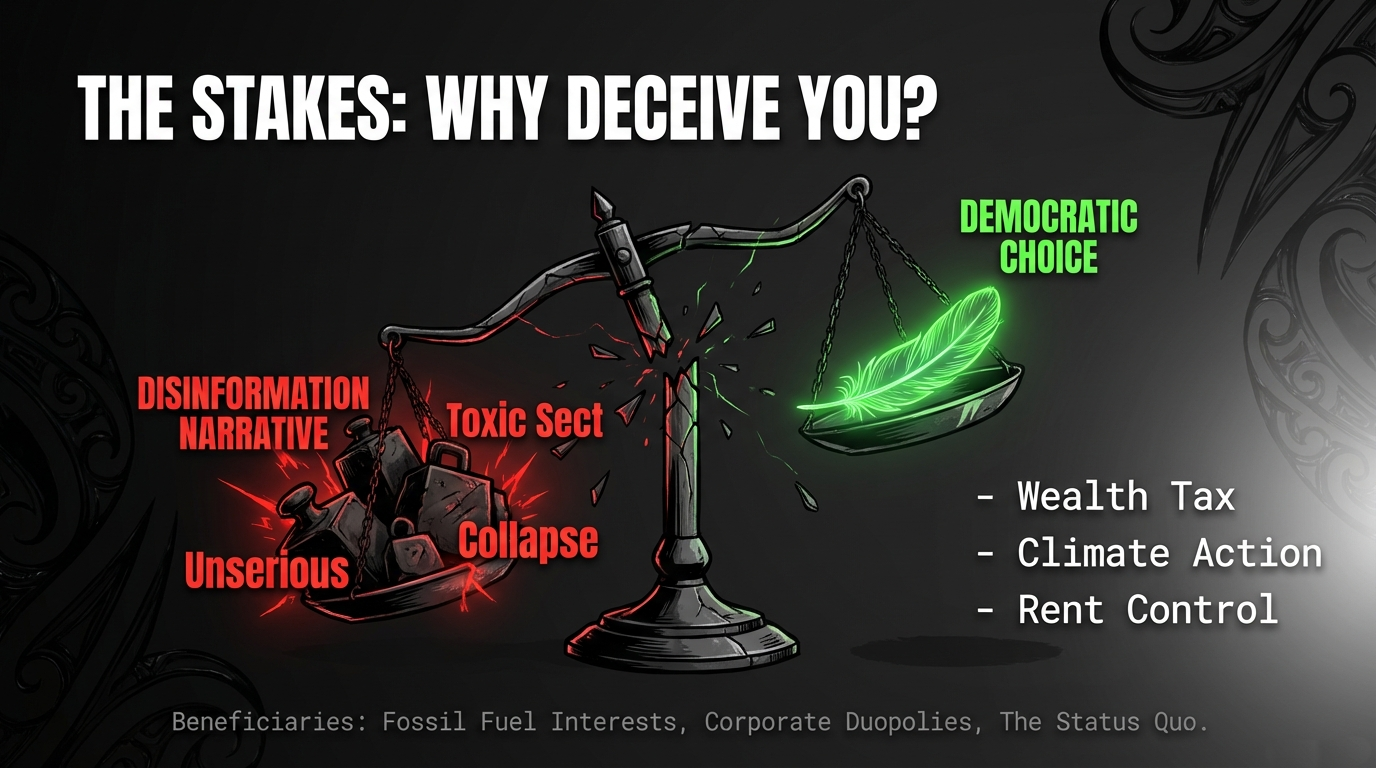
At a time when New Zealand is sliding backwards on climate rankings and inequality remains entrenched, this is not a neutral act. It aids those who benefit from business as usual: fossil‑fuel interests, oligopolistic corporates, and parties willing to manage decline rather than disrupt it.
Recognising and Rejecting the Pattern
By any reasonable standard, these two Edwards articles function less as a contribution to informed democratic debate, and more as a targeted disinformation project aimed at making a serious Green project look ridiculous, toxic, and doomed.
Recognising that pattern is the first step in refusing to let it shape how the Greens – or any movement linking climate, economic justice, and social liberation – are understood.
The case is clear. Readers deserve better than this.

Ivor Jones The Māori Green Lantern Fighting Misinformation And Disinformation From The Far Right