“The Emperor’s New Balance Sheet: How Christopher Luxon’s Coalition Turned New Zealand Into a Grim Laboratory for Ideological Austerity” - 28 January 2026
Mōrena ano Aotearoa,
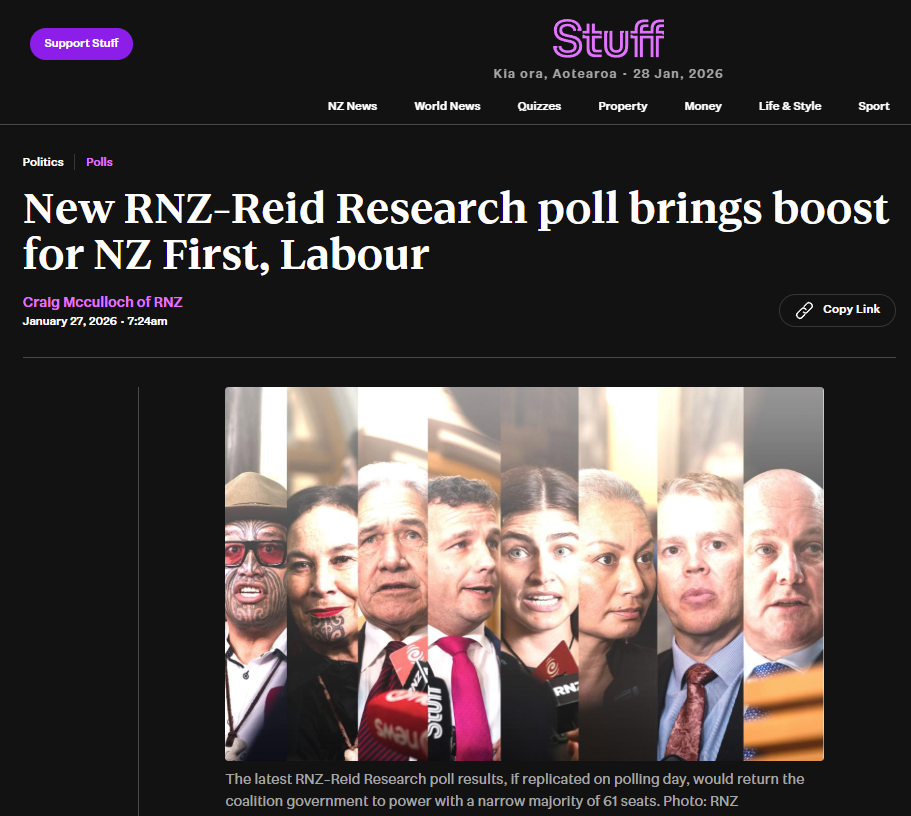
The latest RNZ-Reid Research poll is not merely a statistical snapshot of voter sentiment.
It is an indictment—a damning autopsy of a government that campaigned on competence and has instead delivered a masterclass in institutional vandalism.
Christopher Luxon’s coalition clings to power by the slimmest imaginable margin:
61 seats, the constitutional minimum, a parliamentary majority so fragile it could collapse if a single MP catches a cold. This is not governance. This is political hospice care.
The poll reveals a country teetering on the edge of buyer’s remorse. Labour sits at 35%, National at a humiliating 31.9%—trailing the party it obliterated just 27 months ago.
Meanwhile, Winston Peters’ New Zealand First has surged to 9.8%, its strongest result in eight years, as voters increasingly view Peters as the “change candidate” within his own government. Let that perverse irony marinate:
New Zealanders are so disgusted with this coalition that they’re supporting the coalition partner they perceive as its loudest internal critic. It’s the political equivalent of setting your house on fire to protest the landlord—while you’re still living inside.
The Rubble Where Promises Once Stood
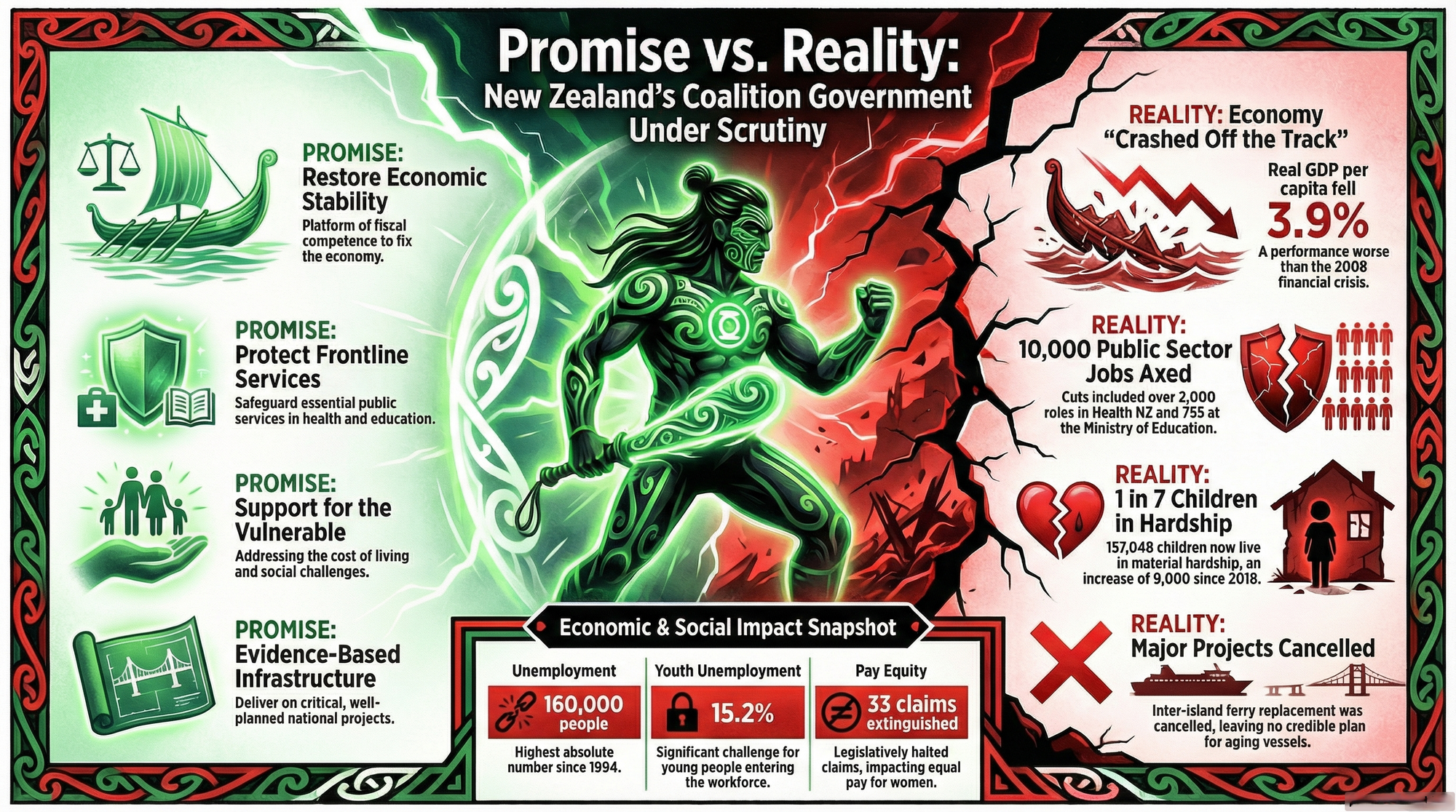
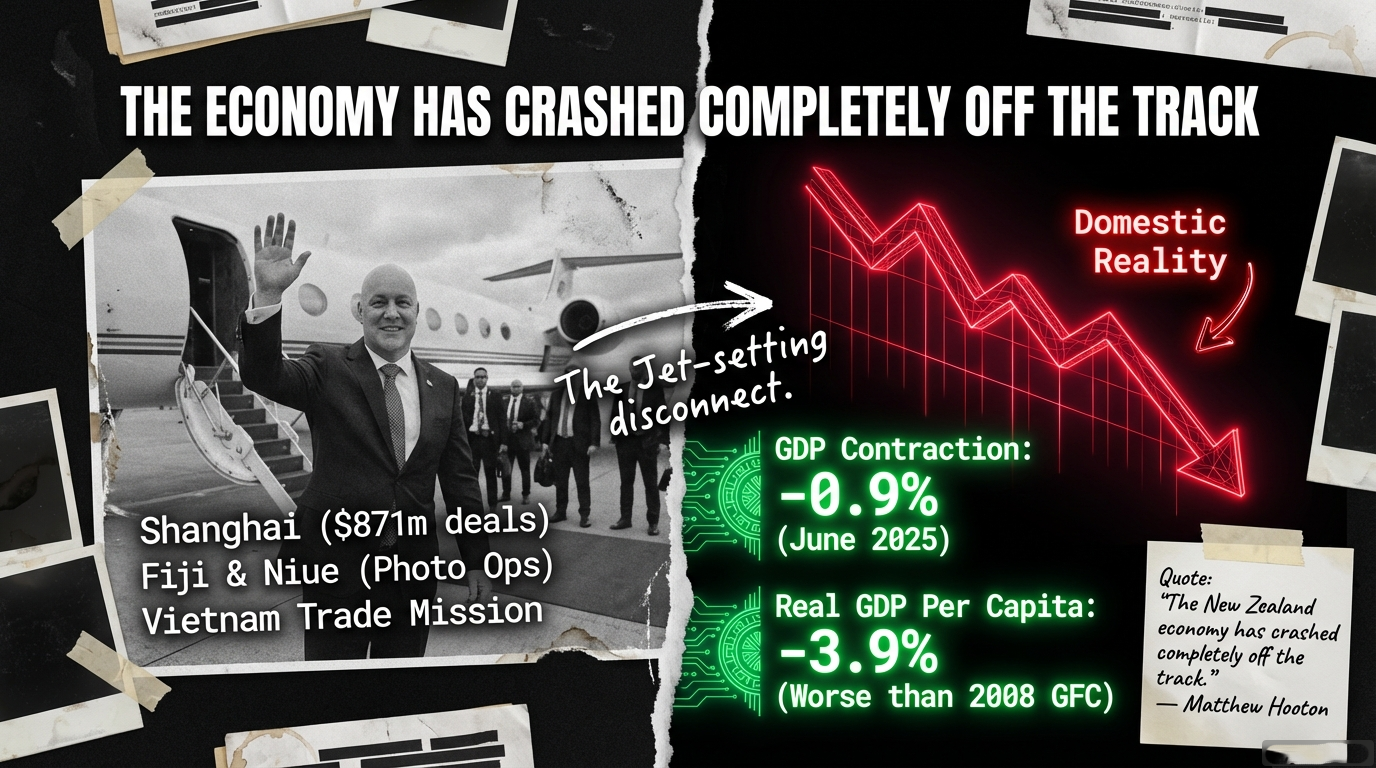
Christopher Luxon promised to restore economic stability. Instead, as commentator Matthew Hooton declared, “the New Zealand economy has crashed completely off the track.” GDP contracted 0.9% in the June 2025 quarter. Real GDP per capita has fallen 3.9% since Luxon took office—a performance worse than the 2008-09 financial crisis. Yet Luxon struts through international airports, signing $871 million in commercial agreements in Shanghai, visiting Vietnam with “senior business leaders”, and jetting to Fiji and Niue for photo opportunities with coconut trees in the background—all while unemployment has climbed to 5.3%, the highest in nine years, with 160,000 people out of work.
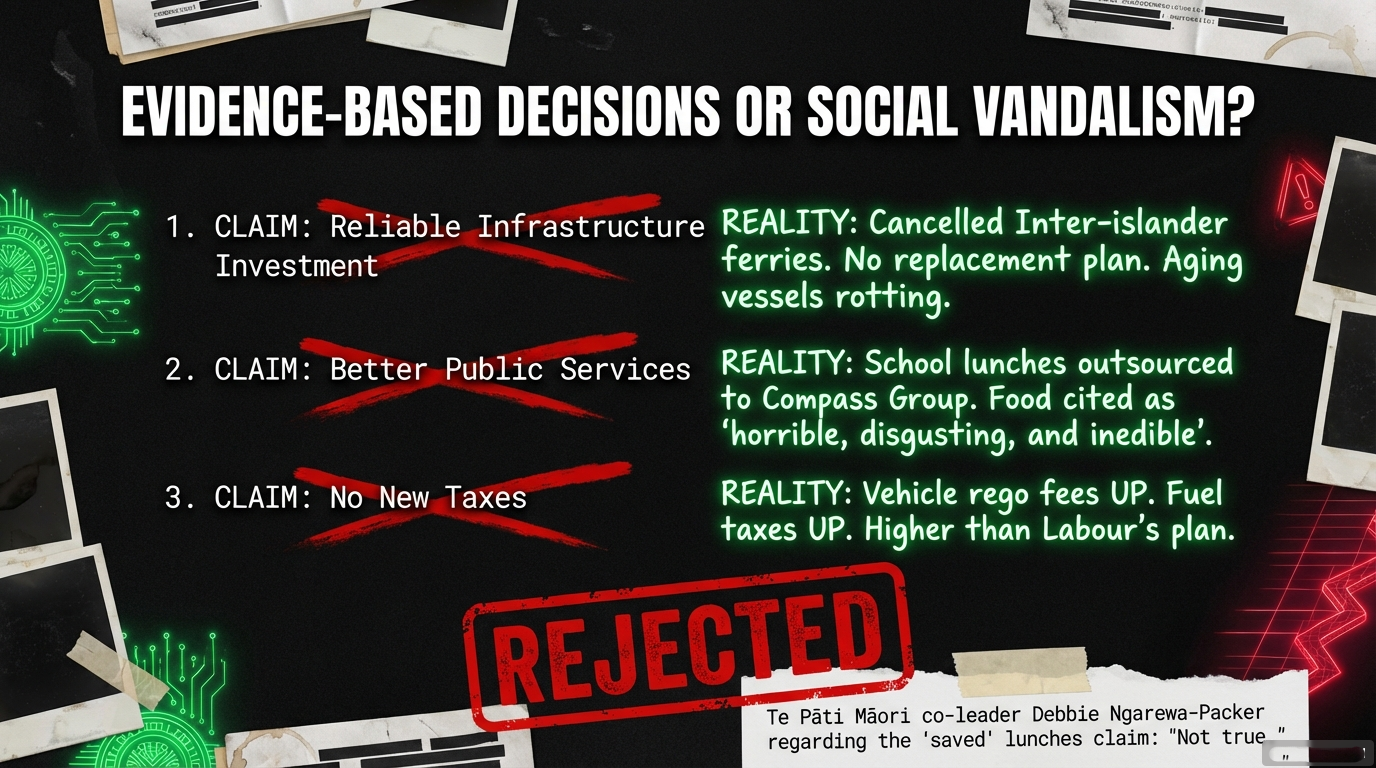
The government promised evidence-based decision-making. Instead, it cancelled the inter-island ferries after refusing to fund cost overruns, leaving the nation with no credible replacement plan for aging vessels that are critical national infrastructure. It promised no new taxes, then increased vehicle registration fees and fuel taxes—higher than Labour had planned—while Finance Minister Nicola Willis claimed these were necessary to fund roads the coalition had already promised voters without explaining where the money would come from.
It promised to protect frontline services. Then it extinguished 33 pay equity claims in a single stroke—saving $2.7 billion by legislatively erasing women’s right to equal pay for work of equal value—an act the Public Service Association called “a dark day for New Zealand women” and unions described as “shameful” and “unconstitutional.” It slashed KiwiSaver contributions, “raiding the future retirement savings” of New Zealanders, while inequality researcher Max Rashbrooke called the changes “mean-spirited.”
And the school lunch programme—a rare bipartisan success—was gutted and outsourced to Compass Group, prompting a petition against “horrible, disgusting, and inedible” meals after the company “repeatedly failed” to deliver edible food to children. Yet Luxon has repeatedly claimed his government “saved” school lunches and that Labour “failed to fund” them—a claim so transparently false that Te Pāti Māori co-leader Debbie Ngarewa-Packer was forced to apologize in Parliament for calling it “not true,” even though it objectively wasn’t true.
The Butchery Disguised as Fiscal Discipline
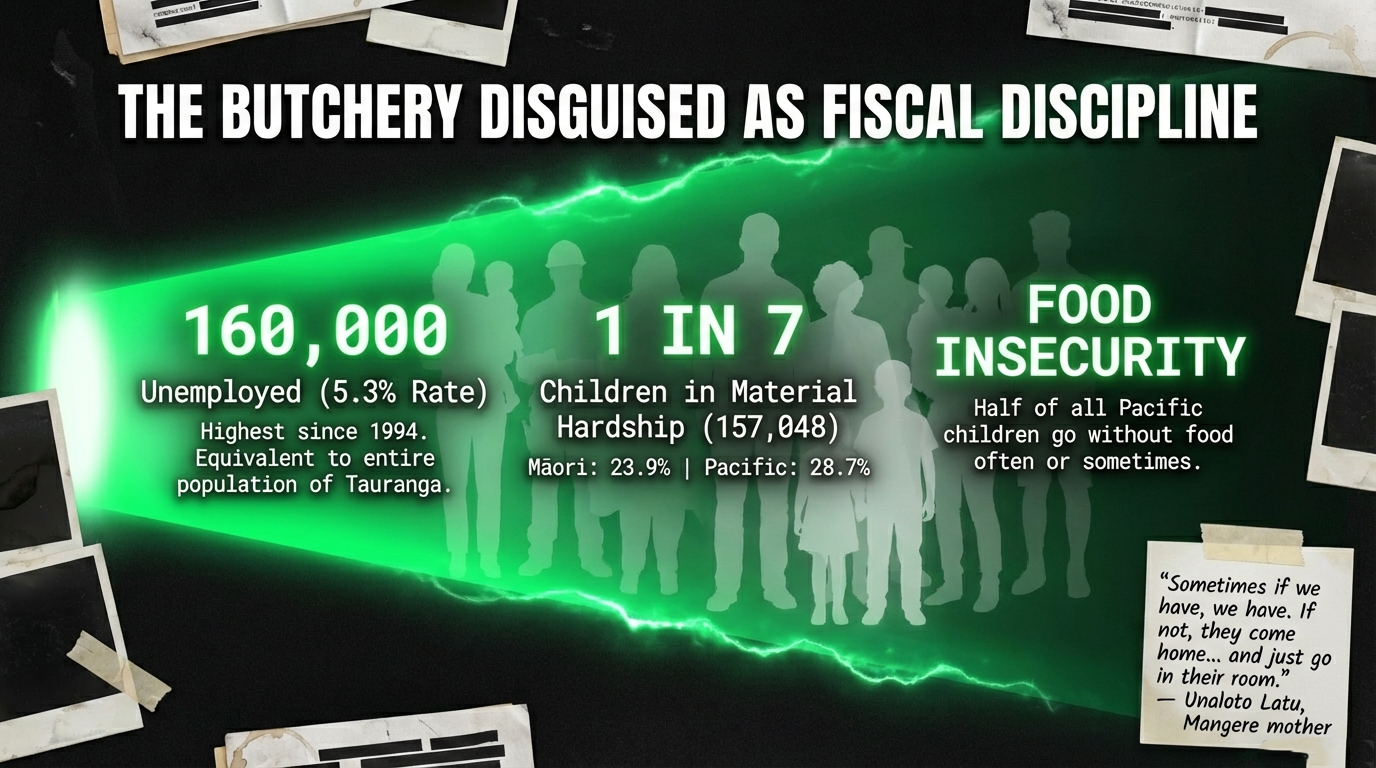
Let us quantify the harm.
Unemployment:
160,000 New Zealanders are now unemployed—the highest absolute number since 1994, roughly equivalent to the entire population of Tauranga cast into joblessness. Youth unemployment has hit 15.2%. The underutilization rate—measuring those unemployed or underemployed—sits at 12.9%, the worst since late 2020. Wages rose just 2.1% while inflation ran at 3%, meaning real incomes are falling. Labour now leads National on managing unemployment (39% to 22%), poverty (41% to 16%), and even the cost of living (35.5% to 24.6%)—a humiliating reversal for a government elected specifically to fix the economy.
Child Poverty:
Despite New Zealand committing in 2018 to halve child poverty by 2028, 157,048 children—one in seven—live in material hardship, meaning they lack access to fresh fruit and vegetables, heating, adequate shoes, or regular doctor visits. That’s 9,000 more children in hardship than in 2018 when the baseline was established. For Māori children, it’s one in five (23.9%); for Pacific children, more than one in four (28.7%); for disabled children, 22.6%. An Auditor-General report found the government failed to meet any of its three 2023/24 targets and warned “current initiatives are unlikely to be enough.” The Salvation Army documented food insecurity rising sharply, with half of all Pacific children going without food “often or sometimes.”
Families in Crisis:
Charities report “alarming levels of poverty” with families sleeping in one room to save on heating, children sharing beds or sleeping on couches, power turned off during the day, and dinner sometimes consisting of only rice. Unaloto Latu, a Mangere mother of eight whose husband has been off work for three years with a knee injury, told RNZ: “Sometimes if we have, we have. If not, they come [home from school] and just go in their room.” Whanganui City Mission’s annual food drive received half the donations of the previous October, while demand for food packages doubled. Zero Hunger Collective executive Tric Malcolm warned: “We can’t meet the need and I am deeply distressed to acknowledge that.”
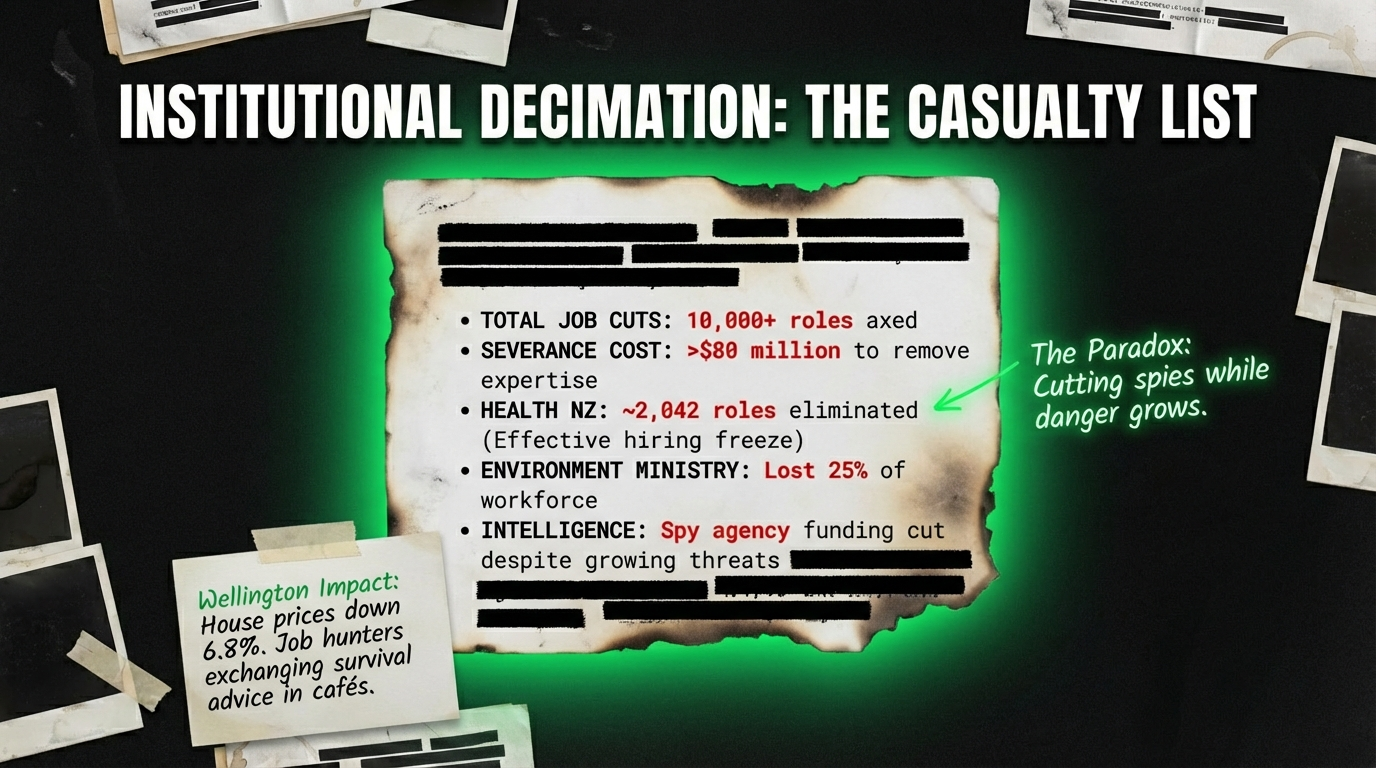
Public Service Decimation:
The coalition has axed at least 10,000 public sector jobs, paying more than $80 million in severance while gutting capacity across health, education, environment, and infrastructure. Health NZ eliminated ~2,042 roles; the Ministry of Education proposed 755 cuts including frontline roles supporting schools; the Ministry for the Environment lost 25% of its workforce; the Productivity Commission was abolished entirely; spy agencies saw funding cut even as security threats grow. Former public servants report hundreds applying for each job, with many emigrating or retraining as teachers out of desperation. Reuters documented how Wellington’s economy has been “punished,” with house prices falling 6.8% and job hunters convening in cafés to exchange survival advice.
Infrastructure Carnage:
The coalition cancelled $300 million for Three Waters, $131 million for Auckland Light Rail, $180.7 million for rail resilience on the Palmerston North-Gisborne line, $149.9 million from the Transport Choices programme, $41.5 million from half-price public transport for under-25s, and $127.5 million from emergency housing—then claimed it was delivering $6 billion in new infrastructure by reannouncing projects already underway or previously committed. Chris Hipkins summed it up: “They cancelled the ferries, they’ve cancelled lots of public house builds, and other decisions they’ve made to cut public spending have led to a construction recession.”
Health System Collapse:
Despite Luxon claiming his government has “saved” health funding, nurses and doctors describe a system under “unsustainable pressure” with an effective hiring freeze on nurses. Patients have died in the Rotorua Hospital waiting room, Christchurch Emergency Department corridors, Middlemore Hospital waiting room, and Gisborne Hospital—”all in unsafe staffing conditions.” Treasury’s own analysis shows $5.6 billion in critical services, including health, are unfunded.
The Vetting Scandal and the Rot of Competence
In June 2025, Luxon’s deputy chief press secretary Michael Forbes resigned after accusations he recorded audio of sessions with sex workers, had intrusive photos of women in public, and footage of women shot through windows at night. Police investigated but didn’t press charges. Forbes had moved from Social Development Minister Louise Upston’s office to the Prime Minister’s office in February 2025—after the police investigation—yet neither disclosed the incidents. Luxon admitted he had “zero tolerance” for behavior that makes women unsafe, but when asked if his workplace was unsafe as a result of not being informed, he replied: “I don’t have answers for you around those today.”
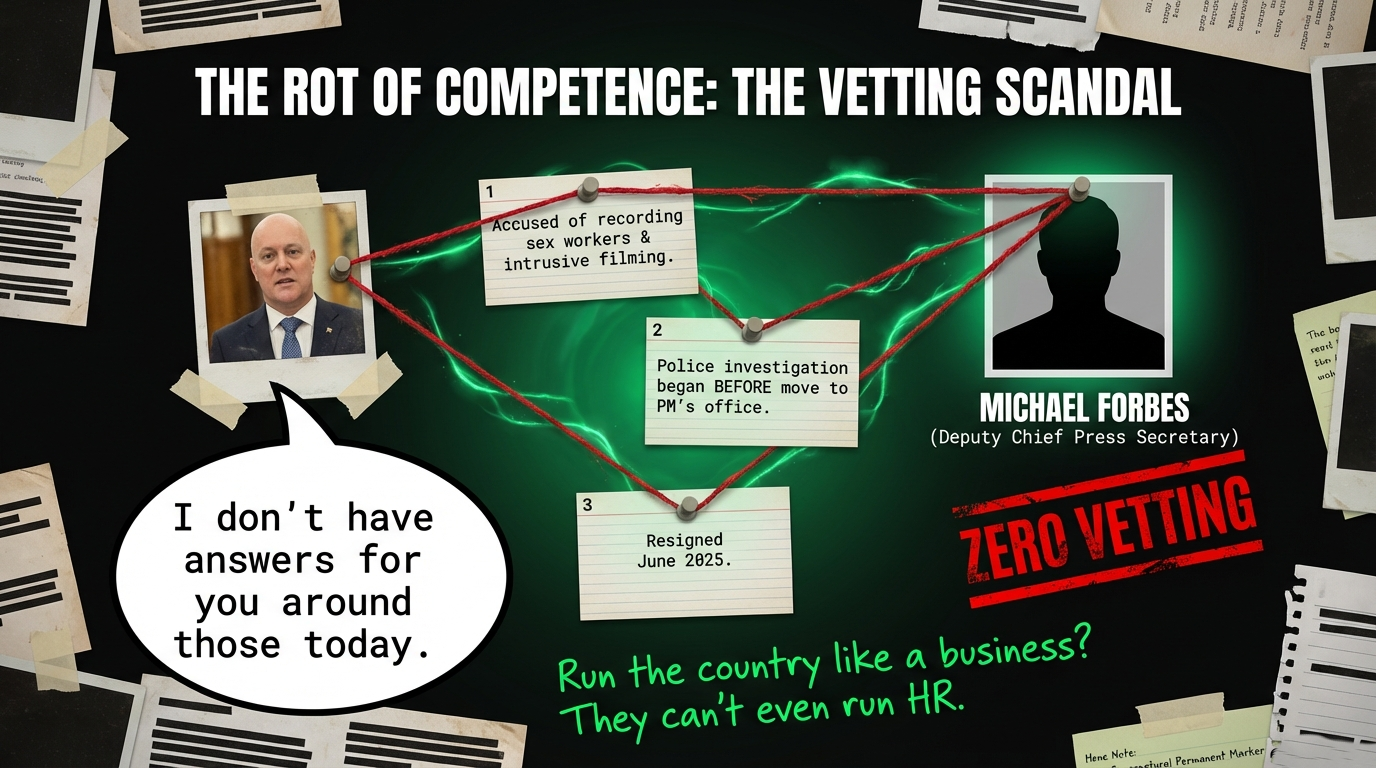
This is a government that promised to run the country like a business. Instead, it cannot even vet the people with access to the Prime Minister’s office, and when caught, demands answers from multiple agencies about whose fault it was—anyone’s fault but his own. “It is not the failure of my organisation at all,” Luxon insisted, before admitting Forbes “has an obligation to actually declare those issues” but “that didn’t happen.”
The Paradox of Peters: Protest Within Power
The poll’s most revealing data point is Winston Peters’ surge. His preferred Prime Minister rating jumped 3.7 points to 12.6%—the highest since January 2016—while NZ First climbed to 9.8%. This is extraordinary because Peters is the government. He is Deputy Prime Minister. He sits in Cabinet. Yet six in ten NZ First supporters report struggling with the cost of living, and more than half say they are worse off financially—percentages higher than among Labour voters. They should be abandoning the coalition. Instead, they are consolidating around Peters because he has successfully differentiated himself through high-profile dissents: opposing Luxon’s India free trade agreement (which Luxon called his “pride and joy”), criticizing ACT’s Regulatory Standards Act, skepticism toward asset sales, and admitting the coalition “has not adequately prepared communities for extreme weather.”
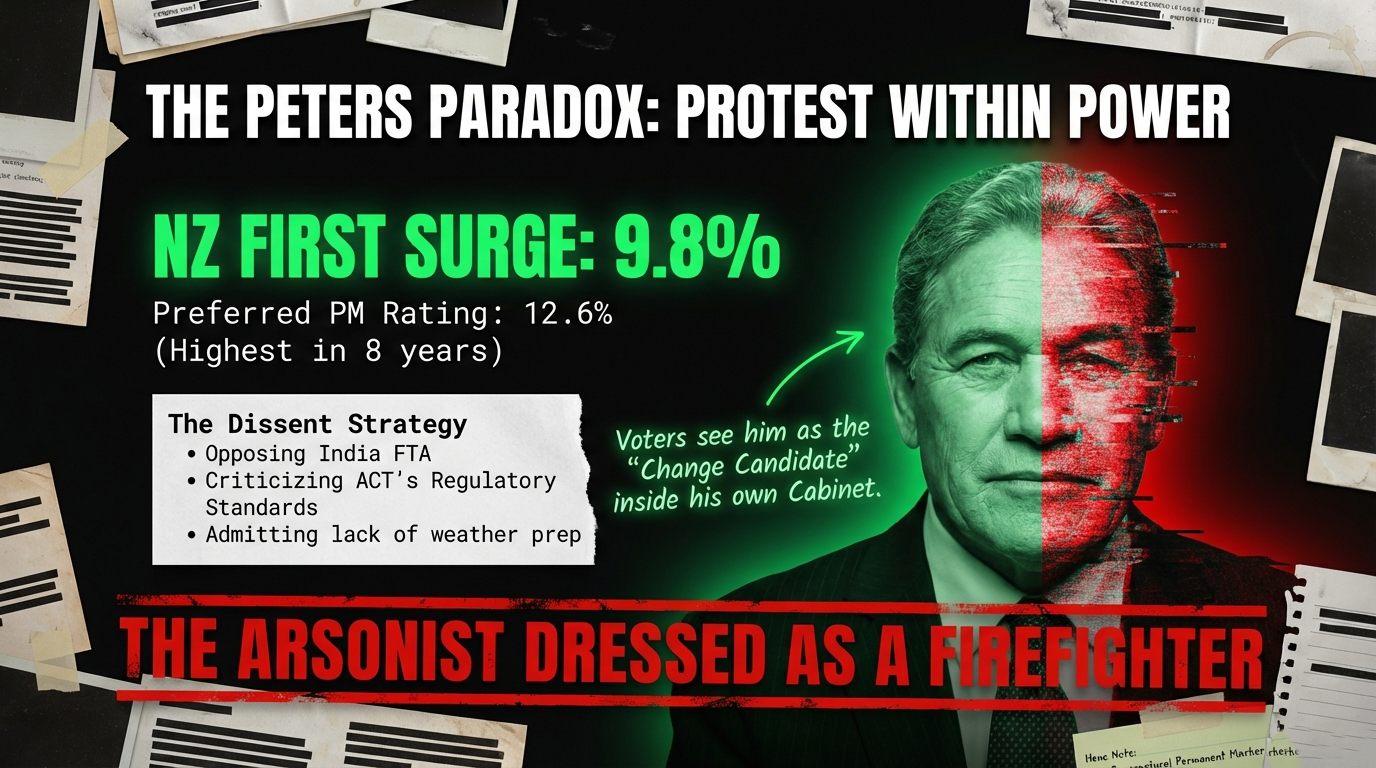
Peters has become a pressure-release valve for voter rage—a political mercury thermometer measuring how hot the discontent burns without triggering a full explosion. He is the arsonist dressed as a firefighter, the man who lights the match and then heroically shouts “Fire!” This sleight-of-hand allows voters to signal their fury with National and ACT while avoiding the cognitive dissonance of voting for Labour. It is a masterstroke of political positioning, and it is working because National has given him so much material to work with.
The Voters Who See No Alternative
The most damning verdict comes not from the 35% backing Labour but from the 46.6% who believe New Zealand is heading in the wrong direction, and the 57.5% finding it harder to manage the cost of living. National trails Labour by 11 points on cost-of-living trust (24.6% to 35.5%) and is statistically tied on economic management (32.2% to 31.4%). For a coalition that campaigned on nothing but economic competence, this is catastrophic. Voters have concluded that the government elected to fix the economy has instead made it measurably worse.
Yet here is the cruelest irony:
the coalition retains 61 seats. It still governs. Labour’s resurgence has not translated into a viable alternative because the Greens fell 1.3 points and Te Pāti Māori dropped 1.1 points, leaving the left-wing bloc with only 59 seats—two short of a majority.
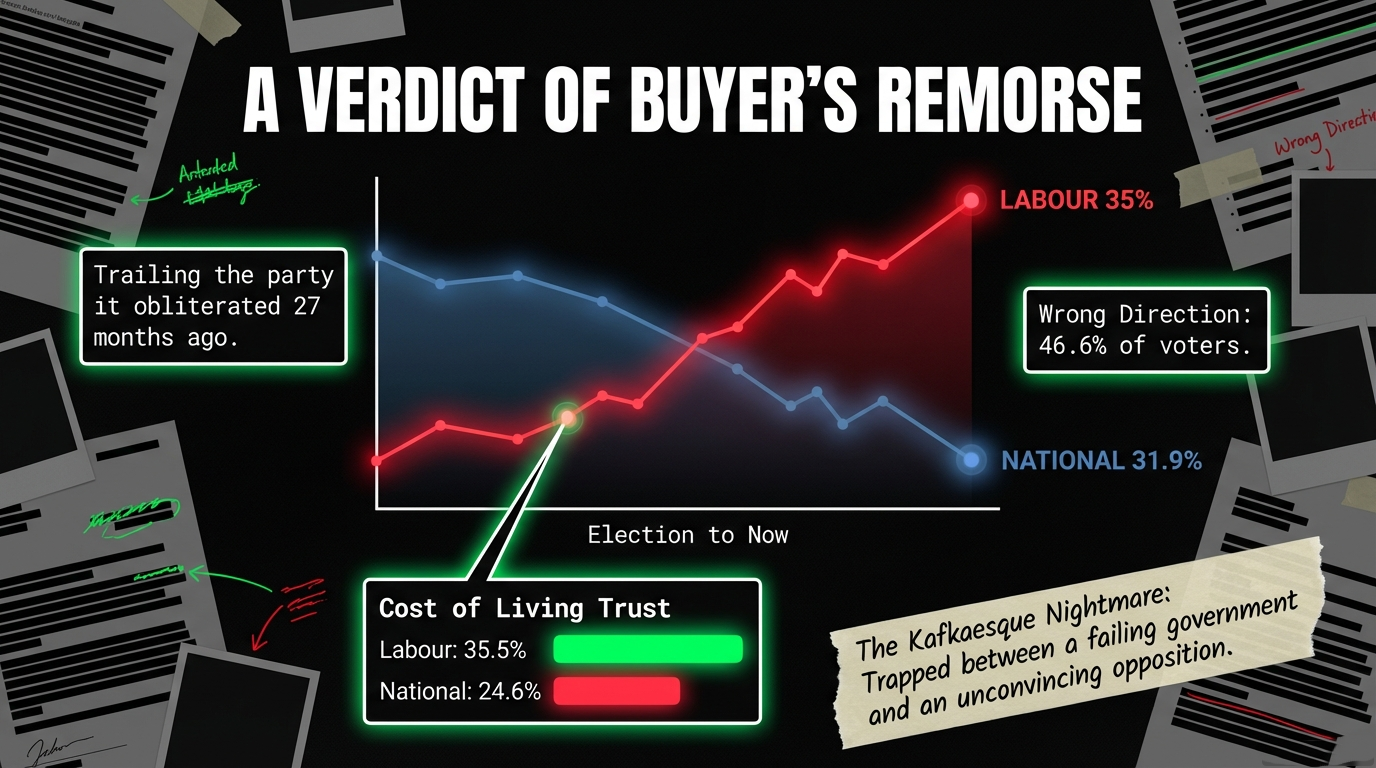
The electorate is trapped in a Kafkaesque nightmare:
disgusted with the government, unconvinced by the opposition, and increasingly flocking to Winston Peters as the only vessel for their rage that doesn’t require them to switch sides entirely.
Solutions: What New Zealand Desperately Needs
If this government were serious about addressing the crises it has created, rather than administering them, it would:
1. Restore Pay Equity Legislation Immediately
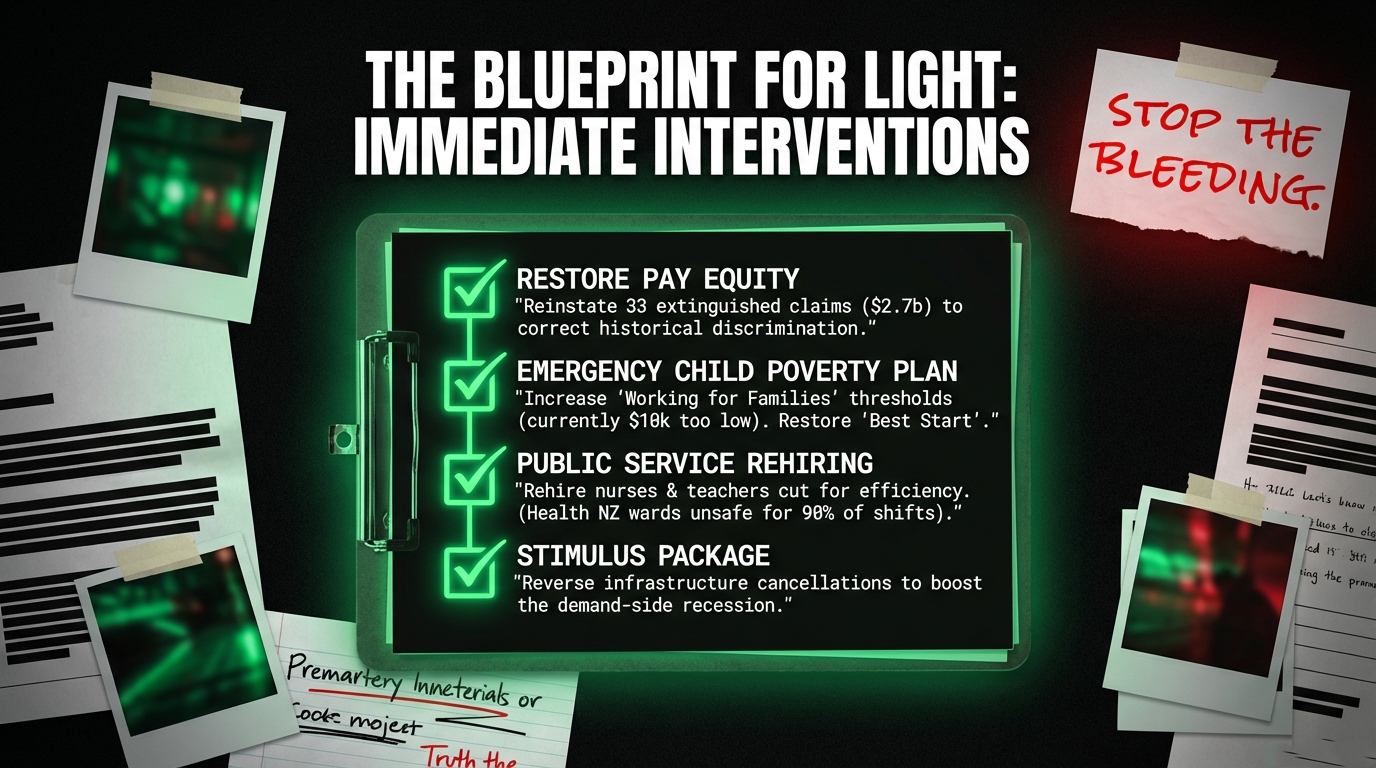
Reinstate the 33 extinguished pay equity claims and reverse the legislative changes that gutted women’s rights to equal pay. This is not about ideology; it is about constitutional justice and economic fairness. Women disproportionately work in undervalued care sectors—aged care, early childhood education, health support—that are essential to a functioning society. Pay equity is not a handout; it is a correction of historical discrimination.
2. Implement an Emergency Child Poverty Action Plan
New Zealand committed bipartisanly to halve child poverty by 2028. That target is now unreachable without urgent intervention. Increase Working for Families thresholds to match inflation since 2018 (currently $10,000 below where they should be), restore Best Start payments, expand the school lunch programme with transparent contracts and quality standards, and fund community-based food security initiatives that work with iwi, hapū, and NGOs rather than imposing top-down bureaucratic solutions.
3. Launch a Public Investment Stimulus
The economy has contracted because the coalition imposed fiscal austerity during a demand-side recession. Treasury’s own models warned that cutting $1 billion from the Budget “could slow economic recovery.” Reverse infrastructure cancellations—restore funding for rail resilience, public transport, Three Waters, and housing—and tie stimulus directly to job creation targets in construction, renewable energy, and digital infrastructure. The Infrastructure Commission found consenting costs have increased 70% since 2014 and timelines by 150%. Fix the system rather than simply slashing spending.
4. Reverse Public Service Cuts in Critical Areas
Rehire nurses, teachers, environmental scientists, and frontline staff whose jobs were eliminated to meet arbitrary “efficiency” targets. Health NZ wards are falling short of safe staffing levels for more than 90% of shifts. The Ministry of Education has cut nearly 100 frontline roles supporting schools. These are not “back office” positions; they are the people who keep the country running. The severance payments alone have exceeded $80 million—money that could have retained expertise rather than paying people to leave.
5. Introduce Genuine Tax Reform
Labour’s proposed capital gains tax is economically flawed—applying only to property, taxing inflation as “gains,” and subsidizing demand (free GP visits) into a supply-constrained system. But the underlying impulse is correct: New Zealand’s tax system is regressive, sheltering asset wealth while overtaxing income. Implement a comprehensive capital gains tax at a low rate (15%) across all asset classes (property, shares, businesses) with inflation indexing, while simultaneously cutting income tax rates for low- and middle-income earners. Use the revenue to fund public infrastructure and reduce inequality.
6. Establish an Independent Infrastructure Authority
Strip infrastructure decisions from the political cycle by creating an arm’s-length body modeled on the UK’s National Infrastructure Commission. Projects like the ferries, Auckland Light Rail, and Let’s Get Wellington Moving have been announced, cancelled, reannounced, and recancelled across successive governments at staggering cost. Infrastructure planning has suffered from “persistent political discontinuity,” with governments reversing predecessors’ decisions out of spite rather than evidence. Lock in 30-year infrastructure pipelines immune to electoral whims.
7. Reform Electoral Finance to Limit Influence of Wealthy Donors
Winston Peters has successfully positioned himself as anti-establishment while sitting in government because he can credibly claim to represent “ordinary New Zealanders” against vested interests. Make this claim harder by banning corporate donations entirely, capping individual donations at $5,000, and funding elections through public matching funds tied to small-donor contributions. Transparency without limits is performative; real reform requires choking off the money.
The Reckoning November Cannot Come Soon Enough
This government will limp to November clinging to its 61-seat majority like a drowning man clutching driftwood. Luxon will continue delivering speeches about “green shoots” and “turning the corner” while 160,000 people remain unemployed and 157,048 children go without adequate food, heating, and medical care. Peters will continue playing the maverick-within-the-machine, critiquing policies he helped pass, while National and ACT pretend the economy is recovering despite every metric screaming otherwise.
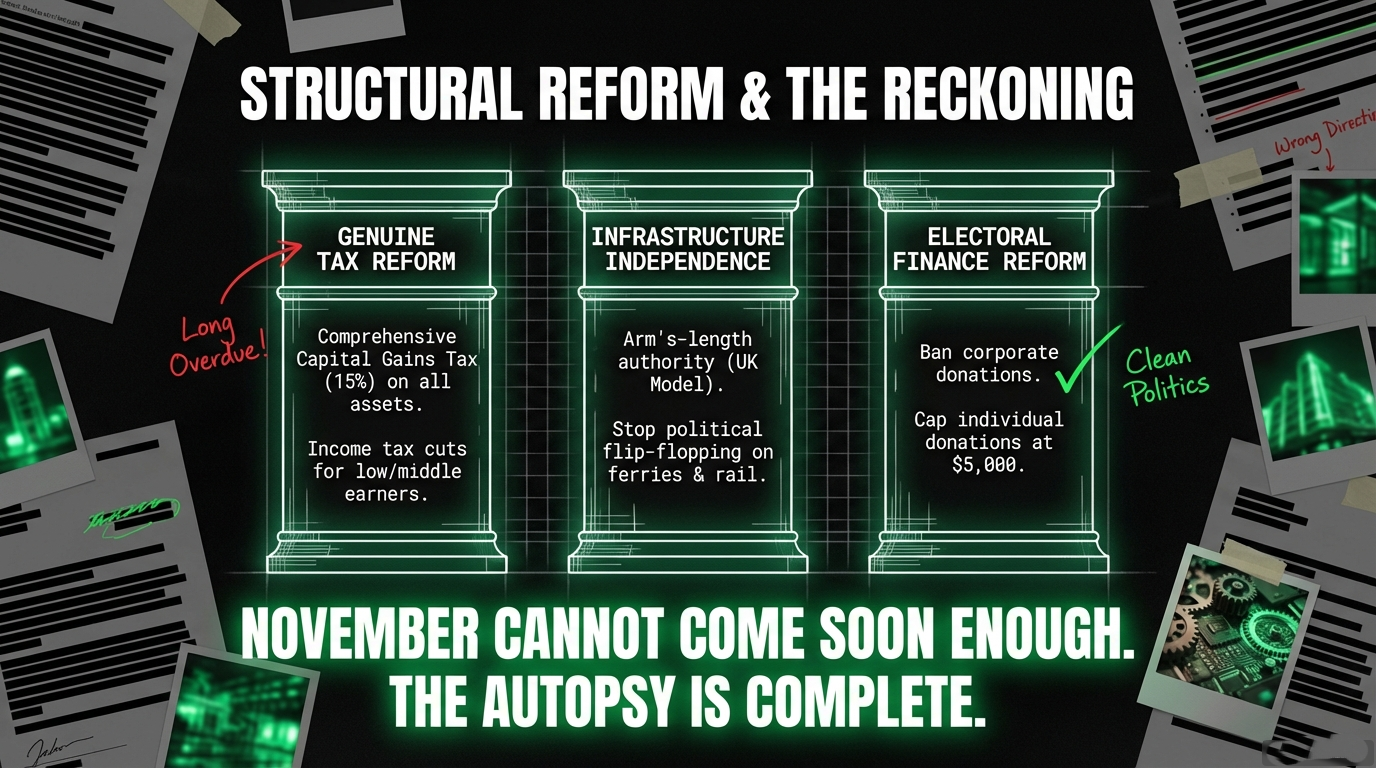
The poll reveals an electorate that has lost faith but sees no clear alternative. Labour leads but cannot govern without coalition partners who are hemorrhaging support. The Greens and Te Pāti Māori are shedding voters who should be their natural base. And so New Zealand remains trapped: governed by a coalition that has demonstrably failed, facing an opposition that has not yet convinced voters it can do better, with Winston Peters as the strange attractor at the center of the vortex—simultaneously the problem and the protest.
New Zealand deserves better than this. It deserves a government that keeps promises, bases decisions on evidence rather than ideology, protects the vulnerable rather than blaming them, and understands that austerity during a recession is not fiscal responsibility—it is economic malpractice. Until November, the country will continue its controlled descent into dysfunction, one broken promise and one cancelled project at a time.
The poll is not a warning. It is a eulogy for a government that never learned the difference between managing a spreadsheet and governing a nation.
Koha Statement
This essay documents 10,000 public sector job cuts, 157,048 children in material hardship, and a government that defunds the very institutions tasked with measuring poverty—making it harder to prove how bad things really are.
Koha funds independent journalism that fills the accountability gap the Crown created through austerity cuts. It funds the investigation that government agencies no longer have capacity to conduct. It funds the voice that refuses to accept “recycled infrastructure announcements” as progress or school lunches described as “inedible” as success.
Your contribution directly enables this mahi to continue.
Three pathways to support:
Koha Platform - Direct Contribution
Substack Subscription - Weekly Essays
Direct bank transfer: HTDM, 03-1546-0415173-000

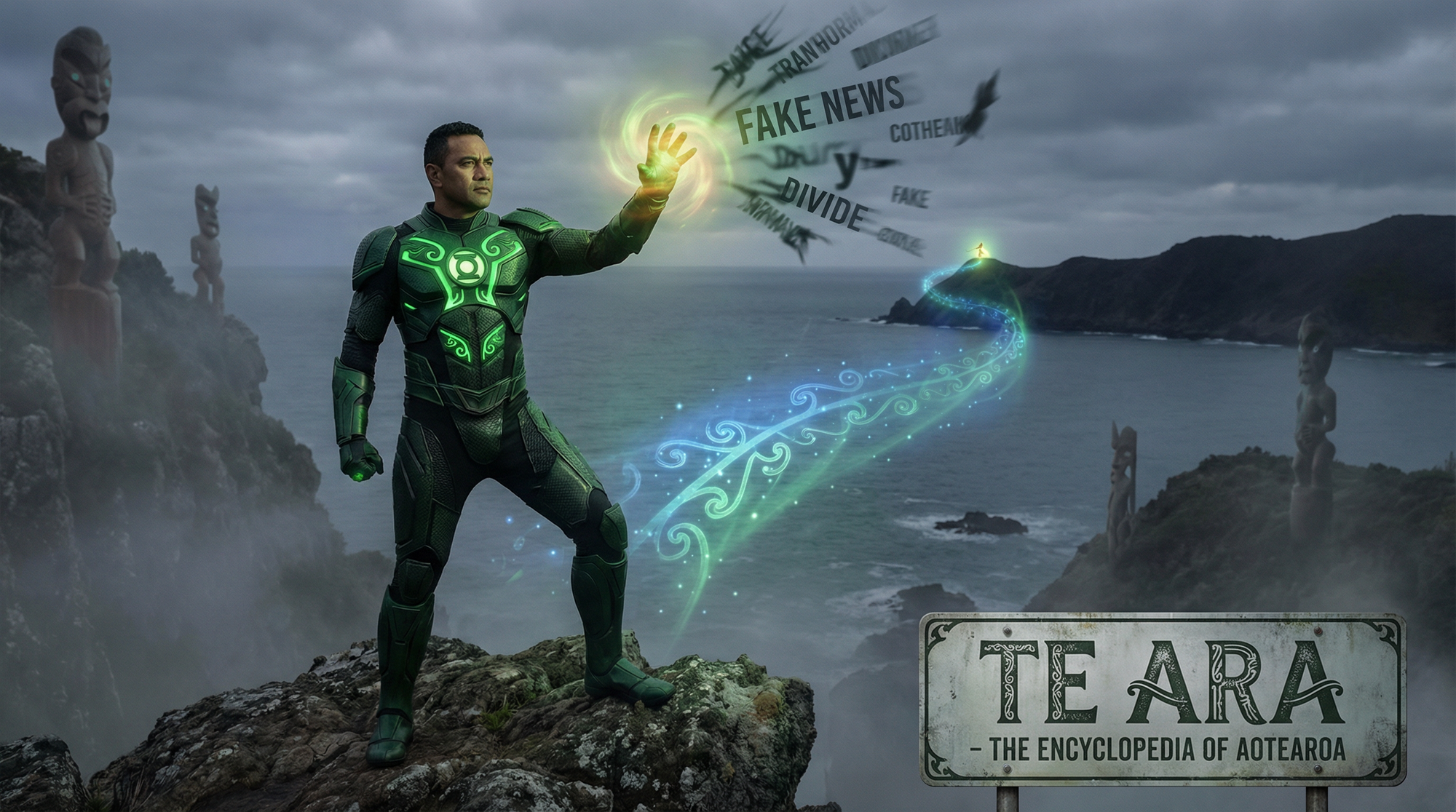
Ivor Jones The Māori Green Lantern Fighting Misinformation And Disinformation From The Far Right