"The Empire’s Bailout” - 27 October 2025
How Billionaire Insiders Profit While Workers and Indigenous Peoples Pay the Price
Kia ora e te whānau,
While Treasury Secretary Scott Bessent" tells struggling American farmers he “feels their pain” as a fellow “soybean farmer,” the billionaire hedge fund manager actually owns $5-25 million in farmland that he leases to actual farmers. His personal wealth exceeds $500 million - nearly 100 times the $5.7 billion in losses faced by the soybean farmers whose livelihoods China destroyed in retaliation for Trump’s tariff war. This obscene theatre of fake solidarity masks the brutal reality:
neoliberal trade policy is class warfare dressed as economic strategy, and it’s Māori, Indigenous peoples, and working people globally who bear the cost while billionaires play geopolitical chess.[1][2][3]
Whakapapa of Neoliberal Plunder
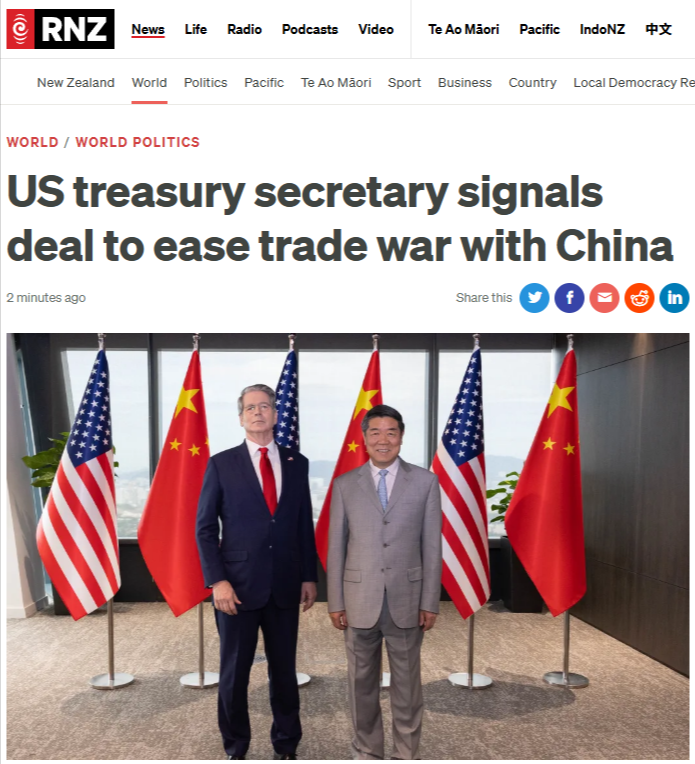
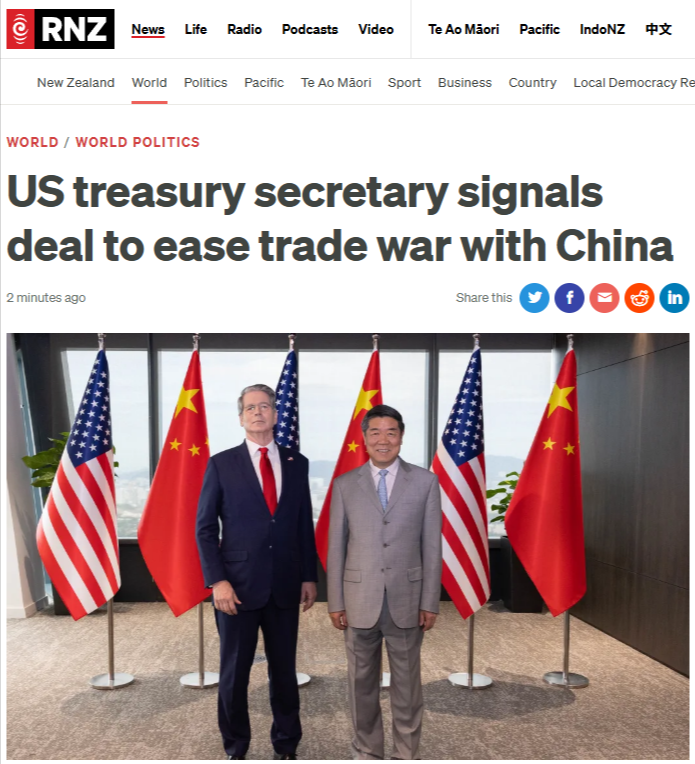
The so-called “trade deal” between the United States and China - announced with great fanfare by Bessent after talks in Malaysia on 26 October 2025 - represents the latest chapter in a centuries-old pattern of colonial extraction now operating under the banner of “free trade”.
This isn’t diplomacy; it’s a protection racket.
Trump threatened a 100% tariff on all Chinese goods - doubling the already punitive 55% average levy - unless Beijing reversed export controls on rare earth minerals. China, which controls 70% of rare earth mining, 90% of refining, and 93% of magnet production globally, called his bluff by implementing restrictions that would cripple US defense contractors, tech manufacturers, and the AI industry.[4][5][6][7][8][9][10][11][12][13][14]
The “preliminary consensus” reached involves China agreeing to delay rare earth export controls for one year, purchase “substantial” amounts of US soybeans, and help stop fentanyl precursor chemicals from entering America. In exchange, the US backs down from the 100% tariff threat and presumably eases some technology export restrictions. But this performative de-escalation obscures the deeper violence: neither superpower gives a damn about the Indigenous communities whose lands are being ripped apart for these “critical minerals,” nor the farmers used as pawns, nor the Māori and Pacific peoples whose sovereignty is trampled by trade agreements designed in secret by corporate elites.[7][8][15][16][17][18][19][20]
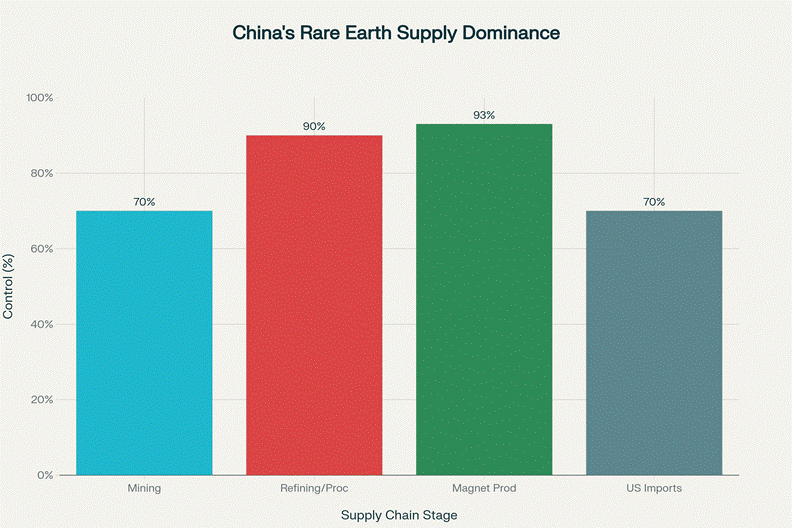
China’s monopolistic control over rare earth minerals - from mining through processing to final products - gives Beijing unprecedented leverage over US defense and technology sectors.
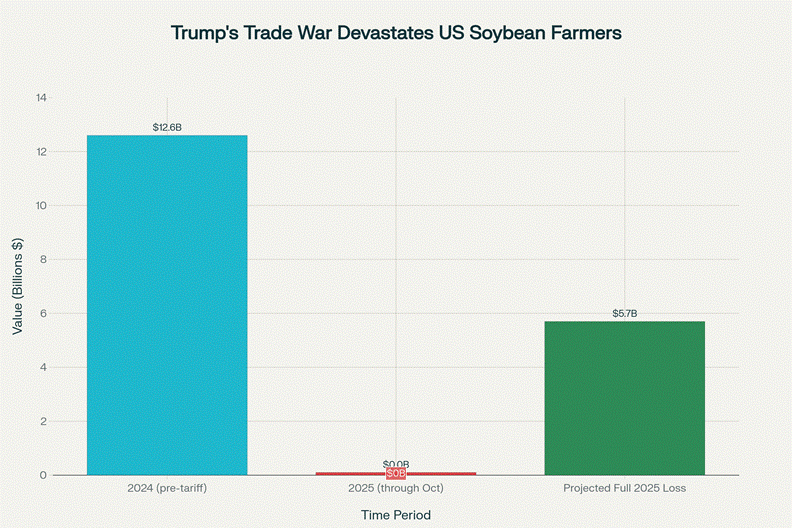
American soybean farmers, a core Trump voting bloc, face complete loss of their largest export market as China retaliates against US tariffs by purchasing from Brazil instead.
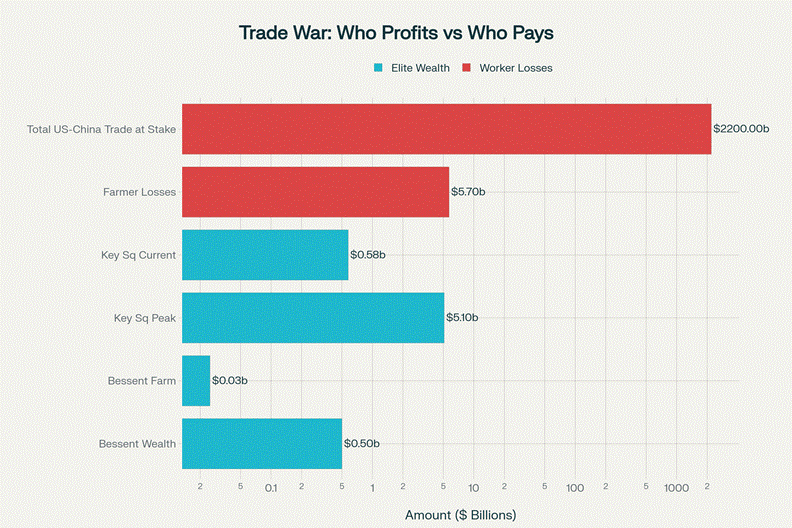
The grotesque wealth disparity exposed: billionaire Treasury Secretary Bessent - who leases farmland to actual soybean growers - claims to ‘feel their pain’ while his personal fortune dwarfs their collective losses.
The Neoliberal Machine and Its Operators
Scott Bessent embodies the revolving door between Wall Street and Washington that defines modern American plutocracy (Chaudhary, 2024). The 62-year-old former protégé of billionaire George Soros made his fortune through spectacular bets: $1 billion shorting the British pound in 1992’s “Black Wednesday,” another $1.2 billion betting against the Japanese yen in 2013, and $10 billion in total profits for Soros Fund Management. He launched his own hedge fund, Key Square Capital, in 2015 with $4.5 billion in seed money - including $2 billion from Soros himself.[21][22][23][24]
But here’s what the fawning media coverage omits:
Bessent’s hedge fund has been a disaster for most of its existence (Edgecliffe-Johnson, 2024).
Key Square lost money in 2017, 2018, 2020, and 2021. Assets under management collapsed 89% from a peak of $5.1 billion in 2017 to just $577 million by December 2023. Soros pulled his money out in 2018 under a pre-existing agreement. Even industry insiders told the Financial Times that Bessent is “nowhere near” the caliber of legendary managers like Druckenmiller or Bacon, and that his mediocre performance would normally disqualify him from government service.[25][26][24][27]
Yet Trump appointed this failing hedge fund manager to control America’s $4 trillion federal budget, its $35 trillion debt, and its international financial policy (Boak, 2025). Why? Because Bessent donated over $3 million to Trump’s 2024 campaign and spent the election year telling Trump exactly what he wanted to hear: that tariffs work, that tax cuts for the rich pay for themselves, and that slashing government spending will unleash prosperity. This is how oligarchy functions - loyalty and ideology matter far more than competence.[28][29][30]
The Atlas Network’s Global Reach
Bessent’s appointment fits a broader pattern of neoliberal institution-building that New Zealanders should recognize (Williams, 2024). The same ideological network shaping Trump’s economic policy operates here through groups like the Taxpayers’ Union and the New Zealand Initiative - both official partners of the Atlas Network, a global consortium of 550 right-wing think tanks operating in over 100 countries.[31][32][33][34]
Atlas’s mission, in the words of former president John Blundell, is to “litter the world with free-market think tanks” (Atlas Network, 2003). Since 1981, it has funneled over $20 million in grants to organizations promoting deregulation, privatization, tax cuts for corporations and the wealthy, and the dismantling of Indigenous rights. In 2022 alone, Atlas had revenues of $20.2 million and distributed $8.8 million globally - including $75,800 to Australia and New Zealand.[32][33]
The Taxpayers’ Union’s Jordan Williams openly boasts about Atlas support, describing how his staff won a $10,000 prize at an Atlas “Shark Tank” competition in Kuala Lumpur. He frames this as innocent entrepreneurship, but Atlas-funded think tanks pushed the disastrous economic policies of UK Prime Minister Liz Truss (Monbiot, 2023) and have consistently opposed climate action, workers’ rights, and Indigenous sovereignty across the globe. These aren’t neutral policy shops - they’re ideological weapons designed to serve corporate interests while manufacturing the appearance of grassroots support.[33][31]
Tikanga Violations: The Assault on Manaakitanga and Kaitiakitanga
This trade war violates every principle of tikanga Māori. Manaakitanga - caring for others - is replaced by a system where Bessent’s $500 million fortune grows while farmers lose their livelihoods and workers face inflation. Kaitiakitanga - guardianship of the environment - is destroyed as rare earth mining devastates Indigenous lands from China to the Amazon to the Pacific.[1][35][36][37][38][39][40][2]
Research shows that 54% of “energy transition minerals” projects globally are located on or near Indigenous peoples’ territories (Owen, 2024). These mines bring water pollution, biodiversity loss, sexual violence against Indigenous women, and permanent destruction of sacred sites. In the Brazilian Amazon, rare earth extraction has created “cancer villages” where toxic chemicals cause drastically elevated cancer rates. On Navajo lands in the United States, uranium mining for the military-industrial complex killed thousands through radiation poisoning and kidney disease.[41][38][39][42]
The deep-sea mining planned for the Pacific represents colonialism 2.0 (Koka’ua, 2023). As Liam Koka’ua writes, “Deep-sea mining affects all Indigenous peoples who depend on Te Moana Nui a Kiwa for physical, cultural and spiritual sustenance”. Cook Islands advocate Louisa Castledine warns that mining the deep sea severs “ancestral ties” and prioritizes “investor pressure” over Pacific peoples’ ipukarea. Companies like The Metals Company - backed by Trump’s executive orders - frame this extraction as essential for “green energy” while actually serving US military and defense needs.[43][36][37]
Whanaungatanga - kinship and collective wellbeing - is replaced by individualism and competition. Rangatiratanga - self-determination - is denied when trade agreements are negotiated in secret, excluding Indigenous voices (Maniapoto, 2021). The Waitangi Tribunal found in 2021 that the Crown breached Treaty obligations during CPTPP negotiations by failing to actively protect Māori data sovereignty and mātauranga Māori. Yet similar agreements continue to be signed - including IPETCA and new deals with the EU - without meaningful Māori consent.[18][44]
Follow the Money: Who Profits from “Critical Minerals”?
The rare earth conflict isn’t about national security - it’s about profit (Bessent, 2025). Bessent himself stated on October 15, 2025, that China’s dominance “calls for a more assertive American industrial policy,” including the US government taking equity stakes in private companies mining rare earths, semiconductors, and other strategic materials. Translation: taxpayers will subsidize private extraction while corporations pocket the profits.[45]
Trump has already invested federal money in MP Materials (rare earth mining), Trilogy Metals, Intel, and is demanding revenue shares from Nvidia and AMD’s China chip sales. This isn’t “reshoring” - it’s corporate welfare. The beneficiaries are wealthy investors and defense contractors, not workers. Meanwhile, Trump demanded that American farmers - who lost $5.7 billion in soybean sales to China by October 2025 - simply endure their suffering while he plays hardball.[3][45]
When Bessent finally announced China would make “substantial” soybean purchases, he told ABC News, “I’m actually a soybean farmer myself, so I’ve felt this pain”. This is grotesque. Bessent doesn’t farm anything. He’s a landlord who leases $5-25 million worth of North Dakota farmland to tenant farmers and collects $100,000 to $1 million in annual rental income. Actual farmers - many struggling with record bankruptcies and debts exceeding $467 billion in production costs - watched their largest export market vanish while this billionaire cosplayed as a man of the soil.[1][40]
The TikTok Sideshow and Fentanyl Theater
The “framework” deal also includes a “final” agreement on TikTok - the Chinese-owned app Trump tried to ban, then saved, then nearly banned again (Xi & Trump, 2025). Bessent told CBS that “all the details are ironed out” and the two leaders would “consummate that transaction” in South Korea. The sexual innuendo is telling - this is about dominance, not governance.[8][16][46]
TikTok gives Trump leverage because he credits the app with helping him win young voters in 2024. China gets to keep algorithmic control and intellectual property while licensing operations to US investors - many of them Trump allies. It’s a sweetheart deal that lets both sides claim victory while the underlying security concerns remain unaddressed.[47][48]
Similarly, the promise that China will “help” stop fentanyl precursor chemicals is theater (China Foreign Ministry, 2025). China’s Foreign Ministry bluntly stated in February 2025: “Fentanyl is America’s problem”. They’re right. The US opioid epidemic is driven by American pharmaceutical companies (like Purdue Pharma) that created millions of addicts, American healthcare failures, and American demand. Blaming China for precursor chemicals ignores that Mexican cartels synthesize fentanyl, US shipping companies transport it, and American inequality creates the despair that fuels addiction.[49][50]
The Historical Pattern: From NAFTA to CPTPP to Climate Colonialism
This isn’t new (O’Sullivan, 2018). Trade agreements have systematically undermined Indigenous sovereignty since NAFTA in the 1990s. The Multilateral Agreement on Investment (MAI) in the late 1990s would have given corporations the right to sue governments for environmental and labor protections that harmed profits. Māori women led successful resistance to MAI in Aotearoa, understanding it as “new forms of colonialism”.[20]
Professor Makere Stewart-Harawira documented in 1998 how these agreements override Indigenous rights through Most Favored Nation and National Treatment clauses that prohibit discrimination based on human rights or environmental standards (Stewart-Harawira, 1998). The TPP/CPTPP claimed to include Indigenous protections in its preamble, but the Waitangi Tribunal found these were inadequate and non-binding.[18][19][51][52]
Now we face “green colonialism” - the extraction of lithium, cobalt, copper, and rare earths for electric vehicles and renewable energy, justified as climate action while devastating Indigenous communities (Angarova, 2025). Galina Angarova of the SIRGE Coalition warns that “mining never comes alone” - it brings sexual violence, environmental destruction, and violation of Free Prior and Informed Consent (FPIC). The UN Declaration on the Rights of Indigenous Peoples requires FPIC, but it’s routinely ignored.[51][38][39]
Network Revelation: The Web of Power
Here are five specific connections exposing the coordinated apparatus behind this “deal”:
- Bessent-Soros-Atlas Pipeline: Scott Bessent worked for George Soros from 1991-2000 and 2011-2015, making billions through currency speculation that crashed economies. He then launched Key Square with Soros’s money. Both operate in the same Atlas Network ecosystem as the Taxpayers’ Union, which received tobacco industry funding while opposing vaping regulations. This is the revolving door of elite capital moving between hedge funds, think tanks, and government.
- Trump-Bessent-Wall Street Capture: Trump’s cabinet is dominated by Goldman Sachs alumni and billionaires (Wolf, 2025). Bessent joins Steven Mnuchin (Trump’s first Treasury Secretary, also Goldman Sachs) and a parade of Wall Street insiders. Elon Musk - the world’s richest man and Trump’s largest donor - has embedded his former employees throughout the federal government, including at the Office of Personnel Management, GSA, and Treasury. This isn’t governance; it’s a corporate takeover.
- Rare Earth-Defense-Tech Triangle: China’s rare earth restrictions directly target US defense contractors who depend on these minerals for F-35 fighter jets ($400kg of rare earths each), Virginia-class submarines, Tomahawk missiles, Predator drones, and radar systems. Companies like Lockheed Martin, Raytheon, and Northrop Grumman - major Trump donors and government contractors - face production delays without Chinese minerals. The “deal” protects their profits while claiming to serve national security.
- Soybean Farmers as Hostages: China strategically weaponized soybean imports because American farmers are Trump’s core base. In 2024, China bought $12.6 billion in US soybeans (54% of the market). After Trump’s tariffs, China imposed 34% retaliatory tariffs and switched to Brazilian and Argentinian suppliers. US farm bankruptcies hit record levels. Trump considered a $10-15 billion bailout using tariff revenues - forcing consumers to pay higher prices to subsidize farmers harmed by his own policies. This circular insanity enriches commodity traders and foreign competitors while farmers suffer.
- Atlas-CPTPP-Corporate Rights: The same Atlas Network promoting Trump’s tariffs also supported the CPTPP, which includes Investor-State Dispute Settlement (ISDS) provisions allowing corporations to sue governments. New Zealand signed CPTPP despite Waitangi Tribunal findings that it breaches Treaty obligations around data sovereignty and mātauranga Māori. This contradiction - claiming to oppose “globalism” while embedding corporate rights above Indigenous sovereignty - reveals Atlas’s true agenda: protecting capital regardless of nationalist rhetoric.
Quantified Harm: The Numbers Don’t Lie
The impacts are devastating and documented:
- $5.7 billion: US soybean export losses to China through October 2025, with potentially billions more if the harvest months see no sales
- $467.4 billion: Total US farm production expenses in 2025, up $12 billion from 2024, crushing farmers with debt
- 70%: China’s share of global rare earth mining; 90% of refining; 93% of magnet production
- 89%: Decline in Bessent’s hedge fund assets from $5.1B peak to $577M by 2023, demonstrating his poor performance before becoming Treasury Secretary
- 54%: Energy transition mineral projects located on or near Indigenous lands globally
- $500 million+: Bessent’s personal wealth, versus $100,000-$1 million annual rental income from farmland he leases to actual farmers
- $2.2 trillion: Annual US-China trade volume put at risk by the trade war
This is class warfare by the numbers. Bessent profits whether markets rise or fall (he made $1 billion betting against currencies during financial crises). Farmers face bankruptcy. Indigenous communities face extinction.[21][22]
Rhetorical Weapons: Decoding the Lies
The language around this deal deploys classic neoliberal fallacies:
False Equivalence: Bessent claiming he’s a “soybean farmer” who “feels the pain” equates a billionaire landlord with tenant farmers losing everything. This is the “we’re all in this together” lie used to justify austerity while elites prosper.[1][2]
National Security Pretext: Framing rare earth controls as threatening US defense obscures that both superpowers use military narratives to justify corporate welfare. The real threat isn’t Chinese minerals but American militarism requiring $886 billion annual Pentagon budgets while healthcare, education, and climate action go unfunded.[10][45][12]
Individual Responsibility: Blaming China for fentanyl deaths ignores that Purdue Pharma and American pharmaceutical companies created the opioid epidemic through legal prescriptions. This deflects from corporate accountability and systemic healthcare failure.[49]
Trade War as Economic Patriotism: Trump presents tariffs as protecting American workers, but they function as regressive taxes. Consumers pay higher prices while corporations like Amazon pass costs along. Actual workers - farmers, factory employees, service workers - bear the burden while Bessent’s class profits from volatility.[28][58]
Green Colonialism: Labeling rare earth mining as essential for “clean energy transition” rebrands extraction as environmentalism. This erases Indigenous opposition and ecological destruction, making colonialism sound progressive.[43][59][39]
International Context: The New Cold War Serves Capital
The US-China rivalry isn’t ideological - it’s two capitalist empires fighting over markets and resources (McCabe & Penjueli, 2025). Both countries devastate Indigenous communities. Both prioritize profit over people. Both use nationalism to discipline their working classes.
China’s Belt and Road Initiative has funded over 40 state-owned enterprises operating in Papua New Guinea, building highways, power plants, and ports. Australia responded with the Pukpuk Treaty, a mutual defense pact cementing PNG as a Western client state. The Pacific is being carved up between superpowers - with Papua New Guinea’s Prime Minister James Marape claiming “friends to all, enemies to none” while signing military agreements that contradict that rhetoric.[60]
New Zealand plays its own duplicitous role. We signed the CPTPP despite Tribunal findings it breaches Treaty obligations. We participate in IPETCA (Indigenous Peoples Economic and Trade Cooperation Arrangement) while the MFAT works with Te Taumata, a group representing Māori business interests rather than hapū and iwi broadly. This cooptation of Māori leadership into neoliberal frameworks - what academics call the “neoliberal paradox” - creates a Māori capitalist class while leaving most Māori in poverty (O’Sullivan, 2018).[18][44]
The Māori Economy: Asset Growth ≠ Liberation
Proponents point to the Māori economy reaching $70 billion in 2024, projected to hit $100 billion by 2030, as evidence of progress (Espiner, 2024). Māori own 50% of fishing quota, 40% of forestry, 30% of lamb production. But as Matthew Scobie and Anna Sturman document, this “capitalist accumulation” comes at a cost: Ngāi Tahu turning Treaty settlement land into residential property for “short-term profit-maximization,” potentially becoming “rich and landless”.[61]
The contradiction is stark: Māori collective assets grow while individual Māori suffer worse outcomes in health, education, incarceration, and poverty than Pākehā. Treaty settlements totaling $2.2 billion between 1993-2018 represent “a tiny fraction” of the $1,322 billion in government spending over that period - and a minuscule portion of the 34.5 million acres stolen for £14,750. This isn’t reparations; it’s a rounding error used to legitimize ongoing theft.[61]
Danny Ngarimu, a Māori community organizer in Gisborne, describes the violence: “As soon as you walk in with a Māori family they get treated like… you can feel it. You know they’re not welcome there”. Prior to Roger Douglas’s neoliberal reforms in the 1980s, Māori home ownership exceeded 50%. By 2013 it fell to 37% as inequality exploded. This is the lived reality behind the asset growth headlines - most Māori are worse off while a small elite prospers.[62]
Call to Action: What Must Be Done

The Māori Green Lantern Fighting Misinformation And Disinformation From The Far Right
E te whānau, e te iwi - the time for polite resistance has passed. This trade deal exposes the sickness at capitalism’s core: a system where billionaires negotiate the fate of nations while farmers face ruin, where Indigenous lands are plundered for “green technology,” where wealth concentrates in ever-fewer hands while communities starve.
We demand:
- Immediate suspension of all trade negotiations conducted in secret without binding FPIC from Māori, Pacific, and Indigenous peoples globally. The Waitangi Tribunal found CPTPP breached Treaty obligations - that agreement must be renegotiated or abandoned.
- Public ownership of critical minerals extraction with zero private profit. If rare earths are truly essential for national security and climate transition, they cannot be left to markets. Nationalize the entire supply chain and guarantee Indigenous sovereignty over homelands.
- Wealth redistribution from financial parasites: Tax speculation at 90%. Nationalize failing hedge funds like Bessent’s Key Square. Use those resources to fund universal healthcare, housing, education, and meaningful climate action - not corporate bailouts.
- Atlas Network transparency and deregistration: Revoke the charitable status of every Atlas-affiliated organization in Aotearoa. The Taxpayers’ Union, New Zealand Initiative, and their ilk are not charities - they’re corporate propaganda outlets. Require full disclosure of all foreign funding and donors.
- Accountability for rare earth mining destruction: International tribunals prosecuting executives and government officials responsible for Indigenous land theft and ecocide. Galina Angarova documents that mining brings sexual violence, water poisoning, and cancer villages - this is genocide.
- End US militarism and Chinese expansion: Both empires must withdraw from the Pacific. No deep-sea mining. No foreign military bases. Self-determination for all Indigenous and colonized peoples, from West Papua to Palestine to Hawaii to Puerto Rico.
- Dismantle the billionaire class: No human should control $500 million while others starve. Confiscate Bessent’s wealth. Confiscate Bezos’s, Musk’s, Soros’s. Use it to repair the damage they’ve caused.
This isn’t radical - it’s basic justice. The radical position is accepting that billionaires should exist, that trade deals should be secret, that Indigenous lands can be mined without consent, that farmers should suffer while hedge fund managers prosper.
Kia mau te rangatiratanga. Our ancestors didn’t survive colonization’s first wave so we could surrender to its latest iteration. The US-China trade war isn’t our fight - but the global system it represents threatens every value we hold. Bessent’s obscene performance of false solidarity, Atlas’s coordinated assault on Indigenous rights, China’s environmental devastation, America’s military-industrial complex - all serve the same master: capital accumulation regardless of human cost.
E kore e ngaro te kakano i ruia mai i Rangiātea. We are not going away. From Te Moana-nui-a-Kiwa to the Amazon, Indigenous peoples resist because we have no choice - this is our land, our moana, our whakapapa. Every mine they dig, every trade deal they sign, every billionaire they appoint is an act of war against us.
They think we’ll accept their crumbs. They’re wrong.
Mauri ora.
Koha
This research requires countless hours of investigation, exposing networks that prefer to operate in shadows. If you found this mahi valuable and have the capacity and capability to contribute, please consider a koha to HTDM: 03-1546-0415173-000. Only if you’re able. The analysis continues regardless.
Ivor Jones - The Māori Green Lantern
Angarova, G. (2025). The impacts of current geopolitics and the new mining era on Indigenous communities. SIRGE Coalition.
Atlas Network. (2003). Mission and funding structure. SourceWatch.
Boak, J. (2025, January 16). Trump’s pick for Treasury Secretary is Scott Bessent. NPR.
Chaudhary, S. (2024, November 26). Donald Trump vows massive tariff rises on goods from Mexico, Canada and China. RNZ.
China Foreign Ministry. (2025, February 1). China denounces Trump tariff: ‘Fentanyl is America’s problem.’ RNZ.
Edgecliffe-Johnson, A. (2024, July 28). US says extended trade war truce with China hinges on approval. Financial Times.
Espiner, G. (2024, June 23). Should NZ “decolonise” its economy? NZ Herald.
Koka’ua, L. (2023, April 3). Our deep sea is being colonised. RNZ Pacific.
Maniapoto, M. (2021, November 18). Waitangi Tribunal finds Crown failed to meet Treaty obligations in parts of CPTPP. RNZ.
McCabe, A., & Penjueli, M. (2025, May 1). Trump’s push on deep sea mining imperils Nauru’s commercial ambitions. RNZ Pacific.
Monbiot, G. (2023, October 12). The Atlas Network and right-wing lobbying. The Guardian.
O’Sullivan, D. (2018). The neoliberal state, recognition and indigenous rights. In Futures of Indigenous Peoples: Voices from Around the World, ed. Colin Scott.
Owen, J. (2024, January 29). Demand for minerals sparks fear of mining abuses on Indigenous peoples’ lands. NPR.
Stewart-Harawira, M. (1998). Economic globalisation, indigenous peoples, and the role of Māori women. Converge.
Williams, J. (2024, May 21). Jordan Williams on what the Taxpayers’ Union really is and who funds it. RNZ.
Wolf, Z. (2025, February 1). Americans unclear on what Elon Musk is doing within their government. RNZ.
Xi, J., & Trump, D. (2025, October 26). U.S. and China agree to a trade deal ‘framework.’ NBC News.