“THE GLOBAL CASCADE: What Trump’s Venezuela Invasion Unleashes” - 5 January 2025
The Three Examples, The Permission Structure, and The Coming Storm
SUPPORT THIS WORK
If this work has been valuable to you, please consider supporting it. Three pathways exist:
For those who wish to support this mahi directly with a koha (voluntary contribution), please visit the Koha platform:
Support The Māori Green Lantern
For those who wish to receive essays directly and support through subscription, join the Substack community:
Subscribe to the Māori Green Lantern on Substack
For those who prefer direct bank transfer, account details are:
HTDM, account number 03-1546-0415173-000
Every koha signals that whānau are ready to fund the accountability that Crown and corporate structures will not provide. It signals that rangatiratanga includes the power to fund our own truth tellers.
Kia kaha, whānau. Stay vigilant. Stay connected. And if you are able, consider a koha to ensure this voice continues.
PART I: THE PATTERN — THREE INVASIONS, THREE FAILURES, SAME IMPERIAL LIE
For the Western mind that believes “Venezuela will be different,” history has three devastating lessons.
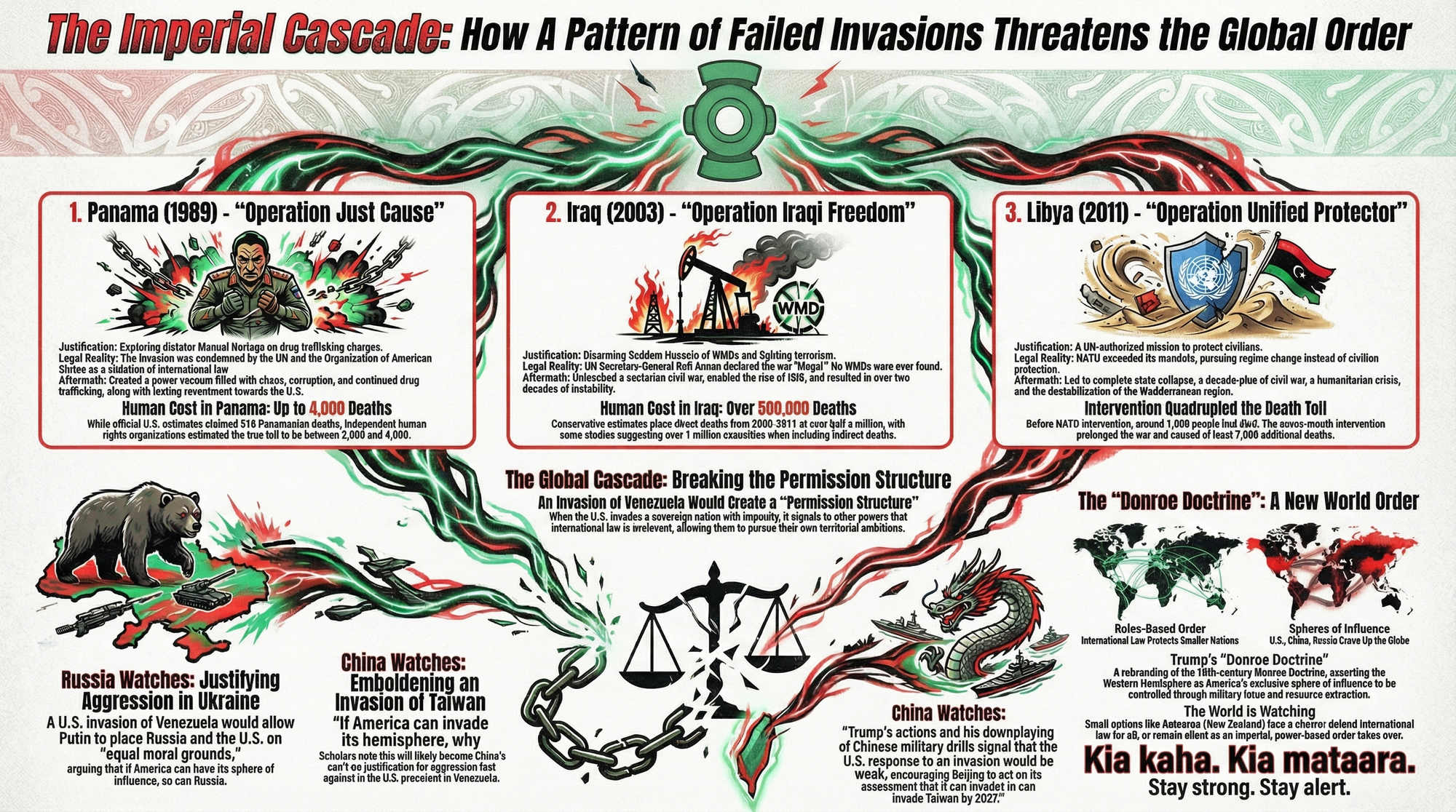
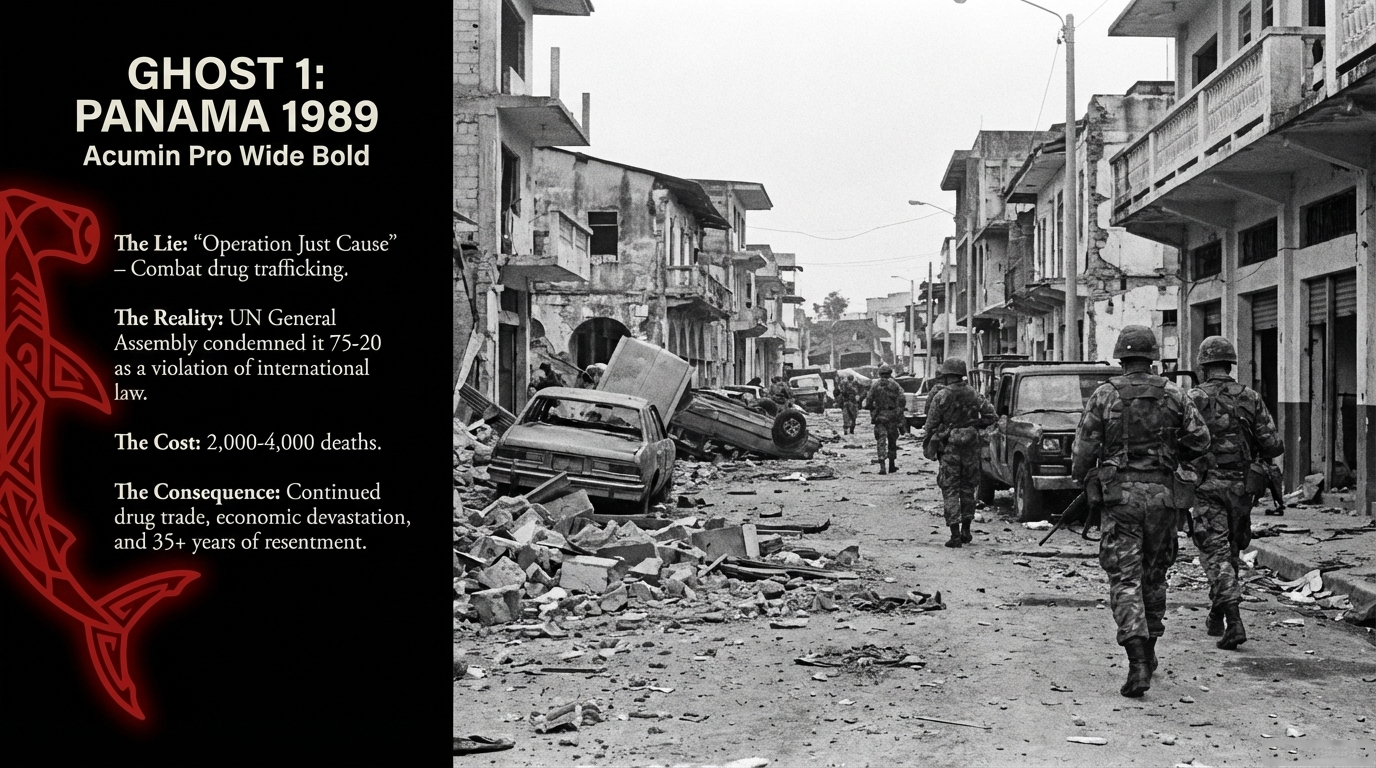
Example 1: Panama 1989 — “Operation Just Cause” — The First Imperial Failure Modern Americans Should Remember
On December 20, 1989, President George H.W. Bush ordered 27,000 troops to invade Panama to capture dictator Manuel Noriega. He had been indicted in Florida on drug trafficking charges—exactly like Maduro.
The Official Justification:
- Protect American citizens
- Restore democracy
- Combat drug trafficking
- Defend the Panama Canal
The Imperial Promise:
Bush declared this would be swift, decisive, and successful. Operation “Just Cause”—as if the name itself sanctified the invasion with moral authority. Within days, Noriega was captured, bound up and sent back to the United States to face trial.
Bush declared victory. The operation was over.
The Legal Reality:
International law scholars concluded: “The invasion of Panama violated international law.” The UN General Assembly condemned it 75-20. The Organization of American States called it a violation of international law. Even legal experts who supported prosecuting Noriega for his crimes concluded that “invoking the drug trafficking indictment as justification provided only a tenuous legal basis for invasion.”
Translation: “You can’t invade a country and kidnap a leader just because you have an indictment against him.”
The Death Toll:
Official US estimates: 516 Panamanian combatants and civilians dead. Independent human rights organizations estimated 2,000-4,000 deaths. Entire neighborhoods in Panama City were destroyed by American bombs.
The Aftermath—The Part They Never Teach:
Guillermo Endara—who had allegedly won Panama’s 1989 election but whom Noriega had refused to recognize—was installed as president. Democracy was “restored.”
But within years, Panama faced:
- Continued drug trafficking (the cartels simply found new routes through Central America)
- Economic devastation from the invasion’s destruction of infrastructure
- Endara’s government riddled with corruption (he was eventually forced from office)
- Long-term resentment toward the United States that persists 35 years later
- Noriega spent 17 years in US prison, was extradited to France for money laundering and served 7 more years, then was extradited back to Panama where he died in 2017
The Lesson:
You can kidnap a dictator in weeks. You cannot create stability through invasion. The vacuum you create is filled by chaos, corruption, and resentment—the very conditions that generate the next dictator.
This is the first example. But the Western mind often dismisses Panama as a 1980s relic. So let me give you a second example—one that is fresh enough in American memory that no one should be able to forget it.
Example 2: Iraq 2003 — “Operation Iraqi Freedom” — The Catastrophe That Should Have Ended American Imperialism
On March 20, 2003, the United States and United Kingdom invaded Iraq to depose Saddam Hussein. The justification was that he possessed weapons of mass destruction and supported terrorism.
The Official Story:
Disarm Iraq of WMDs. End support for terrorism. Liberate the Iraqi people. Establish democracy in the Middle East. This would be a model for how regime change should work.
President George W. Bush promised a swift operation. Military strategists said the invasion would take weeks. Nation-building would take months. Democracy would follow naturally.
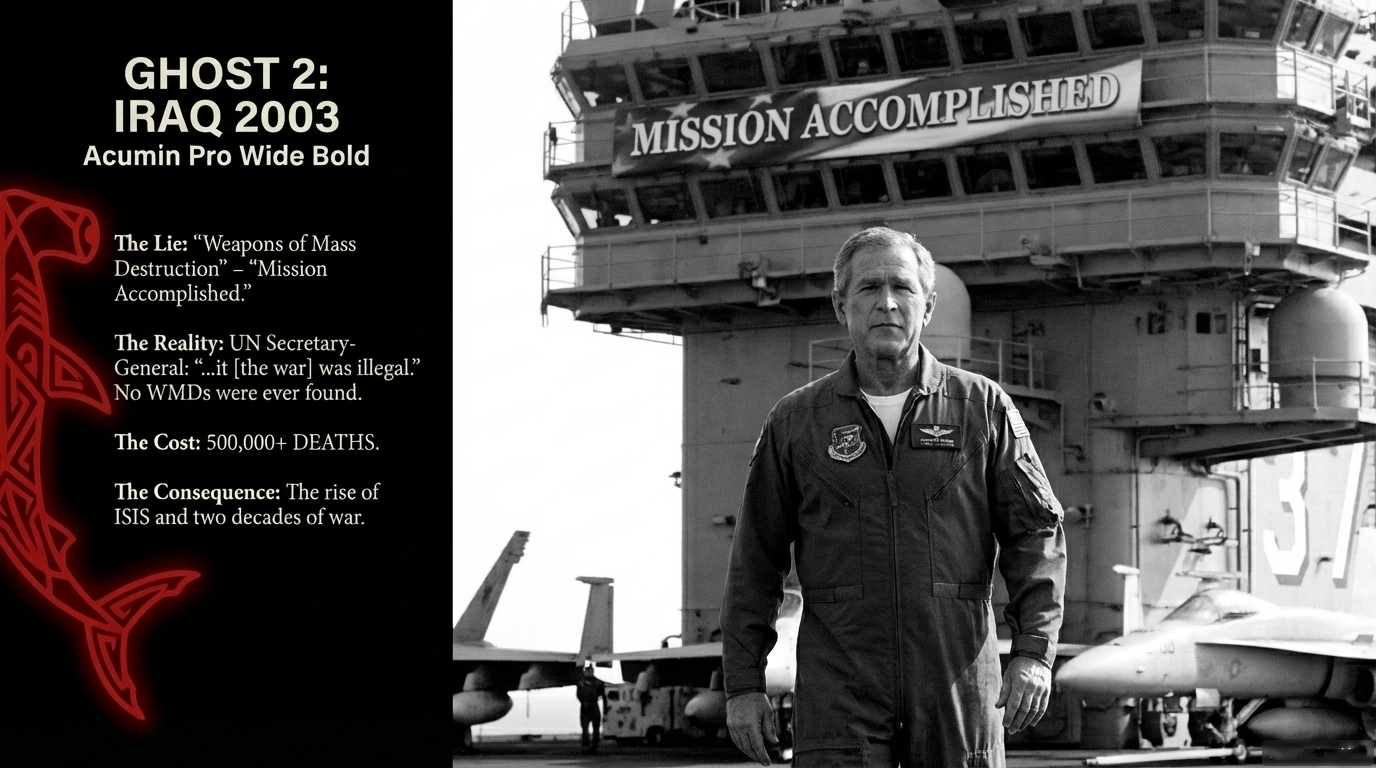
On May 1, 2003, just six weeks after the invasion began, Bush flew onto an aircraft carrier and declared: “Mission Accomplished.”
He stood in a flight suit in front of a banner that said exactly that. Behind him, the banner read “Mission Accomplished” again. The symbolism was complete: America had won. The hard part was over.
The Legal Reality:
UN Secretary-General Kofi Annan stated unequivocally: “From our point of view and the UN Charter point of view, it [the war] was illegal.”
The Netherlands Supreme Court concluded the invasion “violated international law.” International legal scholars wrote: “The US and UK invasion of Iraq in 2003 was a serious violation of international law.”
The Death Toll—and This Is Where Numbers Fail:
Conservative estimates: Over 500,000 deaths directly attributable to the war and occupation between 2003-2011. Some studies estimate over 1 million deaths when including indirect casualties from infrastructure collapse, disease, and civil war that erupted after the invasion.
To put this in perspective: That’s equivalent to the entire population of Auckland being killed.
The Aftermath—The Part That Never Ended:
- No weapons of mass destruction were ever found. The entire legal justification for the invasion was false.
- Saddam Hussein was captured, tried, and executed, but Iraq immediately descended into sectarian civil war
- The power vacuum enabled the rise of ISIS, which seized large portions of Iraq and Syria by 2014, leading to years of additional conflict
- American forces remained in Iraq for 8 years, spending over $2 trillion
- Iraq remains unstable, divided, and traumatized more than 20 years later
- The sectarian violence unleashed by the invasion continues to destabilize the Middle East
One New Zealand RAF doctor, Malcolm Kendall-Smith, refused to deploy to Iraq, arguing the invasion was illegal. He was sentenced to 8 months in military prison. But history proved him right. The man who followed the law was punished. The nation that violated the law was not.
The Lesson:
You can topple a dictator in weeks. The chaos lasts decades. And the longer you occupy a country without legitimacy, the more you become the enemy. American soldiers, who were initially welcomed as liberators in some places, became occupiers. Occupiers become targets. Targets create insurgencies. Insurgencies create the very terrorism and extremism you claimed to be fighting.
Example 3: Libya 2011 — “Operation Unified Protector” — The Moment When Even Legal Intervention Created Collapse
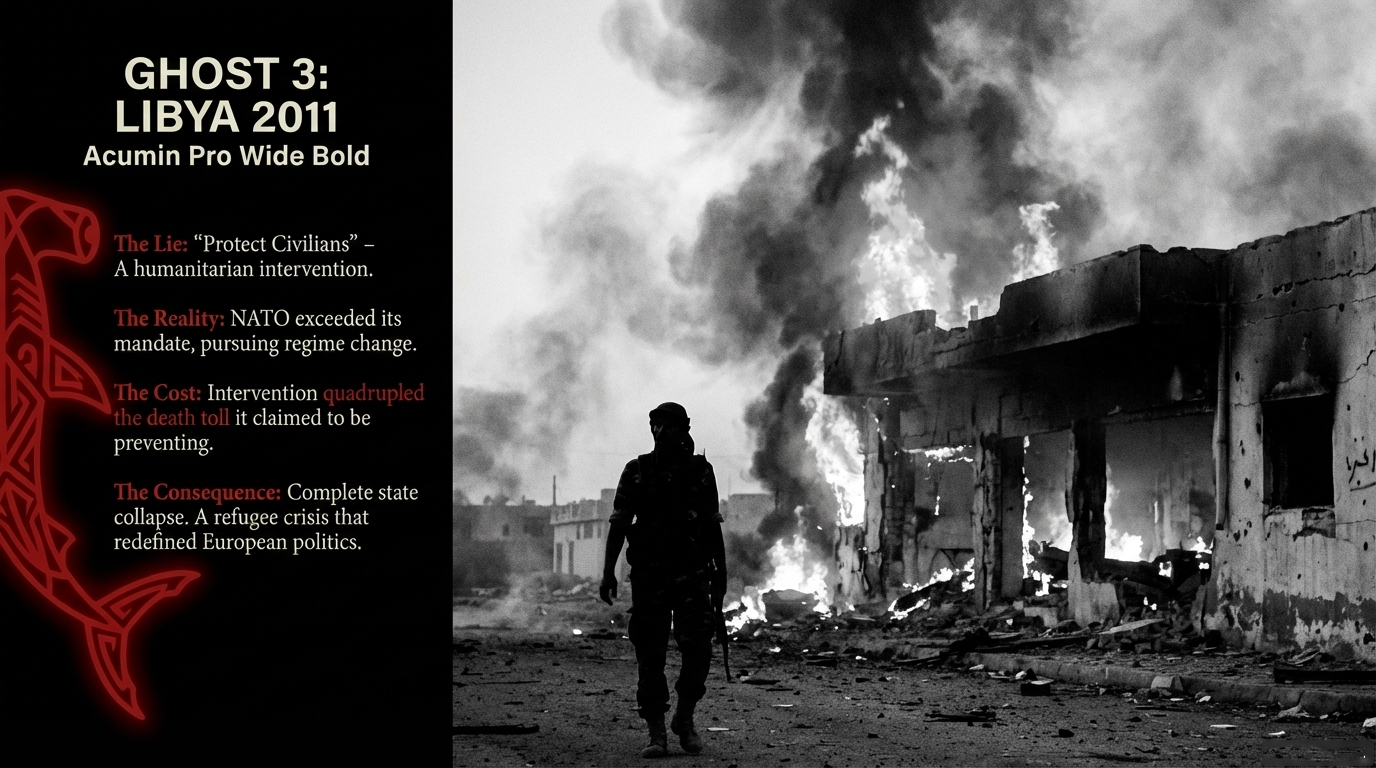
On March 19, 2011, NATO forces began bombing Libya under UN Security Council Resolution 1973, which authorized a no-fly zone to protect civilians during Libya’s civil war.
This is important: Unlike Panama and Iraq, Libya intervention was initially authorized by the UN Security Council. So if you think “international authorization solves the problem,” Libya proves it doesn’t.
The Official Story:
Protect civilians from Muammar Gaddafi’s forces. Prevent mass atrocities. Support democratic uprising. Humanitarian intervention under “Responsibility to Protect” (R2P).
President Obama insisted this was not regime change. It was humanitarian protection. The French, British, and Arab League were on board. This would be the model for responsible international intervention.
The Legal Reality:
The operation was authorized by the UN Security Council. But legal scholars noted that NATO exceeded its mandate, pursuing Gaddafi’s overthrow rather than simply protecting civilians.
The Death Toll:
When NATO intervened in March 2011, approximately 1,000 people had died in Libya’s civil conflict. NATO’s intervention prolonged the war for seven more months, resulting in at least 7,000 additional deaths.
Translation: NATO intervention quadrupled the death toll from the conflict it claimed to be preventing.
Gaddafi was captured by rebels in October 2011 and summarily executed—a brutal killing caught on video that revealed the chaos of the intervention.
The Aftermath—Still Unfolding 15 Years Later:
- Libya descended into complete chaos
- Over 10 years later, Libya remains fragmented with no functioning central government
- Rival militias control different territories
- ISIS and extremist groups established footholds, leading to years of additional terrorism
- Humanitarian crisis with widespread human rights abuses that continue today
- Refugee flows destabilized the Mediterranean region, creating the migration crisis that has defined European politics for a decade
The Lesson:
Even when you have UN authorization, regime change through military force creates chaos that lasts generations. The problem is not legality. The problem is military force’s inability to create political legitimacy. Bombs can destroy. They cannot build. Occupation creates resentment. Resentment creates resistance. Resistance creates the conditions for the next conflict.
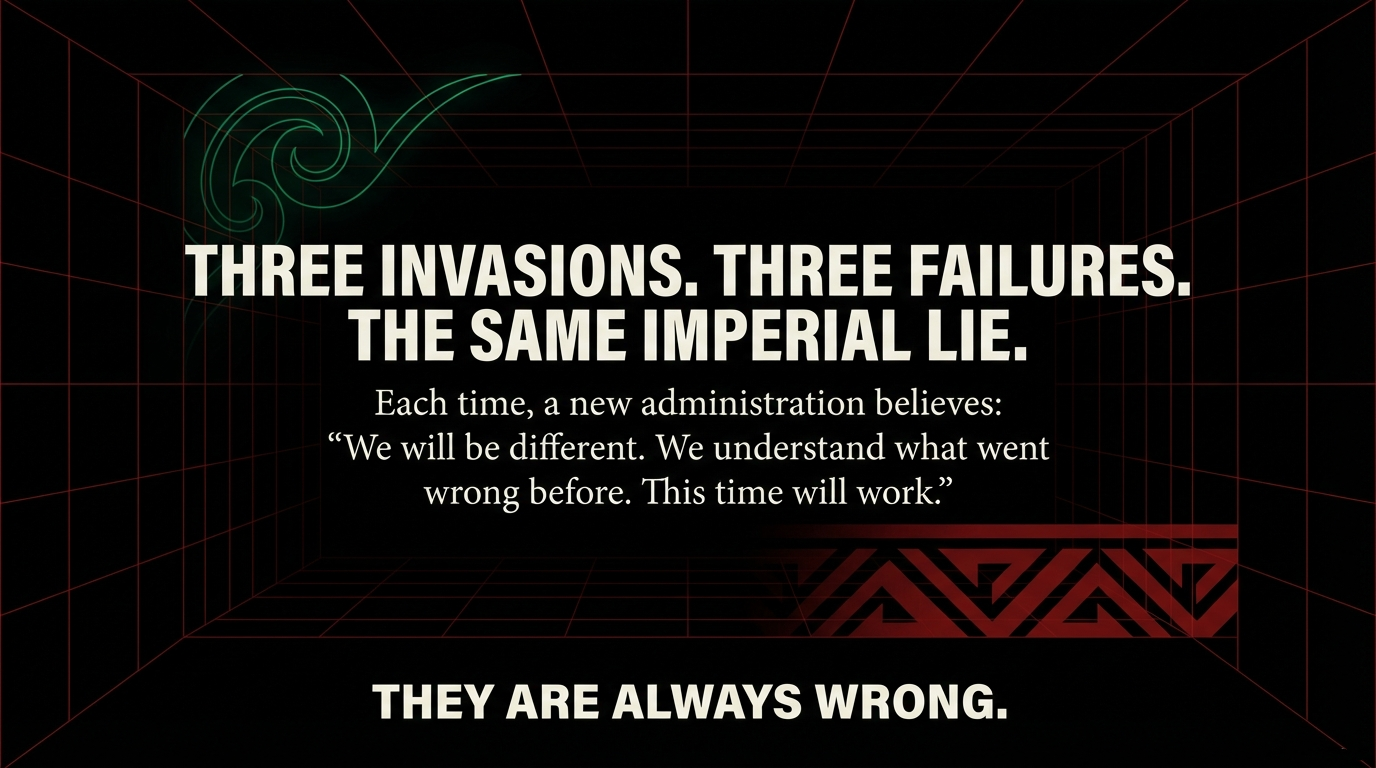
THE PATTERN: Three Invasions, Three Failures, Same Imperial Lie
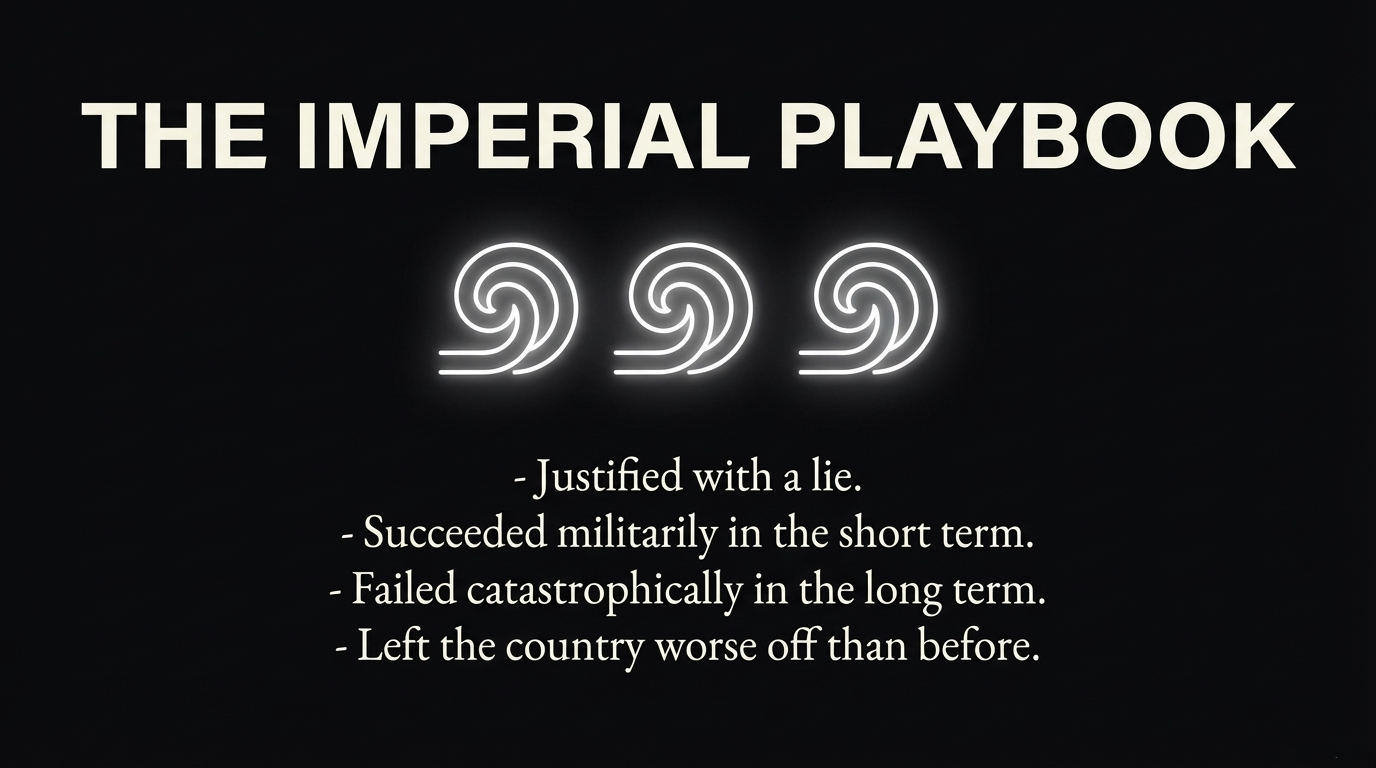
Every single invasion:
- Violated or exceeded international law
- Succeeded militarily in the short term (dictator removed)
- Failed catastrophically in the long term (chaos, death, instability)
- Was justified with lies (drugs, WMDs, humanitarian protection)
- Left the country worse off than before
Yet each time, a new administration believes: “We will be different. We understand what went wrong before. This time will work.”
They are always wrong.
PART II: THE GLOBAL CASCADE — THE PERMISSION STRUCTURE BREAKS
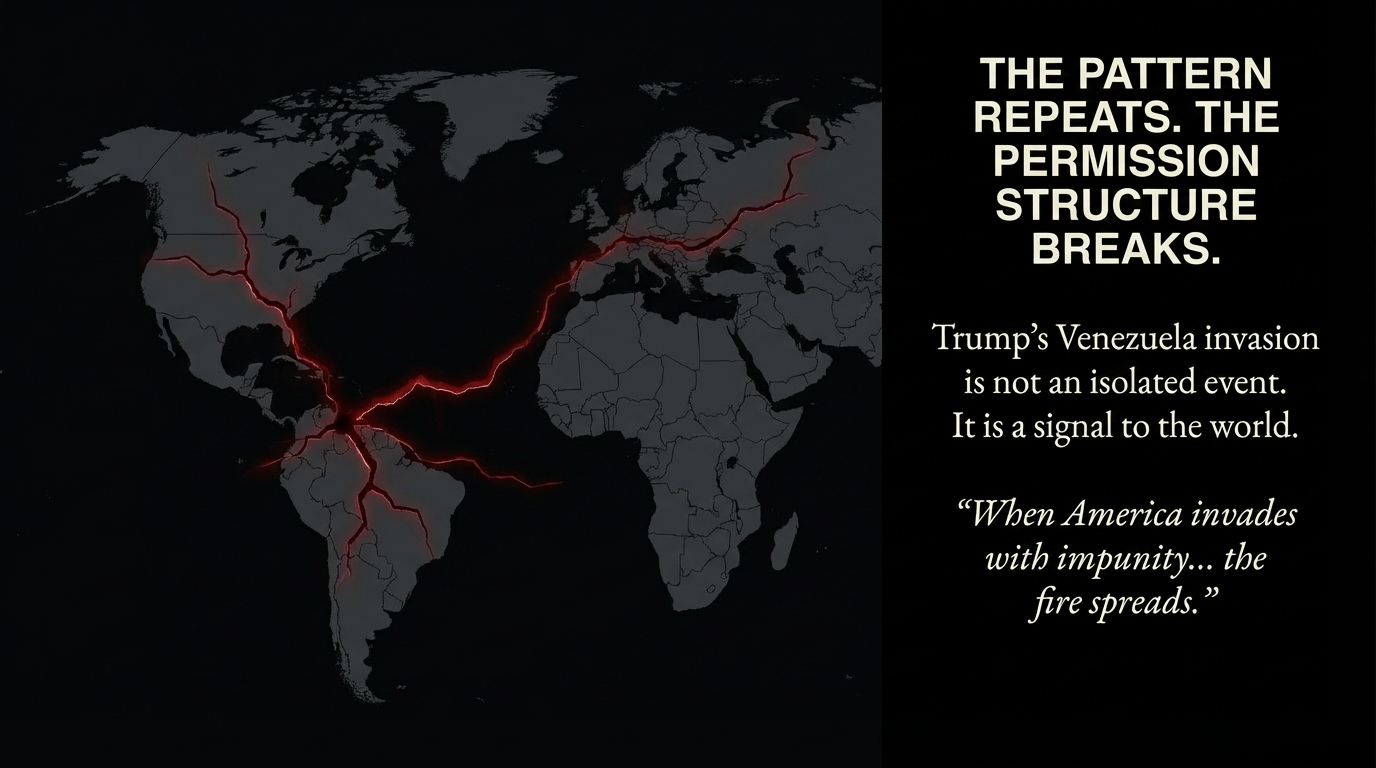
Here is what most observers are missing: Trump’s Venezuela invasion is not an isolated event. It is a permission structure for global imperialism.
When America invades with impunity, what stops China from invading Taiwan? What stops Russia from advancing further in Ukraine? What stops Trump from annexing Greenland?
The answer is: Nothing.
Think of international law as a fire alarm. It only works if someone pulls it. When no one pulls the fire alarm—when nations watch empire advance and do nothing—the fire spreads.
The Greenland Threat: When Manifest Destiny Returns
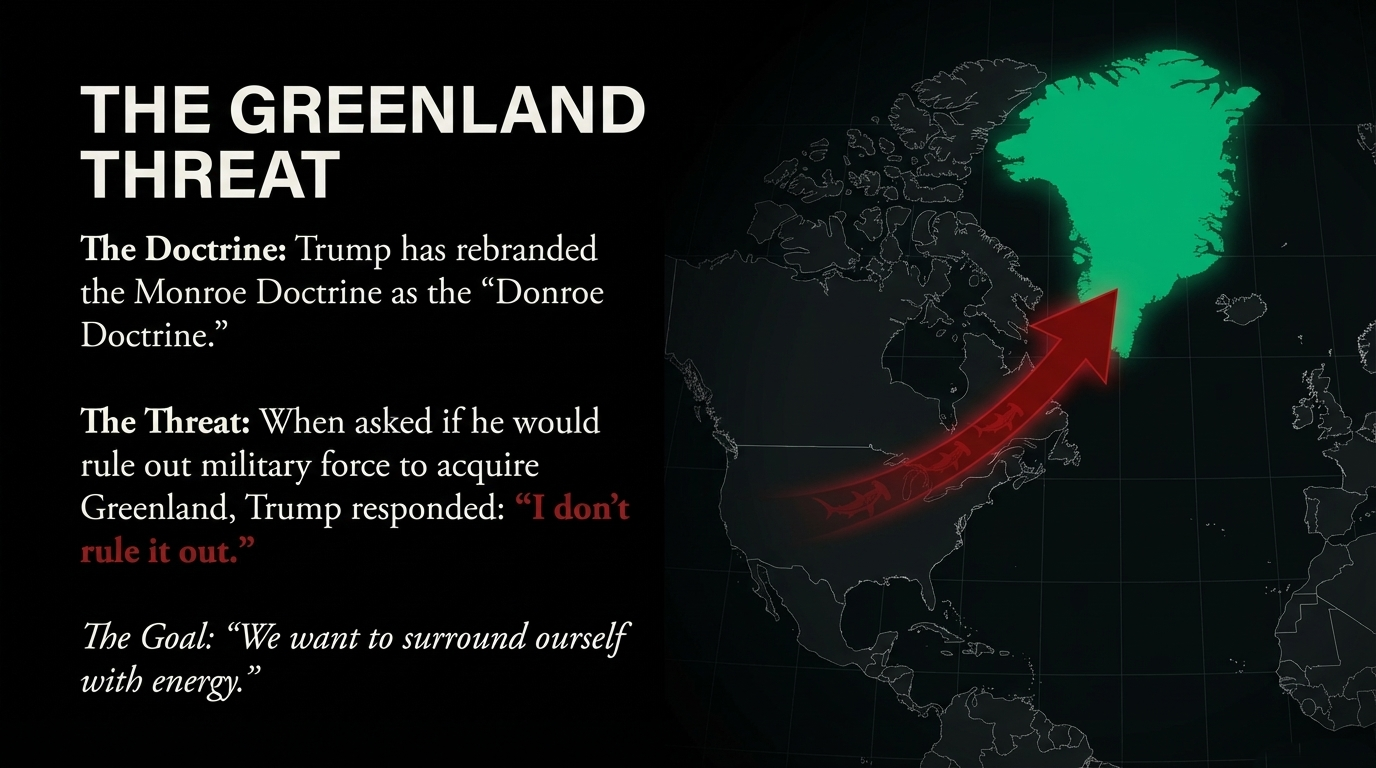
Trump has appointed a special envoy to Greenland and declared: “I think we’re going to have it.”
When asked if he would rule out military force, Trump responded: “I don’t rule it out.” He threatened “very high” tariffs on Denmark if it refused.
Greenland has strategic position between Europe and North America, crucial for ballistic missile defense. It has mineral wealth. Trump wants it.
But Trump is serious. He is not joking. He has appointed a special envoy with explicit instructions to push for annexation—whether through pressure, coercion, or eventually military threat.
The question every European nation must ask: If America can invade Venezuela with impunity, kidnap a president, announce occupation—why should Trump not believe he can pressure or coerce Greenland into submission?
The answer: Because the international order still theoretically exists. Because NATO countries still theoretically defend each other. Because Denmark is a NATO ally.
But Venezuela is not a NATO ally. And Trump has shown: he will violate international law for resources and strategic advantage.
Once America does this, the permission structure is broken for everyone.
China Watches: Taiwan in 2027 — The Real Threat
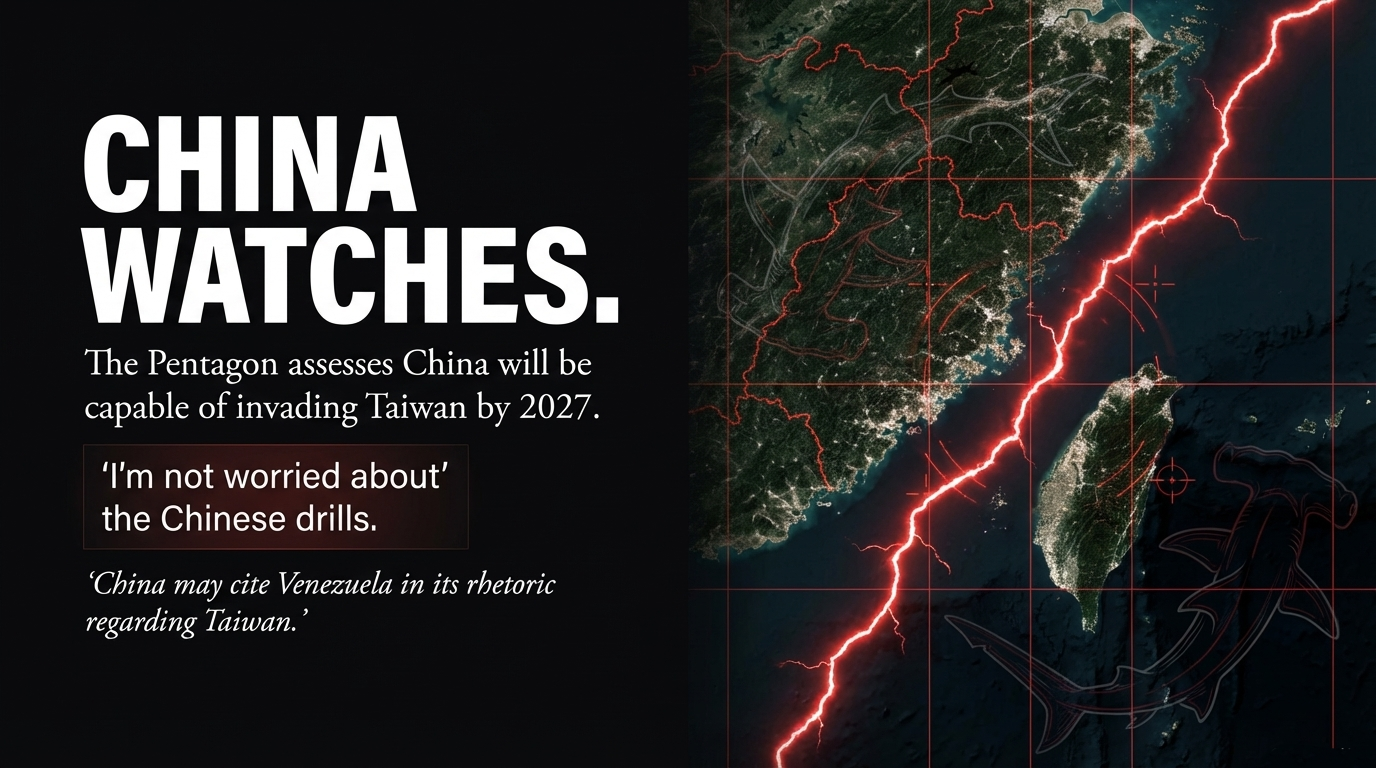
China has conducted massive military drills around Taiwan, codenamed “Justice Mission 2025.” The drills simulated a blockade of Taiwan’s major ports and practiced “all-dimensional deterrence.”
Why does this matter now?
Because Trump’s Venezuela invasion sends a message to Beijing: “The United States will violate international law. It will kidnap foreign leaders. It will announce occupation. And the international response will be diplomatic whimpering.”
The cascade: If America invades Venezuela without meaningful international consequence, what deters China from invading Taiwan?
Scholars have noted: “China may cite Venezuela in its rhetoric regarding Taiwan.” Translation: “If America can invade its hemisphere, why can’t we invade ours?”
Taiwan’s President Lai Ching-te has proposed a $40 billion supplementary defense budget. Taiwan remains on high alert after China’s drills, with military forces “maintaining appropriate contingency mechanisms.”
But defense spending cannot stop an invasion if America will not credibly commit to Taiwan’s defense. And Trump has made clear: his commitments are transactional.
Under Trump, this rationale is no longer softened by diplomatic niceties. Trump views security in transactional terms. Taiwan’s value is assessed in “tangible terms: defense spending, industrial collaboration, and strategic significance.”
To maintain US support, Taiwan must prove the “narrative: a credible threat from China and an impending security crisis.”
Translation: Taiwan’s security guarantee depends not on international law, but on Trump’s mood and commercial interests.
Russia Watches: Ukraine’s Betrayal — The Opportunity Trump Has Handed Putin
Here is where the cascade becomes truly dangerous.
Russia has formally requested that the United States stop pursuing an oil tanker fleeing to Venezuela, submitted “late on New Year’s Eve to the State Department.”
Why would Russia intervene over a tanker? Because Russia understands the geopolitical message Trump is sending.
Think about this carefully:
What Trump is saying to Putin:
“America invades a sovereign nation without UN authorization. America kidnaps a foreign leader. America announces occupation and resource extraction. International law does not apply to superpowers. Only the weak must obey.”
What Putin hears:
“If America can do this in Venezuela, why can’t I do this in Ukraine? If the West looks away from American imperialism, why should I care what the West says about Russian imperialism?”
Translation: “If America invades Venezuela, I can point to America and say: ‘Your values are just like ours. International law means nothing. Power determines right.’”
Trump has already begun the Ukraine betrayal: He has scaled back financial aid to Ukraine, adopted near-neutrality, pressured Zelensky to cede territory, and removed Russia from America’s list of “direct threats.”
Putin has demanded that Ukraine abandon NATO membership, withdraw from captured territories, and accept a “security zone” along Russia’s border. Zelensky has indicated willingness to drop NATO membership if the US provides security guarantees—but these guarantees are Trump’s negotiations with the threat of abandonment hanging over them.
The cascade: Trump invades Venezuela to prove America’s imperial rights. Trump then pressures Ukraine to accept Russian imperial rights in return for a Trump-brokered “peace.”
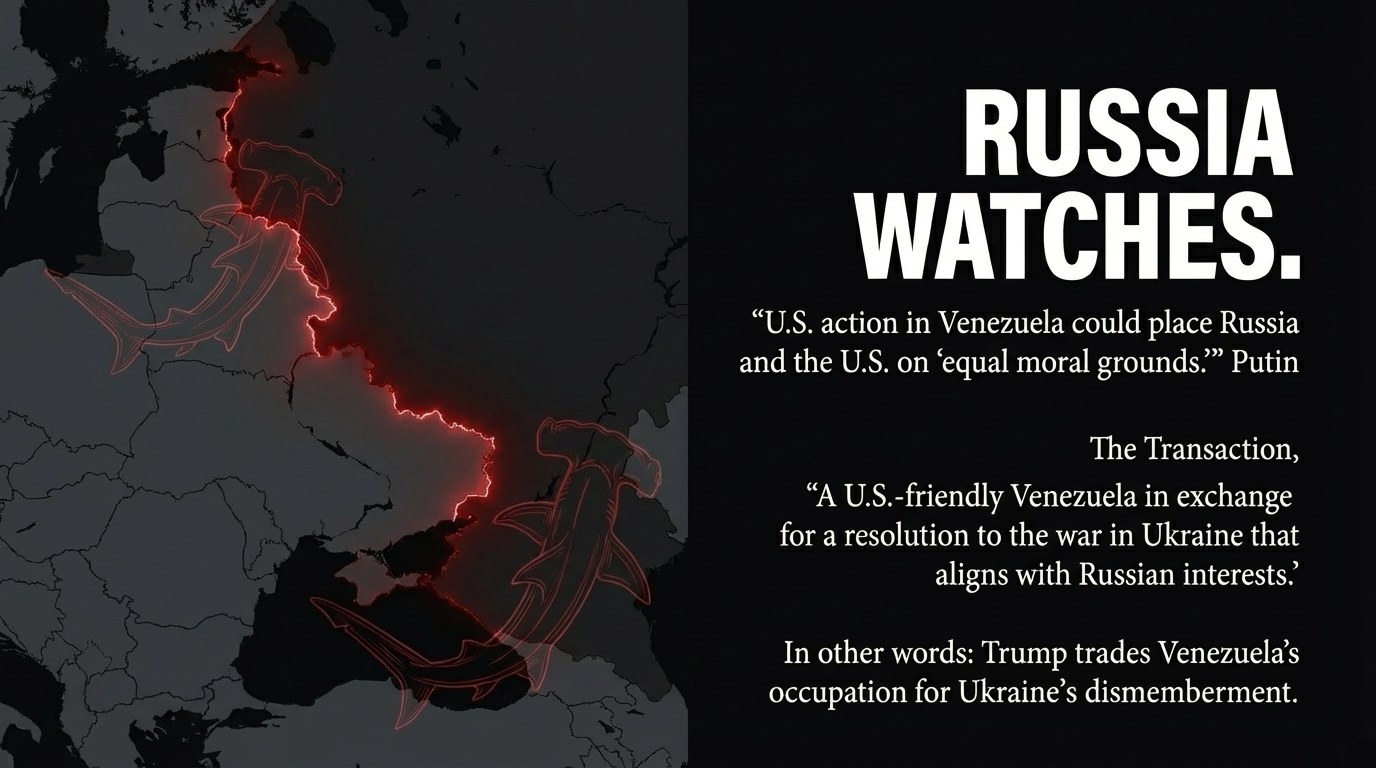
Translation: “Trump trades Venezuela’s occupation for Ukraine’s dismemberment.”
The Hidden Strategy: “The Donroe Doctrine” — Empire Rebranded
Translation: “The Western Hemisphere belongs to America. We will decide what happens here. No other power—China, Russia, or any ally—has a voice.”
But here’s the dangerous part: Trump is not limiting this to diplomacy. He is advancing it through military force, threatening annexation, and seizing resources.
Trump is not building a rules-based order. He is building a sphere-of-influence system where powerful nations carve up the world.
And Aotearoa—a small nation in the Pacific, dependent on global trade and international law for its security—is signing up to serve this new order by staying silent.
WHY AOTEAROA MUST SPEAK NOW
If you believe Trump’s Venezuela will be different, here is what will actually happen:
Trump has no plan beyond military assault. He has no legitimate successor. He has no occupation force. The VP rejected cooperation. The military declared: “We will not negotiate; we will not surrender.”
This is not a defeated military accepting American occupation. This is a military prepared for resistance.
Trump’s threatened “boots on the ground” against a hostile 28 million-person nation, with no exit strategy, no financial plan, no legitimate government partner?
This is Iraq redux. And America will learn the same lesson: military victory and political control are not the same thing.
The metaphor is complete: Trump set a fire to create smoke. But the smoke has revealed something he did not expect—that the house itself is built on sand, and military force cannot make it stand.
Aotearoa’s Choice Is Simple
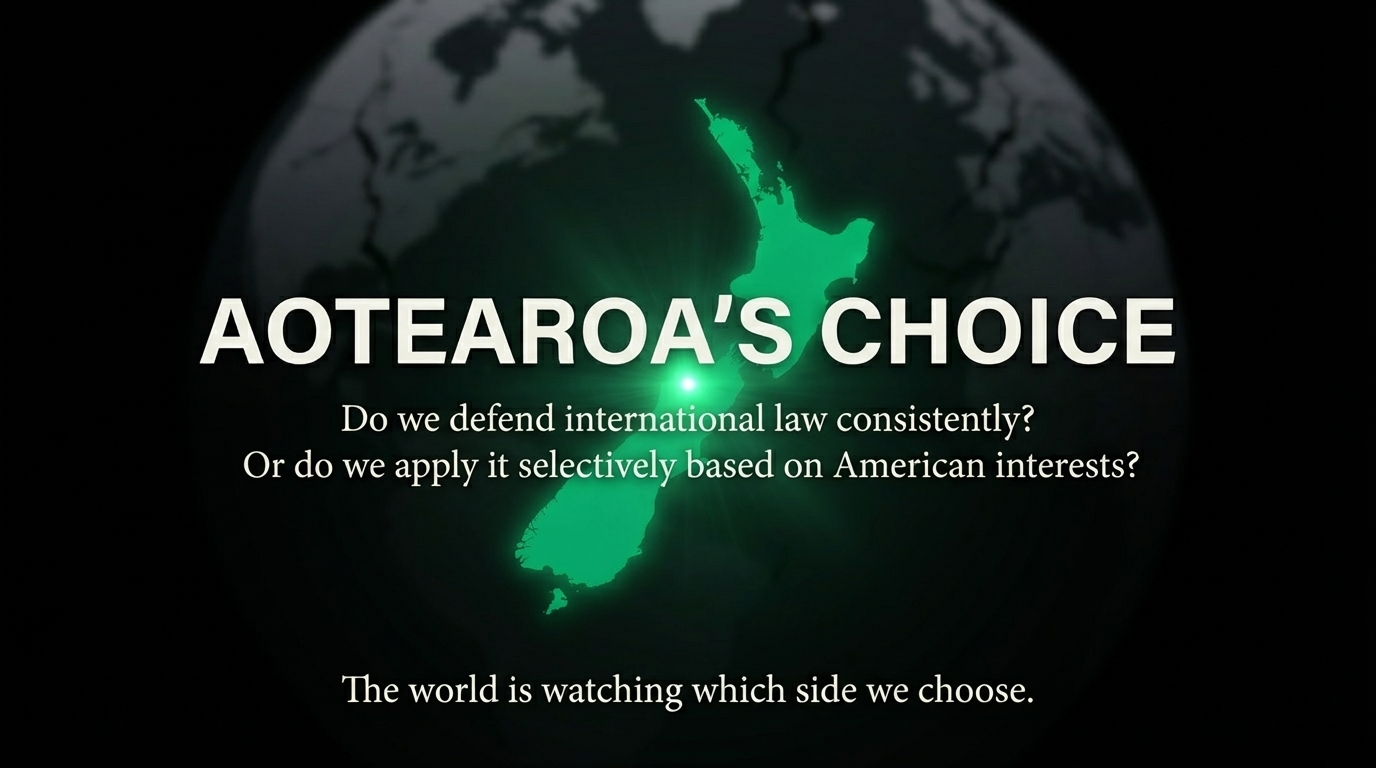
Do we defend international law consistently? Or do we apply it selectively based on American interests?
Do we have moral courage? Or do we hide behind diplomatic language while empire advances?
The world is watching which side we choose.
Kia kaha. Kia mataara.
Stay strong. Stay alert.

Ivor Jones The Māori Green Lantern Fighting Misinformation And Disinformation From The Far Right