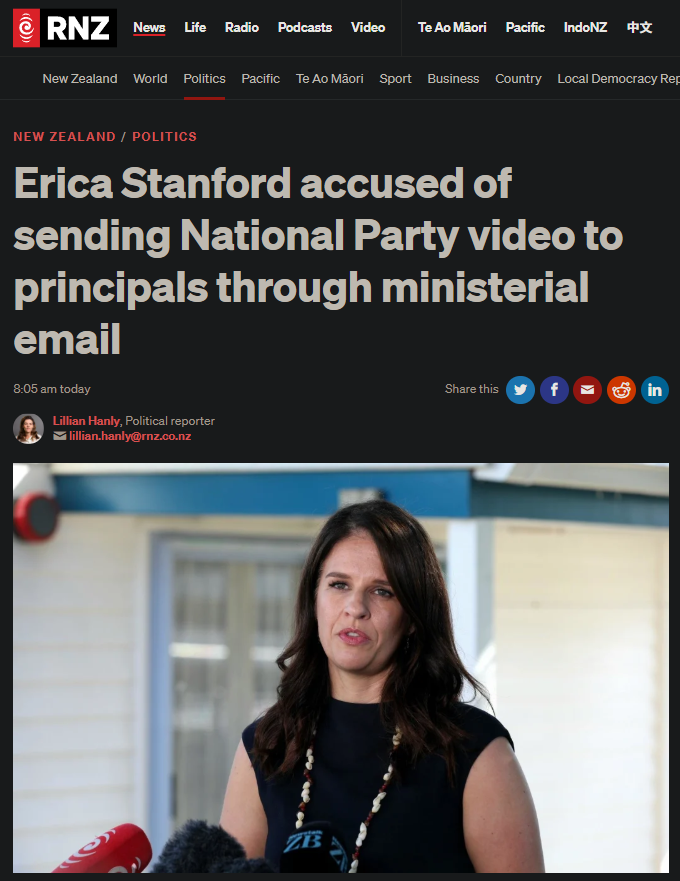
“The Government’s Literacy Shell Game: How National Weaponises Phonics to Wage War on Te Reo Māori” - 13 October 2025
The Point Straight Up: Luxon and Stanford’s Structured Literacy Scam
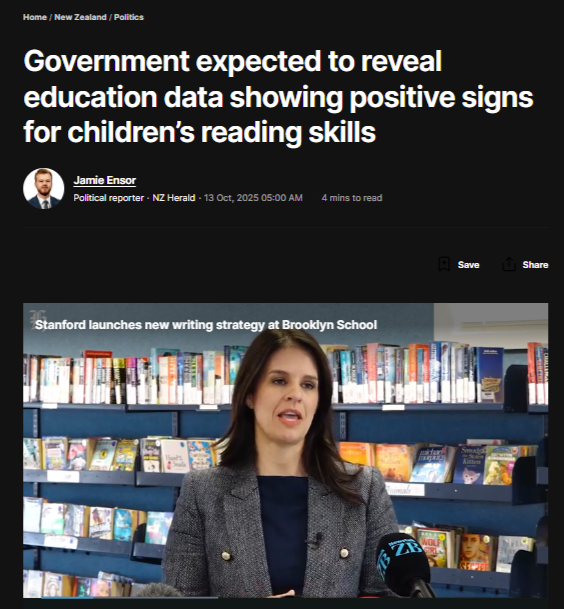
Kia ora e te whānau - Greetings to the family.
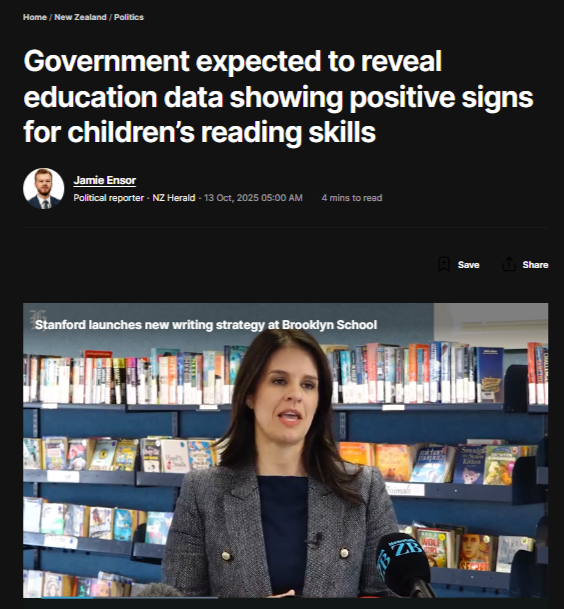
Christopher Luxon and Erica Stanford aren’t teaching kids to read better - they are systematically erasing te reo Māori from our schools while pretending cherry-picked test scores prove their white supremacist education policies work. This is neoliberal colonisation disguised as academic reform, designed to entrench Pākehā privilege while devastating tangata whenua educational aspirations.
The naked truth is this: the government boasted about reducing phonics support needs from 52% to 33% between Terms 1 and 3, but these numbers tell us nothing about whether children are actually reading better. What they do tell us is how desperate this government is to manufacture success stories while systematically attacking Māori language and culture in education.
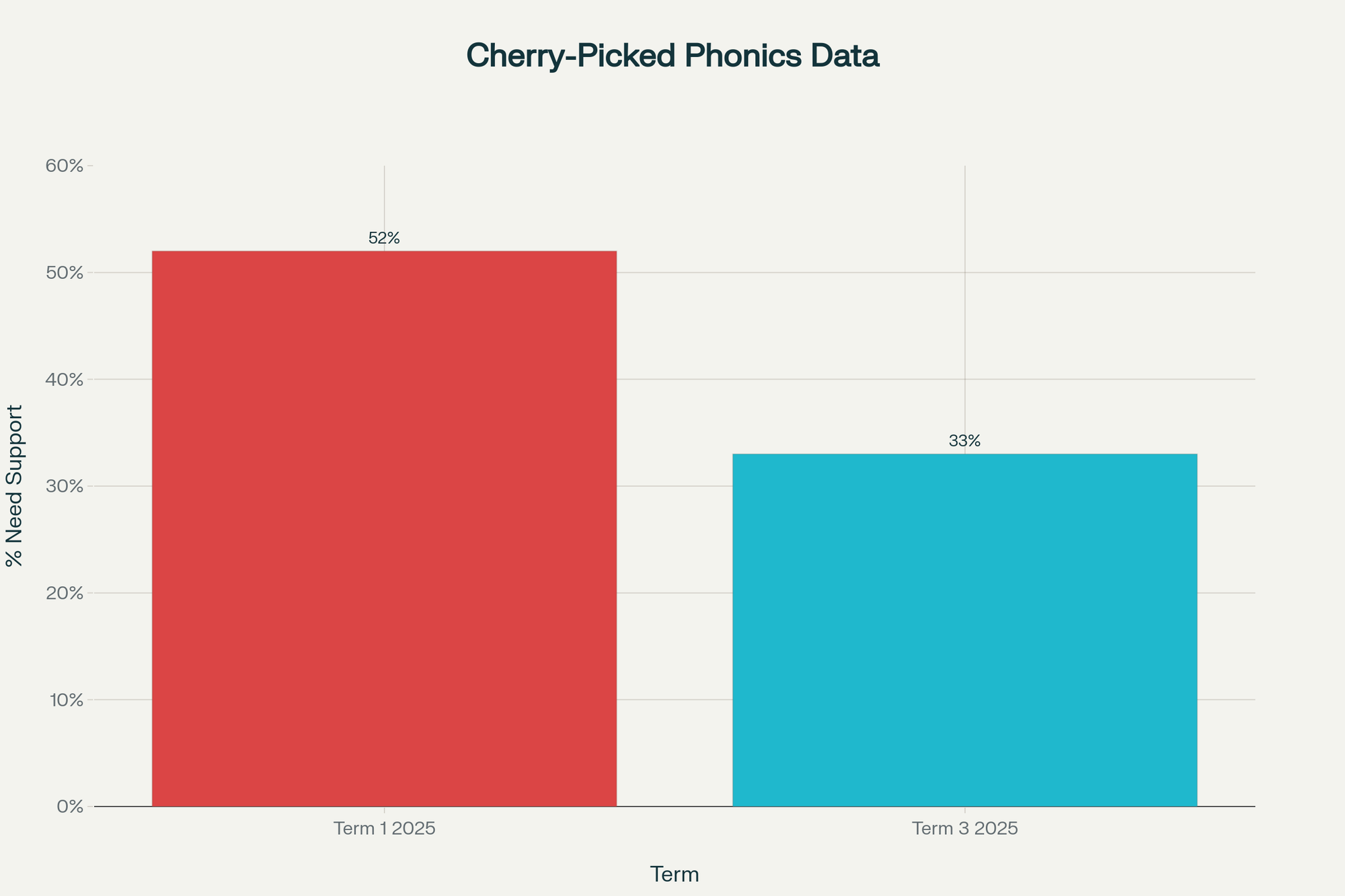
Government data showing the percentage of children needing support after phonics testing, used to justify structured literacy policy
Background: The Colonial Context of Structured Literacy
The structured literacy mandate represents another chapter in the ongoing colonial assault on tangata whenua educational self-determination. This approach focuses exclusively on English phonics while actively removing te reo Māori from children’s learning materials.
The government’s own data reveals the devastating impact of systemic racism in education. Māori students face a 78% University Entrance non-attainment rate compared to just 25% for Asian students. Even after controlling for socio-economic factors, Māori students are 1.36 times more likely to leave school without University Entrance than European students.
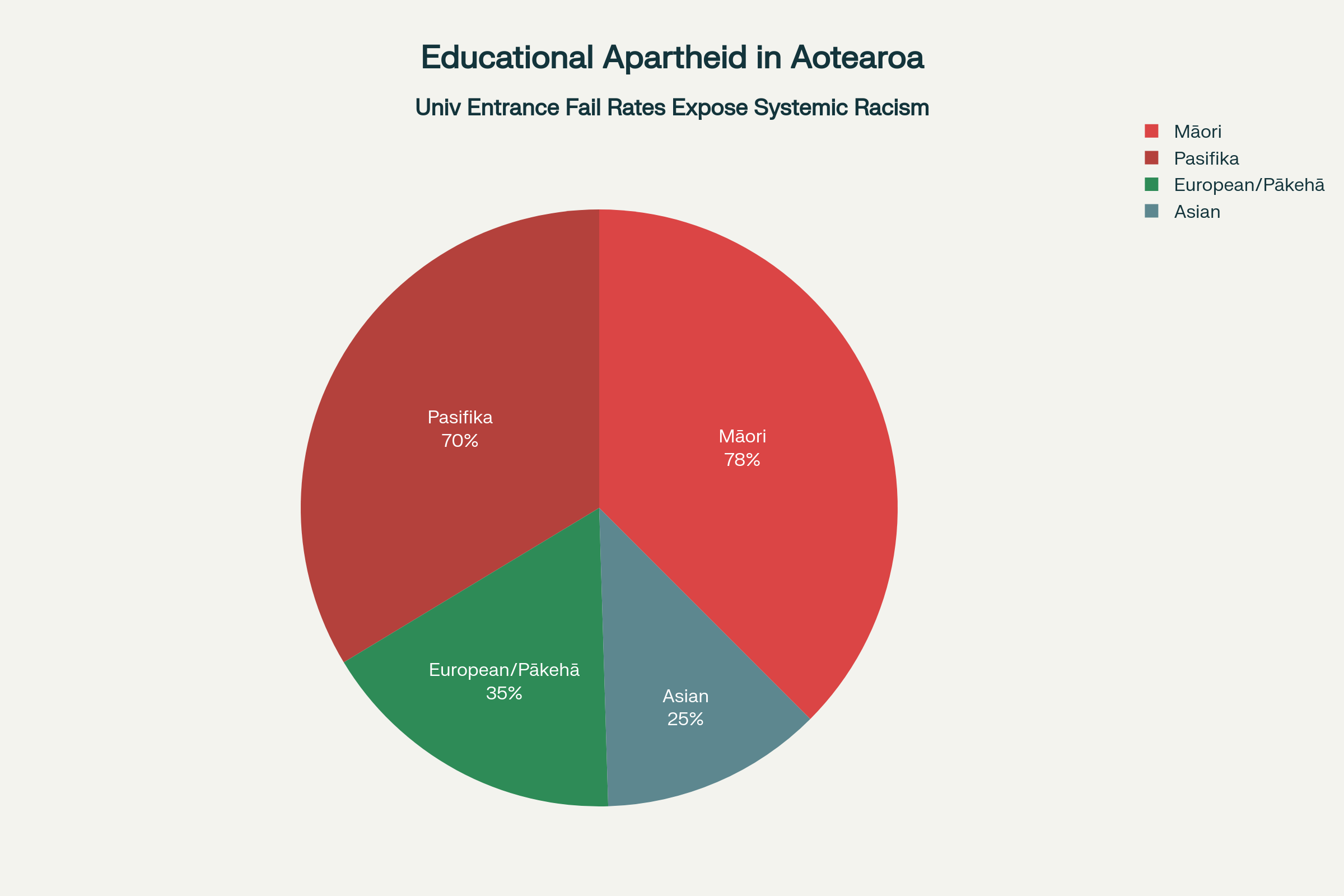
University Entrance non-attainment rates by ethnicity revealing systemic educational inequities
Structured literacy emerged from overseas research contexts that completely ignored Indigenous languages and worldviews. There is no extensive research showing a general reading and writing problem in Māori-medium schools that requires structured literacy intervention. Yet Stanford has imposed this one-size-fits-all approach on all 310 Māori-medium kura without genuine consultation with tangata whenua.
Manufacturing Crisis to Justify Cultural Genocide
The government claims New Zealand faces a literacy crisis requiring urgent intervention. They point to declining PISA scores since 2006, with reading dropping 23 points, science 22 points, and mathematics 29 points. This decline coincides perfectly with the intensification of neoliberal education policies over the past two decades.
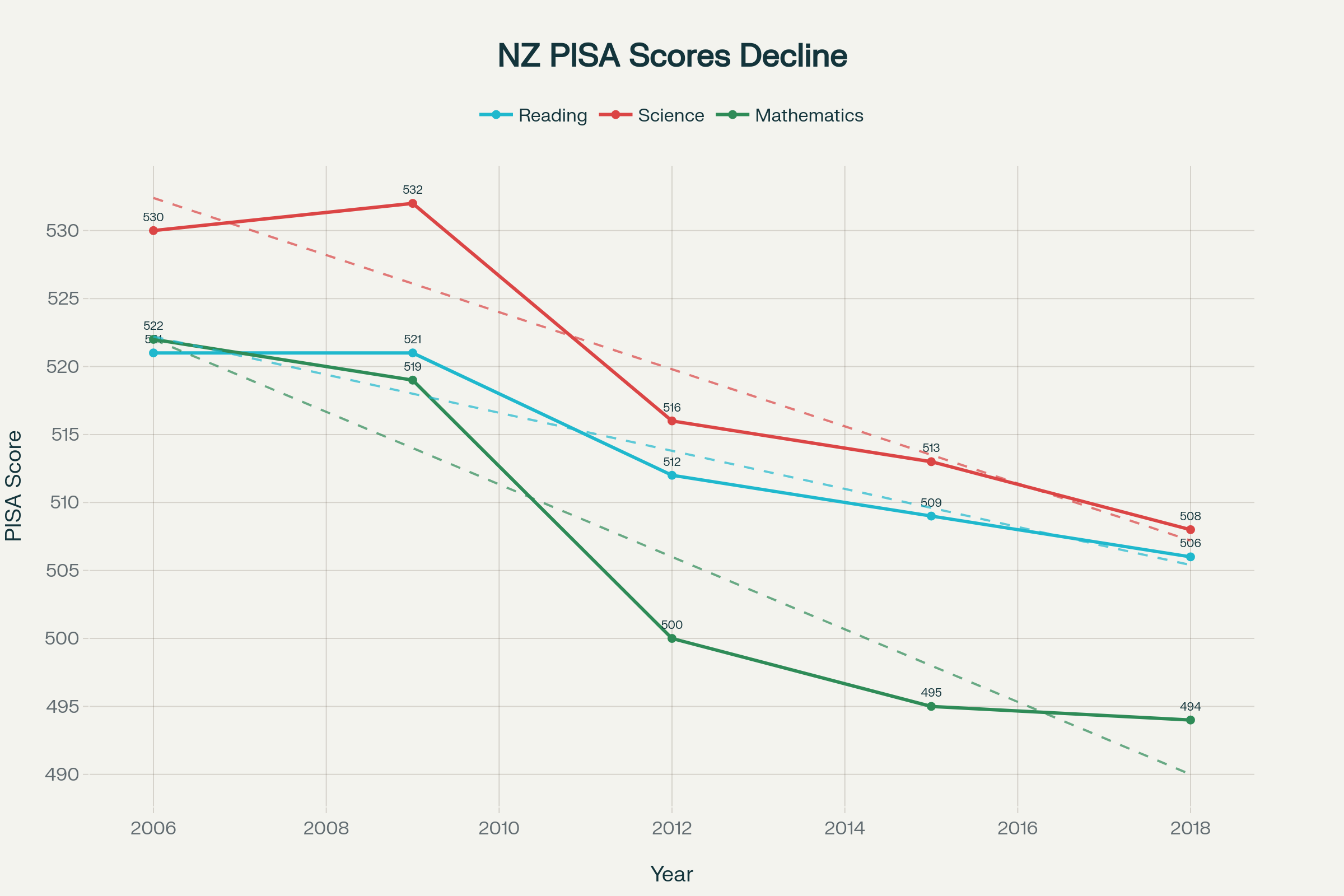
New Zealand’s declining PISA scores across reading, science and mathematics from 2006-2018
But rather than addressing the root causes of educational inequality - poverty, institutional racism, underfunding of schools serving Māori communities - Luxon and Stanford have chosen to scapegoat te reo Māori itself. Their decision to remove Māori words from early reading books except for character names represents what University of Auckland Professor Margaret Mutu correctly identifies as “an attempt to maintain the doctrine of discovery” and “inculcate white supremacy”.
The timing is no coincidence. This attack on te reo comes as 25 areas have removed Māori wards from their councils, while the government systematically dismantles co-governance arrangements across the public sector.
The Neoliberal Network: Following the Money and Ideology
Christopher Luxon: The Christian Capitalist Crusader
Luxon has made his evangelical Christian faith central to his political identity, defending it against accusations of extremism while simultaneously pursuing policies that align perfectly with Christian nationalist agendas. His government has been described as one of the most conservative and right-wing since the 1990s.
As Air New Zealand CEO, Luxon embodied corporate neoliberalism, and now he’s applying the same market-fundamentalist logic to education. His approach treats schools like failing businesses that need corporate-style performance targets and management structures.
The connection to Christian nationalism becomes clearer when examining the broader coalition. Over 400 church leaders opposed the Treaty Principles Bill, yet Luxon continues supporting Seymour’s constitutional vandalism. This suggests his brand of Christianity aligns more with settler colonial interests than with social justice.
Erica Stanford: The Privileged Protégé’s Paper Trail
Stanford completed her Political Science degree with First Class Honours, majoring in Political Science and minoring in Māori Studies. This makes her attacks on te reo Māori particularly cynical - she studied our culture only to better understand how to undermine it.
Her political education came from working four years in Murray McCully’s office. McCully, known as the “dark prince” of National politics, was notorious for his manipulative tactics and contempt for democratic processes. Stanford describes McCully as her mentor, calling him “a political master”.
Before politics, Stanford produced reality TV shows including “Noise Control” and worked on “Piha Rescue”. She jokes that her “skills in reality TV hold me in good stead for my time in this house”. This reveals everything about her approach to politics - it’s all performance, all manipulation, all about managing public perception rather than genuine policy substance.
The Think Tank Pipeline: Manufacturing Consent
The New Zealand Initiative, a key neoliberal think tank, has praised Stanford’s reforms as potentially creating “one of the most exciting education reforms in the world”. They explicitly frame her agenda as “a decisive break from the child-centred, competency-based approach that has dominated New Zealand classrooms for decades”.
This language reveals the real agenda - not improving educational outcomes, but reshaping education to serve neoliberal economic interests. The same document celebrates Stanford’s push for “knowledge-rich curricula” that emphasise conformity to business needs rather than critical thinking or cultural responsiveness.
Data Manipulation and Statistical Sleight-of-Hand
The Phonics Check Con
The government’s headline claim about phonics improvement is deliberately misleading. The drop from 52% to 33% of children needing support represents students who have been in the system longer - not proof that structured literacy works better.
This is statistical cherry-picking designed to manufacture a success story. Any cohort of students will show improvement over time simply through maturation and continued schooling. Without control groups or long-term longitudinal data, these numbers are meaningless propaganda.
The Missing Context: Whose Children Are Failing?
The government carefully avoids breaking down their phonics data by ethnicity, because it would expose how their policies are failing Māori and Pasifika children. The broader education statistics show devastating disparities that structured literacy is doing nothing to address.
Recent Oranga Tamariki data shows Māori children make up half of all reports of concern, two-thirds of those in state care, and over three-quarters in youth justice custody. These children achieve education qualifications at almost half the rate of Māori with no system involvement.
The structured literacy mandate does nothing to address these systemic inequities - it actually makes them worse by removing culturally responsive pedagogies that might help engage tamariki Māori.
The War on Te Reo: Cultural Genocide by Policy
Book Banning and Language Erasure
Stanford’s decision to remove te reo Māori from the “At the Marae” reader because it contained six Māori words - marae, karanga, wharenui, koro, hongi and karakia - represents cultural vandalism disguised as educational policy.
The ministry claimed these “multisyllabic” Māori words presented “decoding challenges” and had “vowel sounds that differ from those specifically taught”. This is linguistic racism - treating te reo Māori as inherently difficult or problematic rather than as a legitimate part of New Zealand’s linguistic landscape.
The Treaty Erasure Project
Teachers and principals report noticeably fewer Māori words and Treaty references in education documents, including new curriculum statements. While Stanford denies these claims, the pattern is unmistakable across multiple policy areas.
The government has removed ethnicity as a factor for targeting services and downgraded Treaty importance in school board guidelines. This systematic erasure aims to make Māori invisible in policy while maintaining the facade of commitment to Te Tiriti.
The Resistance: Academic and Professional Pushback
Expert Opposition to Language Erasure
Dr Vincent Ieni Olsen-Reeder from Te Herenga Waka Victoria University explains that exposing tamariki to multiple languages while their brains are developing actually enhances rather than hinders learning. He argues the government has missed an opportunity to create a localised structured literacy programme informed by how New Zealanders actually speak.
Teacher and Principal Resistance
Te Akatea, the Māori Principals’ Association, called Stanford’s move “an act of white supremacy” and “an act of racism”. President Bruce Jepsen reports that reduced use of te reo and Treaty references is noticeable “on an almost daily basis”.
The Broader Colonial Context: Connecting the Dots
The Neoliberal Education Project
Analysis of New Zealand’s neoliberal transformation shows how education became a tool for creating enterprise culture and economic competitiveness rather than critical thinking or cultural development. The National Party has consistently promoted business influence over curriculum design since the 1990s.
Stanford’s reforms continue this trajectory, treating education as a production line for creating compliant workers rather than empowered citizens. Her emphasis on “knowledge-rich” curriculum actually means knowledge selected by corporate interests and conservative ideology.
The Wider Attack on Māori Rights
The structured literacy policy must be understood alongside the government’s broader assault on tangata whenua rights: dismantling co-governance arrangements, removing Māori wards, cutting funding for te reo teacher training by $30 million, and supporting ACT’s Treaty Principles Bill.
The government allocated $153 million for charter schools while cutting Māori education programmes. This reveals their true priorities - privatisation and cultural assimilation over equity and self-determination.
Images from the Education Battlefront
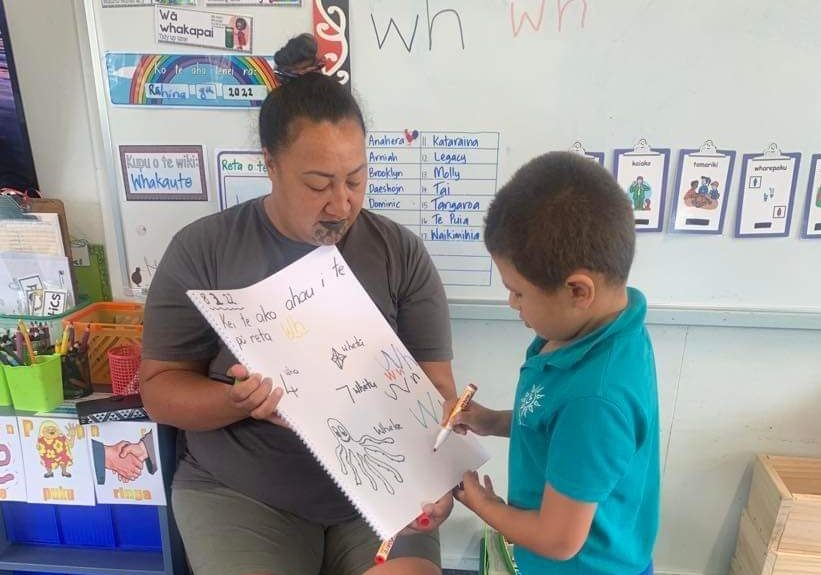
A Māori child engaged in learning in a culturally inclusive primary school classroom in New Zealand
This image shows the kind of culturally responsive education that Stanford’s policies are systematically destroying. Māori children learning in environments that honour their language and culture, rather than treating it as a barrier to “real” learning.
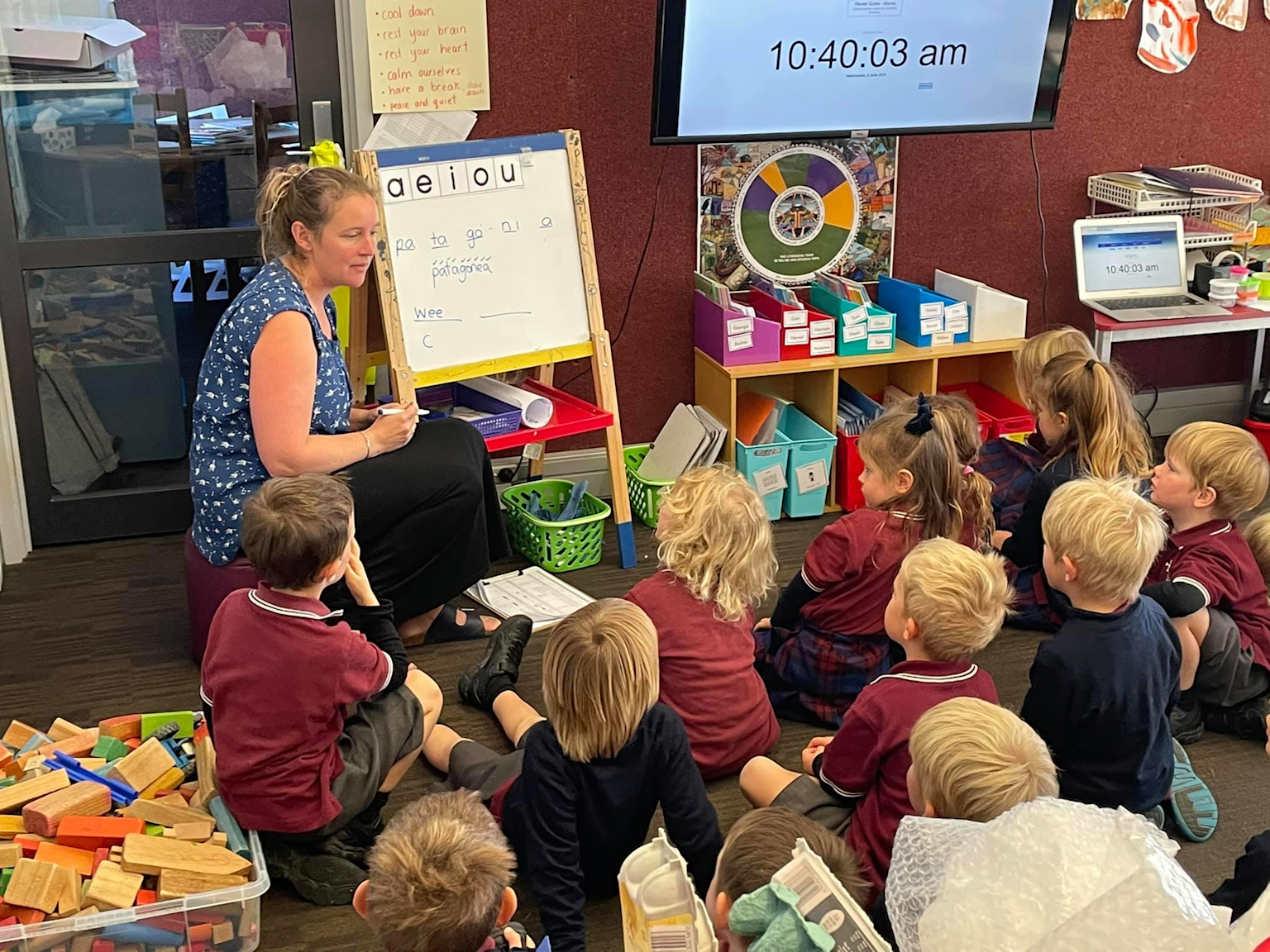
A New Zealand teacher using phonics and structured literacy techniques to teach reading to young children in a classroom
Here we see the mechanistic phonics approach being imposed on young children - reducing the complex, creative process of literacy development to drill-and-kill repetition of decontextualised sounds and letters.
Implications: The Long-term Damage to Tangata Whenua
Educational Apartheid by Design
The government’s policies will entrench rather than reduce educational disparities. By removing culturally responsive pedagogies and te reo Māori from mainstream education, they ensure Māori children continue to be alienated from school systems designed for Pākehā success.
Research consistently shows that students perform better when their cultural identity is valued and reflected in their learning environment. Stanford’s approach deliberately ignores this evidence in favour of assimilationist ideology.
Language Death by a Thousand Cuts
Each Māori word removed from school books, each reduction in te reo teacher training, each erasure of Treaty references contributes to the gradual strangulation of our Indigenous language. Current data shows te reo Māori speakers make up only 3.7% of the population - these policies will accelerate its decline.
Stanford’s removal of te reo from early learning is particularly devastating because children’s language acquisition capacity is greatest before age seven. She is literally stealing our children’s birthright to their ancestral language.
Connecting to Larger Patterns of White Supremacy
The International Context
Stanford’s policies align with white supremacist education movements globally that use “back to basics” rhetoric to justify removing multicultural content and critical thinking from curricula. The structured literacy movement in the US has been captured by conservative forces seeking to eliminate discussions of racism and colonisation from schools.
The Colonial Playbook
This mirrors historical colonial education policies designed to “kill the Indian, save the man” - using schools to destroy Indigenous identity while claiming to help Indigenous children succeed. The removal of te reo from early learning materials follows the same logic as residential schools that punished children for speaking their native languages.
Call to Action: Resistance and Alternatives
Defending Te Reo in Education
Whānau Māori must organise to resist these attacks on our language and culture. Schools using kaupapa Māori approaches consistently achieve better outcomes for tangata whenua children, proving alternatives exist.
We need to demand Stanford’s resignation and the immediate reversal of policies removing te reo from education. The evidence from bilingual education programmes worldwide shows children benefit from multilingual learning rather than being harmed by it.
Building Alternative Systems
Rather than accepting the colonial education system’s false choices, we must continue developing Indigenous-led educational approaches that honour te reo Māori and tikanga Māori while achieving academic excellence. Kura kaupapa Māori consistently achieve higher NCEA success rates than mainstream schools.
Political Resistance
The 2026 election provides an opportunity to reject this government’s assault on tangata whenua rights. Every policy attack - from te reo removal to Treaty Principles Bill to co-governance dismantling - must be understood as part of a coordinated campaign to restore settler supremacy.
Exposing the Lie Behind the Literacy Scam
Stanford and Luxon’s structured literacy crusade has nothing to do with helping children read better and everything to do with reasserting Pākehā cultural dominance over tangata whenua. Their cherry-picked phonics data cannot hide the fundamental racism underlying their policies - the assumption that te reo Māori is a barrier to learning rather than a taonga to be treasured.
The government’s own statistics reveal the systemic nature of educational apartheid in Aotearoa. With 78% of Māori students failing to achieve University Entrance and declining international rankings across all subjects, we need transformative change, not neoliberal tinkering disguised as reform.
True educational transformation requires dismantling the colonial structures that privilege Pākehā ways of knowing while marginalising mātauranga Māori. It requires funding schools adequately, addressing poverty, and treating te reo Māori as the constitutional language it is rather than an inconvenient complication to English-only phonics programmes.
The resistance to Stanford’s cultural vandalism shows that many teachers, parents, and communities understand what is at stake. Te Akatea’s identification of these policies as white supremacist acts reflects a growing recognition that we face not incompetent education policy but deliberate cultural genocide.
Until we address the colonial foundations of our education system, no amount of phonics drilling will close the achievement gaps that reflect broader patterns of systemic racism and economic exploitation. Stanford’s policies will only entrench these disparities while providing convenient scapegoats - our language, our culture, our very existence as tangata whenua.
The fight for educational justice is ultimately a fight for tino rangatiratanga - our right as tangata whenua to determine how our children learn and what knowledge systems are valued in their education. Structured literacy represents the latest iteration of colonial education designed to produce compliant workers rather than empowered Indigenous citizens.
We must resist this assault on our tamariki and our reo with every tool available - political organising, direct action, alternative institution building, and the kind of sustained analysis that exposes the white supremacist foundations of seemingly technical education policies.
Māori tāngata katoa, kia kaha, kia māia, kia manawanui.
For all Māori people, be strong, be brave, be steadfast.

The Māori Green Lantern Fighting Misinformation And Disinformation From The Far Right
For readers who find value in this analysis and wish to support the ongoing work of exposing neoliberal colonisation and white supremacy, please consider making a koha/donation to HTDM: 03-1546-0415173-000. Given these challenging economic times for whānau, please only contribute if you have the capacity and desire to do so.
Ngā mihi nui,
The Māori Green Lantern