"The Great Deception: How Nicola Willis Stole $12.8 Billion from Women to Fund Corporate Welfare" - 4 September 2025
When neoliberal austerity masquerades as fiscal responsibility, working whānau pay the ultimate price

Kia ora koutou katoa - Greetings to you all
The release of Budget 2025's confidential documents has peeled back the veneer of Nicola Willis's so-called "responsible" Budget to reveal something far more sinister underneath. What we are witnessing is not fiscal prudence but a calculated act of wealth redistribution from the most vulnerable New Zealanders to the corporate elite. This is not just another boring Budget analysis - this is about exposing the colonial violence inherent in neoliberal capitalism and how it specifically targets Māori and working women to subsidise the wealthy.

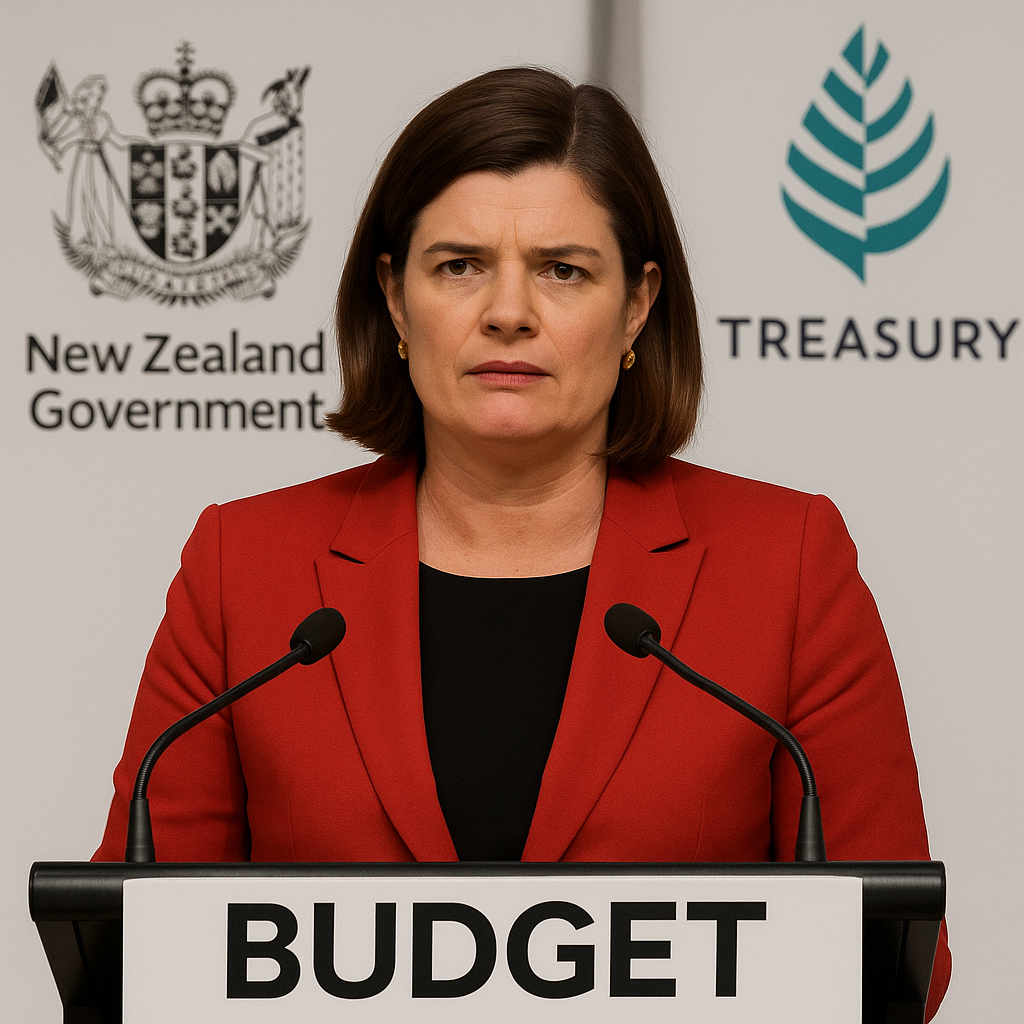
Finance Minister Nicola Willis delivering Budget 2025 speech
Background: The Colonial Context of Austerity
To understand Budget 2025, we must first understand the historical pattern of colonial violence that continues to shape New Zealand's political economy. The coalition government has implemented what the Monitoring Mechanism considers "the most overtly racist and white supremacist government it has had in decades". This Budget represents the latest chapter in that ongoing assault.
The concept of "fiscal responsibility" has long been weaponised against Māori and working-class communities. Since the 1991 "Mother of All Budgets" delivered by Ruth Richardson, successive governments have used the language of financial prudence to justify attacks on the social safety net while protecting the interests of capital. Willis is following this established playbook, but with a particularly vicious twist.
The neoliberal project in Aotearoa has always been about converting social tensions into antagonism between taxpayers and welfare beneficiaries. This Budget takes that strategy to new extremes, using the language of crisis to justify unprecedented attacks on pay equity and social support.
The Great $8.5 Billion Lie
Willis has presented Budget 2025 as addressing an $8.5 billion "hole" in funding future public services. But here's where the deception begins. This "hole" is entirely manufactured through performance plans that estimated $27.9 billion in added cost pressures while only finding $19.7 billion in cuts.
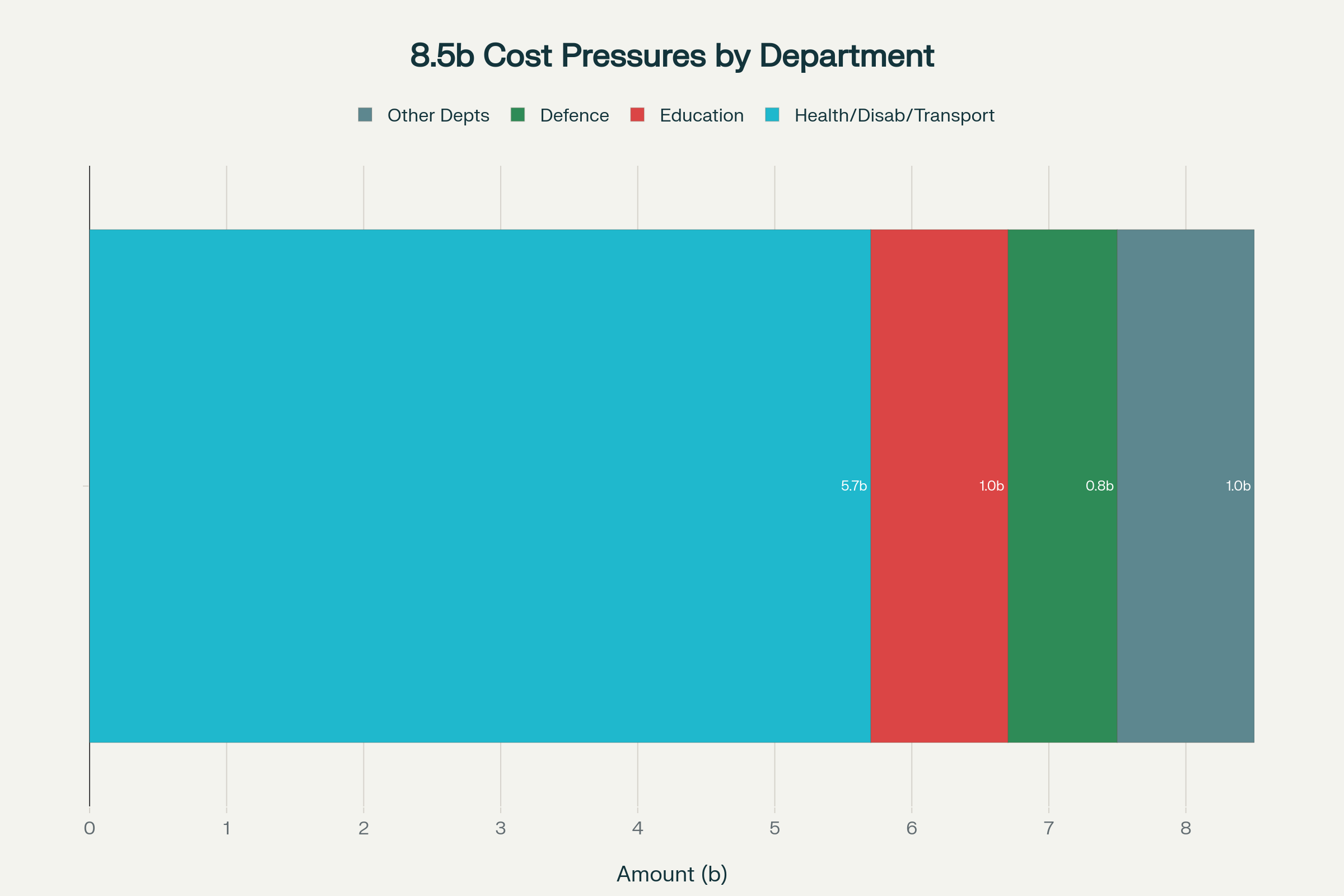
Breakdown of the $8.5 billion unfunded cost pressures revealing which departments face the biggest budget shortfalls
The reality is that 98 percent of these "unfunded pressures" sit within just four portfolios: Health, Social Development, Transport, and MBIE. The cost pressures mainly come from an $8.6 billion increase in inflation and a $5.9 billion increase in service volume as the population ages. These are not unexpected costs - they are the predictable result of running public services in an inflationary environment with an ageing population.
What Willis has done is manufacture a crisis to justify her ideological agenda. The operating allowance for Budget 2025 was slashed to $1.3 billion - the lowest in a decade. This represents a dramatic escalation of the austerity agenda that began with Budget 2024.
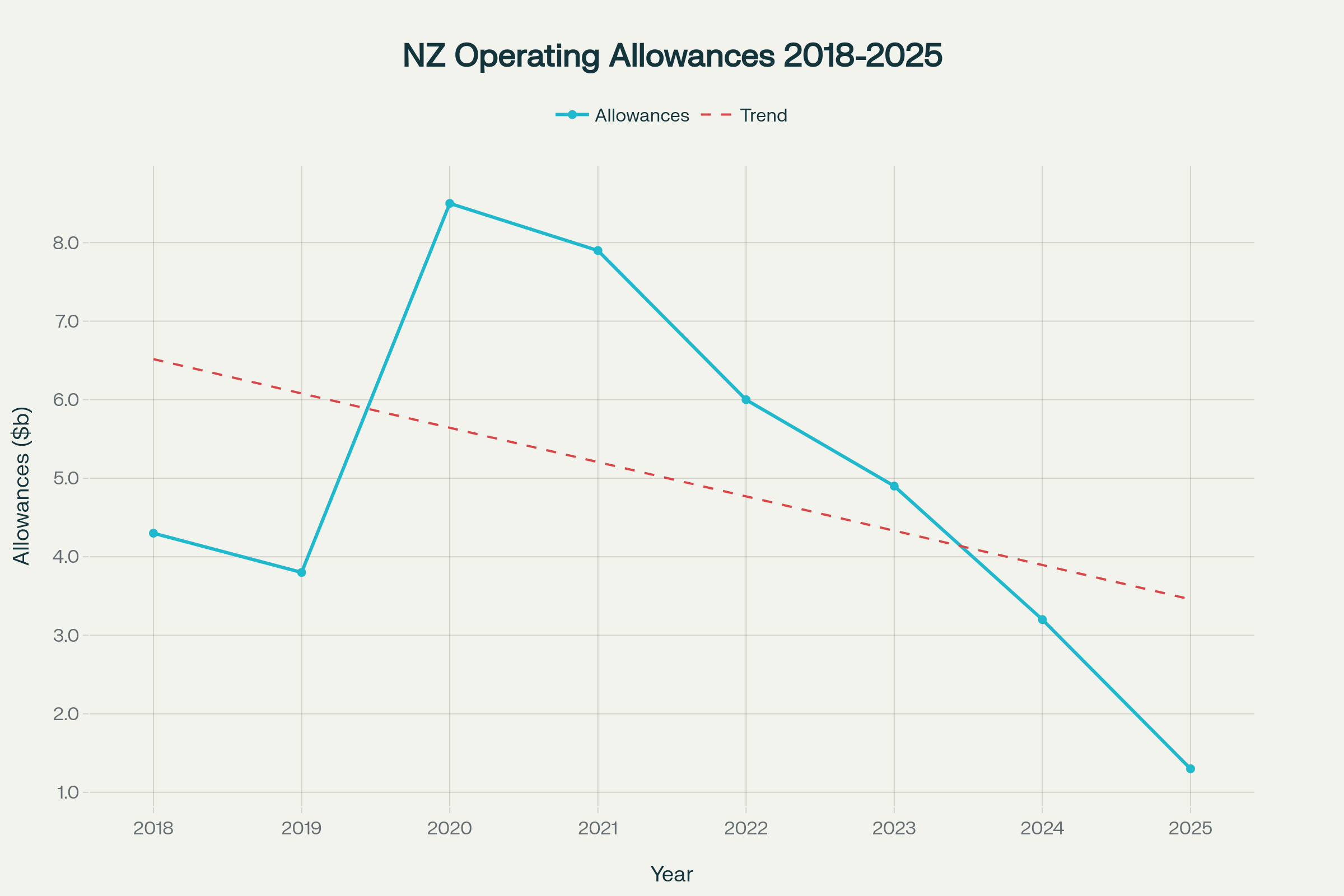
Operating allowances showing the dramatic decline to decade-low levels under the current coalition government
The Pay Equity Heist: Stealing from Women to Fund Corporate Welfare
The centrepiece of Willis's deception is the pay equity changes that net the government $2.7 billion every year, totalling $12.8 billion over four years. This is not just a policy change - it is wage theft on an industrial scale.
The Public Service Association has correctly labelled this the "wage theft budget," noting that it takes "$60 million a week" from care and support workers. These are predominantly women, many of them Māori and Pacific, working in female-dominated sectors like education, health, and social services.
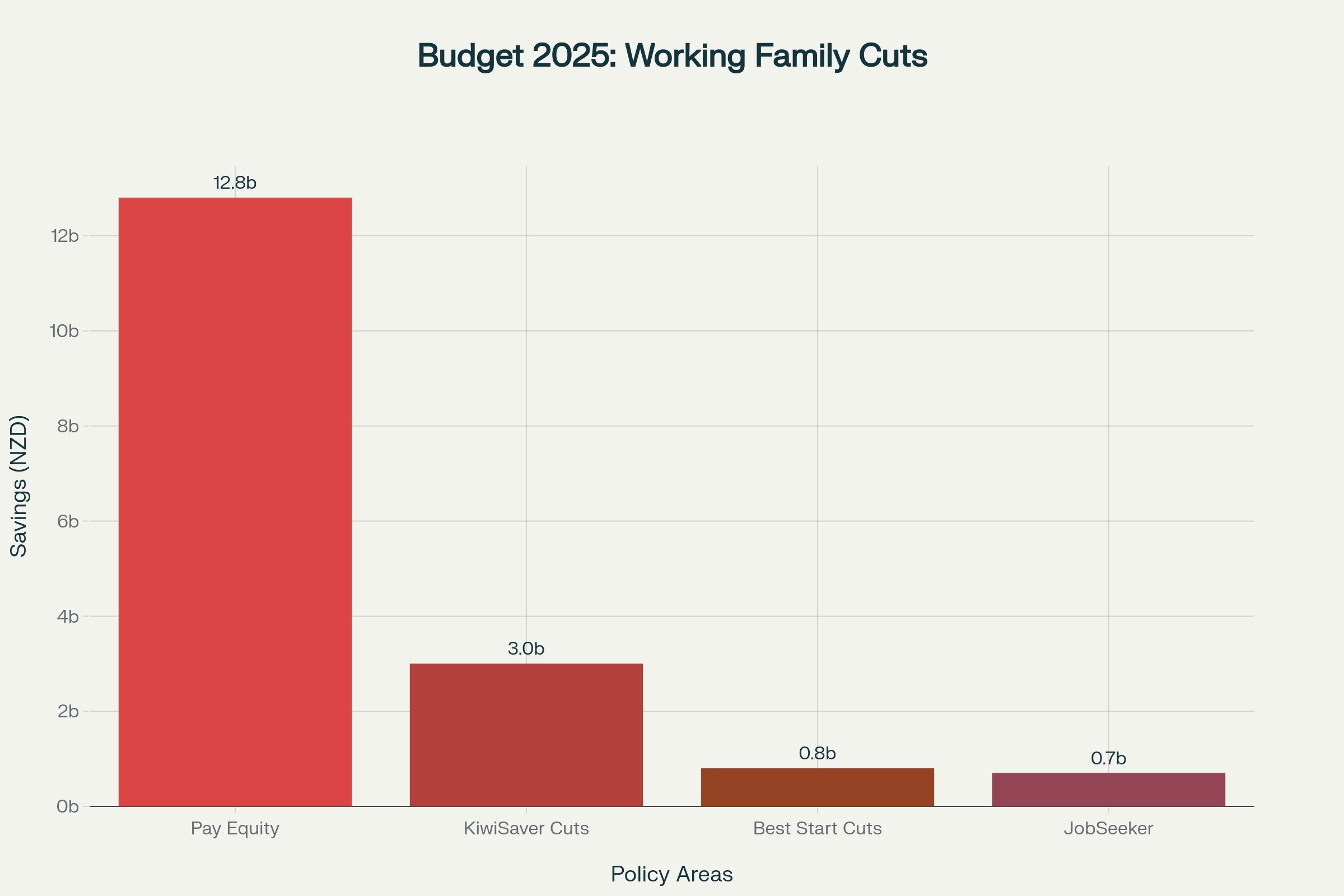
Budget 2025 savings breakdown showing how the government funded its spending through cuts targeting working families
Willis passed these changes under urgency in early May, deliberately avoiding the select committee process and denying women the chance to have a say over how they can get fair wages. This abuse of democratic process is characteristic of how the coalition government operates - ramming through legislation that benefits capital while silencing those it harms.
The pay equity scheme was working. It was designed to address decades of systematic underpayment of women in female-dominated occupations. By gutting this system, Willis has essentially told thousands of underpaid women that their labour is worth less than corporate tax breaks.
The KiwiSaver Con: Robbing Retirement Savings
The second-largest source of Willis's "savings" comes from halving the government's KiwiSaver contribution, saving $3 billion over four years. This represents another attack on working families, particularly sole traders who lose out disproportionately.
What makes this particularly insidious is how Willis has framed it. She claims that increasing the default contribution rate to 4 percent will leave most KiwiSaver members better off. But this is sleight of hand - she is forcing employers and employees to contribute more while the government contributes less.
Treasury documents reveal officials told Willis that removing the government contribution would result in people choosing to stop contributing themselves. The government's own advisors acknowledged this would harm retirement savings, but Willis proceeded anyway because it served her fiscal strategy.
The Investment Boost Scam: Corporate Welfare Disguised as Growth Policy
While Willis was stealing billions from women and retirees, she was simultaneously handing out a $1.7 billion annual tax break to businesses through the "Investment Boost" scheme. This allows businesses to deduct 20 percent of the cost of new assets from their taxable income on top of normal depreciation.

Corporate executives benefiting from Budget 2025 tax incentives
A Kiwibank survey found that just a third of business bankers had reported uptake of the initiative, with many businesses remaining cautious and waiting for better economic conditions. This exposes the fundamental flaw in Willis's approach - you cannot stimulate business investment by cutting government spending during a recession.
The cynicism is breathtaking. Willis claims this tax break will lift GDP by 1 percent and wages by 1.5 percent over two decades, while simultaneously cutting the wages of thousands of women through pay equity changes. She is asking us to believe that corporate tax breaks will somehow trickle down to benefit the same workers she is directly robbing.
The Māori Targeting: Weaponising Racism for Fiscal Ends
Willis's assault extends far beyond pay equity and KiwiSaver. Budget 2025 has been described as "bleak" for Māori, with targeted Māori funding moved into general funding pools. This represents a systematic attack on Māori self-determination and economic development.
Associate Professor Matt Roskruge from Massey University noted that "a lot of funding that was earmarked for Māori has been moved into the general funding pool," resulting in "a loss of mana motuhake or control over our funding". The Māori Development Fund itself has been cut by $20 million over four years, while the Whai Kāinga Whai Oranga housing programme has been scrapped entirely.
The Spinoff analysis revealed that while the government touted $700 million in Māori funding, when stripped of reallocated funds, the real number is closer to $38 million in new money. Meanwhile, more than $750 million in Māori-specific initiatives have been axed.
This is not accidental. It reflects the coalition government's broader strategy of using anti-Māori rhetoric to divide New Zealanders and justify cuts to social spending. ACT leader David Seymour explicitly stated there should be "no such thing as Māori funding," calling targeted funding based on ethnicity "racism".

Empty government office showing impact of public sector cuts
The Hidden Connections: Willis's Corporate Background
Understanding Willis's Budget requires understanding who she is and where she comes from. Willis previously worked as a senior advisor to John Key and later held senior management roles at Fonterra. She also served on the board of the New Zealand Initiative, a pro-free-market think tank linked to the Atlas Network.
These connections matter because they reveal the ideological framework within which Willis operates. The New Zealand Initiative has long advocated for reducing government spending and increasing market freedoms. Willis's father was a partner in corporate law firm Bell Gully and later became chairman of the New Zealand Energy Corporation. This is not someone who comes from a working-class background or understands the struggles of ordinary families.
Treasury documents show Willis was advised that achieving the "scale of ongoing savings required" would mean using "more significant fiscal levers" including changes to welfare and tax relief. Officials warned her that there were "likely to be diminishing returns to successive savings exercises" as "many of the obvious 'low hanging fruit' have already been exhausted".
In other words, Treasury was telling Willis that further cuts would require targeting essential services and support for vulnerable people. She proceeded anyway because her ideological commitment to reducing government spending trumped any concern for social outcomes.
The Intersection of Race, Class and Gender
What makes Willis's Budget particularly pernicious is how it operates at the intersection of race, class, and gender oppression. The pay equity changes predominantly affect women, many of whom are Māori and Pacific. The cuts to Māori-specific programmes target indigenous communities fighting for self-determination. The KiwiSaver changes hurt sole traders and low-income workers who rely on government contributions.
The CTU analysis noted that the cuts will "disproportionately hurt lower-income households" and that "the government has essentially paid for its Budget 2025 initiatives by pinching money from women, welfare recipients, and working households". This is not coincidence - it is strategy.
Willis's approach reflects what researchers call "austerity parenting," where "bad parents are scapegoated and social ills such as poverty are considered the result of moral failures of prudence and responsibility". The coalition government encourages taxpayers to view themselves as "long suffering victims of a socially irresponsible welfare underclass" rather than recognising structural disadvantage.
The Democracy Deficit: Urgency and Secrecy
Throughout this process, Willis has shown complete contempt for democratic norms. The pay equity changes were passed under urgency without proper consultation. The short timeframe meant there had been "limited testing and analysis" of the policy proposals.
The process was kept secret to prevent a surge of claims being lodged under the existing system. This deliberate secrecy denied workers and their unions the opportunity to organise resistance or propose alternatives.
Willis has also used Treasury advice selectively to support her predetermined agenda. When Treasury advised against funding the Youth Justice boot camps, she ignored them and funded the policy anyway. When Treasury warned that police cost pressures could impact frontline services, she told them to assume no new funding for wage increases.
Implications: The Broader Pattern of Colonial Violence
Budget 2025 represents more than just poor fiscal policy - it is part of a broader pattern of colonial violence that seeks to subordinate Māori political authority and extract wealth from indigenous communities. The systematic cuts to Māori programmes while maintaining tax breaks for corporations shows whose interests this government serves.
The coalition government's approach to fiscal policy reflects what researchers describe as "the most overtly racist and white supremacist government" in decades. This is not hyperbole - it is an accurate description of a government that systematically transfers wealth from indigenous and working communities to corporate interests.
The implications extend far beyond the current Budget cycle. Willis has projected that New Zealand's finances will remain in deficit until at least 2029 due to the $14 billion in tax cuts. This creates a permanent justification for further austerity measures targeting social spending while protecting corporate welfare.
The attack on pay equity sets a particularly dangerous precedent. If the government can retrospectively change the rules to avoid paying fair wages to women, what other rights and entitlements are safe? This represents a fundamental assault on the rule of law and workers' rights that will have implications far beyond this Budget.

The Māori Green Lantern Fighting Misinformation And Disinformation From The Far Right
Exposing the Neoliberal Con
Budget 2025 strips away any pretence about the National-ACT-NZ First coalition's priorities. This is not about fiscal responsibility or economic growth - it is about using the power of the state to transfer wealth from working families to corporate interests while maintaining the colonial structures that subordinate Māori political authority.
Nicola Willis has shown herself to be a faithful servant of capital, willing to steal from women, attack indigenous rights, and undermine democracy to serve her corporate masters. Her Budget is not just bad policy - it is morally bankrupt and fundamentally unjust.
The resistance to this agenda must be grounded in solidarity between Māori fighting for tino rangatiratanga and workers fighting for economic justice. The connections between these struggles are not incidental - they reflect the same fundamental conflict between those who produce wealth and those who extract it.
We must reject the false choice between austerity and fiscal irresponsibility. There are alternatives to Willis's path - alternatives that prioritise people over profits and justice over corporate welfare. But achieving these alternatives requires us to name what we are fighting against: a colonial capitalist system that enriches the few at the expense of the many.
The fight for pay equity is not just about fair wages - it is about challenging the power structures that determine who gets what in our society. The fight for Māori self-determination is not just about cultural recognition - it is about challenging the colonial structures that continue to extract wealth from indigenous communities.
Budget 2025 has made the battle lines clear. On one side stand the corporate elites and their political servants, determined to maintain their privilege through state power. On the other stand working families, indigenous communities, and all those who believe in justice and democracy.
The choice is ours.
Kia kaha, kia maia, kia manawanui - Be strong, be brave, be steadfast
Koha/donations: For readers who find value in exposing these truths, please consider a koha to support this mahi: HTDM: 03-1546-0415173-000. The MGL understands these tough economic times for whānau so please only contribute if you have capacity and wish to do so.
Naku noa, nā