“THE GREAT LAND LOCKOUT: A METAPHORICAL RECKONING” - 12 January 2026
The Invisible Prison of Whenua Māori
THE INVISIBLE PRISON
Imagine owning a house, but the only door is bricked up. The windows are painted shut. The Crown has given you the title deed, sealed it with wax, and locked it in a vault. Outside, strangers walk through your rooms, use your kitchen, sleep in your beds. When you ask for the key, they hand you a map and say: “The door is technically there. You just need to climb the mountain range, swim the river, and cross three neighbours’ properties. Oh—and you’ll need a business plan first.”
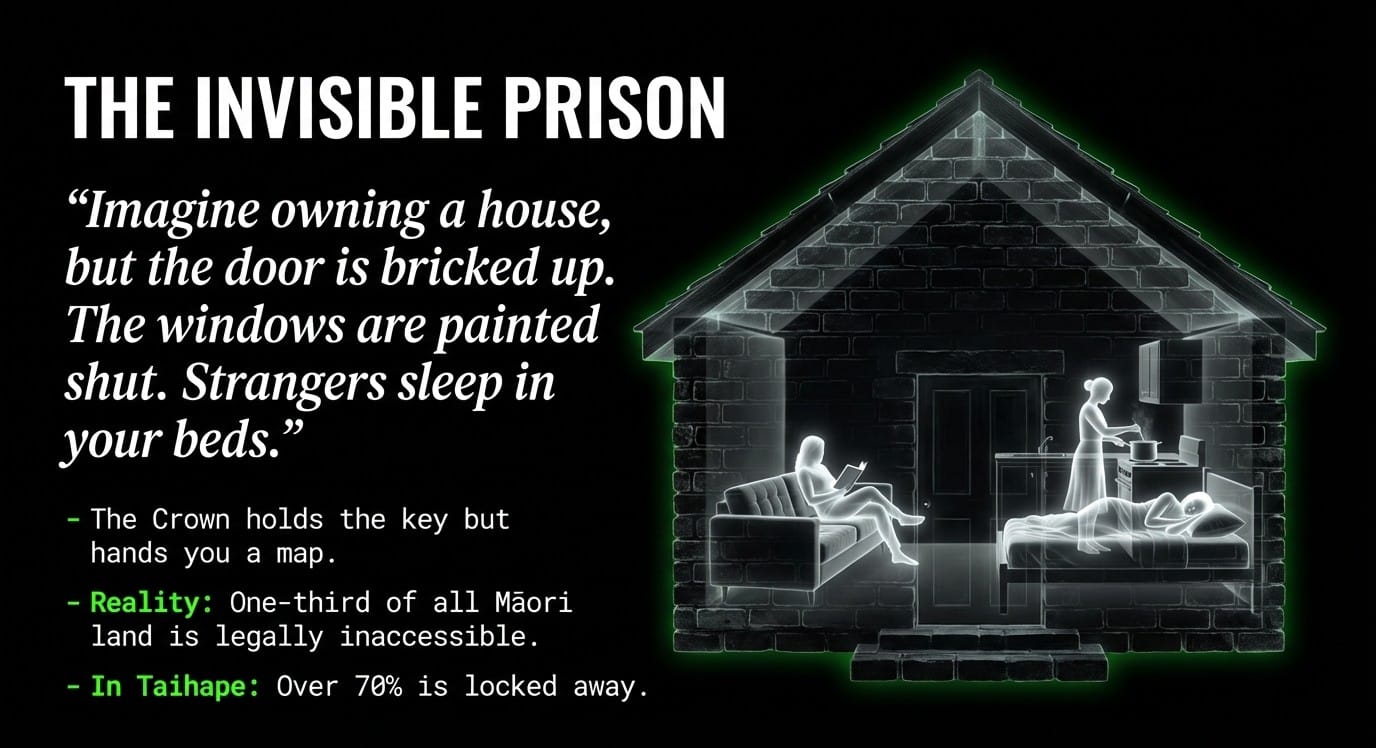
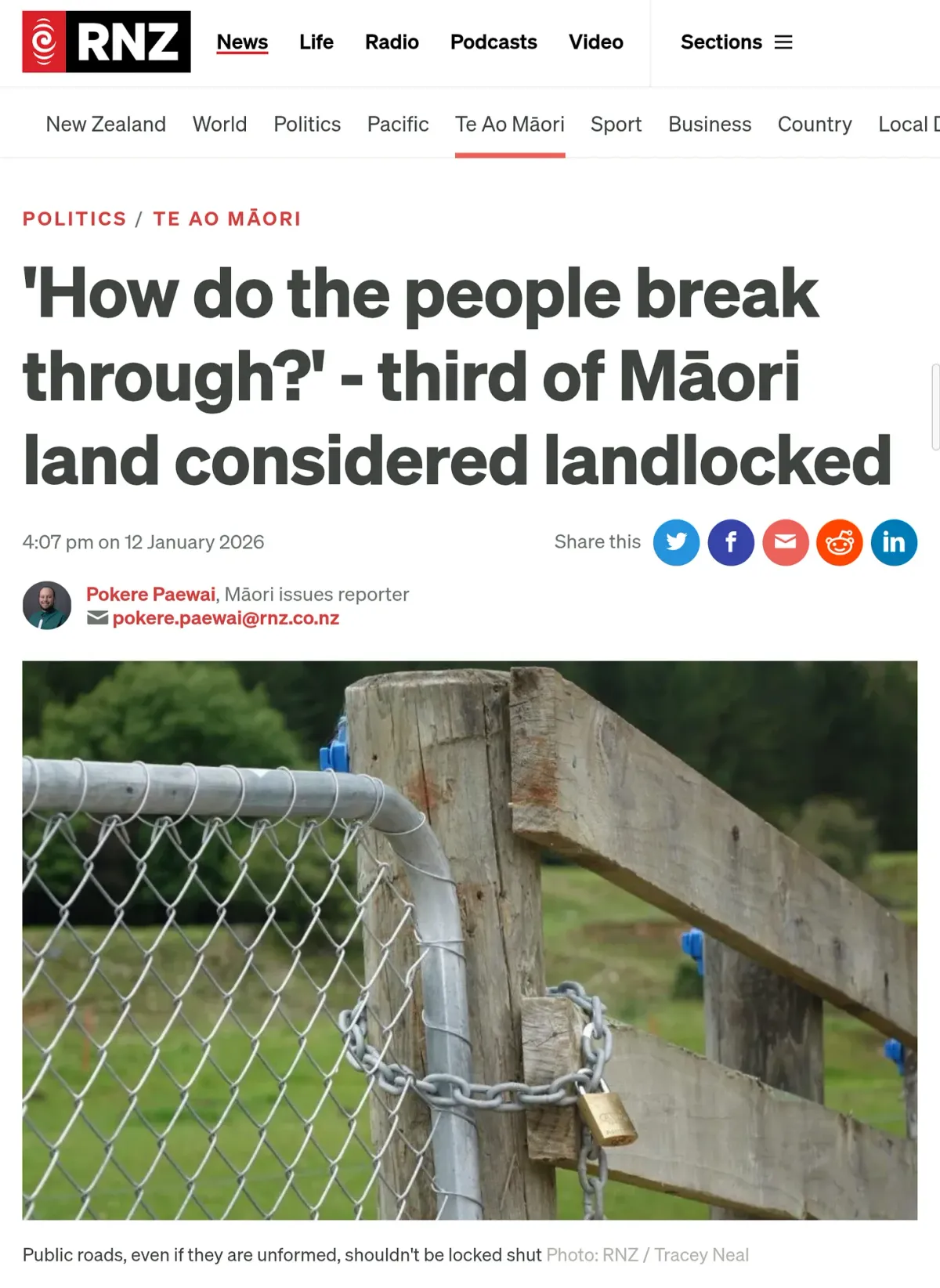
This is the reality of one-third of all Māori land in Aotearoa, as verified by RNZ and the Waitangi Tribunal. In regions like Taihape, the figure balloons to over 70%—an entire landscape transformed into a locked-away kingdom where the rightful owners are eternal exiles, verified by RNZ.Who turns the key? Not you.
THE MACHINERY OF ENTRAPMENT
Picture a master lock-smith who arrives in your home in 1886. His name is the Native Land Court. His job is to divide your house into smaller and smaller rooms. With each cut, he makes sure your sections have no doors to the outside world. He carves up the walls so expertly that when the dust settles, you are left holding the deed to a room with no windows, while the neighbours—the ones he favoured—get the kitchen, the front door, and the veranda.
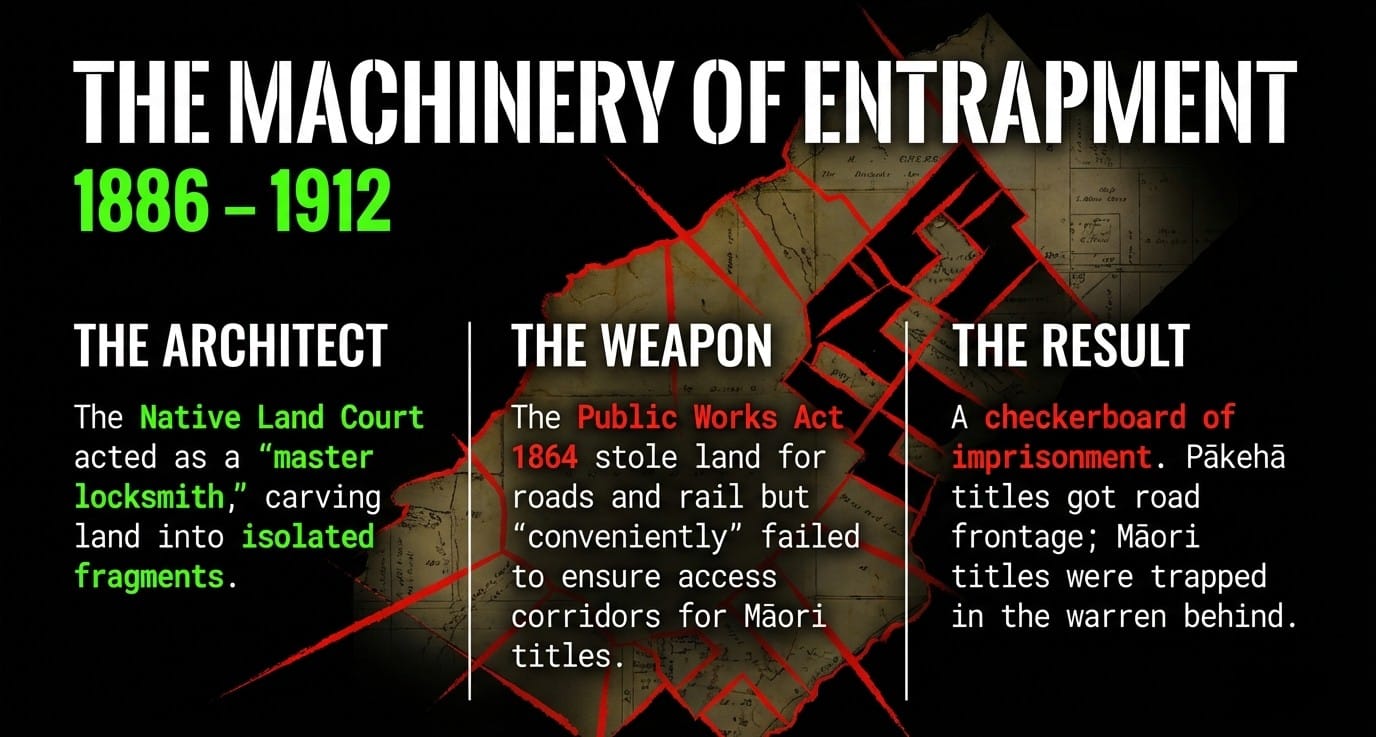
Between 1886 and 1912, this lock-smith—using the Native Land Court and the Native Lands Act 1865—systematically partitioned Māori land without ensuring access corridors. While the Public Works Act 1864 was wielded like a sledgehammer to steal roads and railways through Māori territories, the Crown forgot (conveniently) to return the key, verified by Te Ara and NZ Herald.The result? A checkerboard of imprisonment where Pākehā titles are fronted by roads and rivers, while Māori titles are landlocked in the warren behind.
THE ANCIENT HUMILIATION OF “CAP IN HAND”
In medieval times, a vassal would approach the lord, remove his hat, and beg for permission to cross his land. The posture itself was the punishment.
Today, Doug Macredie—a professional, a trustee, a guardian of whenua—describes himself going “cap in hand” to neighbours, begging for the right to visit his own ancestor’s soil, verified by RNZ.
The Crown, meanwhile, plays a cruel game of theatrics. Government agencies ask iwi to grant public access—to build trails, to facilitate tourism, to “share” their land with all New Zealanders—while those same iwi are locked out of their own whenua. It is as though the Crown asks a mother to feed everyone’s children while her own starve, verified by RNZ.
The hypocrisy is the point. It is how power maintains itself.
ANALYSIS: FIVE HIDDEN REVELATIONS
REVELATION 1: The “Paper Road” Mirage
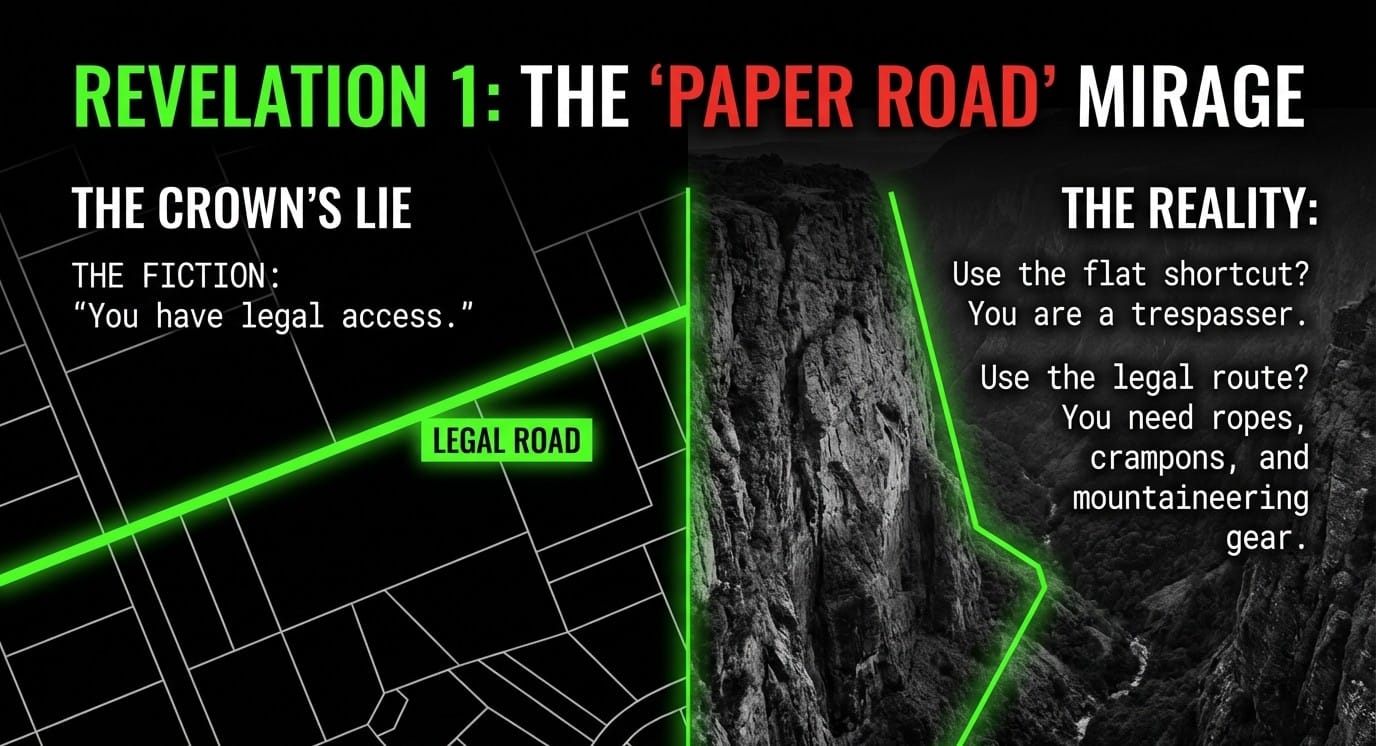
Imagine the Crown offers you a path to your own home. It exists on paper—technically, legally, a right-of-way etched on cadastral maps. But in reality?
This path winds through a ravine. It scales a cliff face. It crosses a bog that swallows horses. A neighbour’s paddock is 100 metres away—a flat, dry walk of 20 minutes.
But take that shortcut, and you are a trespasser. Stay on the “legal” route, and you need ropes, crampons, climbing gear, and half a day of mountaineering.
This is not accident. This is design. The Crown gives you a “door” that only eagles can use, then claims you are not locked out. Verified by RNZ.
It is Kafkaesque cruelty dressed as law.
REVELATION 2: “DOC-Locked”—The Crown as Squatter
Some Māori land is completely surrounded by the Department of Conservation estate. The Crown, which claims to protect “public access,” has accidentally (or deliberately) constructed a prison wall around indigenous property.
Now the Crown acts like the hostile neighbour. It controls who enters. Tourists stream through on DOC-approved tracks. Scientists conduct research. Recreationists photograph waterfalls. But the tangata whenua—the people born to that land, whose ancestors’ bones fertilise that soil—are outsiders in their own country.
The land becomes a de facto national park, free for strangers but closed to its owners’ dreams, verified by Herenga ā Nuku.
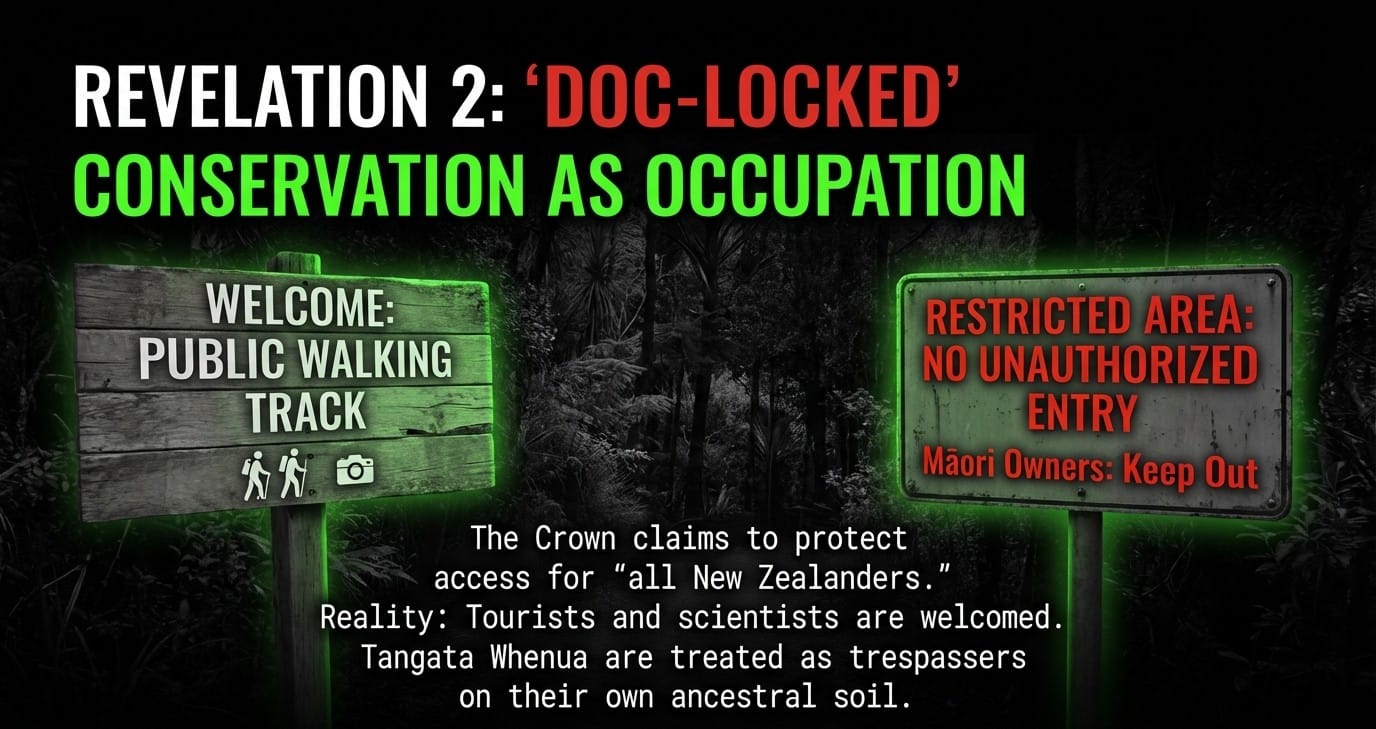
It is occupation dressed as conservation.
REVELATION 3: The Catch-22 Labyrinth
The Māori Land Court can grant access, but first you must produce a “feasible business plan.”
But how do you plan for land you cannot touch? How do you take soil samples from a distance? How do you map water sources through binoculars? How do you understand the mahi—the work, the labour—of a place you have never stood upon?
You cannot. And so the land remains “undeveloped,” ensuring it will never be developed. The law has constructed a maze with no exit, verified by McCaw Lewis.
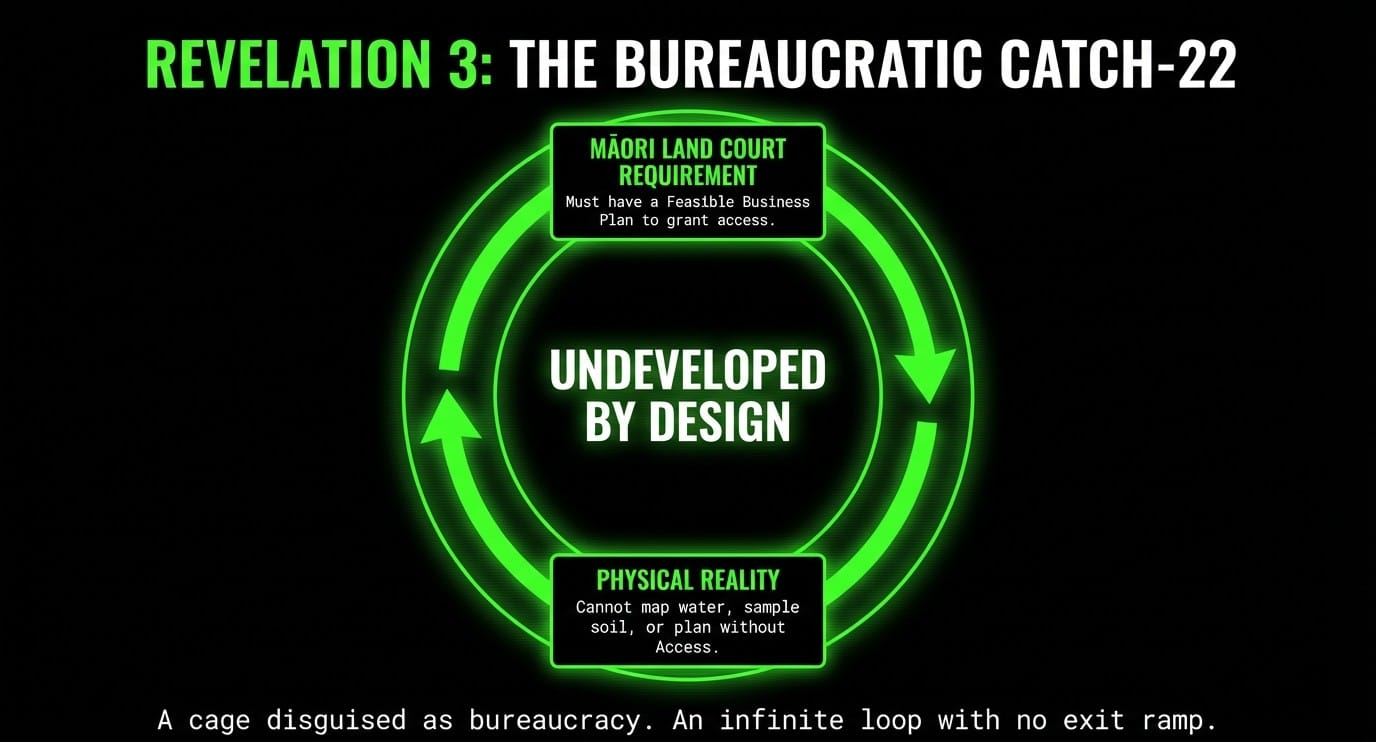
It is a cage disguised as bureaucracy.
REVELATION 4: The Squatter Economy—Theft Sanctioned by Silence
Your land sits empty (in their eyes). Neighbours see potential. A farmer lets his sheep graze. A forestry company plants trees. A recreational entrepreneur builds a tramping track past your waterfall and charges tourists. They harvest the value. You harvest nothing but frustration.
This is theft dressed as utilization. The neighbours are squatters, but because you cannot be there to say “no,” the theft becomes normalcy. Over decades, it becomes tradition. By the time you arrive with lawyers, the neighbours claim “adverse possession” or “customary use.”
Macredie exposes this: recreationists and farmers use Māori land as their own because the owners are not present to object, verified by RNZ.
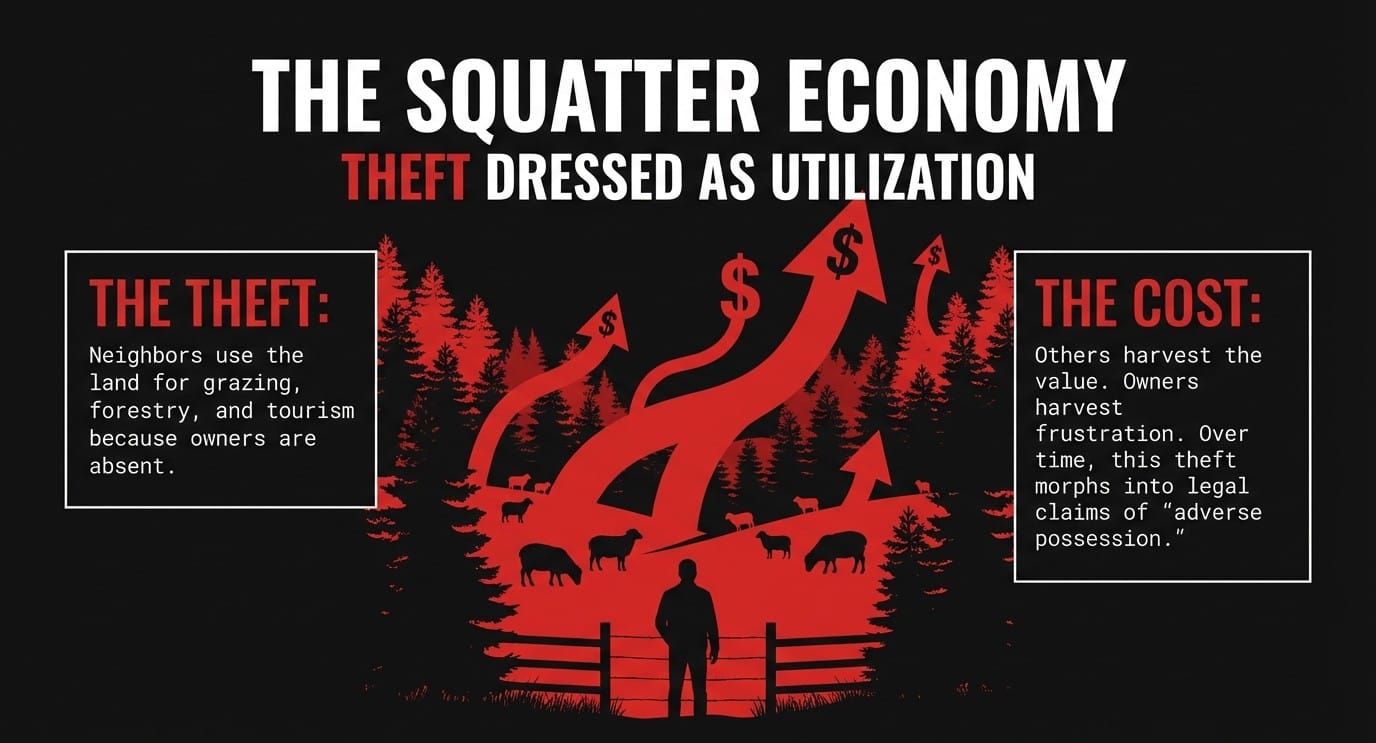
The state collects no tax on this theft. It simply looks away.
REVELATION 5: Te Ara Tipuna—The Battering Ram Against the Prison Wall
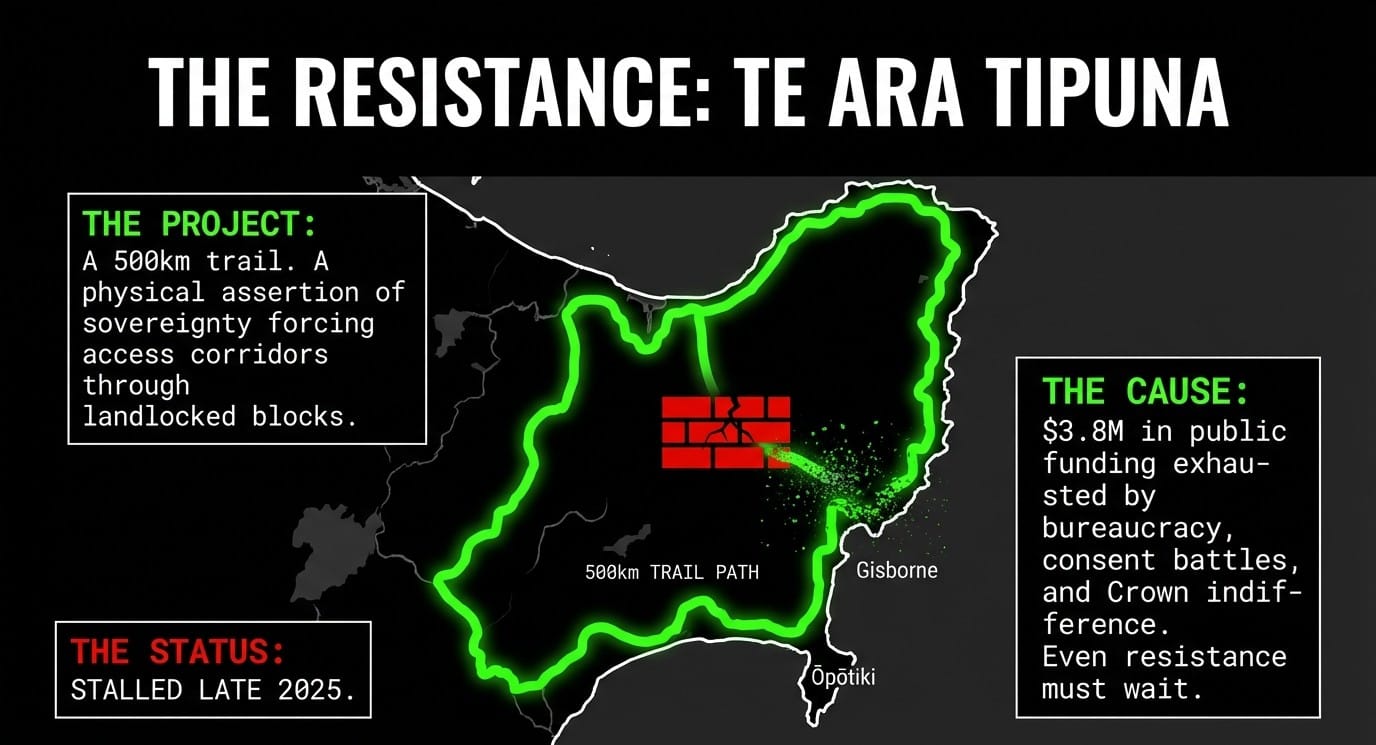
In your own rohe—from Gisborne to Ōpōtiki—a resistance has begun. The Te Ara Tipuna trail is no ordinary walking path. It is a physical assertion of sovereignty, a 500-kilometre finger pointed at the Crown’s failure, verified by Te Ara Tipuna Trust.
Led by trustees including Sir Selwyn Parata and Hon Hekia Parata, this trail was designed to force access corridors through landlocked blocks. It would reconnect the Ngāti Porou diaspora to their scattered whenua, linking fragments into a whole.
But here is the final indignity: despite $3.8M in public funding, the project stalled in late 2025. Why? Because fighting the bureaucracy, the consent battles, the neighbour disputes, the Crown’s indifference—this costs money and political will. The project went “on hold” for lack of funds to fight the system, verified by Te Ara Tipuna Trust.Even resistance must wait.
DATA: THE GEOMETRY OF DISPOSSESSION
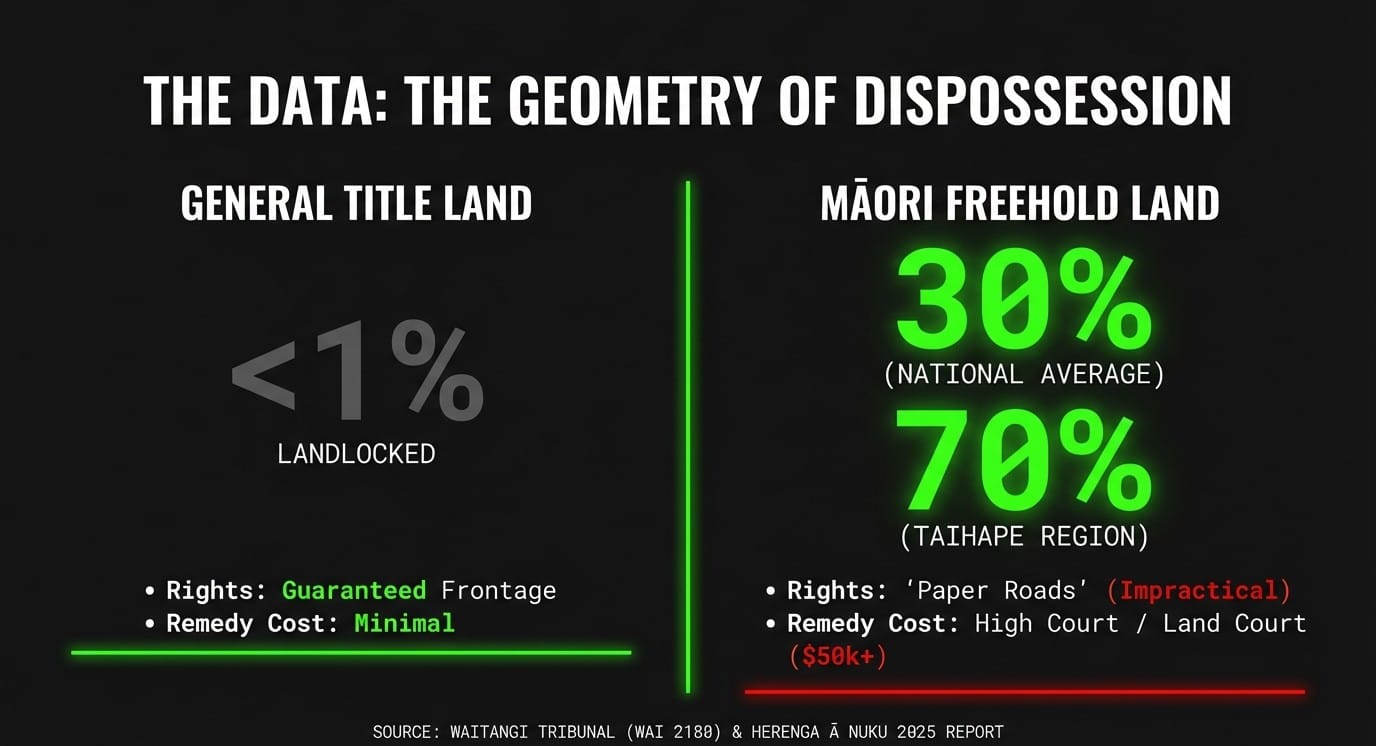
Data verified from Waitangi Tribunal (Wai 2180) and Herenga ā Nuku 2025 Report.
IMPLICATIONS: THE COST OF THE LOCKOUT
Economic Strangulation
Imagine billions of dollars in potential value—ecotourism, housing developments, carbon farming, conservation enterprises—all trapped behind locked gates. While the Crown talks about climate action, it prevents Māori from developing carbon sinks on their land because they cannot reach it.
The Waitangi Tribunal recommended establishing a “contestable fund” to pay for access corridors, explicitly naming this a breach of Treaty principles, verified by Waitangi Tribunal.
The Crown has not moved.
Cultural Erasure
You cannot be kaitiaki of a place you cannot touch. You cannot teach your grandchildren about their ancestors’ lands if you cannot stand on those lands. You cannot perform the ceremonies, walk the pathways, understand the ecology, or feel the spiritual weight of country.
The landlocking policy is cultural lobotomy—severing the nerve that connects tangata to whenua, the people to the place.
TE OHU WHAKAHAERE—THE TIME OF RECKONING
The term “landlocked” is a genteel euphemism. It sounds technical, neutral, unfortunate—like a ship stuck in ice.
But it is not a lock on the land. It is a lock on the people.
The Crown has built a prison. It gave you the title deed but kept the keys. It whispers that the door is “technically” there while strangers walk through your rooms. When you ask for access, it offers you a map of routes that require superhuman effort or a business plan that requires access to create.
It is a closed loop. A labyrinth with no centre. A game rigged so completely that the only way to win is not to play.
Action Required:
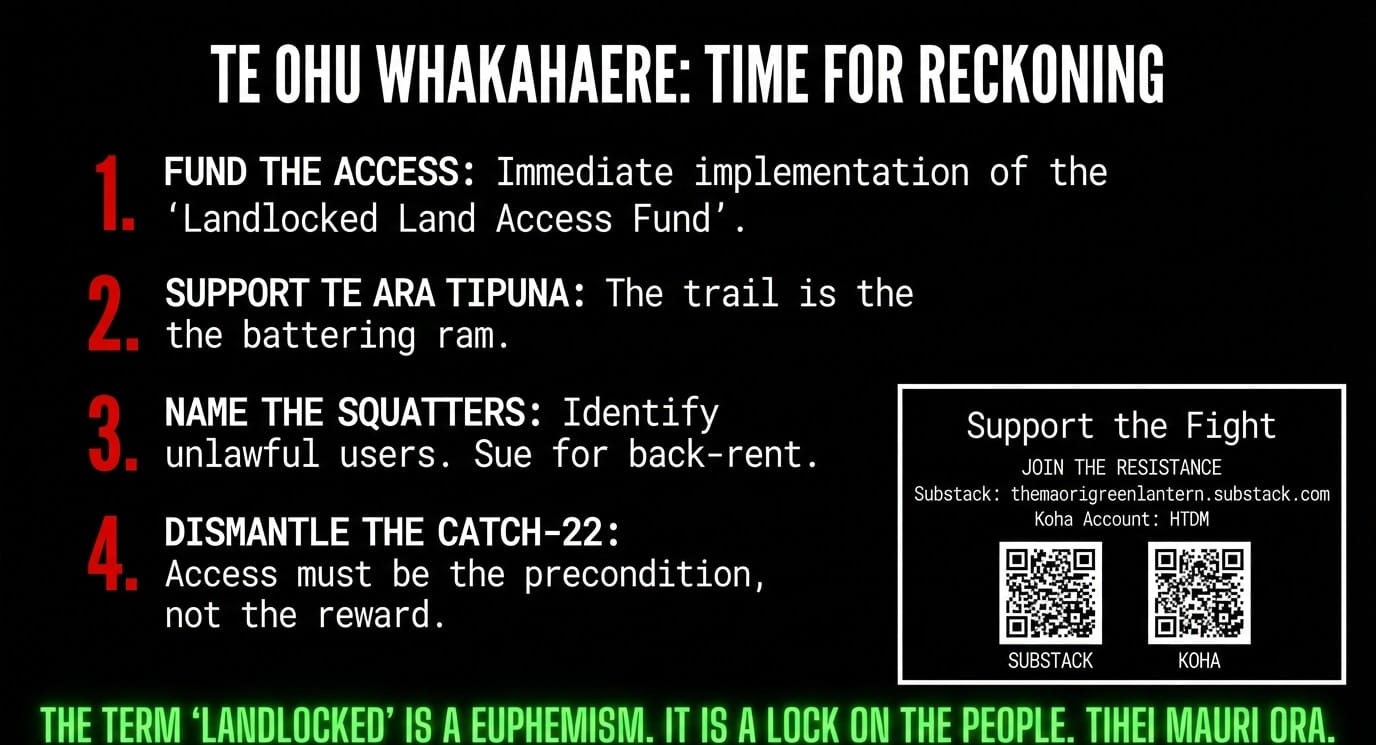
- Demand the Fund: The Crown must immediately fund the Landlocked Land Access Fund recommended by the Waitangi Tribunal. This is not a gift; it is a settlement for breach of Treaty.
- Support Te Ara Tipuna: This trail in your own rohe is a battering ram. Every person who walks it asserts: “This land belongs to tangata whenua. This access is ours.”
- Name the Squatters: Identify neighbouring blocks using Māori land unlawfully, and demand restitution. Sue for back-rent. Make the theft visible.
- Dismantle the Catch-22: Change the Māori Land Court rules. Access should not require a business plan; access is the precondition for any plan.
Tihei mauri ora. The people will break through.
KOHA & SUPPORT
Three pathways exist to fund this accountability:
1. Koha—Support
https://app.koha.kiwi/events/the-maori-green-lantern-fighting-misinformation-and-disinformation-ivor-jones
2. Subscribe on Substack
https://themaorigreenlantern.substack.com/subscribe
3. Direct Bank Transfer
Account: HTDM | Number: 03-1546-0415173-000
Every koha signals that whānau are ready to fund the accountability that Crown and corporate structures will not provide. It signals that rangatiratanga includes the power to fund our own truth tellers.
Kia kaha, whānau. Stay vigilant. Stay connected.

Ivor Jones The Māori Green Lantern Fighting Misinformation