“The Great Polytechnic Heist: How Simmonds' Asset Stripping Serves White Supremacy, Not Students” - 18 July 2025
When Education Ministers become Corporate Raiders, Communities Pay the Price
Kia ora, kia ora, kia ora. Greetings to you all.
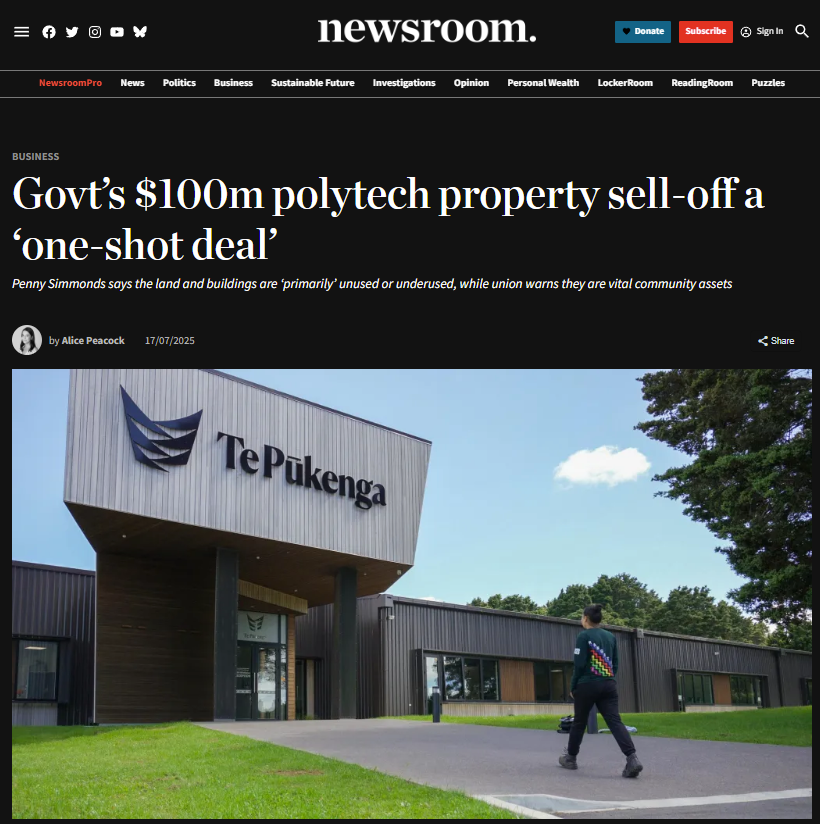
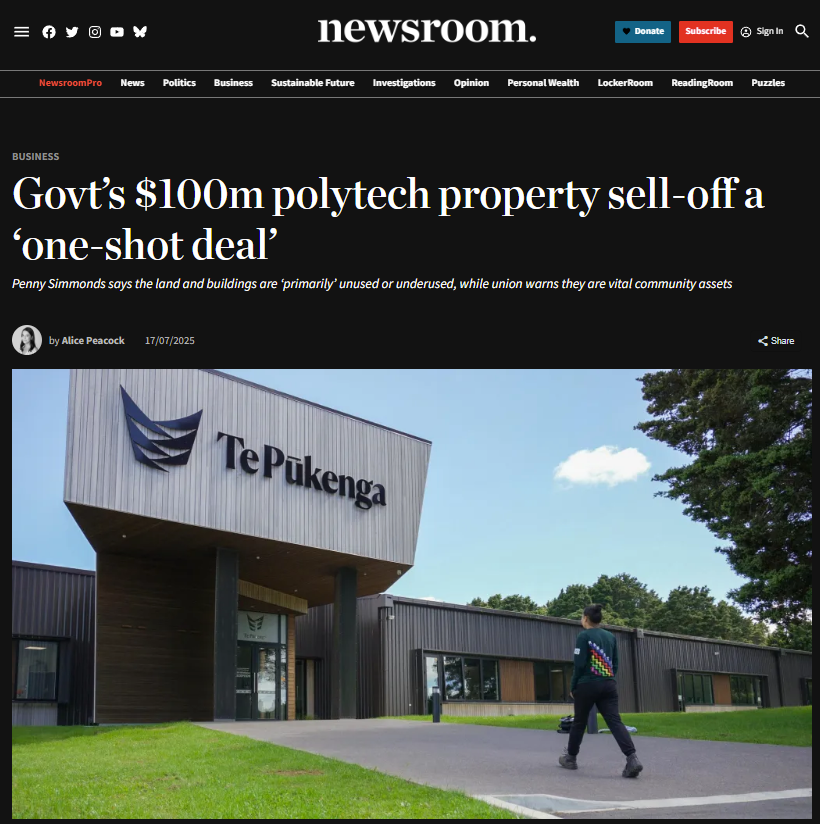
Te Pūkenga is being systematically dismantled, and its $100 million in assets are being sold off in what Vocational Education Minister Penny Simmonds euphemistically calls a "one-shot deal" 1. This isn't fiscal responsibility – it's asset stripping masquerading as education reform, and it represents the latest chapter in neoliberal capitalism's assault on public education in Aotearoa. The real tragedy is that this fire sale will disproportionately harm Māori and Pacific communities, destroy vital regional infrastructure, and entrench the very inequalities that Te Pūkenga was created to address.
Background: The Colonial Pattern of Educational Dispossession
The polytechnic system in Aotearoa has long been more than just vocational training – it represents community-anchored education that serves regions, whānau, and iwi in ways that centralised university systems cannot. These institutions have been critical to Māori educational advancement 2, providing pathways for Indigenous learners who face systemic barriers in mainstream education.
The Education and Training Act 2020 explicitly requires education providers to honour Te Tiriti o Waitangi 3, yet Simmonds' asset-stripping agenda directly contradicts these obligations. When education becomes a commodity to be bought and sold, the foundational principle of education as a public good – and as a Treaty obligation – is abandoned.
The Great Polytechnic Robbery: Asset Stripping for Corporate Profit
The numbers tell a damning story. Te Pūkenga, despite being financially viable with a $16.6 million surplus 4, is being broken up and its assets sold off. This isn't about financial sustainability – it's about opening public infrastructure to private profit.
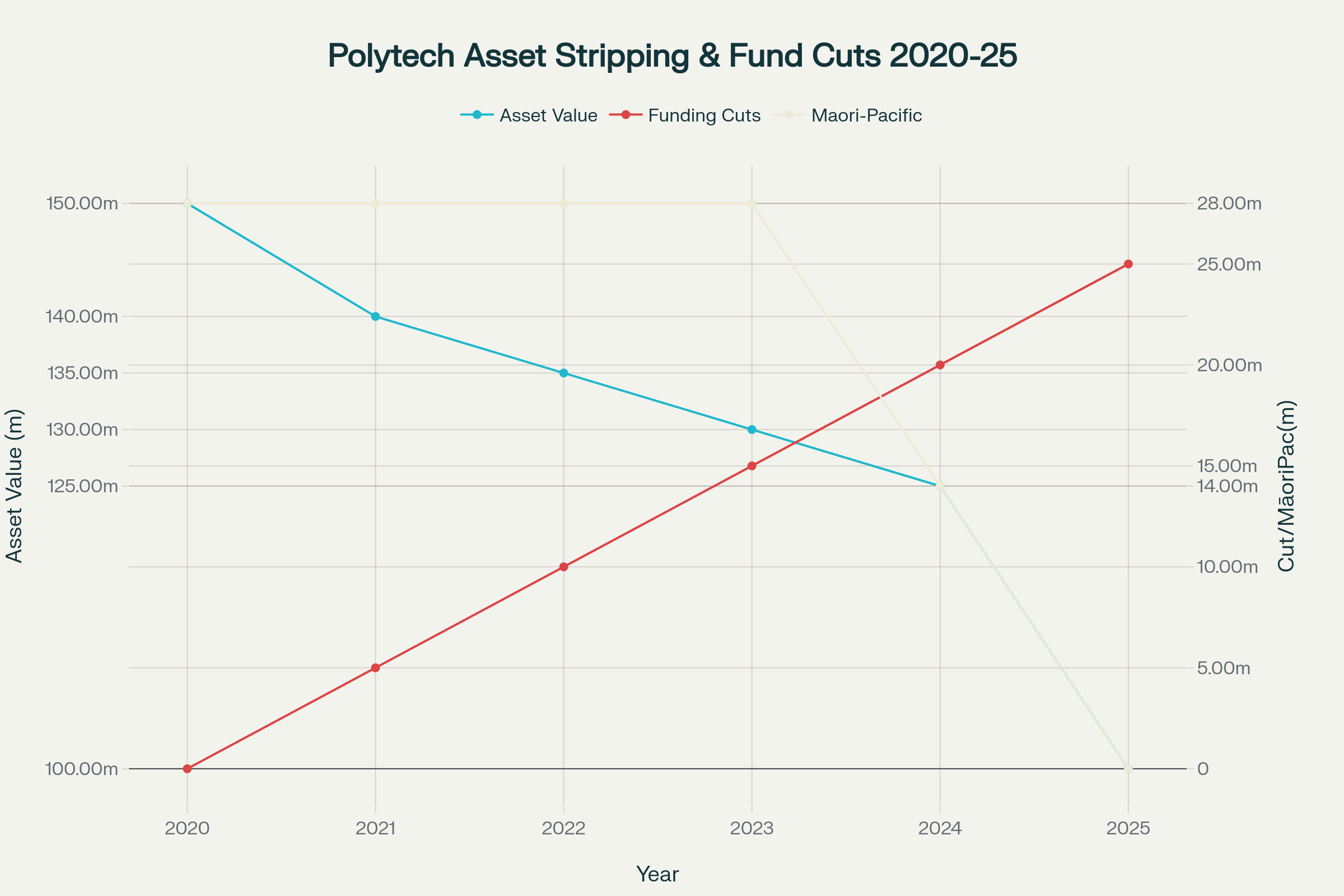
Polytechnic asset values declining while funding cuts increase, with complete elimination of Māori/Pacific funding by 2025
As the data shows, while asset values decline and funding cuts increase, the most devastating impact is on Māori and Pacific students. The government has completely eliminated the $28 million in dedicated Māori and Pacific funding 5, representing a 100% cut to programmes specifically designed to address educational inequities.
This follows the classic neoliberal playbook: defund public services, claim they're failing, then sell them off to private interests 6. The assets being sold include community infrastructure like marae, cafeterias staffed by hospitality students, and specialised workshops that can't be replicated in online learning environments.
Neoliberal Ideology and the Commodification of Education
Simmonds' approach represents textbook neoliberalism – the belief that market mechanisms can solve all social problems, and that public assets should be privatised for maximum "efficiency." This ideology has been devastating for education worldwide 7, transforming learning from a public good into a private commodity.
The rhetoric is familiar: assets are "primarily unused or underused," so they should be sold to those who can "value them most highly." But as neoliberal critics have long argued 8, this equation of value with money ignores the social, cultural, and community value of public assets. A marae isn't just a building – it's a taonga that connects learners to their cultural identity and provides a sense of belonging that no private facility can replicate.

White Supremacy and Educational Dispossession
The asset sales strategy reveals the white supremacist underpinnings of neoliberal education policy. Research has consistently shown 9 that New Zealand's education system is structured around "whitestream" norms that marginalise Māori and Pacific students. The systematic defunding of culturally responsive programmes and the sale of community assets represents a continuation of colonial educational dispossession.
When ACT Party leader David Seymour argues that New Zealanders need to "get past their squeamishness about privatisation" 10, he's deploying classic white supremacist rhetoric that dismisses legitimate concerns about public ownership as mere "squeamishness." The reality is that asset sales have consistently failed to deliver promised benefits 11, with 56% of New Zealanders opposing greater privatisation.
The Destruction of Community Infrastructure
The most insidious aspect of Simmonds' plan is its impact on community infrastructure. As union leader Enzo Giordani noted 1, the assets being sold include "cafeterias that are staffed by hospitality students, marae that give Māori students a sense of place, quiet places to study away from the stresses of home and spaces the public can book and use."
These aren't just educational facilities – they're community hubs that support whānau wellbeing, cultural preservation, and social cohesion. Research on marae-based education 12 demonstrates that these spaces are crucial for Māori educational success, providing culturally appropriate learning environments that mainstream institutions cannot replicate.
The Digital Divide Deception
Simmonds' plan pushes students towards online learning, claiming this will improve access. This is a dangerous fiction that ignores the digital divide affecting Māori and Pacific communities 1. As Giordani points out, online learning disadvantages "those who can't afford the new IT gear and who live in parts of the country that don't have great internet connectivity."
The push towards digital delivery isn't about improving access – it's about reducing costs and eliminating the community connections that make polytechnic education effective. Studies of "whitestream" education 9 consistently show that Māori and Pacific students succeed when they have access to culturally responsive, relationship-based learning – exactly what online delivery cannot provide.
The Treaty Betrayal
Perhaps most damning is how this asset-stripping agenda betrays Te Tiriti o Waitangi obligations. Article Three of the Treaty promises Māori equal access to education 13, while the Crown has specific obligations to actively protect Māori interests in education 14.
The complete elimination of Māori and Pacific equity funding, combined with the sale of culturally significant infrastructure, represents a fundamental breach of Treaty obligations. The Crown's duty of active protection 14 requires not just passive non-interference, but active steps to ensure Māori educational success. Asset sales that destroy community infrastructure do the opposite.
The Privatisation Pipeline
This asset-stripping agenda is part of a broader privatisation pipeline that includes charter schools 15, private literacy and numeracy programmes 16, and the systematic defunding of public education. Prime Minister Christopher Luxon has openly floated taking asset sales to the next election 17, signalling that this is just the beginning.
The pattern is clear: create artificial financial crises through funding cuts, then use those crises to justify selling public assets to private interests. This "disaster capitalism" approach 18 has been used globally to dismantle public services, and it's now being applied to New Zealand's education system.
Regional Devastation and Rural Abandonment
The impact on rural and regional communities will be devastating. Research shows that polytechnics play crucial roles in regional development 19, providing not just education but community infrastructure and economic development. When these institutions are broken up and their assets sold, entire communities lose vital infrastructure.
As one researcher noted 19, polytechnics serve as "knowledge and skill centres for rural community and slum dwellers" and provide "technically qualified and trained faculty members" who can support regional development. The asset sales will destroy this infrastructure, leaving rural communities even more isolated and disadvantaged.
The Resistance and Alternative Vision
Despite the government's claims, there is strong opposition to this asset-stripping agenda 20. The Public Service Association has called on the government to rule out privatisation 21, arguing that it's "not the New Zealand way."
Polling shows that 56% of New Zealanders oppose greater privatisation 11, with Māori (67%) and Pacific peoples (76%) showing even stronger opposition. This reflects a clear understanding that public assets should remain in public hands.
The Path Forward: Protecting Public Education
The solution isn't asset sales – it's proper funding for public education that honours Treaty obligations and serves community needs. Research on successful polytechnic programmes 12 consistently shows that community-based, culturally responsive education delivers better outcomes than privatised alternatives.
We need to reject the neoliberal lie that public assets are "burdens" and instead recognise them as community taonga that support whānau wellbeing and cultural preservation. The Crown has clear obligations under Te Tiriti 3 to protect and actively advance Māori educational interests – obligations that are incompatible with asset sales and privatisation.
Standing Against Educational Colonisation
Simmonds' asset-stripping agenda represents nothing less than the continuation of educational colonisation through neoliberal means. By selling off community infrastructure and eliminating dedicated funding for Māori and Pacific students, this government is abandoning its Treaty obligations and entrenching the very inequalities that public education should address.
The $100 million asset sale isn't about fiscal responsibility – it's about transferring public wealth to private hands while destroying the community infrastructure that makes polytechnic education effective. We must reject this agenda and demand that education remain a public good, not a private commodity.
The fight for public education is ultimately a fight for our communities, our Treaty obligations, and our collective future. We cannot allow corporate raiders masquerading as education ministers to destroy the infrastructure that our whānau and communities need to thrive.
Kia kaha, kia maia, kia manawanui. Be strong, be brave, be steadfast.
Readers who find value in this analysis and wish to support ongoing research exposing neoliberal misinformation and white supremacist narratives are welcome to contribute a koha to: HTDM: 03-1546-0415173-000. The MGL understands these are tough economic times for whānau, so please only contribute if you have the capacity and wish to do so.