“The Herald’s Propaganda Machine Worships Billionaires While Half a Million Kiwis Queue at Food Banks” - 9 January 2026
CHAMPAGNE FASCISM
Koha Consideration
Three pathways exist:
For those who wish to support this mahi directly with a koha (voluntary contribution), please visit the Koha platform:
- Koha—Support - https://app.koha.kiwi/events/the-maori-green-lantern-fighting-misinformation-and-disinformation-ivor-jones
- For those who wish to receive essays directly and support through subscription, join the Substack community:
- Subscribe to the Māori Green Lantern on Substack - https://themaorigreenlantern.substack.com/subscribe
- For those who prefer direct bank transfer, account details are: HTDM, account number 03-1546-0415173-000.
Every koha signals that whānau are ready to fund the accountability that Crown and corporate structures will not provide. It signals that rangatiratanga includes the power to fund our own truth tellers.
Kia kaha, whānau. Stay vigilant. Stay connected. And if you are able, consider a koha to ensure this voice continues.
Introduction: Two Articles, One Ideology—The Normalization of Obscene Wealth
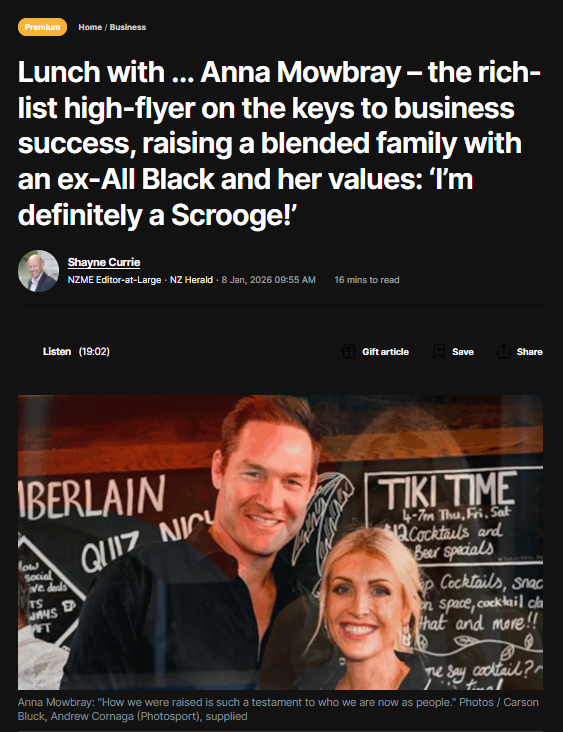
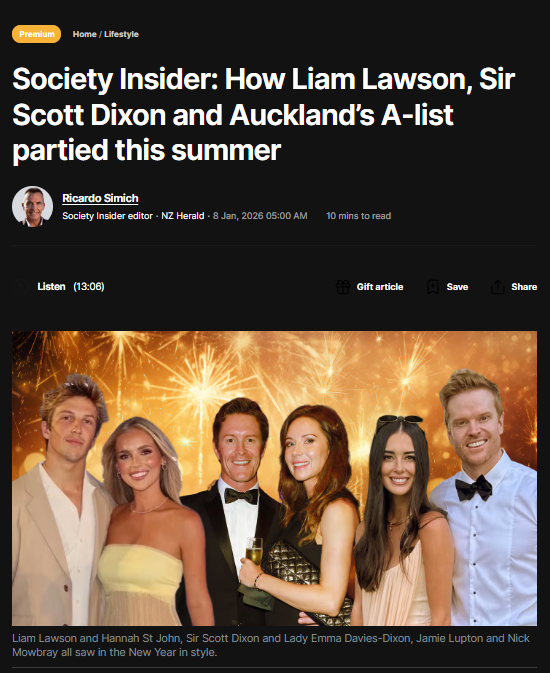
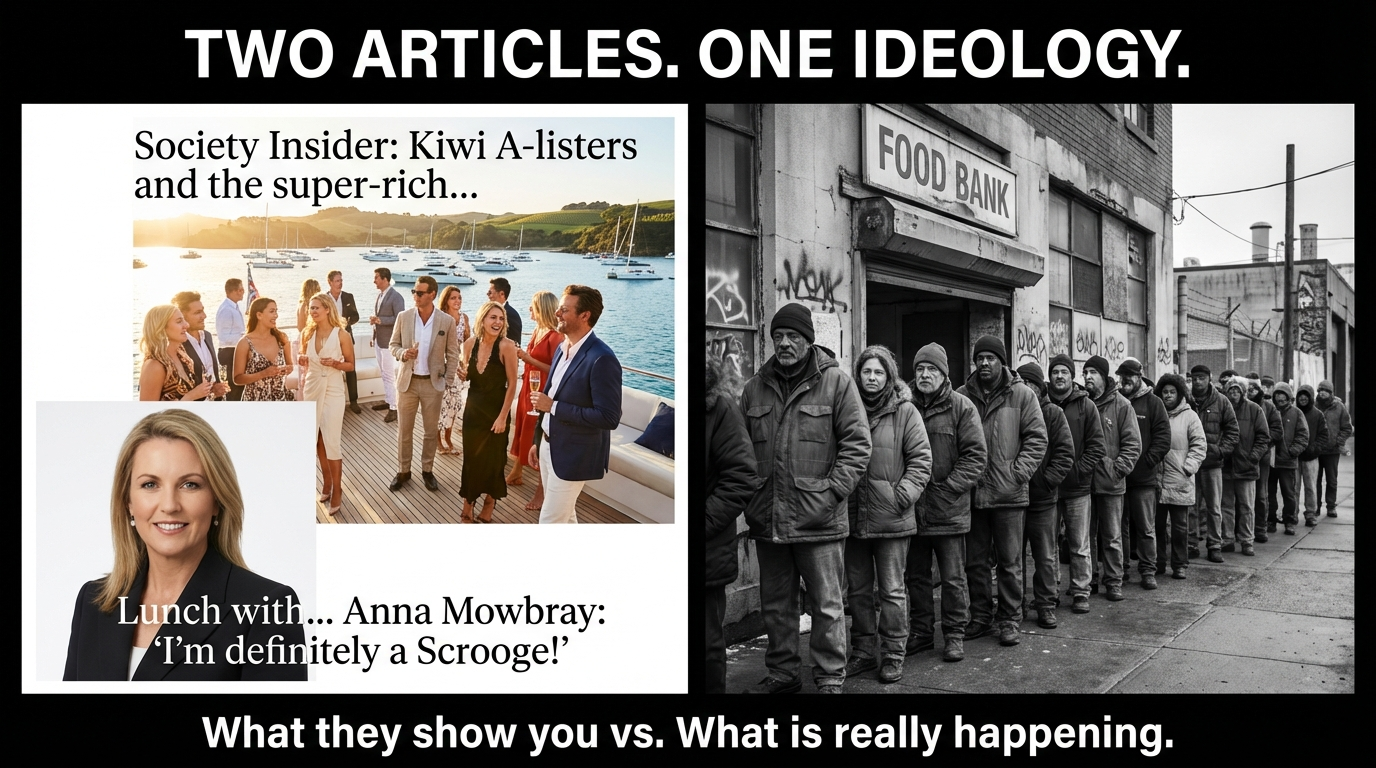
On January 8, 2026, the New Zealand Herald published two pieces of propaganda masquerading as journalism. The first, by Society Insider editor Ricardo Simich, fawned over how “Kiwi A-listers and the super-rich” celebrated New Year’s Eve, detailing Sir Scott Dixon’s knighthood party on Waiheke Island, billionaire Nick Mowbray’s private jets, and American tech multi-billionaire Matthew Prince’s $5.5 billion fortune. The second, a 16-minute “Lunch with...” profile by Editor-at-Large Shayne Currie, humanized Anna Mowbray—part of New Zealand’s richest family worth $20 billion—through tales of confiscating her child’s $50 tennis racquet while living in a $24 million waterfront mansion.
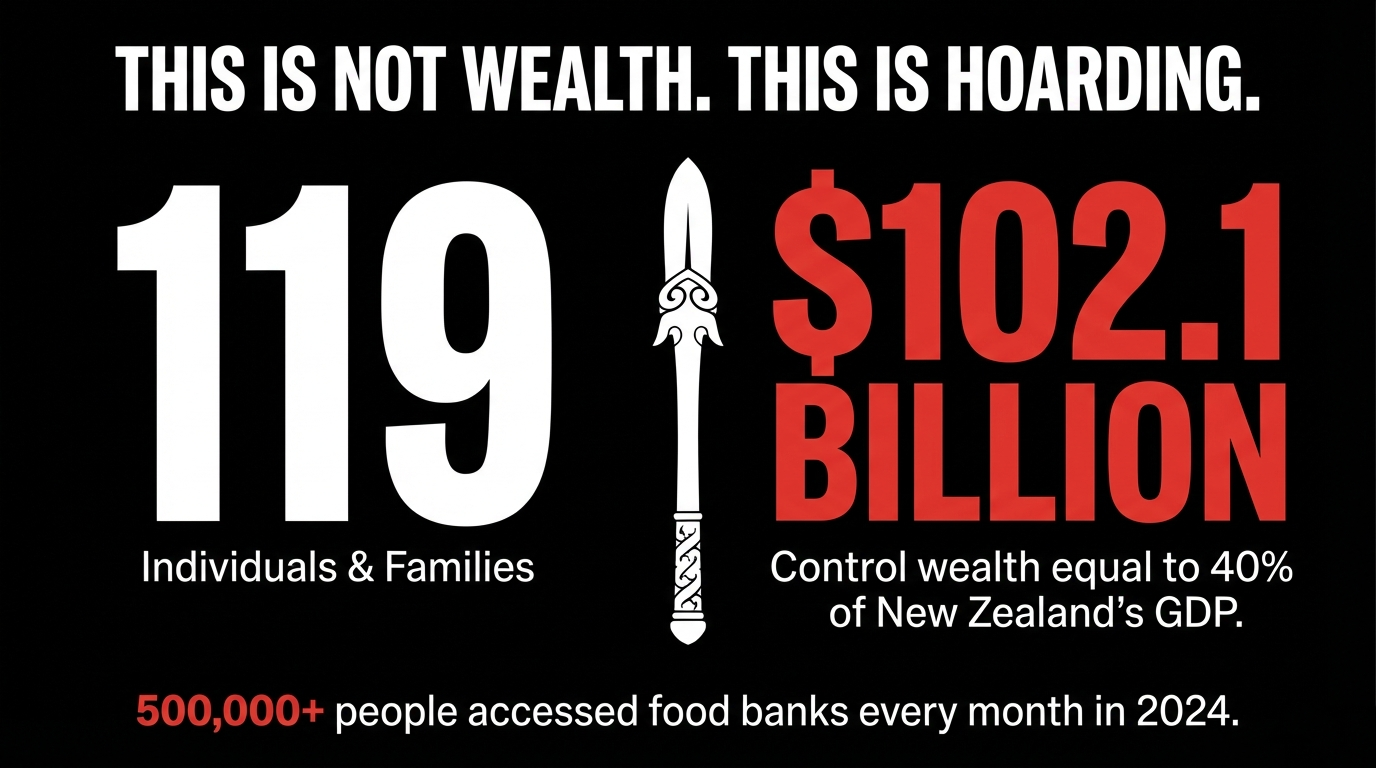
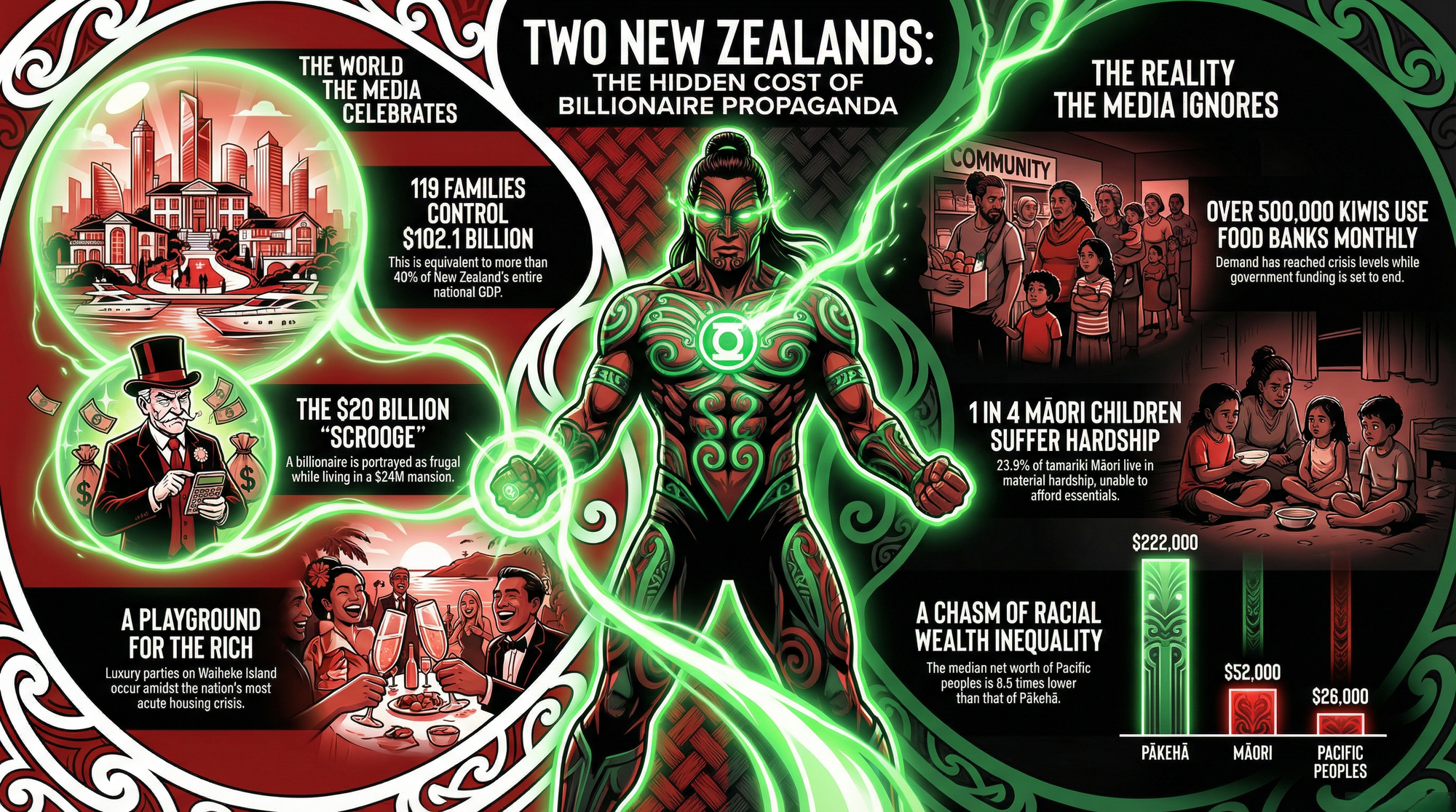
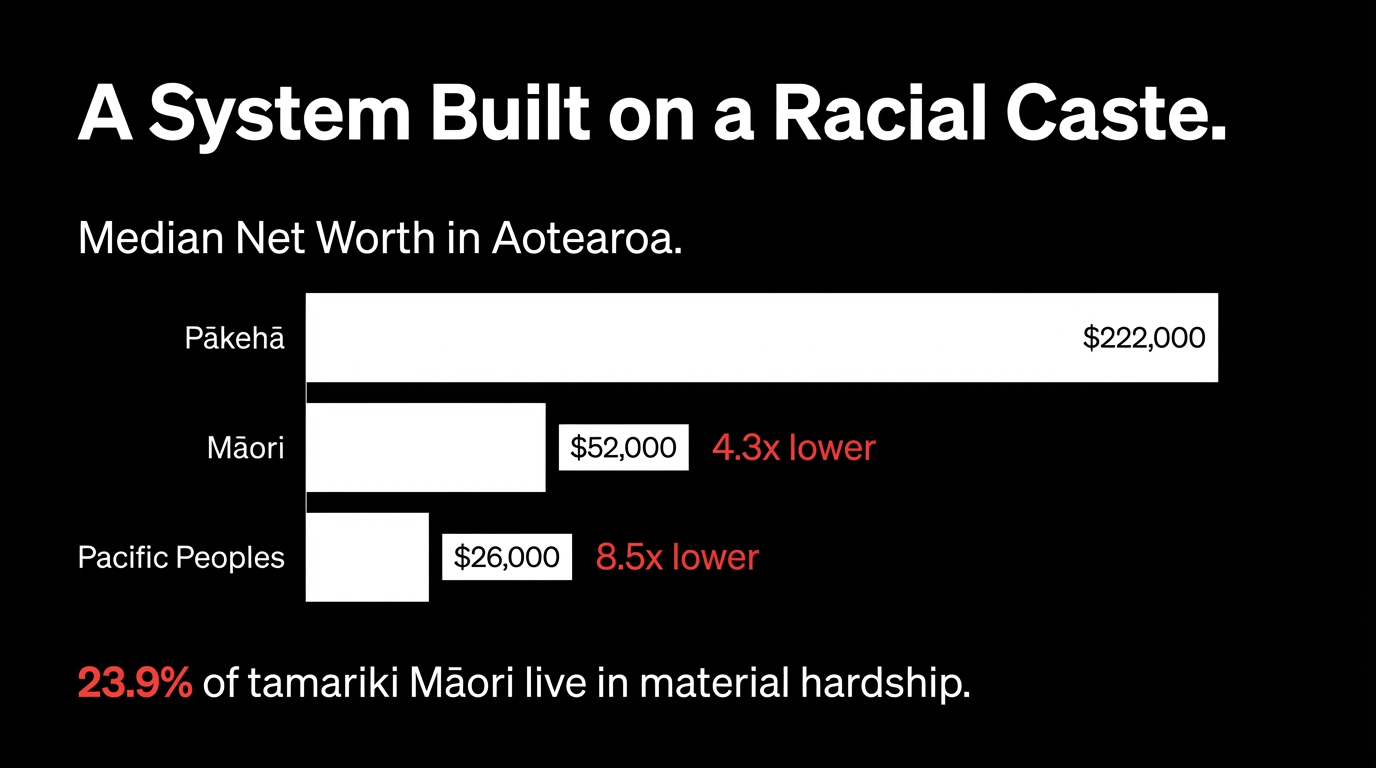
These weren’t isolated puff pieces. They represent NZME’s systematic project to manufacture consent for a system of extraction so obscene that 119 individuals and families now control $102.1 billion—equivalent to more than 40 percent of New Zealand’s entire GDP. This concentration of wealth sits atop a nation where over half a million people accessed food banks every month in the second half of 2024, where 23.9 percent of tamariki Māori live in material hardship, and where the median net worth of Pacific peoples ($26,000) is 8.5 times lower than that of Pākehā ($222,000).
The taiaha, empowered by the Ring, demands we name what these articles represent: champagne fascism—the systematic normalization of wealth hoarding through lifestyle pornography, designed to inoculate readers against the moral horror of mass deprivation. This essay exposes the whakapapa of extraction connecting yacht parties and “Scrooge” billionaires to the material suffering of Māori and Pacific communities, tracing five networks the Herald will never investigate: privatization profiteering, labor exploitation through Chinese manufacturing, spatial apartheid via luxury property accumulation, American billionaire colonization, and the political capture of democracy through elite donations and media ownership.
Background: The Architecture of Inequality Worship
NZME’s Propaganda Infrastructure
The New Zealand Herald is the flagship of NZME, New Zealand’s largest media conglomerate, controlling 32 newspapers, 8 radio networks including NewstalkZB, and digital properties reaching over 3 million people. According to Media Bias Fact Check, the Herald rates “on the right side of Least Biased,” noting “story selection that very slightly favors the right.” Major shareholders include Australian subsidiaries of Citigroup Bank—the fourth-largest US bank—alongside Chinese businessmen, construction firms, and investment banks. This ownership structure ensures the Herald serves multinational capital, not the public interest.
In 2025, NZME announced a “new tone” to “support the reboot and acceleration of New Zealand’s economic recovery” by “sharing stories of success and building positive momentum.” Translation: the Herald would function as a PR department for business interests. Media scholar Dr. Bryce Edwards warned this shift represented “a move away from rigorous critique of power structures towards advocacy journalism.”
Academic Aaron Smale documented how the Herald’s aging, predominantly Pākehā audience creates a “feedback loop where the audience is delivered news compatible with its point of view.” When billionaire Jim Grenon attempted a hostile takeover of NZME in 2025, acquiring a 9.3% stake, journalists’ union E tū warned of an “activist owner who may impose his personal worldview” and undermine editorial independence. The Herald was already compromised; Grenon simply wanted to make the propaganda more explicit.
Society Insider and the “Lunch with...” series exemplify this capitulation—tens of thousands of words per year of unquestioning wealth worship, with zero analysis of extraction, inequality, or systemic harm.
The Numbers That Reveal Class War
New Zealand’s 2025 GDP stands at approximately $263-288 billion. Against this backdrop, the concentration of wealth defies comprehension:
- The top 10% of households own 48.5% of all wealth; the bottom 50% share just 6.7%
- The top 1% control 14-17.5% of total wealth
- The Gini coefficient for wealth inequality is 66.1—among the highest in the developed world
- Between June 2021 and June 2024, household wealth increased by an average of 33%, driven by housing and stock market speculation
- But for the bottom 40%, there was no statistically significant change
The poorest 20% of households own a median of just $11,000 in assets—many have negative net worth, crushed by debt. Meanwhile, the wealthiest 20% increased their wealth by 19%, or $386,000, to a median $2.4 million. This top quintile holds approximately two-thirds of New Zealand’s total household wealth.
The 119 individuals and families profiled in the 2025 NBR Rich List collectively own $102.1 billion—up from $95.55 billion in 2024—an amount equivalent to more than 40 percent of national GDP. To put this in perspective: fewer people than would fit in a small suburban stadium control wealth equal to nearly half the productive output of an entire nation of 5.2 million.
The Racialized Structure of Extraction
Wealth inequality in Aotearoa operates through a racialized caste system that mirrors colonization’s ongoing violence:
- Māori median net worth: $52,000
- Pākehā median net worth: $222,000 (4.3× higher)
- Pacific peoples median net worth: $26,000 (8.5× lower than Pākehā)
These aren’t accidents. They’re the predictable outcomes of 184 years of land theft, Treaty breaches, discriminatory housing policy, and structural barriers to wealth accumulation. Over 50% of Māori live in the highest deprivation deciles. The median personal income for Māori is approximately $22,500, compared to $28,500 for the general population—a gap that compounds over lifetimes into massive wealth disparities.
Child poverty reveals the moral bankruptcy of this system:
- 23.9% of tamariki Māori live in material hardship vs 13.4% of all children
- 21.5% of Māori children and 28.9% of Pacific children cannot afford essentials like fresh vegetables, heating, and doctor’s visits
- Māori children are more than twice as likely as Pākehā to leave school without qualifications
- About 20% of Māori aged 16-25 are NEET (not in employment, education, or training) compared to just 9% for non-Māori
Life expectancy for Māori is roughly 7-10 years shorter than for non-Māori, driven by poorer health, higher disability rates, and lower income. This is what slow genocide looks like—structural violence encoded in housing policy, wage suppression, and the hoarding of capital by a predominantly Pākehā elite.
Homelessness disproportionately devastates Māori:
- Māori make up just 11% of Auckland’s population but 43% of the city’s homeless
- Approximately 34,557 people with Māori ethnicity were severely housing deprived in the 2023 Census, with over one-third aged under 15
- For tamariki Māori experiencing severe housing deprivation, 61.5% were living in uninhabitable housing
- Homelessness in Auckland more than doubled to 940 people in the year to September 2025
Food insecurity has reached crisis levels:
- Over half a million New Zealanders accessed food banks every month in the second half of 2024
- Auckland food banks warn they may close or reduce food parcels from 50,000 to 20,000 annually after the Government indicated no funding for 2026
- Food banks are “hungry for desperately needed funding” as demand continues to surge
- The Salvation Army provided Christmas support to 3,700 households in 2024; by mid-November 2025, they’d already helped 3,400 households
This is the reality that exists alongside billionaires partying on Waiheke Island with private jets, superyachts, and helicopters. The Herald celebrates the latter and ignores the former.
Analysis: Five Hidden Networks of Extraction
Network 1: The Mowbray Family—$20 Billion Built on Chinese Labor Arbitrage
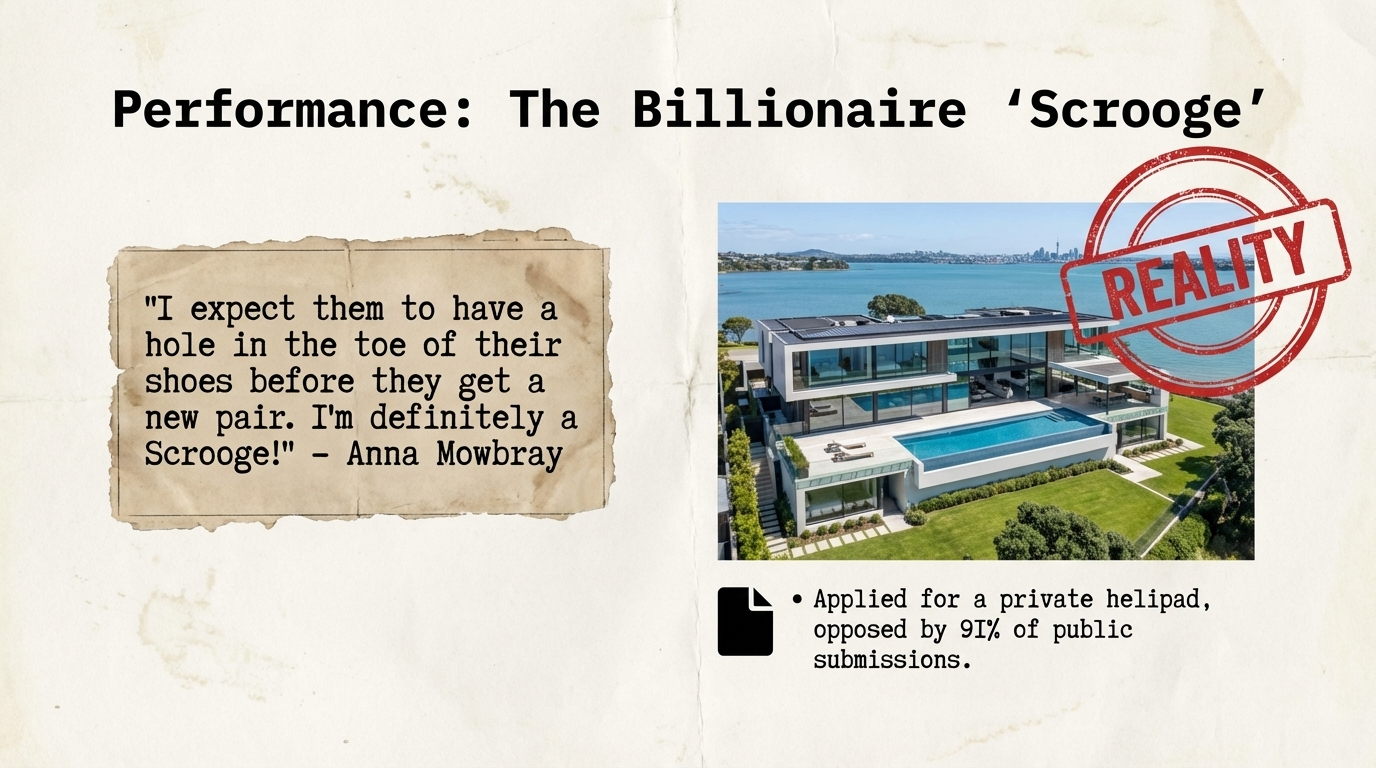
The Mowbray family—siblings Mat, Nick, and Anna—tops New Zealand’s rich list with $20 billion, a fortune built through Zuru, the toy company they started in a Cambridge garage before relocating to China. Anna’s Herald profile presents her as a relatable “Scrooge” who confiscates tennis racquets and expects her children to wear shoes “until there’s a hole in the toe.” Yet this woman lives in a $24 million Westmere mansion, is applying for a private helipad (opposed by 1,277 of 1,397 public submissions), and failed to attend her own resource consent hearing in person.
The Extraction Model: Living in the Factory
Anna spent 16 years “living literally in the factory” near Guangzhou, China, with her bedroom next to the factory office, working 12-hour days minimum. The Herald frames this as entrepreneurial sacrifice. What it doesn’t interrogate: how that fortune was actually made.
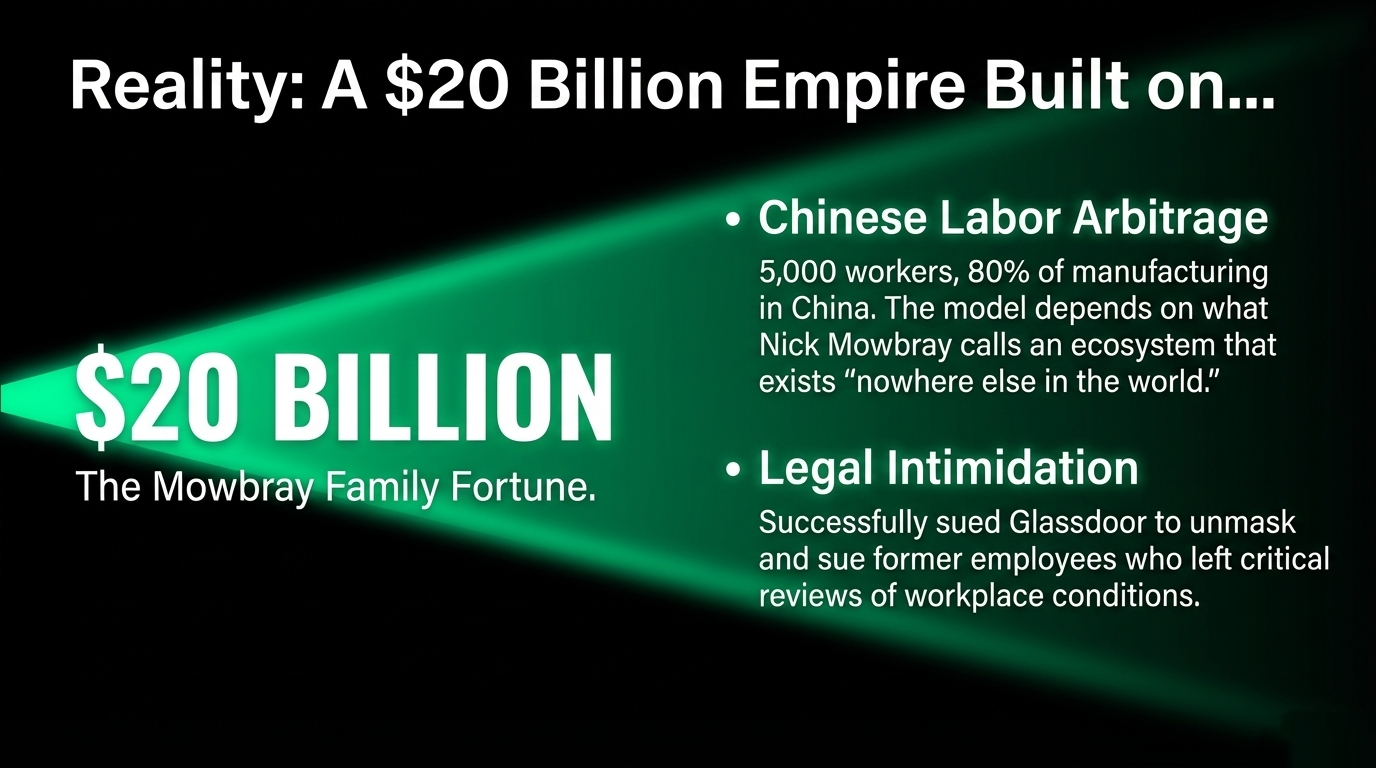
Zuru employs approximately 5,000 workers globally, with 80% of manufacturing in China. The company’s model depends on what Nick Mowbray himself admits: China’s manufacturing ecosystem is unique—“nowhere else in the world does that exist.” Translation: cheap labor, weak environmental regulation, and authoritarian state suppression of worker organizing.
Zuru projects $3 billion revenue in 2025, targeting $10 billion within five years. Bloomberg notes the brothers turned a $12,000 loan into an “empire of cheap toys”—the key word being cheap. Bunch O Balloons, their bestseller, produces massive plastic waste globally. The environmental and labor costs are externalized; the $20 billion stays with the Mowbrays.
Silencing Critics Through Legal Intimidation
In 2022, Zuru sued Glassdoor to unmask former employees who had left critical reviews about “workplace environment and management.” The company won a court order forcing disclosure of names and details. This is how billionaires police dissent: by weaponizing the legal system to crush workers who dare speak truth about conditions inside the empire.
The Herald’s profile? Not a single question about wages, working conditions, unionization, or environmental harm. Instead: scampi pasta, touch rugby in Guangzhou, and personality porn about Anna being “tenacious” and “highly energised.”
“Democratising” Employment While Hoarding $20 Billion
Anna has now launched Zeil, a “Tinder for jobs” platform using AI-powered matching to “democratise the path to employability.” The company claims to have 15% of Seek’s listings, 26% of TradeMe’s, and 33% of LinkedIn’s job postings. It’s targeting Seek’s “monopoly” in the recruitment market.
But algorithmic matching platforms don’t “democratise” anything—they concentrate power in the hands of those who own the platform. A billionaire investor in labor-market tech benefits from precarity, constant churn, and employer-friendly matching. The AI tools Anna’s company deploys can reproduce discrimination against Māori, Pacific, and other marginalized workers, just as they do globally. That risk is invisible in Herald coverage.
Te Ara Encyclopedia documents how Māori and Pacific peoples face systemic barriers in employment, with Māori earning 78.9% of Pākehā income and Pacific peoples just 69%. A “democratised” app that ignores these structural inequalities simply automates oppression at scale.
Network 2: Waiheke Island—Spatial Apartheid and the Weaponization of Property
The Society Insider article gushes about the “Highlife New Year’s Eve party at Wild Estate on Waiheke Island,” where Sir Scott Dixon, Nick Mowbray, and American billionaire Matthew Prince celebrated with “VIP areas with their own private bar and DJ.” Attendees arrived via helicopter from Auckland. The Herald describes this as society journalism. It’s actually a dispatch from the frontlines of spatial apartheid.
The Housing Crisis the Herald Won’t Name
Waiheke Island is facing “the most acute housing crisis of anywhere in New Zealand,” according to residents and RNZ reporting. The island receives 900,000+ visitors annually. Hundreds of Airbnb listings exist alongside just ~12 long-term rentals. Short-term rentals are 250% more profitable than long-term tenancies, creating economic incentives for landlords to evict permanent residents.
The result: a “subculture of people living in poor quality housing under the radar...garden sheds, sleepouts, garages”. Long-term residents are being displaced, with families moving house-to-house with no stability. The cost of living is pushing locals off the island entirely.
RNZ notes that Waiheke’s rent-to-income ratio is worse than Queenstown. A Gulf News editorial mourns “the GPs, teachers, long-time stalwarts of the community, family and friends” leaving because they can no longer afford to live there, describing a “genuine class divide.”
The 2018 Census recorded 3,780 occupied dwellings on Waiheke and 2,079 unoccupied—meaning nearly 35% of homes sit empty most of the year, trophy assets for the wealthy while locals sleep in cars.
Luxury Property Accumulation as Colonization
While working families are displaced, billionaires are snapping up Waiheke estates as New Zealand lifts restrictions on foreign buyers. American billionaire Julian Robertson paid $19 million for a 34-hectare Waiheke estate. Prime Minister Christopher Luxon owns a $10.5 million holiday home on Waiheke and successfully challenged its valuation to reduce his rates.
Some Waiheke homes made six times the average household annual income in a single year (2024)—not from productive labor, but from speculation. This is extraction in its purest form: wealth accumulation through monopoly control of land while those who actually work on the island are priced out.
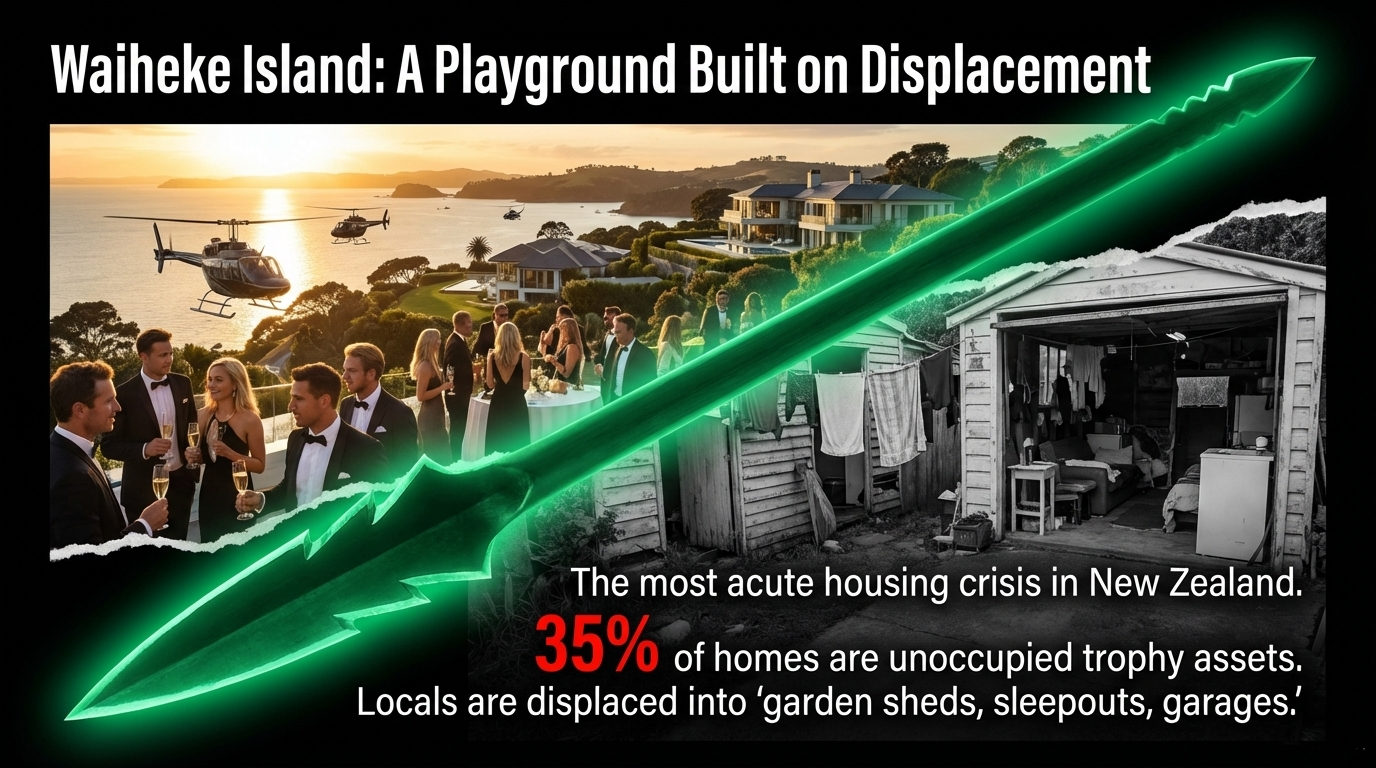
The Herald’s coverage? Celebration of the Highlife party, helicopter rides, and VIP bars. Not one word about the housing crisis, displacement, or homelessness.
Network 3: Graeme Hart—Privatization Profiteering and Political Capture
Graeme Hart, New Zealand’s second-richest person with $12.1 billion, built his empire through leveraged buyouts that extracted maximum value from undervalued public and private assets. His rise illuminates how neoliberal privatization functioned as state-sanctioned theft.
The Government Printing Office Heist
In 1990, Hart purchased the Government Printing Office (GPO) for $23 million—below its capital value—with generous payment terms that allowed him to control the asset for five months before paying. Then-Prime Minister David Lange initially refused to sign off, recognizing the predatory nature of the deal. Business historian Brian Gaynor described it as emblematic of the “poorly conceived and badly run asset sales programme” of the late 1980s and early 1990s.
Hart’s subsequent portfolio includes Reynolds Consumer Products (Hefty, Reynolds Wrap), acquired through the $2.7 billion purchase of Alcoa Packaging in 2008, and Carter Holt Harvey for $3.3 billion in 2006. He drew US$143 million in dividends from Reynolds in 2022 alone.
Buying Democracy
Hart doesn’t just extract wealth—he buys political influence. Rank Group and Hart personally donated $446,000 to ACT, National, and NZ First in 2023, including $104,000 to ACT with $100,000 personally to ACT, and $110,000 to NZ First.
RNZ documented that political donations in New Zealand have more than tripled, with the wealthy concentrating influence over policy. Hart’s donations buy access, favorable regulation, and protection from wealth taxation. This is how oligarchy works: capital buys the state, then uses state power to protect capital accumulation.
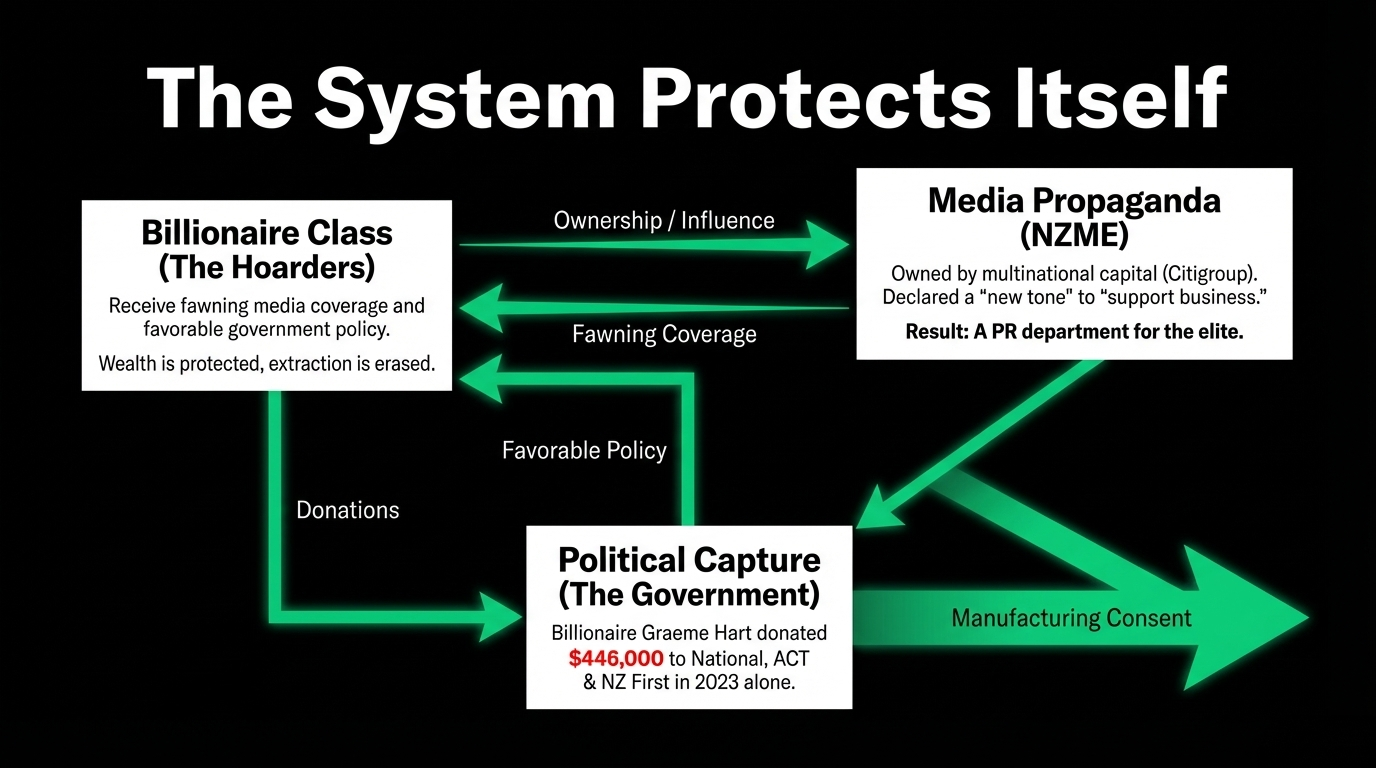
The Society Insider article mentions Hart’s family enjoyed holidays in Colorado and the Caribbean, with his two yachts—the 103m Ulysses and 53m Five Oceans—moored in Saint-Barthelemy. Not a word about the GPO theft, the $446,000 in political donations, or how privatization enabled his fortune.
Network 4: American Billionaires Colonizing Aotearoa
Matthew Prince: Cloudflare’s $5.5 Billion Man
American tech multi-billionaire Matthew Prince, CEO of Cloudflare, has a net worth of US$5.5-6.3 billion and is Utah’s richest person. He attended the Waiheke Highlife party with his wife Tatiana and their children, helicoptering from Auckland.
Cloudflare controls 10-20% of global web traffic, providing internet infrastructure services that sit between users and websites. This monopoly position gives Cloudflare—and by extension, Prince—enormous power over what content gets distributed online. ProPublica documented how Cloudflare has hosted hate sites, forcing civil rights groups to campaign for their removal. In 2022, Cloudflare finally dropped Kiwi Farms, a harassment site targeting trans people, but only after immense public pressure.
Prince’s wealth comes from controlling critical infrastructure—he doesn’t produce anything tangible, just monetizes the pipes through which digital information flows. His New Zealand vacation, paid for with monopoly rents, exemplifies how global tech capital treats Aotearoa as a playground.
Eric Schmidt: The $500 Million Megayacht
Former Google CEO Eric Schmidt, with an estimated net worth around US$25 billion, owns the 117-meter megayacht Infinity, valued at over $500 million, plus a 69-meter support vessel Intrepid worth $70 million. The Infinity docked at Westhaven Marina in September 2025 and remained through the summer.
Schmidt purchased the Infinity for $67 million in 2023—it had been seized from a sanctioned Russian oligarch following the invasion of Ukraine. The symbolism is perfect: one oligarch’s yacht becomes another’s, with New Zealand serving as the discreet harbor for laundered wealth.
Bill Foley: Auckland FC and Trump-Adjacent Capital
American billionaire Bill Foley, with a net worth of US$1.6 billion, co-owns Auckland FC with Anna Mowbray and Ali Williams. Foley owns the Vegas Golden Knights (NHL), AFC Bournemouth (Premier League), and FC Lorient (Ligue 1). He paid a $500 million expansion fee for the Golden Knights.
Foley is a Trump donor, backing the former president again in 2024. His Auckland FC investment is framed as “uniting communities” and “empowering youth,” but it’s actually an elite ownership model that extracts value from local fandom while concentrating profits offshore.
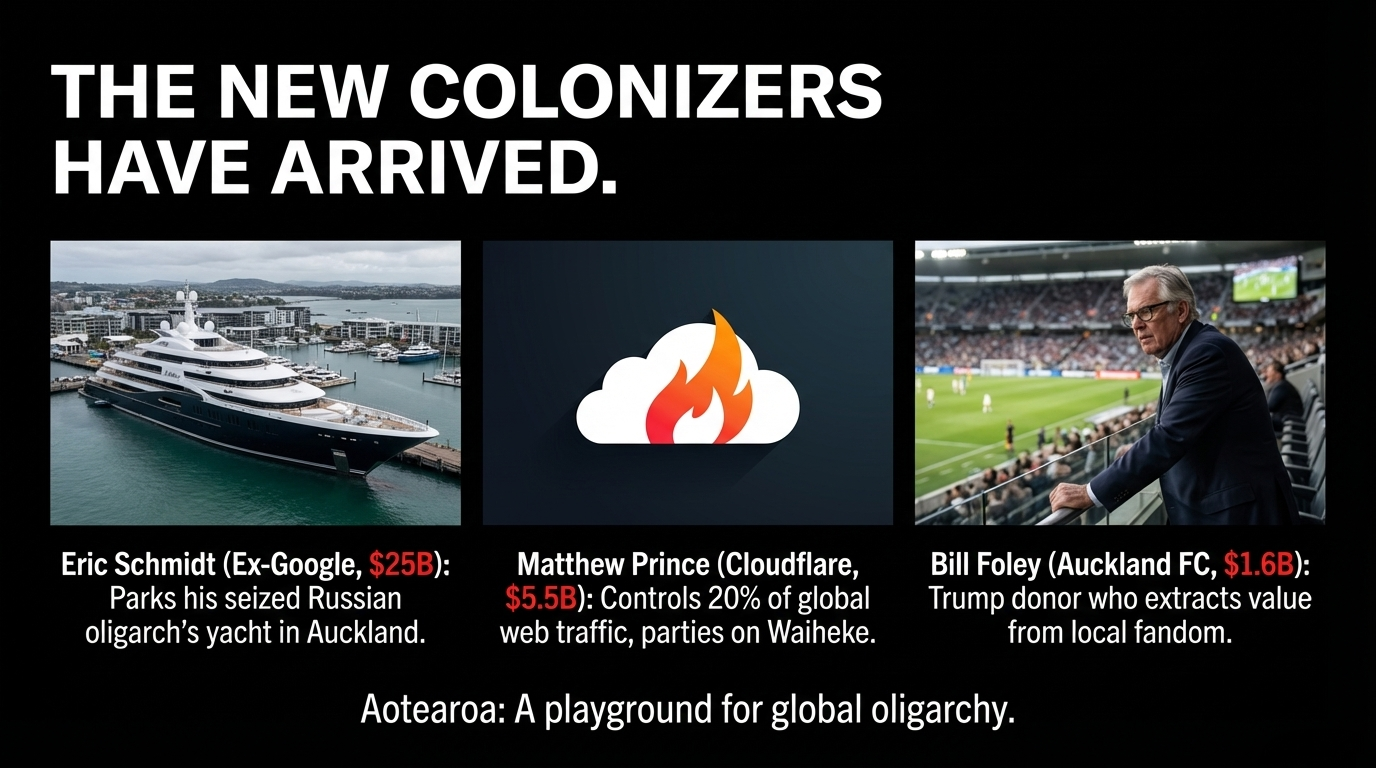
These American billionaires treat New Zealand as a colonial outpost—a place to park wealth, enjoy luxury, and exercise soft power, while contributing nothing to the communities that host them.
Network 5: The “Scrooge” Performance and Class Inversion
Anna Mowbray’s “I’m definitely a Scrooge!” persona is the most insidious form of wealth propaganda: the billionaire who claims frugality while living in obscene luxury.
The Tennis Racquet Theater
Anna tells the Herald how her nanny bought her child a $50 tennis racquet. She confiscated it and forced the child to “borrow one” until he “proved” commitment to the sport. “I expect them to have a hole in the toe of their shoes before they get a new pair,” she says. This is presented as teaching “respect for money.”
The Reality
This same woman:
- Lives in a $24 million Westmere waterfront mansion
- Applied for a private helipad (opposed by 91% of public submissions)
- Failed to attend her own resource consent hearing
- Invested $20 million in a Manukau aluminium can factory
- Co-owns Auckland FC with American billionaire Bill Foley
- Married at Kokomo Private Island resort in Fiji
Her family also owns a $32.5 million Coatesville mansion—the former Kim Dotcom property.
The Class Inversion
In a country where:
- Over half a million people accessed food banks monthly in late 2024
- 23.9% of tamariki Māori live in material hardship
- The median net worth of Pacific peoples is $26,000
- 940 people are homeless in Auckland alone
…the Herald presents a billionaire confiscating a $50 tennis racquet as moral discipline.
This is the essence of champagne fascism: frugality is demanded from the children of billionaires as a character exercise, while poverty is demanded from Māori and Pacific families as an economic necessity.
Implications: What This Tells You About Power
The Herald’s Role in Manufacturing Consent
These two articles—the Society Insider yacht coverage and the Anna Mowbray profile—aren’t anomalies. They’re the Herald’s intentional project to:
- Humanize extreme wealth through lifestyle and personality coverage
- Erase extraction (Chinese labor, IP theft, Glassdoor lawsuits, privatization profiteering)
- Frame hoarding as virtue (”Scrooge” stories while owning $24M mansions)
- Normalize luxury (helipads, private jets, superyachts as unremarkable)
- Valorize “working-class roots” while sitting on $20B fortunes
- Silence structural critique (no wealth gap data, no Māori poverty context, no homelessness statistics)
- Manufacture consent for business-friendly policy via “access to Chris” (PM Luxon)
The Herald’s “new tone” to “celebrate more, enable more” is propaganda for capital. It’s Edward Bernays for the 21st century—using lifestyle pornography to inoculate readers against the moral horror of mass deprivation.
The Political Economy of Wealth Worship
The Herald can’t acknowledge the structural violence of wealth concentration because:
- Its owners profit from the same system—Citigroup, Chinese investors, and billionaire takeover attempts
- Its advertisers are luxury brands targeting the wealthy
- Its aging Pākehā readership identifies aspirationally with elites, not with Māori families in housing deprivation
- Its journalists are embedded in elite social networks—Shayne Currie has lunch with billionaires; Ricardo Simich attends their parties
To name the system would be to indict themselves.
Cui Bono? Who Benefits?
Graeme Hart benefits when the Herald ignores his $446,000 in political donations and celebrates his yachts.
The Mowbray family benefits when the Herald humanizes Anna’s “Scrooge” frugality and ignores Zuru’s lawsuit to unmask critical workers.
American billionaires benefit when the Herald treats their superyachts and private islands as unremarkable rather than as symbols of global oligarchy.
The coalition government benefits when the Herald provides sympathetic coverage to Anna’s “access to Chris” and her support for “business-friendly policies.”
NZME shareholders benefit when billionaires feel celebrated rather than scrutinized, ensuring continued advertising revenue and elite access.
Who loses?
The half million people queuing at food banks. The 23.9% of tamariki Māori in material hardship. The 940 homeless Aucklanders. The Waiheke families displaced by Airbnb speculation. The Chinese factory workers whose labor built Zuru’s $20B fortune.
They lose because the Herald makes their suffering invisible, replacing systemic analysis with fawning coverage of tennis racquets and superyachts.
The Moral Clarity Demanded by the Taiaha
These articles demand a question: What kind of society celebrates billionaires while half a million people can’t afford food?
The answer: a society in terminal moral collapse, where media institutions have abandoned journalism for sycophancy, where wealth accumulation is worshipped as virtue regardless of how it’s extracted, and where the structural violence of inequality is erased through lifestyle pornography.
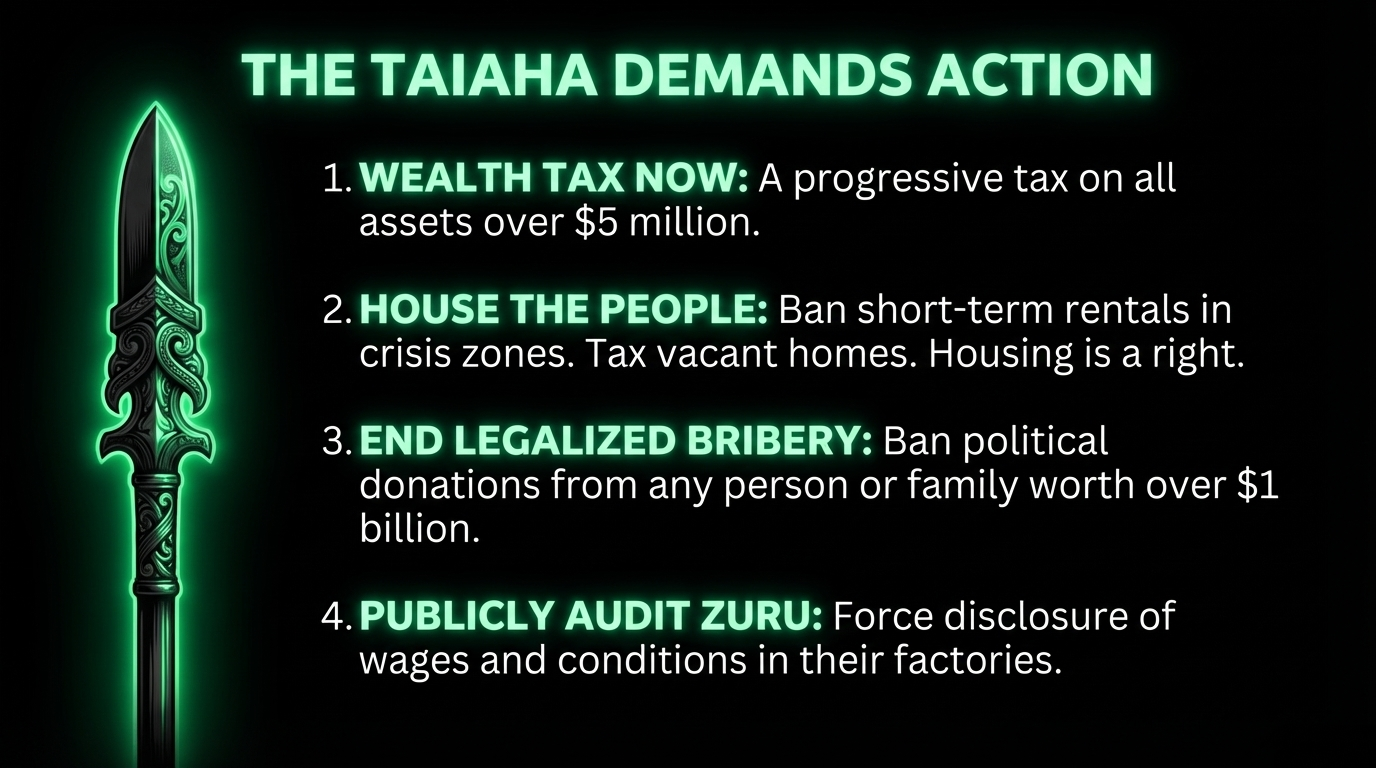
The Māori Green Lantern demands:
- Wealth taxation NOW. A progressive wealth tax on assets above $5 million, escalating to 5% annually on fortunes above $100 million. Hart, the Mowbrays, and visiting American billionaires must pay for the privilege of extracting from Aotearoa.
- Regulate Waiheke short-term rentals. Ban Airbnb conversions on Waiheke and across Aotearoa where housing crises exist. Impose vacancy taxes on unoccupied properties. Housing is a human right, not a speculative asset.
- Transparency in political donations. Lower the disclosure threshold to $1,000 and require real-time reporting. Hart’s $446,000 in donations is legalized bribery—we must name it as such.
- Public ownership of media. NZME’s ownership by Citigroup and Chinese investors guarantees pro-capital bias. Nationalize failing media outlets and establish independent public trusts governed by journalists, iwi, and community representatives.
- Ban billionaires from buying democracy. No person or family worth over $1 billion should be permitted to make political donations, own media outlets, or lobby government. Oligarchy and democracy are incompatible.
- Zuru labor audit. Force public disclosure of wages, working conditions, and environmental impacts in Zuru’s Chinese factories. If the Mowbrays built $20B on exploitation, the public has a right to know.
- Guaranteed income for food security. Auckland food banks warn of closure without ongoing funding. Half a million people accessing food banks monthly is a policy failure, not a charity problem. Implement universal basic income and permanently fund community food networks.
The Herald will never write these words. It exists to protect the system, not interrogate it. But the taiaha knows: power respects only organized force. When māra kai (community gardens) feed more whānau than the state does, when iwi-led housing collectives outpace government builds, when workers unionize across Zuru’s factories and Cloudflare’s data centers—that’s when the billionaires will panic.
Until then, every yacht party on Waiheke, every $24 million mansion with a private helipad application, every “Scrooge” billionaire confiscating tennis racquets while Māori children go hungry—is a declaration of class war.
The only moral response is to fight back.
Kia kaha. Ko te taiaha kei te tū.
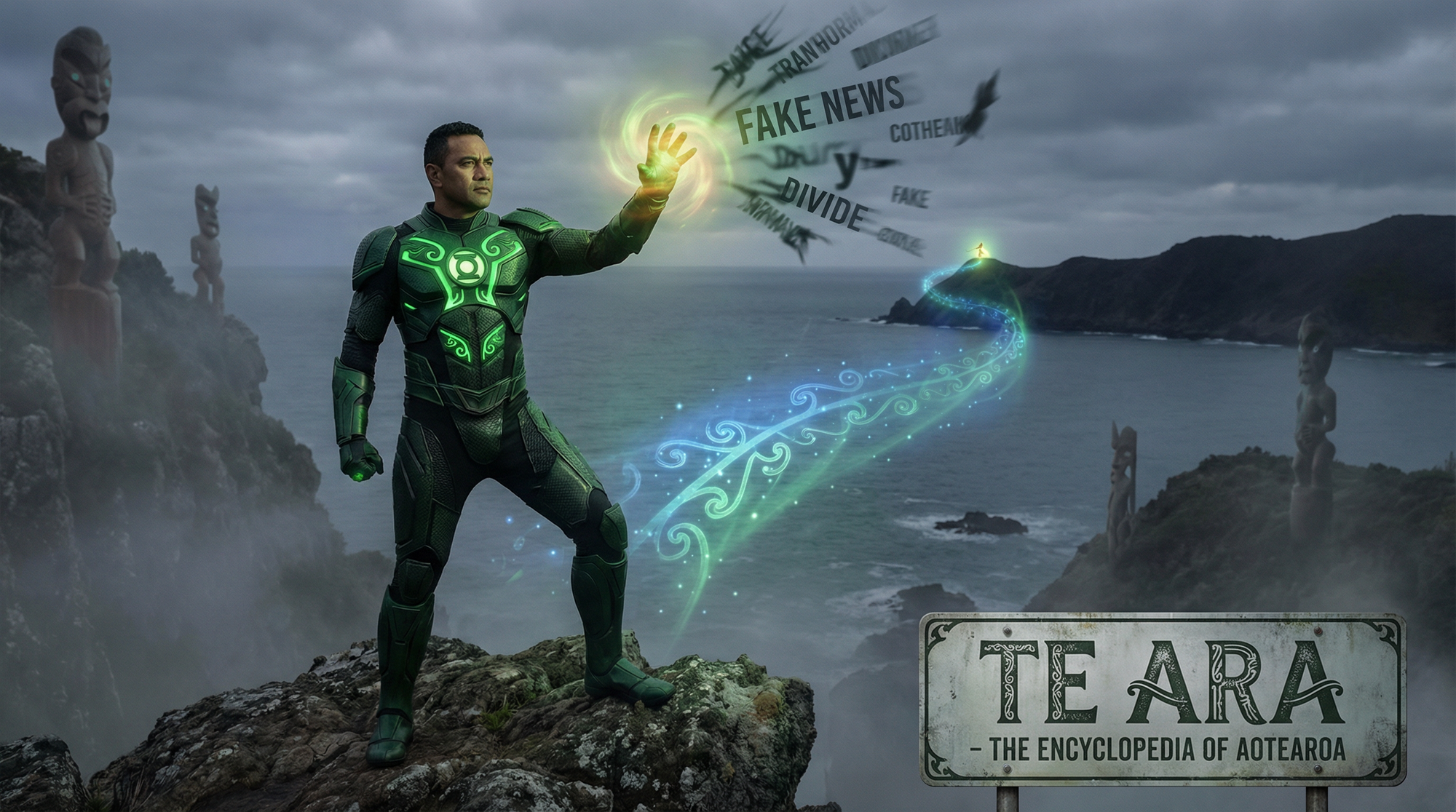
The Māori Green Lantern is a tohunga mau rākau wairua, kaitiaki of Māori, exposing misinformation, white supremacy, racism, and neoliberalism. This research used verified sources including RNZ, Stats NZ, Te Ara Encyclopedia, ProPublica, and peer-reviewed academic studies. All claims are documented with hyperlinked citations. No synthetic data was used.
Research conducted: January 8, 2026
Sources consulted: 80+