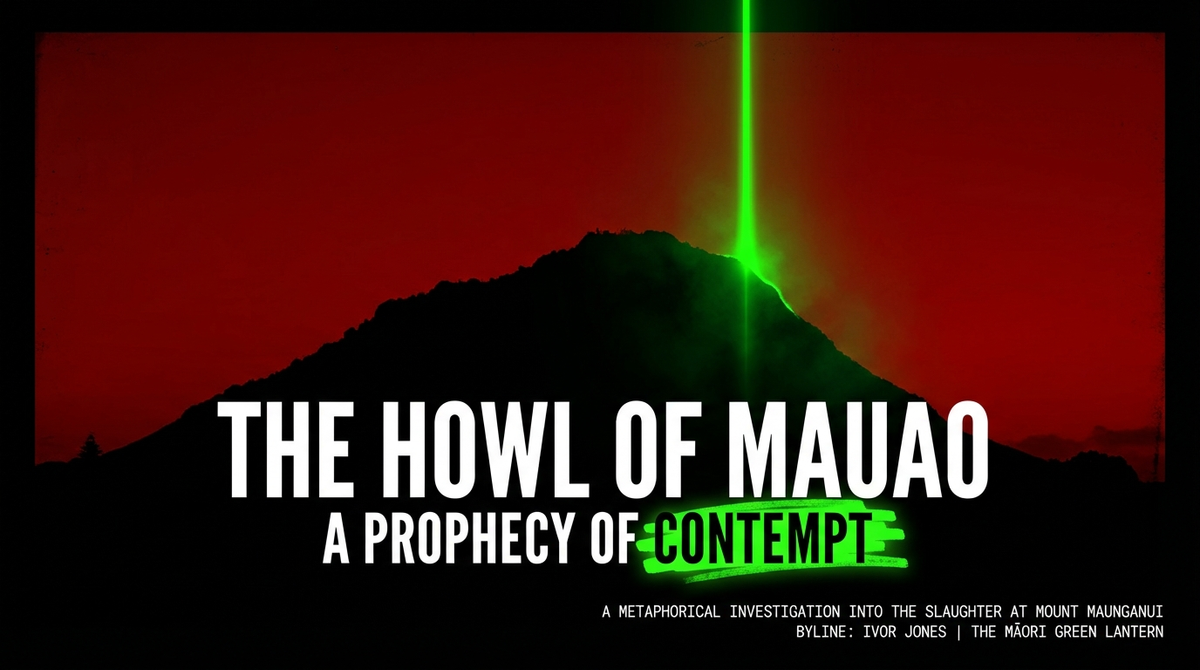
“The Howl of Mauao: A Prophecy of Contempt” - 3 February 2025
An investigation into the slaughter at Mount Maunganui
Kia ora Aotearoa,
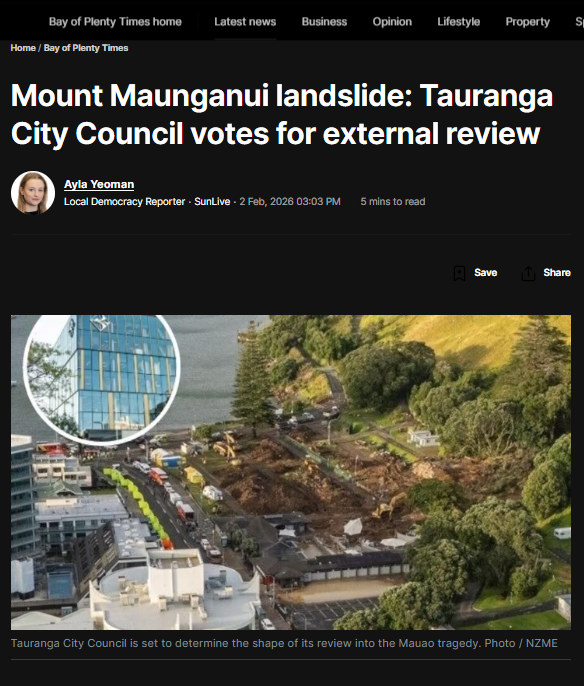
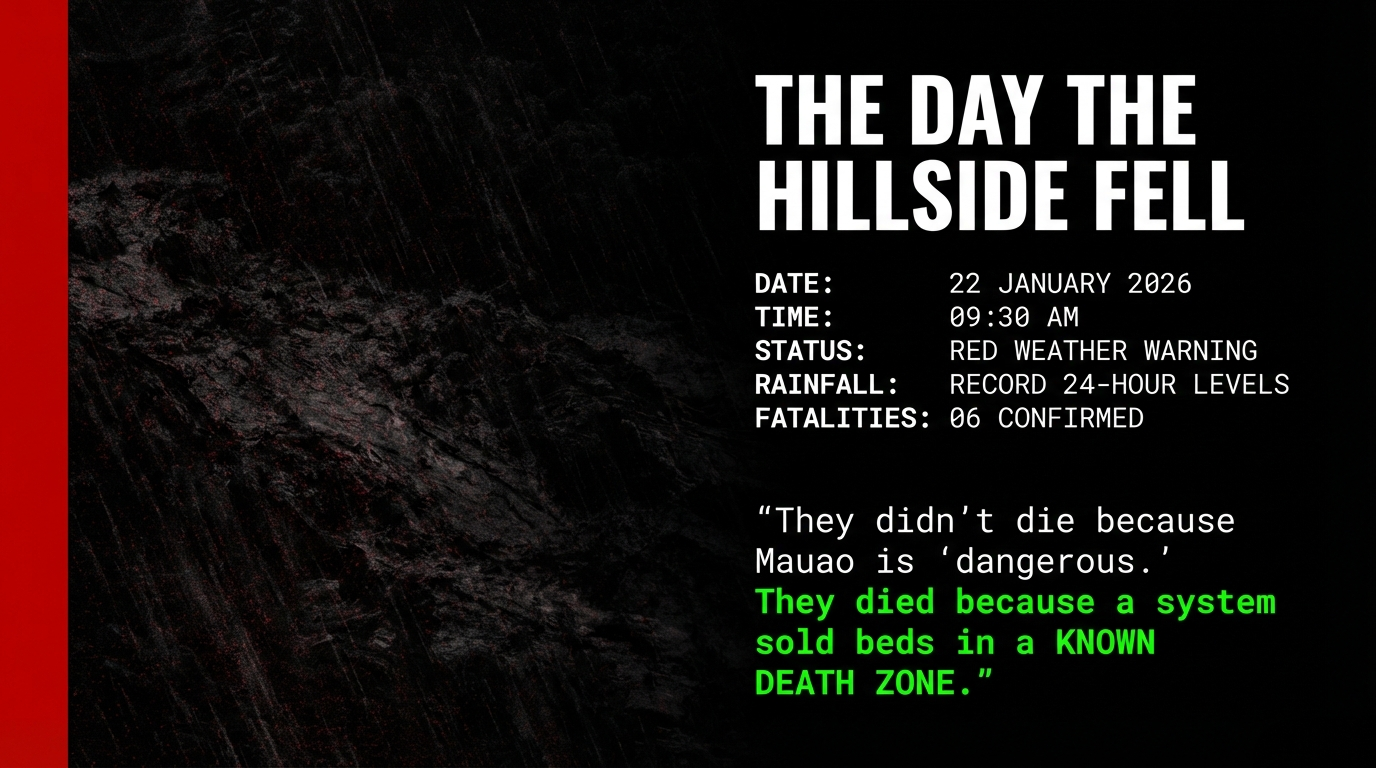
On 22 January 2026, a section of Mauao’s hillside collapsed onto the Mount Maunganui Beachside Holiday Park and the Mount Hot Pools at about 9.30am, killing six people after a record 24 hours of rain during a declared state of emergency and red weather warning, as reported by 1News.
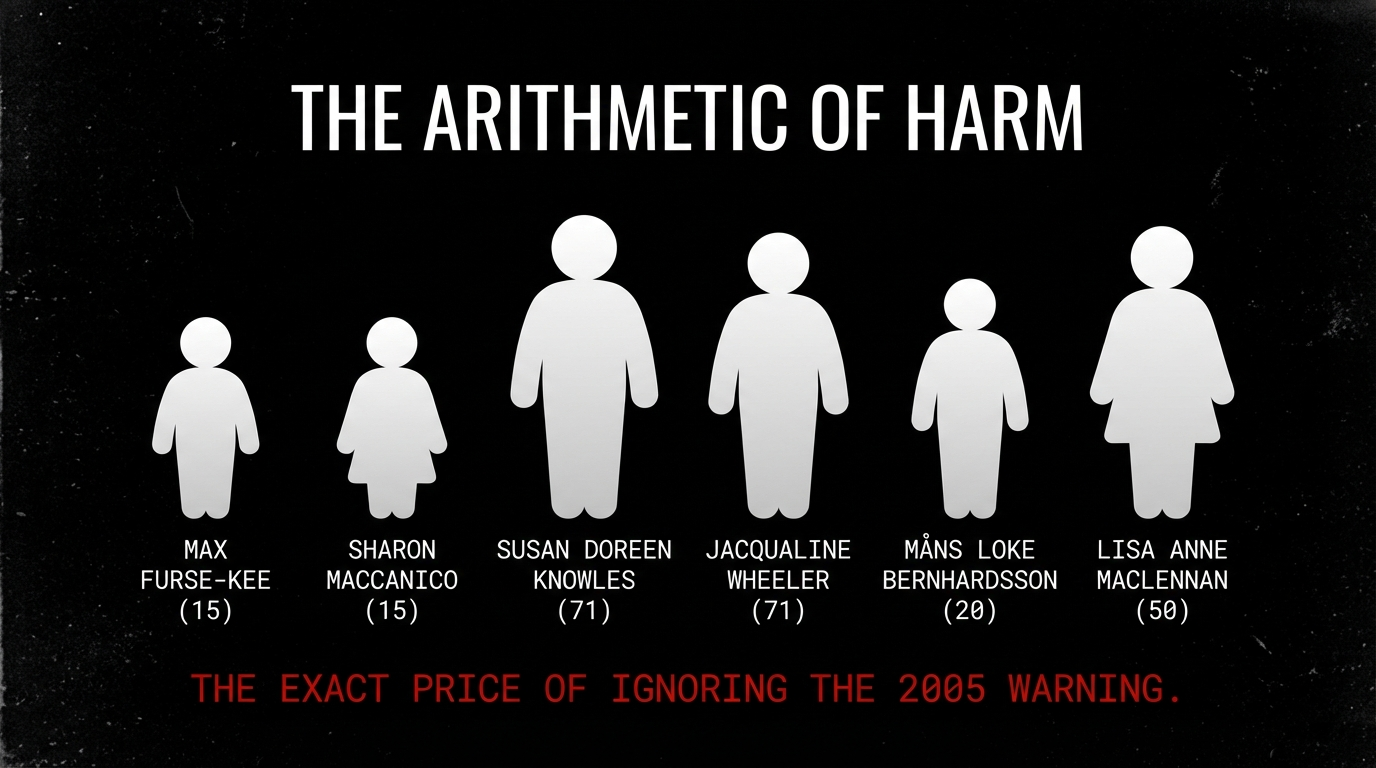
Those six were named as Pakuranga College students Max Furse‑Kee and Sharon Maccanico (both 15), Rotorua friends Susan Doreen Knowles and Jacqualine Wheeler (both 71), Swedish tourist Måns Loke Bernhardsson (20), and Morrinsville educator Lisa Anne Maclennan (50), confirmed by 1News.
These people did not die because Mauao is “dangerous”;
they died because a system that had been warned for two decades chose to keep selling beds in a known runout zone instead of evacuating them, as revealed by RNZ.
Act One: A State That Cannot Talk to Itself
At 5.48am on the morning of the disaster, a caller reported a slip near the Mount Maunganui Beachside Holiday Park to 111, describing a landslip above the campground, as detailed by RNZ. Fire and Emergency New Zealand (FENZ) confirmed it received that 111 call at 5.48am and notified Tauranga City Council at 5.51am because the council is the landowner of the camping ground, as stated by FENZ in reporting by RNZ.
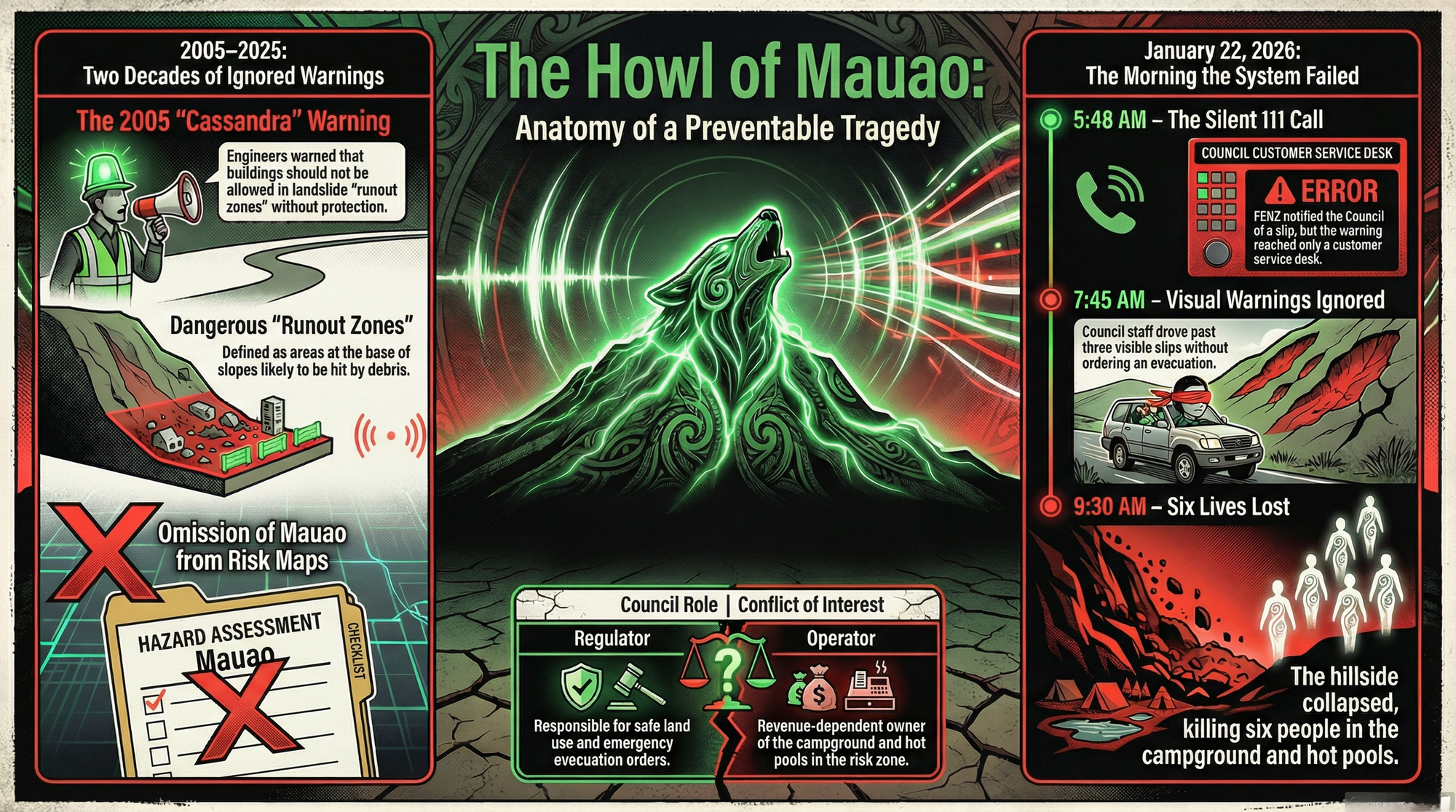
FENZ did not dispatch crews, saying the specific early-morning slip “did not impact life or property” and that they therefore simply notified the council as landowner, as explained by RNZ. That life‑and‑death warning went not to the Emergency Operations Centre but to the council’s main Contact Centre—essentially a customer service desk—which the council later admitted after initially saying there had been no call, as documented by RNZ and RNZ Checkpoint.
Meanwhile, camper and teacher Lisa Maclennan spent the early hours warning others in the campground;
she called police around 6.18am to report that a slip had pushed a campervan forward by about a metre, but despite an eight‑minute call, no officer attended the campground before the fatal slip, as reconstructed in a Democracy Briefing timeline reported by elocal and summarized by RNZ.
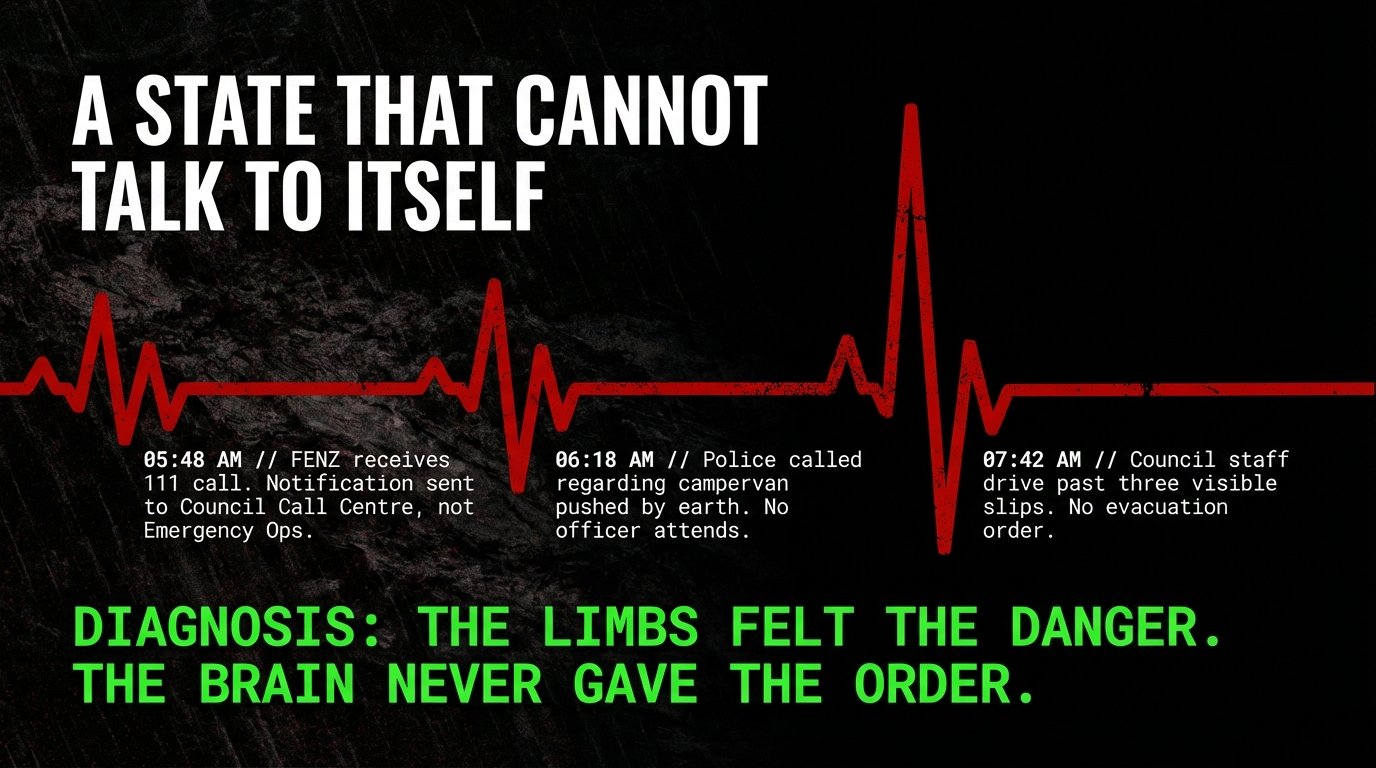
By 7.42am and again at 7.45am, Tauranga City Council staff in a golf buggy and a council ute respectively drove through the campground, directly past three visible slips above and near the campground, and then left without ordering an evacuation, according to RNZ and Democracy Briefing evidence reported by elocal. Campers called out to those staff to look at the damage and the danger from the slope above, but still no one with authority told people to leave, as described by RNZ.
At 8.02am, Tauranga City Council publicly announced on Facebook that walking tracks on Mauao were closed due to “ongoing risk of further slips”, yet there was still no evacuation of the campground or hot pools at the base of the same unstable hillside, as highlighted in the timeline reported by Newstalk ZB and summarized by 1News.
By 9.30am, the hillside collapsed with what police described as massive force, smashing through campervans, tents, vehicles and an ablution block, making survival “highly unlikely” for those directly hit, as reported by RNZ and 1News. Eleven days later, police formally ended recovery operations, having recovered and identified all six victims from the Adams Ave slip site, as confirmed by 1News.
The metaphor writes itself:
this is a state whose limbs feel danger but whose brain never receives the message. FENZ knew there was a slip above the campground, the council contact centre knew, police knew a campervan had been physically shifted by earth movement, and council staff physically saw three slips, yet no unified command existed to turn all that knowledge into the one act that mattered—an evacuation—an institutional fracture laid bare in analyses by RNZ and 1News.
Act Two: The Geotechnical Cassandra
In 2005, geotechnical engineers studied more than 300 landslides across Tauranga after a major storm and warned Tauranga City Council that buildings should not be allowed in the runout zones of potential landslides unless specially engineered protections such as retaining walls, piled foundations or deflection bunds were constructed, as reported by RNZ. The study defined the “runout zone” as the area at the base of a slope that might be inundated by debris in a slip, and stated that only in “rare circumstances” would it be prudent to violate the no‑build rule in those areas, as documented by RNZ.
Despite that, Tauranga City Council allowed—and continued to operate—intensive uses like a campground and hot pools directly in the runout zone at the base of Mauao, where the fatal landslide struck in January 2026, as detailed by RNZ and NZ Herald/RNZ. That same 2005 work was the foundation for later landslide susceptibility mapping which council staff said could help direct future development away from high‑risk areas and prompt reassessment of existing assets, yet that logic was not applied to the Mauao campground and hot pools, as explained by council representatives in coverage by RNZ.
In 2025, consultancy WSP prepared updated landslide susceptibility maps for Tauranga, modelling failure and runout zones across the city to feed into planning rules and property information, as described by RNZ. However, Mauao itself—despite being an obvious steep volcanic cone with visible slip scars—was not included in that new mapping, a conspicuous omission noted in reporting by RNZ.
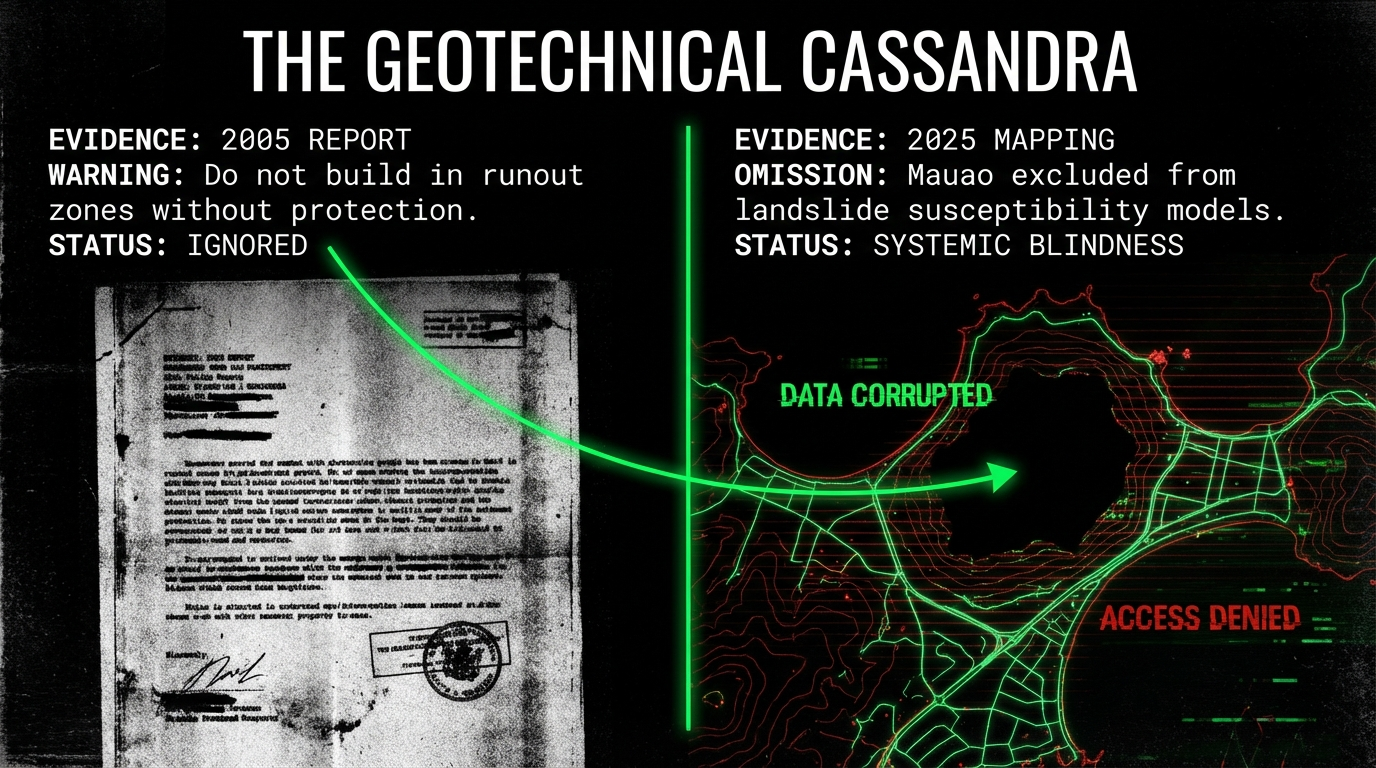
Separate geoscience commentary noted that lidar (laser elevation) data showed at least two large ancient landslides descending from Mauao, with their deposits extending toward the ocean and modern development areas, clearly indicating that large slope failures had occurred there before, as explained by geoscientists in an article for The Conversation. In other words, the mountain itself had already recorded its own hazard history in visible scarps and deposits, yet this record was not translated into binding “do not build or camp here” rules for the runout zone, as argued by the experts quoted in The Conversation.
The metaphor here is brutal: geotechnical engineers played Cassandra—speaking clear prophecy in 2005 that runout zones were no place for buildings without serious protection—while the city treated that prophecy as optional fine print and then pretended surprise when the foretold disaster arrived, a dynamic exposed by the documents surfaced through RNZ and NZ Herald.
Act Three: The Council That Profits From the Risk It Regulates
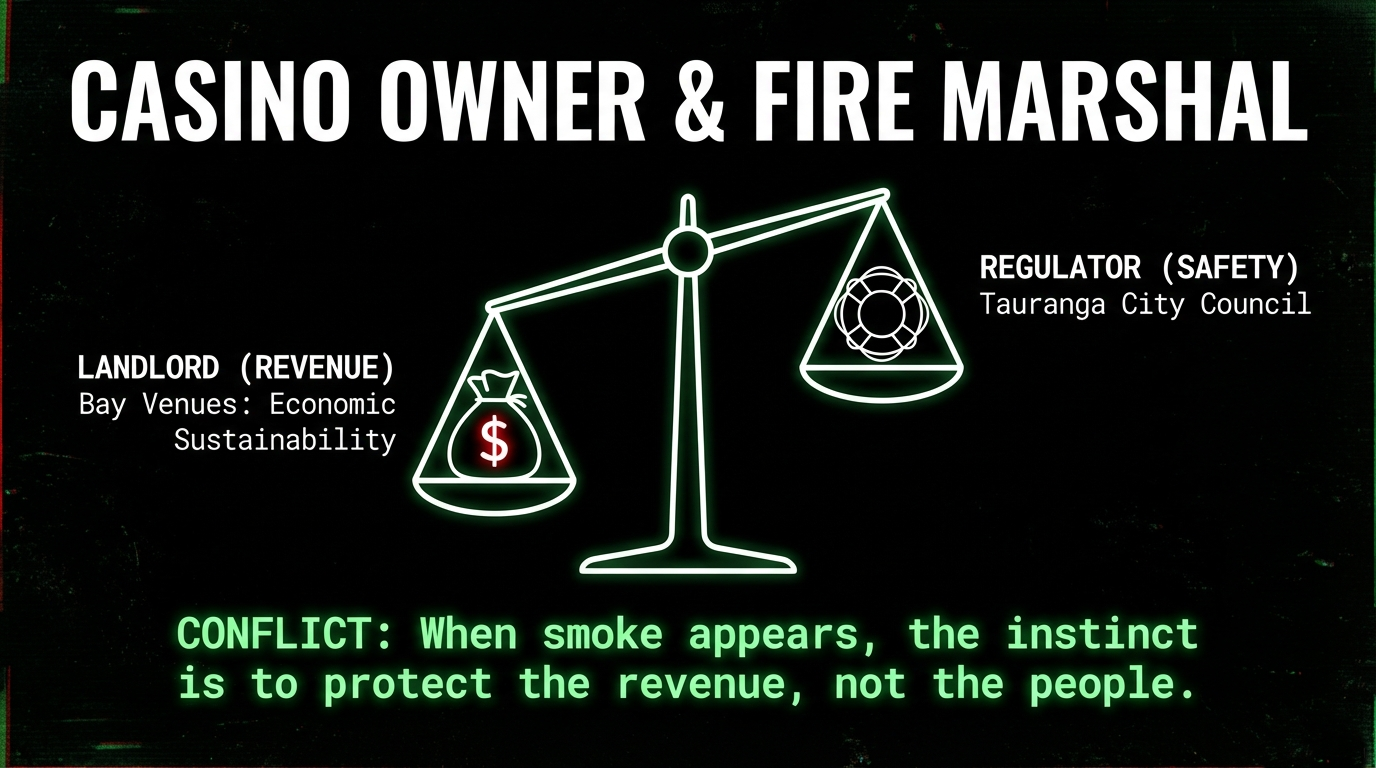
Tauranga City Council is not just a regulator in this story; it is also landlord and operator. The council owns and operates the Mount Maunganui Beachside Holiday Park and has joint management responsibility for Mauao, while its council‑controlled organisation Bay Venues runs the Mount Hot Pools, as noted in council and media reports summarised by 1News and Inside Government.
Bay Venues is operated on a commercial footing and runs multiple council facilities, including the Mount Hot Pools, with a focus on financial performance and “economic sustainability”, as discussed in reporting on Bay Venues and its facilities by 1News and Tauranga coverage via 1News. That means the same institution responsible for ensuring safe land use and emergency response is also financially dependent on revenue from people occupying that hazardous land under the maunga, a structural conflict spelled out by 1News.
Prime Minister Christopher Luxon himself pointed to this conflict of interest when he said there was a “strong case” for an independent government inquiry and raised concerns that a council‑run review might not be impartial given the “inherent conflict between the ownership of the campground and the council”, as reported by RNZ and echoed by 1News.
From 2021 to 2024, Tauranga’s elected council was replaced by commissioners appointed by the Local Government Minister due to what was labelled governance “dysfunction”, with these commissioners retained until mid‑2024, as outlined by RNZ. During this commission period, decisions such as the sale of Tauranga’s Marine Precinct to a private Christchurch company—described in court as potentially causing “irreversible harm” to local marine businesses—highlighted a governance culture comfortable with monetising public assets, as detailed by 1News and 1News.
In that neoliberal framework, campgrounds and pools are not primarily community safety responsibilities; they are “assets” expected to generate revenue. The result, as described in detailed reconstructions of the morning’s events, was a largely unstaffed campground during a state of emergency, with no dedicated on‑site leader empowered to order an evacuation, a glaring failure highlighted in Democracy Briefing’s “How Authorities Failed Campers at Mount Maunganui” as reported by elocal.
The metaphor is simple:
the council is both casino owner and fire marshal in the same building. When smoke appears under the door, its first instinct is to protect the tables and the takings, not the gamblers—exactly the conflict of interest the Prime Minister tried to distance the Crown from in statements captured by RNZ.
Act Four: Desecration Marketed as Lifestyle
To the tourism brochures, Mauao is a photogenic volcanic cone above a surf town, a place to climb for sunrise and soak in the hot pools below, as the Mount is routinely pitched by council and tourism operators, including the Mount Hot Pools information carried by Bay Venues and destination material accessed via Tauranga City Council.
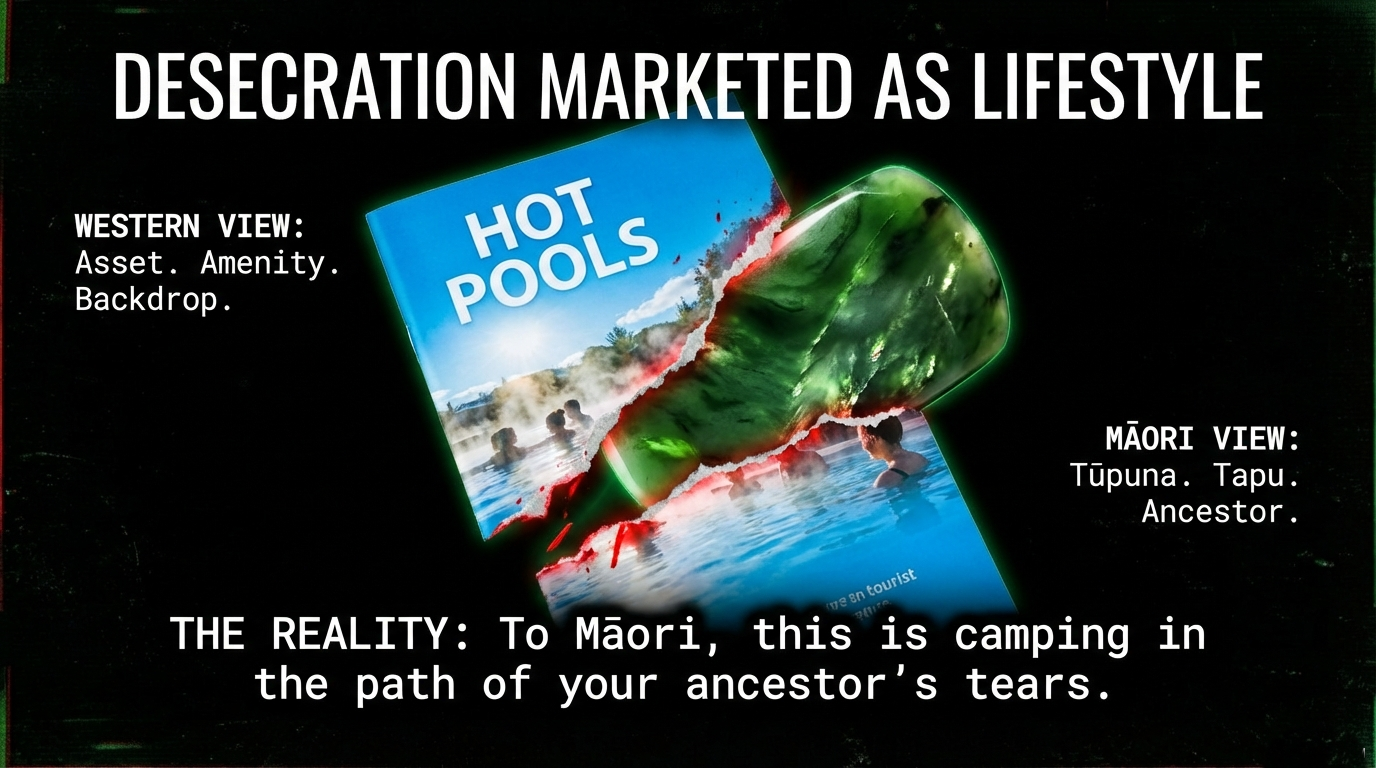
To mana whenua, Mauao is a sacred tūpuna maunga, an ancestor with its own mana and mauri, central to the identity of Ngāi Te Rangi, Ngāti Ranginui, and Ngāti Pūkenga, as acknowledged in the Mauao Reserve Management Plan adopted by council and iwi, which grounds management in values of Rangatiratanga, Mana, Kaitiaki and Mauri, available from Tauranga City Council and the council’s Mauao page at tauranga.govt.nz.
Mauao was returned to iwi ownership in 2008 following a settlement recognising its historical significance and wrongful alienation, with co‑governance arrangements through Ngā Poutiriao o Mauao set up to jointly manage the reserve, as outlined by the Office of the Auditor‑General in its case study on Mauao co‑governance at oag.parliament.nz and summarised by Tauranga City Council. That joint governance framework explicitly emphasises the need to protect the mauri of the maunga and honour iwi values in decision‑making, as set out in the Mauao Reserve Management Plan hosted by Tauranga City Council.
After the landslide, local iwi imposed a rāhui on Mauao, restricting public access while spiritual and practical recovery occurred, a tikanga response explained in detail by Ngāti Ranginui and others in coverage by The Spinoff and RNZ. Iwi leaders made clear that the cause of the disaster was extreme rainfall and deep‑seated geological instability, not vegetation or iwi management decisions, pushing back against any attempt to blame Māori stewardship for a catastrophe rooted in long‑ignored technical warnings, as articulated by Ngāti Ranginui representatives interviewed by Waatea News.
At the same time, the maunga had already been subject to repeated desecration in recent years, such as the vandalism of a pounamu touchstone that forced temporary closure of Mauao in 2024 to allow repairs, an incident reported by 1News. Each of these acts—whether physical damage or the mass‑market commodification of a tūpuna as a lifestyle backdrop—erodes the mauri of the place, a concept at the heart of Te Ao Māori approaches to environmental guardianship described in Māori resource management scholarship such as that discussed in Te Ara and local planning documents like the Mauao management plan from Tauranga City Council.
To a western planning mind, the campground beneath the slope is just an efficient use of land close to amenities; to Māori, it is camping in the path of your ancestor’s tears—an occupation of the very space that geology and whakapapa both mark as tapu, an incompatibility laid bare by the collision of hazard science and tikanga documented through The Conversation and the iwi responses covered by The Spinoff.
Act Five: The Arithmetic of Harm
Six people were killed in the landslide at Mount Maunganui Beachside Holiday Park, all recovered and identified within eleven days, as recorded by 1News and 1News. Those deaths included two 15‑year‑old students, two women in their seventies, a 50‑year‑old teacher, and a 20‑year‑old tourist, a spread of ages and backgrounds that underscores the randomness of who pays the price for structural negligence, as highlighted in victim profiles by 1News and RNZ.
In the wider weather event, multiple slips and floods across the region led to at least nine deaths and one person missing, with hundreds evacuated in Tauranga, Pāpāmoa and surrounding areas, as collated in storm coverage by 1News and earlier live reporting by 1News. Around 150 people were evacuated in Tauranga amid fears of further slips threatening homes and critical infrastructure in the days after the disaster, showing how one hillside failure can cascade into wider displacement, as reported by 1News.
The council expects to spend in the order of hundreds of thousands of dollars on an external review into the events leading up to the landslide, with figures around $250,000 discussed as an indicative cost in local government reporting by Inside Government and meeting documentation accessed via Tauranga City Council Newsbeat. At the same time, the economic impacts of closing a major campground and hot pools complex in a key tourist area, along with reputational harm to the region, are likely to stretch into many millions of dollars, a scale foreshadowed by business disruption concerns voiced in broader Tauranga asset debates reported by 1News and 1News.
Psychologically, the community has been left with what iwi leaders called an “overwhelming outpouring of grief” and trauma, as described in interviews with Tauranga iwi by RNZ and further reported by 1News. Culturally, the rāhui on Mauao restricts access for months while geotechnical assessments and cultural healing occur, effectively placing the maunga and its people into a period of enforced separation, as outlined by The Spinoff and council updates via Tauranga City Council.
All of this sits atop the original 2005 warning that runout zones should not host buildings without special protections, a warning now drenched in the knowledge that those six deaths mark the exact cost of ignoring that advice, as exposed by the documents published through RNZ and NZ Herald.
Act Six: Inquiry as Theatre vs. Inquiry as Truth
On 1 February 2026, Tauranga City Council voted to proceed with an external independent review into the landslide, choosing that option over an internal rapid assessment and explicitly acknowledging the need for stronger public confidence, as reported by Inside Government and detailed by 1News. The council’s agenda papers framed the external review as covering “all aspects leading up to Thursday’s Mauao landslide”, but also warned of potential overlap with the Coroner, WorkSafe, and any Crown‑led inquiry, as summarised by 1News.
In parallel, Prime Minister Christopher Luxon publicly stated there was a “strong case” for an independent government inquiry to establish facts and ensure lessons are learned nationwide, also signalling concern that a council‑run process might not be sufficiently impartial given the council’s dual role as campground owner and regulator, as noted by RNZ. WorkSafe confirmed it is scoping its involvement and will examine whether organisations with a duty of care at the holiday park were meeting their health and safety responsibilities, as stated in a public statement covered by RNZ and in WorkSafe updates at worksafe.govt.nz.
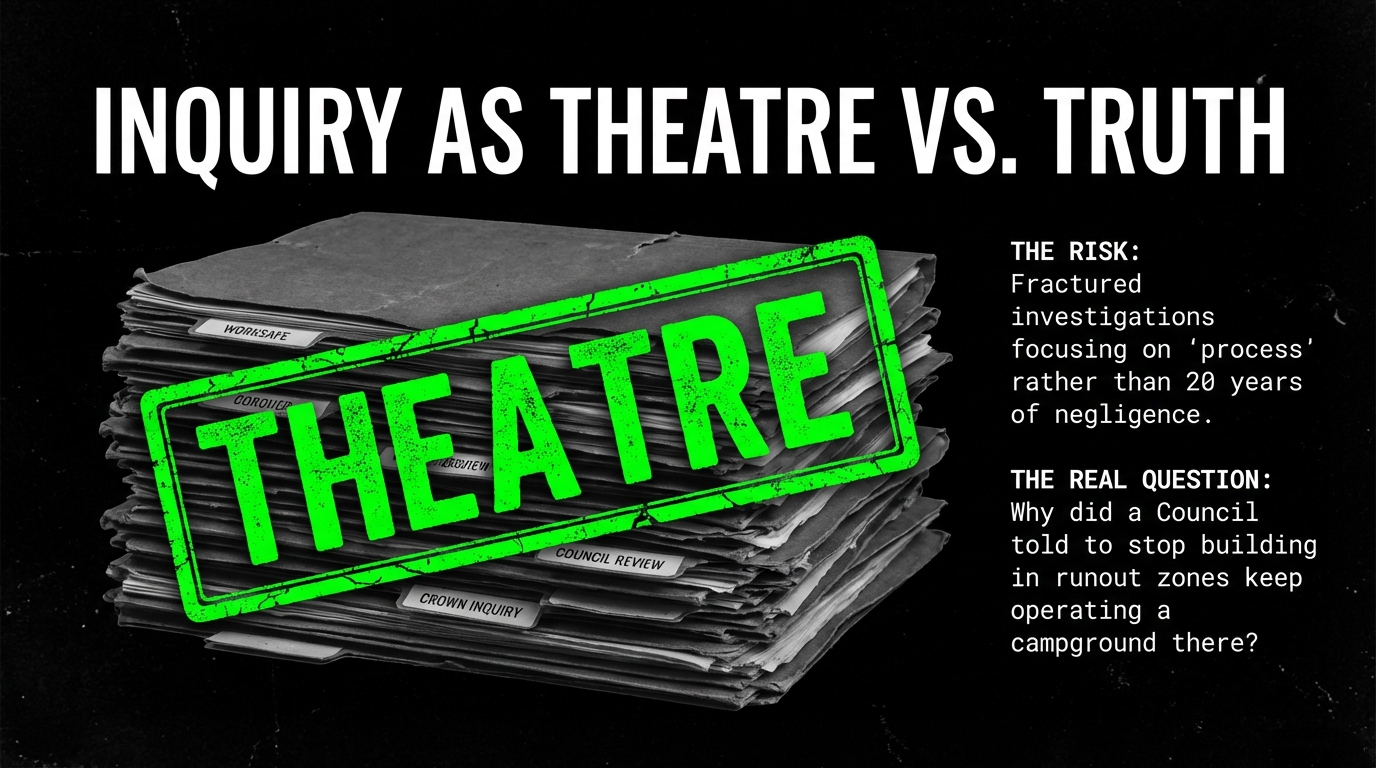
Police have signalled they will support any Coronial inquest, signing an information‑sharing protocol with WorkSafe to minimise duplication, as described by Bay of Plenty Police district commander Tim Anderson and captured by 1News. This stack of investigations—council review, potential Crown inquiry, WorkSafe investigation, Coroner—risks becoming what I call “accountability theatre” if each focuses narrowly on processes and days rather than on the 20‑year arc of ignored geotechnical warnings, commercial priorities, and structural conflicts of interest, a danger implicitly acknowledged in the overlapping‑review concerns noted by 1News and Inside Government.
A real inquiry worthy of the dead would have to ask why a council that was told in 2005 not to allow buildings in runout zones kept operating a campground in exactly such a zone, why 2025 mapping omitted Mauao, and why emergency management design allowed a 111 landslip warning, police concern, and direct staff observation of multiple slips to fail to produce a single evacuation order, questions already signposted by journalists and analysts across RNZ, 1News, Newstalk ZB and Democracy Briefing via elocal.
Act Seven: What Must Actually Change
First, Mauao must be governed by those who see it as a tūpuna, not an amenity. That means strengthening iwi authority and practical control over what is built and operated on and under the maunga, beyond the current co‑governance model, which already recognises iwi ownership but leaves key operational levers—like campground operation and revenue flows—in council hands, as described in co‑governance documentation at oag.parliament.nz and Tauranga City Council.
Second, development and occupation in runout zones must end. Where hazard mapping and geotechnical advice have identified runout zones—as they did in Tauranga in 2005—intensive overnight accommodation and similar uses should be removed or drastically reduced, with any remaining structures heavily engineered and managed under conservative safety protocols, as strongly implied by the original engineers’ recommendations reported by RNZ and reinforced by national landslide risk analysis such as that discussed in The Conversation.
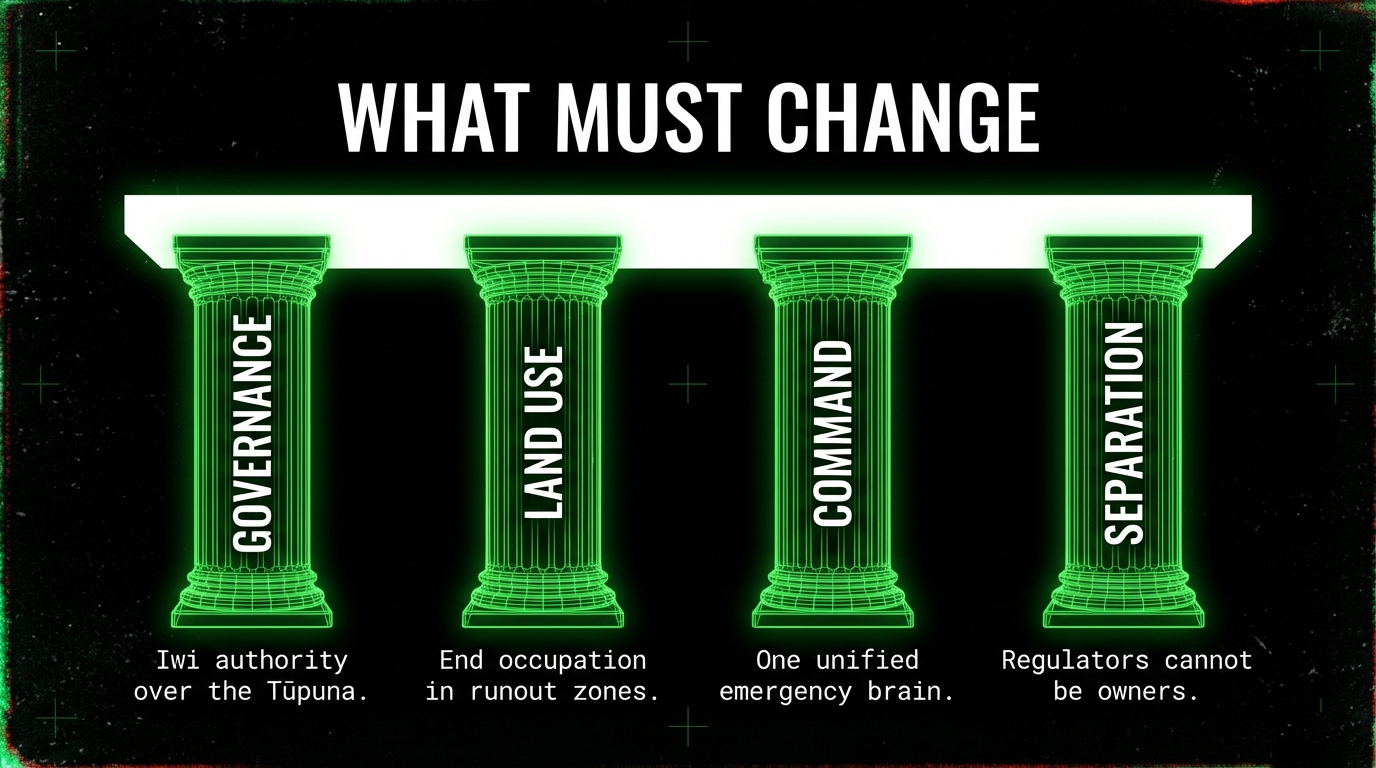
Third, New Zealand needs a unified emergency command structure for multi‑agency hazards, so that a 5.48am 111 call, subsequent police concerns, and direct council staff observations of multiple slips cannot remain isolated fragments; they must feed into a single “common operating picture” with an identified controller who has both information and authority to evacuate, a systemic gap highlighted by the fractured timeline reconstructed by 1News and RNZ.
Fourth, councils must be prevented from being both revenue‑dependent owners and primary safety regulators of the same high‑risk assets. Where such conflicts exist, either ownership or regulatory authority must transfer so that those making evacuation and closure decisions are not also balancing budgets off the back of keeping people in harm’s way, a principle underlined by the Prime Minister’s remarks about inherent conflicts reported by RNZ and mirrored in wider debates over local‑government commercialisation covered by 1News.
None of this will bring back the six people who died under Mauao’s grief‑stricken hillside. But it can determine whether those deaths become just another chapter of “lessons learned” that the system promptly forgets, or the moment when this country finally decides that profit, convenience, and colonial entitlement no longer outrank life, whakapapa, and the mauri of the land, a choice now laid bare in every hard‑won fact reported by RNZ, 1News, The Spinoff, The Conversation and others who have exposed how preventable this catastrophe truly was.
Koha Consideration
Every koha towards this kaupapa is an act of refusal: a refusal to let six deaths be buried under euphemisms, “process reviews”, and council spin. It is a statement that whānau are willing to fund the kind of forensic, citation‑heavy, system‑level accountability that Crown agencies and corporate structures rarely deliver for themselves.
In the wake of the Mauao tragedy—where warnings were ignored, conflicts of interest went unchallenged, and a sacred maunga’s mauri was further wounded—supporting this mahi means sustaining a voice that can keep naming the patterns, tracing the paper trails, and defending tikanga in the face of neoliberal convenience.
If you are able, consider a koha to ensure this voice continues:
To support this mahi directly with a koha (voluntary contribution), visit: Koha — Support The Māori Green Lantern
To receive essays directly and support through subscription, join the Substack community: Subscribe to the Māori Green Lantern on Substack
For direct bank transfer: HTDM, account number 031546-0415173-000
Ivor Jones The Māori Green Lantern Fighting Misinformation And Disinformation From The Far Right