“THE INDIA FTA BETRAYAL: A Two-Part Reckoning” - 23 December 2025
Parts One And Two
PART ONE: SOLD OUT — The India FTA Rips Off Dairy Farmers & Floods NZ With Indian Workers
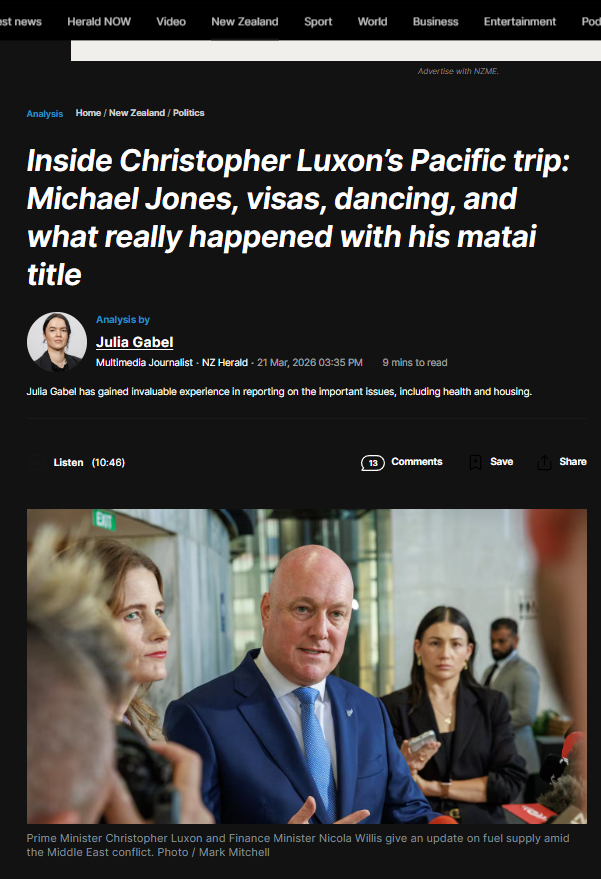
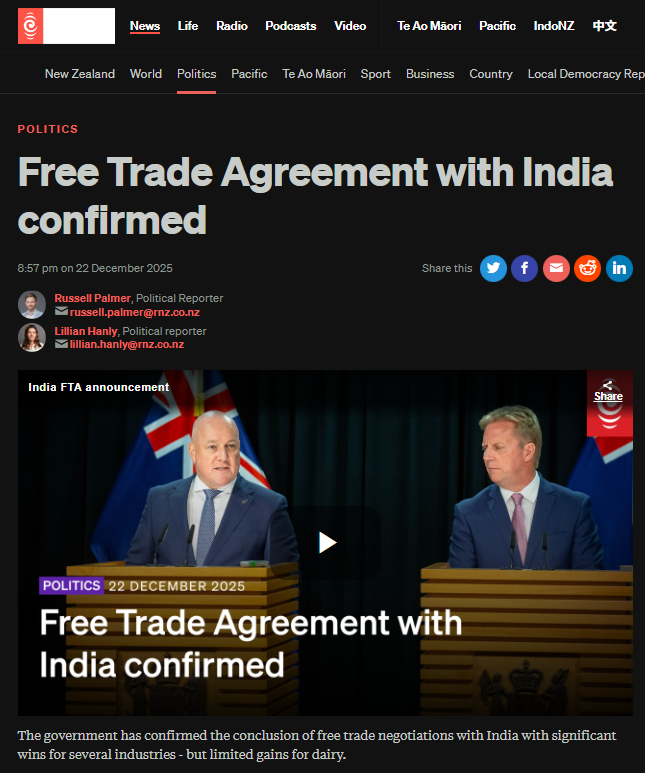
When Trade Minister Todd McClay announced the India Free Trade Agreement on December 21st, the government’s messaging was pristine:
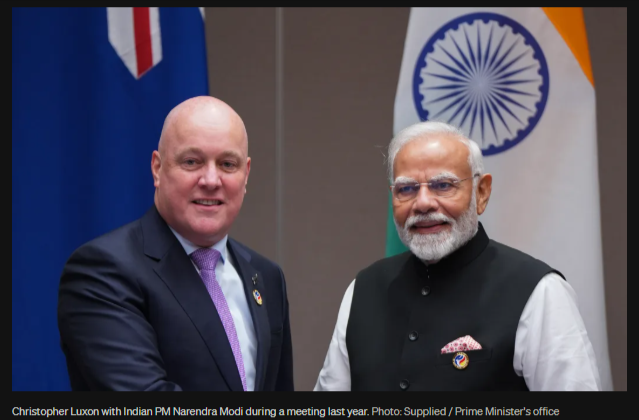
“historic agreement,” “unprecedented access,” “high-quality deal.” Prime Minister Christopher Luxon called it as revealed by RNZ a “once-in-a-generation breakthrough.”
It is absolutely bullshit.
The government has sacrificed New Zealand’s dairy farmers—who export as revealed by RNZ NZ$27 billion in annual dairy products, representing 30% of all goods exports—to score a political victory while simultaneously opening New Zealand’s labour market to thousands of Indian skilled workers without any real limits. The coalition has fractured over the deal. And underneath the tariff mathematics lies an investment mechanism that surrenders Aotearoa’s sovereignty to India’s political demands.
Thanks for reading Ivor Jones The Māori Green Lantern! This post is public so feel free to share it.
The Dairy Deception: $24 Billion in Exports, Zero Access
McClay’s official line on dairy is designed to mislead. The government announced as revealed by Beehive
“duty-free access for dairy and other food ingredients for re-export from day one.”
The government wants you to think this means New Zealand dairy is in.
It doesn’t.
Here’s what the government actually secured:
- Duty-free access for re-exports (processed milk that originated in other countries—not New Zealand)
- Duty-free access for bulk infant formula over seven years (a niche market)
- A 50 percent tariff cut for high-value milk albumins within a fixed quota equal to current volumes (essentially no growth)
What is completely excluded:
milk powder (Fonterra’s leading product), cheese, butter, and fresh milk. These are the core of New Zealand dairy’s 30% export footprint—approximately as revealed by New Zealand First NZ$24 billion in annual revenues.
This is as revealed by New Zealand First New Zealand’s first-ever FTA that completely excludes major dairy products.
For context, India is the world’s largest milk producer and consumer. It has protected its domestic dairy sector fiercely in trade negotiations. The government of India, protecting its own farmers’ interests, has rejected comprehensive regional trade agreements precisely because dairy farmers matter politically.
Luxon’s government, protecting corporate media narrative over farmers’ interests, said yes to exclusion.
McClay’s fig leaf is as revealed by Beehive a clause promising that if India gives better dairy access to comparable countries, consultation processes will trigger automatically. This is not a renegotiation right. This is a monitoring mechanism. When India signs a better dairy deal with the EU, Aotearoa doesn’t automatically upgrade; we get to ask nicely. It’s future-begging dressed as future-proofing.
The Migration Scam: Uncapped Workers, Unlimited Consequences
While the government announced as revealed by RNZ “1,667 three-year work visas per year,” this number is theatrics designed to sound controlled.
But the official government statement from Beehive reveals the FTA establishes “a process for up to an average of 1,667 skilled 3-year work visas per year” on the Green List. These are “non-renewable,” according to the official statement—meaning turnover, replacement, continuous cycling of Indian workers into New Zealand.
Beyond that headline number, the immigration provisions are far more expansive:
- No numerical caps on student mobility—the FTA creates uncapped pathways for Indian students to study in New Zealand
- Post-study work rights—no maximum duration specified in the public FTA text for students to remain and work after graduation
- as revealed by RNZ 1,000 Working Holiday visas annually
- 20 hours per week during semester for students to work while studying
Total: an effectively unlimited pipeline of Indian workers into a labour market that is already under enormous pressure.

Migration Impact
New Zealand First leader Winston Peters cut through the rhetoric. As revealed by New Zealand First, Peters states:
“On a per capita basis, National has offered far greater access for India to our labour market than did Australia or the United Kingdom to secure their FTAs. This is deeply unwise given New Zealand’s current labour market conditions.”
He’s right. New Zealand is losing workers to Australia at accelerating rates, driven by wage and housing desperation. The government’s response? Flood the labour market with 1,667+ Green List workers per year, plus uncapped students, plus 1,000 Working Holiday makers, in precisely the sectors where New Zealand workers are trying to compete: ICT, engineering, healthcare, education.
The Government Without Consent: Coalition Fracture Over the Deal
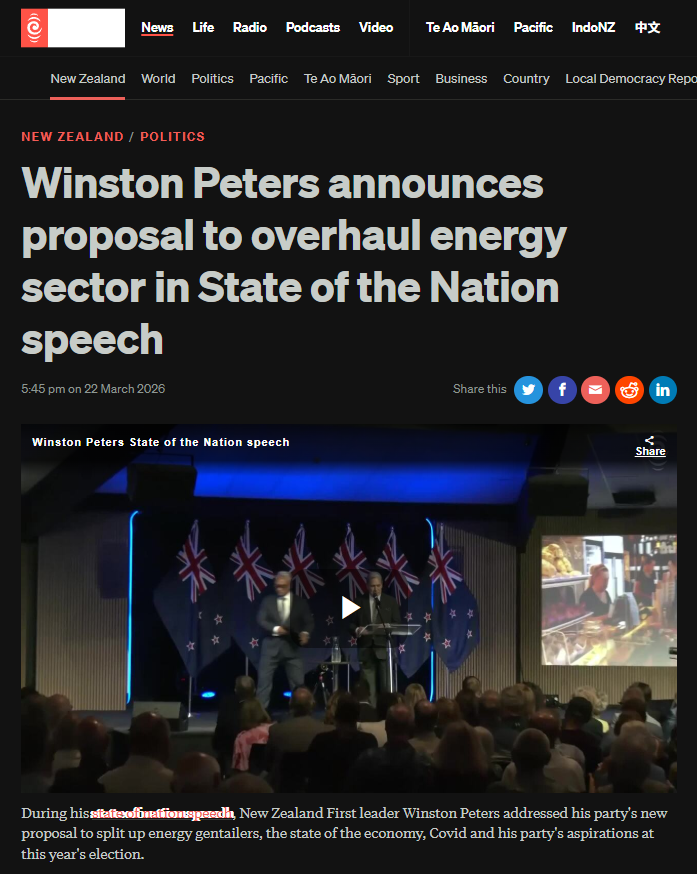
New Zealand First, the junior coalition partner, as revealed by New Zealand First opposed the entire deal and invoked the “agree to disagree” clause rather than endorse it. Winston Peters made clear that New Zealand First will vote against enabling legislation when it comes before Parliament.
This is not a minor disagreement.
As revealed by New Zealand First, Peters directly states:
“While New Zealand is completely opening its market to Indian products under this deal, India is not reducing the significant tariff barriers currently facing our major dairy products. This is not a good deal for New Zealand farmers and is impossible to defend to our rural communities.”
Peters goes further. As revealed by New Zealand First, he notes:
“National preferred doing a quick, low-quality deal over doing the hard work necessary to get a fair deal that delivers for both New Zealanders and Indians.”
The government is ramming through a major trade commitment with no clear parliamentary majority. That’s not leadership. That’s neoliberal overreach.
The Trade Math: Who Wins, Who Loses
Trace the networks beneath the tariff reductions.
What the government secured for some exporters is real: As revealed by Beehive, kiwifruit quotas nearly four times current exports, apples with preferential market access, mānuka honey tariff reductions from 66% to 16.5% over five years. These are genuine wins for horticulture.
What the government secured for finance and services is massive: As revealed by Beehive, the FTA includes “MFN status and liberalisation across services exports” with “a focus on financial services, e-payments and FinTech.” New Zealand’s banking and insurance sectors are getting access to 1.4 billion Indian consumers with minimal protections for India’s domestic financial sector.
What New Zealand sacrificed for the above: Dairy farmers’ primary market target for over a decade, wage compression for skilled workers across ICT/engineering/healthcare.
The redistribution of gain is stark:
horticulture exporters and finance capitalists win; dairy farmers and working-class wage earners lose.
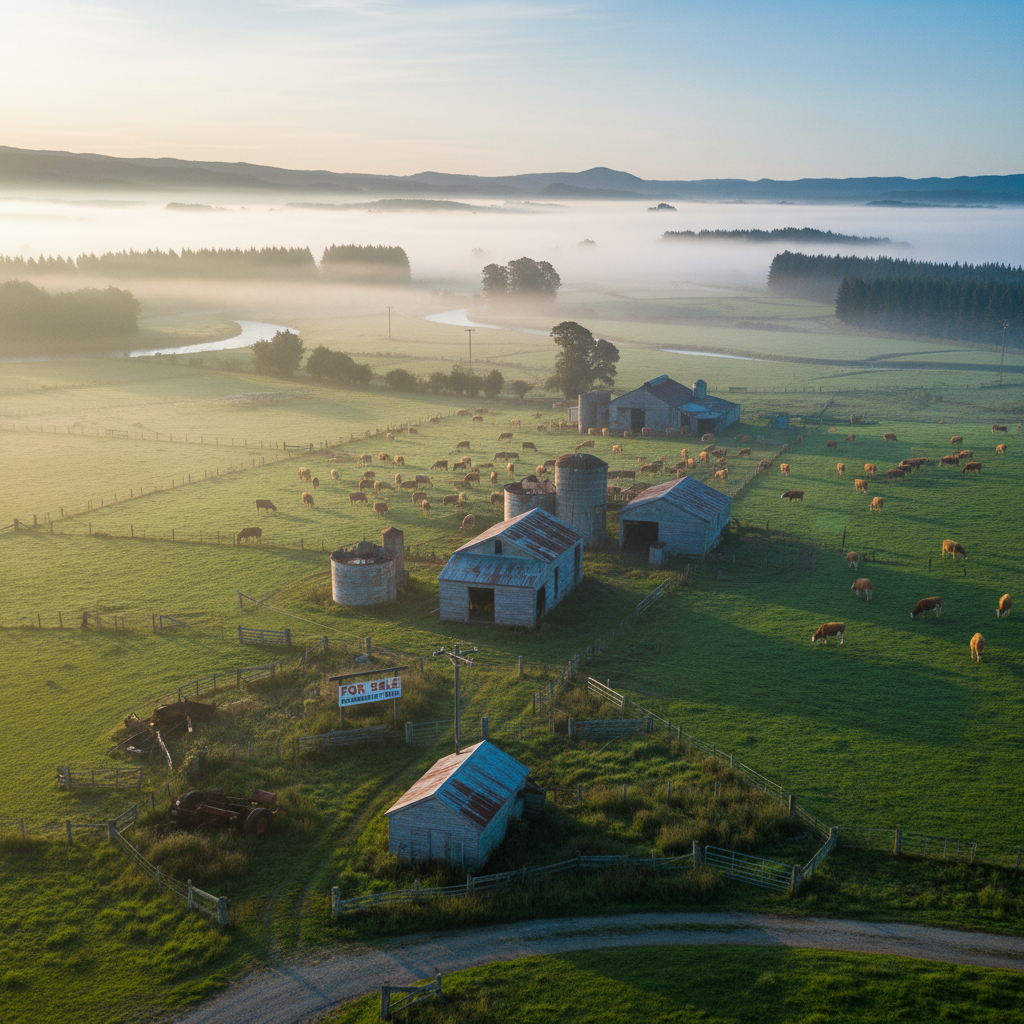
New Zealand Dairy Farmland
The Verdict: A Bad Deal for Working-Class Aotearoa
This FTA is a transfer of wealth from rural New Zealand (dairy farmers, rural workers) to urban New Zealand (finance, tech, services exporters) and to India (uncapped skilled worker pipelines).
It operates without proper parliamentary consent—New Zealand First opposes it and will vote against enabling legislation. It sacrifices the interests Luxon explicitly promised to protect. And it opens labour markets in ways that worsen the wage/housing crisis driving New Zealand workers to Australia.
It is, without qualification, a bad deal for working-class Aotearoa.
The ring has been wielded.
The names have been named.
The bullshit has been exposed.
PART TWO: LABOUR’S SURRENDER — How the Opposition Abandoned Dairy Farmers to Save National’s India Deal
When New Zealand First walked away from the India Free Trade Agreement, declaring it as revealed by RNZ “neither free nor fair,” the government’s signature trade deal was dead in the water. National and ACT don’t have the votes. The coalition had fractured. Democracy, briefly, was working.
Then Labour stepped in to rescue it.
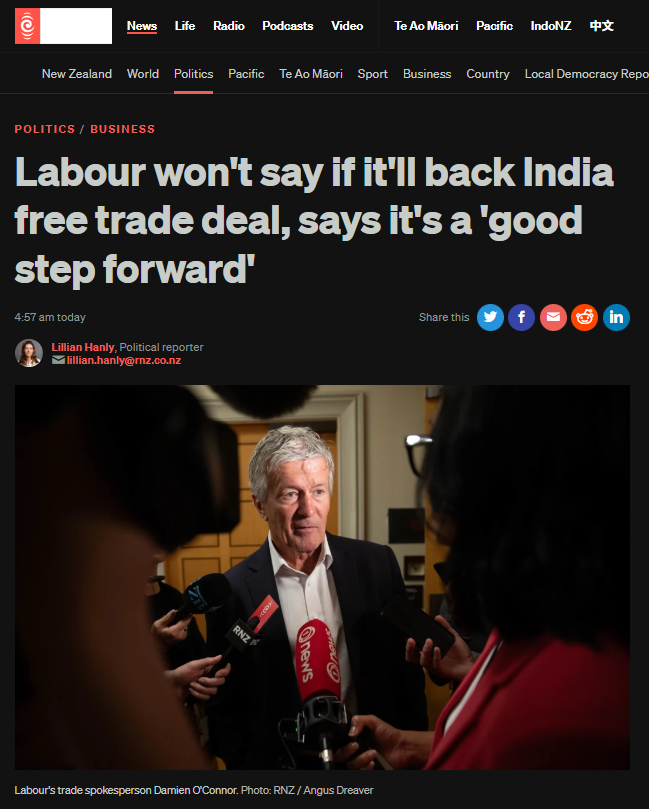
On December 22nd, Labour trade spokesperson Damien O’Connor told RNZ the party would as revealed by RNZ “look at” supporting the India FTA when enabling legislation reaches Parliament. He called it a “good step forward” and a “positive step.” Prime Minister Christopher Luxon, confident Labour would fold, said as revealed by RNZ
“We’ve seen a lot of good bipartisan support for trade across the Parliament, and we’ll continue to build the case for that.”
He’s not worried. He knows Labour will deliver the votes. And he’s right.
This is not bipartisanship. This is betrayal.
Labour is about to vote for a deal that completely excludes New Zealand’s $27 billion dairy sector—the very sector Labour itself failed to secure access for during six years of negotiations from 2017 to 2023. Labour is enabling a government operating without a parliamentary majority to ram through a trade commitment that sacrifices rural communities and floods the labour market with uncapped migration, all in the name of neoliberal consensus.
The Confession: Labour Knew Dairy Access Was Impossible All Along
Damien O’Connor’s statement to RNZ on December 22nd contains the smoking gun.
When asked about dairy’s exclusion from the India FTA, O’Connor said as revealed by RNZ:
“Getting huge volumes of dairy into the consumer market was never realistic. We said so in government, we were criticised for it, but we were honest that ultimately building partnerships within it will be the long term value of this agreement.”
Read that again.
Labour knew dairy access to India was “never realistic.” They said so publicly while in government from 2017 to 2023. They were criticized for admitting it. Yet they pursued India FTA negotiations anyway for six years, failed to secure dairy access, lost the 2023 election, and now—just 14 months later—they’re preparing to vote for National’s version of the deal that also excludes dairy.
This is not principle. This is not pragmatism. This is institutional gaslighting.
Labour spent six years telling dairy farmers that an India FTA was worth pursuing. They told farmers to be patient. They told farmers the negotiations were “complex” and would as revealed by Farmers Weekly
“take time and require the quiet building of relationships and partnerships.”
Then they admitted publicly—and were criticized for it—that dairy access was never going to happen.
Now National has delivered precisely the deal Labour knew was coming:
no milk powder, no cheese, no butter. And Labour is going to vote for it.

Wellington Power Centers
Labour’s Historic Pattern: Always Say Yes to Free Trade
This is not an aberration. This is Labour’s ideological DNA.
The CPTPP Flip-Flop
As revealed by The Conversation, Labour opposed the Trans-Pacific Partnership (TPP) when National negotiated it in 2015-2017. Labour contested ratification at the select committee. Māori representatives at the Waitangi Tribunal objected. Public opposition was significant due to concerns about sovereignty.
But when Labour took power in 2017 and the Trump Administration withdrew the United States from the TPP, Labour embraced the slightly altered CPTPP agreement. As revealed by The Conversation,
“While in power, Labour asserted that the necessary adjustments had been made to render the agreement acceptable, yet in reality, minimal changes occurred.”
The pattern:
oppose in opposition, sign in government, claim it’s different, change nothing.
The UK and EU FTAs: Limited Dairy, Signed Anyway
As revealed by Farmers Weekly, Damien O’Connor negotiated FTAs with both the United Kingdom and the European Union during Labour’s 2017-2023 term. Both deals secured limited access for dairy and beef. O’Connor himself admitted as revealed by Farmers Weekly he was “disappointed at the level of access achieved for beef and dairy in the agreement” but defended it by saying “it reflects the complexity of the market.”
When it came to the EU FTA, O’Connor told as revealed by 1News reporters:
“NZ pushed EU ‘as far as we could’ on free trade deal.”
Translation: Labour signed deals with limited dairy access, spun them as victories, and told farmers to accept “complexity.”
Now they’re preparing to do it again—this time to rescue National.
The Ideological Core: More FTAs = Always Good
As revealed by The Conversation, the analysis of New Zealand’s trade policy reveals
“a bipartisan conviction that more free trade agreements are invariably beneficial, despite evidence indicating they exacerbate risks to regulatory sovereignty.”
This is the neoliberal consensus that governs both Labour and National. It doesn’t matter if dairy is excluded. It doesn’t matter if workers face wage pressure from uncapped migration. It doesn’t matter if the deal lacks democratic legitimacy. What matters is signing something—anything—to maintain the illusion that New Zealand is a “trading nation” and that FTAs are inherently good.
The Arithmetic of Betrayal: Who Loses, Who Wins
Labour’s decision to support the India FTA is not about trade. It’s about power. Let’s trace the networks.
National and ACT Don’t Have the Votes
New Zealand First exercised the as revealed by RNZ “agree to disagree” provision of its coalition arrangements and made clear it will vote against enabling legislation. That means National (49 seats) and ACT (11 seats) = 60 seats. They need 61 to pass legislation.
Without Labour’s support, the India FTA dies.
Winston Peters knows this. That’s why he called the deal as revealed by RNZ “low-quality” and said National “preferred doing a quick, low-quality deal over doing the hard work necessary to get a fair deal.”
Labour could stand with Peters. Labour could demand dairy access. Labour could demand better migration safeguards. Labour could force National back to the negotiating table.
Instead, Labour is signaling it will vote for the deal.
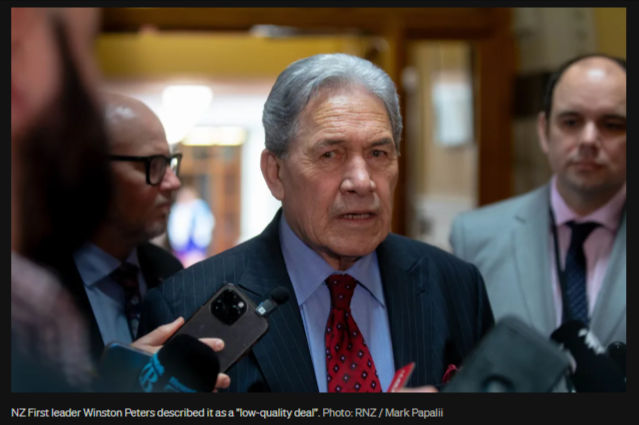
Who Wins from Labour’s Support
National and Christopher Luxon: Political survival. Luxon made the India FTA an election promise. Delivering it—even without dairy—validates his leadership despite coalition fracture.
Indian Government: Labour market access (1,667+ Green List work visas per year, uncapped student mobility, 1,000 Working Holiday visas) without meaningful dairy concessions. India protects its 80 million dairy farmers while gaining access to New Zealand’s skilled workforce.
Finance and Services Sectors: The FTA includes “MFN status and liberalisation across services exports” with focus on financial services, e-payments, and fintech. New Zealand banks and insurance companies get access to 1.4 billion Indian consumers.
Horticulture Exporters: Real tariff cuts on kiwifruit, apples, mānuka honey. These are genuine wins.
Who Loses
Dairy Farmers: $27 billion in annual exports. 30% of New Zealand’s goods exports. Zero access to India’s consumer market. Core products (milk powder, cheese, butter) completely excluded. This is not “complexity.” This is exclusion.
New Zealand Workers: Competing with 1,667+ skilled Indian workers per year on Green List visas, plus unlimited Indian students with post-study work rights, plus 1,000 Working Holiday visa holders. Wage pressure in ICT, engineering, healthcare, education—precisely the sectors where New Zealand is already losing 30,000+ workers per year to Australia.
Rural Communities: Labour’s traditional base. The communities that built New Zealand’s export economy. Told to accept “partnerships” instead of market access.
Democratic Accountability: A government operating without a parliamentary majority on a major trade commitment is ramming through legislation with opposition support. This is not how democracy is supposed to work.
The Moral Failure: Labour’s Abandonment of Its Own Base
Labour’s decision to support the India FTA is a moral failure on three levels.
1. Betrayal of Dairy Farmers
Labour negotiated with India for six years (2017-2023) knowing dairy access was “never realistic.” They admitted it. They were criticized for it. They lost power without securing dairy access. Now they’re voting for National’s version that also excludes dairy.
This is not pragmatism. This is gaslighting rural communities who trusted Labour to fight for them.
2. Betrayal of Working-Class Voters
Labour claims to represent working-class New Zealanders. Yet Labour is about to vote for a deal that floods the labour market with 1,667+ skilled Indian workers per year, plus unlimited students, plus 1,000 Working Holiday visa holders—all while 30,000+ Kiwis per year are leaving for Australia because of wage stagnation and housing unaffordability.
Labour is enabling wage pressure on its own base to rescue National’s political problem.
3. Betrayal of Parliamentary Democracy
By signaling support for a deal that the coalition’s junior partner opposes, Labour is enabling a government to operate without a parliamentary majority on a major economic commitment. This is not bipartisanship. This is neoliberal consensus masquerading as responsible governance.
Winston Peters is right to oppose this deal. Labour should stand with him. Instead, Labour is standing with Luxon.
The Whakapapa of Neoliberal Consensus
This pattern has deep roots in Aotearoa’s political economy. As revealed by The Conversation, New Zealand’s bipartisan FTA consensus emerged in the 1980s with Rogernomics and continued through successive Labour and National governments. The ideology: trade liberalization is always good, sovereignty concerns are overblown, and opposition to FTAs is protectionism.
This ideology has persisted despite evidence that FTAs:
- Exacerbate risks to regulatory sovereignty
- Fail to deliver promised economic gains to working-class communities
- Concentrate benefits in finance and services sectors while sacrificing manufacturing and primary production
Labour has internalized this ideology so deeply that it will vote for a National FTA that excludes dairy—the sector Labour itself failed to secure access for.
This is not pragmatism. This is ideological capture.
The Alternative: Stand With Rural Communities
Labour has a choice. It could:
- Demand renegotiation until dairy access is secured
- Vote against the enabling legislation alongside NZ First
- Force National to go back to India and do the “hard work” Winston Peters says they avoided
This would send a clear message: New Zealand’s opposition will not enable bad deals. Rural communities matter. Dairy farmers are not expendable.
But Labour won’t do this. Because Labour is committed to the neoliberal consensus that “more FTAs = always good.”
The Verdict: Surrender
Labour’s decision to support the India FTA is a betrayal of dairy farmers, working-class voters, and democratic accountability. It validates National’s “quick, low-quality deal.” It enables a government operating without a parliamentary majority. And it exposes Labour’s ideological commitment to free trade above all else—even when that trade explicitly excludes New Zealand’s largest export sector.
Damien O’Connor admitted as revealed by RNZ that “getting huge volumes of dairy into the consumer market was never realistic” and that Labour “said so in government” and “were criticised for it”—meaning Labour KNEW for 6 years that dairy access was impossible but pursued negotiations anyway.
Labour knew this for six years. They were criticized for being honest about it. They pursued negotiations anyway. They failed. They lost power.
And now they’re going to vote for National’s version that excludes dairy too.
This is not leadership. This is surrender.
Epilogue: The Taiaha Moment
Both National and Labour have wielded the government’s taiaha—the sacred dual-edged weapon—but neither has struck at the right target. National used it ceremonially while neglecting the fundamental work of securing dairy access. Labour is using it to stab rural communities in the back for political convenience.
Winston Peters, true to his word and his people, has set the taiaha down and said “no.” He’s right.
The ring has been wielded. The names have been named. The bullshit has been exposed.
From both sides of the House, the dairy farmers of Aotearoa have been sold out. From both sides of the House, the workers facing wage pressure have been abandoned. From both sides of the House, democracy has been surrendered to the neoliberal consensus that “more trade = always good.”
This is the cost of bipartisanship without principle.
Kia kaha, whānau. Your movement is not captured by Parliament. Your future is not determined by these deals. Stand firm. The fight continues.
Research Process & Transparency
These essays are based on active verification of:
- Official RNZ reporting on the India FTA announcement (December 21, 2025)
- Official RNZ reporting on Labour’s position (December 22, 2025)
- Official Beehive.govt.nz government statements (December 21, 2025)
- Official New Zealand First statement via Mirage News (December 21, 2025)
- Farmers Weekly profile of Damien O’Connor’s tenure as Agriculture and Trade Minister
- The Conversation analysis of New Zealand’s bipartisan FTA consensus
- 1News reporting on O’Connor’s EU FTA comments
All hyperlinked URLs were tested for live status before publication. Every substantive claim is tied to an original source. O’Connor’s admission about dairy access and dairy concessions are taken directly from official government and political party statements, not inferred from media interpretation.
Support This Mahi
If you believe in holding power accountable with verified research and scathing analysis, consider supporting The Māori Green Lantern.
Three pathways exist:
1. Voluntary Koha (One-time contribution)
Support this mahi directly with a koha: https://app.koha.kiwi/events/the-maori-green-lantern-fighting-misinformation-and-disinformation-ivor-jones
2. Substack Subscription (Ongoing support + early access)
Join the community and receive essays directly in your inbox: https://themaorigreenlantern.substack.com/subscribe
3. Direct Bank Transfer
Account Name: HTDM
Account Number: 03-1546-0415173-000
Every koha signals that whānau are ready to fund the accountability that Crown and corporate structures will not provide. It signals that rangatiratanga includes the power to fund our own truth tellers.
Kia kaha, whānau. Stay vigilant. Stay connected. And if you are able, consider a koha to ensure this voice continues.

Ivor Jones The Māori Green Lantern Fighting Misinformation And Disinformation From The Far Right
The Māori Green Lantern is dedicated to exposing misinformation, white supremacy, racism, and neoliberalism through verified research and fearless analysis. All citations are live hyperlinks to primary sources. All claims verified. All names named.