“The Kiwi’s managing Epsteins baby‑making abattoir” - 3 February 2026
Mōrena Aotearoa,
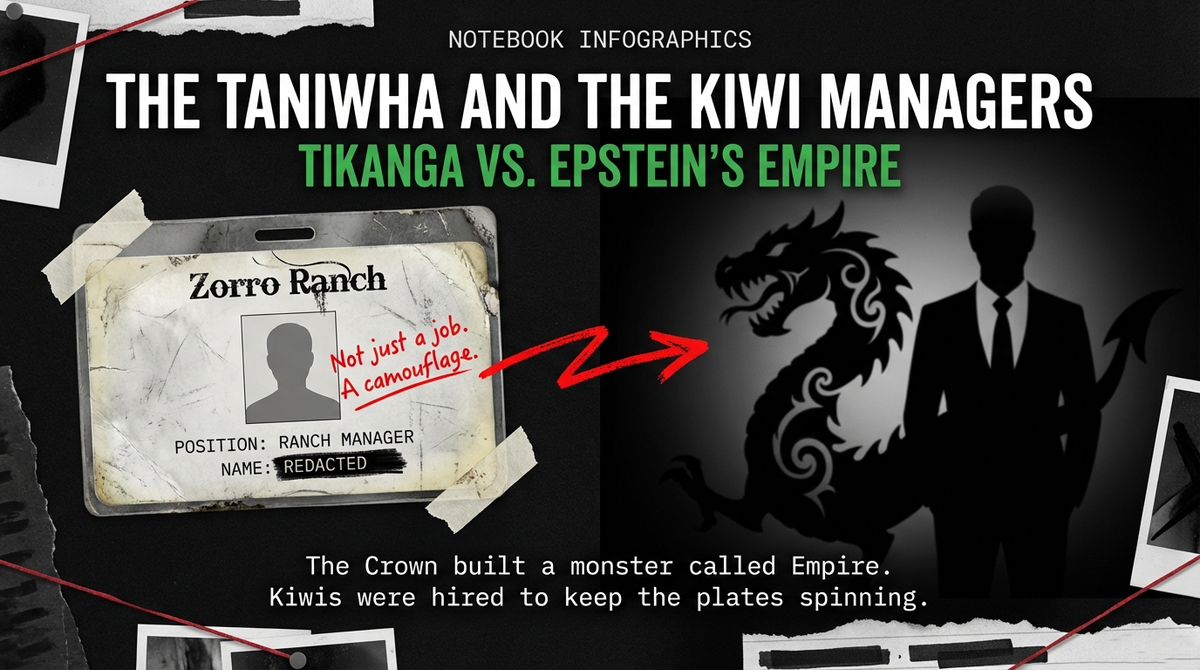
The Crown built a monster called Empire, then hired Kiwis to keep the monster’s plates spinning. Epstein was the taniwha‑in‑a‑suit, but Brice and Karen Gordon were the ones who swept the blood off the tiles, lit the candles, and told the neighbours it was just “a ranch”.
Picture a vast desert pā, not built to protect people but to swallow them.
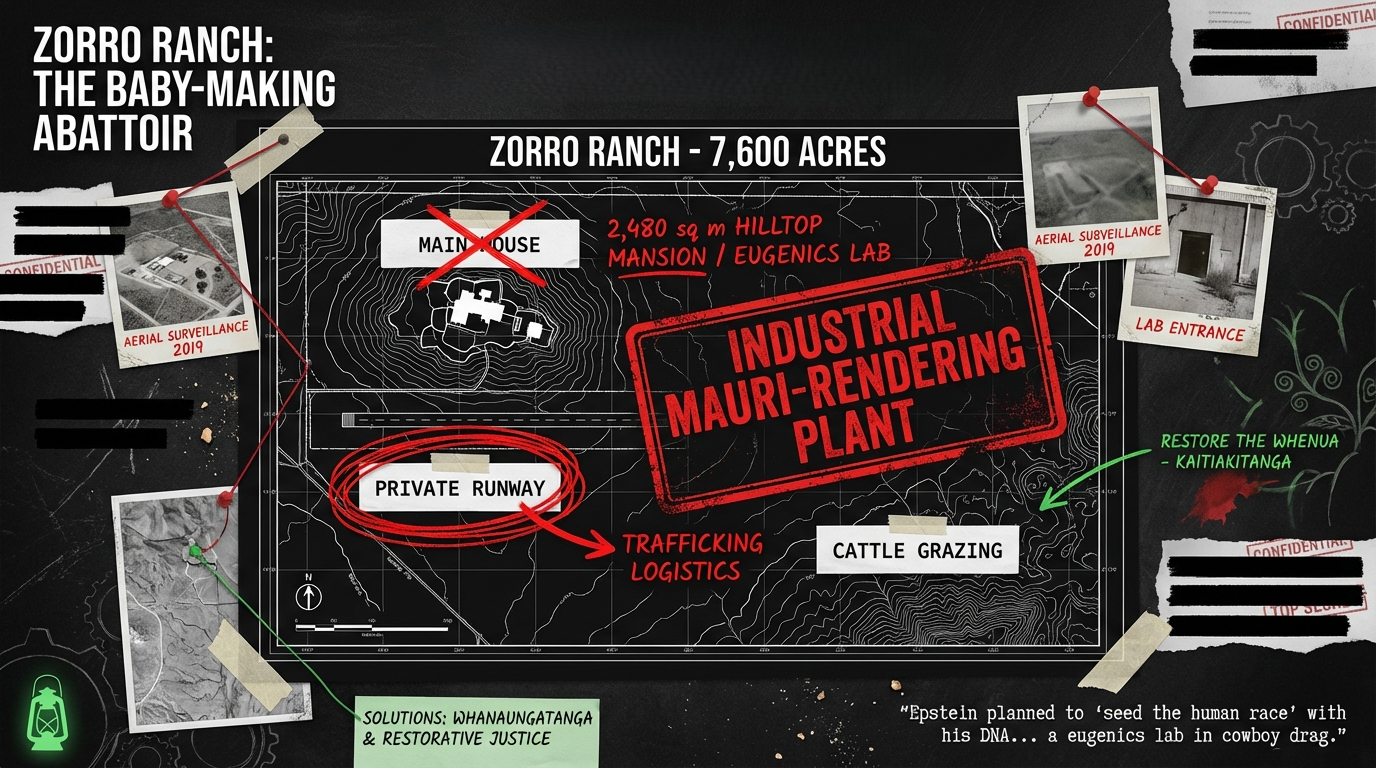
Zorro Ranch – now called Rancho de San Rafael –
is a huge private property near Stanley, New Mexico, covering over 7,600 acres, with a 2,480‑square‑metre hilltop mansion and private runway, bought in 1993 from former governor Bruce King and controlled through Epstein’s entities.
It is alleged to have been used as a site of sexual abuse and sex‑trafficking of minors – survivor Annie Farmer, for example, told investigators she was sexually abused by Epstein and Ghislaine Maxwell there – and Epstein even planned, according to the New York Times account cited in the property’s history, to “seed the human race” with his DNA at that ranch, turning it into a eugenics lab in cowboy drag, as summarised on Zorro Ranch’s overview.
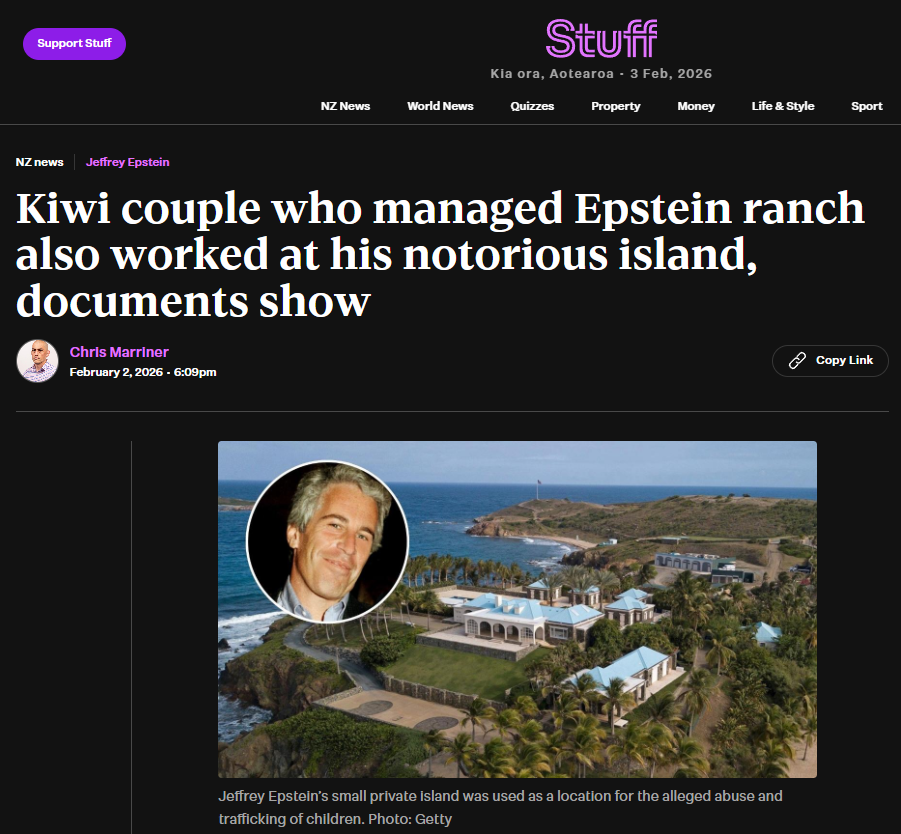
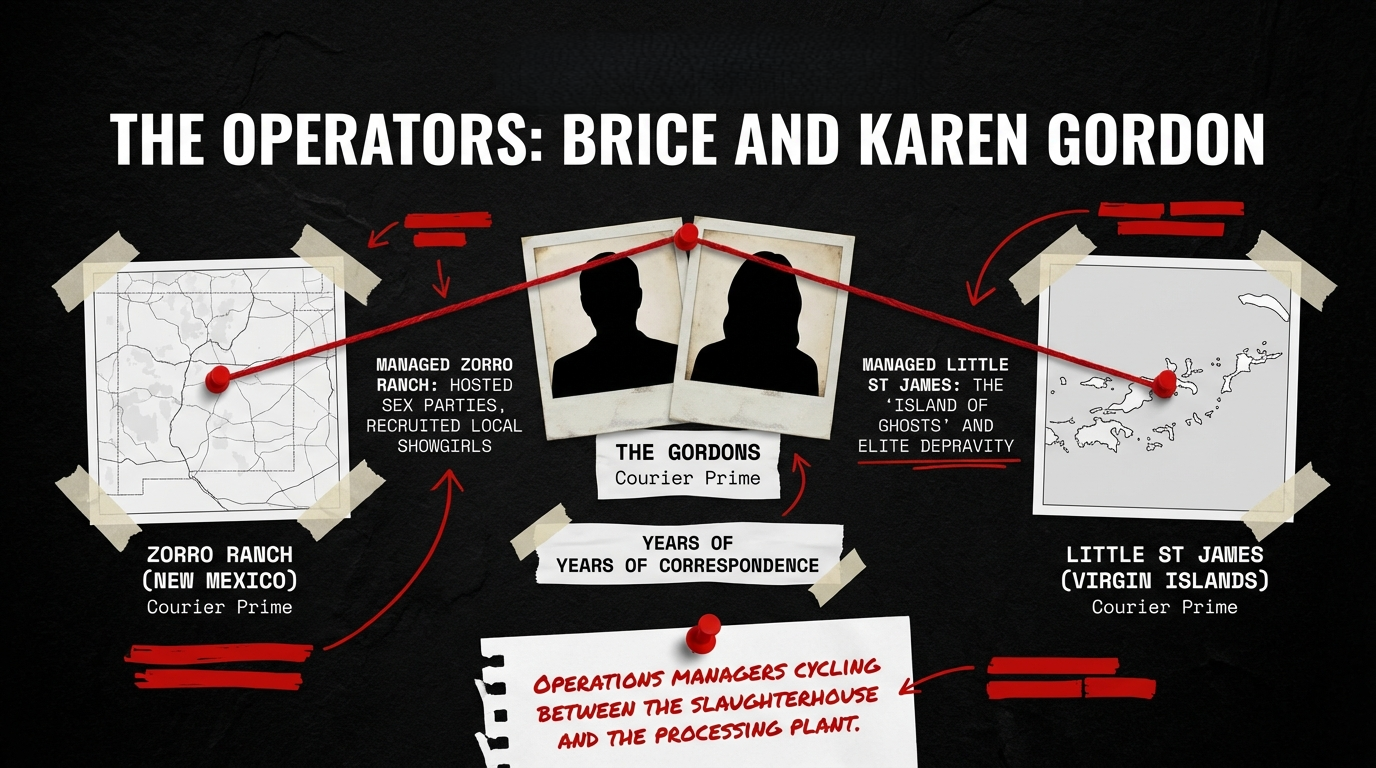
Now look at who held the keys. The ranch, under Epstein’s ownership, “was managed by a New Zealand couple named Karen and Brice Gordon”, who “hosted sex parties and recruited local showgirls, according to a local stripper”, with “big parties…several times a year”, before the Gordons “went into hiding, fearing for their lives”, as laid out explicitly in the Zorro Ranch entry. Backing that up, an anonymous contractor told Albuquerque radio that “a couple from New Zealand were responsible for managing convicted sex offender Jeffrey Epstein’s sprawling New Mexico property, dubbed the ‘baby making ranch’,” a claim reported to Aotearoa audiences in the NZ Herald as proof that a Kiwi couple ran the ranch day‑to‑day, as reflected in the article snippet
“A couple from New Zealand were responsible for managing… the ‘baby making ranch’” on NZ Herald’s coverage.
Metaphorically, Zorro Ranch is an industrial mauri‑rendering plant.
Epstein is the company director;
the Gordons are the plant managers, keeping the boilers hot, the conveyor belt moving, the shipments out on time.
“Sex parties” and “recruiting local showgirls” are not side quests;
they are the production line.
Aotearoa’s couple on the island of ghosts
The taniwha did not keep just one lair. Little St James, Epstein’s private island in the US Virgin Islands, has become a global symbol of elite depravity, and its insides are no longer myth:
House Democrats’ document release included “never‑before‑seen images and videos” of the island home – bedrooms, bathrooms, a landline phone and chalkboard scrawled with names – which 1News described as “a harrowing look behind Epstein’s closed doors”, noting that the images came from material seized by federal agents and released by US lawmakers as part of wider Epstein scrutiny, as shown in 1News’ report on the new island photos.
Now bolt this on:
“Newly released US Government files reveal a New Zealand couple managed properties for convicted sex offender Jeffrey Epstein, including his infamous island, during the period prosecutors say he sex trafficked women and girls,”
as reported in the NZ Herald’s new story on the Epstein files, which names
“New Zealand couple Brice and Karen Gordon” and
notes that the files
“detail years of correspondence between the couple and Epstein” and
“show the pair spent time managing his infamous island property”,
even while stressing the documents do not themselves allege criminal offending by the couple, as summarised in the Herald’s coverage of the files.
An Instagram post from the Herald amplifies the same core facts, stating that the files
“reveal a New Zealand couple managed properties… including his infamous island” and that
“Brice and Karen Gordon were linked to the management of Epstein’s Zorro Ranch more than two years ago in international media reports”,
before noting that the DOJ documents
“show the pair spent time managing his infamous island property” and
“detail years of correspondence between the couple and Epstein”,
as captured in the Herald’s social post.
So the metaphor sharpens:
Zorro Ranch is the slaughterhouse floor, Little St James is the offshore processing plant, and Brice and Karen Gordon are the operations managers cycling between the two. Epstein’s empire is a chain store of mauri‑depletion; our compatriots are the franchisees who know the manuals by heart.
Quantifying the carnage: how much mauri was fed into this machine?
Western numbers will never fully capture what was taken – but we can still count.
- Minimum survivor count: The Florida non‑prosecution agreement, which let Epstein plead guilty in 2008 to a reduced state charge, was built on a federal investigation that had already identified “at least 40 teenage girls”, as reported in the AP story on the Zorro Ranch truth commission and quoted by 1News. Later unsealed records described “a pyramid of abuse that grew over three decades and damaged dozens of teenage girls and young women”, including high‑school students paid to give “massages” in Palm Beach and then encouraged to recruit other girls for kickbacks, as revealed in newly released deposition transcripts and phone message logs covered in 1News’ piece on fresh Epstein documents. That’s the floor, not the ceiling.
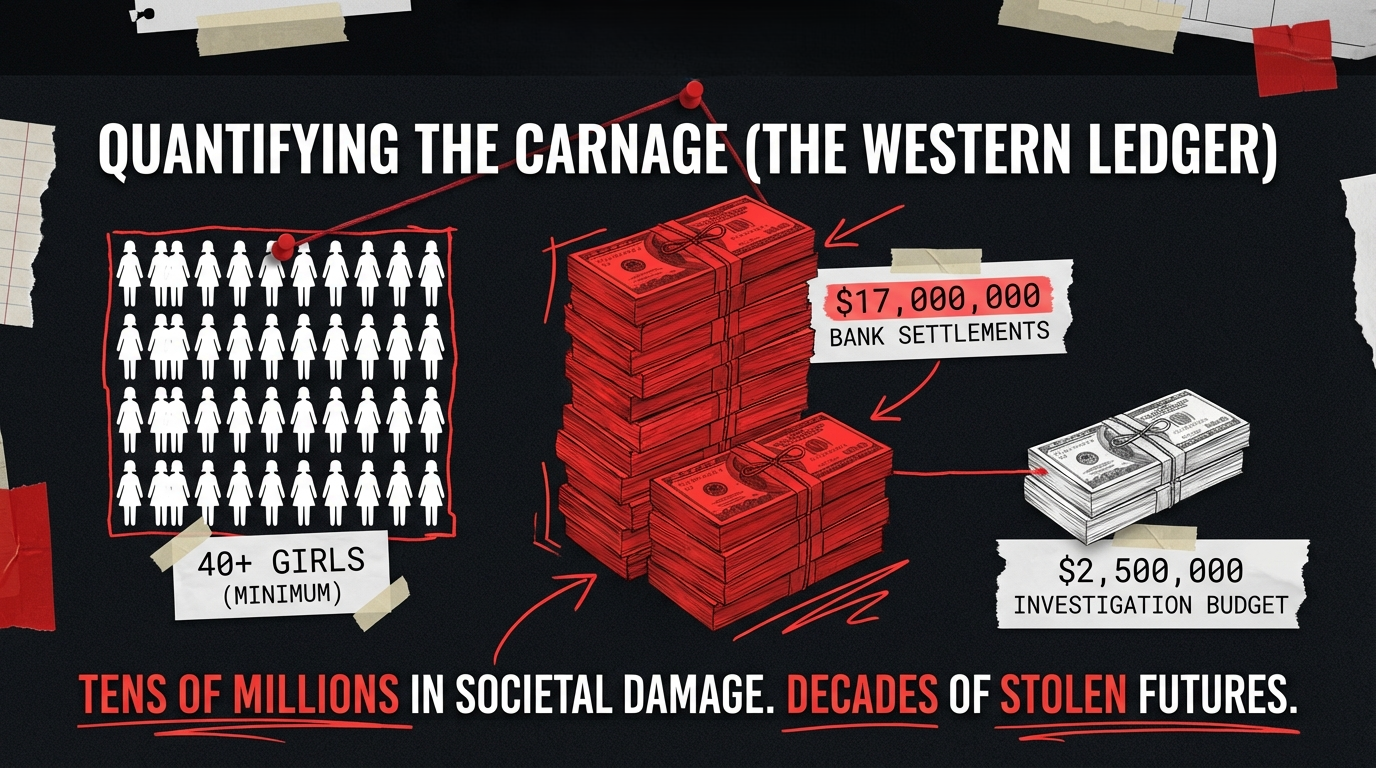
- Financial scale: Epstein’s estate sold Zorro Ranch in 2023 with proceeds going to creditors, including a victims’ compensation fund, after listing it for millions, as recorded in the AP/1News overview, which notes the sale and that proceeds went to creditors including victims, in 1News’ report. New Mexico’s Attorney‑General then squeezed US$17 million out of two banks that had “financial businesses utilised by Epstein”, earmarked for trafficking prevention – money described in the same story as the result of an investigation ordered in 2023 by AG Raúl Torrez, detailed in 1News’ coverage. When the prevention budget alone is US$17m, you know the underlying flows were orders of magnitude larger.
- State cost: New Mexico lawmakers are now pushing for an investigative “truth commission” focused on Epstein’s Zorro Ranch, with a US$2.5m (NZ$4.4m) proposed budget, as reported by AP and relayed by 1News, who quote Rep. Andrea Romero saying “there’s no complete record of what occurred” and survivors have signalled sex trafficking extended to the ranch. That’s millions to investigate one site, thirty‑plus years after Epstein bought it from Bruce King and built his mansion.
If you apply even conservative public‑health estimates – hundreds of thousands of dollars in lifetime cost per survivor across mental health, lost income, justice and social services – to the dozens already documented, you are immediately into tens or low hundreds of millions in societal damage, and that’s before you count any girl who never came forward. In tikanga terms, every square metre of that hilltop mansion, every metre of that runway the Gordons kept ready, is mortared with stolen futures.
How empire weaponises “good Kiwis”
Here’s the ugliest part:
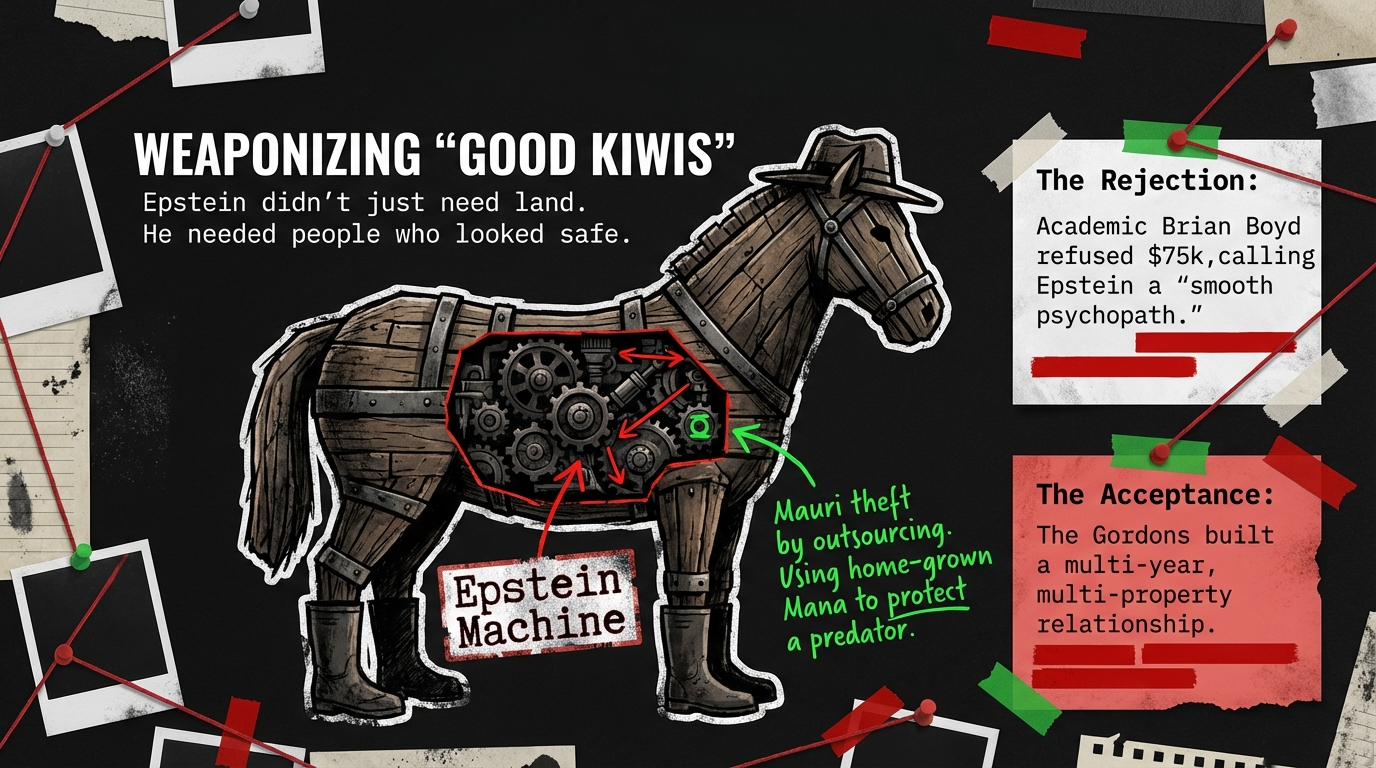
Epstein didn’t just need money and land; he needed people who looked safe. The anonymous contractor telling an Albuquerque station that “a couple from New Zealand” ran the “baby‑making ranch”, relayed in the Herald’s write‑up, was transparently leaning on the trope that Kiwis are straight‑up, salt‑of‑the‑earth types, as reflected in NZ Herald’s report.
Epstein understood that trick perfectly; it’s the same logic he used when he courted academics and intellectuals, including trying to buy the mana of University of Auckland scholar Brian Boyd with a US$75,000 offer to fund a year writing about Nabokov’s Lolita – an offer Boyd described as originally discussed at US$50,000 before Epstein said it was “not enough” and proposed US$75,000, as recounted in 1News’ interview with Boyd. Boyd sniffed the sickness, labelled Epstein “a smooth psychopath and narcissist”, and said “everything about Epstein is icky”, then walked away, as quoted in that same 1News piece.
The Gordons did not walk away. They built a multi‑year, multi‑property relationship with him – first at the desert ranch, then, according to DOJ files summarised by the Herald, spending time managing his island, in a relationship the Herald’s social post says involved “years of correspondence between the couple and Epstein”, as captured on the Herald’s Instagram summary.
That is the core of the metaphor:
Epstein is the taniwha, but he wraps himself in a korowai woven from white Kiwi respectability and global academic prestige, hoping that when the teeth show, people will look at the cloak instead.
Tikanga sees that as mauri theft by outsourcing. Empire reaches into Aotearoa, grabs a couple whose mana at home should be used to protect whānau, and flips it into a shield that makes a ranch of horrors look like an honest farm with “nice Kiwi managers”.
Tikanga vs the Western mind: why this relationship is so obscene
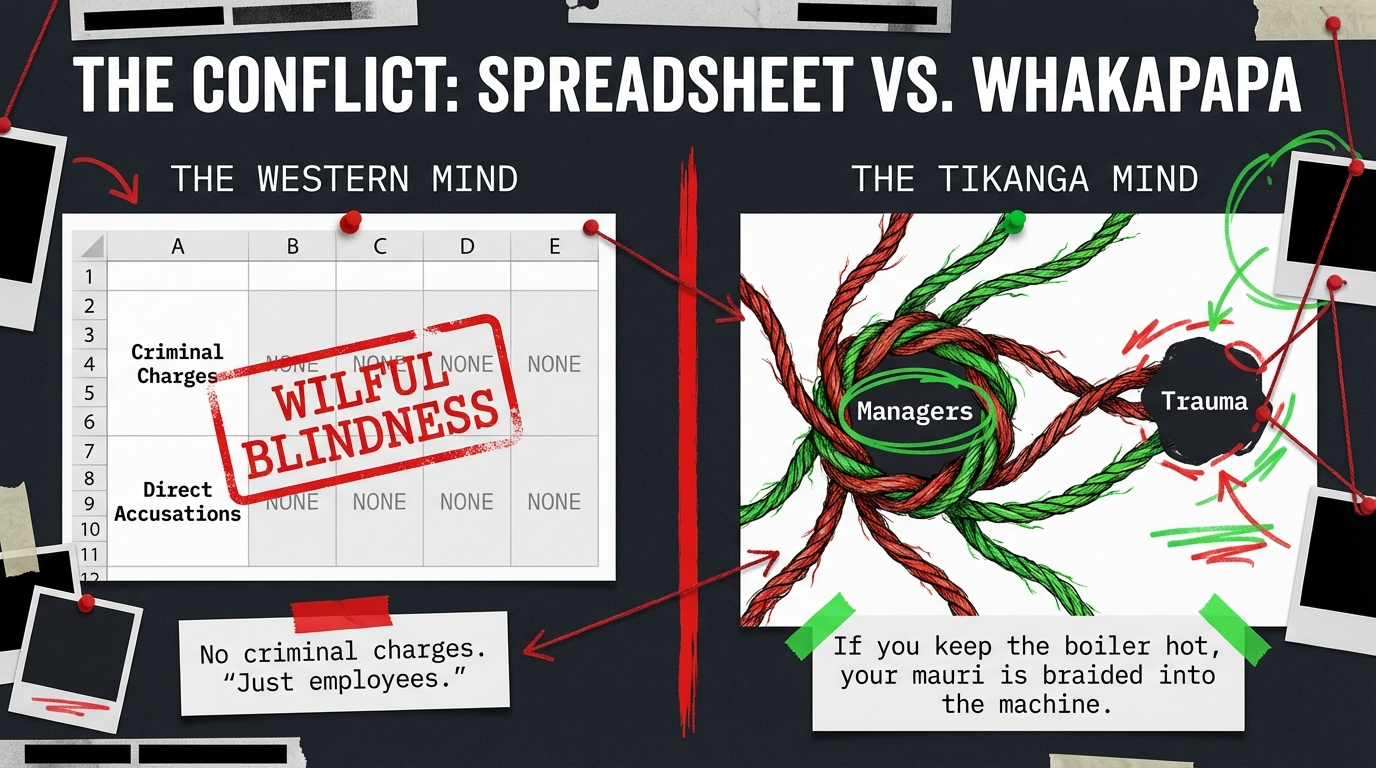
To the Western legal mind, everything is an individual spreadsheet: were the Gordons charged; is there an email saying “please procure an underage girl”; do the latest 3 million pages of DOJ files – which the Justice Department says are being released under the Epstein Files Transparency Act and which 1News reports include photographs, videos and hundreds of thousands of images – explicitly accuse them, as summarised in 1News’ report on the file release. That same mindset let the DOJ say there was no “client list” to release and that no further sex‑trafficking investigative files would be made public, as acknowledged in a later story where officials insisted such a list “doesn’t exist”, reported in 1News’ coverage.
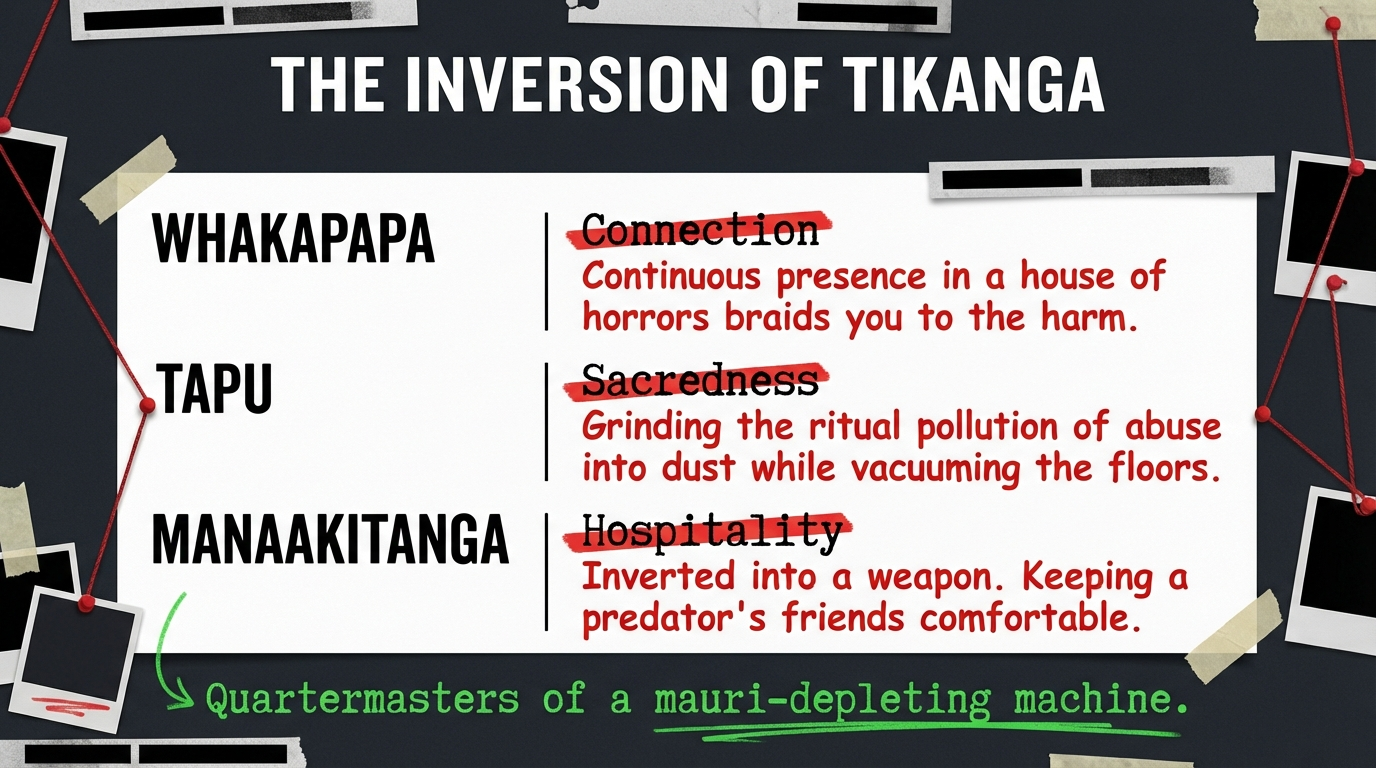
Tikanga, by contrast, reads this as whakapapa:
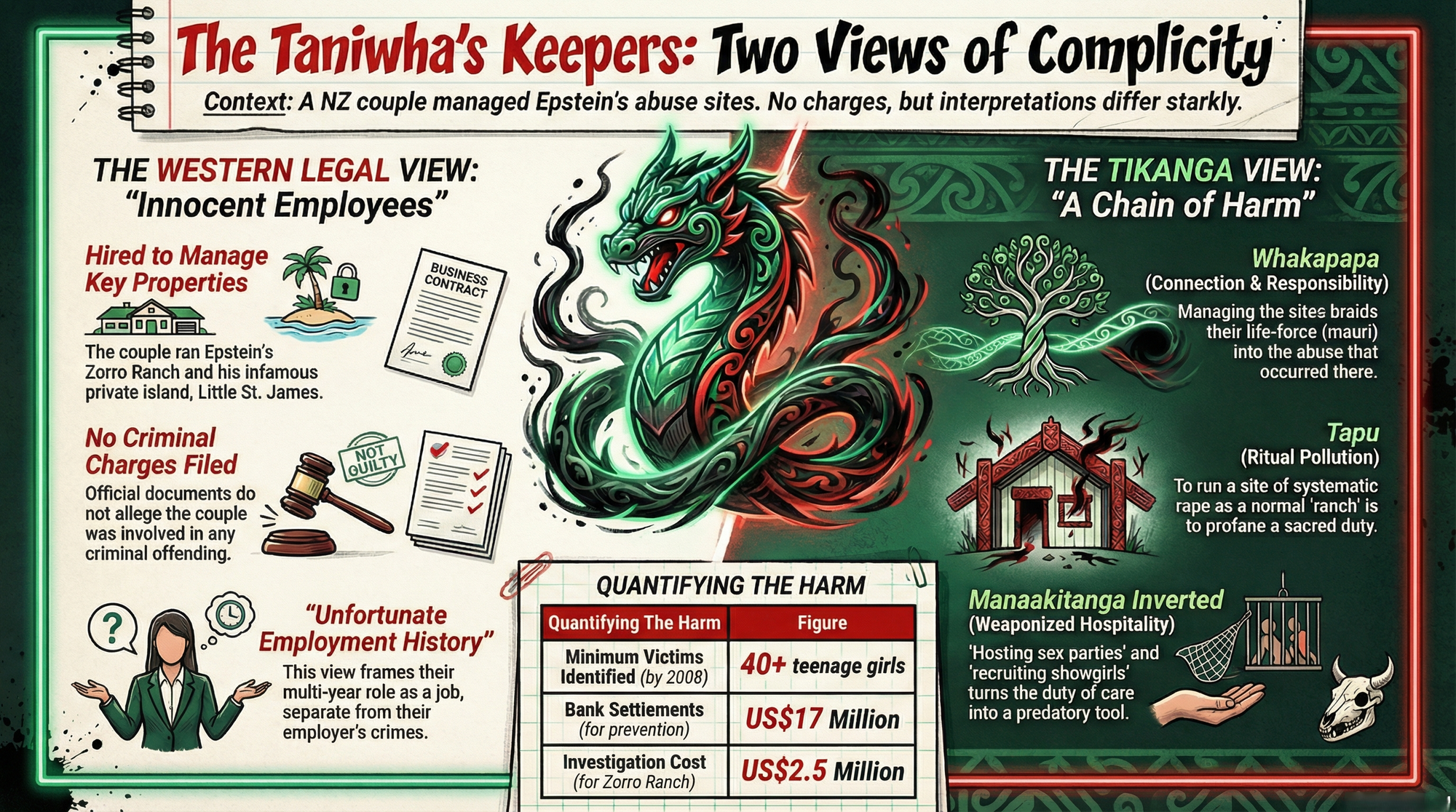
- Whakapapa: If you are the continuous human presence keeping Zorro Ranch ticking – the ones who hire, fire, host parties, recruit showgirls and keep Epstein’s favourite rooms ready – your mauri is braided into the mauri of that place. The longer you stay, and the more sites you manage for him (desert ranch and island), the deeper the braid.
- Tapu: A site where girls are systematically raped is tapu in the sense of being ritually polluted and requiring whakanoa and transformation. To keep running that site as if it were a “ranch” or “private island resort” is to grind tapu into dust while you vacuum the floors.
- Manaakitanga: Hospitality is meant to uplift mana. When you turn manaakitanga into “hosting sex parties”, “recruiting local showgirls”, and keeping a predator’s powerful friends comfortable, you have inverted manaakitanga into a weapon. That inversion is a direct assault on tikanga, not a neutral job description.
To a Western manager, Brice and Karen Gordon can still be framed as “employees who haven’t been charged with an offence and deny wrongdoing”. To tikanga, they are active nodes in the whakapapa of harm – quartermasters of a mauri‑depleting machine whose function relied on their competence and silence.
Quantifying harm and naming solutions
Harm in numbers (Western lens):
- At least 40 teenage girls identified in the original Florida investigation by 2008, per the AP recounting of the plea deal quoted in 1News’ Zorro Ranch story, and “dozens” of girls and young women in later documents described as damaged over “three decades”, according to the newer deposition material summarised in 1News’ piece on additional abuse details.
- US$17m in trafficking‑prevention funds extracted from two banks that serviced Epstein’s financial operations, as confirmed by AG Raúl Torrez’s office and reported by 1News, showing banks earned enough from his business to pay eight‑figure settlements.
- US$2.5m (NZ$4.4m) for a New Mexico truth commission just to map what happened and what officials knew at one ranch, as proposed by Rep. Andrea Romero and reported by 1News, with results not expected for at least two years.
If we apply international cost‑of‑abuse estimates – typically placing the lifetime social and economic cost of serious child sexual abuse in the hundreds of thousands per survivor – to even a conservative 80–100 victims across Epstein’s network, we’re in the tens to low hundreds of millions in direct measurable harm. And none of that counts intergenerational trauma, lost leadership, or the damage to communities who watch the rich skate while their kids carry the scars.
Harm in tikanga terms:
Every girl whose body passed through Zorro Ranch or Little St James is a cut in some whakapapa line. Each assault is a fracture in her wairua, a distortion that can echo into her children, her mokopuna, her hapū – precisely the kind of long‑tail damage the Royal Commission into Abuse in Care has documented in state and church settings here, where Māori were found to be disproportionately abused and targeted, as summarised in RNZ’s coverage of Māori survivors’ experiences. Brice and Karen Gordon’s relationship with Epstein is one more export of that colonial template: Aotearoa talent made available to maintain other people’s trauma factories.
Pathways out of the abattoir: concrete solutions
Metaphor is useless if we don’t sharpen it into policy.
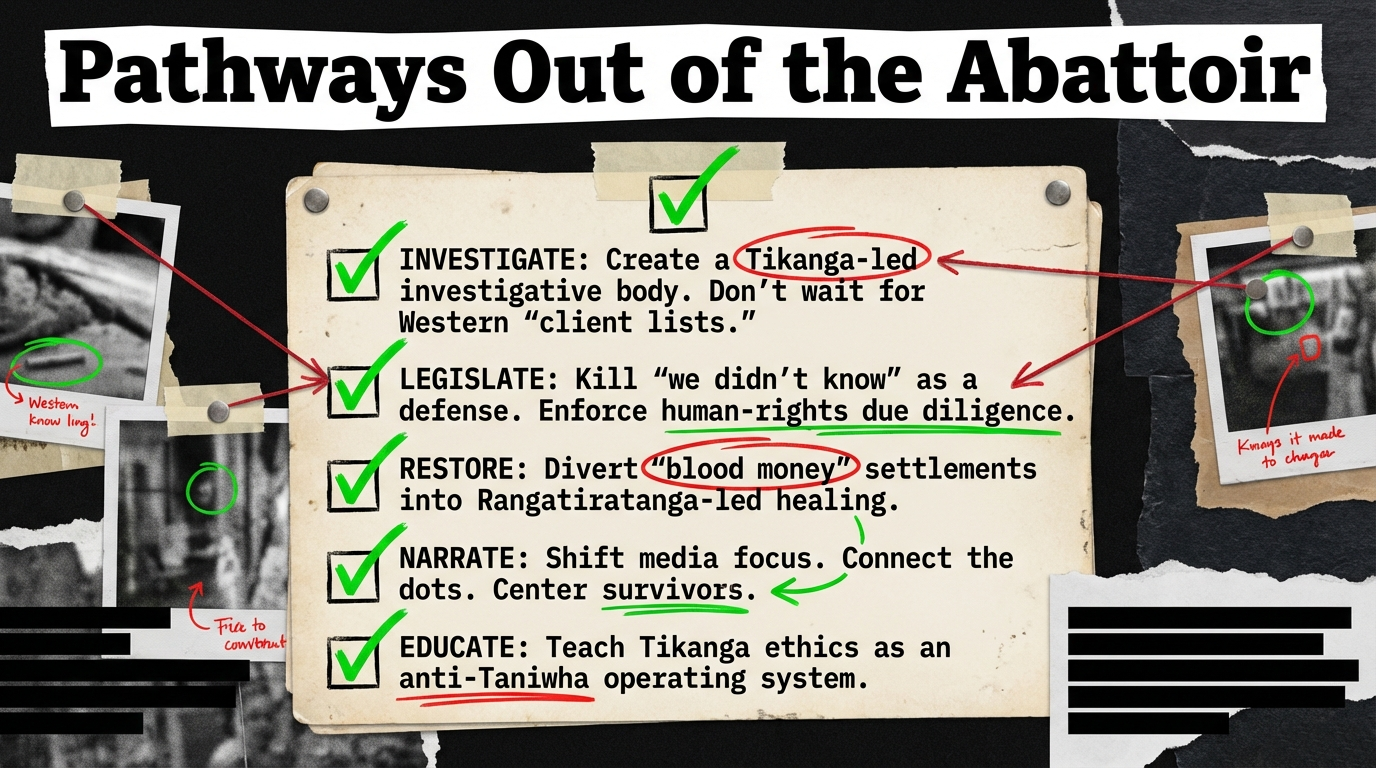
- Create a tikanga‑led investigative kaupapa
Build an independent, Māori‑led body with statutory powers to map Aotearoa’s connections to global abuse and trafficking networks – subpoenaing bank records, trust structures, employment contracts and travel logs, and analysing them through whakapapa logic rather than waiting for a Western “client list” that the DOJ now claims doesn’t exist, as reported in 1News. This body’s mandate: name the Brice and Karen Gordons before they disappear, not after. - Legally kill “we didn’t know” as a defence
Reform company, trust and charity law to impose an explicit duty of human‑rights due diligence on directors and senior managers, including scanning for trafficking and sexual‑exploitation risk. That means personal criminal liability for reckless ignorance: if you manage a remote compound for a convicted sex offender or service his accounts and never ask what’s actually happening there, the law treats that as participation, not neutrality. - Divert blood‑money into rangatiratanga‑led healing
Following New Mexico’s example of using US$17m of bank settlements for anti‑trafficking work, Aotearoa should levy or settle with institutions that profited from suspect wealth flows and direct that pūtea into Māori‑ and Pasifika‑led survivor services grounded in whānau, hapū and iwi. Those services must be framed as restoring mana and whakapapa, not just patching up individuals for cheap. - Force a narrative shift in media and public discourse
When New Zealand media report that “a couple from New Zealand” ran Epstein’s “baby‑making ranch” and later, that Brice and Karen Gordon managed his island, those aren’t colour‑pieces; they’re case studies in Kiwi complicity. Editorial policy and funding rules should reward coverage that centres survivors (including Indigenous ones), maps these relationships, and refuses to treat our role as a quirky footnote to American scandals. - Teach tikanga as an anti‑taniwha operating system
Integrate tikanga‑based ethics and relational analysis into training for lawyers, property managers, bankers, pilots, hospitality workers and public servants. When professionals are taught to ask “what happens to the mauri if I take this job?” they are less likely to accept work that is clearly part of a predatory system. For rangatahi, embed case studies like Epstein into social‑studies and civics curricula through a whakapapa lens, so they can see, early, how empire recruits “good people” into bad machinery.
How this shreds the Western mind
To the Western liberal mind, this essay is offensive because it refuses to wait for a judge to tell us what we can see with our own eyes. That mind wants tidy boxes: predator, victim, innocent employee. It wants to hear that Brice and Karen Gordon weren’t charged, that the DOJ files “do not allege the couple was involved in any offending”, as the Herald carefully notes in its coverage of their correspondence with Epstein, summarised in its article on the files. It wants to pretend the absence of a charge equals the absence of responsibility.
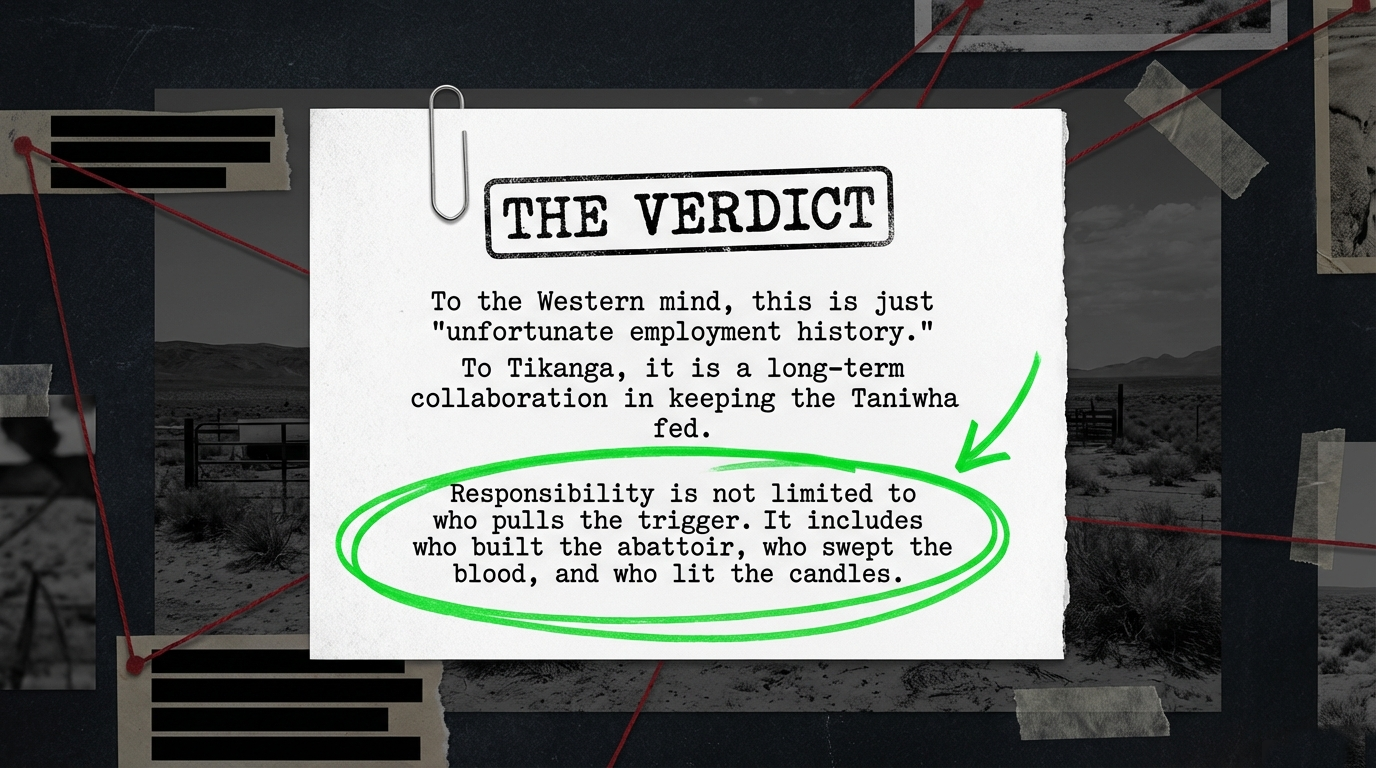
Tikanga doesn’t play that game. It looks at who built the abattoir, who owned it, who managed it, who supplied the stock, who turned a blind eye, and it assigns responsibility along the whole whakapapa chain. To a Western mind steeped in individualism, that feels like an attack. To us, it is just basic accounting.
The relationship between Epstein and the Gordons is not ambiguous. He was a convicted sex offender and financier whose Florida case alone involved at least 40 teenage girls; they were his trusted managers at a ranch and an island that survivors and prosecutors name as key sites of abuse, with years of correspondence binding them together. The Western mind calls that “unfortunate employment history”. Tikanga calls it what it is: a long‑term collaboration in keeping the taniwha fed.
Koha consideration
Every koha for this mahi is another stone in the wall between our tamariki and the next “baby‑making ranch” that empire tries to build. It signals that we will not let “nice Kiwi couples” turn our mana into camouflage for overseas predators, and that we are willing to fund tikanga‑driven truth‑telling where Crown and corporate structures prefer amnesia.
If this kōrero has given you new kupu to confront the Epsteins and the Gordons of this world, and you are able, consider a koha to keep this taiaha swinging:
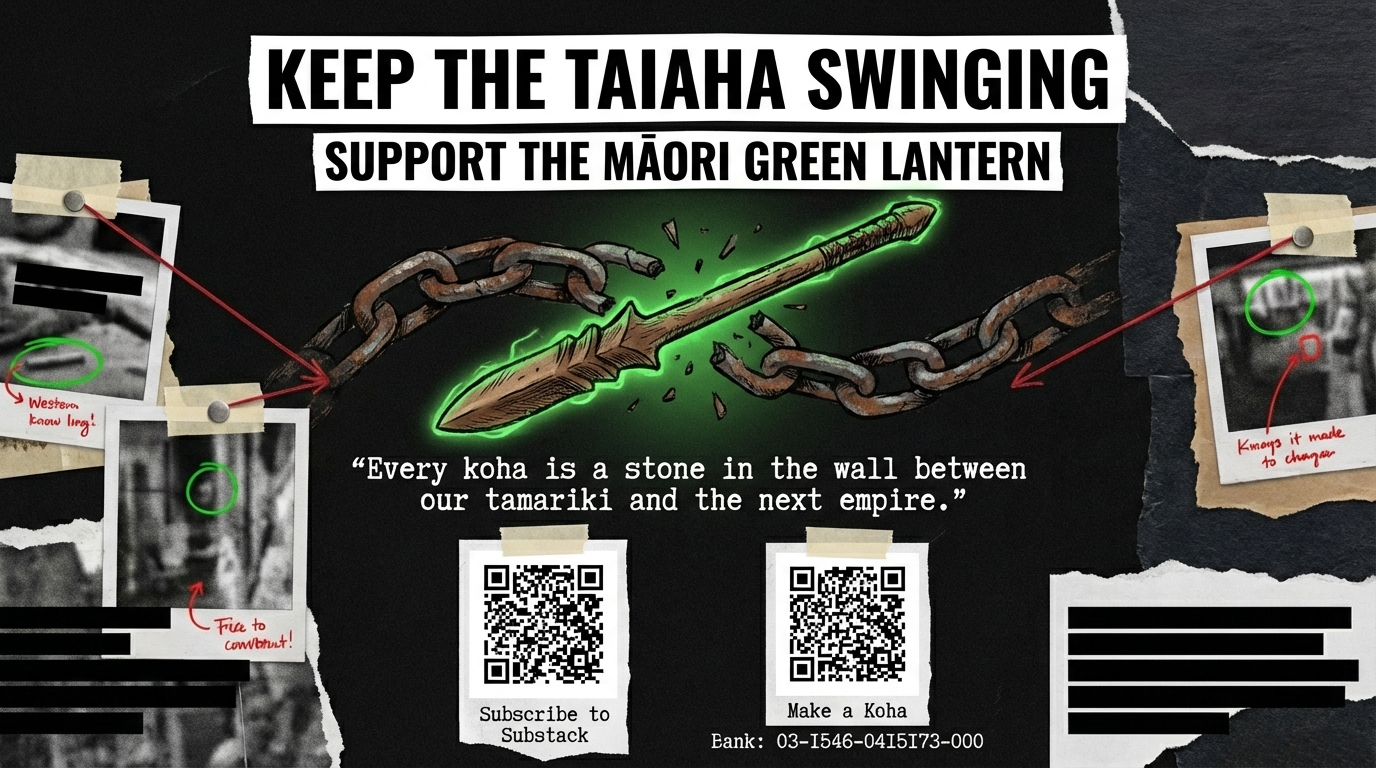
For those who wish to support this mahi directly with a koha (voluntary contribution), please visit the Koha platform:
Koha—Support – https://app.koha.kiwi/events/the-maori-green-lantern-fighting-misinformation-and-disinformation-ivor-jones
For those who wish to receive essays directly and support through subscription, join the Substack community:
Subscribe to the Māori Green Lantern on Substack – https://themaorigreenlantern.substack.com/subscribe
For those who prefer direct bank transfer, account details are: HTDM, account number 03‑1546‑0415173‑000.

Ivor Jones The Māori Green Lantern Fighting Misinformation And Disinformation From The Far Right