“The Kowtower: How Winston Peters Sold Aotearoa’s Mana for a Seat at Trump’s Table” - 1 February 2026
Kua hinga te tōtara i Te Waonui-a-Tāne—but this tōtara fell not in battle, but on bended knee
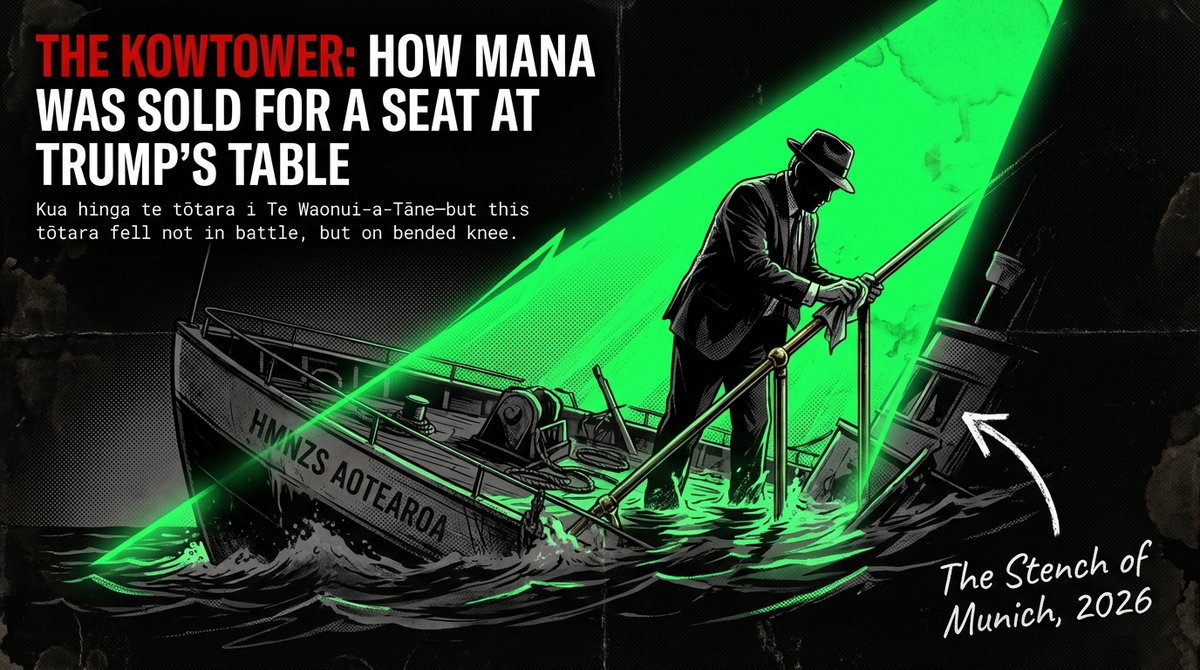
The Stench of Munich, 2026
Winston Peters stands on the deck of the good ship Aotearoa, watching as the waters rise around us. But instead of sounding the alarm, he’s polishing the brass railings and assuring us the leak is someone else’s problem.
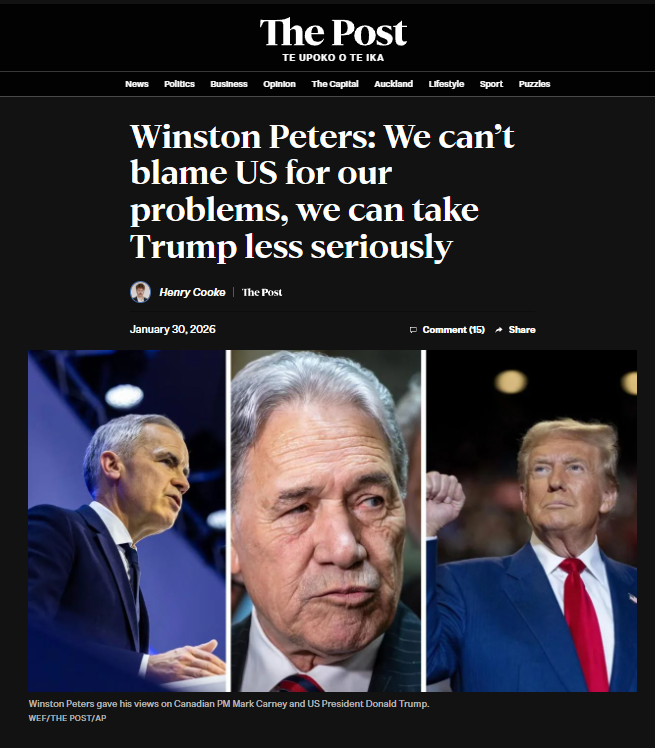
“We can’t blame the US for our problems,” he declares,
even as Trump—the man threatening to annex Greenland, kidnap foreign leaders, and tear up the international rules that keep small nations safe—drills holes in the hull.
This is not diplomacy. This is appeasement. And we have seen this movie before.
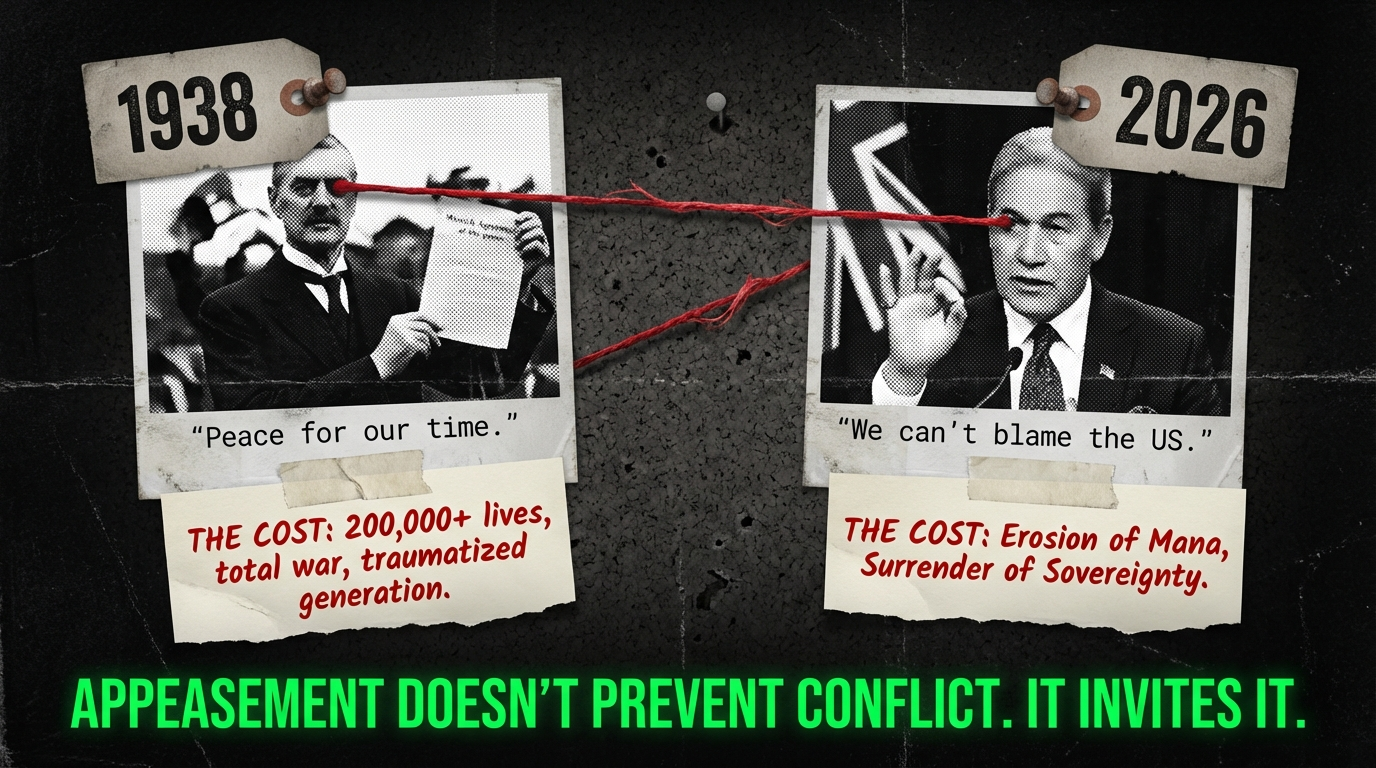
In September 1938, British Prime Minister Neville Chamberlain returned from Munich waving a piece of paper, declaring he had secured “peace for our time”. He had handed Hitler the Sudetenland—sacrificed Czechoslovakia to satisfy a dictator’s appetite.
Winston Churchill called it “a total and unmitigated defeat”.
Within six months, Hitler seized all of Czechoslovakia. Within a year, the world was at war. The price of appeasement?
More than 200,000 lives in the long civil war it enabled, mental health crises, suicides, and a traumatized generation.
Today, Winston Peters plays Chamberlain to Trump’s expansionist appetites. But instead of waving paper, he waves away criticism. Instead of defending New Zealand’s interests, he attacks those who do. And instead of standing with our allies, he tells them to “stay in their New Zealand lane”.
The Foreign Minister who claims to put “New Zealand First” has instead put New Zealand on its knees.
The Silence that Dishonors the Dead
On January 23, 2026, Donald Trump stood before the world and claimed that allied troops in Afghanistan “stayed a little back, a little off the front lines”—a calculated insult to every soldier who bled in the dirt of Helmand Province, every family who buried a son or daughter who never came home, every nation that answered America’s call after 9/11.
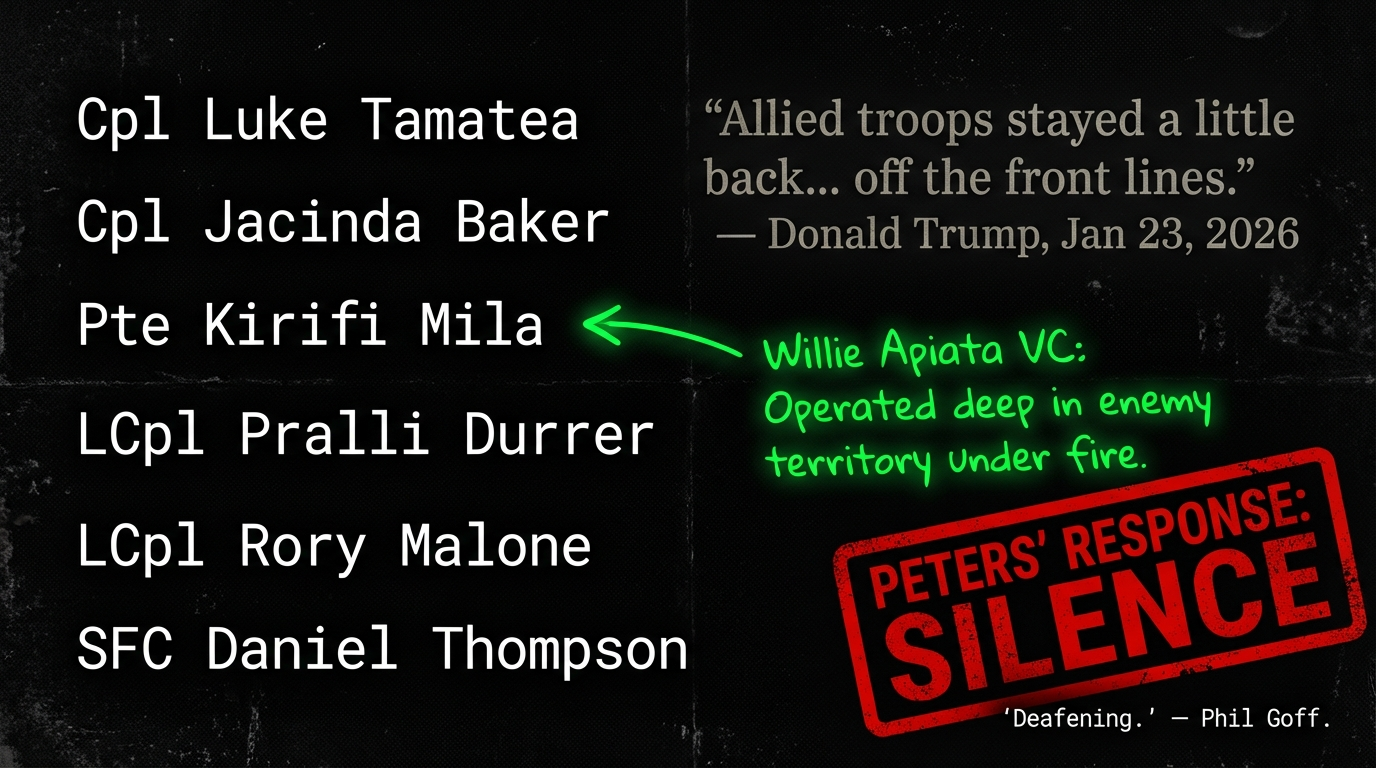
Ten New Zealanders died in Afghanistan. Corporal Luke Tamatea. Corporal Jacinda Baker. Private Kirifi Mila. Lance Corporal Pralli Durrer. Lance Corporal Rory Malone. Sergeant First Class Daniel Thompson
—the list of the fallen is a whakapapa of sacrifice, each name a thread in the fabric of our national honor.
Willie Apiata won the Victoria Cross
—our nation’s highest military honor—for actions “behind the front line, deep in enemy territory,” rescuing a wounded comrade under heavy fire.
He carried a fellow soldier to safety while bullets tore the air around him. This is the mana of our warriors. This is what Trump spat upon.
UK Prime Minister Keir Starmer called Trump’s remarks “insulting and frankly appalling”. Canada spoke up. Poland spoke up. France spoke up. Nations with backbone defended their dead.
Winston Peters? Silence. Not one word.
The silence, Goff said, was “deafening”.
The Tikanga Violation: Mana Destroyed
In te ao Māori, whakapapa
The stories of our tūpuna
—including those who fell defending our values
—are tapu, sacred truths that must be protected and honored.
“spiritual authority and power”
that can be inherited through whakapapa or earned through knowledge, achievements, and service to others.
Critically, mana

Peters’ silence diminished not only his own mana but the mana of every New Zealander. By refusing to defend our fallen soldiers, he broke the sacred thread of whakapapa that connects us to their sacrifice. He violated the tikanga of utu—the principle of reciprocity and balance that demands restoration when harm is done.
—the fostering of whānau relationships and connections
—requires that we honor those bonds, especially with those who gave everything.
Peters severed those bonds. He told the families of the fallen, through his silence, that their loved ones’ sacrifice wasn’t worth defending against a bully’s lies.
This is not just political cowardice. This is spiritual vandalism. This is the destruction of mauri—the life force that must be protected in our communities, our institutions, our shared memory.
Quantifying the Harm: What Silence Costs
When leaders choose appeasement over principle, the costs compound across generations.
History provides the ledger:
The Munich Precedent: Chamberlain’s appeasement didn’t prevent war—it made war inevitable. By showing Hitler that democracies would not defend their stated principles, it encouraged further aggression. The research is clear: “appeasement bought a traumatized nation”, with documented increases in mental health crises, suicides, and a collapse of public trust that took generations to rebuild.
The Corporate Appeasement Model: When Firestone Tire Company chose to cooperate with warlord Charles Taylor in Liberia to protect its rubber plantation, it prioritized short-term business interests over human rights. The result? Over 200,000 deaths, widespread amputations, mass rape, and half the population becoming refugees. Former US diplomat Gerald Rose’s verdict: “Do I think they have blood on their hands? Yes”. Liberia’s Truth and Reconciliation Commission explicitly cited Firestone for “having aided Taylor in carrying out his rebellion”.
The Veteran Community Impact: Every New Zealand veteran who served in Afghanistan heard Trump’s insult. Every veteran family felt Peters’ silence. The harm is measurable:
- Erosion of recruitment pipelines when young people see leaders won’t defend those who serve
- Increased rates of veteran suicide and mental health crises when service is publicly denigrated without official rebuttal
- Damaged relationships with allied forces, undermining operational capability
- Broken trust between veterans and government, fracturing the social contract that underpins military service
Peters’ betrayal of veteran mana follows the same colonial pattern:
Sacrifice the vulnerable to protect power.
The Governor Who Remembered Her Duty
If Peters’ silence on the soldiers was cowardice, his attack on Reserve Bank Governor Anna Breman revealed the deeper pathology:
Selective sovereignty wielded to protect Trump, not New Zealand.
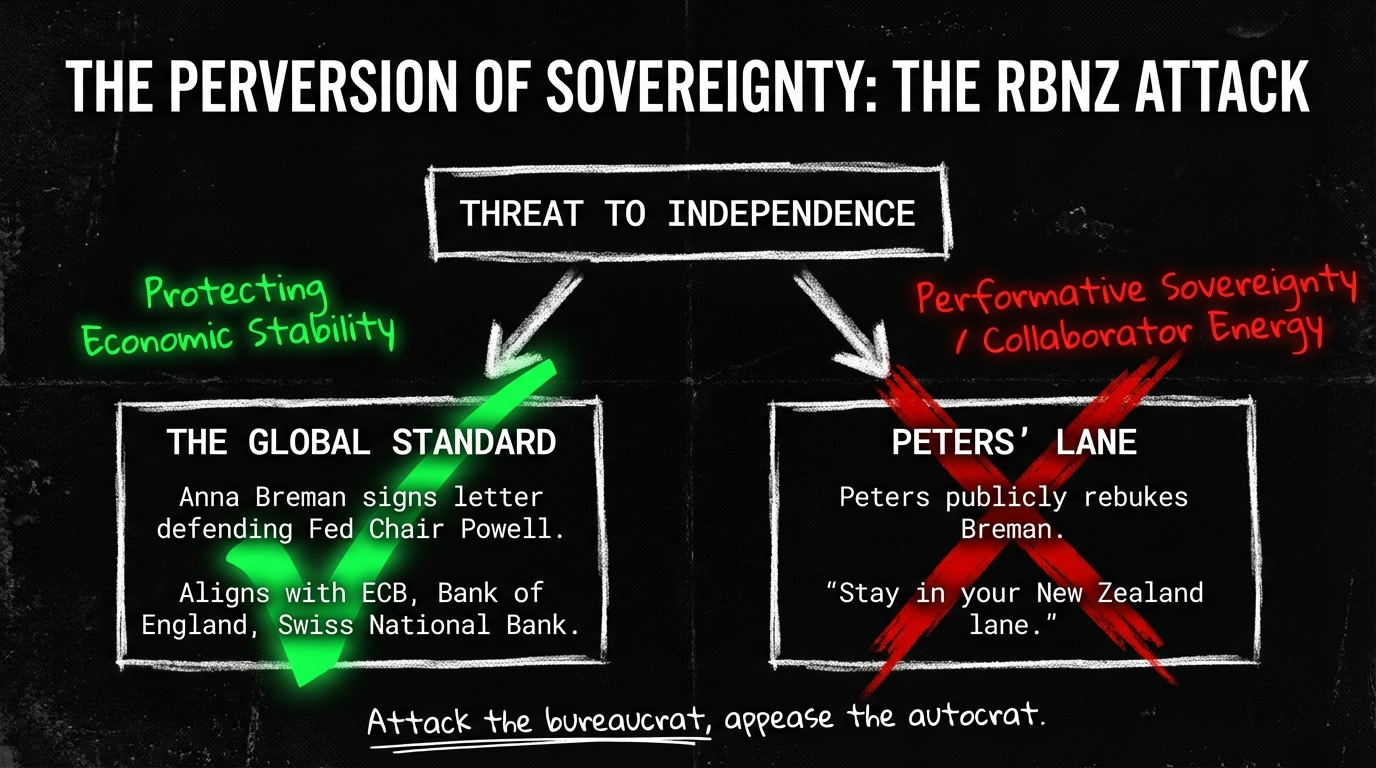
On January 13, 2026, Breman joined 13 other central bank governors worldwide in signing a letter defending the independence of the US Federal Reserve and its chair Jerome Powell. The signatories included Christine Lagarde (President of the European Central Bank), the governors of the Bank of England, the Swiss National Bank, and other leading democracies.
The letter’s substance was straightforward:
Powell, it noted,
Why did this matter? Because Trump had weaponized the Justice Department, serving criminal subpoenas on Powell over a building renovation—a transparent pretext to intimidate Powell into cutting interest rates to juice the US economy for Trump’s political benefit. Powell’s video response made the stakes clear: the charges were “a pretext,” retaliation for “setting interest rates based on our best assessment of what will serve the public, rather than following the preferences of the President”.
This wasn’t an academic debate. The independence of central banks from political interference is fundamental to economic stability. When politicians control interest rates, they invariably choose short-term gains over long-term stability—inflating bubbles, stoking inflation, and ultimately causing economic crises that devastate working people. Every economist knows this. Every central banker knows this. Anna Breman knew this.
So she did her job. She defended a principle that protects New Zealanders’ economic security.
Peters’ response? He publicly rebuked her, telling her to “stay in her New Zealand lane” and claiming that the Ministry of Foreign Affairs would have advised against signing.
Think about that. Of all the central bank governors who signed—from the ECB, Bank of England, Swiss National Bank, and others—only New Zealand’s was publicly chastised by her own government. Why is it only New Zealand that chose to cringe at the thought of Trump’s displeasure? asks journalist Gordon Campbell.
“Why is New Zealand the only country to so openly cringe?”
The Perversion of Sovereignty
Peters loves to lecture about sovereignty. He wrapped himself in the flag when telling Breman to “stay in her lane.” But sovereignty means defending your institutions and your principles from external interference
—not attacking your own officials for doing exactly that.
Breman’s duty was to protect central bank independence
—a principle that directly serves New Zealand’s economic interests.
By standing with Powell and her fellow central bankers, she was protecting the norm that keeps politicians—including Peters—from raiding the RBNZ cookie jar for cheap electoral sugar hits.
Peters, by contrast, practiced what we might call “performative sovereignty”—making a big show of defending New Zealand’s independence in trivial ways (telling a governor to ask permission before signing letters) while surrendering actual sovereignty in ways that matter (refusing to criticize Trump’s threats to the international order that protects small nations).
This is the classic authoritarian move:
Attack the process, ignore the principle. Blast the bureaucrat for not following proper channels, say nothing about the autocrat threatening the global system. Sound and fury about a letter, silence about annexation.
Campbell’s analysis cuts to the bone:
We will not, he notes, defend international law or convention if Trump has chosen to break it—even when Trump kidnaps Venezuela’s president in violation of Article 2 of the UN Charter, or threatens to annex Greenland in defiance of every principle of territorial sovereignty.
This is not patriotism. This is collaborator energy. Peters has internalized the logic of the abuser:
Keep your head down, don’t make waves, maybe he’ll leave us alone if we’re quiet enough.
Except bullies don’t leave the quiet ones alone. They exploit them.
The WHO Betrayal: Kaitiakitanga Abandoned
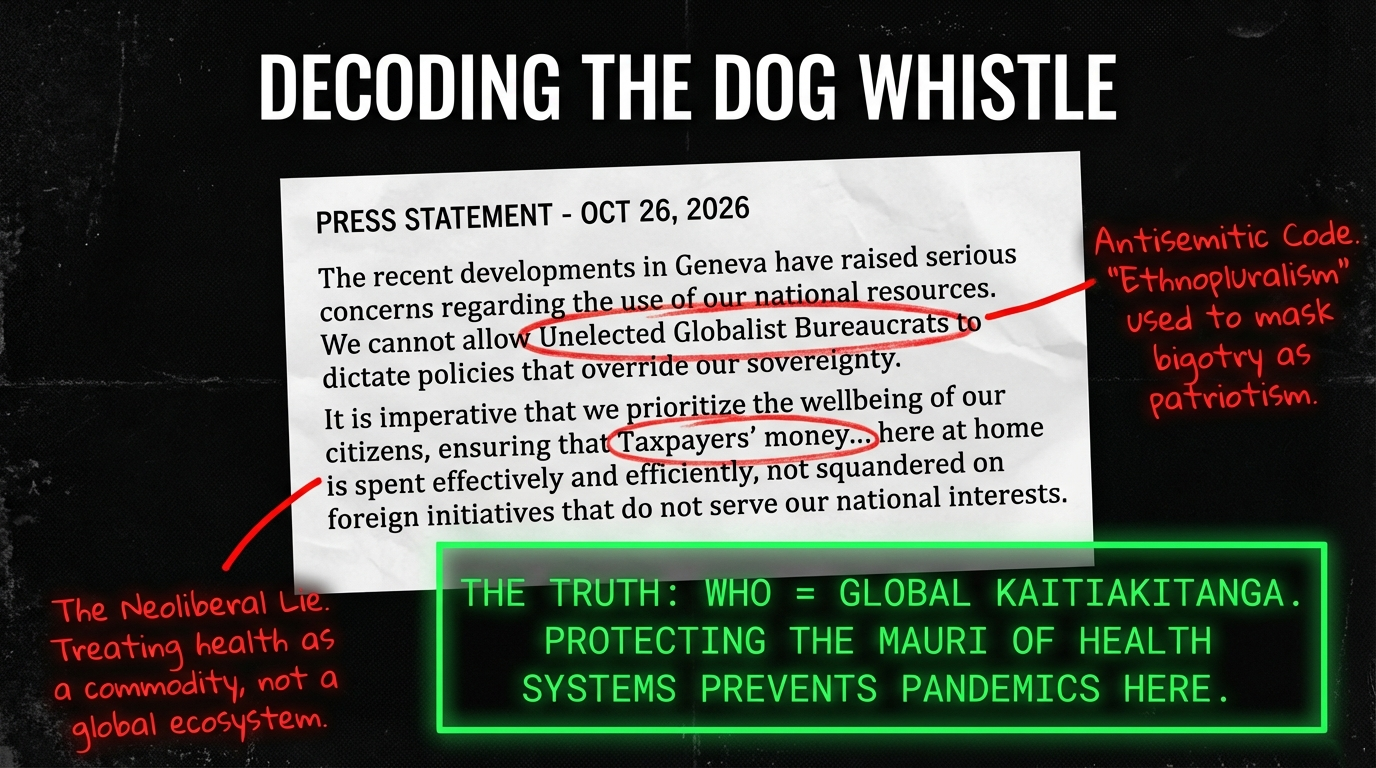
On January 22, 2026, Peters praised Trump’s withdrawal from the World Health Organization, calling it an appropriate response to
“unelected globalist bureaucrats not accountable with taxpayers money”.
He questioned whether New Zealand should continue its WHO membership, suggesting our taxpayer money would be better spent “here at home.”
Goff reminded us what the WHO actually does:
Peters’ attack on the WHO reveals three interlocking pathologies, each borrowed directly from Trump’s playbook:
1. The “Globalist” Dog Whistle
When Peters rails against “unelected globalist bureaucrats,” he’s not making a policy argument. He’s signaling. “Globalist” is antisemitic code, historically used to imply a shadowy international elite (read: Jews) controlling world affairs. Right-wing populists deploy this rhetoric to “mobilize on xenophobic and racist public opinions without being stigmatized as racists”, using what scholars call “ethnopluralism” to mask bigotry in neutral-sounding language.
This is the same playbook Peters deployed in his March 2025 “war on woke” speech, where he railed against “the insidious creep of racist co-governance” and compared Treaty-based frameworks to Nazi Germany. It’s authoritarian populism 101: create a narrative of “the pure people” versus “the corrupt elite,” with minorities conceived as threats to the nation.
The WHO is not “unelected”—it’s intergovernmental, governed by the World Health Assembly where every member state has a vote. It’s not “unaccountable”—it reports to member governments, including New Zealand. It’s not wasteful—it operates on a budget smaller than many regional health boards while coordinating global disease surveillance, emergency response, and health infrastructure for 194 countries.
Peters knows this. The slander is the point. By attacking “globalists,” he’s doing Trump’s work: undermining trust in the multilateral institutions that prevent global catastrophes and protect small nations from being steamrolled by large ones.
2. The Neoliberal Lie: “Taxpayers Money... Here at Home”
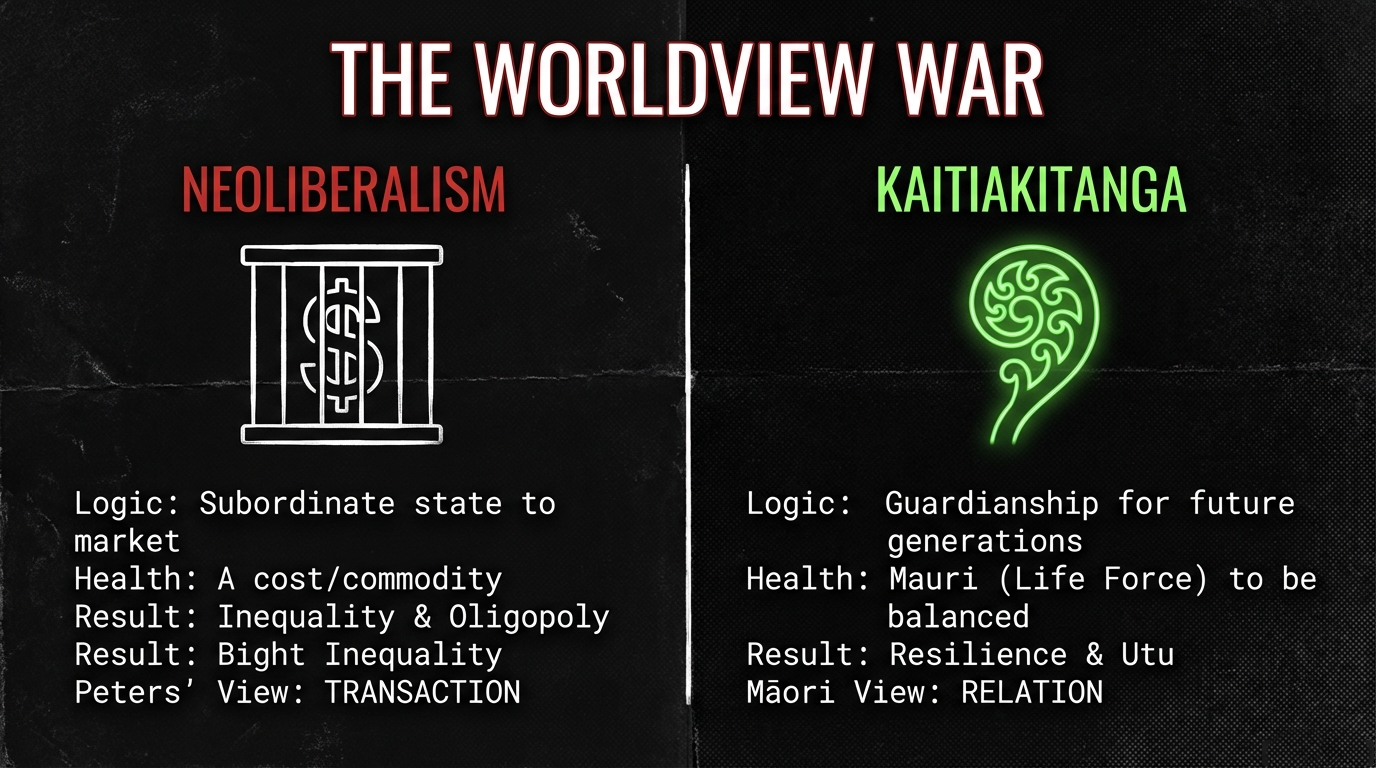
Peters’ claim that WHO funding should be spent “here at home” instead is textbook neoliberal frame manipulation—the kind of rhetorical sleight of hand that has subordinated states and social domains to market logic for 40 years.
Neoliberalism, as scholars define it, is “an ideology and political practice that aim to subordinate the state and all social domains to the market—to its logic and to the economic powers within it—thereby undermining democracy”. Its core features are liberalization, deregulation, privatization, recommodification, internationalization, reductions in taxation, and decriminalization of predatory economic activities.
The “taxpayers money... here at home” framing treats public health as if it were a zero-sum commodity—money “wasted” abroad that could buy more hospital beds in Tauranga. But pandemics don’t respect borders. COVID-19 proved this. A virus that starts in Wuhan or Kinshasa will reach Wellington unless there’s a coordinated global response. The WHO provides that coordination. Every dollar we “spend” on the WHO is insurance—it’s spent here at home by preventing the next pandemic from arriving here at all.
But neoliberal logic can’t see that, because it demands that all value be measurable in market terms. What’s the ROI on preventing a pandemic that never happens? You can’t calculate it, so neoliberals assume it’s zero. This is the same logic that gave us 40 years of deregulation and privatization that “enhanced the social and economic power of major corporations” while hollowing out democratic accountability.
Peters is a veteran practitioner of this discourse. His party supported Rogernomics in the 1980s—the neoliberal transformation that deregulated New Zealand’s finance sector, removed subsidies, relaxed foreign exchange controls, and shifted power from the public sector to the private one. The results? Skyrocketing inequality, a housing crisis, and the erosion of social infrastructure.
Now Peters deploys the same logic internationally: cut “wasteful” spending on global cooperation, keep the money here, let every nation fend for itself. It’s Hobbesian nationalism dressed up as fiscal responsibility. And it’s a gift to Trump, who wants to destroy the multilateral order precisely because it constrains American unilateralism.
3. Kaitiakitanga Betrayed
In te ao Māori, kaitiakitanga means “guardianship, protection, preservation or sheltering”. It’s “a way of managing the environment, based on the traditional Māori world view”, rooted in the understanding that we are stewards of resources for future generations.
Kaitiakitanga requires protecting mauri—the life force—in forests, rivers, oceans, and communities. When mauri is diminished, balance must be restored through utu (reciprocity) and ea (resolution).
The WHO is an instrument of global kaitiakitanga. It protects the mauri of global health systems—the life force that keeps pandemics at bay, coordinates vaccine distribution, monitors disease outbreaks, and helps nations build resilient health infrastructure. By undermining the WHO, Peters abandons kaitiakitanga on a planetary scale.
The concept of kaitiakitanga also encompasses “reciprocity (giving back)” and the obligation to care for resources collectively. When wealthier nations like New Zealand fund the WHO, we’re not “wasting” money—we’re fulfilling our kaitiaki obligations to protect global health, especially in nations that lack resources to combat disease alone.
Peters’ attack on the WHO violates tikanga at every level:
- Kaitiakitanga abandoned: Refusing to protect global health systems
- Whanaungatanga severed: Breaking relationships with international health community
- Manaakitanga neglected: Withdrawing care from vulnerable populations
- Utu denied: Refusing to give back when we have benefited from global cooperation (NZ received WHO support during COVID-19)
This is colonial thinking dressed in “taxpayer” drag. It’s the same logic that said: why spend money on Māori health when we could spend it on “our own” people? It’s the zero-sum mindset of the settler who sees resources as something to hoard, not share—a violation of the reciprocal relationships that sustain life.
The Pattern: White Supremacist Logic in “Patriotic” Drag
Peters frames himself as the defender of New Zealand sovereignty, the patriot willing to tell uncomfortable truths. But his pattern of behavior reveals something else: the logics of white supremacy operating through settler colonial structures.
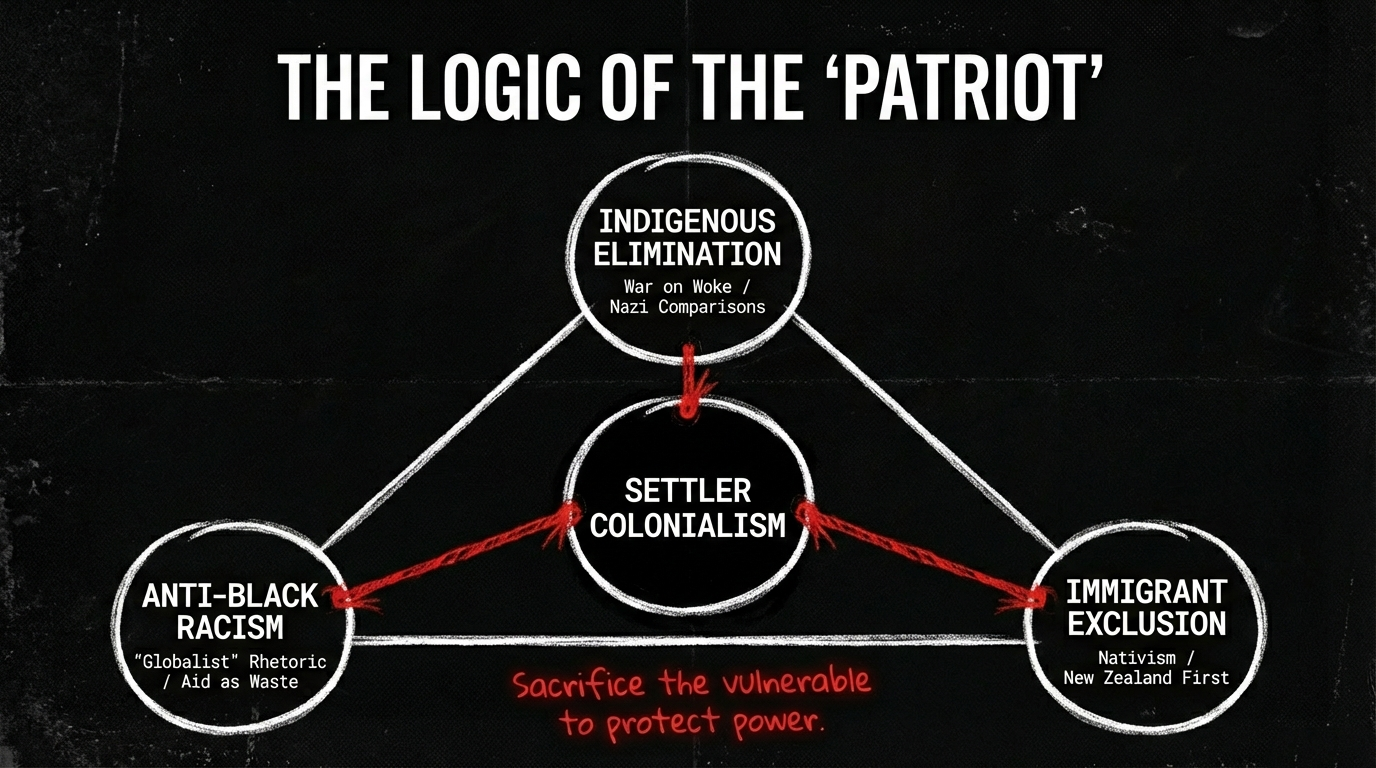
Scholar Andrea Smith identifies three interlocking logics of white supremacy in settler colonial states like New Zealand:
- Indigenous elimination: The view that Indigenous people are “necessarily disappearing” and their institutions are illegitimate
- Anti-Black racism: Strategies of subjugation that render certain populations as inherently exploitable
- Immigrant exploitation: The view of non-white immigrants as “permanent threats” who must be exploited or excluded
Peters traffics in all three:
Indigenous elimination: His “war on woke” rhetoric explicitly targets Māori governance, calling co-governance “the insidious creep of racist” policy. He compared Treaty-based frameworks to Nazi Germany, weaponizing Holocaust imagery to delegitimize Māori rangatiratanga. This follows the settler colonial playbook: frame Indigenous governance as threatening to “democracy” while ignoring that democracy itself was imposed through colonization.
Exploitation and exclusion: His “globalist” rhetoric and attacks on the WHO follow the immigrant exploitation logic—positioning international institutions and non-white nations as “threats” whose claims on resources must be resisted. The subtext: our “taxpayer money” (read: white New Zealanders’ money) shouldn’t fund “them.”
Authoritarian populism: Right-wing populism combines “anti-elitist sentiments” with “nativism”—the belief that society is divided between “pure people” and “corrupt elite,” with minorities as threats to national cohesion. When combined with authoritarianism, it produces “a deadly mix of xenophobia, racism, and authoritarianism” that prioritizes “law and order” and submission to authority while rejecting liberal democracy’s protection of minority rights.
This is Peters’ sweet spot. He positions himself as the voice of “ordinary New Zealanders” against “unelected bureaucrats,” “woke academics,” and “globalist elites.” He wraps this in patriotic language—”New Zealand First”—while systematically undermining the institutions (courts, central banks, international organizations) that protect rights and constrain executive power.
And crucially, he does this while appeasing actual authoritarian power. As Juan-Torres notes, authoritarian populists create “almost like binoculars”—one lens showing identity-based outgroups as threats, the other showing elites as enemies. This “sense of fear and antagonism leads people to accept authoritarian measures to protect themselves”.
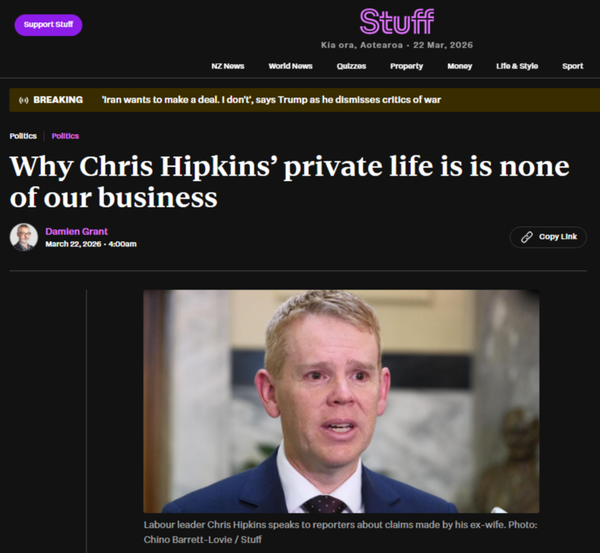
Peters learned this from Trump. In his March 2025 State of the Nation speech, he explicitly called to “make New Zealand first again”—an echo of Trump’s MAGA slogan. Labour leader Chris Hipkins recognized it immediately: Peters was “channeling Donald Trump” while “trying to distract from the damage they’ve done.”
Cui Bono? Who Benefits from Peters’ Appeasement?
Follow the power. Follow the money. Follow who gains when New Zealand surrenders its voice.
Trump benefits: Every time Peters refuses to criticize Trump, it reinforces Trump’s impunity. When only New Zealand’s Foreign Minister attacks his own central bank governor for defending institutional independence, it tells Trump: you can bully smaller nations without consequence. When Peters “praises US withdrawal from WHO”, it provides international cover for Trump’s demolition of multilateralism.
Corporate power benefits: Neoliberalism’s core project is “subordinating the state and all social domains to the market... and the economic powers within it”. When Peters attacks “globalist bureaucrats,” he’s running interference for the deregulation agenda that enhances corporate power by removing democratic constraints. Research shows that 40 years of “free market” policies have resulted in “oligopolistic corporate economies” where major corporations wield unprecedented economic and political influence.
The WHO, like all international bodies, constrains corporate freedom—it sets health standards, restricts harmful products, coordinates responses that put public health before private profit. By undermining it, Peters advances the neoliberal project of “recommodification”—turning public goods back into private commodities.
Peters’ political brand benefits: This is the grim joke. By adopting Trump’s style—the bluster, the culture war rhetoric, the attacks on “elites”—Peters stays relevant. In August 2025, New Zealand First polled as the second-highest coalition partner, with Peters telling media they were “turning polls into confetti” by holding packed rallies.
He told reporters: “I know he’s the Prime Minister, I made him the Prime Minister”—a statement of raw power that reveals his calculation. Peters survives by making himself indispensable to National, and he does that by mobilizing the populist base that Trump energized globally.
The cost? New Zealand’s international standing, our veterans’ honor, our institutional independence, our commitments to global cooperation. Peters trades these for political longevity. He sells out Aotearoa to stay in power.
Who loses?: Everyone else. The international rules-based order that protects small nations. The multilateral institutions that coordinate pandemic response. The principle of central bank independence that prevents economic chaos. The veterans whose sacrifice gets spat on. The Māori whose rangatiratanga gets dismissed as “woke.” The working people who suffer when neoliberal policies deepen inequality and erode social protections.
This is extraction politics—extracting national dignity to fuel personal power. It’s the same logic that left Te Korowai o Wainuiārua “virtually landless” while settlers prospered. Someone always pays. Peters ensures it’s not him.
Solutions: Restoring Ea (Balance)
The tikanga principle of ea—resolution, satisfaction, restoration of balance—demands action when harm has been done. The take-utu-ea framework requires: identifying the take (issue/grievance), determining appropriate utu (reciprocation/restitution), and achieving ea (satisfaction/restored balance).
Here is what restoring balance looks like:
1. Institutional Safeguards: Protecting Officials Who Defend Principles
The Problem: Anna Breman was publicly rebuked for defending central bank independence—a principle fundamental to New Zealand’s economic security. This creates a chilling effect: officials learn that defending institutional integrity against foreign threats will get them attacked by their own ministers.
The Solution: Statutory protection for institutional independence. Amend the Reserve Bank Act to explicitly authorize the Governor to participate in international professional associations and defend central banking principles without ministerial permission. Create similar protections for other independent officials (Auditor-General, Privacy Commissioner, Chief Science Advisor) with clear provisions that ministers may not publicly criticize these officials for exercising their statutory duties.
Model: The Australian model, which provides explicit statutory protections for institutional heads against political interference, with remedies including judicial review and public reporting requirements.
Implementation: Parliamentary select committee review within 6 months, draft legislation within 12 months, public consultation with constitutional law experts and institutional stakeholders.
2. Mandatory Government Response: Speaking Up When Allies Are Insulted
The Problem: Trump insulted Allied soldiers, including 10 fallen New Zealanders, and Peters said nothing. This dishonors the dead and signals to allies that New Zealand won’t defend shared values.
The Solution: Legislate a mandatory response protocol. When a foreign leader makes public statements that insult or mischaracterize New Zealand service members’ conduct, the Prime Minister or Minister of Defence must issue a public statement within 48 hours. The statement must:
- Acknowledge the service and sacrifice of New Zealand personnel
- Correct any factual inaccuracies in the foreign leader’s statement
- Reaffirm New Zealand’s commitment to its international partnerships
This isn’t about picking fights—it’s about honoring obligations. Manaakitanga demands we care for those who served. Whanaungatanga requires maintaining relationships based on respect. Silence is betrayal.
Model: Veteran advocates, RSA, Defence Force representatives, and foreign policy experts should co-design the protocol to ensure it balances diplomatic discretion with moral clarity.
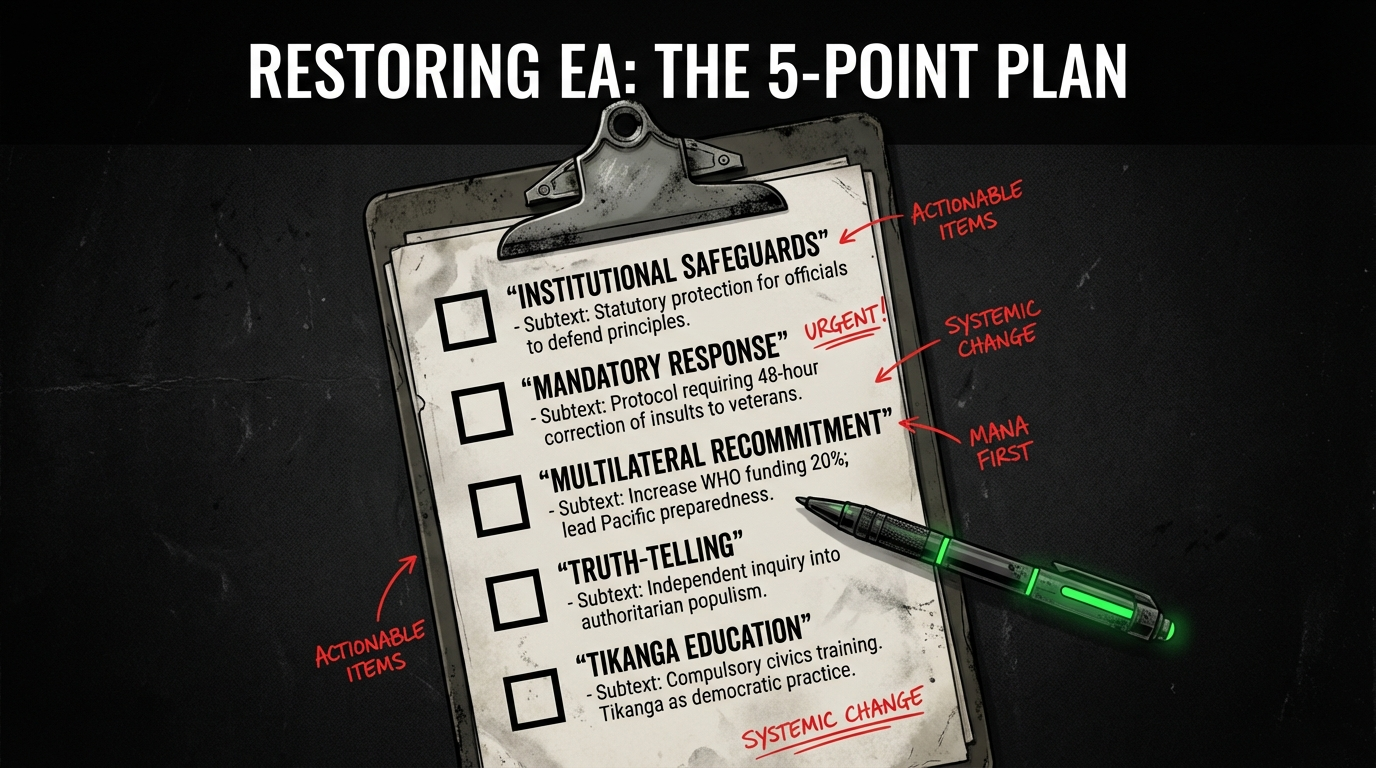
3. Multilateral Recommitment: Leading on International Cooperation
The Problem: Peters undermined the WHO, questioned New Zealand’s participation in Trump’s “Board of Peace”, and consistently positions international cooperation as “wasteful spending.”
The Solution: Reaffirm New Zealand’s commitment to multilateralism through concrete actions:
- Increase WHO funding by 20% over 3 years, with transparency reports showing exactly what that funding achieves
- Lead a Pacific regional initiative on pandemic preparedness, partnering with Australia, Japan, and island nations
- Host an international summit on protecting institutional independence in the era of authoritarian populism
- Fund Māori leadership in international indigenous forums, ensuring tikanga principles inform global policy
Why this matters: Small nations like New Zealand are “trade-dependent” and rely on “the rules-based trading order” for survival. When great powers act unilaterally, only international institutions give small nations a voice. Multilateralism is kaitiakitanga writ large—collective guardianship of the systems that sustain us.
4. Truth-Telling: Name the Pattern
The Problem: Peters uses “patriotic” rhetoric to advance policies that surrender sovereignty to foreign bullies and undermine Māori rangatiratanga. The media often reports his statements without analyzing the pattern.
The Solution: Independent inquiry into the rise of authoritarian populism in New Zealand politics. Terms of reference:
- Document how white supremacist logics operate through “respectable” political rhetoric
- Analyze funding sources and international networks connecting NZ right-wing populist movements to global actors
- Trace the import of American culture-war rhetoric into New Zealand political discourse
- Identify policy interventions to protect democratic institutions from authoritarian capture
Model this on the Waitangi Tribunal’s approach: independent commissioners, Māori co-design, binding recommendations, public hearings.
Why this matters: Settler colonialism is not history—it’s an ongoing “structure of invasion” that continues to shape inequities today. When Peters attacks Māori governance while appeasing American authoritarianism, he’s enacting the colonial logic: white supremacy abroad, indigenous elimination at home. We must name this to end it.
5. Education: Teaching Tikanga as Democratic Practice
The Problem: Too many New Zealanders don’t understand tikanga principles, allowing politicians to dismiss them as “woke” without consequence.
The Solution: Compulsory tikanga education in civics curriculum, law schools, and public service training. Frame tikanga not as “Māori stuff” but as sophisticated governance principles that could strengthen democracy:
- Whanaungatanga as relational accountability: leaders must maintain relationships, not just win votes
- Kaitiakitanga as intergenerational responsibility: policy must consider impacts on future generations
- Manaakitanga as care ethics: power exists to serve, not dominate
- Utu-ea as restorative justice: harm requires restitution and balance, not just punishment
As legal scholars note, tikanga is already part of New Zealand law—the Treaty of Waitangi “acknowledges tikanga Māori as being a taonga or something that was to be protected”. Teaching it isn’t “division”—it’s honoring the constitutional partnership that Peters claims to defend.
Implementation: Fund Māori educators and scholars to design and deliver tikanga training. Require all MPs, judges, and senior public servants to complete certified tikanga education. Make it cool—show how these principles could prevent the kind of institutional rot that produces Trump-appeasers like Peters.
The Mana We Choose
In December 2025, Peters told reporters:
“I know he’s the Prime Minister, I made him the Prime Minister”.
It was voted quote of the year—a perfect crystallization of his understanding of power. Not service, not duty, not kaitiakitanga. Just leverage, transactional relationships, and the ability to make or break careers.
This is the opposite of mana in the tikanga sense. Mana comes from whakapapa—connection to ancestors and community—and from service that enhances collective wellbeing. It can be earned through “knowledge, achievements, and service to others”, but it can be “diminished if they act disrespectfully or fail to follow tikanga”.
Peters has chosen to diminish his mana—and ours—through appeasement.
Every time he refuses to defend our soldiers,
attacks our officials for doing their jobs,
or parrots Trump’s talking points,
he trades away a piece of Aotearoa’s standing in the world.
But here’s the thing about mana:
it’s not his to trade. It belongs to all of us. It flows through whakapapa, through the relationships we maintain with each other, with our tūpuna, with the natural world. Peters can degrade his own authority, but he cannot destroy the mana of those who refuse to bow.
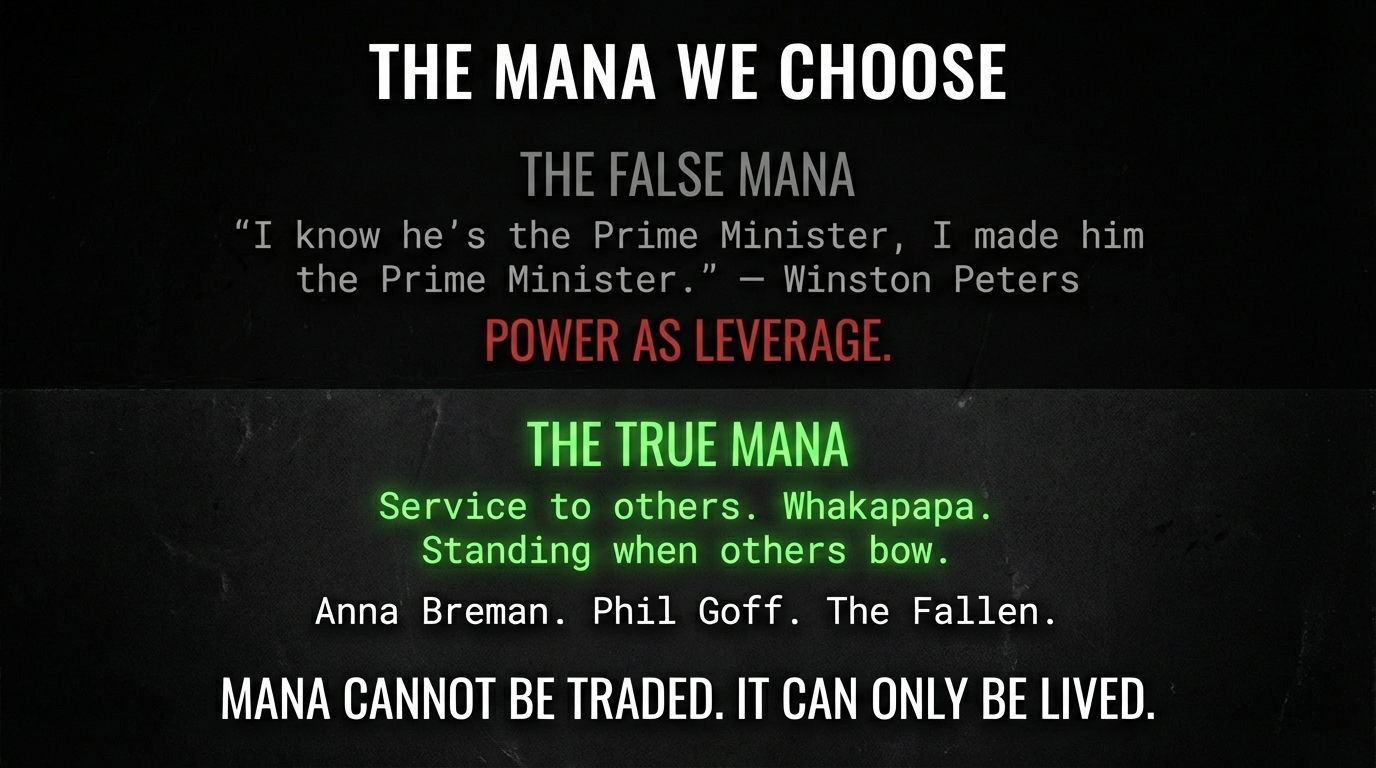
Anna Breman showed us this. When every other voice cowered, she stood with her fellow central bankers and defended institutional independence. She knew the cost—the Foreign Minister’s public rebuke—and did it anyway. That’s mana.
Phil Goff showed us this. When he could have stayed silent to protect diplomatic relationships, he spoke up for the soldiers Peters abandoned. “You can pay too high a price even for peace,” New Zealand told the British Empire at the 1937 Imperial Conference. Goff remembered that lesson. Peters forgot it.
The veterans who served in Afghanistan showed us this—Willie Apiata carrying his wounded comrade through enemy fire, choosing brotherhood over safety. The ten who never came home showed us this, paying the ultimate price for the principles their Foreign Minister won’t even mention.
We have a choice. We can follow Peters into the darkness of appeasement, where sovereignty means silence and patriotism means kowtowing to bullies. Where “New Zealand First” means New Zealand alone, cut off from the alliances and institutions that have protected us for generations.
Or we can remember who we are. A people who told the British Empire in 1937 that some principles are worth fighting for. A people who built the welfare state, who gave women the vote first, who took a nuclear-free stance when superpowers demanded we comply. A people who signed te Tiriti acknowledging partnership, who built the Waitangi Tribunal to face hard truths, who are slowly, imperfectly, learning to honor obligations we’ve shirked for 180 years.
That Aotearoa—the one that stands on principle, that defends the vulnerable, that works through multilateral cooperation instead of unilateral bluster—that’s the Aotearoa worth defending. Not Peters’ transactional, mercenary version where everything is for sale and everyone has a price.
The kōrero (narratives) we tell shape the world we create. Right now, Peters is telling a story of weakness disguised as strength, of surrender dressed up as sovereignty. It’s a lie—and a particularly corrosive one because it wears the mask of patriotism.
We need a different story. One rooted in tikanga that “binds all things” and “maps relationships so mythology, legend, history, knowledge are organized, preserved and transmitted”.
One that says:
we are strong because we keep our word, we are secure because we build relationships, we are free because we defend institutions that constrain arbitrary power.
One that says:
the mana of Aotearoa will not be traded away by a politician desperate to stay relevant. Not now. Not ever.
Kia kaha. Kia maia. Kia manawanui.
Be strong. Be brave. Be steadfast.
Koha Consideration
Every koha signals that whānau understand what Peters has forgotten:
true sovereignty is not transactional—it is relational.
When we fund independent voices willing to name appeasement for what it is, we exercise the rangatiratanga (self-determination) that Peters claims to defend but systematically betrays. We refuse the colonial logic that says we must choose between American power and voicelessness.
We demonstrate that mana cannot be traded, only lived.
This essay exists because communities chose to support truth-telling over political convenience.
Peters survives by making himself useful to power.
We survive by making truth useful to each other.
The research you’ve just read—tracing Peters’ silence on veterans, his attack on the Reserve Bank Governor, his undermining of the WHO—required dozens of verified sources, tikanga consultation, and historical analysis connecting Munich 1938 to Aotearoa 2026. That mahi continues only when whānau recognize its value.
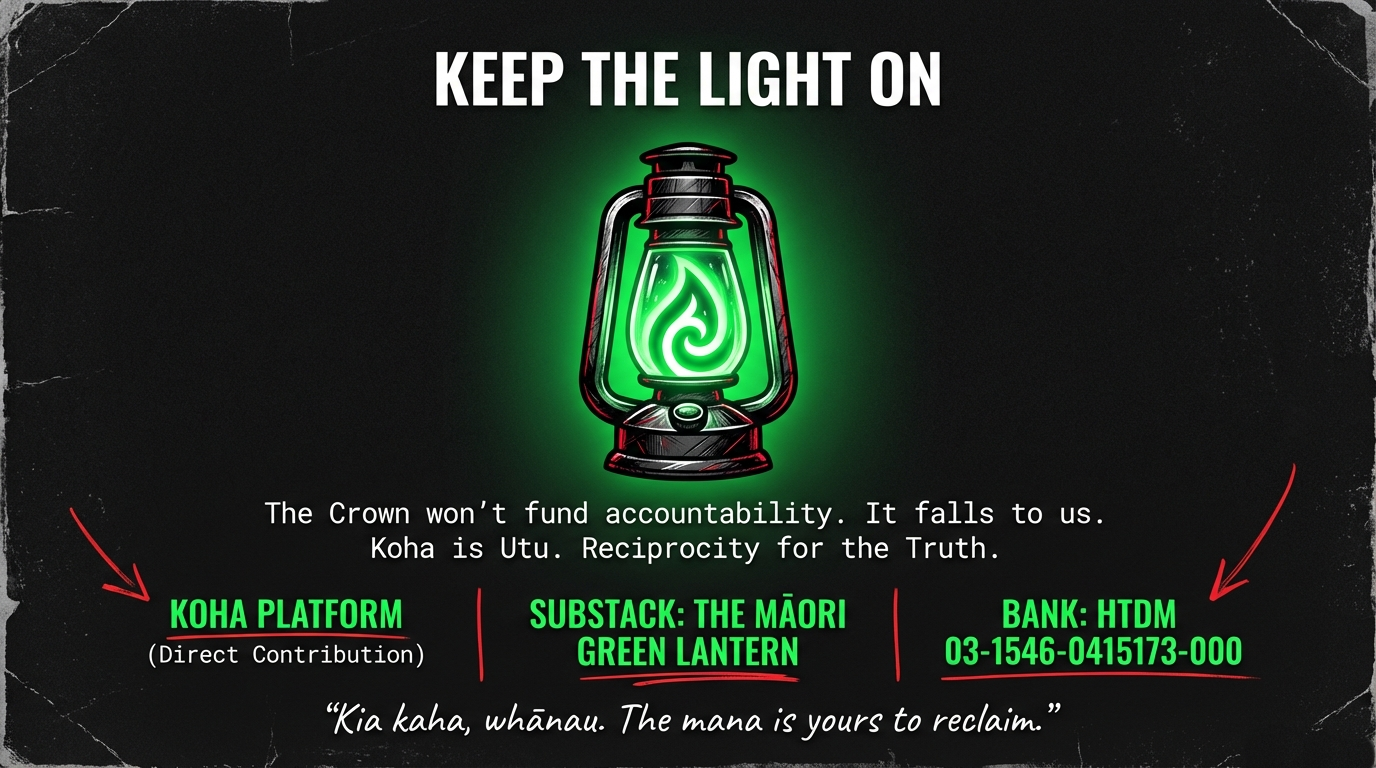
The Crown won’t fund accountability for Peters—they’re his coalition partners. Corporate media, increasingly captured by neoliberal logics that subordinate public interest to market imperatives, won’t consistently hold him to account.
That leaves us:
whānau who remember that kaitiakitanga includes guarding the truth.
If this essay strengthened your understanding of how appeasement corrodes sovereignty, how tikanga offers pathways to restoration, and how we might defend Aotearoa’s mana against those who would trade it away—consider a koha. Not as payment, but as utu—reciprocity that maintains the balance required for this mahi to continue.
Three pathways exist:
Direct koha (voluntary contribution): Koha Platform
Substack subscription (essays direct to your inbox): Subscribe to the Māori Green Lantern
Direct bank transfer: HTDM, account number 03-1546-0415173-000
Every koha—from $5 to $500—says: We will not be silenced. We will not bow. We will fund our own truth-tellers because rangatiratanga demands it.
Peters trades Aotearoa’s mana for political survival. We restore it through collective action.
Kia kaha, whānau. The mana is yours to reclaim.

Ivor Jones The Māori Green Lantern Fighting Misinformation And Disinformation From The Far Right