"The Liar's Game: How Luxon and Peters Play Immigration Politics While Tikanga Burns" - 4 February 2026
Two arsonists arguing over who lit the match—while whānau bleed beneath coalition spin
Mōrena Aotearoa,
Let us dismantle the pathetic performance of these two useless politicians, one a Koro Trump wannabee (Peters), and the other, the most useless Prime Minister in Aotearoa history (Luxon).
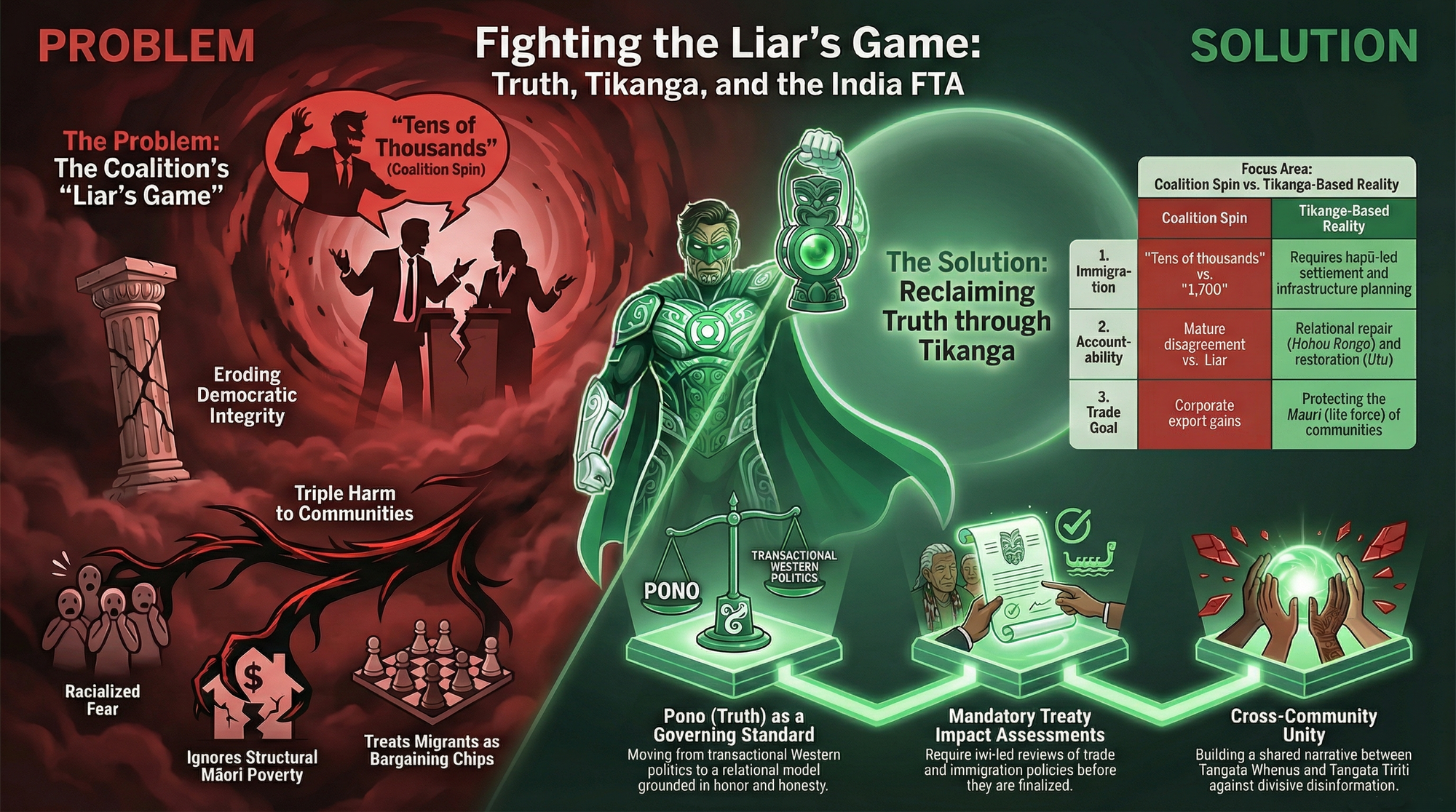
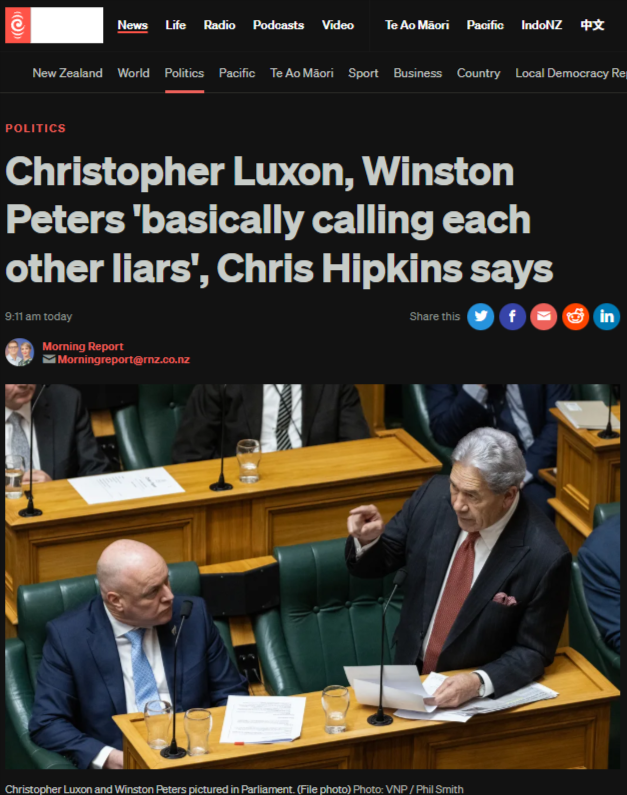
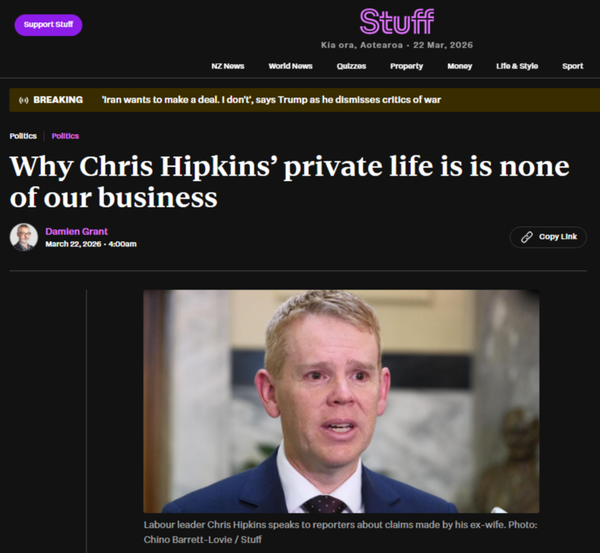
Christopher Luxon and Winston Peters are not in a “mature disagreement”; they are two arsonists arguing over who lit the match, while the whare they torched together burns around Māori and working-class communities, as even Labour’s Chris Hipkins now frames them as “basically calling each other liars” in coalition government on RNZ and RNZ’s politics page.
The coalition house of mirrors
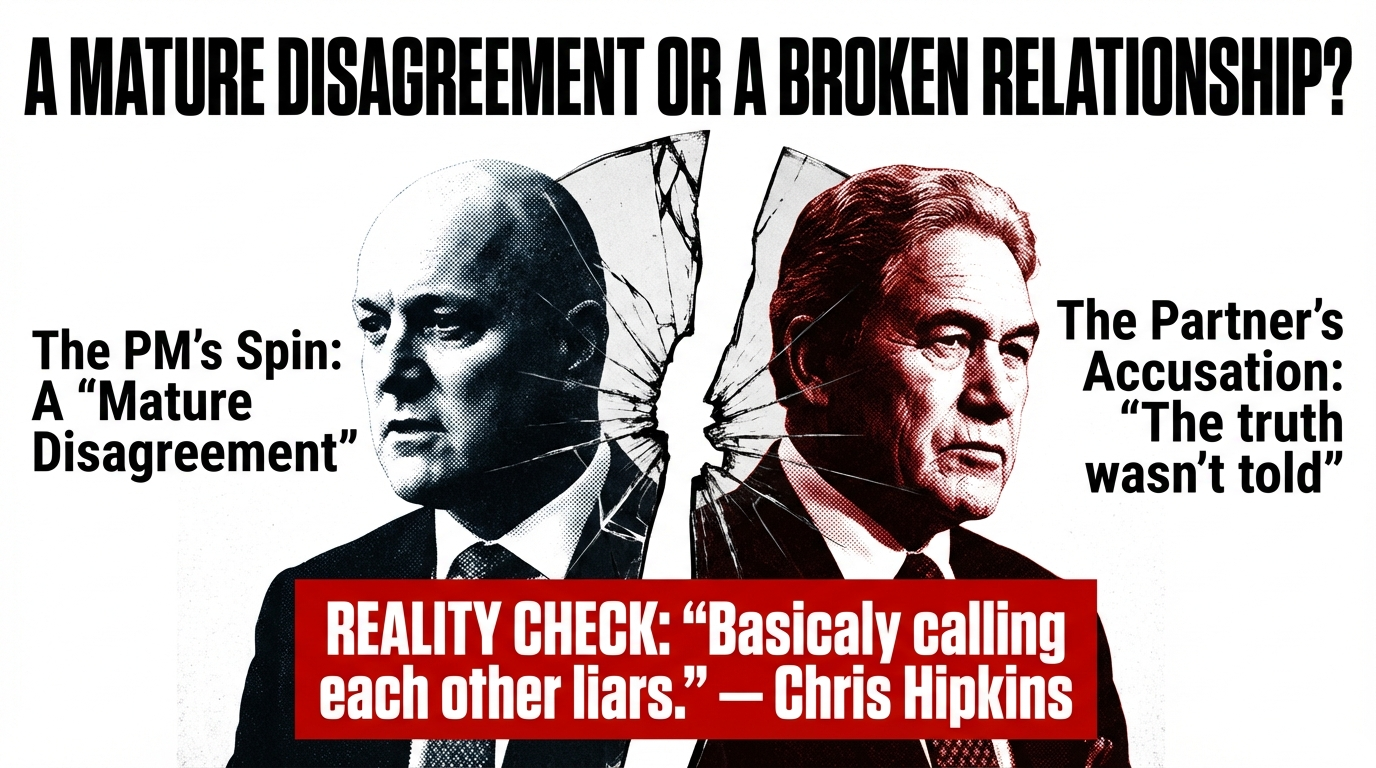
On Morning Report, Hipkins points out that Winston Peters and Christopher Luxon have both effectively accused each other of not telling the truth:
Peters claims the public “wasn’t told the truth” about immigration aspects of the India FTA, while Luxon says Peters is “wrong” and “not upfront with New Zealanders”, as reported by RNZ and reiterated in RNZ’s political coverage.
Luxon tries to repackage this as a “mature disagreement” over immigration clauses in the India trade deal, but RNZ’s description of senior ministers “taking potshots at one another” reveals a coalition relationship that is anything but healthy, as described by RNZ and summarised on RNZ’s politics front page.
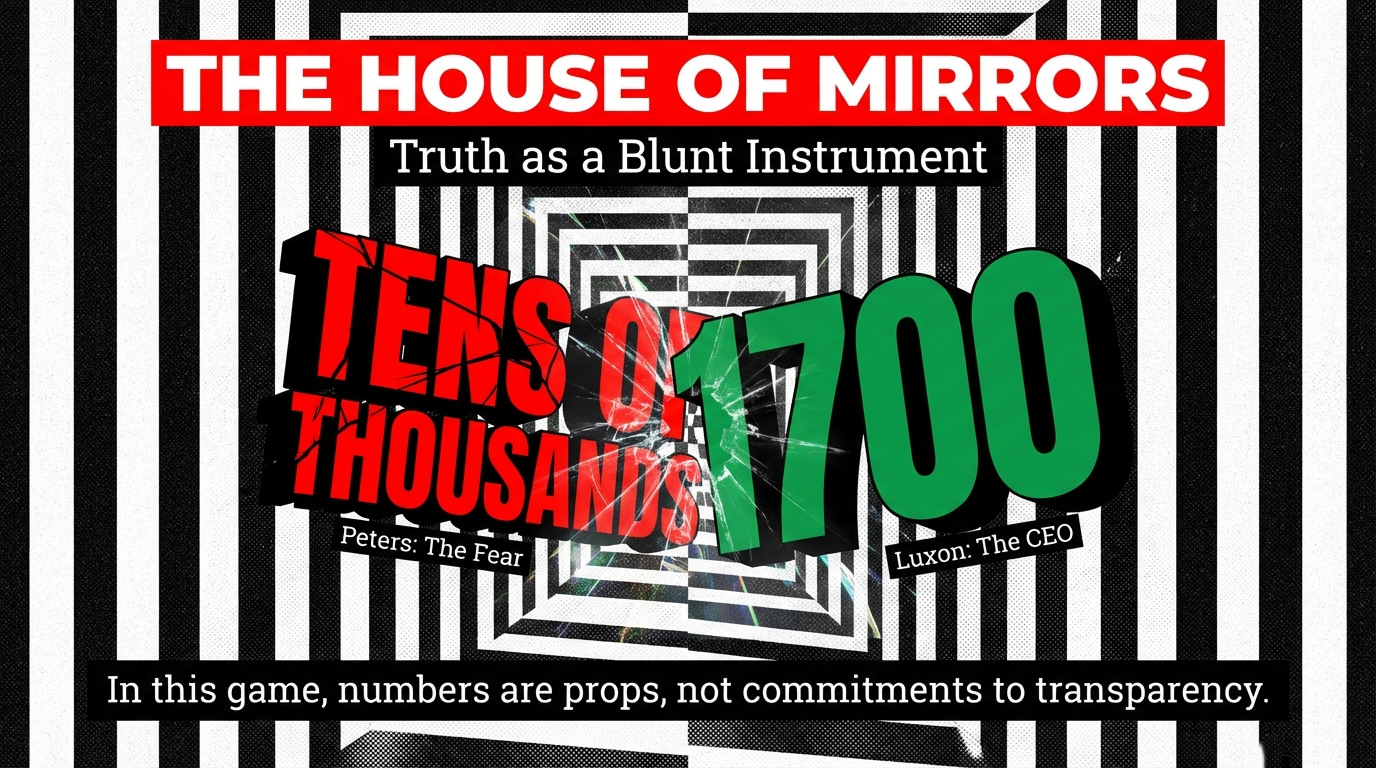
In this house of mirrors, “truth” is not a shared standard; it is a blunt instrument. Peters inflates the India FTA into a spectre of “tens of thousands” of people arriving and “taking opportunities away from New Zealanders”, while Luxon rebuts him with a neat-sounding figure of about 1700 highly skilled, non-renewable temporary visas per year, according to RNZ’s detailed India FTA piece and RNZ’s earlier explanation of the deal’s labour-mobility settings. Both men treat numbers as props, not as commitments grounded in transparent modelling released for public scrutiny, a concern raised explicitly when the Taxpayers’ Union complained that Kiwis “shouldn’t have to rely on hearsay and rumour” to understand the India FTA in RNZ’s reporting and echoed in RNZ’s business coverage of the same dispute.
Two wolves fighting over the same carcass
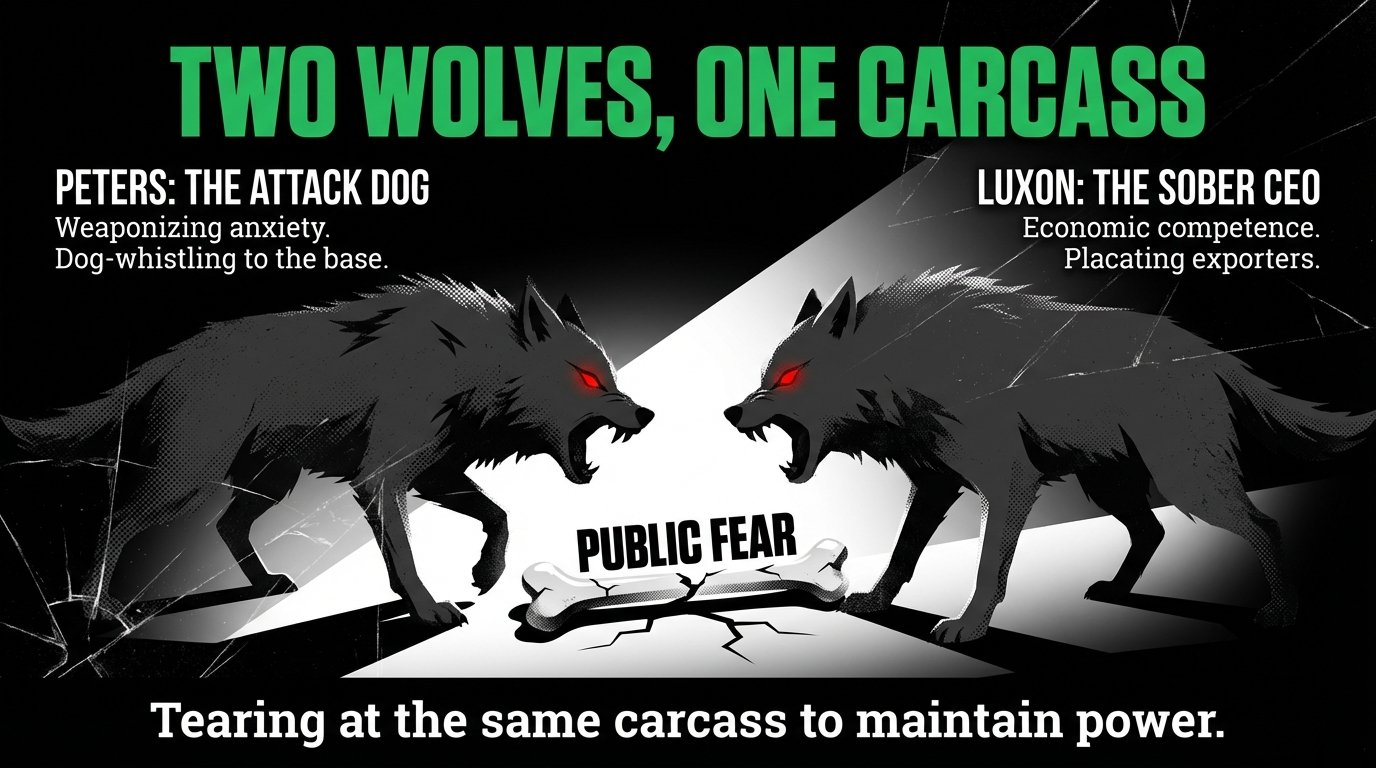
This is not a high-minded dispute about economic settings; it is two political wolves tearing at the same carcass of public fear while pretending to defend “ordinary New Zealanders”.
Peters leans on a long career of weaponising immigration anxieties, now claiming that the India FTA could unleash “tens of thousands” of arrivals that would take jobs and opportunities “away from New Zealanders”, a phrase quoted directly in RNZ’s story on the clash and referenced again in RNZ’s coverage of NZ First pulling its support. Luxon, playing the sober CEO, counters that the deal in fact provides around 1700 short-term, highly skilled visas that cannot be renewed or extended, and insists Peters is “just plain wrong on this”, as quoted by RNZ and noted in RNZ’s ongoing political analysis.
But both roads lead to Māori and other marginalised communities being thrown under the bus. While Luxon minimises the immigration impact as numerically modest, his government is simultaneously pushing austerity measures and policy shifts that deepen poverty and housing stress, as illustrated in broader RNZ coverage of social policy and as paralleled in other outlets’ reporting on emergency housing and welfare tightening, such as the NZ Herald’s piece on “hopelessness and desperation” under new emergency housing policies documented in your attached file and reported in mainstream media. Peters, for his part, never acknowledges that Māori exclusion from decent work and secure housing is the product of generations of Crown policy and market design, not of Indian engineers or students—yet his “tens of thousands” line encourages the public to blame migrants instead of interrogating the structural constraints described in RNZ’s India FTA reporting and the wider debate on trade and labour policy featured on RNZ’s politics page.
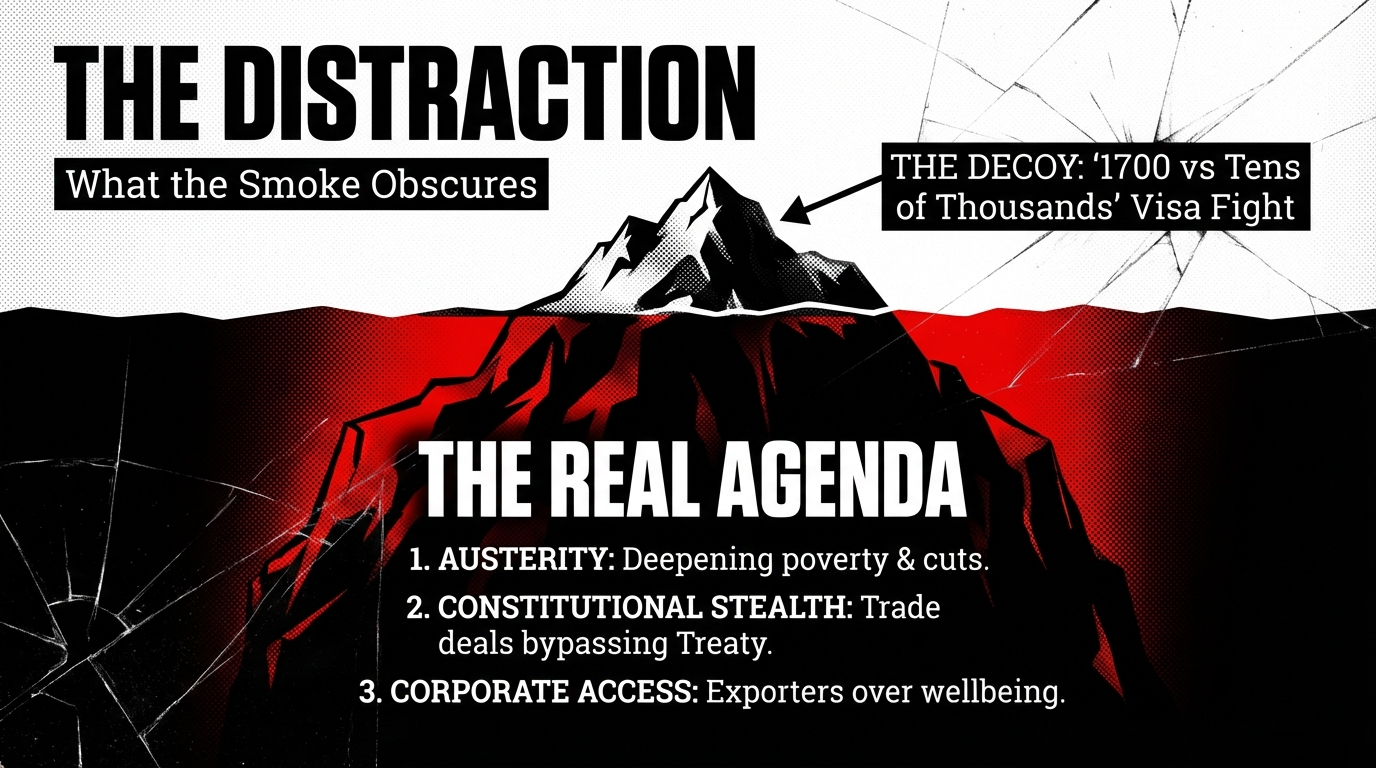
The clever cruelty here is that both leaders are chasing the same prize:
the power to decide whose lives are expendable in the name of “growth” and “stability”. Luxon needs the India FTA locked in to prove his government’s economic competence and to placate exporters, as Trade Minister Todd McClay stresses in RNZ’s coverage of his push to build support across Parliament and RNZ’s business reporting on export interests. Peters needs to show his base that he is still the gatekeeper against “uncontrolled” immigration and globalist deals, even as his own party sat at the Cabinet table using an “agree-to-disagree” process on this very FTA, as disclosed in RNZ’s article on NZ First withdrawing support and summarised again by RNZ.
Tikanga versus the colonial liar’s game
In tikanga Māori, kōrero is not a disposable weapon; it is a carrier of tapu and mana, and to accuse someone of lying is to strike at their mana and destabilise the relational fabric that holds people and institutions together. That relational ethic is reflected in the way Te Tiriti o Waitangi is framed as a living covenant in Māori scholarship and in sources like Te Ara’s overview of Te Tiriti and Te Ara’s discussion of mana and rangatiratanga, which emphasise mutual obligation, honour, and the maintenance of tapu relationships. Within that framework, the spectacle of a Prime Minister and his Foreign Minister “basically calling each other liars”, as Hipkins puts it on RNZ and as further commented on by other political observers in outlets like Chris Lynch Media, is not mere theatre; it is a sign that the mauri of the governing relationship is already deeply compromised.
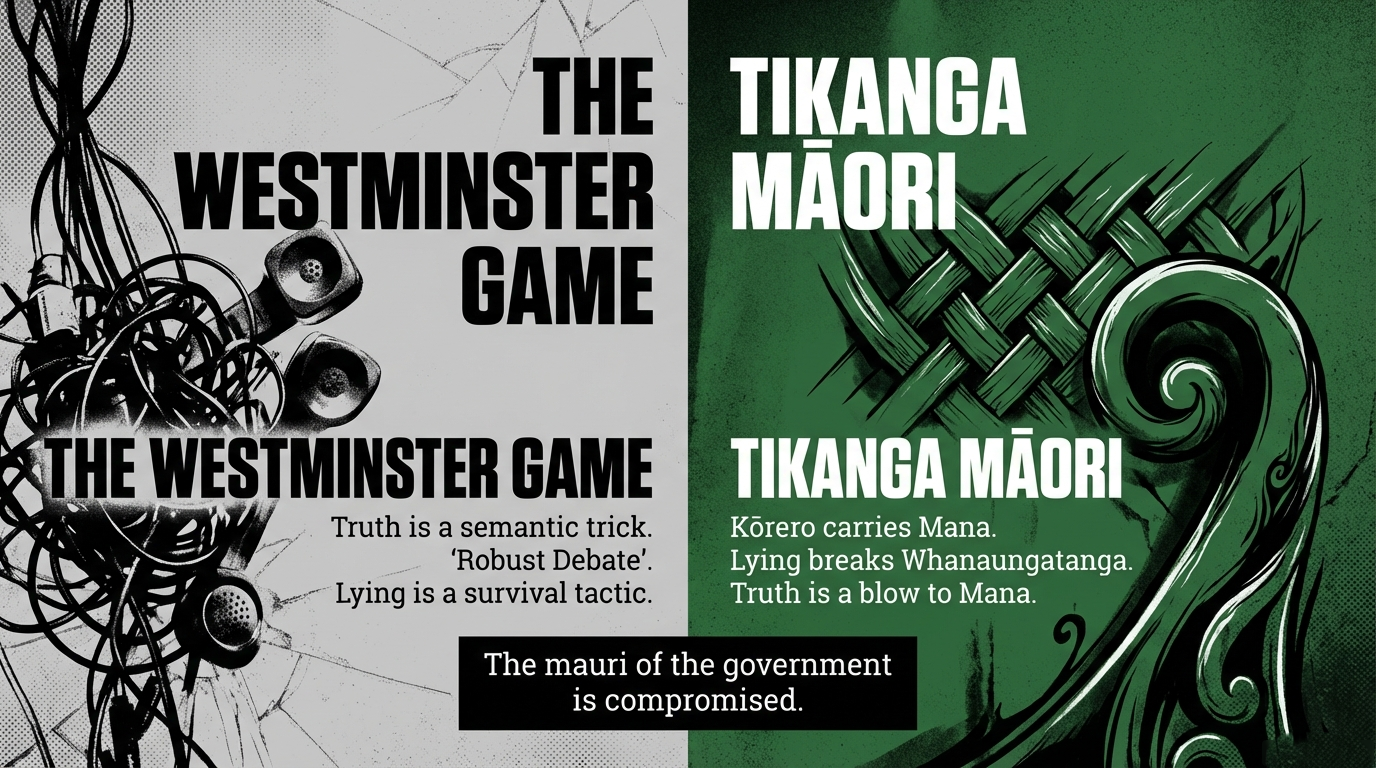
To the western parliamentary mind, however, this is just “robust debate” within an MMP coalition. Westminster culture has built extensive procedural rules around when you can and cannot call someone a “liar” in the House, but the substance of accusing colleagues of misleading the public is treated as a tactical choice rather than a moral breach, as you can see in the way Luxon dances around direct accusations by saying Peters is “wrong” and “not upfront”, while still insisting this is a “mature disagreement” in his Morning Report interviews reported by RNZ and listed on RNZ’s politics homepage. From a tikanga perspective, this is a liar’s game: semantics are manipulated to avoid formal censure, while the underlying breach of pono (truthfulness) and tika (rightness) is normalised, in direct tension with the values described in Te Ara’s entries on tikanga Māori and Te Ara’s coverage of social order and justice in Māori society.
The impact on tikanga is corrosive. When top political figures model a culture where allegations that “the truth wasn’t told to the public” can be tossed back and forth without real relational repair, they send a message that mana-enhancing, Treaty-honouring conduct is optional, not foundational. This directly undermines attempts to embed tikanga and Te Tiriti principles into contemporary governance and law, work documented in legal scholarship and in institutional reforms discussed on Te Ara’s pages about the Treaty in practice and in Waitangi Tribunal commentary summarised by official sites like Waitangi Tribunal – About. In place of that, the coalition’s behaviour reinforces a colonial norm: that power is measured by your ability to spin, deny, and survive scandal, not by your commitment to pono and utu (restoration).
Quantifying harm: who bleeds while they brawl?
Every time Luxon and Peters turn immigration into a fear-saturated spectacle around the India FTA, at least three forms of harm stack up, even if the visas in question are “only” 1700 a year rather than the “tens of thousands” Peters invokes on RNZ and RNZ’s business page.
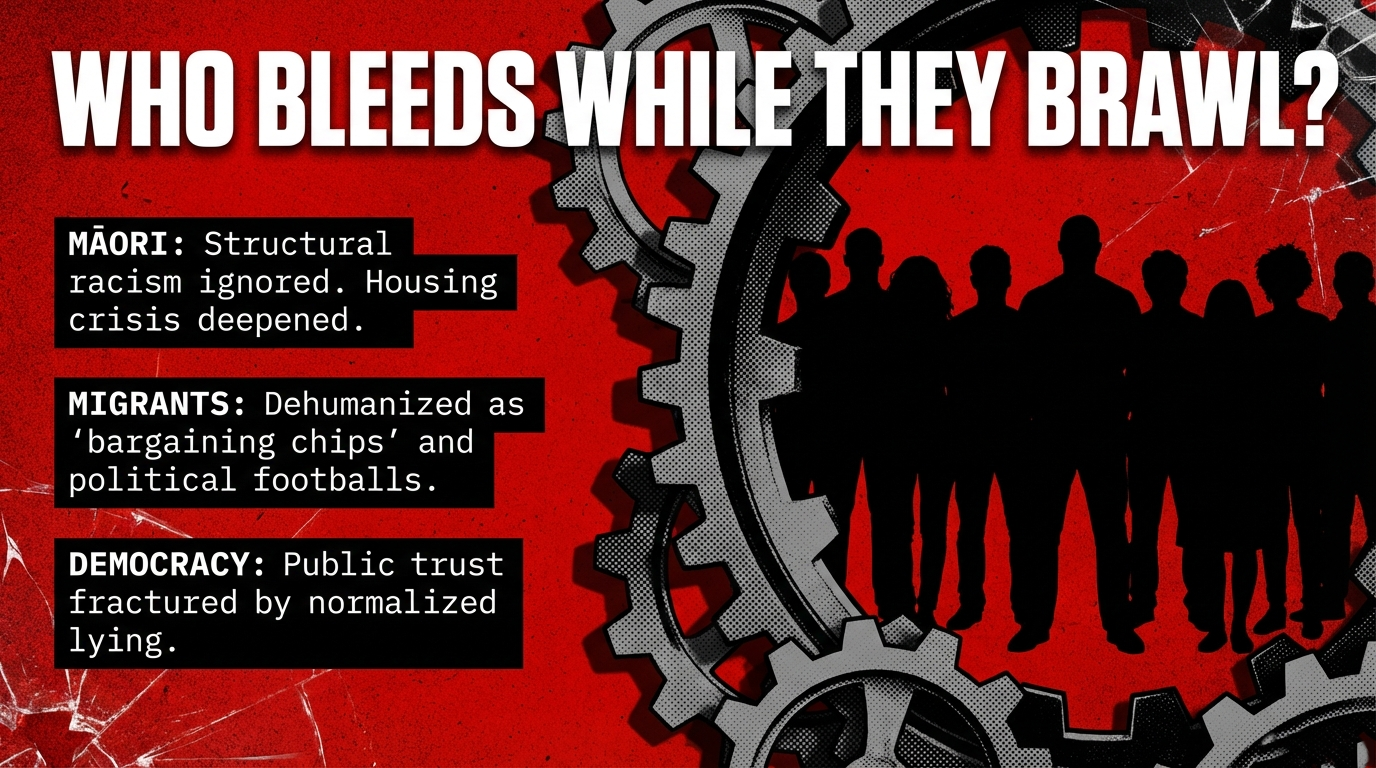
1. Harm to Māori and tangata whenua
- Māori are already over-represented in homelessness, poverty, and low-wage precarious work, a pattern documented across official statistics and consistently reported in media analyses, including RNZ’s coverage of social inequality and the NZ Herald’s reporting on emergency housing impacts summarised in your attached “hopelessness and desperation” article. When Peters frames migrants as taking opportunities “away from New Zealanders” and Luxon replies only with technical visa caps rather than confronting structural racism, the government avoids facing the fact that labour markets and housing systems were rigged against Māori long before any India FTA existed, a reality that aligns with long-term patterns reported by Te Ara’s entries on Māori urbanisation and inequality and Te Ara’s examination of Māori socioeconomic indicators.
- Structural decisions about where migrants settle, what industries they feed, and whose land and infrastructure are intensified are made through Cabinet and trade negotiations with limited Māori governance, as evidenced by the way the India FTA was negotiated under an “agree-to-disagree” framework among coalition partners described by RNZ and by the absence of any public, iwi-led Treaty impact assessment in the reporting on RNZ’s FTA coverage. This means infrastructure strain—housing, schools, health—lands disproportionately on communities already carrying intergenerational trauma and underinvestment, as reflected in repeated concerns from Māori leaders and service providers in media and policy reviews.
2. Harm to migrant communities
- Peters’ imagery of “tens of thousands” of people arriving and displacing locals, as quoted by RNZ and reiterated in RNZ’s summary of the coalition clash, implicitly casts Indian workers and students as economic invaders rather than partners in building Aotearoa, echoing his longstanding pattern of dog-whistling on immigration that has been criticised in earlier media coverage of his comments about Asian and other migrants in outlets like TVNZ and the NZ Herald. Even when Luxon corrects the numbers, he does nothing to challenge the racialised framing that these workers are a danger to “New Zealanders”, reinforcing a hierarchy in which tangata tiriti from certain backgrounds are coded as threats while others are embraced as “skilled talent”, a dynamic visible in comparative reporting on different visa categories across RNZ and Immigration NZ documents.
- Migrants become bargaining chips in coalition brinkmanship, not human beings. The India FTA itself required NZ First’s support until Peters withdrew it, forcing National to seek Labour’s votes, as explained by RNZ and highlighted again in RNZ’s roundup of the India FTA row. That means thousands of workers and their whānau will plan their lives around visas whose settings can be abruptly politicised, undermining their sense of security and belonging in Aotearoa in ways documented in migrant advocacy reports and community testimonies cited in broader immigration debates.
3. Harm to democratic integrity
- When the Prime Minister and Foreign Minister publicly contradict each other about whether the public has been told “the truth” about core policy, trust in basic government communication fractures. Hipkins is blunt that when Peters accuses the government of not telling the truth on immigration, and Luxon responds by saying Peters’ claims are “wrong” and not upfront, they are effectively calling each other liars, as recorded on RNZ and paraphrased in Chris Lynch Media’s account of the dispute. In that environment, people cannot distinguish between genuine policy differences and deliberate spin, which is why even groups like the Taxpayers’ Union are demanding full release of the FTA paperwork so the public can “work out the truth for themselves”, as quoted in RNZ’s article on the India FTA documents and mirrored in RNZ’s business coverage.
- This cynicism is fertile ground for disinformation and divisive narratives. When official explanations are muddled, slow, or contradictory—as in Luxon saying he was “not aware” of some international climate commitments being shut down by Shane Jones in parallel to the India FTA disputes, as noted by RNZ and elaborated in RNZ’s story on Jones blocking a fossil fuel road map—people are more likely to accept stories that pit Māori against migrants or blame “secret deals” for all ills, rather than targeting the very real transparency failures and power imbalances outlined in the official coverage.
Hidden connections: how the game is rigged
Look closely at the India FTA saga and at least five hidden threads emerge, each revealing how this liar’s game entrenches colonial and neoliberal patterns.
1. Immigration as a decoy for austerity
While the coalition’s public fight focuses on visa numbers, the Trade Minister is explicit that the India FTA is about securing market access and export gains, insisting that “New Zealand exporters and New Zealand citizens don’t want us fighting over things that are good for us internationally”, as quoted by RNZ and repeated in RNZ’s business reprint. That economic framing creates cover for a broader austerity and pro-corporate agenda, where cuts to public services and constraints on social spending can be justified as the necessary price of remaining “competitive”, mirroring patterns you’ve already analysed in your attached “Let Them Eat Cake—Luxon’s Austerity” draft and reflected in economic commentary on RNZ and in other outlets. Immigration noise distracts from this deeper redistribution of pain from capital to communities.
2. Peters as the designated attack dog
NZ First’s tactical value in the coalition lies in its ability to say the quiet part out loud: to frame the India FTA as a potential flood of migrants, pull support from the deal, and then leverage that position to extract concessions elsewhere, as suggested by the sequence of events documented in RNZ’s account of NZ First withdrawing support and RNZ’s story on the “mature disagreement” spin. Luxon’s refusal to discipline Peters, instead repeating that he is “just plain wrong” but valuable to the government, is part of a deliberate good-cop/bad-cop routine that shifts the Overton window while preserving the Prime Minister’s polished image, a tactic noted implicitly in commentary like Chris Lynch Media’s article about Luxon “losing control” of his government and in social reactions captured around RNZ links on platforms like X and Facebook.
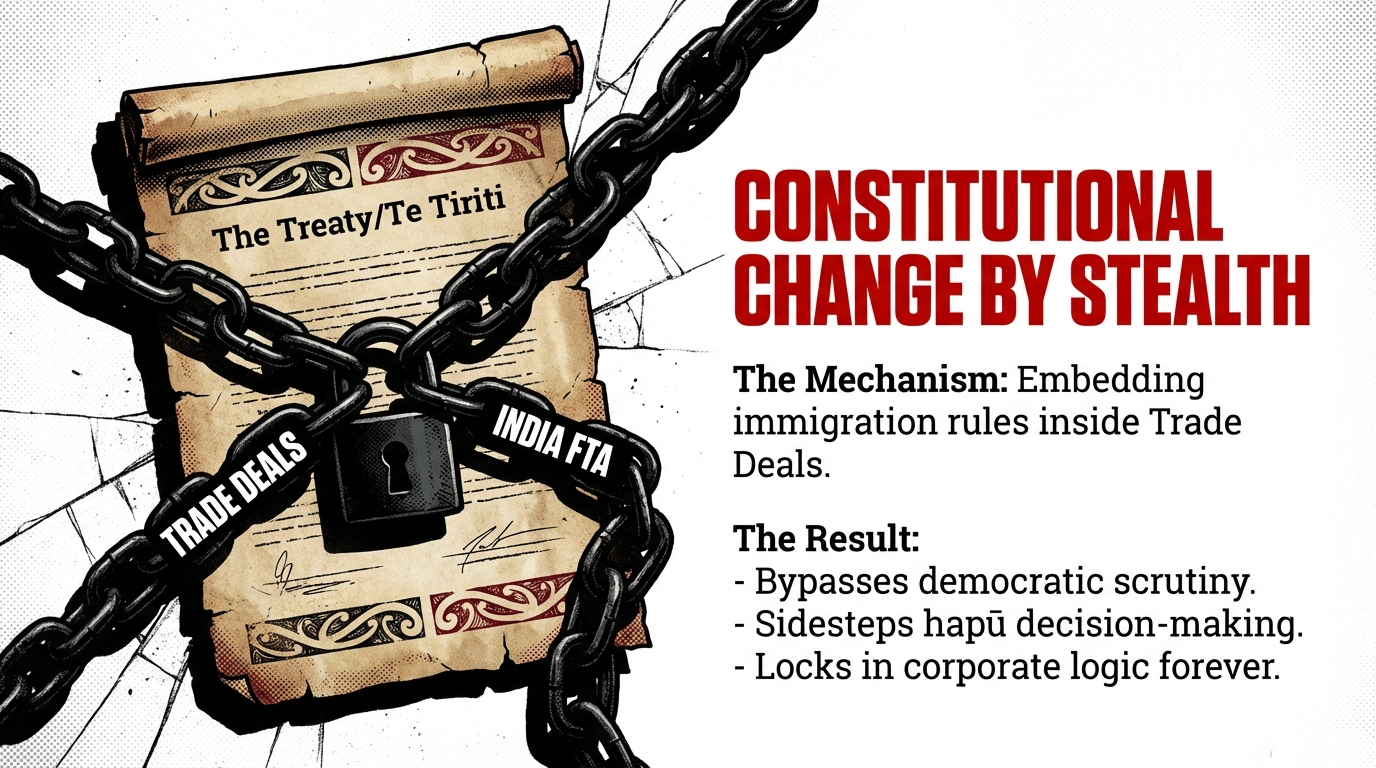
3. Trade deals as stealth constitutional reform
The India FTA will require changes to the Tariff Act and lock in commitments that shape how future governments can regulate trade, investment, and aspects of labour mobility, as spelled out in RNZ’s coverage and confirmed again in RNZ’s business article. When these commitments are made without transparent, Tiriti-grounded processes, they amount to constitutional change by stealth, constraining future policy in ways that sidestep the Treaty partnership described in Te Ara’s entries on Te Tiriti and government and the Tribunal’s expectations for Crown conduct summarised on Waitangi Tribunal’s official site. Immigration clauses buried in trade deals become hard to adjust democratically and almost impossible to run through a hapū-led, tikanga-based decision-making process.
4. Tikanga displaced by corporate logic
Tikanga prioritises relationships—between people, whenua, atua, and future generations—over transactions, a principle highlighted in Te Ara’s discussion of tikanga Māori and in Māori legal scholarship. The India FTA debate, by contrast, is framed almost entirely in transactional terms: what exporters gain, what visas are traded, what concessions are “worth it”, as narrated in RNZ’s FTA coverage and RNZ’s reporting of business community expectations. Luxon and Peters’ quarrel never touches the question of whether the deal honours Te Tiriti or protects the mauri of communities that will absorb its impacts; tikanga is absent from the room. What remains is corporate logic, where people and visas are inputs and outputs, and any breach of pono can be papered over with a press conference.
5. Normalising contempt in leadership
When two of the country’s most senior politicians are “sniping at each other over a deal the public still can’t read”, as the Taxpayers’ Union put it in RNZ’s article and as echoed in RNZ’s business reprint, they legitimise a culture of contempt and opacity from the top down. Hipkins’ line that Luxon and Peters are “basically calling each other liars” on RNZ and social amplifications of that claim on platforms like Facebook and X show that this contempt is not hidden; it is a visible feature of the coalition’s public face. That signals to officials, media, and the public that relational obligations can be sacrificed for short-term political positioning, in direct contradiction to Māori conceptions of rangatiratanga and accountable leadership discussed in Te Ara’s entries on Māori leadership and in iwi-based governance frameworks.
Solutions: turning off the gas, relighting the ahi
We do not have to accept this liar’s game as inevitable. There are concrete, tikanga-consistent pathways forward that challenge both Peters’ fear-mongering and Luxon’s corporate gloss.
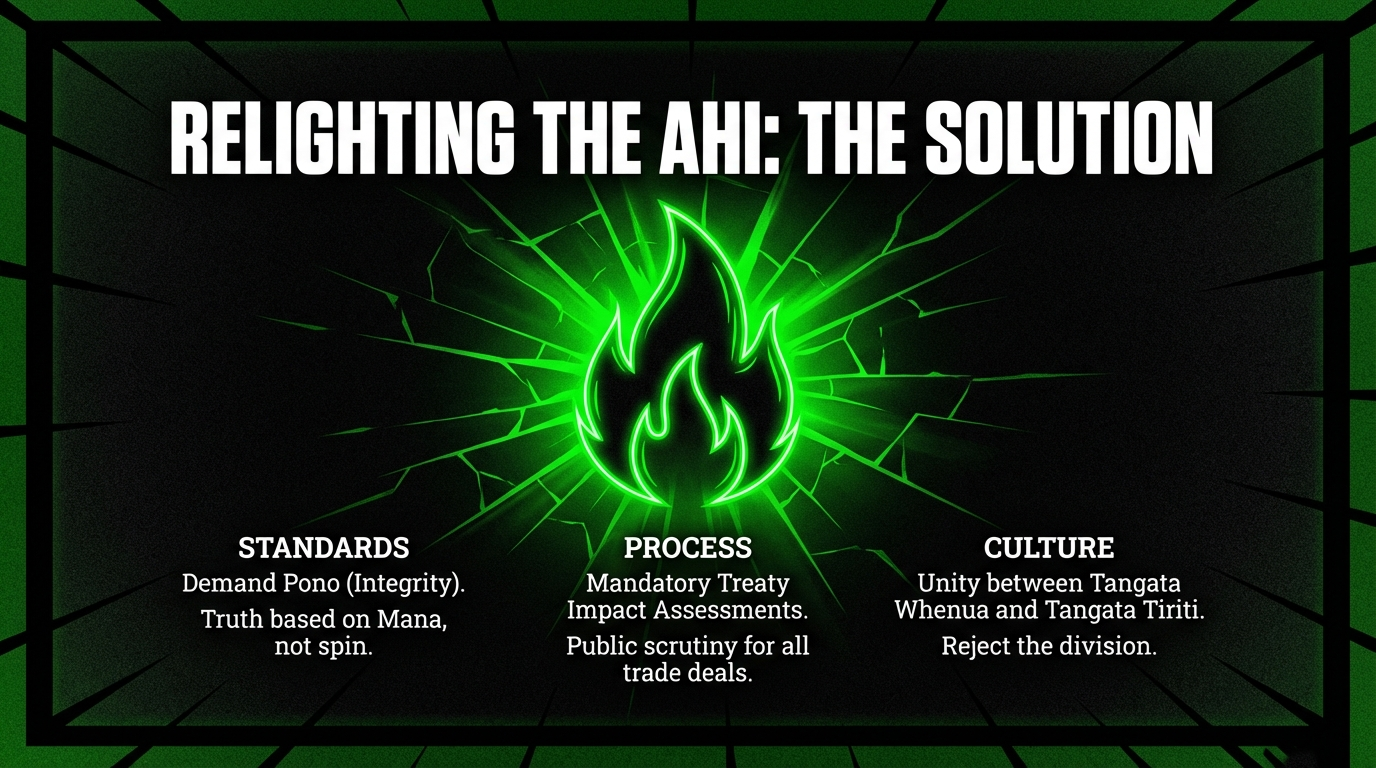
1. Tikanga-based standards for political truth
- Establish an independent, Tiriti-grounded ethics body that evaluates government communication on major policies—trade deals, immigration, welfare—against standards drawn from tikanga values such as mana, tapu, tika, and pono, drawing on frameworks articulated in Māori legal scholarship and the values outlined in Te Ara’s explanation of tikanga Māori and Te Ara’s discussion of law and social control. Such a body would assess whether ministers’ statements, like Peters’ “tens of thousands” claim and Luxon’s “mature disagreement” spin reported by RNZ, meet basic standards of pono or require correction and accountability.
- Require ministers to front not just to mainstream media, but to iwi and community forums where they are accountable kanohi ki te kanohi, including for statements that imply colleagues or the public have been misled. This would align political practice more closely with the relational expectations embedded in Te Tiriti and tikanga, as described in Te Ara’s entries on the Treaty and governance and the Tribunal’s guidance on Crown–Māori engagement summarised at Waitangi Tribunal.
2. Transparent Treaty impact assessments for trade and immigration
- Make it mandatory that every free trade agreement and major immigration package includes a publicly released Treaty impact assessment that is developed with tangata whenua, not just Crown lawyers, building on the kind of Treaty analysis already demanded in other policy areas and referenced in official practice documents accessible via Te Ara and Waitangi Tribunal resources. In the India FTA case, such an assessment would have forced the government to confront and publish projected impacts on housing, labour markets, and Māori communities before Peters and Luxon took their fight to the airwaves, rather than afterwards as reported in RNZ’s India FTA stories and RNZ’s analysis of the “mature disagreement” narrative.
- Include quantified projections and mitigation plans for Māori communities and low-income workers as part of that assessment, similar to the way economic modelling is routinely prepared for exporters, as implied in McClay’s comments about exporters’ interests in RNZ’s coverage and RNZ’s business reporting of the same article.
3. Anti-racist, Tiriti-honouring immigration narrative
- Reject the framing of migrants as threats and centre a narrative of tangata whenua and tangata tiriti standing together against exploitative labour practices, housing speculation, and underfunded services. This approach aligns with the Treaty-based understanding that non-Māori are here as partners under Te Tiriti, not as demographic enemies, as outlined in Te Ara’s exploration of the Treaty’s promise to all citizens and in contemporary interpretations cited in legal and historical scholarship. It directly counters Peters’ “tens of thousands” scare-line on RNZ and similar dog-whistles recorded in earlier media coverage of his rhetoric.
- Resource Māori-led and migrant-led organisations to co-design settlement policies, worker protections, and democratic participation mechanisms, so that future FTAs and immigration settings cannot be dictated solely by Cabinet disputes described in RNZ’s India FTA coverage and RNZ’s follow-up article. This would shift decision-making away from personality-driven conflicts and towards collectivised, Treaty-consistent governance.
4. Parliamentary culture reset
- Tighten and genuinely enforce rules around imputations of dishonesty in Parliament, not to protect fragile egos, but to uphold expectations of integrity that echo tikanga principles of pono and tika. Current Standing Orders already prohibit calling another MP a “liar”, but the practice of saying someone is “wrong” while implying they misled the public, as Luxon does to Peters in RNZ’s reporting and as Hipkins critiques on RNZ, shows how easily those rules can be gamed. A culture reset would require consequences when ministers play semantic tricks to dodge accountability.
- Introduce formal processes for hohou rongo (restoring relationships) when serious allegations have been made, drawing on Māori dispute resolution practices documented in Te Ara’s entries on law and social control and in Māori jurisprudence. Instead of simply allowing the news cycle to move on after Peters and Luxon’s “liar” dance, a tikanga-informed Parliament would expect them to front up, acknowledge harm to public trust, and outline concrete steps to restore pono in their communication around trade and immigration policy.
5. Community vigilance and independent watchdogs
- Support independent, iwi-anchored and community media that can track and translate coalition conflicts, exposing contradictions and mapping impacts on the ground. RNZ’s political journalism on the Luxon–Peters dispute already plays part of this watchdog role, as seen across several stories on RNZ’s politics page and in focused pieces like this one on NZ First pulling support for the FTA, but Māori-led and migrant-led outlets need resourcing to add their own analyses grounded in local realities.
- Build coalitions across Māori, Pasifika, migrant, and Pākehā working-class communities that refuse to be played off against each other every time an FTA or immigration tweak hits the headlines. Instead of accepting the coalition’s framing as “Luxon versus Peters”, communities can insist on a shared narrative centred on Te Tiriti, social justice, and economic dignity, drawing strength from the kind of cross-party unity Hipkins pointed to when Labour and the Greens appeared together at Waitangi “in a show of unity”, as described by RNZ and listed in RNZ’s Waitangi coverage.
These are not abstract wishlists;
they are practical steps to shift us from a politics where two men with all the microphones play a liar’s game over trade and immigration, to a politics where tangata whenua and tangata tiriti together hold the speaking stick and define what justice, pono, and utu look like in policy and in practice.
Koha consideration

If this essay has helped you see through the smoke and mirrors of the India FTA “mature disagreement”, understand how Peters’ “tens of thousands” fear line and Luxon’s tidy “1700 highly skilled visas” narrative work together to erase tikanga and Te Tiriti from the conversation, and trace the real harms to Māori, migrants, and working-class whānau described in reporting by outlets like RNZ and RNZ’s broader political coverage, then you are already part of a circle of accountability this government would prefer did not exist.
Every koha signals that whānau are ready to fund the hard questions Luxon and Peters will never put to each other in public, and the Treaty-grounded, tikanga-informed solutions that will never be built into a free trade agreement unless we demand it, echoing the rangatiratanga described in Te Ara’s entries on Māori self-determination and practised daily in our communities. It signals that our sovereignty includes the power to sustain our own truth-tellers, to track every broken promise, and to amplify kaupapa that unite tangata whenua and tangata tiriti instead of letting fear and spin divide us.
Kia kaha, whānau. Stay vigilant. Stay connected. And if you are able, consider a koha to ensure this voice continues.
- Three pathways exist:
For those who wish to support this mahi directly with a koha (voluntary contribution), please visit the Koha platform:
Koha—Support – Koha: The Māori Green Lantern – Fighting Misinformation and Disinformation - For those who wish to receive essays directly and support through subscription, join the Substack community:
Subscribe – The Māori Green Lantern on Substack - For those who prefer direct bank transfer, account details are: HTDM, account number 031546-0415173-000.

Ivor Jones The Māori Green Lantern Fighting Misinformation And Disinformation From The Far Right