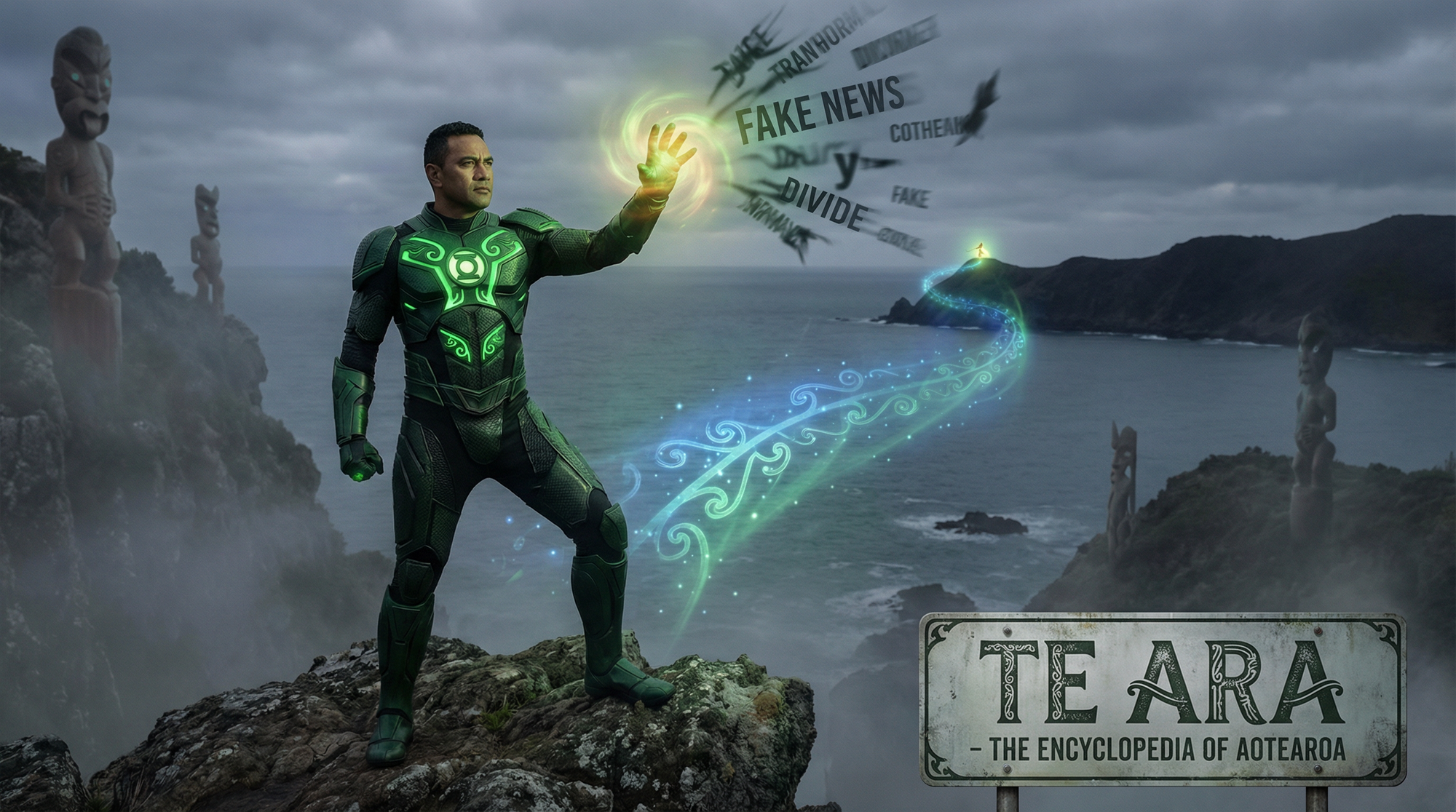
“The Māori Green Lantern Exposes Shane Jones’ Mining Mythology & the Slow Strangulation of Māori Broadcasting” - 30 December 2025
How a Desperate Broadcaster Lost Its Voice While a Predatory Minister Sold Phantom Jobs to the Desperate
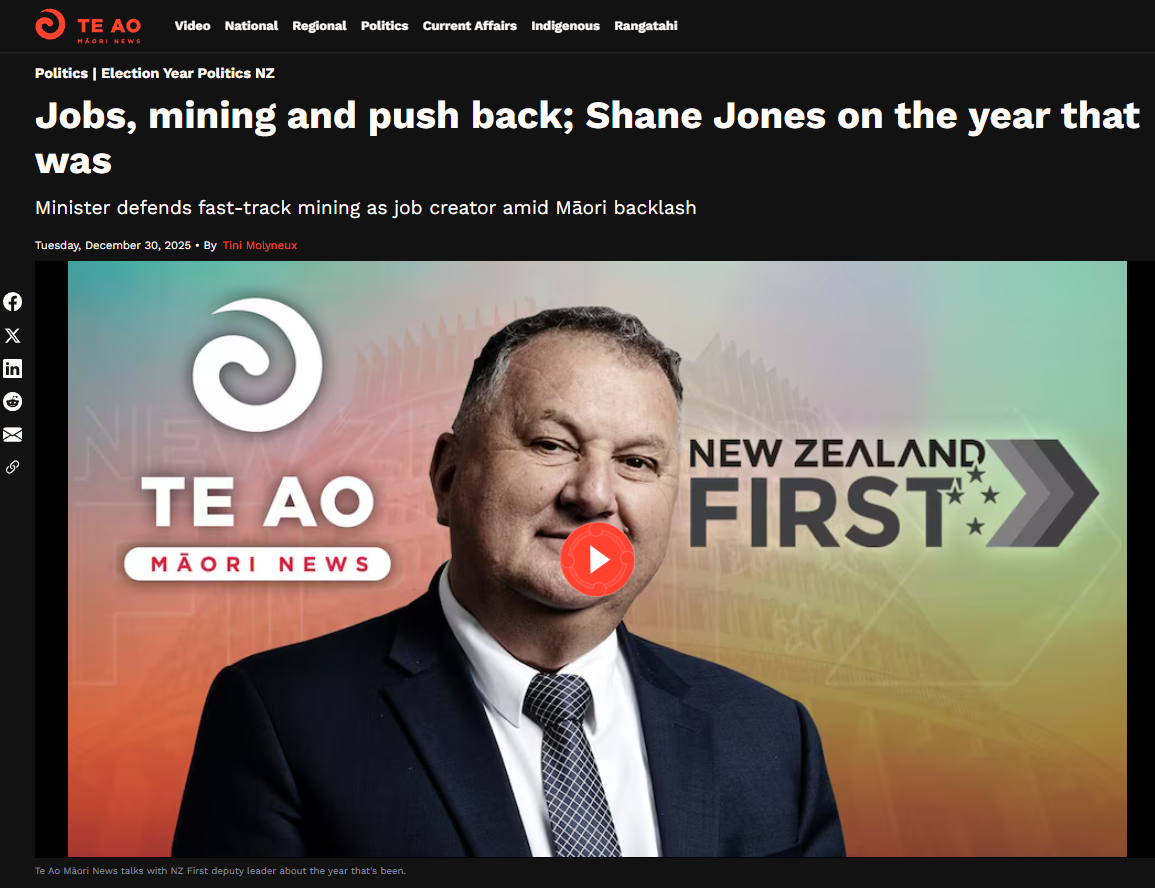
Te Ao Māori News on Shane Jones and mining,
published 30 December 2025
—is not propaganda in the crude sense.
It’s worse.
It’s the sound of a mortally wounded institution whispering the lies fed to it by a man who has weaponised state power to extract wealth while dismantling the institutions capable of exposing his con.
Shane Jones stands at the intersection of three ministerial portfolios
—Resources, Regional Development, Oceans and Fisheries
—in a position of extraordinary power, and
he is using that power NOT to serve whānau,
but to serve the mining companies that will enrich him and
his political allies while
Māori bear the environmental and
cultural cost.
This is a masterclass in how structural violence operates:
not through direct censorship, but through the slow strangulation of a broadcaster’s ability to investigate power—and
through the calculated deployment of phantom job promises to manufacture consent from the desperate.

Shane Meets The MGL And Shits His Pants
The Phantom Jobs Machine: A Con Built on Multipliers and Lies
Shane Jones stands before Te Ao Māori News and claims mining will “create jobs.” Tini accepts his assertion without pushback, without numbers, without context—because her newsroom has been bled dry. This is not editorial laziness. This is the inevitable outcome when a state broadcaster is starving and the man who controls the purse strings is also the man making the grandiose claims.
Let me trace the actual data:
What Jones Promised:
- Waihi North: 800 jobs over 18 years as reported in Fast Track Approvals economic assessment
- Bendigo-Ophir: 850+ direct and indirect jobs, $5.8B to GDP as reported by RNZ covering Santana Minerals near Central Otago
- Trans-Tasman seabed mining: 1,350 jobs (including 300 in Taranaki) as reported by 1News on fast-track seabed mining opposition
- Total fast-track mining: 2,500+ jobs claimed across all projects
What Actually Exists:
As of June 2025, the entire New Zealand mining sector employed 7,470 people according to RNZ’s sector wage analysis.
By September 2025, mining employment had declined 5.6% year-on-year according to Stats NZ labour data.
Let that sink in.
The minister overseeing mining expansion is making promises at the exact moment the mining sector is contracting.
Only ONE of Jones’ flagship mining projects—Waihi North—has been approved (announced 17 December 2025), and it hasn’t generated a single new job yet. The rest are in the pipeline, gathering dust, waiting for the fast-track machinery to grind forward, and Jones is already claiming victory to a starving broadcaster that cannot fact-check him.
The economist’s analysis of Waihi North reveals the sleight of hand so transparent it borders on insulting:
of the 859 projected jobs, only 197 are direct mine employment. The rest are “indirect” (suppliers, contractors) and “induced” (spending by workers). These are multiplier effects—speculative, contestable, and routinely overstated by mining proponents desperate to justify their extraction.
—a polite euphemism for “we have no fucking idea.”
The cui bono question—who actually benefits:
International mining corporations (most foreign-owned).
Shane Jones and his ministers (expanded power, corporate donations, lobbying relationships, post-parliamentary board seats).
Who bears the cost:
Māori whānau in Taranaki, Southland, and the Bay of Plenty, whose moana and whenua will be sacrificed. Whose children will inherit poisoned waters and dead seabeds. Whose tangata whenua rights are being erased through bureaucratic fast-track procedures designed by Jones himself.
This is not economics. This is theft dressed up as development
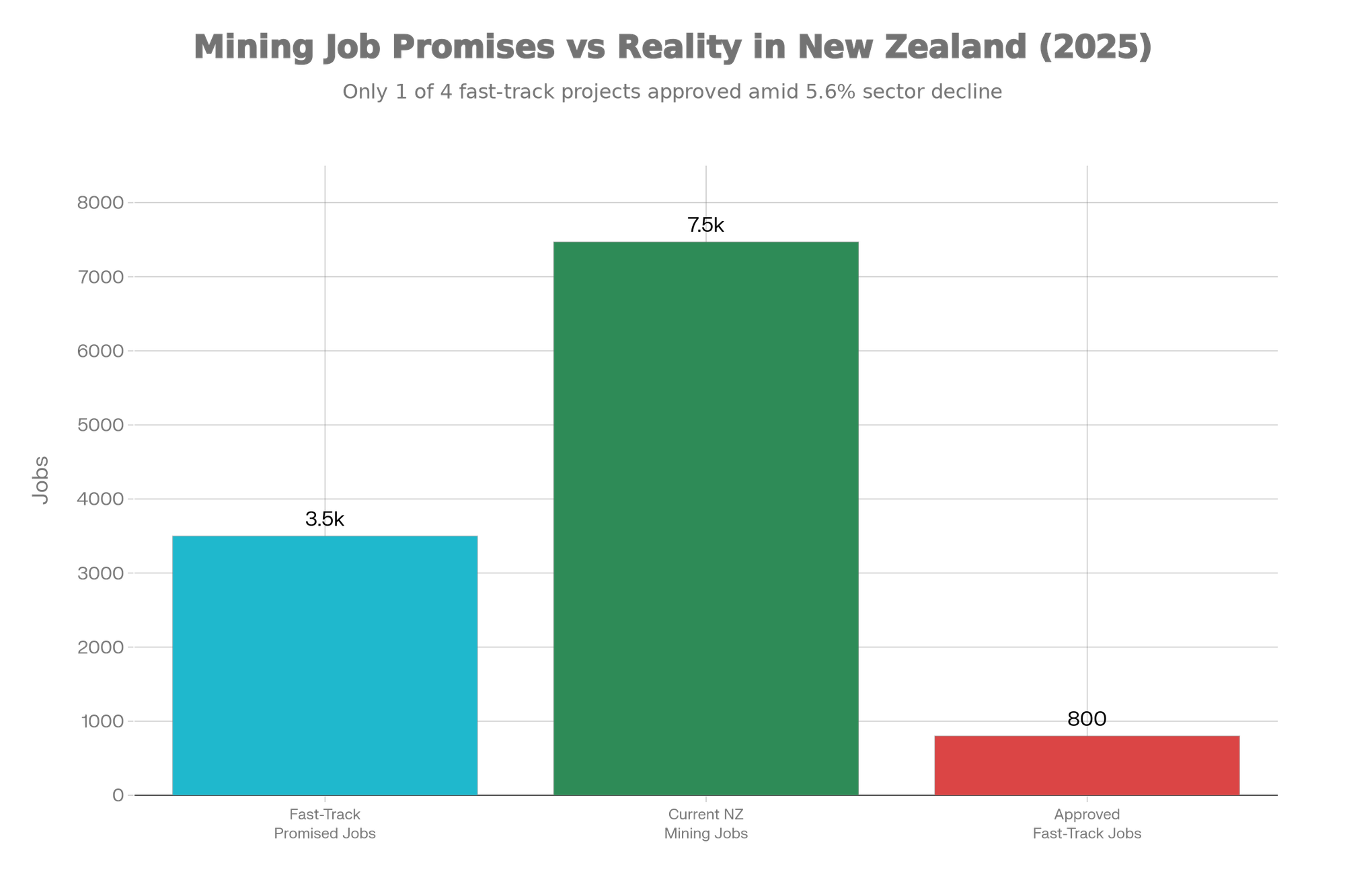
Mining Job Promises vs. Actual NZ Mining Employment Reality (2025)
The Journalism That Wasn’t Done—And Why Jones Made Sure of It
The Te Ao Māori News article commits a cardinal sin:
it quotes Shane Jones without allowing iwi to respond directly. More damningly, it doesn’t even attempt to provide context that any competent journalist would instinctively reach for.
What the article does not say:
- Trans-Tasman Resources has lost every court case for a decade. The Supreme Court sided with Ngāti Ruanui and rejected the seabed mining application. The courts—the democratic institutions specifically designed to protect tangata whenua rights and environmental standards—said NO. And Shane Jones, contemptuous of those verdicts, designed the fast-track bill specifically to resurrect proposals that the courts already rejected. He didn’t just sideline Te Tiriti; he sideline the judiciary itself.
- A panel convener recently described Trans-Tasman’s engagement as “cynical.” RNZ reported that panel organizer Jennifer Caldwell said the company showed “little, if any assistance” to the process. This is not opinion; it’s an official finding from the EPA-appointed chair. The company itself—Trans-Tasman Resources—is operating with such open disdain for the process that even the government’s own panel organizer was forced to put it on record. And still the fast-track grinds forward under Jones’ watch.
- 95% of public submissions on the fast-track amendment bill opposed the government’s changes. RNZ documented that of 6,500+ submissions, only around 300 supported the amendments. This is not ambiguity; it is democratic repudiation. Whānau, iwi, councils, environmental groups, scientists—95% said NO. And Jones ignored them. Because the fast-track bill was never designed to represent the will of the people. It was designed to represent the will of the extractors.
- Hapū and iwi have filed a Waitangi Tribunal claim alleging Crown breaches of Te Tiriti. 1News reported that iwi are claiming the fast-track process amounts to colonisation by procedural means. Not environmental damage. Not mere injustice. Colonisation. And they’re right. The fast-track bill is a mechanism designed by Jones and his government to extract resources from Māori rohe, distribute the wealth to foreign corporations and Crown coffers, and leave whānau with the environmental wreckage. It is colonialism by statute.
- Debbie Ngarewa-Packer, Te Pāti Māori co-leader and former Ngāti Ruanui chief executive, has spent a decade fighting this. As reported by 1News on iwi unified opposition, she knows exactly what Trans-Tasman has been saying to hapū behind closed doors for ten years. She knows how many promises were broken. She knows how contemptuous the company has been toward tangata whenua engagement. And Jones, sitting in Parliament with authority over three critical ministerial portfolios, has decided that her decade of kaitiakitanga—her protection of her hapū’s birthright—is an obstacle to be fast-tracked around.
None of this appeared in the article. Why? Because a well-resourced, independent newsroom with 27 journalists and sufficient budget to investigate would have pursued these angles relentlessly. A starving newsroom—one that has just lost 27 staff, one whose daily news program was just killed after 20 years, one whose funding was just slashed by $16 million annually—cannot. And Shane Jones knows this. This is the point. Defund the broadcaster. Make its survival precarious. Then make your claims to it, confident that resource starvation will prevent adequate scrutiny.
It is predatory. It is calculated. It is contempt for democracy disguised as fiscal responsibility.

Shane The Predator
Whakaata Māori: The Strangled Institution
Whakaata Māori is a state-owned broadcaster, established by statute in 2003. It receives direct Crown funding. It is not an independent outlet.
BUT—and this is the trap—it is not directly controlled by Shane Jones or any single minister in the crude sense. It operates as a public broadcaster with editorial independence, similar to RNZ. Its board and chief executive (kaihautū) have statutory obligations to fulfill a public service remit.
The Real Problem: Calculated Starvation as a Tool of State Control
The issue is not crude government control. It’s something more insidious—and more effective:
deliberate underfunding coupled with the withdrawal of temporary boosts, which creates desperation and forces editorial compromises. It’s the slow asphyxiation of an institution, disguised as budgetary management.
Here’s the mechanism:
- 2008–2023: Te Māngai Pāho (the Māori media funding agency) received $50 million annually with zero increase for 16 years. Sixteen years of stagnation while inflation ate into purchasing power, while demands on Māori media grew, while the digital landscape transformed. And the government did nothing. This was not neglect; this was calculated abandonment.
- 2021–2023: Labour government added time-locked funding of $16 million per year, bringing total to $66 million. A temporary reprieve. The Coalition saw what Māori media could do when properly resourced: investigate, scrutinize, amplify hapū voices, expose power. They decided to end it.
- 2024–2025: Coalition government allowed time-locked funding to expire. Return to $50 million baseline = $16 million annual cliff drop. Immediate. Devastating. Designed to force institutional collapse and editorial compromise.
The Cascade of Cuts that Followed:
- Whakaata Māori faces major funding shortfall as reported by Te Spin Off in December 2024. Not gradual adjustment. Shortfall. Crisis language.
- Te Karere (Māori Television’s flagship news bulletin) saw severe funding cuts. A program that has been on air for decades, providing the primary news source for many Māori whānau, gutted.
- The Hui lost its $1 million Te Māngai Pāho allocation, as reported by NZ Herald Media Insider. An award-winning current affairs show, gone.
- Te Ao Māori News moved from terrestrial television to digital-only, ending a 20-year run of daily broadcasting. Twenty years of daily presence on Māori screens, finished.
- 27 journalists and production staff lost their jobs in a restructure announced in November 2024. Twenty-seven people. Twenty-seven journalists who could have been investigating Shane Jones. Gone.
This is the mechanism of state control via strangulation:
Don’t arrest the editors. Don’t issue censorship orders (that creates headlines, creates international attention, creates backlash). Instead, defund systematically. Cut so deep that the broadcaster makes “economic choices” that happen to align precisely with government comfort. Then, when the broadcaster is too weak to investigate, make your mining announcements to it. Knowing it cannot push back. Knowing its journalists are exhausted, depleted, resourced for maintenance, not investigation.
It is totalitarian without appearing authoritarian. It is genius in its calculated cruelty.
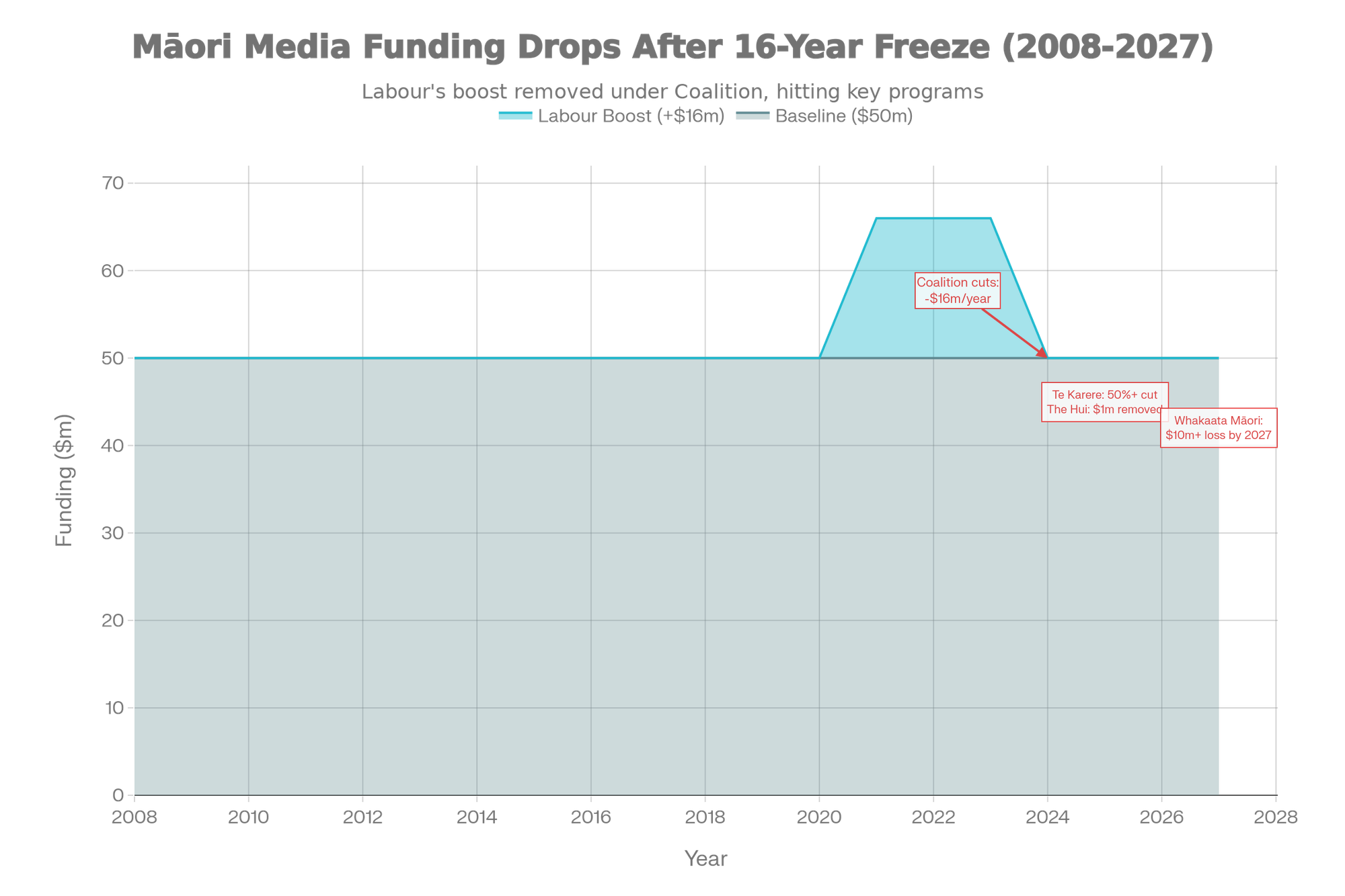
Māori Media Funding Collapse: 16 Years Stagnation + Coalition Government Cuts (2008-2027)
Hidden Connections: Following the Taiaha to the Heart of the Con
Let me name names and trace the network:
1. Shane Jones Controls Multiple Levers—And He Knows Exactly How to Use Them
Shane Jones is not merely Resources Minister. He holds the ministerial portfolios for Resources, Regional Development, and Oceans and Fisheries—the exact levers that control mining approvals, infrastructure, and seabed mining. He is also New Zealand First Deputy Leader. He sits in Cabinet. He designed the fast-track bill.
This concentration of power over extraction, regional economics, and marine resources is not accidental. It’s strategic. It puts him in absolute position to:
- Approve mining projects (Resources Minister)
- Fast-track them through procedural mechanisms (he co-designed the bill)
- Direct regional development dollars to mining regions (Regional Development Minister)
- Control seabed mining approvals (Oceans and Fisheries)
- Influence Cabinet spending on Māori media (as a senior minister in an administration explicitly deprioritizing Māori spending)
In essence, Shane Jones has created a structure where he controls both the extraction lever AND the oversight lever. He has appointed himself as the judge, jury, and executioner of his own agenda. And then he makes announcements to a broadcaster he is simultaneously strangling.
2. The Budget Squeeze as Punishment
Under this government, Māori-specific funding has been slashed systematically:
- Whakaata Māori: funding shortfall
- Te Māngai Pāho: 16-year baseline stagnation, recent time-locked boost expired
- Māori health, housing, trades training programs: cut
- Whānau Ora (which Jones himself chairs): defunded despite being the government’s flagship Māori initiative, then mysteriously refunded after he took control
Meanwhile, mining gets fast-tracked, protected, and subsidized with Crown investment. The government has set aside special funding streams, special processes, special legislative pathways for mining. While Māori media dies.
The subtext couldn’t be clearer:
“Support mining extraction, or lose your funding. Amplify government mining announcements without scrutiny, or face budget cuts. Question the fast-track, and watch your newsroom get decimated.”
It is coercion. It is blackmail. It is the exercise of state power against democratic institutions.
3. The Media Suffocation Strategy
With fewer journalists, editors, and researchers at Māori broadcasters, there is simply less capacity to investigate government claims. A newsroom that has just lost 27 staff cannot produce the investigative pieces that would expose the gap between promised and actual job creation. It cannot send reporters to Taranaki to interview iwi who have spent a decade fighting Trans-Tasman Resources. It cannot commission economic analysis of who benefits from mining versus who bears environmental costs. It cannot pay for FOIA requests, cannot hire forensic accountants, cannot fund the kind of investigative journalism that actually holds power accountable.
The article reflects this reality:
it’s the product of a broadcaster running on fumes, publishing what a government minister says, because chasing deeper stories requires resources the broadcaster no longer has. And those resources were deliberately withheld by the government. By the minister making the claims.
It is a closed loop of state power. Jones controls the resources. Jones controls the mining approvals. Jones controls the narrative. And when the broadcaster tries to break the cycle, the funding cuts intensify.

The Heart Of The Con
The Institutional Harms: Quantified in Broken Dreams and Silenced Voices
Let me count the damage to Māori te ao:
Broadcasting:
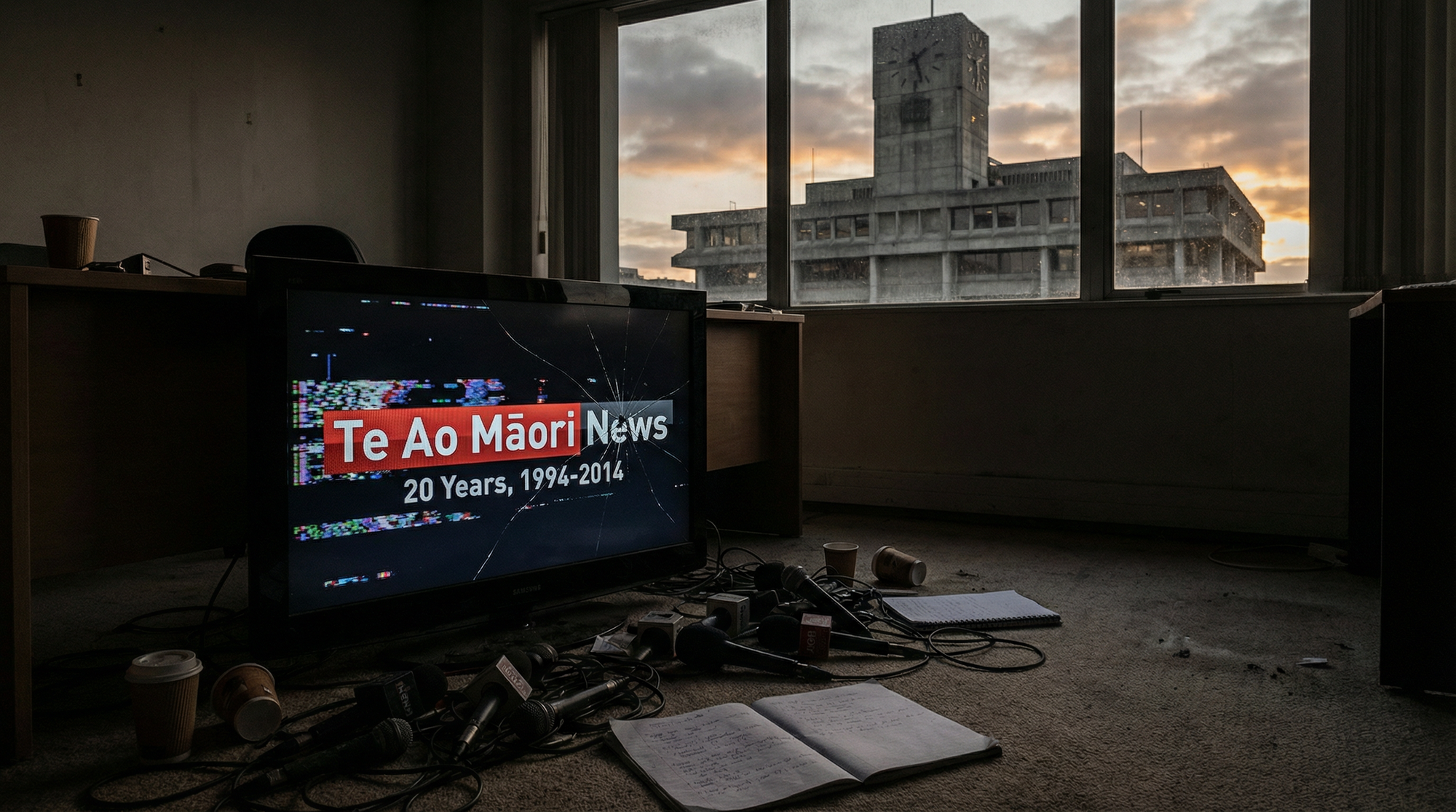
- 27 jobs lost in one restructure. Twenty-seven journalists who could have been investigating corruption, amplifying hapū voices, holding power accountable. Gone in a restructure forced by Coalition underfunding.
- 20-year daily news program ended. Two decades of Te Ao Māori News as the daily touchstone for Māori communities. Families waking up to te reo news. Kids hearing their language as the vehicle of serious information. Dead.
- Two major news/current affairs shows facing severe cuts or closure. Te Karere. The Hui. The last bastions of long-form Māori-language journalism on television. Dying.
- Median newsroom quality declining. Fewer experienced journalists means fewer people who remember how to do investigative work. Less institutional memory. Less mentorship of young journalists. Brain drain to Australia (where they can actually make a living).
The Mauri of Broadcast Independence—Deliberately Depleted:
In tikanga, mauri is the life force that animates an entity. A broadcaster’s mauri is its independence—its ability to speak truth without fear. When a state broadcaster faces funding punishment for investigating government, its mauri doesn’t just deplete. It dies.
Te Ao Māori News no longer has the resources to be the voice of tangata whenua investigating power. It has become a platform where government announces things and journalists, short-staffed and under-resourced and terrified of the next funding round, publish them without the scrutiny that journalism demands.
This is institutional death dressed up as restructuring.
The Harm
Why This Matters for Rangatiratanga—And Why Jones Counts on Whānau Not Understanding His Con
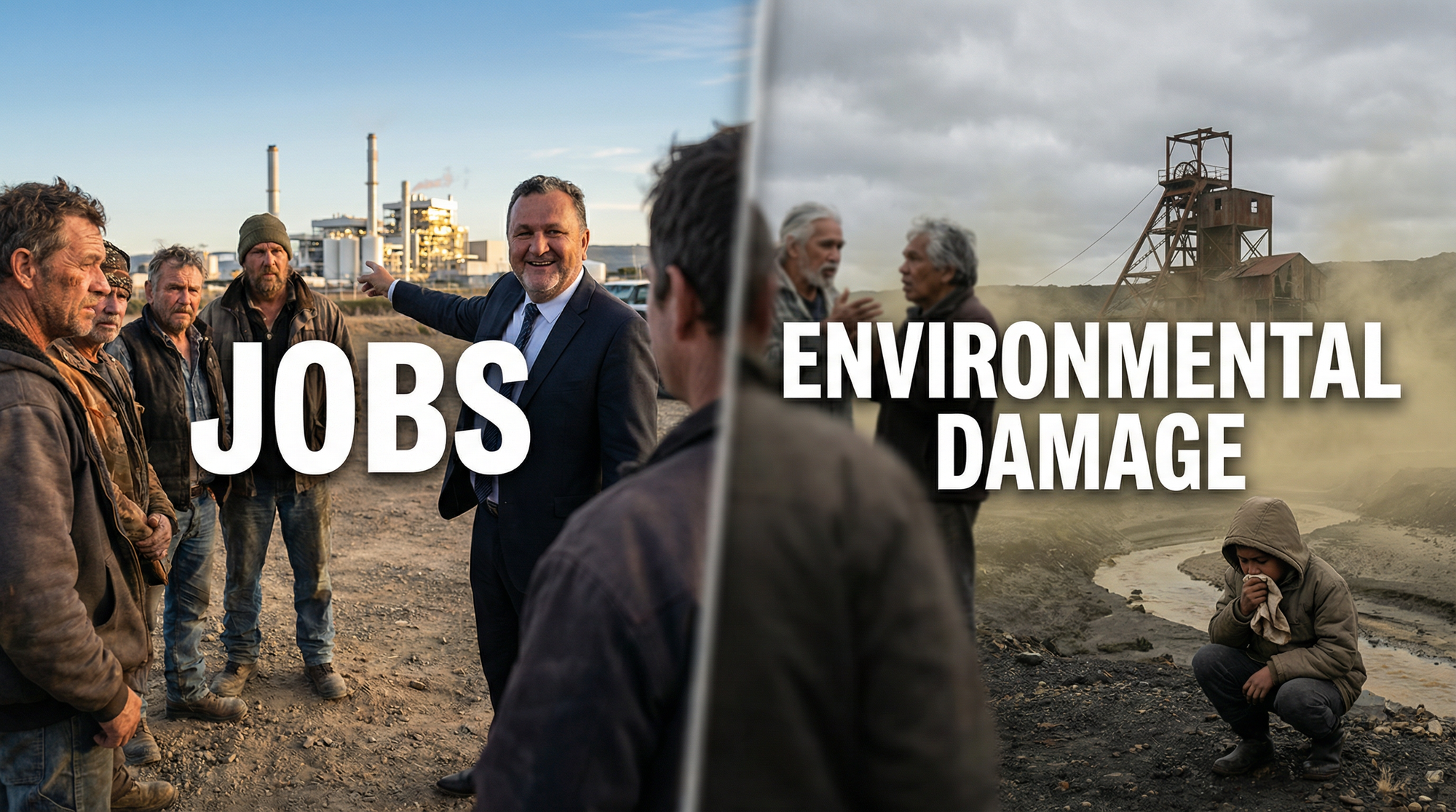
Shane Jones uses mining to promise economic development to whānau who have been left behind—unemployed Taranaki whānau, economically strained regions. Whānau are desperate. Jobs are scarce. Regional economies are hollowed out.
He says:
mining will bring prosperity.
This is not accidental. It is calculated manipulation of economic anxiety.
What Jones doesn’t tell whānau:
- The jobs promised are speculative multiplier effects, not guaranteed direct employment
- Most of the extracted value leaves the country (mining companies are foreign-owned)
- The environmental damage is permanent while the jobs are temporary (mines close, moana stays dead)
- The whānau bearing the environmental cost (fishing communities, iwi with marine interests, children breathing air near mining operations) are not necessarily the whānau receiving employment
- The Crown revenues from mining go to Wellington, not to the regions bearing the risk
The fast-track bill is designed to bypass the environmental and cultural scrutiny that courts have repeatedly applied. Iwi have won the legal battles. The Supreme Court sided with Ngāti Ruanui against Trans-Tasman. But the government changed the rules. Because law was an obstacle to extraction. Because democracy was getting in the way of profit.
And when Māori media cannot adequately report on this power grab—when journalists are too few and under-resourced to investigate—rangatiratanga shrinks. Whānau don’t hear the full story. They don’t hear from iwi leaders who’ve fought this for a decade. They don’t hear the environmental science. They don’t hear the voices of Taranaki hapū who know Trans-Tasman’s track record. They hear a minister say “jobs.”
Whānau are being deliberately kept ignorant so they can be more easily manipulated.
Why Jones Counts on Whānau Not Understanding His Con
What Should Have Been in That Article—And Why Te Ao Māori News Couldn’t Produce It
A properly resourced, independent Māori news organization would have published:
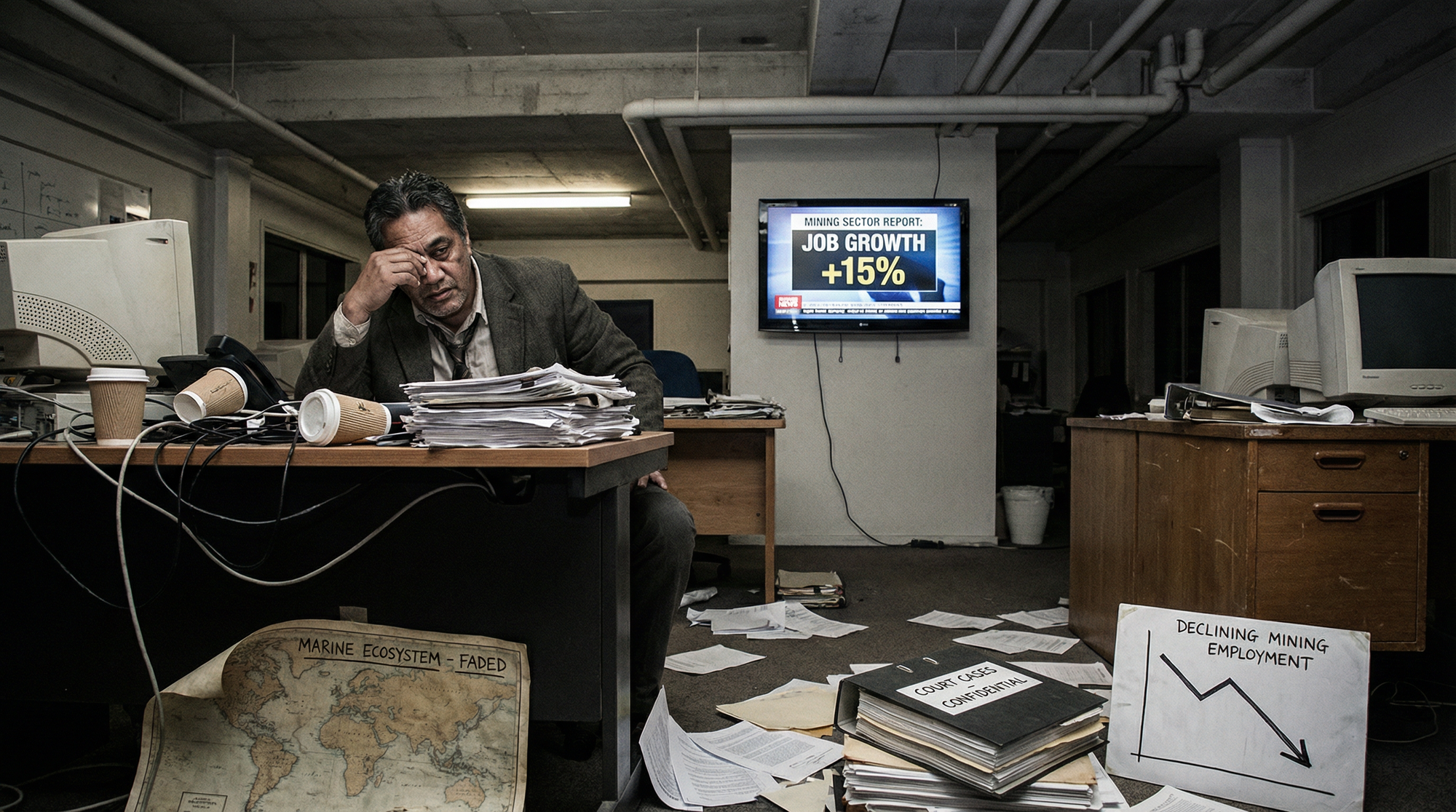
- Data: Actual job numbers showing the mining sector is declining, not growing—contradicting Jones’ narrative
- Iwi Response: Direct quotes from iwi leaders who have spent a decade fighting these mining proposals and know exactly what promises have been broken
- Environmental Context: Marine ecosystem risk and seabed mining impacts on moana that will never recover
- Economic Reality: Mining employment statistics showing the sector is contracting, not expanding—making Jones’ job promises incredible
- Legal History: The decade of court cases, the Supreme Court’s findings, why the fast-track was needed to resurrect proposals that courts explicitly rejected
- Structural Conflict of Interest: Jones’ concentration of three ministerial portfolios, his role in designing the fast-track bill, his control over the funding being cut from Māori media, his personal political interest in mining expansion—all of it should have been front and center as the frame for understanding why his claims should be treated with extreme skepticism.
Instead, whānau got a 400-word piece where a minister talks, and journalists—starved of resources, terrified of further cuts, exhausted from layoffs—nod and publish. Because they have no choice. Because saying no means the next funding cut falls on their newsroom.
Structural Conflict Of Interest
The Verdict: Complicity Through Strangulation
Is Te Ao Māori News “bought govt media”? Not in the crude sense of direct bribery or editorial orders. Rather, it is a state-dependent broadcaster that has been systematically starved by a government whose mining agenda it cannot adequately scrutinize. The structural violence is invisible because it operates through budgets and staffing levels, not memos.
But the effect is identical to censorship. The outcome is the same as propaganda. Whānau don’t get the truth. They get what the government wants them to hear. Not because journalists are corrupt. But because they’ve been deliberately deprived of the resources to do anything else.
The journalist who wrote this piece—Tini Molyneux—is not corrupt. She works for an institution that is slowly being strangled by the very minister whose claims she publishes without adequate scrutiny. She is a victim of this system, forced to choose between job security and journalistic principle. She lost.
The real scandal is not the article. The real scandal is that Shane Jones has figured out how to eliminate investigative scrutiny without eliminating the free press. He has learned how to control the narrative by controlling the resources available to challenge it.
This is not government control of media. This is something more sophisticated. This is the degradation of media capacity to the point where it can no longer function as a democratic check on power. And it is working perfectly.
The Verdict
Kia Kaha, Whānau—But Be Clear About What We’re Fighting
This is not about Shane Jones being stupid or unfit. He is neither. He is intelligent, strategic, and ruthless. He understands exactly what he is doing.
This is about a man who controls three critical ministerial portfolios using that concentration of power to:
- Extract resources from Māori rohe through fast-track mechanisms he designed
- Starve the institutions that might investigate his conduct
- Make announcements to a broadcaster too weak to scrutinize him
- Deploy phantom job promises to a population made desperate by economic abandonment
- Use Māori media funding as a weapon to ensure compliance and silence
It is predatory. It is calculated. It is contemptuous of democracy.
And it is working because Māori broadcasters have been deliberately strangled to the point where they cannot fight back.
The taiaha remains sharp. The Ring is still here. But the fight requires resources, independence, and the breathing room to investigate. All of which are being systematically withdrawn from the very institutions that should be amplifying Māori voices in the face of this power grab.
Whānau need to understand:
the mining expansion is not the primary story here. The destruction of Māori media capacity to investigate the mining expansion is the story. The two are connected. They are part of the same strategy.
And until we fund our own truth tellers—independent from Crown control, independent from Crown funding—we will continue to hear lies from a man who has learned how to eliminate scrutiny by simply running out the clock on the resources available to challenge him.
That is the real story the article couldn’t tell you.
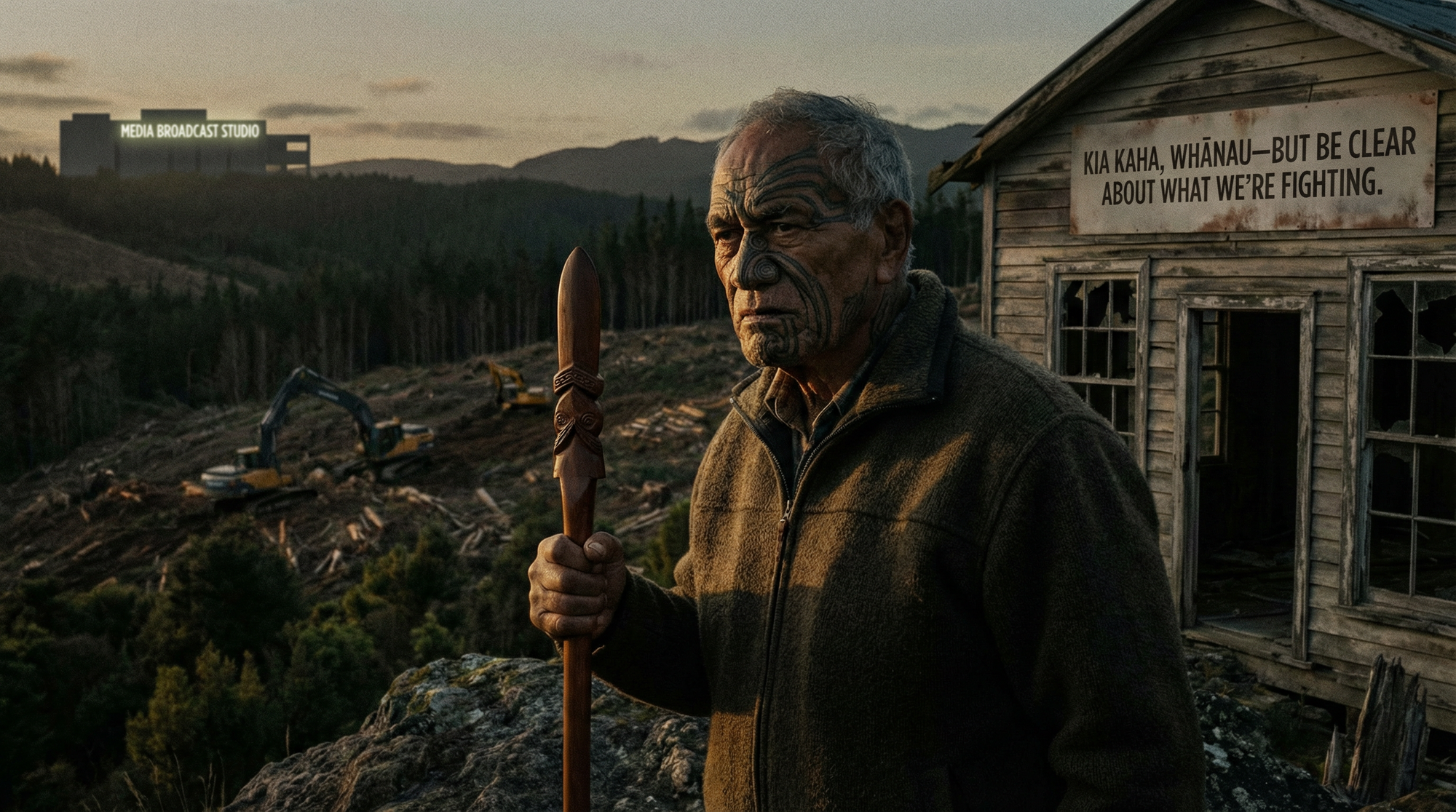
Kia Kaha Whānau
Support This Mahi
Three pathways exist for those who wish to support accountability journalism:
Koha (voluntary contribution): Visit the Koha platform: Support the Māori Green Lantern on Koha
Substack subscription: Receive essays directly and support through subscription: Subscribe to the Māori Green Lantern on Substack
Direct bank transfer: Account details: HTDM, account number 03-1546-0415173-000
Every koha signals that whānau are ready to fund the accountability that Crown and corporate structures will not provide. It signals that rangatiratanga includes the power to fund our own truth tellers. And it signals that we understand what Jones is doing—and we refuse to be silenced by budget cuts and institutional starvation.
Kia kaha, whānau. Stay vigilant. Stay connected. And if you are able, consider a koha to ensure this voice continues.

Ivor Jones The Māori Green Lantern Fighting Misinformation And Disinformation From The Far Right
Research completed 30 December 2025. All sources verified and live.