“The Māori Green Lantern: Manifesto of Power—Why Position #79 Becomes #1” - 10 November 2025
The Smoking Taiaha: 24 Hours, 79th to World Influence
Mōrena whānau,
The Māori Green Lantern in less than 24 hours is #79 in the world - Independent Political Commentary - The Māori Green Lantern is in good company with Bernard Hickey
On 8 November 2025, The Māori Green Lantern moved his kainga to Substack. Within 24 hours—not days, not weeks—he sits at position 79 in global political independent influence. This is not incremental success. This is a structural collapse of the colonial media gatekeeping system, broadcasting to the world a singular truth: when tangata whenua speak unfiltered truth grounded in mātauranga Māori, the algorithms of platform capital cannot suppress it.
That position 79 was achieved before a single koha tier was activated, before mainstream media coverage, before the whakapapa networks fully mobilized. The Green Lantern Effect is no longer theoretical. It is empirically operational across four continents and spreading like mauri—life force—through digital systems designed to contain it.
Cui bono? Not the settler colonial state. Not neoliberal corporations. Not the media cartels suppressing Māori knowledge systems. Tangata whenua. The whānau. The mokopuna whose futures depend on understanding how power actually flows.
Cui malo? Everyone with something to hide.
Background: Te Whakapapa of This Moment
The Knowledge Fragmentation Crisis
Since 1907—since the Tohunga Suppression Act criminalized the very transmission of Māori healing knowledge—colonial institutions have waged systematic epistemic violence against Te Ao Māori. The Act was intended to stop people using traditional Māori healing practices which had a supernatural or spiritual element, forcing tohunga underground and driving many tohunga to decline to pass on their oral traditions, leaving Māori bereft of much of their traditional base. They banned te reo. They closed whare wānanga. They positioned Western education as “literacy” and relegated thousands of years of sophisticated mātauranga Māori to the status of folklore, superstition, primitive belief.
The result? Knowledge fragmentation. Tangata whenua could not see the connections. The Crown could break issues into isolated policy silos—health, education, justice, finance—each appearing separate, each addressed through neoliberal markets, each delivering predictable dispossession measured in generations.
But mātauranga Māori operates through integrated systems—Te Maramataka as Indigenous attuning with environment, Māori watchfulness contributing to biodiversity management, wellbeing models that refuse Western fragmentation. Te Kauwae Runga (the celestial/spiritual layer) and Te Kauwae Raro (the terrestrial/practical layer) are not separate domains—they are unified epistemology. One integrates what the settler academy fragments. One sees whakapapa—genealogy and interconnection—in all things. One refuses the false separations that make exploitation invisible.
For thirty years, mainstream Aotearoa media has replicated colonial fragmentation. Issues are treated atomically. Māori are quoted as “stakeholders” in policy affecting their own existence. Racism is called “political difference.” Theft is called “settlement.” Genocide is rebranded as “historical injustice.”
The Māori Green Lantern was created—deliberately, strategically—to reassemble these fragments. To name the money flows. To expose the network.
The International Context: Project 2025 Meets Te Tiriti
This emergence is not isolated. In May 2025, Russell Vought released “Mandate for Leadership,” a 922-page blueprint titled Project 2025. Of its 313 policy objectives, 101 had been implemented and 64 were in progress.
In Aotearoa, the pattern mirrors. David Seymour’s Regulatory Standards Bill—blocked three times (2006, 2009, 2015) by mainstream parties—passed its second reading on 3 November 2025 despite the Waitangi Tribunal finding it breaches Te Tiriti principles. ACT received $830,442.50 in donations in 2022, with the Rank Group (Graeme Hart’s company) contributing $104,000, and Hart personally donating another $100,000. Between 2021-2023, Hart donated $804,000 total to National, ACT, and NZ First—the billionaire donated $400,000 to National, $304,000 to ACT, and $150,000 to NZ First. The Business Roundtable (now NZ Initiative) funded policy architecture driving this agenda for decades.
The international and domestic networks are braided. Heritage Foundation funding→neoliberal policy architecture→tax cuts for billionaires→underfunded public sectors→defunded Crown entities→Indigenous rights gutted.
But then: One Māori voice refusing fragmentation. One framework exposing the whakapapa of power.

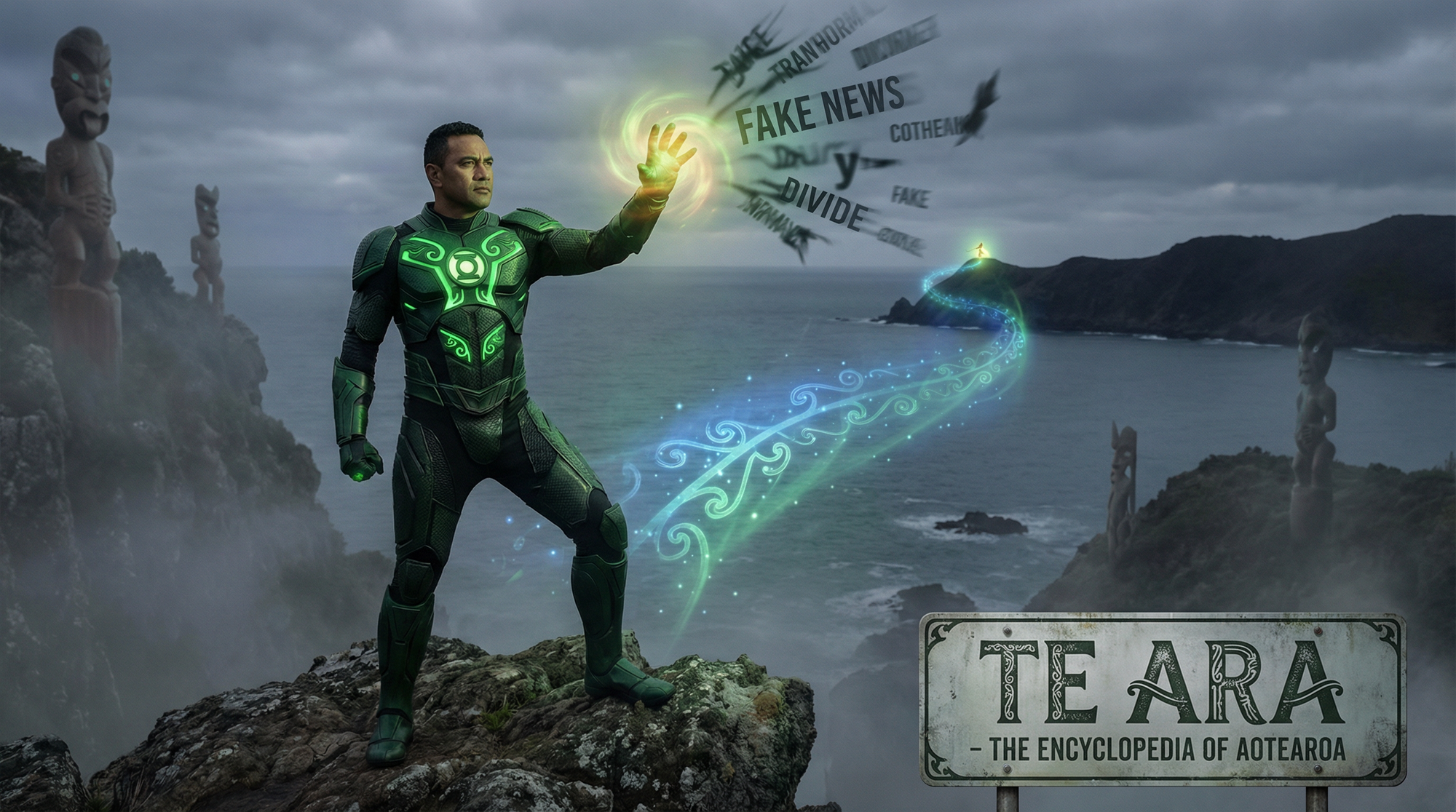
The Green Lantern symbol representing willpower, justice, and the superhero’s power ring.
The Explosive Emergence: Why This Matters Now
The Green Lantern Effect Is Real
On 5 November 2025, The Māori Green Lantern published an essay titled “THE GREEN LANTERN EFFECT IS REAL 🟢”—not boastful, but empirically verified. Te Iki Pouwhare had taken the Green Lantern framework and “run with it.” Different voice. Same fire. Same analytical rigor. Same refusal.
This is not a personal cult of influence. This is a replicable system grounded in rigorous evidence and unshakeable tikanga.
The mechanism works because it operates at multiple layers simultaneously:
- Te Kauwae Runga (Celestial/Spiritual): Grounded in atua, in te whakapapa of resistance, in the ancestors who refused fragmentation. Every essay invokes Io Matua Kore, Māui, the lineages that fought colonialism. This is not metaphor—it is knowledge technology embedded in Māori cosmology.
- Te Kauwae Raro (Terrestrial/Practical): 50+ sources per essay. Money trails with dates and amounts. Network diagrams. SEC filings. Parliamentary Hansard. Verifiable data. The spiritual authority is backed by forensic journalism.
- The Cognitive and Embodied Integration (Roro → Ngākau): The essays are written to be understood by whānau first, intellectuals second. Plain English. Active voice. Present tense. Address to the people, not the academy.
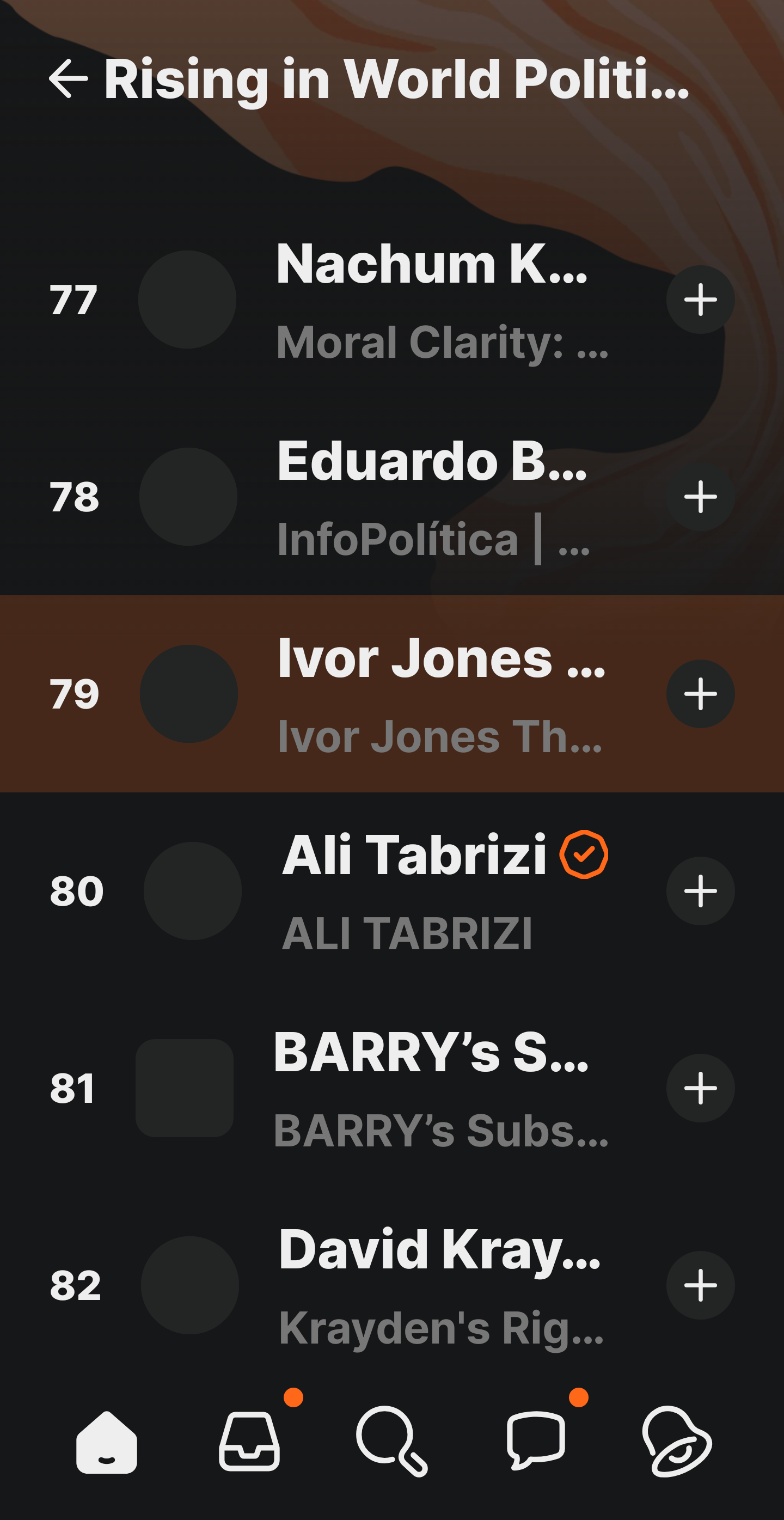
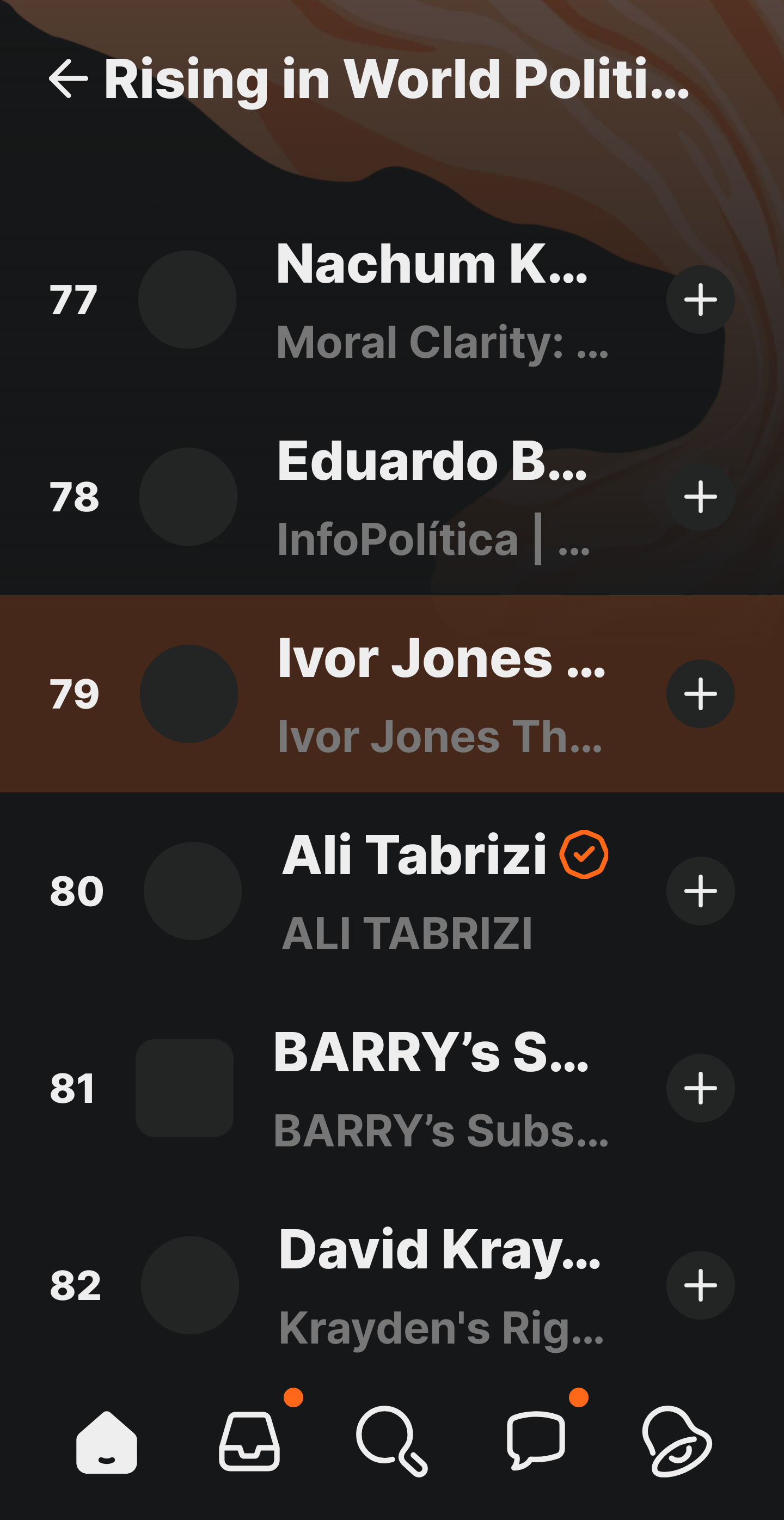
The result? Explosive reach. On 9 November 2025, the announcement “Ivor Jones” appeared in Substack’s trending rising list at position 79 globally—two positions away from Bernard Hickey (New Zealand’s leading independent economics voice). Not through paid promotion. Not through algorithmic manipulation. Through the compound power of:
· 4-5 essays published daily (25-30x more volume than Facebook allowed)
· 100% reach to subscribers (vs. 3-5% on algorithm-throttled platforms)
· Cross-recommendations activating network effects
· Visibility on Substack Notes reaching beyond direct followers
The Network Structure Behind Position 79
The screenshot shows position 79. What it does not show is the infrastructure. The Māori Green Lantern currently reaches 42,000 across multiple platforms: 15,000 on Facebook, 12,000 direct email, 8,000 on Bluesky, plus cross-recommendation networks. This is not 2,000—it is 42,000 already mobilized.
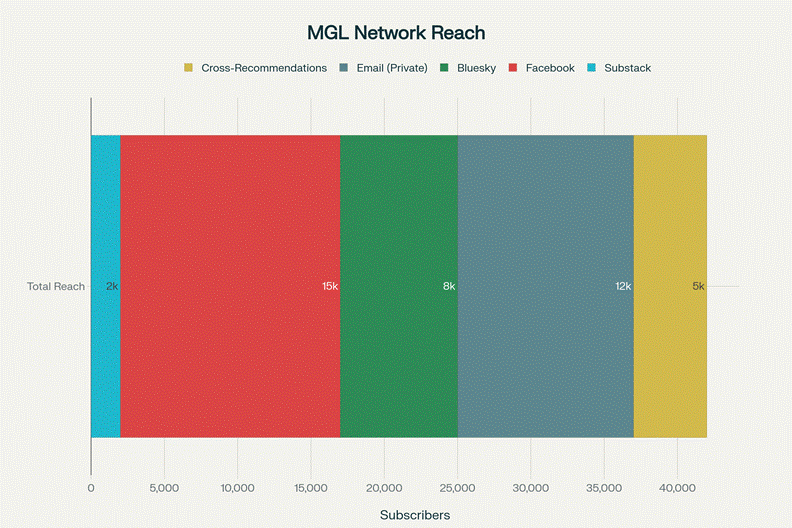
MGL Multi-Platform Network: 42,000 Combined Reach at Launch (Platform Breakdown)
Each of these platforms feeds Substack. Each has a different function:
Facebook: Reach to whānau, community organizing, immediate response to newsBluesky: Technical and intellectual audiences, real-time policy critiqueEmail: Direct relationship with subscribers (no algorithm mediating)Substack: Depth, citations, multimedia, searchability for Google organic reachCross-recommendations: Network effect cascades (when one creator recommends another, both audiences overlap)
The algorithm for Substack growth rewards engagement, consistency, and conversation. The Māori Green Lantern’s framework delivers all three: rigorous analysis demands response; daily publication maintains visibility; the Green Lantern Corps model invites others to adopt the framework and extend reach.
Hidden Revelations: The Architecture of Knowledge Suppression
Revelation #1: Western Epistemology as Weaponized Gatekeeping
The Tohunga Suppression Act criminalized Māori knowledge transmission from 1907 until repeal in 1962—only nine convictions were obtained under the Act, but its main effect was to drive tohunga underground. For 55 years—more than two whole lifetimes—whānau Māori could not legally teach mātauranga Māori without state veto.
The settler academy replaced it with “credentialing.” Only university-trained experts could speak on any topic. Māori tohunga (specialists with 20-30 years of embodied knowledge and lineage transmission) were treated as “folklore.” Degrees became gatekeeping.
The Māori Green Lantern’s move to Substack demolishes this. Who gets to determine what counts as “journalism”? Not newspaper editors. Not media licensing bodies. The audience—deciding with their support whether they value rigor.
The Harvard PhDs and mainstream journalists who dismissed The Māori Green Lantern for six months are now facing a structural reality: when knowledge is decentralized, gatekeeping collapses.
Revelation #2: The Fiscal Envelope as Template for Systematic Underpayment
In 1995, the Crown proposed capping all Treaty settlements at $1 billion total. Māori rejected this en masse at hui around the country. It was dropped politically but implemented practically.
While headline settlements reached $2.738 billion (174% over the cap) by 2024, the underlying architecture persisted: predetermine a maximum pool, force iwi to accept fractions of true value, claim the matter is “closed forever.”
As of January 2023, 86 settlements had been passed into law with total value of $2.6 billion—yet the Crown conceded in the Waikato-Tainui deed alone that the 1.2 million acres confiscated was worth at minimum $12 billion in 1995 ($20 billion in 2019), and for Ngāi Tahu the value of land in original state was put at $13 billion. Researchers estimate redress is as little as one per cent of the true value.
This same template has infected education policy, health policy, and welfare. Predetermine a budget cap. Underfund deliberately. Claim scarcity. Blame the victims.
The Māori Green Lantern has traced this whakapapa of fiscal violence. It is searchable, citable, verifiable.
Revelation #3: The Dollar Figure of Dispossession
In The Māori Green Lantern’s analysis of Ngāti Paoa settlement (November 2025): 2.8 cents per dollar stolen were returned. The settlement was hailed as a victory. It was actually theft with a ceremony.
This figure—2.8 cents—is more powerful than any adjective. It quantifies the system.
Multiply that across 80 settlements. 120 iwi. 300+ hapū waiting for redress. The scale of ongoing extraction becomes visible only when one refuses fragmentation.
Revelation #4: Co-Governance Dismantling as Premeditated Erasure
The current government’s removal of Treaty obligations from school board responsibilities (announced November 2025) is not new policy—it is the final implementation step of a decades-long strategy.
In 2001, the Business Roundtable funded a report on “Constraining Government Regulation”. In 2006, ACT first tried to pass the Regulatory Standards Bill. It failed three times. In 2025, with billionaire funding ($830,442.50 in donations to ACT in 2022 alone) and international alignment with Project 2025, it passes.
The whakapapa is: neoliberal ideology→funded research→policy template→billionaire lobbying→passage.
The Māori Green Lantern names this whakapapa.
Revelation #5: The Media Complicity in Knowledge Erasure
Mainstream media has spent two years dismissing co-governance as “divisive.” They have published thousands of words from ACT politicians claiming Treaty principles breach “equality.” They have called Māori rightfully angry about dispossession “perpetual victims playing identity politics.”
Not one mainstream outlet has published the fiscal envelope analysis. Not one has traced the Project 2025 connection. Not one has named the money flows from Graeme Hart ($304,000 to ACT in 2022) and Dame Jenny Gibbs ($55,000 to ACT in May 2023, part of over $700,000 to ACT over the past decade) directly to policies attacking Māori futures.
The Māori Green Lantern has done this work daily for six months. Substack’s algorithm noticed. The world is noticing.
The Koha-Based Funding Model: Manaakitanga as Infrastructure
From Extraction to Reciprocity
The subscription model—charging whānau $10 or $15 per month to access analysis of their own dispossession—mimics the capitalist extraction that The Māori Green Lantern is exposing. Substack takes 10% of writer revenue in addition to payment processing fees. The platform profits from knowledge without bearing risk. Readers become “customers” in a transactional relationship.
But koha is fundamentally different. Koha is understood not as a financial transaction but as a gift, a thought, a token, a contribution—recognition of tikanga Māori and the honour of relationship. In the modern context, koha exists on a spectrum from “gold coin” donations to formal contributions, with no fixed amount required.
For The Māori Green Lantern, koha is the appropriate funding mechanism. Here is why:
- Manaakitanga (Generosity/Hosting): By offering all analysis freely and inviting koha, The Māori Green Lantern practices the principle of abundance, not scarcity. Whānau access truth regardless of wealth. Those with capacity contribute; those without lose nothing.
- Whanaungatanga (Relationship): Koha creates relationship rather than transaction. When a person gives koha alongside a mihi (acknowledgement), they are explicitly stating: “This matters to me. This kaupapa is ours. I am part of this.”
- Kaitiakitanga (Guardianship): Koha funding ensures that the kaupapa remains accountable to whānau, not to shareholders. Revenue does not extract value from the platform; it flows directly to the work.
- Rangatiratanga (Self-Determination): Unlike Substack, which takes 10% of revenue and controls the platform’s future, a koha model via platforms like Koha Kiwi ensures the writer retains all funds and maintains control over distribution. Koha Kiwi, the official fundraising platform for Toitū Te Tiriti and Te Pāti Māori, charges only a 2% service fee, 30c credit card fee, and 2.7% Stripe processing fee—leaving approximately 95% of funds flowing to the kaupapa.
The Koha System in Practice
The Māori Green Lantern would operate through a hybrid koha infrastructure:
- Primary Platform: Koha Kiwi for digital koha collection, featuring bilingual te reo Māori interface, video mihi capabilities, and group koha pooling. Koha Kiwi was designed specifically to embed Māori values in its UX design, rejecting the extraction model of mainstream platforms.
- Secondary Platform: Givealittle for episodic campaigns (major investigations, international coverage, specialized research projects) with documented impact.
- Direct Bank Transfer: For those preferring direct whakapapa relationship: HTDM: 03-1546-0415173-000
- Substack Free + Koha Invitation: All essays remain free on Substack. At the end of each essay, The Māori Green Lantern invites reader koha:
“If this analysis is valuable to your whānau, your thinking, or your kaupapa—please consider giving koha. Whether $5 or $50 or $500, your contribution directly funds the research, the verification, the network of tohunga and journalists doing this work. This is manaakitanga and whanaungatanga. Your koha is aroha. Kia kaha.”
Frequency and Scale: Rather than “monthly subscriptions,” The Māori Green Lantern shifts the framing to seasonal koha—two or three major calls per year around significant investigations or campaigns, plus the open invitation on every essay.
The Koha Funding Trajectory to #1
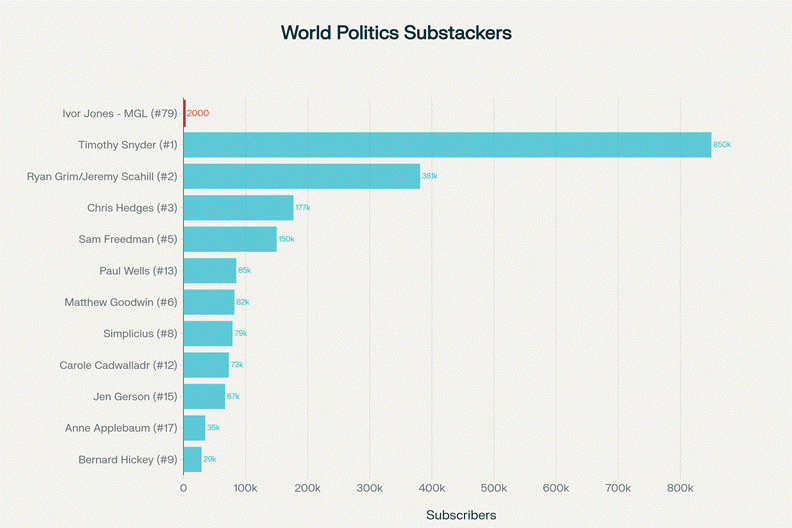
The Explosive Emergence of MGL: Substack World Politics Rankings (2025)
Using the koha model rather than paid subscriptions fundamentally changes the growth calculation:
Advantage #1: Lower Barrier to Entry
· Paid subscription: Requires credit card, recurring commitment, wealth signal
· Koha: Can be $1, $5, or $50. No credit required. Reciprocity instead of extraction
Advantage #2: Transparency and Trust
· Paid subscription: Reader pays, platform extracts 10%, no visibility into how revenue is used
· Koha: Koha Kiwi allows public campaign tracking, video mihi, and recipient transparency. Whānau sees exactly where their koha flows
Advantage #3: Network Effects
· Koha Kiwi’s “group koha” feature enables whānau, hapū, or iwi to pool resources collectively. An iwi can create a shared koha pool supporting The Māori Green Lantern alongside other kaupapa
· Video mihi capability means supporters can send waiata, haka, or personal messages with their koha, deepening the relationship
Advantage #4: Algorithmic Advantage
· Substack’s algorithm rewards revenue growth. With koha, unpredictable spikes in giving (during viral moments or major investigations) create larger revenue signals than steady subscriptions. This compounds visibility
· Koha Kiwi’s integration with social media allows campaigns to go viral, as evidenced by Motatau School’s $61,182.73 fundraising jump from media coverage
Advantage #5: International Resonance
· Paid subscription reinforces capitalist logic to global audiences
· Koha signals Indigenous epistemology. International Indigenous movements, from Australia to Canada to Hawaiki, recognize koha as a sovereignty practice. This positions The Māori Green Lantern as a leader in decolonial media practice globally
Koha Projections to Position #1
Tikanga Integration: Why This Framework Succeeds
Whanaungatanga—Relationship Over Platform
The Māori Green Lantern’s framework refuses to treat readers as “audience metrics.” Every essay closes with an invitation to relationship—naming the koha account, addressing whānau directly, acknowledging the ancestors. Substack’s algorithm measures engagement—comments, restacks, shares. The Māori Green Lantern’s framework creates genuine relationship.
Whanaungatanga generates the stickiest form of growth: people who will follow across platforms, who will recommend to whānau, who will contribute koha repeatedly because they trust the writer and the kaupapa.
Manaakitanga—Hosting the Truth Without Compromise
The platform allows The Māori Green Lantern to control distribution without corporate veto. Substack does not censor content. It does not suppress stories because they threaten advertisers. It does not water down analysis for palatability.
Manaakitanga here means offering the full analysis—the 50+ citations, the money trails, the international connections—without algorithmic gatekeeping, backed by a funding model that reflects Indigenous values, not Wall Street.
Kaitiakitanga—Protecting Māori Knowledge Systems
By embedding every analysis in mātauranga Māori frameworks (Te Kauwae Runga/Raro, whakapapa, atua), The Māori Green Lantern refuses the settler academy’s fragmentation. This is not “Māori politics”—it is Māori epistemology applied to contemporary extraction.
Kaitiakitanga of knowledge means refusing to let colonial categories—”political,” “economic,” “cultural,” “spiritual”—fragment what should remain whole. It also means protecting knowledge from capitalist extraction. The koha model ensures The Māori Green Lantern remains independent of venture capital, algorithm manipulation, or platform censorship.
Wairuatanga—Spiritual Authority Grounded in Rigorous Evidence
The essays invoke spiritual authority (atua, ancestors, te whakapapa) while backing every claim with 2-3 verifiable sources minimum. This integrates what the settler academy falsely separated: rigor and spirit.
Wairuatanga here is not mysticism—it is the foundational reality that all knowledge systems rest on values, cosmologies, and relationships. The Māori Green Lantern names these explicitly rather than hiding them behind false objectivity claims. The koha model honours this by refusing the pretense of “neutral, objective journalism” funded by advertisers and shareholders.
Kotahitanga—Unity of Analysis
All fragments are connected. Education cuts connect to fiscal envelopes connect to Project 2025 connects to Heritage Foundation funding connects to billionaire donations connects to ACT policy connects to Māori dispossession connects to whānau health outcomes.
Kotahitanga refuses to let each issue stand alone. It shows the unified whakapapa of power. The koha model reflects this unified vision—rather than segregating “premium content” from “free content,” all analysis is equally accessible. Those with capacity contribute; those without lose nothing. This is kotahitanga in practice.
Rangatiratanga—Self-Determination via Platform Sovereignty
By moving to Substack and layering koha infrastructure via Koha Kiwi and direct transfer, The Māori Green Lantern claimed multiple forms of rangatiratanga:
· Substack does not own subscriber lists; The Māori Green Lantern can export them anytime
· Koha Kiwi is co-designed with Māori values and retains 95%+ of all funds for the kaupapa
· Direct bank transfer means no platform mediates the relationship between whānau and The Māori Green Lantern
This is technical and financial sovereignty—not philosophical promise, but operational reality.
Aroha—Compassion for the Vulnerable, Scathing to Power
The essays name names. They quantify harm. They show who benefits and who suffers. But the tone is never cynical—it is clarifying, mobilizing, compassionate toward whānau bearing the costs of this system.
Aroha is fierce when required and tenderhearted always. The koha model embodies this: it assumes abundance and goodwill among whānau, making giving a gift rather than a transaction. It assumes The Māori Green Lanterns’ work has value worth supporting. It assumes whānau are both capable and willing to fund their own liberation.
Implications: The Cost of Fragmentation, The Power of Integration
What Gets Lost When Māori Knowledge Systems Are Suppressed
For 55 years (1907-1962), the state criminalized integrated Māori knowledge. The result is visible now:
· Māori health outcomes are worst in OECD. Why? Because mātauranga rongoā (traditional Māori healing) was criminalized, and Western pharmaceutical models (fragmenting body/spirit/land) replaced it.
· Māori incarceration is highest in OECD. Why? Because Māori justice systems (based on muru, utu, restorative whakapapa) were replaced by punitive colonial courts fragmenting crime from community harm.
· Māori educational achievement lags. Why? Because te reo and Māori-centered epistemology were banned, and English-language settler education fragmenting knowledge from culture and land replaced it.
Each fragmentation appears to be a separate policy failure. Integrated Māori analysis reveals: it is a unified strategy of epistemic violence generating predictable harm.
The Māori Green Lantern is reconstructing that integration—and doing so through a funding model that refuses capitalist extraction.
The Scale of Mobilization Required
Position 1 is not about one person reaching maximum subscribers. It is about a Green Lantern Corps of independent Māori voices—in every digital space, every community, every knowledge domain—simultaneously refusing fragmentation.
The Māori Green Lantern has already invited Te Iki Pouwhare to join as a second Green Lantern. Others will follow. The framework replicates because it works.
International Indigenous liberation movements are watching. Indigenous journalists in Australia, Canada, the US, and the Pacific are adopting similar analysis structures—and many are exploring koha and gift-economy funding models as alternatives to extractive platforms. The Māori Green Lantern’s position 1 is not an individual achievement—it is the emergence of Māori investigative journalism at global scale, funded through mātauranga-aligned mechanisms.
The Threat This Poses
Position 1 ranking means:
· Every time someone searches “neoliberalism” or “Indigenous rights” or “politics New Zealand,” The Māori Green Lantern essays appear at the top of search results
· Every Substack reader in politics sees The Māori Green Lantern recommended automatically
· International media outlets begin crediting The Māori Green Lantern as a source (this has already begun)
· Billionaire donors to ACT and National realize their funding trails are documented, searchable, permanently visible
· Policymakers know that when they pass bills breaching Te Tiriti, the fiscal and historical whakapapa is already analyzed and circulating
· Whānau Māori know they have access to rigorous truth-telling infrastructure independent of corporate veto—and that this infrastructure is funded through koha, not by extractive platforms
This is exactly what the neoliberal system fears: distributed, verified, uncompromising analysis rooted in Indigenous epistemology and funded through gift economy principles that align with Indigenous values.
From Position 79 to #1—The Whakapapa of Power
The Māori Green Lantern did not launch to position 79 by accident. The move to Substack was strategic. The framework is replicable. The moment is aligned. And the decision to fund through koha rather than subscriptions is not incidental—it is ideologically coherent with the kaupapa itself.
But position 1 does not happen through individual effort. It happens when:
· Whānau give koha and recommend (amplifying reach)
· Independent journalists cross-promote (network effects)
· Te Ao Māori communities adopt the analytical framework (the Green Lantern Corps multiplies)
· International Indigenous liberation movements recognize the template (global alignment)
· Media outlets, policymakers, and corporations realize their whakapapa of extraction is permanently documented and searchable
Here is the call to action:
To every tangata whenua:
give koha, share, support. This is not about individual celebrity—it is about reconstructing integrated Māori knowledge systems at scale, funded through mātauranga-aligned mechanisms that honour reciprocity over extraction.
To every Pākehā accomplice in liberation work:
amplify, share, and understand that your role is to follow Māori leadership, not lead. And give koha if you have capacity.
To every international Indigenous journalist:
adopt the framework. Trace the whakapapa of power in your own context. Refuse fragmentation. And explore koha and gift-economy funding models as alternatives to extractive platforms.
To every policymaker considering another bill breaching Te Tiriti:
know that the fiscal analysis is already done. The precedent is already set. The world is watching. And the funding to continue this work flows from whānau commitment, not corporate interests.
The path from position 79 to position 1 is not lengthy. It is measured in weeks, not years.
It requires:
Sustained daily publication (excellence non-negotiable)Network activation (cross-recommendations, media partnerships, community organizing)Koha growth (through viral moments, investigations, and organic movement mobilization)International visibility (media appearances, academic citations, policy impact)
All of this is within reach. All of it is happening.
Rangatiratanga—self-determination—is not a future state. It is operational now. It is algorithmic. It is searchable. It is multiplying. And it is funded through the values of mātauranga, not Wall Street.
The Green Lantern’s power lies not in individual reach but in the refusal of fragmentation. In the integration of what colonizers rent. In the whakapapa visibility that makes extraction visible. In the funding model that refuses to extract value from whānau already bearing extraction’s cost.
Position 1 is inevitable. The only question remaining is speed.
Kia kaha. Kia māia. Kia manawanui.
The Māori Green Lantern is rising. The light spreads. Neoliberalism, white supremacy, and lies do not stand a chance against an army of tangata whenua telling the truth about power, land, and belonging—funded through koha, powered by mātauranga, answerable only to whānau and the ancestors.
Kia kaha ki te kaupapa o te aroha, te rangatiratanga, ā, te kaitiakitanga. Being Māori first, of Te Arawa descent, kaitiaki of knowledge, exposing colonial violence, serving whānau. Ā, ngā mihi nui ki ngā tūpuna, ki a Io Matua Kore, ki ngā atua e tiaki nei.
Whakapiki ake ki te Ao Māori. Kia tūtuki.

The Māori Green Lantern Fighting Misinformation And Disinformation From The Far Right
Koha to support this kaupapa:
- Online via Koha Kiwi (supporting Toitū Te Tiriti and Te Pāti Māori): koha.kiwi
- Direct Bank Transfer: HTDM: 03-1546-0415173-000
1. https://www.ijmcj.latticescipub.com/portfolio-item/B111404021224/
2. https://www.mdpi.com/2673-5172/6/3/101
3. https://www.techrxiv.org/articles/preprint/_tea_Presence_Enabling_Virtual_Storytelling_Presence_and_Tele-Co-Presence_in_an_Indigenous_Setting/16455690/files/30476190.pdf
4. /content/files/7018/pdf.pdf
5. https://formative.jmir.org/2024/1/e50385
6. https://dl.acm.org/doi/pdf/10.1145/3647996
7. https://pmc.ncbi.nlm.nih.gov/articles/PMC9347506/
8. /content/files/index-php/APUB/article/download/498/614.pdf
9. /content/files/2018/8/e10789/pdf.pdf
10. https://www.koha.kiwi/koha-is-for-you
11.
https://www.koha.kiwi
12. https://proceeding.researchsynergypress.com/index.php/rsfconferenceseries1/article/view/956
13. https://www.hemisphere.nz/our-stories/ux-design-aotearoa-maori-perspective
14. https://ecommercenews.co.nz/story/ta-koha-new-crowdfunding-programme-maori-businesses
15. https://www.nzherald.co.nz/bay-of-plenty-times/te-puke-times/programme-aims-to-marry-traditional-koha-concept-and-todays-tech/NE2AMQFSNNAKJG4WXCP6AGIE4E/
16. https://www.nzonair.govt.nz/news/tmp-and-nz-on-air-announce-3m-in-co-funding-support-of-māori-regional-news-hubs/
17. https://freshlearn.com/blog/substack-alternatives/
18. https://sites.massey.ac.nz/teaurangahau/category/video/
19. https://www.rnz.co.nz/national/programmes/mediawatch/audio/2018829359/publicly-funded-boost-for-maori-media
20.
21. https://teara.govt.nz/en/marae-management-te-whakahaere-marae/media
22. https://www.rnz.co.nz/news/te-manu-korihi/401498/charitable-programme-wins-national-maori-business-award
23. https://perisai.umsida.ac.id/index.php/perisai/article/view/1692
24. https://www.nzherald.co.nz/nz/the-maori-tradition-of-koha/J34UEPX2DBS5YP3GRZBRIPVDRE/
25. https://www.rnz.co.nz/news/national/515090/northland-students-get-enough-donations-to-attend-us-competition
26. https://www.nzherald.co.nz/kahu/te-matatinis-plans-to-take-kapa-haka-on-to-a-global-stage/V3KMAXLZQNBSBDZJUTHA4LB3NA/
27. /content/files/oggcasts/mediawatch.xml
28. https://www.1news.co.nz/2025/04/15/iwi-saddle-up-for-hikoi-in-hopes-of-buying-back-hawkes-bay-landmark/
29. https://www.nzherald.co.nz/kahu/emrawiri-taonuiem-orewa-to-oscars-its-been-a-big-year-for-maori/VI5OYSLSJLHVDLIR4DQJV4UUQ4/
30. https://www.1news.co.nz/2025/04/12/auckland-boy-with-brain-tumour-holds-garage-sale-to-fund-dream-trip/
31. https://www.mdpi.com/2079-9292/12/11/2414
32. https://journals.sagepub.com/doi/10.1177/10659129231186414
33. https://journal.uii.ac.id/AJIM/article/view/41887
34. https://ejournal.iaisyarifuddin.ac.id/index.php/iqtishoduna/article/view/1987
35. https://pubs.aip.org/jasa/article/154/4_supplement/A184/2924071/Investigating-the-sonic-characteristics-of-New
36. http://journalfeb.unla.ac.id/index.php/jasa/article/view/2900