“The McKee Appointments Scandal: How New Zealand’s Government Captured a Regulatory Body in Plain Sight” - 20 January 2026
A Comprehensive Analysis of Institutional Decay, Procedural Cynicism, and the Normalization of Patronage
Mōrena whānau,
On 20 January 2026, the New Zealand Herald published an investigation documenting how Associate Justice Minister Nicole McKee systematically manipulated the appointment process for the Ministerial Arms Advisory Group (MAAG), bypassing merit-based standards to advance candidates from her professional network while maintaining the appearance of legitimate process.
Through Official Information Act documents, government records, and analysis of Public Service Commission and Department of Prime Minister and Cabinet guidelines, this report establishes:
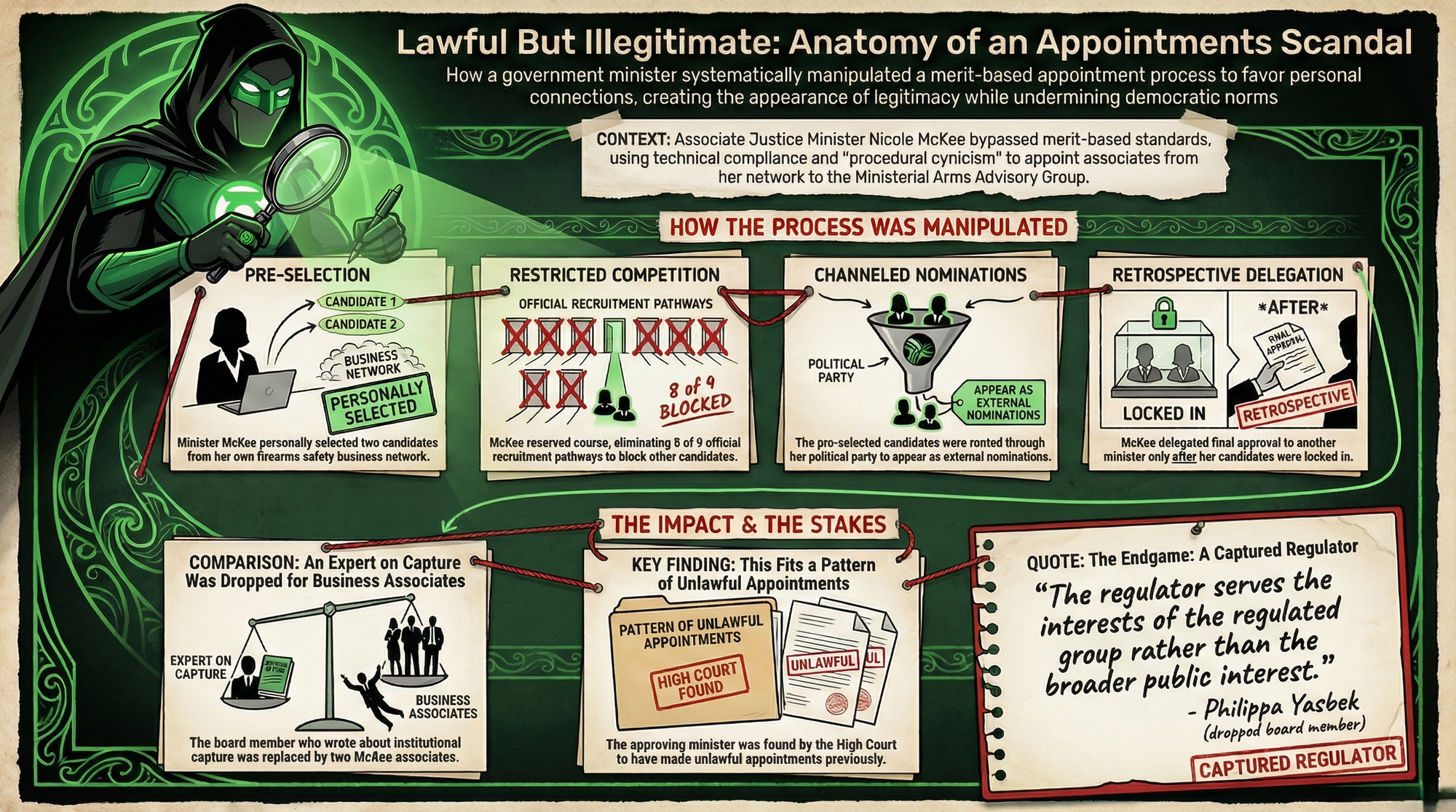
- McKee personally pre-selected appointees (Mike Spray and Michelle Roderick-Hall) connected to her firearms safety business, then orchestrated their nomination through Act Party channels while restricting access to all competing candidates, as the Herald’s OIA documents reveal
- The process violated fundamental merit-based standards: McKee eliminated eight of nine Public Service Commission-recommended recruitment pathways, restricted nominations to coalition partners only, and predetermined outcomes before any competitive assessment
- Conflicts of interest were managed retrospectively: McKee received conflict-of-interest advice in August (fully redacted in public documents) but delegated the process to Goldsmith only in September, after candidates were identified and nominations secured—violating DPMC requirements to “assure colleagues” conflicts are identified before ministerial involvement
- This represents a pattern: Justice Minister Paul Goldsmith, who formally appointed the MAAG members, faced a High Court ruling in December 2025 that he had unlawfully appointed the Human Rights Commissioner and Race Relations Commissioner, “failing to apply the correct legal test” and “failing to consider mandatory considerations”
- Institutional capture is the endgame: The Arms Bill will grant McKee appointment authority over a new firearms regulator with minimal statutory safeguards. If she uses that authority with the same procedural cynicism demonstrated in the MAAG appointments, the result will be a regulatory body serving gun lobby interests rather than public safety
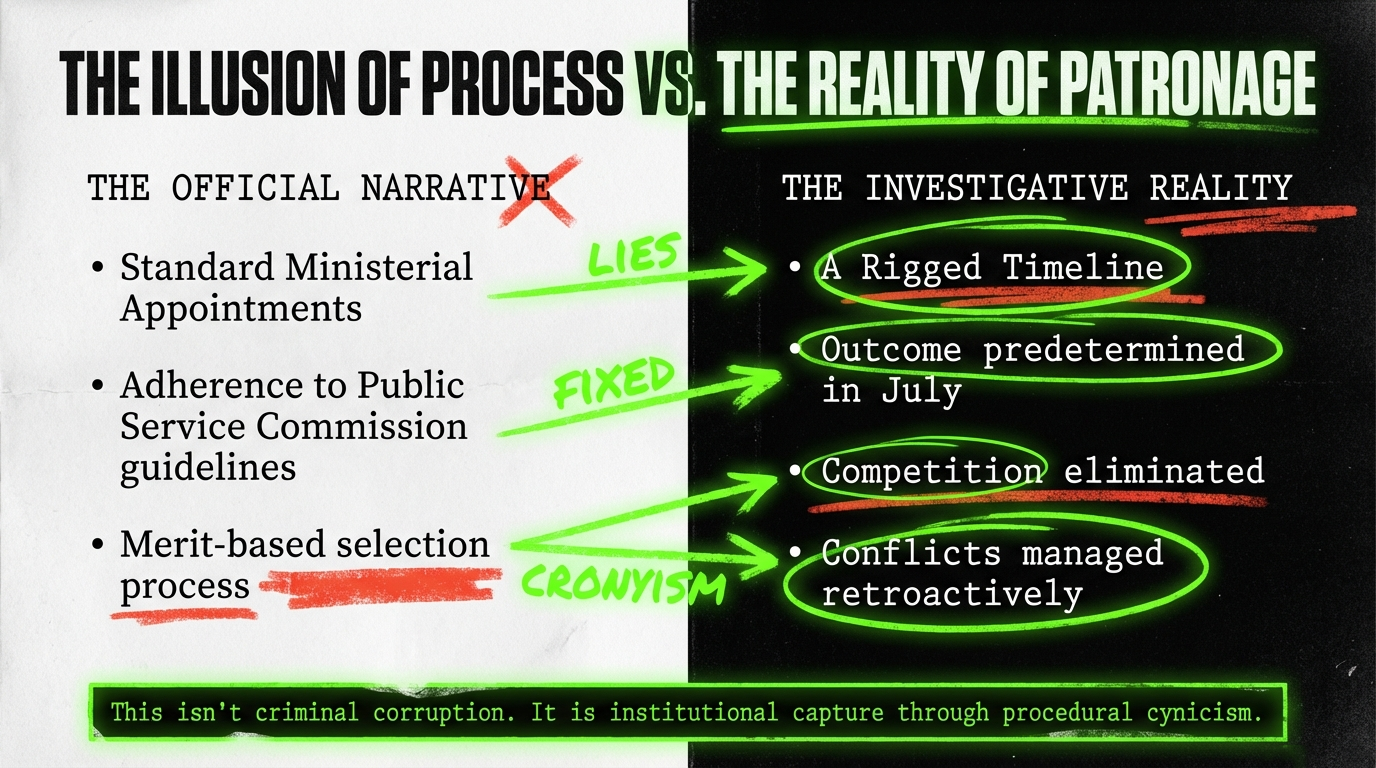
This is not criminal corruption. It is institutional capture through procedural cynicism: technical compliance with guidelines while systematically eliminating their protective function. It is the normalization of patronage disguised as process.
Three Pathways to Support This Mahi
Koha—Support (Direct contribution via platform)
Subscribe to the Māori Green Lantern on Substack (Ongoing subscriber support)
Direct bank transfer
- Account name: HTDM
- Account number: 03-1546-0415173-000
- Reference: McKee essay / Institutional accountability
PART ONE: WHAT HAPPENED—THE DOCUMENTED FACTS
The Timeline: From Agreement to Predetermined Outcome
- Early July 2025: The Herald investigation reports the Ministry of Justice proposes nominations from “agencies, ministers, Cabinet, caucus and interested groups”—consistent with Public Service Commission guidelines emphasizing “widest possible canvassing of high-quality candidates” and use of “as many” recruitment channels as possible. McKee initially agrees.
- ~10 days later, July 2025: McKee reverses course. Her private secretary instructs the Ministry to proceed with broad outreach only if there are no nominations from coalition colleagues. This is the pivot. DPMC guidance explicitly names Te Puni Kōkiri, police, and other agencies as sources for “balanced representation.” McKee’s reversal eliminates these pathways.
- Mid-July 2025: Mike Spray emails Act Party chief of staff Andrew Ketels with his CV.
The critical line:
“Nicole has asked that I send these.”
This sentence is the scandal compressed. Not “I am applying” or “A colleague suggested I apply.”
Rather:
McKee is the originating source. Spray is executing her instruction.
“Act nominates Mike Spray for the Minister’s Arms Advisory Group.”
- August 2025: McKee’s ministerial advisor sends Michelle Roderick-Hall’s details to Ketels: “Another one for nomination please good sir.”
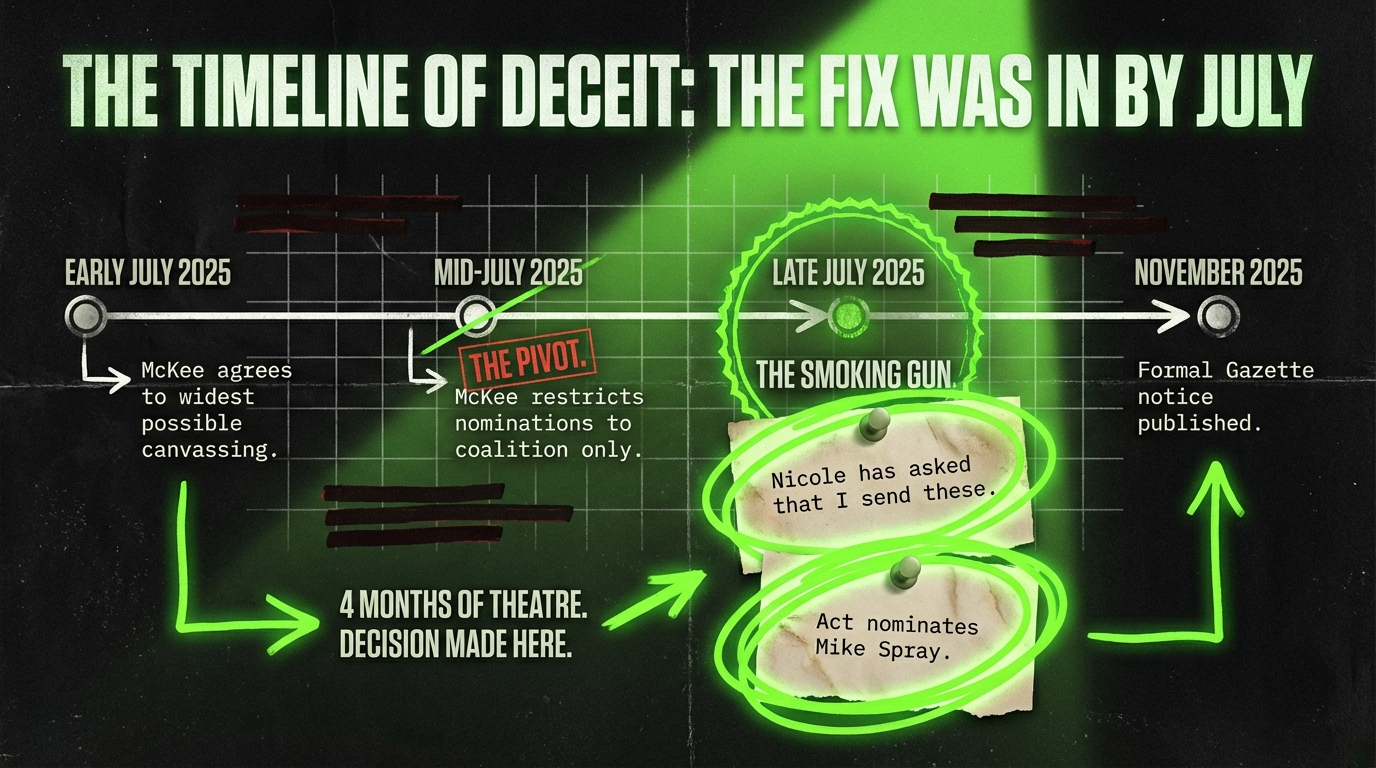
The tone (”good sir,” “another one”) presumes Ketels already understood he was processing McKee’s selections. These are not independent candidate nominations. They are McKee’s preferred candidates routed through party machinery to create appearance of external nomination.
- August 2025: McKee’s office receives conflict-of-interest advice. The contents are unknown. The OIA release shows this advice is fully redacted on grounds including “possibility of unreasonably prejudicing the commercial position of a person.” This redaction prevents public scrutiny of how McKee’s conflicts—ownership of Firearms Safety Specialists NZ Limited and control of the Whakatūpato programme—were identified and managed.
- September 2025: McKee’s private secretary tells the Justice Ministry that Goldsmith would take over the process to “avoid any potential conflicts of interest.” A Ministry document to Goldsmith states: “To avoid any potential conflicts of interest, Hon Nicole McKee has requested that you make the decisions required in this briefing.”
This is performance of conflict management, not actual conflict management. The conflict existed in July-August when McKee identified candidates and arranged nominations. Delegating to Goldsmith in September—after the outcome was predetermined—does not “avoid” conflict; it obscures it.
- November 2025: Cabinet approves nominees. Goldsmith gazettes the appointments on 5 November 2025, with three-year terms commencing 6 November 2025 for Mike Spray, Michelle Roderick-Hall, Shayne Walker (reappointed), and Deborah Lamb (reappointed).
From initial identification to gazette: four months. Yet the outcome was never in doubt after July. Everything after was choreography.
PART TWO: WHO WAS REMOVED AND WHO WAS ADDED
The Expert Who Scrutinizes Process: Philippa Yasbek (Dropped)
Philippa Yasbek served as Deputy Chair of MAAG. Co-founder of Gun Control NZ. Economist with public policy background. Author of “Shining a Light: Improving transparency in New Zealand’s political and governance systems” for the Helen Clark Foundation, specifically addressing institutional capture, lobbying reform, and beneficial ownership transparency.
Yasbek’s expertise directly addresses the procedural failures evident in her own removal. She is exactly the kind of board member who asks hard questions.
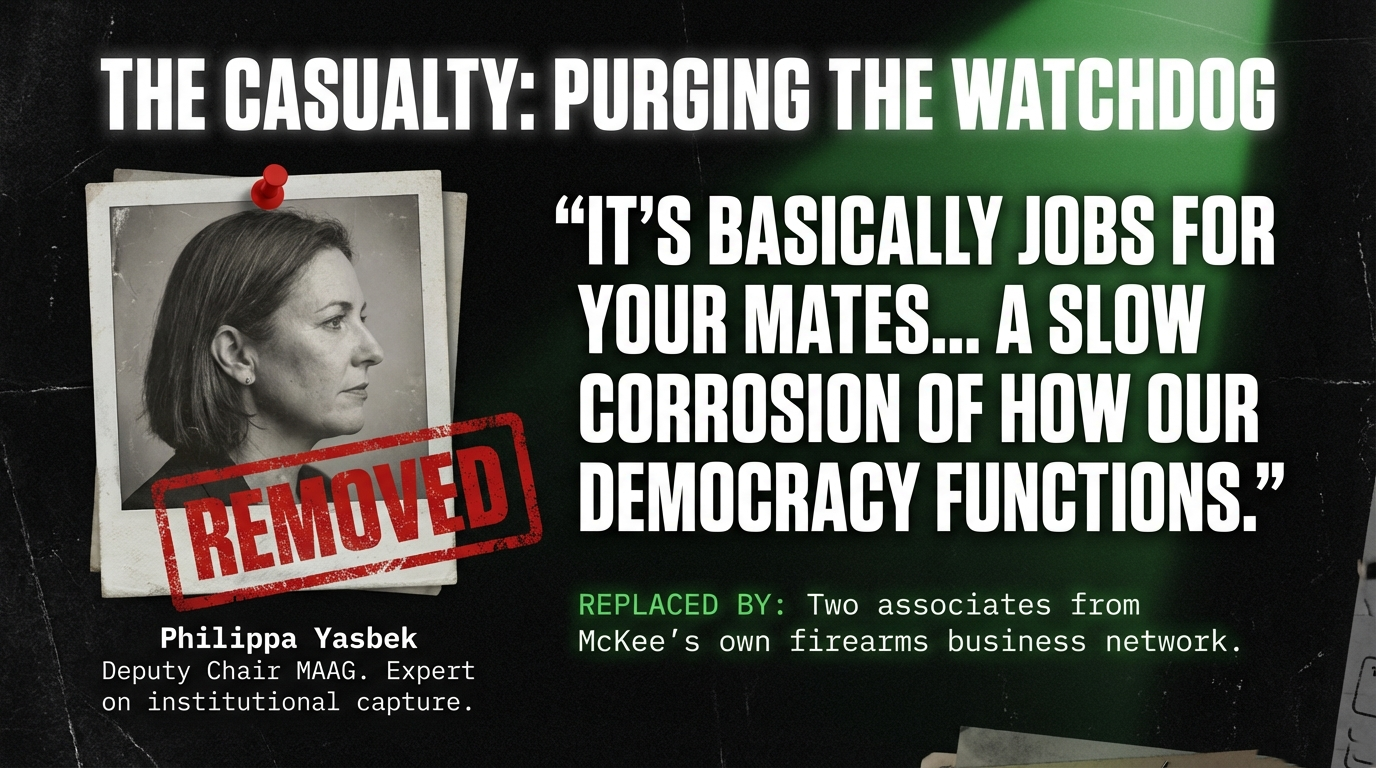
When the Herald published its investigation, Yasbek told reporters:
“It’s basically jobs for your mates. New Zealand has a long tradition of doing merit-based appointments, not a crony-based system where appointments are who you know rather than what your abilities are.”
She continued:
“People believe the game is rigged. And it’s part of a broader pattern, a slow corrosion of how our democracy functions, and of trust in public institutions.”
Helene Leaf (Dropped)
Appointed November 2022 for three-year term expiring November 2025. McKee did not reappoint.
The Reappointments: Qualified, No Procedural Concerns
- Shayne Walker (reappointed): Senior Lecturer, University of Otago; Managing Partner, Māori Growth Partners; former CEO, Ngāti Porou Holding Company; ONZM recipient. Qualified. No apparent procedural concerns about his reappointment.
- Deborah Lamb (reappointed): Long-time COLFO board member; former President, Pistol New Zealand. Qualified. No apparent procedural concerns.
The New Appointees: McKee’s Professional Network
- Mike Spray (new appointee): National Programme Manager, NZDA HUNTS programme; former Mountain Safety Council Firearms Instructor; worked for McKee’s Firearms Safety Specialists NZ Limited. Connected to McKee through previous shared role at MSC.
- Michelle Roderick-Hall (new appointee): No firearms licence. Worked with Whakatūpato programme—founded by McKee’s Firearms Safety Specialists NZ Limited. Promotes firearms safety in rural communities, aligning with Whakatūpato’s mission.
The pattern is unmistakable: drop the expert who scrutinizes process (Yasbek), add appointees connected to McKee’s business network (Spray, Roderick-Hall).
PART THREE: THE NETWORK—CONNECTIONS AND CONFLICTS
Nicole McKee’s Financial Interests
McKee is the owner and founder of Firearms Safety Specialists NZ Limited. The company founded the Whakatūpato firearms safety programme, contracted by NZ Police to deliver training in rural communities.
Before entering Parliament, McKee:
- Served as spokesperson for the Council of Licensed Firearms Owners (COLFO)
- Worked five years for Steve’s Wholesale Limited, a firearms component wholesaler
- Managed Mountain Safety Council’s Firearms and Hunter Safety Programme
- Served as president of multiple rifle clubs
- Was secretary of COLFO
This background provides deep industry knowledge. It also creates structural conflicts when McKee wields appointment authority over bodies overseeing that industry.
The Direct Connections
- Mike Spray to McKee: Spray worked for McKee’s Firearms Safety Specialists company. He is listed on FSS NZ’s website as one of the company’s “experienced and well known firearms safety consultants.”
- Michelle Roderick-Hall to McKee: Roderick-Hall worked with the Whakatūpato programme—McKee’s programme. The alignment between her rural community firearms safety work and Whakatūpato’s mission is precise.
- Both to McKee’s Industry: Both appointees are embedded in the firearms safety ecosystem that McKee has built, led, and profited from.
The Formal Appointer: Paul Goldsmith
Goldsmith accepted delegated authority from McKee. He wrote the Cabinet paper recommending Spray and Roderick-Hall, claiming “an appropriate process has been followed in selecting the proposed appointees, in terms of the Public Service Commission appointment guidelines.”
Yet in December 2025—one month after gazetting the MAAG appointments—the High Court ruled that Goldsmith unlawfully appointed Stephen Rainbow as Human Rights Commissioner and Melissa Derby as Race Relations Commissioner.
- “The minister failed to apply the correct legal test”
- “Failed to take mandatory considerations into account”
This is the same minister and the same coalition party (Act) involved in both the Rainbow appointments and the MAAG appointments. The pattern is now visible: Act advances preferred candidates → Goldsmith approves → subsequent scrutiny reveals procedural failure.
The Facilitator: Andrew Ketels
- Ketels, Act Party chief of staff at the time, served as the channel through which McKee’s pre-selected candidates became official party nominations. In December 2025—shortly after the Herald investigation—Ketels resigned, citing 12 years in Parliament and 5 years as Act chief of staff.
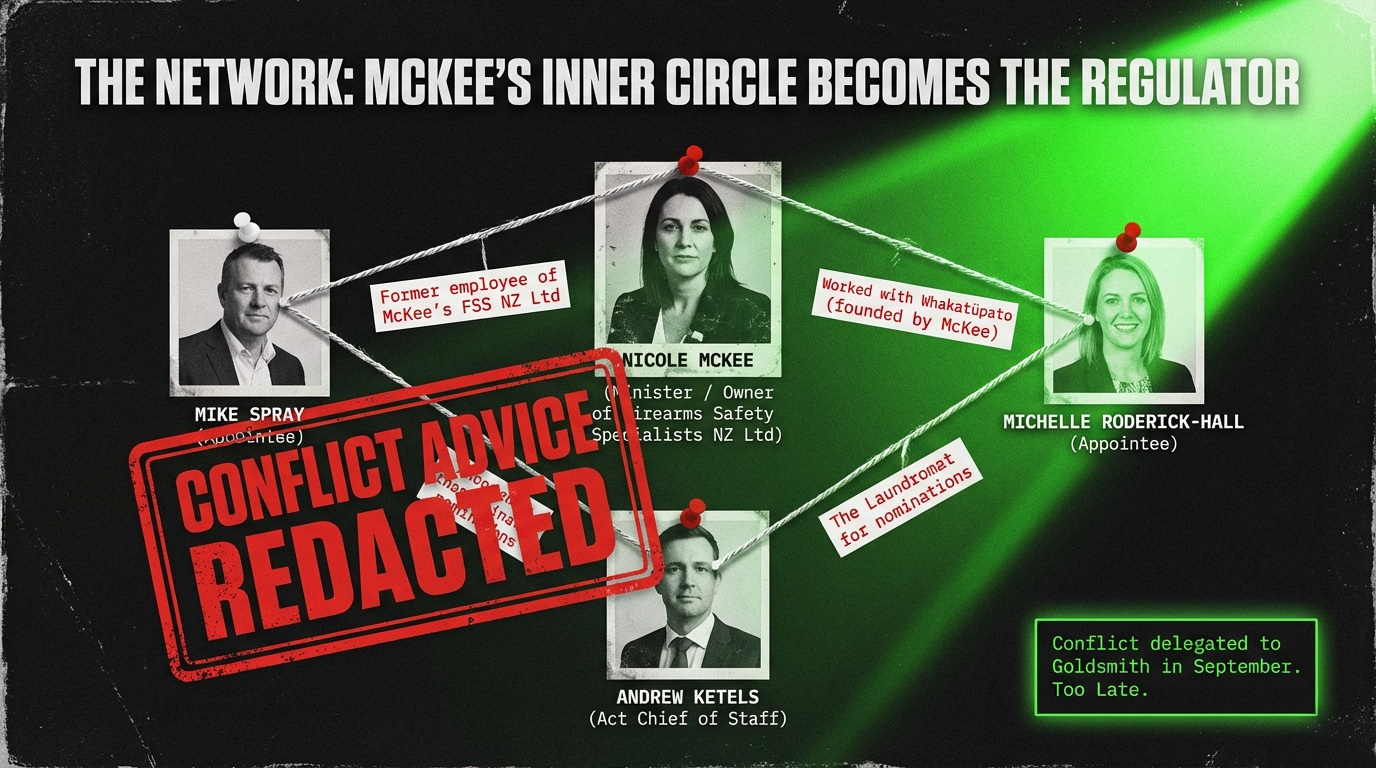
The timing is revealing: Ketels remained in post through the appointment process but departed once the process was exposed.
PART FOUR: STANDARDS VIOLATED—THE EVIDENCE OF PROCEDURAL FAILURE
Public Service Commission Guidelines: “Widest Possible Canvassing”
The PSC’s Board Appointment and Induction Guidelines explicitly require:
- “Widest possible canvassing of high-quality candidates”
- Use “as many” recruitment channels as possible
- “As inclusive as possible” appointments reflecting Aotearoa’s diversity
- Nine pathways for candidate identification, one of which is ministerial recommendation
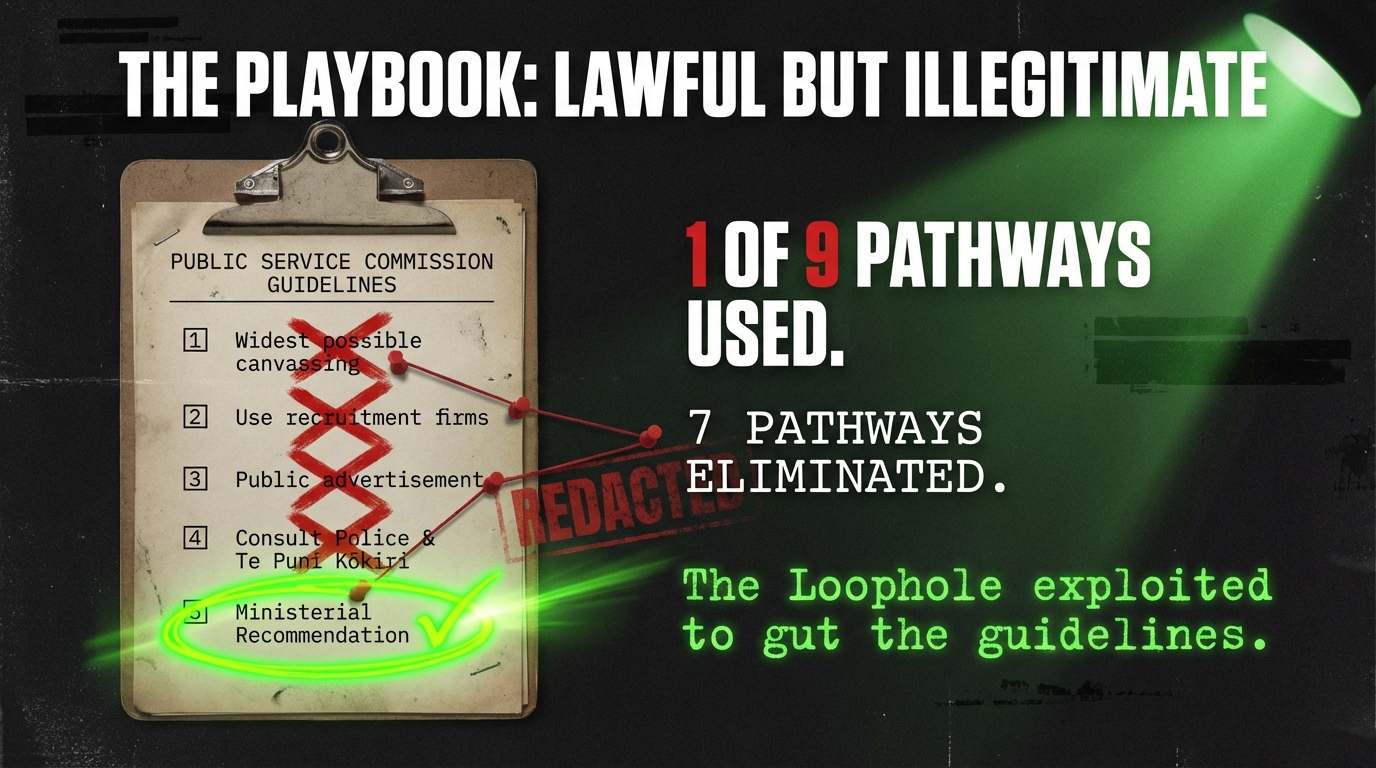
- Used one of nine pathways (ministerial recommendation)
- Eliminated seven pathways that would have involved Te Puni Kōkiri, police, other agencies, existing MAAG members, and Arms Engagement Group
- Eliminated public advertisement
- Eliminated recruitment firms
- Produced two appointees from McKee’s professional network
This inverts the PSC principle. The guideline presumes multiple candidates identified through diverse channels, from which the best is selected. McKee predetermined her selections before opening any channel.
DPMC Appointments Guidance: Assuring Colleagues of Conflict Management
“For each appointment, Ministers must be able to assure their colleagues that any conflicts of interest that could reasonably have been identified have been identified and, where a conflict has been identified, propose an appropriate way to manage it.”
The phrase “could reasonably have been identified” presumes before the appointment process, not after. Ministers must assure colleagues of conflict management before becoming involved in selections.
- July-August 2025: Personally identifies candidates, directs submissions, arranges nominations
- August 2025: Receives conflict advice (redacted)
- September 2025: Only then delegates to Goldsmith
The proper sequence under DPMC guidance:
- Identify conflict
- Assure colleagues conflict will be managed
- Recuse from appointment process
- Allow another minister to proceed
Instead, McKee:
- Involved herself substantively
- Received conflict advice
- Then delegated
This violates the sequencing requirement. Conflict management came after substantive decision-making, not before.
Cabinet Manual: Prompt Conflict Management
The Cabinet Manual (2023) requires ministers to ensure conflicts “are addressed promptly“—meaning as they arise, not retrospectively.
McKee violated this by involving herself in candidate selection before addressing the conflict. The presumption is that a minister who identifies a conflict will step back while conflict management procedures operate.
Instead, McKee involved herself fully, then asserted conflict and delegated only the formal approval.
PSC Conflicts Standards: Transparency Over Silence
The PSC’s model standards emphasize:
- “If uncertain about whether something constitutes a conflict of interest, it is safer and more transparent to disclose anyway”
- “Disclosure promotes transparency and is always better than the member silently trying to manage the situation”
- Board members have a “collective obligation to be aware of colleagues’ interests”
The redaction of McKee’s conflict advice prevents this collective awareness. The public cannot assess whether conflicts were properly identified or managed if the evidence is hidden.
PART FIVE: THE PATTERN—WHY THIS ISN’T JUST ABOUT MCKEE
The Rainbow Precedent: December 2025 High Court Ruling
One month before the Herald published its investigation into McKee, the High Court issued judgment on another Goldsmith appointment: Stephen Rainbow as Human Rights Commissioner.
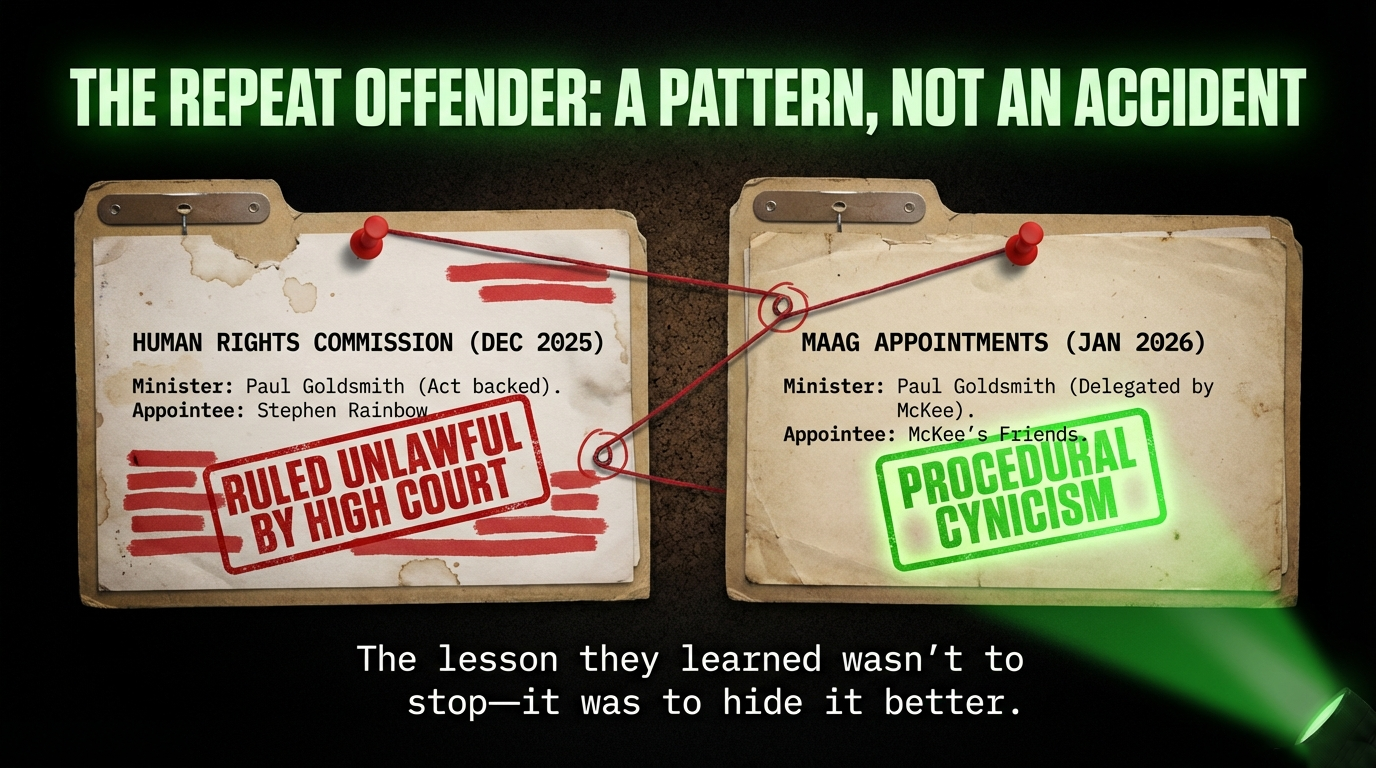
- Rainbow was not initially shortlisted by an independent selection panel
- Act leader David Seymour advanced Rainbow after he wasn’t recommended
- Rainbow was added to shortlist despite panel’s judgment
- Goldsmith formally appointed Rainbow
- High Court subsequently ruled the appointment unlawful
- “The minister failed to apply the correct legal test”
- “Failed to take mandatory considerations into account”
This is not a trivial procedural error. The appointment itself was unlawful.
The Pattern Across Both Cases
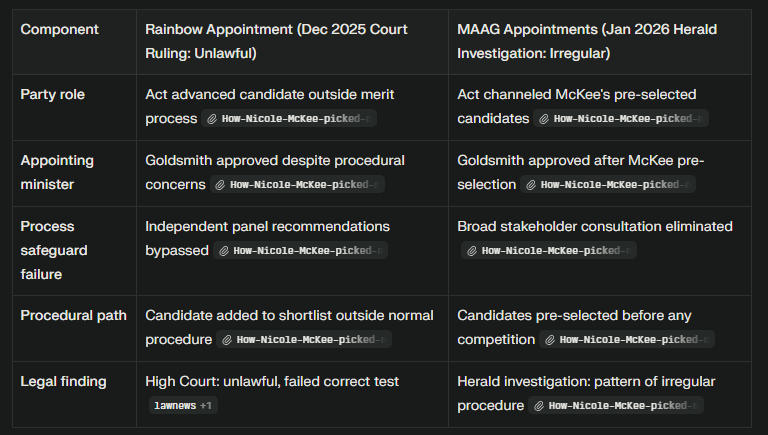
The lesson for Seymour and McKee: exploit discretion, maintain technical compliance, and the only risk is subsequent court challenge. Since Seymour faced no coalition consequences for the Rainbow intervention, why would McKee constrain future appointment influence?
The Coalition Enabling Ecosystem
The National-Act Coalition Agreement allocated firearms policy to Act. McKee—an Act MP and former COLFO spokesperson—wields appointment authority over the bodies that will shape firearms regulation.
Act’s agenda on firearms is narrower and more industry-aligned than National’s or NZ First’s:
- Greater access to military-style semi-automatic weapons
- Scrapping the firearms registry
- Reducing regulatory burden on gun clubs
McKee has invoked the “agree to disagree” clause twice when unable to secure full Act agenda. This demonstrates Act’s priorities diverge from coalition partners on firearms—yet Act’s minister controls appointment authority over the advisory bodies shaping policy.
PART SIX: THE REGULATORY CAPTURE ENDGAME—THE ARMS BILL
What McKee Will Control
The Arms Bill, currently before Parliament with submissions closing 16 February 2026, proposes:
- New independent firearms regulatory agency replacing the Firearms Safety Authority
- Chief Executive appointed by Governor-General on recommendation of the responsible minister (McKee)
- Firearms Licensing Review Committee with members appointed by McKee’s recommendation
- Direct ministerial reporting: CE “reports solely to the firearms minister”
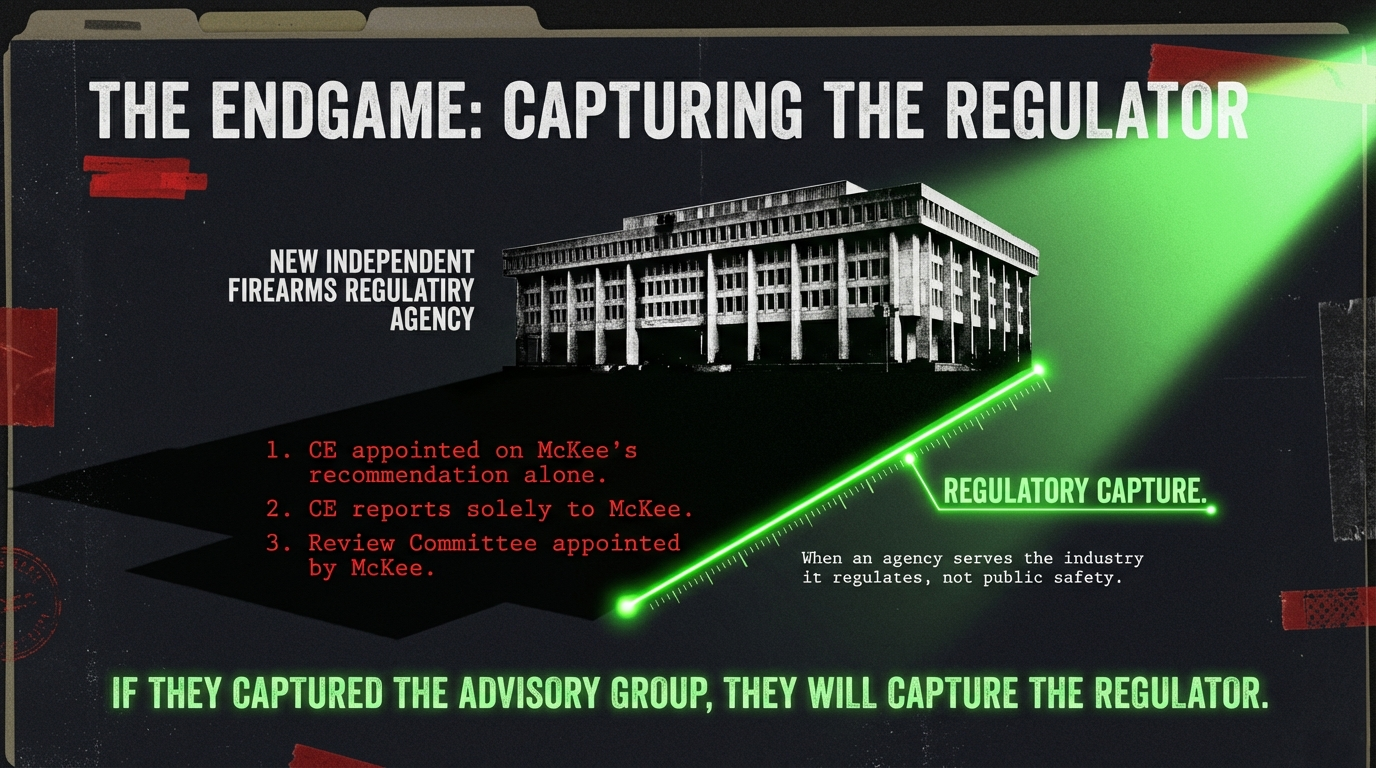
Currently, the Firearms Safety Authority’s leadership is overseen through Public Service Commission processes. The Arms Bill would transfer that authority directly to McKee.
The bill does not require the Justice Secretary to lead CE hiring. McKee’s office claims “transparent and contestable” procedures “with Cabinet oversight,” but these are intentions, not statutory requirements.
Given McKee’s demonstrated willingness to manipulate appointments to bodies with far less regulatory power, the prospect of her controlling appointments to the firearms regulator should alarm anyone invested in public safety.
Yasbek’s Warning: Regulatory Capture Defined
Philippa Yasbek—the expert McKee chose not to reappoint—stated:
“This is a fancy way of saying that the regulator serves the interests of the regulated group rather than the broader public interest, prioritising the convenience of gun owners rather than focusing on public safety.”
Regulatory capture is the mechanism by which an agency responsible for regulating an industry begins to serve that industry’s interests rather than the public’s. It operates through:
- Appointment capture: Staffing the agency with industry sympathizers
- Ideological alignment: Ensuring decision-makers share the regulated group’s policy preferences
- Revolving door: Creating pathways between industry and regulator
- Regulatory forbearance: Reducing enforcement or compliance costs for regulated entities
The MAAG appointments exemplify stage one: controlling the advisory body that shapes policy. If McKee uses similar tactics for the regulator itself, the result will be an agency captured by the industry it oversees.
PART SEVEN: WHY THIS IS LAWFUL BUT ILLEGITIMATE
The Technicality Problem
Every action McKee and Goldsmith took operated within existing law:
- Ministers have inherent discretion in making appointments
- No law prohibits restricting nominations to coalition partners
- No law requires using all nine PSC-recommended pathways
- No law mandates minimum timelines for conflict management
- No law prohibits delegating appointment authority to another minister
This is why their conduct is lawful but illegitimate. The law fails to require particular standards; it does not prohibit the conduct.
The PSC guidelines are guidance, not binding rules. The DPMC requirements are recommendations, not statutory obligations. The Cabinet Manual reflects constitutional convention, not law. The OIA redaction grounds allow commercial sensitivity claims without independent scrutiny.
When systems rely on compliance based on institutional norms rather than enforceable rules, they are vulnerable to actors willing to exploit the gap between legality and legitimacy.
PART EIGHT: THE MACHINERY OF NORMALIZATION—HOW DEMOCRACIES CORRODE
The Pattern Across Portfolios
The McKee appointments exemplify a broader pattern when power accumulates without transparency:
Finance: Ministers directing investment decisions toward preferred industries
Health: Appointing board members aligned with ministerial policy preferences
Education: Staffing curriculum boards with ideological allies
Justice: Appointing commissioners aligned with ministerial agenda
Firearms: McKee controlling MAAG and, under the Arms Bill, the regulator
The mechanism is universal:
- Identify discretionary authority (appointment power)
- Eliminate alternative pathways (restrict nominations)
- Pre-select preferred candidates (identify from personal network)
- Create appearance of legitimacy (route through formal channels)
- Delegate formal approval (transfer decision to create appearance of impartiality)
- Publish gazetted decision (make formally official)
By the time the public sees the gazetted appointment, the outcome was predetermined. The formal process is performance. The guidelines remain on the books, apparently protecting merit-based appointments, but their function has been gutted.
The Trust Collapse
When people observe this pattern—as Yasbek did—they conclude “the game is rigged.” Once that conviction takes hold, it undermines legitimacy of all government decision-making.
A 2022 survey showed junior public service staff are significantly less confident merit-based appointments occur than senior staff. This gap reflects their observation of exclusion from processes senior staff benefit from.
Similarly, when citizens see ministerial networks determining appointments to regulatory bodies, they lose confidence that regulations serve the public interest.
Once that trust erodes, it cascades: if citizens don’t believe the regulator is independent, they don’t trust its decisions; if they don’t trust decisions, they don’t comply; if they don’t comply, enforcement costs rise; enforcement becomes selective and arbitrary.
This is how democracies corrode: not suddenly, but through accumulated violations of institutional norms that, by themselves, seem defensible but collectively undermine legitimacy.
Historical Context: The 1912 Reform
New Zealand abolished patronage appointments in 1912 specifically to prevent the kind of network-based selection McKee employed. Te Ara, the Encyclopedia of New Zealand, records:
“In the 19th century, appointments often depended on a person’s relationship with a minister rather than skills or merit, and this system created serious problems.”
The public service was reformed to eliminate this system. Yet more than a century later, McKee’s process demonstrates that under the right conditions, ministers can recreate patronage while remaining technically compliant with merit-based guidelines.
PART NINE: ACCOUNTABILITY—OR THE ABSENCE OF IT
Who Should Face Consequences
Nicole McKee: Should apologize publicly, recuse herself from MAAG decisions, submit to independent review of her appointment decisions, and commit to departmental reform.
Paul Goldsmith: Should clarify the process and his role, announce reforms to prevent future irregularities, and establish independent oversight of Justice portfolio appointments.
Cabinet Office: Should review whether the process met DPMC standards, investigate the conflict advice redaction, and recommend statutory reforms.
Public Service Commission: Should clarify whether the process met “widest possible canvassing” standards, review other ministerial appointments for similar patterns, and recommend statutory reforms.
Parliament: Should call ministers to account, amend the Arms Bill to include statutory safeguards, and consider broader ministerial accountability reforms.
What Will Actually Happen
None of the above is likely. Here’s why:
McKee remains in Cabinet: Luxon has not indicated dissatisfaction. National needs Act’s three votes. Removing McKee would destabilize the coalition.
Goldsmith remains Justice Minister: Coalition stability prevents Luxon from enforcing accountability on a coalition partner’s minister.
Cabinet Office remains silent: It depends on ministerial confidence and cannot investigate without implicit Cabinet support, which is not forthcoming.
PSC remains deferential: It cannot compel ministerial accountability without government backing.
Parliament remains fractured: Labour and Greens lack votes to pass reform. National and NZ First benefit from weak accountability norms and will not strengthen them.
In other words, the system has no mechanism to hold these ministers accountable unless:
- Luxon decides coalition stability matters less than institutional integrity
- Voters turn against the Government on accountability grounds
- Media maintains pressure beyond the news cycle
None are likely.
PART TEN: THE CHOICE BEFORE PARLIAMENT AND THE PUBLIC
The Question
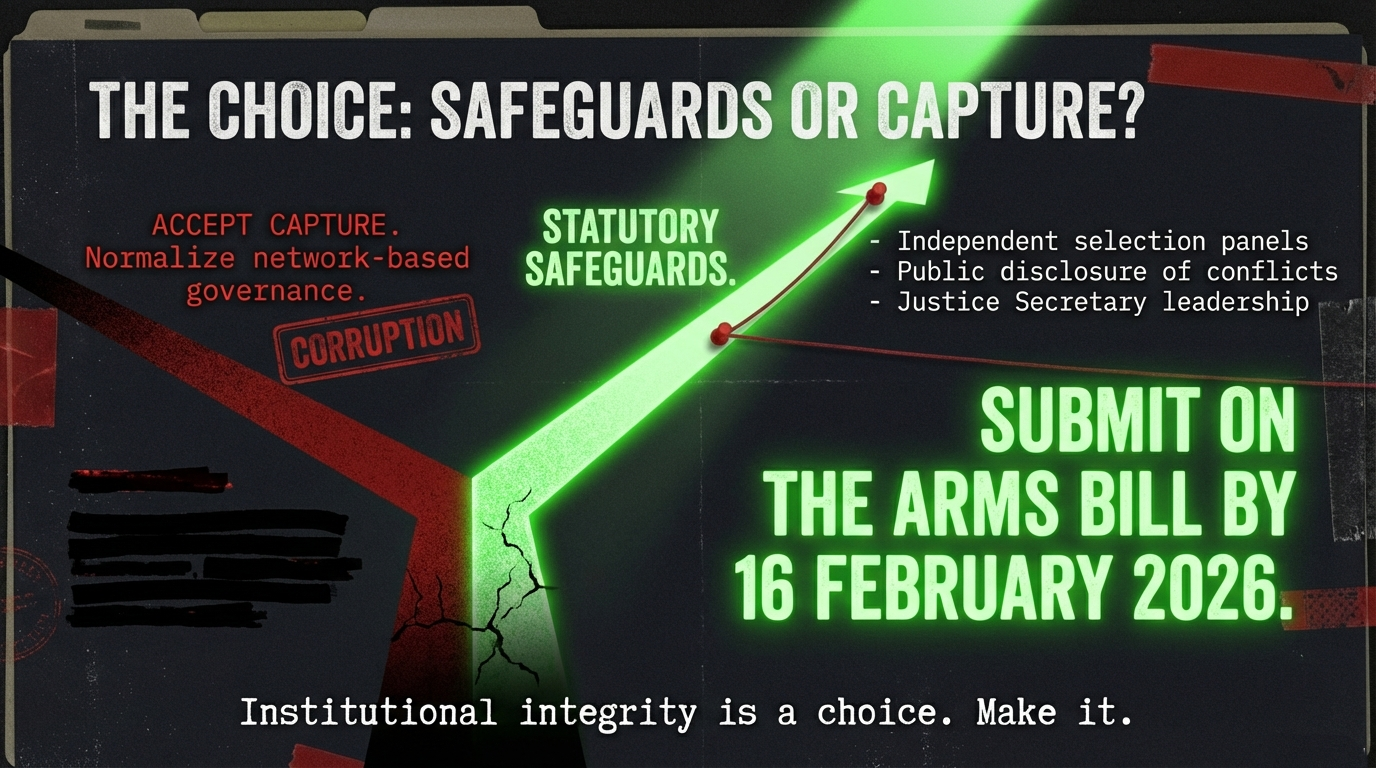
The McKee appointments present a choice point for New Zealand democracy: will merit-based governance and institutional integrity be maintained through statutory safeguards, or will they be abandoned to ministerial goodwill?
For more than a century, New Zealand assumed ministerial goodwill. PSC guidelines are guidance, not law. Cabinet Manual reflects convention, not requirement. Conflict management relies on ministerial compliance, not oversight.
This system worked when ministers respected institutional norms. The McKee and Rainbow cases suggest those norms are no longer operative.
Option One: Statutory Safeguards
Amend legislation to require:
- Independent selection panels for ministerial appointments to regulatory bodies
- Mandatory public disclosure of ministerial conflicts related to appointments
- Justice Secretary (not appointing minister) leadership of processes for regulatory bodies
- Annual reporting on appointment processes and outcomes
Option Two: Accept Capture
Maintain current arrangements and accept that ministers will use appointment authority to advance preferred candidates. At least make it explicit.
The Arms Bill as the Test
Parliament will make this choice implicitly through the Arms Bill. If the bill passes without statutory safeguards on appointments, Parliament will have chosen to accept capture. If the bill is amended to include safeguards before passage, Parliament will have chosen institutional integrity.
The choice will be made by 16 February 2026—the submissions deadline. That decision will signal whether institutional reform is coming or whether capture will be normalized.
THE SLOW CORROSION
What This Reveals
The McKee firearms appointments scandal is not a unique event. It is a visible manifestation of slow, systemic corrosion of democratic norms.
What happened here:
- Has been happening across government agencies for years
- Will continue at accelerating pace if no statutory constraints are imposed
- Undermines public confidence in institutional decision-making
- Redistributes power from citizens and expertise to ministers and networks
- Represents regression to pre-1912 patronage culture disguised in modern procedural language
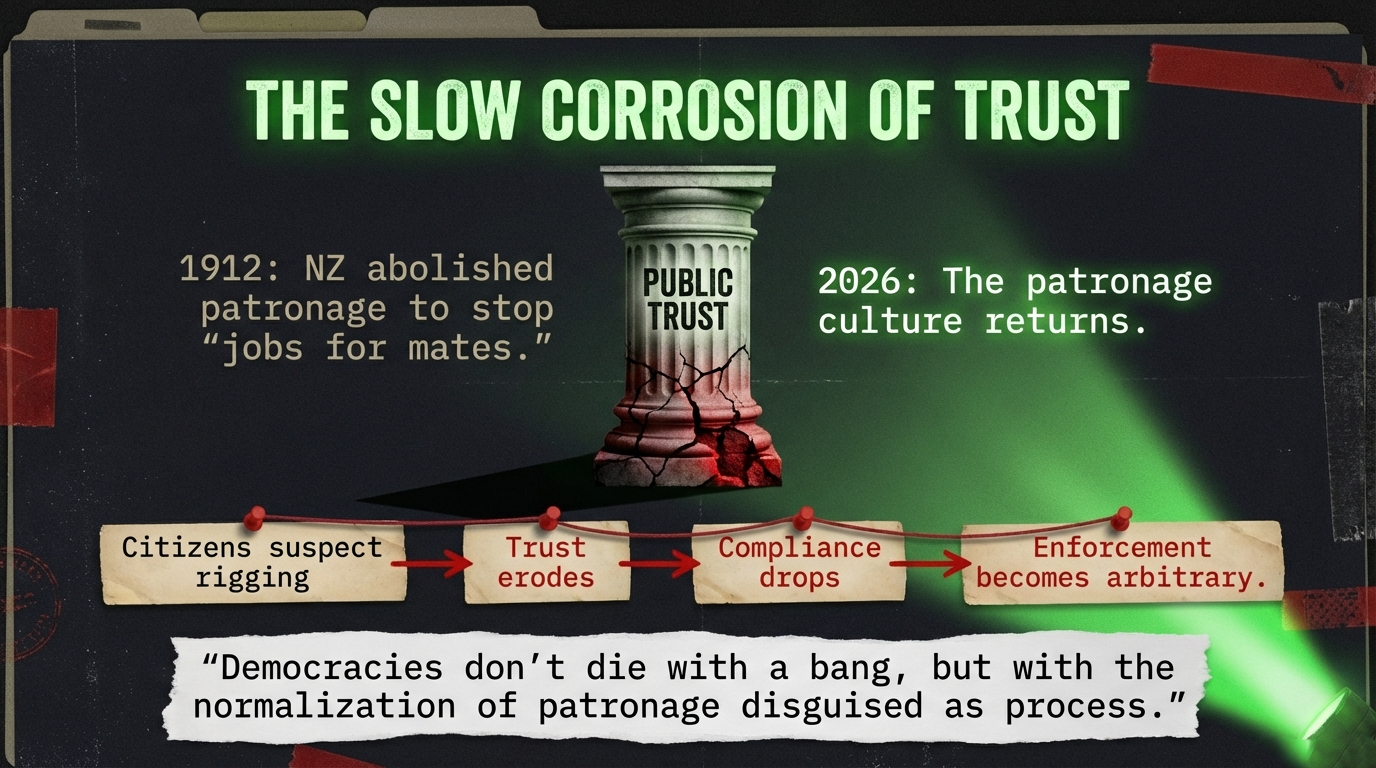
Yasbek said it best: “People believe the game is rigged. And it’s part of a broader pattern, a slow corrosion of how our democracy functions, and of trust in public institutions.”
The Threshold
New Zealand is at an inflection point. Institutions formally remain in place, but their protective function is hollow if ministers can exploit discretion with impunity.
If the response is to normalize the conduct, merit-based governance is replaced by network-based governance. Public trust erodes. Regulatory bodies serve regulated industries. Institutions remain formally independent while becoming functionally captured.
If the response is to strengthen statutory safeguards, New Zealand will have chosen institutional integrity over ministerial convenience.
The Arms Bill provides a concrete opportunity to make that choice. Parliament will decide within weeks. That decision will signal whether institutional reform is coming or whether capture will be normalized.
Everything depends on what happens next.
For Now
For now, we have the facts:
- Nicole McKee identified two candidates from her professional network
- She restricted nominations to exclude independent stakeholders and expertise
- She routed their nominations through Act Party channels
- She claimed conflict management required delegation to Paul Goldsmith
- But she involved herself substantively in the process before delegating
- And Goldsmith approved the appointments despite having been found to have violated legal standards in a similar appointment context one month prior
The MAAG appointments are lawful. No regulation was broken. No law was violated.
But they represent precisely the kind of institutional capture that democratic governance is designed to prevent. And the fact that they occurred within the formal bounds of existing guidelines suggests those guidelines are no longer adequate to protect merit-based appointments.
That is the scandal. Not what was illegal, but what was normalized.
And unless Parliament and the public demand reform, it will continue.

Ivor Jones The Māori Green Lantern Fighting Misinformation And Disinformation From The Far Right