”The Motel Generation and the Man Who Calls It “Success”” - 8 January 2026
How Tama Potaka’s smiling neoliberalism turns missing whānau, motel kids, and Te Tiriti itself into collateral damage for a white‑supremacist coalition he chose to serve
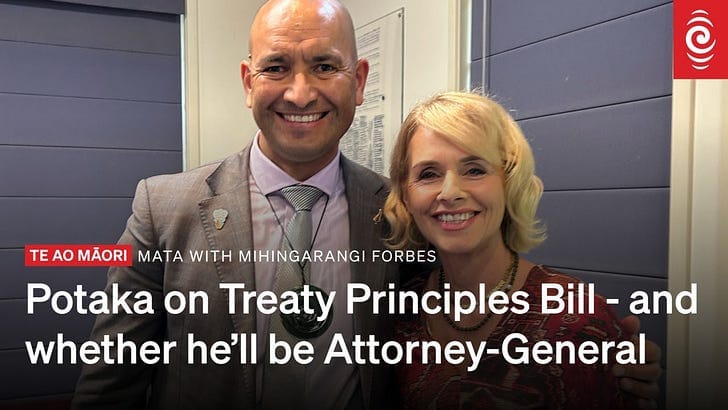
The Minister of Missing Whānau
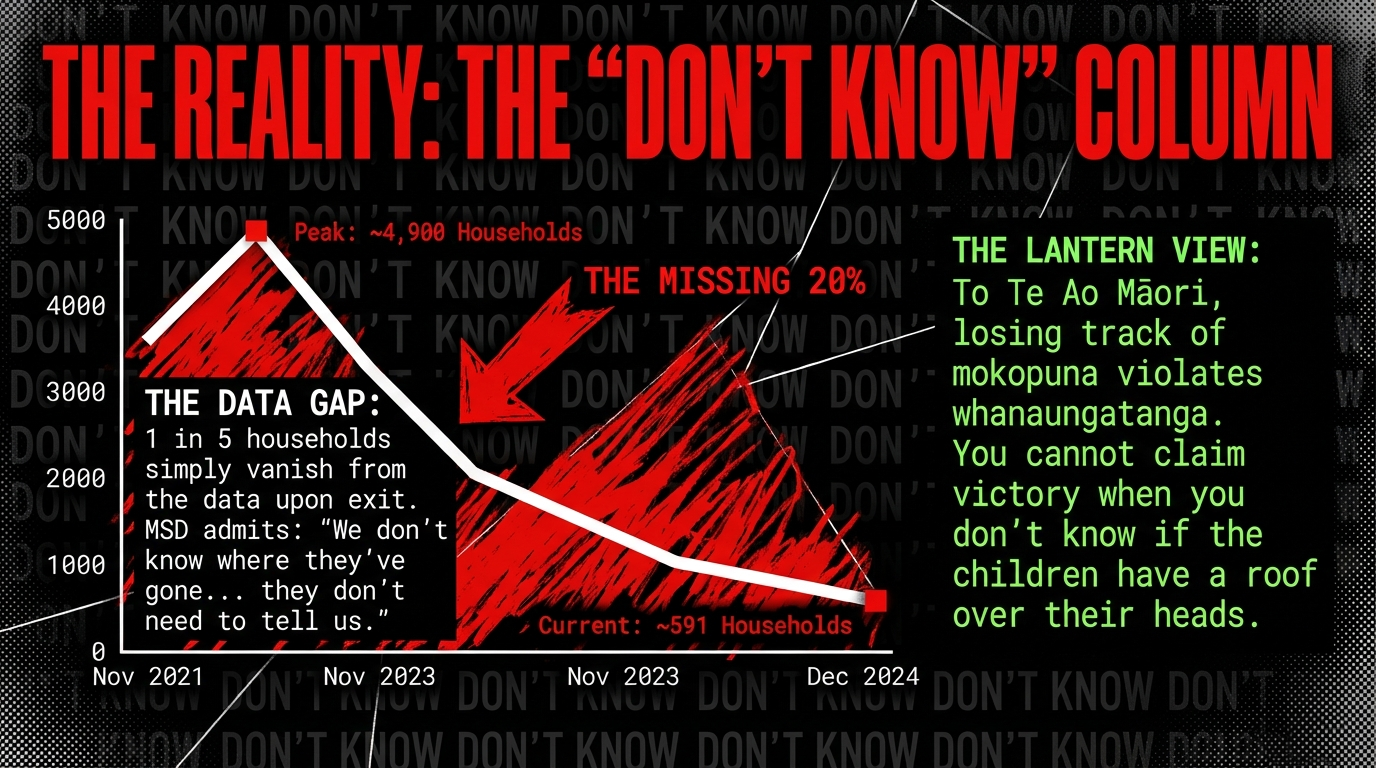
Tama Potaka stands in front of the nation and calls it “success” when one in five whānau who were in emergency housing simply disappear from the books, echoing the same colonial logic I exposed in “The Colonial Attack on Tikanga” where data and headlines are weaponised to hide deeper structural violence against Māori. RNZ The Māori Green Lantern – Colonial Attack on Tikanga
As he calmly rejects the idea of a “police state”, tamariki vanish from the data, and this government pats itself on the back for meeting a target five years early – the same sleight of hand I tracked when I showed how gang patch laws were sold as “public safety” while actually targeting Māori identity and tikanga in the courts. Beehive The Māori Green Lantern – Colonial Attack on Tikanga
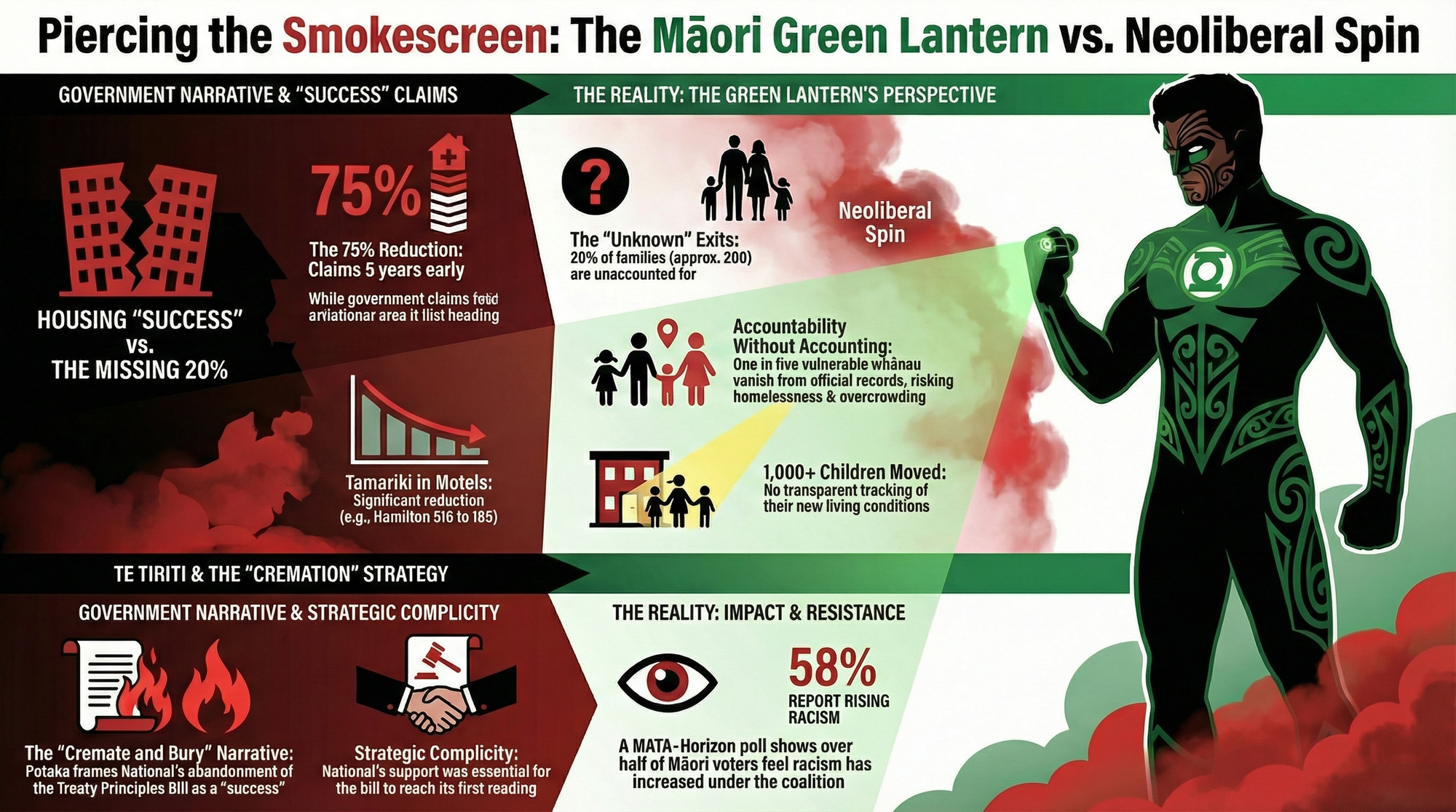
Under this coalition, racism is not a glitch – it is the operating system. A MATA–Horizon poll of Māori voters found 58% believe Aotearoa has become more racist under this government, with just 7% saying less racist, and 28% saying it is the same – and Tama’s response is to float above it all, “impartial”, as if tikanga demands neutrality in the face of harm, a pattern I named directly as “neoliberalism wins again” in my foundational essay on the 2023 election. 1News RNZ – Neoliberalism Wins Again
Background: From Te Tiriti to Treaty Bonfire
When Mihingarangi Forbes asks him about the Coalition’s Treaty Principles Bill – a bill that sparked marches, submissions, and deep mamae – Potaka leans on the line he’s clearly workshopped: National would “cremate and bury it”. RNZ 1News
Here’s the metaphor he won’t name: he agreed to help light the funeral pyre, then told us to be grateful that the fire stopped short of the urupā. National backed the bill through first reading as part of the coalition deal, even as Māori called it racist, divisive, and a direct attack on Te Tiriti – exactly the pattern of “colonial arrogance and neoliberal assault” I mapped in “Kia ora, my name is Ivor Jones, The Māori Green Lantern”. 1News The Māori Green Lantern – Colonial Arrogance & Neoliberal Assault
Potaka tells us the government will not “rewrite” Te Tiriti, while he sits at the table with ACT and NZ First, whose core kaupapa includes redefining Treaty principles in law and constraining Māori rights, the same network of actors – Seymour, Plunket, corporate funders – I traced as co‑conspirators in a coordinated attack on tikanga in the courts. Teaonews The Māori Green Lantern – Colonial Attack on Tikanga
Meanwhile, a coalition of Māori legal experts and advocates tell the United Nations that this government is “actively and profoundly aggravating New Zealand’s constitutionally racist foundation” in a way not seen for at least 50 years. Auckland University Teaonews
In my own essay on Seymour’s rogue UN letter, I showed how this coalition uses international forums not to protect Māori rights but to undermine UN scrutiny, then retreat, then spin it as “miscommunication” – the same dance Potaka now performs with Treaty “cremation day”. The Māori Green Lantern – UN Letter & Regulatory Standards NZ Herald
Tikanga vs Neoliberal Spin
Potaka repeatedly invokes “tikanga” – respect for people, impartiality, objectivity – as a personal brand shield while he front‑foots policies that Māori identify as racist and harmful, just as I warned in “The Hollow Shell of Non‑Judgmental Culture” where Pākehā systems hollow out tikanga language into neutral, non‑judgmental mush that protects power, not people. RNZ The Māori Green Lantern – Hollow Shell of Non‑Judgmental Culture
To the Western political mind, “tikanga” here is recast as virtue signalling: a kind of spiritual Teflon coating that turns every hard question into a shrugging mantra about “respect” and “difference”, while the material conditions of Māori life deteriorate under the weight of structural racism and austerity. Te Ara RNZ – Structural Racism
Māori scholars and community research show racism is daily, pervasive, and structurally embedded – 93% of Māori surveyed experience racism, and 96% say it is a problem for their whānau. RNZ SAGE Journals
When a Minister insists he does not “subscribe to racism” while actively advancing and legitimising the machinery that deepens racial harm, that is not neutrality – that is complicity dressed in reo Māori, the very dynamic I dissected when I described “neoliberalism wins again” regardless of whether the tie is red or blue. RNZ – Neoliberalism Wins Again The Māori Green Lantern – Colonial Arrogance & Neoliberal Assault
Analysis: Five Revelations of Neoliberal Damage
1. The Motel Generation and the 20% Who Vanish
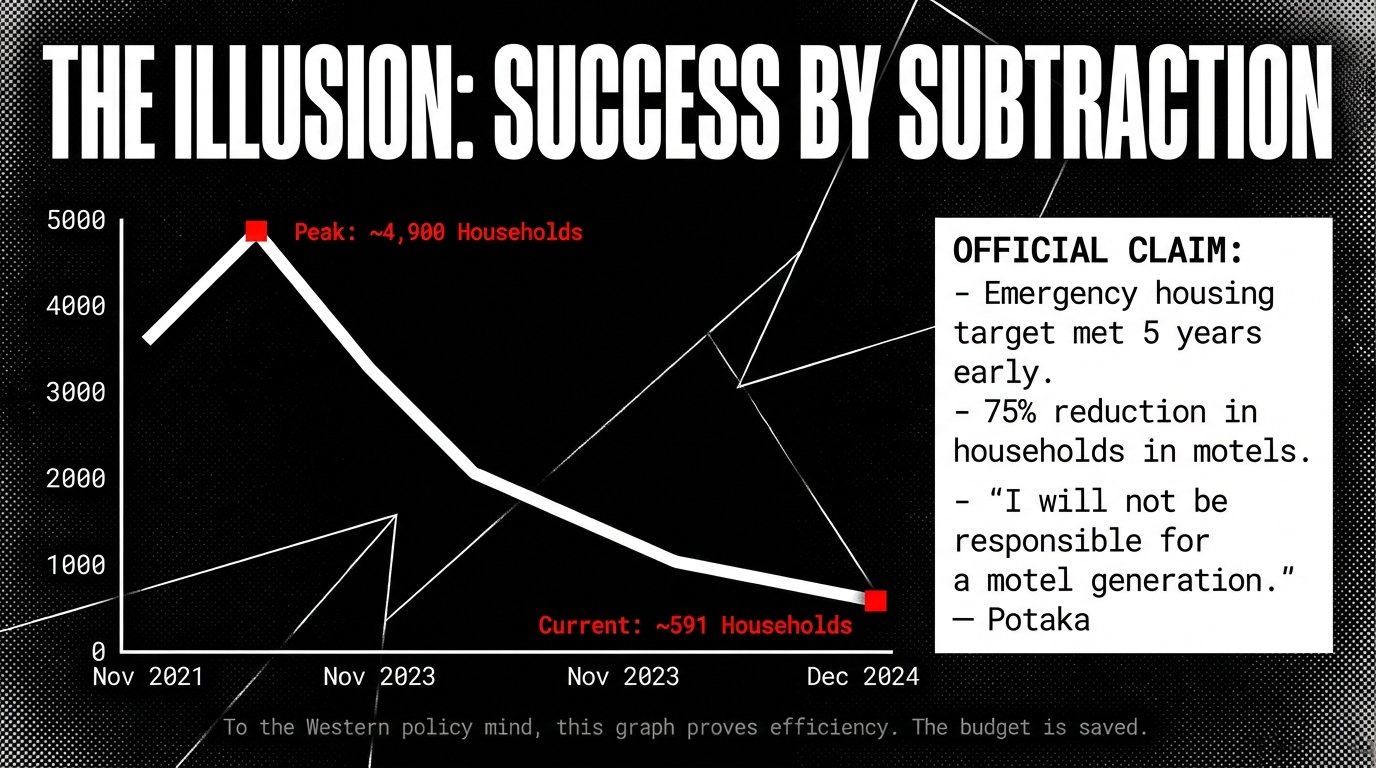
Potaka boasts that emergency housing targets have been smashed: the government claims a 75% reduction in households in emergency motels, five years ahead of schedule. Beehive 1News
But when pressed, MSD and his office cannot say where roughly 20% of those whānau – about 200 families in one RNZ investigation alone – have gone, even as he publicly celebrates that “more than 1000 children” are no longer in motels. RNZ 1News
In another region‑focused report, Potaka acknowledges that despite government efforts, 20% of those leaving emergency housing still cannot be accounted for. 1News NZ Herald – Waikato
This is the motel generation metaphor made real: tamariki are shuffled from motel corridors into an invisible column labelled “don’t know”, while the Minister points to a beehive press release as proof that progress has been made – exactly the kind of “accountability without accountability” I critiqued when looking at state care, prisons, and social services in my essays on tikanga and accountability. Tikatangata Housing Inquiry The Māori Green Lantern – Hollow Shell of Non‑Judgmental Culture
Quantifying harm:
- National peak of 4,983 households in emergency housing in November 2021. Beehive 1News
- Reduction to 591 households by December 2024 – but no clear public accounting of how many of those exits were into stable, healthy homes versus overcrowded garages, unsafe rentals, or the street. Beehive RNZ
- In Hamilton, Potaka touts a drop from 507 households in emergency motels in December 2023 to 144 in November 2024, and a reduction of tamariki in motels from 516 to 165 – yet again with no transparent breakdown of where those whānau now live. NZ Herald – Waikato Beehive
To a Western policy mind, this can be spun as efficiency: targets met, costs reduced, motels vacated. To tikanga, disappearing one in five vulnerable households from the record while claiming victory violates manaakitanga and whanaungatanga – you do not call it success if you don’t know whether the kids ate last night, a point I drove home when describing how housing policy becomes a “state‑care‑to‑prison pipeline” in practice. RNZ Te Ara
Example: A kuia raising mokopuna in a motel is shifted out as the “pipeline” tightens; if she falls into an overcrowded lounge in a cousin’s house or onto a couch that can vanish with one argument, she still counts as “no longer in emergency housing”, even as her housing insecurity and stress get worse. RNZ Tikatangata Housing Inquiry
Solutions:
- Mandate full exit tracking from emergency housing, including whether people move to stable housing, overcrowded situations, cars, or rough sleeping. RNZ 1News
- Shift funding from motel subsidies into Māori‑led papakāinga, community housing providers, and kaupapa Māori wraparound services with long‑term contracts, not short‑term crisis band‑aids – the exact alternative I highlighted when exposing “dangerous” social housing plans and neoliberal asset stripping of Te Pūkenga. NZ Herald – Social Housing Plans The Māori Green Lantern – Great Polytechnic Heist
2. Treaty Smoke and Mirrors: Cremating the Evidence
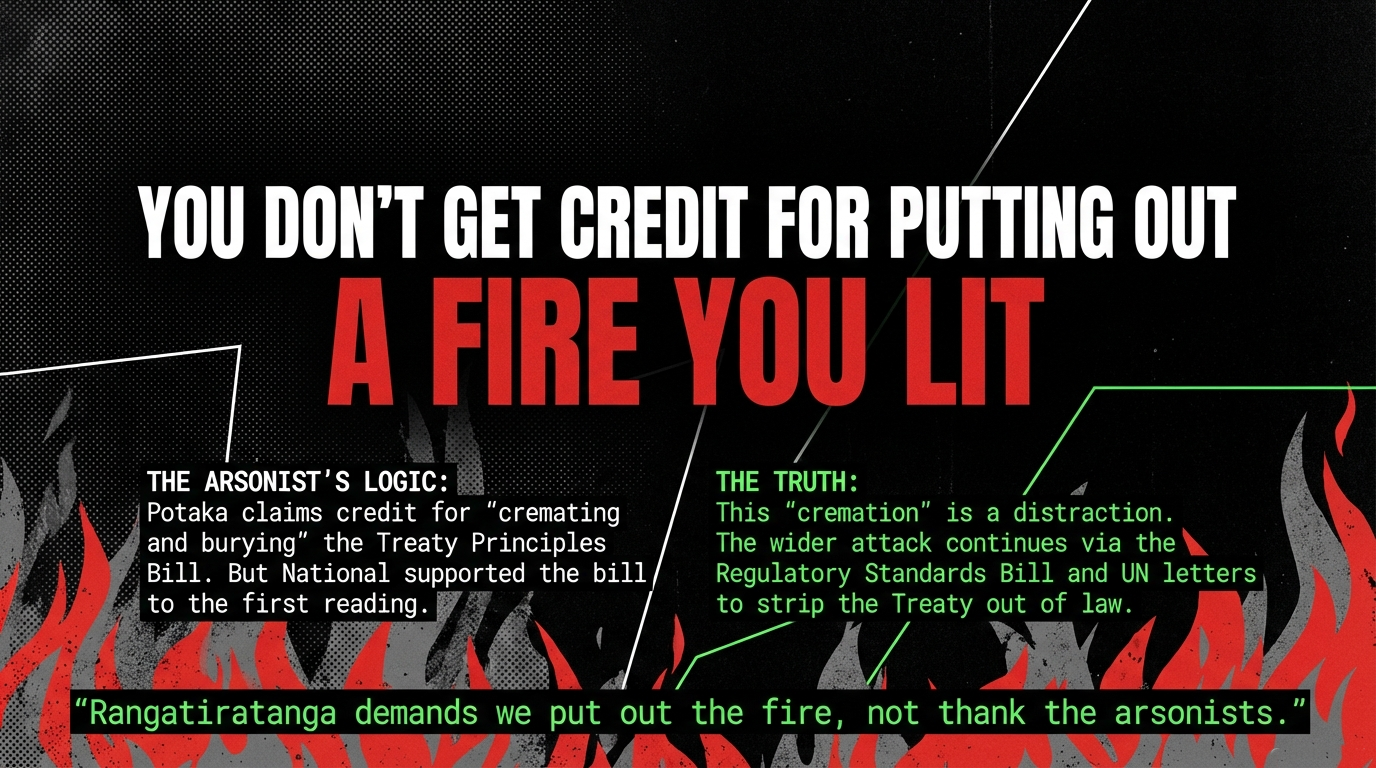
Potaka’s “cremate and bury it” line has become the official absolution phrase for National’s role in propelling the Treaty Principles Bill into the House. RNZ 1News
The reality:
- National’s support was essential for the bill to reach first reading and select committee, giving ACT’s project parliamentary legitimacy and forcing Māori to mobilise across the motu to defend Te Tiriti. 1News 1News
- Tens of thousands marched to Parliament, and the bill drew hundreds of thousands of submissions, the vast majority opposed – yet Potaka talks as if the only thing that matters is that National eventually walked away at second reading, just as Seymour tried to front‑run the UN narrative and then pretend it was all just a mis‑step. 1News The Māori Green Lantern – UN Letter & Regulatory Standards
This is like burning down half the whare and then asking for praise because you finally dropped the match at the porch.
A UN‑bound report by Māori legal and research experts explicitly warns that this coalition’s policy agenda – including attacks on Te Tiriti frameworks – is deepening structural racism and eroding Māori rights protections. Auckland University Teaonews
In “Kia ora, my name is Ivor Jones”, I traced how the Regulatory Standards Bill, Seymour’s UN antics, and the Treaty Principles Bill form a single campaign: use technical legal language and “equal rights” rhetoric to strip Te Tiriti out of regulation, funding, and judicial interpretation. Potaka’s “cremation day” line slots neatly into that strategy as the Māori frontman for a Pākehā demolition job. The Māori Green Lantern – Colonial Arrogance & Neoliberal Assault Maori Law Society Submission
Solutions:
- Codify Te Tiriti o Waitangi in constitutional form, recognising tino rangatiratanga and shared authority rather than leaving it hostage to coalition deals and culture‑war referenda. Te Ara Teaonews
- Require any Treaty‑related legislation to undergo independent tikanga‑based and human‑rights impact assessments led by Māori experts, with binding recommendations – an idea consistent with indigenous accountability frameworks I explored in my essays on tikanga, accountability, and state power. OAG Māori Perspectives Tikatangata Accountability
3. Racism as “Not My Tikanga”
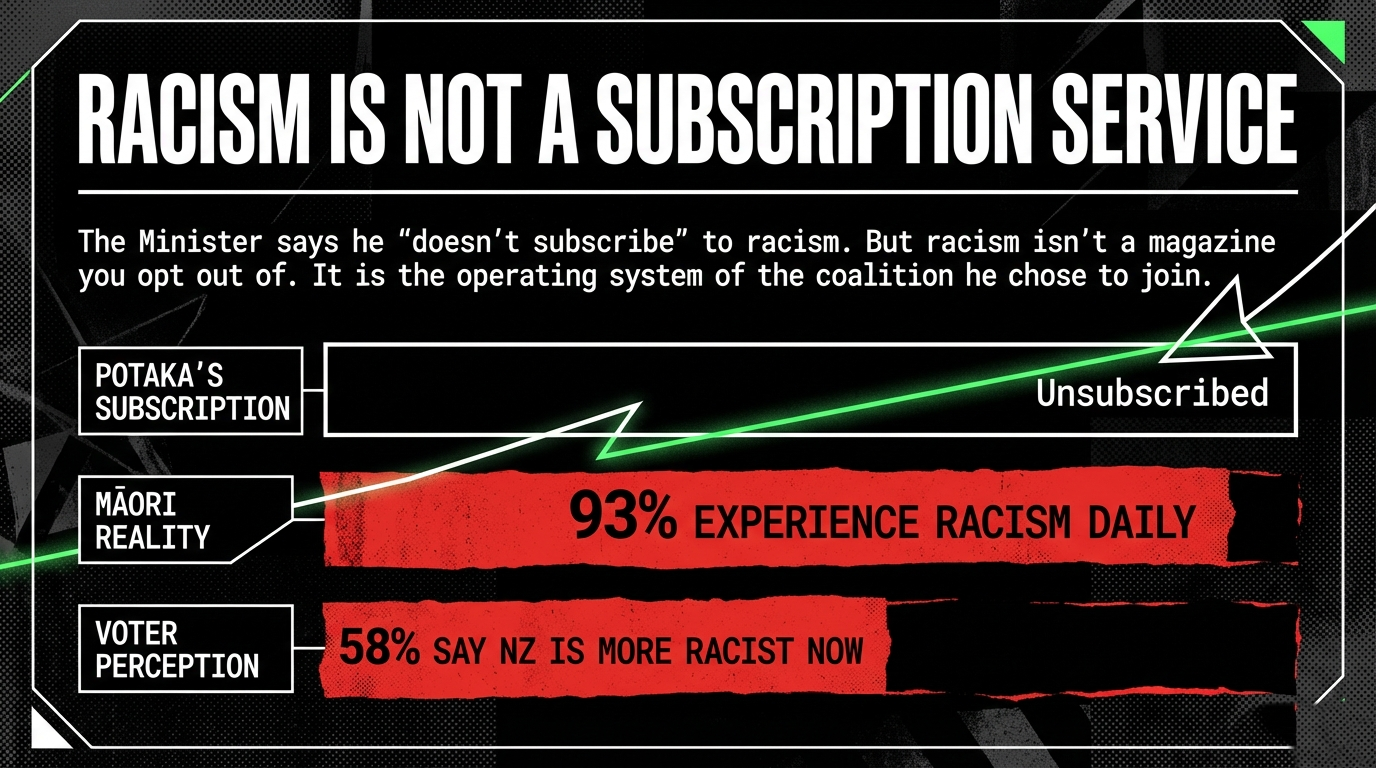
When confronted with polling showing Māori believe the country is more racist under this coalition, Potaka retreats into the language of personal tikanga: he “does not subscribe” to racism, he is “impartial and objective”, and racism is framed as an “air” others might get “caught up in”. RNZ 1News
Yet research across health, justice, housing, and everyday life shows racism is experienced by the vast majority of Māori, with measurable impacts on mental and physical health. RNZ SAGE Journals
A 93% daily racism exposure rate is not an “air” you avoid by saying the right karakia before Cabinet. It is institutional, baked into legislation, policing, housing policy, schooling, and welfare systems – many of which this government is either cutting, restructuring, or weaponising against Māori, just as I showed in my essays on education, health cronyism, and the dismantling of Māori‑centred tertiary structures. The Māori Green Lantern – Govt’s Violent Dismantling of Māori Education The Māori Green Lantern – Simeon Brown’s Healthcare Cronyism
To the Western mind, this “I personally am not racist” script is familiar: it separates individual virtue from collective harm, allowing powerful people to disclaim responsibility while continuing to vote for, implement, and defend racially damaging policies. Te Ara ProPublica
Solutions:
- Replace “intentions” talk with measurable anti‑racism obligations in ministerial portfolios – including targets to reduce disparities in homelessness, incarceration, and health outcomes for Māori. Taylor & Francis MDPI
- Embed Māori‑led monitoring of government racism across all sectors, with public reporting and the power to trigger formal inquiries, as proposed in multiple reports on structural racism and indigenous rights. RNZ Auckland University
4. Devolution as Distraction While Structural Chains Stay On
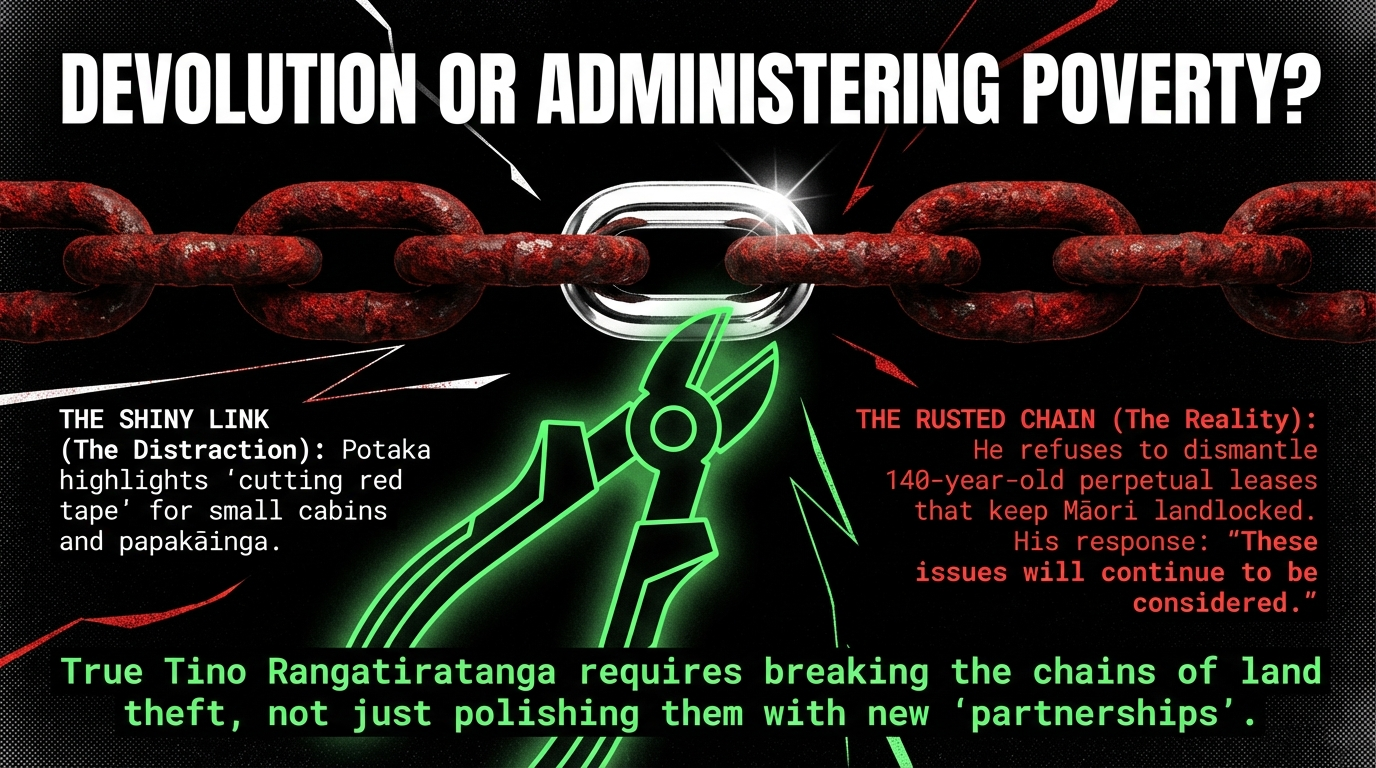
Potaka talks glowingly about devolution and “working together” with iwi to achieve shared aspirations. He uses examples like cabins after extreme weather events and papakāinga housing to position the government as flexible, responsive, and partnership‑oriented. RNZ Beehive
He celebrates contracted Māori housing builds – such as 392 homes out of a promised 400 on Māori land, backed by $200 million – as evidence that things are “going really, really well”. RNZ Beehive
Yet when asked about perpetual leases and landlocked Māori land – 140‑year‑old chains that still prevent whānau from using their whenua – he shrugs them off as live issues that will continue to “be considered” and hints they won’t be attached to key law reforms, echoing the colonial tradition I unpacked where big speeches skirt around the actual land theft and structural constraints. Te Ara NZ Herald – Trampling on Māori Land Rights
To a Western policymaker, this looks like balance: some red tape cut, some issues left for later. To tikanga, it is a breach of whakapapa obligations: you cannot talk about unlocking potential while leaving whole communities stuck under 999‑year leases and blocked access roads, generation after generation. Te Ara Waitangi Tribunal
Example: Taranaki whānau trapped in 999‑year leases see their whenua generate wealth for others while they remain renters in their own rohe, yet the Minister of Māori Development tells them their issue will keep being “considered” as he fast‑tracks other reforms that suit the Crown. Te Ara Waitangi Tribunal
Solutions:
- Legislate an early‑termination pathway for perpetual leases on Māori land, with compensation calibrated to historical injustice, not just current market logic. Waitangi Tribunal Te Ara
- Create a national programme to resolve landlocked Māori land with state‑funded access solutions, driven by iwi and hapū priorities rather than Crown convenience, aligning with accountability models for housing in te ao Māori. Tikatangata Housing Inquiry Taylor & Francis
5. The White‑Supremacist Coalition He Chose
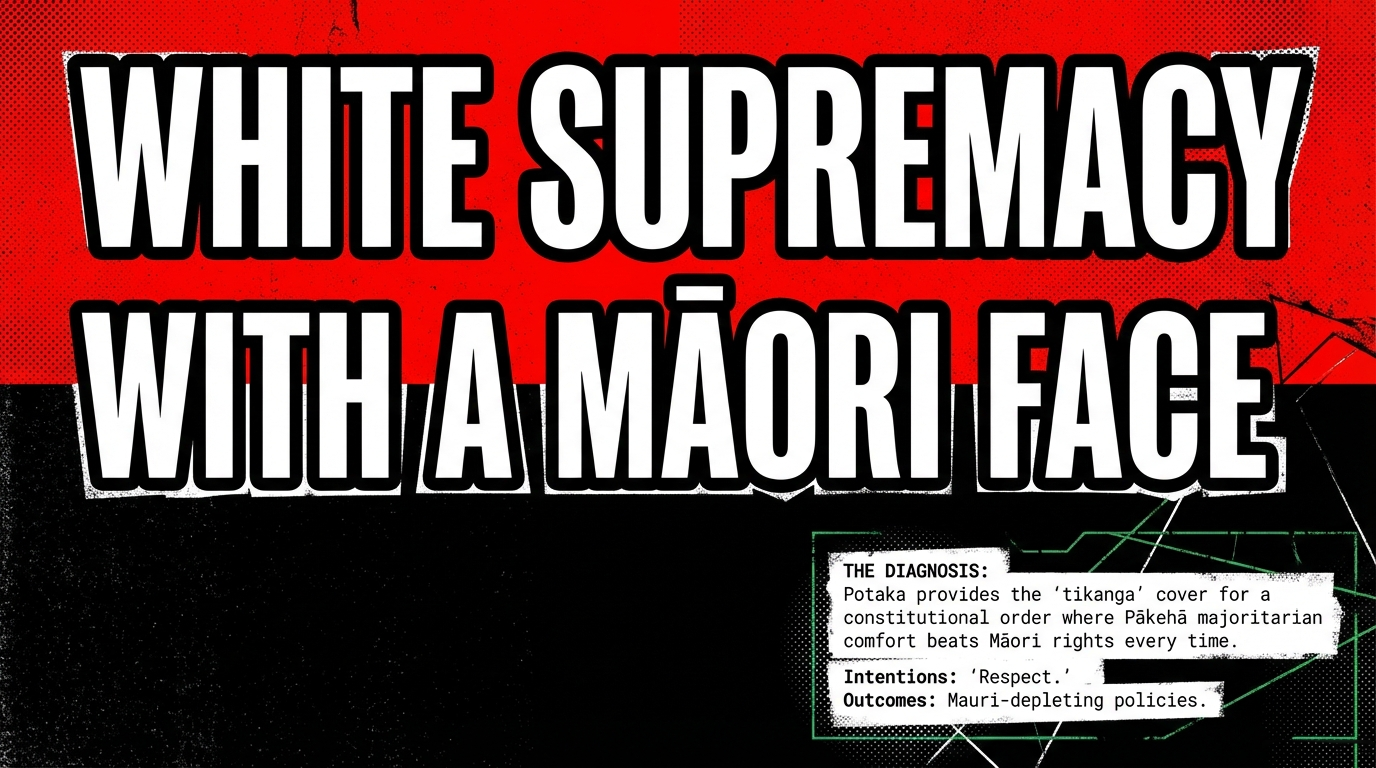
Potaka defends his place in the coalition bluntly: he is proud to be in the government that blocked Labour, the Greens, and Te Pāti Māori from forming the next administration. RNZ 1News
The coalition he props up has:
- Backed ACT’s Treaty Principles Bill through first reading, legitimising a project widely condemned as racist. 1News RNZ
- Triggered a surge in perceptions of racism, with Māori and wider public polls showing low confidence that government policies are reducing racial tensions. 1News RNZ
- Drawn international attention for policies that aggravate Aotearoa’s “constitutionally racist foundation”, including in housing, health, and Treaty settings. Auckland University Teaonews
White supremacy in this context is not a hood and a burning cross; it is a constitutional order where Pākehā majoritarian comfort beats Māori tino rangatiratanga every time, and where “unity” is invoked only to discipline Māori resistance – the same pattern I dissected in my essays on Te Pūkenga, tech colonialism, and the “one law for all” rhetoric. E-Tangata – One Law for All The Māori Green Lantern – Great Polytechnic Heist
Potaka has made his choice: his loyalty is to the coalition arithmetic that keeps this order intact, not to the Māori who tell pollsters, researchers, and the United Nations that racism is worsening and their rights are under attack. RNZ Auckland University
Tikanga Explained to the Western Mind
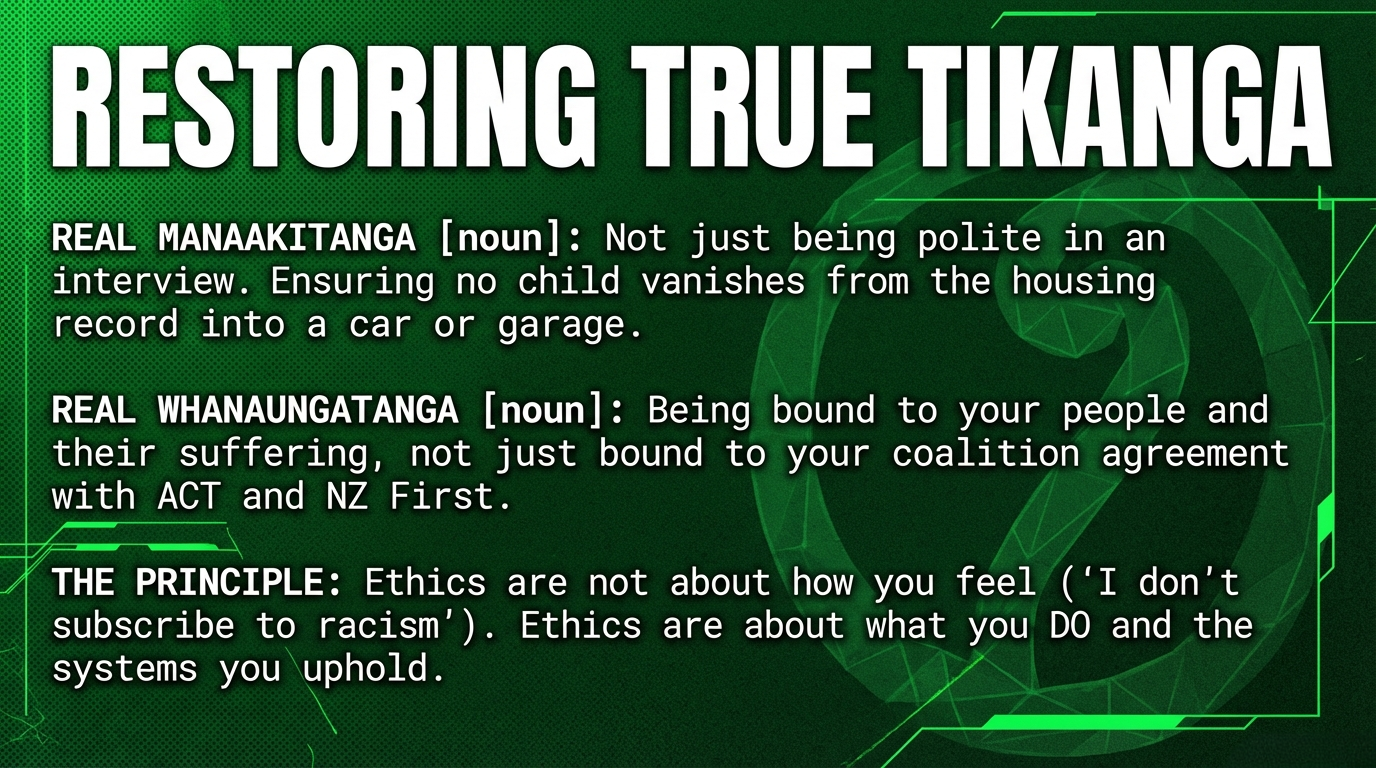
In tikanga Māori, manaakitanga is not a branding exercise – it is an obligation to uphold the mana of others, especially the vulnerable. You cannot claim manaakitanga while designing policy that leaves hundreds of families in an “unknown” housing status and calls it a triumph, any more than you can call gang‑patch seizure “public safety” while using it to crush Māori identity. Te Ara The Māori Green Lantern – Colonial Attack on Tikanga
Whanaungatanga insists you are bound to your people; there is no “I do not subscribe to racism” out clause when your political decisions deepen the structures that grind down your own. Te Ara RNZ
To a Western liberal mind, ethics is often individual: if you feel respect and you speak nicely, you’re a good person, even if the system you run is cruel. Tikanga judges differently: your kupu, your votes, your policies, and their effects on the whenua and on the whānau are one continuous line – if the outcomes are mauri‑depleting, your mana is compromised, no matter how polished the interview, as I argued when calling out “non‑judgmental culture” that hides harm instead of confronting it. The Māori Green Lantern – Hollow Shell of Non‑Judgmental Culture Te Ara
Implications and Action: From Motel Stats to Mana Motuhake
Harms quantified:
- Emergency housing reduced on paper, but with 20% of exits untracked, hundreds of families – many Māori – risk falling into chronic homelessness, overcrowding, and cascading health harms. RNZ 1News
- Racism experienced daily by over 90% of Māori, compounded by policies flagged to the UN as aggravating structural discrimination. RNZ Auckland University
Pathways forward for whānau and allies:
- Back Māori‑led housing, health, and justice solutions – not just as service delivery, but as expressions of mana motuhake with real control over pūtea and policy levers, the kind of solutions I consistently amplify across essays on education, health, food systems, and tikanga‑based accountability. The Māori Green Lantern – Stopping the Corporate Takeover of Our Food MDPI
- Support constitutional transformation that centres Te Tiriti and tikanga, as called for by Māori legal scholars and advocates, so future coalitions can’t treat our rights as negotiable, a position I set out clearly in my breakdown of Seymour’s Treaty project and the Regulatory Standards Bill. Maori Law Society Submission The Māori Green Lantern – Colonial Arrogance & Neoliberal Assault
- Document and expose local impacts of these policies – every whānau moved, every service cut, every racist interaction – and feed that evidence into iwi, community, legal, and international forums, just as my previous investigations traced money, media, and law from childcare empires to anti‑Māori propaganda platforms. The Māori Green Lantern – Colonial Attack on Tikanga ProPublica
The metaphor is simple: this government, with Tama Potaka as its Māori face, is running a bonfire. Te Tiriti, emergency housing whānau, Māori land rights – everything that gets too loud, too assertive, too alive is pushed closer to the flames, then we are told to be grateful that not everything burned.
Rangatiratanga demands we put out the fire, not thank the arsonists for eventually dropping one match.
Koha Consideration – Motel Generation, Treaty Fire
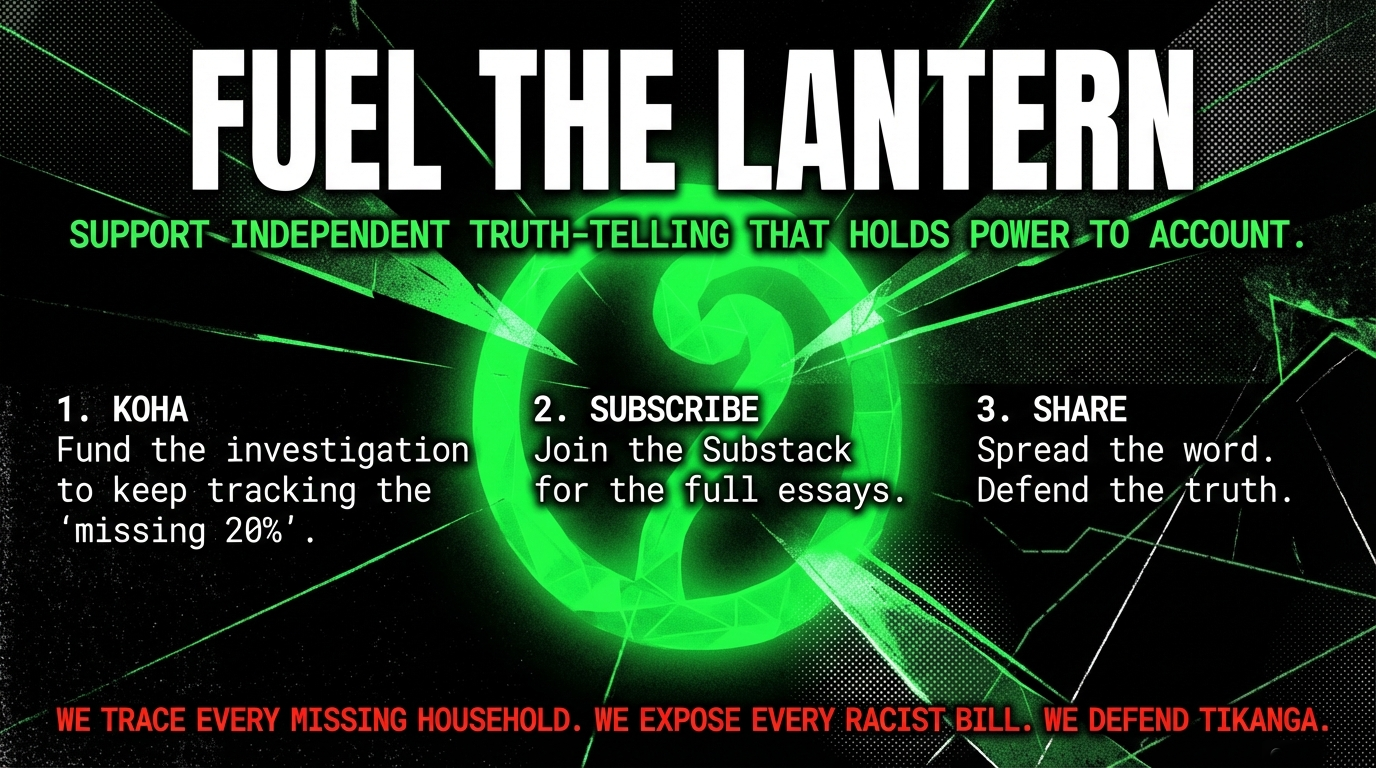
Every koha to this kaupapa is a line in the sand against a government that can celebrate motel “success” while 20% of our most vulnerable whānau vanish from the stats, and a Treaty “cremation” while Te Tiriti is dragged through the flames of white‑supremacist policy.
It is a declaration that rangatiratanga includes funding our own truth‑tellers to trace every missing household, expose every racist bill, and defend tikanga where ministers misuse it as a shield – the same mahi carried through my investigations into gang‑patch laws, Te Pūkenga’s dismantling, health cronyism, and tech colonialism. Kia kaha, whānau. Stay vigilant. Stay connected. And if you are able, consider a koha to ensure this voice keeps calling out the motel generation politics and Treaty bonfires in real time.
If you are unable to koha, kei te pai – subscribe or follow The Māori Green Lantern on Substack, kōrero and share with your whānau and friends. That is koha in itself.
Three pathways exist:
For those who wish to support this mahi directly with a koha (voluntary contribution), please visit the Koha platform:
Koha—Support – https://app.koha.kiwi/events/the-maori-green-lantern-fighting-misinformation-and-disinformation-ivor-jonesFor those who wish to receive essays directly and support through subscription, join the Substack community:
Subscribe to The Māori Green Lantern on Substack – https://themaorigreenlantern.substack.com/subscribeFor those who prefer direct bank transfer, account details are: HTDM, account number 031546-0415173-000.

Ivor Jones The Māori Green Lantern Fighting Misinformation And Disinformation From The Far Right