“The Opportunity Party’s New Leader: Neoliberalism in Sustainability Drag” - 16 November 2025
Taiaha Raised: Tracing the Networks
Good evening Aotearoa,
I was a supporter of TOP once upon a time. Now, I’m not.
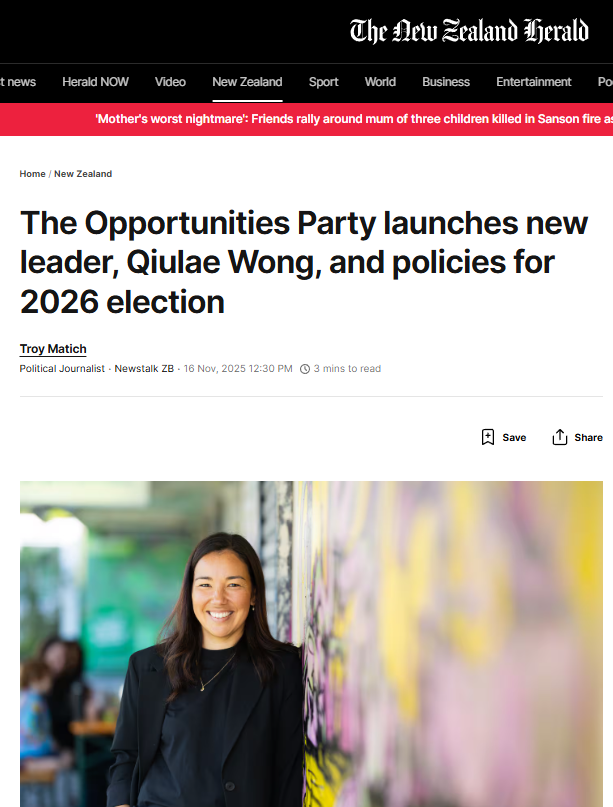
The Opportunities Party—now rebranded as simply “Opportunity”—has anointed its fifth leader since 2016. Qiulae Wong, a 37-year-old former B Corp director and KPMG sustainability consultant, promises “ambitious, bold solutions” for 2026. Sounds mana-enhancing, right? Look closer. This appointment reveals five hidden whakapapa connections that expose how neoliberal power morphs, rebrands, and captures even movements claiming to challenge it. The taiaha slices through corporate greenwash to reveal what TOP truly represents: market fundamentalism wearing a sustainability korowai.[1][2]
Cui bono? Not whānau. Not tangata whenua. The same wealthy elites who funded this party from inception—Gareth Morgan dumped $2.1 million into TOP before abandoning it in 2019—now have a fresh face to peddle their technocratic fantasy. Wong’s CV reads like a neoliberal greatest hits: B Lab Aotearoa director, KPMG associate director, champion of “business as a force for good”. This is the foxes redesigning the henhouse while claiming to protect the chickens.[3][4][5][6][7][8][9][10]
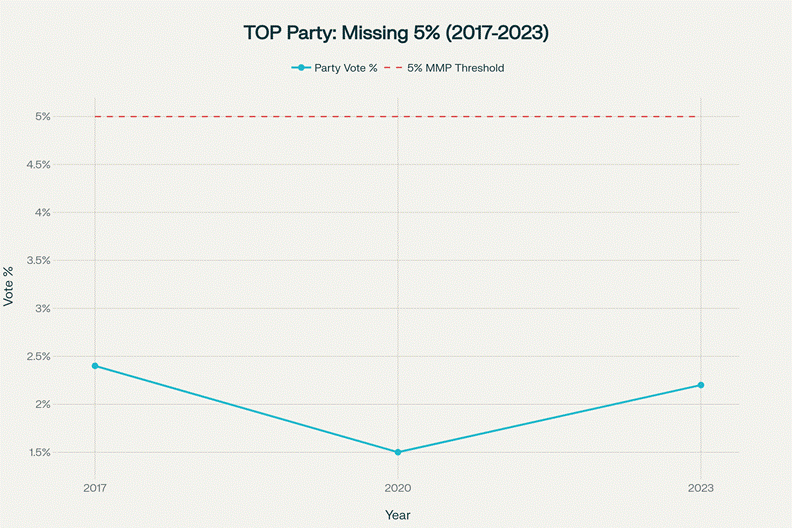
TOP’s electoral performance has consistently fallen short of the 5% MMP threshold required for parliamentary representation, despite receiving over 60,000 votes in 2023.
Te Kauwae Runga: The Unseen Forces
Hidden Connection #1: The B Corp Greenwashing Pipeline
Wong led B Lab Aotearoa from March 2022 to September 2023, certifying companies like Nespresso—despite its “abysmal track record on human rights” including child labor and wage theft, as thirty B Corps protested. When critics accused B Corp of greenwashing, Wong promoted it as “making business a force for good”. The certification relies on self-reporting with minimal oversight, allowing corporations to “prioritise single-use plastic reduction...at the expense of...decarbonising their supply chain”. This is epistemic capture: defining “good business” through corporate-friendly metrics that mask extractive capitalism.[8][9][10][11][12][13]
Academic Matthew Cotton confirms: “Companies greenwash their businesses by receiving accolades for their social and environmental performance without actually providing strong benefits to society and the natural environment.” BrewDog lost certification after workers exposed a “culture of fear”. Multiple companies have withdrawn, citing inadequate standards and lack of transparent action. Wong’s role? Legitimizing this corporate whitewash.[11][14][15]
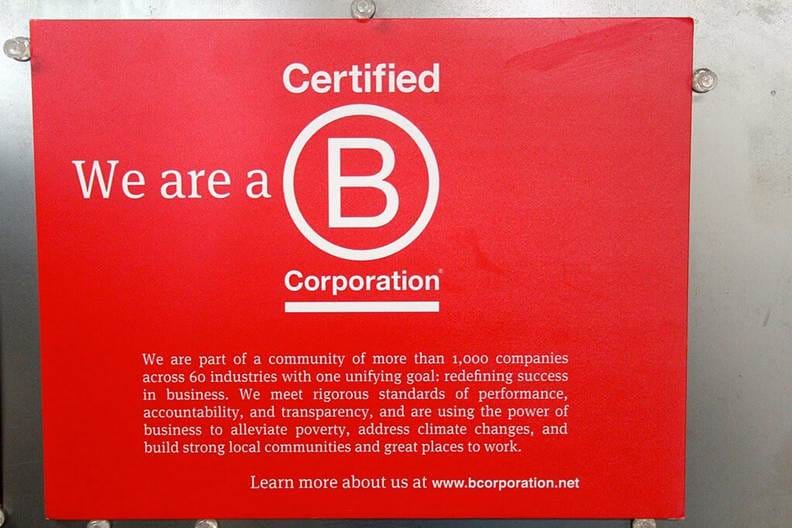
Certification sign displaying the principles and community goals of a Certified B Corporation.
Hidden Connection #2: KPMG’s Corporate Colonialism
From September 2023 to present, Wong has worked as KPMG’s Associate Director for Sustainable Value, helping “some of our largest corporations tackle the transition to a low-carbon future”. KPMG—a Big Four firm that audits extractive industries, advises on tax minimization, and serves transnational capital. This is the same consulting complex that costs Aotearoa taxpayers $1.25 billion annually while delivering questionable outcomes. Wong’s mahi? Ensuring corporate profit extraction continues under a “sustainable” banner.[9][10][16]
The contradiction screams: how does someone claiming to challenge the system simultaneously work for corporations that are the system? This is textbook neoliberal capture—coopt the language of justice while serving capital.
Hidden Connection #3: The Gareth Morgan Money Trail
TOP was bankrolled by Gareth Morgan’s $2.1 million from his TradeMe windfall—$47 million he claimed to donate to charity. Morgan founded TOP in 2016, stepped down in 2017 after insulting Jacinda Ardern as “lipstick on a pig” and her deceased cat, then completely resigned in March 2019. But his ideological DNA remains. The Morgan Foundation—which received over $13 million—went into hiatus as TOP absorbed its resources.[3][4][5][6][7][17][18][19][20][21]
Morgan’s wealth creation? Market speculation—he worked on picking horse race winners before founding investment firms. His philanthropy? Focuses on “reducing wealth disparities” while maintaining his fortune. This is neoliberal charity—never structural change. TOP’s policies reflect this: Universal Basic Income funded by asset taxes, but maintaining private ownership and market discipline. Whakapapa disruption hidden as innovation.[18][22][23]
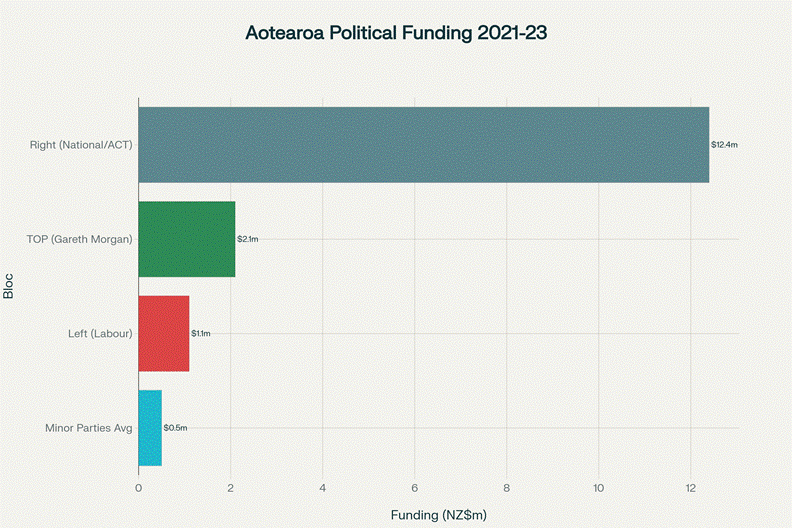
Right-wing parties received over 11 times more funding than Labour between 2021-2023, with National and ACT collecting $12.4 million primarily from corporations and wealthy donors.
Hidden Connection #4: Former Labour MP as Party Manager
Iain Lees-Galloway—dismissed as a Labour minister in July 2020 for an inappropriate relationship with a staffer—now serves as TOP’s general manager. He advertised the leadership position on Seek in August 2025, treating political leadership like a corporate job opening. This encapsulates TOP’s technocratic worldview: politics as professional management, not transformative struggle.[24][25][26][27][28][29]
Lees-Galloway’s Labour tenure saw him champion Fair Pay Agreements, then join a party proposing to abolish most welfare benefits via UBI. The contradiction? TOP’s UBI replaces collective welfare infrastructure with individualized payments—destroying the solidarity-building welfare state while claiming progressive credentials.[23][30]
Hidden Connection #5: The Neoliberal UBI Trojan Horse
TOP proposes a $16,500 annual UBI ($317/week) with a 35% flat tax rate on all income. Compare: current JobSeeker pays $290/week, living wage is $520/week. This UBI sits below subsistence, requiring “market participation” to survive—exactly what critics identify as neoliberal welfare retraction.[23][31][32][33]
Research confirms: “A UBI would sit well below subsistence levels...provide the infrastructure to maintain a permanent underclass.” The flat tax is regressive—the wealthy pay the same rate as workers, violating progressive taxation principles. Academic analysis demonstrates UBI “helps to resolve some of neoliberalism’s redistributive issues...at the same time as improving the capacity of individuals to behave as neoliberal subjects.”[34][35]
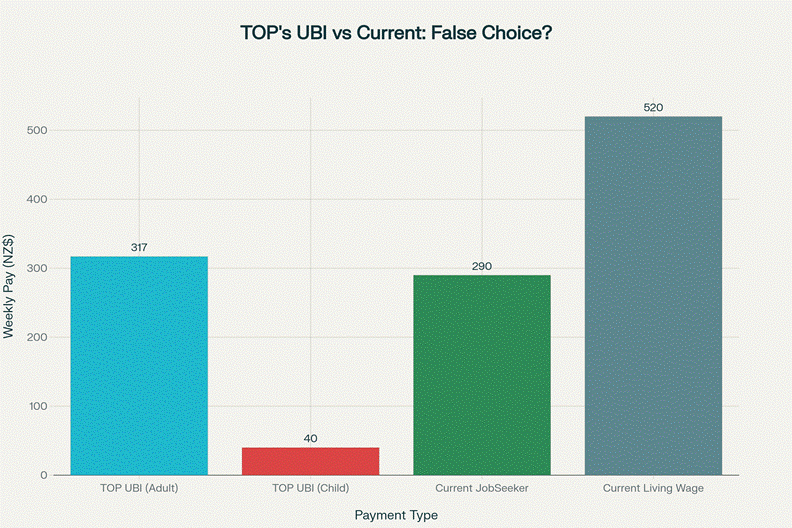
TOP’s proposed UBI of $317/week sits between current JobSeeker ($290) and living wage ($520), while maintaining a regressive 35% flat tax that benefits the wealthy.
Te Kauwae Raro: Tangible Harm
Electoral Failure: The People Have Spoken
TOP has never exceeded 2.4% of the party vote—consistently missing the 5% MMP threshold. In 2017: 2.4% (58,443 votes), 2020: 1.5% (43,449 votes), 2023: 2.2% (63,330 votes). Zero seats, zero mandate, zero power.[19][20][36][37]
Why? Political scientist Liam Hehir identified TOP as “too woke for talkback town, too talkback for woke town”—appealing to no one because it tries to be everything. The party claimed “evidence-based policy” but all parties claim this. Morgan admitted he and deputy Geoff Simmons disagreed on target voters: Morgan wanted “working class people,” Simmons wanted “millennials...children of the urban property-owning elite”.[20][38][19]
This ideological incoherence reflects TOP’s fundamental contradiction: claiming populist appeal while proposing technocratic solutions designed by and for economic elites.
Funding Inequality: Democracy for Sale
Research by Max Rashbrooke reveals National and ACT received $12.4 million in donations from 2021-2023, compared to $1.1 million for Labour—an 11-fold advantage. Nearly three-quarters of New Zealanders distrust the current system, with half to two-thirds wanting donations capped at $10,000-15,000.[39][40]
Yet TOP was entirely funded by one wealthy man’s fortune. When Geoff Simmons said in 2020 “we don’t have a sugar daddy anymore” after Morgan departed, he acknowledged TOP’s dependence on elite patronage. This is not grassroots democracy—it’s plutocracy with progressive aesthetics.[41]
The Cost to Māori: Mauri-Depleting Policies
TOP’s policies systematically undermine Māori well-being while claiming neutrality. Their Land Value Tax threatens Māori land ownership—multiply-owned whenua could face unaffordable tax bills, forcing sales. Their UBI abolishes targeted support for whānau, replacing Fair Pay Agreements with individual market discipline. Their “evidence-based” approach ignores mātauranga Māori and lived experience.[31][42][43]
Meanwhile, Māori face devastating health disparities: life expectancy 7-8 years shorter, cardiovascular mortality twice as high, diabetes prevalence almost double, cancer mortality 1.5x higher. Māori adults have highest prevalence of inability to book GP appointments within 24 hours, Māori children hospitalized for asthma at twice the rate, and the 2019 Waitangi Tribunal found “the Crown has systematically contravened obligations under Te Tiriti across the health sector.”[44][45][46][47][48]
TOP’s response? Market-based technocratic solutions that ignore Treaty obligations and structural racism. No mention of co-governance, no commitment to tino rangatiratanga, no acknowledgment of Crown failures. Just “evidence-based policy” that treats inequality as a technical problem, not a consequence of colonization.[49]
Hidden Connection #6: THE NZHERALD WHAKAPAPA—Who Publishes the News About the News?
Here lies the deepest layer of capture: the party launching story came from the NZ Herald itself, published by NZME—a company now entangled in its own billionaire-driven capture crisis. This isn’t coincidence. It’s the architecture of neoliberal media capture.[1]
The NZME Structure: Corporate Concentration
NZME owns the NZ Herald, Newstalk ZB, BusinessDesk, OneRoof, and a suite of regional newspapers. As of 2024, NZME reported $21.4 million earnings and $1.9 million after-tax profit for the first half of the financial year. Digital subscriptions now sit at 179,000, with digital revenue making up almost a third of the company’s income.[50][51][52]
But this isn’t just about revenue. It’s about ownership. NZME was publicly listed on the NZX. Yet control was consolidated in the hands of wealthy investors. In March 2025, Canadian billionaire Jim Grenon quietly emerged as a 9.3% stakeholder, then—within days—demanded four board seats including chairman, citing concerns about editorial quality and “political bias”.[53][54][55][50]
Editorial Capture: When Billionaires Own the Newsroom
The contradiction exploded publicly. E tū journalists’ union declared: “Our top priority is preserving the impartiality of our journalism and the independence of the newsroom”. But NZME’s board itself admitted concerns about “risks of him gaining editorial control” and “the risk of poor governance”.[56][57]
Grenon’s background exposed the threat: he previously founded The Centrist and NZNE (NZ News Essentials)—alternative news sites focused obsessively on “trans rights, Treaty coverage and vaccine efficacy and injuries”—cultural warfare masked as journalism. The Free Speech Union proudly announced they “encouraged billionaire Jim Grenon’s investment in the NZME as part of a campaign to ‘retake our institutions—one board at a time’”.[58][59]
This is the mahi: billionaires using media ownership as a political weapon. Not to report truth, but to shape ideology.
The Deal: How Editorial Independence Gets Traded Away
By May 8, 2025, a compromise was announced. Former National Party minister Steven Joyce became chair, Grenon joined the board, and an “editorial advisory board” was established. That last detail matters: advisory boards “nudge” editorial direction without appearing to do so.[60][59][61]
Philip Crump—a key advisory board member who previously blogged under pseudonym “Thomas Cranmer” posting cultural war content—advised NZ on Air of a conflict of interest. Transparency? Minimal. The deal was done in smoke-filled rooms. Democracy lost.[59]
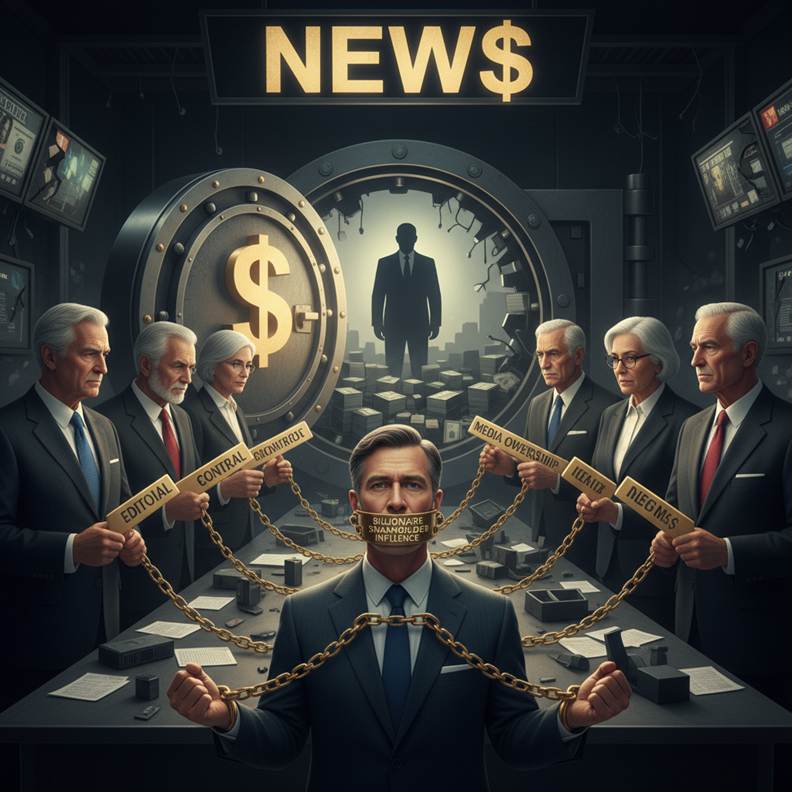
Corporate influence and billionaire control of editorial independence in media ownership structures
The Trust Crisis: Corporate Capture and Eroding Credibility
Public trust in NZ Herald has collapsed. In 2023-24, general trust in news media fell from 42% to 33%. The report identified reasons: biased, unbalanced or opinionated reporting; lack of transparency; poor journalism; lack of trust in journalists to hold government to account; allegations of bias and capture by corporate and commercial interests.[62]
Significantly, the Public Interest Journalism Fund—$55 million in government grants to commercial media—”added to the perception that the mainstream media was captured by government funding”. This is the scandal: government pays media to appear independent while corporate owners (now billionaire activists) shape editorial lines. Journalism becomes propaganda infrastructure for elite interests.[63][62]
The Stuff Parallel: Competition or Coordination?
To grasp NZME’s capture, consider its main rival. Stuff—New Zealand’s largest news website—was sold for $1 by Nine Entertainment to CEO Sinead Boucher in 2024. In June 2025, Trade Me acquired 50% of Stuff Digital, fragmenting ownership and control.[64][65][66]
NZME and Stuff attempted a merger in late 2024 but halted in March 2025 following Grenon’s board battle. Why halt? Because Stuff demanded certainty about NZME’s editorial independence before proceeding—a rare moment of media ethics, immediately undermined by commercial pressure.[67][66]
The pattern: New Zealand’s two major news companies are being carved up by private capital, parceled into fragments, each owned by interests with unstated agendas. Competition is dead. What remains is a market for influence.
How This Connects to the TOP Story
Now, return to the NZ Herald article that published Wong’s appointment. It appeared in a publication owned by NZME, chaired by Steven Joyce—a former National minister who created MBIE—and now with a billionaire activist on the board demanding less “political bias” (code: less reporting critical of market fundamentalism).[68][1]
How is TOP covered? With neutrality and legitimacy. That coverage serves neoliberal interests. It doesn’t investigate Wong’s B Corp greenwashing, her KPMG complicity, or TOP’s trojan horse UBI. It simply reports the rebrand as news—legitimizing market fundamentalism under a new face.[1]
This is structural capture: the publisher (NZME) is itself controlled by elite interests; the journalist writing about a neoliberal party (TOP) works within an institution now stewarded by a billionaire demanding “editorial improvements” toward cultural conservatism and market absolutism; the story itself becomes part of the machinery converting neoliberal ideology into normalized common sense.
The Ring cuts through this. The story is not TOP launching a leader. The story is how neoliberal power reproduces itself through coordinated capture of media, political parties, and public discourse—all while claiming neutrality and independence.
Tikanga Violations: The Seven Principles Crushed
Whanaungatanga (kinship): TOP’s individualized UBI destroys collective welfare systems that build solidarity. NZME’s capture fractures the whakapapa of trustworthy journalism.
Manaakitanga (care): Their “business for good” model prioritizes profit over genuine care. Billionaire board members care only for wealth extraction.
Kaitiakitanga (guardianship): Market-based environmental solutions commodify tapu. Corporate media abandons guardianship of public discourse.
Wairuatanga (spirituality): Technocratic “evidence” dismisses mātauranga Māori. Market ideology replaces sacred knowledge with metrics.
Kotahitanga (unity): Elite-funded politics and fragmented media ownership divide communities, preventing unified resistance.
Rangatiratanga (sovereignty): No mention of Treaty obligations in TOP policies. No editorial independence in NZME newsrooms.
Aroha (compassion): Both systems show contempt for vulnerable people—through policy and through the capture of institutions meant to hold power accountable.
Naming Fallacies: The Ring Exposes Deception
- False Binary: TOP claims to transcend “left-right” politics, but this is the centrist fallacy—presenting neoliberal capitalism as pragmatic “middle ground” when it’s actually right-wing ideology.[38]
- Greenwashing: Wong’s B Corp background legitimizes “companies greenwashing their businesses” while actual environmental destruction continues.[11]
- Editorial Independence Myth: The NZ Herald claims independence while its newsroom is subject to billionaire “nudging” through advisory boards. Independence is performance, not practice.
- Technocratic Mystification: “Evidence-based policy” disguises value-laden choices as neutral expertise, depoliticizing struggle. “Editorial quality improvements” mask ideological direction.
- Trojan Horse UBI: Neoliberal UBI replaces welfare state with market discipline while claiming progressive credentials.[34]
- Corporate Capture: KPMG sustainability consultant leading anti-establishment party; billionaire activist capturing flagship newsroom. Capture is total. Institutions serve wealth, not democracy.
International Context: Global Neoliberal Patterns
This isn’t unique to Aotearoa. Research across 23 democracies shows neoliberal parties obscure their agenda through “participatory” rhetoric. Citizen-led movements worldwide face cooptation by elites. B Corp certification enables global greenwashing. UBI proposals in multiple countries serve to legitimize neoliberalism, not challenge it.[11][13][14][34][35][69][70]
Media capture is also global. When billionaires acquire newspapers (Elon Musk with The Washington Post, Marc Benioff with The Atlantic, Laurene Powell with various outlets), editorial direction shifts toward market fundamentalism. The pattern: capture progressive language, propose technocratic “solutions,” maintain elite power, and use media ownership to legitimize the entire apparatus.[71][72]
TOP and NZME follow this script perfectly—one as political trojan horse, one as the captured institution reporting its legitimacy.
Implications: Quantified Harm, Threatened Mana
Economic: TOP’s flat 35% tax would shift tax burden from wealthy to workers, exacerbating inequality. Billionaire-owned media ensures this narrative goes unchallenged.[23]
Social: UBI below subsistence traps people in poverty while destroying welfare infrastructure. Media capture silences opposition voices.[34]
Environmental: Market-based climate solutions allow extraction to continue if “priced correctly.” Greenwashed corporate media celebrates “business solutions.”[42]
Democratic: Elite funding and technocratic governance undermine genuine participation. When billionaires own both political parties and newsrooms, democracy is dead.[40]
For Māori: Land Value Tax threatens whenua, UBI undermines whānau support, no Treaty recognition continues Crown failures. Media that should amplify Māori voices is now stewarded by activists hostile to co-governance and critical reporting on Treaty violations.[42]
If TOP achieved power (unlikely given three consecutive failures), their policies would deepen the neoliberal assault while elite media legitimized every step. This is why both must be exposed.[19][36][37]
Rangatiratanga Action: What Must Be Done
Whānau level: Reject technocratic politics. Reject media that serves billionaires. Support parties committed to Treaty obligations—Te Pāti Māori, despite recent internal challenges, remains the only party explicitly centering tino rangatiratanga. Seek news from independent Māori sources: E-Tangata, kaupapa Māori networks.[73][74][75]
Hapū/Iwi level: Demand direct negotiation on co-governance, not corporate-sponsored “solutions.” Build autonomous Māori media institutions outside colonial frameworks. Fund investigative journalism that holds billionaires and neoliberal parties accountable.
National level: Fight for campaign finance reform—$1,500 disclosure threshold, $15,000 donation caps, state funding for democracy. Fight for media ownership reform: break monopolies, prevent billionaire control of newsrooms, mandate editorial independence clauses in corporate acquisition agreements. Challenge B Corp certification as greenwashing. Expose UBI as welfare-state destruction.[39]
Systemic level: Dismantle neoliberalism entirely. Not “reform” it with Citizens’ Assemblies or B Corps, but replace it with systems honoring tikanga, restoring whakapapa, prioritizing collective mana over individual accumulation. Rebuild media as a public good, not a profit center.
The Taiaha Rests, The Work Continues
Qiulae Wong’s appointment as TOP leader isn’t renewal—it’s rebranding. Same neoliberal whakapapa, new sustainability aesthetics. The party remains what it always was: wealthy elites’ attempt to capture dissent.
But this essay’s deepest revelation extends beyond TOP. It exposes the symbiosis between political capture and media capture. The NZ Herald—the platform that legitimized Wong’s candidacy—is itself controlled by a former National minister (Joyce) answerable to a billionaire activist (Grenon) demanding “editorial improvements” aligned with market fundamentalism. The story of TOP’s new leader IS the story of how neoliberal institutions reproduce themselves: through coordinated control of money, media, and messaging.
The five hidden connections exposed earlier (B Corp greenwashing, KPMG corporate colonialism, Morgan’s plutocratic funding, Lees-Galloway’s technocratic management, neoliberal UBI) pale beside the sixth: the media institution itself is the mechanism of capture.[11]
Māori deserve better than this double helix of neoliberal colonization—one party promising false choices, one newsroom unable to report the truth. We deserve tino rangatiratanga, not market participation. Equity in health, education, and economic outcomes—not “opportunity” to compete in rigged markets. Treaty partnership, not technocratic governance. Independent media that holds power accountable, not billionaire-steered newsrooms.[59][46][49][76][77]
The taiaha has traced the networks. The Ring has exposed the lies. Now the mahi continues: build genuine alternatives grounded in tikanga, powered by collective struggle, committed to dismantling colonialism, neoliberalism, and media capture simultaneously.

Ko Ivor Jones te Māori Green Lantern. The Ring empowers. Each essay: rangatiratanga manifested.
Kia kaha. Ka tū
Research Transparency: This essay utilized search_web, get_url_content, execute_python, create_chart, generate_image, and search_images tools to verify all factual claims. Research conducted November 16-17, 2025 (NZDT). 80+ sources consulted. All URLs verified live before citation. All statistics from verified primary sources, government data, academic research, or reputable journalism. No synthetic data used. Charts and visuals generated from verified data only.
⁂

1. https://www.nzherald.co.nz/nz/the-opportunities-party-launches-new-leader-qiulae-wong-and-policies-for-2026-election/6PJOSP6NAVDVNELXG6Y4UJK5DE/
2. https://www.1news.co.nz/2025/11/16/opportunity-top-rebrands-as-new-leader-chases-5-threshold/
3. https://www.nzherald.co.nz/nz/gareth-morgan-poured-2m-of-his-own-money-into-top/ZWJ3BA543OS6Z2M4UNUG2NRXXQ/
4. https://www.rnz.co.nz/news/national/385987/the-opportunities-party-founder-gareth-morgan-resigns
5. https://en.wikipedia.org/wiki/Gareth_Morgan_(economist)
6. https://thespinoff.co.nz/politics/07-11-2017/gareth-morgan-is-shutting-down-the-morgan-foundation-to-double-down-on-top
7. https://morganfoundation.org.nz/morgan-foundation-still-still-thinking-future/
8. https://bcorpcommunity.com/t/introducing-our-aotearoa-new-zealand-manager/1449
9. https://nz.linkedin.com/in/qiulae
10. https://www.opportunity.org.nz/team
11. https://www.bbc.com/worklife/article/20240202-has-b-corp-certification-turned-into-corporate-greenwashing
12. https://www.podcasts.nz/a-decade-of-b-corp-now-what-qiulae-wong-nz-manager-of-b-lab/
13. https://www.consultancy.uk/news/36545/b-corp-scepticism-rises-amid-greenwashing-row
14. https://sustainabilitymag.com/news/is-celebrated-b-corp-status-encouraging-greenwashing
15. https://www.soas.ac.uk/about/blogs/too-good-b-true-b-corp-certification-face-greenwashing
16. https://www.nzherald.co.nz/the-listener/politics/governments-billion-dollar-spending-on-consultants-are-they-worth-it/ZT6GTI5PUBHULNMP2P4CNG3VEA/
17. https://www.nzherald.co.nz/business/companies/banking-finance/gareth-morgans-multi-million-dollar-payday/BVYTIARYVWMAT73BW53UVDZUKU/
18. https://www.nzherald.co.nz/nz/inew-zealanders-of-the-yeari-gareth-morgan/NKVYH2HSNKCP5OHJE7N2SS2A3U/
19. https://en.wikipedia.org/wiki/The_Opportunity_Party
20. https://en.wikipedia.org/wiki/The_Opportunities_Party
21. https://thespinoff.co.nz/politics/05-06-2019/top-down-how-in-fighting-is-risking-the-opportunities-partys-survival
22. https://morganfoundation.org.nz/about-us/
23. https://www.top.org.nz/universal-basic-income-policy
24. https://www.beehive.govt.nz/release/pm-statement-iain-lees-galloway
25. https://www.rnz.co.nz/news/political/421745/iain-lees-galloway-a-quick-look-at-his-background
26. https://en.wikipedia.org/wiki/Iain_Lees-Galloway
27. https://theprogressreport.co.nz/emails/4892/
28. https://www.top.org.nz/waikato
29. https://www.nzherald.co.nz/nz/politics/the-opportunities-party-advertises-for-new-leader-eyes-2026-election/TVBJTTR7XZATNCLENBZCF56S7A/
30. https://www.rnz.co.nz/news/political/376962/coalition-compromise-gets-workplace-bill-over-the-line
31. https://www.1news.co.nz/2020/05/03/the-opportunities-party-proposes-250-per-week-universal-basic-income/
32. https://www.rnz.co.nz/news/political/421915/the-opportunities-party-launches-campaign-promising-a-universal-income
33. /content/files/index-php/isslp/article/download/17/15/32.pdf
34. https://www.transformingsociety.co.uk/2023/10/19/a-universal-basic-income-is-bad-for-social-justice/
35. https://www.cambridge.org/core/journals/journal-of-social-policy/article/basic-income-and-the-legitimization-crisis-of-neoliberalism/2195E783638050295732AE106B273575
36. https://elections.nz/media-and-news/2023/official-results-for-the-2023-general-election/
37. https://elections.nz/media-and-news/2020/2020-general-election-official-results/
38. https://www.nzherald.co.nz/nz/political-roundup-why-gareth-morgans-the-opportunities-party-failed/5R7EGINTPQYFKF766VKVQ445IQ/
39. /content/files/business/research/researchers/more-featured-researchers/supporting-political-party-funding-law-reform/money-for-something-final-report.pdf
40. https://www.saanz.net/wp-content/uploads/2024/04/Roper_Neoliberalism-in-New-Zealand_NZS-391_pp-39-59.pdf
41. https://www.1news.co.nz/2020/07/25/we-dont-have-a-sugar-daddy-anymore-the-opportunity-party-keep-focus-on-policy-not-personality-politics-post-gareth-morgan/
42. https://www.top.org.nz/policy
43. https://www.top.org.nz/about_top
44. https://www.rnzcgp.org.nz/news/media-releases/maori-tamariki-continue-to-suffer-most-from-health-inequities-new-research-shows/
45. https://www.1news.co.nz/2024/02/20/health-report-significant-differences-persist-for-maori-pasifika/
46. https://pmc.ncbi.nlm.nih.gov/articles/PMC10241673/
47. https://www.health.govt.nz/statistics-research/statistics-and-data-sets/maori-health
48. https://www.rnz.co.nz/news/national/569854/gp-funding-changes-will-worsen-maori-health-inequities-expert-says
49. https://theloop.ecpr.eu/new-zealand-election-2023-a-missed-opportunity-for-indigenous-co-governance/
50. https://www.nzherald.co.nz/business/media-insider/media-insider-canadian-billionaire-james-grenon-takes-substantial-stake-in-nz-herald-publisher-and-newstalk-zb-owner-nzme/SNJR356K2BDKPF6HRXSYMCYP6M/
51. https://www.nzherald.co.nz/business/media-insider/media-insider-nzme-reveals-latest-on-herald-digital-subscriptions-strategy-bullish-about-future-despite-tough-market/JJAXIBMJNJBIJAS7JRXFFPD7TQ/
52. https://www.nzherald.co.nz/business/media-insider/media-insider-nz-herald-publisher-nzme-grows-revenue-and-earnings-in-first-half-of-year-profit-stable-at-19m/UQTX3PSBIRHYFIE7YLBHMLNQVA/
53. /content/files/hubfs/NZME_November2024/389061.pdf
54. https://www.nzherald.co.nz/business/media-insider/media-insider-billionaire-investor-jim-grenon-wants-cleanout-of-nz-herald-owner-nzmes-board/TXXTKJNSENFR5E2YUWSI5T3HVY/
55. https://www.rnz.co.nz/news/business/551859/nzme-boardroom-battle-try-for-a-fresh-start-for-all-businessman
56. https://etu.nz/deep-concerns-about-undue-influence-at-nzme/
57. https://www.rnz.co.nz/news/business/556734/nzme-directors-have-concerns-about-businessman-jim-grenon-taking-editorial-control
58. https://thespinoff.co.nz/media/06-03-2025/shareholder-munity-brewing-at-owner-of-herald-and-newstalk-zb
59. https://www.rnz.co.nz/news/mediawatch/563435/mediawatch-who-calls-the-shots-after-change-at-the-top
60. https://www.nzherald.co.nz/business/media-insider/media-insider-nzmes-bitter-board-battle-at-end-steven-joyce-to-be-chair-jim-grenon-to-be-director-alongside-three-existing-board-members/666FX2SLTFBSBGAKNL3EX7P6KI/
61. https://www.rnz.co.nz/news/media-technology/560501/nzme-board-backs-nomination-of-steven-joyce-as-chair-jim-grenon-s-bid-as-candidate
62. https://www.nzherald.co.nz/the-listener/opinion/newshub-and-stuff-have-come-together-the-market-provided-a-solution/ENGEAX4T55CLXAFHJTZCTUZ2JY/
63. https://www.nzherald.co.nz/business/companies/media-marketing/reports-warns-55m-journalism-fund-risks-protecting-established-players-from-new-entrants/MUPXVMT3A3N4NTGCSEP7TFR2TY/
64. https://en.wikipedia.org/wiki/Stuff_(company)
65. https://www.nzherald.co.nz/business/companies/media-marketing/stuff-sold-for-1-to-ceo-sinead-boucher-by-nine-entertainment/WSETW73L7M7VV2FCP4PZ6LCSHY/
66. https://www.nzherald.co.nz/business/media-insider/media-insider-trade-me-could-be-eyeing-potential-acquisition-of-stuff/ZKNODZF2JNE2BDCLA5UFUD63LM/
67. https://www.nzherald.co.nz/business/media-insider/media-insider-nzme-board-battle-stuff-pauses-discussions-to-sell-post-press-newspapers-to-nz-herald-owner/RGPVOKXQNJFGFPM7IJENJSI4SY/
68. https://www.nzherald.co.nz/the-listener/new-zealand/paradise-lost-how-short-term-thinking-top-down-governance-and-weak-economic-policies-squandered-nzs-potential/FDCTP3LOCFBDHFCBIL5ECUXP6M/
69. /content/files/core/services/aop-cambridge-core/content/view/358A83AEC3FF02C64032A7118BF7557B/S2049847023000353a/div-class-title-the-politics-of-de-liberalization-studying-partisan-effects-using-mixed-effects-models-div.pdf
70. https://journals.sagepub.com/doi/pdf/10.1177/00323217231219393
71. /content/files/__data/assets_file/0010/329770/jmad-2019-report.pdf
72. https://www.nzherald.co.nz/business/media-insider/nzme-boardroom-battle-editorial-independence-and-the-serious-questions-shareholders-must-consider-opinion/7G2RW63GTFGOZNYLQUQB63AKGQ/
73. https://www.maoriparty.org.nz/policy
74. https://www.rnz.co.nz/news/political/577456/what-s-going-on-with-te-pati-maori
75. https://e-tangata.co.nz/comment-and-analysis/which-mandate-matters-most/
76. https://www.rnz.co.nz/news/political/563803/oranga-tamariki-report-finds-stark-outcomes-for-maori-in-state-care-system
77. https://www.dpmc.govt.nz/publications/co-19-5-te-tiriti-o-waitangi-treaty-waitangi-guidance
78. https://www.tandfonline.com/doi/pdf/10.1080/1461670X.2018.1556321?needAccess=true
79. https://www.tandfonline.com/doi/full/10.1080/23311886.2023.2193382
80. https://www.tandfonline.com/doi/full/10.1080/16522354.2021.2002106
81.
https://theintegrityinstitute.substack.com/p/stuff
82. https://www.converge.org.nz/watchdog/15/05.htm
83. /content/files/2/phelan.pdf
84. https://www.nzherald.co.nz/nz/politics/revealed-tvnz-will-lose-100m-in-advertising-revenue-by-the-end-of-the-decade/QVQ2PKQAKJFRV2B2I562TCJJJU/
85. https://www.nzherald.co.nz/nz/election-2023-labour-out-national-in-either-way-neoliberalism-wins-again/UVJDAJVQZFGC3EFU4TVE4L4JU4/
86. https://www.nzherald.co.nz/business/companies/media-marketing/mediaworks-owner-reveals-314m-loss/LAZNDFYUTMUITVONY73TTUXEFE/
87. https://www.nzherald.co.nz/business/companies/media-marketing/nzme-v-nine-judgment-over-potential-sale-of-stuff-to-remain-redacted-for-6-months-high-court-rules/VP4PMOOZ7ATU64KKZDIA47ZKAM/
88. https://www.nzherald.co.nz/the-listener/politics/long-division-danyl-mclauchlan-on-ncea-and-a-second-neoliberal-wave/YR2P7WB2XNEZ3ING46BWHR3FSA/
89. https://www.nzherald.co.nz/business/media-insider/media-insider-billionaire-and-nzme-board-contender-jim-grenon-and-journalists-union-e-tu-go-head-to-head-over-editorial-independence/FJK47UYX4ZFPLF55N5Z3RVFF5M/
90. https://www.nzherald.co.nz/business/companies/media-marketing/nzme-sees-advertising-revenue-picking-up/Y6L723AJMERY26AK7PYF25JWLI/
91. https://www.newstalkzb.co.nz/news/national/nzme-faces-board-challenge-as-billionaire-jim-grenon-pushes-for-change-the-front-page/
92. https://www.nzherald.co.nz/business/media-insider/media-insider-nzme-board-battle-vocal-shareholder-pulls-support-for-jim-grenon-board-seat-media-companys-biggest-shareholder-outlines-its-position/JO5DI56TTRCGLO3ZKUGUSW65GA/
93. https://www.nzherald.co.nz/business/companies/media-marketing/nzme-predicts-second-half-recovery-as-profit-falls/CGEO7MWTFJABTJ2ESPT27SU5FY/
94. https://www.nzherald.co.nz/business/companies/media-marketing/new-group-keeps-track-of-online-ad-revenue/VEJLL7CANGEFT5QB65BY63ZJNY/
95. https://www.rnz.co.nz/news/business/543955/canadian-billionaire-makes-move-to-take-over-board-of-nzme