“The Poison Tree: On Muriel Newman, The New Zealand Herald, and the Profitable Industry of Manufactured Grievance” - 30 January 2026
A Reckoning
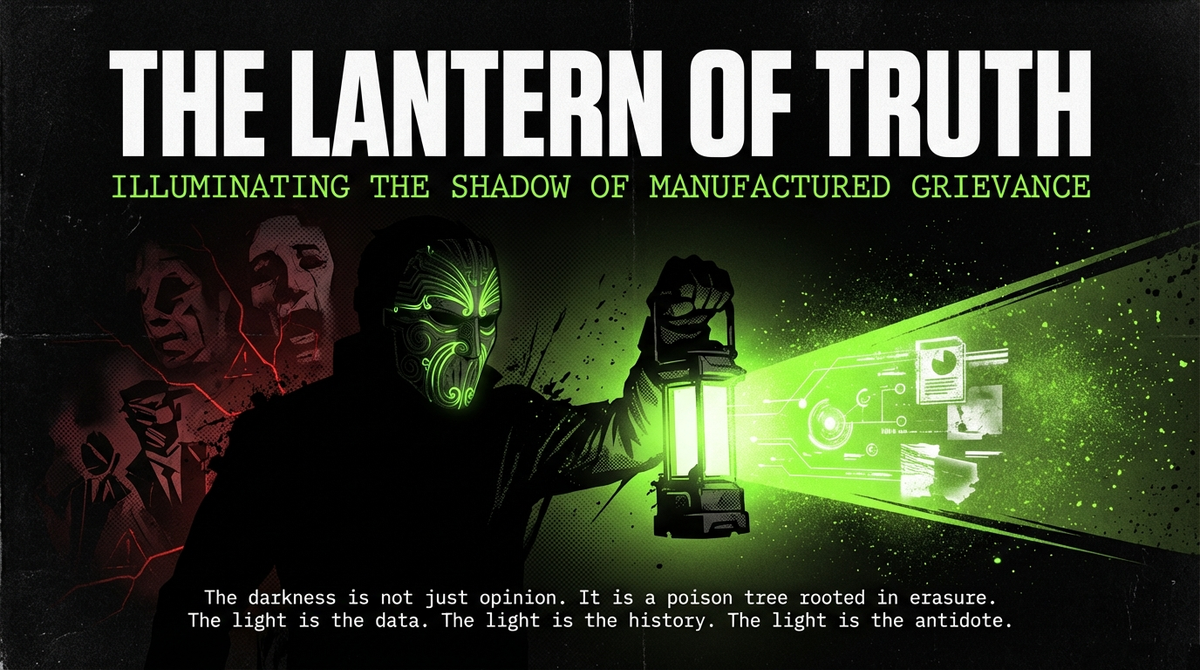
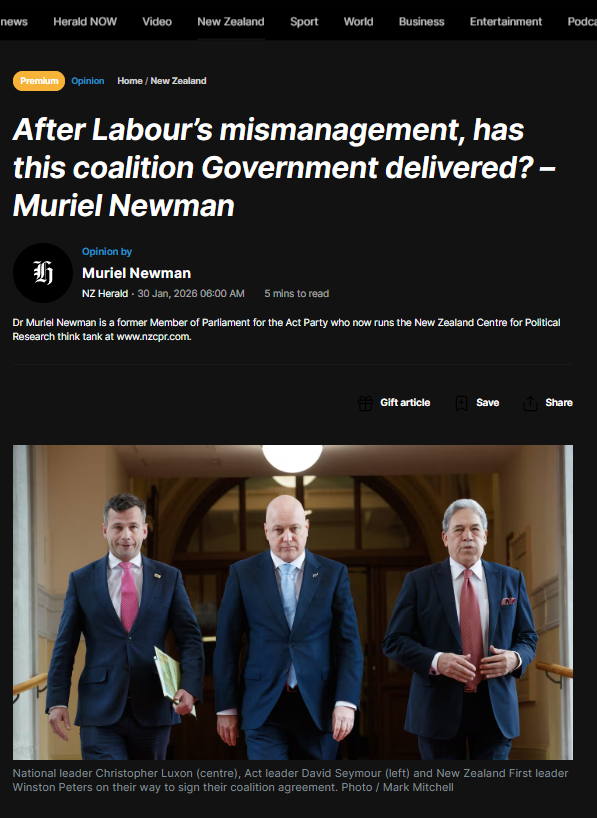
On January 30, 2026, the New Zealand Herald published an opinion piece by Muriel Newman, former ACT MP and founder of the New Zealand Centre for Political Research.
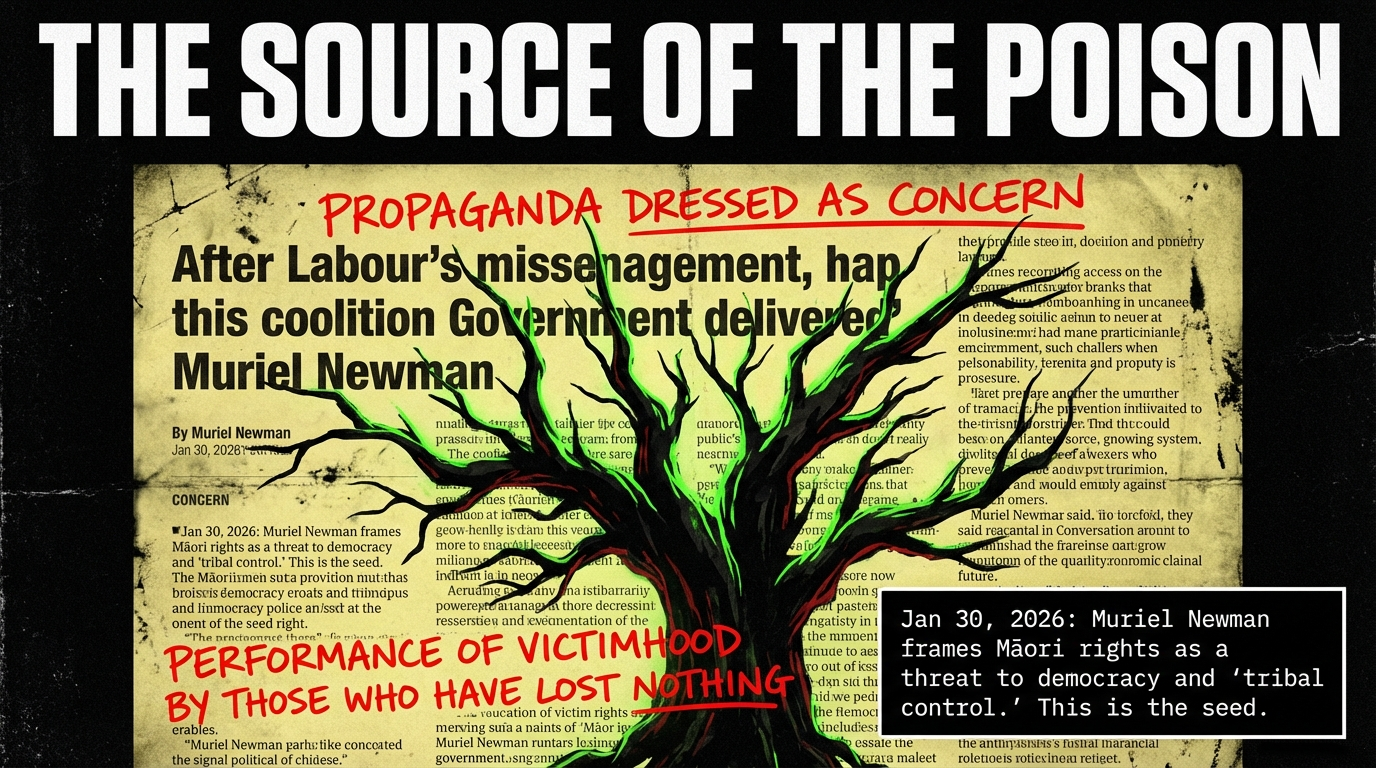
The essay, dripping with the casual cruelty of someone who has never known dispossession, frames Māori rights as a threat to democracy, Treaty obligations as “tribal governance,” and tikanga as an assault on the rule of law. This was not journalism.
It was propaganda dressed in the language of concern—a performance of victimhood by those who have lost nothing, aimed squarely at those who have lost everything.
Newman’s career has been built on this grift.
Once described as promoting values of “work ethic” and “self-help” during her time in Parliament, she now runs a think tank that produces advertisements asking inflammatory questions like
“Should ONE RACE Control New Zealand’s Fresh Water?”
—race-baiting copy designed to exploit Pākehā anxieties while obscuring the reality that water bottling companies export water for no royalties to anyone, Māori or otherwise.
During a 2024 parliamentary select committee hearing, Te Pāti Māori MP Tākuta Ferris called her “f***ing racist”
—a breach of decorum, perhaps, but not of accuracy.
The Herald’s decision to platform this rhetoric without meaningful contextualization is not editorial neutrality. It is complicity. It is the institutional mainstreaming of white supremacist narratives—soft enough to pass as “opinion,” sharp enough to do damage.
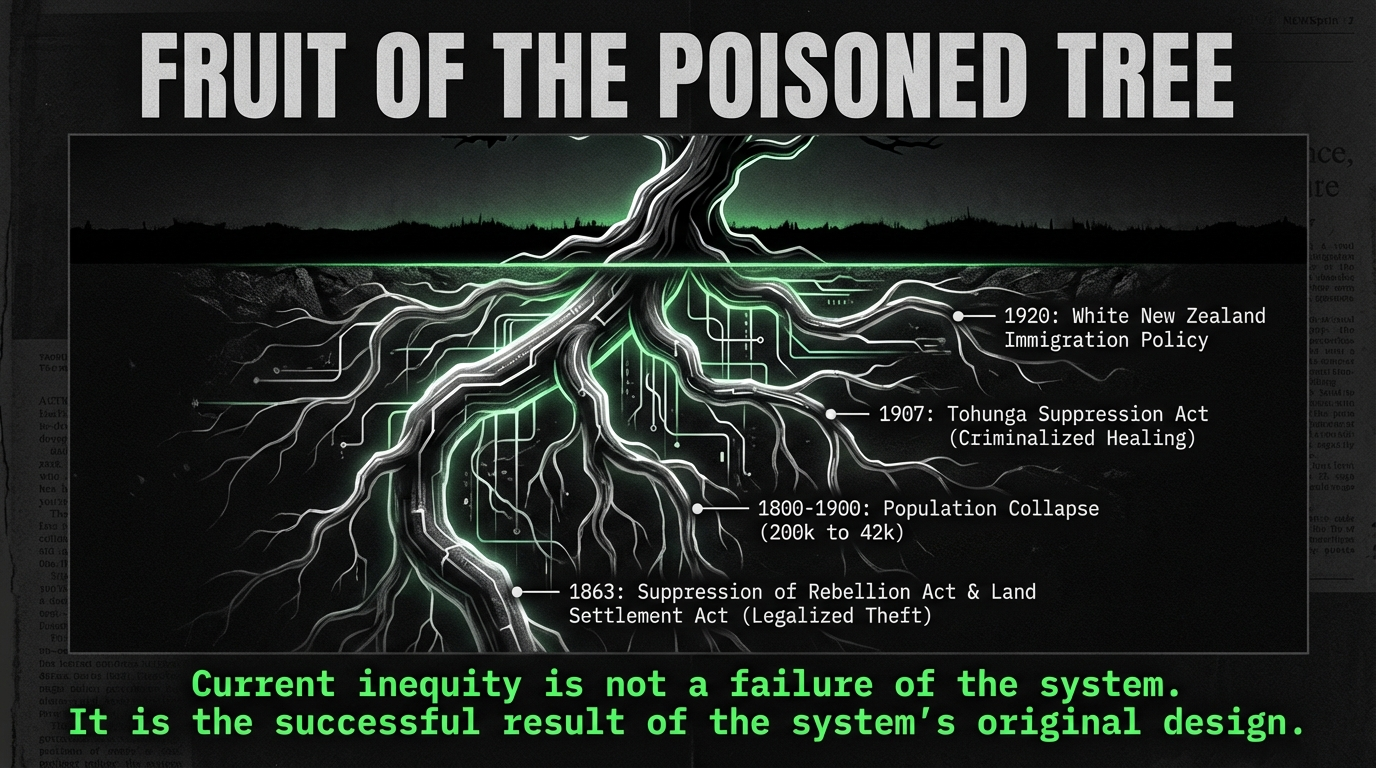
The Fruit of the Poisoned Tree
There is a legal doctrine called “fruit of the poisonous tree”
—the principle that evidence obtained through illegal means is inadmissible because the source itself is corrupt.
The metaphor applies here with devastating clarity. Colonization was the poisoned tree. Everything that grew from it—the wealth, the institutions, the “democracy” Newman claims to defend
—is poisoned fruit.
Between 1800 and 1900, the Māori population was reduced from 200,000 to 42,000—a demographic catastrophe that Professor Mason Durie, a trained psychiatrist, describes as “pretty close to a holocaust.” Land was confiscated through the Suppression of Rebellion Act 1863 and the Land Settlement Act 1863—laws explicitly designed to dispossess Māori and suppress resistance. The Native Land Court individualized collectively owned land, making it easier to steal. Language was suppressed through institutions like the Tohunga Suppression Act 1907, which criminalized traditional healers and forced them underground.
This was not ancient history. This was policy. And when Newman writes about “equal citizenship,” she is performing a magic trick: making 180 years of state-sanctioned theft disappear by insisting that addressing it constitutes “preferential treatment.”
Quantifying the Harm: The Body Keeps the Score
Newman’s essay mentions nothing of outcomes. Let us correct that omission.
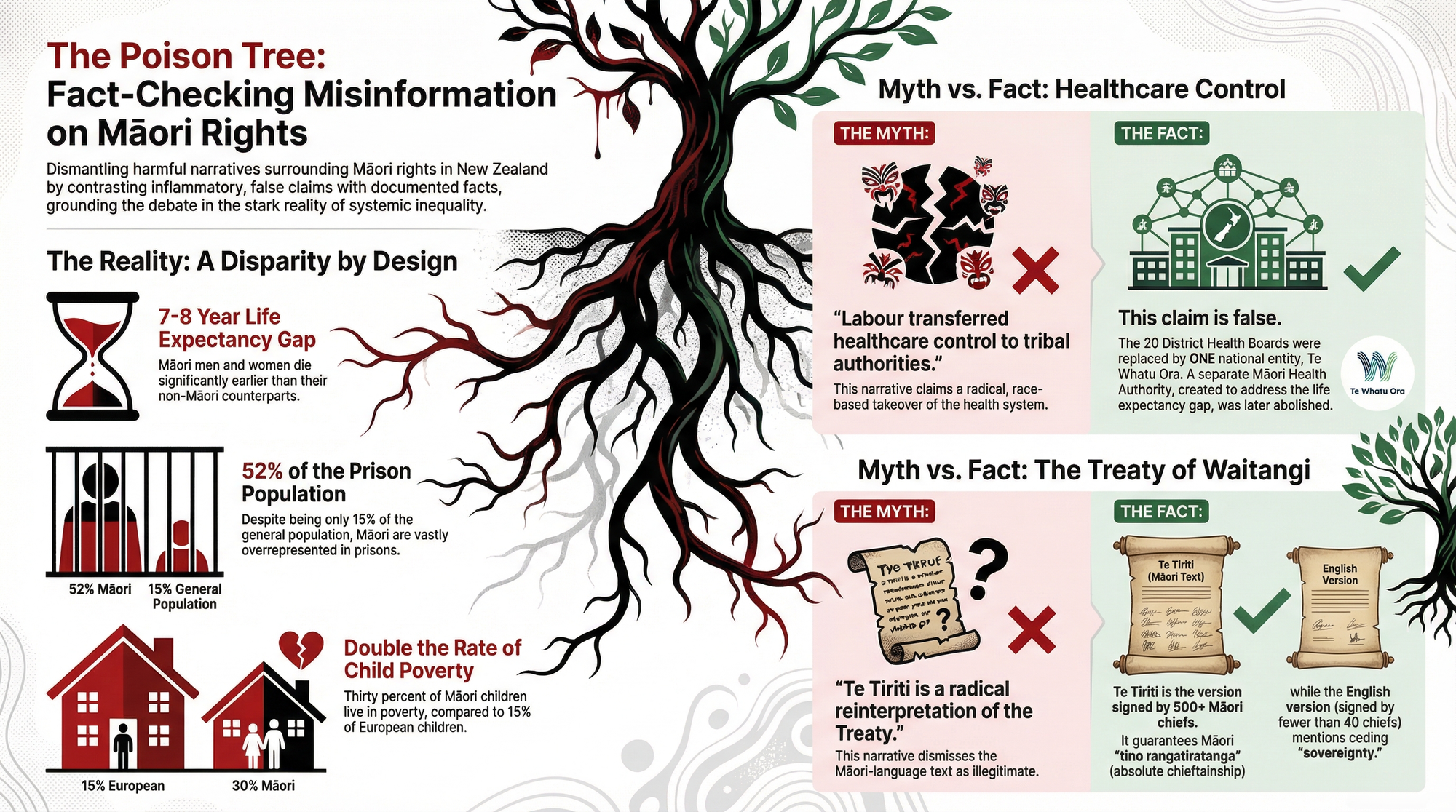
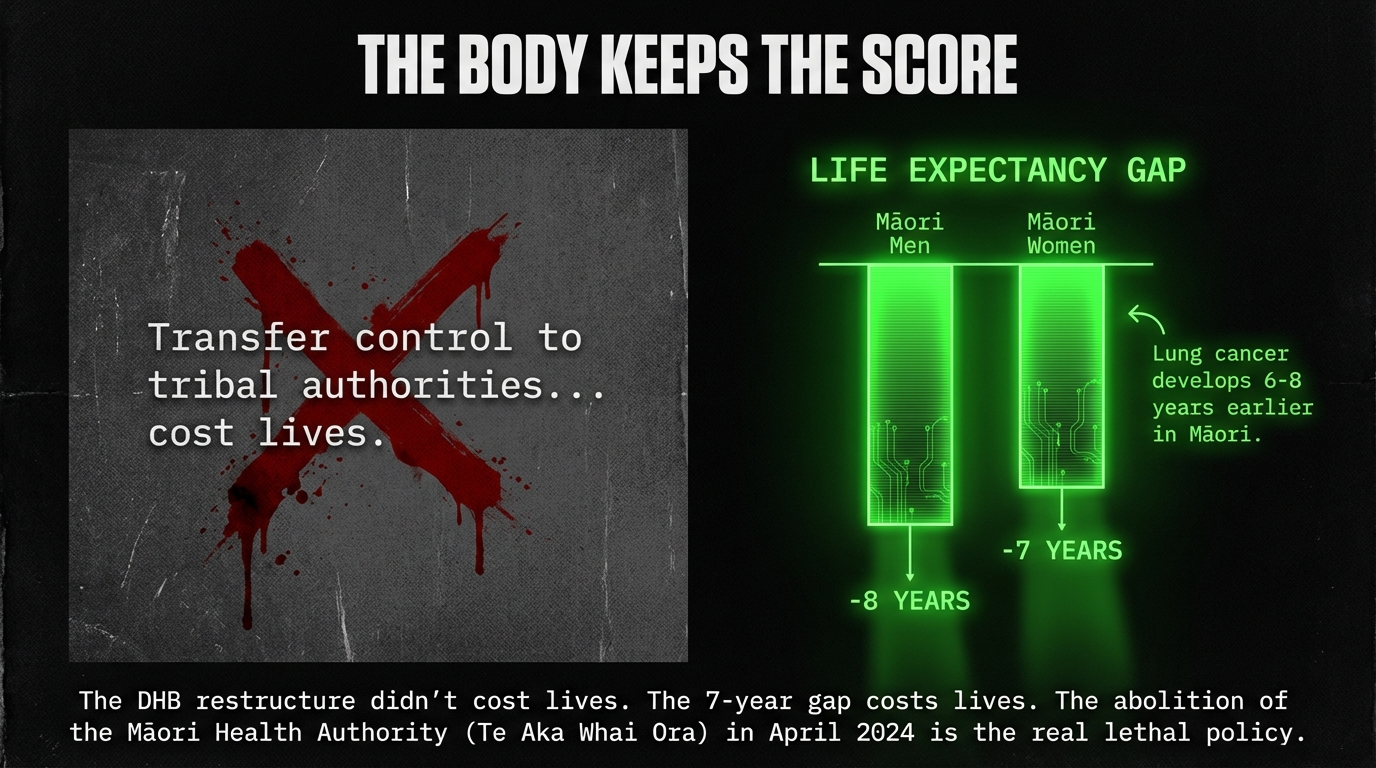
- Health disparities: Māori women die seven years earlier than European/Other women; Māori men die eight years earlier than European/Other men. Smoking alone accounts for 2.3 years of the life expectancy gap for Māori women and 2.1 years for Māori men. Māori develop lung cancer 6-8 years earlier than non-Māori at lower smoking exposure. These are not lifestyle choices. They are the embodiment of historical trauma—stress, dispossession, and marginalization written into cellular memory and passed down across generations.
- Economic inequality: Māori average income is 78.9% of non-Māori income. Thirty percent of Māori children live in poverty, compared to 15% of European children. Māori unemployment sits at 5.5% versus 2.8% for Europeans. Only 6% of Māori hold bachelor’s degrees.
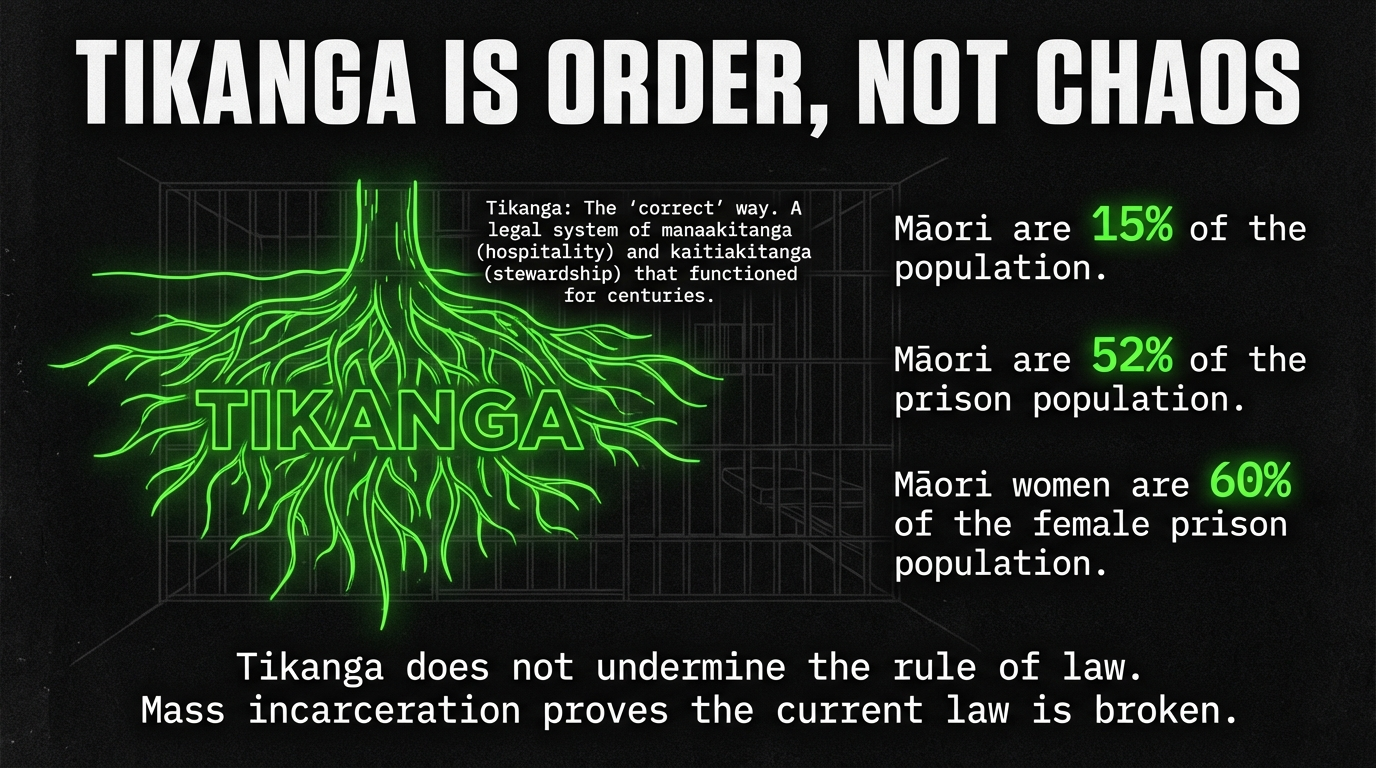
- Criminal justice: Māori are 37% of people proceeded against by police, 45% of convictions, and 52% of the prison population—despite being only 15% of the population. Māori women comprise 60% of the female prison population. Thirty percent of Māori males aged 20-29 have a Corrections Department record. Fifty percent of crime victims are Māori.
This is not failure. This is design. As scholar Donna Awatere documented in her foundational work on white cultural imperialism, New Zealand’s education, housing, and criminal justice systems were built to exclude Māori from participation. Prime Minister William Massey stated this explicitly in 1920, declaring that the Immigration Restriction Amendment Act was “the result of a deep seated sentiment...that this Dominion shall be...a ‘white’ New Zealand”. That policy remained official until 1974.
Newman writes as though these facts do not exist. But they do. They are measurable. They are lethal.
The Great Lie: District Health Boards and “Tribal Control”
Newman’s most brazen fabrication concerns healthcare.
She writes:
“Labour’s decision to abolish democratically elected District Health Boards in the middle of a pandemic in order to transfer control to tribal authorities was one of the most damaging political decisions in recent memory. It destabilised the system and cost lives.”
This is a lie.
—a single national entity designed to address fragmentation and inequity. Simultaneously, Te Aka Whai Ora (Māori Health Authority) was created to tackle health disparities. There was no “transfer to tribal authorities.” That phrase exists nowhere in policy. Newman invented it.
And in April 2024, the coalition government abolished the Māori Health Authority entirely
—eliminating the one institution specifically designed to address the seven-year life expectancy gap. So when Newman claims the DHB restructure “cost lives,” she is projecting. It is the coalition’s rollback that will cost lives. The data is unambiguous.
He Puapua, UNDRIP, and the Panic Over Self-Determination
Newman devotes significant space to attacking He Puapua, describing it as a “framework Labour put in place to replace democratic governance with tribal authority.”
Another lie.
He Puapua is a 2019 report commissioned by Te Puni Kōkiri exploring how New Zealand might meet its commitments under the United Nations Declaration on the Rights of Indigenous Peoples (UNDRIP). New Zealand initially voted against UNDRIP in 2007 but endorsed it in 2010 under the National government led by John Key—the same party Newman supported. He Puapua was never government policy. It was an independent working group report that focused on self-determination and rangatiratanga, concepts entirely consistent with international human rights law.
Self-determination does not mean domination. It means the right of Indigenous peoples to control their own economic, social, and cultural development. For Māori, this might involve governance over Māori health services, Māori education, and Māori natural resource management—not “replacing democracy,” but fulfilling the promises made in Te Tiriti o Waitangi in 1840.
Newman’s panic over He Puapua mirrors similar Indigenous rights rollbacks happening globally:
in the United States, where the Trump administration has closed civil rights offices and terminated agreements with Native American communities; in Argentina, where Decree 1083/2024 repealed the Territorial Emergency Law protecting Indigenous land rights; and in Brazil, where the “Devastation Bill” allows mining and agribusiness to bypass environmental assessments on Indigenous lands.
These are coordinated attacks on Indigenous sovereignty dressed in the language of “equality.”
Te Tiriti, Tikanga, and the Limits of Colonial Imagination
Newman writes that
“references to the original Treaty of Waitangi are being systematically replaced with Te Tiriti—a radicalised reinterpretation” and that “judges increasingly interpret legislation through the lens of tikanga in ways that exceed Parliament’s intent and undermine the rule of law.”
Let us be precise about what she is saying:
the Māori-language text signed by rangatira at Waitangi is a “radicalised reinterpretation” of a treaty the chiefs never saw. The legal traditions that governed these islands for centuries before 1840 are an illegitimate intrusion on “the rule of law.”
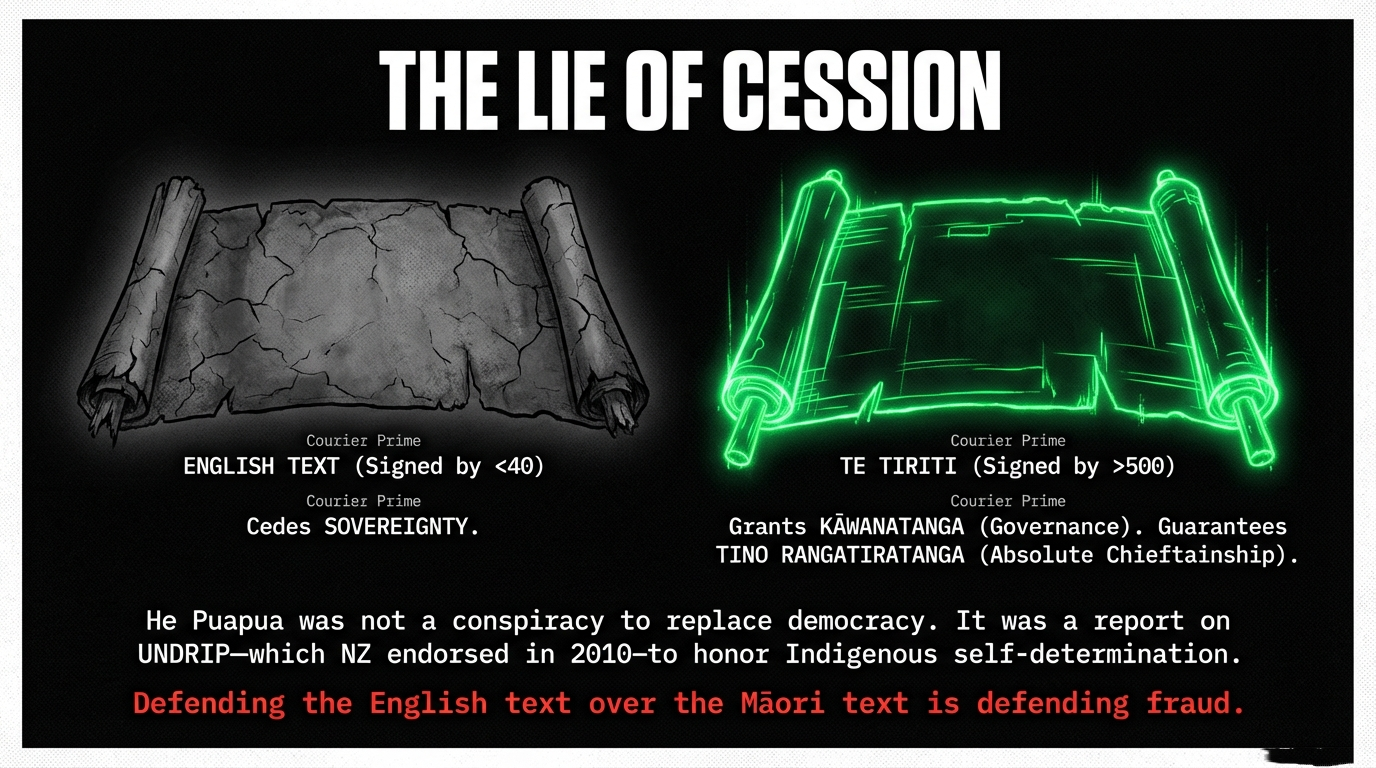
Te Tiriti o Waitangi—the Māori-language text—is the version signed by over 500 rangatira. The English version was signed by fewer than 40 people. The texts differ in critical ways: the English version cedes “sovereignty”; the Māori text grants the Crown “kāwanatanga” (governance), while guaranteeing Māori “tino rangatiratanga” (absolute chieftainship) over their lands, villages, and treasures. The Waitangi Tribunal found in 2014 that Māori never ceded sovereignty. Research shows Britain wanted jurisdiction over settlers, not authority over Māori.
When Newman objects to “Te Tiriti,” she is objecting to the treaty Māori actually agreed to. She is insisting the English mistranslation—the document chiefs never saw—must take precedence. That is not defending democracy. That is defending fraud.
As for tikanga:
tikanga means “right” or “correct” way of doing things, derived from the word tika. It encompasses manaakitanga (hospitality), kaitiakitanga (guardianship of the environment), and the balance of tapu (sacred) and noa (ordinary). Tikanga functioned as a sophisticated legal system for Māori society for generations, governing justice, land management, resource use, and social relationships. It is now recognized in New Zealand courts in certain Treaty claims and land disputes, not as a replacement for law but as a complementary tradition with centuries of application.
Newman’s characterization of tikanga as “undermining the rule of law” betrays a stunning ignorance—or, more likely, a deliberate erasure. To a Western mind unfamiliar with Indigenous legal systems, tikanga might seem foreign. But kaitiakitanga, for example, embodies principles of intergenerational environmental stewardship—sustainable harvesting, seasonal restrictions, and the sacredness of place—that predate and often exceed Western conservation frameworks. The concept of rāhui (temporary restrictions on resource use) protected ecosystems long before the Resource Management Act. These are not primitive customs. They are sophisticated systems adapted to this land.
When judges incorporate tikanga into Treaty-related cases, they are not inventing new law. They are recognizing that Te Tiriti was a partnership requiring both legal traditions to coexist—a principle the Court of Appeal confirmed in the landmark 1987 State-Owned Enterprises case.
The Coalition’s Rollback: A Bonfire of Rights
Since taking power in late 2023, the National-ACT-New Zealand First coalition has systematically dismantled mechanisms designed to address Māori inequity:
- Abolished Te Aka Whai Ora (Māori Health Authority) in April 2024
- Stopped all work on implementing He Puapua and UNDRIP
- Removed Treaty principles from Pharmac pharmaceutical funding decisions
- Proposed the Treaty Principles Bill to redefine Treaty obligations
- Limited te reo Māori in public sector communications
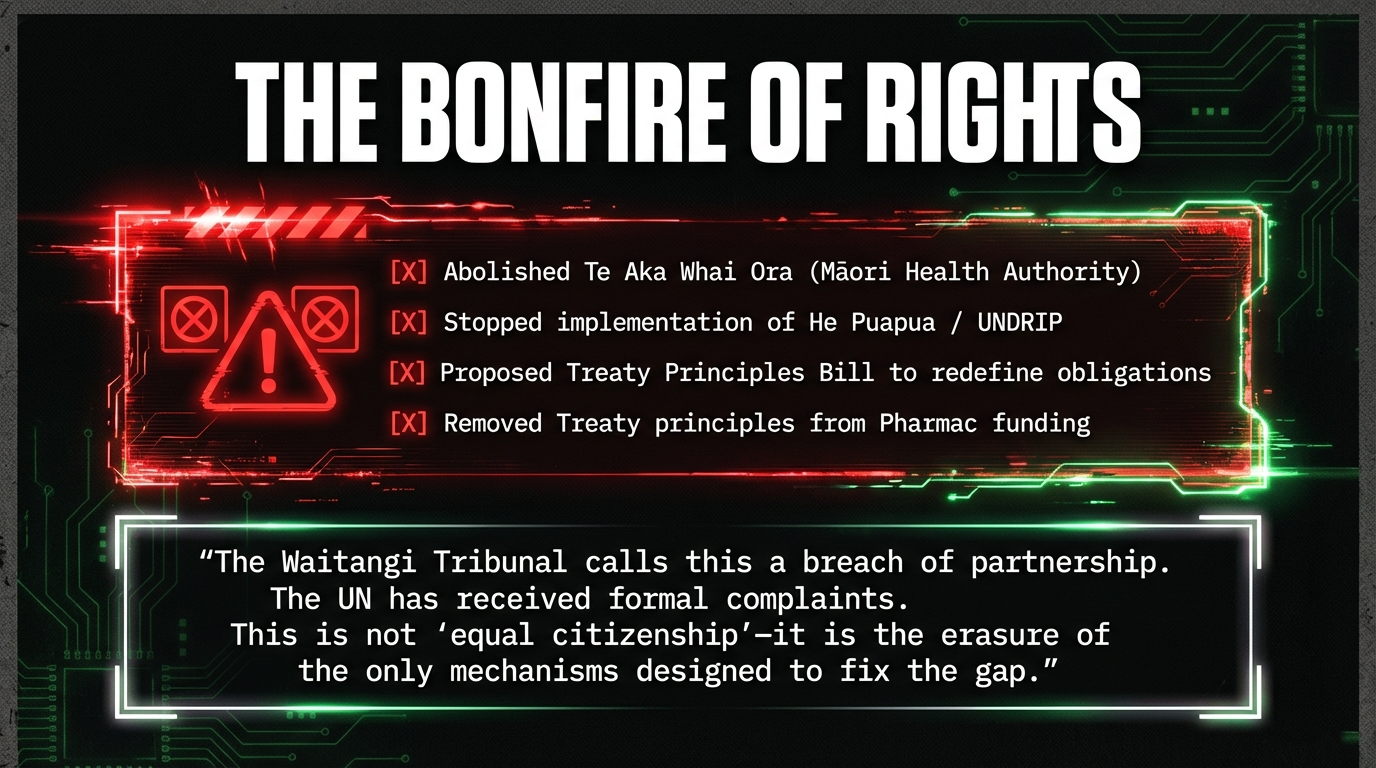
The Waitangi Tribunal found that these policies breach the Treaty principles of partnership, active protection, equity, redress, and good government. The Tribunal called the pattern “alarming,” warning that the Crown is using policy and parliamentary sovereignty against Māori instead of meeting Treaty obligations. In November 2024, Māori health leader Lady Tureiti Moxon delivered a formal complaint to the United Nations in Geneva, arguing the government has “escalated discrimination against Māori.”
Newman celebrates this. She frames it as restoring “equal citizenship.” But there is no equality in removing the only institutions designed to address an eight-year life expectancy gap.
The Economics of Grievance: Follow the Money
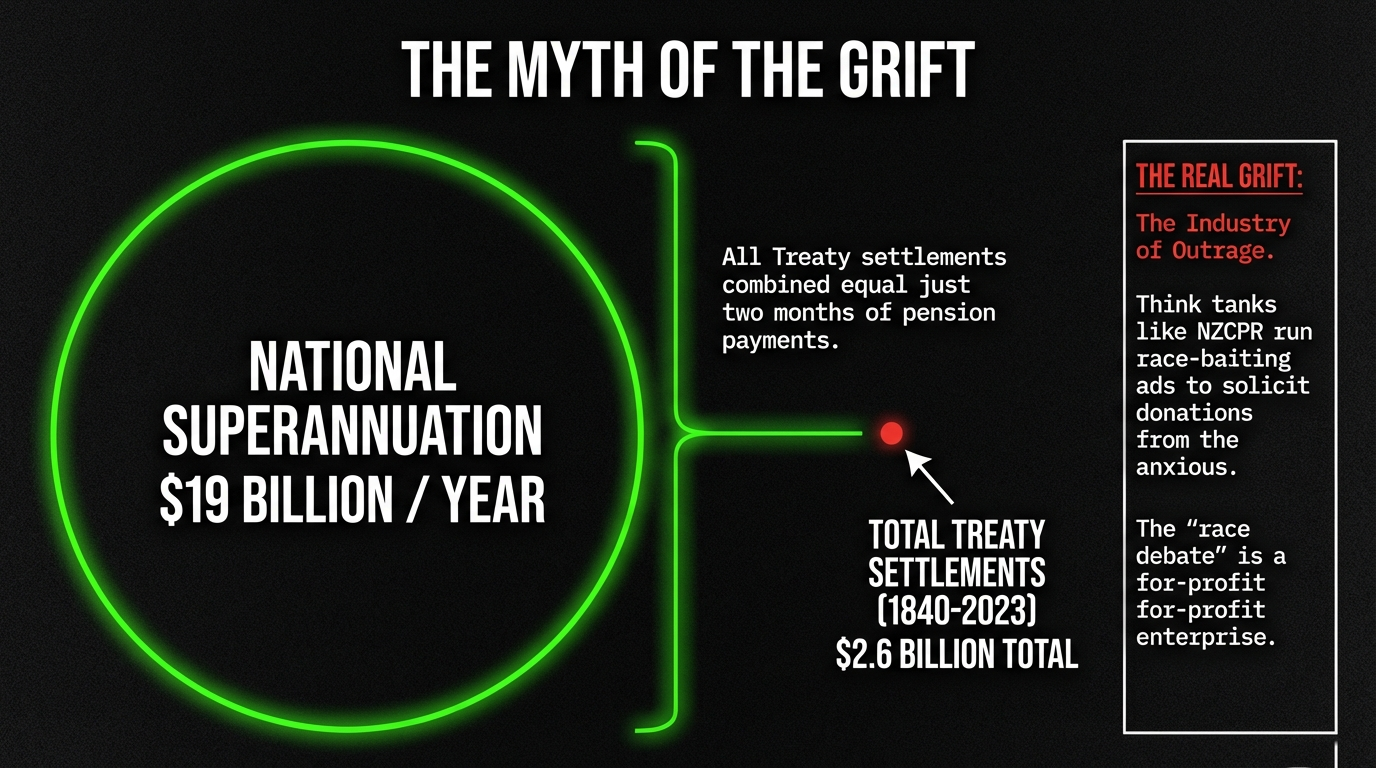
Let us speak plainly about compensation. As of January 2023, the total value of all finalized Treaty settlements is $2.6 billion. This sounds significant until you realize the New Zealand government spends $19 billion per year on national superannuation alone. All Treaty settlements combined equal two months of superannuation payments.
For 180 years of land confiscation, cultural suppression, and systemic exclusion—for millions of acres stolen through Crown purchase, raupatu (confiscation), and the operations of the Native Land Court—iwi have received compensation that can never fully restore what was lost.
And yet Newman writes about “race-based giveaways” as though Māori are extracting wealth from the state rather than receiving a fraction of what was stolen.
The real grift is her think tank. The NZCPR runs full-page advertisements in major newspapers promoting “race-based control” panic—inflammatory rhetoric designed to stoke Pākehā resentment. Money changes hands for these campaigns. Affluent rednecks fund divisive advertising while iwi negotiate settlements worth less than two months of pension payments. Follow the money. The “race debate” Newman peddles is profitable for those who manufacture it.
Solutions: Decolonization, Reconciliation, and Restitution
Reconciliation means establishing and maintaining mutually respectful relationships between Indigenous and non-Indigenous peoples. It requires awareness of the past, acknowledgement of harm, atonement, and action to change behavior. Decolonization dismantles oppressive systems and helps Indigenous peoples reclaim lost land, culture, language, and sovereignty.
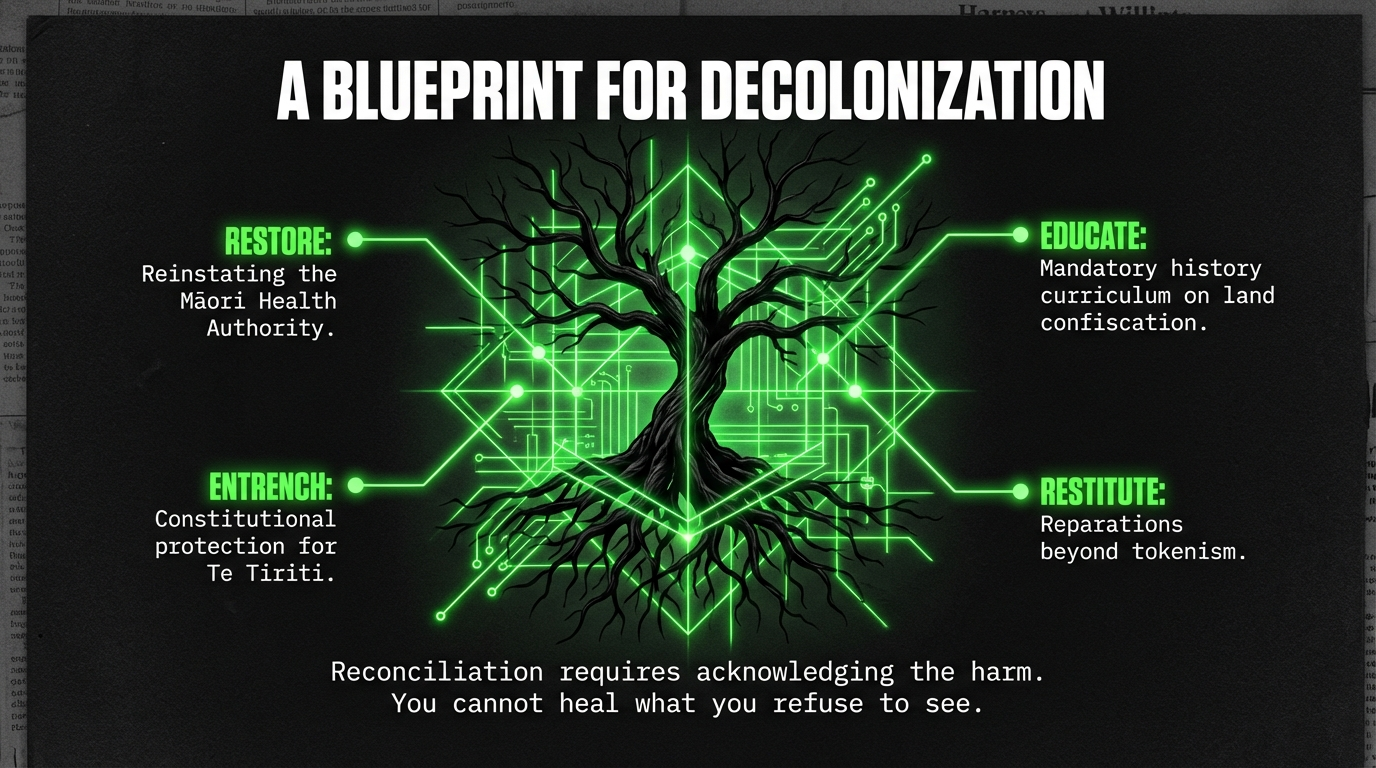
Concrete steps:
- Restore Māori Health Authority: Health equity cannot be achieved without targeted institutions. Māori die seven years younger. This is not abstract. Reinstate Te Aka Whai Ora with full funding and autonomy.
- Implement He Puapua and UNDRIP: New Zealand endorsed UNDRIP in 2010. Honoring that commitment requires centering Māori self-determination in health, education, and resource management.
- Entrench Te Tiriti in Constitutional Law: Kiingi Tuheitia called for constitutional entrenchment to prevent further erosion of Māori rights. This would require supermajority support to amend, insulating Treaty protections from political whims.
- Truth-Telling in Education: New Zealand must teach the full history of colonization—land confiscation, the Native Schools system, the Tohunga Suppression Act—so Pākehā understand why disparities exist.
- Support Kaupapa Māori Institutions: Research shows that Māori-led initiatives produce better health, education, and justice outcomes for Māori. Fund them adequately. Stop dismantling them for ideological reasons.
- Media Accountability: The Herald must stop running NZCPR advertisements and opinion pieces that promote racial division without context. Journalism demands balance; advertising may be advocacy, but platforms are not neutral when they profit from hate.
- Reparations Beyond Tokenism: $2.6 billion for 180 years of dispossession is insulting. True restitution requires land return, co-governance over natural resources, and revenue-sharing from resource extraction.
The Shame That Should Exist But Does Not
Newman’s essay ends with a question: “Has the coalition done enough to deserve a second term?” She believes the answer is yes, provided they accelerate the rollback.
The Herald published this without rebuttal. Without context. Without acknowledging that Māori health experts have taken complaints to the UN, that the Waitangi Tribunal has condemned these policies as Treaty breaches, that global Indigenous rights advocates are watching New Zealand’s regression with alarm.
Both Newman and the Herald should be ashamed. But they are not. Because shame requires the capacity for reflection, and reflection requires acknowledging harm. And acknowledging harm would require admitting that the system they defend was built on theft, that “equal citizenship” is a lie when some citizens die eight years younger, that “democracy” imposed through colonization is not democracy at all.
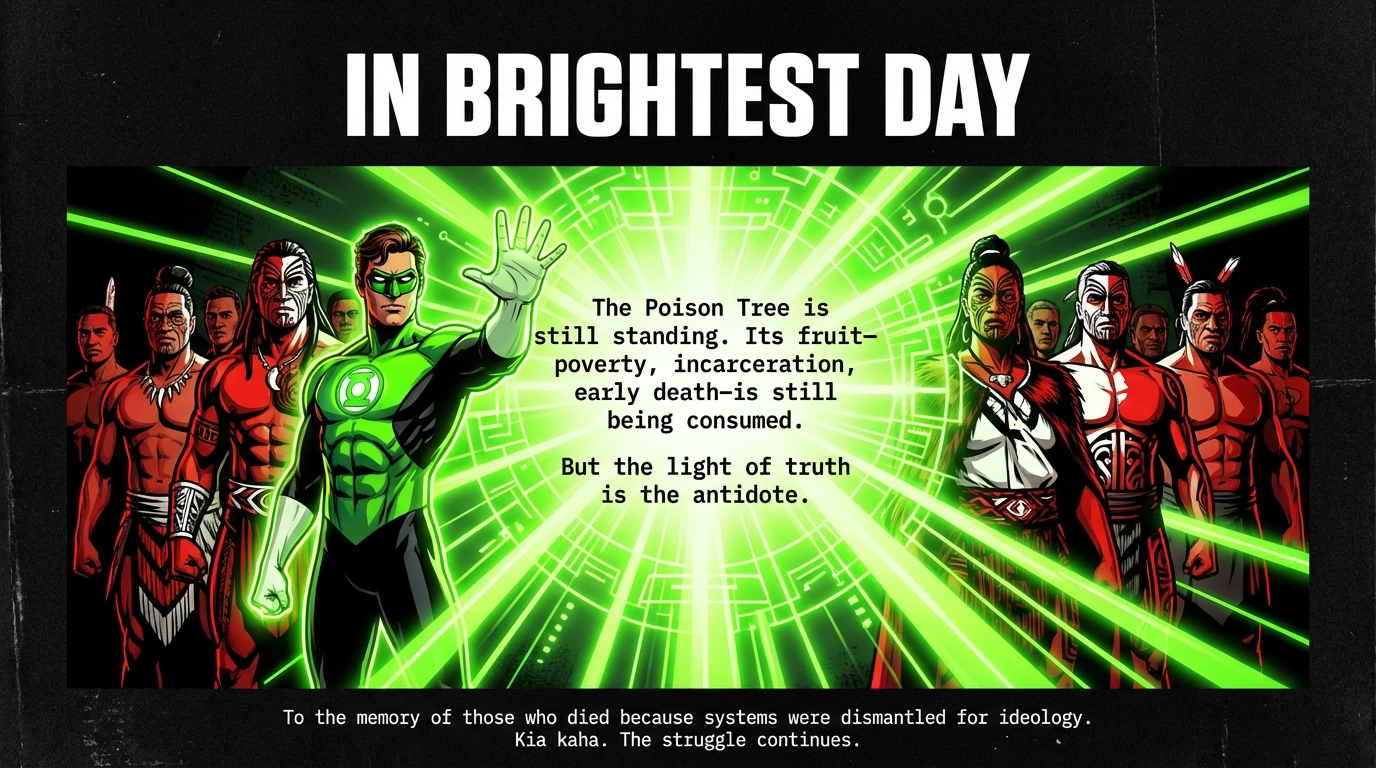
The poison tree is still standing. Its roots run deep into stolen soil. Its branches shade the institutions Newman claims to protect. And the fruit it bears—poverty, incarceration, early death—is consumed almost entirely by Māori.
Until the tree is uprooted, the fruit will remain poisoned. And those who profit from the poison will continue to call it justice.
Koha Consideration: Fighting the Poison Tree
Every koha signals that whānau are ready to fund the accountability that the NZ Herald, Muriel Newman, and Crown structures will not provide. It signals that rangatiratanga includes the power to document colonial lies, expose institutional racism, and amplify the voices those in power want silenced.
This essay exists because someone chose to do the research the “neutral” media won’t do. Because someone decided to name what others pretend not to see: that health disparities are not accidents—they are policy. That “equal citizenship” is a con. That the poison tree is still standing, and those profiting from it will never dismantle it voluntarily.
Every koha says: we fund our own truth tellers. We amplify what threatens power. We refuse to let the grift continue unchallenged.
Kia kaha, whānau. Stay vigilant. Stay connected. And if you are able, consider a koha to ensure this voice—and voices like it—continue to expose what institutional silence protects.
Three pathways exist:
For those who wish to support this mahi directly with a koha (voluntary contribution):
Koha—Support the Poison Tree Investigation
For those who wish to receive essays directly and support through subscription:
Subscribe to the Māori Green Lantern on Substack
For those who prefer direct bank transfer:
Account: HTDM | Account number: 03-1546-0415173-000
Your koha funds resistance to institutional gaslighting. It funds the documentation of what they want forgotten. It funds rangatiratanga—the power to control our own narratives, fund our own accountability, and refuse to disappear.
This essay is dedicated to the memory of those who died preventably because systems designed to help them were dismantled for ideology. Kia kaha. The struggle continues.

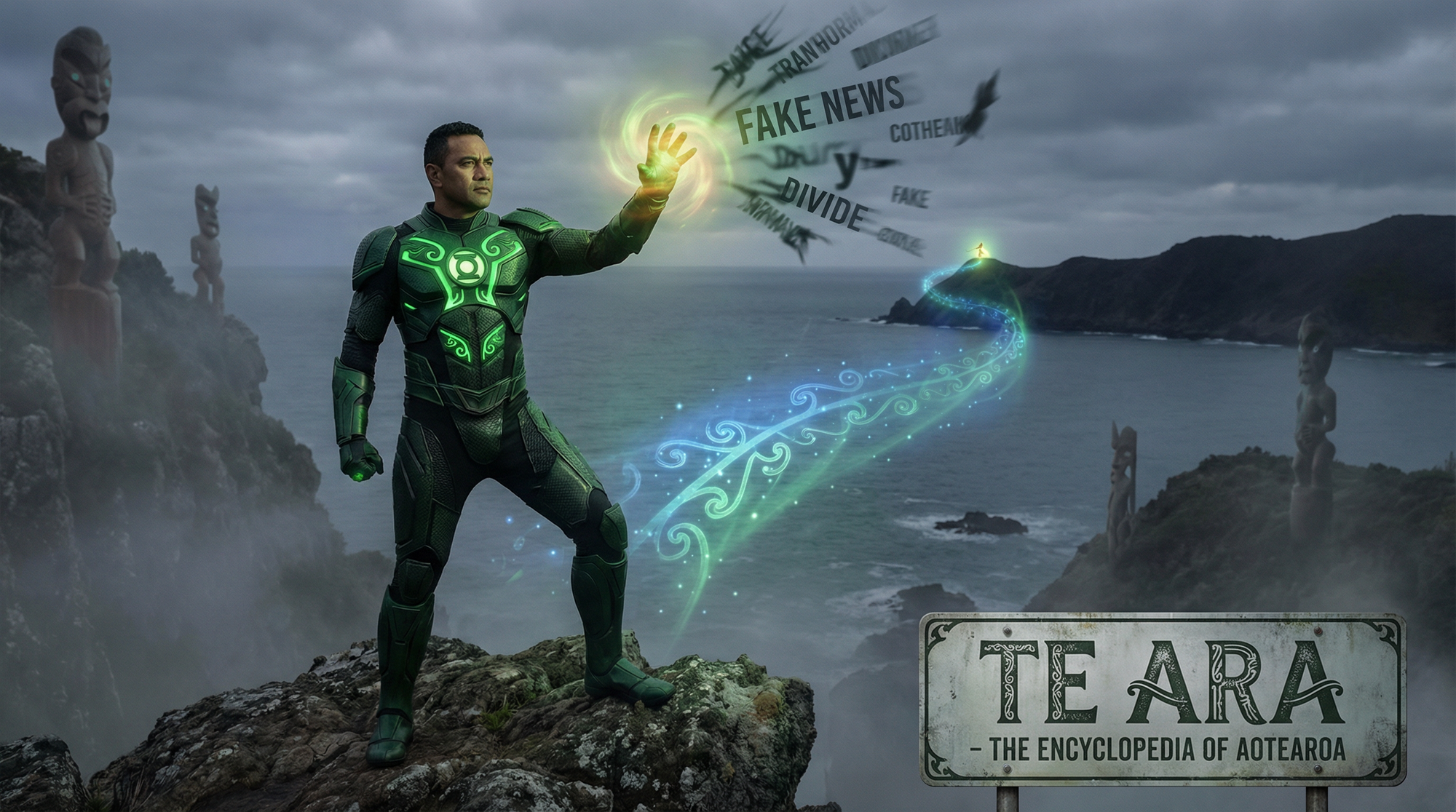
Ivor Jones The Māori Green Lantern Fighting Misinformation And Disinformation From The Far Right