“The Quigley Conspiracy: How Neoliberal Cronyism Corrupted New Zealand's Financial Institutions” - 9 September 2025
Exposing the Web of Elite Capture That Betrayed Tangata Whenua and Democratic Governance
Kia ora e hoa mā. Ko Ivor Jones ahau, he uri no Te Arawa, no Ngāti Pikiao hoki. Greetings my friends. I am Ivor Jones, a descendant of Te Arawa and Ngāti Pikiao.
Neil Quigley didn't just resign in disgrace – he was exposed as the corrupt face of institutional capture that has poisoned New Zealand's economic governance for decades. The disgraced Reserve Bank chairman's spectacular downfall reveals a sordid web of neoliberal cronyism that has systematically enriched Pākehā elites while devastating Māori communities through calculated austerity. This is not merely about one man's conflicts of interest – it's about how our most critical financial institutions have been captured by a network of corporate lobbyists, political fixers, and academic opportunists who serve capital over community, profit over people, and colonisation over tino rangatiratanga.
Through meticulous analysis of the Quigley scandal, this essay exposes how neoliberal ideology has weaponised institutions like the Reserve Bank and Treasury to perpetuate structural racism and economic violence against tangata whenua. From Steven Joyce's million-dollar lobbying empire to the systematic destruction of Māori housing and education programmes, we witness the complete abandonment of Crown obligations to te Tiriti o Waitangi in service of market fundamentalism.
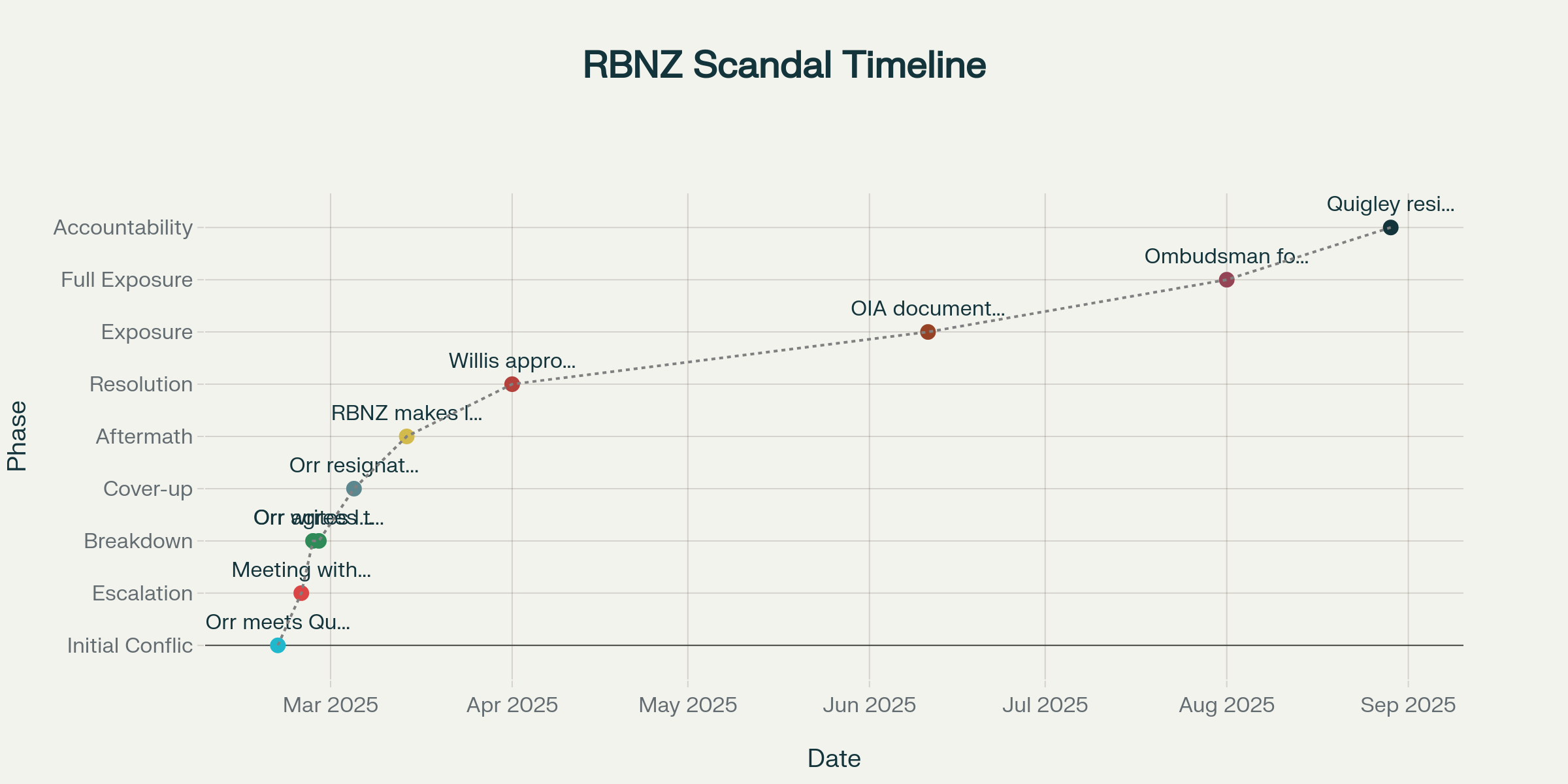
Timeline of the Neil Quigley RBNZ Governance Scandal: From Cover-up to Resignation
Te Taiao o te Tawhito: The Corrupted Landscape of Financial Governance
To understand the depths of Quigley's corruption, we must first grasp how neoliberalism has transformed New Zealand's economic institutions from servants of the public good into weapons of class warfare. The Reserve Bank of New Zealand, established as our central banking authority, was never intended to be a playground for corporate cronies and political wheeler-dealers. Yet under the neoliberal capture that intensified from the 1980s onwards, it became exactly that.
Neil Quigley's resignation followed months of scrutiny over his handling of Adrian Orr's departure (RNZ, "Reserve Bank chair Neil Quigley resigns with immediate effect," August 29, 2025), but the rot runs far deeper than one man's deception. The Reserve Bank's governance structure, supposedly designed for independence and accountability, had been compromised by a network of interconnected elite interests that prioritised market ideology over democratic oversight.
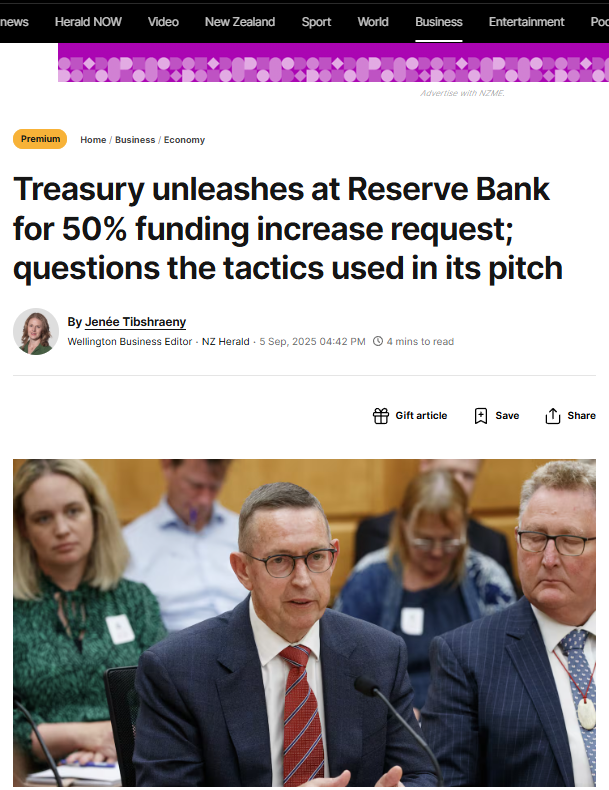
Treasury's role in this scandal is equally damning. Treasury's savage attack on the Reserve Bank's funding request (Jenée Tibshraeny, "Treasury unleashes at Reserve Bank for 50% funding increase request," NZ Herald, September 5, 2025) wasn't about fiscal responsibility – it was about enforcing neoliberal austerity that has systematically underfunded public institutions while showering corporate welfare on the wealthy. This is the same Treasury that has overseen decades of policies that have impoverished Māori communities while enriching Pākehā elites.
From a Māori perspective, these institutions represent the colonising state's attempt to control our economic destiny while excluding us from meaningful participation in financial governance. The absence of Māori voices in the Reserve Bank's decision-making structures is not accidental – it's a deliberate exclusion that ensures monetary policy serves settler interests while marginalising indigenous economic aspirations.
Te Kōrero Roa: The Quigley Conspiracy Exposed
The Neil Quigley scandal represents one of the most egregious examples of institutional corruption in New Zealand's recent history. This is not simply about poor governance or communication failures – it's about systematic deception, elite capture, and the complete abandonment of democratic accountability in favour of corporate cronyism.
Adrian Orr's resignation was deliberately misrepresented by Quigley, who claimed it was a "personal decision" when he knew full well it resulted from a funding dispute orchestrated by the Coalition Government's austerity agenda (RNZ, "Documents reveal why Adrian Orr suddenly quit as Reserve Bank governor," June 10, 2025). This wasn't an innocent miscommunication – it was calculated deception designed to protect the government's neoliberal assault on public institutions.
The true scale of Quigley's conflicts of interest becomes clear when we examine his dual role as University of Waikato Vice-Chancellor and Reserve Bank Chairman. Documents reveal that Quigley promised National Party politicians that a medical school could be "a present" to a future National government (RNZ, "University of Waikato boss referred to new medical school as a present for future National government," September 4, 2023), demonstrating how he weaponised his university position for partisan political advantage.
Even more damaging is the revelation that Waikato University paid Steven Joyce's consultancy firm nearly $1 million while Quigley simultaneously chaired the Reserve Bank board (RNZ, "Cash-strapped Waikato University has paid former cabinet minister Steven Joyce nearly 1 million," June 12, 2023). This created a direct financial pipeline between Joyce, a former National Finance Minister turned corporate lobbyist, and Quigley, who held ultimate responsibility for New Zealand's monetary policy governance.
For Māori, this scandal matters because it exposes how our most critical economic institutions have been captured by networks of Pākehā elites who actively exclude indigenous voices while pursuing policies that devastate Māori communities. The Reserve Bank's recent attempts to address Māori access to capital, championed by the now-departed Adrian Orr, represented a rare acknowledgment of structural racism in the financial system. Quigley's corrupt leadership undermined these efforts at every turn.
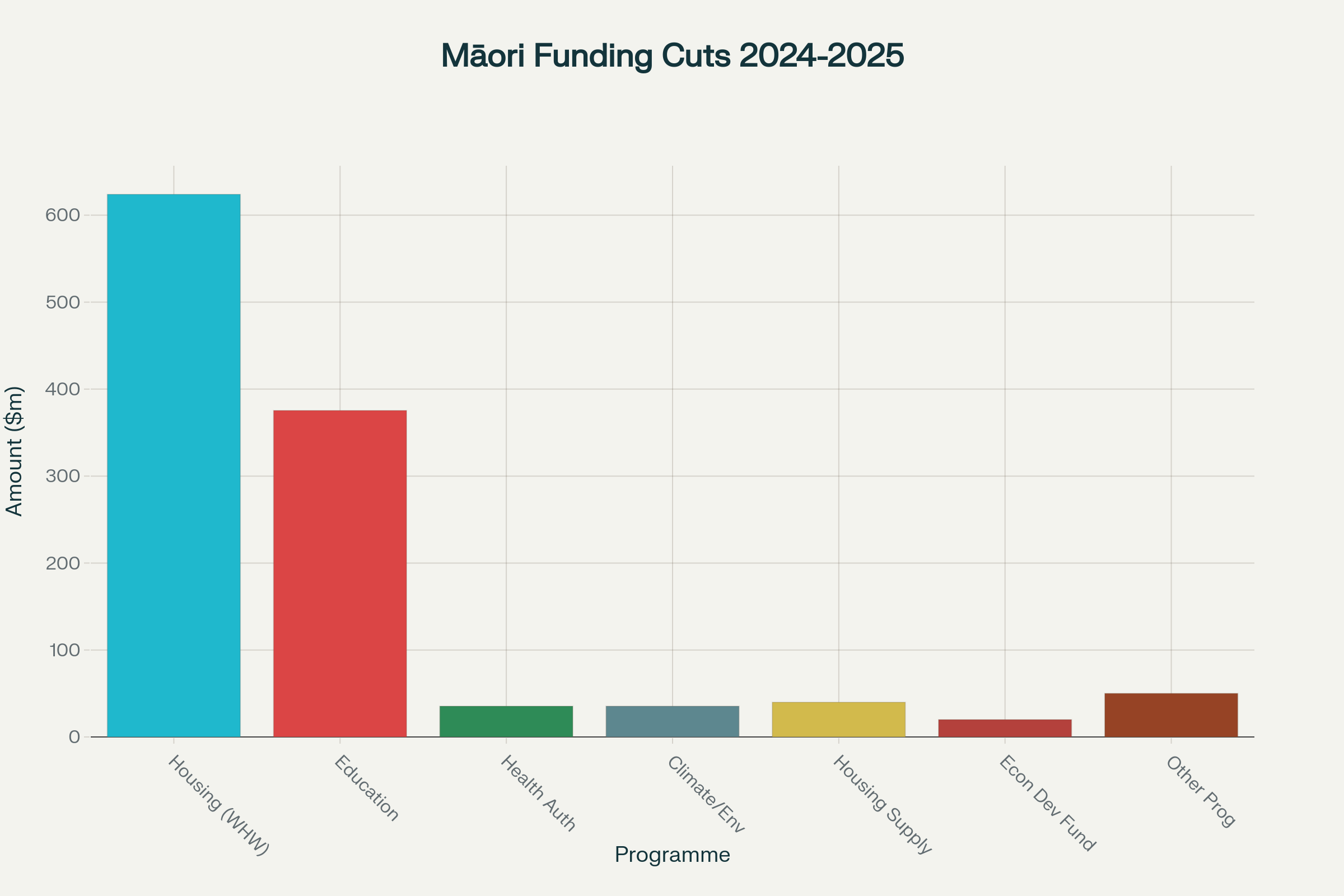
Coalition Government Cuts to Māori-Specific Funding: Over $1 Billion Slashed Across Two Budgets
Ngā Rore Kino: The Networks of Neoliberal Corruption
Steven Joyce's Lobbying Empire and Elite Capture
At the heart of the Quigley conspiracy lies Steven Joyce, the former National Finance Minister who has built a million-dollar lobbying empire that exemplifies everything wrong with neoliberal governance. Joyce's transformation from politician to corporate fixer represents the revolving door between political power and private profit that has corrupted New Zealand's economic institutions.
Joyce's lobbying work for Waikato University created a web of conflicts that threatened coalition stability (Bryce Edwards, "Lobbying for Waikato's Medical School causing problems for the govt," Democracy Project, May 16, 2024), yet he was rewarded with over $1 million in public funds for his influence-peddling. This is the same Steven Joyce who, as Finance Minister, oversaw policies that increased inequality and undermined Māori economic development. Now, as a private lobbyist, he continues to shape government policy for personal profit.
The Joyce-Quigley connection reveals how neoliberal networks operate: former politicians leverage their connections to secure lucrative contracts, while sitting officials like Quigley use their institutional positions to deliver outcomes for their corporate partners. This isn't market efficiency – it's state-sanctioned corruption that perverts democratic governance in favour of elite interests.
From a Māori worldview, this represents a fundamental violation of the principle of utu – balanced reciprocity and fair exchange. Joyce and Quigley extracted massive value from public institutions while giving nothing back to the communities they claimed to serve. Their actions embody the worst aspects of colonial capitalism: the exploitation of collective resources for individual gain.
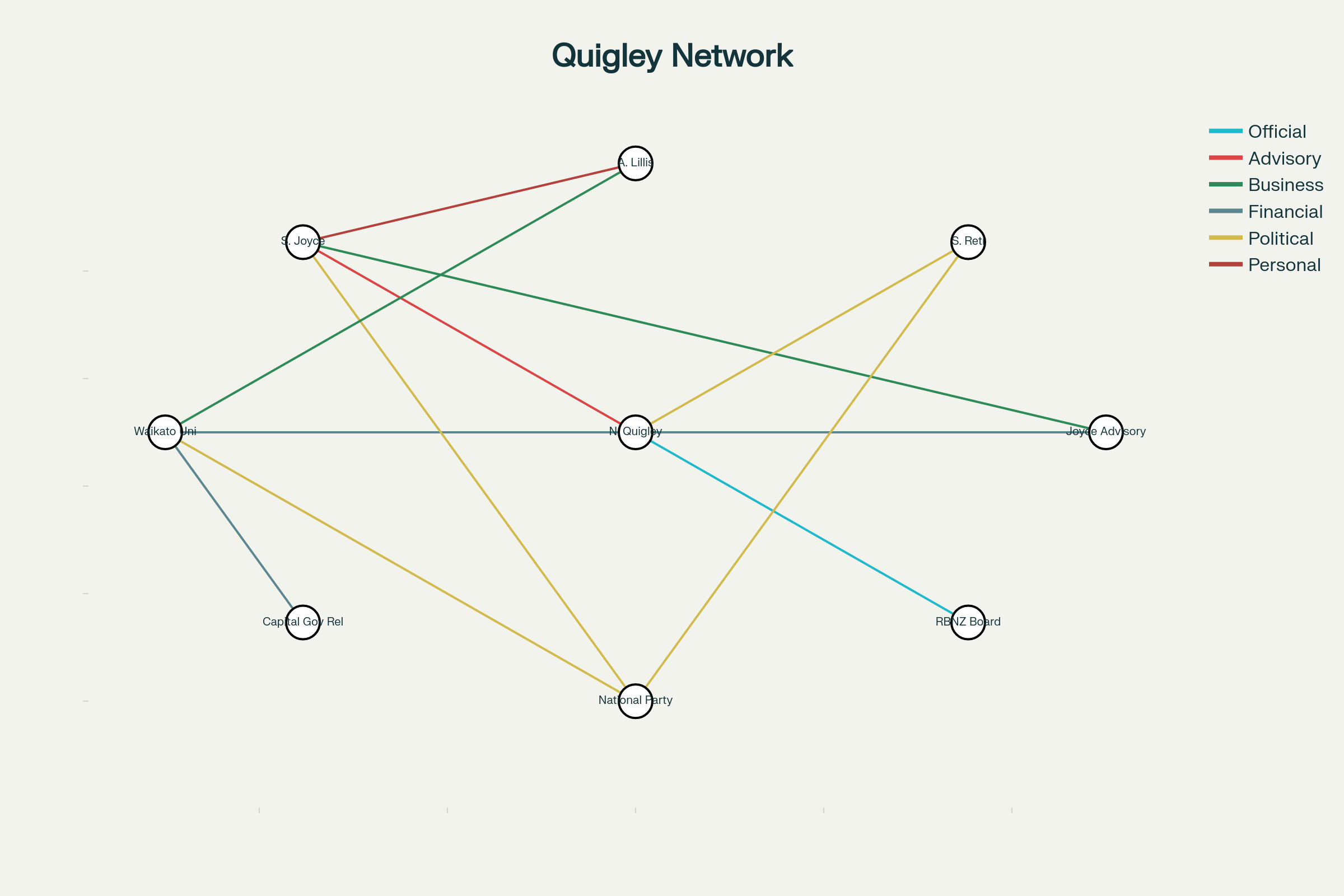
Web of Influence: Neil Quigley's Network of Political and Financial Conflicts of Interest
The Medical School Scandal: Policy Capture in Action
The Waikato medical school saga provides a perfect case study of how Quigley's corruption operated in practice. The proposal represents a textbook case of policy capture, where well-connected institutions override expert advice and fiscal prudence to secure taxpayer-funded projects that serve narrow interests rather than public good (The Integrity Institute, "Integrity Briefing: Waikato Medical School – A Costly case study," July 20, 2025).
Quigley's intimate involvement in crafting National's medical school policy while simultaneously chairing the Reserve Bank created obvious conflicts of interest that he systematically concealed. His promise that the school could be a "present" to National reveals the transactional nature of his relationship with the party – trading public resources for political favour.
The involvement of Joyce's network extends beyond direct lobbying to encompass a web of connected operatives who shaped communications and strategy. Anna Lillis, Joyce's former advisor, was contracted to lead Waikato's communications strategy, while other Joyce associates provided strategic advice. This represents a systematic colonisation of policy development by corporate interests.
For Māori, the medical school scandal is particularly galling because it diverted resources and attention from addressing genuine health inequities faced by our communities. Instead of addressing the structural racism that prevents Māori from accessing medical education and healthcare, the Coalition prioritised a vanity project that served political rather than health objectives.
Treasury's Austerity Agenda: Weaponising Fiscal Policy Against Māori
Treasury's savage critique of the Reserve Bank's funding request must be understood within the broader context of neoliberal austerity that has systematically underfunded services crucial to Māori wellbeing. The Coalition's budget cuts revealed a systematic assault on Māori-focused programmes (RNZ, "Line by line: The coalition's Budget cuts in one list," May 31, 2024), with over $1 billion slashed from housing, education, and economic development initiatives.
Treasury's role in this austerity agenda cannot be separated from its neoliberal ideology, which views government spending as inherently wasteful and market mechanisms as naturally efficient. This ideological framework systematically ignores the historical and structural factors that create inequality, instead blaming individuals and communities for their circumstances while refusing to address systemic racism.
The timing of Treasury's attack on Reserve Bank funding, coinciding with massive cuts to Māori programmes, reveals the coordinated nature of this assault. While institutions serving elite interests like universities receive taxpayer-funded medical schools worth hundreds of millions, programmes addressing Māori disadvantage are deemed unaffordable luxuries.
From the perspective of tikanga Māori, Treasury's approach violates fundamental principles of manaakitanga (hospitality and care) and whakatōhea (collective responsibility). By prioritising fiscal orthodoxy over human wellbeing, Treasury has abandoned its obligation to serve all New Zealanders in favour of an ideology that serves only the wealthy.
The Institutional Racism of Financial Exclusion
Adrian Orr's work on improving Māori access to capital represented a rare acknowledgment of systemic racism within New Zealand's financial system (Interest.co.nz, "Reserve Bank says Maori 'too often' under-served by the financial system," October 13, 2024). His research revealed that Māori businesses face persistent barriers to accessing credit and investment, barriers rooted in colonial structures that continue to disadvantage indigenous enterprises.
Quigley's corrupt leadership undermined these efforts at every opportunity. While publicly supporting diversity initiatives, he simultaneously advanced policies and appointments that reinforced the very power structures that exclude Māori from economic opportunity. His network of connections ensured that resources flowed to well-connected Pākehā institutions rather than addressing structural inequalities.
The broader financial system continues to fail Māori communities in ways that reflect deliberate policy choices rather than market failures. Banking institutions consistently under-serve Māori customers, while lending policies systematically discriminate against indigenous businesses and whenua-based enterprises. These aren't technical problems – they're manifestations of institutional racism that serves to maintain Pākehā economic dominance.
Ngā Hua Kino: The Devastating Implications for Tangata Whenua
Economic Violence Through Austerity
The Quigley scandal exposes how neoliberal governance perpetrates economic violence against Māori communities through systematic underfunding of crucial services and programmes. The Coalition's savage cuts to Māori housing, education, and economic development represent more than fiscal policy – they constitute a deliberate attack on Māori aspirations for self-determination and prosperity.
Budget 2025 revealed over $750 million in cuts to Māori-specific programmes (The Spinoff, "Budget 2025: New funding headlines mask deeper cuts to Māori programmes," May 23, 2025), while the government simultaneously funded tax cuts for landlords and corporate welfare for connected elites. This represents a massive redistribution of resources from the most disadvantaged communities to the wealthiest, enforced through the very institutions that Quigley helped corrupt.
The dismantling of the Māori Health Authority, cuts to Māori education programmes, and elimination of housing initiatives like Whai Kāinga Whai Oranga demonstrate how austerity serves as a weapon of cultural destruction. By defunding programmes that support Māori development, the government forces our communities into dependency on mainstream services that have consistently failed to meet our needs.
These policies violate every principle of te Tiriti o Waitangi, particularly the Crown's obligation to protect Māori interests and ensure equitable outcomes. Instead, we see systematic discrimination disguised as fiscal responsibility, with cuts disproportionately affecting Māori while preserving programmes that benefit Pākehā communities.
The Colonisation of Financial Institutions
Quigley's corruption represents the latest chapter in the ongoing colonisation of New Zealand's economic institutions. Just as nineteenth-century settlers used legal and financial mechanisms to dispossess Māori of land, contemporary neoliberals use monetary policy and fiscal austerity to dispossess us of economic opportunity and self-determination.
The systematic exclusion of Māori from financial governance reflects a deliberate strategy to maintain colonial control over economic decision-making. While Māori constitute nearly 20% of the population and contribute billions to the economy, we remain marginalised from the institutions that shape monetary and fiscal policy. This isn't accidental – it's structural racism designed to preserve Pākehā economic dominance.
The Reserve Bank's recent efforts to address Māori financial exclusion, limited though they were, represented a threat to this colonial order. Quigley's corrupt leadership ensured that these initiatives remained tokenistic rather than transformational, preserving the fundamental structures that disadvantage Māori enterprises and communities.

The Māori Green Lantern Fighting Misinformation And Disinformation From The Far Right
Whakatau: Demanding Revolutionary Change
The Quigley conspiracy demands nothing less than revolutionary transformation of New Zealand's economic institutions. We cannot reform our way out of systemic corruption – we must fundamentally restructure these institutions to serve people over profit, community over capital, and tino rangatiratanga over colonial control.
First, we demand the complete decolonisation of economic governance through guaranteed Māori representation on all major financial institutions. This means constitutional protections for indigenous participation in monetary policy, banking regulation, and fiscal decision-making – not token consultation, but genuine power-sharing that reflects our status as tangata whenua.
Second, we must dismantle the networks of elite capture that enable corruption like Quigley's conspiracy. This requires comprehensive lobbying reform, strict conflict-of-interest rules, and criminal penalties for officials who abuse their positions for personal or political gain. The revolving door between government and corporate lobbying must be permanently closed.
Third, we need a fundamental shift from neoliberal austerity to indigenous-centred economic development that prioritises wellbeing over wealth accumulation. This means massive reinvestment in Māori housing, education, and economic development, funded by progressive taxation that makes the wealthy pay their fair share (University of Auckland, "The neoliberal attack on the Treaty of Waitangi," September 17, 2024).
The struggle against neoliberal corruption is ultimately a struggle for the soul of Aotearoa. We can choose to remain captured by colonial capitalism that serves only the elite, or we can build an economy based on Māori values of manaakitanga, whakatōhea, and utu that serves all our people.
E hoa mā, the time for gentle reform and polite protest has passed. The Quigley conspiracy shows us the true face of institutional corruption that has captured our democracy and enslaved our economy to serve foreign capital and local elites. We must organise, resist, and transform these corrupt institutions before they complete the colonisation of our economic future.
I ask those who find value in this analysis and others like it to consider contributing a koha to support this crucial work: HTDM: 03-1546-0415173-000. Please only contribute if you have capacity and wish to do so, as I understand these are challenging times for many whānau.
Kia kaha, kia māia, kia manawanui.
Ivor Jones
The Māori Green Lantern
Kaitiaki exposing corruption and defending tangata whenua