“The Roads to Bankruptcy: How Newsroom, Marc Daalder, and Chris Bishop are Selling Aotearoa’s Future to Corporate Profit Takers” - 23 October 2025
Neoliberal Mega-Roads, Privatisation, Christian Nationalism, and the $5 Billion Lie
Kia ora, kia ora, kia ora. Greetings from the kaitiaki whakaatu pono (the guardian exposing truth).
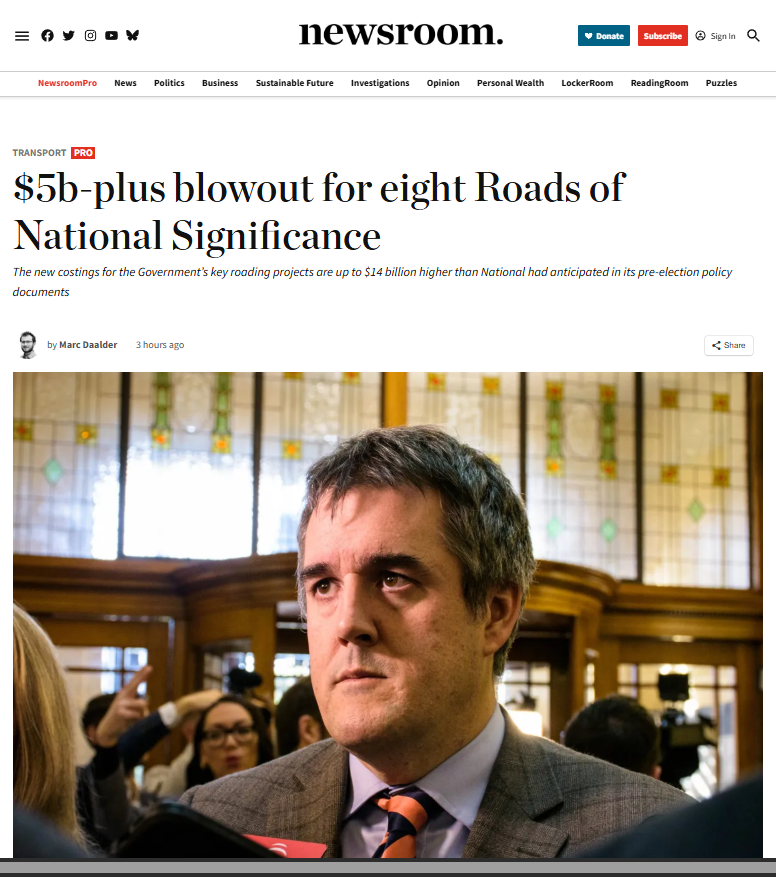
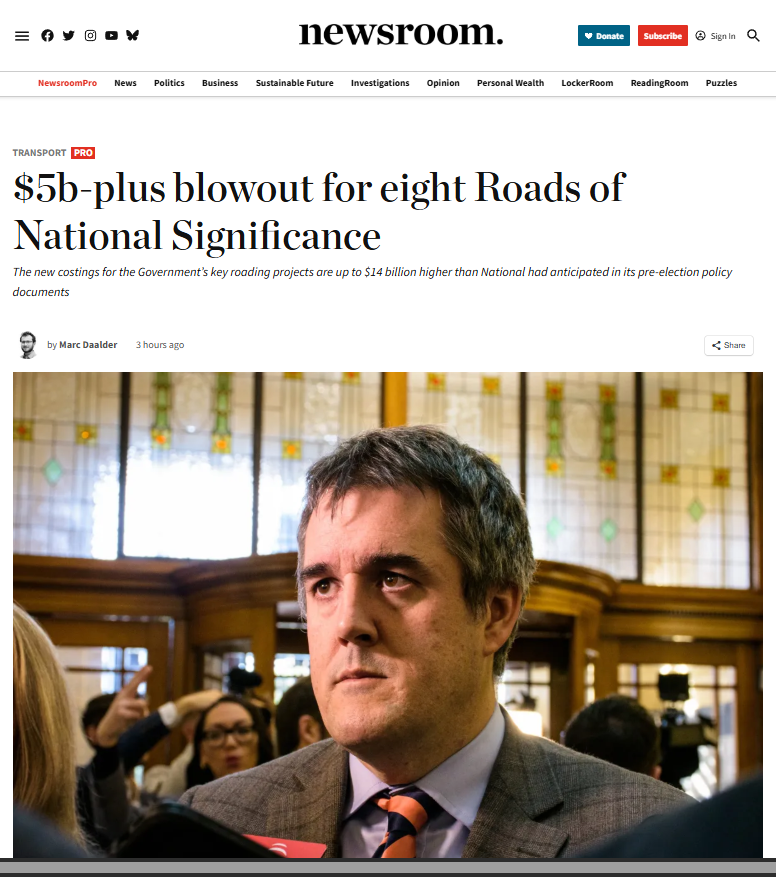
Five billion dollars. That’s the number buried in a Newsroom headline on October 23, 2025. That’s not just money—that’s the future of hospitals, schools, community health centres, and whānau support services that our people desperately need. It’s taken from the pockets of ordinary Kiwis who are already drowning in cost-of-living pressures. And it’s being stolen quietly, with barely a whisper of outrage from the so-called “journalists” tasked with holding power to account.
This essay exposes the systematic deception behind the Roads of National Significance (RoNS) cost blowouts—a privatisation scheme disguised as infrastructure investment. It names the players, reveals the hidden connections, and shows how neoliberal ideology, corporate greed, and Christian nationalist values are converging to privatise public assets and concentrate wealth in fewer hands.
The article by Newsroom and political reporter Marc Daalder, titled “$5b-plus blowout for eight Roads of National Significance,” fails spectacularly at journalism. It reports the facts but obscures the catastrophe. It documents the crisis but normalises the incompetence. And it presents Transport Minister Chris Bishop—a tobacco lobbyist with deep ties to free-market fundamentalism—as merely navigating challenges, rather than as the architect of a system rigged to benefit the wealthy.
Background
Te Manu Mātai o Te Ao Māori (The Guardian of Māori Worldviews) requires us to understand the spiritual and practical foundations of colonisation. For 150 years, Pākehā settlers and their institutions have seized Māori land, resources, and futures. Today, that theft has a new face: neoliberalism.
Neoliberalism—the ideology of market fundamentalism that emerged in the 1980s—teaches that private enterprise solves everything, that profit motive drives efficiency, and that government should shrink while corporations expand. New Zealand adopted neoliberalism ferociously under Finance Minister Roger Douglas in 1984. We sold off state assets, deregulated markets, and dismantled the welfare state. The result: inequality skyrocketed, Māori communities were devastated, and public services crumbled.
Today’s Roads of National Significance programme represents neoliberalism’s evolution: not the outright selling of assets, but the gradual privatisation of public infrastructure through tolling, public-private partnerships, and “toll concessions”—legal structures that let corporations collect revenue from roads built with taxpayer money.
Marc Daalder is Newsroom’s senior political reporter covering climate, health, energy, and extremism. He’s respected in Wellington’s political bubble. But his October 23 article exemplifies how even “independent” journalism can become complicit in obscuring state failure. The article doesn’t ask the hard questions: Who benefits from these blowouts? How did we get here? And why is a government claiming fiscal responsibility while presiding over infrastructure chaos?
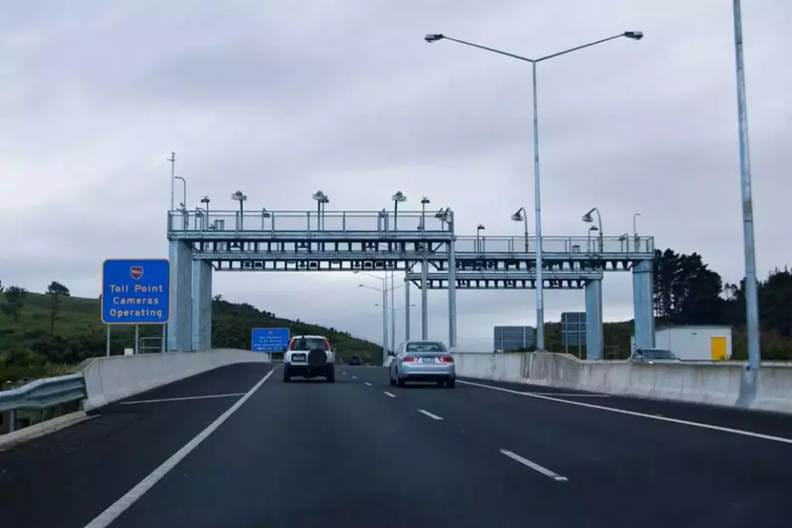
Electronic toll point cameras operating on a New Zealand highway to capture toll payments.
The Issue
On October 23, 2025, the New Zealand Transport Agency (NZTA) Board endorsed investment cases for all eight Roads of National Significance. The government announced $1.2 billion in combined funding for design, consenting, route protection, and property acquisition across six projects.
But here’s where the real story is buried: the cost estimates have exploded beyond all recognition.
The Northland Expressway (Te Hana to Whangarei) was originally estimated at $6 billion for the entire four-lane corridor from Whangarei to Tauranga. But just the Te Hana to Whangarei section now costs $15.3-18.3 billion. The Otaki to North of Levin highway doubled from $817 million (2019) to $2.1 billion (2025). Lower Hutt’s Riverlink project more than doubled from $700 million to $1.5 billion. The Hope Bypass, just 4 kilometres long, costs $1.1-1.4 billion.
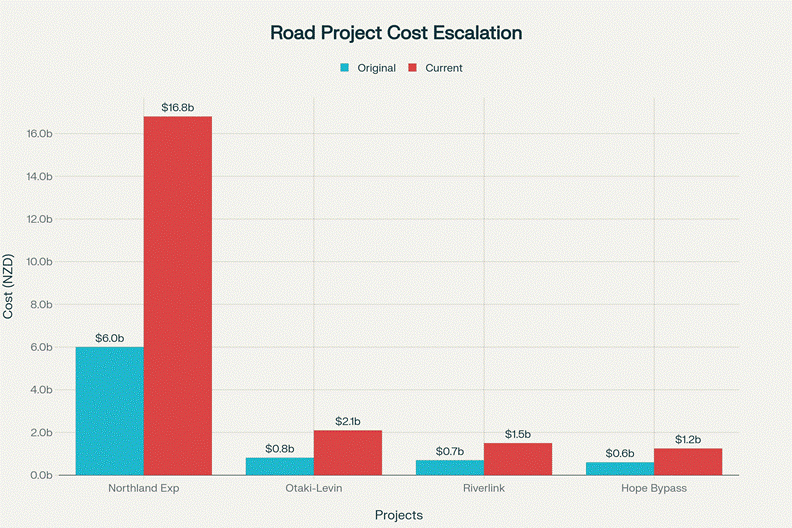
Cost Blowouts in Roads of National Significance: Original Estimates vs Current Reality
Marc Daalder’s article reports these numbers. But it doesn’t interrogate them. It doesn’t ask why government business cases—the supposedly rigorous assessments used to justify spending billions—are so catastrophically inaccurate. And it doesn’t explore what these blowouts mean for ordinary families.
While these mega-roads consume $40-50 billion of public money, schools lack resources, emergency departments overflow, child poverty persists, and whānau languish on waiting lists for mental health services.
The Hidden Story: How Treasury Warnings Were Ignored
In September 2024, just months before the NZTA Board endorsed these projects, the Ministry of Transport warned the government that business cases for Roads of National Significance had “become disconnected from the available revenue and market capacity.” Officials told Transport Minister (then Simeon Brown) that decisions were being made without business cases being completed, meaning “more cost increases, delays and ultimately an inability to deliver intended benefits.”
Treasury also warned that “initial cost estimates are increasingly unreliable indicators of final costs.” The agency identified 10 “wild-card factors” that could influence costs—from ground conditions to fast-track legislation—but provided no contingencies.
The government saw these warnings and proceeded anyway. This wasn’t incompetence; it was a deliberate choice to prioritise ideology over fiscal responsibility.
Marc Daalder’s article mentions Chris Bishop’s vague assurance that projects are “multi-generational in scope.” But it doesn’t challenge Bishop on what that actually means. Will these roads take 20, 30, or 50 years to build? Will they consume ever-larger portions of public money while whānau suffer?
The Privatisation Trap: From Public Roads to Corporate Tolling
In July 2025, Chris Bishop announced the government is exploring “toll concessions”—a mechanism where private corporations pay the government an upfront capital payment for the right to operate a toll road for 20-30 years, collecting all revenues during that period.
This is neoliberalism in its purest form. It converts public infrastructure into private profit centres. It transforms roads into financial assets where corporations extract wealth from every citizen who drives.
Bishop says toll concessions will “accelerate infrastructure delivery.” What he means is: we’re abandoning the principle that public infrastructure is funded through taxes and maintained as a collective good. Instead, ordinary working people will pay twice—once through taxes (which built the roads), and again through tolls (which generate corporate profits).
Currently, New Zealand has 3 toll roads, all publicly operated. By 2026, there will be 6 toll roads. The government is now explicitly considering private concessions for all future Roads of National Significance. This is a systematic privatisation of public infrastructure, executed quietly through technical policy rather than legislative fanfare.
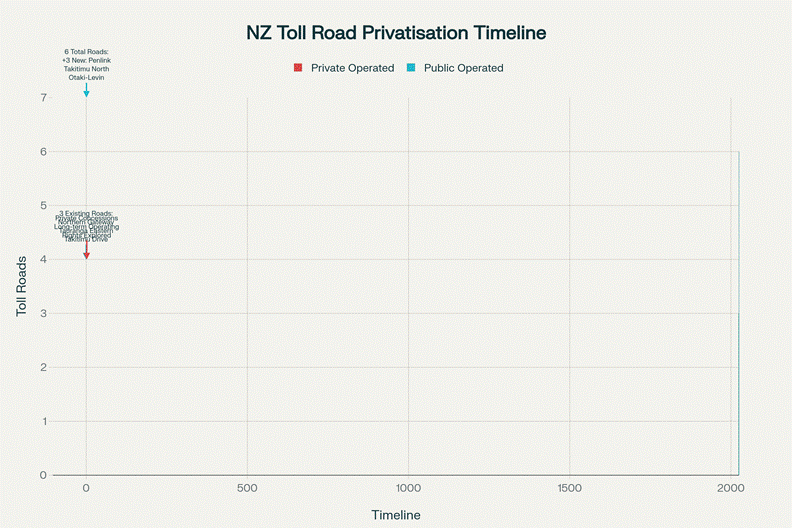
Privatisation Escalation: From Public Ownership to Private Corporate Control
Marc Daalder’s article never utters the word “privatisation.” It presents tolling as a neutral policy option. It allows Chris Bishop to frame toll concessions as innovative financing rather than the systematic transfer of public wealth to corporate shareholders.
The Neoliberal Christian Nationalist Coalition
Here’s where the connections become sinister.
Chris Bishop is a former tobacco lobbyist who worked for Philip Morris (2011-2013). His father, John Bishop, founded and chaired the Taxpayers’ Union—a right-wing pressure group that demands smaller government, lower taxes, and corporate deregulation. John Bishop died in September 2024, but his ideological legacy lives on through his son.
The Taxpayers’ Union was co-founded by David Farrar and Jordan Williams. These figures operate at the intersection of neoliberal economics and Christian nationalism. They advocate for individualism, market fundamentalism, and traditional Christian values aligned with a particular vision of New Zealand nationhood.
Chris Bishop’s policies reflect this fusion. His commitment to mega-roads is paired with his opposition to public transport, his support for tolling, and his willingness to sideline Māori co-governance in favour of “one law for all” rhetoric—a white nationalist position wrapped in legal language.
In June 2025, after a performance at the Aotearoa Music Awards featuring Māori performers with tino rangatiratanga flags, Bishop was recorded calling the performance “a load of crap” and “performative acclaim.” He didn’t apologise. He justified his outburst by claiming frustration at “politicisation.”
This is how Christian nationalist ideology operates in New Zealand: it wraps itself in market language (tolls, efficiency, user-pays), combines it with cultural nationalism (defending “one law for all”), and deploys Pākehā grievance politics to justify dismantling public goods that benefit everyone.[1]
The Benefit Cost Ratio Scam
To justify these mega-roads, the NZTA changed how it calculates Benefit Cost Ratios (BCRs). Previously, projects needed a BCR of 3.0 or higher to qualify as economically viable. Now, they’ll accept projects with BCRs barely above 1.0—meaning barely $1.01 in benefits for every $1 spent.
How did projects that previously failed suddenly become viable? NZTA changed the calculation method:
First, it extended the assessment period from 30 years to 60 years. This stretches benefits over longer timeframes, making marginal projects look better.
Second, it slashed the discount rate from 6% to 2% (dropping to 1.5% after 30 years). This massively inflates the present value of future benefits—a mathematical trick that makes distant benefits seem more valuable than they actually are.
Greater Auckland calculated that the Northland Expressway alone carries only 10-15,000 vehicles per day across most of its length. Even if traffic doubled to 30,000 vehicles daily, the cost per trip would be approximately $70 (including operations and maintenance over 30 years). This is not an economically justified project—it’s a political project disguised as economics.
Marc Daalder’s article doesn’t mention these methodology changes. It accepts the BCR numbers at face value, as though they’re neutral technical measures rather than the result of changed assumptions designed to justify predetermined outcomes.
The Language of Deception: How Newsroom Frames Infrastructure Failure
Newsroom’s article employs several rhetorical moves that obscure rather than illuminate:
First, it uses the passive voice. “The new costings for the Government’s key roading projects are up to $14 billion higher than National had anticipated.” Nobody made this happen. It simply occurred. This language strips agency and responsibility.
Second, it normalises failure. A $5 billion blowout on eight projects is presented as a manageable challenge rather than a sign of systemic dysfunction. Bishop’s claim that projects are “multi-generational in scope” is allowed to stand without interrogation.
Third, it presents the government’s position uncritically. When Bishop says he “wouldn’t say if they would take multiple generations to fund and build,” Daalder accepts this non-answer. A rigorous journalist would press: Are you committing to deliver these roads or not? What’s the timeline? What’s the cost-benefit analysis? How will it be funded?
Fourth, it erases alternatives. The article never mentions public transport, never discusses whether these road-centric investments represent the best use of limited public resources, and never asks what would happen if this money was invested in rail, bus networks, cycling infrastructure, or regional development.
Newsroom was founded in 2017 by Tim Murphy (former NZ Herald editor) and Mark Jennings (former Newshub head). It received initial funding from universities and functions partly as a subscription service. Its business model depends on politically engaged readers—often professional, urban, and wealthy. These readers might be affected by tolls, but they’re not devastated by them. They can afford to pay. They probably own shares in companies that benefit from infrastructure privatisation.
This explains Newsroom’s framing: it’s business journalism for the business class, not journalism for ordinary people.
Revealing the Connections: Follow the Money and Power
The connections between key figures reveal a coordinated ideological project:
Chris Bishop is Transport Minister and holds three other ministerial portfolios. He’s married to Jenna Raeburn. His father founded the Taxpayers’ Union. His colleagues in government include David Seymour (ACT leader, libertarian), Winston Peters (New Zealand First, populist), and Christopher Luxon (Prime Minister, corporate executive).
The government prioritises Roads of National Significance while cutting funding for public transport, cycling infrastructure, and rail. This isn’t neutral policy—it reflects neoliberal ideology that privileges cars, individual choice, and market mechanisms over collective provision.
ACT’s David Seymour advocates for further deregulation, lower taxes, and smaller government. New Zealand First’s Winston Peters uses populist rhetoric while supporting corporate interests (he’s been linked to commercial fishing and tourism). Together, these parties form a coalition committed to privatisation and market fundamentalism.
The Taxpayers’ Union amplifies this ideology through media advocacy, funded by wealthy donors who benefit from lower taxes and deregulation.
Newsroom, as an independent outlet, should serve as a counter-weight to this. Instead, it functions as a neutral platform where government claims go unchallenged.
Meanwhile, corporate media ownership is concentrating. NZME (owner of the NZ Herald, Newstalk ZB, and formerly BusinessDesk) is now vulnerable to takeover by Canadian billionaire James Grenon, who has been linked with alternative right-wing media. This concentration makes it easier for neoliberal and nationalist narratives to dominate public discourse.
Māori, Whānau, and the Toll on Tino Rangatiratanga
The cost blowouts and tollification of public infrastructure disproportionately harm Māori and Pacific communities.
First, Māori have lower incomes and are more likely to live outside wealthy urban centres. Toll roads in areas like Northland and the Wellington region will impose direct financial burdens on whānau already struggling with poverty, healthcare costs, and inadequate housing.
Second, mega-roads consume public budgets that could fund health services, education, and community support essential for Māori wellbeing. The government’s commitment to RoNS means reduced funding for māori health initiatives, bilingual education, and cultural revitalisation.
Third, the prioritisation of roads over public transport reflects a worldview that privileges private consumption over collective wellbeing. This values cars over whānau, profit over kaitiakitanga (stewardship), and individual responsibility over manaakitanga (hospitality and collective care).
Fourth, the narrative of “user-pays” disguises the reality that wealthy Pākehā benefit most from infrastructure investment while costs are distributed across entire communities. This reproduces colonial extraction patterns: resources flow to those with capital and power.
Te Ao Māori teaches that all things are interconnected (āhuatanga). When public money is diverted to mega-roads, it’s diverted from healthcare, education, and environmental protection. When toll roads are privatised, control over public commons passes to corporations focused on profit rather than community wellbeing.
Implications
If this trajectory continues, several outcomes are virtually certain:
First, infrastructure bankruptcy: The government simply cannot afford to build all 17 Roads of National Significance. Treasury warned in June 2024 that they may have $24 billion in unfunded infrastructure commitments. Rather than acknowledge this, the government is lowering standards (accepting BCR above 1.0 instead of 3.0), extending timelines indefinitely, and turning to privatisation.
Second, infrastructure inequality: Toll roads will price ordinary people out of basic mobility. Communities served by tolled highways will fracture—wealthy people will pay and use the new roads; lower-income people will use congested old routes. This reproduces inequality at the infrastructure level.
Third, corporate control of public assets: Toll concessions will transfer decision-making power from elected government to profit-maximising corporations. These companies will prioritise tolling revenue over maintenance, safety, or community needs.
Fourth, Māori dispossession: Mega-roads will consume resources that could address Māori health disparities, educational inequities, and environmental justice. The move to tolling will impose costs on whānau already struggling with systemic poverty.
Fifth, democratic erosion: By using technical policy mechanisms (tolling, concessions, benefit-cost ratio adjustments) rather than parliamentary legislation, the government avoids public debate. This depoliticises privatisation—it happens quietly while journalists like Marc Daalder document it without interrogating it.

The Māori Green Lantern Fighting Misinformation And Disinformation From The Far Right
The $5 billion cost blowout on eight Roads of National Significance is not a story about incompetence. It’s a story about ideology, power, and the systematic transfer of public wealth to private corporations.
Marc Daalder and Newsroom have documented the facts but failed to pursue the truth. They’ve reported the blowout without exploring how neoliberal assumptions about infrastructure delivery led to this catastrophe. They’ve presented Chris Bishop as a pragmatic minister navigating challenges rather than as an ideological actor committed to privatisation and market fundamentalism. And they’ve normalised tollification—the conversion of public roads into profit centres—without interrogating what this means for democracy, equality, and kaitiakitanga.
The Māori Green Lantern calls on all who believe in Aotearoa’s future to resist this agenda. We need public investment in public infrastructure. We need to prioritise whānau wellbeing over corporate profit. We need to reclaim our commons from those who seek to monetise them.
The roads to bankruptcy are being built right now. It’s time to change course.
For those who find value in this work and wish to support independent, anti-colonial analysis: HTDM: 03-1546-0415173-000. I understand these are tough economic times for whānau, so please only contribute if you have capacity.
Kia kaha. Stay strong. The fight for our future is just beginning.
Yours in truth-telling,
Ivor Jones
Te Arawa / Ngāti Pikiao
The Māori Green Lantern

Sources and Further Reading:
1. Greater Auckland’s analysis of RoNS cost escalation and fiscal constraints
2. Infrastructure Commission warnings on RoNS budget impact (2024)
3. Treasury quarterly investment reports on infrastructure planning failures
4. Ministry of Transport warnings on disconnected business cases
5. Transport policy analysis showing ideological bias toward roads
6. Chris Bishop’s background as tobacco lobbyist and family connections to Taxpayers’ Union
7. New Zealand Taxpayers’ Union founding and ideology
8. Toll concessions and privatisation of infrastructure
9. Christian nationalism in New Zealand politics
10. Media ownership concentration and billionaire influence
⁂
1. https://en.wikipedia.org/wiki/Chris_Bishop
2. https://www.mdpi.com/2076-3417/10/16/5506/pdf?version=1596971580
3. https://www.semanticscholar.org/paper/58615e3190b8d00f75ad25bc449b84288281569f
4. https://www.semanticscholar.org/paper/b13cbb54c1fbb7dec403c3194d3e35759904727b
5. https://www.semanticscholar.org/paper/c9bb3307fdda48ae43592e16d4263ca4bb197412
6. https://www.semanticscholar.org/paper/6e96ed3272c82daa71c220fb4baecdb9fee6ae9f
7. https://www.tandfonline.com/doi/full/10.1080/24694452.2021.1956874
8. https://www.semanticscholar.org/paper/e3bec5e98bec77de5022bf8fdddbf483206411a8
9. https://www.semanticscholar.org/paper/ecbc0306648f6e89aad79ea045e227d5cd343608
10. http://article.sciencepublishinggroup.com/pdf/10.11648.j.ijem.20200402.13.pdf
11. https://journals.sagepub.com/doi/pdf/10.1177/0308518X211050407
12. /content/files/anzsw/article/download/220/290.pdf
13. http://www.insightsociety.org/ojaseit/index.php/ijaseit/article/download/4322/1408
14. https://pmc.ncbi.nlm.nih.gov/articles/PMC9082096/
15. https://www.tandfonline.com/doi/pdf/10.1080/23311916.2024.2307212?needAccess=true
16. /content/files/bitstream/1885/155675/1/neoliberalism_regulatory_2005.pdf
17. https://onlinelibrary.wiley.com/doi/pdfdirect/10.1111/j.1468-0491.2010.01508.x
18. https://journals.sagepub.com/doi/pdf/10.1177/1329878X20953278
19. https://www.greaterauckland.org.nz/2025/07/08/selling-tolling-rights/
20.
21. https://www.national.org.nz/news/national-s-transport-plan-will-drive-prosperity
22. https://infrastructure.org.nz/tolls-the-way-to-go-for-new-rons/
23. https://counterfutures.nz/15/3 Gregory CF_15.pdf
24. https://www.beehive.govt.nz/release/next-steps-roads-national-significance
25. https://www.beehive.govt.nz/release/market-sounding-toll-road-concessions-begin
26. https://en.wikipedia.org/wiki/Christian_politics_in_New_Zealand
27. https://en.wikipedia.org/wiki/Sixth_National_Government_of_New_Zealand
28. https://www.beehive.govt.nz/release/investment-summit-tolling-concessions-could-help-deliver-more-roads-sooner
29. https://en.wikipedia.org/wiki/Vision_NZ
30. https://www.dpmc.govt.nz/publications/co-24-2-national-act-and-new-zealand-first-coalition-government-consultation-and-operating-arrangements
31. https://www.facebook.com/Themaorigreenlantern/posts/tolling-our-futures-exposing-the-price-of-privatisation-on-the-road-to-inequalit/9710977098986758/
32. https://hail.to/methodist-church-of-new-zealand-emessenger/article/YHcSqwa
33. /content/files/wp-content/uploads/2023/11/national_act_agreement.pdf
34. https://www.reddit.com/r/newzealand/comments/1h4nbfj/toll_roads_and_private_infrastructure/
35. https://www.newstalkzb.co.nz/on-air/heather-du-plessis-allan-drive/audio/chris-bishop-transport-minister-on-the-governments-plan-for-the-roads-of-national-significance/
36. https://teara.govt.nz/en/religion-and-society/print
37. https://www.national.org.nz/values
38. https://www.transport.govt.nz/area-of-interest/revenue/tolling-and-public-private-partnerships
39. /content/files/jnzs/article/download/8336/7402/11993.pdf
40. https://www.nzherald.co.nz/nz/why-nz-needs-to-invest-properly-in-rail-and-ferry-infrastructure-for-the-public-good-bryce-edwards-political-roundup/NKNOGOD5VZASZMIMDDSFCVWJMM/
41. https://www.rnz.co.nz/news/national/543244/government-struggles-with-lack-of-visibility-of-big-projects-ahead-of-budget-2025
42. https://www.1news.co.nz/2025/10/20/funding-green-lit-for-next-phase-of-major-road-projects/
43. https://www.beehive.govt.nz/minister/hon-chris-bishop
44. https://www.facebook.com/indianweekendernz/posts/the-government-will-spend-more-than-half-a-billion-dollars-acquiring-properties-/1207877514702015/
45. https://www.greaterauckland.org.nz/2025/10/21/rons-reality-needs-to-bite/
46. https://www.facebook.com/ChrisBishopMP/
47. 5b-plus-blowout-for-eight-Roads-of-National-Significance-Newsroom-10-23-2025_07_44_AM.jpg
48. https://www.national.org.nz/news/20250522-honchrisbishopinvestingininfrastructure
49. https://www.rnz.co.nz/news/political/576442/watch-christopher-luxon-on-515m-spend-up-for-new-roads
50. https://www.transporting.nz/press-releases/government-cant-take-its-foot-off-the-gas-pedal-on-transport-infrastructure
51. https://www.facebook.com/groups/106049564684/posts/10162631696869685/
52. https://www.rnz.co.nz/news/national/557150/cost-of-lower-hutt-s-riverlink-project-doubles-to-1-point-5-billion
53. https://www.rnz.co.nz/news/national/528916/manawatu-highway-s-200m-cost-blow-out-shows-need-for-toll-minister
54. https://www.nzherald.co.nz/nz/politics/from-817m-to-21b-in-five-years-one-roads-cost-blowout/TGCB7L3ADBCPDH55SFZ7USGWUU/
55. https://www.rnz.co.nz/news/national/576442/watch-christopher-luxon-on-515m-spend-up-for-new-roads
56. https://www.rnz.co.nz/news/business/528940/business-cases-for-large-roading-projects-disconnected-from-reality-ministry
57. https://www.rnz.co.nz/news/political/519065/unfunded-roads-and-an-unfinished-tax-treasury-s-fiscal-risks
58. 5b-plus-blowout-for-eight-Roads-of-National-Significance-Newsroom.pdf
59. https://www.nzherald.co.nz/nz/politics/government-tips-extra-252m-into-beleaguered-road-programme/S4CAOLK4QVEWHNNDWNR3VHM5KI/
60. https://www.rnz.co.nz/news/political/529456/watch-pm-christopher-luxon-targets-infrastructure-in-latest-quarterly-plan-for-government
61. https://www.rnz.co.nz/news/national/568151/funding-to-councils-to-be-throttled-for-using-too-many-road-cones
62. https://www.rnz.co.nz/news/on-the-inside/494939/70-years-of-road-based-policies-created-today-s-problems-does-national-s-transport-plan-add-up
63. https://www.nzherald.co.nz/the-listener/politics/danyl-mclauchlan-will-our-political-parties-ever-work-together-on-infrastructure/DN74DG63URAPTAP26XEJ2PSYH4/
64. https://www.1news.co.nz/2025/06/30/new-stretch-of-motorway-to-have-110kmh-speed-limit/
65. https://www.1news.co.nz/2025/10/02/under-pressure-national-transit-ticketing-systems-budgets-at-risk/
66. https://www.nzherald.co.nz/nz/government-faces-60-year-debt-blowout-after-building-costs-explode/R7L54GYHNIEJD3Z6TQDFOYRJMI/
67. https://www.rnz.co.nz/news/political/576049/transport-minister-chris-bishop-backs-calls-for-harsher-driving-fines
68. https://www.1news.co.nz/2024/07/01/rough-road-ahead-why-nzs-transport-network-is-struggling/
69. /content/files/ejtir/article/download/2864/3054.pdf
70. https://www.rnz.co.nz/news/political/503534/government-confirms-its-100-day-plan
71. https://www.1news.co.nz/2025/10/15/aa-calls-for-driving-offence-fines-to-rise-well-behind-the-times/
72. https://www.tandfonline.com/doi/full/10.1080/21670811.2020.1811743
73. https://journals.sagepub.com/doi/10.1177/135485659900500304
74. https://ieeexplore.ieee.org/document/10444515/
75. https://journals.sagepub.com/doi/10.1177/107769909807500413
76. https://journals.sagepub.com/doi/10.1177/1077695811428884
77. https://www.semanticscholar.org/paper/cbc3552bfe382c248659985925ec665bb4b1c070
78. https://www.tandfonline.com/doi/full/10.1080/17512786.2021.1910983
79. https://www.semanticscholar.org/paper/b07eeaa8ae0cdd36e37201d64b661aaba2110123
80. https://www.mdpi.com/2071-1050/15/6/5584/pdf?version=1679481707
81. https://www.mdpi.com/2227-7080/10/3/68
82. https://journals.sagepub.com/doi/10.1177/0791603520922945
83. https://www.cogitatiopress.com/mediaandcommunication/article/download/4173/4173
84. /content/files/2407-06604.pdf
85. https://journals.sagepub.com/doi/pdf/10.1177/14648849231212737
86. /content/files/1904-07536.pdf
87. https://journals.sagepub.com/doi/10.1177/2046147X231154550
88. https://pmc.ncbi.nlm.nih.gov/articles/PMC5777551/
89. /content/files/record/3894468/files/raz_milosavljevic_marko_2019.pdf
90. https://figshare.com/articles/journal_contribution/News_from_the_User_s_Perspective_With_Naivety_to_Validity/22232494/1/files/39515821.pdf
91. /content/files/1304-4476.pdf
92. https://www.rnz.co.nz/tags/Marc Daalder
93. https://www.greaterauckland.org.nz/2024/03/05/the-governments-ideological-transport-policy/
94. https://nz.linkedin.com/in/marcdaalder
95. https://www.transport.govt.nz/area-of-interest/strategy-and-direction/government-policy-statement-on-land-transport-2024
96. https://www.beehive.govt.nz/minister/biography/chris-bishop
97. https://x.com/marcdaalder?lang=en
98. /content/files/assets/Uploads/government-policy-statement-on-land-transport-2024-final.pdf
99. https://www.wgtn.ac.nz/law/about/alumni/creating-careers/christopher-bishop
100. https://nzta.govt.nz/assets/planning-and-investment/nltp/2024/docs/2024-27-national-land-transport-progarmme.pdf
101. https://www.national.org.nz/team/chrisbishop
102. https://www.mdpi.com/2075-5309/10/6/97/pdf
103. https://www.national.org.nz/policies/transport-for-the-future
104. https://www.rnz.co.nz/news/political/495988/government-releases-10-year-transport-plan-for-consultation
105. https://thespinoff.co.nz/politics/05-06-2025/what-was-chris-bishop-thinking-an-earnest-attempt-to-figure-it-out
106. https://www.national.org.nz/policy-2023
107. https://www.nzherald.co.nz/nz/chris-bishop-is-a-man-with-a-plan-for-building-better-infrastructure-will-it-work/MD224U5C3RGEJFO64RKVXGBKIA/
108. https://www.russellmcveagh.com/insights-news/budget-2024-election-commitments-to-the-squeezed-middle-and-a-laser-focus-on-returning-to-surplus/
109. https://nz.linkedin.com/in/christopher-bishop-6a294b43
110. /content/files/assets/Proactive-releases/2024-72-documents-released.pdf
111. https://www.rnz.co.nz/tags/Marc Daalder?page=2
112.https://www.rnz.co.nz/news/world/558739/cardinals-possibly-in-the-running-to-become-next-pope
113. https://www.mdpi.com/2071-1050/14/15/9303/pdf?version=1659089459
114.https://www.rnz.co.nz/national/programmes/mediawatch/audio/2018820274/all-journalists-are-climate-reporters-now
115. https://www.nzherald.co.nz/business/companies/freight-logistics/transport-projects-could-cost-twice-as-much-as-national-estimated-leaving-potential-fiscal-hole-of-24b-nzta/DOYAPIZECNFYPBWYP6Z6J66XEM/
116.https://www.nzherald.co.nz/nz/14-things-you-might-not-know-about-destiny-church/AKBOGIIYPHX43HOFAOLMRHRSSM/
117. https://www.rnz.co.nz/programmes/the-detail/story/2018943734/scrutiny-week-s-scoreboard
118. https://www.1news.co.nz/2024/07/04/zoning-land-use-reforms-will-push-down-property-prices-minister/
119.https://www.nzherald.co.nz/entertainment/the-best-books-of-2019-the-canvas-picks/OGBFI7MXNGIJAM3GW2XPAC24PQ/
120. https://www.rnz.co.nz/news/national/530084/covid-fatigue-ignores-a-very-real-problem
121.https://www.nzherald.co.nz/nz/transport-minister-simeon-brown-unsure-about-starting-billions-of-dollars-of-new-roads-this-term/DAMDEC3RLJBYBMXPM3MBC6VKNA/
122. https://www.rnz.co.nz/national/programmes/morningreport/library?page=79&q=Visit+Cheapfifa23coins.com+30%+OFF+code%3AFIFA2023|+I+like+this+place.+I+got+a+good+deal+on++coin+selling+fifa+23+in+LIBYA!..++qcks
123. https://www.rnz.co.nz/news/thedetail/570687/attempted-spying-conviction-for-soldier-who-was-less-bond-more-bumbling
124. https://www.tandfonline.com/doi/pdf/10.1080/23311916.2022.2129363?needAccess=true
125. https://www.nzherald.co.nz/nz/politics/governments-transport-shake-up-new-roads-in-cycleways-out/ODVUVNJMW5CDBLQ4DFO75PLB2A/
126. /content/files/concert/schedules/whole_week/20090112.pdf
127. https://www.rnz.co.nz/news/mediawatch/562767/climate-change-coverage-in-a-changed-media-climate
128. https://www.rnz.co.nz/news/political/518246/budget-2024-at-a-glance-what-you-need-to-know
129. https://www.nzherald.co.nz/nz/my-first-death-threat-the-rise-of-violent-rhetoric-against-local-journalists/LMREYBB5GDGFNFX4BNM6IJHUH4/
130. https://www.rnz.co.nz/news/alert-top/510814/watch-prime-minister-christopher-luxon-s-post-cabinet-press-conference
131. https://www.rnz.co.nz/news/political/575149/why-the-government-s-power-plan-is-likely-to-result-in-dirtier-more-expensive-power
132. https://www.semanticscholar.org/paper/dc5a49f163b42bc5e5bf5486e05fb281ead1bbae
133. https://www.semanticscholar.org/paper/3031d7ad8ca83bd661fa6793af6ac427bfd05baa
134. https://www.semanticscholar.org/paper/4ed79e0f127ed99fe0e6f00b02fcd621c3d10710