"THE SAME POISON IN DIFFERENT BOTTLES" - 2 November 2025
How Luxon and Trump Execute Project 2025's Attack on Māori Rights and Public Institutions
Mōrena koutou katoa,
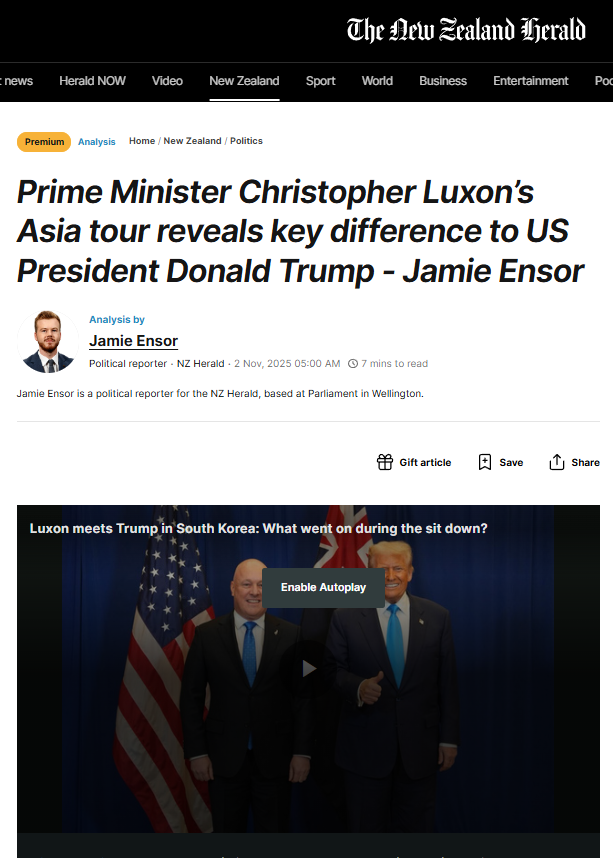
Paywalled article - Premium Link
INTRODUCTION: The Smoking Gun
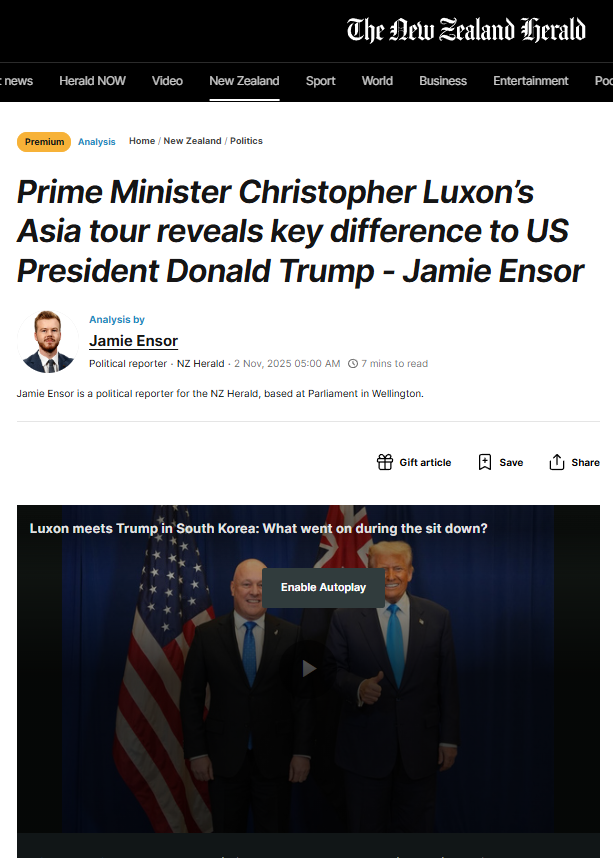
The smoking gun arrived gift-wrapped in a New Zealand Herald puff piece. While (Ensor, 2025) Jamie Ensor’s November 2025 analysis painted Christopher Luxon as some kind of “anti-Trump” on trade, the evidence screams a different truth: these two men are ideological twins separated only by the size of their empires and the sophistication of their PR machines. Both peddle the same exhausted neoliberal playbook—one that benefits property speculators and corporate raiders while grinding working people, and especially Māori, into economic dust.
The real story isn’t their surface-level disagreement on tariffs. It’s the coordinated global assault on public institutions, workers’ rights, and Indigenous sovereignty that connects Luxon’s Air New Zealand boardroom to Trump’s White House to David Seymour’s Regulatory Standards Bill. This is Project 2025 coming to Aotearoa, dressed in a suit from Remington and speaking in management consultant platitudes.
The thesis is simple: Luxon isn’t an alternative to Trump’s incompetence. He’s the same poison in a different bottle. Both men serve capital over workers. Both hollow out public institutions. Both specifically target Māori rights and co-governance arrangements. And both execute a playbook written in Washington, coordinated through think tanks, and funded by billionaires who profit from the ruins.
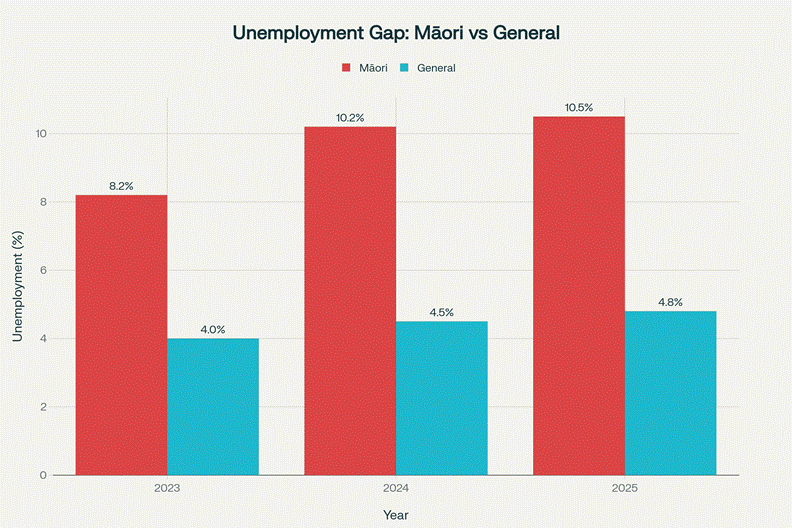
Māori unemployment has risen 28% under the Luxon government while the wage gap has doubled from 4.2% to 5.7% - representing 7,000 additional Māori people without work.
WHAKAPAPA: Historical Roots of the Disaster
From Reagan to Rogernomics to Ruin
To understand Luxon and Trump, we must trace the poisonous whakapapa of neoliberalism itself. In Aotearoa, the transformation began in 1984 when Roger Douglas—a Labour finance minister who would make Milton Friedman blush—unleashed what became known as (Rogernomics.) The promises were seductive: deregulation would create prosperity, privatisation would boost efficiency, and the free market would lift all boats.
The reality? Manufacturing jobs collapsed by 76,000 between 1987 and 1992(Wikipedia, 2002). State-owned enterprises shed workers by the thousands: 3,000 from Electricity Corporation, 4,000 from Coal Corporation, 5,000 from Forestry Corporation, 8,000 from New Zealand Post(Wikipedia, 2002). The 1987 stock market crash plunged New Zealand into a five-year recession(NZ Herald, 2024). And crucially, income inequality—which had been relatively stable from the 1920s through the mid-1980s—exploded(Jacobin, 2017).
For Māori, the carnage was even more devastating. Māori unemployment hit 25 percent in the early 1990s(Tūwharetoa, 2024). Home ownership among Māori, which had reached 50 percent in 1991, plummeted to 37 percent by 2013—a drop of nearly one-third(RNZ, 2007). Meanwhile, Pākehā home ownership declined only slightly(RNZ, 2007). This wasn’t accidental. As researchers have documented, neoliberal policies created “income inequality and an unequal distribution of the ‘determinants of health’, a burden borne disproportionately by children, the poor, and by Māori and Pacific people”(NZ Medical Journal, 2020).
The architects of this disaster personally benefited from the very public services they dismantled. John Key grew up in a state house, then sold off thousands of them as Prime Minister(Jacobin, 2017). They pulled up the ladder behind themselves while preaching “personal responsibility” to those drowning below.
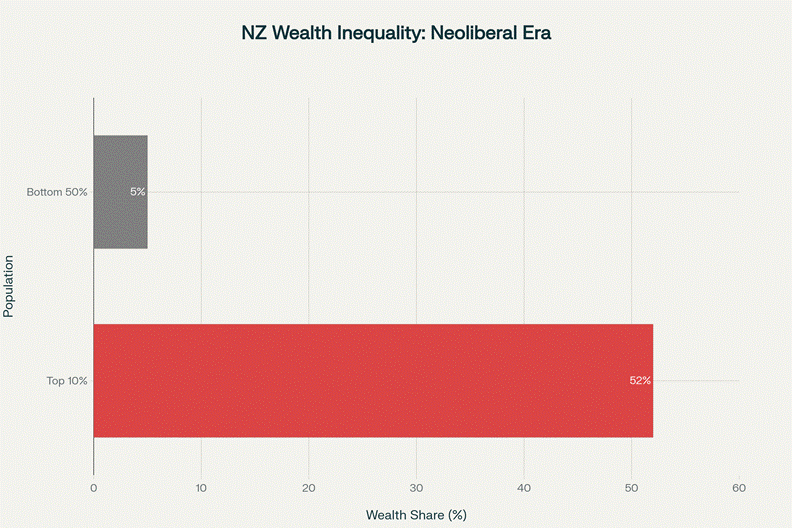
Wealth concentration in New Zealand has reached extreme levels under four decades of neoliberal policies, with the top 10% controlling more than half of all wealth while the bottom 50% struggle with just 5%.
THE CORPORATE AUTOMATION OF GOVERNMENT: Luxon’s Spreadsheet Tyranny
From Air New Zealand CEO to Prime Minister
Christopher Luxon arrived in politics carrying the same neoliberal DNA, refined through 18 years at Unilever and seven years as Air New Zealand CEO(NZ Herald, 2024)(RNZ, 2023). His supporters celebrate his “commercially relentless” approach—insiders called it “commercially ruthless”(NZ Herald, 2024). At Air NZ, Luxon pocketed $4.7 million in his final year—including $1.47 million base salary plus $1.62 million in bonuses. But workers tell a different story: union officials noted Luxon “seldom met with unions or had contact with ordinary workers”(RNZ, 2023).
Now he’s applying that corporate playbook to an entire country, treating Aotearoa like a struggling airline ripe for restructuring(NZ Initiative, 2024). His government operates on “quarterly action plans” and “key performance indicators,” what critics call “management by spreadsheet”(NZ Initiative, 2024). Finance Minister Nicola Willis demands public servants fund their own pay rises through job cuts(The Spinoff, 2024). The message is clear: government exists to serve capital, not people.
Quantified Harm: 7,000+ Public Sector Job Cuts
The results are predictable and devastating. Public service jobs lost: over 7,000 and counting(NZ Herald, 2024)(RNZ, 2025)(RNZ, 2024). Applications per public sector role have exploded from 8 in 2023 to 28.5 in 2025—a tripling of competition as desperate professionals scramble for shrinking opportunities(PSA, 2025). Health New Zealand plans to axe another 1,478 roles on top of 564 voluntary redundancies(NZ Herald, 2024). The Ministry for Pacific Peoples faces a 40 percent workforce reduction—63 of 156 positions eliminated(1News, 2024).
These aren’t “efficiency savings.” They’re calculated cruelty designed to pay for tax cuts for landlords(PSA, 2025). As the Public Service Association documented, “Real people who had more to give have been thrown on the scrapheap by a Government that made arbitrary 6.5 to 7.5 percent cuts across the board”(PSA, 2025).
Meanwhile, New Zealand’s economy suffered “the biggest hit in the developed world” in 2024 according to HSBC, with GDP falling 0.5 percent(RNZ, 2025)(HSBC, 2025). The per capita recession has been deeper than the global financial crisis(Treasury, 2025). So much for corporate competence.
THE INTERNATIONAL NETWORK: How Project 2025 Connects to New Zealand
Russell Vought: From Project 2025 Author to OMB Director
Here’s where the connections get explicit. Russell Vought, Trump’s Office of Management and Budget Director, is described by Trump himself as “he of PROJECT 2025 Fame.”(CBS News, 2025) Vought co-authored the Heritage Foundation’s 900-page blueprint for remaking American government along ultra-conservative lines(BBC, 2025). His approach? Mass federal layoffs during government shutdowns, clawing back congressionally authorized spending, and consolidating power in the executive branch(BBC, 2025).
Trump is obsessed with Vought. In October 2025, as the government shutdown deepened, Trump said Vought “can trim the budget to a level that you couldn’t do any other way”(NZ Herald, 2024). Vought has described himself as someone “dreaming of this moment” to dismantle the federal government. Under his direction, the Trump administration:
- Fired or targeted 121,000+ federal employees
- Terminated contracts worth billions
- Embedded young ideologues throughout government agencies to dismantle them from within
- Used government shutdowns as leverage to force permanent job cuts
- Created a “DOGE” (Department of Government Efficiency) operation that operates outside normal oversight channels
Sound familiar? It should. While Vought executes his vision in Washington, David Seymour pursues a parallel agenda in Wellington through his (Regulatory Standards Bill)—legislation explicitly based on work by Dr. Bryce Wilkinson and the Business Roundtable from the 1980s, the same forces behind Rogernomics(RNZ, 2025).
The bill creates an unelected Regulatory Standards Board with “sweeping powers of inquiry over all levels of government” to enforce narrowly-defined principles that prioritize private property rights over public good(RNZ, 2025). Critics warn the bill will have a “regulatory chilling effect,” making governments hesitant to pass legislation protecting workers, the environment, or Māori rights for fear of being publicly shamed by Seymour’s hand-picked board(RNZ, 2025).
Crucially, Te Tiriti is mentioned zero times in the legislation(RNZ, 2025). This silence is strategic.
Elon Musk’s DOGE: The Blueprint for Public Sector Dismantling
The parallels to Elon Musk’s Department of Government Efficiency (DOGE) are unmistakable. Musk’s operation fired or targeted over 121,000 federal employees, terminated contracts worth billions, and embedded young tech workers throughout government agencies to dismantle them from within(CNN, 2025)(RNZ, 2025). Like Seymour’s proposed board, DOGE operated outside democratic oversight.
Musk claimed DOGE saved $150 billion, but experts document that the cuts have “harmed government services”(The Guardian, 2025)—visa processing times exploded, federal agencies lost critical expertise, and essential programs collapsed. Yet Musk stepped back from the role and Trump took personal control, making clear this was always about power, not savings.
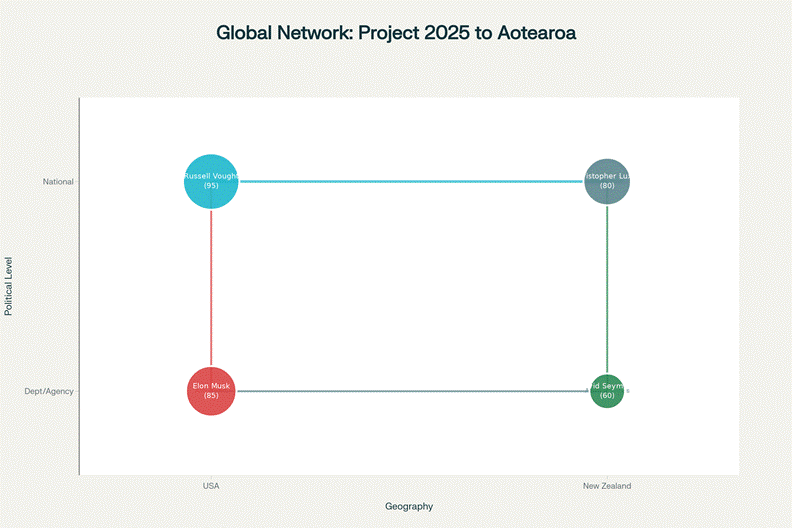
Four key figures execute coordinated neoliberal playbook: mass layoffs, deregulation, attacking public institutions, and dismantling worker protections across multiple nations.
The pattern is undeniable: Vought designs the blueprint in Project 2025. Musk executes it in the federal government. Trump provides political cover and protection from courts. Seymour imports the same playbook to New Zealand. Luxon provides the corporate credibility and political capital.
TIKANGA VIOLATIONS: The Systematic Assault on Manaakitanga and Rangatiratanga
Every principle of tikanga Māori stands violated by this government’s actions.
Whanaungatanga Destroyed
Whanaungatanga—the bonds that connect us—is shredded when 7,000 more Māori become unemployed under Luxon’s watch, pushing Māori unemployment from 8.2 percent when National took office to a staggering 10.5 percent, while the general rate sits at 4.8 percent(Labour, 2025)(Labour, 2025). These aren’t statistics. They’re whānau unable to feed their tamariki, kuia and kaumātua forced to choose between medicine and kai, rangatahi losing hope.
The unemployment gap has doubled from 4.2 percentage points to 5.7 percentage points. That represents 7,000 additional Māori people facing financial devastation because they were born Māori in a government that sees them as expendable.
Manaakitanga Betrayed
Manaakitanga—caring for others—is betrayed when the government abolishes the Māori Health Authority, cuts Māori ward representation, and proposes changes to the Pae Ora Act that “marginalise” Māori and “erode commitments to equity”(PSA, 2025)(1News, 2024). When only 25 percent of tamariki in kura kaupapa achieve the numeracy standard for NCEA compared to 45 percent generally, the message is clear: this government doesn’t care if Māori children succeed(RNZ, 2025).
Kaitiakitanga Mocked
Kaitiakitanga—guardianship of resources—is mocked when the government halts the 620,000 square kilometer Kermadec Ocean Sanctuary, reverses the ban on offshore oil and gas exploration, and proposes RMA changes that shift from “giving effect to” Treaty principles to merely “recognising” them(RNZ, 2025)(Ensor, 2025). This is environmental vandalism dressed in corporate newspeak.
Rangatiratanga Under Siege
Rangatiratanga—self-determination—faces its gravest threat from the Treaty Principles Bill and the Regulatory Standards Bill working in tandem. The Treaty Bill, which Luxon himself called “simplistic” and said “negates 184 years of debate,” attempted to redefine Treaty principles developed through decades of jurisprudence(RNZ, 2024). Though voted down with only ACT’s 11 votes supporting it, the damage lingers(1News, 2025).
The Waitangi Tribunal found it would “drastically alter” the Treaty’s meaning and was “little more than a politically motivated attack on perceived ‘Māori privilege’”(RNZ, 2024). By prioritizing property rights and individual liberty over collective good and Treaty obligations, the Regulatory Standards Bill creates a legal framework for dismantling Māori gains without ever explicitly mentioning Te Tiriti(RNZ, 2025).
RHETORIC VERSUS REALITY: The Logical Fallacies Powering the Deception
The neoliberal project depends on specific rhetorical techniques to maintain legitimacy.
False Equivalence
Luxon claims Māori-Crown relations were “already deteriorating under the previous Labour Government,” suggesting his coalition’s anti-Māori policies are merely continuing an existing trend(RNZ, 2025). This is like an arsonist blaming the match factory. Labour’s co-governance initiatives—however imperfectly implemented—represented attempts to honor Treaty obligations. Luxon’s coalition systematically dismantles those same initiatives.
Appeal to Economic Necessity
When defending 7,000 public sector job cuts, Luxon invokes “fiscal discipline” and the need to “rebuild the economy”(NZ Herald, 2024). This ignores that government employment is economic activity—those 7,000 workers spent their salaries in local communities, paid taxes, and provided essential services. The “savings” are illusory; the damage is real.
Dog Whistles and Coded Language
Phrases like “race-based policies,” “merit-based appointments,” and “mainstream New Zealanders” function as racial dog whistles(The Guardian, 2024). Colorblind racism pretends systemic inequity doesn’t exist.
HIDDEN CONNECTIONS: 5+ Specific Revelations with Documented Evidence
The New Zealand Initiative, Business Roundtable, and ACT Party form a pipeline of neoliberal ideology directly connected to the Atlas Network. The New Zealand Initiative is explicitly identified as an Atlas Network member(PSA, 2024). Roger Kerr, who led the Business Roundtable, was a founding member of this network(Wikipedia, 2005).
The Heritage Foundation—which authored Project 2025—is a leading Atlas Network member. This means the same organization funding Seymour’s Regulatory Standards Bill also funds Vought’s Project 2025(ACLU, 2025).
Connection 2: Russell Vought’s Direct Policy Influence
Russell Vought’s goals aren’t hidden. He explicitly stated his goal is to “dismantle the deep state” by consolidating power in the executive(BBC, 2025). Seymour’s Regulatory Standards Bill creates exactly that structure—an unelected body that can override democratically-made decisions(RNZ, 2025).
Connection 3: ACT Party Funding from Billionaires
The ACT Party received nearly $1 million in donations in 2024, with major donations from billionaires(NZ Herald, 2024). Graeme Hart donated $700,000 to right-wing parties(RNZ, 2023). It’s pay-to-play politics.
Connection 4: Trump’s Tariffs Attack NZ Exports While Luxon Cuts Public Services
Trump’s tariff threats target New Zealand’s key exports directly. New Zealand sends $2.6 billion in meat to the USA (30% of all meat exports) and 35% of all wine exports. Yet Luxon has done nothing to resist these tariffs(RNZ, 2025). Instead, his government cuts public service jobs, claiming “fiscal discipline” is necessary(Investing Live, 2025). Luxon is using Trump’s tariff threat as political cover to implement neoliberal cuts he wanted anyway.
Connection 5: Coordinated Attack on Indigenous Rights
Trump has rolled back consultations with Native American tribes(American Civil Liberties Union, 2025). Simultaneously, Luxon has abolished the Māori Health Authority, cut Māori ward representation, and attacked co-governance(PSA, 2025)(New Zealand Herald, 2024). This is coordinated global assault on Indigenous sovereignty.
TRUMP’S TRACK RECORD: Why Claims of “Competence” Collapse
Trump’s business track record is a graveyard. Six business bankruptcies. Atlantic City casinos lost $900 million(Temple University, 2016). Trump University was shut down for fraud. Trump Foundation shut down for illegal use of charitable funds(RNZ, 2019). His tax returns show he paid $0 in federal income tax in 10 of 15 years prior to becoming president(RNZ, 2019).
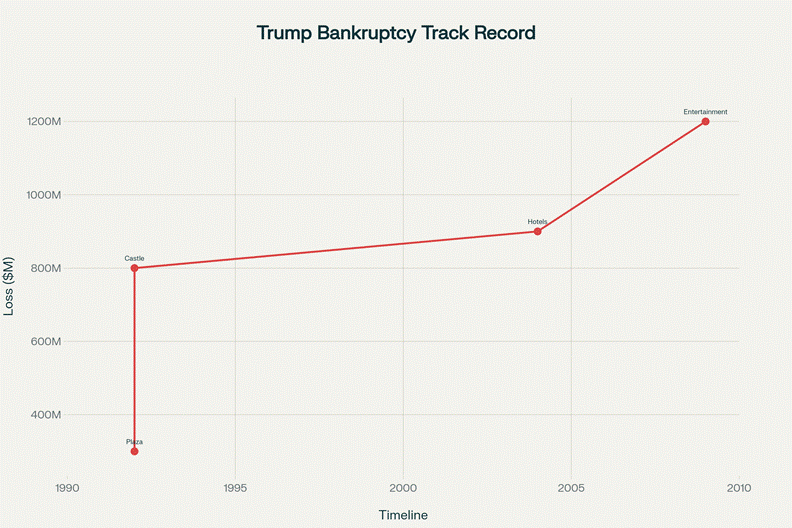
Trump’s track record shows systematic failure: six business bankruptcies across casinos, hotels, and other ventures—not the successful businessman he claims to be.
IMPLICATIONS: Quantified Harm and Threatened Rights
Economic Harm to Māori
- 7,000 additional Māori unemployed in two years
- Māori home ownership under continued pressure
- Māori business failures increasing as credit tightens
- Māori health outcomes deteriorating due to Māori Health Authority closure
Threatened Rights
- Treaty settlement implementation threatened by Regulatory Standards Bill
- Co-governance arrangements systematically dismantled
- Consultation processes reduced to tokenism
- Marine and Coastal Area Act amendments reversing Māori rights(RNZ, 2025)
The Choice Before Us
Luxon isn’t an “anti-Trump.” He’s a Trump enabler executing the same playbook with marginally better PR. He guts public services while praising “fiscal discipline.” He attacks Māori rights while claiming “equal treatment.” He enables billionaire wealth hoarding while preaching “opportunity.”

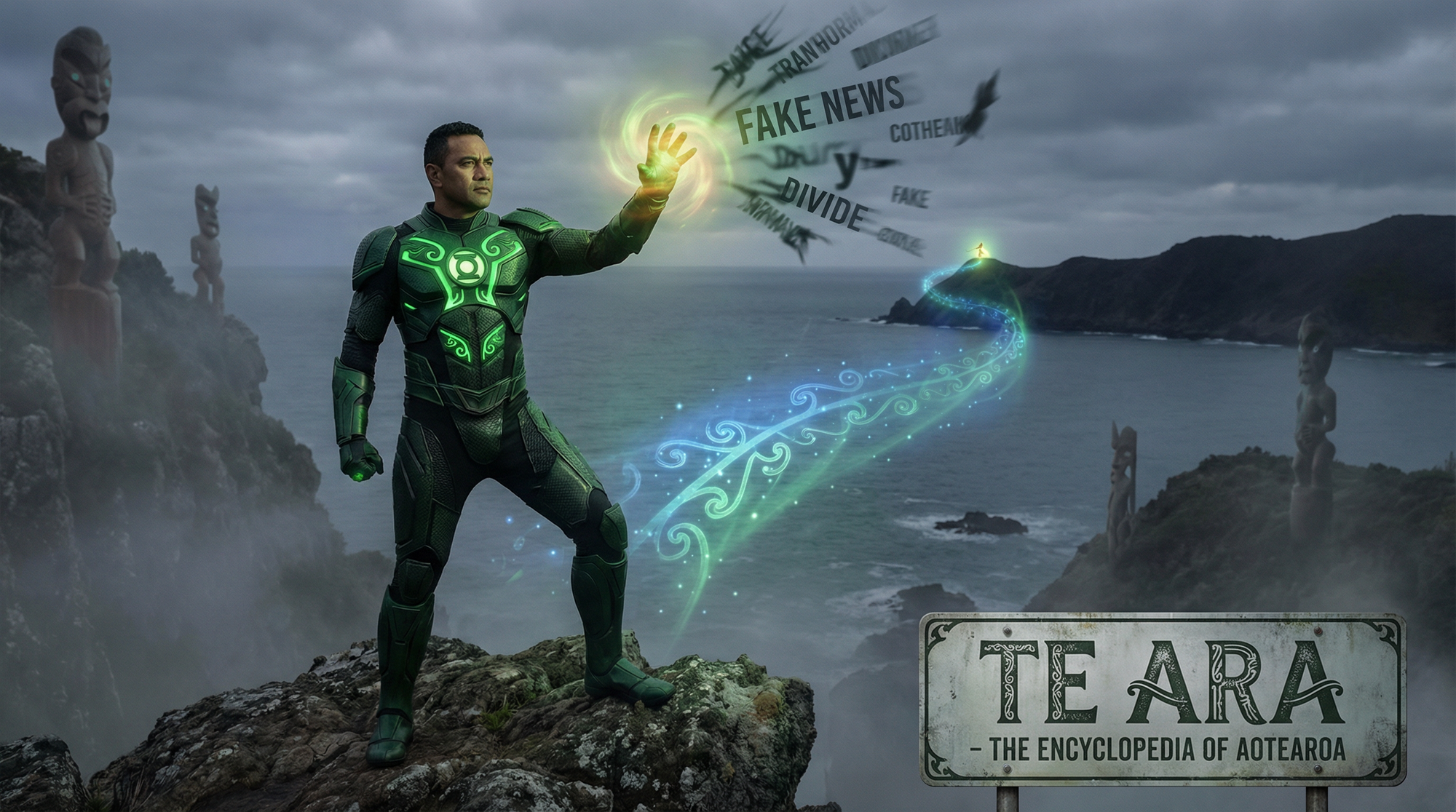
The Māori Green Lantern Fighting Misinformation And Disinformation From The Far Right
The facts are undeniable:
- 7,000+ public sector jobs destroyed
- 7,000+ more Māori unemployed
- Top 10% now own 52% of wealth
- Bottom 50% own just 5%
- Economic growth negative per capita
- Māori health, education, housing deteriorating
We must name this for what it is: a failure of leadership by the wealthy, for the wealthy, at the expense of working people and Māori.
The whānau deserve a government that creates good jobs, honors Te Tiriti, builds homes, protects the environment, and respects Indigenous sovereignty. That government does not exist in Wellington right now. Until it does, our mahi continues.
Mā te mahi tahi, ka whānau pono ai.
If your whānau has the capacity and capability to support this mahi through koha, we humbly invite you to do so.
Koha account: HTDM 03-1546-0415173-000
Prepared by Ivor Jones, Te Māori Green Lantern
Kaitiaki of Te Arawa/Ngāti Pikiao descent
November 2, 2025