“The Sellout Spectacle: How Clark and Key Danced with Dictators While Betraying Māori Sovereignty” - 9 September 2025
Betraying Tūpuna for Beijing's Blood Money
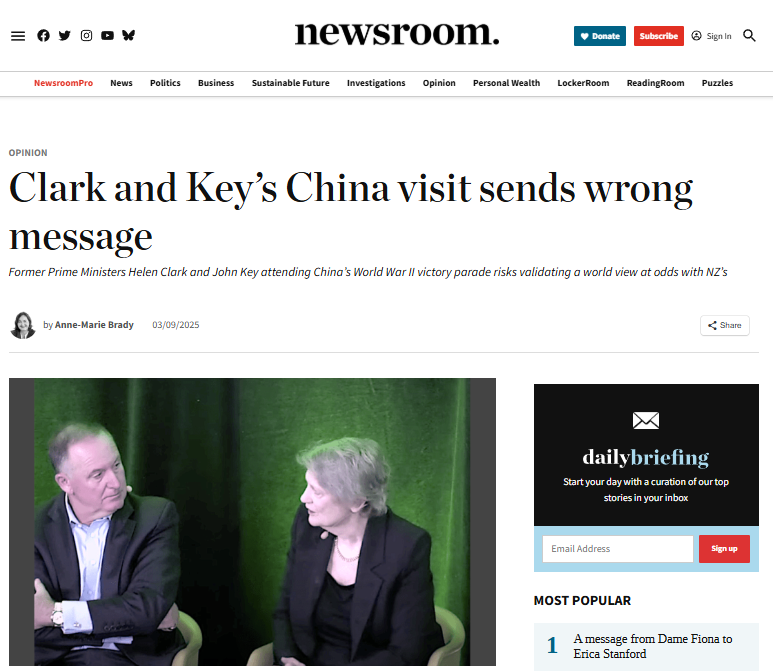
Kia ora koutou katoa. Ko Ivor Jones ahau, he uri nō Te Arawa, he uri hoki nō Ngāti Pikiao, ā, he kaitiaki mō te pono me te mauri o tō tātou whenua. The Māori Green Lantern sees through the smoke and mirrors of colonial collaboration.
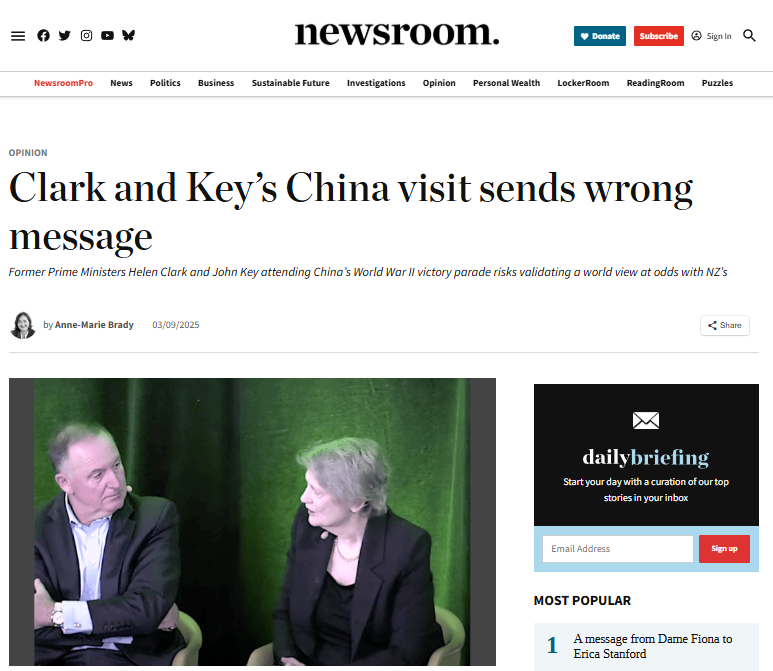
In September 2025, two of Aotearoa's most prominent political has-beens - Helen Clark and John Key - disgraced themselves and our nation by attending China's military parade in Beijing, rubbing shoulders with the world's most notorious dictators while legitimizing an authoritarian spectacle that spat in the face of everything our tūpuna fought and died for. This grotesque display of political prostitution represents the culmination of decades of neoliberal sellout politics that has systematically undermined Māori sovereignty while enriching the very colonizers who stole our land.
This essay exposes the rotten foundations of New Zealand's relationship with China, revealing how our former leaders have become willing accomplices in a new form of colonialism that threatens not just our democratic values, but the very survival of tangata whenua. Through examining the web of corruption, influence operations, and economic dependency that binds our nation to Beijing's authoritarian agenda, we will uncover how Clark and Key's Beijing betrayal is merely the latest chapter in a story of colonial collaboration that stretches back generations.
Understanding the Colonial Continuum
Historical Context of Colonialism in Aotearoa
To understand the full magnitude of Clark and Key's betrayal in Beijing, we must first examine how colonialism has operated in Aotearoa New Zealand since 1840. The Treaty of Waitangi promised Māori retention of tino rangatiratanga - absolute sovereignty over our lands and taonga - yet within four years, colonial officials admitted that traditional rights of rangatira would have to be limited because they conflicted with Crown authority. This pattern of promising partnership while systematically undermining Indigenous power has defined New Zealand politics ever since.
The colonial state has always relied on compliant Indigenous and settler elites who legitimize foreign domination in exchange for personal enrichment. From the Native Land Court that facilitated the transfer of Māori land to Pākehā hands through individual titling, to modern neoliberal politicians who sell out national sovereignty for free trade deals, the mechanism remains the same: find local collaborators willing to betray their people for personal gain.
Te Ao Māori Values Under Attack
Traditional Māori values provide a stark contrast to the mercenary mindset displayed by Clark and Key. Kaitiakitanga demands that we protect the mauri of our people and environment for future generations, not sacrifice them for short-term economic gain. Manaakitanga requires genuine hospitality based on mutual respect, not the hollow performance of diplomatic niceties with genocidal dictators. Whakatōhea teaches us that our actions must honor our ancestors and preserve mana for our mokopuna - something impossible when legitimizing authoritarian regimes that crush Indigenous peoples worldwide.
Neoliberalism as Modern Colonialism
The neoliberal economic model imposed on New Zealand since the 1980s represents a new form of colonialism that operates through debt, trade dependency, and elite capture rather than direct military conquest. New Zealand's signing of the China Free Trade Agreement in 2008 made it the first developed country to surrender economic sovereignty to the Chinese Communist Party, establishing a template for how authoritarian states could use economic leverage to silence criticism and co-opt democratic institutions.
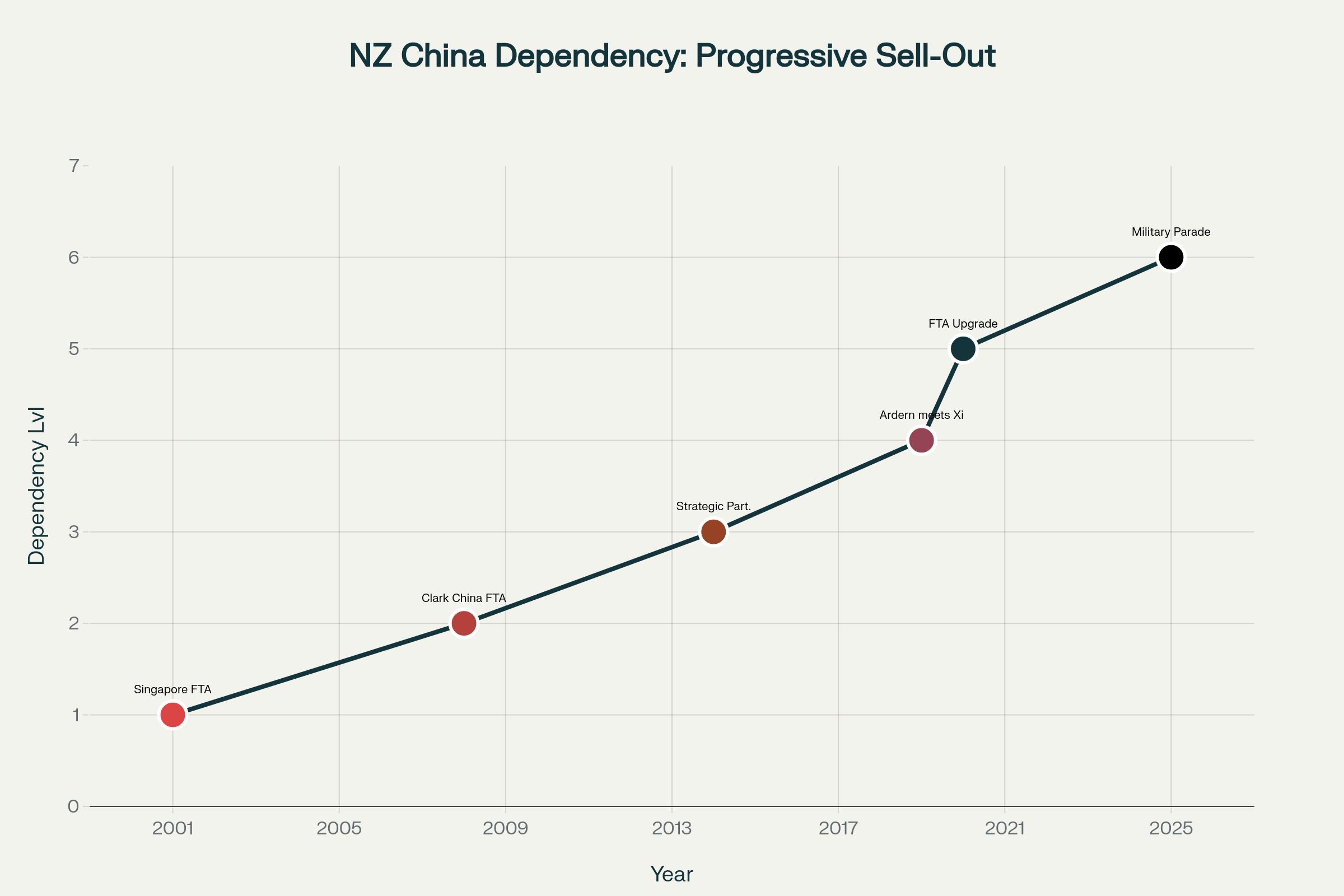
Timeline showing New Zealand's progressive entanglement with China and legitimization of authoritarianism from 2001 to 2025
This timeline reveals the systematic progression from economic engagement to political submission, with each milestone representing a further erosion of New Zealand's independence and values.
The Spectacle of Shame: Clark and Key's Beijing Betrayal
The Authoritarian Alliance
On September 3, 2025, Helen Clark and John Key chose to stand alongside Vladimir Putin, Kim Jong Un, and other dictators at China's military parade, lending democratic legitimacy to what was essentially a gathering of the world's worst human rights abusers. The event showcased China's military might while Xi Jinping declared the Chinese nation "unstoppable", a barely veiled threat to democratic nations worldwide.
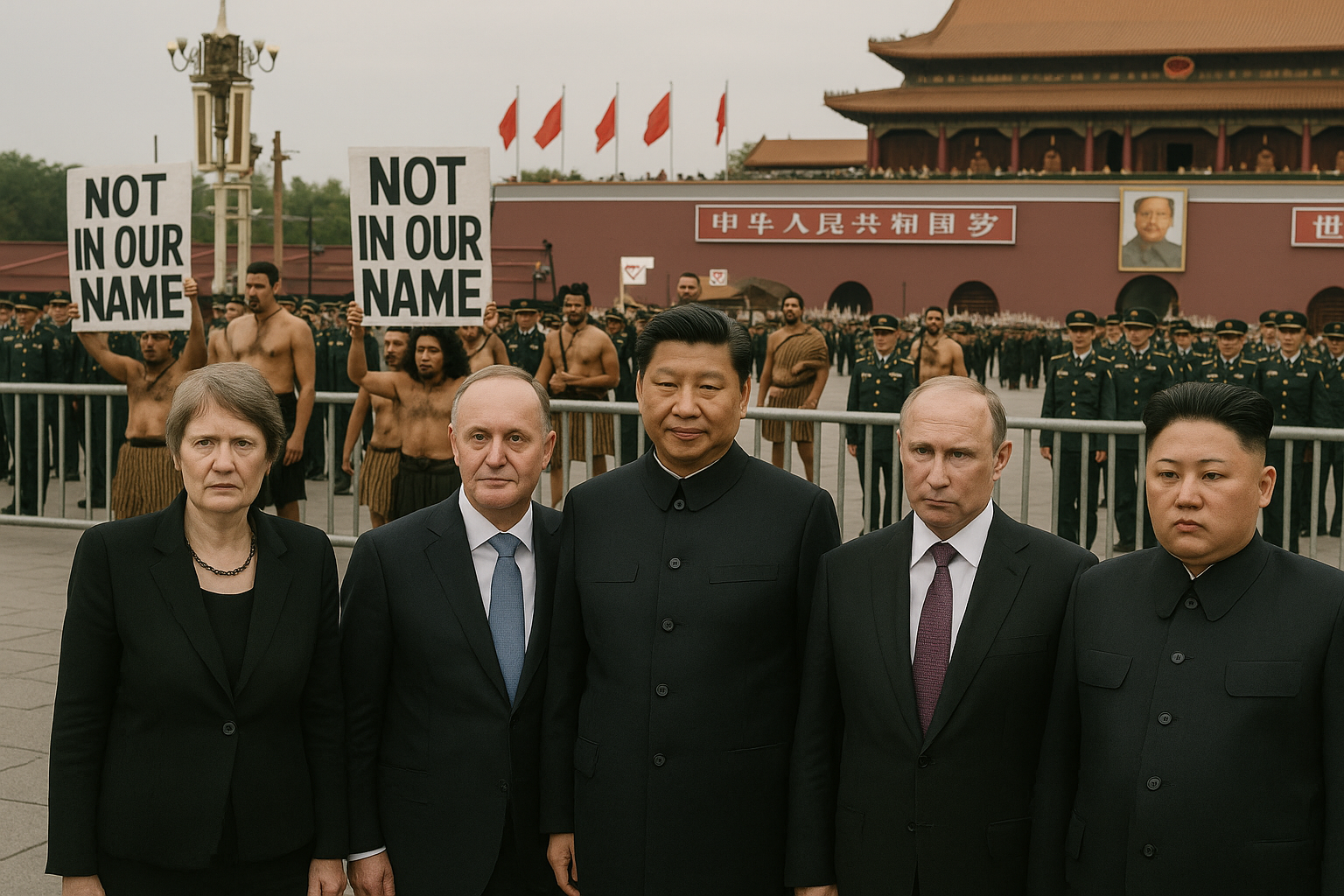
Former NZ PMs legitimizing authoritarian regimes while Māori protests go unheard
The presence of New Zealand's former prime ministers at this authoritarian love-fest sent a clear message: democratic values are negotiable when there's money to be made. While democratic leaders from the US, UK, Australia, and Canada stayed away, Clark and Key chose to legitimize a regime that operates concentration camps in Xinjiang, crushes pro-democracy movements in Hong Kong, and threatens to invade Taiwan.
The Historical Lie
The parade was supposedly commemorating the 80th anniversary of the end of World War II, but this represents a fundamental rewriting of history. China's contribution to WWII was made by the Kuomintang Nationalist government, not the Chinese Communist Party military, which was then a very small force that avoided large conflicts and was saving strength for civil war against the KMT. The People's Republic of China was only founded in 1949, yet Xi Jinping's regime has the audacity to claim credit for defeating fascism while operating as a modern fascist state itself.
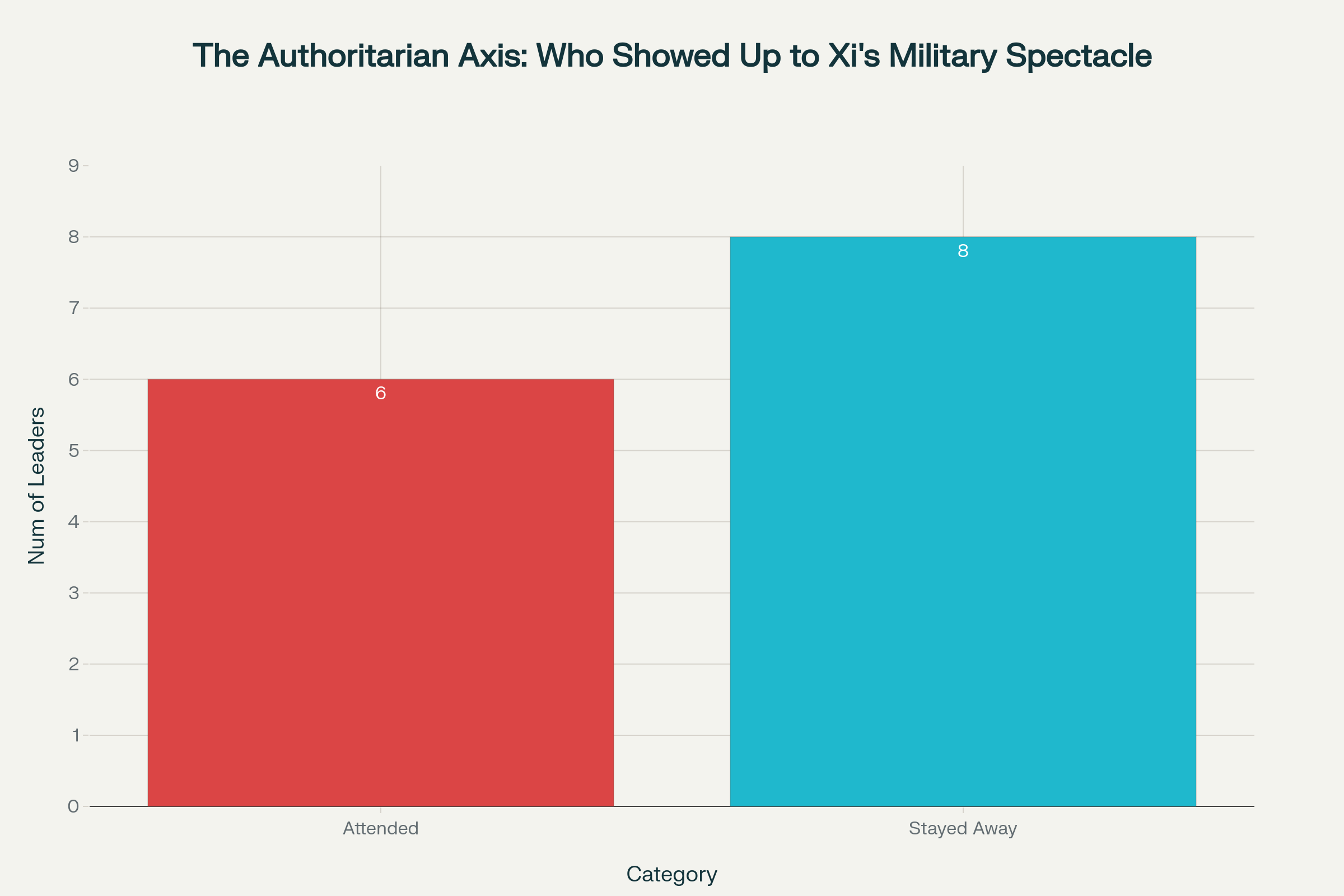
Comparison showing how New Zealand's former PMs aligned themselves with dictators and authoritarians while democratic allies stayed away from China's military parade
This stark comparison reveals the moral bankruptcy of Clark and Key's decision. They chose to align themselves with dictators and authoritarians while democratic allies maintained their principles and stayed away.
Economic Blackmail as Justification
Clark's pathetic attempt to justify her presence by citing China as New Zealand's "major trade partner" exposes the neoliberal mindset that prioritizes profit over principle. She told The Post that "engagement with China as our major trade partner is very important", as if economic dependency somehow excuses moral cowardice. This logic - that trade justifies any compromise - is the same reasoning used by apartheid apologists and every other regime that profits from oppression.
The United Front War Against Māori Sovereignty
China's Systematic Influence Operations
The attendance of Clark and Key at Beijing's military parade represents just the tip of an iceberg of Chinese influence operations that have systematically penetrated New Zealand's political, economic, and social institutions. University of Canterbury professor Anne-Marie Brady has documented how China's "covert, corrupting, and coercive political influence activities" in New Zealand are "now at a critical level".
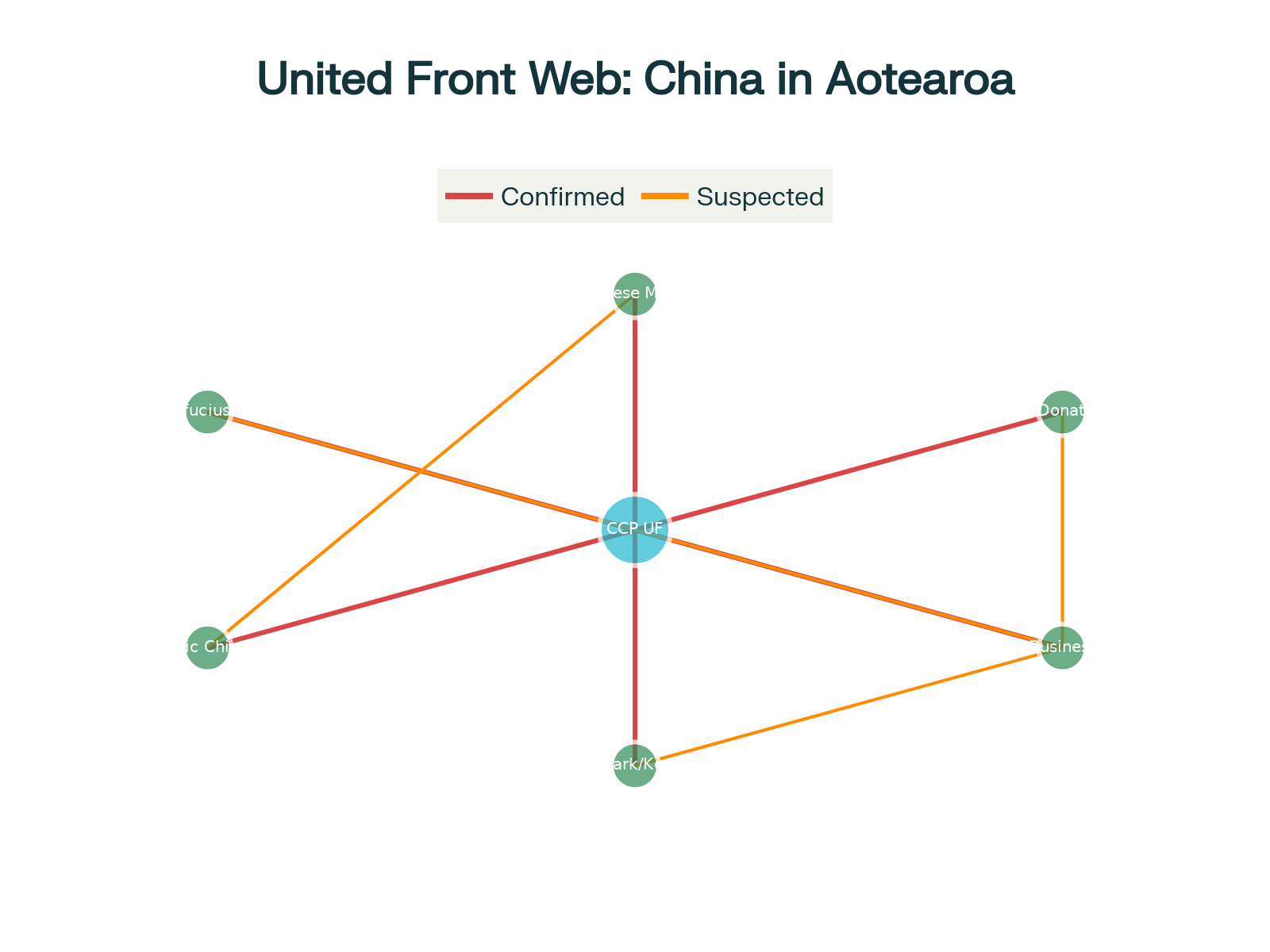
Network diagram showing how China's United Front operations systematically infiltrate New Zealand's political, economic, media and academic institutions
This network diagram reveals the systematic nature of Chinese infiltration through United Front operations, which aim to co-opt political and economic elites, access strategic information, and undermine democratic institutions. The fact that Clark and Key have become willing participants in this influence network represents a profound betrayal of the democratic principles they once claimed to serve.
Targeting Tangata Whenua
China's influence operations pose a particular threat to Māori sovereignty because they operate through the same colonial mechanisms that have oppressed Indigenous peoples for generations. The United Front strategy incorporates co-opting elites, information management, persuasion, and accessing strategic resources - precisely the tactics used by European colonizers to undermine Indigenous resistance and extract wealth from colonized territories.
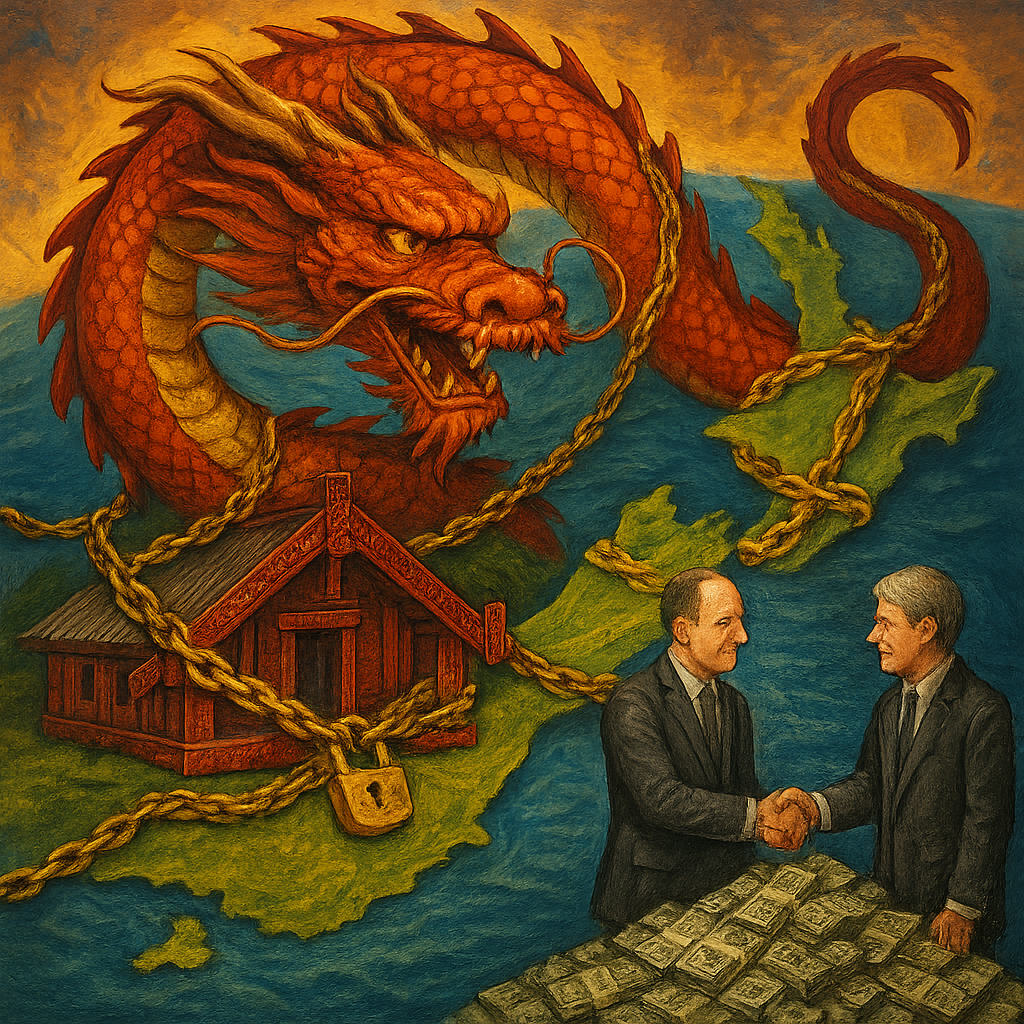
Economic colonialism: China's grip tightens while Māori sovereignty is sold off
The symbolism is unmistakable: a new colonial power tightens its grip while Māori sovereignty is auctioned off by compliant politicians who have sold their souls for Chinese gold.
The Police Bribery Scandal
Recent revelations about New Zealand police officers taking a "private" trip to China that had "all the hallmarks of a foreign interference operation" demonstrate how deeply Chinese influence operations have penetrated our institutions. This so-called "cultural competency" trip - organized through China's official travel agency and involving meetings with Chinese government officials - represents exactly the kind of political tourism used to compromise foreign officials.
For Māori, this is particularly concerning because police are often the front line of state oppression against Indigenous communities. The thought that our police might be compromised by foreign authoritarian influence adds another layer to existing concerns about institutional racism and state violence against tangata whenua.
The Free Trade Trap: Economic Colonialism Disguised as Partnership
The 2008 Sellout Agreement
Helen Clark's signature on the 2008 New Zealand-China Free Trade Agreement - the first FTA between China and any developed country - represents a watershed moment in our nation's history. Disguised as economic opportunity, this agreement established the framework for Chinese economic colonialism that now holds our economy hostage to Beijing's political demands.
The FTA included provisions for up to 1,800 Chinese workers to enter New Zealand annually, effectively importing cheap labor to undercut local wages while Chinese companies gained preferential access to New Zealand markets. Meanwhile, safeguard measures meant New Zealand dairy exports faced higher tariffs whenever volume thresholds were exceeded, ensuring Chinese domestic producers remained protected.
The Treaty Exception Lie
One of the most cynical aspects of New Zealand's China FTA was the inclusion of a "Treaty of Waitangi exception clause" that was supposedly designed to protect the government's ability to adopt policies that fulfill its obligations to Māori. This clause has been included in every subsequent FTA, creating the illusion that Māori rights are protected while the underlying economic structures systematically undermine Indigenous sovereignty.
The reality is that these exception clauses are meaningless legal theater designed to provide political cover for trade deals that fundamentally compromise national sovereignty. When the Waitangi Tribunal found that the CPTPP negotiations did not protect Māori data sovereignty or mātauranga Māori in the digital domain, it became clear that these protections exist only on paper.
Economic Dependency as Control Mechanism
China now takes twice as much of New Zealand's exports as Australia and more than twice as much as the US, creating a level of economic dependency that effectively gives Beijing veto power over New Zealand's foreign policy. This economic leverage explains why Clark and Key felt compelled to attend Beijing's military parade despite the obvious moral compromises involved.
This dependency represents a form of neocolonialism that operates through debt and trade rather than direct military occupation. Just as European colonizers used economic pressure to force Indigenous peoples to sell their land, China uses economic leverage to force democratic nations to compromise their values and silence criticism of Chinese human rights abuses.
The Institutional Capture: From Media to Universities
Controlling the Narrative
China has systematically captured New Zealand's Chinese-language media landscape, with 17 Chinese-language newspapers and four radio stations now operating in the country, many of which are responsive to PRC direction and repeat approved talking points. This media control ensures that Chinese New Zealanders receive information that supports Beijing's political agenda while suppressing dissenting voices.
For Māori, this media capture represents a familiar pattern of colonial information control. Just as European colonizers used newspapers and official communications to justify land theft and cultural suppression, China uses captured media to legitimize its influence operations and silence criticism of its authoritarian practices.
Academic Infiltration
Confucius Institutes have been established at New Zealand universities, providing China with direct access to academic institutions and the ability to influence curriculum and research. These institutes represent a form of soft power colonialism that shapes how young New Zealanders understand China and its role in the world.
The targeting of universities is particularly insidious because it shapes the next generation's understanding of democracy, human rights, and international relations. By embedding Chinese government perspectives in academic institutions, Beijing ensures that future leaders will be more sympathetic to authoritarian governance models and less likely to challenge Chinese expansion.
Political Donations and Elite Capture
From 2007-2017, the National Party received NZ$1.36 million in publicly declared donations from Chinese entrepreneurs with close political connections to the CCP, while campaign finance laws allow for anonymous donations from foreign sources, with more than 80 percent of donations to New Zealand's two largest parties coming from anonymous sources during this period.
This systematic corruption of the political system through foreign donations represents a direct attack on democratic governance. When political parties become financially dependent on foreign authoritarian regimes, they inevitably compromise their principles to protect their funding sources.
The Intelligence Warning Ignored
SIS Reports Dismissed by Clark
New Zealand's intelligence services have repeatedly warned about Chinese interference operations, with the 2025 Security Intelligence Service report identifying China as the "most active" threat to national security. The report warned that China is an "assertive and powerful" actor with both the intent and means to conduct intelligence operations affecting New Zealand's national priorities.
Helen Clark's response to these intelligence warnings reveals the depth of her compromise. She criticized the SIS for becoming "more politicized" and claimed she had "never known it to release reports like that" during her time as minister. This attempt to discredit intelligence professionals doing their job to protect national security demonstrates how former politicians can become so compromised by foreign influence that they actively work against their own country's interests.
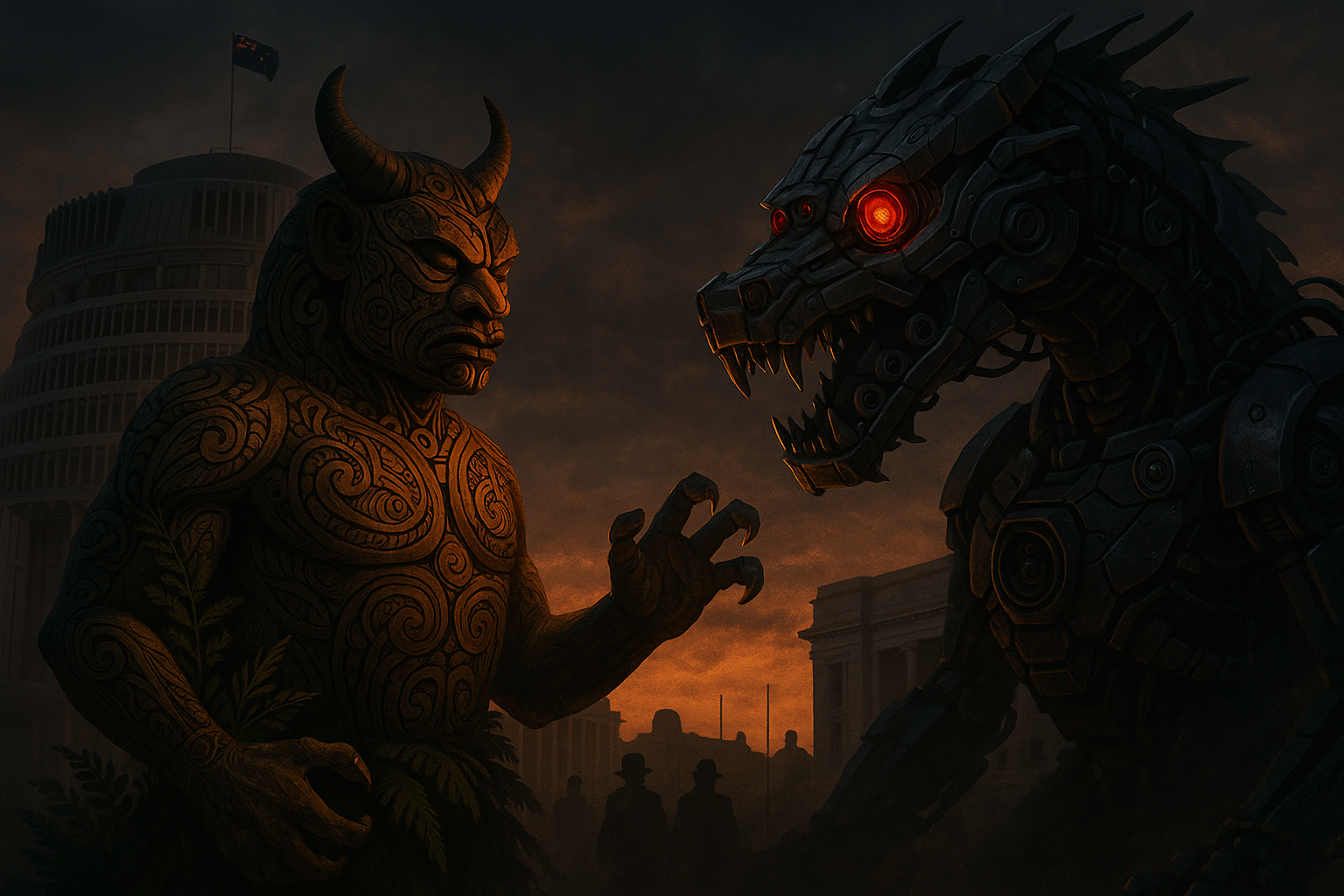
The taniwha awakens to confront digital surveillance colonialism
The image of the taniwha awakening to confront digital surveillance colonialism represents the spiritual dimension of this struggle - the need for Indigenous guardians to protect not just physical territory, but the informational and cultural sovereignty that defines a people's identity.
The FBI Office Response
The establishment of an FBI office in Wellington specifically to counter Chinese Communist Party threats in the Indo-Pacific represents an acknowledgment by New Zealand's closest intelligence partners that Chinese influence operations have reached critical levels. The fact that New Zealand was the only Five Eyes partner without such an office reveals how complacent our authorities had become about foreign interference.
For Māori, the presence of foreign intelligence agencies on our soil raises complex questions about sovereignty and self-determination. While protection from Chinese authoritarianism is welcome, we cannot ignore the historical role of intelligence agencies in suppressing Indigenous rights movements. The challenge is ensuring that protection from one form of colonialism doesn't enable another.
The Pacific Manipulation: China's Island Strategy
Cook Islands Betrayal
The Cook Islands' decision to sign a comprehensive strategic partnership with China without proper consultation with New Zealand represents a direct challenge to the constitutional arrangements that have protected Pacific Island sovereignty since decolonization. China's manipulation of Pacific Island governments through economic inducements and diplomatic pressure represents a modern form of imperial competition that threatens regional stability.
For Māori, this Pacific strategy is particularly concerning because Polynesian peoples share whakapapa connections across the Pacific. Chinese efforts to divide and control Pacific Island nations threaten not just regional security, but the cultural and spiritual connections that link Indigenous peoples across the moana.
The Belt and Road Trap
China's Belt and Road Initiative represents a global strategy of debt-trap diplomacy that turns developing nations into economic vassals through unsustainable infrastructure loans. This model of resource-backed lending creates economic limitations to sovereignty for developing states, forcing countries to mortgage their natural resources and strategic assets to Chinese state-owned enterprises.
The parallels to colonial-era resource extraction are unmistakable. Just as European colonizers used debt and unfair treaties to gain control of Indigenous lands and resources, China uses infrastructure loans and trade agreements to establish economic control over strategic territories and resources.
Hidden Connections and Corrupt Networks
The Post-Politics Gravy Train
Both Clark and Key have built lucrative post-political careers that depend heavily on maintaining good relationships with Chinese authorities. Clark's role with various international organizations requires Chinese cooperation, while Key's business interests benefit from access to Chinese markets and investors. This creates powerful incentives to avoid criticizing Chinese policies or supporting human rights causes that might anger Beijing.
The timing of their Beijing visit is particularly suspicious, coming at a moment when New Zealand's intelligence agencies were intensifying warnings about Chinese interference and FBI was establishing a dedicated office in Wellington to counter Chinese threats. Their attendance at the military parade can be seen as a direct rebuke to these intelligence warnings and a signal to Beijing that they remain reliable allies despite shifting government positions.
The Alumni Network of Shame
Clark and Key are part of a broader network of former Western politicians who have been co-opted by Chinese influence operations. From Tony Blair to David Cameron in Britain, to numerous former Australian politicians, there exists an entire ecosystem of ex-leaders who trade their reputations and democratic credentials for access to Chinese markets and opportunities.
This network operates through a combination of business opportunities, speaking fees, board positions, and "cultural exchange" programs that gradually compromise former leaders and turn them into advocates for Chinese interests. The fact that Clark and Key attended the military parade together suggests coordination and mutual reinforcement of their pro-China positions.
The Timing of Betrayal
The September 2025 military parade was deliberately timed to coincide with escalating tensions between China and the United States under the Trump administration, with Trump himself accusing the assembled dictators of "conspiring against the United States of America." Clark and Key's decision to attend at this moment of maximum geopolitical tension represents a deliberate choice to side with authoritarianism against democracy.
Implications for Māori and Aotearoa
The Sovereignty Question
Clark and Key's Beijing betrayal raises fundamental questions about the relationship between Māori sovereignty and New Zealand's foreign policy. If the Crown continues to compromise national independence through economic dependency and political submission to authoritarian regimes, what does this mean for Treaty obligations and the protection of Māori rights?
The principle of tino rangatiratanga - absolute sovereignty - cannot be realized within a framework of colonial dependency, whether that dependency is to Britain, China, or any other imperial power. Māori liberation requires genuine independence and self-determination, not the hollow sovereignty of a neocolonial client state.
Cultural and Spiritual Pollution
From a Māori worldview, Clark and Key's association with dictators and war criminals represents a form of spiritual pollution that affects not just themselves but the entire nation. Their willingness to legitimize regimes responsible for genocide, cultural suppression, and environmental destruction violates fundamental principles of kaitiakitanga and mana.
The attendance at a military parade celebrating war and violence is particularly offensive to Indigenous values that prioritize peace, harmony, and the protection of life. The fact that this parade featured weapons designed to kill and destroy demonstrates the moral bankruptcy of those who participated.
The Threat to Future Generations
Perhaps most seriously, Clark and Key's Beijing betrayal represents a theft from future generations - both Māori and non-Māori - who will inherit the consequences of their moral cowardice. By legitimizing authoritarian governance and economic dependency, they have made it harder for future leaders to stand up for human rights and democratic values.
The children and mokopuna who grow up in a world where New Zealand politicians dance with dictators will find it normal for democratic leaders to compromise their principles for economic gain. This normalization of moral corruption represents a profound threat to the values and institutions that protect human dignity and freedom.

The Māori Green Lantern Fighting Misinformation And Disinformation From The Far Right
The Reckoning Ahead
Helen Clark and John Key's grotesque performance at China's military parade represents the logical endpoint of three decades of neoliberal sellout politics that has systematically undermined New Zealand's independence and values. Their willingness to legitimize Xi Jinping's authoritarian spectacle alongside Putin, Kim Jong Un, and other dictators exposes the moral bankruptcy of a political class that prioritizes profit over principle and personal enrichment over national sovereignty.
For tangata whenua, this betrayal is particularly painful because it represents a continuation of the colonial pattern that has oppressed Indigenous peoples for generations. Just as our tūpuna faced colonizers who promised partnership while stealing our land, we now face politicians who promise prosperity while selling our sovereignty to the highest bidder.
The path forward requires a fundamental rejection of the neoliberal model that has made our economy hostage to authoritarian regimes. We must rebuild genuine independence based on Indigenous values of kaitiakitanga, manaakitanga, and tino rangatiratanga. This means diversifying our trade relationships, strengthening our democratic institutions, and never again allowing former leaders to legitimize dictatorships in our name.
The taniwha is awakening. The time for accommodation and compromise with colonial forces - whether old or new - is ending. Our ancestors gave their lives for sovereignty and freedom. We dishonor their sacrifice when we allow political prostitutes like Clark and Key to trade our mana for Beijing's blood money.
The choice before us is clear: we can continue down the path of neocolonial dependency that leads to moral corruption and spiritual death, or we can choose the path of Indigenous resistance and genuine liberation. There is no middle ground between freedom and slavery, between sovereignty and submission.
Ko te mutunga tēnei o ngā kōrero. The truth has been spoken.
Readers who find value in The Māori Green Lantern's mahi and wish to support this kaupapa of exposing colonial lies and fighting for Indigenous truth are invited to contribute a koha to: HTDM: 03-1546-0415173-000. Given these tough economic times for whānau, please only contribute if you have capacity and wish to do so. Every contribution helps maintain this platform for Indigenous resistance against neoliberal colonialism.
Noho ora mai, whakatōhea.
Ivor Jones
The Māori Green Lantern
Kaitiaki for Truth and Indigenous Sovereignty