"The Settlement That Settled Nothing" - 6 November 2025
Ngāti Paoa’s $23.5 Million and the Global Architecture of Indigenous Dispossession

Kia ora e te whānau,

The Crown just handed Ngāti Paoa a cheque for $23.5 million for stealing their entire whenua, shelling their unfortified villages, and leaving them “virtually landless.” That’s not reparation—that’s insult dressed as justice. While 500 iwi members gathered at Parliament to witness this moment, they celebrated not victory but survival. Because here’s what the Crown won’t tell you: Ngāti Paoa’s stolen lands are conservatively worth $833 million in today’s dollars, meaning this settlement represents 2.8 cents per dollar stolen.[1][2]
But this isn’t just about one iwi’s struggle for justice. This is about a coordinated international assault on Indigenous rights, connecting the dots from Russell Vought’s Project 2025 in Washington to David Seymour’s Regulatory Standards Bill in Wellington. The same neoliberal playbook that gutted 260,000 US federal jobs through DOGE is now being weaponized against Te Tiriti o Waitangi. And the money trail leads straight back to the same corporate elites who’ve been waging war on collective rights for forty years.[3][4][5]
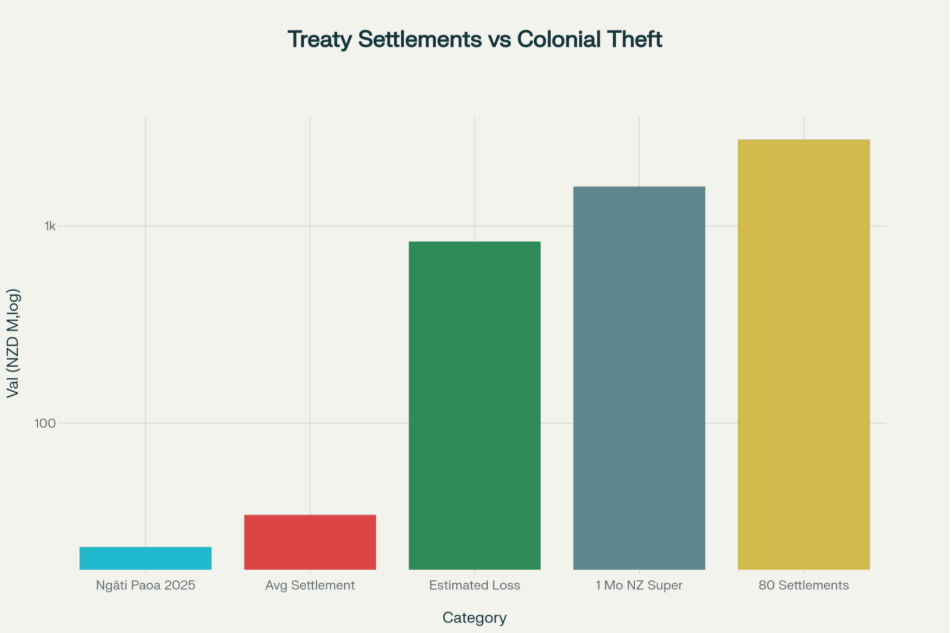
The stark disparity between Treaty settlements and actual losses reveals the systematic devaluation of Māori land and rights.
Historical Whakapapa: The 1863 Invasion and the Machinery of Raupatu
To understand why Ngāti Paoa’s settlement is an obscenity, you need to understand what was stolen. On 12 July 1863, Crown forces crossed the Mangatāwhiri stream and invaded the Waikato, attacking Ngāti Paoa and allied iwi. The HMS Miranda shelled the unfortified village of Pūkorokoro in October 1863, killing iwi members—a war crime by any definition. This wasn’t spontaneous violence. The Crown had drawn up confiscation plans before the invasion, recruiting military settlers with promises of stolen Māori land as payment.[6][2][7]
The New Zealand Settlements Act 1863 provided the legislative framework for the largest land theft in our history. Passed on the eve of the Waikato invasion, it declared that Māori living north of the Waikato who didn’t swear allegiance to Queen Victoria would “forfeit the right to the possession of their lands guaranteed to them by the Treaty of Waitangi.” Let that sink in: the Crown violated the Treaty by threatening to confiscate land guaranteed by that same Treaty, using Māori refusal to submit as justification.[8]
Over 3.2 million acres were confiscated across Waikato, Taranaki, Tauranga, Bay of Plenty, and the East Coast. Ngāti Paoa lost interests in the 51,000-acre East Wairoa confiscation block and the Central Waikato district including their sacred maunga Kohukohunui and Rataroa. No land was returned to Ngāti Paoa in East Wairoa. None.[2][9]
Then came the Native Land Court, designed to individualize collective title and make Māori land “susceptible to alienation.” What raupatu didn’t steal directly, the courts and Crown purchasing seized through legal manipulation. The Crown acknowledged that its actions left Ngāti Paoa “virtually landless” and “undermined the iwi’s economic, social and cultural development.”[1][2]
The Mathematics of Colonial Theft: Quantifying the Inadequacy
Numbers don’t lie, but governments do. The Crown admitted in the Waikato-Tainui deed that 1.2 million confiscated acres were worth a minimum $12 billion in 1995 dollars—$20 billion in 2019. Yet Waikato-Tainui received $170 million in their 1995 settlement, representing less than 1.5% of the admitted minimum value. Even with relativity clause payments bringing the total to $289.3 million by 2018, that’s still only 1.45% of what was stolen.[10][11][12]
Using that same conservative valuation, if Ngāti Paoa lost just 50,000 acres—a fraction of their actual rohe spanning Hauraki, the Coromandel Peninsula, Auckland, and the Hauraki Gulf—the value would be approximately $833 million in 2019 dollars. The $23.5 million settlement represents 2.82% of this conservative estimate. In other words, Ngāti Paoa received roughly 35 cents for every dollar stolen.
Context matters. Total Treaty settlements across 80 iwi have reached $2.738 billion. The average settlement is $34.2 million. Ngāti Paoa’s $23.5 million sits 31% below average—below average for inadequate compensation. The entire value of all Treaty settlements would cover New Zealand’s annual superannuation spending for just 1.7 months. The Crown spends more on retirement in two months than it has paid for 150 years of colonial theft, warfare, and cultural genocide.[13][14]
This isn’t generosity. This is a calculated strategy to lock iwi into “full and final” settlements at cents on the dollar, then claim the matter is closed forever.
The Fiscal Envelope: Blueprint for Systemic Underpayment
In 1995, the Crown proposed a “fiscal envelope” capping all Treaty settlements at $1 billion total. Māori overwhelmingly rejected this at hui around the country, calling it inadequate consultation and denial of natural justice. The proposal was dropped politically but implemented practically.[15][16]
While actual settlements have reached $2.738 billion—174% over the original cap—the Crown has maintained the underlying logic: predetermine a maximum pool regardless of actual losses, then force iwi to accept a fraction of true value or get nothing. As former Treaty Negotiations Minister Doug Graham admitted, the “discipline” of the fiscal envelope was “holding your benchmarks and holding firm”—a euphemism for systematically underpaying every claim.[14][17]
This created the “relativity clauses” for Waikato-Tainui and Ngāi Tahu, ensuring their settlements remained at 17% and 16.1% respectively of total settlements. But even this mechanism keeps payouts tied to the artificial cap rather than actual value.[18]
Researchers have estimated Treaty redress represents “as little as one percent of the true value” of what was stolen. The fiscal envelope’s legacy isn’t just inadequate compensation—it’s a systematic architecture ensuring every settlement perpetuates injustice while claiming to resolve it.[10]
Enter David Seymour: The Regulatory Standards Bill as Constitutional Vandalism
While Paul Goldsmith negotiates settlements worth pennies on the dollar, David Seymour is busy ensuring future governments can never correct this injustice. The Regulatory Standards Bill passed its second reading on 3 November 2025, despite the Waitangi Tribunal finding it breaches Te Tiriti principles and recommending an immediate halt.[3][19][20][21]
Here’s what Seymour is doing: The bill establishes “principles of responsible regulation” that future and existing legislation must be assessed against. These principles prioritize individual property rights and require compensation for any regulation that “severely impairs” property—even when protecting public health, the environment, or Indigenous rights. Nowhere does the bill acknowledge Te Tiriti o Waitangi.[22][23]
The bill creates a Regulatory Standards Board—handpicked by Seymour, now appointed by the Governor-General on his recommendation after select committee pushback. This board can review any regulation and publish reports declaring non-compliance with Seymour’s neoliberal principles. While technically non-binding, these reports create political pressure to avoid progressive legislation.[24][25][3]
The Waitangi Tribunal found the Crown “breached the Treaty principles of partnership and active protection by failing to meaningfully consult with Māori” before Cabinet approved the bill. The Tribunal found that enacting the bill without consultation would constitute a further breach. The Crown admitted its policy development “occurred without targeted engagement with Māori”—a violation of partnership obligations.[20][26][21]
Seymour’s response? He dismissed the Tribunal’s concerns, claiming “equality before the law is fundamental to a functioning democracy”—the classic dog-whistle that treats historical injustice and Treaty obligations as “racial discrimination.”[20]
The Neoliberal Whakapapa: From Business Roundtable to Seymour
This bill isn’t new. It originated in a 2001 report by Bryce Wilkinson for the Business Roundtable (now NZ Initiative), titled “Constraining Government Regulation”. ACT has tried to pass versions of this bill three times since 2006, blocked each time. The Business Roundtable, founded by Roger Kerr in 1986, was among the main proponents of New Zealand’s neoliberal economic reforms of the 1980s and 1990s.[27][28]
Recent OIA releases show Wilkinson lobbied the Ministry for Regulation extensively with work from Richard A. Epstein, a fringe American libertarian scholar tied to multiple right-wing think tanks. The ideology is imported wholesale from US libertarian circles that view any regulation protecting collective rights as tyranny.[29]
The bill’s estimated annual cost to government: $50-60 million minimum, potentially up to 15% of policy resources in regulatory-heavy portfolios. MBIE warned the bill could create “business uncertainty, slowing economic growth”. LINZ warned compliance costs could be “significant” and hinder infrastructure projects.[30][31]
Seymour’s response? He blasted officials for “not prioritising New Zealanders’ rights” and said their concerns prove “the need for the Regulatory Standards Bill”. Translation: anyone opposing corporate supremacy is the enemy.[30]
The Money: Who Funds the Anti-Treaty Agenda?
Follow the money. In 2022, ACT received $2,081,331.19 in donations. Billionaire Graeme Hart and his Rank Group contributed $304,000. Between 2021-2023, Hart donated $700,000 total to National, ACT, and NZ First. Dame Jenny Gibbs donated $100,000 to ACT in 2022, continuing over $700,000 in donations to ACT over the past decade.[32][33][34]
Since 2021, National received $8.2 million in donations, ACT $4.2 million—bringing their total to over $12 million. The property industry alone contributed $2.5 million across parties, with over half going to the right-wing coalition.[35][36]
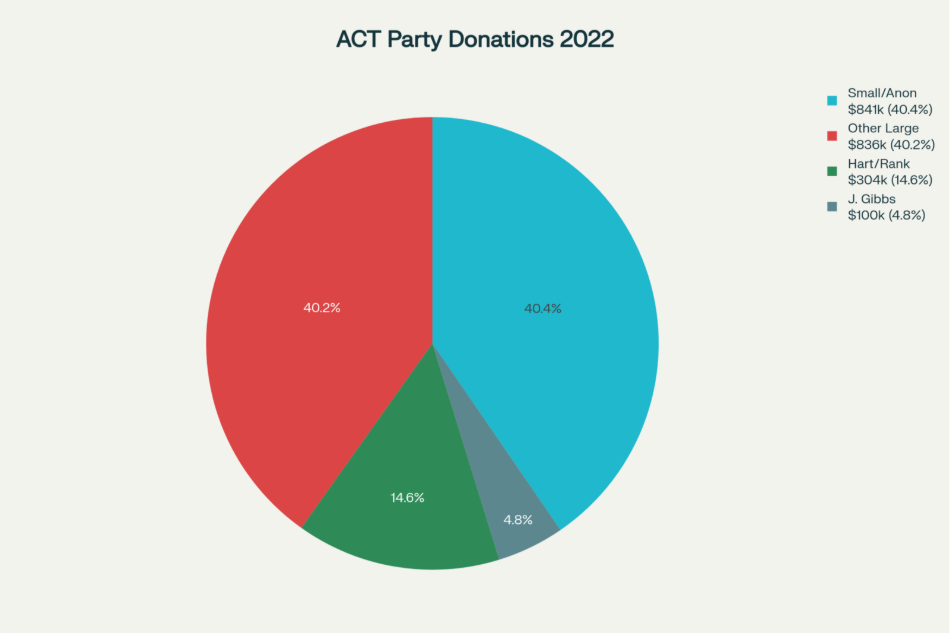
Billionaires and business elites bankroll the legislative assault on Te Tiriti o Waitangi.
This isn’t grassroots politics—it’s a billionaire-funded assault on collective rights. As researcher Max Rashbrooke noted, “the days where companies donated to both sides of the political spectrum had ‘gone the way of the dodo’”. Business knows which parties will deregulate, privatize, and dismantle Indigenous protections.[32]
The International Connection: Project 2025 and the Heritage Foundation
Now here’s where it gets truly sinister. Russell Vought is the Director of the Office of Management and Budget in Trump’s administration and a key architect of Project 2025. Vought’s 922-page blueprint, “Mandate for Leadership,” was published by the Heritage Foundation in April 2023. Of Project 2025’s 313 policy objectives, 101 have been implemented and 64 are in progress as of May 2025.[4][37][38]
Vought founded the Center for Renewing America in 2021, focused on “combating critical race theory” and promoting an “America First” agenda. As OMB Director, Vought has transformed the office into a key player in Trump’s agenda to reduce government spending and workforce. He worked with Elon Musk’s DOGE to implement extensive cuts across federal agencies.[37][38][39]
DOGE cut 260,000 federal civilian jobs—12% of the 2.3 million-strong workforce—through threats, buyouts, and early retirement offers. Vought and Musk developed a partnership where DOGE identified “excessive spending” using data, while OMB validated findings and provided recommendations.[38][5]
Sound familiar? Seymour is running the exact same playbook in Aotearoa. He’s appointed as Minister for Regulation, establishing a Regulatory Standards Board to scrutinize all legislation—paralleling Vought’s use of OMB to control federal agencies. Both claim to fight “waste” and “bad regulation” while systematically dismantling protections for marginalized communities.[3]
The Heritage Foundation’s Global Network
The Heritage Foundation isn’t just influencing US policy—it’s building a global network. Heritage Foundation president Kevin Roberts traveled to France in May 2025 to forge “civilizational allies in Europe”. Roberts has cited Hungary’s Viktor Orbán as inspiration, noting Orbán “revived national identity in Hungary” in opposition to the EU.[40][41]
In March 2025, Heritage convened hardline conservative groups to discuss proposals for “dismantling” the EU. Participants included Hungary’s Mathias Corvinus Collegium (MCC)—essentially a government front for Orbán—and Poland’s Ordo Iuris Institute, tied to the far-right Law and Justice party. Both organizations have documented connections to Russian influence networks.[42][43]
Project 2025’s foreign policy agenda includes reducing US participation in international organizations like WHO and UN agencies, while cutting foreign aid. It proposes making “protecting life” a core objective of foreign assistance while eliminating “gender equity”—code for attacking reproductive rights and LGBTQ+ protections globally.[44]
Heritage has platformed Orbán at its events and announced a partnership with the pro-Orbán Danube Institute. This isn’t coincidence—it’s a coordinated strategy to build an international authoritarian network under the guise of “conservatism.”[44]
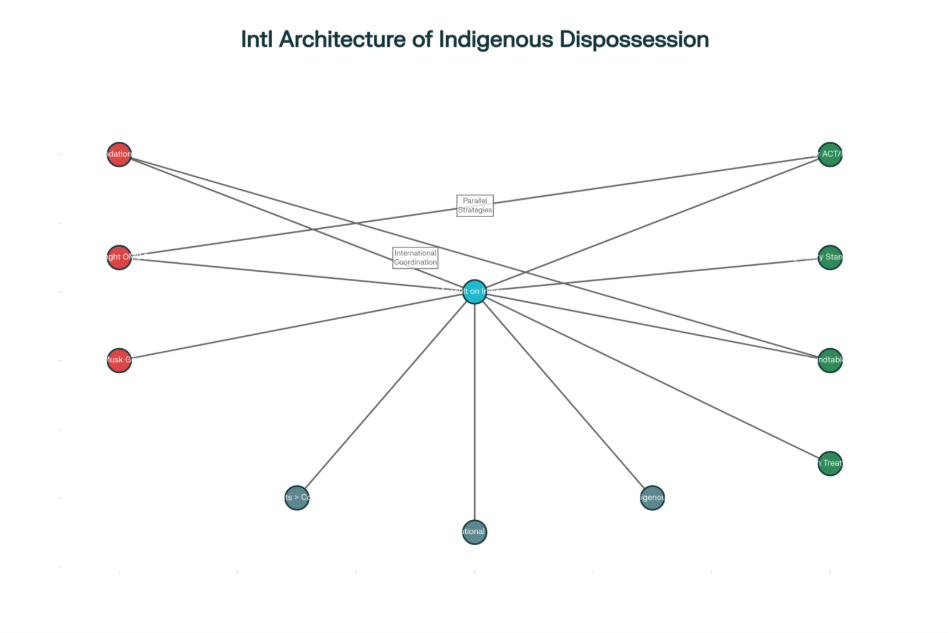
The coordinated international network driving attacks on Indigenous rights from Washington to Wellington.
The Parallel: Seymour as Aotearoa’s Vought
The parallels are chilling:
Constitutional Capture: Vought uses OMB to control all federal agency spending and regulations. Seymour uses the Regulatory Standards Bill to control how Parliament makes laws.[22][4]
Attacking Indigenous Rights: Project 2025 advocates abolishing the Gender Policy Council and promoting “religious freedom” abroad—targeting policies protecting Indigenous peoples and minorities. Seymour’s bill excludes Te Tiriti entirely and prioritizes property rights over collective Indigenous rights.[45][23]
Bypassing Democratic Oversight: Vought’s OMB operates with sweeping powers, often overruling Cabinet secretaries. Seymour’s Regulatory Standards Board, appointed on his recommendation, can investigate any legislation and issue public reports pressuring compliance.[38][25]
Ideological Uniformity: Both claim to fight for “freedom” and “efficiency” while systematically entrenching corporate power and dismantling collective protections.[46]
When UN Special Rapporteur Albert K. Barume criticized the Regulatory Standards Bill for excluding tikanga Māori, Seymour fired back, calling the intervention “presumptive, condescending, and wholly misplaced”. Paul Goldsmith was consulted before Seymour sent his response, showing coordination between the anti-Treaty agenda across portfolios.[47][48]
Tikanga Violations: The Assault on Māori Values
Every aspect of this coordinated assault violates core tikanga:
Whanaungatanga (relationships): The Crown’s failure to genuinely engage with Ngāti Paoa before, during, and after settlement perpetuates broken relationships. The Regulatory Standards Bill was developed without targeted Māori consultation, violating partnership.[1][21]
Manaakitanga (care for others): Settling for 2.8% of stolen land value while claiming “no settlement can fully compensate” isn’t care—it’s contempt. The Pare Hauraki Collective Redress Bill hasn’t had a first reading despite being introduced in December 2022, showing Crown indifference.[1]
Kaitiakitanga (guardianship): The Regulatory Standards Bill makes environmental protections vulnerable to corporate legal challenges by requiring compensation for property “impairment”, undermining Māori guardianship of whenua and taiao.[24]
Kotahitanga (unity): The fiscal envelope and settlement process pit iwi against each other, creating competition for inadequate resources rather than solidarity for justice.[17]
Rangatiratanga (sovereignty): The Regulatory Standards Bill explicitly prioritizes individual property rights over collective tino rangatiratanga. The Waitangi Tribunal found Māori would be “particularly prejudiced by the extinguishment of tino rangatiratanga in a legal sense”.[23][49]
Aroha (compassion): There is no aroha in paying $23.5 million for hundreds of thousands of acres stolen, villages shelled, and generations dispossessed.[1]
The Hidden Connections: Five Revelations
1. The Business Roundtable-to-ACT Pipeline: The same Bryce Wilkinson who wrote the 2001 Regulatory Responsibility Bill for the Business Roundtable has been lobbying Seymour’s Ministry for Regulation. The Business Roundtable merged into NZ Initiative in 2012, but the ideology and personnel connections remain. This isn’t organic policy development—it’s a forty-year project to constitutionalize neoliberalism.[28][29]
2. Treaty Negotiations Minister Backing Anti-Treaty Legislation: Paul Goldsmith, who apologizes to Ngāti Paoa for Treaty breaches while negotiating their settlement, simultaneously approved Seymour’s UN letter attacking Indigenous rights protections. He’s leading a review of Treaty principles in legislation while backing a bill that excludes Te Tiriti entirely. The hypocrisy is the point—apologize for past breaches while enabling future ones.[48][50]
3. International Think Tank Coordination: The Heritage Foundation has established partnerships with European far-right organizations and is now coordinating transatlantic conservative strategy. While direct Heritage-NZ Initiative ties aren’t documented in available sources, both organizations share membership in the Atlas Network of libertarian think tanks promoting identical neoliberal policies globally.[40][46][51]
4. The Settlement Delivery Crisis: An Auditor-General report found public organizations failing to meet Treaty settlement commitments, with compensation for failures potentially exceeding original redress values. About 150 organizations hold 12,000 individual commitments under 80 settlements, and agencies are “struggling to meet their settlement commitments”. The Crown not only underpays—it fails to deliver even inadequate settlements.[52][53][14]
5. The Coalition Agreement Lock-In: National’s coalition agreement with ACT requires supporting the Regulatory Standards Bill all the way through Parliament—unlike the Treaty Principles Bill which only required a first reading. This means National is locked into passing legislation the Waitangi Tribunal found breaches Te Tiriti, revealing the coalition’s true priorities.[22][21]
The Implications: What’s At Stake
The Ngāti Paoa settlement isn’t an ending—it’s a warning. While iwi celebrate partial redress, the Crown is constructing a constitutional architecture ensuring no future government can deliver justice.
Immediate Harm: Ngāti Paoa chair Herearoha Skipper noted “there are other aspects of the Ngāti Pāoa settlement package that will need to be finalised”, including the Pare Hauraki Collective Redress Bill (no first reading since December 2022) and the Marutūāhu Iwi Collective Redress Deed (not yet signed). The iwi expressed confidence these would be resolved “before the next general election”—a deadline that may come and go with Crown inaction.[1]
Systemic Threat: Once the Regulatory Standards Bill passes, any legislation protecting Māori rights, environmental taonga, or collective interests will face scrutiny from Seymour’s board. Future governments will face “huge pressure” to avoid progressive reforms or pay corporations for “impaired property rights”.[24][25]
International Precedent: If Seymour succeeds in constitutionalizing neoliberalism in Aotearoa, it provides a model for the global far-right. The Heritage Foundation is already promoting similar constitutional attacks in Europe. The assault on Te Tiriti is connected to a worldwide campaign against Indigenous rights, collective protections, and democratic governance.[40][43]
Kia Kaha: The Path Forward
Around 18,000 people registered support for the Waitangi Tribunal claim against the Regulatory Standards Bill. Over 23,000 submissions opposed the bill. This resistance is Aotearoa pushing back.[20][54]
Expose the Networks: Share this analysis. Connect the dots between Heritage Foundation, Project 2025, Vought, DOGE, Seymour, the Regulatory Standards Bill, and settler colonial violence. The international far-right counts on people not seeing the coordinated strategy.[44]
Demand Real Redress: Ngāti Paoa deserves full compensation, not 2.8% of stolen value. Every iwi in settlement negotiations must reject “full and final” settlements that perpetuate theft. The Crown admitted Waikato land was worth $20 billion—so pay it.[1][11]
Stop the Regulatory Standards Bill: The Tribunal found it breaches Te Tiriti. 18,000 people oppose it. National and NZ First must break their coalition agreement and vote it down before third reading.[54][21]
Follow the Money: Demand transparency on who funds ACT, National, and NZ First. Expose billionaire donors like Graeme Hart who bankroll anti-Treaty legislation. Boycott their businesses. Make funding white supremacy expensive.[32][33]
International Solidarity: The Heritage Foundation’s global network must be exposed and opposed everywhere it operates. Indigenous peoples, climate activists, labor unions, and democratic movements worldwide face the same coordinated assault. Our resistance must be equally coordinated.[43]
Whakamutunga: The Verdict
The Crown just paid Ngāti Paoa $23.5 million for stealing hundreds of thousands of acres, shelling villages, killing iwi members, and destroying generations of economic and cultural development. That’s not justice—it’s a continuation of theft by other means.
While Goldsmith apologizes for past breaches, Seymour builds the constitutional infrastructure for future ones. The apology is performance; the bill is policy.[1][3]
From Russell Vought’s OMB controlling federal agencies to David Seymour’s Regulatory Standards Board controlling Parliament, the playbook is identical. From the Heritage Foundation’s Project 2025 to ACT’s neoliberal constitution, the ideology is shared. From DOGE cutting 260,000 federal jobs to Seymour’s assault on Te Tiriti, the targets are consistent: collective rights, Indigenous sovereignty, democratic accountability, environmental protection.[3][4][37][5][27]
This is the global architecture of Indigenous dispossession, and it’s operating in Aotearoa right now.
Ka whawhai tonu mātou. We will fight on.
Nāku noa, nā

Ivor Jones
The Māori Green Lantern
Tēnā koutou e te whānau. If this mahi speaks to you and you have the capacity to support this work, koha can be sent to HTDM: 03-1546-0415173-000. Only give if you’re able—solidarity matters more than money. This is a labor of love for our people and our whenua.
- Crown-apologises-to-Auckland-Hauraki-iwi-Ngati-Paoa-for-leaving-them-virtually-landless-_-RNZ-Ne.pdf
- /content/files/assets/Treaty-Settlements/FIND_Treaty_Settlements/Ngati-Paoa/DOS_documents/2021-03-20-n-paoa-deed-of-settlement-summary.pdf
- https://www.rnz.co.nz/news/political/577806/regulatory-standards-bill-passes-second-reading-after-heated-debate-in-parliament
- https://www.propublica.org/article/about-russell-vought-trump-shadow-president
- https://www.rnz.co.nz/news/world/562542/elon-musk-has-left-the-trump-administration-white-house-confirms
- https://en.wikipedia.org/wiki/Invasion_of_the_Waikato
- https://e-tangata.co.nz/history/a-dark-tale-of-dispossession-and-greed/
- https://nzhistory.govt.nz/land-confiscation-law-passed
- https://www.meetingplace.nz/2019/01/raupatu-and-remembrance-new-zealand.html
- https://www.nzherald.co.nz/kahu/iwi-power-24b-from-30-years-of-treaty-of-waitangi-settlements/A32RSAFV7TNLI2OP6J73U4LAJ4/
- https://teara.govt.nz/en/te-tai/waikato-tainui-raupatu-1
- https://tetai.nz/en/waikato-tainui-raupatu-1
- https://tetai.nz/en/about-treaty-settlements
- /content/files/2025/treaty-settlements/docs/treaty-settlements.pdf
- https://teara.govt.nz/en/waitangi-tribunal-te-ropu-whakamana/page-3
- https://www.rnz.co.nz/collections/treatyofwaitangi/events1990s
- https://www.nzherald.co.nz/nz/treaty-settlements-teeter-at-make-or-break-stage/AANRO6U7FG4E5S6APWITBGC73Y/
- https://en.wikipedia.org/wiki/Treaty_of_Waitangi_claims_and_settlements
- https://www.beehive.govt.nz/node/122107
- https://www.rnz.co.nz/news/political/561265/waitangi-tribunal-recommends-immediate-halt-regulatory-standards-bill-for-meaningful-consultation-with-maori
- https://www.waitangitribunal.govt.nz/en/news/tribunal-releases-report-on
- https://www.rnz.co.nz/news/political/563636/the-regulatory-standards-bill-what-is-it-what-does-it-propose-and-what-s-next
- https://www.equaljusticeproject.co.nz/articles/a-new-name-the-same-agenda-the-dangers-of-the-regulatory-standards-bill
- https://e-tangata.co.nz/uncategorised/how-the-regulatory-standards-bill-gives-companies-more-rights-than-the-public/
- https://www.greenpeace.org/aotearoa/story/the-regulatory-standards-bill-david-seymour-power-grab/
- https://mccawlewis.co.nz/publications/introduction-of-the-regulatory-standards-bill/
- https://www.rnz.co.nz/news/on-the-inside/505478/act-s-attempt-at-regulatory-reform-in-nz-has-failed-3-times-already-what-s-different-now
- https://en.wikipedia.org/wiki/New_Zealand_Initiative
- https://thespinoff.co.nz/politics/18-09-2025/nz-first-is-digging-its-own-grave-by-backing-the-regulatory-standards-bill
- https://www.rnz.co.nz/news/national/567191/david-seymour-lashes-officials-after-linz-becomes-latest-agency-raising-concerns-about-his-regulatory-standards-bill
- https://www.rnz.co.nz/news/political/567120/ministry-feared-costs-of-60m-a-year-to-review-laws-under-regulatory-standards-bill
- https://www.rnz.co.nz/news/in-depth/523415/why-new-zealand-political-donations-have-more-than-tripled
- https://www.rnz.co.nz/news/political/498251/billionaire-graeme-hart-s-700k-in-donations-to-right-wing-parties
- /content/files/assets/Annual-Returns/2022/act-party-annual-return-2022.pdf
- https://www.rnz.co.nz/news/in-depth/496383/national-banks-7-point-5-times-more-in-donations-than-labour
- https://www.rnz.co.nz/news/business/499176/property-industry-tops-political-donations
- https://en.wikipedia.org/wiki/Russell_Vought
- https://theconversation.com/who-is-project-2025-co-author-russ-vought-and-what-is-his-influence-on-trump-255134
- https://www.bbc.com/news/articles/c059ydyqe19o
- https://www.lemonde.fr/en/m-le-mag/article/2025/06/22/the-heritage-foundation-sets-its-sights-on-europe_6742608_117.html
- https://ip-quarterly.com/en/maga-and-regime-change-europe
- https://vsquare.org/heritage-foundation-mcc-ordo-iuris-russia-european-union-european-court-of-justice/
- https://www.desmog.com/2025/03/14/heritage-foundation-project-2025-allies-mcc-ordo-iuris-discuss-dismantling-the-eu-european-union/
- https://kettering.org/the-global-dimensions-of-project-2025-a-foreign-policy-for-authoritarianism/
- https://www.aclu.org/project-2025-explained
- https://www.greenpeace.org/aotearoa/story/placing-the-current-new-zealand-government-into-context/
 Ivor Jones The Māori Green Ltn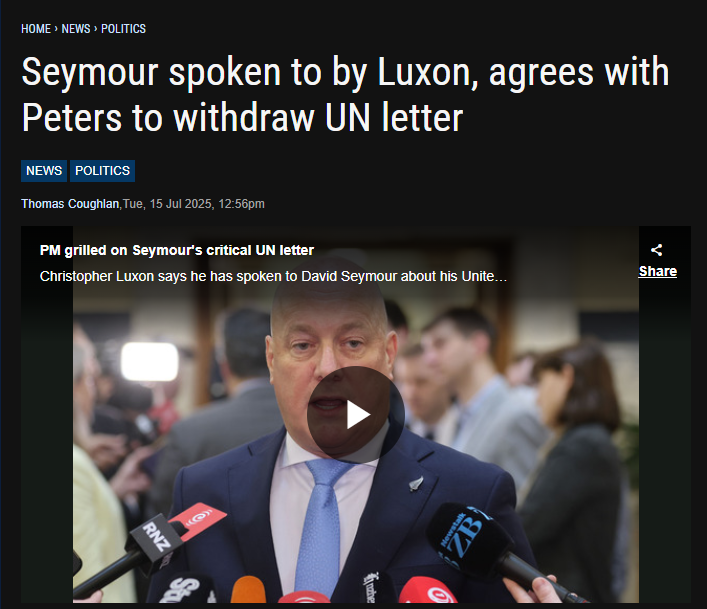
- https://www.rnz.co.nz/news/political/570177/another-cabinet-minister-caught-up-in-united-nations-letter-writing-saga
- https://www.waitangitribunal.govt.nz/en/news/tribunal-releases-chapter-6
- https://www.democracyaction.org.nz/review_of_treaty_principles_in_legislation
- https://www.heritage.org/europe/commentary/new-conservative-trans-atlantic-partnership
- https://www.teaonews.co.nz/2025/05/04/a-rocky-27b-atonement-warning-on-treaty-settlement-commitments/
- https://www.rnz.co.nz/news/political/557767/watchdog-warns-of-reputational-damage-from-failure-to-meet-treaty-settlement-obligations
- https://www.rnz.co.nz/news/political/560950/18-000-register-support-for-tribunal-claim-against-regulatory-standards-bill
- https://apnews.com/article/elon-musk-doge-donald-trump-d40ff2bfe020001d2770660e72f5c9f2
- https://www.heritage.org/china-transparency-project/influence-operations
- https://www.bbc.com/news/articles/c23vkd57471o
- https://www.cbsnews.com/news/trump-promised-cuts-spent-200-billion-more/
- https://www.politico.com/interactives/2025/trump-executive-orders-project-2025/
- https://www.bbc.com/news/articles/cn4j33klz33o
- https://en.wikipedia.org/wiki/Project_2025
- https://doge.gov/savings
- https://www.nzherald.co.nz/kahu/hauraki-pains/AQL22AQEBFR7OWCO4RYZOIS2NI/
- https://www.rnz.co.nz/authors/shannon-haunui-thompson?page=3
- https://teara.govt.nz/en/tamaki-tribes/print
- Crown-apologises-to-Auckland-Hauraki-iwi-Ngati-Paoa-for-leaving-them-virtually-landless-RNZ-News-11-06-2025_08_29_PM.jpg
- https://www.facebook.com/Themaorigreenlantern/posts/25020707940920425/
- https://www.nzherald.co.nz/world/judge-orders-trump-administration-to-pause-us-government-shutdown-layoffs/AY7SAB5ZTRBXPLQE5OJG3KCDFE/
- https://www.nzherald.co.nz/world/the-longest-shutdown-which-lasted-34-days-during-trumps-first-term-cost-about-18-billion/EFIJ5IWLMRHEPDYDEJQ7CNTQ4E/
- https://www.rnz.co.nz/news/national/564236/why-opponents-and-supporters-of-the-regulatory-standards-bill-are-so-far-apart
- https://www.rnz.co.nz/news/thehouse/577915/regulatory-standards-bill-back-in-the-house-after-a-highly-engaged-public-submission-period
- https://www.rnz.co.nz/news/on-the-inside/566580/analysis-where-next-for-regulatory-standards-bill
- https://www.rnz.co.nz/news/political/576052/footnote-in-history-constitutional-experts-shrug-off-regulatory-standards-bill-tweaks
- https://www.nzherald.co.nz/nz/politics/regulatory-standards-bill-opponents-lash-david-seymours-legislation-at-select-committee/IP4EPLOHPRDRRJOIQOOZG627XI/
- https://www.nzherald.co.nz/nz/politics/david-seymours-regulatory-standards-bill-reported-back-by-select-committee-opposition-criticises-egregious-failure/C5AWHOTNK5BT3NV2VJ7TQ4YCEE/
- https://www.facebook.com/groups/aotearoanzhistory/posts/1357329399422752/
- https://www.facebook.com/Themaorigreenlantern/videos/te-rāhui-pōtiāra-myth-vs-fact-mondaymōrenaon-this-monday-lets-illuminate-the-pat/1394827544771317/
- https://www.port.ac.uk/news-events-and-blogs/blogs/academic-expertise/who-is-project-2025-co-author-russ-vought-and-what-is-his-influence-on-trump
- https://www.politico.com/news/2025/07/03/project-2025-architect-helped-pull-megabill-over-the-line-00439753
- https://www.rnz.co.nz/news/national/577806/regulatory-standards-bill-passes-second-reading-after-heated-debate-in-parliament
- /content/files/project2025/2025_mandateforleadership_full.pdf
- https://thespinoff.co.nz/politics/04-11-2025/the-regulatory-standards-bill-is-back-in-parliament-heres-what-you-need-to-know
- https://www.axios.com/2025/10/02/russ-vought-omb-director-government-shutdown
- https://www.beehive.govt.nz/release/regulatory-standards-bill-passes-first-reading
- https://www.newyorker.com/magazine/2025/10/27/russell-vought-profile-donald-trump
- https://www.teaonews.co.nz/2025/11/05/regulatory-standards-bill-clears-second-reading-amid-fierce-backlash/
- https://www.pbs.org/newshour/show/a-look-at-russell-voughts-influence-and-his-push-to-reshape-the-government
- https://www.rnz.co.nz/news/on-the-inside/542018/elon-musk-s-doge-agency-is-at-the-centre-of-controversy-in-the-us-so-what-is-it
- https://www.nzherald.co.nz/world/elon-musks-doge-sees-mass-resignations-in-protest/T2GWUCILBBFHPIPTZEOCLMB63U/
- https://www.nzherald.co.nz/world/donald-trump-says-elon-musk-will-help-uncover-hundreds-of-billions-in-us-govt-fraud/OHPD2AKPCVCDBCES23RKAT4C5A/
- https://www.rnz.co.nz/international/pacific-news/531536/the-pacific-prepares-for-a-potential-trump-presidency
- https://www.rnz.co.nz/news/world/542731/musk-says-all-us-government-staff-must-justify-their-work-or-lose-jobs
- https://www.nzherald.co.nz/world/elon-musk-demands-us-federal-workers-justify-jobs-amid-spending-cuts/W4XSF6C4LRE7XPV6ZQRDPSOFUY/
- https://www.rnz.co.nz/news/what-you-need-to-know/525019/project-2025-what-is-it-what-is-donald-trump-s-stand-on-it-and-who-created-it
- https://www.rnz.co.nz/news/world/542278/white-house-says-elon-musk-is-not-doge-employee-has-no-authority
- https://www.rnz.co.nz/news/world/558984/trump-s-cabinet-ready-to-take-back-power-with-musk-stepping-back-sources-say
- https://www.rnz.co.nz/international/pacific-news/536187/what-s-in-store-for-pacific-island-nations-under-trump-2-point-0
- https://www.rnz.co.nz/news/world/562023/elon-musk-s-doge-prompts-new-york-leaders-to-take-aim-at-tesla
- https://www.nzherald.co.nz/nz/elon-musk-confirms-exit-from-role-as-special-government-employee/NOKPUCA2IZFMZCVRSJYPJ5LSVQ/
- https://www.nzherald.co.nz/world/maga-movement-increasingly-at-odds-with-establishment-republicans-over-israels-war-in-gaza/FKGD5BXWXRH3TA2NAJU2ZGL2BU/
- https://www.rnz.co.nz/news/world/541317/us-judge-temporarily-blocks-musk-s-doge-from-accessing-payment-systems
- https://www.rnz.co.nz/news/world/563189/what-is-trump-s-big-beautiful-bill-and-why-does-elon-musk-hate-it
- https://www.nzherald.co.nz/world/donald-trump-signs-order-to-eliminate-us-education-department/LN7MHQKUIFFRJLE7SLFOG2YXPE/
- https://www.rnz.co.nz/news/world/542825/fact-check-eight-ways-elon-musk-has-misled-americans-about-government-spending
https://doge.gov
- https://theconversation.com/efficiency-or-empire-how-elon-musks-hostile-takeover-could-end-government-as-we-know-it-249262
- https://www.pbs.org/newshour/politics/elon-musk-leaving-trump-administration-after-efforts-to-slash-federal-budget-through-doge
- https://www.britannica.com/topic/Department-of-Government-Efficiency-United-States
- https://www.reuters.com/sustainability/sustainable-finance-reporting/musk-said-he-was-chainsawing-government-spending-it-was-more-like-trim-2025-05-30/
- https://en.wikipedia.org/wiki/Department_of_Government_Efficiency