“The Smoking Gun: How Political Elites Plan to Privatize Your Water for Billions” - 27 October 2025
How Three Political Elites Plan to Steal $15.7 Billion from Aotearoa by Privatizing Sacred Māori Water Through Fast-Track Legislation and Offshore Investor Networks
Kia ora e te whānau,
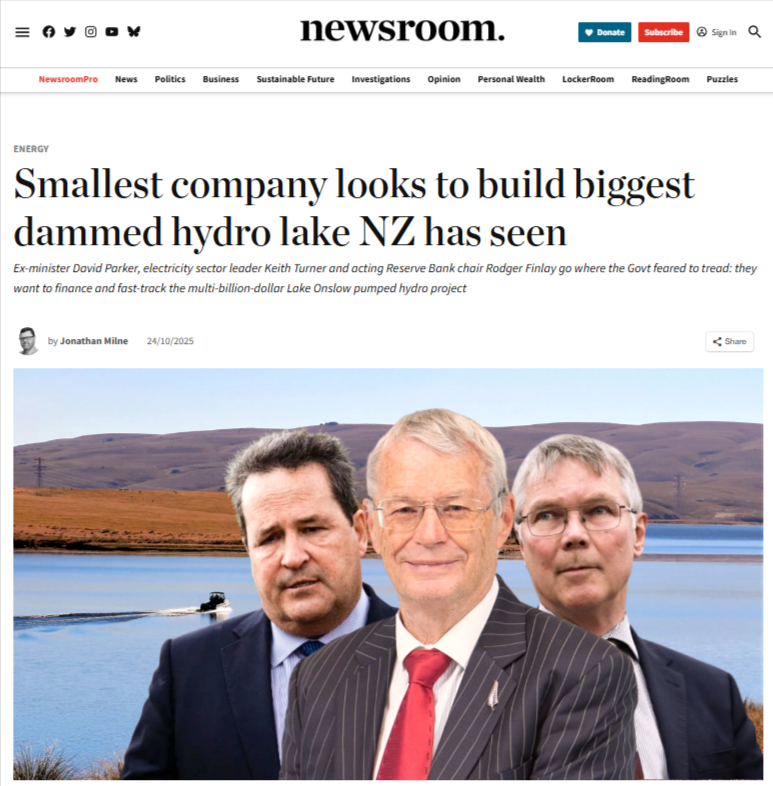
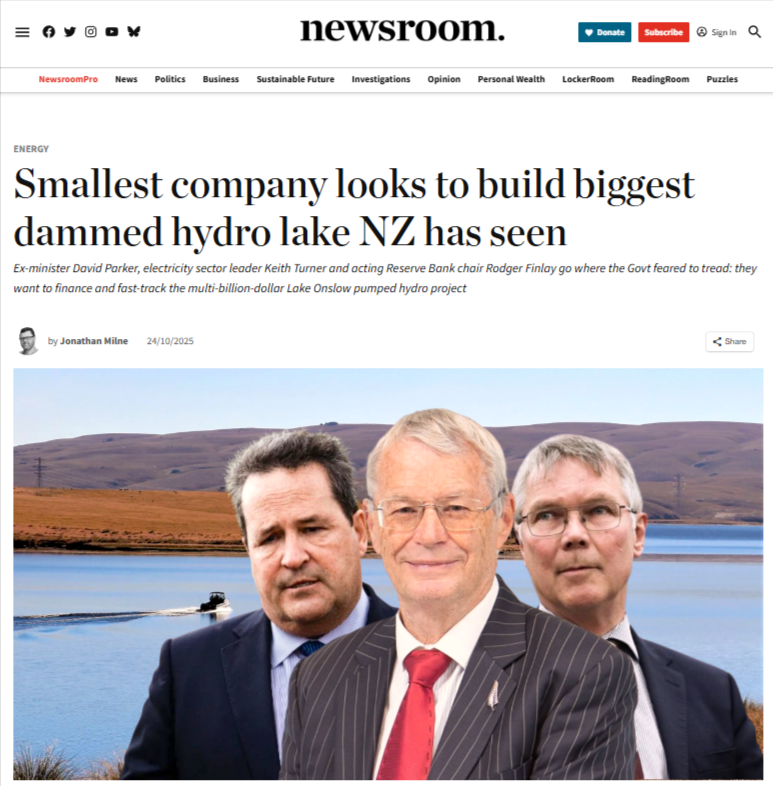
Three powerful men—former Labour minister David Parker, ex-Transpower chair Keith Turner, and acting Reserve Bank chair Rodger Finlay—want to build New Zealand’s largest infrastructure project through fast-track legislation that bypasses environmental protections and Māori consultation (Milne, 2025). The Lake Onslow pumped hydro scheme would cost $15.7 billion (MBIE, 2023), flood ancestral Māori lands, and hand control of public water resources to private investors. Their company, Pumped Hydro Holdings Ltd, currently has virtually no capital—one shareholder is a 20-something freelance journalist teaching English in China who received 4,956 shares for “contract writing” (Milne, 2025). Yet these men claim they’ll attract billions in private capital to build what they call “the largest pumped-storage scheme in the world” with 5 terawatt hours capacity (Milne, 2025).
This isn’t visionary infrastructure development. This is neoliberal asset-stripping disguised as energy policy—and it perfectly demonstrates how white supremacy, privatization ideology, and the Fast-track Approvals Act 2024 combine to threaten Māori sovereignty, environmental protection, and economic justice.
Background: The Whakapapa of Privatization and Māori Harm
New Zealand’s electricity sector was systematically restructured under neoliberal ideology starting in 1986, when the State-Owned Enterprises Act converted public utilities into profit-oriented businesses (Bertram, 2015). The 1986 Commerce Act then stripped common-law consumer protections and transferred regulatory power from independent bodies to politicians (Bertram, 2015). Residential electricity prices have doubled under these neoliberal reforms, rising 38% since the late 1990s, while the “gentailer” oligopoly—Genesis, Meridian, Mercury and Contact—posted combined profits exceeding $2.7 billion in 2024 (Consumer NZ, 2025).
The privatization of electricity infrastructure transferred $11 billion in asset value from the public to private shareholders through revaluations alone between 2000-2022, while total generation capacity increased only 15% (Consumer NZ, 2025). Merchant bankers Michael Fay and David Richwhite made an estimated $500 million from 1980s-90s asset sales, representing approximately $8 billion in losses to the nation (NZ Herald, 2024). This is the historical pattern Parker, Turner and Finlay now seek to replicate.
For Māori, this history carries specific trauma. Te Rūnanga o Ngāi Tahu settlement explicitly recognizes sole rangatiratanga over their takiwā covering most of the South Island (RNZ, 2024). The Lake Onslow site—known locally as “Dismal Swamp”—was historically a wetland used for seasonal mahika kai practices by Kāi Tahu, providing abundant waterfowl including pūtakitaki, pārera, kukupako, pāteke, whio, and totokipio (MBIE, 2021). Colonial modification transformed this wāhi mahika kai into an artificial reservoir, degrading its mauri and severing mana whenua connections (MBIE, 2021). Now private investors seek to further commodify and control these waters for profit.
The Issue: Deconstructing the Privatization Scheme
The consortium’s pitch reveals multiple layers of deception and ideological manipulation:
Fallacy 1: The Appeal to Authority – Parker, Turner and Finlay present their impressive CVs as evidence the scheme will succeed. Parker served as Attorney General, Environment Minister, and championed the Emissions Trading Scheme (RNZ, 2025). Turner chaired Transpower until May 2025 and served as Meridian CEO (NZ Herald, 2024). Finlay chairs multiple boards including Mundane Asset Management and sits on the Reserve Bank board (MarketScreener, 2012). Yet credentials don’t create capital—and their holding company structure reveals they’re middlemen seeking to profit from arranging the deal, not funding it.
Fallacy 2: The False Dilemma – Turner claims “the country has got a serious dry year or dry sequence problem” requiring Lake Onslow, presenting it as the only solution (Milne, 2025). This ignores alternatives including distributed solar with battery storage, which Dr Earl Bardsley’s own calculations show could provide equivalent storage for similar cost (Milne, 2025). The false choice obscures who benefits: private investors collecting rents on public water resources.
Fallacy 3: The Sunk Cost Manipulation – The consortium emphasizes that Labour spent $30 million investigating Lake Onslow (Otago Daily Times, 2025), implying that investment shouldn’t be “wasted.” This manipulates taxpayers into supporting private profit-taking to justify past public expenditure.
Dog Whistle: “Private Sector Efficiency” – Energy Minister Simon Watts praised “private sector entities looking to invest and grow our electricity supply on a commercial basis” (Milne, 2025). This neoliberal rhetoric implies government is inherently inefficient—yet the $15.7 billion cost estimate came from public sector analysis, and private “efficiency” historically means extracting maximum profit from captive consumers (Bertram, 2015).
Omitted Context: The consortium letter to landowners promises to “deal well and generously” and offer shareholdings (Otago Daily Times, 2025)—but omits that private pumped hydro operators worldwide charge market rates that maximize returns to investors, not minimize costs to consumers.
Analysis: Follow the Money, Expose the Networks
The Financial Structure
Pumped Hydro Holdings Ltd’s shareholders are: David Parker (23%), Keith Turner (23%), John Hardie (23%), Rodger Finlay through RGH Holdings Ltd (23%), Ken Smales (smaller percentage), and Oscar Francis of Dunedin (2%) (Interest.co.nz, 2025). The company was recently registered with virtually no startup capital (Milne, 2025)—proving this is a vehicle for attracting offshore investment, not deploying domestic capital.
Turner claims “enormous amount of money floating around the world looking to invest in renewable projects” from “sovereign funds and ethical investors” (Milne, 2025). Translation: foreign capital will own New Zealand’s largest energy storage asset, extracting returns for decades. The consortium directors will profit as intermediaries arranging the deal—the classic merchant banker model that enriched Fay and Richwhite in the 1980s-90s.
The Personnel Connections
David Parker resigned as Revenue Minister in 2023 after Labour ruled out his wealth tax proposal (RNZ, 2025), then left Parliament in May 2025. His Lake Onslow involvement began immediately after—suggesting this “private sector” venture was planned while still in government. Parker championed the Emissions Trading Scheme, which economist Geoff Bertram argues enables financial speculation rather than emissions reduction (Bertram, 2015). His environmental credentials mask neoliberal ideology that commodifies nature.
Keith Turner chaired Transpower—the grid operator—until May 2025, overlapping with Pumped Hydro Holdings formation (Transpower, 2024). As Transpower chair, Turner oversaw a system that issued “customer advice notices” three years running, indicating inadequate supply margins (Milne, 2025). Now he profits from proposing a private solution to the supply problem his own institution failed to address through public investment. Turner also served as Meridian CEO and founded electricity market company M-Co (Energy Awards NZ, 2015)—he’s an architect of the neoliberal market structure that doubled electricity prices.
Rodger Finlay is acting Reserve Bank chair while simultaneously holding a 23% stake in a company seeking billions in financing (MarketScreener, 2012). The Reserve Bank stated Finlay’s investment “do not regard his interest as representing a potential or actual conflict of interest” (Milne, 2025)—a breathtaking dismissal of obvious conflicts. Finlay chaired NZ Oil & Gas (now Echelon Resources) and Crown Regional Holdings (Crown Regional Holdings, 2022), positioning him to facilitate sovereign wealth fund investment—likely including from fossil fuel-rich nations.
John Hardie is a Christchurch barrister and mediator with environmental law expertise (John Hardie, 2020). He represented private interests opposing Dunedin developments on environmental grounds (Dunedin Commissioners, 2013)—now he represents private interests seeking to fast-track the nation’s largest environmental modification. His role demonstrates how “environmental” credentials get weaponized for neoliberal projects.
The Ideological Networks
This consortium embodies the neoliberal “revolving door” between government, state enterprises, and private capital. Turner moved from government (NZED/ECNZ) to Transpower to Meridian to private infrastructure investment. Parker moved from government ministries championing market mechanisms to private infrastructure promotion. This pattern replicates worldwide: public servants who implement privatization later profit from advising private buyers (Kelsey, 2021).
The rhetoric mirrors Atlas Network think tank talking points: government “chilling effect” on investment, private sector “efficiency,” market solutions to climate change. Energy Minister Watts parroted this perfectly: “It was government intervention in the market that had a chilling effect on the pipeline of renewable electricity” (Milne, 2025). This inverts reality—gentailer underinvestment caused supply shortages, not government planning.
The Fast-Track Mechanism
The consortium explicitly plans to use Fast-track Approvals Act 2024 (Milne, 2025). This legislation allows three ministers—Chris Bishop, Shane Jones, Simeon Brown—to bypass Resource Management Act protections, Conservation Act safeguards, and public consultation (RNZ, 2024). Environmental groups including Greenpeace and Forest & Bird condemned it as “anti-democratic” with “no semblance of environmental protection” (Wikipedia, 2024).
Critically, the Act weakened iwi consultation requirements. Original provisions required iwi representatives on all expert panels; final legislation requires them only when Treaty settlements are affected (Wikipedia, 2024). Te Rūnanga o Ngāi Tahu opposed the bill, demanding amendments recognizing their rangatiratanga over South Island territory (RNZ, 2024). Environmental consultant Tina Porou warned the Act has “grand repercussions for hapū and iwi customary rights and Te Tiriti o Waitangi” (1News, 2024).
Who Profits, Who Pays
If Lake Onslow proceeds, offshore investors will own the asset, consortium directors will collect arrangement fees and ongoing board remuneration, landowners may receive token shareholdings—while electricity consumers pay inflated prices for storage services.
Pumped hydro operates by buying cheap power to pump water uphill, then selling expensive power when releasing water through turbines (Milne, 2025). Private operators maximize profit by timing purchases and sales—exactly what gentailers currently do, creating the price volatility that harms consumers and manufacturers. Contact, Mercury, Meridian and Genesis posted $1.08 billion combined profit in 2024 while manufacturers closed due to unaffordable electricity (Stewart Group, 2025).
Turner admitted Lake Onslow would operate by making “power purchase agreements” with wind and solar developers, guaranteeing to buy their electricity (Milne, 2025). This creates a private monopsony controlling access to market for renewable generators—entrenching private power over public electricity system.
Tikanga Violations
Whanaungatanga (relationships) – The consortium approached landowners confidentially through Ken Smales, avoiding public engagement with affected communities including Māori (Otago Daily Times, 2025). This secretive approach violates principles of transparent relationship-building.
Manaakitanga (care and respect) – Lake Onslow’s cultural values assessment identified the site’s whakapapa as mahika kai and its degraded mauri from colonial modification (MBIE, 2021). Further flooding for private profit shows contempt for mana whenua guardianship.
Kaitiakitanga (guardianship) – Privatizing water storage transfers kaitiaki responsibilities from public stewards accountable through democracy to private investors accountable to shareholders. Te Rūnanga o Ngāi Tahu explicitly opposed projects on their lands without proper consultation recognizing their rangatiratanga (RNZ, 2024).
Rangatiratanga (sovereignty) – The Fast-track Act enables private interests to override Māori authority. Even though Ngāi Tahu settlement recognizes sole rangatiratanga over their territory, the consortium can bypass meaningful consultation using fast-track provisions (RNZ, 2024).
Hidden Connections Revealed
1. Parker-Turner Government-to-Private Pipeline: Parker championed NZ Battery Project as Environment Minister spending $30 million public money investigating Lake Onslow (MBIE, 2023); Turner as Transpower chair oversaw the supply crisis justifying storage investment; both now profit from private consortium using public-funded feasibility work.
2. Finlay-Reserve Bank-Sovereign Fund Connection: Finlay sits on Reserve Bank board while seeking billions in foreign capital (MarketScreener, 2012), positioning him to facilitate sovereign wealth fund investment potentially including fossil fuel revenues—contradicting renewable energy justifications.
3. Turner-Gentailer-Market Design: Turner founded M-Co electricity market company and served as Meridian CEO (Energy Awards NZ, 2015)—he designed the market structure that enables gentailer profiteering, then profits from proposing private infrastructure to fix the problems that structure created.
4. Coalition Government-Fast Track-Private Infrastructure: National-ACT-NZ First coalition passed Fast-track Act enabling this scheme; Energy Minister Watts explicitly welcomed private Lake Onslow investment (Milne, 2025); coalition donations from business interests seeking fast-track approvals create direct financial incentive for enabling private infrastructure on public lands.
5. Parker-Labour-Neoliberal Continuity: Parker’s move from Labour minister to private infrastructure promoter demonstrates how both major parties share neoliberal ideology despite rhetorical differences—Labour investigated Lake Onslow for public ownership, National enables private ownership, but both accept commodification of water and market-based solutions.
Implications: Quantified Future Harm
If Lake Onslow proceeds under private ownership:
Economic Harm: $15.7 billion construction cost will be recovered through electricity price increases paid by all consumers, while profits flow to offshore investors. Gentailers already extract $2.7 billion annual profits (Consumer NZ, 2025); adding private storage operator increases extraction. Over 360,000 households already struggle with power bills (Consumer NZ, 2025)—privatized storage will worsen energy poverty.
Environmental Harm: Fast-tracking bypasses full environmental assessment. Lake Onslow requires flooding 3 cubic kilometers of water, building a 1.5km dam (second longest hydro dam globally), drilling 24km tunnels, and permanently pumping to offset seepage and evaporation losses (Interest.co.nz, 2023). Round-trip efficiency is under 60%—meaning significant energy loss (Interest.co.nz, 2023).
Māori Rights Threatened: Private ownership of water storage infrastructure on Ngāi Tahu territory violates rangatiratanga. The Clutha River/Mata-Au is taonga; pumping 200 cubic meters per second over 17km to Lake Onslow represents massive interference with natural flows affecting mahika kai downstream (Milne, 2025).
Precedent for Further Privatization: Success of Lake Onslow privatization will encourage private consortiums to target other public water resources. Te Rūnanga o Ngāi Tahu already fights to protect South Island rivers from agricultural degradation (IRN, 2022)—adding private energy extraction compounds threats.
International Pattern: Australia’s Snowy 2.0 pumped hydro costs ballooned from A$2 billion to over A$12 billion (Interest.co.nz, 2025). Private infrastructure projects worldwide consistently exceed budgets with costs socialized and profits privatized.
Conclusion: He Whakaaro Whakamutunga
This consortium represents everything wrong with neoliberal governance: political elites using public office to generate private wealth; commodification of sacred water resources; bypassing democratic and environmental protections; ignoring Treaty obligations; and perpetuating the colonial dispossession of Māori from their lands and waters.

The Māori Green Lantern Fighting Misinformation And Disinformation From The Far Right
The solution is clear:
Reject private Lake Onslow – Contact Energy Minister Simon Watts ([email protected]) and Infrastructure Minister Chris Bishop ([email protected]) demanding they refuse fast-track approval for Pumped Hydro Holdings.
Demand public ownership – If storage is genuinely needed, publicly owned Lake Onslow under Crown/Iwi co-governance protects consumers from price-gouging while honoring Treaty obligations.
Support distributed alternatives – Invest public money in solar + battery systems providing equivalent storage without massive environmental impact or privatization risk.
Expose the networks – Research and publicize connections between political elites, private capital, and infrastructure privatization schemes.
Defend Treaty rights – Support Te Rūnanga o Ngāi Tahu’s assertion of rangatiratanga over South Island waters against both government overreach and private exploitation.
The consortium’s promise that “there’s an enormous amount of money floating around the world” reveals the truth (Milne, 2025): global capital seeks returns from controlling New Zealand’s most essential resource—water. We must choose between collective ownership serving people and planet, or private ownership serving profit.
Mō tātou, ā, mō kā uri ā muri ake nei – for us and our children after us.
Support this mahi: If this research helps your understanding and you have capacity, please consider koha to HTDM: 03-1546-0415173-000. No pressure in tough economic times—this work serves our communities regardless.
Kia kaha, kia māia, kia manawanui.
— Ivor Jones, The Māori Green Lantern
References
1. Smallest-company-looks-to-build-biggest-dammed-hydro-lake-NZ-has-seen-Newsroom-10-27-2025_09_44_AM.jpg
2. https://www.rnz.co.nz/news/in-depth/514352/secrecy-shrouds-fast-track-projects-as-submissions-close
3. https://www.nzherald.co.nz/nz/politics/watch-after-23-years-david-parker-bows-out-of-parliament/5DGJF6CBPBAQPKXONPEJQUGND4/
4. https://www.nzherald.co.nz/nz/politics/labour-mp-david-parker-to-resign-from-politics/S3FYGANGDJBCZIIOVGJGUJLUQA/
5. https://www.nzherald.co.nz/nz/who-is-going-to-fill-david-parkers-shoes-for-labour-shane-te-pou/YXGWQCVWQJGPJIMIZZ44ZF4Z6I/
6. https://www.nzherald.co.nz/business/business-reports/infrastructure-report/infrastructure-report-david-parker-on-the-ways-to-accelerate-infrastructure-projects-and-job-creation/AIBZBI765BI5OOAMBX2QYUJ5PU/
7. https://en.wikipedia.org/wiki/David_Parker_(New_Zealand_politician)
8. https://planning.org.nz/PersonProfile?Action=View&PersonProfile_id=1010332
9. https://www.rnz.co.nz/news/political/560590/the-house-labour-s-conviction-politician-waves-parliament-goodbye
10. https://www.facebook.com/davidparkermp/
11. https://www.marketscreener.com/insider/KEITH-TURNER-A0I8DK/
12. Smallest-company-looks-to-build-biggest-dammed-hydro-lake-NZ-has-seen-Newsroom.pdf
13. https://www.marketscreener.com/insider/RODGER-JOHN-FINLAY-A0OLF9/
14. https://economictimes.com/news/international/new-zealand/david-parker-resigns-from-new-zealand-parliament-after-23-years-to-take-up-new-challenges/articleshow/120084217.cms
15. https://www.energyawards.co.nz/finalist/2015/editors-award-for-outstanding-contribution-to-the-sector/keith-turner
16. https://croakingcassandra.com/2022/12/
17. https://www.transpower.co.nz/news/transpower-announces-board-chair-reappointment
18. /content/files/assets/uploads/crown-regional-holdings-limited-annual-report-2022.pdf
19. https://www.beehive.govt.nz/minister/hon-david-parker
20. https://www.miragenews.com/transpower-welcomes-new-chair-three-board-1467070/
21. https://www.nzherald.co.nz/business/companies/banking-finance/conflict-of-interest-director-tied-to-kiwibank-contracts-to-rbnz/Y46ECB7SAKXLM5UK3OWOABA67U/
22. https://www.labour.org.nz/news/release-david-parker-to-step-down-from-parliament/
23. https://www.rnz.co.nz/news/political/557515/labour-stalwart-and-former-cabinet-minister-david-parker-resigns-from-parliament
24. https://en.wikipedia.org/wiki/Keith_Turner_(businessman)
25. https://www.pggwrightson.co.nz/sites/default/files/2021-11/R FInlay Disclosure Notice 25082020.pdf
26. https://www.energyco.nsw.gov.au/about-us/our-board
27. https://www.nzherald.co.nz/business/snags-on-path-to-hydrogen-economy/RV6UFNO32QP5CU45SPM6IPTMII/
28. /content/files/webcontent/document/20117/pgg_target_statement.pdf
29. /content/files/webcontent/document/201248/fracking.pdf
30. https://www.nzherald.co.nz/nz/simon-henry-inside-the-complex-life-of-the-rich-lister-boss-who-called-nadia-lim-a-eurasian-fluff/GOQJD6FQCRFBVCYAA67HTY5NNI/
31. /content/files/arc/outboundfeeds/sitemap3/2024-06-17.xml
32. https://www.nzherald.co.nz/hawkes-bay-today/news/the-report-inquiry-into-havelock-north-water-contamination/PM4T245Y7PSPHYBNF465S4TEUM/
33. https://media.nzherald.co.nz/webcontent/document/pdf/201246/EMBARGOED until 15 NOV - Green Growth Opportunities for New Zealand - media.pdf
34. https://www.rnz.co.nz/news/political/560241/long-serving-labour-mp-david-parker-s-valedictory-address
35. /content/files/webcontent/document/201241/imf.pdf
36. https://www.nzherald.co.nz/nz/election-2023-compare-party-policies-with-our-new-interactive/EXDYG3LB3ZF4JCZTBLYZLTU4RE/
37. /content/files/podcasts/ourchangingworld.xml
38. https://companies-register.companiesoffice.govt.nz/help-centre/getting-support-to-use-the-companies-register/searching-the-companies-register/
39. https://www.interest.co.nz/public-policy/135843/white-elephant-hardly-snowy-20-will-last-150-years-and-work-batteries-push-out
40. https://companies-register.companiesoffice.govt.nz/search/
41. https://www.griffith.edu.au/__data/assets/pdf_file/0040/1948468/No.2024-02-Pumped-Hydro-Financing.pdf
42. /content/files/globalassets/downloads/insights/p/pumped-hydro-energy-storage/pumped-hydro-energy-storage.pdf
43. /content/files/dmsdocument/28329-cultural-values-statement-the-lake-onslow-option-for-the-new-zealand-battery-project.pdf
44. https://www.odt.co.nz/regions/central-otago/consortium-quietly-gauging-interest-shelved-lake-onslow-scheme
45. https://www.1news.co.nz/2025/04/08/labours-david-parker-to-leave-parliament/
46. https://missionenergy.org/phs25/
47. /content/files/sites/default/files/2024-05/pc-inq-lee-sub-083-te-runanga-o-ngai-tahu.pdf
48. https://www.odt.co.nz/rural-life/rural-life-other/revival-lake-onslow-scheme-considered
49. https://thestandard.nz/daily-review-23-10-2025/
50. https://ngaitahu.iwi.nz/te-runanga-o-ngai-tahu/our-work-pou/strategy-and-environment/environment/
51. https://www.pv-magazine.com/2022/06/14/pumped-hydro-storage-project-takes-shape-in-new-zealand/
52. /content/files/assets/Documents/te-runanga-o-kaikoura-environmental-management-plan.pdf
53. https://www.facebook.com/OtagoDailyTimes/posts/subscriber-a-private-consortium-is-reviving-the-controversial-lake-onslow-pumped/1226101389538238/
54. /content/files/media/xqflfxgs/appendix-10-clause-4a-consultation-with-iwi.pdf
55. https://environment.govt.nz/acts-and-regulations/acts/fast-track-approvals/fast-track-projects/clutha-hydro-scheme-increasing-operational-flexibility-and-efficiency-the-project/
56. https://www.nzherald.co.nz/nz/politics/why-theres-no-one-in-labour-quite-like-the-hon-david-parker-audrey-young/LRKB363KANBJPNYPTXZ7THSNWU/
57. /content/files/assets/OIA/Files/OIAD-1417/7--brf-5276-mitigating-impacts-with-iwi-and-maori-in-erp2_redacted.pdf
58. https://www.linkedin.com/posts/tomp1_private-sector-consortium-serious-about-activity-7369550325730443265-0lwz
59. /content/files/assets/Publications/Policy-Briefing-Guidance-Papers/policy-brief-7-using-maori-to-inform-freshwater.pdf
60. https://www.rnz.co.nz/news/in-depth/536978/how-the-fast-track-approvals-bill-became-law
61. https://www.rnz.co.nz/news/political/526195/fast-track-bill-changes-and-how-it-will-work-what-you-need-to-know
62. https://www.rnz.co.nz/news/political/515810/fast-track-approvals-bill-none-from-first-day-of-hearings-support-bill-in-current-form
63. https://www.1news.co.nz/2024/04/19/concern-govts-fast-track-legislation-may-breach-treaty-rights/
64. https://www.rnz.co.nz/news/te-manu-korihi/519184/ngai-tahu-want-fast-track-approvals-bill-to-recognise-rangatiratanga-of-territory
65. https://www.nzherald.co.nz/business/why-our-biggest-power-companies-should-be-broken-up-and-why-they-shouldnt-power-to-the-people-part-4/DGINVE5UVVG7LDR2G25ZYPRZEE/
66. https://www.1news.co.nz/2024/10/06/govt-unveils-149-projects-it-wants-fast-tracked-across-nz/
67. https://www.nzherald.co.nz/business/david-parker-emerges-as-pivotal-minister-in-new-cabinet/A4KCKXX6QKALDFLWJ34M4COQFU/
68. https://www.rnz.co.nz/news/business/525629/electricity-authority-puts-spotlight-on-power-profits
69. https://www.1news.co.nz/2024/05/01/1news-poll-nz-split-on-govts-fast-track-approvals-bill/
70. https://www.rnz.co.nz/news/business/540613/real-risk-of-double-digit-increases-in-power-prices
71. https://www.nzherald.co.nz/nz/politics/fast-track-approvals-bill-government-backs-down-on-giving-ministers-final-decision-making-power/4VTMJY53TNGJNKCVHJ4M73YL3I/
72. https://www.rnz.co.nz/news/on-the-inside/567858/energy-reform-has-to-go-beyond-cheaper-off-peak-power
73. https://www.rnz.co.nz/news/alert-nat/531234/new-fast-track-bill-criteria-still-heavily-weighted-against-environment-critic
74. https://www.nzherald.co.nz/business/companies/energy/call-for-power-market-reform-consumer-nz-targets-big-generators/RN7AZM3PUNHJLOSUYLCZDJSEAM/
75. https://www.nzherald.co.nz/nz/fast-track-approvals-bill-no-one-from-first-day-of-hearings-supports-bill-in-current-form/CLSTOLEOUFATLCHFV5P6UJ5VJM/
76. https://www.nzherald.co.nz/business/as-kiwis-battle-rising-electricity-bills-campaigners-call-for-change-power-to-the-people-part-1/LLE2GYWHT5BODH5FAXE6ZQGFDI/
77. https://www.nzherald.co.nz/nz/governments-energy-sector-announcement-missing-reassurance-for-consumers-editorial/WBYYSIEOO5G2HCK5LSMOI4XUIQ/
78. https://www.nzherald.co.nz/business/companies/energy/lusk-brings-wealth-of-experience-to-top-meridian-job/X5QJNWVPE3UNUVSHE7EYP6KWYI/
79. https://www.nzherald.co.nz/business/markets-with-madison/power-problems-how-electricity-companies-are-handling-high-prices/5KA6KHOKPFE6XCTZOO33VC4DPM/
80. https://www.nzherald.co.nz/nz/politics/energy-crisis-details-of-electricity-market-review-released-by-government/BYCUSJOYUFGPHOJ2TOLUKEV3S4/
81. https://www.1news.co.nz/2024/09/08/nz-economy-better-off-by-ditching-fossil-fuels-report/
82. https://papara.co.nz/the-fast-track-approvals-act-2024/
83. https://en.wikipedia.org/wiki/Fast-track_Approvals_Act_2024
84. https://www.facebook.com/groups/hetangata/posts/953858053329493/
85. https://www.greenpeace.org/aotearoa/story/the-fast-track-consenting-bill-whats-the-story/
86. https://www.tiakilife.com/blogs/news/🛠️-fast-isn-t-always-forward-what-new-zealand-s-fast-track-approval-law-means-for-our-environment
87. https://www.rnz.co.nz/news/national/486111/lake-onslow-pumped-hydro-scheme-cost-estimate-rises-almost-300-percent-to-15-point-7b
88. https://www.ibisworld.com/new-zealand/industry/electricity-retailing/2147/
89. https://www.nzherald.co.nz/nz/politics/no-co-governance-in-rma-reforms-environment-minister-david-parker/LNOQLO6F3AYU6EQWV4PBO6QAJ4/
90. https://e-tangata.co.nz/comment-and-analysis/fast-track-to-maori-exclusion/
91. https://www.nzherald.co.nz/business/price-tag-on-proposed-pumped-hydro-scheme-rises-above-15-billion/6RMIFV6QJFHTBHWR5GAD25LLMI/
92. https://www.reimagineaotearoa.nz/publicly_owned_electricity
93. https://www.dentons.co.nz/en/insights/articles/2025/july/14/fast-track-approvals-act-lessons-from-implementation
94. https://rejigit.co.nz/vendor/article.php?uid=kk
95. /content/files/wp-content/uploads/2025/06/economic-analysis-of-the-electricity-authoritys-proposed-level-playing-field-measures-genesis-energy-report-may-2025.pdf
96. https://environment.govt.nz/acts-and-regulations/acts/fast-track-approvals/fast-track-approvals-process/
97. https://www.interest.co.nz/public-policy/120351/government-puts-massive-price-tag-potential-lake-onslow-pumped-hydro-scheme