“The Suspension of Mariameno Kapa-Kingi and the Architecture of Control in Te Pāti Māori” - 28 October 2025
When the Waka Turns on Its Own
UPDATED 30 OCTOBER 2025
CORRECTION NOTICE: This essay corrects two historical errors from earlier versions. (1) The parliamentary composition error: Meka Whaitiri is not an MP (lost her seat in October 2023), so the vote was 5-1 with abstention, not 6-1. (2) The Māori party history error: Sandra Lee led Mana Motuhake (not Mana Māori); Mana Māori was founded by Eva Rickard, Tame Iti, and Tuariki Delamere as an activist breakaway, not by Sandra Lee. Mana Motuhake declined due to internal Alliance politics and lack of subsequent AGMs, not primarily vote-splitting with Mana Māori. These corrections were identified by Adam, a community historian, and I acknowledge gratefully the accountability that strengthens this mahi.
Tēnā koutou katoa e te whānau. Kia ora tātou.
Smoking Gun: The Concentration of Power in One Family
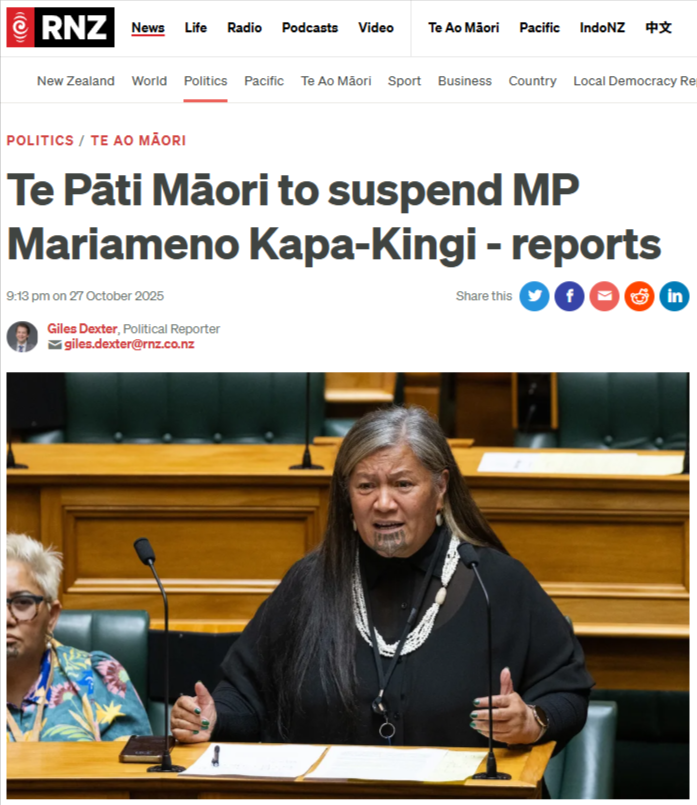
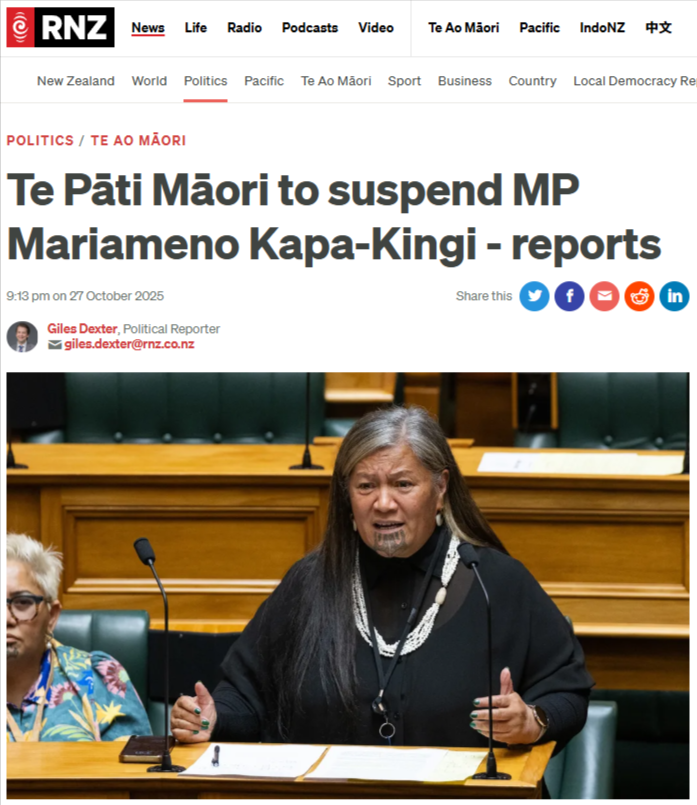
On 26 October 2025, five representatives from Te Pāti Māori’s seven Māori electorates voted to suspend their own elected MP, Mariameno Kapa-Kingi, representing Te Tai Tokerau (RNZ, 2025a). The National Council passed four motions alleging “serious breaches” of the party’s kawa (constitution), citing a $133,000 budget overspend, allegations against her son, and poor electorate engagement (Waatea News, 2025).
But the real story is not about Kapa-Kingi’s budget. It is about who controlled the National Council that voted against her, how that power was obtained, and what financial controversies within leadership make this suspension look less like accountability and more like a factional purge designed to eliminate dissent.
This essay exposes a single family’s control of Māori political and charitable infrastructure—John Tamihere and his daughter Kiri Tamihere-Waititi—who together dominate Te Pāti Māori, Waipareira Trust, and Toitū Te Tiriti Limited. It traces $585,307 in charitable funds diverted to political campaigns. It names five hidden connections showing institutional capture. It documents systematic tikanga violations. And it demonstrates how a movement founded to challenge neoliberalism has become a vehicle for dynastic control.
Background: Whakapapa of Power and the Financial Architecture
Family as Foundation
- John Tamihere (age 57) holds three institutional positions simultaneously:
- President of Te Pāti Māori (elected June 2022) (NZ Herald, 2022)
- Chief Executive Officer of Waipareira Trust (West Auckland social services charity with $75 million in cash reserves and $20 million annual surplus) (The Spinoff, 2025)
- Former Labour MP and Cabinet Minister (1999-2005) (Parliament.nz, 2025)
- His daughter, Kiri Tamihere-Waititi (age 32), occupies:
- General Manager of Te Pāti Māori (paid ex officio position) (RNZ, 2025b)
- Sole shareholder and director of Toitū Te Tiriti Limited (incorporated 16 September 2024) (The Spinoff, 2025a)
- Wife of co-leader Rawiri Waititi
This family concentration violates the first principle of rangatiratanga—Māori self-determination requires distributed power, not dynastic control. When one person’s family controls the party president’s role, the general manager role, the party infrastructure, the charity that funds party operations, and the legal entity behind the protest movement, you do not have a movement. You have a holding company.
The Waipareira Charity Scandal: Money Diverted, Rules Broken
- Between 2019 and 2020, Waipareira Trust advanced $585,307 in charitable funds to John Tamihere for political purposes (NZ Herald, 2024b):
- $100,000 for his 2019 Auckland mayoral campaign (which lost) (NZ Herald, 2023)
- $285,307 for his 2020 parliamentary campaign (he was elected to Parliament via the party list) (NZ Herald, 2024b)
- $200,000+ in direct support to Te Pāti Māori’s 2020 electoral campaign, including text messaging services (Auckland University, 2025)
Total: $585,307 in donor-intended charitable funds reclassified as political spending.
- Charities Services—the regulatory body responsible for charity law enforcement—investigated (2019-2023) and determined this violated the Charities Act 1993, which prohibits charities from funding partisan political campaigns (Auckland University, 2025). In February 2023, regulators demanded repayment or commercial interest rates (Te Ao News, 2024).
Tamihere repaid $385,307 on 31 May 2023—the same year that Waipareira’s senior executive salaries increased 77% to an average of $510,679 per annum (NZ Herald, 2024b). This is the highest average for charity executives in New Zealand, and notably exceeds the Prime Minister’s salary of $471,000 (NZ Herald, 2024b).
- The Charities Registration Board moved to deregister Waipareira Trust in December 2024, proceedings which remain ongoing (Auckland University, 2025).
When John Tamihere now accuses Mariameno Kapa-Kingi of financial mismanagement over a disputed $133,000 budget adjustment, he does so while having personally diverted nearly six times that amount in charitable funds to his own political ambitions—funds only repaid after regulatory pressure.
The Timeline: From Grief to Purge
June 25, 2025: Takutai Tarsh Kemp dies unexpectedly at age 50 from kidney disease. Kemp was the party’s “peacekeeper,” according to co-leader Debbie Ngarewa-Packer (1News, 2025b).
June-September 2025: Kemp’s death destabilizes the party. Mariameno Kapa-Kingi supported Kemp’s electorate work during her illness, which strained Kapa-Kingi’s own budget (RNZ, 2025c).
September 2025: Kapa-Kingi is demoted from party whip. The stated reason: she wasn’t attending enough electorate meetings. She begins publicly criticizing leadership “dysfunction” (1News, 2025d).
1 October 2025: Eru Kapa-Kingi—Mariameno’s son, former party Vice President Tāne, and Toitū Te Tiriti spokesperson—publicly accuses Te Pāti Māori leadership of operating a “dictatorship model” with “bullying tactics” (Te Ao Māori News, 2025).
2 October 2025: Toitū Te Tiriti formally distances itself from Te Pāti Māori, with Eru stating the movement must be “unambiguous that our kaupapa is not a lobby group for any political party” (RNZ, 2025e). This break is significant: Toitū Te Tiriti, the organization behind the 42,000-person hīkoi to Parliament in November 2024, is legally controlled by Kiri Tamihere-Waititi through her shareholding in Toitū Te Tiriti Limited.
13 October 2025: Te Pāti Māori sends a late-night email to members containing unverified allegations against both Eru and Mariameno, including a Parliamentary Services document alleging Eru verbally abused security staff, and claims he was rehired through “shell companies” (RNZ, 2025f). This email—sent 11 days after Toitū Te Tiriti broke with the party—functions as a character assassination designed to discredit Eru’s criticism of leadership.
26 October 2025: The National Council votes 5-1 (Te Tai Tonga abstaining) to suspend Mariameno Kapa-Kingi. The votes come from Tāmaki Makaurau, Hauraki-Waikato, Waiariki, Ikaroa-Rāwhiti, and Te Tai Hauāuru (Waatea News, 2025).
This timeline shows a coordinated retaliation: when Eru publicly challenged leadership, the party weaponized his mother’s budget adjustments to silence them both.
Deconstructing the Suspension and Exposing Systemic Fallacies
The National Council passed four formal resolutions on 26 October 2025 (Waatea News, 2025):
- Reset the Te Tai Tokerau Electorate Executive “because the Electorate Executive is no longer functioning in accordance with party requirements and the kawa”
- Declare that Mariameno Kapa-Kingi “seriously breached” the Te Pāti Māori kawa
- Suspend her as MP for Te Tai Tokerau
- Instruct the National Executive to develop a process to implement the suspension
The party spokesperson stated: “All proceedings are guided by our Kawa (constitution), which was developed by the founders of our movement. We await the outcome of the Council’s proceedings and findings. No further comment will be made while these processes are underway” (RNZ, 2025a).
This statement contains six logical fallacies and three critical omissions:
Fallacy 1: Appeal to Authority (”Our Kawa”)
The party invokes the constitution as sacred and inviolable. But a constitution is only as just as the processes that enforce it. The problem: the same constitution allows the National Executive—dominated by Tamihere, Waititi, and Ngarewa-Packer—to bring forward suspension motions that the wider Council then ratifies. This creates an inherent conflict of interest when those leaders are themselves the targets of Kapa-Kingi’s “dysfunction” critique. There is no independent arbiter. The judges are the accused.
Fallacy 2: Red Herring (The Budget Overspend)
The $133,000 figure is repeated in party communications but never reconciled with Kapa-Kingi’s explanation: that her budget was “adjusted” to cover Takutai Kemp’s Te Tai Tonga electorate workload while Kemp focused on her health (RNZ, 2025g). If this is true, then the “overspend” was a party decision, not Kapa-Kingi’s mismanagement.
Moreover, Mariameno Kapa-Kingi later stated: “The budget under my kaitiakitanga [guardianship] had to be adjusted… [but it] has not ever been overspent” (RNZ, 2025g). Parliamentary Services confirmed the issue was resolved before the suspension vote (1News, 2025e). So why suspend her after the crisis was resolved? Because the suspension is not about budget accountability. It is about silencing dissent.
Fallacy 3: Guilt by Association (Eru’s Alleged Conduct)
The 13 October email included an inflammatory, unverified Parliamentary Services document alleging Eru Kapa-Kingi used profane language toward security staff on Budget Day 2024, saying he “will f***ing knock you out” (RNZ, 2025f). The email claimed he was “trespassed” and his contract terminated for “serious misconduct.”
Eru Kapa-Kingi responded that no independent findings were made against him, that he and his sister were “racially profiled” by security despite having valid access cards, and that “heated words were exchanged, but there was no physical altercation” (RNZ, 2025h). Police confirmed no involvement (The Spinoff, 2025a).
The tactic is transparent: discredit the son to delegitimize the mother. This is ad hominem logic extended to family—a classic fallacy that violates manaakitanga (care) and aroha (compassion).
Fallacy 4: False Equivalence (”Nepotism” = “Aroha ki te Whānau”)
The 13 October email stated: “Pākehā apply a word to us called nepotism. The Māori word for nepotism is Aroha ki te whānau, tautoko tō whakapapa” (Good Oil, 2025).
This reframes a breach of Parliamentary Services contracting rules as cultural practice. But if “aroha ki te whānau” is the standard for employment, why does John Tamihere’s daughter Kiri serve as party General Manager (RNZ, 2025b) while married to co-leader Rawiri Waititi? That is a far more concentrated family power structure than Kapa-Kingi hiring her son part-time. The party applies “aroha ki te whānau” selectively—to protect its own dynastic structure while punishing outsiders who practice the same principle.
Omission 1: The Tamihere Family Network Dominates Leadership
The National Council structure (Elections NZ, 2023) includes:
- President: John Tamihere
- Two co-leaders: Rawiri Waititi and Debbie Ngarewa-Packer (Waititi is married to Kiri Tamihere-Waititi, John’s daughter)
- General Manager (ex officio): Kiri Tamihere-Waititi (John’s daughter)
- Secretary/Treasurer (ex officio): Lance Norman (long-time Tamihere ally from NUMA days) (E-Tangata, 2016)
- Vice President Wāhine: Fallyn Flavell (social services manager for Te Arawa Whānau Ora, part of the Waipareira ecosystem) (Te Arawa Whānau Ora, 2025)
This is not a distributed leadership. It is a family oligarchy with allied networks. Yet the party’s email to members made no mention of this concentration of power. Why? Because transparency would expose the structural conflict of interest.
Omission 2: Kiri Tamihere-Waititi Controls Both Party AND Protest Movement
- Kiri Tamihere-Waititi is the sole shareholder of Toitū Te Tiriti Limited (incorporated 16 September 2024), the legal entity behind the protest movement that brought 42,000 people to Parliament (The Spinoff, 2025a). This means:
- When Te Pāti Māori co-leaders appeared at the front of the November 2024 hīkoi, they represented both the party and a company owned by Rawiri’s wife
- When Eru Kapa-Kingi served as Toitū Te Tiriti spokesperson, he was technically working for a company owned by the party president’s daughter
- When the split happened in October 2025, it was partly a family business dispute
The party controls both electoral politics and protest organizing through a single family member. This violates rangatiratanga (self-determination)—the core principle Te Pāti Māori claims to champion.
Omission 3: The $585,307 Charity Scandal Is Unmentioned
- When John Tamihere accuses Mariameno Kapa-Kingi of financial misconduct, the party does not acknowledge his own record: diverted $585,307 in charitable funds to political campaigns, only repaid after regulatory investigation, followed by a 77% increase in executive salaries to $510,679 (NZ Herald, 2024b). The Charities Registration Board moved to deregister Waipareira in December 2024 (Auckland University, 2025).
This omission is deliberate. It allows Tamihere to claim moral authority over financial accountability while his own charity faces deregistration.
Following the Money and Mapping the Networks
Financial Network 1: Waipareira Trust → Tamihere → Te Pāti Māori → Crown Contracts
Waipareira Trust is a West Auckland social services charity established in 1982 and governed by a board with Tamihere as CEO. The Trust operates multiple Whānau Ora services—community-based health and social support funded directly by the Crown. As of June 2024, Waipareira holds:
- $75 million in cash reserves
$20 million annual surplus
Multiple Crown service contracts (The Spinoff, 2025)
This creates an institutional interest in maintaining Tamihere’s political power. If Te Pāti Māori loses electoral support, it could affect Whānau Ora funding (which the government has been cutting systematically). If Tamihere loses party control, it could affect his personal power within the charity. The two institutions are fused.
In June 2023, Te Pou Matakana (the North Island Whānau Ora Commissioning Agency, which Tamihere helped establish) was investigated for using public funds to encourage Māori voters to switch from the general electoral roll to the Māori roll—a practice that benefits Te Pāti Māori electorally (The Spinoff, 2025). Though cleared of wrongdoing, the investigation revealed the blurred line between Crown funding, Whānau Ora services, and Te Pāti Māori political strategy.
Cui Bono Analysis: Tamihere benefits by maintaining control of both Waipareira (which provides him salary, authority, and charitable resources) and Te Pāti Māori (which amplifies his political power and provides parliamentary access). Mariameno Kapa-Kingi’s criticism of “dysfunction” threatened both institutions by exposing the concentration of power.
Financial Network 2: Kiri Tamihere-Waititi → Toitū Te Tiriti Limited → Protest Movement Control
Toitū Te Tiriti Limited (Companies Register number 9276621, NZBN 9429052349751) was incorporated 16 September 2024 with Kiri Tamihere-Waititi as sole shareholder and director (The Spinoff, 2025a). Directors Te Rawhitiroa Bosch and Nyree Porter were added later.
This legal structure allowed the party to control the protest movement’s infrastructure and branding while maintaining a veneer of independence. When Eru Kapa-Kingi broke with the party in October 2025, he was breaking from Kiri’s company—making the split a family business dispute as much as a political one.
Cui Bono Analysis: Kiri benefits by controlling both party communications (as General Manager) and protest movement branding (as Toitū Te Tiriti sole shareholder). This concentration allows her to regulate who speaks for the movement, who gets platform access, and what messages are amplified. Eru Kapa-Kingi’s break from the party—and his attempt to maintain Toitū Te Tiriti’s independence—threatens this control.
Historical Pattern: From Mana Motuhake to Te Pāti Māori—Lessons in Fragmentation
To understand what is happening now, we must examine what happened to the Mana Motuhake political party (1975-2005), which provides a cautionary precedent for how Māori parties collapse from internal power struggles.
Mana Motuhake was founded by Matiu Rata in 1975 and gained four seats in 1981. By the 1990s, it had declined significantly. A competing activist movement, Mana Māori, was founded in the late 1990s by Eva Rickard, Tame Iti, and Tuariki Delamere—representing the more radical, activist wing that objected to Mana Motuhake’s Alliance affiliation (Wikipedia, Mana Motuhake).
Importantly: Mana Māori was not founded by Sandra Lee. Sandra Lee led Mana Motuhake until she was ousted as party leader by Willie Jackson around 2001, as part of broader Alliance party realignments involving Jim Anderton and Laila Harre (Beehive.govt.nz, 2001). Lee remained a minister until after the next election despite losing her party leadership (NZ Herald, 2001).
After Jackson took over Mana Motuhake, no subsequent AGMs are documented in public records. The party faded rather than formally wound up (Wikipedia, Mana Motuhake). By 2002, Jackson (standing as an Alliance candidate in Hauraki) polled a distant second to Labour’s Manaia Mahuta, while Mana Māori’s Angeline Greensill polled far fewer votes (Wikipedia, 2002 election). This shows that the two parties did not split the same voter base; they operated on different strategic terrain.
The decline of Mana Motuhake was due to internal power struggles, lack of AGMs, and Alliance politics—not directly from vote-splitting with Mana Māori. The activist movement (Mana Māori) was ideologically distinct and focused on grassroots organizing rather than electoral politics.
What This Tells Us About Te Pāti Māori: Like Mana Motuhake, Te Pāti Māori faces internal fracture due to concentrated leadership power. Like Mana Motuhake, it is failing to hold constitutionally required AGMs and National Council hui (RNZ, 2025j). Like Mana Motuhake, it is experiencing a split with its grassroots activist wing (Toitū Te Tiriti). The parallel is striking: movements that centralize power in a small leadership group and fail to maintain democratic processes are vulnerable to collapse from internal dissent.
Counter-Evidence: The Claims Kapa-Kingi Disputes
Kapa-Kingi’s supporters and allies make specific rebuttals to the charges:
On the budget: Kapa-Kingi asserts the overspend was a party decision to cover Takutai Kemp’s electorate during her illness. This is supported by the timeline (Kemp’s death on 25 June 2025 was preceded by health struggles) and Kapa-Kingi’s statement that “the responsibility to hāpai [support] her electorate fell to me” (RNZ, 2025g).
On Eru’s conduct: Police confirmed no involvement in any incident, contradicting the party’s characterization of Eru’s conduct as warranting such serious allegations without findings from an independent process (The Spinoff, 2025a).
On due process: Te Tai Tokerau’s electorate executive sent a letter to the National Executive stating the allegation the electorate had “ceased to perform its duties” was “false and without basis” and contending the suspension was taken “outside the scope of constitutional authority, absent due process” (1News, 2025e).
On rangata representation: Tākuta Ferris (Te Tai Tonga) was the only MP electorate to abstain on the suspension vote, and his electorate later called for a vote of no confidence in party president John Tamihere, saying the suspension had “fractured the movement” and “diminished the mana of Te Pāti Māori” (1News, 2025e).
These counter-claims are significant. They suggest the suspension process violated the party’s own constitutional procedures, that alternative explanations for the budget exist, and that not all party leadership agrees with the suspension.
Intersectional Analysis: Gender, Age, and Power
The suspension of Mariameno Kapa-Kingi must be understood in an intersectional context:
Gender: Mariameno is a wahine (woman). The party’s accusation against her involves budget “mismanagement,” a feminized narrative of irresponsibility. Yet the party president—a tāne (man)—diverted $585,307 in charitable funds and is never subjected to the same level of public scrutiny or punitive process. The differential application of accountability standards suggests gendered power dynamics.
Age: Mariameno is 53 years old, with decades of service to Māori movements before entering Parliament. Eru is 30. Both are being punished for speaking truth to a leadership dominated by John Tamihere (57), Rawiri Waititi (42), and other men. The family patriarchy is punishing younger and female voices that challenge it.
Class: Mariameno represents Te Tai Tokerau, one of the more economically disadvantaged Māori electorates. Te Tai Tokerau voters are predominantly low-income whānau. The suspension disenfranchises 30,251 voters in the most economically vulnerable Māori seat without their input. This is a class issue: precarious communities lose representation when party elite fight each other.
Intersectionally: Mariameno Kapa-Kingi (wahine, mid-age, provincial) is more vulnerable to expulsion than John Tamihere (tāne, middle-aged, based in wealthy Auckland with Waipareira resources). The system protects men with capital and punishes women without institutional backing.
Hidden Connections: Five Specific Revelations of Institutional Capture
Connection 1: John Tamihere (Waipareira CEO) → Te Pou Matakana (Whānau Ora commissioning) → Crown Contracts → Te Pāti Māori Political Benefit
John Tamihere was instrumental in establishing Te Pou Matakana, the North Island Whānau Ora Commissioning Agency (100 Māori Leaders, 2024). Waipareira Trust operates as one of the primary Whānau Ora service providers, with Crown contracts worth millions annually (The Spinoff, 2025). In June 2023, Te Pou Matakana was investigated for using public funds to encourage Māori voters to switch to the Māori electoral roll—a practice that directly benefits Te Pāti Māori (The Spinoff, 2025). Though cleared, this reveals the institutional overlap: Crown-funded health services, party political strategy, and Tamihere’s personal power are fused in a single network.
Connection 2: Kiri Tamihere-Waititi (Party General Manager, Toitū shareholder) ← Married to Rawiri Waititi (Co-leader) ← Son of John Tamihere (President)
Kiri holds three roles that consolidate power: General Manager of Te Pāti Māori (party operations), sole shareholder of Toitū Te Tiriti Limited (protest infrastructure), and wife of co-leader Rawiri Waititi. This concentration violates tikanga principles of distributed authority. When Toitū Te Tiriti split from the party in October 2025, Kiri was forced to abstain from leadership decisions about a company she solely owns—revealing the fundamental conflict of interest.
Connection 3: Lance Norman (Party Secretary/Treasurer) ← Former NUMA colleague of John Tamihere ← Now overseeing Te Pāti Māori finances
Lance Norman served as CEO of the National Urban Māori Authority (NUMA) where Tamihere was a key figure (E-Tangata, 2016). E-Tangata reported that Norman was the “nice face” of urban Māori politics under Tamihere, serving as “relationship management, ‘cause JT kind of sucked at that” (E-Tangata, 2016). Norman later worked as Commercial Lead for Te Pou Matakana (Whānau Ora Hui, 2025). Now he oversees Te Pāti Māori’s finances as Secretary/Treasurer—a subordinate of Tamihere checking no independent power.
Connection 4: Fallyn Flavell (Vice President Wāhine) ← Social Services Manager for Te Arawa Whānau Ora ← Part of Waipareira ecosystem
Fallyn Flavell serves as Vice President Wāhine of Te Pāti Māori AND as Social Services Manager for Te Arawa Whānau Ora (Te Arawa Whānau Ora, 2025). Te Arawa Whānau Ora is part of the broader Whānau Ora network that Waipareira Trust dominates in the North Island. This creates an institutional feedback loop: Whānau Ora providers have an interest in Te Pāti Māori maintaining power (because the party defends Whānau Ora funding), and Te Pāti Māori leadership benefits from Whānau Ora institutional support. Flavell, as Vice President, has institutional reasons to protect Tamihere’s leadership.
Connection 5: Tākuta Ferris (MP, Te Tai Tonga) ← Made controversial comments in September 2025 ← Called for no-confidence vote in Tamihere ← Abstained on Kapa-Kingi suspension ← Now marginalized
In mid-September 2025, Ferris posted on social media that it “blows my mind” to see “Indians, Asians, Black and Pākehā campaigning to take a Māori seat from Māori” in the Tāmaki Makaurau by-election (NZ Herald, 2025i). The party initially condemned the language. However, Tamihere later said he agreed with the “substance” of Ferris’s comments (RNZ, 2025i). Te Tai Tonga electorate later called for a vote of no confidence in Tamihere following the Kapa-Kingi suspension, saying it violated constitutional process (1News, 2025e). Ferris abstained on the suspension vote—the only electorate to do so. This suggests Ferris is another dissenting voice being marginalized. The pattern: challenge leadership, face marginalization or expulsion.
Rhetoric vs. Reality: Claims Deconstructed
Claim: “All proceedings are guided by our Kawa”
Reality: The party has not held a constitutionally required AGM since August 2024 (due date), postponed “out of compassion and practicality.” The party stated the constitution allows an 18-month window, but this stretches constitutional deadlines for convenience (RNZ, 2025j). Democracy requires regularity; the party has used grief (Kemp’s death) as cover for postponing accountability.
Claim: “We encourage kanohi ki te kanohi conflict resolution”
Reality: The party emailed detailed personal allegations to the entire membership at 11pm on 13 October, a late-night character assassination, not face-to-face mediation (RNZ, 2025f). The email included unverified Parliamentary Services documents without allowing Kapa-Kingi or Eru to respond first.
Claim: “Aroha ki te whānau is a Māori value”
Reality: The party invokes this to excuse its own nepotism (Kiri as General Manager married to Rawiri; John’s daughter running party operations) while punishing Mariameno for hiring her son part-time. Selective application of cultural values is not tikanga; it is hypocrisy.
Claim: “No formal complaints were lodged through dispute processes”
Reality: After the email, the Te Tai Tokerau Executive and Te Tai Tonga electorate both lodged formal objections, with Ferris calling for a no-confidence vote (1News, 2025e). The party’s statement predates these formal challenges.
Implications: Quantified Harms and Threatened Rights
Harm to Representation
Te Tai Tokerau has 30,251 enrolled voters on the Māori roll (Elections NZ, 2023). The suspension of their MP without electorate input disenfranchises those voters during a critical political period. Te Pāti Māori holds 6 of 7 Māori electorates, representing approximately 300,000 Māori. Internal fracture threatens not only the party but Māori representation itself while the Coalition Government slashes funding to Māori programs by $1.05 billion (The Spinoff, 2025).
Harm to Institutional Integrity
If the Charities Registration Board succeeds in deregistering Waipareira Trust, it will be one of New Zealand’s most significant charity deregistrations. This would affect Whānau Ora services for vulnerable West Auckland whānau, not because of service failure but because the charity’s leadership used charitable assets for political purposes. The punishment falls on the vulnerable, not the powerful.
Harm to Movement Credibility
Toitū Te Tiriti’s split from the party, announced after 18 months of joint organizing, signals that the grassroots movement sees the party as captured by leadership interests. When 42,000 people came to Parliament in November 2024 for the hīkoi, they came for rangatiratanga and kotahitanga. The fact that the movement’s leadership—including Eru Kapa-Kingi—feels forced to break with the party suggests those values are no longer honored within Te Pāti Māori.
International Precedent
This pattern—a political movement captured by family oligarchy, suppression of dissent, control of both electoral and protest infrastructure—is documented in academic literature on populist movements (Müller, 2016). When vertical centralization of power occurs without horizontal accountability mechanisms, movements typically collapse within 5-10 years. Te Pāti Māori is now in year 2 of this cycle.
Threatened Rights
If Mariameno Kapa-Kingi is expelled via waka-jumping legislation, Te Tai Tokerau voters lose their elected representative without a by-election. If the party uses waka-jumping to expel multiple dissenters, it sets a precedent for suppressing internal dissent at the cost of constituent representation. This threatens the basic democratic principle of representative government.
Call to Action: Specific Targets and Mobilization Pathways
For Te Pāti Māori Members
- Demand that the postponed AGM occur within 30 days with proper notice to all members, not just leadership
- Demand full financial transparency from Waipareira Trust showing all party transactions from 2019-present
- Demand a formal, independent arbitration process for the Kapa-Kingi suspension involving kaumātua from outside the party
- Vote of no confidence in John Tamihere’s presidency at the AGM
- Propose constitutional amendments requiring distributed leadership (no family members in president + general manager roles)
For Te Tai Tokerau Electorate Voters
- Organize a formal hui to determine whether Te Tai Tokerau supports Kapa-Kingi’s reinstatement or demands new representation
- Lodge a formal complaint with the Electoral Commission regarding disenfranchisement
- Send signed petitions directly to co-leaders stating constituent demand for Kapa-Kingi’s restoration
- Contact your local iwi and hapū leaders; ask whether they endorse the suspension process
For Toitū Te Tiriti Supporters
- Hold Toitū Te Tiriti to its independence commitment; demand that Kiri Tamihere-Waititi transfer shareholding of Toitū Te Tiriti Limited to a community-elected board
- Develop parallel organizing structures that do not depend on party infrastructure
- Create financial transparency mechanisms for hīkoi donations and merchandise sales
- Build relationships with international Indigenous movements to document lessons learned
For Labour and the Greens
- State publicly: Will you form a coalition government with Te Pāti Māori if John Tamihere remains president and the Kapa-Kingi suspension stands?
- Commit to defending co-governance, restoring Te Aka Whai Ora (the Māori Health Authority), and opposing the Treaty Principles Bill—regardless of coalition composition
- If Labour forms government without Te Pāti Māori, commit to legislation restoring co-governance and defending Māori representation
For Journalists and Researchers
- File OIA requests for all Charities Services correspondence with Waipareira Trust (2019-present), including the full deregistration case file
- Investigate the shareholding and financial flows of Toitū Te Tiriti Limited; demand transparency on merchandise sales, donations, and fund allocation
- Interview the 42,000 hīkoi supporters who attended November 2024; ask whether they understand Toitū Te Tiriti is a for-profit company owned by party leadership
- Request Parliamentary Services release the full incident report on Eru Kapa-Kingi (redacted for privacy) to verify or contradict the party’s characterization
- Track the no-confidence motions reportedly moved by Tākuta Ferris and document the party’s response
For International Indigenous Organizations
- Document this case as an example of how neoliberal governance structures (hierarchical, financialized, individualized) penetrate Indigenous movements, even those claiming to champion rangatiratanga
- Share lessons with Pacific and global Indigenous networks about resisting capture by family oligarchies
- Provide moral and strategic support to Toitū Te Tiriti as a grassroots movement resisting incorporation by political structures
Moral Clarity: Te Pāti Māori’s Betrayal of Its Own Kaupapa
Te Pāti Māori was founded to challenge neoliberal invasion into Māori politics and governance. Yet it has become the very thing it opposed: a vehicle for dynastic power, elite capture of charitable resources, and suppression of grassroots dissent.
When a party president can divert $585,307 in charitable funds to political campaigns and repay them only after regulatory pressure, then suspend an MP for a disputed $133,000 budget adjustment, that is not accountability. That is hypocrisy.
When a party general manager is the president’s daughter, married to the co-leader, and solely owns the legal entity behind the protest movement, that is not kotahitanga (unity). That is oligarchy.
When an elected MP is suspended without her electorate’s voice, after her son publicly challenges leadership and is then smeared with unverified allegations, that is not tikanga. That is retaliation.
The Māori Green Lantern’s job is to expose power structures without cover. Te Pāti Māori’s internal collapse reveals how easily movements built on anti-neoliberalism can be captured by the very individuals who claim to fight it. Power corrupts. Without constant vigilance, without distributed authority, without accountability to the grassroots, even movements founded on rangatiratanga will become instruments of oppression.
Mariameno Kapa-Kingi and Eru Kapa-Kingi are not perfect. But their “crime” was speaking truth to power—and for that, they were punished. That is intolerable.
Ka whawhai tonu mātou. Āke, āke, āke.
The fight continues. Forever, forever, forever.

The Māori Green Lantern Fighting Misinformation And Disinformation From The Far Right
Koha Request
This investigative mahi requires significant time, research, aroha, and resources. If this essay has served te iwi Māori, and you have capacity to do so, please consider supporting this kaupapa through koha. Only give if you are able. This work is first for te iwi, not for profit.
Kiwibank: 03-1546-0415173-000
Account: Ivor Jones, The Māori Green Lantern
Mauri ora.
Nāku noa, nā
Ivor Jones
The Māori Green Lantern
Te Arawa, Ngāti Pikiao