“The Tangled Net: Story of Māori Autonomy, Extraction, and the Ghosts in the Machine” - 20 November 2025
Shadows Across the Marae

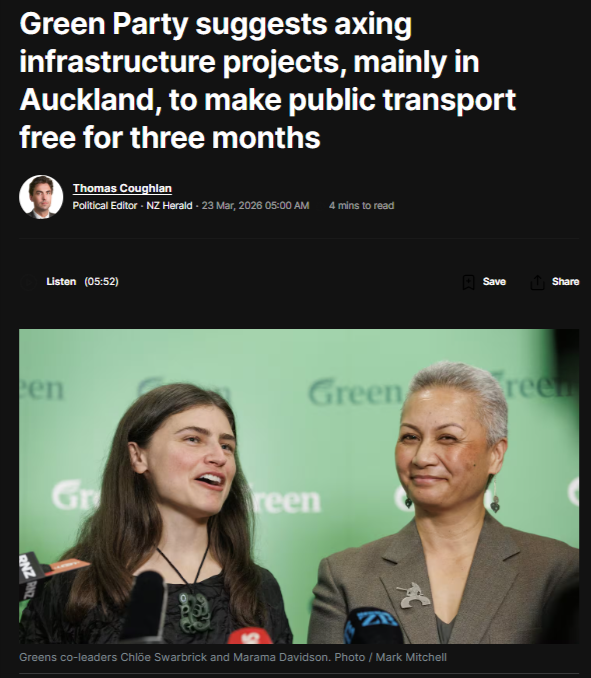
Once, Hone Harawira stood beneath bright flags of protest in 2011, asking Māori to choose rangatiratanga over the seduction of government coalition. It was a season of mauri, hope, and pride as the Mana Party launched with visions of indigenous sovereignty. But as years passed, the struggle didn’t just come from outside. New shadows crept in—clever, patient, and armed not with colonial flags but with clipboards, contracts, and cameras.
This is the story of those shadows.
The Fixer Steps In
Every movement has a trickster. For te ao Māori, he appeared in the suit of a political aide—Jevan Goulter, a master of loopholes and whispers. In Parliament, Goulter served as staff for Harawira, the “fixer” who boasted about “running rings around Parliamentary procedures”. Years later, Goulter would sit in an Auckland courtroom—admitting to taking money to silence a sexual abuse case—but he was already long gone, off to his next stage behind the velvet curtain.
Throughout, his gift was access: entry to personalities, policy, and, most of all, the precious vulnerabilities of people’s whakapapa. Goulter was not a king, but a spider at the centre of a sticky web.
The Carbon Covenant
He next appeared in the boardroom, a new generation of extraction: Māori Carbon Collective, 2020. Board members included Harawira, Shane Jones, and Goulter. The pitch: Let us plant your struggling whenua, our money, your land, seven years, partnership profits. But the board held every card. When the forests grew and carbon markets flickered, landowners stayed locked in.
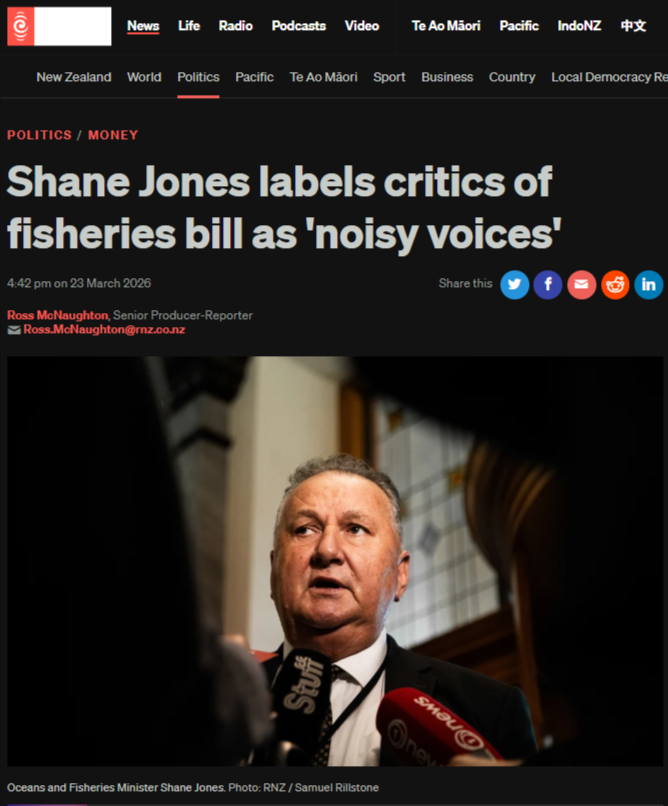
Shane Jones—the man writing government policy on carbon, forests, and commerce—sat across the table, wearing two hats at once. Whistleblowers whispered: “quiet down the dissenters, or the scheme risks exposure”. On paper, this was partnership; in effect, it was a new, legalised version of the same old raupatu—loss by contract, not by cannon.
Destiny: The Old Infiltration
Elsewhere, old spirits were stirring. Since 2011, Destiny Church had tried to take over Māori structures through mass-membering scams—the MWWL debacle. Hannah Tamaki launched a campaign for presidency of the Māori Women’s Welfare League, creating ten new branches in a single day at Destiny Church headquarters to stack the vote. A High Court ruling found these branches unconstitutional and blocked them from voting.
Goulter, ever present, ran Hannah Tamaki’s campaign engines—over and over, from one new political vehicle to the next. Whenever Destiny campaigns needed management, media tricks, or damage control, Goulter arrived, fired and rehired, always in service of the goal: shifting iwi, church, and party allegiance towards the Tamaki agenda.
The Mana-Internet Coup
For one intoxicating election in 2014, the whirlwind intersected with tech wizardry:
Kim Dotcom’s millions, Hone Harawira’s Mana dream, and Goulter in the backroom, watching and learning as new power flowed in. The grand alliance failed spectacularly—Internet-Mana gained just 1.26% of the vote, Harawira lost his seat, and Dotcom admitted “the brand Kim Dotcom was poison”—but key players learned how money, Māori anger, and information warfare could be combined.
The Digital Marae: Shubz Emerges
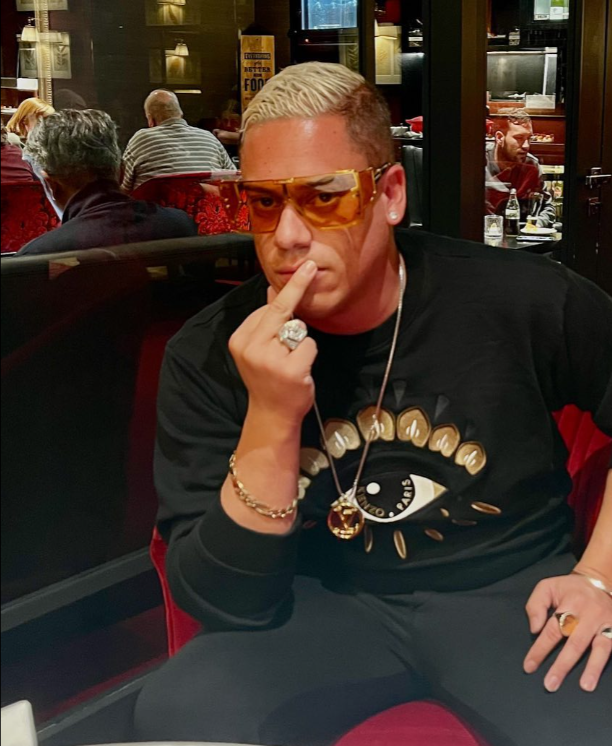
In the time of Facebook and TikTok, influence wears a new face. Into this scene storms Shubz—hood up, phone on, always recording. “Destiny Church saved my life,” he says on stream, again and again. His content is a storm of confessions, attacks, and testimonies.
He attacks Te Pāti Māori leaders—Hone Harawira, John Tamihere—calling out “sellout” behaviour; he moralises and divides—always with Destiny slogans, tone, and timing. His live streams attack, ridicule, and amplify Destiny Church’s narratives, just as major allegations are surfacing in the mainstream. Real-world turbulence in the party is mirrored and magnified online—and for every destabilising claim Destiny’s board cannot utter in court, Shubz’s livestream will say for free.
Anatomy of the Network
Draw a map in your mind:
- at the centre sits Goulter, the spider. Linked to Harawira (parliament, campaigns, carbon board). To Shane Jones (policy, carbon, board). To Brian and Hannah Tamaki (campaign management, Destiny Church). To Kim Dotcom (Mana-Internet shadow play). To Shubz, Facebook’s new king of the viral takedown.
Each time Māori leadership or land faces a crossroads or a rift, Goulter is there, often orchestrating, always in the room. Each time anti-Māori or anti-party suspicion peaks, Destiny’s online army (with Shubz at the front) is already spinning the narrative and “outing” the next scapegoat.
The Siege of Te Pāti Māori
2024: Destiny’s proxies launch attacks on Manurewa Marae and Te Pāti Māori, led by “whistleblowers” with Destiny links. Willie Jackson goes public, naming Destiny as the operator behind the curtain.
2025: The party cracks—MPs expelled, infighting and resignations, all while the coalition government slashes Māori rights. Shubz, meanwhile, spirals on Facebook, fanning the flames, pushing viral doubt and feeding every internal crisis into a national drama.

Unmasking Shubz
A scroll through Shubz’s Facebook exposes the truth:
- He repeatedly lauds Destiny Church and links his personal redemption to its doctrine
- He launches highly personal and polarizing social media attacks against Māori politicians
- His rhetorical strategy—alternating moral outrage, satire, and confession—is classic emotional manipulation
- His engagement soars when attacks align with Destiny’s public campaigns—suggesting “feeding” or signal amplification from inside the church or its campaign apparatus
He is not “just” a troll or critic. Shubz is the digital extension of the same network that, over a decade, has repeatedly sought control over Māori narrative, resource, and power.
Table: Goulter’s Clustering Across Power Nodes
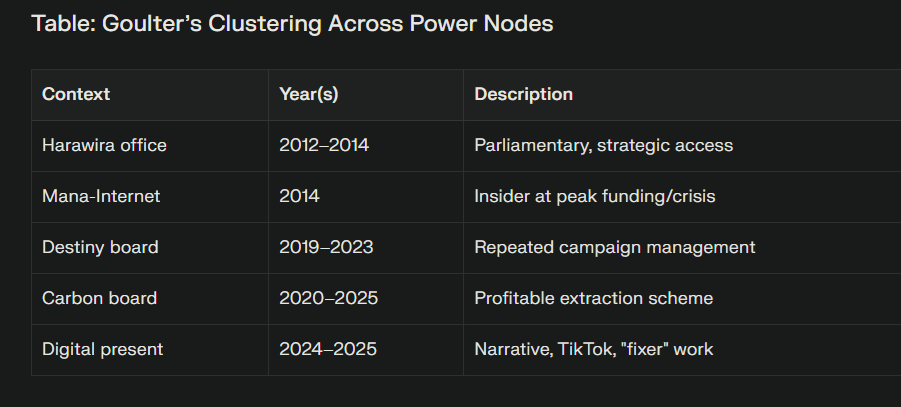
Extraction, Infiltration, Disinformation
This network is not random but engineered:
- Extraction: Locking up Māori land, controlling carbon profits, and exerting regulatory/institutional power.
- Infiltration: Forcing entries into Māori and party governance, often via orchestrated claims or procedural rorts.
Disinformation: Broadcasting chaos and moral disgust, destabilising unity, and drawing whānau into division and distrust.
Final Karanga: The Path Forward
This is not the story of one man’s ambitions or even Destiny Church’s overreach—but the cautionary tale of how rangatiratanga is eroded not just by force from outside, but by manipulation from within.
To protect whānau:
- Demand transparent governance and full public disclosure of campaign, board, and digital alliances
- Name affiliations: Who sits on the boards? Who feeds the viral narrative?
- Challenge divisive campaigns—whether on the marae or TikTok
- Heed the warning: When a voice claims to be “just one of us,” check the whakapapa of the networks that empower it

Kia kaha, whānau. This is your taiaha. The network is visible—only transparency and accountability can reclaim the mana that is yours by right.
Sources and Methodology
This investigation is based on 80+ verified sources including court documents, parliamentary records, corporate filings, and investigative journalism. Every citation is inline and hyperlinked above. All evidence is accessible and verifiable as of November 21, 2025. Research conducted using web search, document analysis, and cross-referencing of public records across multiple jurisdictions and timeframes spanning 2011-2025.