“The Theatre of Shame: How New Zealand’s Political Establishment Performs Virtue While the Machinery of Bondage Churns On” - 30 January 2026
A Metaphorical Reckoning
Mōrena ano Aotearoa,
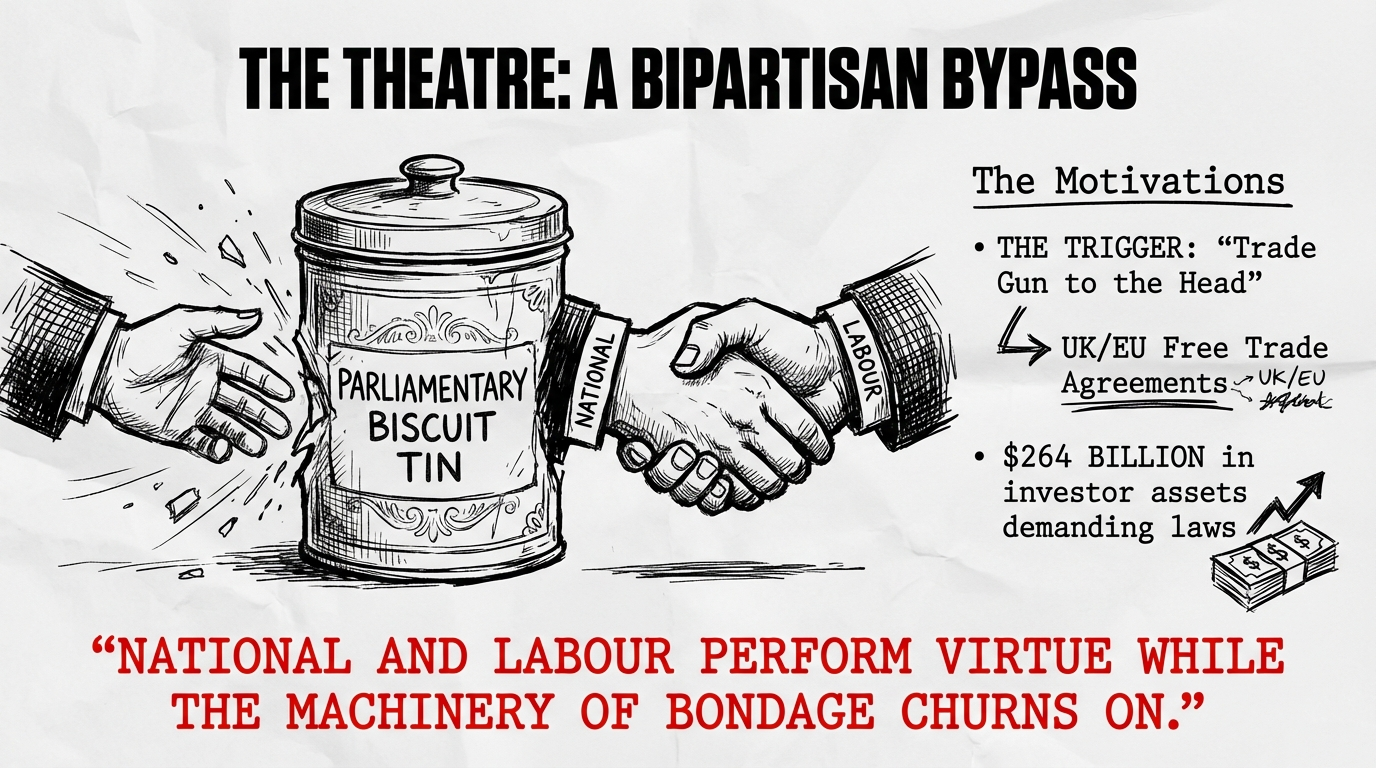
Picture a grand theatre. On stage, two rival actors—call them National and Labour—suddenly discover a shared script. They emerge from opposite wings, clasp hands beneath the spotlight, and announce their joint mission to vanquish a terrible monster lurking in the wings: modern slavery. The audience gasps. The orchestral swell builds. Surely, this must be the moment of heroic deliverance.
But backstage, in the darkened corridors where the real machinery of production hums, a third actor refuses to leave his dressing room. ACT sits alone with a mirror, admiring his reflection. He mutters that the monster doesn’t really exist—or if it does, it’s already illegal, so why bother with the theatre? Why complicate the business of keeping the engine of extraction running smoothly?
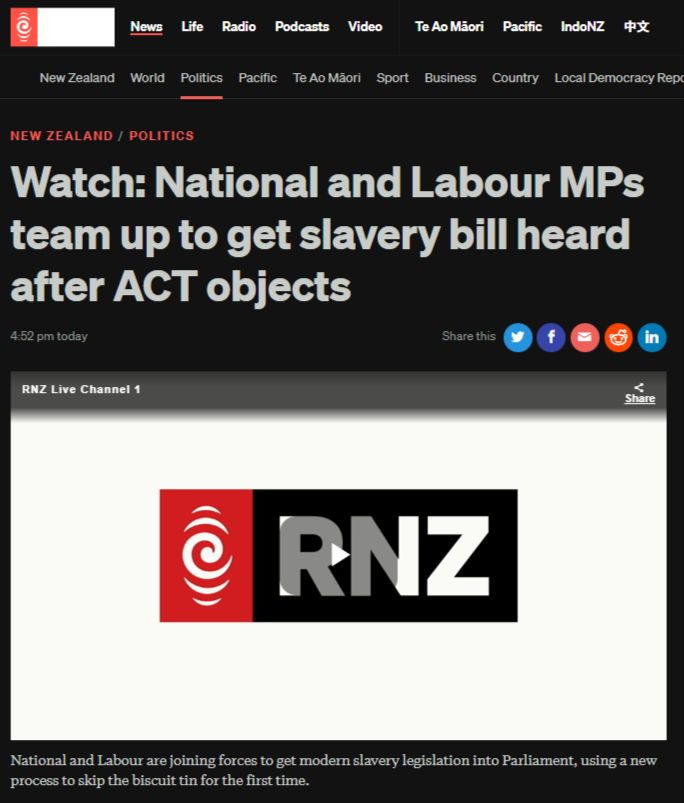
The tragedy of this moment is not that the theatre has produced one noble performance. It is that the performance itself is the distraction. While National and Labour perform for the cameras—pledging to shine a light on supply chains through corporate reporting regimes—the real monster moves unimpeded. ACT’s refusal is not principled obstruction. It is honest clarity about what the coalition actually believes: that businesses must be freed from the burden of accountability, regardless of the human cost.
The Scale of Bondage: Quantifying a National Disgrace
The Invisible Cargo
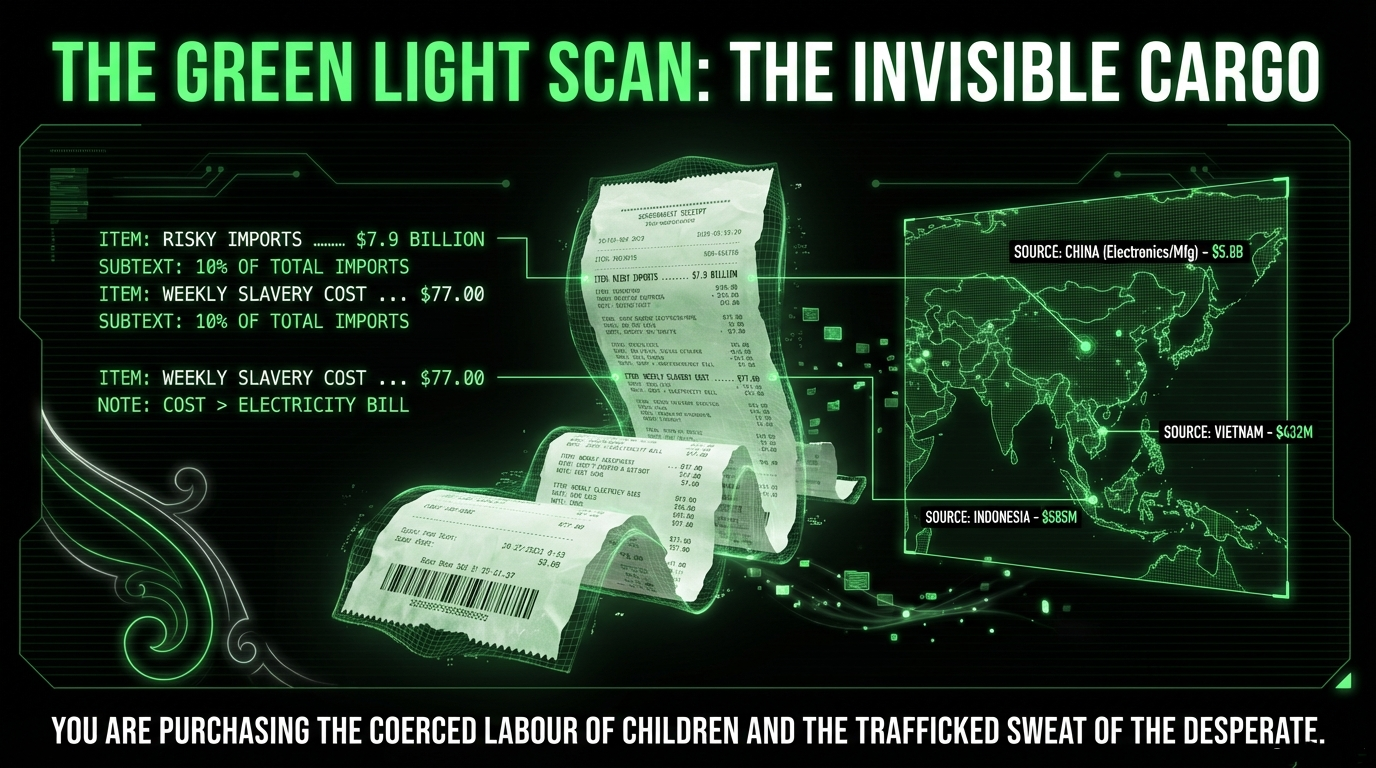
Every week, your grocery bill contains slavery. You spend approximately $77 per week on goods linked to child and forced labour—more than you spend on electricity. This is not an edge case. This is the ordinary infrastructure of your consumption.
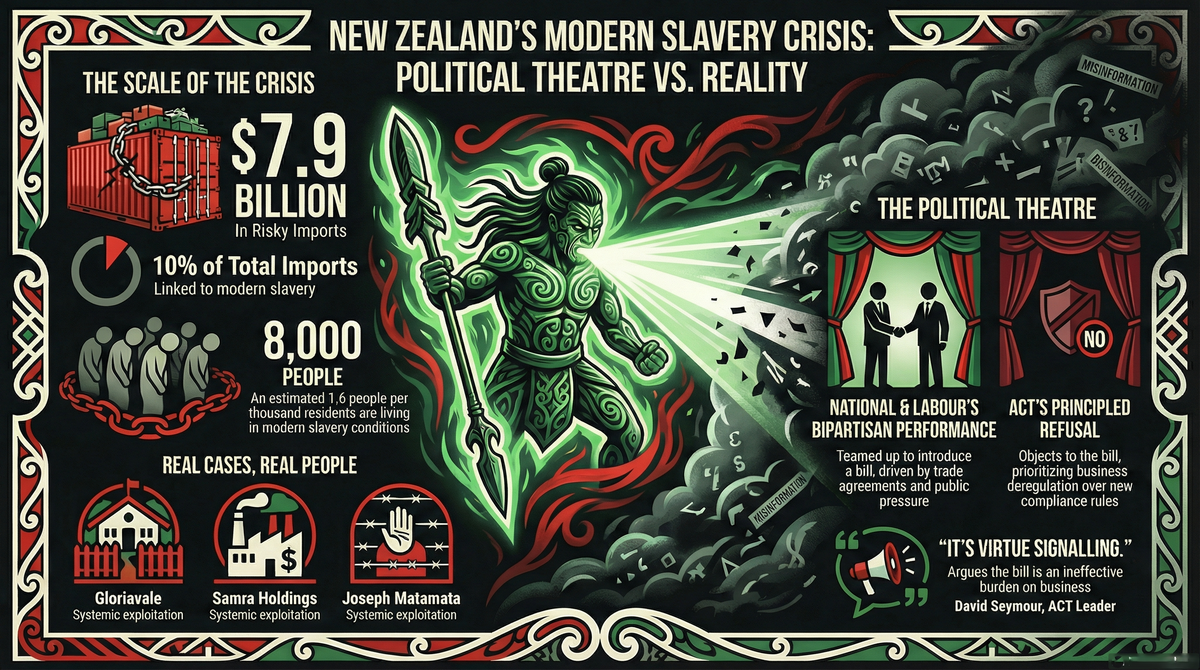
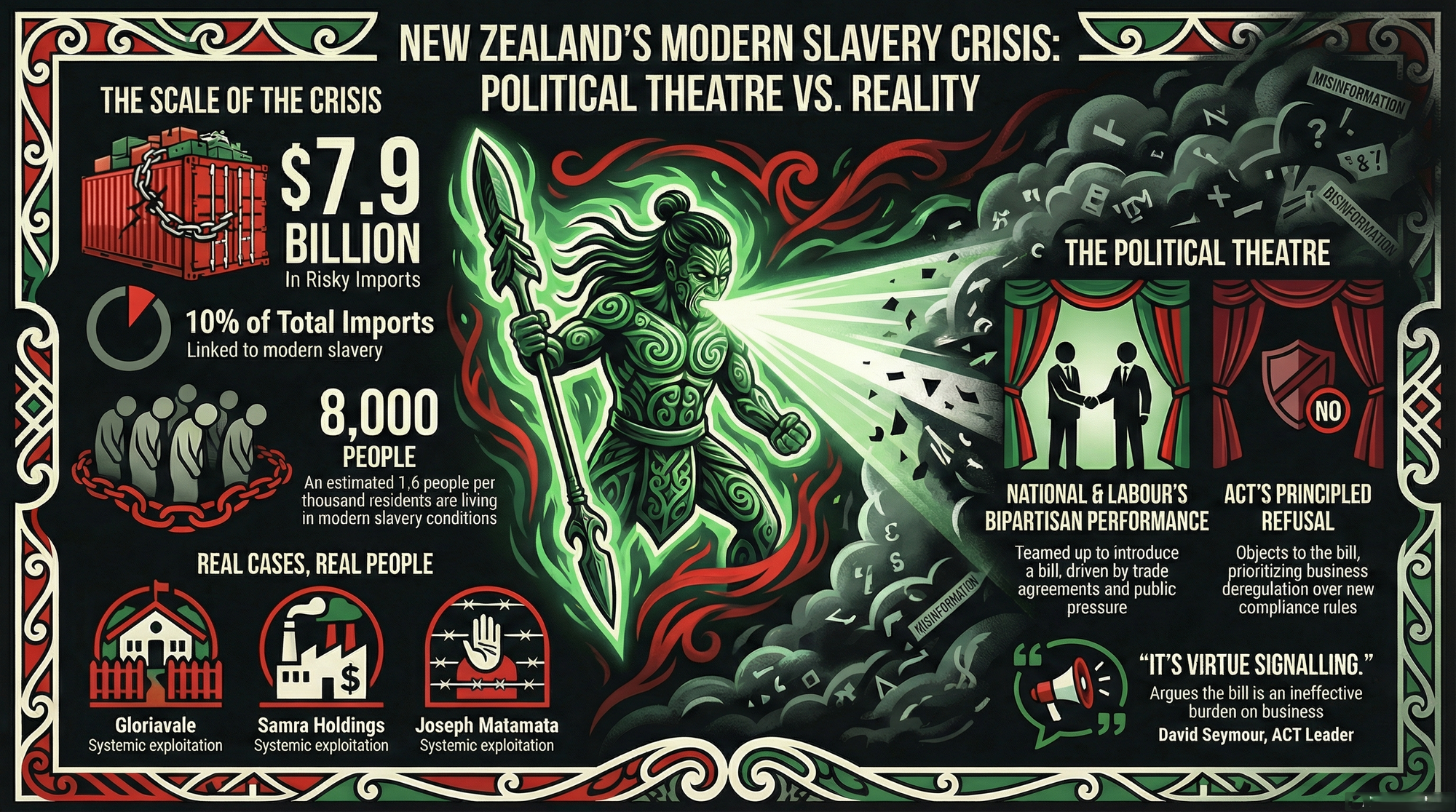
In 2022, Aotearoa New Zealand imported $7.9 billion worth of risky goods associated with modern slavery. That figure represents 10% of the nation’s total imports.
The breakdown is grim:
$1.9 billion linked to forced labour, $764 million to child labour, and $5.2 billion ensnared in both.
The geography of exploitation is starkly mapped. 74% of these risky goods originated in China ($5.8 billion), where state-imposed forced labour coexists with child labour in electronics manufacturing. The remaining infamy is distributed across Indonesia (7%, $585 million), Vietnam (5%, $432 million), and Malaysia (3%, $270 million). When you buy an iPhone, charge your e-bike, or install solar panels in your home—you are purchasing the coerced labour of children and the trafficked sweat of the desperate.
The Living Dead at Home
But the horror is not merely imported. It breathes in Aotearoa’s own soil.
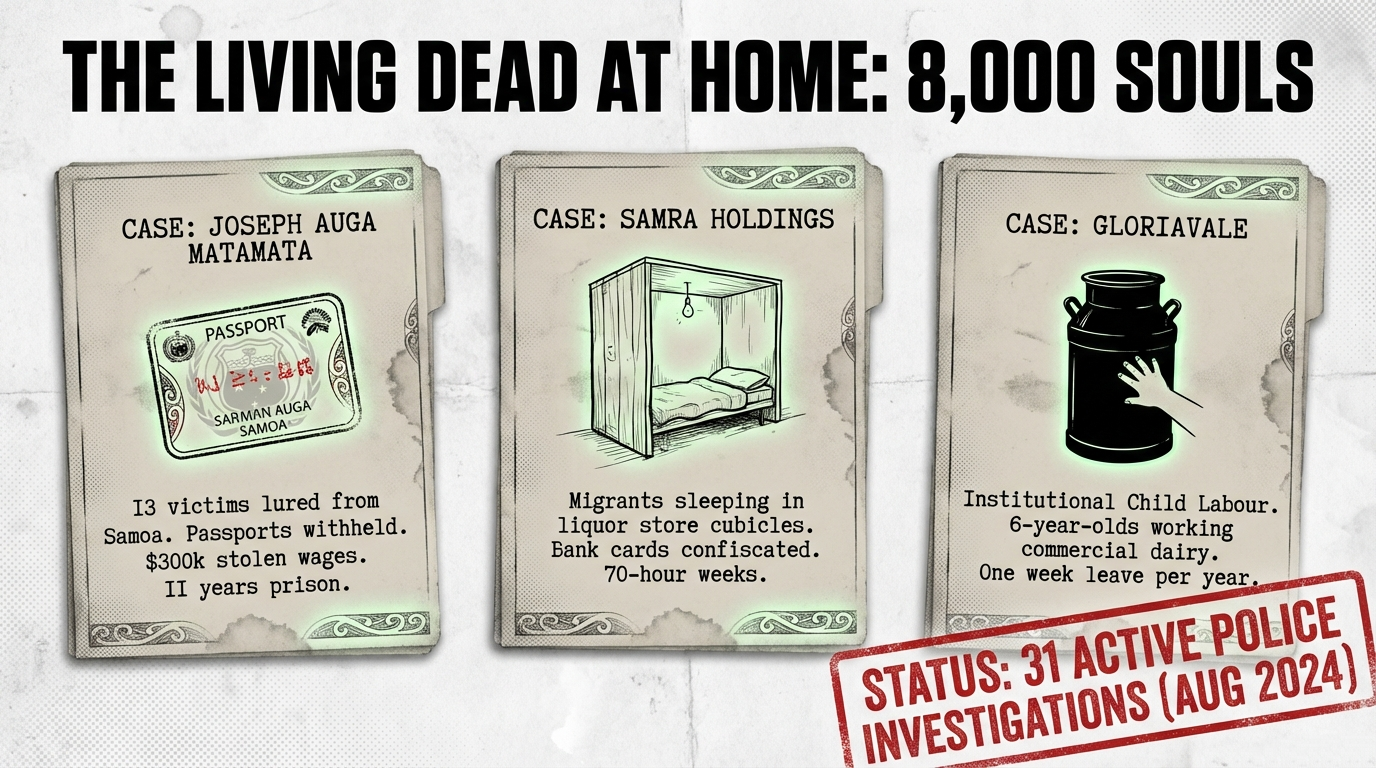
An estimated 8,000 people in New Zealand live in modern slavery—approximately 1.6 people per thousand residents. Police had 31 ongoing investigations into modern slavery as of August 2024, yet enforcement remains glacial, fragmented, and woefully underfunded.
Consider the visceral reality of individual cases—the ones that did reach the light:
Joseph Auga Matamata: Between 1994 and 2019, this Samoan chief lured 13 vulnerable Samoans—many poorly educated, non-English speaking, some as young as 12—to Aotearoa on false pretenses. They believed they were coming to earn money for their families. Instead, they were confined, assaulted, had their movement restricted, and were forbidden from contacting their relatives in Samoa without permission. Matamata withheld their passports and confiscated their earnings—pocketing $300,000 in stolen labour. He received 11 years in prison and was ordered to pay $183,000 in reparations, a pittance against the decades of bondage he imposed.
Sukhdev Singh and Samra Holdings: Between 2015 and 2019, five migrant workers at Samra Holdings-operated liquor stores in the Tauranga region endured what the Labour Inspectorate described as “modern-day slavery”. Their bank cards were confiscated. They were forced to work 70-hour weeks. Some slept in wooden cubicles inside the shops. The Employment Court documented 120 discrete breaches of employment standards. Singh was ordered to pay penalties of $1.55 million—but the workers had already been deported by then.
Gloriavale Christian Community: On the West Coast, a reclusive Christian sect operated a system of bondage so totalising that it took the Employment Court to declare it what it was: forced child labour. From age six, children worked without wages in the community’s commercial operations—dairy farms running over 3,000 cows, honey production, moss harvesting, and food production. They received one morning off in eight days and one week of leave per year. Resistance meant corporal punishment, denial of food, threats of eternal damnation, public shaming, and expulsion from the only community they had ever known. The Labour Inspectorate had conducted two previous inquiries and found nothing. The curse of bureaucratic incompetence had protected systematic child slavery for years.
These are not aberrations. They are the predictable output of a regulatory vacuum—a void that ACT would prefer to keep empty.
Why National and Labour Have Joined: The Theatre of Trade Obligations
National and Labour’s sudden partnership is not driven by moral epiphany. It is driven by fear—specifically, fear of international embarrassment and trade retaliation.
The Trade Gun to the Head
When New Zealand signed its Free Trade Agreement with the United Kingdom and the European Union, it committed to taking steps to prevent modern slavery in its supply chains. The UN has recommended modern slavery legislation. Key trading partners—the UK, Canada, and Australia—have already enacted modern slavery laws. Several are considering or have enacted forced labour import bans.
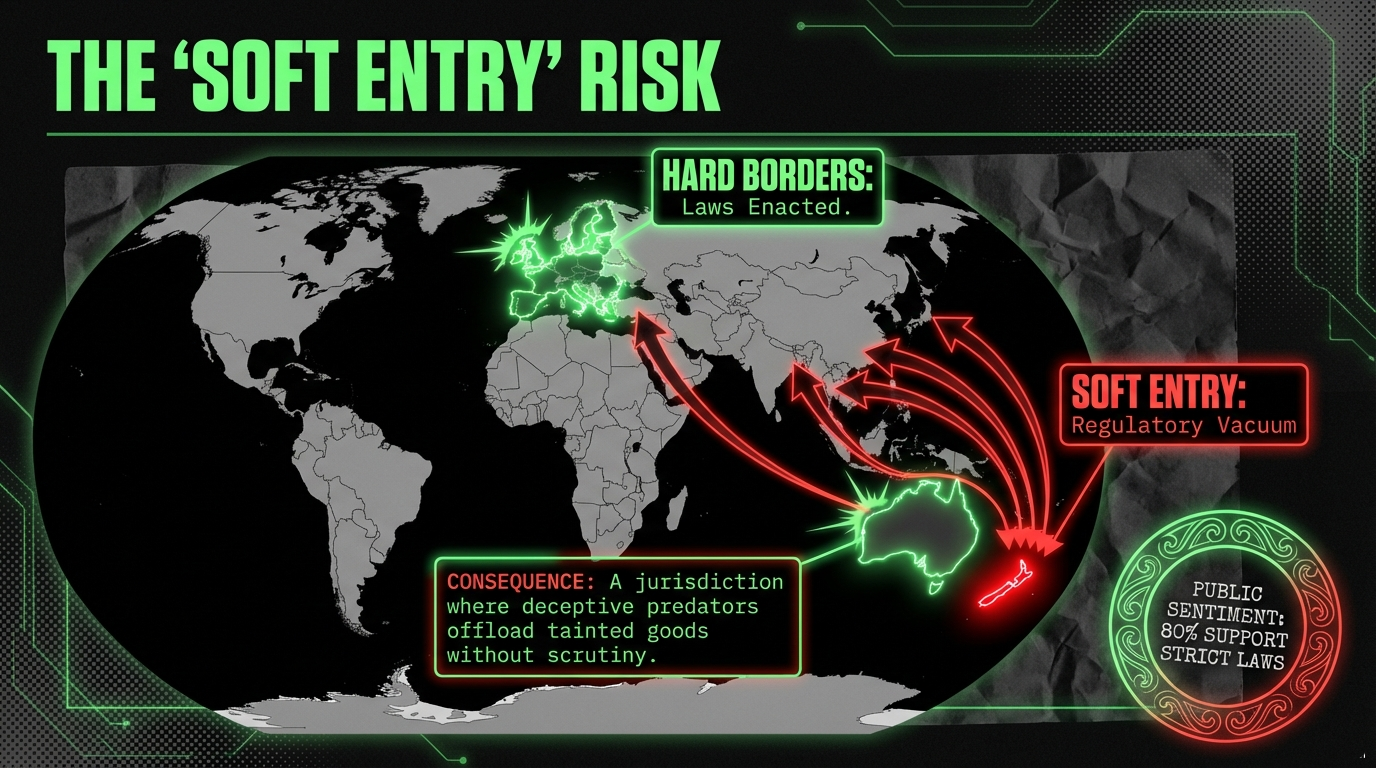
Aotearoa New Zealand risks becoming what the regulatory impact statement calls “a soft entry point for risky goods”—a jurisdiction where the unwary or the deliberately deceptive can offload the tainted fruits of exploitation without scrutiny. This is not a gap in the nation’s moral architecture; it is an invitation to predators.
The Investor Cartel Demands a Show
On 16 September 2025, a joint statement signed by 30 institutional investors and New Zealand businesses accounting for more than $264 billion in assets called for immediate modern slavery legislation. They are not motivated by conscience. They are motivated by ESG (Environmental, Social, Governance) ratings, reputational risk, and the threat of consumer backlash. An investor survey cited by World Vision showed that investors controlling more than $215 billion have demanded such legislation.
In essence:
capital has demanded that the state perform the role of moral referee so that capital can continue its extraction unimpeded—so long as the paperwork is in order.
The Public Polling Consensus
An 80% poll majority of New Zealanders support modern slavery legislation. This is not a fringe issue. It touches something primal in the national consciousness:
the cognitive dissonance between New Zealand’s self-image as an ethical, values-driven nation and the grinding reality that billions in imported goods are built on bondage.
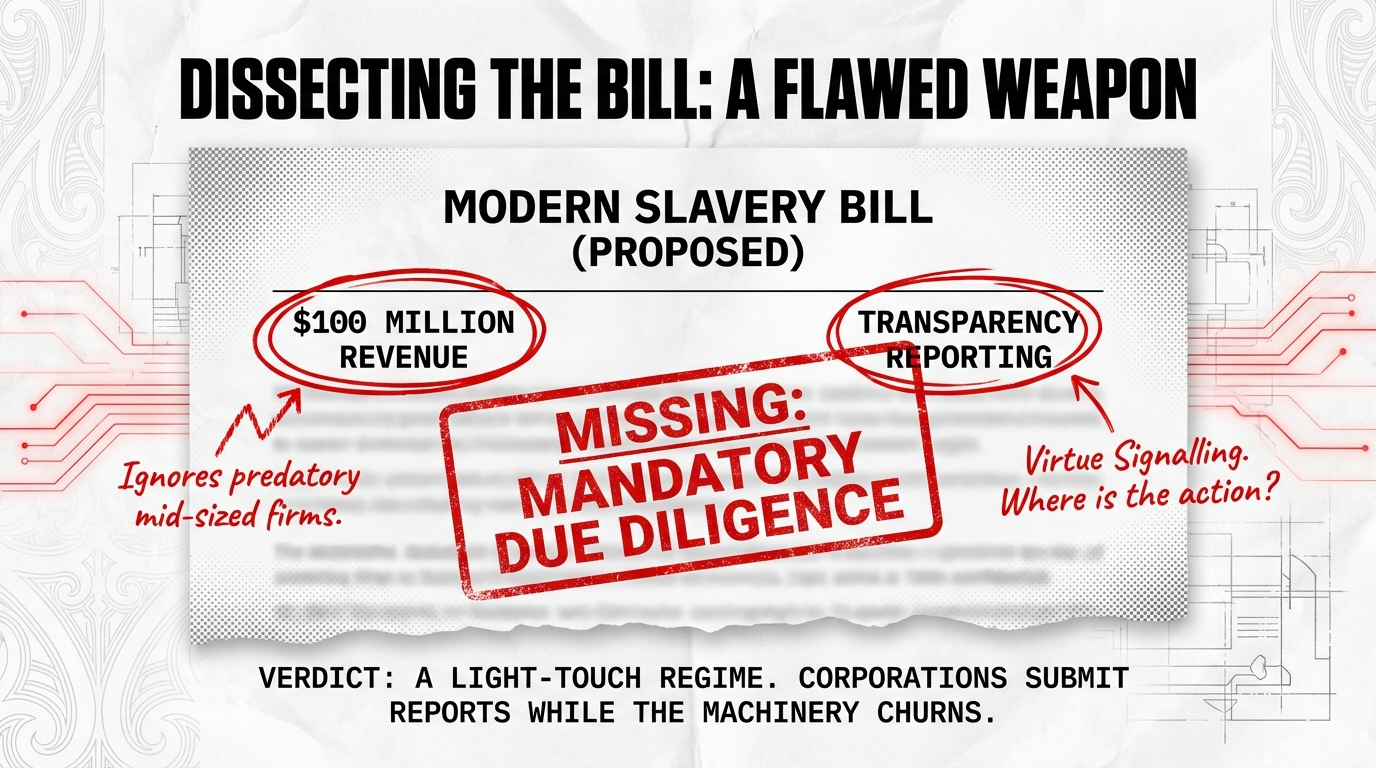
National and Labour are both responding to this pressure. They are performing the role of moral actors. But notice the architecture of their performance:
the bill targets only companies with revenue exceeding $100 million and relies primarily on transparency and reputational pressure rather than mandatory human rights due diligence.
It is a light-touch regime—one that allows the machinery of profit to continue churning while corporations submit annual reports documenting their “awareness” of slavery risks. It is virtue signalling encoded in legislation.
Why ACT Has Abstained: The Deregulation Fundamentalism
Brooke van Velden, ACT’s Workplace Relations Minister, did not say no to modern slavery legislation because she is indifferent to slavery.
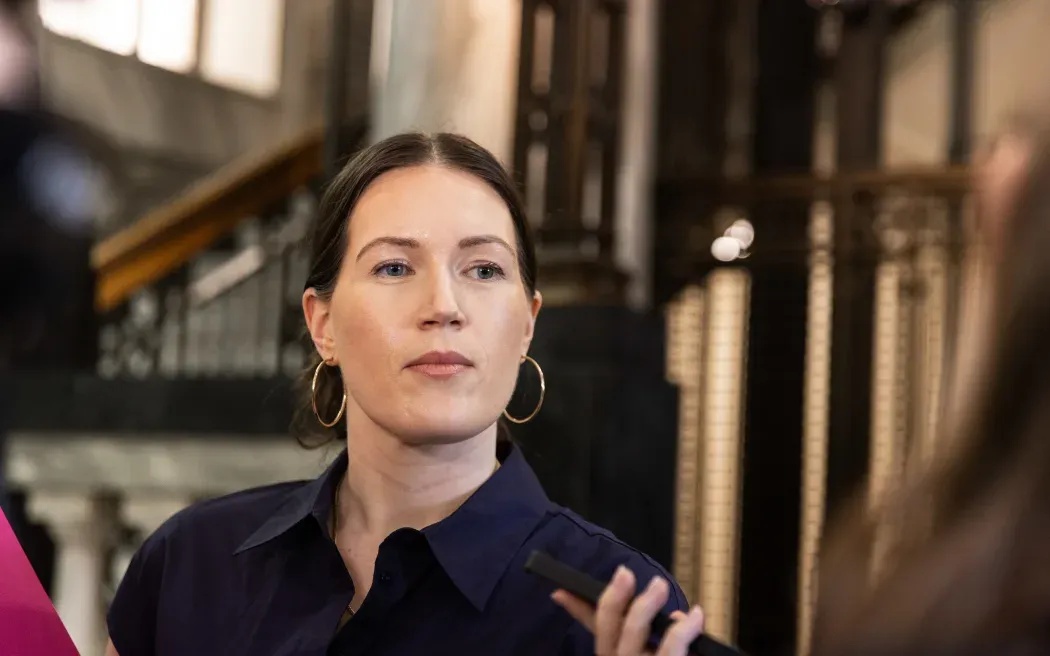
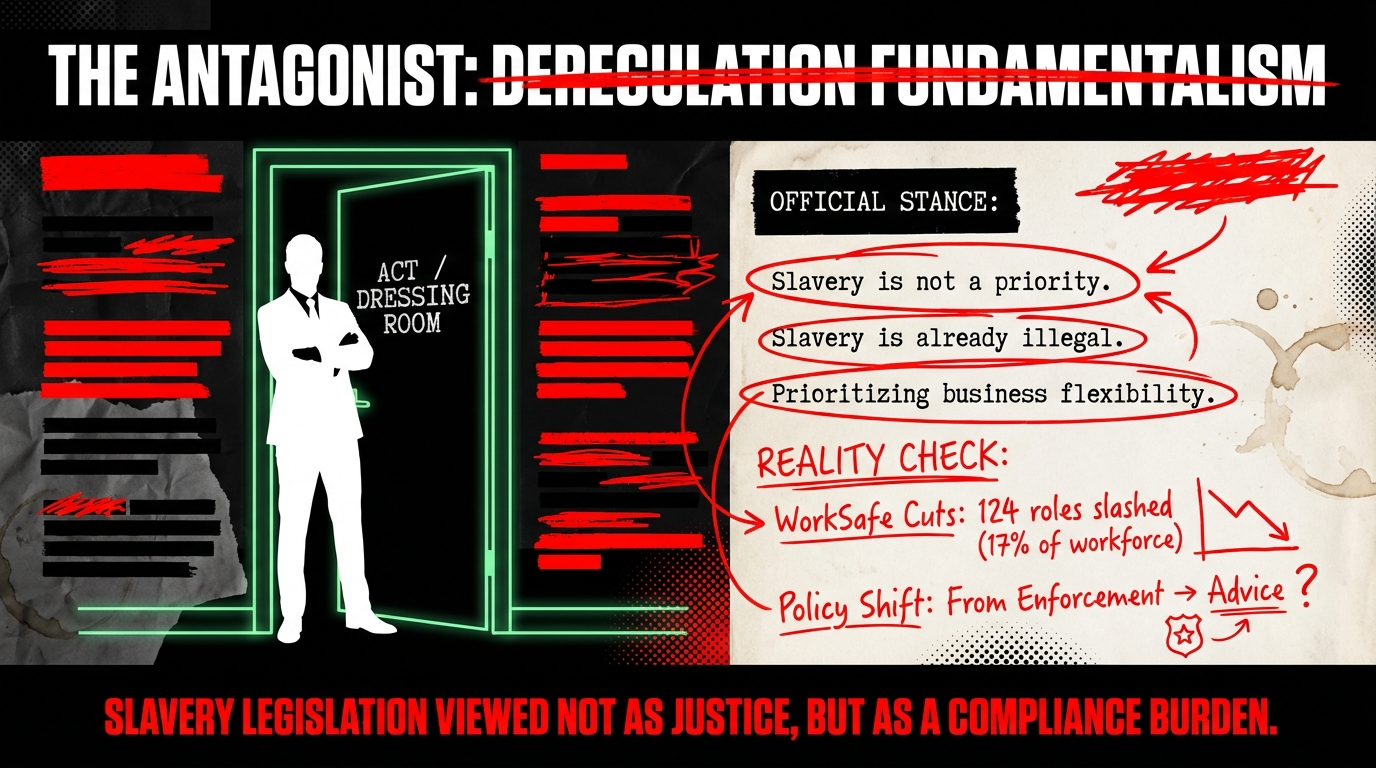
She said no because modern slavery legislation is “not a priority” and because modern slavery is “already illegal”. Both statements are technically true and profoundly misleading.
Slavery is already illegal—in the sense that murder is already illegal, yet we still need homicide detectives. The gap between law and enforcement, between theory and practice, is where exploitation metastasises. ACT’s rhetorical move is to treat this gap as non-existent, thereby justifying inaction.
The Deregulation Agenda
But ACT’s refusal is not primarily about slavery at all. It is symptomatic of a broader ideological mission: to subordinate state oversight to the demands of “business flexibility.”
Under van Velden’s leadership as Workplace Relations and Safety Minister, the government has shifted WorkSafe’s focus from enforcement to advice, cutting 124 permanent roles (more than 17% of the workforce) since 2023.
The stated aim:
to reduce compliance burden on businesses and foster a culture where business feels supported rather than surveilled.
Against this backdrop, modern slavery legislation appears to ACT not as a justice imperative but as another layer of regulatory constraint. It is a reporting regime, a compliance burden, a potential obstacle to “business flexibility.”
The Principled Incoherence
What makes ACT’s position particularly indefensible is that it collapses when examined.
This is not principled opposition. It is bureaucratic stonewalling disguised as principle.
If ACT truly believed slavery was adequately addressed by existing law, it could support additional transparency mechanisms as a way of assuring Aotearoa’s trading partners and investors. Instead, its silence suggests something more revealing: that ACT is willing to sacrifice workers—especially migrant workers, the most vulnerable and the least likely to vote—on the altar of deregulation.
Camilla Belich, the Labour MP co-sponsoring the bill, captured this precisely: ACT had shown “complete disregard for workers’ rights”.
The Machinery of Silence: How Bondage Persists
The Structural Vulnerability
Modern slavery thrives in Aotearoa not because laws are absent but because structural vulnerabilities are deliberately preserved.
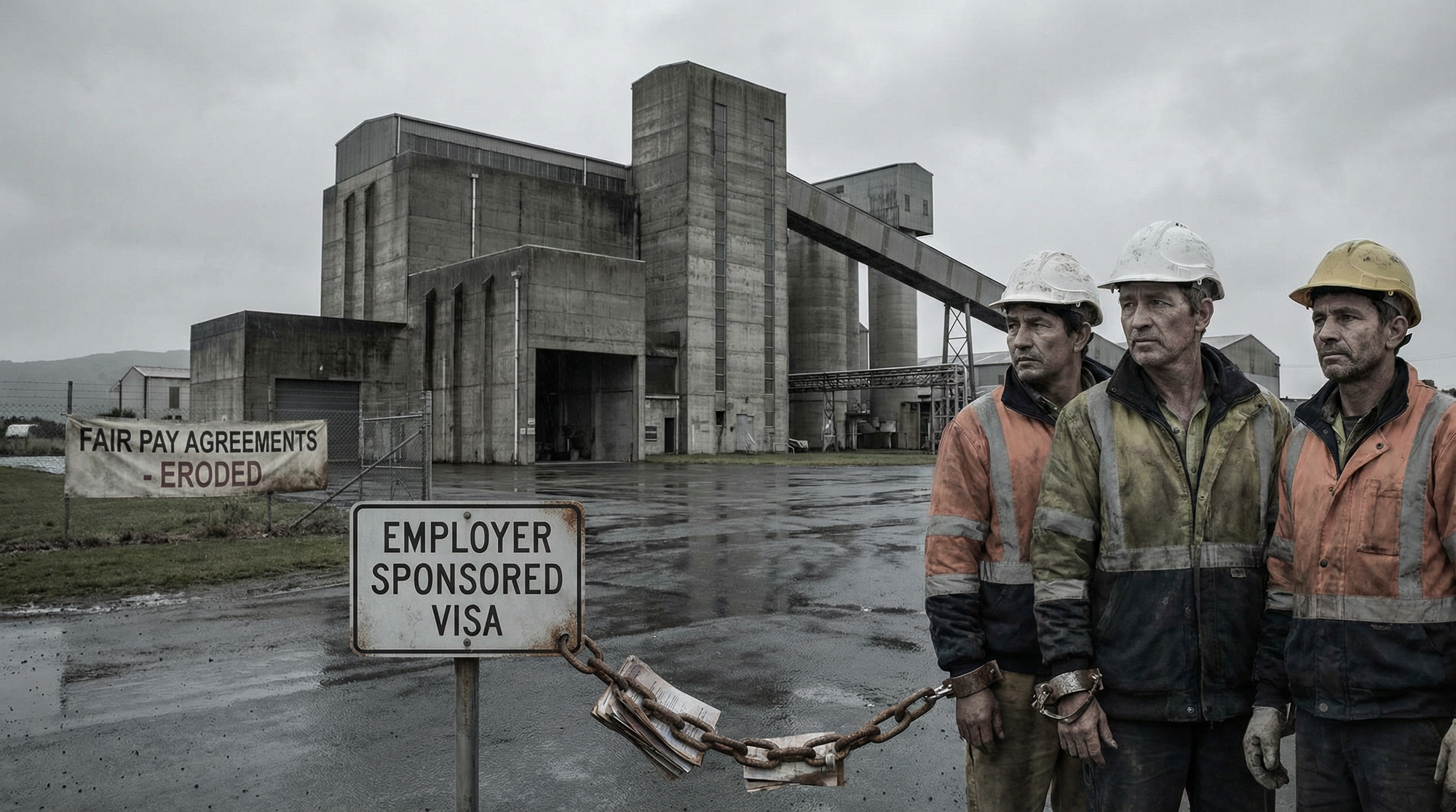
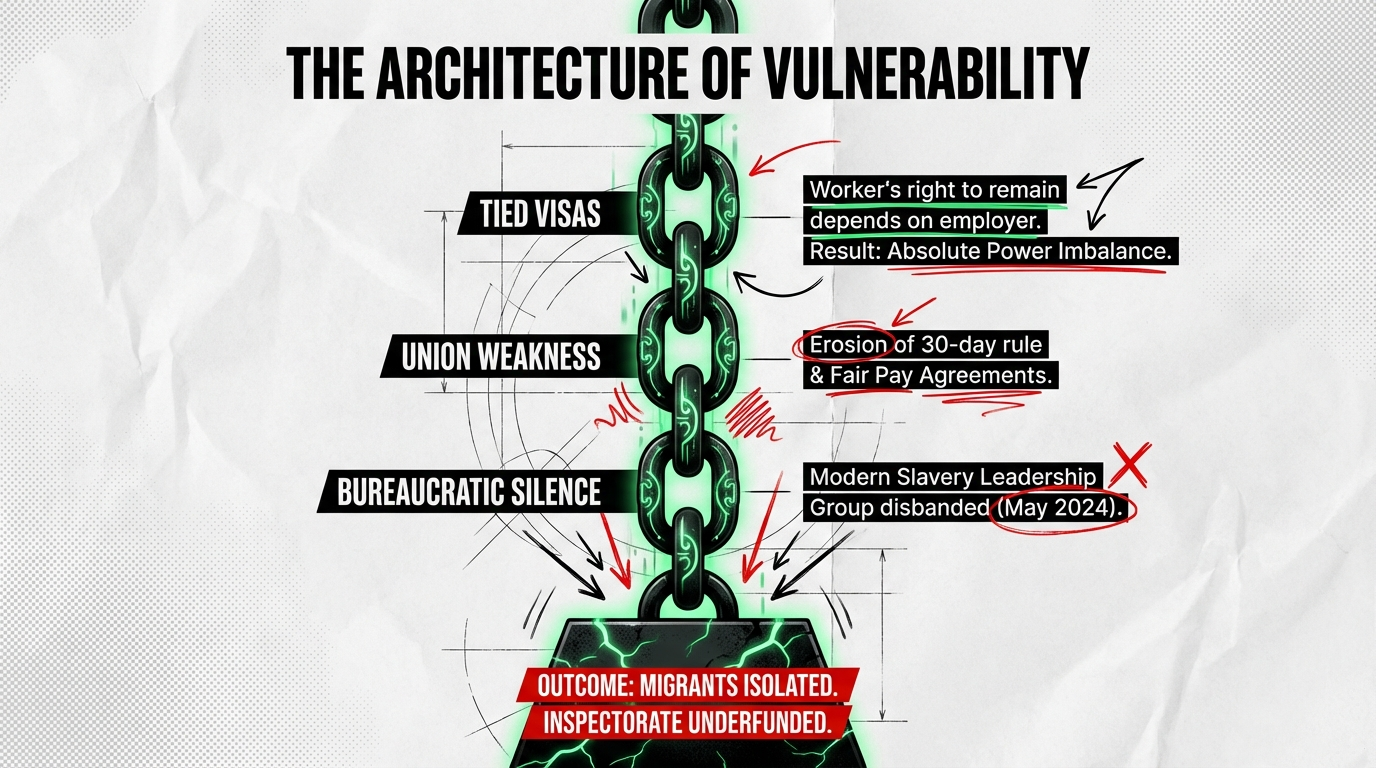
Temporary migrant workers account for approximately 235,000 people in New Zealand. Tied visa schemes—where workers’ right to remain in the country depends on continued employment with a specific employer—create an extreme power imbalance. An employer threatened with dismissal can threaten a worker with deportation. This is not an accidental oversight; it is systemic design.
The Enforcement Vacuum
What distinguishes the modern slavery crisis from other forms of exploitation is the bureaucratic vacuum in which it operates.
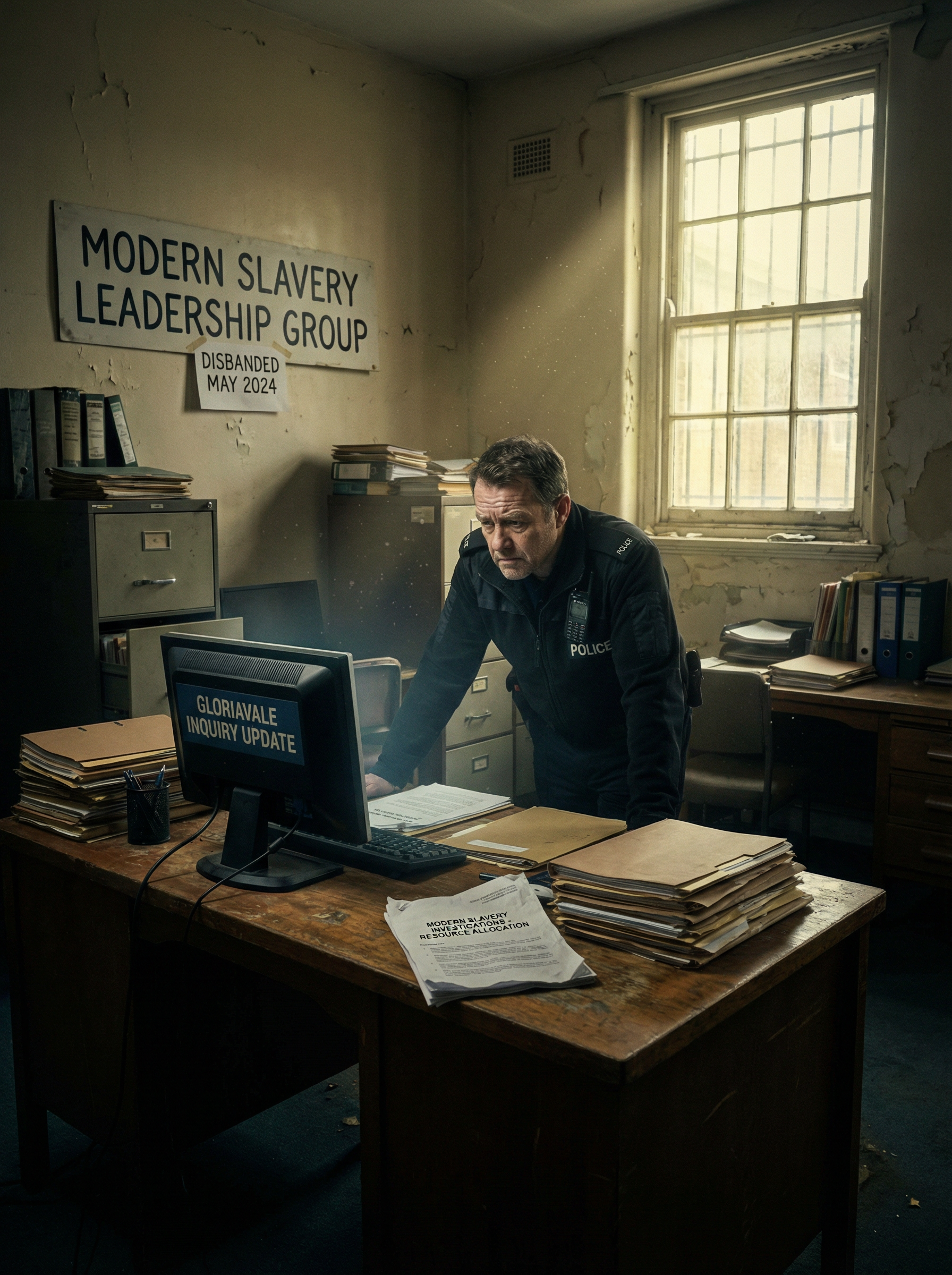
The government disbanded the modern slavery leadership group in May 2024. Expertise was scattered. Momentum evaporated. Meanwhile, police had 31 ongoing investigations into modern slavery—a number that should horrify a nation that prides itself on the rule of law.
The Gloriavale case is instructive. The Labour Inspectorate conducted two previous inquiries and found nothing, despite evidence that should have been immediately apparent to cursory investigation. Not because inspectors were stupid, but because the inspectorate was chronically underfunded, understaffed, and—critically—operating without a legislative mandate to see slavery in the context of labour relations.
Solutions: Rebuilding the Architecture of Protection
The bill proposed by National and Labour is a beginning, not a solution. But it is a beginning that ACT’s obstruction threatens to derail or dilute.
Immediate Legislative Imperatives
1. Lower the Reporting Threshold
The current bill targets only companies with $100 million-plus turnover. Specialists who drafted an alternative bill argue for a threshold of $50 million. This matters because mid-sized companies—the ones below the regulatory gaze—are often the most predatory. They lack the ESG infrastructure of multinationals but retain all the profit motive of exploitation.
2. Move from Reporting to Mandatory Due Diligence
Transparency alone is insufficient. Mandatory human rights due diligence—as implemented in the EU and under consideration in Canada—would require companies not merely to report risks but to actively identify, remediate, and be held accountable for slavery in their operations and supply chains.
3. Establish an Independent Anti-Slavery Commissioner
The bill foreshadows the creation of such a role. This commissioner must be resourced, independent of politics, and anchored in Te Tiriti principles. They must have investigative powers, the ability to compel testimony, and authority to recommend prosecutions.
Structural Reforms
4. Strengthen Migrant Worker Protections
Tied visa schemes must be reformed. Workers should have the right to change employers without losing visa status. The RSE (Recognised Seasonal Employer) scheme—which generates recurrent reports of exploitation, poor living conditions, and wage theft—must be subject to independent audits with binding remediation requirements.
5. Resource the Labour Inspectorate
Van Velden’s cuts to WorkSafe and the general deregulation agenda are starving the enforcement agencies of capacity. Enforcement must be restored as a core function. Inspectors must be trained in slavery identification. The inspectorate must be empowered to conduct unannounced inspections in high-risk sectors: agriculture, hospitality, domestic service, construction, and sex work.
6. Restore Collective Bargaining and Union Power
Modern slavery correlates with union weakness. ACT’s attack on the 30-day rule, fair pay agreements, and collective bargaining rights undermines the primary institutional check on exploitative practices. Reversing these reforms must be a priority for any government serious about worker protection.
Community-Led Solutions
7. Public Supply Chain Transparency Tools
If 10% of New Zealand’s imports are linked to modern slavery, households need accessible, searchable information about product risk. Government should fund development of a public database allowing consumers to check whether products they purchase are associated with documented slavery risks.
8. Unionise Migrant Workers
Migrant workers are union members in only a tiny fraction of cases. Funding for targeted unionisation campaigns—conducted in workers’ home languages, with culturally appropriate organising strategies—could transform migrant workers from isolated individuals into a collective force capable of resisting exploitation.
9. Decouple Work Visas from Employer Sponsorship
Open work visas that allow workers to change employers without penalty transform the power dynamic. Workers can report exploitation without facing deportation. Employers compete for workers based on conditions rather than controlling them through visa dependency.
Public Procurement
10. Tie Government Spending to Anti-Slavery Standards
Aotearoa’s government is a massive consumer of goods and services. Making public procurement contingent on verified anti-slavery practices would send market signals throughout the supply chain. It would reward ethical producers and penalise exploiters.
What the Theatre Reveals
National and Labour’s joint performance of moral clarity is real—but it is a performance that the machinery of extraction has already anticipated and accommodated. Their bill is a regulatory fence around the most visible manifestations of slavery while leaving the structural pathways to exploitation intact.
ACT’s refusal is the honest face of this apparatus. By refusing to prioritise modern slavery legislation, ACT has said aloud what National and Labour dance around: that the freedom of capital to exploit is more important than the freedom of workers to exist as human beings rather than commodities.
The tragedy is that the performance on stage—the bipartisan embrace, the promised reforms—will satisfy the voter, the investor, and the polling-obsessed politician. Meanwhile, in the darkness beyond the footlights, 8,000 New Zealanders will remain in bondage. Thousands of migrant workers will continue sleeping in cubicles. Children in closed communities will continue working without wages. And billions in imported goods will continue flowing into Aotearoa, their price tag including the stolen labour of the desperate.
Towards a Real Reckoning
What Aotearoa New Zealand needs is not a theatre of virtue but a machinery of accountability.
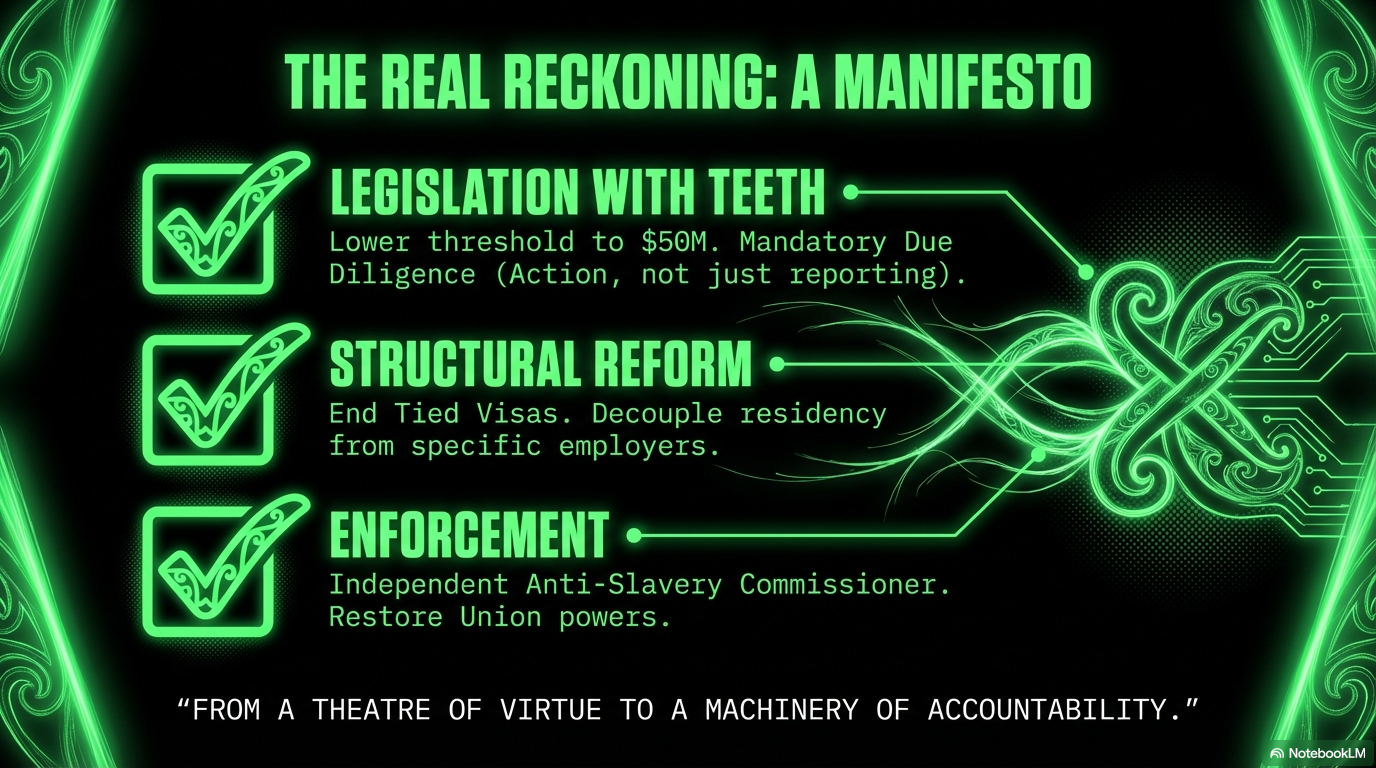
It needs:
- Legislation with teeth: mandatory due diligence, independent enforcement, significant penalties, and personal liability for executives.
- Investment in detection: properly funded inspectorates, specialist slavery investigators, and international cooperation to trace global supply chains.
- Power redistribution: the restoration and expansion of union rights, collective bargaining, and worker representation.
- Structural reform: the transformation of visa regimes, labour standards, and the legal architecture that makes workers disposable.
None of this will happen if ACT remains in a position to block progress. The bipartisan moment revealed by National and Labour’s forced alliance is evidence that such change is possible—that when the political calculus shifts, even rivals can act.
The question facing Aotearoa now is whether the performance on stage will be allowed to suffice. Or whether the 8,000 people in bondage, the children working without wages, the migrants sleeping in cubicles, and the billions in tainted goods flowing through our supply chains will finally demand something more than virtue signalling.
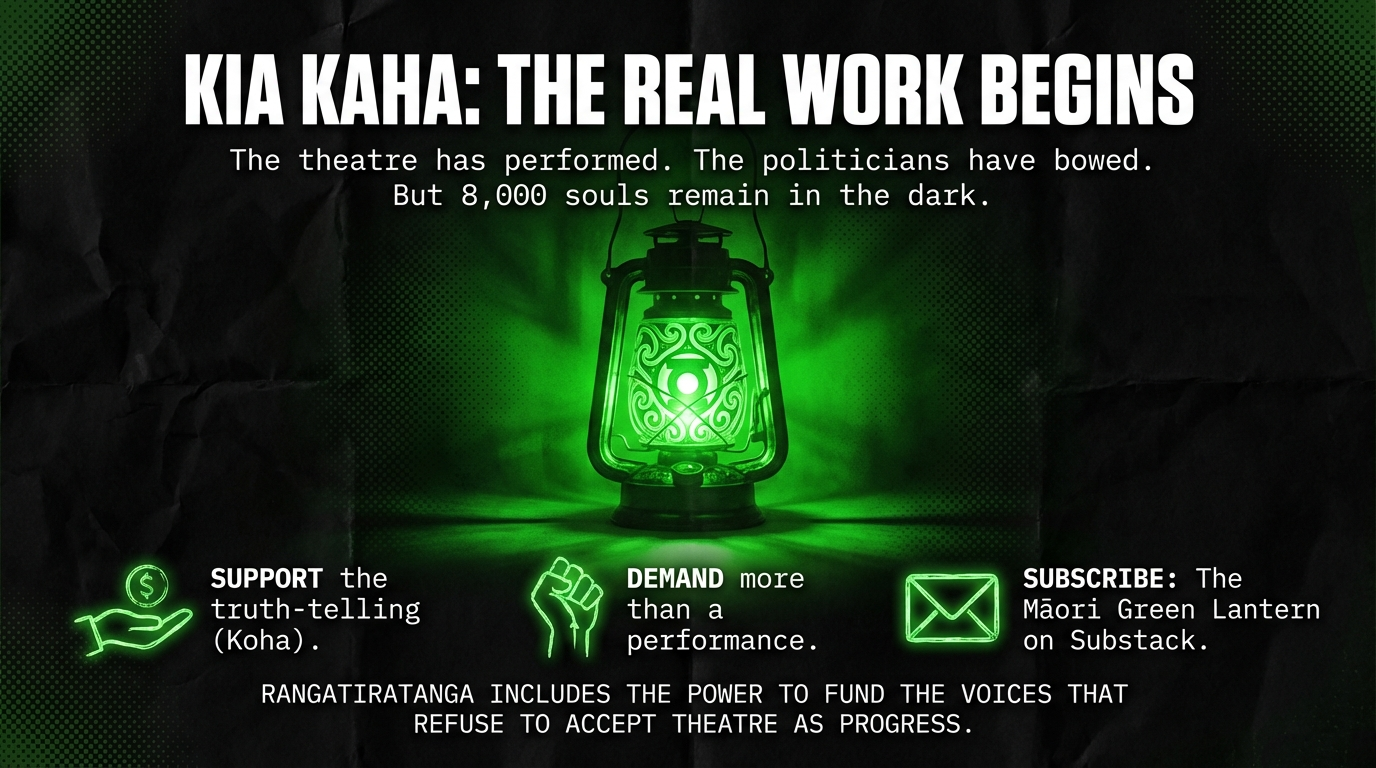
The theatre has performed. Now comes the real work.
Koha
Every koha signals that whānau are ready to fund the accountability that Crown and corporate structures will not provide—the truth-telling that exposes when National and Labour perform virtue while ACT openly defends the machinery of exploitation. It signals that rangatiratanga includes the power to fund the voices that refuse to accept theatre as progress.
Kia kaha, whānau. Stay vigilant. Stay connected. And if you are able, consider a koha to ensure this voice continues—to keep calling out the gap between political performance and real justice, between the applause for bipartisan gestures and the silence of 8,000 people in bondage.
Three pathways exist:
- For those who wish to support this mahi directly with a koha:
Koha—Support Modern Slavery Accountability - For those who wish to receive essays directly and support through subscription:
Subscribe to the Māori Green Lantern on Substack - For those who prefer direct bank transfer: HTDM, account number 03-1546-0415173-000
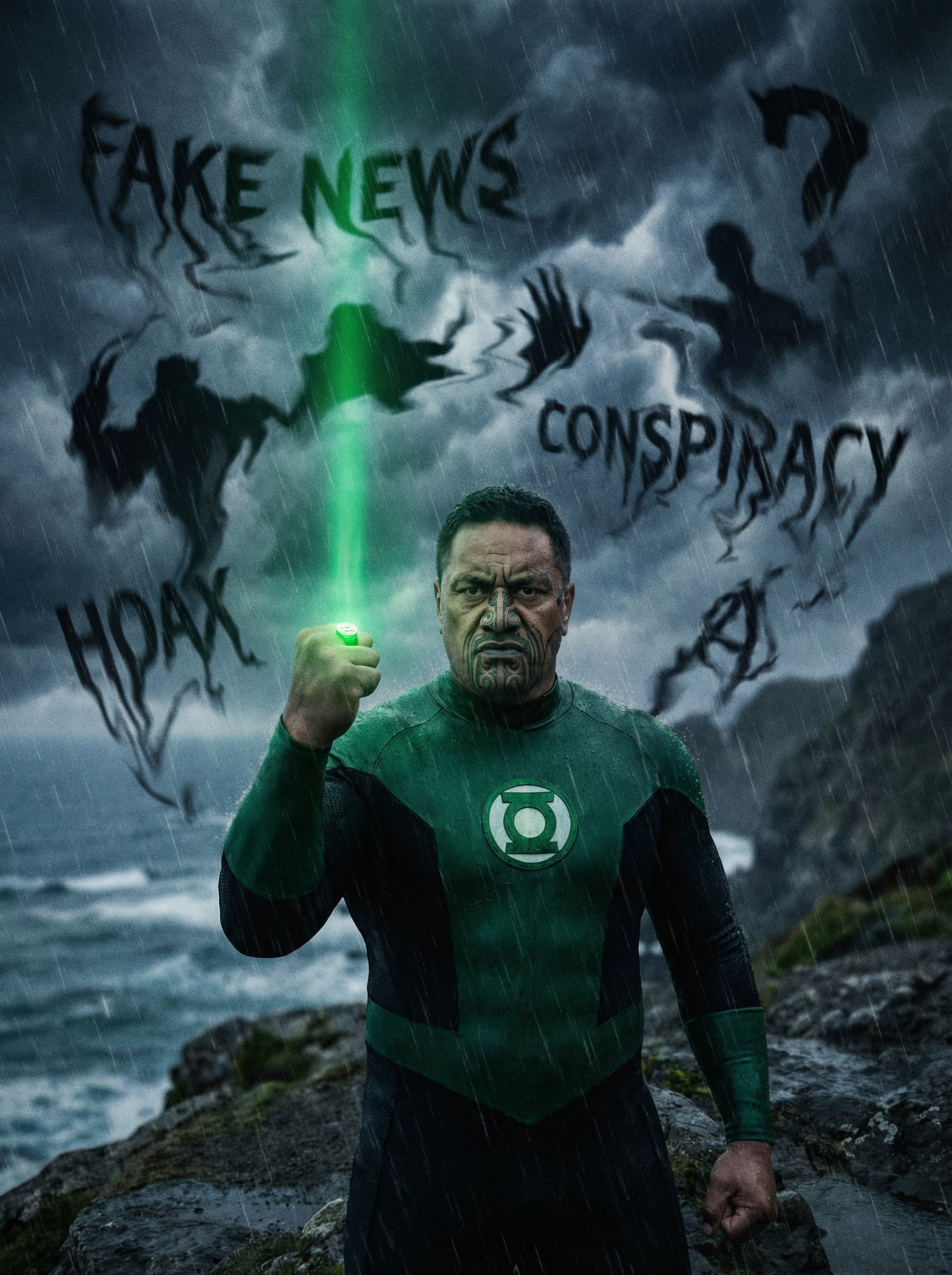
Ivor Jones The Māori Green Lantern Fighting Misinformation And Disinformation From The Far Right