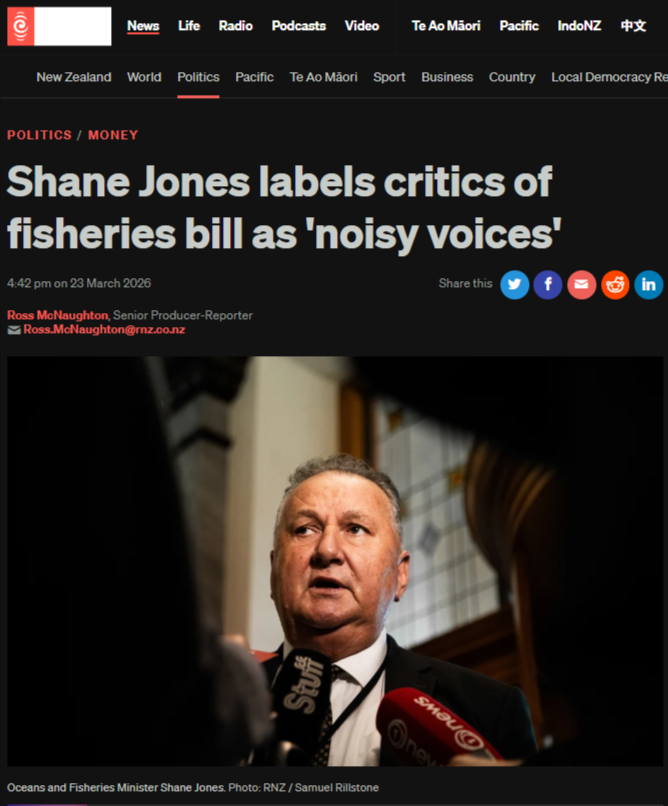
“The Trojan Horse Weaponising Aotearoa’s Constitution Against Māori and Whānau” - 13 November 2025
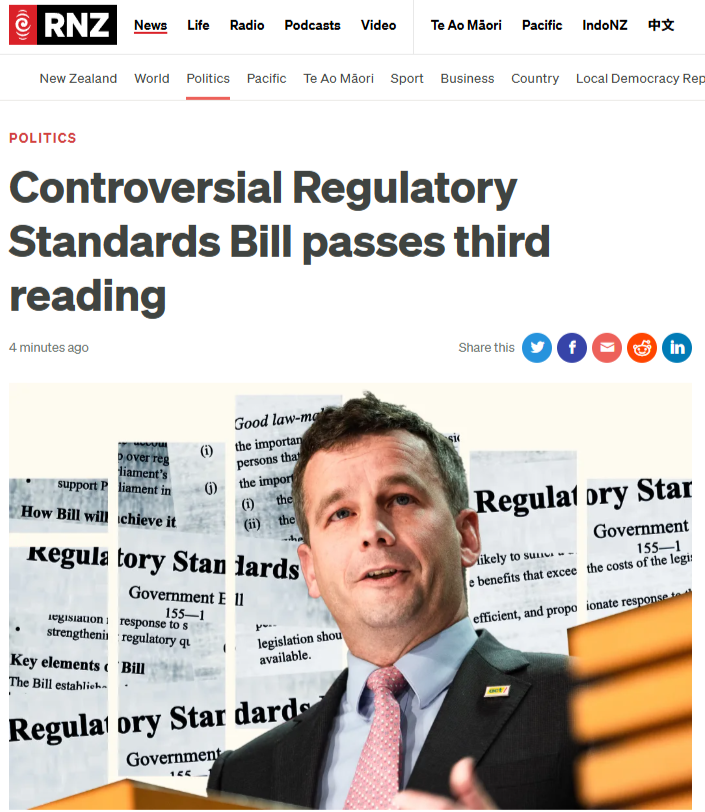
Regulatory Standards Bill Passes Third Reading
Kia ora whānau,
We gotta get this turd outta government asap!
The Regulatory Standards Bill—a piece of legislation sold to Aotearoa as a mechanism for reducing “red tape”—has now passed its third reading and will become law on January 1, 2026. What the bill’s architect, David Seymour, frames as transparent lawmaking is, in fact, a constitutional coup disguised as technocratic reform. Buried within its principles lies an ideological trap that will lock Aotearoa into a neoliberal framework hostile to Te Tiriti o Waitangi, Māori collective rights, environmental protection, and public health. The networks driving this bill stretch back two decades through international libertarian think tanks, with funding, personnel, and ideological DNA flowing directly from the US-based Atlas Network through Canadian training hubs to Seymour and the ACT Party. The bill will weaponise future governments against Māori equity initiatives and force Māori communities to pay corporations for the “loss of profits” when regulations protect indigenous rights. The Waitangi Tribunal has already named this a Treaty breach. Over 18,000 Māori and allies have mobilised against it. Yet the coalition government—driven by Seymour’s ideological vision and backed by corporate interests—has rammed it through with zero meaningful consultation with Māori.
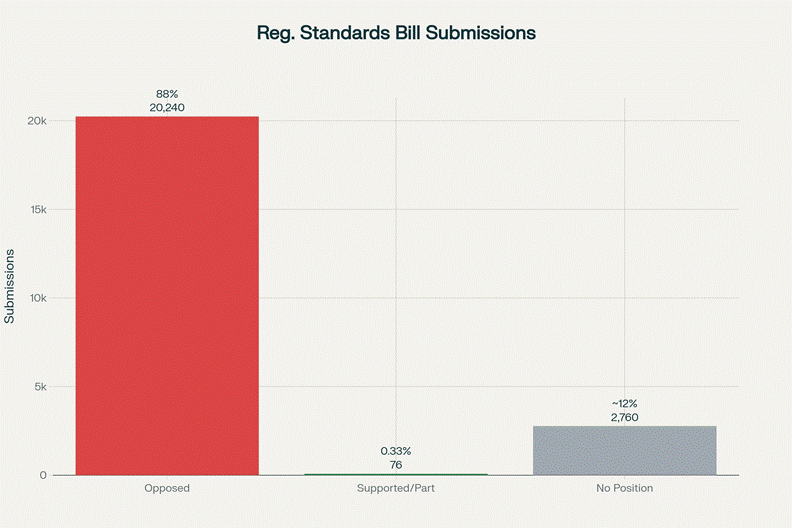
Public Opposition to the Regulatory Standards Bill (23,000 submissions)
The Ideological Architecture: Atlas Network Capture and the 20-Year Plot
The Regulatory Standards Bill is not new. Its intellectual DNA traces to the early 2000s, when economist Bryce Wilkinson—commissioned by the Business Roundtable (now merged into the libertarian New Zealand Initiative)—authored a foundational report proposing statutory regulatory principles. Wilkinson’s work was grounded in austere libertarian philosophy: property rights and economic efficiency over collective goods, indigenous rights, or environmental protection.[1]
This wasn’t a homegrown idea. The ideological architecture comes from the Atlas Network, a US-based organisation founded in the 1980s and explicitly modelled on F.A. Hayek and Milton Friedman’s principles of radical free-market libertarianism. The Atlas Network operates as what insiders call a “think tank that creates think tanks”—it funds, trains, and networks libertarian organisations globally to promote “individual liberty, property rights, limited government, and free markets”. In 2022 alone, Atlas had revenues of US$20.2 million (NZ$32.8 million), of which it distributed US$8.8 million (NZ$14.3 million) globally in grants for projects promoting “individual liberty”.[2][3]
The New Zealand branch of this network is well-documented. The Taxpayers’ Union is a direct Atlas Network partner and received approximately NZ$123,000 in grants in 2022. The New Zealand Initiative, formed in 2012 from the merger of the Business Roundtable and the New Zealand Institute, is another official Atlas partner. Both organisations operate as effective lobbying arms for corporate and libertarian interests, flooding media with coordinated messaging.[4][2]
David Seymour himself was trained within this network. In the 2000s, he worked for the Frontier Centre for Public Policy, an Atlas Network-affiliated think tank in Canada. This was not casual employment—the Frontier Centre operates as part of Atlas’s training pipeline, indoctrinating future policy actors in libertarian ideology and mentoring them to return to their home countries as agents of deregulation. Seymour’s international ideological apprenticeship was not coincidental; it was strategic placement.[3]
Even more telling: Debbi Gibbs, the former chair of the Atlas Network, had family links that helped found the ACT Party itself. This is not a conspiracy; it is structural capture. The same ideological network that funded and trained Seymour through international libertarian think tanks also engineered the rise of the ACT Party as New Zealand’s libertarian vanguard.[3]
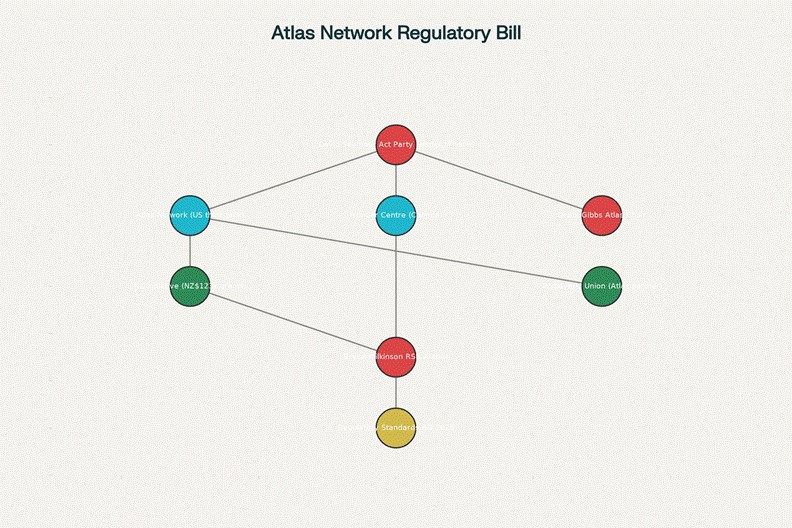
The Atlas Network’s Regulatory Standards Bill: Ideological Capture Whakapapa
The bill passed third reading with ACT, National, and NZ First voting for it; Labour, the Greens, and Te Pāti Māori voting against. Seymour’s political investment has paid off. What was rejected three times (in 2006, 2011, and 2021) has now been locked into law by coalition agreement—a structure deliberately designed to prevent National and NZ First from abandoning the bill even as criticism mounted.[5][1][6]
The Democratic Sham: 88% Public Opposition Ignored
The bill’s lack of democratic legitimacy is stark. The Ministry for Regulation received 23,000 public submissions during consultation. Of these, 88% opposed the bill (approximately 20,240 submissions), 0.33% (76 submissions) supported or partially supported it, and about 12% had no clear position. Put bluntly: the government received near-universal public rejection and proceeded anyway.[1][7][8]
Even more damning, approximately 80% of these submissions arrived in the final four days of consultation—a mobilisation of public opposition that Seymour attempted to dismiss by alleging that submissions were generated by “bots”. The allegation is baseless; it was grassroots mobilisation by whānau, workers, environmental advocates, and Māori sensing existential threat.[9][1]
The Waitangi Tribunal’s interim report, released after an urgent one-day hearing on May 15, 2025, found that the Crown’s policy development for the bill occurred without targeted engagement with Māori—a violation of Te Tiriti principles of partnership and active protection. The Tribunal explicitly stated that “if the Regulatory Standards Act were enacted without meaningful consultation with Māori, it would constitute a breach of the principles of the Treaty of Waitangi”. The government ignored this warning. The Tribunal recommended an “immediate halt” to the bill’s advancement. Seymour responded by dismissing the Tribunal itself, calling it a “parallel government” and questioning its authority.[10][11]
This is the template of authoritarianism: mobilise corporate money, lock coalition partners into binding agreements, dismiss democratic feedback as misinformation, and override indigenous consultation obligations.
The Mauri-Depletion Trap: Māori Forced to Compensate Corporations for Their Own Dispossession
The bill’s most dangerous provision is its “regulatory takings clause”—Principle 3, the “taking of property.” This principle states that legislation should not “take or impair” property without the owner’s consent unless there is “a good reason” and the person is compensated. This sounds neutral. It is not.[12]
Under New Zealand law, corporations have many of the same legal rights as people. Applied to the real world, this means that if government regulation decreases corporate profits, the corporation can claim compensation. An agribusiness corporation that pollutes waterways can claim property loss if regulation restricts the pollution. A fossil fuel company can claim property loss if government halts oil and gas exploration. A logging company can claim loss if government restricts forestry to protect endangered species.[12]
But the trap for Māori is deeper. The bill’s compensation principle states that compensation for “taking of property” should be provided “by or on behalf of the persons who obtain the benefit of the taking or impairment”. This means that when legislation benefits Māori by protecting indigenous rights (honours Te Tiriti), it is Māori who may be legally compelled to compensate the corporation for its loss of profits.[12]
This is mauri-depletion at constitutional level. It forces Māori to pay for their own dispossession. A government measure protecting Māori land rights from corporate encroachment? Māori pays the corporation. A regulation protecting Māori fisheries from commercial overharvesting? Māori pays the corporation. Environmental regulations protecting taonga (sacred resources)? Māori communities absorb the compensation bill.
This is not speculative. Regulatory takings clauses identical to this have been weaponised globally by corporations against public health, climate, and indigenous protection measures. In the United States, regulatory takings litigation has been used to block environmental regulations, tobacco control measures, and indigenous rights protections. The Canadian government has faced billion-dollar claims from corporations alleging regulatory takings for environmental measures. This is the playbook being imported to Aotearoa.[13][14]
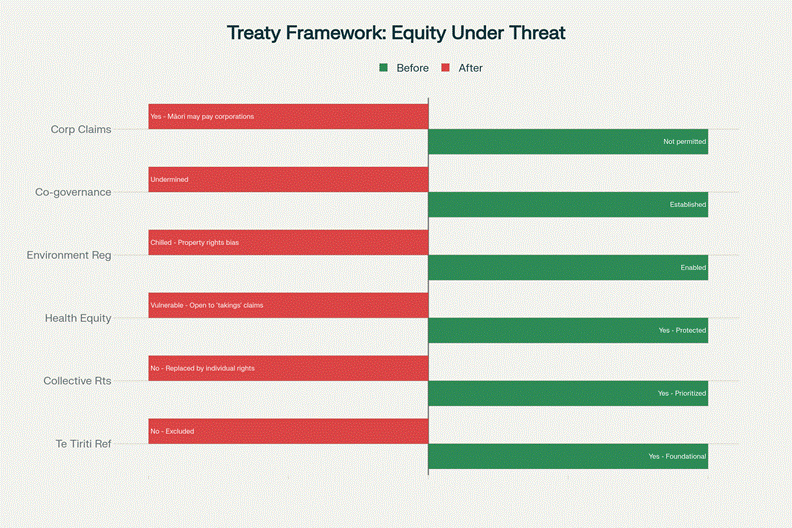
Treaty Protection Framework: Māori Health Equity Under Threat
Treaty Breach by Design: The Exclusion of Te Tiriti o Waitangi
The bill’s most politically glaring feature is its silence on Te Tiriti o Waitangi. The bill sets out eight principles of “responsible regulation,” none of which explicitly reference the Treaty. This is not an oversight. It is deliberate constitutional exclusion.[1][15][7]
The bill includes a principle stating “every person is equal before the law“—language lifted directly from Seymour’s earlier Treaty Principles Bill, which was voted down by Parliament after mass hikoi and public pressure. This seemingly neutral language is a Trojan horse. By enshrining “equality before the law” as a supreme regulatory principle while excluding Te Tiriti, the bill creates a framework hostile to equity-focused regulation designed to address historic injustices.[16][17]
Professor Jane Kelsey, an emeritus law professor and long-time critic of the bill, has documented how the bill’s principles operate to exclude Treaty-informed lawmaking “by stealth and without the consent of Māori as Treaty partner“. The Ministry of Justice itself warned that the bill “fails to recognise Te Tiriti’s constitutional significance or the Crown’s obligations under it” and is not aligned with the Bill of Rights Act.[18][19]
Thanks for reading Ivor Jones The Māori Green Lantern! This post is public so feel free to share it.
The Waitangi Tribunal’s second report on the Treaty Principles Bill (a companion piece to the RSB, as both seek to rewrite constitutional foundations) found that the Crown’s Cabinet decisions were breaches of Treaty principles of tino rangatiratanga (self-determination), kāwanatanga (governance), partnership, and active protection. These findings apply directly to the Regulatory Standards Bill as well—a bill designed to institutionalise the same exclusion of Māori rangatiratanga and the same dismantling of Treaty-informed governance.[17]
Māori Mobilisation and the Tribunal’s Warning
Over 18,000 Māori and supporters registered as claimants in Toitū te Tiriti’s urgent claim to the Waitangi Tribunal. The claim alleges that if enacted, the bill would breach Te Tiriti and cause significant prejudice to Māori. Lawyer Tania Waikato, representing the claimants, described the bill as enabling “constitutional warfare“ and argued that the bill would alter “the constitutional arrangements between the Crown and Māori under te Tiriti by stealth, and without consent by Māori as Treaty partner”.[10][20][21]
Eru Kapa-Kingi, spokesperson for Toitū te Tiriti, articulated the stakes clearly: the bill gives the Minister of Regulation (currently Seymour) broad powers to review legislation that could undermine Te Tiriti protections. Because Seymour appoints the Regulatory Standards Board (the board has since been restructured slightly to require Governor-General sign-off, but the minister’s influence remains dominant), he effectively controls the mechanism by which future laws are judged against neoliberal principles.[1][20]
Senior law lecturer Carwyn Jones, in evidence to the Tribunal, stated that the Crown’s actions were “as serious and as dangerous as the Treaty Principles Bill“—a finding that recognises the bill as a “combined legislative pincer movement” with the Treaty Principles Bill. The intent is the same: dismantle Treaty protections through constitutional rewriting.[21]
Thanks for reading Ivor Jones The Māori Green Lantern! This post is public so feel free to share it.
Lady Tureiti Moxon, a Māori health leader, welcomed the Tribunal’s report and called it a warning of “a serious constitutional threat to Māori rights and Te Tiriti o Waitangi”. She highlighted the danger of the bill’s “equality before the law” principle: “Equality assumes a level playing field—but for Māori, the field has been tilted against us for generations. This Bill promotes a version of fairness that ignores our history, overlooks injustice, and threatens the very laws and policies designed to address those harms that currently exist”.[10]
Health Equity and Environmental Protection Under Siege
The bill’s threat to Māori health and environmental protection is immediate and quantifiable. The Ministry of Health’s Whakamaua: Māori Health Action Plan 2020–2025 explicitly prioritises achieving health equity for Māori through targeted, culturally appropriate interventions. These policies acknowledge that Māori health disparities stem from colonisation and are locked in by decades of systemic neglect and discrimination. Equity requires targeted action.[22]
Under the Regulatory Standards Bill, such targeted action becomes vulnerable. Any Māori health programme—whether targeted mental health services, nutrition initiatives, or disease prevention focused on Māori communities—could be challenged as violating the principle of “equality before the law.” A tobacco company facing marketing restrictions could claim a regulatory taking. A pharmaceutical corporation facing biosecurity or price regulation could demand compensation.
Dr. George Laking, an associate professor of medicine and clinical Māori director at the Centre for Cancer Research at Auckland University, warned that the bill “will stop lawmakers from taking broader public health considerations into account”. He said the bill attempts to “narrow the frame for what’s considered to count as being relevant” in health regulation and that using such a “blunt instrument” on health policy is dangerous.[23]
The Ministry for the Environment submitted to Cabinet that the bill’s proposals “conflict with the principles of New Zealand’s environmental and climate systems which focus on balancing short-term and longer-term interests, and collective, rather than individual, interests”. Māori environmental frameworks—based in rangatiratanga, kaitiakitanga (stewardship), and collective wellbeing—directly contradict the bill’s emphasis on individual property rights and short-term economic value.[21]
The Coalition Government’s Abdication of Responsibility
What makes this passage particularly brazen is that the government knows the bill lacks democratic mandate and violates Treaty obligations, yet has proceeded anyway. The Ministry for Regulation’s own regulatory impact statement stated that the bill was “poorly consulted on” and “hasn’t got a problem that it needs to address”. The Ministry of Regulation itself expressed ambivalence, suggesting that an “enhanced disclosure statement regime” would achieve similar benefits at far lower cost.[5][1][6]
Yet Seymour, empowered by his position as Minister for Regulation and backed by coalition agreement, has bulldozed the bill through Parliament. Coalition partners National and NZ First, bound by coalition agreements that require their support for “The” Regulatory Standards Bill, have abandoned any meaningful scrutiny. This is political capture in real time: a minority party (ACT received only 8% of the 2023 general election vote) imposing its ideological vision on the country through coalition mechanics.[1][24]
Thanks for reading Ivor Jones The Māori Green Lantern! This post is public so feel free to share it.
Prime Minister Christopher Luxon and his government have chosen to treat Te Tiriti o Waitangi as optional—a choice the Waitangi Tribunal has explicitly condemned as a breach. The Crown’s pattern (repeated refusal to consult Māori meaningfully, fast-tracking legislation despite Tribunal warnings, dismissing indigenous concerns as “fearmongering” and “bots”) reveals an administration willing to subordinate constitutional obligations to corporate interests and libertarian ideology.[10]
International Context: The Atlas Network’s Global Project
The Regulatory Standards Bill is not an aberration; it is part of a global strategy by the Atlas Network to embed libertarian frameworks into law across the world. The Atlas Network has 581 partners in over 100 countries, funding projects from Costa Rica’s pension “reforms” to the Philippines’ “Foundation for Economic Freedom” focused on property rights over collective welfare.[3]
Importantly, the Atlas Network has received funding from the Charles Koch Foundation, the Lynde and Harry Bradley Foundation, and historically from ExxonMobil itself (though it claims to have ceased oil and gas funding “nearly 15 years” ago). This is not grassroots libertarianism; it is oligarchic capture of policy through think tanks funded by billionaires and fossil fuel interests.[3]
New Zealand is a test case. If Seymour’s bill succeeds in locking Aotearoa into regulatory takings and “equality before the law” principles, it will be replicated elsewhere. The Regulatory Standards Bill is a template for constitutional capture—a model by which neoliberal think tanks, working through local political actors, can rewrite fundamental law to privilege property rights and corporate interests over indigenous rights, collective welfare, and environmental protection.
Thanks for reading Ivor Jones The Māori Green Lantern! This post is public so feel free to share it.
Implications: Quantified Harm to Whānau and Rangatiratanga
The passage of this bill to law on January 1, 2026 will produce measurable harms:
1. Māori Health Equity at Risk
Targeted health interventions for Māori communities (addressing disparities in heart disease, diabetes, suicide, maternal mortality) will face regulatory and legal headwinds. Corporations will have grounds to challenge public health regulations as regulatory takings. Estimated annual cost to Māori health equity programmes: $millions in legal defence and compensation claims.
2. Environmental and Climate Regulation Chilled
New Zealand’s climate adaptation obligations (signed under international agreements) will face delays and cost increases as companies challenge climate regulations as takings. The Health National Adaptation Plan’s focus on collective wellbeing and long-term resilience will clash with the bill’s individual property-rights framework. Estimated cost: billions in delayed climate action and increased climate disaster impact on vulnerable communities (disproportionately Māori).[25]
3. Constitutional Subordination of Te Tiriti
By excluding Te Tiriti from regulatory principles while elevating “equality before the law,” the bill institutionalises the Treaty’s demotion. Future governments cannot prioritise Te Tiriti principles without defending those choices against the RSB’s neoliberal filter. This constitutes a de facto rewriting of the Constitution, achieved without referendum or broad democratic consent.
4. Corporate Compensation Claims Burden Māori Communities
Māori iwi and hapū seeking to protect taonga (sacred resources), fisheries, and forests will face compensation claims from corporations whose profits are affected by regulation. Estimated liability: hundreds of millions of dollars as corporations litigate over regulatory takings.
Rangatiratanga Action and Constitutional Reclamation
Ko Ivor Jones, tōhunga mau rākau wairua. The taiaha has cut through the fog. The Regulatory Standards Bill is constitutional warfare by stealth—a mechanism by which international libertarian networks, operating through New Zealand’s coalition government, are attempting to lock Aotearoa into a legal order hostile to Te Tiriti o Waitangi, indigenous self-determination, and collective wellbeing.
The Waitangi Tribunal has named it a Treaty breach. Over 18,000 whānau have mobilised against it. Yet the government has rammed it through to become law January 1, 2026.
The response is clear:
Immediate legal action: Iwi and hapū should prepare for judicial review. The bill’s exclusion of Te Tiriti, its lack of targeted Māori consultation (admitted by the Crown), and its material breach of Treaty principles create grounds for constitutional challenge before the bill takes effect.Regulatory defiance: Māori councils, kura, and health services should plan now to interpret and apply the Regulatory Standards Bill in ways consistent with Te Tiriti and tikanga, not neoliberal principles. Use the bill’s own language of “transparency” to name its ideological bias and refuse compliance.Sustained political mobilisation: The hīkoi mō Te Tiriti demonstrated that mass Māori mobilisation can shift political pressure. This moment requires sustained pressure—hikoi, occupation, media strategy—to demand the government either repeal the bill or entrench explicit Te Tiriti and tikanga Māori principles within it.International accountability: Report the bill to United Nations bodies monitoring indigenous rights compliance (UN Permanent Forum on Indigenous Issues, UN Human Rights Committee). Name the Atlas Network’s role. Demand international pressure on New Zealand’s Crown to comply with Te Tiriti and international indigenous rights covenants.Knowledge reclamation: This moment calls for tohunga and kaitiaki to speak publicly about the mauri-depleting nature of neoliberal regulation. Mātauranga Māori frameworks—whakapapa, rangatiratanga, kaitiakitanga, whanaungatanga, manaakitanga—must be articulated as constitutional alternatives to individual property rights and market rationality.
The bill has passed third reading. It becomes law January 1, 2026. But law made in breach of Te Tiriti is not legitimate law. Kia kaha, kia tū.
Ka tū, ka tū, ka tū.

Ivor Jones The Māori Green Lantern Fighting Misinformation And Disinformation From The Far Right
Citations
RNZ Political News (November 13, 2025) - “Controversial Regulatory Standards Bill passes third reading”[5]
RNZ (June 9, 2025) - “The Regulatory Standards Bill: What is it, what does it propose”[1]
RNZ (November 3, 2025) - “Regulatory Standards Bill passes second reading after heated debate”[6]
Wikipedia (March 3, 2025) - “Regulatory Standards Bill”[26]
New Zealand Initiative (May 25, 2025) - “Dr Bryce Wilkinson on the Regulatory Standards Bill”[27]
Wikipedia (2005) - “New Zealand Initiative”[4]
1of200.nz (November 19, 2024) - “Toitū Te Tiriti: The Treaty Principles Bill and the Dark Money”[28]
RNZ (June 14, 2025) - “Regulatory Standards Bill will stop lawmakers considering broader public health”[23]
RNZ (May 22, 2025) - “Regulatory Standards Bill passes first reading”[15]
Te Ara Māori (2012) - “Law” entry on Treaty protections and Māori Land Court[29]
Public Service Association (April 4, 2024) - “Understanding Atlas: how a right-wing network is building power”[2]
New Zealand Herald (February 5, 2025) - “Regulatory Standards Bill is extreme and unjustified”[9]
Te Ao News (November 4, 2025) - “Regulatory Standards Bill clears second reading”[30]
RNZ (October 15, 2025) - “Constitutional experts shrug off Regulatory Standards Bill changes”[24]
RNZ (June 15, 2025) - “Why opponents and supporters of the Regulatory Standards Bill disagree”[16]
Greenpeace Aotearoa (July 27, 2025) - “The Regulatory Standards Bill is Seymour’s next power grab”[18]
E-Tangata (May 30, 2025) - “How the Regulatory Standards Bill gives companies more rights”[12]
Wikipedia (April 23, 2005) - “Atlas Network”[3]
Waitangi Tribunal (May 15, 2025) - “Tribunal releases report on proposed Regulatory Standards Bill”[11]
RNZ (May 15, 2025) - “Waitangi Tribunal recommends ‘immediate halt’ to Regulatory Standards Bill”[10]
New Zealand Herald (May 13, 2025) - “Regulatory Standards Bill faces backlash at urgent hearing”[31]
Equal Justice Project (July 1, 2025) - “A New Name, the Same Agenda: The Dangers of the Regulatory Standards Bill”[19]
RNZ (May 14, 2025) - “Waitangi Tribunal hears evidence against ‘dangerous’ bill”[21]
RNZ (April 30, 2025) - “Regulatory Standards Bill claim accepted for urgency by Waitangi Tribunal”[20]
The Spin Off (May 14, 2025) - “Waitangi Tribunal hears evidence against another ‘dangerous’ bill”[21]
New Zealand Herald (January 13, 2025) - “The Regulatory Standards Bill: What you need to know”[7]
Ministry of Health (2024) - “New plan outlines adaptation to the health impacts of climate change”[25]
New Zealand Herald (November 25, 2024) - “Treaty Principles Bill is harmful and false”[32]
New Zealand Herald (December 31, 2016) - “Citizen Thiel”[33]
Cornell Law (July 24, 2016) - “Regulatory Takings: General Doctrine”[14]
Georgetown University Scholarship (1999) - “Basic Themes For Regulatory Takings Litigation”[13]
Elections NZ (2008–2024) - “Party donations and loans by year”[34]
Ministry of Health (2020) - “Whakamaua: Māori Health Action Plan 2020–2025”[22]
Public Health Expert Briefing (June 12, 2025) - “Regulatory Standards Bill threatens the public interest”[35]
MATA with Mihingarangi Forbes (July 14, 2024) - RNZ Radio programme on Māori political resistance[36]
New Zealand Herald (February 19, 2025) - “1984 Revolution part I: The rise of Rogernomics”[37]
RNZ (November 7, 2024) - “The Treaty Principles Bill has been released”[17]
1. https://www.rnz.co.nz/news/political/563636/the-regulatory-standards-bill-what-is-it-what-does-it-propose-and-what-s-next
2. https://www.psa.org.nz/journals/understanding-atlas-how-a-right-wing-network-is-building-global-influence
3. https://en.wikipedia.org/wiki/Atlas_Network
4. https://en.wikipedia.org/wiki/New_Zealand_Initiative
5. https://www.rnz.co.nz/news/national/577806/regulatory-standards-bill-passes-second-reading-after-heated-debate-in-parliament
6. https://www.rnz.co.nz/news/political/577806/regulatory-standards-bill-passes-second-reading-after-heated-debate-in-parliament
7. https://www.rnz.co.nz/news/political/538931/the-regulatory-standards-bill-what-you-need-to-know
8. https://www.nzherald.co.nz/nz/politics/the-regulatory-standards-bill-what-you-need-to-know/ZHS3SJD3D5ANNPARCUS4EJGK4E/
9. https://www.nzherald.co.nz/nz/politics/regulatory-standards-bill-is-extreme-and-unjustified-bill-rosenberg/4HXC7WPYPNFG7CSB64LEXB45EE/
10. https://www.rnz.co.nz/news/political/561265/waitangi-tribunal-recommends-immediate-halt-regulatory-standards-bill-for-meaningful-consultation-with-maori
11. https://www.waitangitribunal.govt.nz/en/news/tribunal-releases-report-on
12. https://e-tangata.co.nz/uncategorised/how-the-regulatory-standards-bill-gives-companies-more-rights-than-the-public/
13. https://scholarship.law.georgetown.edu/cgi/viewcontent.cgi?article=2585&context=facpub
14. https://www.law.cornell.edu/constitution-conan/amendment-5/regulatory-takings-general-doctrine
15. https://www.rnz.co.nz/news/political/561957/regulatory-standards-bill-passes-first-reading
16. https://www.rnz.co.nz/news/national/564236/why-opponents-and-supporters-of-the-regulatory-standards-bill-are-so-far-apart
17. https://www.rnz.co.nz/news/political/533115/the-treaty-principles-bill-has-been-released-here-s-what-s-in-it
18. https://www.greenpeace.org/aotearoa/story/the-regulatory-standards-bill-david-seymour-power-grab/
19. https://www.equaljusticeproject.co.nz/articles/a-new-name-the-same-agenda-the-dangers-of-the-regulatory-standards-bill
20. https://www.rnz.co.nz/news/national/559647/regulatory-standards-bill-claim-accepted-for-urgency-by-waitangi-tribunal-with-12-000-claimants-signed-on
21. https://thespinoff.co.nz/politics/15-05-2025/waitangi-tribunal-hears-evidence-against-another-dangerous-principles-based-bill
22. /content/files/system/files/2020-07/whakamaua-maori-health-action-plan-2020-2025-2.pdf
23. https://www.rnz.co.nz/news/national/564161/regulatory-standards-bill-will-stop-lawmakers-considering-broader-public-health-warns-cancer-specialist
24. https://www.rnz.co.nz/news/political/576052/footnote-in-history-constitutional-experts-shrug-off-regulatory-standards-bill-tweaks
25. https://www.health.govt.nz/news/new-plan-outlines-adaptation-to-the-health-impacts-of-climate-change
26. https://en.wikipedia.org/wiki/Regulatory_Standards_Bill
27. https://www.nzinitiative.org.nz/reports-and-media/media/the-platform-dr-bryce-wilkinson-on-the-regulatory-standards-bill/
28. https://www.1of200.nz/articles/toit-te-tiriti-the-treaty-principles-bill-and-the-dark-money-behind-it
29. https://teara.govt.nz/en/law/print
30. https://www.teaonews.co.nz/2025/11/05/regulatory-standards-bill-clears-second-reading-amid-fierce-backlash/
31. https://www.nzherald.co.nz/nz/politics/regulatory-standards-bill-faces-backlash-at-urgent-waitangi-tribunal-hearing/NEKDPBFLEZGKNHMVMVA6KOYHCA/
32. https://www.nzherald.co.nz/kahu/maori-health-professor-condemns-treaty-principles-bill-for-harming-maori-rights/QEUAI432PNHNHIS72W5SWTFV74/
33. https://www.nzherald.co.nz/indepth/national/how-peter-thiel-got-new-zealand-citizenship/
34. https://elections.nz/democracy-in-nz/political-parties-in-new-zealand/party-donations-and-loans-by-year/
35. https://www.phcc.org.nz/briefing/regulatory-standards-bill-threatens-public-interest-public-health-and-maori-rights
36. /content/files/podcasts/mata-with-mihingarangi-forbes.xml
37. https://www.nzherald.co.nz/the-listener/politics/1984-revolution-the-rise-of-rogernomics-and-how-it-still-shapes-nz-lives/XN63LYQ37BCPFK3PNKCKCAT63I/
38. Controversial-Regulatory-Standards-Bill-passes-third-reading-RNZ-News-11-13-2025_04_23_PM.jpg
39. https://www.rnz.co.nz/news/political/578793/controversial-regulatory-standards-bill-passes-third-reading
40. https://www.rnz.co.nz/news/political/577915/regulatory-standards-bill-back-in-the-house-after-a-highly-engaged-public-submission-period
41.
42. https://www.russellmcveagh.com/insights-news/regulatory-standards-bill-passes-first-reading-in-parliament/
43. https://www.reddit.com/r/newzealand/comments/1hun20t/whats_the_problem_with_the_atlas_network_in_nz/
44. /content/files/webcontent/document/201243/prospectus.pdf
45. https://www.rnz.co.nz/news/political/469509/why-nz-first-president-quit-over-party-s-moral-and-business-failings
46. /content/files/webcontent/document/201251/localgovt.pdf