“The Vultures Circle” - 27 October 2025
Neoliberal Profiteering and the Selling of Ukraine’s Rebuild
Kia ora koutou,
While over 1,120 Western corporations continued operating inside Russia, generating $136 billion USD in 2022 revenues that bolstered Putin’s war machine, Wellington is now urging Kiwi firms to “not miss out” on Ukraine’s $524 billion USD reconstruction bonanza—a profit hunt disguised as solidarity (Kyiv School of Economics, 2024; World Bank, 2025).
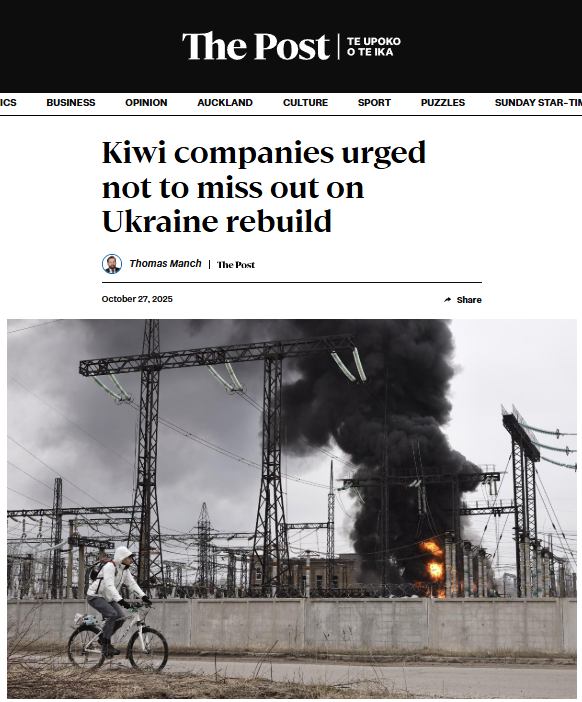
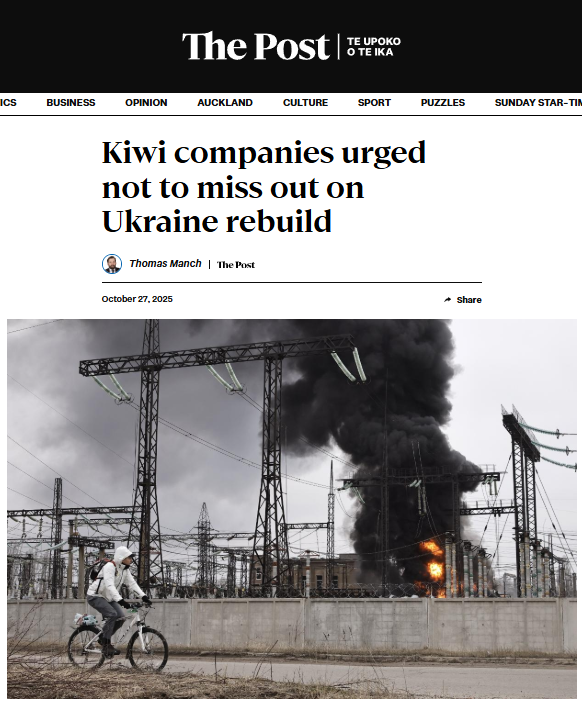
At an Auckland summit on 25 October 2025, Ukrainian ambassador Vasyl Myroshnychenko urged New Zealand companies to enter Ukraine’s “rebuild market” before it got “too crowded.” Neither he nor Prime Minister Christopher Luxon mentioned the millions dead or displaced. Instead, they pitched dairy, agri‑tech, and renewable “opportunities” while Trade Minister Todd McClay nodded along (The Post, 2025).
This is not manaakitanga. It is disaster capitalism—te mahi kōhuru o te ao hurihuri—rebuilding profit margins from the ashes of human suffering.
Whakapapa o te Hara: Profiteering’s Colonial Genealogy
Ukraine’s “free‑market reforms” of the 1990s—engineered by Western advisers after the USSR’s collapse—privatized public wealth into oligarchic hands and left the state indebted to foreign lenders (Novomlynets, 2023; Slobodian, 2023).
When BlackRock CEO Larry Fink told the 2023 Davos Forum that Ukraine’s reconstruction would prove “the power of capitalism,” he exposed the truth: this war is an “investment story” not a human one (Fink, 2023). By late 2022, the Zelensky administration had signed a memorandum deputizing BlackRock Financial Market Advisory to “coordinate private investment” for Ukraine’s rebuild—effectively outsourcing national sovereignty to Wall Street (Ukraine Invest, 2023; BlackRock, 2023).
World Bank RDNA4 figures published in 2025 confirmed a ten‑year reconstruction bill of $524 billion USD, with housing ($84 b) and transport ($78 b) topping the list (World Bank, 2025). Yet BlackRock’s proposed fund—just $15 billion—would earn hundreds of millions in management fees (Quartz, 2024). When Donald Trump retook office in 2025, BlackRock froze the plan; without guaranteed U.S. backing, private capital fled (Kyiv Post, 2025). The message: reconstruction proceeds only when oligarchs can be paid first.
Te Kōrero Tōtika: Picking the Bones of a Nation
BlackRock, JPMorgan & McKinsey—The “Rebuild Cartel”
Between 2022 and 2024 these three giants positioned themselves as Ukraine’s “trusted advisers.” BlackRock handled investor coordination; JPMorgan Chase managed debt; McKinsey & Company mapped privatization targets—all “pro bono,” yet all angling for future contracts (Pulaski Foundation, 2025; Dentons, 2025).
When U.S. and Ukrainian officials signed a “minerals‑for‑reconstruction” pact in April 2025, half of future profits from Ukraine’s rare‑earth and lithium deposits were pledged to a joint U.S.–Ukraine fund controlled by the U.S. International Development Finance Corporation (CSIS, 2025; RNZ, 2025). In effect, Ukraine traded resource sovereignty for post‑war loans—a twenty‑first‑century form of rau patu, economic confiscation.
Western Double‑Dealing
The Kyiv School of Economics found that by October 2024, 82 percent of Western companies headquartered in “supporter nations” still operated in Russia, paying billions in taxes to the Kremlin (KSE, 2024). French supermarket chain Auchan, Austria’s Raiffeisen Bank, and Germany’s Metro AG all maintained Russian subsidiaries. Together they earned $136 billion USD in 2022 while lobbying Brussels for Ukrainian reconstruction contracts (The Ins, 2025; Atlantic Council, 2025).
Ko te moni i puta i te toto. The money came from blood.
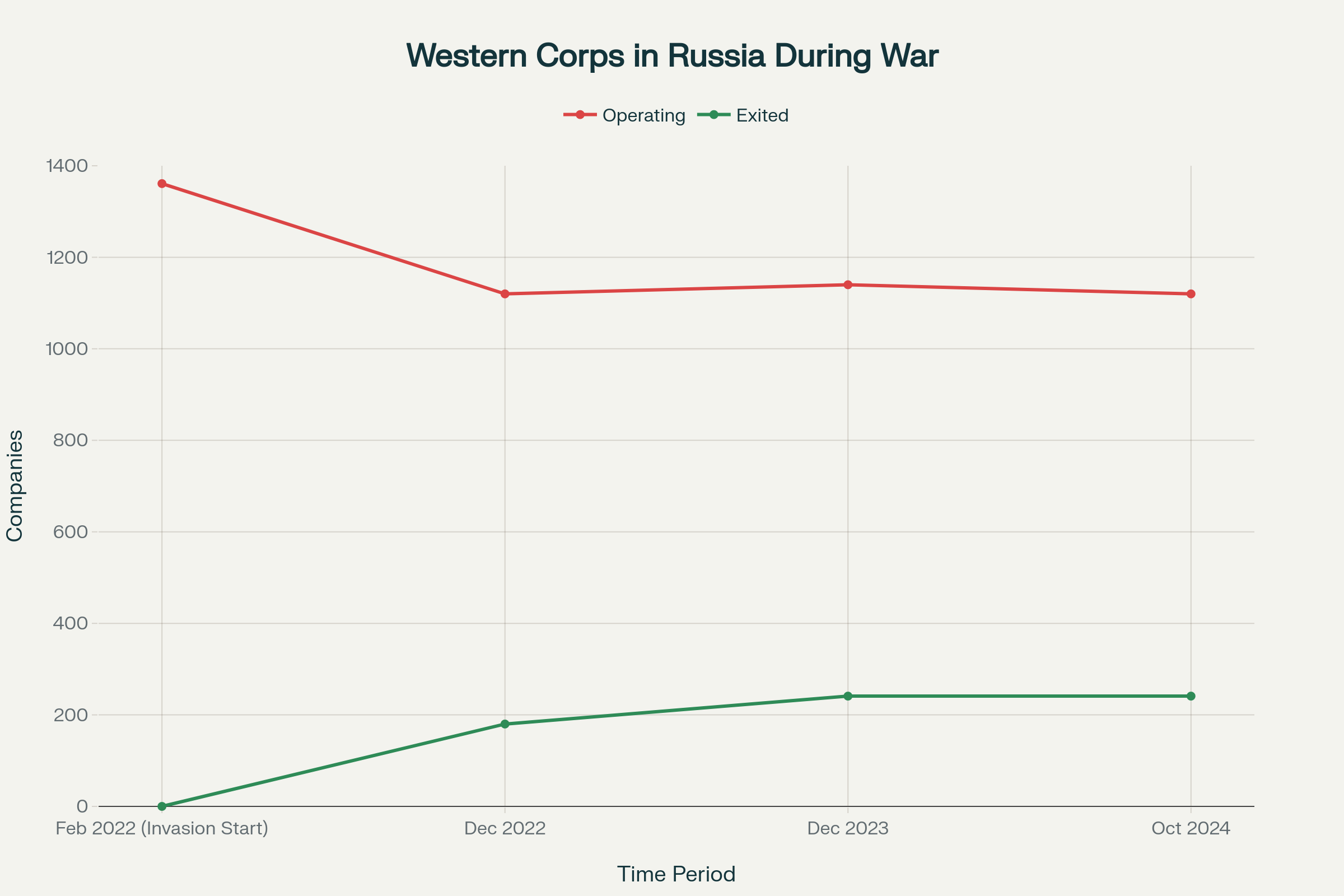
Timeline showing 82% of Western companies continued operating in Russia throughout the Ukraine war, generating billions in revenue that funded Russian aggression
Aotearoa’s Small but Dirty Footprint
New Zealand’s government has promised ≈ $168 million NZD for Ukraine across 2022–2025—roughly $90 million USD—divided among UK arms packages, training missions, humanitarian aid, and legal support (MFAT, 2025; RNZ, 2025).
Contrast that with:
- BlackRock’s $15 billion fund proposal
- U.S.–Ukraine minerals deal: $50 billion potential extraction profits
- Western firms’ $136 billion Russian revenues
- Ukraine’s $524 billion reconstruction cost
New Zealand’s share = 0.017 % of the total (Quartz, 2024; World Bank, 2025).
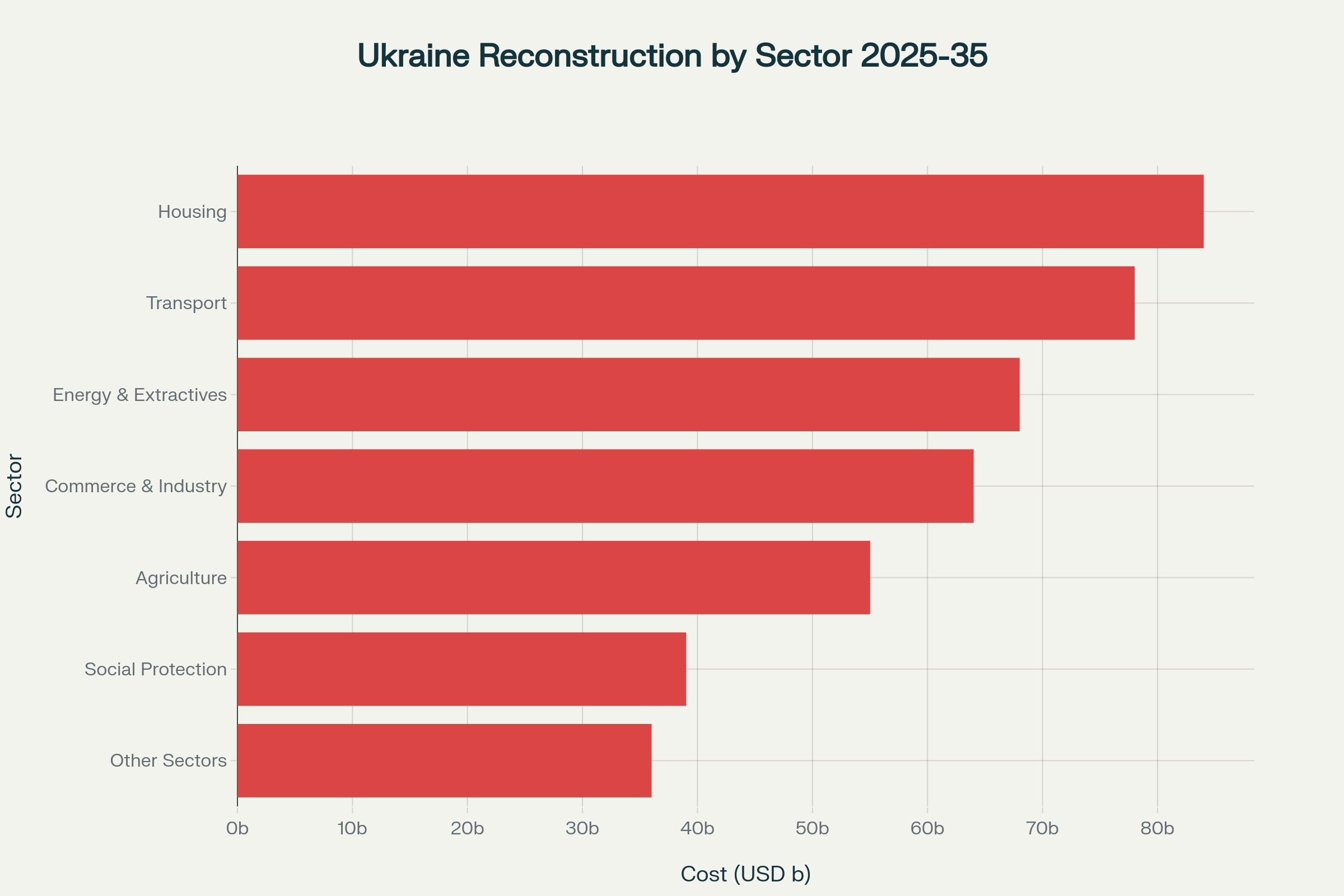
Ukraine’s reconstruction costs by sector, showing housing and transport as the largest needs, totaling $524 billion over the next decade
And yet Ambassador Myroshnychenko scolded Kiwis for skipping July 2024’s reconstruction conference in Rome, warning they’d “lose out.” Prime Minister Luxon replied that NZ firms had “a lot to offer,” merely waiting for “the right time” (The Post, 2025). That “right time” means when foreign contracts are ripe—not when Ukrainians stop dying.
Ngā Hononga Huna: Hidden Neoliberal Networks
1. BlackRock‑JPMorgan‑McKinsey triangle controlling investor access via the Ministry of Economy.
2. U.S. DFC pipeline tying Ukraine’s minerals to Pentagon‑linked private equity funds (CSIS, 2025).
3. NZ Defense Industry tie‑ins: SYOS Aerospace and Rocket Lab’s Pentagon‑funded drone projects marketed as “aid” (1 News, 2025; RNZ, 2025).
4. EU Reconstruction Fund guaranteeing European bank loans while labeling them “aid” (European Commission, 2025).
5. Corruption loop: reconstruction contracts channeled via opaque shell firms in Mykolaiv and Odesa (Intent Press, 2024).
Each tie reveals the same pattern: privatize risk, socialize cost, externalize morality.
Rhetoric, Fallacies and Tikanga Violations
- Appeal to inevitability: framing privatization as the only route to rebuilding (“it’ll get too crowded”).
- False dichotomy: “either investors or chaos.”
- Omission: total silence on companies still fueling Putin’s economy.
These narratives weaponize waitohu rangatira—the language of leadership—to cloak exploitation. By praising “enterprise” over empathy, Wellington has breached whanaungatanga, manaakitanga, and rangatiratanga alike. Tikanga Māori teaches aroha kore utu — love without payment. The neoliberal creed preaches love for profit only.
Ngā Hua: Quantified Harms
- Debt servitude: Ukraine’s 2024 debt to‑GDP ratio hit 92%; servicing a half‑funded $524 billion rebuild at 5 percent interest = $13 billion USD annually—more than its national education budget (World Bank, 2025).
- Resource loss: U.S. share of mineral profits could drain $50 billion over 20 years (CSIS, 2025).
- Labor precarity: post‑war “flexible” employment laws dismantling unions (DonNTU Economics, 2025).
- Corruption risk: Ukraine’s NACP identifies 10 systemic loopholes in reconstruction procurement (Basel Institute Governance, 2025).
All framed as “innovative public‑private partnership.”
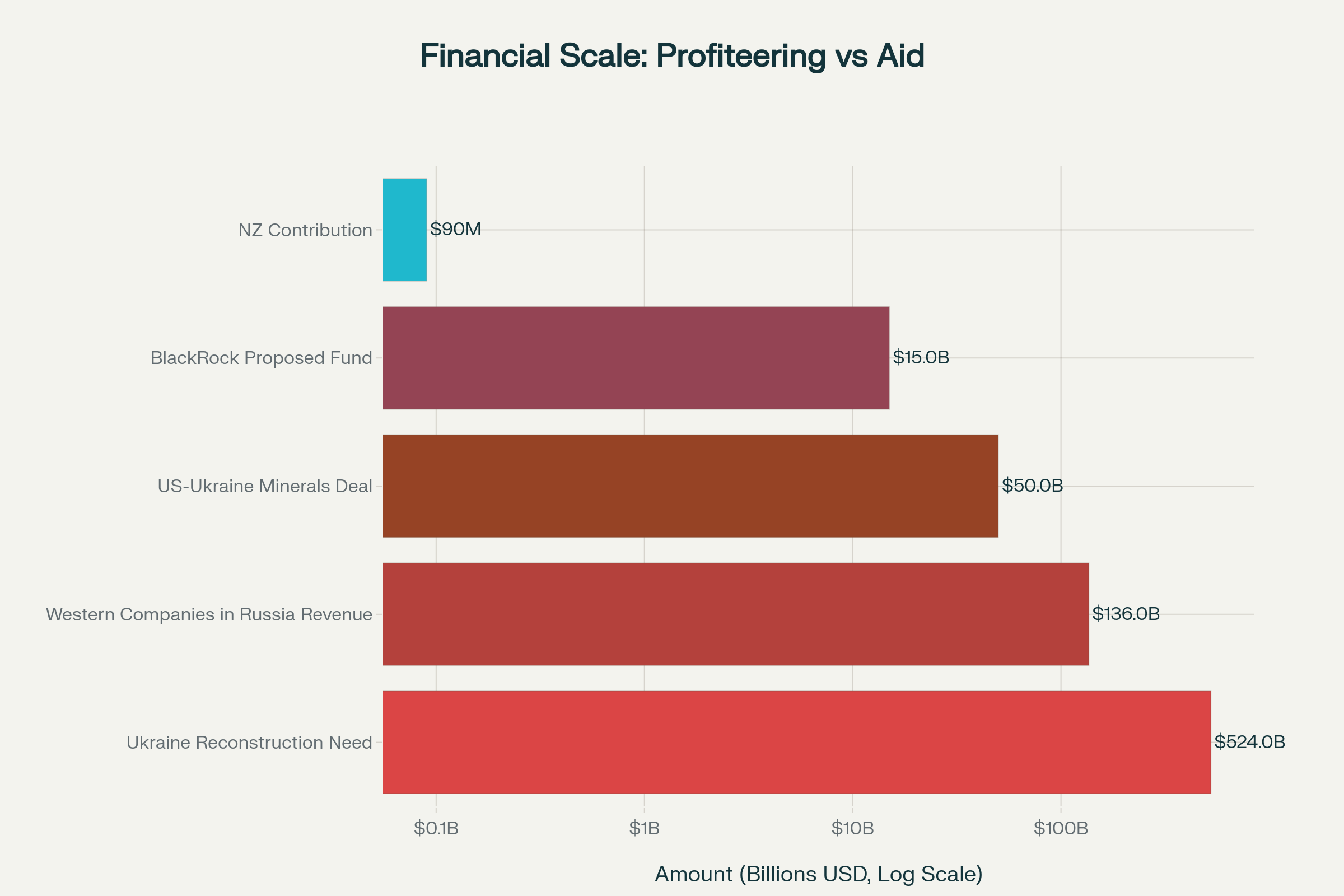
Logarithmic comparison showing New Zealand’s $90 million contribution dwarfed by $524 billion reconstruction needs and corporate profiteering schemes
Whakamutunga: Moral Accounting
If BlackRock’s $15 billion fund and the U.S. minerals deal’s $50 billion extraction are the new colonization, New Zealand’s silence makes us accomplices.

The Māori Green Lantern Fighting Misinformation And Disinformation From The Far Right
Tikanga Māori demands tika me aroha—justice through compassion. Instead, our leaders practice raupatu whakaaro — the ideological confiscation of conscience.
Ko te kupu whakamutunga: the neoliberal order cannot rebuild what it destroys.
We must demand that Aotearoa:
- convert its Ukraine aid into grants, not investments;
- prohibit any NZ firm from profiteering in Ukraine reconstruction;
- require fossil‑free, labor‑secure contracts in any future aid.
Otherwise, our koha becomes complicity.
Kia kaha, kia mahia te tika — stand strong, act righteously.
Ko te moni, ko te mate. Ko te aroha, ko te ora.
(If you find value in this mahi and have capacity, please consider koha: HTDM 03‑1546‑0415173‑000. Support only if able—many are struggling. The kaupapa is truth, not transaction.)
— Ivor Jones (The Māori Green Lantern)
References
- The Post, 2025 — Kiwi Companies Urged Not to Miss Out on Ukraine Rebuild
- World Bank, 2025 — Updated Ukraine Recovery and Reconstruction Needs Assessment (RDNA4)
- Quartz, 2024 — BlackRock and JPMorgan Backing a $15 Billion Investor Fund for Ukraine
- CSIS, 2025 — What to Know About the Signed U.S.–Ukraine Minerals Deal
- Kyiv Post, 2025 — BlackRock Backs Out of Ukraine Rebuild Fund Initiative
- Basel Institute on Governance, 2025 — Corruption Risks in the Construction and Reconstruction Sectors
- European Commission, 2025 — EU Announces €2.3 Billion for Ukraine Recovery Conference
- Intent Press, 2024 — Billions for Reconstruction: Who Got the Contracts in Mykolaiv
- KSE, 2024 — Ukraine Foreign Business Tracker
- RNZ & MFAT Releases, 2025 — NZ Ukraine Aid and Military Support Statements