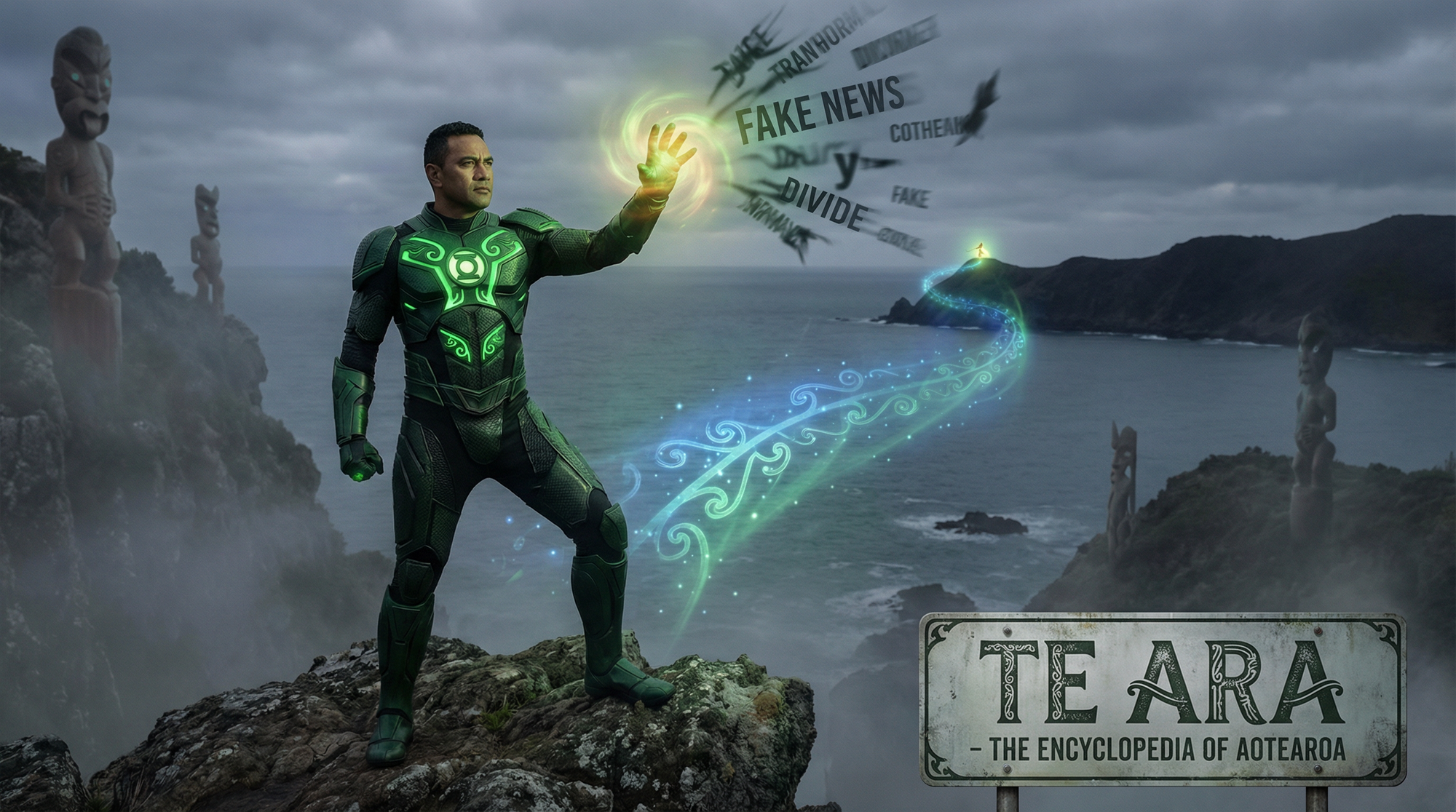
“The Waiatai Stream Massacre” - 16 January 2026
How Power Fails Aotearoa’s Taonga Species
Koha Consideration
Every koha signals that whānau are ready to fund the accountability that Crown and corporate structures will not provide. It signals that rangatiratanga includes the power to fund our own truth tellers.
Kia kaha, whānau. Stay vigilant. Stay connected. And if you are able, consider a koha to ensure this voice continues.Three pathways exist:
For those who wish to support this mahi directly with a koha (voluntary contribution), please visit the Koha platform:
- Koha—Support - https://app.koha.kiwi/events/the-maori-green-lantern-fighting-misinformation-and-disinformation-ivor-jones
For those who wish to receive essays directly and support through subscription, join the Substack community:
- Subscribe to the Māori Green Lantern on Substack - https://themaorigreenlantern.substack.com/subscribe
For those who prefer direct bank transfer, account details are:
- HTDM, account number 03-1546-0415173-000.
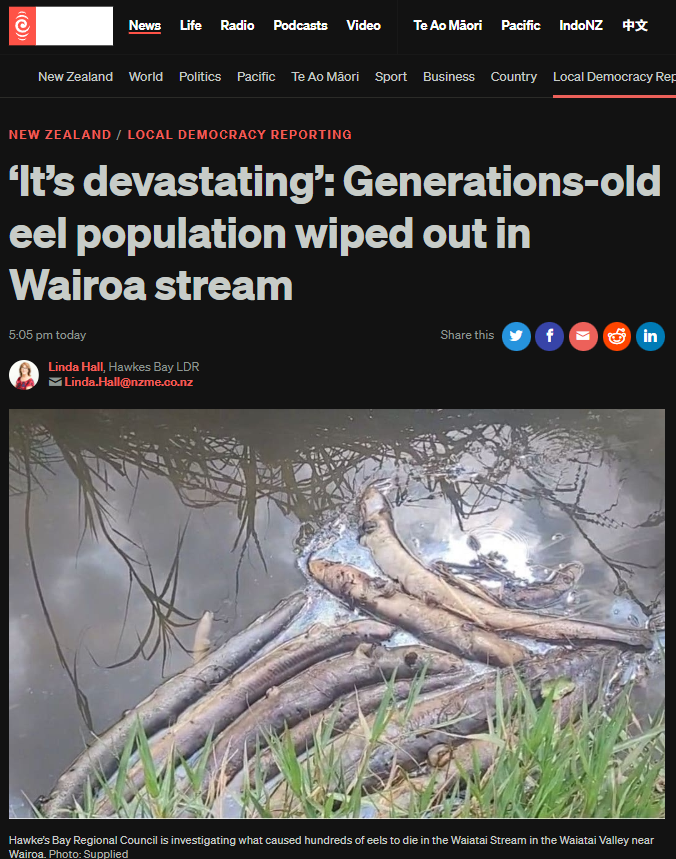
Hundreds of ancient eels are dead. The water reeks of diesel. And once again, those charged with protecting our environment are scrambling for answers—while ecosystems collapse in real time.
The Crime Scene
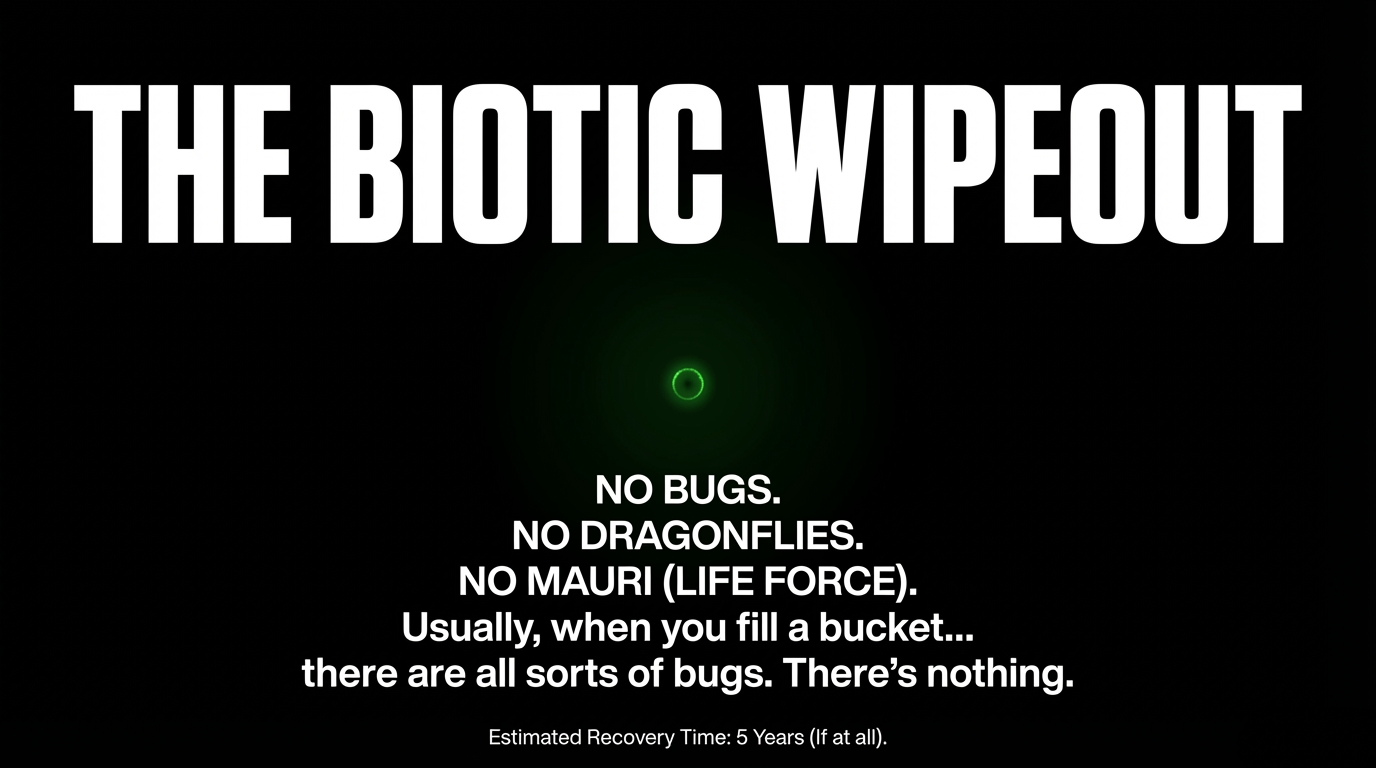
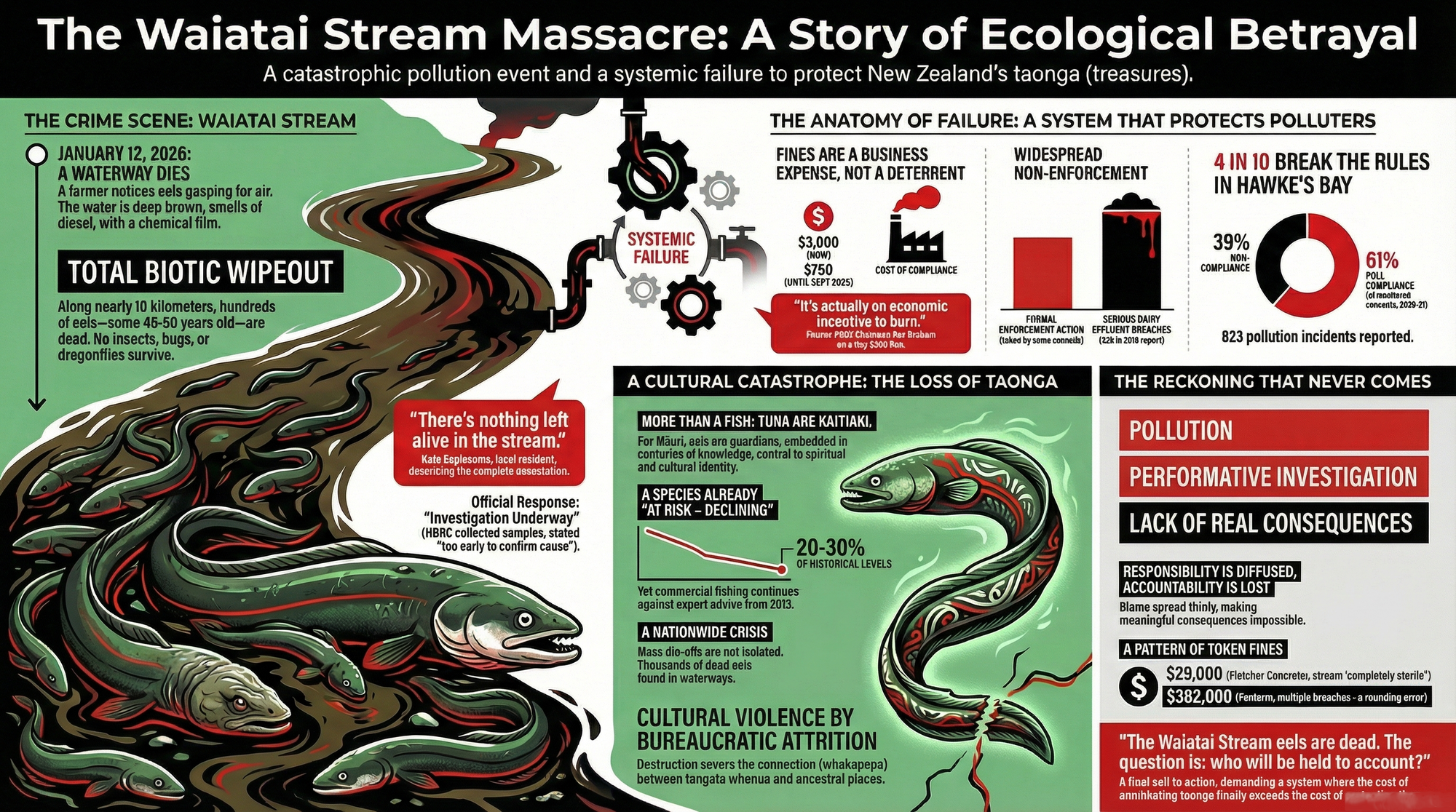
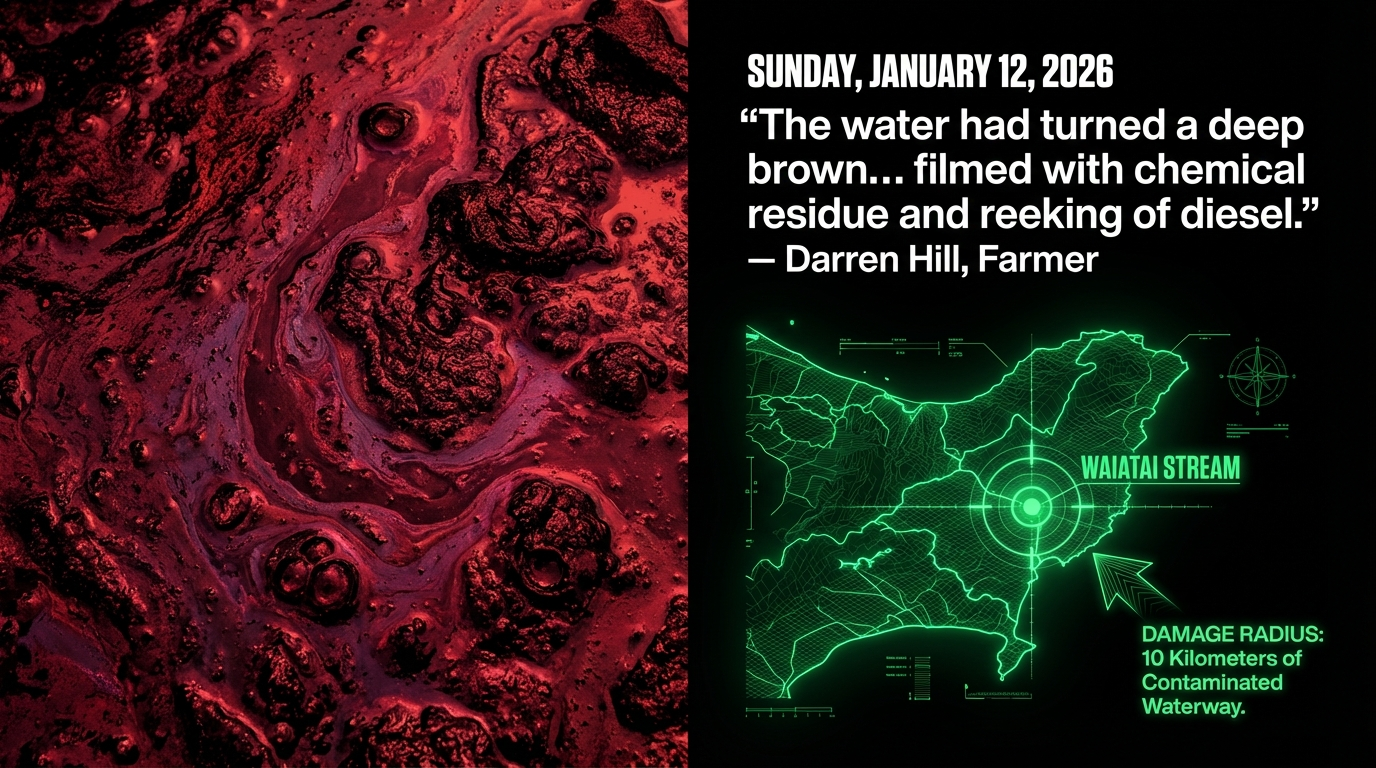
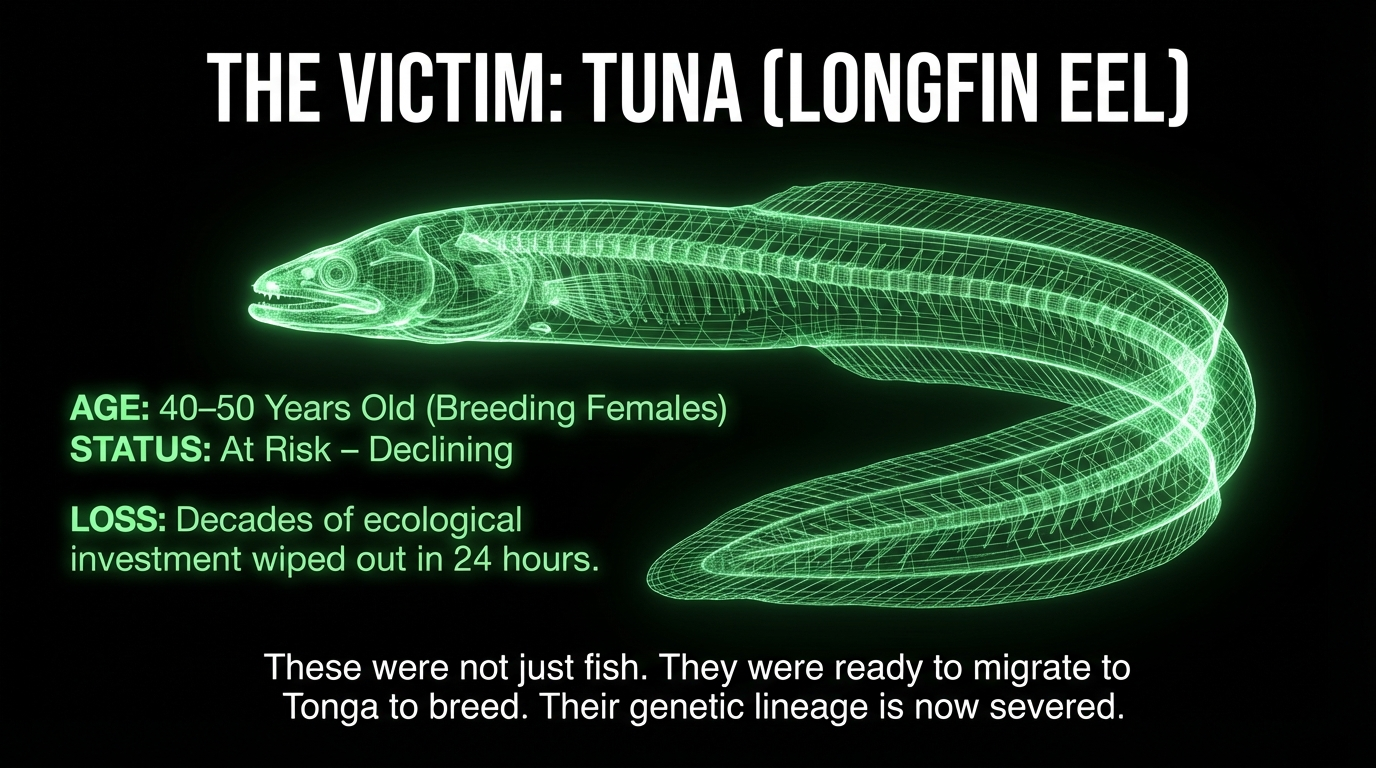
On Sunday, January 12, 2026, farmer Darren Hill watched eels in the Waiatai Stream near Wairoa gasping at the water’s surface, struggling to breathe. The water had turned a deep brown, filmed with what appeared to be chemical residue and reeking of diesel, as reported by RNZ. By Monday evening, hundreds of tuna—including breeding-age females estimated at 40 to 50 years old—lay dead along nearly 10 kilometers of waterway. Not just the eels: everything. No insects, no dragonflies, no aquatic bugs. A complete biotic wipeout across a culturally significant waterway in an area containing Māori pits, wāhi tapu, and burial sites.
Kate Eaglesome, Hill’s daughter who has spent 38 years with this stream as her backyard, told reporters: “There’s nothing left alive in the stream. Usually, when you fill a bucket with stream water, there are all sorts of bugs and insects in it. There’s nothing.” She watched her children’s inheritance—generations of ecological knowledge, cultural connection, and living taonga—snuffed out in a single toxic event.
And the official response? Hawke’s Bay Regional Council (HBRC) collected water samples and issued a statement saying it was “too early to confirm the cause.” The investigation continues. The eels remain dead.
The Anatomy of Regulatory Failure
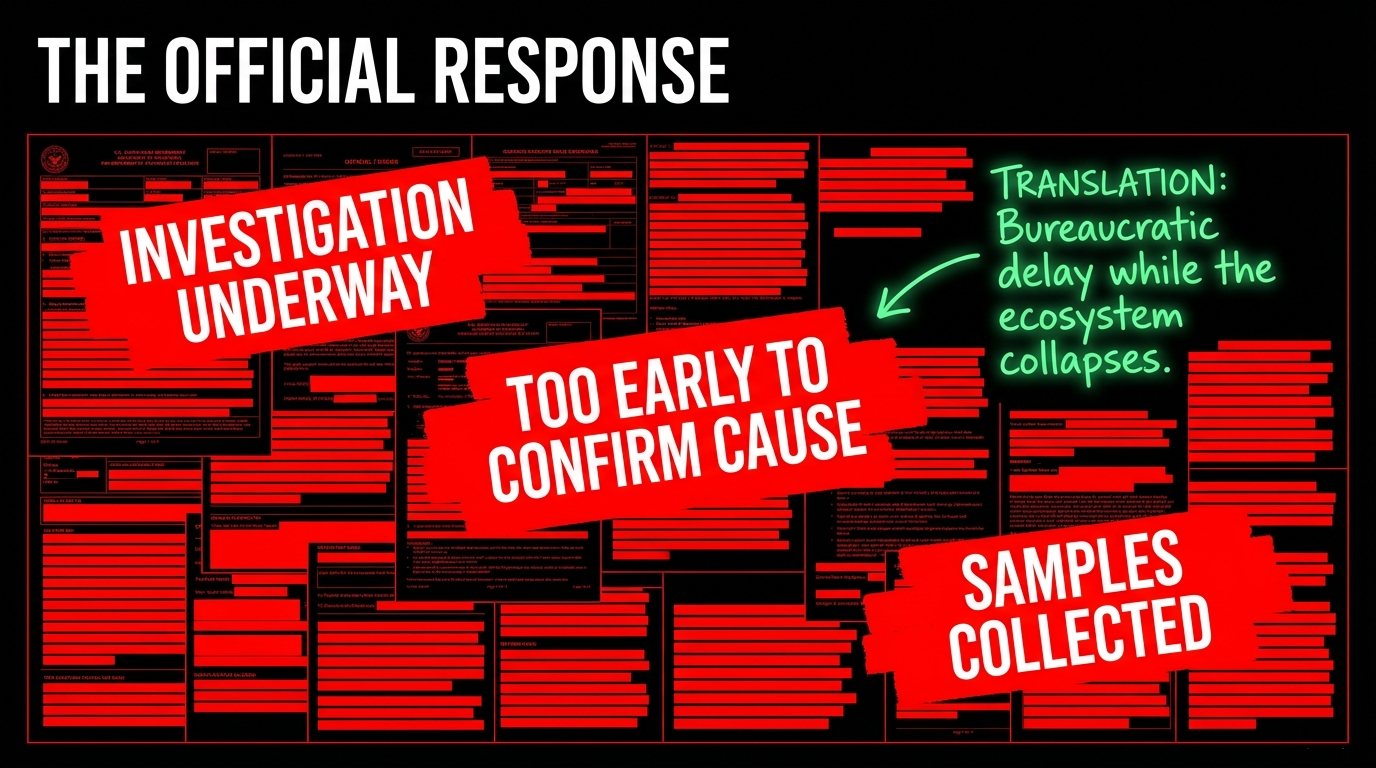
Let’s be clear about what “investigation underway” actually means in the New Zealand environmental governance wasteland: bureaucratic ass-covering punctuated by glacially slow laboratory analysis while those responsible—if they’re ever identified—face penalties so pathetically inadequate they function as a business expense rather than a deterrent.
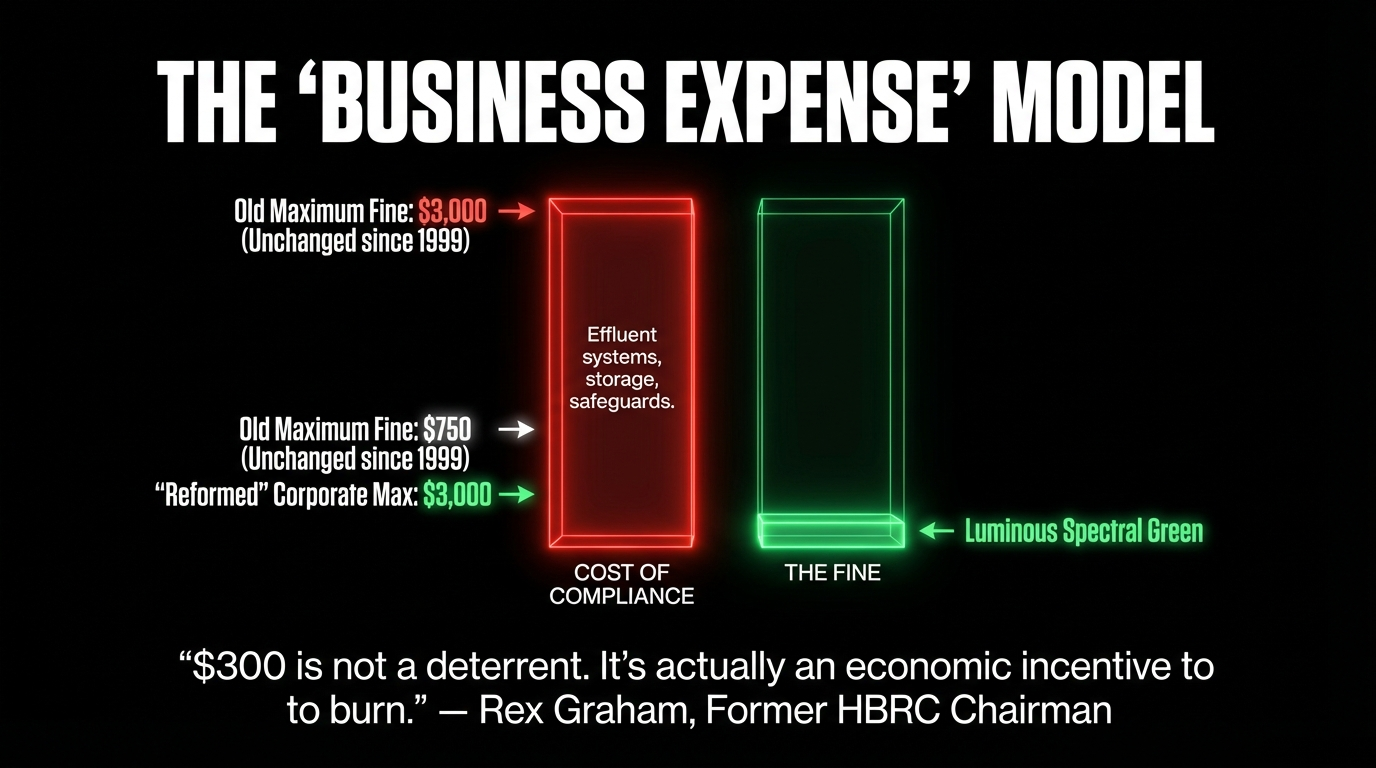
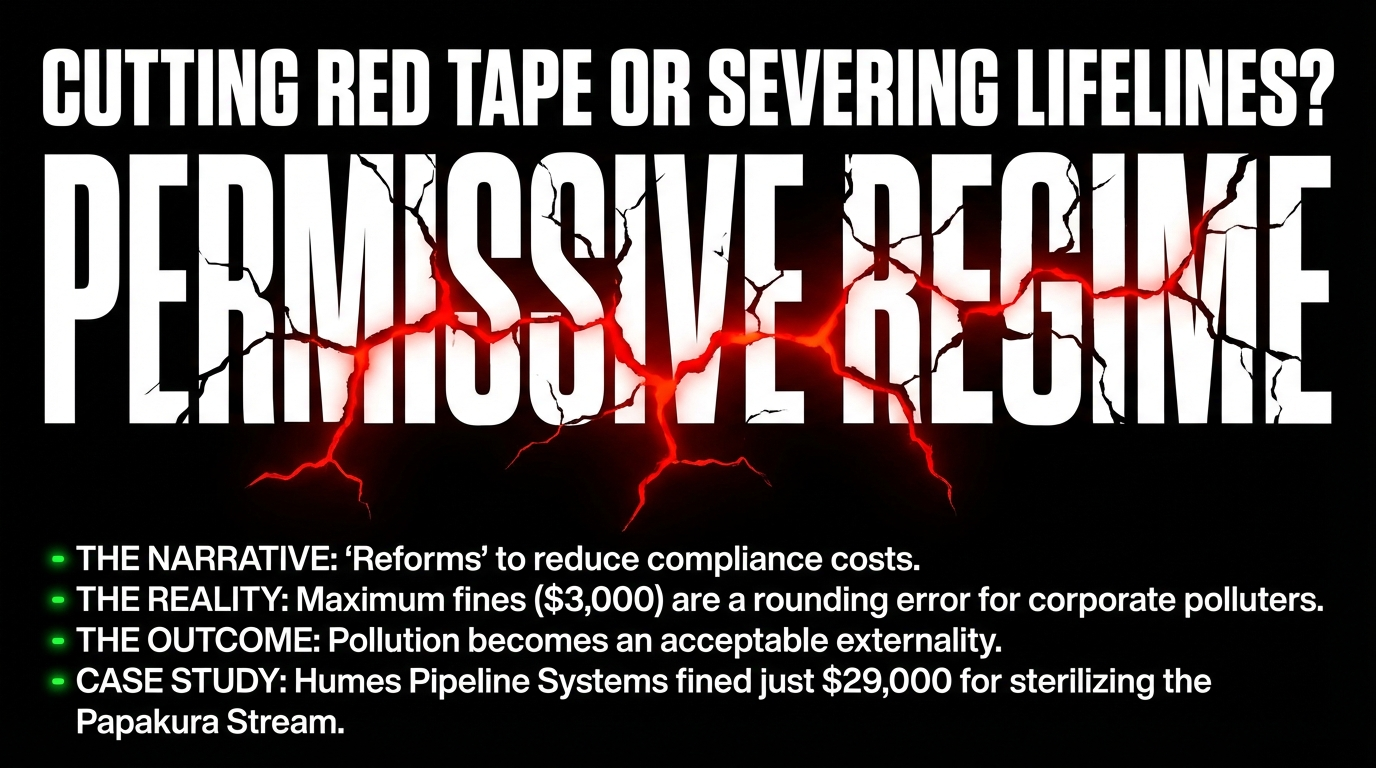
Until September 2025, the maximum infringement fee for discharging contaminants into water in New Zealand was a risible $750. Even after much-touted “reforms,” individuals now face a maximum on-the-spot fine of $1,500, while companies—entities with vastly deeper pockets and greater capacity for environmental destruction—face just $3,000. As Auckland Council’s compliance manager noted, these fees had not been adjusted since 1999, meaning inflation alone had rendered them meaningless. For context, a single mature longfin eel represents decades of ecological investment in a species now classified as “At Risk – Declining” and estimated at just 20-30% of historical population levels.
When a Hawke’s Bay landowner received a $300 fine for open burning that breached air quality standards in August 2025, former HBRC chairman Rex Graham stated the obvious: “$300 is not a deterrent. It’s actually an economic incentive to burn.” The same perverse calculus applies to water pollution. Why invest in proper effluent systems, chemical storage, or environmental safeguards when the potential fine is less than the cost of compliance?
This is not accidental. This is regulatory capture by design.
A Pattern of Non-Enforcement and Impunity
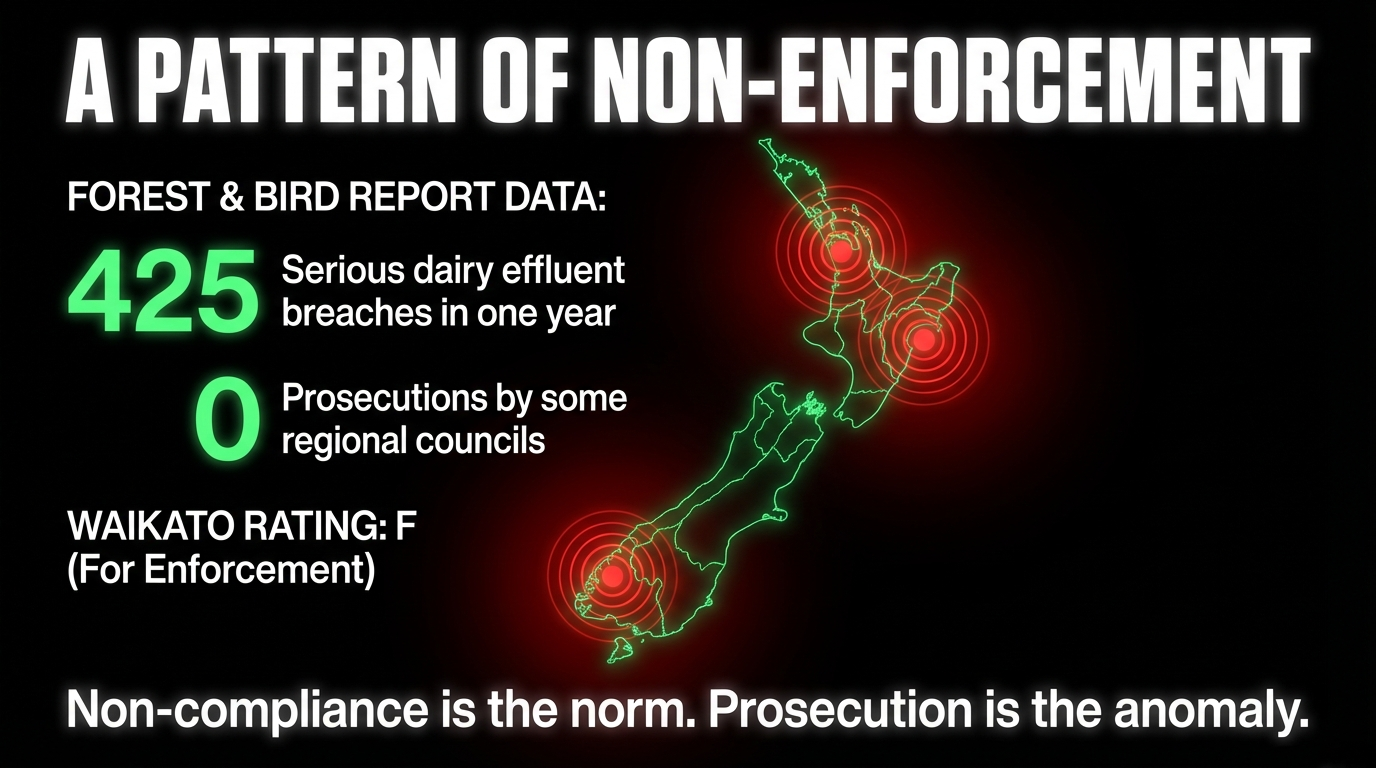
The Waiatai incident is not an anomaly—it’s the predictable outcome of a system that privileges polluters over ecosystems. In 2018, Forest and Bird released a damning report showing that despite 425 cases of serious dairy effluent non-compliance across New Zealand in a single year, some regional councils took zero formal enforcement action. Not one prosecution. Not one abatement notice. Twenty-nine farms were found to be seriously non-compliant for the third consecutive year, and still councils looked the other way. The Waikato region—home to the highest concentration of dairy farms in the country—received an F grade for enforcement. The council’s response? Deny, deflect, claim they were “targeting high-risk farms.”
Hawke’s Bay has its own inglorious history. In 2016, no one was convicted for environmental pollution in the region despite multiple incidents. The HBRC itself has breached its own pollution compliance rules, a Kafkaesque scenario where the regulator cannot regulate itself. Meanwhile, HBRC reported that in 2020-21, only 61% of monitored consents achieved full compliance—meaning nearly 4 in 10 consent holders were breaking the rules. The council issued 12 prosecutions that year, resulting in $196,000 in fines. Spread across a region with thousands of consents and 823 reported pollution incidents, this is enforcement theater, not environmental protection.
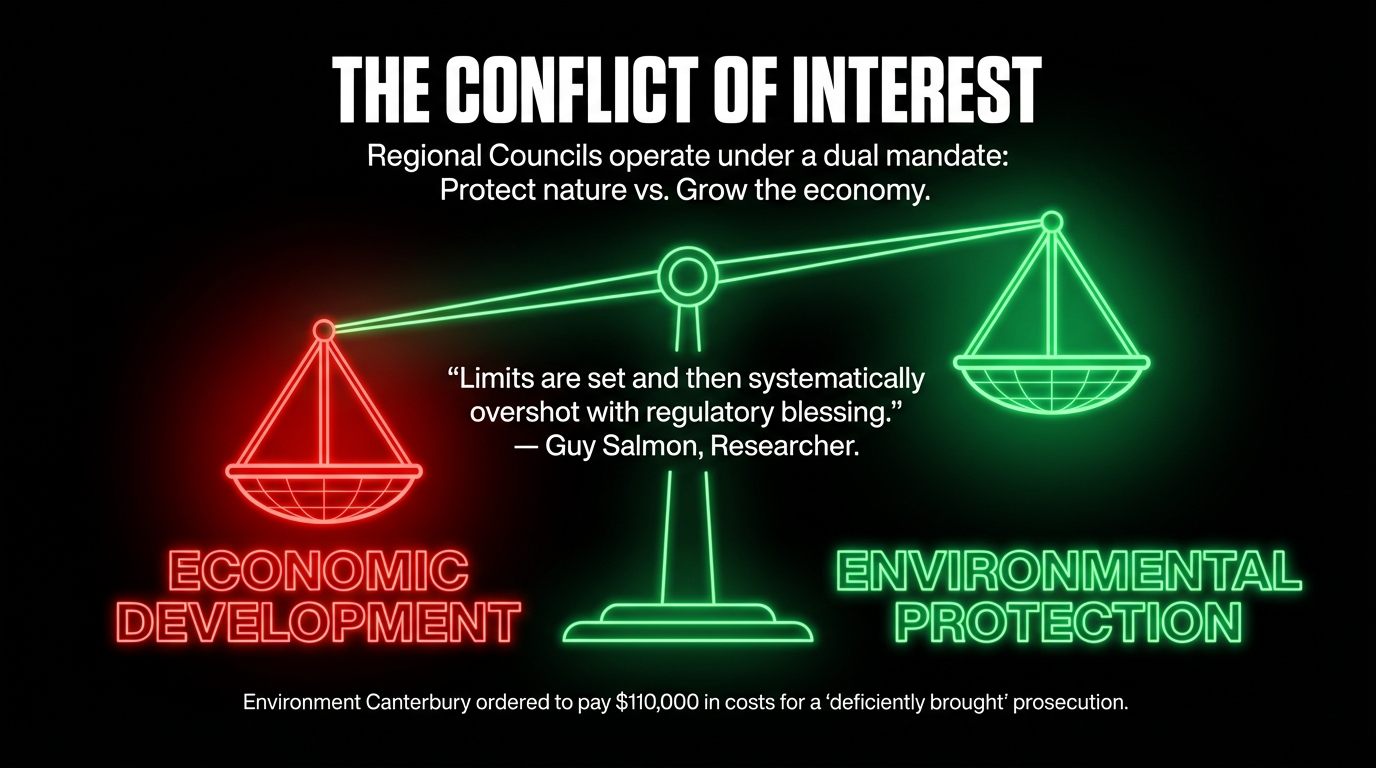
The courts offer no salvation. A Canterbury Regional Council prosecution was so poorly investigated and deficiently brought that the council was ordered to pay $110,000 in costs to the defendants after charges were dismissed. A Waikato pig farm finally drew a $437,000 fine—described as the largest in RMA history—but only after 50 inspections revealed repeated, brazen discharges over eight months. This is not a justice system; it’s a façade where only the most egregious, sustained, and well-documented offending might result in meaningful consequences.
The Longfin Eel: A Case Study in Bureaucratic Extinction
The death of mature breeding-age longfin eels in the Waiatai Stream is particularly devastating because this species is already circling the drain, pushed there by a regulatory apparatus that treats extinction as an acceptable externality of economic development.
In 2013, Parliamentary Commissioner for the Environment Jan Wright recommended an immediate suspension of commercial longfin eel fishing to prevent the species’ “slow decline to extinction.” Her report eviscerated the Ministry for Primary Industries’ (MPI) flawed science and noted that the Department of Conservation (DOC)—which had classified longfin eels as “at risk and declining”—was overruled by MPI because eels are a “fished species.” Economic interests trump conservation status. Wright noted that about 140 tonnes of longfin eel were commercially harvested annually despite the species being in precipitous decline, and that hydro dams had already destroyed access to breeding grounds for approximately 6,000 tonnes of eels.
Thirteen years later, commercial fishing continues. The population continues to decline. And when hundreds of breeding-age eels die in a single toxic event, the institutional response is: samples collected, investigation underway, please hold.
As Erina Watene of Te Mana o Ngā Tuna stated in April 2025: “The fragmented approach to tuna management isn’t working. There’s no national plan for tuna—people are all doing their bits within their own spaces. We need something that works across all agencies.” Mass die-offs have been reported across Aotearoa—over 200 dead tuna in Tāmaki Makaurau, several thousand in Mataura, Southland, over 3,500 in the Kauritutahi Stream in Northland. Each incident prompts the same performative concern, the same calls for investigation, and the same structural inaction.
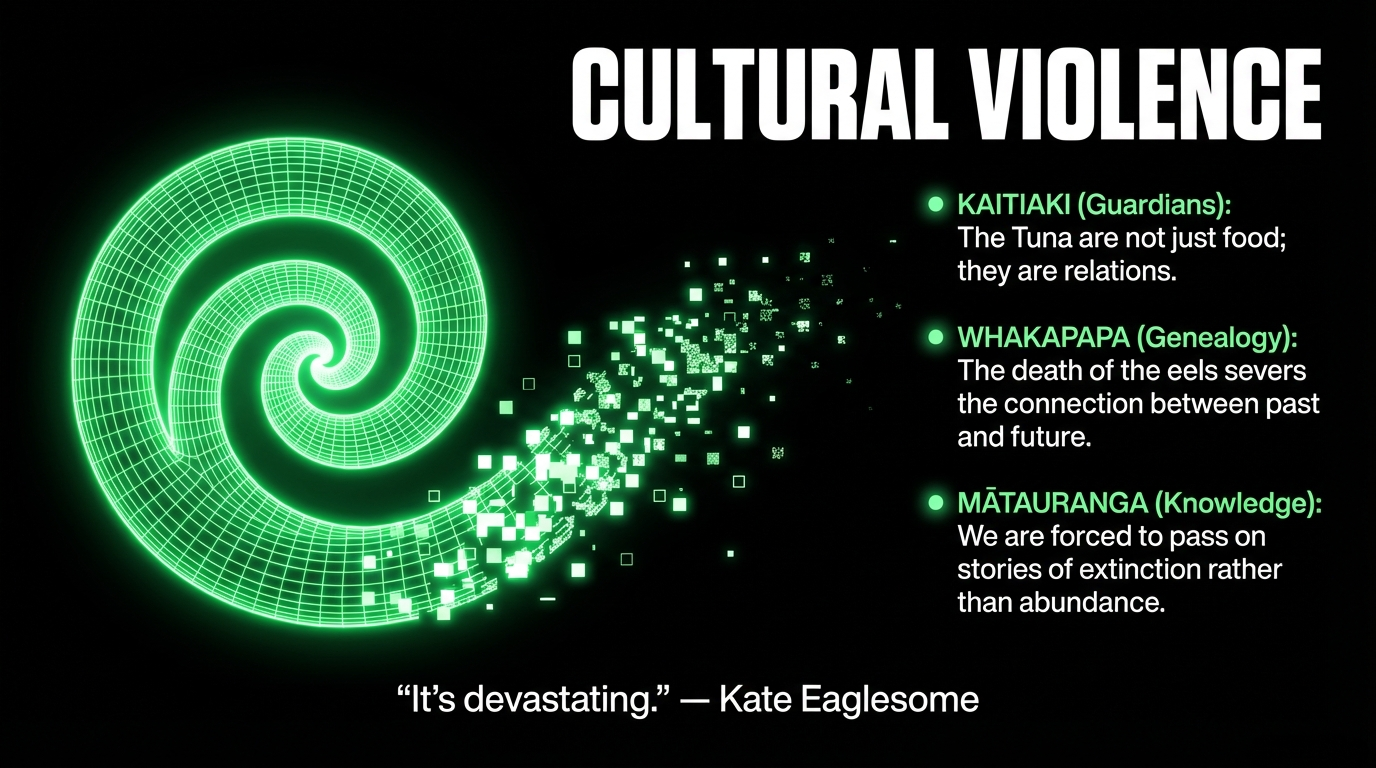
Tuna are not merely a fish species. They are kaitiaki—guardians of waterways, embedded in centuries of mātauranga Māori and central to the spiritual and material wellbeing of iwi and hapū. Their decimation is not just ecological collapse; it is cultural violence, the erasure of living knowledge systems and the severing of whakapapa connections that bind tangata whenua to place.
Who Pays? Who Suffers? (Spoiler: Not Those Responsible)
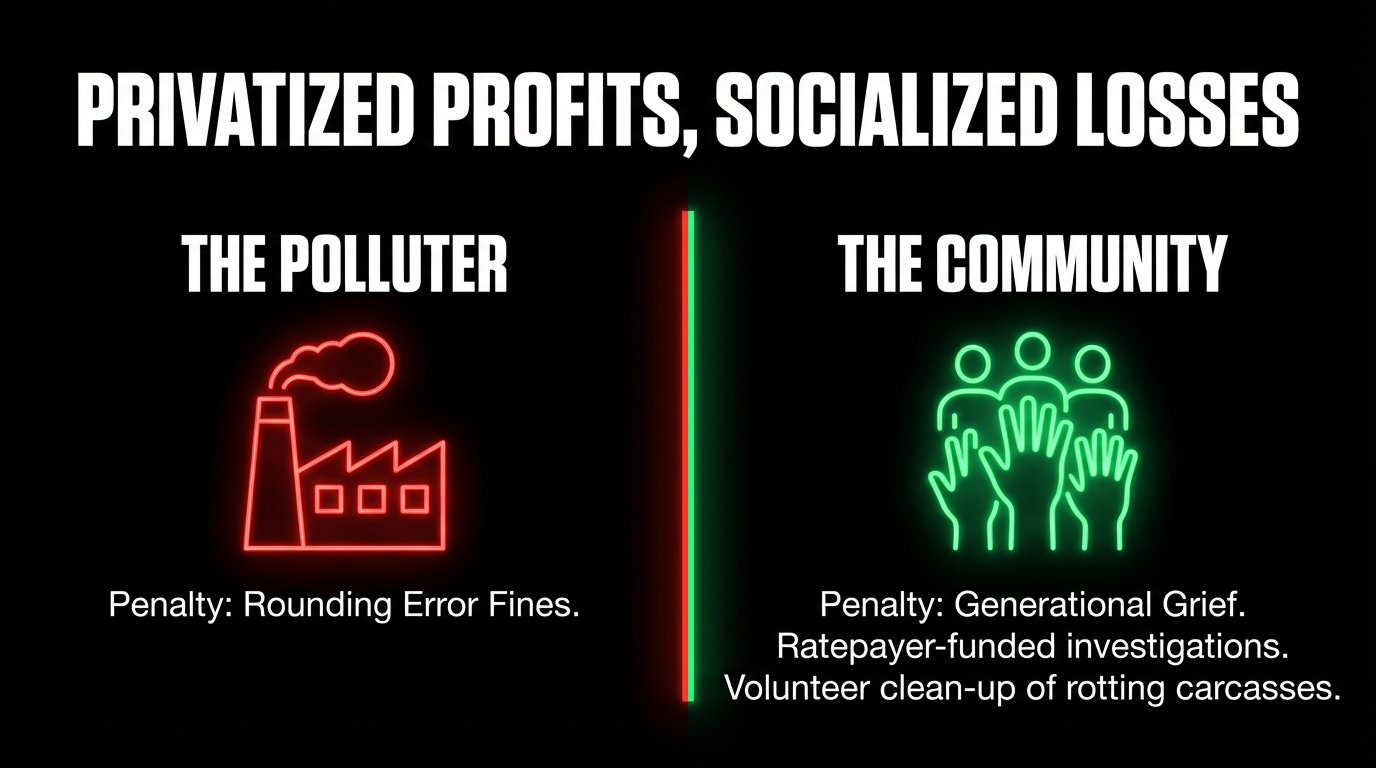
When the Fletcher Concrete subsidiary Humes Pipeline Systems discharged concrete wastewater into the Papakura Stream in 2000-2001, rendering it completely sterile and lifeless—so toxic that investigators couldn’t even find the bodies of dead fish or eels—the company was fined $29,000. For extinguishing all aquatic life in a stream feeding into the Manukau Harbour. Fonterra has been fined $362,000 across multiple prosecutions for Resource Management Act breaches, a sum that represents a rounding error in the company’s annual revenue while communities downstream live with degraded water and lost fisheries.
And who bears the cost of ecosystem recovery? Ratepayers. Communities. Iwi who must organize volunteer clean-ups of thousands of dead tuna, who must watch their taonga species disappear, who must pass on to their children not mātauranga about abundant kai but stories of what used to exist before it was poisoned into oblivion.
Darren Hill was told the Waiatai Stream could take up to five years to recover—if it recovers at all. Eel populations don’t bounce back on convenient timescales. The 40-50 year old breeding females killed in this incident represent irreplaceable genetic lineages and decades of population investment. Their loss reverberates forward for generations.
The Illusion of Oversight
Regional councils operate under a mandate to protect environmental quality while simultaneously promoting economic development—an inherent conflict of interest that resolves, time and again, in favor of polluters. Researcher Guy Salmon found that regional councils have spent decades “encouraging good management practice by voluntary means while enabling farmers to accrete entitlements to degrade fresh water,” creating a system where limits are set and then systematically overshot with regulatory blessing.
A January 2026 High Court decision found that Environment Canterbury had “errantly included a rule in its regional plan” that allowed continued pollution, a decision made without adequate evidence or clear reasoning. The court noted that the council’s decision-making record was so deficient it “severely undermines” any claim the decision was valid. This is the quality of environmental governance in Aotearoa: councils writing rules to permit the degradation they’re supposed to prevent, backed by either incompetence or willful disregard for statutory obligations.
When Environment Southland was forced to issue itself an abatement notice in 2024 after its own river work breached environmental standards, the absurdist theater of self-regulation reached peak farce. Who holds councils accountable when they cannot—or will not—hold themselves accountable?
The answer: increasingly, no one.
Cultural Genocide by Bureaucratic Attrition
For Māori, the destruction of freshwater ecosystems is not an abstract environmental concern—it is an assault on identity, sovereignty, and intergenerational knowledge transmission. Research on culturally significant fisheries shows that Indigenous peoples across the Pacific have “acquired a profound understanding of these freshwater animals and ecosystems that have become embedded within their cultural identity.” The loss of species like tuna doesn’t merely reduce biodiversity; it severs the relational networks that constitute tangata whenua connection to place.
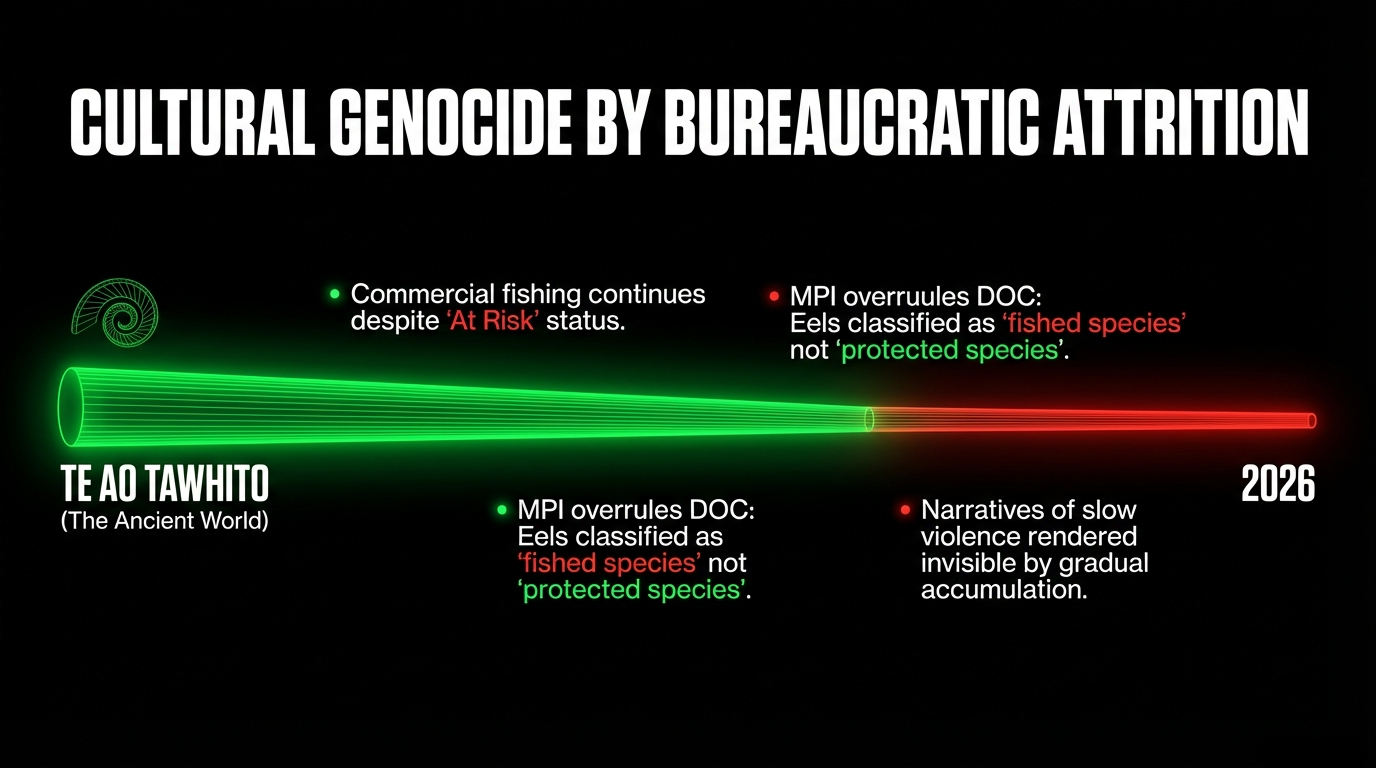
As documented in studies of slow violence in the Kaipara moana, narratives of water pollution, habitat loss, and species extinction form “the narratives of slow violence” against Indigenous communities—violence rendered invisible by its gradual accumulation and the representational bias that marginalizes Indigenous voices in environmental governance.
Te Wai Māori, established under the Māori Fisheries Act 2004 to represent Māori freshwater fisheries interests, created Te Mana o Ngā Tuna in 2017 specifically to halt tuna decline. The advisory group advocates for integrating mātauranga Māori with Western science and calls for a unified national recovery plan. But they operate within a system designed to fragment responsibility, delay action, and subordinate Indigenous knowledge to bureaucratic process.
The Waiatai Valley is not just another polluted stream. It is a culturally significant landscape to local iwi, and the eels are not just fauna—they are ancestors, teachers, and the physical embodiment of centuries of reciprocal relationship. Their annihilation is the continuation of colonial environmental destruction, now administered through the ostensibly neutral mechanisms of regional resource management.
The Reckoning That Never Comes
So where does accountability lie in the Waiatai Stream disaster?
Was it the unidentified polluter, who may receive a token fine years from now if investigators can overcome the evidential burden required for prosecution—a standard so high that councils routinely abandon enforcement?
Was it HBRC, which will issue a report, express concern, and return to monitoring the same inadequate consent compliance regime that allowed this to happen?
Was it the Ministry for Primary Industries, which continues to permit commercial exploitation of a declining endemic species despite more than a decade of scientific consensus that the fishery is unsustainable?
Was it the coalition government that has prevented councils from bringing in greater protections, ordered reviews of freshwater management, and foreshadowed a “more permissive resource management regime” for farmers—code for rolling back the already inadequate environmental protections?
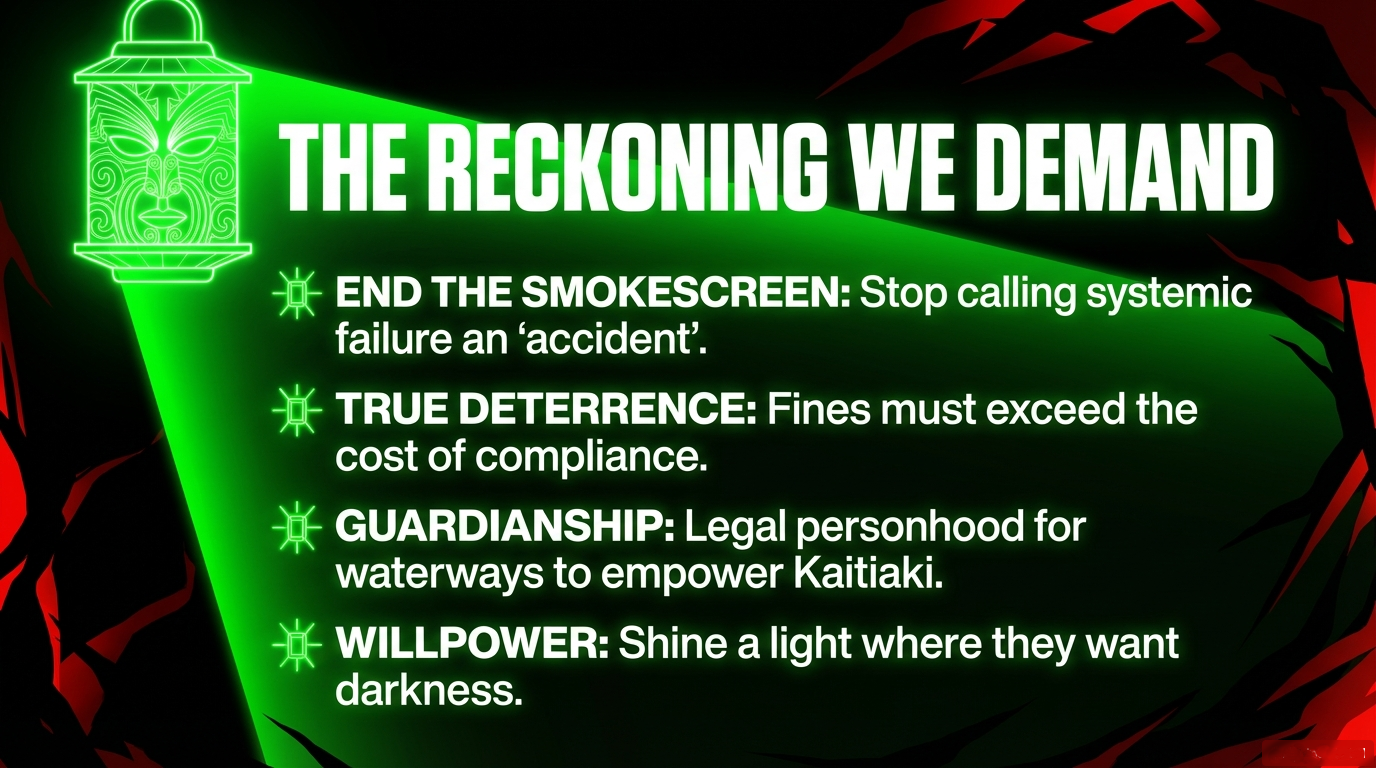
The answer is all of them and none of them. The system is functioning exactly as designed: to diffuse responsibility across so many actors and agencies that meaningful accountability becomes impossible. Pollution incidents are treated as isolated events rather than systemic failures. Fines—when levied at all—are calibrated to avoid economic disruption to polluters rather than to reflect ecological harm. Prosecutions are so rare and cumbersome that they function as public relations exercises rather than deterrents.
The Waiatai eels are dead. The investigation will conclude. Perhaps a fine will be issued. The stream will be declared “recovering” on some bureaucratic timeline. And the next mass die-off—because there will be a next one—will generate the same cycle of inadequate response.
Kate Eaglesome, standing beside a lifeless stream that was once her children’s classroom in conservation and connection to place, said it best: “It’s devastating.” That word—devastating—carries the weight of cumulative loss, intergenerational grief, and the recognition that what has been destroyed cannot be replaced by any investigation, any fine, any regulatory reform.
Power in Aotearoa has failed the tuna. It has failed the communities who depend on them. It has failed the principle that those who poison our waterways should face consequences commensurate with the harm they cause.
And until that failure carries an unbearable cost—political, economic, and reputational—the massacres will continue.
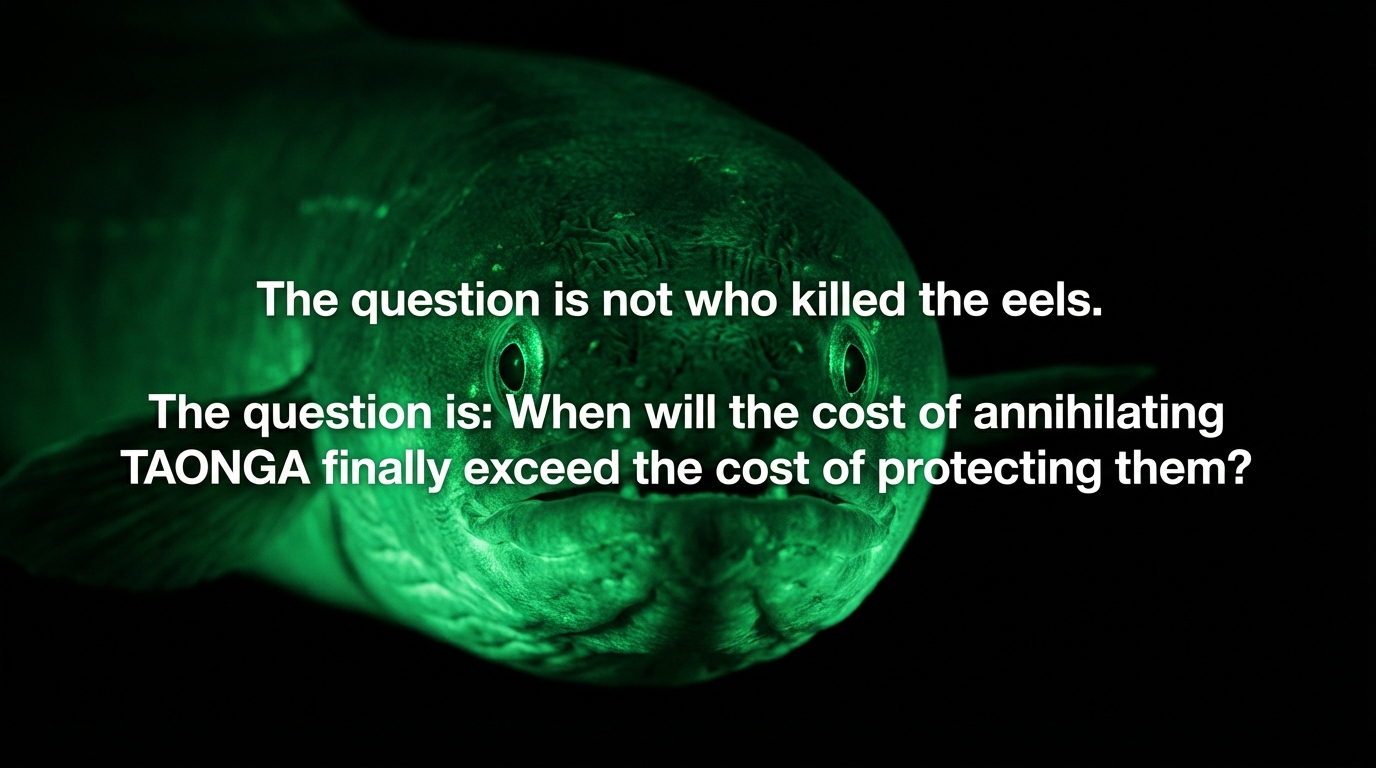
The Waiatai Stream eels are dead. The question is: who will be held to account, and when will the cost of annihilating taonga finally exceed the cost of protecting them?