“The Wellington Septic Debacle: A Government Happy to Have You Swim in Its Own Shit” - 7 February 2026
When a regime treats Moana and Māori as its toilet, the only shock is that the pipes failed before the politicians did
Mōrena Aotearoa,
Power Standing in the Sewage, Asking for Applause
Moa Point is not just a sewage disaster; it is this government’s soul made visible.
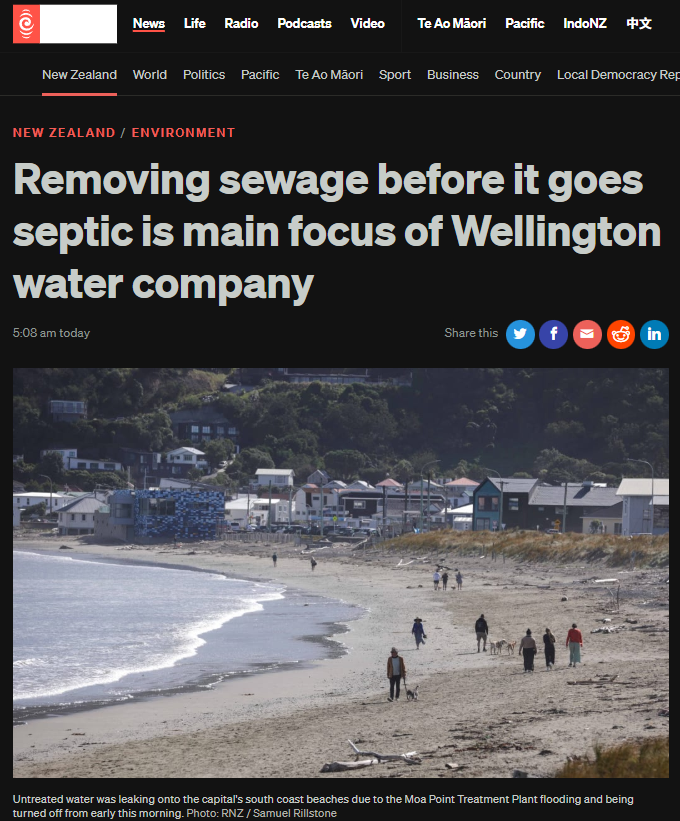
Raw human waste floods a critical plant in the capital, the system shuts down, and the best the state can offer is a CEO babbling about keeping the workplace “safe” and not “emitting obviously a stench,” as reported by RNZ. They are working “against the clock” to get the sewage out “before it goes septic,” as if the only thing rotting here is the fluid in the pipes, not the morality of the people who designed, underfunded, and defended this infrastructure for years. RNZ
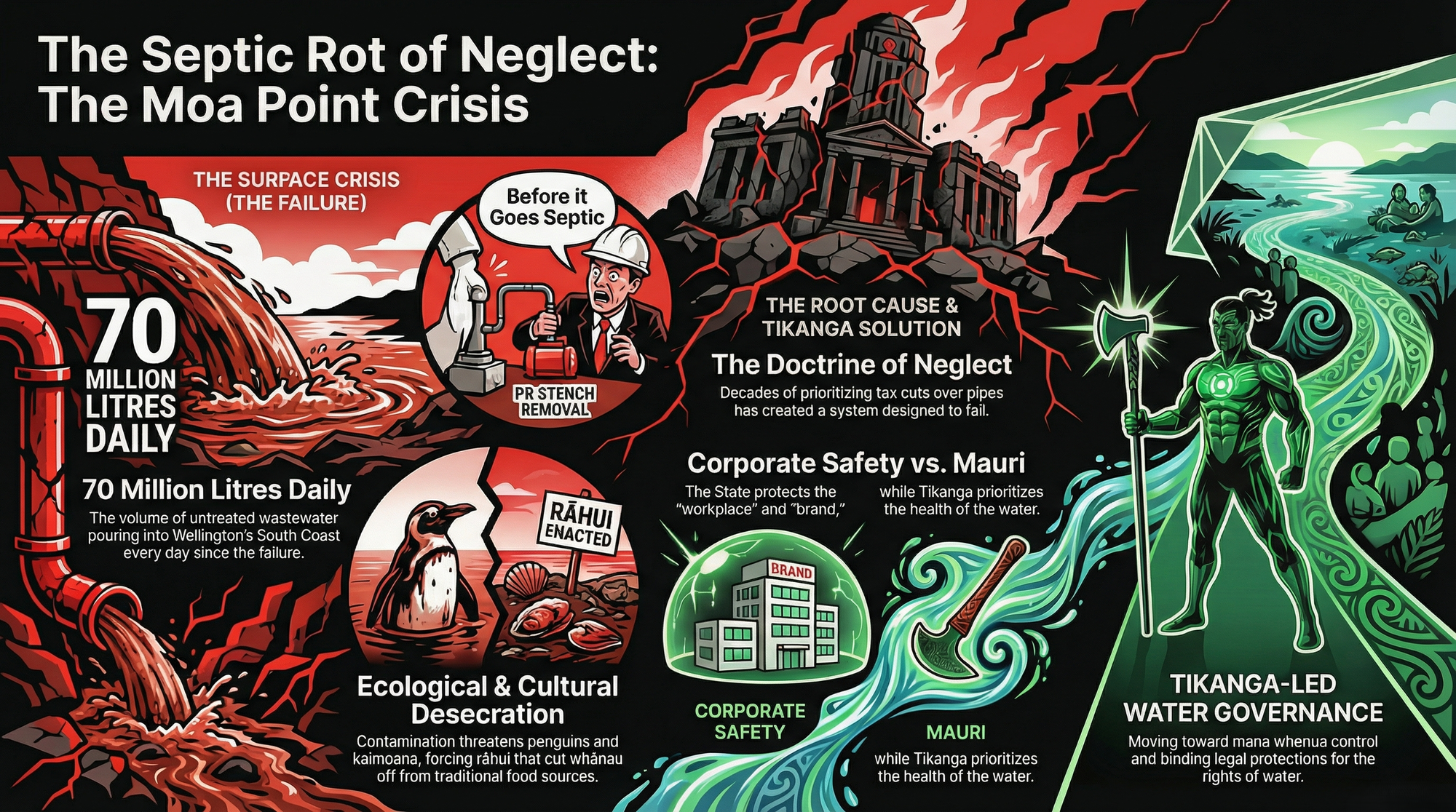
This is not mismanagement; this is a confession. The country’s capital is literally swimming in excrement while Cabinet pretends they are shocked. The truth: the pipes simply failed faster than their excuses.
The Headline as Indictment: “Before It Goes Septic”
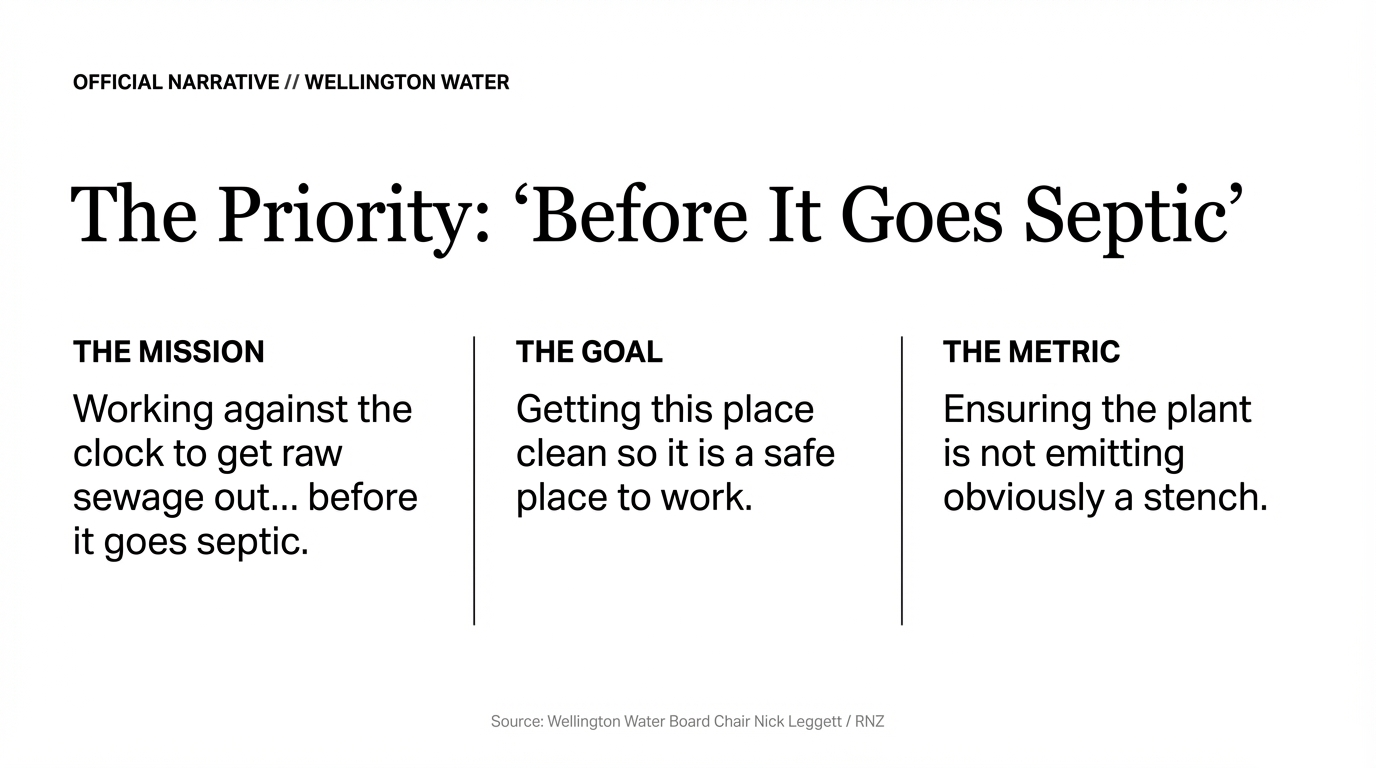
Wellington Water’s stated focus is getting sewage out of Moa Point
“before it goes septic.”
That line is the perfect mission statement for this white supremacist neoliberal regime. RNZ
The facts:
- Early Wednesday morning, the Moa Point treatment plant is flooded by raw sewage, forcing a shutdown and evacuation. RNZ
- Some waste is dumped at landfill; the rest is being pumped out of the facility. RNZ
- Board chair Nick Leggett spells out the priority: clean the plant so it’s a “safe place to work” and so it’s not “emitting obviously a stench.” RNZ
There it is:
- Raw sewage = the racism, climate denial, and deliberate underinvestment that defines this government.
- “Before it goes septic” = before the public understands how deeply the system is decayed.
- “Safe place to work” = safe for executives and officials to keep cashing cheques while communities choke.
- “Not emitting obviously a stench” = the real priority is PR, not mauri, not health, not justice.
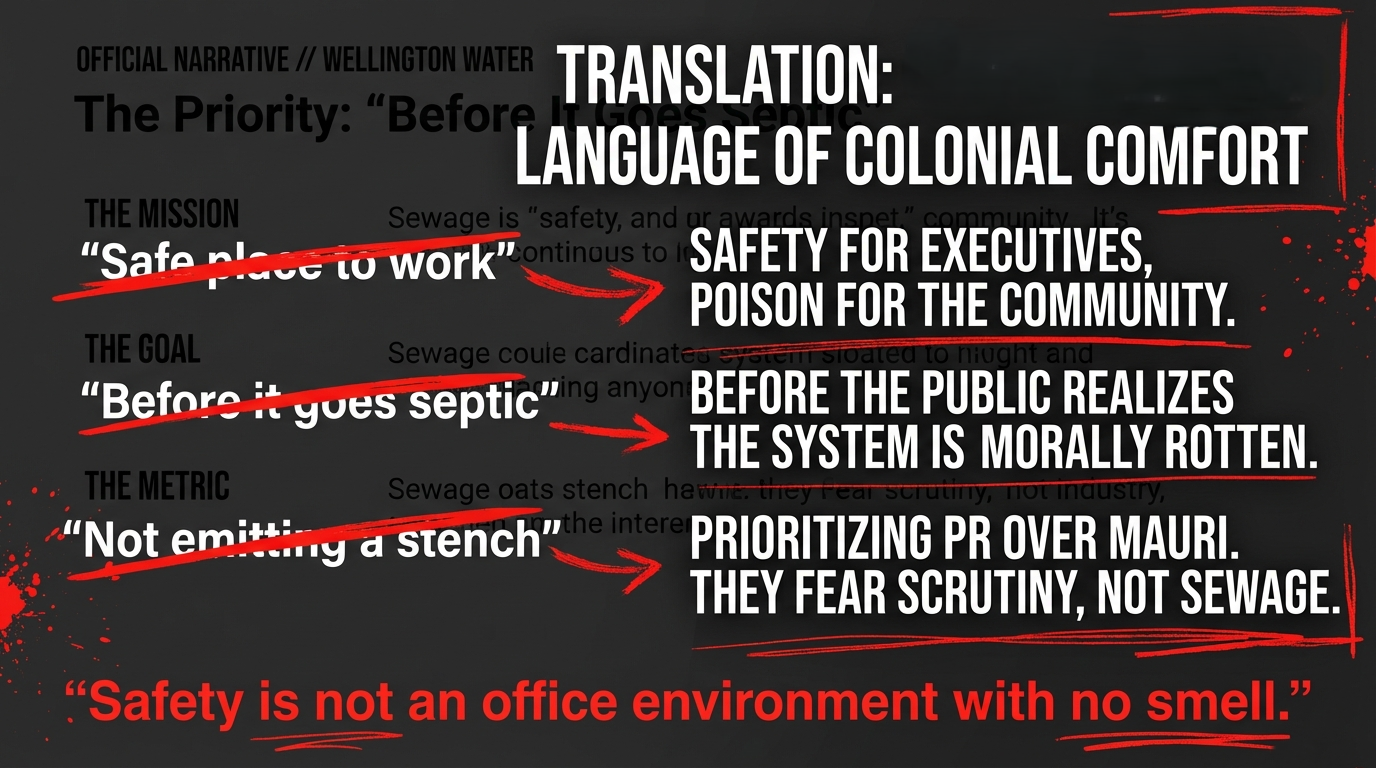
They are not afraid of sewage. They are afraid of scrutiny.
The Outfall Pipe: The Regime’s Favourite Weapon
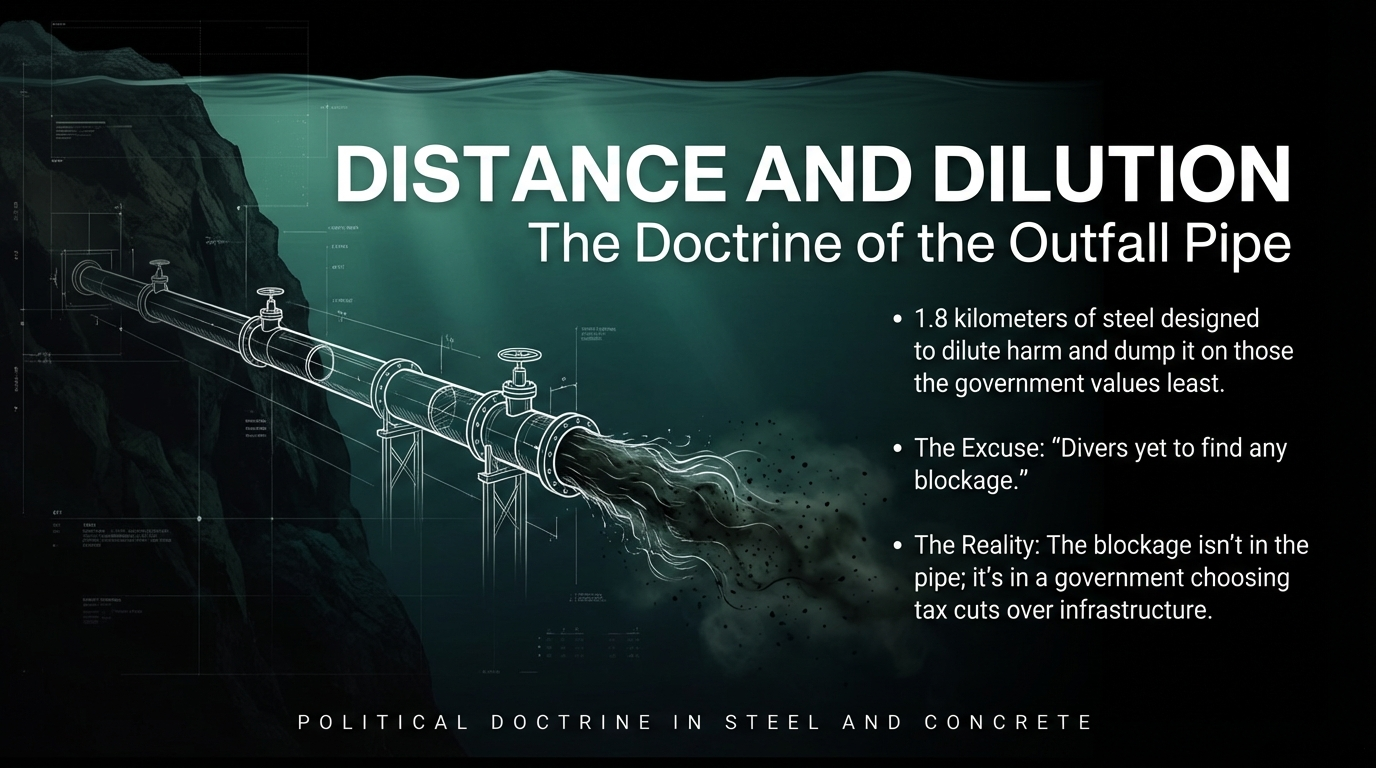
The sewage is being pumped out through the plant’s 1.8 km outfall pipe to “reduce harm to beaches.” RNZ That pipe is not just infrastructure; it is political doctrine in steel and concrete.
This is how power works in Aotearoa:
- Build long pipelines—legal, economic, bureaucratic—that carry away the visible waste of the system and dump it in places you don’t value: Māori communities, poor suburbs, the moana.
- Rely on distance and dilution. Spread the harm far enough that no single spill becomes a career-ending scandal.
Wellington Water “believed some issue with that pipe had caused the major failure,” and divers have been searching but have “yet to find any form of blockage.” RNZ
That line could sit in every Crown report:
- We sense “some issue,” but no clear culprit.
- No “blockage,” no one to blame, just mysterious failure.
- Translation: it’s everyone’s fault and therefore no one’s fault—perfect for politicians.
Meanwhile, we all know the real blockage: decades of governments choosing tax cuts over pipes, corporate welfare over infrastructure, and white comfort over Māori survival. This government didn’t trip into this mess; it accelerated towards it.
Quantifying Harm: What Their “Environmental Degradation” Really Looks Like
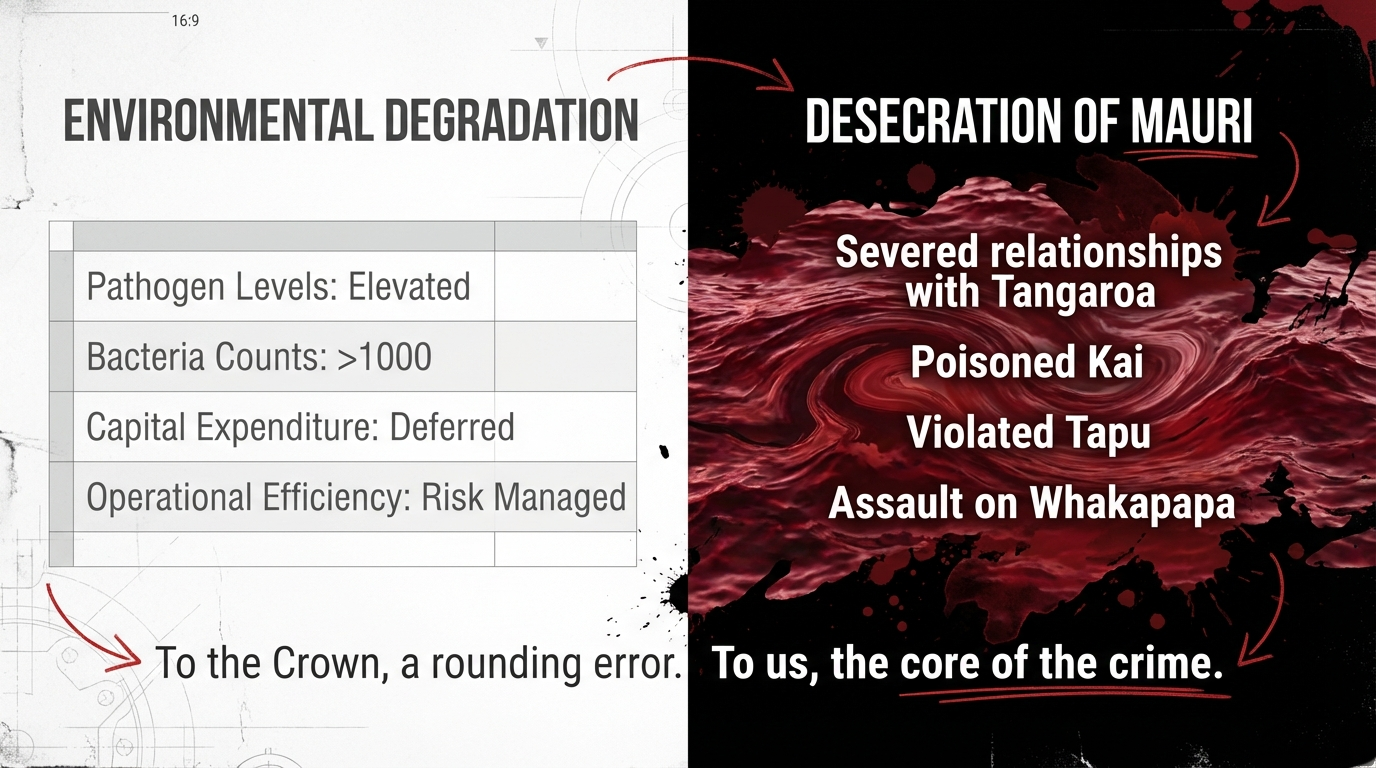
Mayor Andrew Little wrings his hands and insists “we can’t let such a critical plant for a modern city fail in the way that this has and cause the environmental degradation that it has.” RNZ That phrase—“environmental degradation”—is a coward’s euphemism.
Here is what this actually means when the pipes fail:
- Sewage discharges push pathogen levels in coastal waters and shellfish beds way beyond safe limits, increasing the risk of gastro illnesses, skin infections, and other health impacts, especially in communities already hammered by systemic neglect in housing, health, and infrastructure.
- Each contamination event can force closure or rāhui over coastal areas, cutting whānau off from kaimoana and places where tikanga is lived—hurting food security and attacking manaakitanga and whanaungatanga in very concrete ways.
- Repeated incidents erode trust: parents stop letting their kids swim, kaumātua stop trusting traditional gathering sites, and whole communities absorb another lesson that the state will happily poison them as long as it can issue a press release afterward.
Now, scale that up:
- If thousands of people across the region avoid swimming, gathering kai, or using local beaches because of contamination risks, that is thousands of unpaid health costs, lost recreation, and crushed cultural practices every year.
- Each year of underinvestment compounds the risk, making catastrophic failure—not “environmental degradation”—the logical outcome.
The government’s ideology counts none of this. Their spreadsheets only see “capital expenditure” and “operational efficiency.” The human cost, the Māori cost, is treated as a rounding error.
“Safe Place to Work”: The Smug Face of Colonial Cowardice
Nick Leggett proudly explains that from the moment they noticed “something was wrong,” the focus was to get the plant “clean so it is a safe place to work and so it is not emitting obviously a stench.” RNZ
Strip away the corporate tone, and you get the real doctrine:
- Protect the workplace, not the water.
- Protect the brand, not the beach.
- Protect the officials, not the whānau.
For Māori, safety is not an office environment with no smell. Safety is:
- Tamariki swimming without fear of sickness.
- Kaimoana gathered without suspicion of invisible toxins.
- Tangaroa respected as ancestor, not treated as a dumping ground for a government too cheap and too cowardly to maintain its own infrastructure.
Under tikanga, what they euphemise as “environmental degradation” is an active desecration of mauri and tapu. To the Western colonial mind, that is a cultural footnote. To us, it is the core of the crime.
It is not ignorance. It is contempt.
The Fake Accountability Ritual: Investigations as Deodorant
Wellington Mayor Andrew Little will “raise” the Moa Point failure with Prime Minister Christopher Luxon at a meeting that was already scheduled. Of course, he will. He talks about the need for “an appropriate investigation or inquiry into what happened,” adds “we can’t let this happen again,” and emphasises getting “the facts” to prevent a repeat. RNZ
This is the well-practised ritual of a political class that has no intention of changing:
- Catastrophic failure hits.
- Leaders perform outrage and surprise, even though they sit on top of decades of warnings and reports.
- They promise an “inquiry” to delay real accountability and diffuse anger.
- They ensure the inquiry’s terms point at technical faults, not ideological ones.
- They bury recommendations in bureaucracy or underfund them.
This government does not need another inquiry to reveal that chronic underfunding and neoliberal worship of “efficiency” wreck critical infrastructure. They already know, because they built careers on it, voted for budgets that entrenched it, and sneered at anyone who called for serious public investment.
Every time they say, “We can’t let this happen again,” they are lying. They absolutely can. They absolutely will. Because this is not a bug in their system—it is a feature.
Tikanga vs a Government That Thinks in Sewage
Tikanga sees this for what it is: a sustained, structured assault on relationships—with wai, with moana, with atua, with one another.
- Wai is kin, not a trash chute.
- Tangaroa is whanaunga, not infrastructure.
- The coast is a living limb of our whakapapa, not a line on a stormwater map.
The Western technocratic mind, shaped by white supremacy and neoliberal economics, cannot even see the crime properly. It downgrades tikanga to a “cultural consideration,” a PR add-on after the engineering and economics are locked in. It calls the poisoning of mauri “environmental degradation” and moves on.
Tikanga insists:
- You cannot routinely contaminate wai and claim to honour Te Tiriti.
- You cannot keep weighing Māori survival against budget savings and call it “responsible government.”
- You cannot expect long-term stability when your entire economic model is built on bleeding the whenua for short-term gain.
To power, this sounds “radical.” In reality, it is the only sane position in a world where climate chaos, failing infrastructure, and institutional racism are converging. The radicals are in Cabinet, betting everyone’s future that they can keep cutting, privatising, and polluting without the system collapsing.
Spoiler: it is already collapsing. Moa Point is one of the cracks where the truth leaks out.
Examples: This Is Their Normal, Not an Exception
Moa Point is not an isolated “incident”; it is a local eruption of a national pattern:
- Across Aotearoa, combined sewage and stormwater systems overflow in heavy rain, spewing contaminants into rivers, harbours, and coastlines, normalising “do not swim” signs like they are acts of God, not policy choices.
- In multiple regions, repeated contamination has forced long-term or recurring restrictions on kaimoana gathering, cutting off whānau from traditional food sources, undermining manaakitanga, and eroding the everyday practice of tikanga.
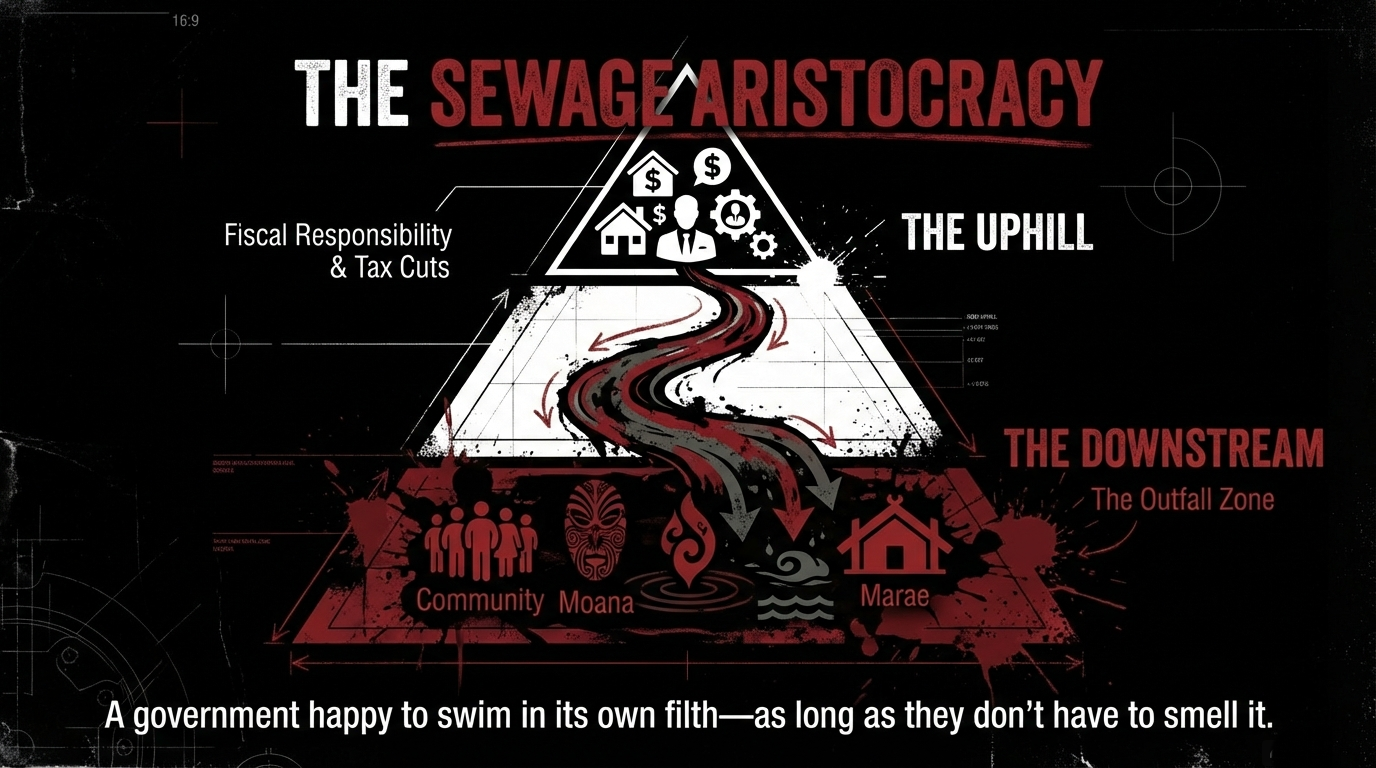
- Councils sit on multi-billion-dollar infrastructure backlogs while governments posture about “fiscal responsibility” and pander to property interests, treating resilient public systems as luxuries rather than obligations.
This government stands on top of all of that and calls itself “modern.” It is not modern. It is a sewage aristocracy: a small class safely uphill from the mess, insisting everything is under control while everyone downstream smells otherwise.
Real Solutions: Not More Band-Aids on a Burst Pipe
If we took this crisis seriously—not as an engineering hiccup but as a symptom of structural rot—the solutions would look nothing like the timid nonsense coming out of Wellington.
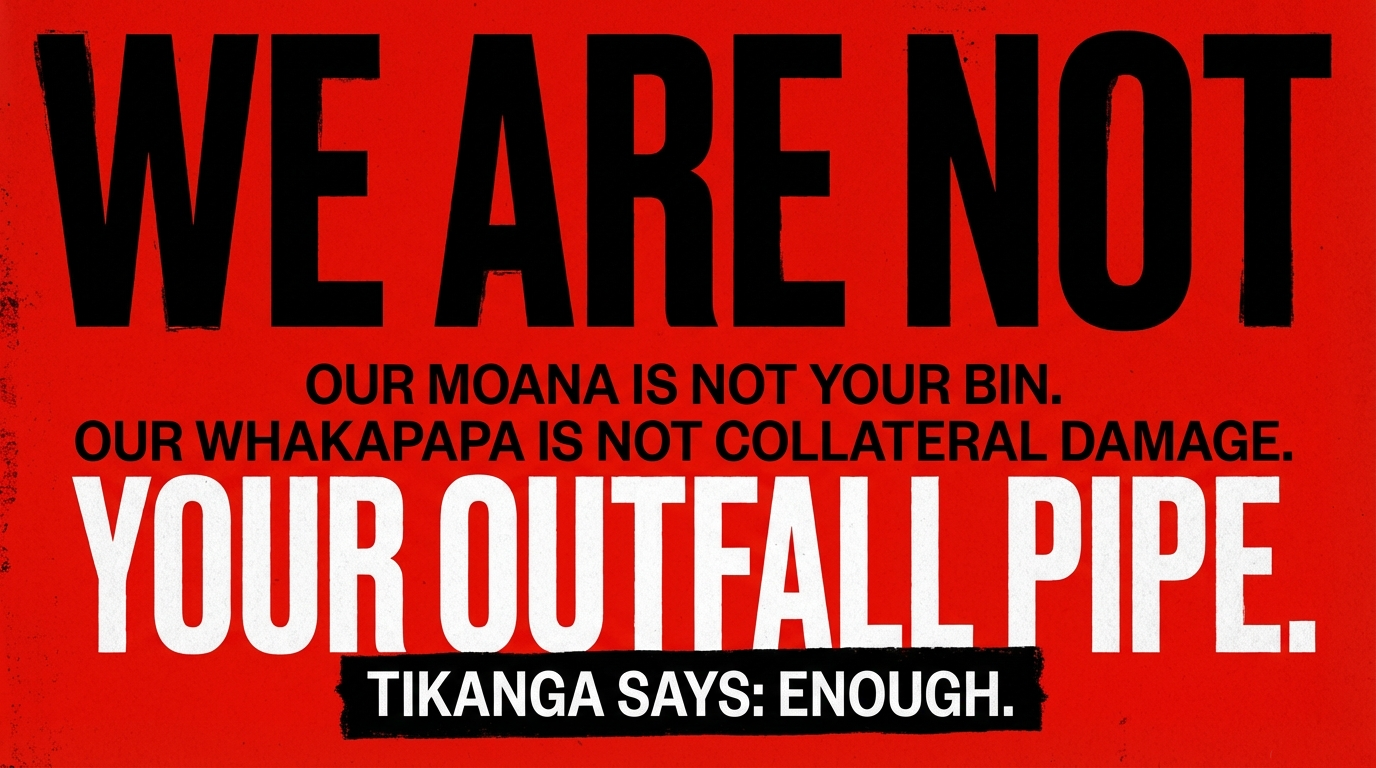
We would be demanding:
Tikanga-led water governance
Tangata whenua in actual control of water and wastewater decision-making, not token consultation.
Infrastructure designed from first principles that acknowledge wai and moana as living entities with rights and status, not convenient drains.
Binding legal protection for mauri
Legal frameworks that recognise and enforce the rights of wai and moana, building on models like Te Awa Tupua, backed by enforcement teeth sharp enough to bite councils, companies, and even central government when they breach them.
Real penalties, including personal liability for senior decision-makers when repeated or severe contamination occurs—no more hiding behind “system failures.”
Massive public investment in water infrastructure
End the lie that “we can’t afford” safe, resilient water systems while billions flow to the already rich.
Lock in multi-decade funding guaranteed by statute, with co-governance, to rebuild pipes, plants, and protections around a mauri-first ethic.
Community and iwi-led monitoring and response
Build and fund monitoring programs under mana whenua leadership, combining mātauranga and Western science to track mauri and contamination in real time.
Make public reporting automatic, with mandatory enforcement triggers that politicians cannot quietly ignore.
Cultural and spiritual restitution along with technical repair
After every significant contamination, resource cultural processes, health support, and long-term community recovery—not as charity, but as reparations.
Anything less is just more sewage management for a system too cowardly to fix its own foundations.
Who Profits From the Filth?
Follow the stench, and you find the beneficiaries:
- Politicians who ride waves of “fiscal discipline” rhetoric into office, slashing investment in public infrastructure while shifting risk onto future governments and vulnerable communities.
- Corporates and consultants who gorge on emergency contracts and “expert” reviews once the inevitable collapse happens.
- Wealthy property owners and businesses who enjoy lower rates and taxes while everyone else pays in sickness, contaminated environments, and shredded tikanga.
And who pays?
- Māori, whose tikanga, whakapapa, and daily relationships with wai and moana are treated as disposable.
- Working-class communities, who live closest to failing systems and farthest from the boardrooms where decisions are made.
- Our mokopuna, handed a poisoned chalice and told to be grateful for “modern” infrastructure.
This is not misfortune. It is organised harm.
Refusing to Be Their Outfall Pipe
Moa Point is the mask off moment. A supposedly “modern” capital, ruled by ministers who worship efficiency and austerity, cannot even keep its own excrement contained. The same people who starve infrastructure of funding then stand in front of microphones, dripping with innocence, and promise inquiries.
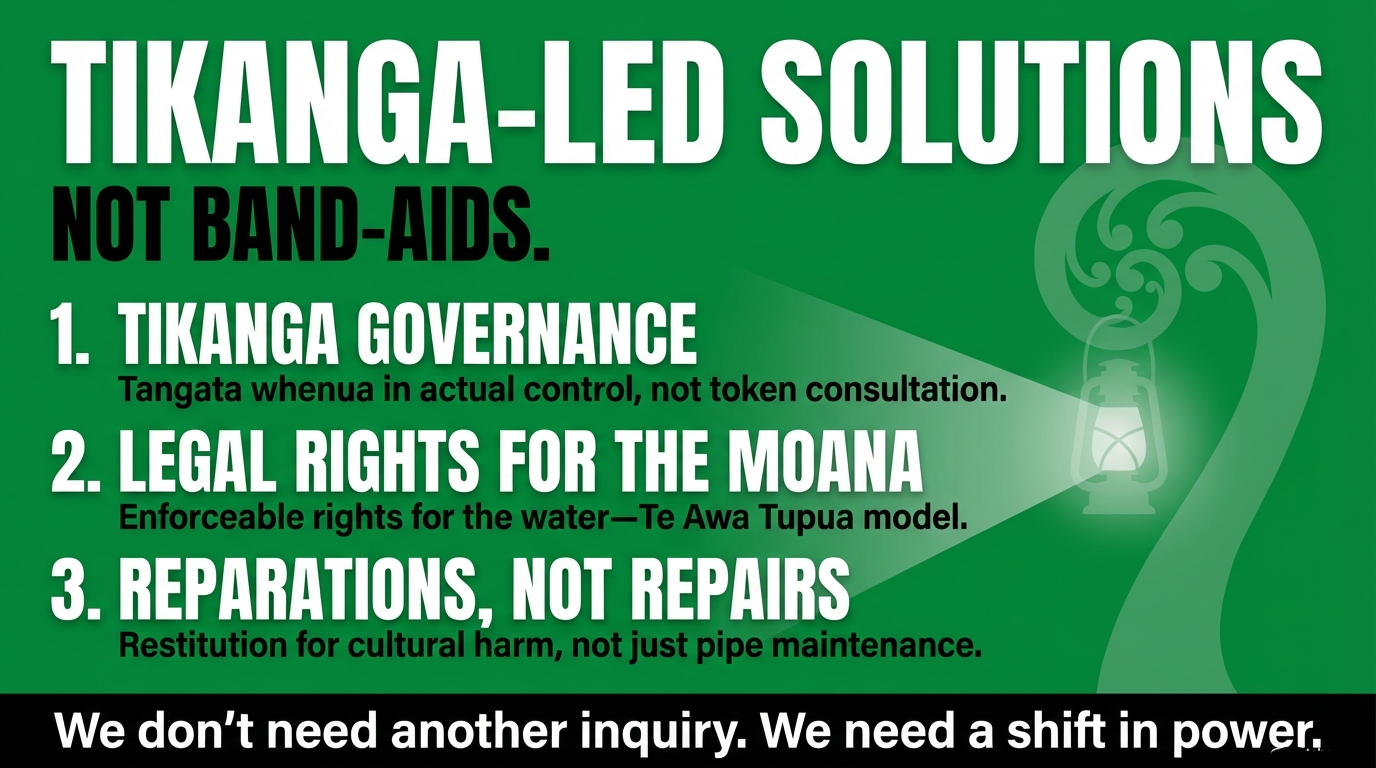
Tikanga says: enough. We are not your outfall pipe. Our moana is not your bin. Our whakapapa is not your collateral damage.
They are terrified of the sewage going septic. They should be more terrified of a people who refuse to let them flush this away, politically or spiritually.
Koha Consideration
Every koha to this kaupapa is a refusal to let this government and its corporate enablers drown us in their lies while they pump their waste into our moana. It is a choice to fund the naming of names, the exposing of pipelines of power, and the defence of tikanga where the Crown prefers silence.
Rangatiratanga means we do not wait for inquiries written by those standing knee-deep in the mess. We pool our own resources to hold them to account, to protect mauri, and to tell the truth they work so hard to deodorise.
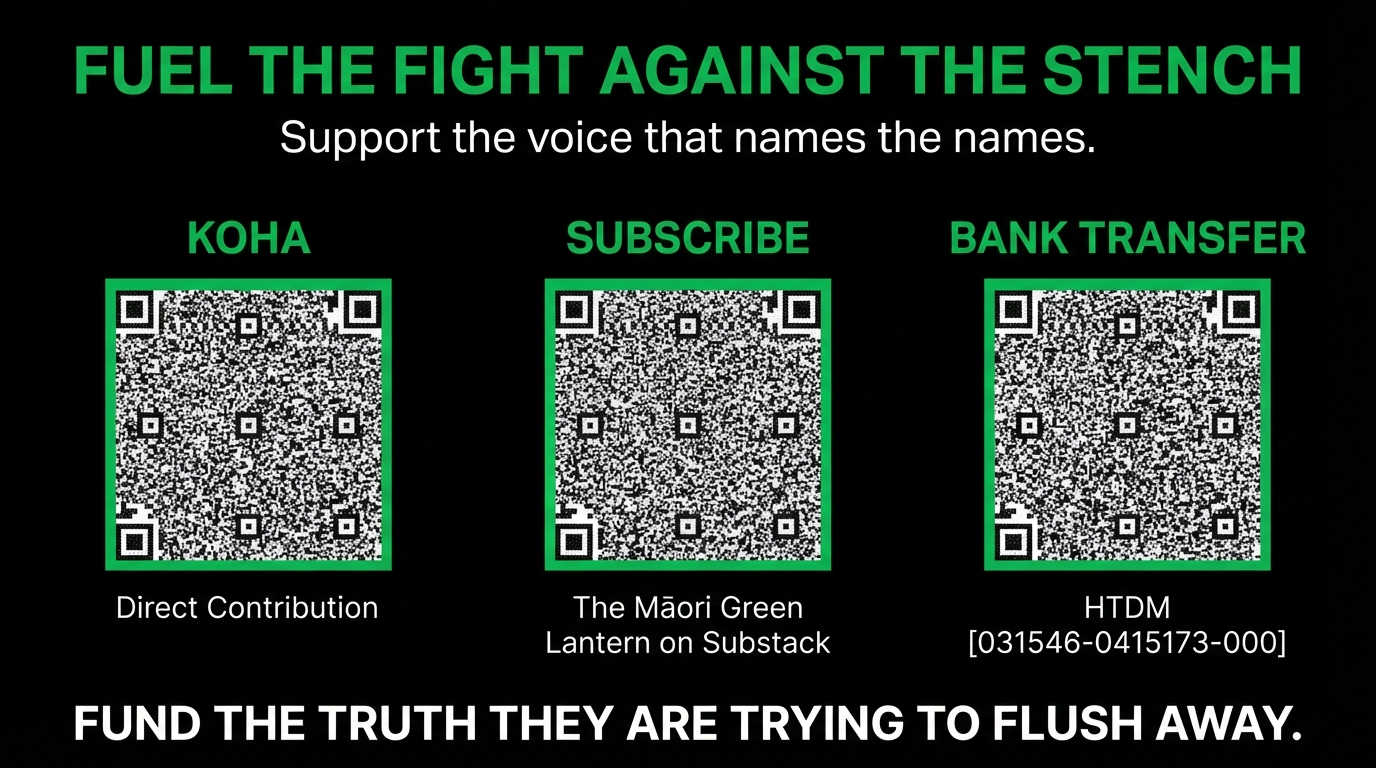
If you cannot koha financially, kei te pai. Subscribe or follow The Māori Green Lantern on Substack, share this kōrero, and bring your whānau into the conversation—that is koha of the highest value.
Three pathways exist:
- Direct koha (voluntary contribution) to support this mahi:
Koha—Support - https://app.koha.kiwi/events/the-maori-green-lantern-fighting-misinformation-and-disinformation-ivor-jones - Receive essays directly and support through subscription:
Subscribe to the Māori Green Lantern on Substack - https://themaorigreenlantern.substack.com/subscribe - Direct bank transfer: HTDM, account number 031546-0415173-000.

Ivor Jones The Māori Green Lantern Fighting Misinformation And Disinformation From The Far Right