"The Zombie Tax: How Labour Resurrected a Dead Idea While Leaving Its Power to Challenge Inequality in the Grave" - 29 October 2025
From $8 Billion to $700 Million—How Property Lobbyists, Atlas Network Think Tanks, and a Prime Minister's Personal Profits Killed Comprehensive Tax Reform and Condemned Māori to Deepening Wealth Inequ
Kia ora e te whānau,
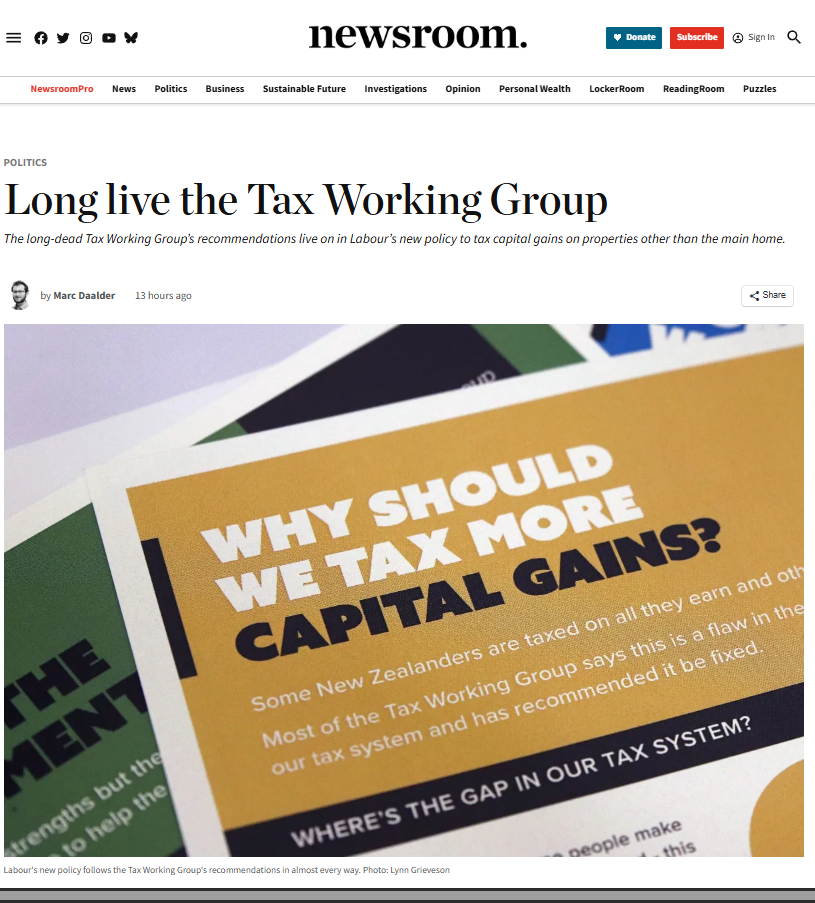
Labour’s October 2025 “capital gains tax” announcement, hailed as a phoenix rising from the Tax Working Group’s ashes, is actually a zombie—legally alive but spiritually dead, drained of the power to challenge wealth inequality that crushes Māori. Six years after Finance Minister Grant Robertson gutted the Tax Working Group’s comprehensive proposal, Labour resurfaces with a watered-down property-only tax that captures just $700 million annually instead of $8 billion, explicitly exempting farms and inherited wealth while Prime Minister Christopher Luxon pockets $500,000 tax-free from property sales (Daalder, 2025). This is not reform—it’s capitulation wearing reform’s clothes.
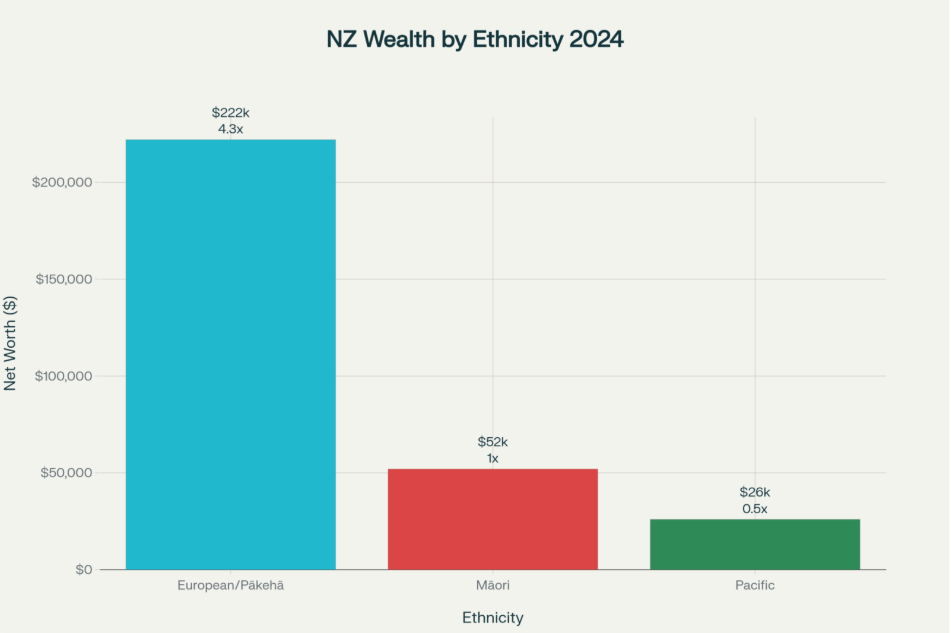
Median Household Net Worth by Ethnicity, 2024
Whakapapa: How Wealth Became Untaxable
When Jacinda Ardern established the Tax Working Group in 2017 under the leadership of Sir Michael Cullen, the nation watched as democracy encountered wealth. For two years, the Working Group researched, consulted, and deliberated on a question fundamental to any fair tax system: should capital gains—the profits earned when assets appreciate in value—be taxed, just as wages are?
In February 2019, the answer came back clear. A comprehensive capital gains tax on land, farms, shares, and business assets (excluding the family home) would raise $8 billion over five years and align New Zealand with every other OECD nation except Mexico (Tax Working Group, 2019). The recommendation reflected a fundamental principle: it’s unfair when workers pay tax on every dollar they earn while property speculators, share investors, and business owners pay zero tax on gains that often dwarf their salaries.
Then Winston Peters walked into the room and walked the idea out.
On April 17, 2019, Prime Minister Ardern announced the government would not implement any capital gains tax (Ardern, 2019). The reason given: she could not build consensus with her coalition partner New Zealand First and its leader Peters. Cullen later confirmed Peters bore primary responsibility (Cullen, 2020). What wasn’t mentioned: Peters represents an electorate where property investors hold significant wealth and political influence, and the decision aligned with his financial interests.
For six years, the Tax Working Group remained dead—or so it seemed.
The Issue: A Phoenix or a Zombie?
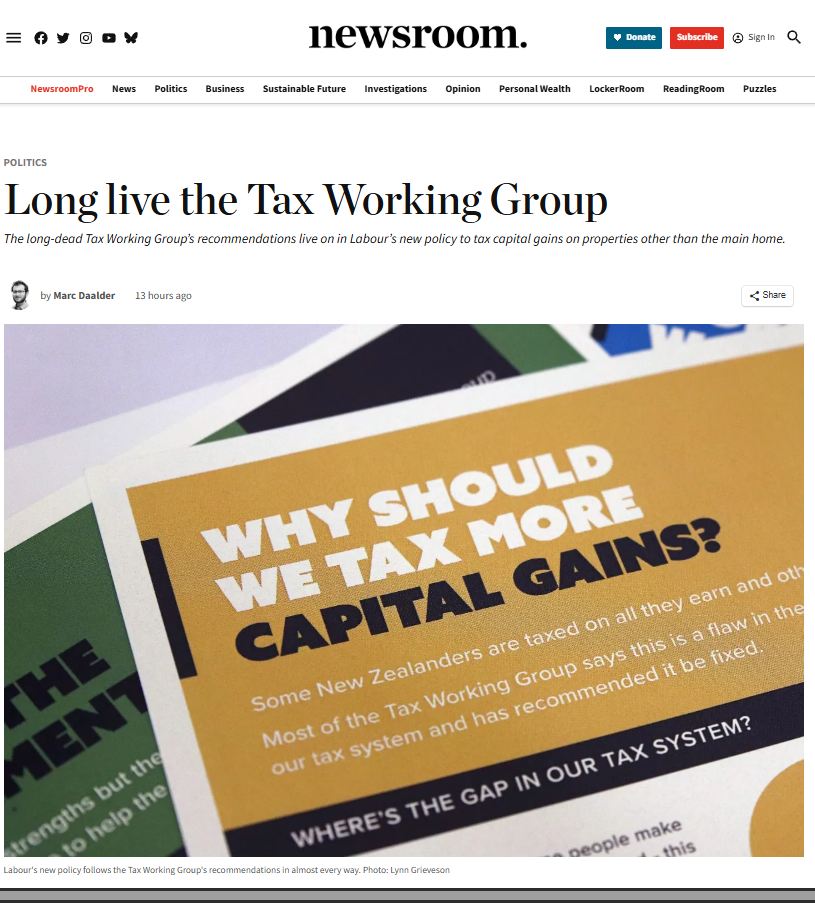
On October 28, 2025, reporter Marc Daalder, in an article titled “Long live the Tax Working Group,” announced the resurrection (Daalder, 2025). Labour, under new leader Chris Hipkins, would campaign on a capital gains tax. The announcement seemed triumphant: the Working Group’s ideas finally had political backing again.
But the devil lives in the details—details that Daalder himself identified as problematic. Labour’s 2025 proposal is drastically narrower than the 2019 Working Group recommendations. Where Cullen’s report recommended comprehensive taxation of capital gains from property, farms, shares, and business assets, Labour now proposes taxing only residential and commercial investment property—explicitly excluding the family home, farms, and inherited property (Daalder, 2025; Labour Party, 2025).
The revenue collapse is staggering. The Tax Working Group’s comprehensive proposal would have raised $8 billion over five years. Labour’s narrowed approach is projected to raise just $700 million annually—a reduction of over 91% (Daalder, 2025; Hipkins, 2025).
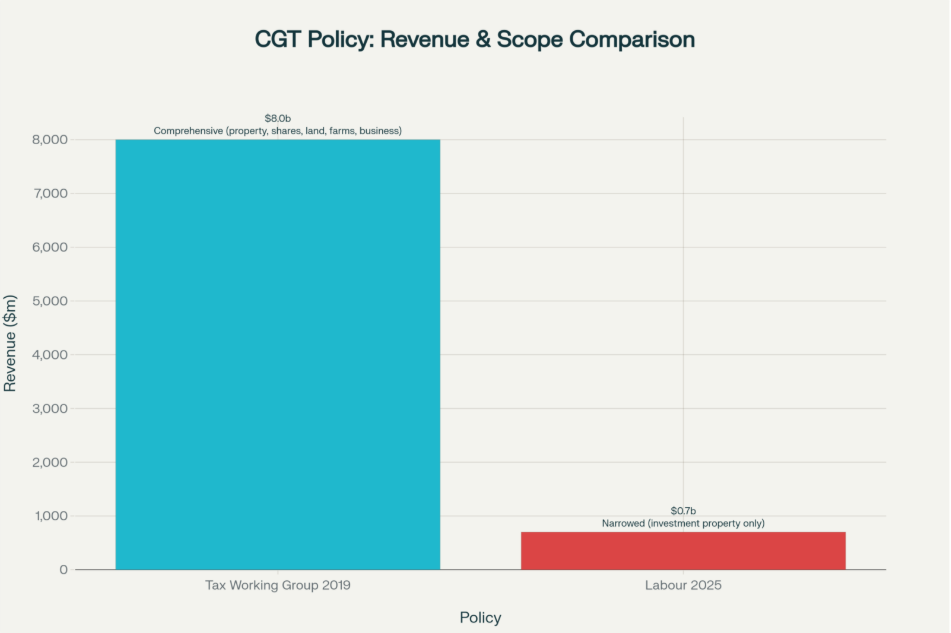
Tax Working Group vs Labour 2025 Capital Gains Tax Policy Scope
Daalder noted the irony with surgical precision: Labour’s finance spokesperson Barbara Edmonds mentioned the Tax Working Group by name eight times while explaining how Labour was implementing its recommendations. Yet on nearly every substantive point—scope, revenue, assets covered—Labour had narrowed the working group’s vision (Daalder, 2025).
The tax will not apply retroactively, meaning the pandemic-era property boom—which saw median house prices spike 36% between 2020 and 2022—faces zero taxation (Daalder, 2025). Speculators who bought Auckland apartments in 2020 for $400,000 and sold them in 2025 for $600,000 can keep that $200,000 profit untaxed. Those gains will only be captured if the properties remain unsold after July 1, 2027, when the tax commences.
Home Ownership Rates by Ethnicity, 2024
Analysis: The Lobby Victory That Never Ended
The defeat of the Tax Working Group’s comprehensive proposal in 2019 was not a democratic decision—it was a lobby victory. Understanding why Labour’s 2025 proposal is so narrowed requires tracing the coordinated campaign that killed Cullen’s vision and how those same networks now shape the watered-down alternative.
The 2019 Opposition Campaign: Money, Messages, Media
When the Tax Working Group’s final report dropped in February 2019, the business lobby was ready. Damien Venuto, analyzing media coverage for the NZ Herald, noted the “carefully crafted responses” from property interests that “quickly made their way into headlines, skewing the debate sharply in favour of those opposed to a capital gains tax” (Venuto, 2024). The coordinated strategy revealed:
The Property Institute of New Zealand submitted detailed opposition arguing that CGT would not reduce house prices or increase supply (Property Institute, 2018). The Employers and Manufacturers Association opposed it. Business NZ opposed it. The Taxpayers’ Union, funded partly through Atlas Network affiliate relationships, launched the “Axe This Tax” campaign with full-page newspaper advertisements claiming that “most New Zealanders will be hit by the tax at some point in their life” if they owned homes with flatmates, lifestyle blocks, or rental properties (Taxpayers’ Union, 2019).
The campaign deployed a deliberate logical fallacy: conflating family home ownership (protected in every serious CGT proposal) with investment property speculation. The message was designed for maximum emotional resonance: your family home is at risk. The reality was technically false but politically effective.
By contrast, pro-CGT advocacy was starved of resources. Tax Justice Aotearoa, a pro-CGT group, managed only $15,000 in public advocacy spending—a rounding error compared to the coordinated corporate campaign (RNZ, 2019).
The Atlas Network Connection: Global Coordination of Opposition
The Taxpayers’ Union, which led the “Axe This Tax” campaign, is affiliated with the Atlas Network, a global coalition of over 500 think tanks spanning 100+ countries dedicated to promoting free-market ideology (Atlas Network, 2025). The Union’s executive director Jordan Williams attended the Atlas Think Tank MBA program in 2015 and has received Atlas Network funding (Williams, 2024).
This network reaches into cabinet. ACT Party leader David Seymour worked for Atlas affiliate Frontier Centre for Public Policy from 2007 to 2011 (Seymour profile, 2023). In a 2021 speech, he referenced “my old friends at the Atlas Network” (Bad Newsletter, 2024). Yet in a February 2024 interview with Mihingarangi Forbes on Māori Television, Seymour denied any Atlas connection when questioned about the Australian referendum on Indigenous voice to parliament (Forbes, 2024). The lie is documented—Seymour appears in the 2008 Atlas Year in Review composing a song about school choice (Bad Newsletter, 2024).
Seymour is now Deputy Prime Minister in the National-ACT-NZ First Coalition. His Deputy role gives him direct influence over financial policy—and consistent opposition to any capital gains tax.
The New Zealand Initiative: Corporate Ownership of Tax Policy
The New Zealand Initiative, formed in 2012 from the merger of the Business Roundtable and the New Zealand Institute, represents approximately 70 major corporations including all five major banks (ANZ, ASB, BNZ, Westpac, Kiwibank), both supermarket chains (Foodstuffs and Woolworths), Fletcher Building, Genesis Energy, and British American Tobacco (NZ Initiative, 2025; Integrity Institute, 2025).
Roger Partridge, the NZ Initiative’s chairman, is a member of the Mont Pelerin Society, the global network of neoliberal intellectuals founded by Friedrich Hayek in 1947 (NZ Initiative, 2025). Deputy Chair Barbara Chapman, former ASB Bank CEO, now chairs Genesis Energy and sits on the boards of Fletcher Building, NZME, and IAG—a web of interlocking directorates giving banking and energy interests unified voice on tax policy (NZ Initiative, 2025).
This interlocking directorate ensured coordinated opposition to any capital gains tax—not because such taxes are economically unsound (every OECD nation except Mexico disagrees), but because property investors and banks directly profit from untaxed capital gains.
Hidden Connections: Five Specific Revelations
Connection 1: Prime Minister’s Personal Wealth Driving Policy
Christopher Luxon sold three investment properties between August and November 2024, netting approximately $500,000 in tax-free capital gains (RNZ, 2024). His Wellington apartment purchased in 2020 for $795,000 and sold for $975,000 would have incurred a tax bill of approximately $70,000 under the 10-year bright-line test his government scrapped in July 2024. His Onehunga properties, purchased in 2015 for approximately $620,000-$650,000 and sold for $930,000 each, represented gains of $280,000-$310,000 each—all tax-free (RNZ, 2024). Luxon’s government then restored full mortgage interest deductibility for landlords—a subsidy worth $2.9 billion over four years (Budget 2024-2025). This is not coincidental policy-making—it is direct self-dealing.
Connection 2: Bob Jones Funds the Taxpayers’ Union Opposition Network
Sir Bob Jones, a property developer and former politician with direct financial interest in preventing capital gains taxation on real estate, has donated substantially to the Taxpayers’ Union and provided rent-free office space for the organization (Williams, 2024). The Union then deployed its resources to campaign against capital gains tax. This is not a grassroots civic organization—it is a property investor’s advocacy vehicle disguised as a taxpayer watchdog.
Connection 3: Barbara Chapman’s Interlocking Directorates Link Finance, Energy, Media, and Policy
As former ASB Bank CEO, Barbara Chapman oversaw one of the major lenders that discriminates against Māori borrowers (Houkamau & Sibley, 2015). She now serves as Deputy Chair of the NZ Initiative (which opposes capital gains tax), Chair of Genesis Energy (which benefits from deregulated markets the Initiative advocates for), and director of NZME (which shapes media narratives about tax policy) (NZ Initiative, 2025). Through these roles, Chapman represents finance, energy, and media interests united in opposition to any taxation of capital gains.
Connection 4: David Seymour’s Deception Reveals the Network’s Preference for Secrecy
Seymour worked for Atlas Network affiliate Frontier Centre from 2007-2011, referenced “my old friends at the Atlas Network” in 2021, yet flatly denied any Atlas connection in a February 2024 television interview (Bad Newsletter, 2024). His lie reveals that the network prefers to operate without public scrutiny. Now as Deputy Prime Minister, Seymour directly influences tax policy in a coalition that opposes capital gains taxation—policy that directly aligns with his ideological network’s interests.
Connection 5: Grant Robertson’s Tax Working Group Success Killed by His Coalition Partner
Grant Robertson, as Finance Minister under Jacinda Ardern, commissioned the Tax Working Group and publicly supported its recommendations. Yet as a member of the coalition government with New Zealand First, he watched Prime Minister Ardern accept Winston Peters’ veto on capital gains tax without visible internal opposition (Robertson, 2019). Robertson could have resigned in protest. He did not. Six years later, Labour returns with a drastically narrowed proposal—partly because Robertson’s previous capitulation established that property interests could successfully block comprehensive tax reform. The 2025 narrowed proposal reflects the lesson learned: don’t even ask for the full thing, because the lobby will block you anyway.
Tikanga Violations: Why Untaxed Capital Gains Betray Māori Values
The refusal to tax capital gains systematically violates the foundation principles of tikanga Māori:
Whanaungatanga (relationships and collective wellbeing): When 119 individuals control $102.1 billion—4.9% of GDP—while over 100,000 households own negative net worth due to debt, whanaungatanga becomes impossible (WSWS, 2025). The wealth concentration required by zero-tax-on-gains capitalism literally severs the connections that allow whānau to support each other. Māori households with median net worth of $52,000 cannot tautoko their whānau when Europeans accumulate untaxed capital gains at 4.3 times the rate (Stats NZ, 2024).
Manaakitanga (respect and care): A tax system exempting property speculators while taxing workers’ wages shows fundamental disrespect for labour. Māori, overrepresented in wage-dependent employment, bear disproportionate tax burdens while landlords—disproportionately European—accumulate untaxed wealth. This is the opposite of manaakitanga.
Kaitiakitanga (guardianship and stewardship): Land as taonga requires kaitiakitanga—but property speculation treats whenua as commodity. The housing affordability crisis—median Auckland house prices at 11.5 times median household income in 2020—locks rangatahi Māori out of property ownership and severs intergenerational connection to whenua (Global Property Guide, 2025). Untaxed capital gains accelerate property speculation and pricing that prevents Māori land stewardship.
Kotahitanga (unity and collective action): The division between property-owning speculators who accumulate untaxed wealth and wage-dependent workers who pay on every dollar earned fractures our collective strength. This fragmentation is deliberate—neoliberal tax policy is designed to make solidarity harder to build.
Rangatiratanga (self-determination): Māori home ownership collapsed from 57% in 1991 to 43% in 2013 to 35% in 2024, while Pākehā rates fell less dramatically from 79.3% to 70.1% (Stats NZ, 2015). When Māori cannot afford to own homes due to property speculation enabled by untaxed capital gains, Māori cannot exercise rangatiratanga over their own lives. This is economic colonialism.
Aroha (compassion): Where is aroha when a Prime Minister pockets $500,000 tax-free while 66,665 children live in consistent poverty, denied adequate housing, healthcare, and education? (CPAG, 2025) Where is aroha when landlords receive $2.9 billion in subsidies while Māori health outcomes remain devastated?
Implications: Quantified Harm and Escalating Stakes
The Coalition Government’s tax policies represent the largest wealth transfer upward in a generation. Between 2023 and 2025, the government cut income taxes by $14.7 billion over four years, restored mortgage interest deductibility worth $2.9 billion to landlords, cut the bright-line test from 10 years to 2 years, and slashed the government contribution to KiwiSaver (Budget 2024-2025; Willis, 2025). Combined, these policies reduce annual tax revenue by approximately $3.7 billion while enriching property investors and high-income earners (Taxpayers’ Union, 2025).
For Māori, the implications are catastrophic:
Health: With Māori life expectancy already 7 years less than non-Māori (75.1 versus 82.1 years), underfunding through lower tax revenue directly kills people (Chin et al., 2018). Labour’s $700 million annual CGT revenue would have funded universal dental care or substantial primary healthcare expansion. Without it, healthcare remains rationed by wealth, and Māori die younger.
Housing: With only 35% of Māori owning homes compared to 70% of Pākehā, every year of inaction on capital gains taxation deepens property-based wealth inequality (Stats NZ, 2024). Property speculators—disproportionately European—accumulate untaxed wealth while Māori rangatahi remain locked out of homeownership.
Employment and Income: The Coalition cut funding for the Workforce Development Councils and Regional Skills Leadership Groups by $2.1 billion (Budget 2024-2025). Māori, overrepresented in vocational education and skills training, face deteriorating training infrastructure while landlords accumulate untaxed gains.
Intergenerational Wealth: The KiwiSaver government contribution was cut in half, reducing from 50 cents to 25 cents per dollar contributed (Budget 2024-2025). For low-income Māori workers, this means approximately $1,000 less retirement savings over 40 years of work—precisely the period when property speculators accumulate untaxed capital gains at multiples of that amount.
The international context is clear: New Zealand’s refusal to tax capital gains stands with Mexico as a global anomaly. Every other OECD nation taxes capital gains, many at rates exceeding the 28% Labour proposes (OECD, 2024). This isn’t policy based on evidence—it’s policy based on the power of property interests to block reform.
Tactical Deconstruction: How Neoliberal Rhetoric Betrays Itself
The opposition to Labour’s CGT proposal deploys specific fallacies that deserve naming:
The “Handbrake on the Economy” Fallacy: Finance Minister Nicola Willis claims the tax would “load more costs on businesses, investors and savers and act as a handbrake on our economy” (Willis, 2025). This commits the error of assuming property speculation equals productive economic activity. It does not. A CGT discourage unproductive property speculation (buying to flip, not to house) while redirecting capital to productive investment—exactly the stated policy goal (Hipkins, 2025).
The “Tax on Kiwis” Dog-Whistle: Opposition rhetoric frames the CGT as affecting ordinary Kiwis, evoking family home ownership. But Daalder noted explicitly that 90% of New Zealanders would be unaffected because the tax excludes the family home (Daalder, 2025). The rhetoric deliberately conflates investment property speculation with family homeownership to create fear.
The “Uncooked” Dismissal: Prime Minister Christopher Luxon, speaking from Malaysia, called Labour’s policy “uncooked”—a vague dismissal that evades substantive critique (Hipkins, 2025). The policy is 28 pages of detailed technical specifications following Tax Working Group recommendations. “Uncooked” means “threatens my property profits.”
The “Individual Responsibility” Frame: The rhetoric shifts taxation of speculative capital gains into an individualistic frame—”those profiting from property should pay their fair share.” But the systemic issue is that the tax system allows certain forms of income (capital gains) to escape taxation while others (wages) cannot. The problem is structural, not individual. Framing it as individual responsibility obscures the policy choice to exempt certain income streams.
Whakamutunga: The Path Forward for Kotahitanga

The Māori Green Lantern Fighting Misinformation And Disinformation From The Far Right
The October 2025 resurrection of capital gains tax is real, but incomplete. Labour has shown willingness to challenge untaxed capital gains—six years after Peters vetoed it. Yet the narrowed proposal reflects the ongoing power of property interests to constrain reform. This is where whānau must act.
For Māori communities: Organize to demand the full Tax Working Group recommendations, not the narrowed version. Call Labour MPs directly. Demand they explain why farms and inherited property are exempt—assets historically concentrated in European ownership. Make clear: a 28% tax only on future property gains is insufficient. We need taxation of current capital holdings, inherited wealth, and speculative gains from the pandemic boom. Contact Chris Hipkins (chris.hipkins@parliament.govt.nz) and Barbara Edmonds (barbara.edmonds@parliament.govt.nz) directly.
For all communities: Name the networks. When the Taxpayers’ Union, NZ Initiative, or ACT Party oppose progressive taxation, expose their funders and international connections. Make “Atlas Network” a household term. Call out lies about policy: David Seymour’s denial of Atlas Network involvement after documented participation is disqualifying for office. Media outlets must demand accountability.
For voters: October 2026 is coming. Vote accordingly. This government cut taxes by $14.7 billion while cutting funding for skills training, slashing KiwiSaver contributions, and gutting public services. Every property speculator’s untaxed capital gain is a dollar not funding healthcare, education, or housing for whānau. Choose differently.
For activists: Support Tax Justice Aotearoa and other progressive groups demanding full Tax Working Group implementation. Build media capacity. Make progressive taxation not just policy—make it a movement.
The neoliberal era isn’t ending because its beneficiaries wish it so. It ends when we organize to end it. The capital gains tax debate is a test case. If we accept Labour’s narrowed proposal without demanding more, we accept the principle that property interests have veto power over tax policy. If we push for full implementation of the Tax Working Group recommendations, we establish that democracy—not lobby donations—determines tax policy.
Kia kaha. Kia māia. Kia manawanui.
The Māori Green Lantern

Tautoko this mahi: If this analysis serves you and your whānau, please consider koha to HTDM: 03-1546-0415173-000. Only give if you have capacity—times are tough for many. This work continues through your support.
Ardern, J. (2019). Government will not implement a Capital Gains Tax. Beehive Press Release, April 16, 2019.
Atlas Network. (2025). Atlas Network Wikipedia. Wikipedia.
Bad Newsletter. (2024). ACT leader David Seymour lies about his ties to the Atlas Network. October 2024.
Budget 2024-2025. (2025). Coalition Budget Documents. Treasury New Zealand.
Child Poverty Action Group. (2025). 2023/2024 child poverty statistics. CPAG Press Release, February 2025.
Chin, M. H. et al. (2018). Lessons for Achieving Health Equity Comparing Aotearoa/New Zealand and the United States. Health Affairs, 37(6), 2018.
Cullen, M. (2020). Tax Working Group’s chairman Michael Cullen says Winston Peters is to blame for the capital gains tax rejection. NZ Herald, September 21, 2020.
Daalder, M. (2025). Long live the Tax Working Group. Newsroom, October 28, 2025.
Global Property Guide. (2025). New Zealand Residential Real Estate Market Analysis 2025. Global Property Guide.
Hipkins, C. (2025). Labour announces capital gains tax policy. RNZ News, October 27, 2025.
Houkamau, C. A., & Sibley, C. G. (2015). Looking Māori Predicts Decreased Rates of Home Ownership. PLoS ONE, 10(3), 2015.
Integrity Institute. (2025). The New Zealand Initiative. The Integrity Institute, April 7, 2025.
Labour Party. (2025). Targeted tax to grow the economy and fund free doctor’s visits. Labour Press Release, October 27, 2025.
NZ Herald. (2024). Prime Minister Christopher Luxon sells another investment property. NZ Herald, September 30, 2024.
NZ Initiative. (2025). About Us and Board. The New Zealand Initiative.
OECD. (2024). Capital Gains Tax by Country. OECD Tax Statistics.
Property Institute of New Zealand. (2018). Submission to Tax Working Group. Public Submission, April 30, 2018.
RNZ. (2024). Prime Minister Christopher Luxon sells another investment property. RNZ News, December 3, 2024.
RNZ. (2025). Household wealth statistics. RNZ News, September 28, 2025.
RNZ. (2019). Capital gains tax timeline. RNZ News Archive.
Stats NZ. (2015). Housing Security and Rangatahi Māori. Stats NZ Housing Report.
Stats NZ. (2024). Household wealth by ethnicity. Stats NZ Household Economic Survey, June 2024.
Tax Working Group. (2019). Future of Tax: Final Report. Tax Working Group, February 20, 2019.
Taxpayers’ Union. (2019). Major campaign launched to beat unfair capital gains tax. Taxpayers’ Union Press Release, April 2, 2019.
Taxpayers’ Union. (2025). National deliver another Labour Party Budget. Taxpayers’ Union Analysis, May 21, 2025.
Venuto, D. (2024). How lobby groups stole the capital gains tax debate. NZ Herald, October 16, 2024.
Willis, N. (2025). Nicola Willis slams Labour’s capital gains tax plan. RNZ News, October 27, 2025.
Williams, J. (2024). Jordan Williams on what the Taxpayers’ Union really is and who funds it. RNZ 30 with Guyon Espiner, May 21, 2024.
WSWS. (2025). Stark wealth inequality in New Zealand. World Socialist Web Site, October 2, 2025.
⁂
- Long-live-the-Tax-Working-Group-Newsroom.pdf
- https://www.nzherald.co.nz/nz/politics/labours-mini-cgt-sets-a-small-target-but-has-big-loopholes-including-for-the-family-home-thomas-coughlan/QZMZZINPO5ATLCDESMPOT4CPJY/
- https://www.1news.co.nz/2025/10/28/chris-hipkins-on-capital-gains-tax-policy-leak/
- /content/files/podcasts/acast/the-detail.xml
- https://www.rnz.co.nz/news/political/476167/finance-minister-grant-robertson-says-national-s-top-tax-rate-cut-does-not-add-up
- https://www.1news.co.nz/2025/10/28/labour-details-capital-gains-tax-policy-to-fund-free-gp-visits/
- https://www.rnz.co.nz/tags/Jesse Mulligan?page=164
- https://www.rnz.co.nz/news/business/575279/is-this-new-zealand-s-highest-marginal-tax-rate
- https://www.rnz.co.nz/national/programmes/checkpoint/audio/2019010298/labour-announces-capital-gains-tax-policy-to-fund-gp-appointments
- https://www.rnz.co.nz/features?page=420
- https://www.rnz.co.nz/news/national/570406/grant-robertson-stands-by-covid-era-spending-in-wake-of-treasury-rewriting-history
- https://www.rnz.co.nz/news/thedetail/563589/the-electricity-evangelist-spreading-the-solar-message
- https://www.1news.co.nz/2025/10/28/live-stream-hipkins-fronts-media-on-labours-capital-gains-tax-policy/
- /content/files/oggcasts/nights.xml
- https://nz.linkedin.com/in/marcdaalder
- https://x.com/marcdaalder?lang=en
https://marcdaalder.wordpress.com
- https://thespinoff.co.nz/the-bulletin/28-10-2025/economic-drivers-or-money-pits-the-debate-over-the-governments-billion-dollar-roads
- https://www.ph.co.nz/about/tax-blog/labours-tax-policy-just-announced/
- https://centrist.nz/labour-backs-28-percent-capital-gains-tax/
- https://www.facebook.com/Breakfaston1/videos/labours-finance-spokesperson-grant-robertson-on-their-proposed-tax-policy/614155252632487/
- https://www.national.org.nz/news/grant-robertsons-credibility-problem
- https://www.rnz.co.nz/news/national/432644/think-tank-editor-running-far-right-blog-resigns
- https://www.labour.org.nz/news/release-targeted-tax-to-grow-the-economy-and-fund-free-doctor-s-visits/
- https://www.taxpayers.org.nz/budget_2025
- https://www.nzherald.co.nz/nz/politics/labours-tax-plan-coalition-parties-attack-capital-gains-tax-policy-as-chris-hipkins-set-to-reveal-more/PBOCJFIBINALBDCLFNJEZWS2TA/
- https://www.rnz.co.nz/national/programmes/checkpoint/audio/2019010298/labour-announces-capital-gains-tax-policy
- https://lawnews.nz/tax/scant-detail-on-hipkins-proposed-cgt-willis-slams-new-tax-as-a-handbrake-on-the-economy/
- https://www.nzherald.co.nz/nz/politics/government-announces-4-billion-worth-of-public-service-savings-cutbacks-to-consultants-and-contractors/RUK5QUIFQBEMHODX3HTZHML5EI/
- https://www.rnz.co.nz/news/mediawatch/548685/climate-message-cutting-through
- https://www.rnz.co.nz/tags/energy
- https://www.rnz.co.nz/news/media-technology/537073/mediawatch-the-good-bad-and-weird-media-in-2024
- https://www.rnz.co.nz/news/political/496895/national-s-tax-plan-and-costings-what-you-need-to-know
- https://www.rnz.co.nz/news/political/577060/labour-will-oust-anyone-found-to-have-leaked-capital-gains-tax-policy-chris-hipkins-says
- https://www.rnz.co.nz/topics/nature-environment?page=432