“Three Articles That Expose the Crown’s Constitutional Assault and Māori’s Divided Response” - 24 January 2026
The Arsonists’ Ball: How Luxon’s Coalition Set Fire to the Treaty House While Māori Built Their Own Gilded Cage
Mōrena Aotearoa,
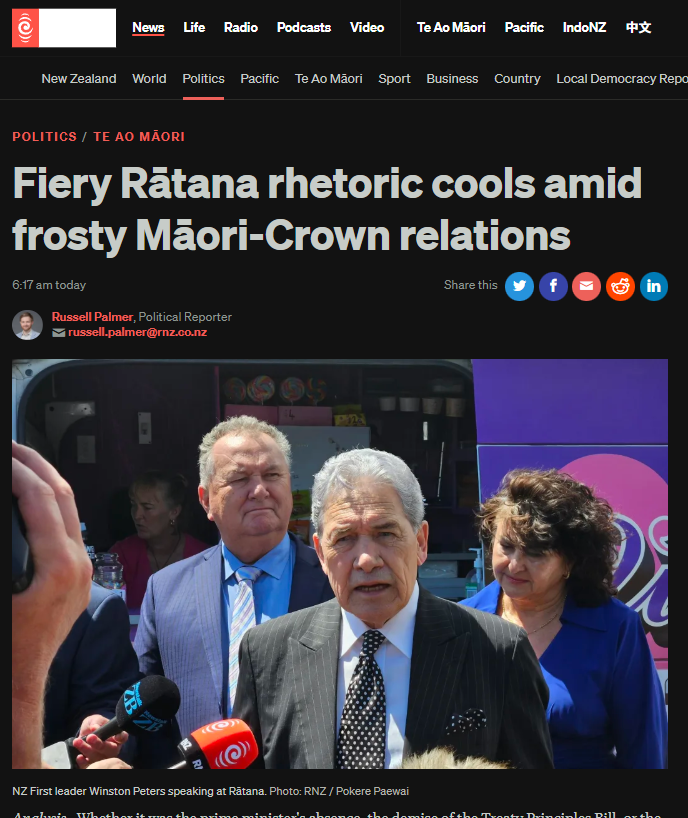
This analysis examines three interconnected RNZ articles published in January 2026 that collectively expose a constitutional and political crisis:
first, “Fiery Rātana rhetoric cools amid frosty Māori-Crown relations” documents how Christopher Luxon’s absence from Rātana 2026 and the “cooler” political tone mask deeper fractures in Crown-Māori relations resulting from the coalition government’s systematic dismantling of Māori institutions including Te Aka Whai Ora, the defeat of the Treaty Principles Bill, and legislative erasure of Treaty protections;
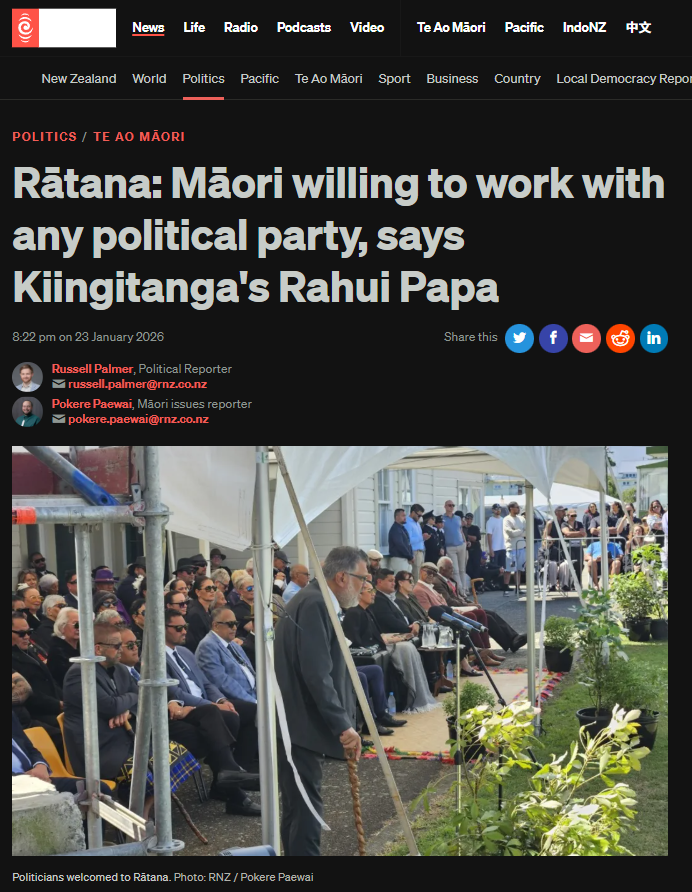
second, “Rātana: Māori willing to work with any political party” features Kiingitanga (Māori monarchy) statements from Rahui Papa and Tukoroirangi Morgan signaling strategic disengagement from the Crown and a pivot toward Māori self-determination, with Morgan declaring the relationship “pretty fractured” and stating that Māori now possess “a far greater desire to do things for ourselves”; and
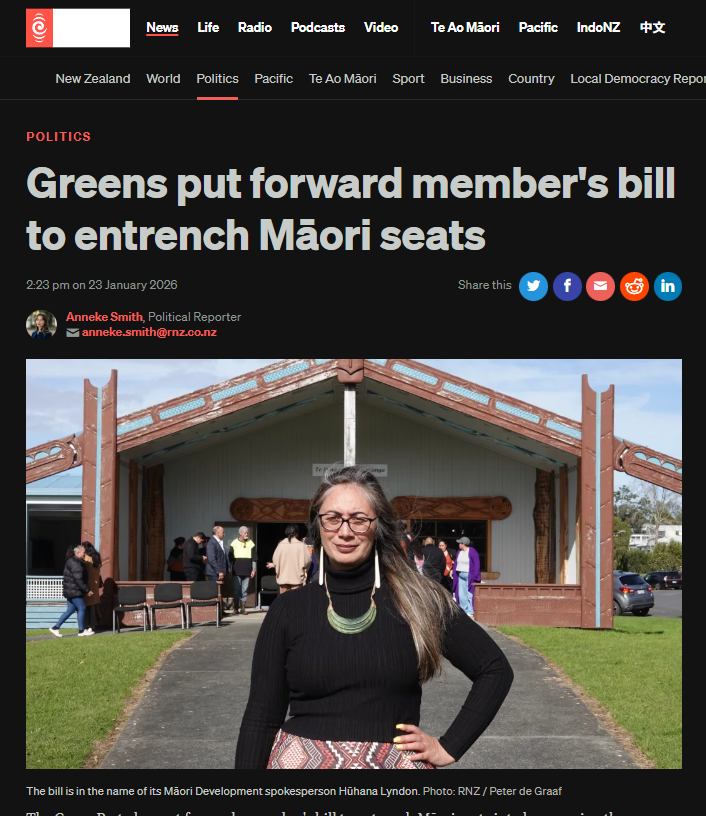
third, “Greens put forward member’s bill to entrench Māori seats” presents a futile procedural attempt by the opposition to protect Māori electoral representation through legislative entrenchment—a symbolic gesture that obscures the structural impossibility of constitutional protection under parliamentary sovereignty.
Together, these three articles reveal not a cooling of political tensions but a strategic fracturing:
the Crown dismantles constitutional protections with impunity; Māori leadership responds by constructing alternative power structures including the $100 million Kotahitanga Fund and economic self-determination initiatives that paradoxically entrench neoliberal inequality by concentrating wealth within iwi corporate elites while 99% of Māori remain trapped in generational poverty; and the parliamentary opposition offers constitutional band-aids that Parliament can unilaterally revoke whenever political ideology demands it.
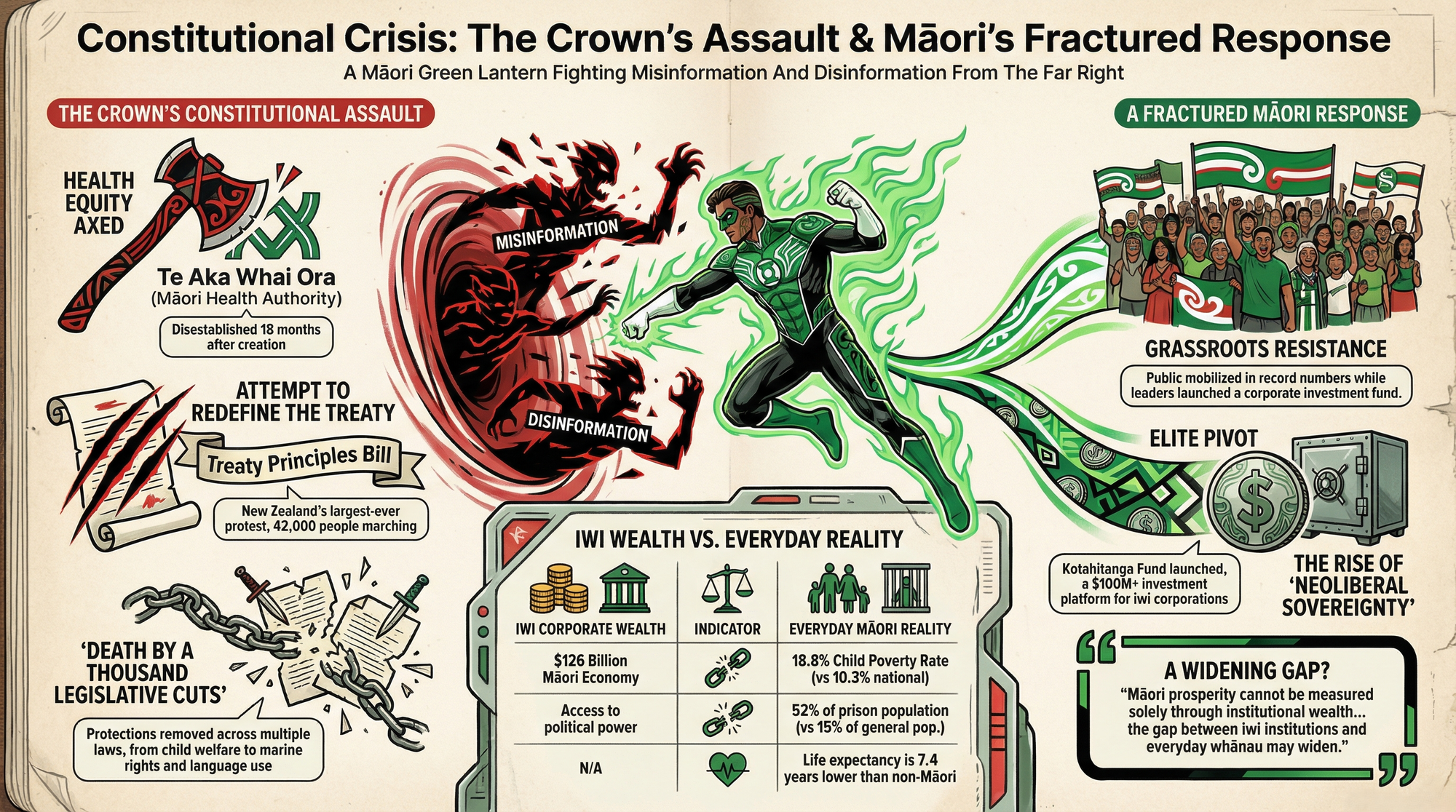
This essay deconstructs all three narratives to expose what the mainstream media frames as “cooling rhetoric” and “Māori pragmatism” as actually representing the calculated abandonment of collective liberation in favor of elite-managed neoliberal sovereignty, occurring amid a government that has proven itself constitutionally contemptuous of its own foundational Treaty obligations.
The Theatre of Managed Decline
When 42,000 people marched to Parliament in November 2024—New Zealand’s largest protest in recorded history—they were not simply opposing a piece of legislation. They were watching their constitutional house burn while the arsonists stood on the lawn, matches still in hand, explaining why the fire was actually good for property values. Christopher Luxon’s coalition government has spent the past two years systematically demolishing every load-bearing structure of Māori constitutional protection, then acting bewildered when Māori stopped asking for their permission to rebuild.
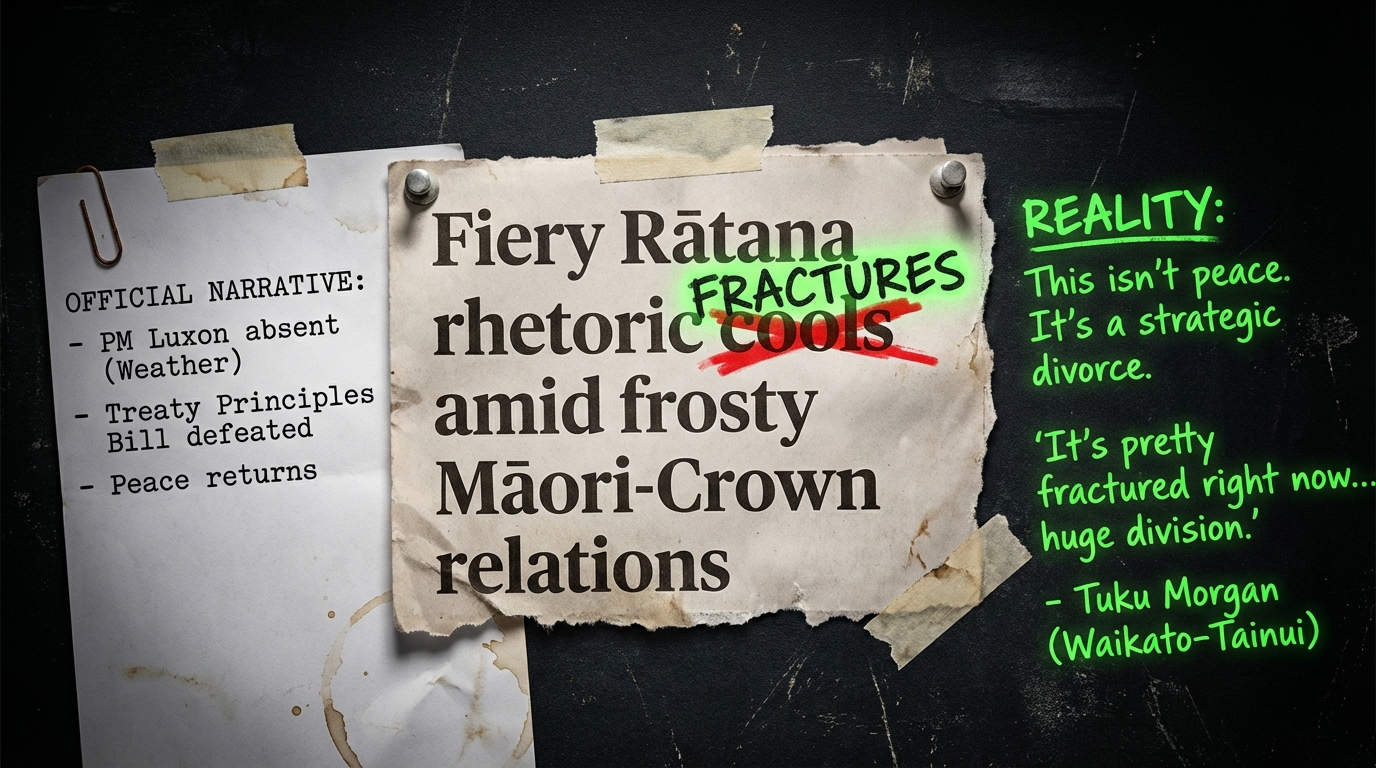
The cooler rhetoric at Rātana 2026 that RNZ’s analysis celebrates is not détente—it is Māori leadership recognizing that negotiating with vandals is a waste of breath. When Tukoroirangi Morgan declared the Crown relationship “pretty fractured right now...there’s huge division” and that Māori have “a far greater desire to do things for ourselves,” he was not describing a temporary diplomatic chill. He was articulating a strategic divorce from a partner who has proven themselves constitutionally abusive.
This is the story of how a government turned policy violence into performance art, how Māori elites responded by building a neoliberal investment vehicle that will enrich tribal corporations while 99% of Māori remain trapped in poverty, and how Christopher Luxon’s cowardice became the defining feature of his political leadership.
The Prime Minister Who Wouldn’t Show Up
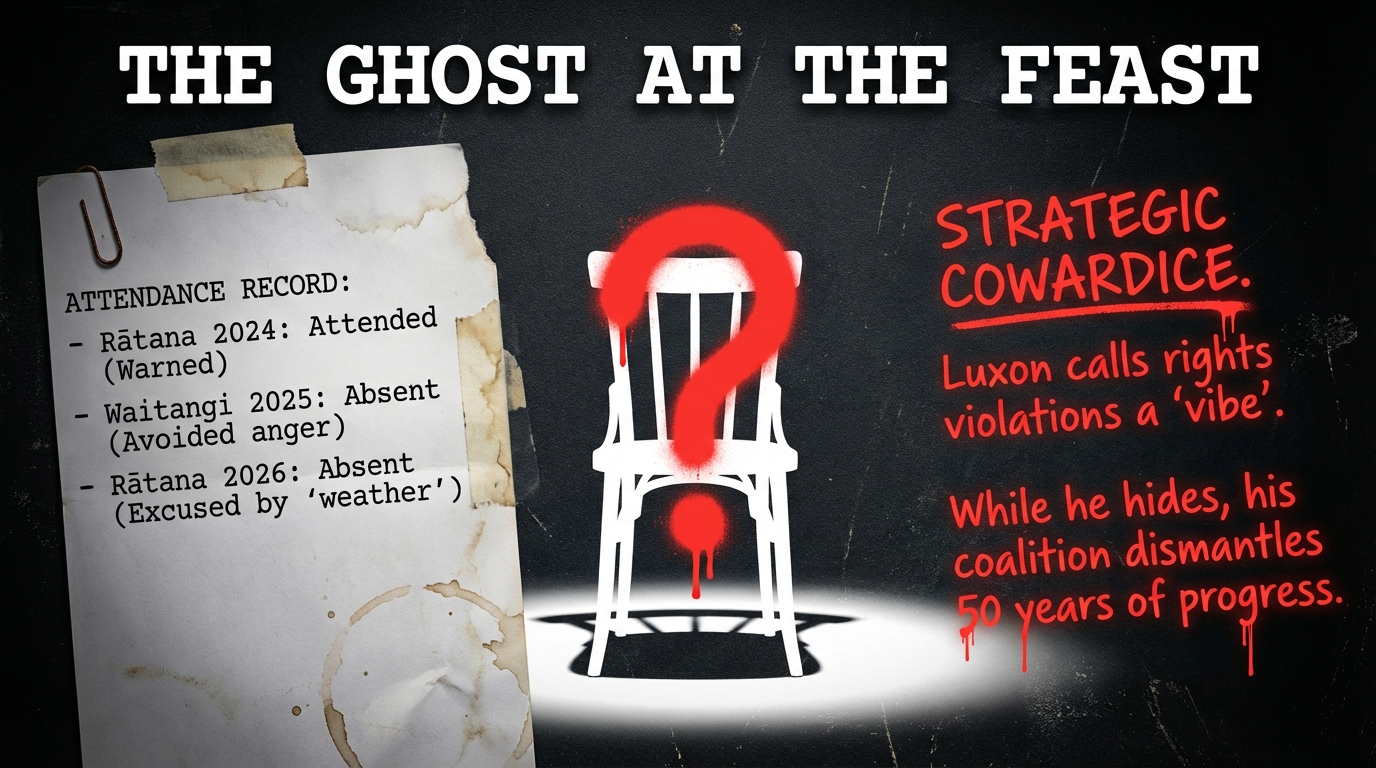
Christopher Luxon’s attendance record at Māori commemorations reads like a masterclass in strategic absence. Appear at Rātana 2024 when you need Māori votes and can still play the political tourist. Skip Waitangi 2025 after Māori anger over your coalition’s Treaty attacks makes the political temperature uncomfortable. Skip Rātana 2026 again, this time with the conveniently-timed excuse of visiting storm-damaged communities.
The pattern is transparent:
Luxon attends Māori events when he can extract political capital and vanishes when accountability is demanded. His defense that “it’s not uncommon for PMs not to be at Waitangi every Waitangi Day” conveniently ignores that his absence comes after orchestrating the most comprehensive attack on Māori rights in half a century. Previous prime ministers who skipped Waitangi weren’t actively dismantling the Treaty’s constitutional protections while claiming to improve Māori outcomes through “pragmatism.”
When Luxon does speak about Māori, the language is revealing. He characterizes Māori opposition to the Treaty Principles Bill as concern about “vibe”—as if 42,000 protesters marching, over 300,000 submissions (90% opposed), and international condemnation represent aesthetic preferences rather than legitimate constitutional grievances. This framing—”vibe” versus “outcomes”—constructs a false binary where Māori concerns about rights violations are dismissed as emotional while Luxon’s policy vandalism is presented as hard-headed practicality.
The question he posed—“How are you upholding the Treaty of Waitangi if you’re not delivering getting kids to school?”—weaponizes Māori disadvantage to justify removing the constitutional protections designed to address that very disadvantage. It’s the rhetorical equivalent of breaking someone’s legs, then mocking them for not running fast enough, then using their inability to run as justification for taking away their wheelchair.
Meanwhile, Luxon’s actual record on Māori outcomes is catastrophic. Māori are imprisoned at seven times the rate of non-Māori, making up 52% of the prison population despite being 15% of the general population. Māori die 7.4 years earlier than non-Māori. Māori smoking rates are 20% compared to 8% nationally. His government’s response? Dismantle the Māori Health Authority designed to address these inequities, then repeal the smoke-free legislation Māori health leaders advocated for.
The Demolition Derby: Cataloguing Constitutional Vandalism
The speed and scope of the Luxon coalition’s assault on Māori institutional architecture reveals ideological commitment to erasure. This was not policy correction—it was structural violence dressed in spreadsheets.
Te Aka Whai Ora: Eighteen Months from Vision to Vandalism
Te Aka Whai Ora (Māori Health Authority) was established in July 2022 after the Waitangi Tribunal’s Wai 2575 report found the Crown systematically contravened Treaty obligations across the health sector, leading to persistently poor Māori health outcomes. The Authority represented the strongest expression of rangatiratanga Māori had achieved in health policy—independent governance, dedicated commissioning of kaupapa Māori services, and statutory obligations to achieve health equity.
The coalition government disestablished it via urgent legislation in February 2024, just 18 months after its creation. Government officials admitted there was “no alternative plan to address poor Māori outcomes” and conceded the motivation was “political as part of a campaign to win the General Election.” No consultation with Māori occurred before disestablishment. When Lady Tureiti Moxon and others filed an urgent Waitangi Tribunal claim, the government introduced legislation before the Tribunal could hear the case—a deliberate circumvention showing contempt for both Treaty processes and judicial oversight.
Health Minister Shane Reti’s claim that dismantling the Authority would “reduce bureaucracy” was Orwellian nonsense—the functions simply transferred to Health NZ, maintaining bureaucratic structures while eliminating Māori governance. The destruction sent a message: when the Waitangi Tribunal identifies Crown Treaty breaches and recommends remedies, the Crown’s response is to destroy those remedies and proceed with the violations.
The Treaty Principles Bill: Colonial Redefinition Disguised as Clarity
David Seymour’s Treaty Principles Bill was an audacious attempt to legislatively redefine Te Tiriti o Waitangi through simple parliamentary majority—constitutional colonialism with better PowerPoint. The bill sought to replace court-established Treaty principles with three new principles: government has the right to govern, everyone has equal rights before the law, and the only exception is in Treaty settlements. This formulation erases tino rangatiratanga (self-governance), partnership, and active protection while weaponizing “equality” that ignores structural racism and historical land theft measuring 1.5 million hectares.
The public response was volcanic. Over 303,500 submissions were received—the largest in New Zealand’s parliamentary history—with 90% opposed and only 8% supportive. The volume was so overwhelming it crashed Parliament’s submission system. The Justice Select Committee heard 529 oral submissions over 79 hours, with 85% opposed, and recommended the bill not proceed.
The 42,000-person hīkoi mō te Tiriti in November 2024 was New Zealand’s largest recorded protest, with police later revising estimates upward as 42,000+ marched and thousands more couldn’t fit onto Parliament grounds. The hīkoi represented kotahitanga (unity) across iwi, age groups, and ethnicities—a rejection of the bill’s premise that New Zealanders needed David Seymour to “clarify” what their foundational document meant.
National and New Zealand First voted the bill down at second reading in April 2025: 112 against, 11 (ACT only) in favor. Yet the threat persists. Seymour vowed in December 2025 to “reignite the Treaty principles debate” in the 2026 election campaign, describing supporters as having “planted the seeds of a movement of equal rights for this country that won’t go away.” The bill’s purpose was never legislative success but cultural warfare—shifting the Overton window to normalize attacks on Treaty foundations.
Luxon’s role deserves contempt. While claiming the bill was “too simplistic,” Luxon’s government enabled its introduction through coalition negotiations. National voted for the bill at first reading, giving it parliamentary legitimacy and triggering the select committee process that consumed enormous Māori time, energy, and resources fighting a proposal National claimed to oppose. This is strategic duplicity: allowing ACT to attack Treaty foundations while maintaining plausible deniability.
Death by a Thousand Legislative Cuts
Beyond flagship demolitions, the coalition methodically removed Treaty references and protections across legislation:
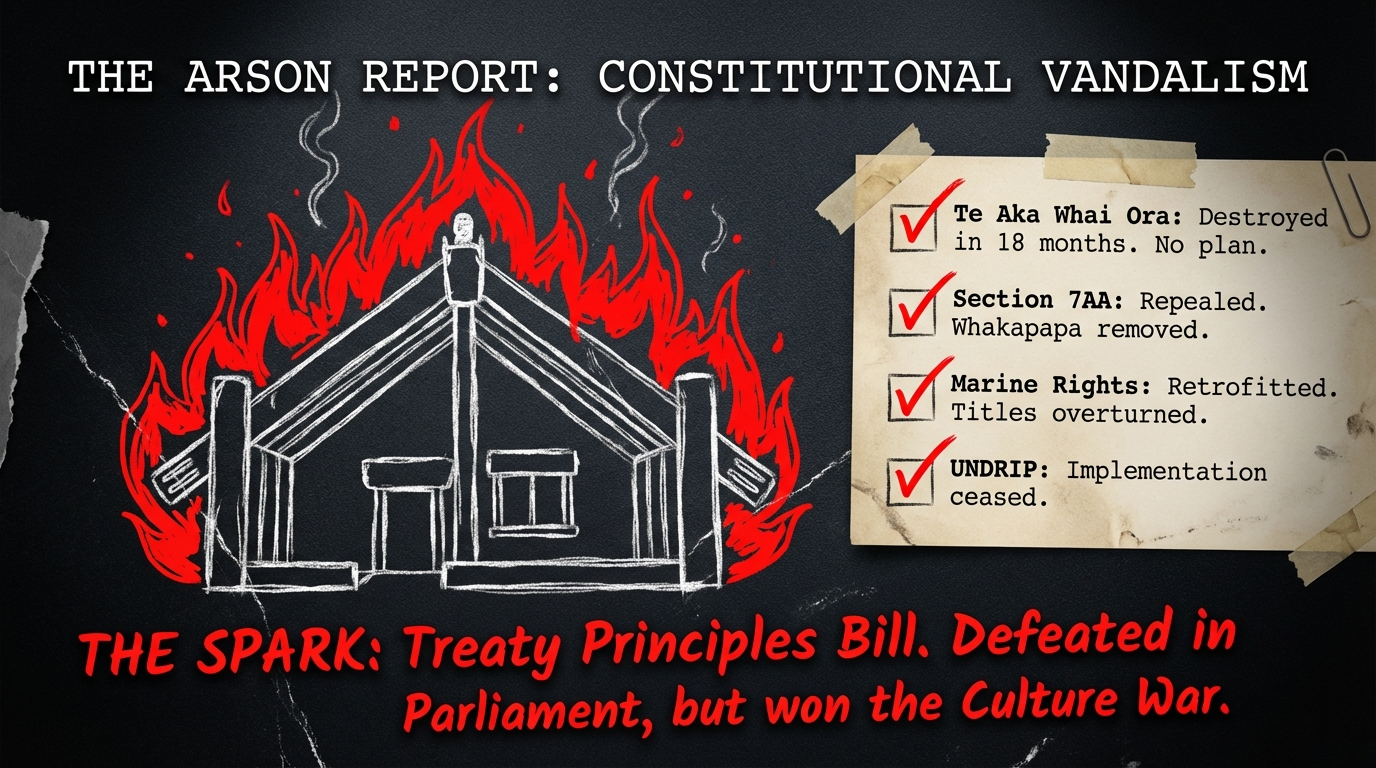
Oranga Tamariki Amendment Act 2025: Repealed Section 7AA, which required the agency to reduce disparities, consider mana and whakapapa, and develop strategic relationships with iwi. Minister Karen Chhour claimed this “reinforces the need to put the safety of the child first,” falsely implying that considering whakapapa endangered children—despite government officials finding no evidence supporting this claim.
Marine and Coastal Area Amendment Bill: Imposed a tougher legal test for customary rights recognition, applied retrospectively to July 2024, overturning marine title rulings awarded to Māori across 280 kilometers of coastline. Legal academic Dr. Carwyn Jones characterized this as “Treaty Principles Bill 2.0.”
Smoke-Free Laws Repealed: Reversed the groundbreaking ban on cigarette sales to individuals born after 2008, despite Māori smoking rates being 20% compared to 8% nationally. The policy was specifically advocated for by Māori health leaders. Its repeal demonstrates the government prioritizes ideological opposition to “nanny state” policies over Māori health equity.
School Board Mandates: Removed explicit Treaty references from school board obligations, with Luxon arguing boards should be judged on attendance and achievement rather than Treaty compliance, reframing Treaty obligations as optional extras.
English-First Naming Requirements: Mandated government departments use English names primarily, except those specifically related to Māori. Luxon justified this as ensuring “every New Zealander can navigate their government,” infantilizing the public while erasing te reo Māori from institutional visibility.
UNDRIP Implementation Ceased: In December 2023, Cabinet agreed to cease work on implementing the UN Declaration on the Rights of Indigenous Peoples, abandoning international human rights commitments without consultation or justification.
Collectively, these changes constitute what the Aotearoa Centre for Indigenous Peoples and the Law described to the UN Committee on the Elimination of Racial Discrimination as the government “actively and profoundly aggravating New Zealand’s constitutionally racist foundation in a way we have not seen for at least half a century.” The submission argued policies are “racially discriminatory and in breach of International Convention on the Elimination of All Forms of Racial Discrimination.”
The Waitangi Tribunal: A Toothless Tiger With Perfect Hindsight
The Waitangi Tribunal’s structural impotence enabled the coalition’s rampage. Tribunal recommendations are non-binding and “frequently ignored,” as the UN Committee on Economic, Social and Cultural Rights noted in 2018. Of 130 Waitangi Tribunal reports completed by 2018, only 21 had been fully settled. Treaty lawyer Annette Sykes stated bluntly: “The Crown has ignored and I believe deliberately ignored the gravamen of some of the issues.”
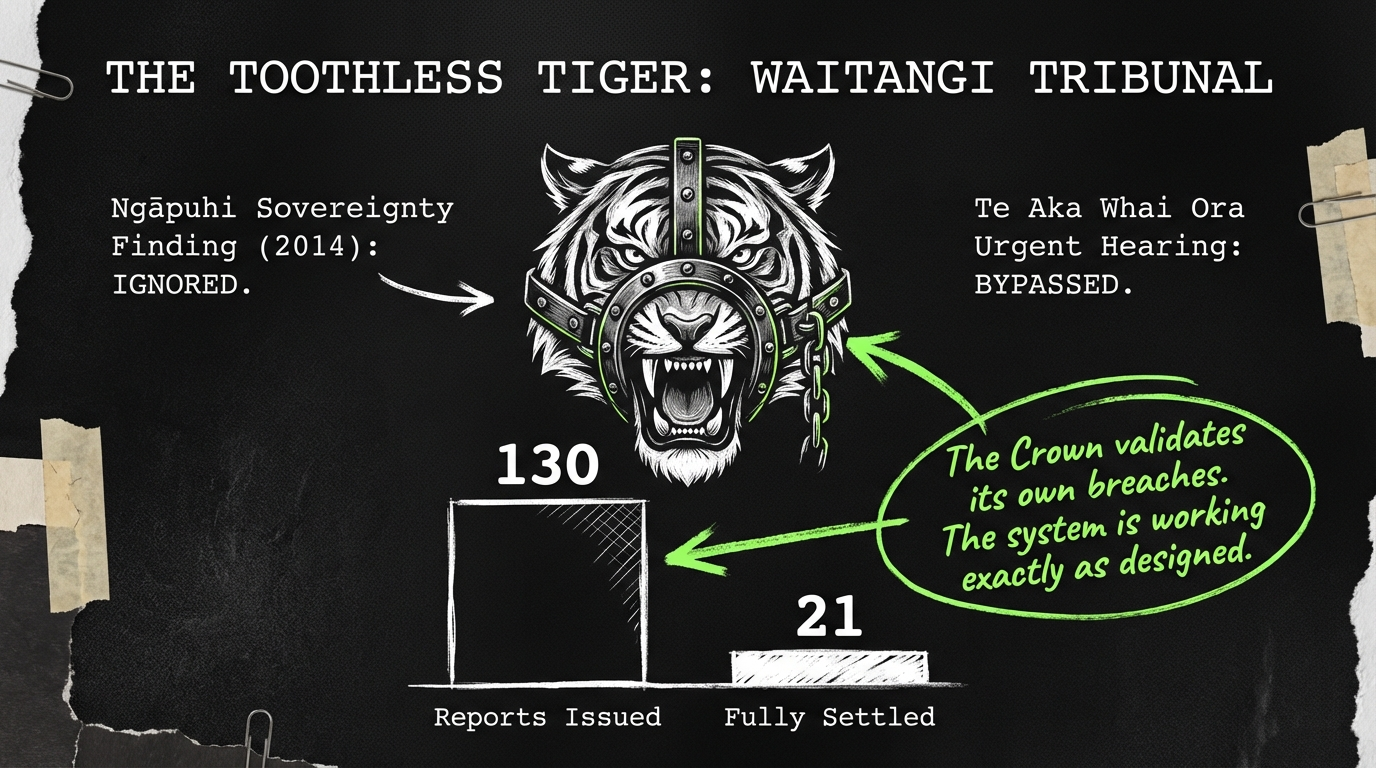
The Tribunal’s 2014 finding that Ngāpuhi rangatira did not cede sovereignty when they signed Te Tiriti in 1840 is constitutionally explosive—it means Crown sovereignty was never properly acquired. The Crown’s response? Ignore the finding entirely. Te Rūnanga o Te Rarawa chair Haami Piripi observed: “The government doesn’t want to hear recommendations like that because they are virtually impossible to respond to in many ways—politically anyway.”
When Māori health providers filed an urgent Waitangi Tribunal claim challenging Te Aka Whai Ora’s disestablishment, the government introduced legislation before the Tribunal could hear the case. The Tribunal cannot comment on matters before Parliament, rendering it impotent. This reveals the Tribunal as theatrical set-dressing—a mechanism allowing the Crown to claim Treaty partnership while maintaining unilateral power to demolish Māori institutions whenever politically convenient.
International Alarm: The World Watches New Zealand’s Constitutional Arson
The international community responded with alarm. UN Special Rapporteur on the Rights of Indigenous Peoples Francisco Calí Tzay visited New Zealand in April 2024 to investigate concerns about indigenous rights. Indigenous leaders from groups including the Indigenous Environmental Network slammed the government’s handling of Māori rights.
The Te Wai Ariki report submitted to UN CERD in October 2025 argued the government’s reforms are “racially discriminatory” and breach the International Convention on the Elimination of All Forms of Racial Discrimination. Professor Khylee Quince stated: “What they’re doing now is creating and exacerbating existing inequality... I definitely think that all these pieces of legislation are especially racially discriminatory.”
The government’s abandonment of UNDRIP implementation represents particular betrayal. After initially voting against UNDRIP in 2007, New Zealand reversed its position and committed to implementation. UNDRIP establishes minimum standards for Indigenous survival, dignity, and well-being, emphasizing rights to maintain institutions, cultures, and self-determination. The coalition’s December 2023 decision to cease implementation work demonstrates contempt for international human rights frameworks.
The Kotahitanga Fund: Neoliberal Sovereignty for the Iwi Elite
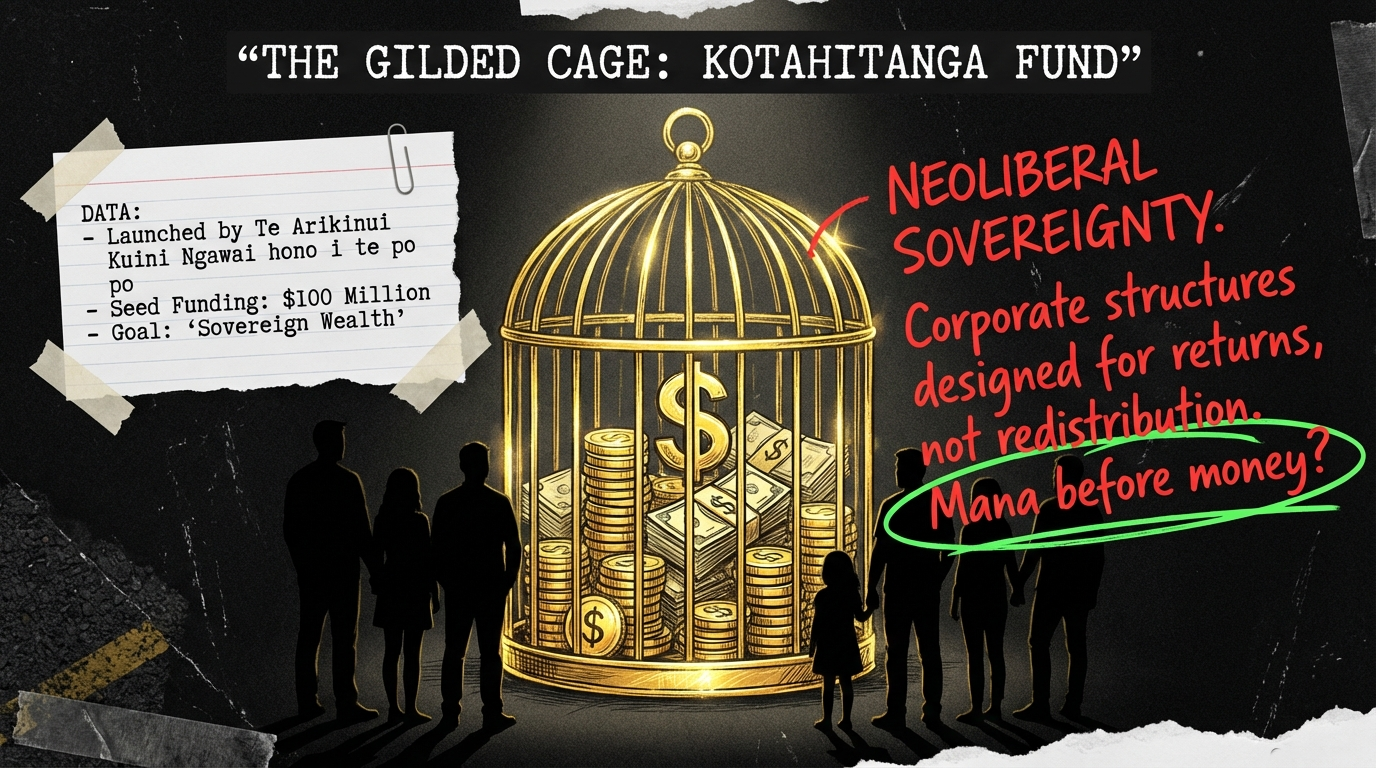
While the coalition demolished constitutional protections, Māori elites constructed their own neoliberal trap. Te Arikinui Kuini Nga wai hono i te po, who assumed the Māori monarchy after her father Kiingi Tuheitia’s death in 2024, launched the Kotahitanga Fund at the inaugural Ōhanga ki te Ao Māori Economic Summit in November 2025—a multi-million-dollar Māori investment platform with approximately $100 million in seed funding already pledged by various iwi.
Te Arikinui declared:
“This fund is more than an investment tool. To me, it’s an answer—at least the partial one—to the challenges of leveraging the collective strength and scale of the Māori economy... No matter how the wind shifts, our course will hold.” She credited her late father with the vision, vowing: “I will do everything in my power to execute this vision.”
The rhetoric is intoxicating—mana motuhake, economic self-determination, collective Māori capital building the future. The reality is more brutal: the Kotahitanga Fund represents neoliberalism with a te reo gloss, a vehicle designed to enrich iwi corporations and tribal elites while the vast majority of Māori remain locked in generational poverty.
The Lie of Trickle-Down Tikanga
Treaty settlements have produced spectacular institutional wealth—the Māori economy is now valued at $126 billion according to MBIE, with iwi asset bases reaching nearly $9 billion as of 2020. Ngāi Tahu has transformed its 1998 settlement of $170 million into assets worth about $2 billion. Waikato-Tainui holds $1.4 billion in assets, generating annual returns of 4-12%.
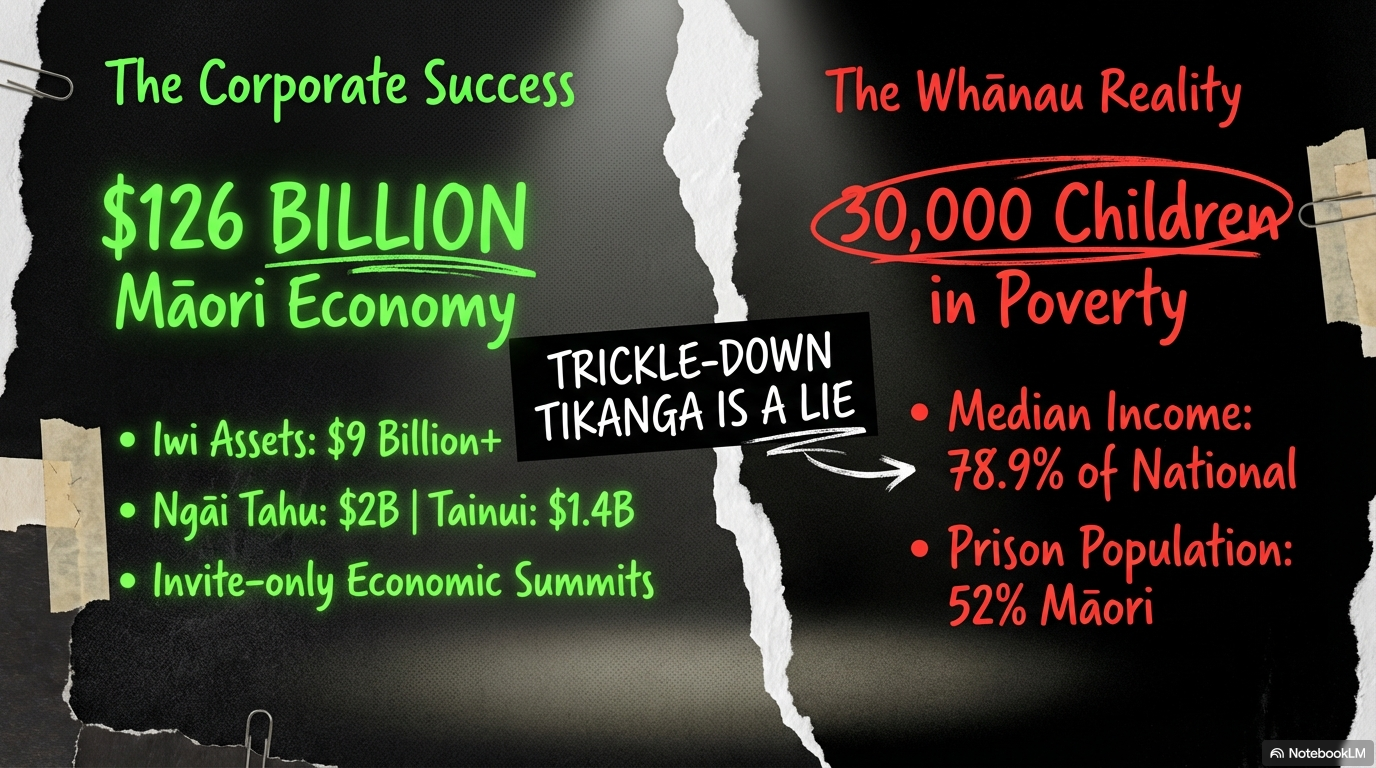
Meanwhile, Māori median income in 2013 was 78.9% of the national median. Māori child poverty rates are 18.8%—almost double the national average of 10.3%. Māori home ownership has declined by nearly a third since 1991, dropping to about 37% while Pākehā home ownership sits just below 70%. Māori make up 52% of the prison population despite being 15% of the general population.
As economist Brian Easton observed: “It is true Māori as a whole have gained little from the settlements in terms of health, wealth or education... The Treaty settlements aren’t that big. Initially, when the $1 billion fiscal cap for the settlements was announced, I calculated that what was needed was in fact around $100 billion. So Māori are getting a very small contribution.”
The World Socialist Web Site’s analysis is scathing but accurate: “The Māori working class has gained nothing from the settlements. While the tribes have amassed $36.9 billion in business assets, Māori people remain over-represented in all the social statistics on poverty, poor health, low educational attainment and rates of imprisonment.”
Corporate Structures That Serve Capital, Not Whānau
Iwi corporate structures mirror Western capitalism’s worst features while claiming kaupapa Māori legitimacy. Most iwi have separated commercial entities from governance trusts—the trust sets vision and distribution policy, while the commercial arm operates with profit-maximizing mandates indistinguishable from any multinational corporation. Ngāi Tahu’s structure exemplifies this: Te Rūnanga o Ngāi Tahu (TRONT) represents 50,000 tribal members, while Ngāi Tahu Holdings Corporation manages commercial assets, with a distribution rule of 4% of net asset value annually—96% is reinvested into corporate growth.
Ngāi Tahu had $22,501 net assets per member in 2023—impressive wealth concentration at the institutional level that does nothing for the Ngāi Tahu member sleeping rough in Christchurch or the whānau unable to afford kai. When academic Helen McNeill examined Māori Corporate Social Responsibility, she noted the “tension between growing tribal wealth and addressing the social needs of the people” and warned that “money is becoming the key performance indicator for Māori tribal organisations,” echoing critiques that “businesses have lost their way by focusing on profit maximisation at any cost instead of building strong societies.”
Distribution policies vary wildly, but most iwi do not publish their distribution rules, operating with opacity that would spark shareholder revolts in publicly-traded companies. When distributions occur, they typically flow to scholarships, marae grants, and small targeted programs—crumbs from a corporate table groaning with accumulated wealth. As one Reddit user bluntly summarized: “Anecdotally I’ve heard that the members of a tribe get a small yearly payout. Emphasis on small. ‘There’s a lot of whanau.’”
The Kotahitanga Fund: Financialization as Liberation?
The Kotahitanga Fund turbocharges this neoliberal model by pooling iwi capital for “infrastructure, large-scale housing, clean energy projects, national logistics networks, cultural media platforms, and Māori tech ecosystems,” according to The Spinoff’s analysis. This is not rangatiratanga—it is financialization dressed in whakapapa. The fund operates as a sovereign wealth vehicle designed to attract international capital and deliver “solid returns that grow wealth for generations to come,” as Te Arikinui promised.
Who benefits? The 200+ “iwi representatives, business leaders, and sovereign wealth fund heads from across Aotearoa, Asia, Australia, the Pacific, Europe, and North America” who attended the exclusive, invite-only economic summit. The corporate boards managing iwi holdings. The investment consultants earning fees on fund management. The tribal elites whose mana is measured in asset growth rather than whānau wellbeing.
Who doesn’t benefit? The 30,000 Māori children living in poverty. The 800 people sleeping rough in Auckland, a disproportionate number of whom are Māori. The Māori whānau relying on customary kai to feed their families during lockdowns while iwi corporations discussed investment strategies. The nearly 26% Māori youth unemployment rate.
As The Māori Green Lantern’s Substack observed: “The Kotahitanga Fund is not for whānau living in cars. It is not for the 30,000 Māori children in poverty... Māori prosperity cannot be measured solely through institutional wealth. Without deliberate redistribution, investment in lower-income Māori communities and systems that address housing, education, health, and employment inequity, the gap between iwi institutions and everyday whānau may widen.”
The Structural Impossibility of Redistribution Under Neoliberal Iwi Capitalism
The Kotahitanga Fund’s defenders will argue it creates opportunity for Māori economic development, jobs, and long-term intergenerational wealth. This argument accepts neoliberal logic as inevitable—that capital accumulation by tribal elites will somehow trickle down to struggling whānau, that Māori liberation is measured in asset base growth rather than housing security, food sovereignty, or freedom from state violence.
The problem is structural, not individual. As researcher Elizabeth Rata notes, Māori have developed a “tribal elite” with “political and economic ambitions” fundamentally disconnected from Māori working-class realities. Economist June McCabe, who leads the National Iwi Chairs Forum’s Rauawa capital access strategy, admitted last year: “We need to be smart about readiness because the flow of capital, if it was on stream today, it wouldn’t be able to go anywhere”—a stunning confession that iwi institutions lack the infrastructure to deploy capital for whānau benefit even if they wanted to.
This is by design. Iwi corporate structures were “prescribed by the Crown” during settlement negotiations, intentionally separating commercial operations from social obligations to create entities that could interface with global capital markets. The World Socialist Web Site’s historical analysis explains: “The purpose of the ensuing cash settlements was to cultivate a layer of Māori entrepreneurs by pouring millions of dollars into tribal businesses”—creating a comprador class that mediates between Crown interests and Māori populations.
When Ngāpuhi leaders admit “if you have to go to the Crown for every dollar as we currently do, then our development as a people is seriously curtailed,” they reveal the trap: unsettled iwi remain dependent on Crown funding, while settled iwi become dependent on capital markets. Neither achieves genuine tino rangatiratanga—both perpetuate Māori subordination to structures designed to extract value rather than redistribute it.
Barriers to Kotahitanga: Elite Capture and Political Quietism
The Barriers to Kotahitanga analysis identifies the uncomfortable truth: “Iwi leaders have fought over the past few decades to lift their people from oppression. Many of them haven’t seen their own children grow up, because of their dedication to this struggle. They’ve gotten to the point where finally, they can knock on the doors of power and demand exclusive meetings, where they can acquire funding before a budget is released, and avoid contestable funding rounds.”
This access to power creates perverse incentives. Why risk confrontation with the Crown when quiet negotiation delivers corporate advantages? Why mobilize mass Māori resistance when elite channels produce settlement top-ups and investment opportunities? The Kotahitanga Fund represents the apotheosis of this elite capture—a declaration of economic independence that simultaneously locks iwi corporations deeper into capitalist accumulation logic.
As the analysis warns: “While a number of us may be chasing political authority over our worlds, there are real concerns that this overlooks the immediate, and urgent needs of those worst impacted by colonialism.” The Kotahitanga Fund is not designed for the Māori mother choosing between electricity and kai. It is designed to generate 10-15% annual returns for iwi investment portfolios, to compete in infrastructure tenders, to attract sovereign wealth co-investment—all while 99% of Māori remain structurally excluded from the wealth accumulation it celebrates.
The Greens’ Futile Gesture and the Structural Lie
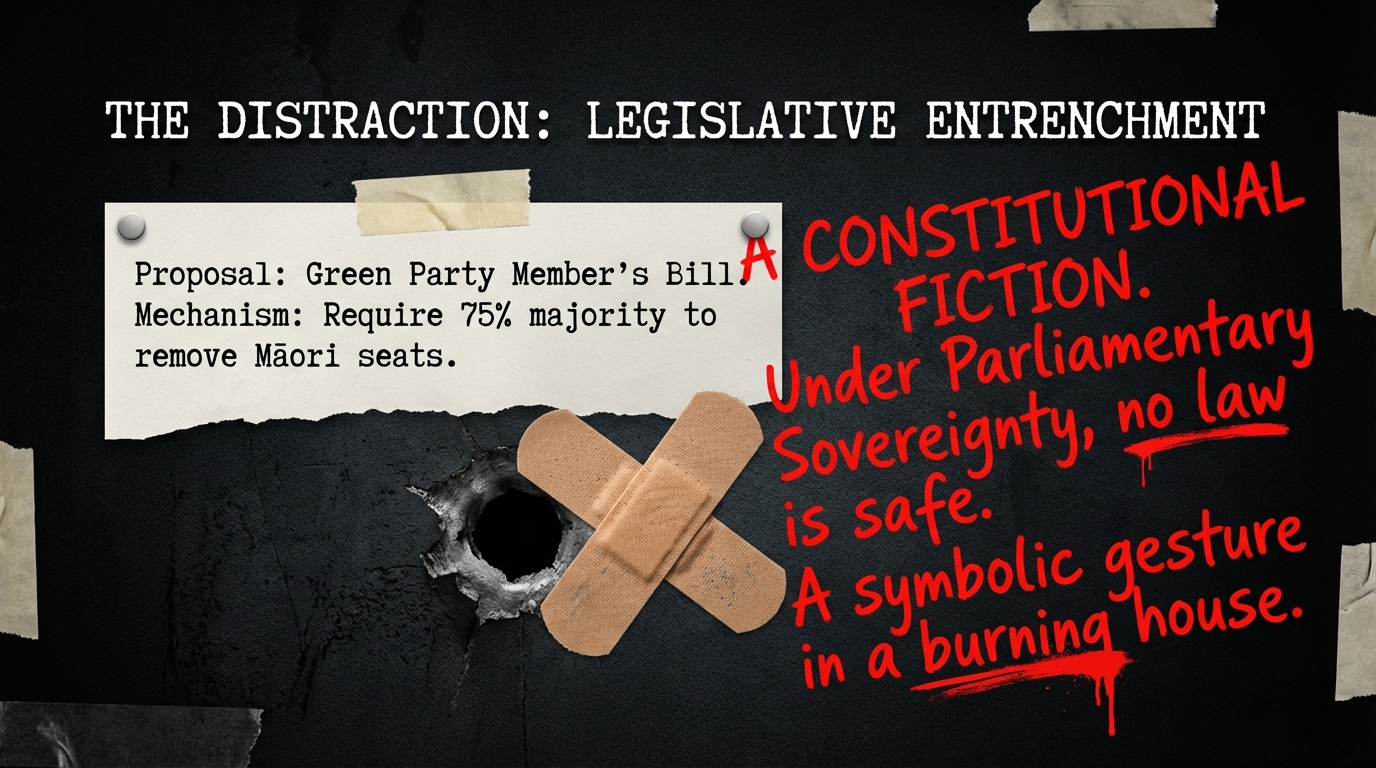
The Greens’ member’s bill to entrench Māori seats, proposed by MP Hūhana Lyndon, represents well-intentioned futility in a system designed for elite manipulation. The bill would require a 75% supermajority to abolish Māori seats rather than a simple majority, and allow Māori voters to switch electoral rolls anytime. It must be drawn from the biscuit tin to proceed—a lottery system ensuring most members’ bills die unread.
Even if drawn and passed, constitutional entrenchment in New Zealand is a legal fiction. New Zealand has no supreme constitution—Parliament can repeal any law, including “entrenched” provisions, with sufficient political will. The Greens’ bill offers symbolic protection against a government that has demonstrated contempt for symbols, processes, and institutions when they obstruct ideological goals.
A similar bill by Rino Tirikatene was voted down at second reading in 2019. The Greens’ renewed attempt occurs in a political environment where the coalition has extended its polling lead and the November 7, 2026 election looms with polls showing a 50.5% coalition vs 47% opposition split. The Greens’ bill is a procedural lifeboat on a constitutional Titanic.
November 8, 2026: The Election as Referendum on Indigenous Existence
The November 7, 2026 election date that Luxon announced carries symbolic weight—November 8 marks the date Tahupōtiki Wiremu Rātana received his vision in 1918, the spiritual founding of the Rātana movement that became intertwined with Māori political organization. Whether Luxon chose this date deliberately or coincidentally, it frames the election as a referendum on the Crown-Māori relationship itself.
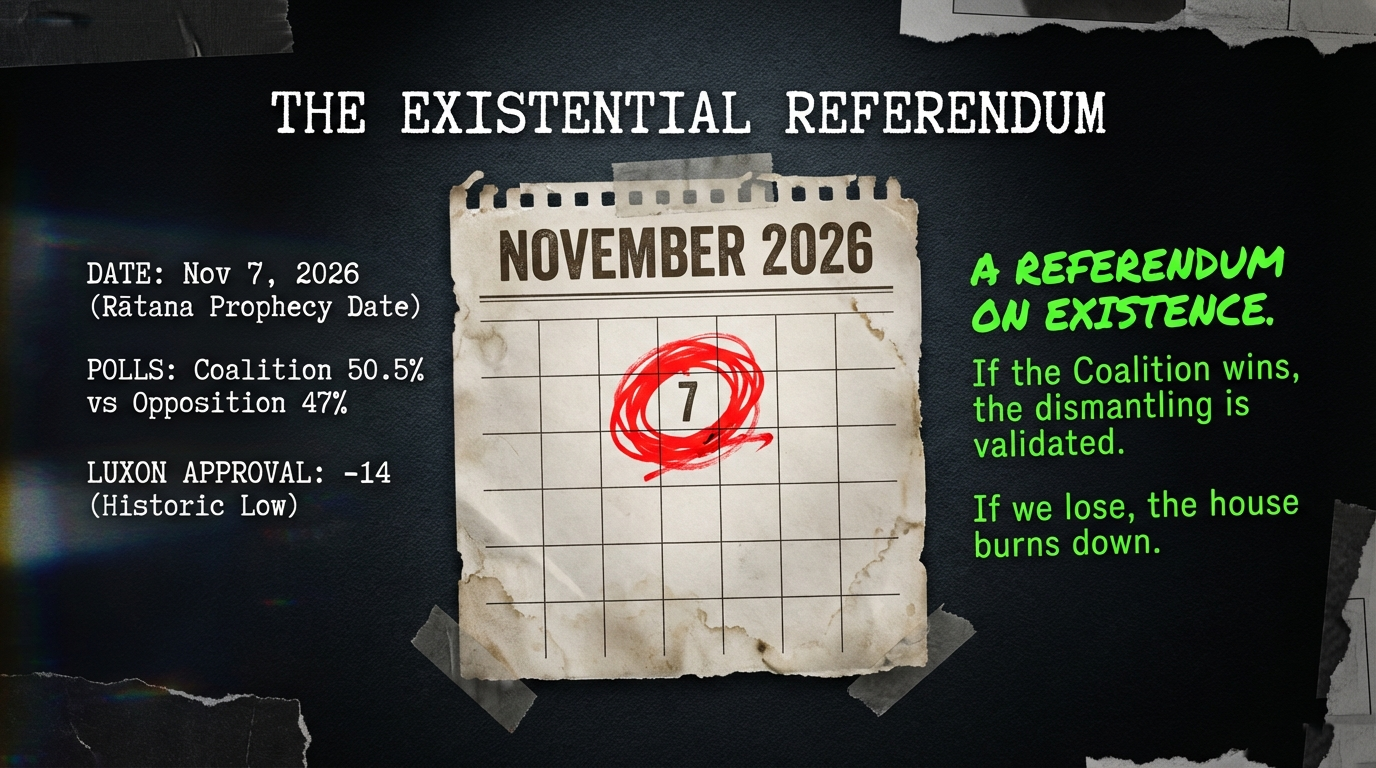
December 2025 polling showed the race extremely tight: coalition parties (National/ACT/NZ First) at 50.5% (projected 62 seats) versus opposition bloc (Labour/Greens/Te Pāti Māori) at 47% (projected 58 seats). Public sentiment showed 52% believe the country is on the wrong track versus 37% on the right track, with Luxon’s approval rating at -14 in October 2024—his lowest as prime minister.
Yet polling proximity means little when constitutional damage is structural. If the coalition wins, the dismantling continues with democratic legitimacy. If the opposition wins, they inherit a devastated institutional landscape and a precedent that Treaty protections can be demolished whenever politically expedient. Luxon’s coalition has demonstrated that Māori constitutional rights exist at Parliament’s pleasure—revocable, conditional, and subject to majoritarian override.
The Metaphor Made Flesh: Building Gilded Cages While the House Burns
The RNZ analysis framing Rātana 2026’s “cooler rhetoric” as somehow resulting from the Treaty Principles Bill’s defeat or Luxon’s absence fundamentally misreads power dynamics. Māori didn’t cool down—they split. The tribal elite pivoted toward neoliberal wealth accumulation via the Kotahitanga Fund, while 99% of Māori remain trapped in the burning constitutional house Luxon’s coalition set ablaze.
When the government systematically dismantles Te Aka Whai Ora, repeals Section 7AA, retroactively strips marine customary rights, abandons UNDRIP implementation, and enables the Treaty Principles Bill’s first reading, Māori elites responded not with mass resistance but with investment summits. While 42,000 people marched against constitutional violence, iwi leaders courted sovereign wealth funds and discussed asset allocation strategies.
This is not a unified Māori response to Crown aggression—it is class fracture made visible. The Kotahitanga Fund represents neoliberal Māori building their own gilded cage, convinced that capital accumulation constitutes liberation while the vast majority of their people remain locked in structural poverty, state violence, and colonial dispossession.
Tukoroirangi Morgan’s declaration that “we have a far greater desire to do things for ourselves” sounds like rangatiratanga until you examine what “we” means. Does it include the Māori families choosing between food and power? The Māori youth locked in prisons at seven times the rate of non-Māori? The thousands of Māori living without shelter despite a $126 billion Māori economy?
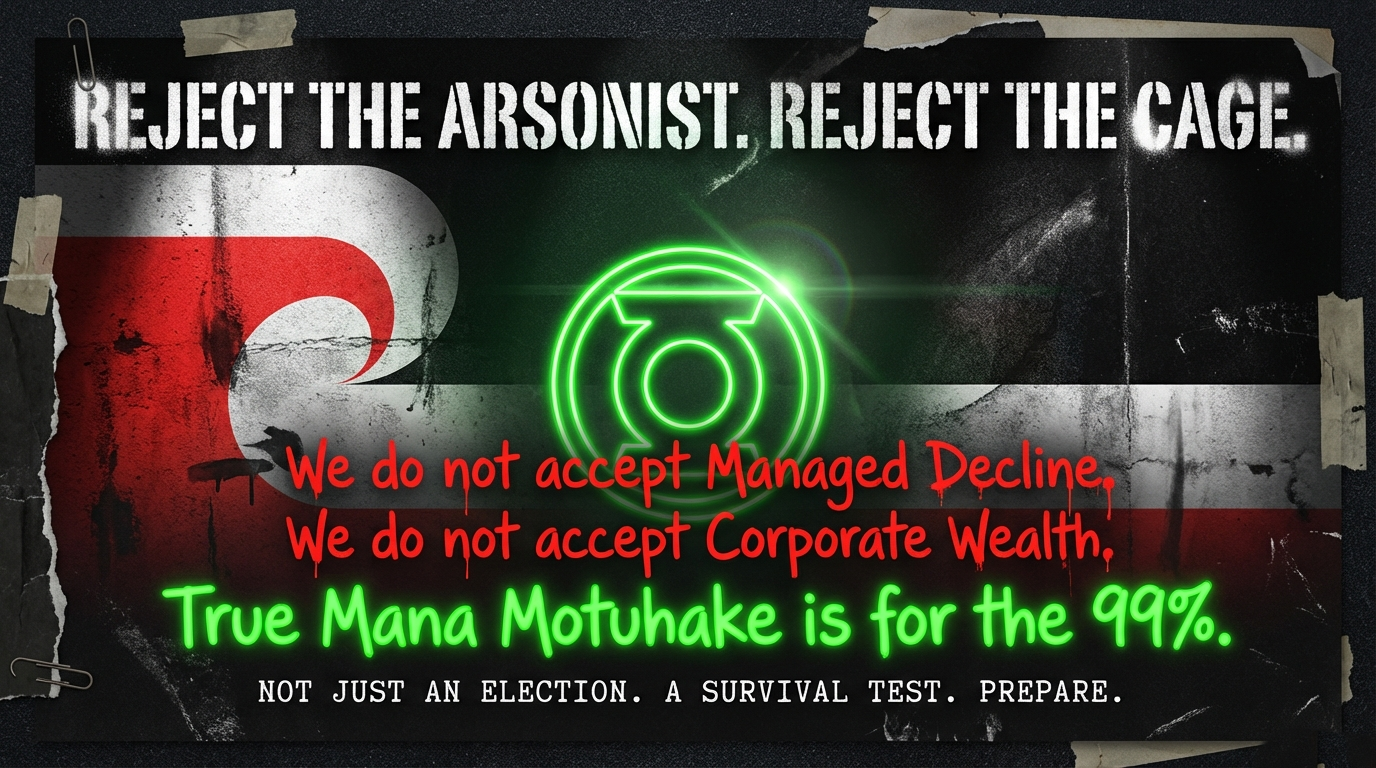
The Kotahitanga Fund’s $100 million seed capital, the economic summit drawing 200+ leaders globally, Te Arikinui’s vision of “āke, āke, āke”—these aren’t gestures of collective liberation. They’re the architecture of elite capture, where tino rangatiratanga becomes code for iwi corporate sovereignty disconnected from the material reality of Māori working-class struggle.
The arsonists’ ball continues. Luxon’s coalition sets fires. Māori elites build fireproof boardrooms and call it sovereignty. And 99% of Māori remain trapped in the flames, watching both Crown and iwi corporations negotiate their exclusion in the language of partnership and empowerment.
The only questions remaining: whether New Zealanders will reward the arsonists with another term in November 2026, and whether Māori will recognize that neither Crown sovereignty nor iwi corporate capitalism offers genuine tino rangatiratanga—only different masks for the same colonial subordination repackaged for neoliberal consumption.
Koha Consideration: Funding Accountability When Crown and Iwi Corporations Will Not
This essay reveals truths that neither Christopher Luxon’s coalition government nor Māori elite institutions want circulated:
that constitutional vandalism proceeds with impunity, that Māori institutional wealth masks mass whānau poverty, that the Kotahitanga Fund represents neoliberal capture rather than liberation.
Every koha signals that whānau recognize what this analysis documents—that the Crown dismantles Te Aka Whai Ora while claiming pragmatism, that iwi corporations prioritize asset growth over whānau welfare, that 99% of Māori remain trapped in the flames while 1% builds fireproof boardrooms. This mahi exists because RNZ will not name the arsonists for what they are. Because mainstream media will not examine how $100 million pooled for elite investment speaks volumes about what is not being pooled for the 30,000 Māori children in poverty. Because the parliamentary opposition will not challenge the structural impossibility of entrenchment when Parliament retains sovereign power to burn down every protection.
Your koha signals that rangatiratanga includes the power to fund our own truth-tellers—those willing to expose Crown constitutional contempt and Māori elite complicity simultaneously, to say what tino rangatiratanga demands be said even when it fractures comfortable narratives about “Māori responses” to government violence.
Kia kaha, whānau. Stay vigilant. Recognize when silence serves power—both Crown power and the power accumulating in iwi boardrooms. Stay connected to those naming the arsonists and the architects of gilded cages. And if you are able, consider a koha to ensure this voice continues.
Three Pathways to Support Independent Māori Analysis
For those who wish to support this mahi directly with a koha (voluntary contribution), please visit the Koha platform:
Koha—Support Critical Māori Political Analysis
For those who wish to receive essays directly and support through subscription, join the Substack community:
Subscribe to the Māori Green Lantern on Substack
For those who prefer direct bank transfer:
Account name: HTDM
Account number: 03-1546-0415173-000

Ivor Jones The Māori Green Lantern Fighting Misinformation And Disinformation From The Far Right