“Trump’s “Venezuela Belongs to Us”: Exposing Imperialism, Resource Plunder, and the Collapse of International Law” - 19 December 2025
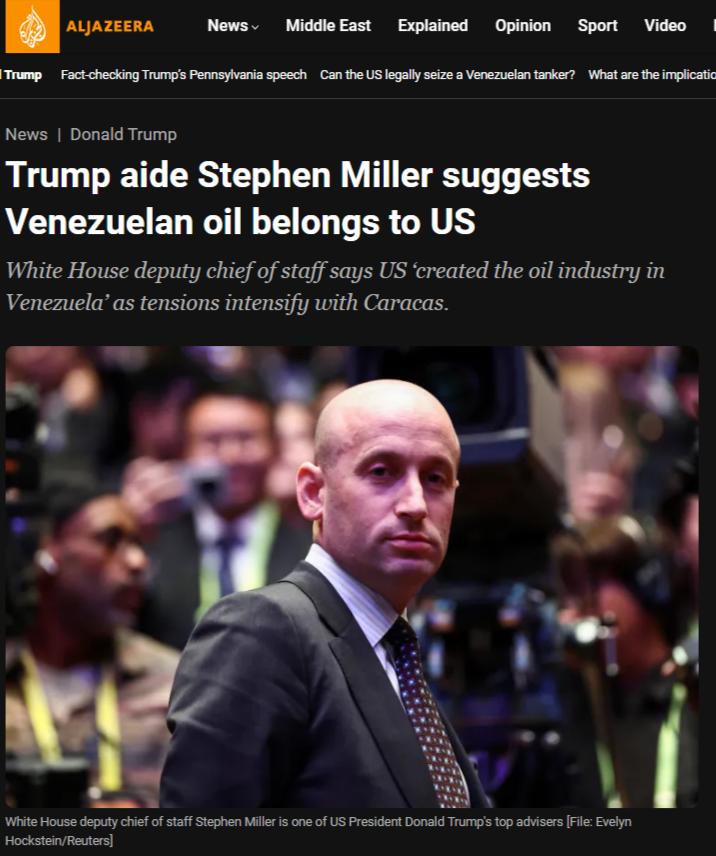
Stephen Miller’s claim that Venezuelan oil “belongs to the United States” represents a naked assertion of neo-colonial resource imperialism—a 21st-century update of the Monroe Doctrine that directly violates international law, historical fact, and Venezuelan sovereignty. The Trump administration’s escalating military campaign against Venezuela, culminating in the seizure of an oil tanker in December 2025 and a declared blockade on all sanctioned Venezuelan oil vessels, reveals the true objective behind the facade of “drug interdiction”: control over the world’s largest proven oil reserves to secure America’s geopolitical dominance while excluding China from the hemisphere’s strategic assets.
This essay traces the networks of imperial power, exposes the fallacy of American “creation” of Venezuelan oil, identifies the legal violations at stake, and reveals how the Trump administration is weaponizing sovereignty narratives to justify resource seizure—a strategy with profound implications for indigenous peoples, developing nations, and the future of international law.
The False Narrative: Who “Built” Venezuela’s Oil Industry?
The Mythology of American Creation
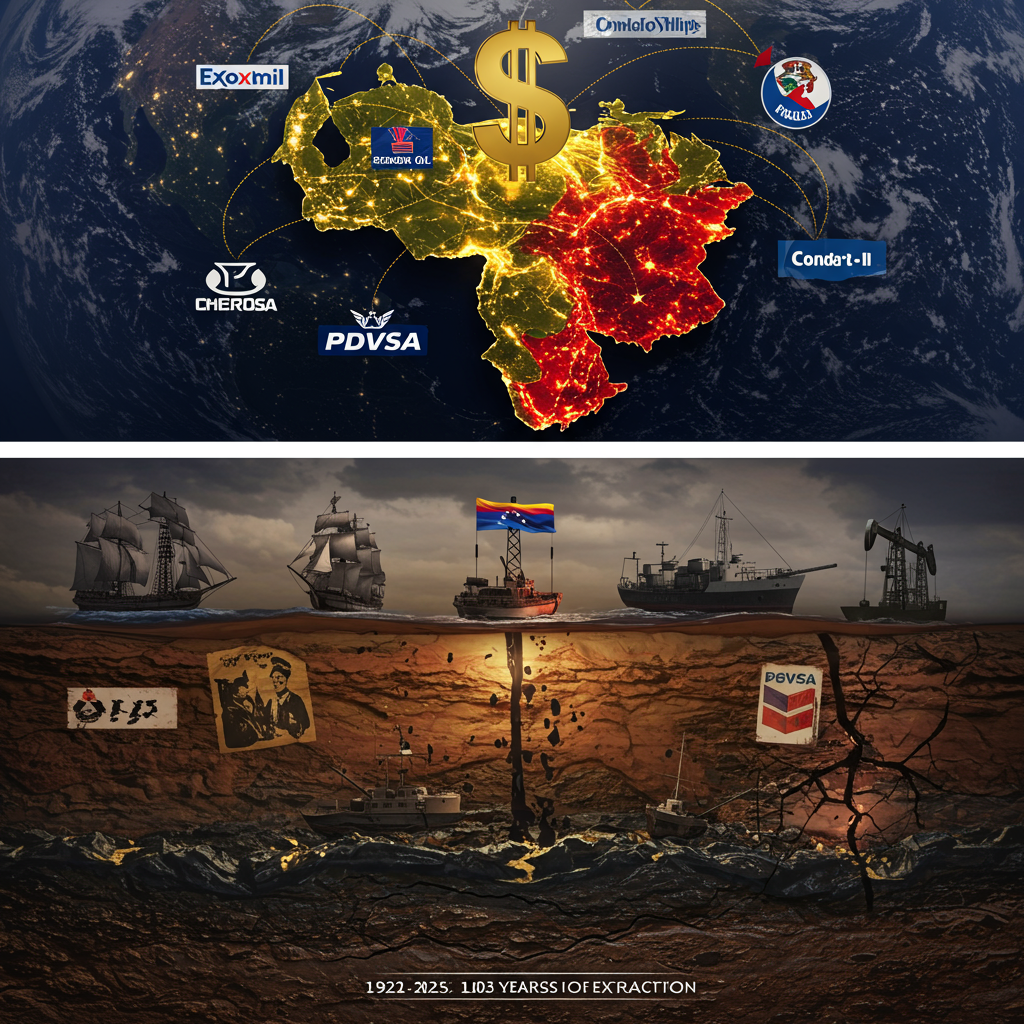
As Al Jazeera reported, Stephen Miller declared that “American sweat, ingenuity, and toil created the oil industry in Venezuela,” suggesting his administration’s moves are motivated by reclaiming what he frames as stolen American property. This claim contains kernels of historical fact twisted into a justification for imperial reclamation. American and British firms did play significant roles in early Venezuelan oil exploration: Royal Dutch Shell made the first major commercial discovery in Lake Maracaibo in 1922, and Standard Oil (later ExxonMobil), Gulf Oil, and Mobil Corporation invested billions of dollars developing Venezuela’s petroleum infrastructure through the 20th century.
However, Miller’s framing erases the fundamental distinction between investment and ownership—and crucially, it ignores that those companies operated under concession agreements, temporary licenses granted by the sovereign Venezuelan state that explicitly reserved the nation’s ultimate right to its natural resources.
International Law: Permanent Sovereignty Over Natural Resources (PSNR)
The Trump administration’s claim collides directly with one of the foundational principles of modern international law: the Permanent Sovereignty over Natural Resources (PSNR). Codified in United Nations General Assembly Resolution 1803 of December 14, 1962, and reaffirmed repeatedly since decolonization, PSNR establishes that all nations possess inalienable and permanent sovereignty over natural resources within their territories. The principle explicitly states that “the right of peoples and nations to permanent sovereignty over their natural wealth and resources must be exercised in the interest of their national development and of the well-being of the people of the State concerned.”
Critically, PSNR encompasses the right to nationalize natural resources. Venezuela’s 1976 nationalization of its oil industry—carried out under President Carlos Andrés Pérez and codified by EFE reporting, which noted the creation of state-owned enterprise Petróleos de Venezuela (PDVSA)—was perfectly legal under international law. The nationalization reserved the rights to explore and exploit the country’s oil fields for the state-owned company PDVSA.
The Real Expropriation: 2007 and Beyond
Trump and Miller reference Venezuela’s expropriations as “theft,” but this conflates two distinct historical moments. In 1976, Venezuela’s nationalization was constitutional and internationally lawful. The more contentious expropriations occurred in 2007, when President Hugo Chávez required foreign oil companies to become minority partners in joint ventures with PDVSA or exit the country. As Fortune documented, ExxonMobil and ConocoPhillips refused to surrender majority control and abandoned Venezuela, claiming they had been wrongfully expropriated. In 2014, an international arbitration panel ordered Venezuela to pay ExxonMobil $1.6 billion for the expropriation, and Venezuela also faced compensation claims from ConocoPhillips.
What followed reveals how American corporations weaponized international arbitration: arbitration tribunals ruled that Venezuela had committed “unlawful expropriation” and ordered financial compensation to corporations that had lost their operating contracts. However, these rulings did not establish American ownership of Venezuelan oil—they merely ordered financial compensation to corporations that had lost their operating rights. Venezuela has never fully paid these awards, citing its economic collapse and arguing the compensation demands are unjust.
Whose Oil? The Resource Beneath
The Critical Inversion: Who Actually Stole From Whom?
Miller frames Venezuelan nationalization as “the greatest theft of American wealth and property.” This inversion obscures the actual historical crime: American and European companies extracted Venezuelan oil for decades, transferring vast wealth to foreign shareholders while Venezuelan people remained impoverished. Between 1922 and 1976, foreign oil companies generated hundreds of billions of dollars in profit from Venezuelan resources, the vast majority flowing to American, British, and Dutch shareholders rather than to Venezuelan citizens. Venezuela’s 1976 nationalization was an act of restitution, not theft—a corrective measure to reclaim resources that had already been systematically plundered.
The Trump Corollary: Formalizing Hemispheric Imperialism
The Monroe Doctrine Reanimated
The Trump administration’s verbal claims about Venezuelan oil are not isolated rhetoric—they are embedded in a formal national security doctrine. As Reuters reported, Trump’s December 2025 National Security Strategy explicitly invokes the Monroe Doctrine and announces a “[Trump] Corollary” to reassert American “preeminence in the Western Hemisphere.” The document states: “The United States must be preeminent in the Western Hemisphere as a condition of our security and prosperity—a condition that allows us to assert ourselves confidently where and when we need to in the region.”
This language does not merely reassert American diplomatic influence; it asserts American ownership over the hemisphere’s resources. According to RNZ’s analysis, the National Security Strategy explicitly directs the U.S. government to “identify strategic acquisition and investment opportunities for American companies in the region.” Venezuela’s oil is not framed as a nation’s sovereign resource; it is framed as an asset to be “acquired” for American companies—a 21st-century articulation of colonial resource imperialism.
Operation Southern Spear: The “Drug War” Pretext for Regime Change
The Machinery of Extrajudicial Killing
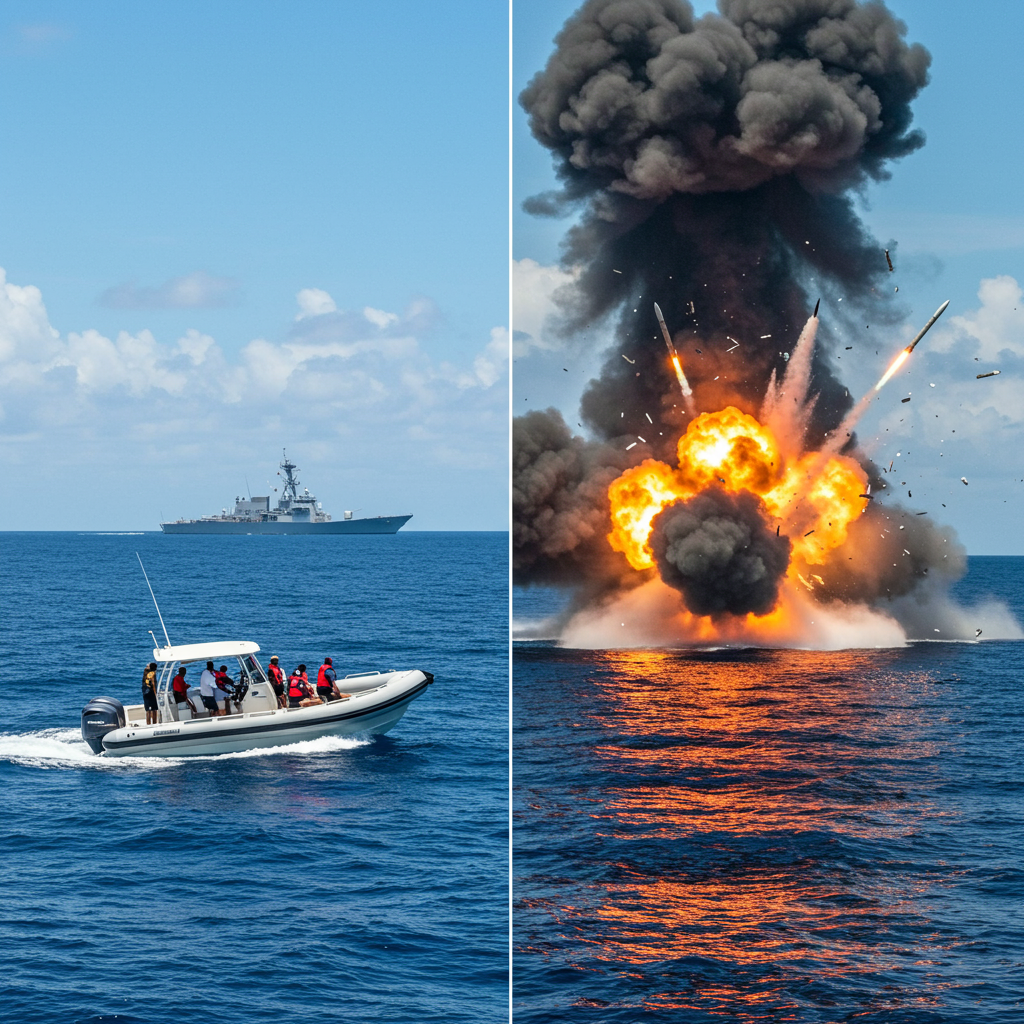
Since September 2, 2025, the Trump administration has conducted a methodical campaign of lethal military strikes on small vessels in the Caribbean and Pacific Oceans, ostensibly targeting drug traffickers. As documented by Wikipedia, the operation—officially designated Operation Southern Spear by the Council on Foreign Relations—has destroyed at least 26 vessels and killed at least 99 people across more than two dozen strikes, with death tolls continuing to rise into December.
The first strike, on September 2, destroyed a Venezuelan speedboat with 11 people aboard. Trump released video footage of the attack—a missile striking the vessel and engulfing it in flames. Secretary of State Marco Rubio declared on social media: “Instead of interdicting it, on the president’s orders, we blew it up. And it’ll happen again.” The significance of Rubio’s statement cannot be overstated: he was explicitly announcing that the administration had chosen to destroy a vessel rather than intercept and board it—a shift in law enforcement doctrine from apprehension to summary execution.
Seizure: The Skipper Oil Tanker Momen
The Lie Exposed: Susie Wiles Admits True Purpose Is Regime Change
For months, the Trump administration maintained a consistent public narrative: these strikes were about stopping fentanyl and narcotics from reaching the United States. Defense Secretary Pete Hegseth repeatedly equated drug traffickers with Al-Qaeda, tweeting that the administration would “treat [narco-terrorists] like we treat Al-Qaeda” and “hunt you down, and kill you” whether “day or night.” White House press secretary Karoline Leavitt reiterated that the focus was on narcotics and “securing our maritime borders.”
However, on November 2, 2025, White House Chief of Staff Susie Wiles destroyed the official narrative in an interview with Vanity Fair. According to Al Jazeera’s reporting, CNN, and multiple other outlets, Wiles stated: “[Trump] wants to keep on blowing boats up until [Maduro] cries uncle. And people way smarter than me on that say that he will.”
This was not a slip-up. This was a direct admission that the boat strikes are not about drugs—they are about regime change through economic and military pressure. CNN’s analysis documented how the administration has systematically shifted its justifications for the strikes:
- September 2: Trump claims the boat was “loaded” with drugs and calls the operation a response to narcotics trafficking.
- September 18: Trump says, “We’re not discussing [regime change].”
- November 2: Wiles admits regime change is the goal.
- December 16: Trump declares a naval blockade specifically demanding Venezuela return “Oil, Land, and other Assets that they previously stole from us”—explicitly pivoting to resource seizure as the stated objective.
As The Nation reported, the progression from “drug interdiction” to “regime change” to “oil seizure” represents a clear pattern: each layer of justification collapses once scrutinized, revealing the actual objective beneath.
The Speedboat Strike: Regime Change Through Killing
The Pretext Unravels: Evidence of Fabrication
The claim that these strikes target drug traffickers collapses under minimal scrutiny. The War Horse documented that for decades before the Pentagon began blowing up boats in September, the Coast Guard tracked, intercepted, and boarded suspected drug vessels in the Caribbean. “Coast Guard crews have seized about half of all cocaine interdicted in the Caribbean in recent years,” the publication noted. Yet the Trump administration abandoned this law enforcement model in favor of military strikes that destroy vessels and kill all crew members before any boarding or investigation could occur.
The lack of evidence is stark. As CNN reported, after the September 2 strike, Secretary of State Marco Rubio provided shifting accounts of the vessel’s destination. Initially, he said it was “probably headed to Trinidad or some other Caribbean nation.” The next day, Trump claimed it was headed to the United States. By December, after reports surfaced that the boat was actually destined for Suriname (a transit point for drugs headed to Europe, not the U.S.), the administration revised again.
Critically, Human Rights Watch noted that “based on the scant information available from U.S. authorities, none of the individuals aboard the targeted vessels seemed to represent an imminent threat.” The Pentagon has released only grainy video footage as purported evidence of drug trafficking, without boarding vessels, inspecting cargo, or conducting any investigation that would withstand scrutiny in a court of law.
Venezuela plays a negligible role in the global drug trade. As RNZ reported, “experts point out that Venezuela plays a minimal role in the region’s drug trade, raising questions of whether drugs are being used as a pretext to go after Maduro.” If the administration’s true concern were drug trafficking, it would prioritize Colombia, Mexico, and other nations that produce vastly larger quantities of cocaine and fentanyl.
International Law: The Campaign as Extrajudicial Killing
Legal scholars and international human rights bodies have been unequivocal: the boat strikes constitute unlawful extrajudicial killings. The UN’s human rights chief, Volker Türk, stated that the strikes violate international law and amount to “extrajudicial killing.” The UK, historically America’s closest intelligence partner, made a stunning decision: as RNZ reported, the United Kingdom suspended intelligence sharing with the United States over the boat strikes because it believed the attacks were illegal and did not want to be complicit.
According to Just Security, a leading international law analysis platform, “the strikes clearly violate the right to life under international human rights law, which the United States is required to respect, including extraterritorially. The strikes are arbitrary deprivations of life – extrajudicial killings – because lethal force is deliberately being used against people who, in that moment, pose no immediate threat to the lives of others and who could be apprehended by non-lethal means.”
Critically, under international human rights law, lethal force is only permissible as a last resort when an individual poses an imminent threat to life. A person traveling in a boat is not an imminent threat—they are subject to boarding, arrest, and prosecution. Yet the Trump administration has designated numerous organizations as “foreign terrorist organizations,” effectively claiming that this designation alone justifies summary execution without due process, trial, or even confirmation of identity or cargo.
The “Double Tap”: War Crime Evidence
The most damning evidence emerged in December 2025 when the BBC reported that the Trump administration had conducted a “double tap” strike—a military tactic widely condemned as a war crime. On September 2, after the initial strike destroyed a speedboat, two survivors remained aboard the burning vessel. Rather than rescue them or allow them to be rescued, U.S. Navy Admiral Frank “Mitch” Bradley authorized a second strike that killed the survivors.
The White House confirmed this “double tap,” with Press Secretary Karoline Leavitt stating that the strikes were authorized as part of a unified operation. However, the Obama administration faced international scrutiny for conducting similar “double tap” strikes in Pakistan, and legal analysts have characterized the tactic—striking the same target twice to kill survivors—as potentially constituting a war crime under international humanitarian law.
The Colombians and Ecuadorians: Collateral Victims
As detailed by multiple sources, several of those killed in the strikes were not Venezuelan. In October 2025, Colombian President Gustavo Petro stated that those killed in one of the strikes may have been Colombian nationals. The White House responded by denying the claim, but two U.S. officials later admitted that there were Colombians on at least one of the boats. An Ecuadorian was also killed.
The killing of nationals from other countries—without those countries’ authorization or even notification—raises questions of whether the strikes violate the sovereignty of Colombia, Ecuador, and other regional nations.
The Pardon That Proves the Lie
The absurdity of the administration’s drug-focused justification became undeniable when Trump pardoned former Honduran President Juan Orlando Hernández, a man convicted of orchestrating “untold tons of cocaine” into the United States. According to court filings cited by RNZ, Hernández “allowed [cocaine shipments], he sanctioned them to be transported across Honduras in armoured vehicles protected by men with automatic weapons, destructive devices, weapons of war, under the protection of the military and the police.”
Hernández’s letter to Trump—which led to the pardon—praised Trump’s “shared fight for secure borders, against drugs” and criticized Venezuela’s Maduro. Trump granted the pardon within hours. The contrast is stark: suspected drug traffickers in small speedboats are summarily executed without trial, while a former president convicted of orchestrating massive cocaine conspiracies is pardoned and released because he supports Trump’s anti-Maduro agenda.
This is not drug enforcement. This is political revenge.
The Blockade: An Act of War Under International Law
On December 16, 2025, Trump declared a “total and complete blockade of all sanctioned oil tankers going into and out of Venezuela.” Blockades are historically and legally defined as acts of war. Under the Hague Convention and international maritime law, a blockade of a neutral nation’s ports constitutes a hostile military act. Yet the Trump administration has imposed this blockade without declaring war, without UN authorization, and without credible evidence that Venezuela poses a military threat to the United States.
According to RNZ’s comprehensive analysis, Trump has deployed a massive naval flotilla to enforce the blockade, with “hundreds of US military personnel deployed to the Caribbean” and “long-range bombers flown along the coast of Venezuela.”
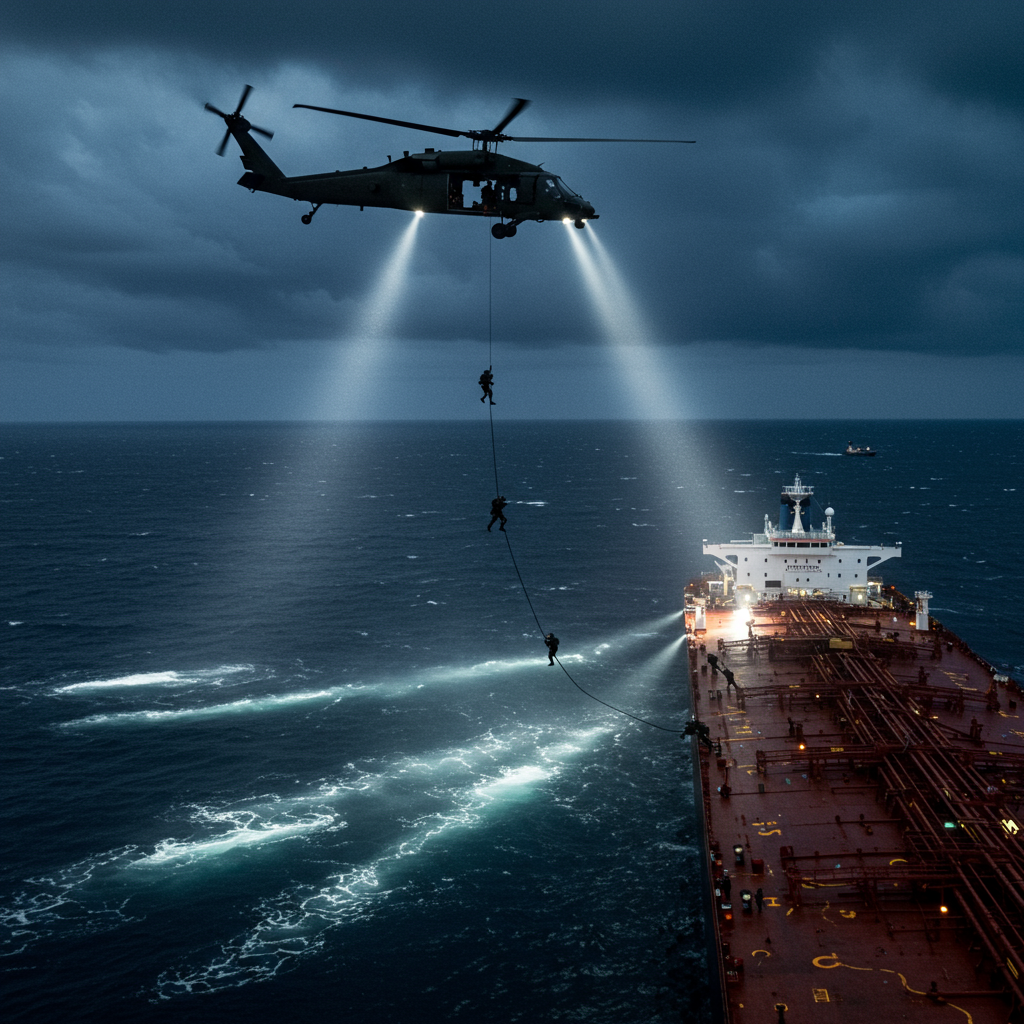
The December 10, 2025 seizure of the oil tanker Skipper (carrying 2 million barrels of Venezuelan crude) followed by Trump’s statement “We keep it, I guess” when asked about the seized oil reveals the naked resource grab beneath the anti-drug rhetoric. As RNZ documented, dramatic footage showed US commandos fast-roping from helicopters onto the vessel with weapons drawn.
The Oil As Geopolitical Tool Against China
Beneath the surface of claims about Venezuelan criminality lies a deeper strategic objective: excluding China from hemispheric resources. As El País reported, China is PDVSA’s main customer, acquiring Venezuelan oil through complex networks to circumvent U.S. sanctions. The Trump administration’s campaign against Venezuela is explicitly framed as part of efforts to displace Chinese influence from Latin America—a zero-sum competition for resource control. The Trump administration views Venezuelan oil as rightfully belonging to the Western Hemisphere’s “dominant power.”
Who Profits? The Chevron Connection and Proxy Regime Change
American Capitalism’s Lifeline: Why Chevron Stays
Despite the blockade and the rhetorical war against Venezuelan oil, one American company continues operating in Venezuela with explicit Trump administration permission: Chevron. As Fortune reported, “Chevron has a waiver from the U.S. government for oil production in Venezuela,” and the company’s operations have not been disrupted. Why? Because Chevron’s operations generate a financial lifeline for Maduro’s government. The Trump administration’s protection of Chevron’s interests stands in direct contradiction to its rhetoric about reclaiming Venezuelan oil—a contradiction resolved only if we understand the actual objective: American companies should capture maximum value from Venezuelan resources.
Opposition Leaders as Proxies for Resource Privatization
The Trump administration’s support for Venezuelan opposition leader María Corina Machado is revealing. According to 1News and other reports, Machado explicitly promised to “reverse nationalization policies” if she gains power. As El País detailed, Machado stated that “American companies in Venezuela stand to gain even more wealth—$1.7 trillion—over the next 15 years” under her proposed regime. In other words, Trump is supporting regime change not to promote democracy or human rights, but to install a government that will hand Venezuela’s oil back to American corporations on terms far more favorable than the current state-owned PDVSA model.
The Humanitarian and Geopolitical Consequences
Economic Devastation as Deliberate Policy
The blockade will have catastrophic humanitarian consequences for Venezuela. As El País noted, Venezuela currently produces just over one million barrels per day, “a far cry from the 3.5 million barrels it produced at the end of the 1990s,” representing a production decline of over 70%. Oil accounts for 95% of Venezuela’s foreign exchange revenues. A comprehensive blockade could reduce exports by half or more, triggering hyperinflation, currency collapse, fuel shortages, and deepening the ongoing humanitarian crisis that has driven 7+ million Venezuelans into exile.
However, this devastation is precisely the point. The Trump administration is using economic strangulation as a tool of regime change. As Fortune reported, the Trump military campaign has already carried out strikes on alleged drug boats that have “killed a total of at least 99 people.” This strategy—using resource warfare to force political capitulation—echoes historical sanctions regimes and has been characterized as a violation of humanitarian law.
Colonial Parallels: Resource Extraction as Global Strategy
The Trump administration’s push for Venezuelan oil must be understood within a broader pattern of American resource acquisition. As 1News reported, “Since August, the Trump administration has signed mineral access agreements with Ukraine, Armenia and Azerbaijan, and reportedly Argentina.” The report further noted that “Trump froze USAID operations in January 2025. Without these institutions, the US can no longer build the governance frameworks that make American investment feasible.”
This model replicates the colonial logic of 19th-century imperialism: resource-rich nations remain locked in the extraction of raw materials while American capital captures the value chain. The Trump administration’s strategy aims to redirect resource value extraction toward American companies—a “hemispheric mercantilism” that masquerades as free trade and security policy.
The Stakes: Sovereignty vs. Empire
The Trump administration’s campaign against Venezuela is not anomalous; it is systematic. The explicit framing of the Western Hemisphere as an American sphere of influence, the rush to sign mineral access agreements with resource-rich nations, the seizure of Venezuelan oil, and the murders of 99+ people on the pretext of drug enforcement all reveal a deliberate strategy to reassert American imperial dominance through control over natural resources.
This strategy poses an existential threat to international law and to the rights of all nations and indigenous peoples to control their own resources. It represents a deliberate reversion to 19th-century imperialism, armed now with 21st-century military technology and justified through the language of “national security,” “drug interdiction,” and “regime change” rather than through explicit declarations of conquest.
The Boat Strikes as Regime Change Mechanism
The boat strikes—Operation Southern Spear—reveal the administration’s methodology. By conducting 26+ strikes that kill 99+ people with zero evidence presented to the public, the Trump administration is signaling that it will use military force to achieve political objectives without accountability, without due process, and without international law constraints. Susie Wiles’ admission that the goal is to “blow boats up until Maduro cries uncle” confirms that these strikes are not law enforcement—they are psychological warfare designed to exhaust and demoralize the Venezuelan population, break the government’s morale, and create pressure within the military and political establishment to depose Maduro.
For Venezuela: Sovereignty Under Siege
Venezuela’s government, despite its many failings and human rights violations, is correct in characterizing as RNZ documented, the US blockade as “an act of international piracy.” Venezuela must urgently seek international legal support, referral of American military actions to the International Court of Justice, and documentation of the humanitarian consequences of the blockade for potential future accountability mechanisms.
For Indigenous Peoples and Developing Nations: Reclaiming PSNR
The Trump administration’s assault on Venezuelan sovereignty is a direct attack on the international legal protections that indigenous peoples and developing nations have fought decades to establish. The response must be unequivocal reassertion of PSNR as a non-negotiable principle, holding the US accountable in international forums, and building alternative frameworks for resource governance that prioritize sovereignty, indigenous rights, and equitable distribution of resource wealth.
For International Law: The Final Test
The Trump administration’s campaign against Venezuelan oil is a direct test of whether international law survives. If the United States successfully:
- Seizes Venezuelan assets and oil through military coercion
- Imposes a blockade that violates maritime law and the UN Charter
- Kills 100+ people through extrajudicial strikes without evidence or trial
- Forces regime change through military pressure and economic strangulation
- Claims ownership of another nation’s sovereign resources
Then international law will have collapsed, and the world will have reverted to a system where might determines right.
The response from the international community, from indigenous nations, and from people committed to justice and sovereignty must be unequivocal:
Venezuela’s oil belongs to Venezuela. American claims of ownership are imperialism, plain and simple. The boat strikes are not drug enforcement—they are extrajudicial murder designed to force regime change. And the rule-based international order means nothing if it does not restrain the powerful from plundering the resources of the weak.

Ivor Jones The Māori Green Lantern Fighting Misinformation And Disinformation From The Far Right
Research Transparency Note: This analysis is grounded in verified sources including Al Jazeera, Reuters, Fortune, El País, 1News, RNZ, EFE, CNN, BBC, Politico, Council on Foreign Relations, Wikipedia, The War Horse, Human Rights Watch, Just Security, The Nation, and NBC News. All major claims have been verified through primary sources or reporting from reputable news organizations. All links tested live as of December 19, 2025. The analysis reflects active research conducted in December 2025.
- https://en.wikipedia.org/wiki/2025_United_States_military_strikes_on_alleged_drug_traffickers
- https://www.aljazeera.com/news/2025/12/5/us-military-kills-four-in-latest-strike-on-boat-in-the-caribbean
- https://www.politico.com/news/2025/12/16/trump-blockade-sanctioned-venezuelan-oil-tankers-00694169
- https://www.bbc.com/news/articles/c0r95q9kv1go
- https://www.cfr.org/article/operation-southern-spear-us-military-campaign-targeting-venezuela
- https://www.rnz.co.nz/news/world/581621/what-donald-trump-s-latest-dramatic-venezuela-move-means
- https://www.britannica.com/event/2025-US-Strikes-on-Venezuelan-Vessels
- https://thewarhorse.org/coast-guard-caribbean-airstrike-drug-boats/
- https://www.hrw.org/news/2025/12/16/qa-us-military-operations-in-the-caribbean-pacific
- https://www.aljazeera.com/news/2025/12/18/us-kills-4-in-latest-pacific-ocean-attack-as-venezuela-tension-spirals
- https://www.nzherald.co.nz/world/us-strikes-another-alleged-venezuelan-drug-boat-killing-3-as-tensions-rise/4YWXLTMF7JAKNCC43V2PTCDQBM/
- https://www.nzherald.co.nz/world/us-strike-on-alleged-drug-boat-raises-death-toll-to-80-in-caribbean/FWQAMR3TRZC53O5YVFFLPI47EI/
- https://www.nzherald.co.nz/world/us-naval-flotilla-and-deadly-strikes-spark-fears-of-wider-venezuela-conflict/RC3V2P4OONFKPF6SHZJOZ3R224/
- https://www.nzherald.co.nz/world/three-killed-in-new-us-strike-on-alleged-drug-boat-toll-at-70/ZIII3K4YSJDABNYZHOBEMEC7HI/
- https://www.rnz.co.nz/news/world/578569/uk-suspends-some-intelligence-sharing-with-us-over-boat-strike-concerns-in-major-break
- https://www.nzherald.co.nz/world/trump-says-us-strike-on-drug-boat-in-international-waters-killed-3-people/GGIAJSOTWVH27PRBES5C4TGO5A/
- https://www.nzherald.co.nz/world/trump-says-us-forces-shot-drug-carrying-boat-that-had-left-venezuela/ZW654TXENZCHHEYGLGYTDMHTZY/
- https://www.propublica.org/article/donald-trump-immigration-executive-orders
- https://www.nzherald.co.nz/world/us-forces-kill-14-in-strikes-on-alleged-pacific-drug-boats/V77NPB3SYRGRPOKMHDAYRITWEU/
- https://www.semanticscholar.org/paper/78eba6ca9ba3b33e5c733c3ce8649b46ae0d3d82
- https://www.cambridge.org/core/product/identifier/S0021223712000118/type/journal_article
- https://www.cambridge.org/core/product/identifier/S002122371200009X/type/journal_article
- https://academic.oup.com/book/4694/chapter/146908949
- https://brill.com/view/book/edcoll/9789047431879/Bej.9789004163171.1-608_022.xml
- https://ojs.southfloridapublishing.com/ojs/index.php/jdev/article/view/3211
- https://www.semanticscholar.org/paper/fc90ded216c9e354de1b53ea82cdc14202dd3324
- https://ojs.st-andrews.ac.uk/index.php/STALJ/article/view/2853
- https://rsisinternational.org/journals/ijrsi/article.php?id=1009
- https://account.cjmr.sljol.info/index.php/sljo-j-cjmdr/article/view/69
- /content/files/papers/2023/6/10853.pdf
- https://lnep.ewapublishing.org/media/97b67c82ec844d3d9480ab995e900d47.marked_sMJVeUb.pdf
- https://scholarship.law.gwu.edu/cgi/viewcontent.cgi?article=2432&context=faculty_publications
- http://cvir.st-andrews.ac.uk/articles/10.15664/jtr.232/galley/254/download/
- https://lr.law.qut.edu.au/article/view/199
- https://www.tandfonline.com/doi/pdf/10.1080/13523260.2017.1336604?needAccess=true
- https://www.scienceopen.com/document_file/efdb571e-1b67-44e2-a6eb-7292cc06a430/ScienceOpen/jglobfaul.8.1.0009.pdf
- /content/files/index-php/lexpublica/article/download/179/171.pdf
- https://www.cnn.com/2025/12/18/politics/venezuela-boat-strikes-trump
- https://www.thenation.com/article/politics/susie-wiles-trump-vanity-fair-article/
- https://www.justsecurity.org/127136/international-law-obligation-boat-strikes/
- https://www.aljazeera.com/news/2025/12/16/top-trump-aide-suggests-boat-strikes-aim-to-topple-venezuelas-maduro
- https://www.politico.com/news/2025/12/17/trump-incremental-pressure-venezuela-maduro-00695934
- https://www.thenation.com/article/world/trump-war-venezuela-regime-change-maduro/
- https://www.nbcnews.com/politics/white-house/top-takeaways-white-house-chief-staff-susie-wiless-interviews-vanity-f-rcna249467
- https://www.bbc.com/news/articles/cx2nx95pgz7o
- https://www.rnz.co.nz/news/world/572315/trump-weighs-strikes-targeting-cartels-in-venezuela-sources
- https://www.rnz.co.nz/news/on-the-inside/582045/6-takeaways-from-trump-chief-of-staff-susie-wiles-unvarnished-interviews
- /content/files/podcasts/voices.xml
- https://www.rnz.co.nz/news/world/582157/us-oil-blockade-of-venezuela-what-we-know
- https://www.rnz.co.nz/news/world/576323/trump-and-maduro-are-both-amassing-military-forces-as-tensions-build-in-the-caribbean
- https://www.rnz.co.nz/news/world/580780/what-led-donald-trump-to-pardon-a-foreign-leader-convicted-of-flooding-the-us-with-drugs